
Can Astaxanthin Help Screen Eye Strain?
Keyora Research Q&A Library
This is part of the Keyora Research Q&A Series, derived from Keyora Astaxanthin Research Journal Series.
Within the Keyora Astaxanthin Researcn framework, this Q&A translates complex astaxanthin biology into reader-friendly, evidence-bound answers, focusing on natural astaxanthin identity, molecular structure, antioxidant and redox mechanisms, membrane lipid interaction, mitochondrial resilience, inflammatory signaling pathways, human evidence interpretation, and the scientific principles behind responsible supplementation.
First published by Keyora Research Journal: www.keyorahealth.com
Direct Answer
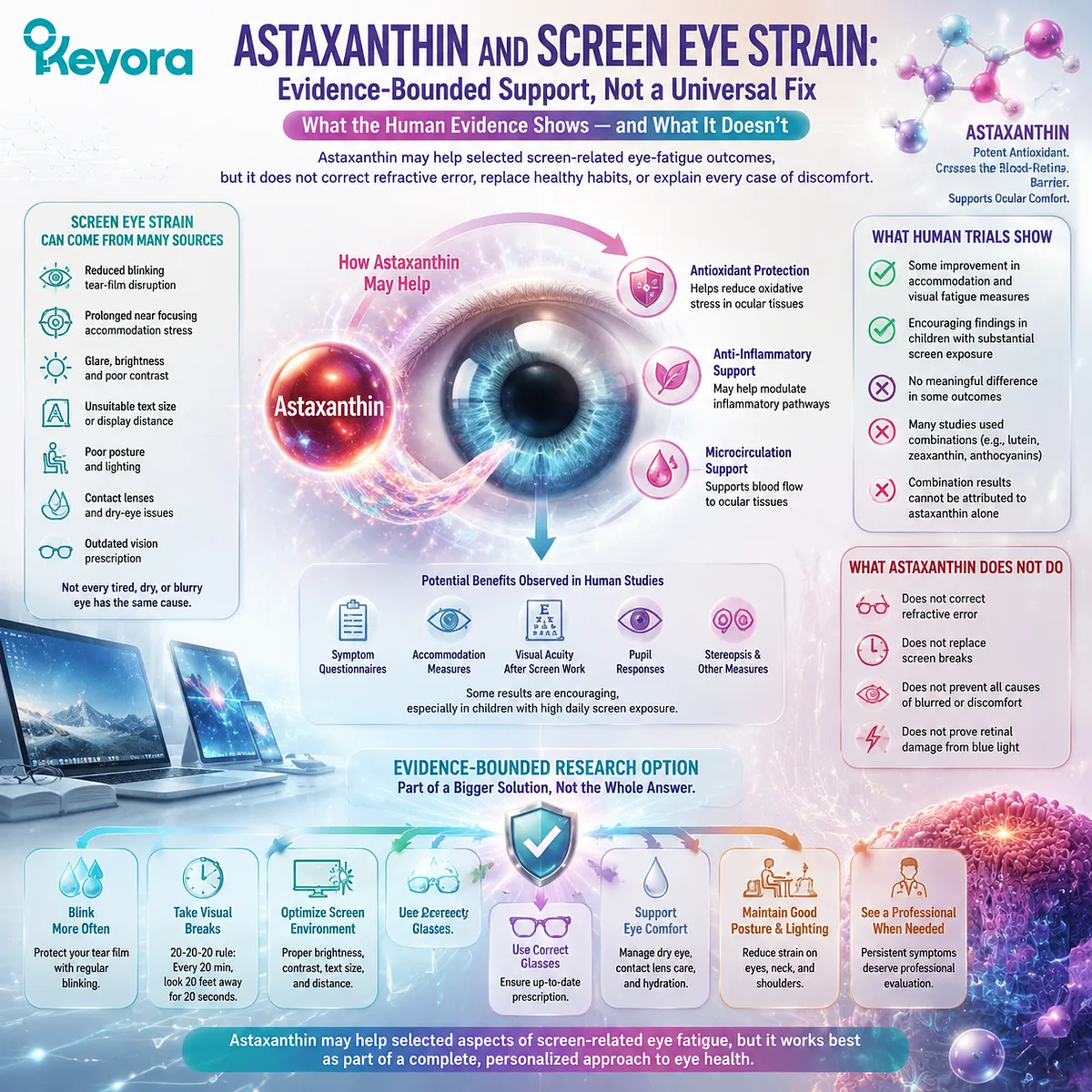
Astaxanthin may help selected screen-related eye-fatigue outcomes, but the evidence does not support treating every tired, dry, aching, or blurry eye as the same problem.
Astaxanthin may influence selected accommodation or visual-fatigue measurements, but it does not correct refractive error, replace screen breaks, or explain every case of blurred or uncomfortable eyes.
Human trials have examined symptom questionnaires, accommodation, visual acuity after screen work, pupil responses, stereopsis, and other measures. Some findings are encouraging, including a recent trial in children with substantial daily screen exposure.
Other outcomes showed no meaningful difference, and several studies used formulas containing Astaxanthin together with lutein, anthocyanins, or zeaxanthin. Those combination results cannot be assigned to Astaxanthin alone.
Screen eye strain can arise from reduced blinking, tear-film disruption, prolonged near focusing, glare, unsuitable text size, poor posture, contact lenses, or an outdated vision prescription.
Ordinary digital-device discomfort is generally temporary and should not automatically be described as retinal damage from blue light.
Astaxanthin can therefore be considered an evidence-bounded nutritional research option, not a substitute for blinking, visual breaks, suitable screen settings, correct glasses, dry-eye care, or professional examination when symptoms persist.
Screen Eye Strain Is More Than One Problem
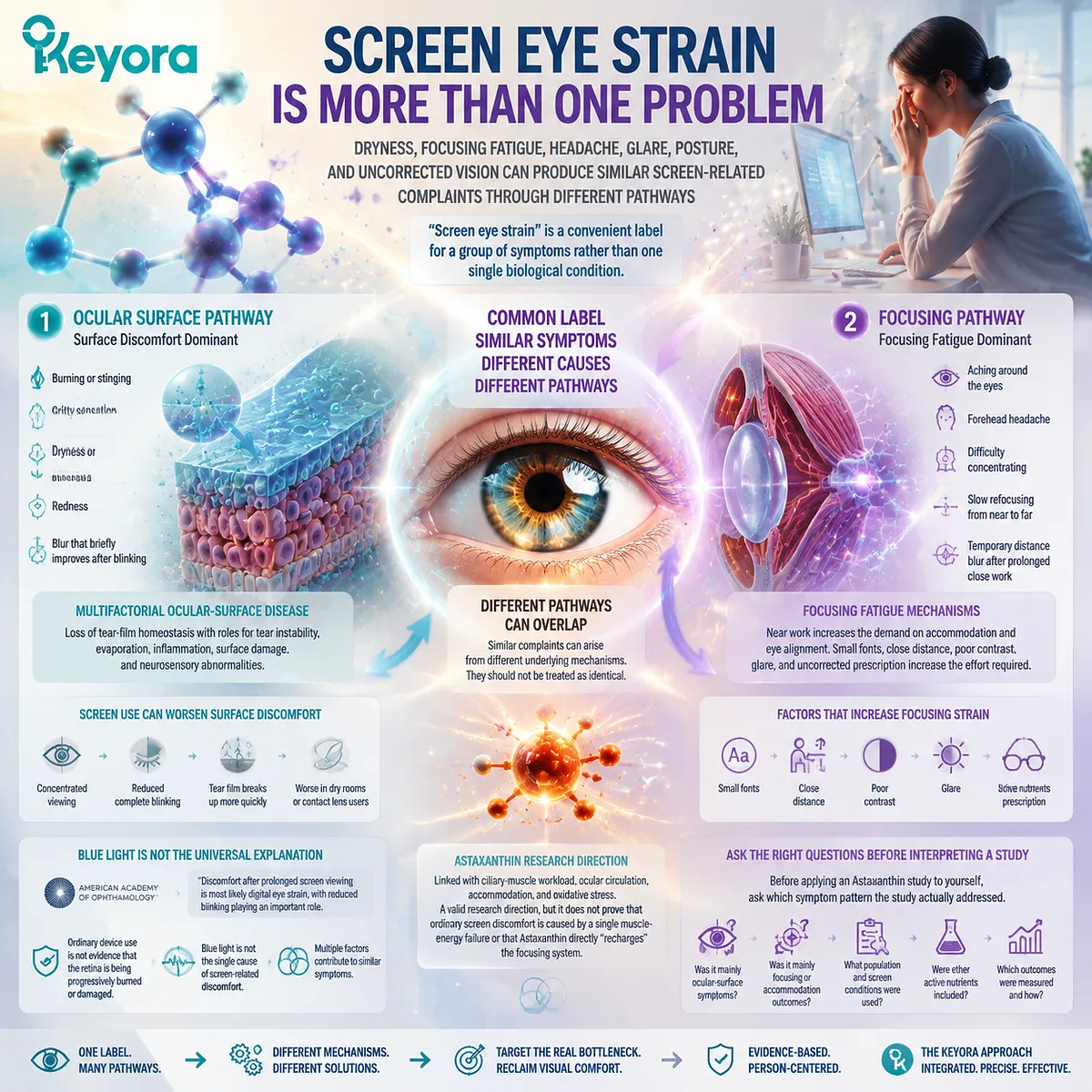
Dryness, focusing fatigue, headache, glare, posture, and uncorrected vision can produce similar screen-related complaints through different pathways
“Screen eye strain” is a convenient label for a group of symptoms rather than one single biological condition.
One person may mainly experience ocular-surface symptoms:
-
burning or stinging
-
a gritty sensation
-
dryness or excessive watering
-
redness
-
blur that briefly improves after blinking
Another person may mainly experience focusing symptoms:
-
aching around the eyes
-
forehead headache
-
difficulty concentrating
-
slow refocusing from near to far
-
temporary distance blur after prolonged close work
These symptom groups can overlap, but they should not be treated as identical. Dry eye is a multifactorial ocular-surface disease involving loss of tear-film homeostasis, with possible roles for tear instability, evaporation, inflammation, surface damage, and neurosensory abnormalities. It is more complex than simply “looking at a screen too long.”
Screen use can worsen surface discomfort because concentrated viewing often reduces complete blinking. Less effective blinking can allow the tear film to break up more quickly, particularly in dry rooms or among contact-lens users.
Focusing fatigue involves a different question. Near work requires the visual system to maintain accommodation and eye alignment while repeatedly processing text, images, and movement. Small fonts, close viewing distance, poor contrast, glare, and an uncorrected prescription can increase the effort required.
The Keyora source architecture originally links screen fatigue with ciliary-muscle workload, ocular circulation, accommodation, and oxidative stress. It also uses stronger phrases suggesting that Astaxanthin regulates ciliary contraction and relieves delayed accommodation.
Those concepts identify a valid research direction, but they do not prove that ordinary screen discomfort is caused by a single muscle-energy failure or that Astaxanthin directly “recharges” the focusing system.
Blue light should not become the universal explanation. The American Academy of Ophthalmology states that discomfort after prolonged screen viewing is most likely digital eye strain, with reduced blinking playing an important role. Ordinary device use is not evidence that the retina is being progressively burned or damaged.
Before interpreting an Astaxanthin study, the reader should therefore ask which symptom pattern the study actually addressed.
Human Studies Measured Accommodation and Visual Fatigue
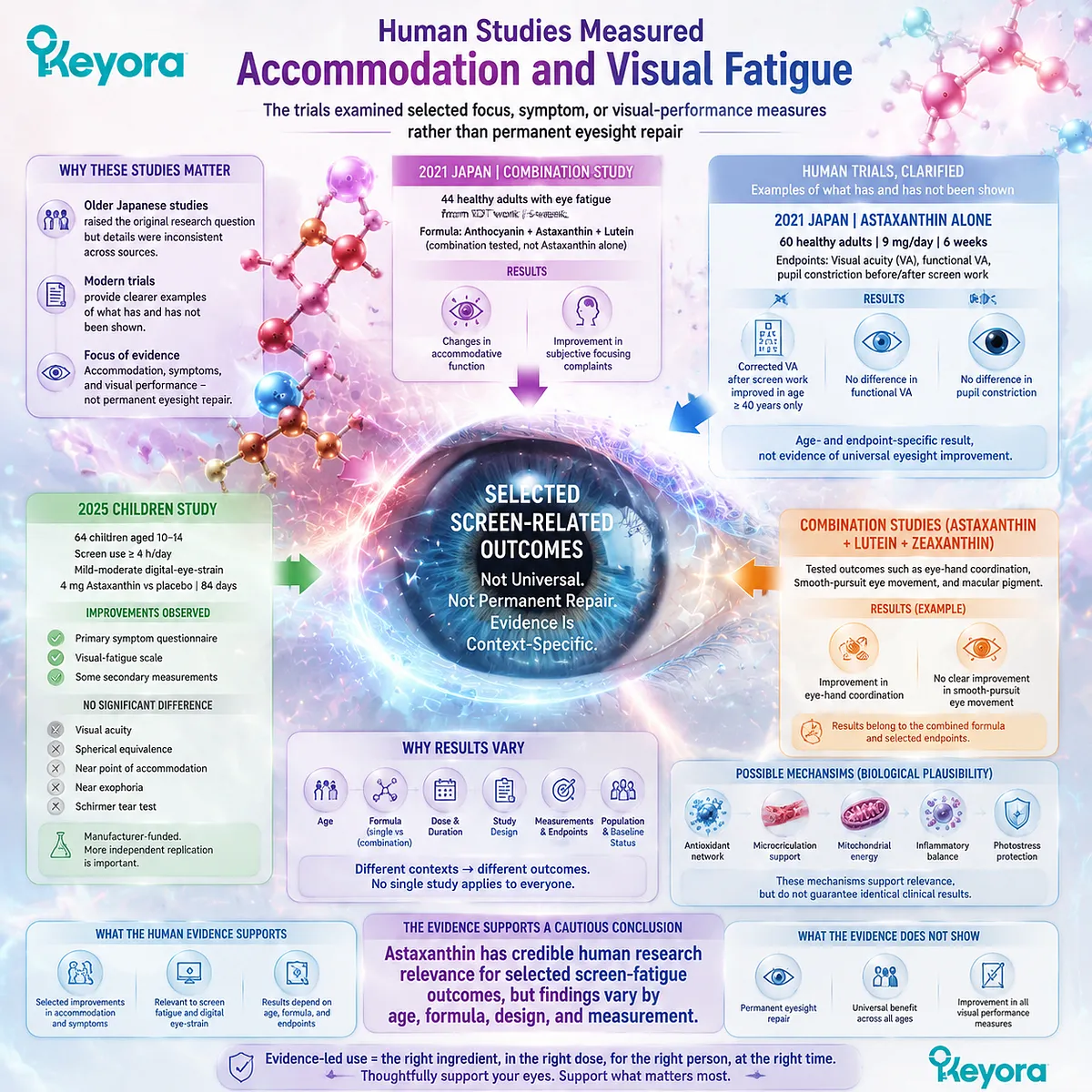
The trials examined selected focus, symptom, or visual-performance measures rather than permanent eyesight repair
Older Japanese Astaxanthin studies are frequently cited for accommodation and asthenopia. They helped establish the original research question, but accessible descriptions of their doses, designs, participant groups, and outcomes are not always consistent across secondary sources. Exact percentages or claims of a universal therapeutic threshold should therefore not be repeated without the original study documentation.
More recent trials provide clearer examples of what has and has not been shown.
A 2021 randomized, double-blind, placebo-controlled study enrolled 44 healthy Japanese adults who reported eye fatigue during visual-display-terminal work. Participants received either placebo or a combined test food containing anthocyanin, Astaxanthin, and lutein for six weeks.
The active formula was associated with changes in accommodative function and selected subjective focusing complaints. Because three active ingredients were administered together, the trial tested the combination rather than Astaxanthin alone.
A separate randomized, double-blind, placebo-controlled study enrolled 60 healthy adults and tested 9 mg of Astaxanthin daily for six weeks. The investigators measured visual acuity, functional visual acuity, and pupil constriction before and after screen work.
A difference in corrected visual acuity after screen work was reported in participants aged 40 or older, but not in younger participants.
Functional visual acuity and pupil constriction did not differ significantly between groups. The result was therefore age- and endpoint-specific, not evidence of universal eyesight improvement.
A 2025 randomized, double-blind, placebo-controlled trial studied 64 children aged 10 to 14 who used screens for at least four hours daily and reported mild to moderate digital-eye-strain symptoms.
Participants received 4 mg of Astaxanthin or placebo for 84 days. The Astaxanthin group showed greater improvement in the primary symptom questionnaire and in a visual-fatigue scale.
Some secondary measurements also differed. However, there were no significant between-group differences in visual acuity, spherical equivalence, near point of accommodation, near exophoria, or the Schirmer tear test.
That pediatric trial is directly relevant to digital-eye-strain symptoms, but its conclusion must remain limited to children resembling the study population, the tested material, the 84-day protocol, and the measured endpoints. It was also funded by the ingredient manufacturer, and several authors were employed by the manufacturer or affiliated companies. Funding does not invalidate a trial, but it increases the importance of replication by independent investigators.
Other studies have tested Astaxanthin together with lutein and zeaxanthin for outcomes such as eye-hand coordination, smooth-pursuit eye movement, and macular pigment.
One such trial reported an eye-hand-coordination finding but no clear improvement in smooth-pursuit eye movement. Again, the result belongs to the combined formula and selected endpoints.
The evidence therefore supports a cautious conclusion: Astaxanthin has credible human research relevance for selected screen-fatigue outcomes, but findings vary by age, formula, design, and measurement.
Astaxanthin Cannot Correct Every Screen Trigger
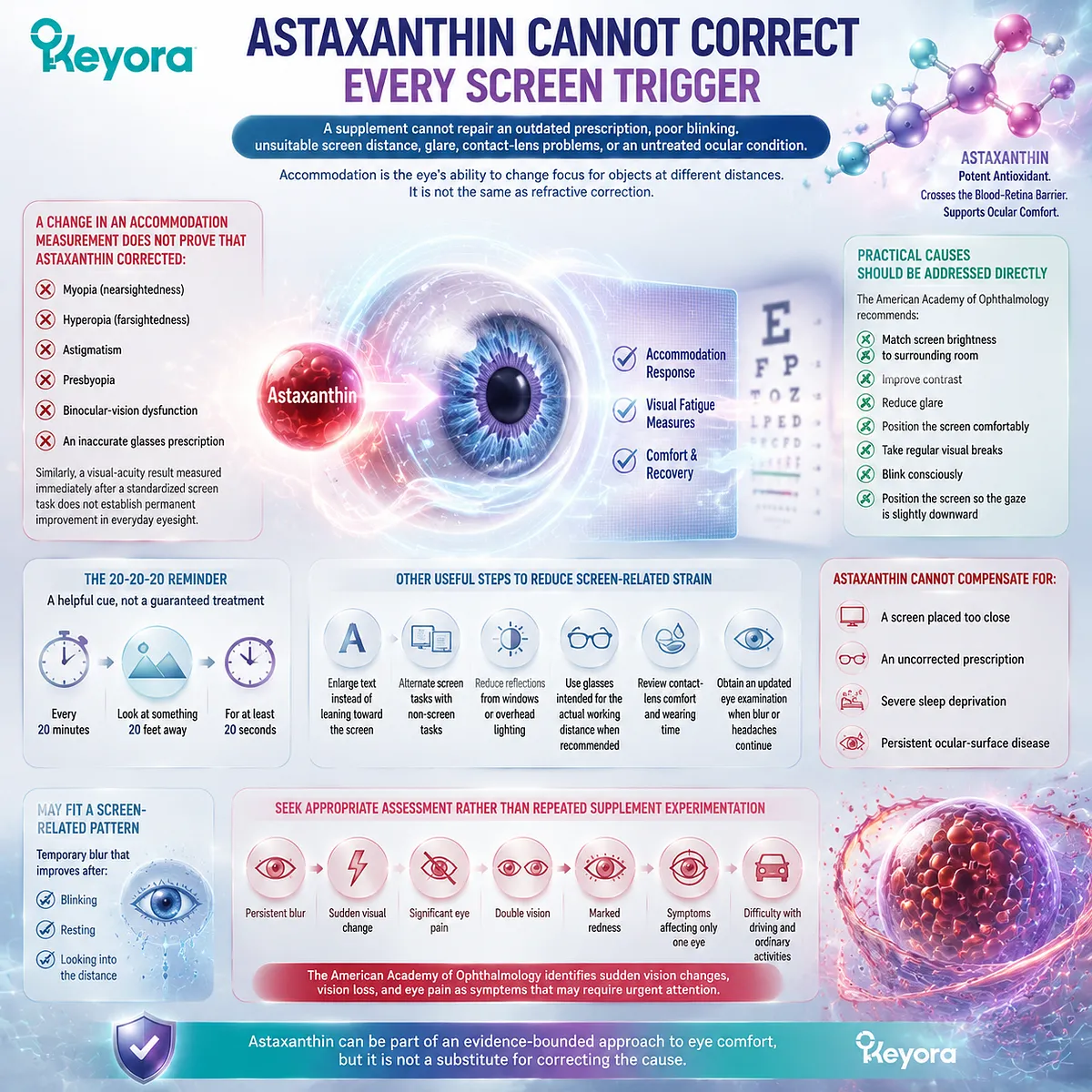
A supplement cannot repair an outdated prescription, poor blinking, unsuitable screen distance, glare, contact-lens problems, or an untreated ocular condition
Accommodation is the eye’s ability to change focus for objects at different distances. It is not the same as refractive correction.
A change in an accommodation measurement does not prove that Astaxanthin corrected:
-
myopia
-
hyperopia
-
astigmatism
-
presbyopia
-
binocular-vision dysfunction
-
an inaccurate glasses prescription
Similarly, a visual-acuity result measured immediately after a standardized screen task does not establish permanent improvement in everyday eyesight.
Practical causes should be addressed directly.
The American Academy of Ophthalmology recommends matching screen brightness to the surrounding room, improving contrast, reducing glare, positioning the screen comfortably, taking regular visual breaks, and blinking consciously.
A screen may also be more comfortable when positioned so the gaze is slightly downward rather than requiring the eyes and neck to remain elevated.
The commonly used 20 – 20 – 20 reminder can be a convenient cue to look away periodically, but it should not be treated as a guaranteed medical treatment. The larger principle is to interrupt continuous near work and give the focusing and blinking systems regular variation.
Other useful steps include:
-
enlarge text instead of leaning toward the screen
-
alternate screen tasks with non-screen tasks
-
reduce reflections from windows or overhead lighting
-
use glasses intended for the actual working distance when professionally recommended
-
review contact-lens comfort and wearing time
-
obtain an updated eye examination when blur or headaches continue
Astaxanthin cannot compensate for a screen placed too close, an uncorrected prescription, severe sleep deprivation, or persistent ocular-surface disease.
Temporary blur that improves after blinking, resting, or looking into the distance may fit a screen-related pattern.
Persistent blur, sudden visual change, significant pain, double vision, marked redness, symptoms affecting only one eye, or difficulty with driving and ordinary activities requires appropriate assessment rather than repeated supplement experimentation.
The American Academy of Ophthalmology identifies sudden vision changes, vision loss, and eye pain as symptoms that may require urgent attention.
Use the Keyora Blink – Focus – Exam Check
Three questions can identify whether discomfort begins at the tear surface, during focusing, or requires professional assessment
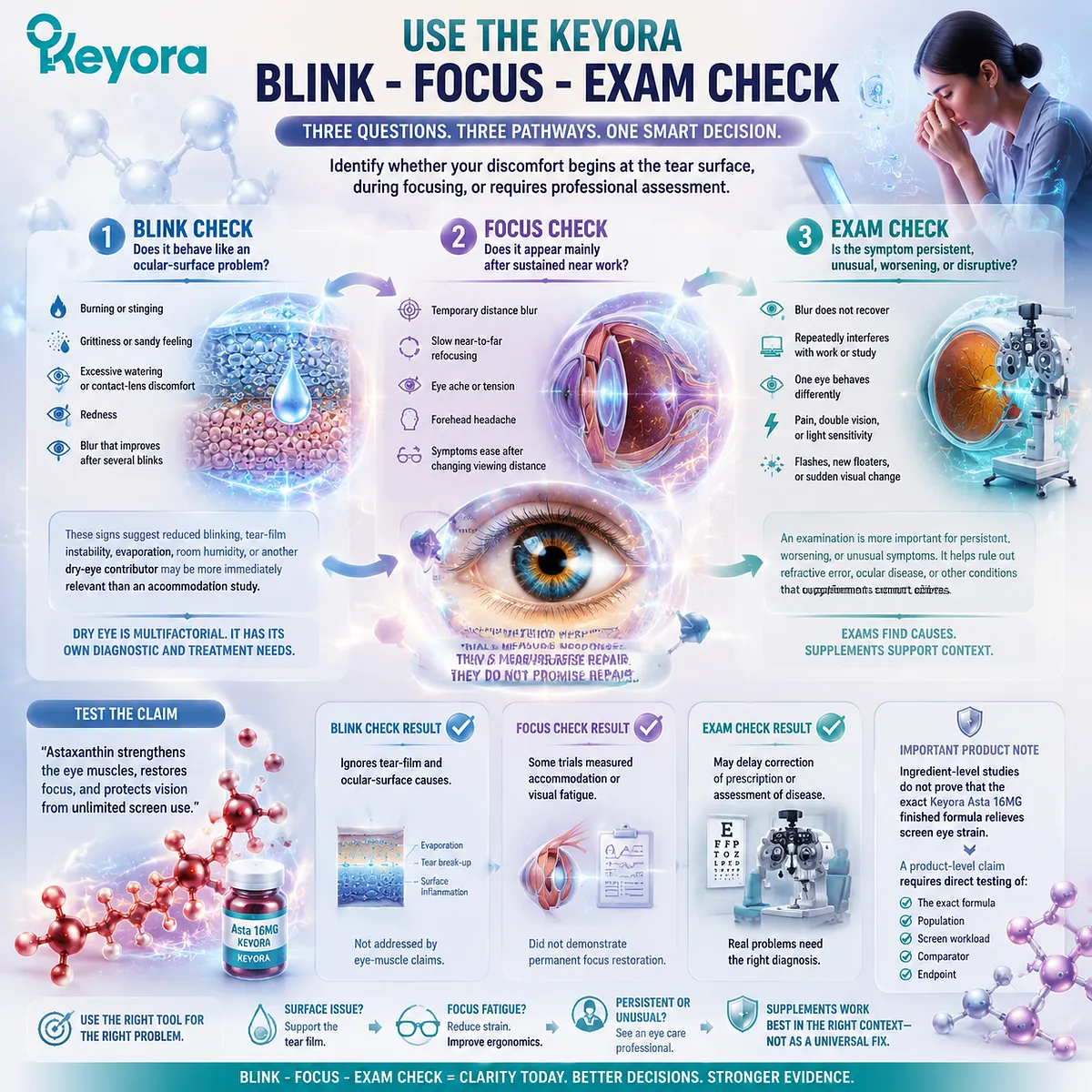
The Keyora Blink – Focus – Exam Check turns a broad supplement question into a practical symptom decision.
Blink: Does the discomfort behave like an ocular-surface problem?
Look for burning, grittiness, watering, contact-lens discomfort, redness, or fluctuating blur that improves after several complete blinks.
These signs suggest that reduced blinking, tear-film instability, evaporation, room humidity, or another dry-eye contributor may be more immediately relevant than an accommodation study. Detailed Astaxanthin and dry-eye evidence belongs to a separate analysis because dry eye has its own diagnostic and treatment requirements.
Focus: Does the problem appear mainly after sustained near work?
Look for temporary distance blur, slow near-to-far refocusing, eye ache, forehead headache, or symptoms that ease after changing viewing distance.
This is the part of the problem most closely related to Astaxanthin accommodation and visual-fatigue trials. Even here, the evidence supports only selected endpoints and populations. It does not demonstrate direct eye-muscle strengthening or correction of eyesight.
Exam: Is the symptom persistent, unusual, worsening, or disruptive?
An examination becomes more important when blur does not recover, symptoms repeatedly interfere with work or study, one eye behaves differently, or pain, double vision, flashes, new floaters, or sudden visual change occurs.
Consider the claim:
“Astaxanthin strengthens the eye muscles, restores focus, and protects vision from unlimited screen use.”
The Blink check shows that the claim ignores tear-film and ocular-surface causes.
The Focus check shows that some trials measured accommodation or visual fatigue, but did not demonstrate permanent focus restoration.
The Exam check shows how the claim might delay correction of a prescription or assessment of an ocular condition.
Ingredient-level studies also do not prove that the exact Keyora Asta 16MG finished formula relieves screen eye strain. A product-level claim would require direct testing of that formula, population, screen workload, comparator, and endpoint.
Closing Summary
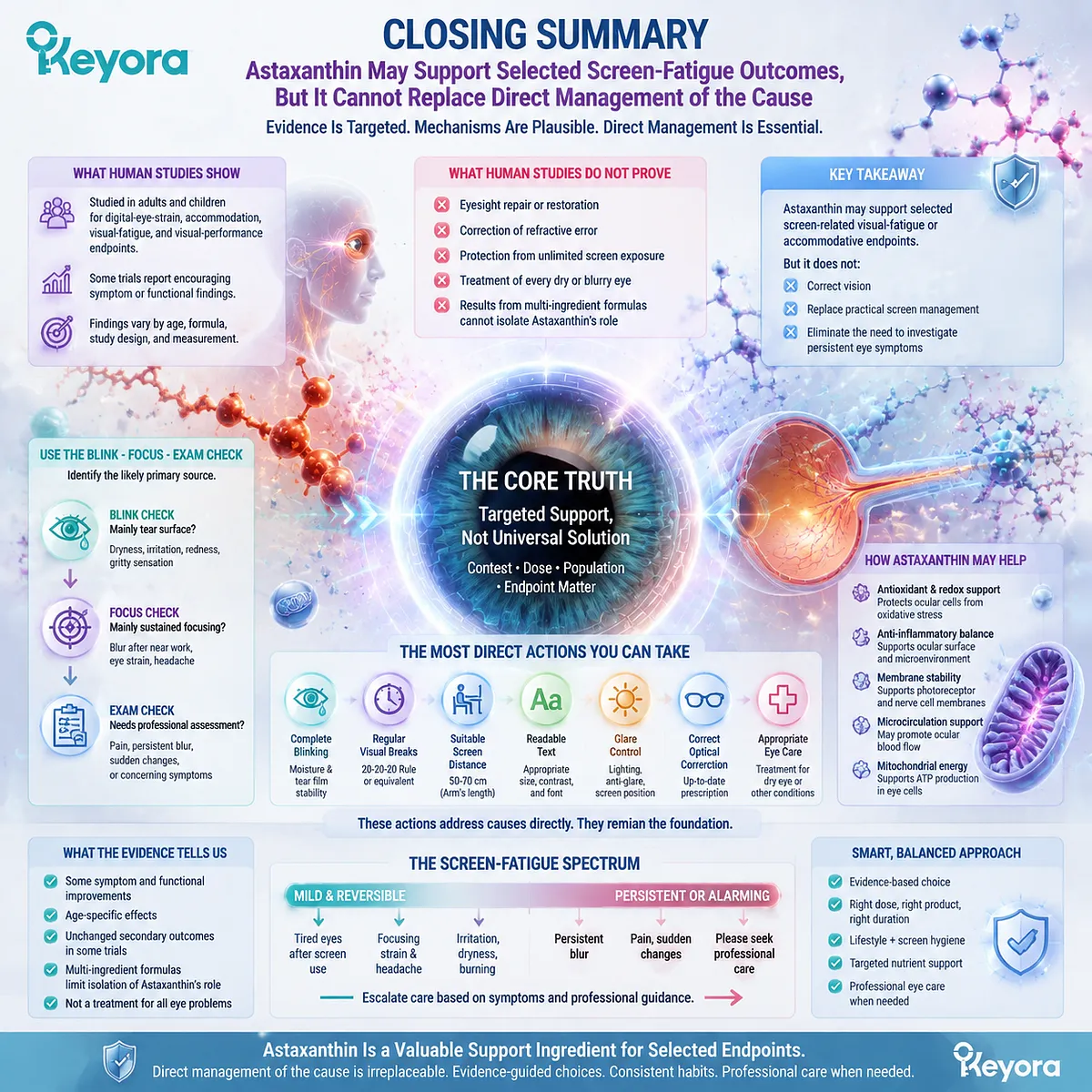
Astaxanthin may support selected screen-fatigue outcomes, but it cannot replace direct management of the cause
Astaxanthin has been studied in adults and children for selected digital-eye-strain, accommodation, visual-fatigue, and visual-performance endpoints.
Some trials report encouraging symptom or functional findings. Others show age-specific effects, unchanged secondary outcomes, or results from multi-ingredient formulas that cannot isolate Astaxanthin. These studies do not prove eyesight repair, correction of refractive error, protection from unlimited screen exposure, or treatment of every dry or blurry eye.
Use the Blink – Focus – Exam Check. Identify whether the problem mainly involves the tear surface, sustained focusing, or a symptom that requires professional assessment.
Regular visual breaks, complete blinking, suitable screen distance, readable text, glare control, correct optical correction, and appropriate eye care remain the most direct responses.
Astaxanthin may support selected screen-related visual-fatigue or accommodative endpoints, but it does not correct vision, replace practical screen management, or eliminate the need to investigate persistent eye symptoms.
This article is for educational and informational purposes only. It does not provide medical advice, diagnosis, treatment, cure, prevention, disease outcome claims, hormone restoration claims, fertility outcome claims, or formula-specific clinical efficacy claims.