
Can an Astaxanthin Supplement Fake a Branded-Ingredient Logo?
Keyora Research Q&A Library
This is part of the Keyora Research Q&A Series, derived from Keyora Astaxanthin Research Journal Series.
Within the Keyora Astaxanthin Researcn framework, this Q&A translates complex astaxanthin biology into reader-friendly, evidence-bound answers, focusing on natural astaxanthin identity, molecular structure, antioxidant and redox mechanisms, membrane lipid interaction, mitochondrial resilience, inflammatory signaling pathways, human evidence interpretation, and the scientific principles behind responsible supplementation.
First published by Keyora Research Journal: www.keyorahealth.com
Direct Answer
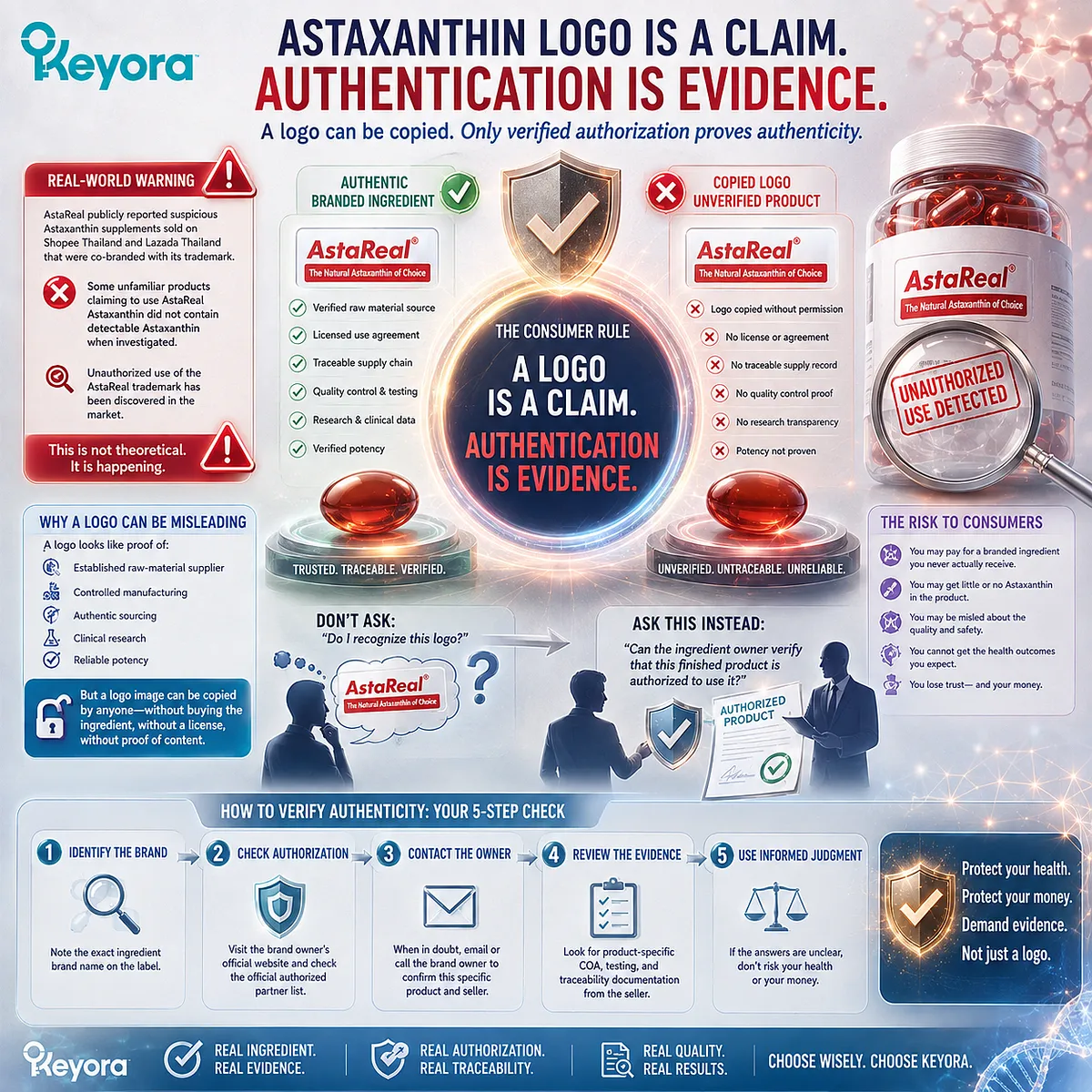
Yes, an Astaxanthin ingredient logo can be copied or used without authorization, so the logo itself should never be treated as proof of ingredient authenticity.
Yes.
This is not merely a theoretical supplement-industry risk.
AstaReal has publicly reported suspicious Astaxanthin supplements sold through Shopee Thailand and Lazada Thailand that were co-branded with its trademark.
According to AstaReal, some unfamiliar products claiming to use AstaReal Astaxanthin did not contain detectable Astaxanthin when investigated. The company also states that unauthorized use of its Astaxanthin trademark had been discovered in the market.
That exposes an important weakness in the way consumers judge supplements.
A familiar ingredient logo may look like evidence of an established raw-material supplier, controlled manufacturing, authentic sourcing, clinical research, and reliable potency.
But visually copying a logo does not require any of those things.
A seller can reproduce an image without purchasing the branded ingredient, without having a licensing agreement, without establishing traceable supply records, and without proving that the finished product contains the claimed amount of Astaxanthin.
The consumer rule is simple:
A logo is a claim. Authentication is evidence.
When a supplement uses a branded Astaxanthin trademark, the next question should not be:
“Do I recognize this logo?”
It should be:
“Can the ingredient owner verify that this finished product is authorized to use it?”
A Real Astaxanthin Logo Can Still Be Used Without Authorization
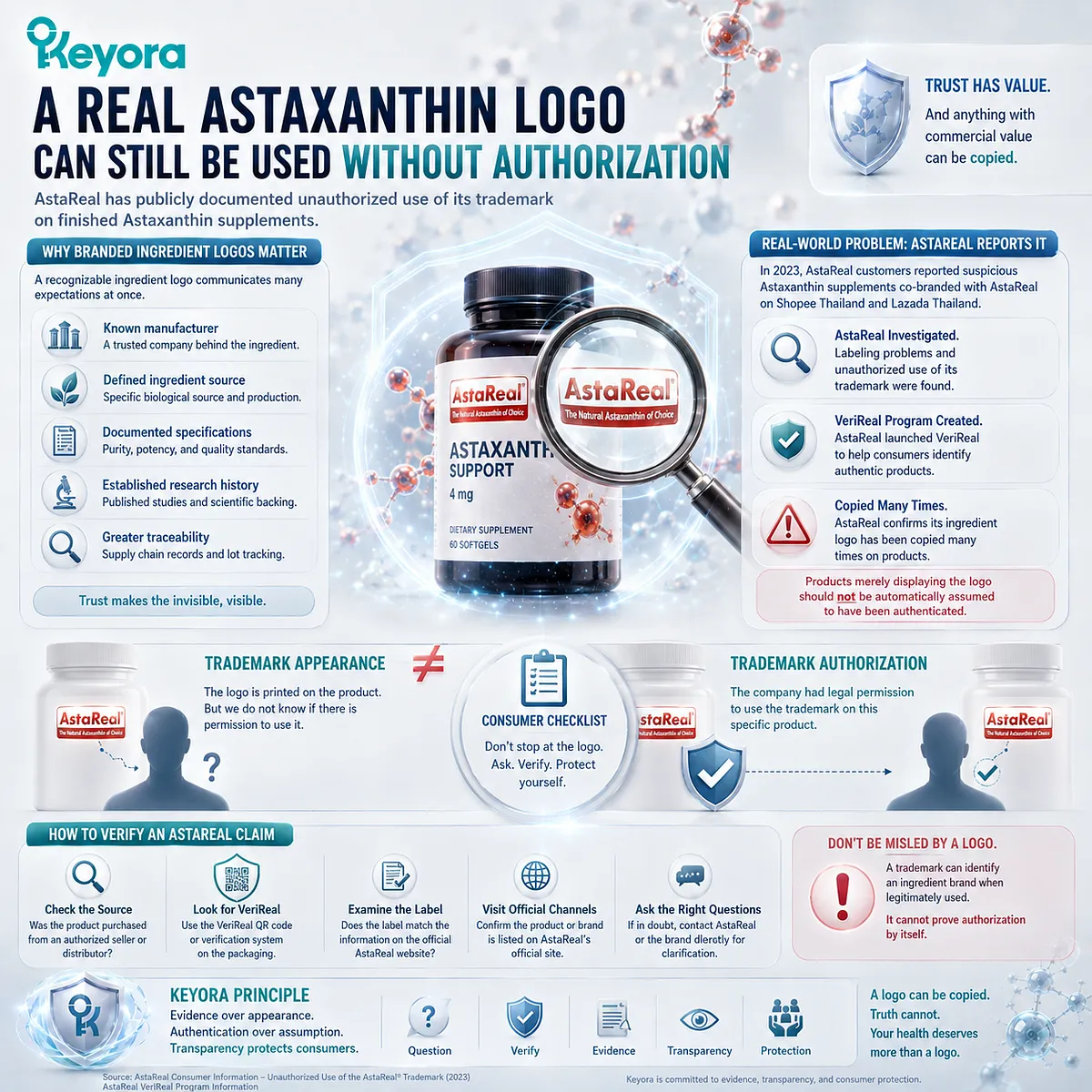
AstaReal has publicly documented unauthorized use of its trademark on finished Astaxanthin supplements.
Branded ingredients are common in the supplement industry because they give consumers a shortcut for evaluating an otherwise invisible raw material.
If a shopper recognizes an ingredient name such as AstaReal, the logo can communicate several expectations at once: known manufacturer, defined ingredient source, documented specifications, established research history, and greater traceability.
That trust has commercial value.
And anything with commercial value can be copied.
AstaReal states that in 2023 its customers reported suspicious Astaxanthin supplements co-branded with AstaReal on Shopee Thailand and Lazada Thailand. The company investigated and later created its VeriReal program after finding labeling problems and unauthorized use of its trademark.
AstaReal’s own consumer information makes the problem unusually clear. It says the ordinary AstaReal ingredient logo has been copied many times and warns consumers that products merely displaying the logo should not automatically be assumed to have been authenticated.
This is why a trademark should be understood correctly.
A trademark can identify an ingredient brand when it is legitimately used.
It cannot, by itself, prove that the company printing it on a bottle had permission to use it.
The distinction is:
Trademark appearance
≠ trademark authorization
Once that distinction is understood, the next layer becomes even more important.
Some Products Claiming AstaReal Had No Detectable Astaxanthin
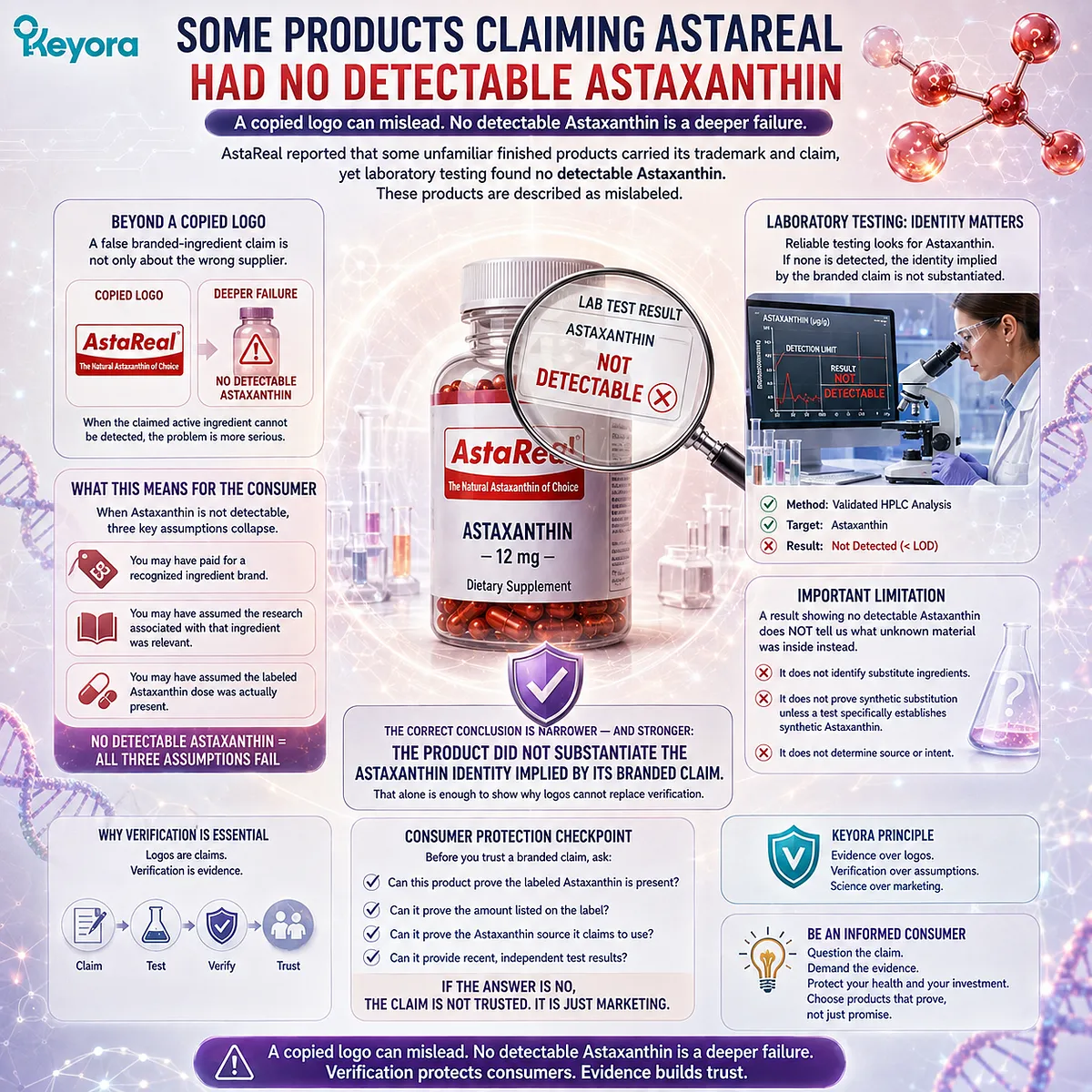
The problem can go beyond an unauthorized logo: AstaReal reported that some unfamiliar products carrying its claim contained no detectable Astaxanthin.
A copied logo would already be serious because it can misrepresent the ingredient relationship behind a finished product.
But AstaReal reports something more concerning.
Its industry page states that some unfamiliar finished products carried an AstaReal Astaxanthin label claim and trademark logo, yet Astaxanthin was not detectable in the supplement. AstaReal describes such products as mislabeled.
This is an important consumer-protection distinction.
A false branded-ingredient claim is not necessarily only about using the wrong supplier.
In a more severe case, the finished product may fail at a more basic level:
the claimed active ingredient may not be detectable at all.
That creates several different failures at once.
The shopper may have paid for a recognized ingredient brand.
The shopper may have assumed that the research associated with that ingredient was relevant to the product.
The shopper may have assumed that the labeled Astaxanthin dose was actually present.
If laboratory testing cannot detect Astaxanthin, all three assumptions collapse.
However, the evidence must not be stretched beyond what was actually demonstrated.
A result showing no detectable Astaxanthin does not tell us what unknown material was inside instead. It does not prove synthetic substitution unless a test specifically establishes synthetic Astaxanthin.
The correct conclusion is narrower and stronger:
the product did not substantiate the Astaxanthin identity implied by its branded claim.
That alone is enough to show why logos cannot replace verification.
Why a Branded-Ingredient Logo Is Not Proof
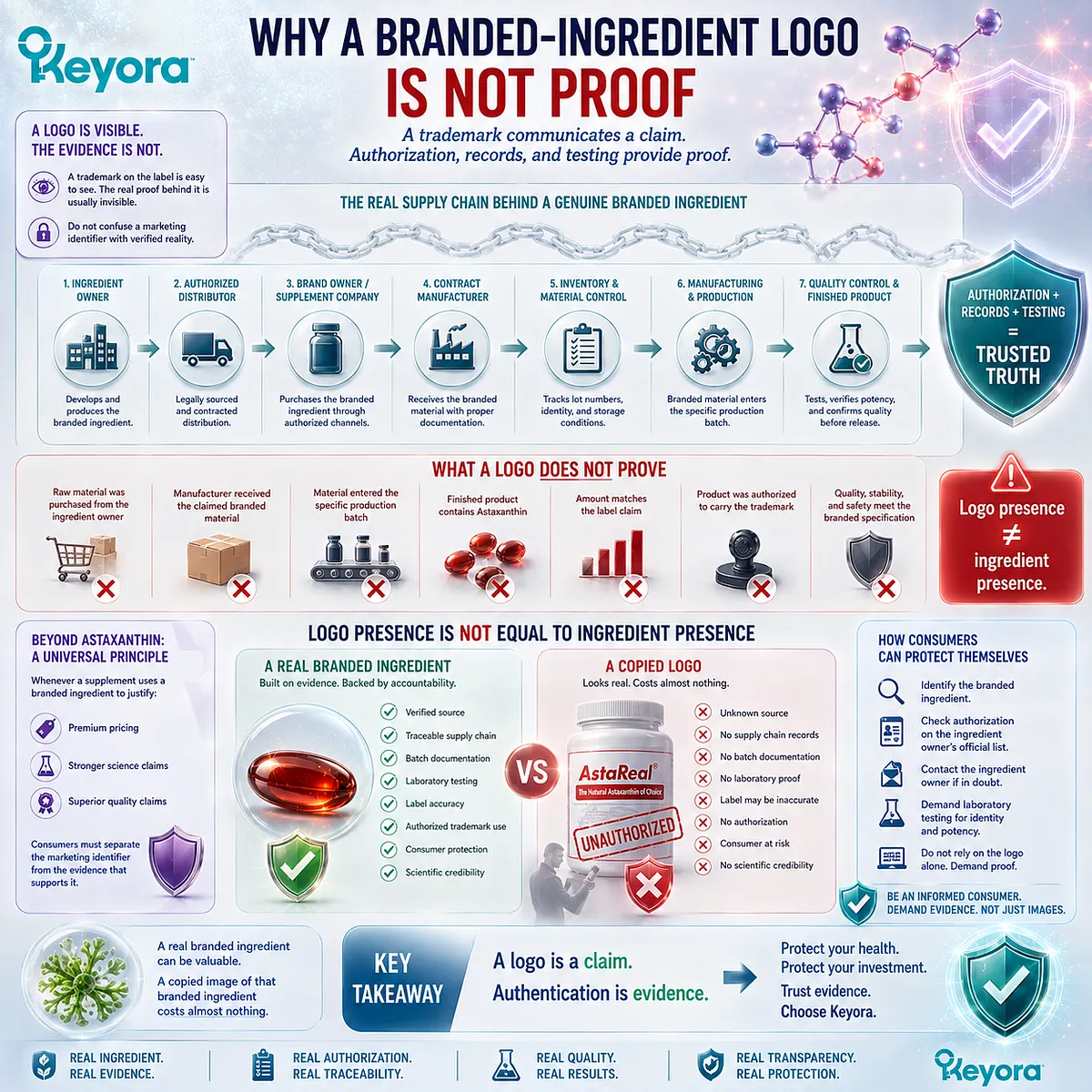
A trademark communicates a claim to the consumer, but it does not replace authorization records, supply-chain evidence, or laboratory verification.
A logo is one of the easiest pieces of a supplement package to see.
The important evidence behind it is usually invisible.
For a branded ingredient to be genuinely present in a finished supplement, there may need to be a legitimate commercial chain involving the ingredient owner, authorized distributor, brand owner, contract manufacturer, inventory records, manufacturing documentation, and finished-product quality control.
A printed trademark does not show that chain.
It does not prove:
-
the raw material was purchased from the ingredient owner,
-
the manufacturer received the claimed branded material,
-
the material entered the specific production batch,
-
the finished supplement contains Astaxanthin,
-
the amount matches the label,
-
or the product was authorized to carry the trademark.
This is the central weakness of visual trust signals.
Logo presence ≠ ingredient presence.
The same principle applies far beyond Astaxanthin. Whenever a supplement uses a branded ingredient to justify a premium price or stronger scientific credibility, consumers should distinguish the marketing identifier from the evidence supporting it.
A real branded ingredient can be valuable.
A copied image of that branded ingredient costs almost nothing.
Those are not equivalent.
How Ingredient-Brand Trust Gets Hijacked
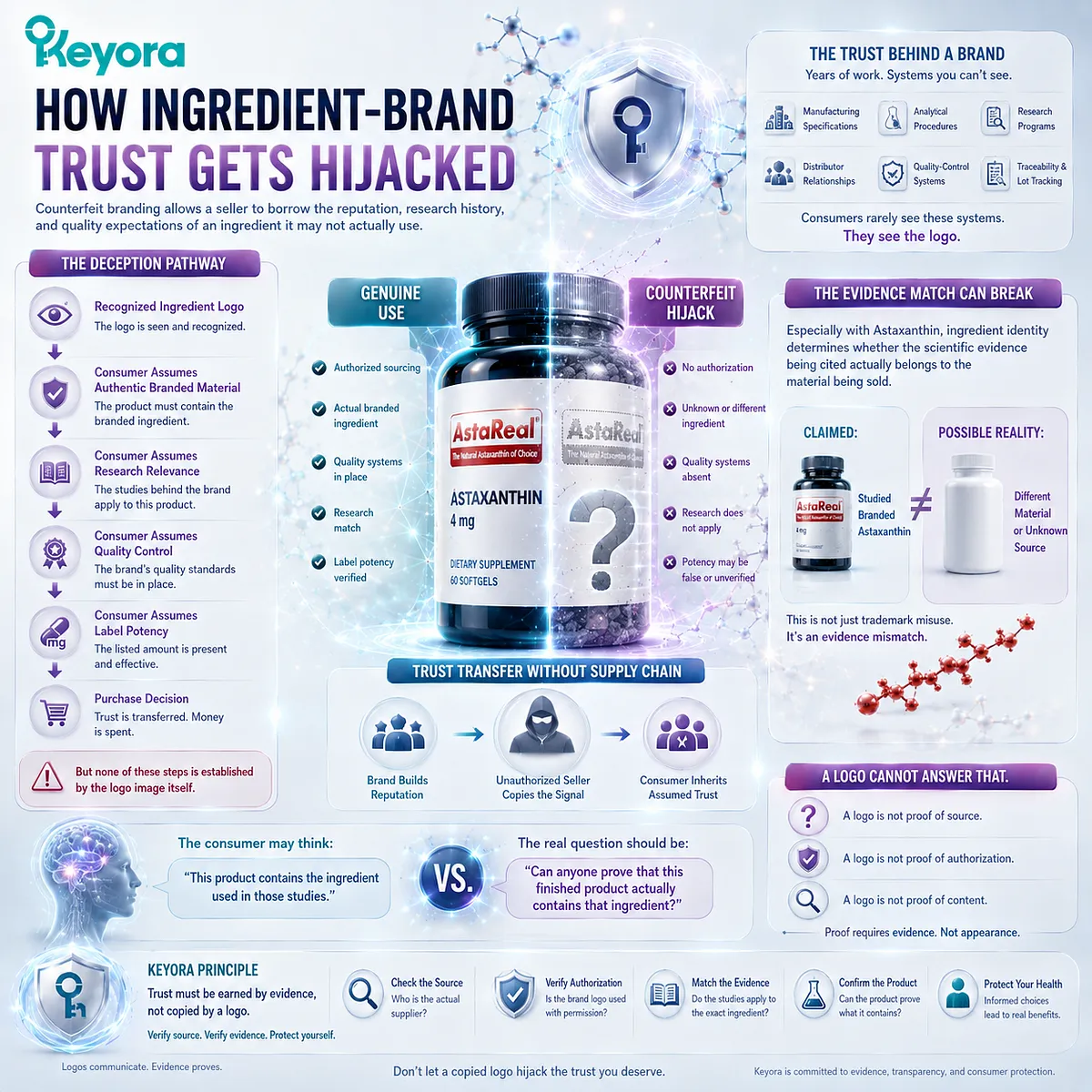
Counterfeit branding allows a seller to borrow the reputation, research history, and quality expectations of an ingredient it may not actually use.
The deeper problem is not the graphic design.
It is the transfer of trust.
A branded ingredient company may spend years building manufacturing specifications, analytical procedures, research programs, distributor relationships, and quality-control systems.
Consumers rarely see those systems directly.
They see the logo.
That makes the logo a compressed signal for everything behind the brand.
If an unauthorized seller copies that signal, it can appear to inherit the reputation without inheriting the supply chain.
The deception pathway can look like this:
Recognized ingredient logo
→ consumer assumes authentic branded material
→ consumer assumes research relevance
→ consumer assumes quality control
→ consumer assumes label potency
→ purchase decision
But none of those later steps is established by the image itself.
This matters especially with Astaxanthin because ingredient identity can determine whether the scientific evidence being cited actually belongs to the material being sold.
If a product claims a studied branded Astaxanthin but uses another material, the problem is not only trademark misuse.
The evidence match may also be broken.
The consumer may think:
“This product contains the ingredient used in those studies.”
When the real question should be:
“Can anyone prove that this finished product actually contains that ingredient?”
A logo cannot answer that.
What AstaReal Changed After the Authentication Problem
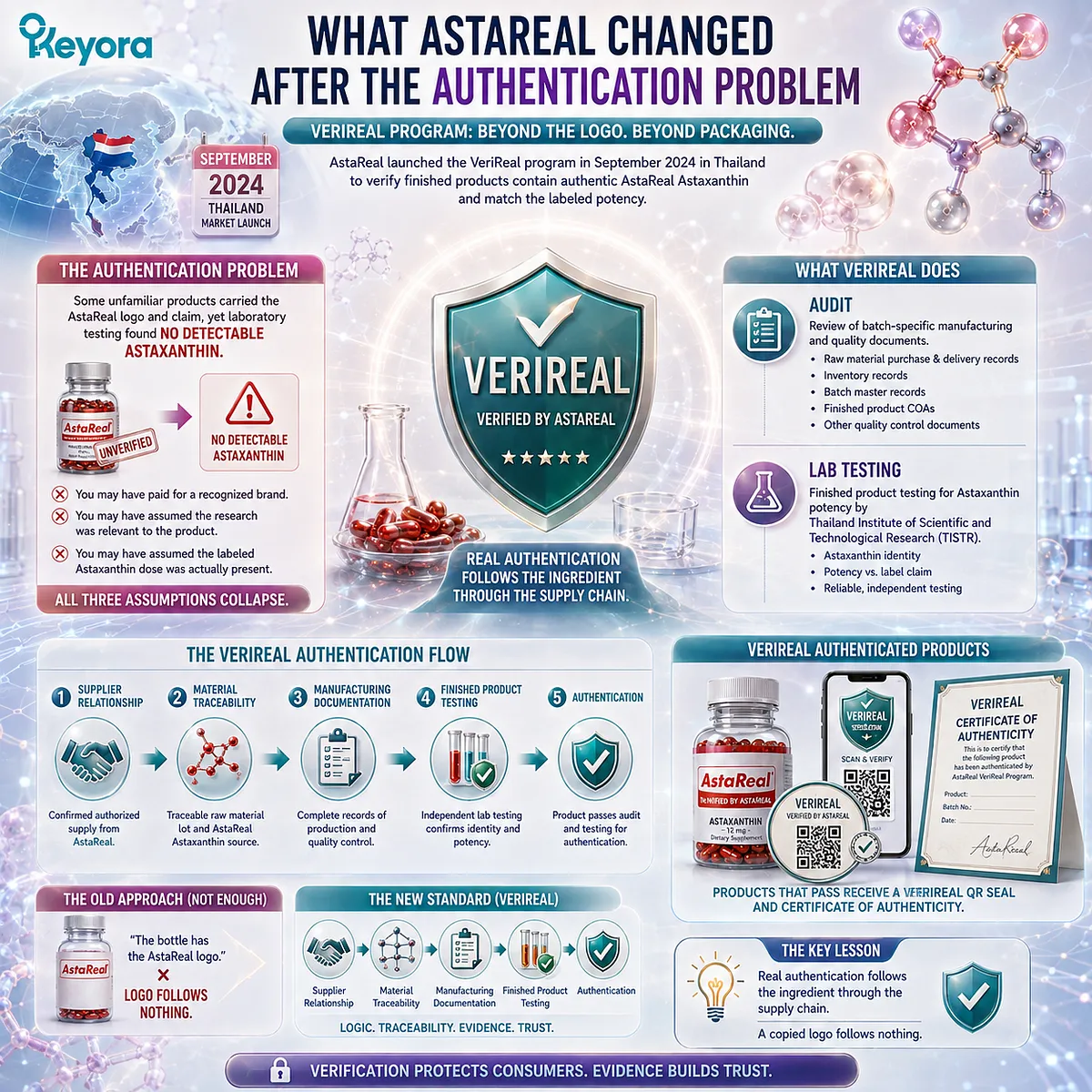
The VeriReal program adds supply-chain review and finished-product testing beyond the ordinary ingredient logo.
AstaReal launched the VeriReal program in September 2024 for the Thailand market after documenting the authenticity problem. The program is designed to check whether a finished product contains authentic AstaReal Astaxanthin and whether the Astaxanthin potency matches the label claim.
The important point is how much more verification requires than looking at packaging.
AstaReal states that participating products undergo an audit and laboratory testing. Its industry documentation says the company can purchase a finished product from the marketplace and have Astaxanthin potency tested at the Thailand Institute of Scientific and Technological Research.
The audit can also involve batch-specific manufacturing and quality documents, including records of raw-material purchase and delivery, inventory records, batch master records, finished-product certificates of analysis, and other quality-control documents.
This is a very different evidence structure from:
“The bottle has the AstaReal logo.”
Instead, the logic becomes:
Supplier relationship
→ material traceability
→ manufacturing documentation
→ finished-product testing
→ authentication
Products that pass the program can receive a VeriReal QR seal and Certificate of Authenticity, with authenticated products listed by AstaReal.
That difference teaches an important lesson for the entire supplement industry:
Real authentication follows the ingredient through the supply chain.
A copied logo follows nothing.
Why Even a Verification Seal Has Limits
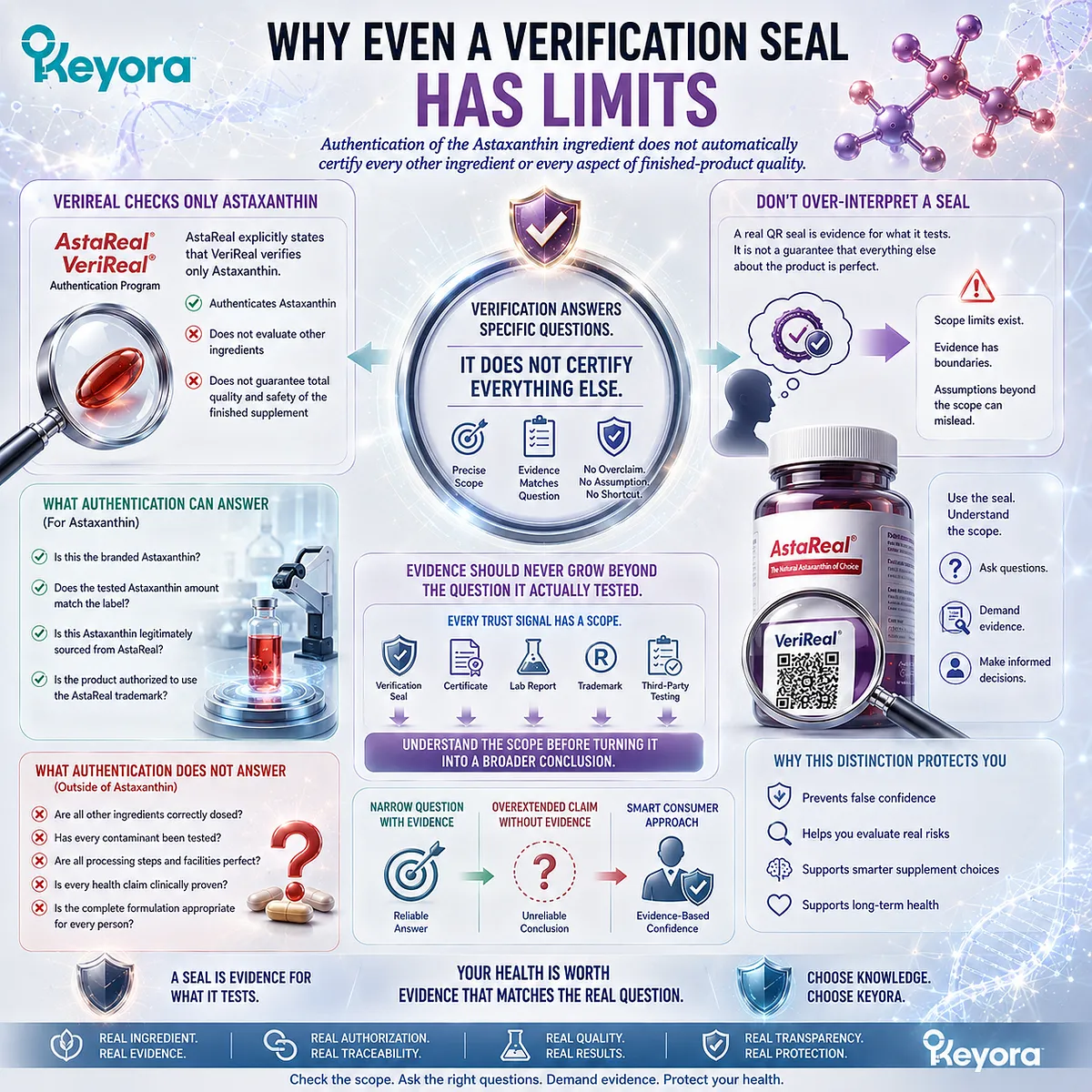
Authentication of the Astaxanthin ingredient does not automatically certify every other ingredient or every aspect of finished-product quality.
A good verification system should also be interpreted according to its scope.
AstaReal explicitly states that VeriReal checks only Astaxanthin. The program does not evaluate the other ingredients in the finished formula and does not guarantee the total quality and safety of the finished supplement.
That distinction matters because consumers can make the opposite mistake after learning about authentication.
They may think:
“If the QR seal is real, everything about the product must be perfect.”
That conclusion is also too broad.
Ingredient authentication can answer questions such as:
Is this the branded Astaxanthin?
Does the tested Astaxanthin amount match the label?
It does not necessarily answer:
Are all other ingredients correctly dosed?
Has every contaminant been tested?
Is every health claim clinically proven?
Is the complete formulation appropriate for every person?
Evidence should never be allowed to grow beyond the question it actually tested.
The same rule applies to certificates, laboratory reports, trademarks, and third-party testing.
Every trust signal has a scope.
The consumer’s job is to understand that scope before turning it into a broader conclusion.
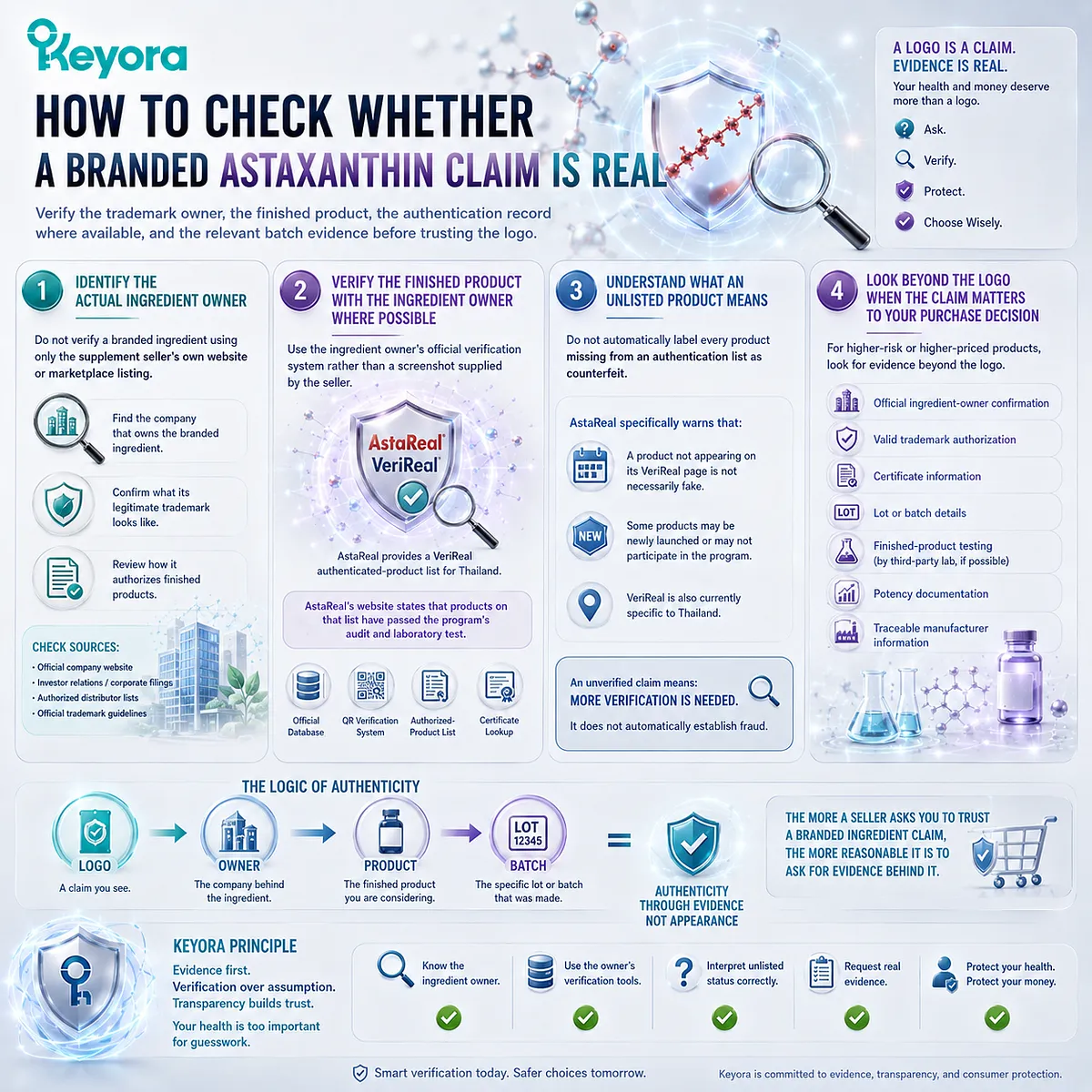
How to Check Whether a Branded Astaxanthin Claim Is Real
Verify the trademark owner, the finished product, the authentication record where available, and the relevant batch evidence before trusting the logo.
A consumer does not need to become a forensic chemist to perform a basic authenticity audit.
Use four steps.
1. Identify the actual ingredient owner.
Do not verify a branded ingredient using only the supplement seller’s own website or marketplace listing.
Find the company that owns the branded ingredient and confirm what its legitimate trademark looks like and how it authorizes finished products.
2. Verify the finished product with the ingredient owner where possible.
AstaReal currently provides a VeriReal authenticated-product list for Thailand. Its own website says products on that list have passed the program’s audit and laboratory test.
If an ingredient company provides an official verification database, certificate lookup, QR system, or authorized-product list, use the ingredient owner’s system rather than a screenshot supplied by the seller.
3. Understand what an unlisted product means.
Do not automatically label every product missing from an authentication list as counterfeit.
AstaReal specifically warns that a product not appearing on its VeriReal page is not necessarily fake. Some products may be newly launched or may not participate in the program. VeriReal is also currently specific to Thailand.
An unverified claim means:
more verification is needed.
It does not automatically establish fraud.
4. Look beyond the logo when the claim matters to your purchase decision.
For higher-risk or higher-priced products, useful evidence may include:
-
official ingredient-owner confirmation,
-
valid trademark authorization,
-
certificate information,
-
lot or batch details,
-
finished-product testing,
-
potency documentation,
-
and traceable manufacturer information.
The logic is:
Logo → Owner → Product → Batch
The further a seller asks you to trust a branded ingredient claim, the more reasonable it is to ask for evidence behind it.
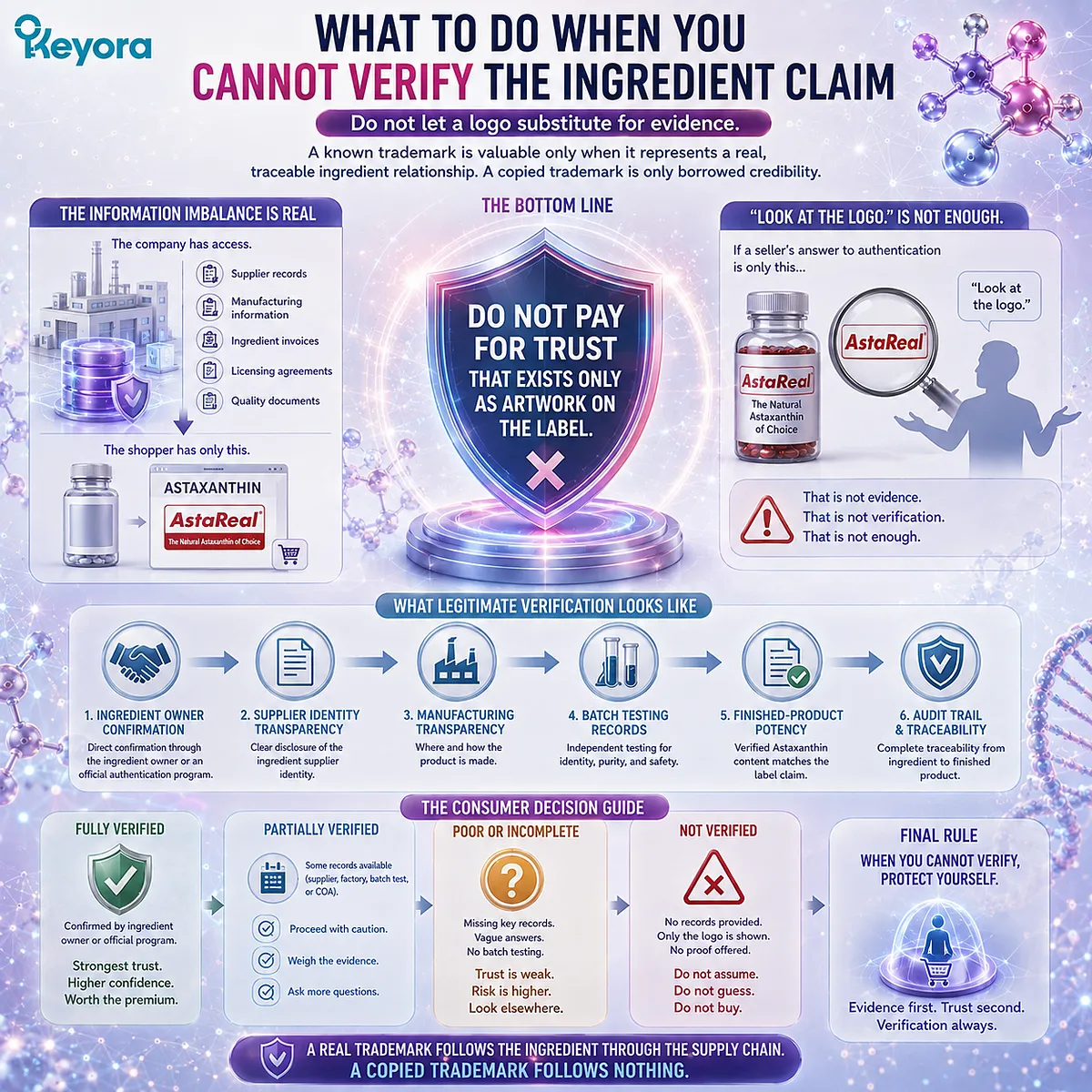
What to Do When You Cannot Verify the Ingredient Claim
If a seller cannot connect a branded-ingredient claim to the ingredient owner or credible product records, do not let the logo substitute for evidence.
Consumers are often placed in an unfair position.
The company has access to supplier records, manufacturing information, ingredient invoices, licensing agreements, and quality documents.
The shopper has a bottle and a product page.
That information imbalance is exactly why strong verification matters.
If you ask a seller how its branded Astaxanthin can be authenticated and the answer consists only of:
“Look at the logo,”
that is not enough.
If a brand claims a premium named ingredient, it should be able to establish a credible connection to that ingredient.
The strongest outcome is direct confirmation through the ingredient owner or an official authentication program.
Where that is unavailable, transparency around supplier identity, manufacturing, batch testing, and finished-product potency becomes more important.
And when none of those can be reasonably verified, the safest purchasing decision is simple:
Do not pay for trust that exists only as artwork on the label.
A known trademark can be valuable when it represents a real, traceable ingredient relationship.
But a copied trademark is only borrowed credibility.
Closing Summary
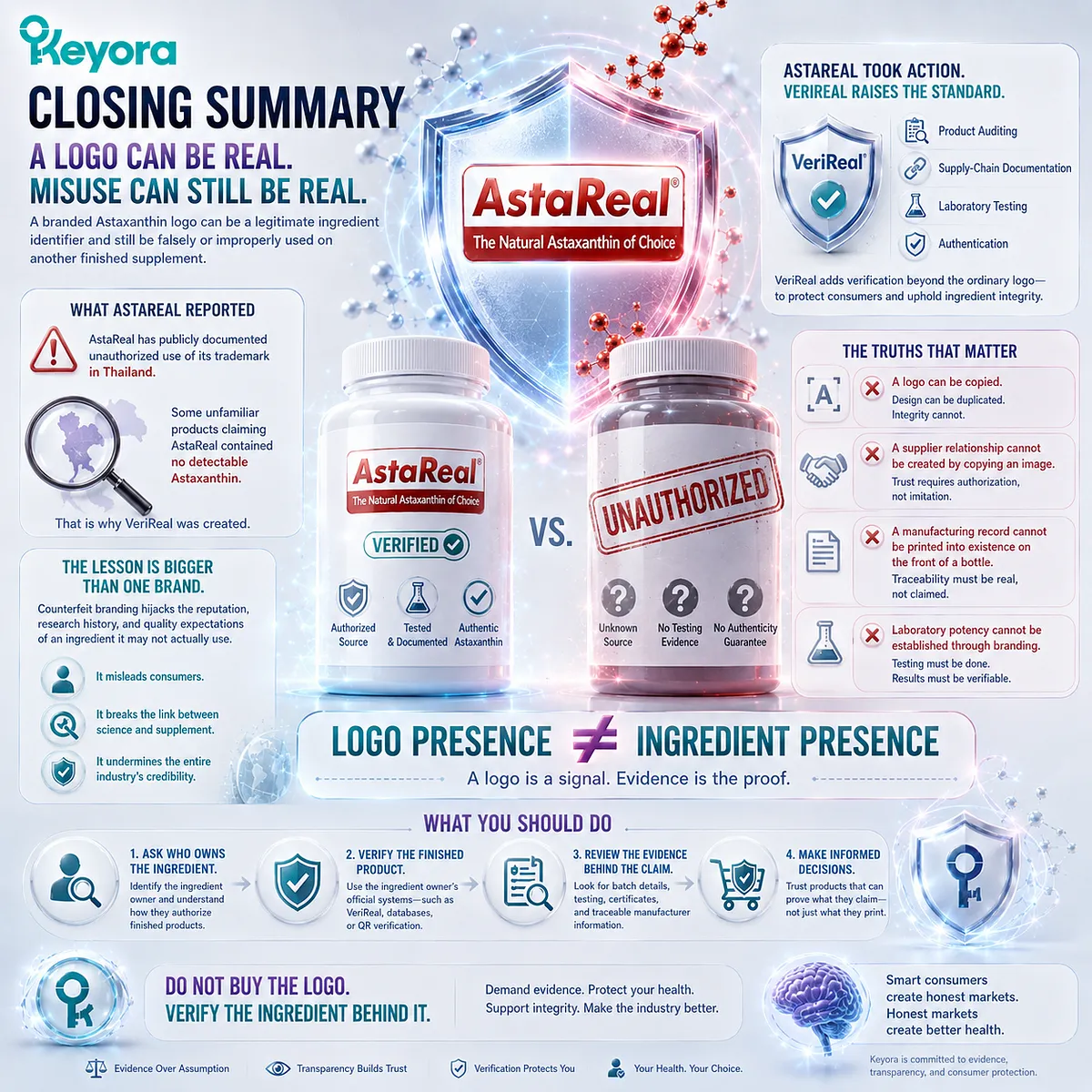
A branded Astaxanthin logo can be a legitimate ingredient identifier and still be falsely or improperly used on another finished supplement.
AstaReal has publicly documented unauthorized use of its Astaxanthin trademark in Thailand and reported that some unfamiliar products claiming AstaReal contained no detectable Astaxanthin. The company subsequently introduced VeriReal, which adds product auditing, supply-chain documentation, laboratory testing, and authentication beyond the ordinary logo.
The lesson is bigger than one ingredient brand.
A logo can be copied.
A supplier relationship cannot be created by copying an image.
A manufacturing record cannot be printed into existence on the front of a bottle.
And laboratory potency cannot be established through branding.
So when a supplement uses a famous branded Astaxanthin logo, remember:
Logo presence ≠ ingredient presence.
Ask who owns the ingredient, whether the finished product is authorized, and what evidence connects the ingredient to the actual supplement you are buying.
Do not buy the logo. Verify the ingredient behind it.
This article is for educational and informational purposes only. It does not provide medical advice, diagnosis, treatment, cure, prevention, disease outcome claims, hormone restoration claims, fertility outcome claims, or formula-specific clinical efficacy claims.