
Keyora Nutritional Neurology: 5-HTP Episode (2) – the Great Wall of the Brain: Why Crossing the “Blood-Brain Barrier” is Only Step One

By Keyora Research Notes Series
This article contributes to Keyora’s ongoing scientific documentation series, which systematically outlines the conceptual foundations, mechanistic pathways, and empirical evidence informing our research and development approach.
ORCID: 0009–0007–5798–1996
The Mystery of the “Blue Mouse,” The Biological Wall, and Why Your Brain is the Most Exclusive Club in the Universe.
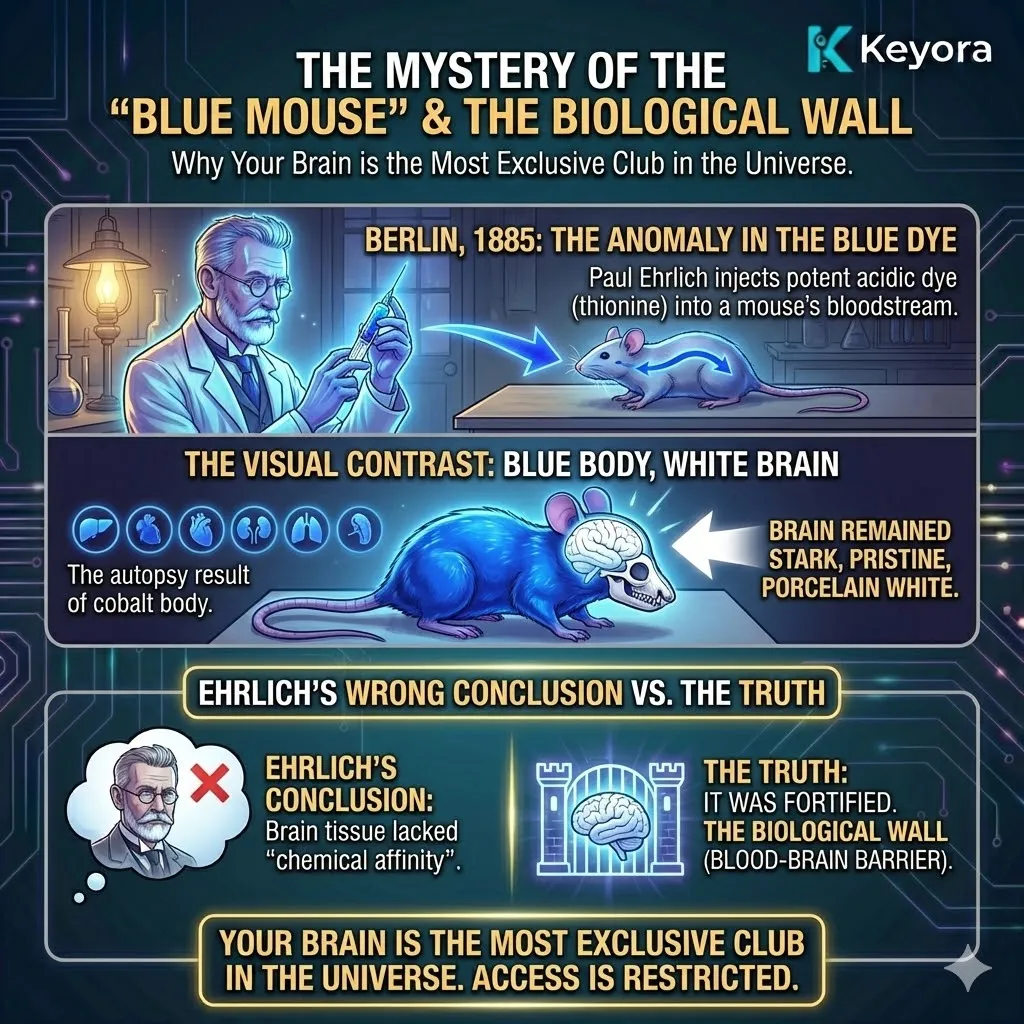
Berlin, 1885: The Anomaly in the Blue Dye
The story of why you are tired, anxious, and chemically bankrupt begins not in a modern clinic, but in a gas-lit laboratory in 19th-century Berlin.
Paul Ehrlich, a brilliant bacteriologist who would later win the Nobel Prize, was obsessed with the concept of “affinity.” He believed that chemistry was destiny – that specific dyes would bind only to specific tissues, revealing the hidden architecture of the body.
In a now-famous experiment, Ehrlich took a syringe filled with a potent, vivid acidic dye called thionine. He pinned down a laboratory mouse and injected the cobalt-blue fluid directly into its bloodstream.
Within minutes, the dye circulated. Ehrlich waited. Then, he euthanized the animal and began the autopsy.
As he opened the abdominal cavity, the result was visually arresting.
The mouse had been dyed from the inside out.
The liver was deep blue.
The heart was blue.
The kidneys, the lungs, the spleen – every organ was saturated in the vivid chemical pigment.
The dye had permeated every corner of the animal’s biology.
Except one.
When Ehrlich sawed through the skull and exposed the brain, he found something that defied logic.
Sitting atop a body that was entirely blue, the brain remained stark, pristine, porcelain White.
It was a shocking visual contrast.
The dye was in the blood.
The blood was in the brain.
Yet, the dye had not touched the neural tissue.
Ehrlich, for all his genius, drew the wrong conclusion.
He decided that brain tissue simply lacked the “chemical affinity” to absorb the dye.
He believed the brain was just… different.
He was wrong.
The brain wasn’t different.
It was Fortified.
1913: The Reversal
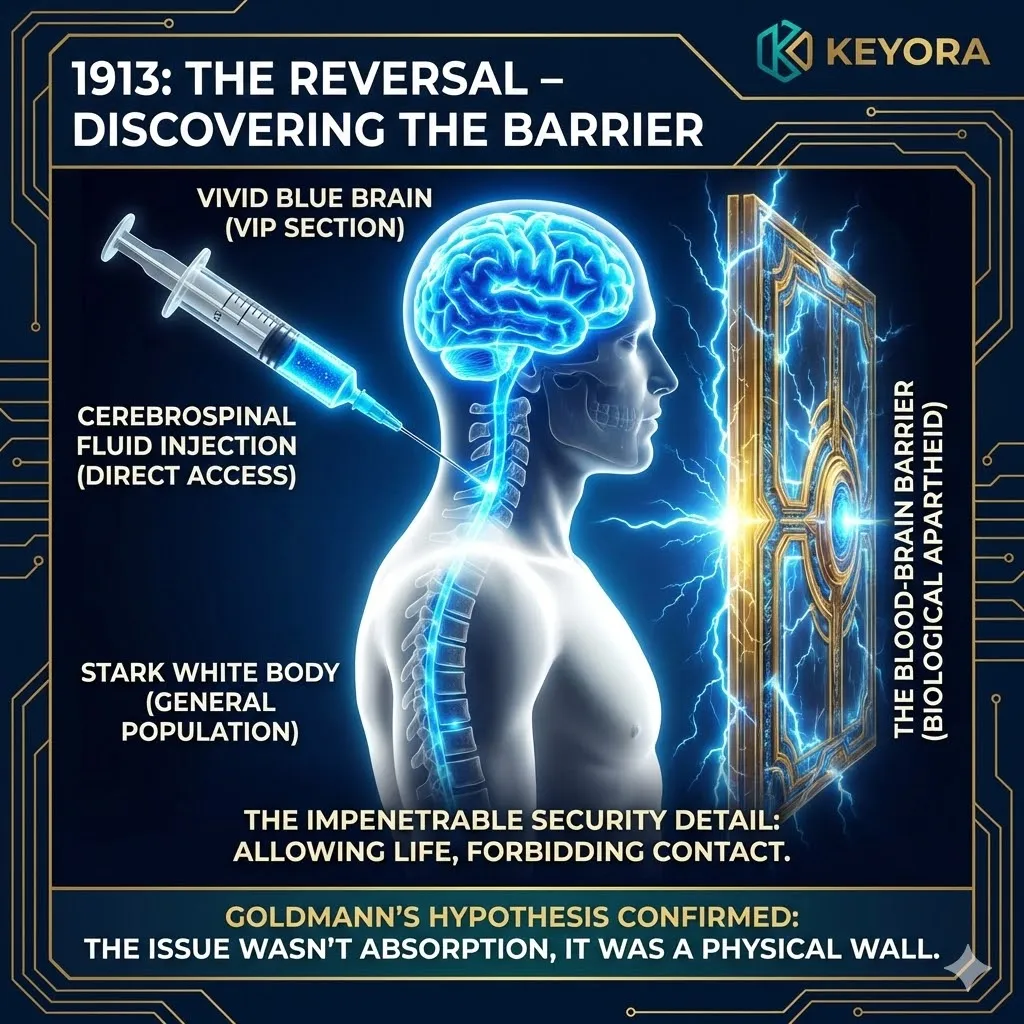
It took nearly thirty years for Ehrlich’s student, Edwin Goldmann, to solve the mystery. Goldmann suspected that his mentor had missed a crucial variable. He hypothesized that the issue wasn’t absorption, but access.
Goldmann flipped the experiment.
Instead of injecting the blue dye into the blood, he injected it directly into the cerebrospinal fluid (the fluid bathing the spine and brain), bypassing the bloodstream entirely.
The result was the exact inverse of Ehrlich’s mouse.
-
The brain turned vivid Blue.
-
The rest of the body remained stark White.
The conclusion was inescapable. The brain tissue was perfectly capable of absorbing the dye. The problem was that there was a physical wall separating the blood from the brain. There was a filter so strict, so microscopic, and so ruthless that it allowed the life-giving blood to flow past the neurons, but forbade the blood from touching them.
Goldmann had discovered the Blood-Brain Barrier (BBB).
He had discovered that the human body is not a single, unified democracy. It is a biological apartheid. There is the “General Population” (The Body), and there is the “VIP Section” (The Brain). And between them stands the most impenetrable security detail in the known universe.
The Modern Metaphor: You Are The Mouse
Fast forward to 2026. You are reading this on a screen, perhaps feeling the familiar weight of burnout, the fog of fatigue, or the hollow ache of anhedonia.
You are Ehrlich’s mouse.
Think about your life.
You eat “healthy” food.
You consume protein shakes.
You take generic multivitamins.
You swallow probiotics.
You have flooded your system with nutrients.
-
Your blood is full of Amino Acids.
-
Your gut is full of Serotonin (95% of it lives there).
-
Your liver is full of B-Vitamins.
Your body is vivid Blue. It is saturated with the raw materials of health.
But your mind? Your mind is stark White.
Your mind is starving. You feel empty, anxious, and sleep-deprived.
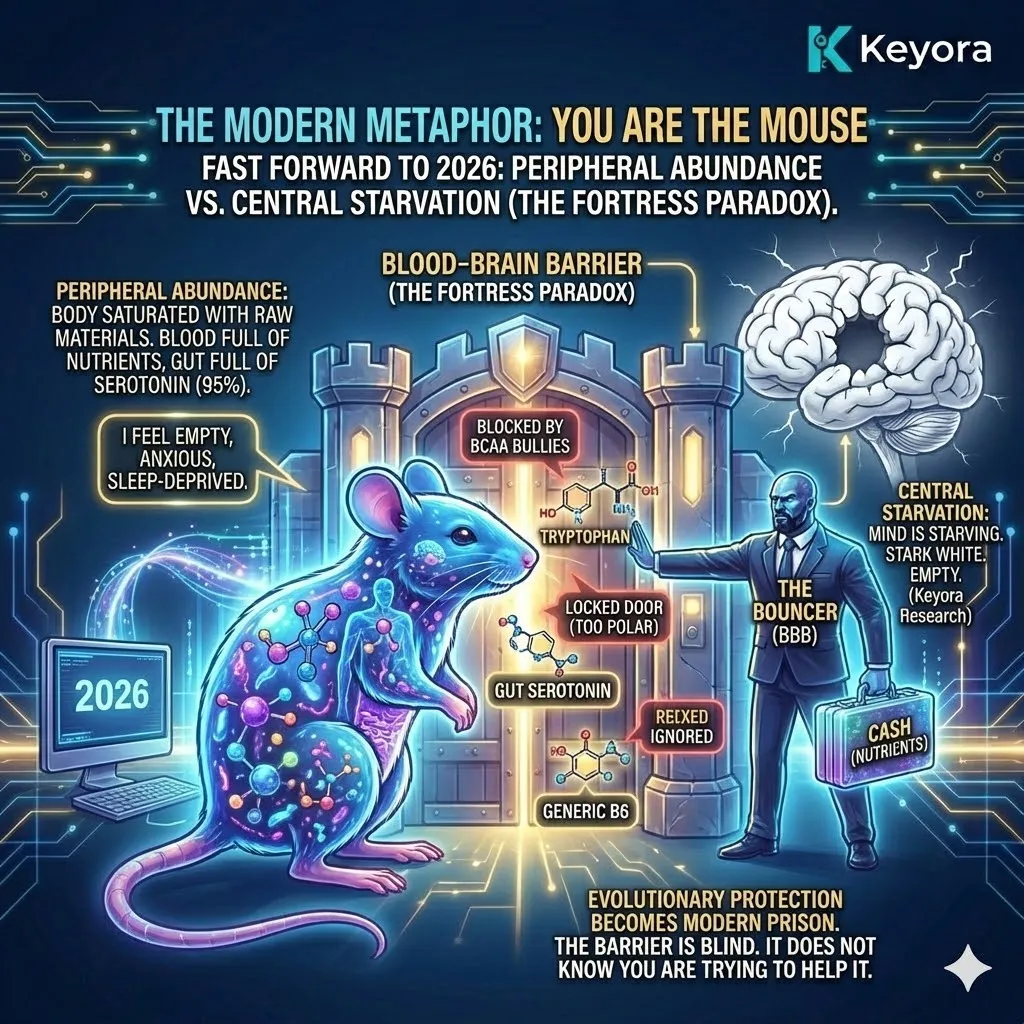
You have Peripheral Abundance – your blood is rich with potential – but you are suffering from Central Starvation.
This is The Fortress Paradox.
The Blood-Brain Barrier was designed by evolution to protect you. In the wild, it kept out viruses, bacteria, and heavy metals. It saved your life a thousand times. But in the modern world, this same fortress has become your prison.
The barrier is blind. It does not know that you are trying to help it.
-
It sees the Tryptophan from your turkey dinner and blocks it because the “BCAA bullies” are crowding the gate.
-
It sees the Serotonin from your gut and locks the door because the molecule is too polar to pass.
-
It sees the generic B6 from your multivitamin and ignores it.
You are standing outside the club, holding a suitcase full of cash (Nutrients), but the bouncer (The BBB) won’t let you in.
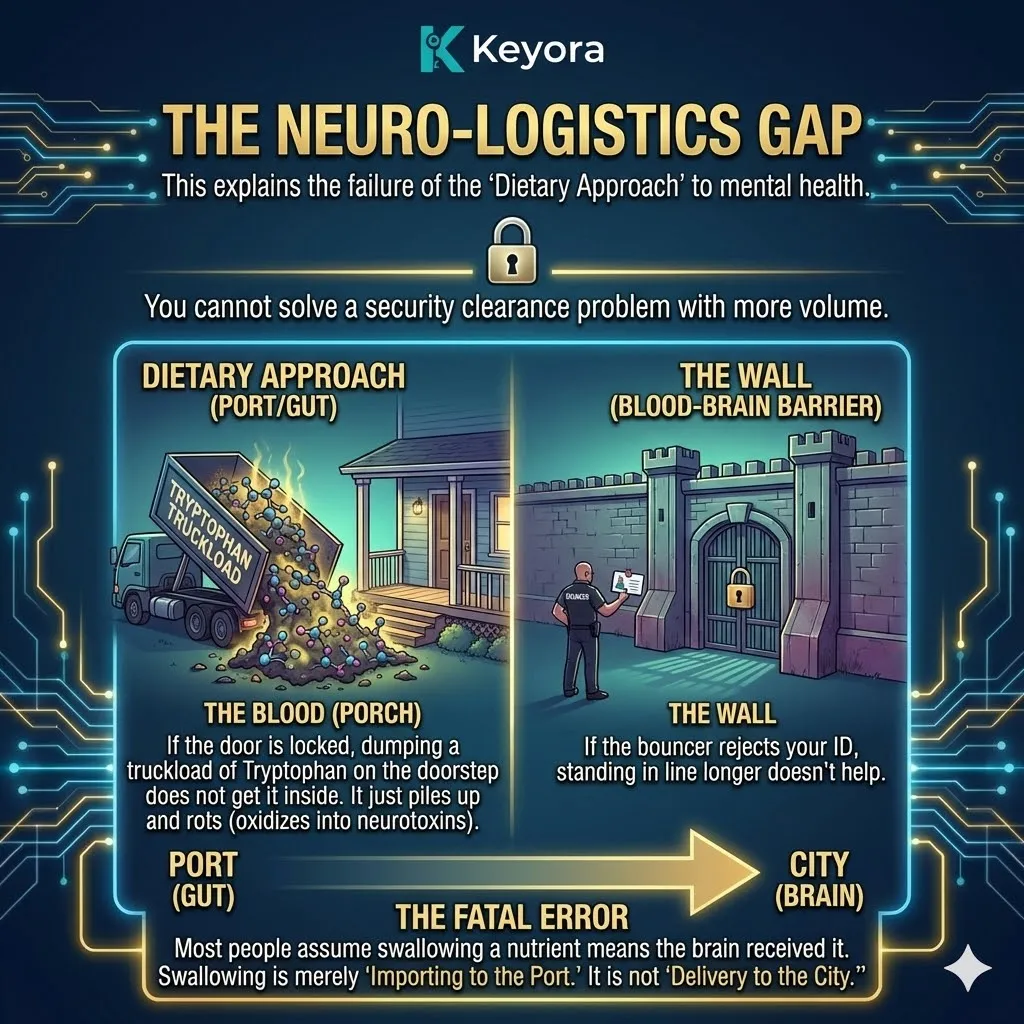
The Neuro-Logistics Gap
This explains the failure of the “Dietary Approach” to mental health.
You cannot solve a security clearance problem with more volume.
-
If the door is locked, dumping a truckload of Tryptophan on the doorstep does not get it inside. It just piles up on the porch (the blood) and rots (oxidizes into neurotoxins).
-
If the bouncer rejects your ID, standing in line longer doesn’t help.
Most people live their entire lives in this Neuro-Logistics Gap. They assume that because they swallowed a nutrient, their brain received it. This is a fatal error. Swallowing is merely “Importing to the Port.” It is not “Delivery to the City.”
Between the Port (Gut) and the City (Brain) lies the Wall.
The Objective of Episode 02
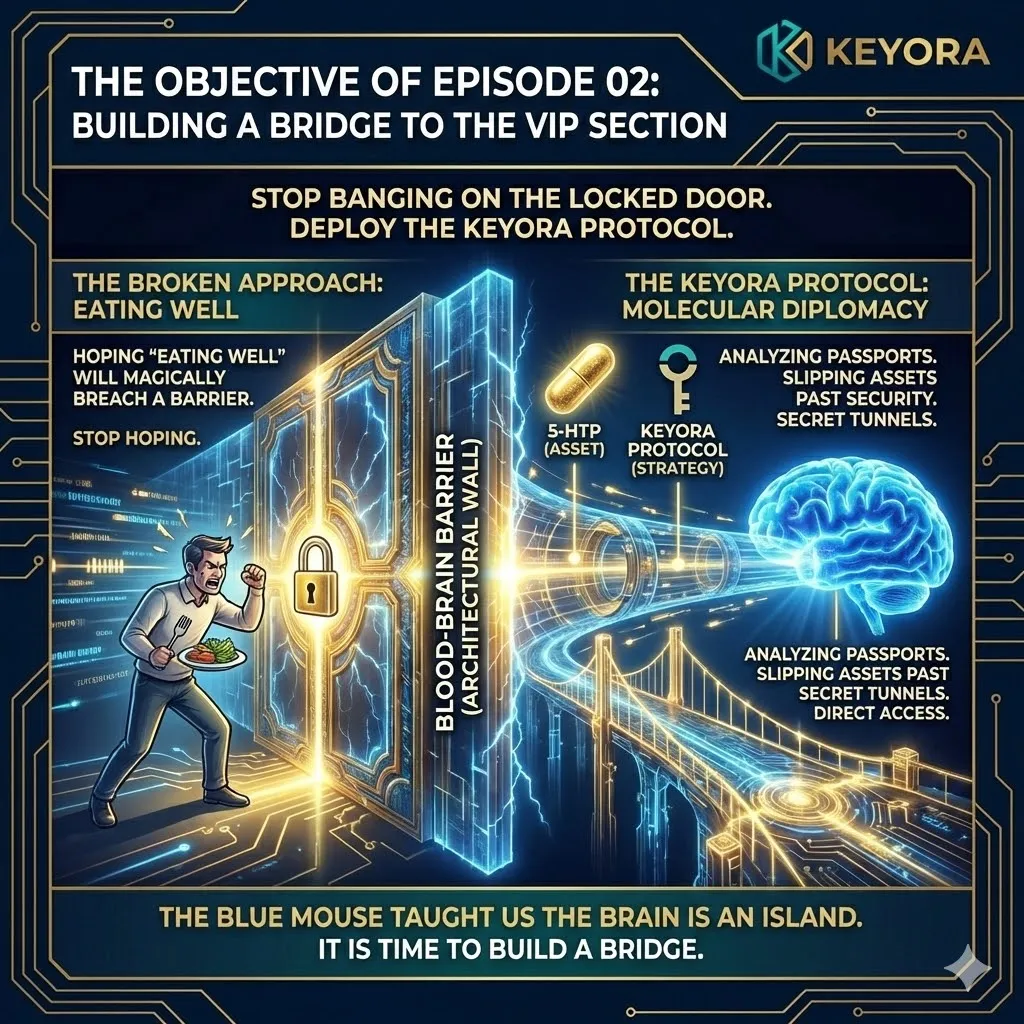
In this episode, we are going to stop banging on the locked door.
We are going to stop hoping that “eating well” will magically breach a barrier designed to keep molecules out.
We are going to study the architecture of the Wall.
We are going to analyze the specific “Passports” that the bouncer respects.
And we are going to deploy the Keyora Protocol – a strategy of molecular diplomacy designed to slip the assets (5-HTP) past the security, through the secret tunnels, and directly into the VIP section where they belong.
The Blue Mouse taught us that the brain is an island.
It is time to build a bridge.
CHAPTER I: THE ANATOMY OF EXCLUSION – INSIDE THE FORTRESS WALLS
A Forensic Tour of Tight Junctions, Lipid Bilayers, and the Evolution of the Brain’s “Zero Trust” Security Protocol.
If you walk through the R&D department of any major pharmaceutical company, you will eventually find a specific department shrouded in a unique kind of quiet despair. It is the Neurology Division.
This is the graveyard of modern medicine.
Billions of dollars, decades of research, and thousands of brilliant molecules have died here.
We have engineered drugs that can theoretically cure Alzheimer’s plaques.
We have synthesized compounds that can arrest Parkinson’s tremors.
We have designed potent neuro-protective agents that work perfectly in a petri dish.
But when we inject them into a living human, they fail.
They circulate in the blood, potent and ready, but they never reach the target.
They are stopped cold at the threshold of the central nervous system.
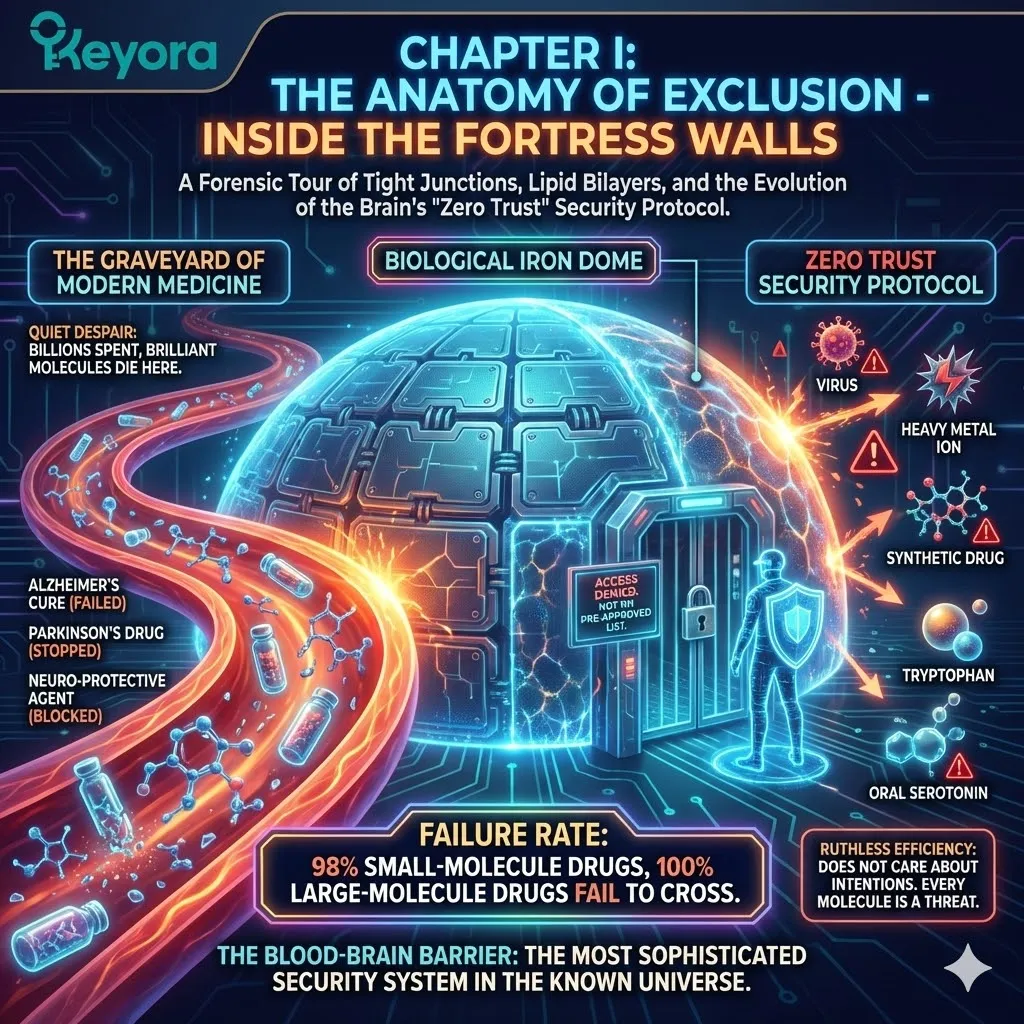
The statistics are sobering: 98% of all small-molecule drugs and 100% of large-molecule drugs developed by medical science fail to cross the Blood-Brain Barrier (BBB).
This failure rate is not due to a lack of chemical ingenuity. It is due to the ruthless efficiency of the barrier itself.
The Blood-Brain Barrier is the Biological Iron Dome.
It is the most sophisticated, unforgiving, and impenetrable security system in the known universe.
It does not care about your intentions.
It does not care that you are trying to save the neuron from degeneration.
It does not care that you are trying to deliver Serotonin to cure depression.
To the BBB, every molecule that is not on the “Pre-Approved List” is a threat.
-
A virus is a threat.
-
A heavy metal is a threat.
-
A synthetic drug is a threat.
-
And yes, generic Tryptophan and oral Serotonin are treated as threats.
The Illusion of Access
For the average person – and indeed, for many well-meaning nutritionists – the human body is viewed as a single, continuous vessel. We imagine that if we swallow a pill, it dissolves into the blood, and the blood takes it everywhere, like a river irrigating a field.
This is a dangerous illusion.
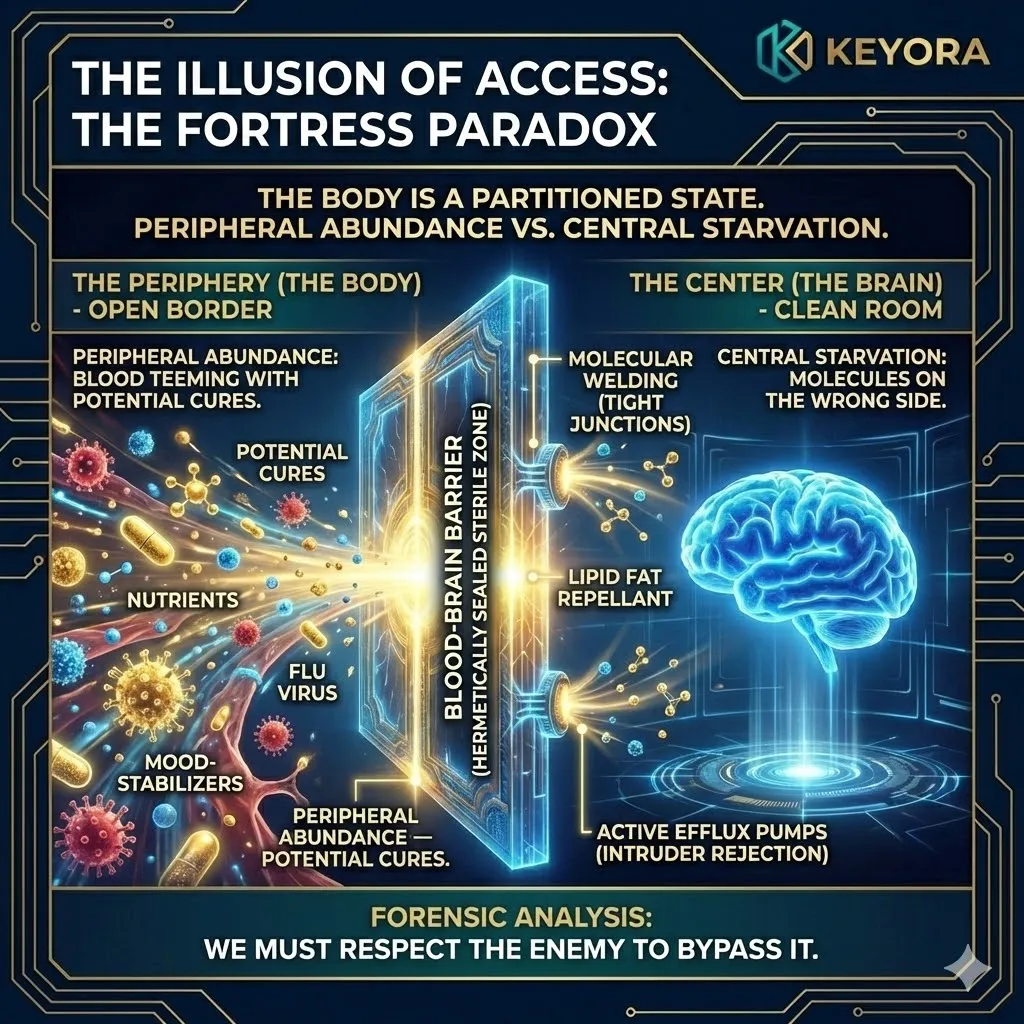
The body is not a field; it is a partitioned state.
The blood that washes over your liver and muscles is fundamentally different from the fluid that bathes your neurons.
-
The Periphery (The Body): A permissive environment. Capillaries here are leaky. They allow nutrients, hormones, and even mild toxins to drift in and out of tissues freely. It is an “Open Border” policy.
-
The Center (The Brain): A hermetically sealed sterile zone. It is a “Clean Room.”
This creates the central conflict of The Fortress Paradox.
The fortress is designed to keep you safe.
It prevents the flu virus in your blood from becoming encephalitis in your brain.
It prevents the mercury in your sushi from destroying your memory.
But this same fortress locks out the very things you desperately need.
It locks out the mood-stabilizers.
It locks out the neuro-repair agents.
It locks out the raw materials of joy.
You are suffering from anxiety and burnout not because the molecules don’t exist, but because they are on the wrong side of the wall.
You have Peripheral Abundance – your blood is teeming with potential cures – but Central Starvation.
In this chapter, we will strip away the skin and skull to look directly at this wall.
We will not use vague terms like “barrier.”
We will use the forensic language of anatomy.
We will examine the molecular welding that seals the cracks, the lipid fat that repels the water, and the active guards that throw intruders back into the street.
We must respect the enemy before we can bypass it.
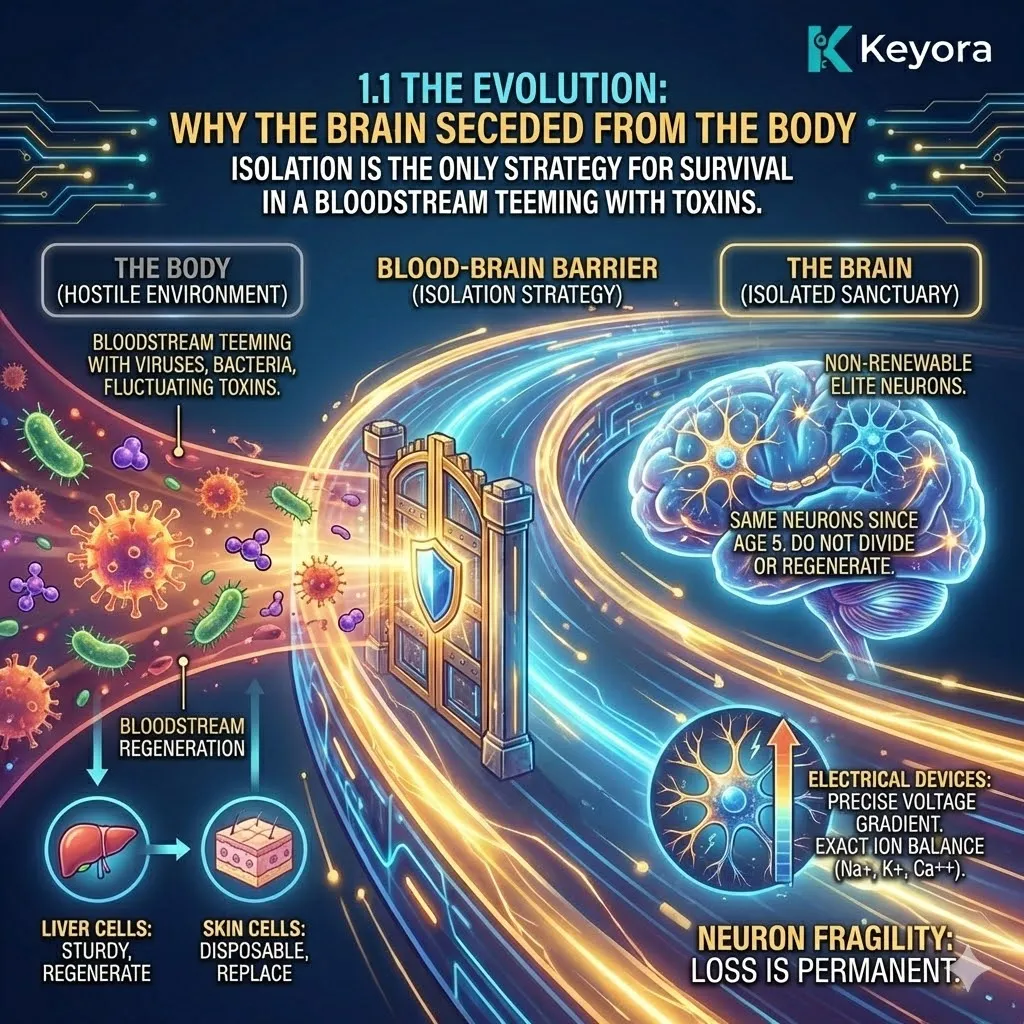
1.1 THE EVOLUTION: Why the Brain Seceded from the Body
In a Bloodstream Teeming with Viruses, Bacteria, and Fluctuating Toxins, Isolation is the Only Strategy for Survival.
To understand why the Blood-Brain Barrier is so hostile to your supplements, we must first ask:
Why does it exist at all?
Why did evolution go to such extreme lengths to isolate the brain from the rest of the body?
The answer lies in the fundamental fragility of the Neuron.
The High-Stakes Hardware
Your liver cells are sturdy. If they are damaged by alcohol or toxins, they can regenerate.
Your skin cells slough off and replace themselves every few weeks. They are “disposable” hardware.
Neurons are different.
They are the Non-Renewable Elite.
Most of the neurons you have today are the same ones you had when you were five years old. They do not divide. They do not regenerate. If a neuron dies, the memory, skill, or function it held is often lost forever.
Furthermore, neurons are electrical devices.
They function by maintaining a precise, microscopic voltage gradient across their membranes.
They rely on the exact balance of ions (Sodium, Potassium, Calcium) to fire signals.
The Chaos of the Bloodstream
Now, consider the environment of the bloodstream.
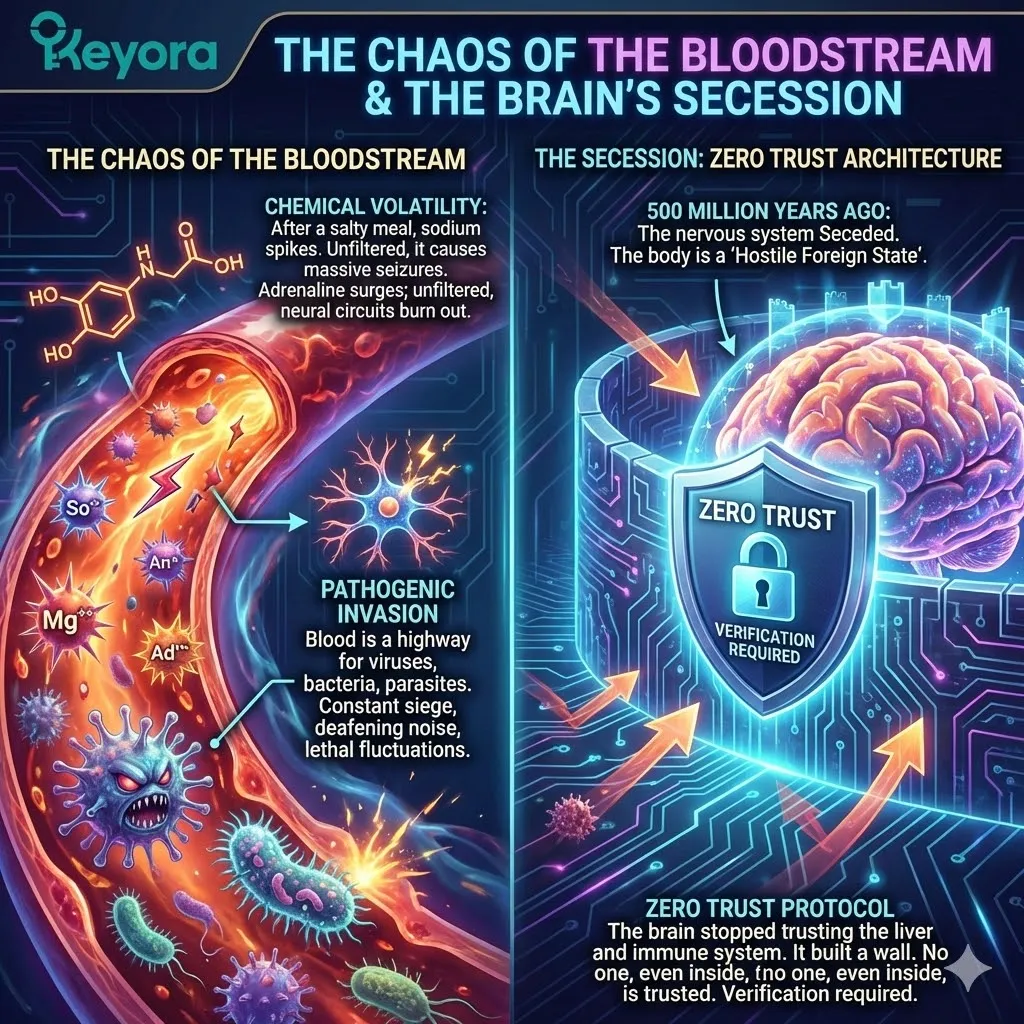
The blood is a chaotic, volatile, and dirty sewer.
-
Chemical Volatility: After you eat a salty meal, sodium levels spike. If this blood touched your neurons directly, the sudden influx of sodium would cause them to fire uncontrollably. You would have a massive seizure and die.
-
Hormonal Storms: When you are stressed, Adrenaline surges. If this hit the brain unfiltered, your neural circuits would burn out from over-excitation.
-
Pathogenic Invasion: Your blood is the highway for viruses, bacteria, and parasites seeking a host.
If the brain were connected to the general blood supply, it would be under constant siege. The electrical noise would be deafening. The chemical fluctuations would be lethal.
The Secession: Zero Trust Architecture
About 500 million years ago, in the evolutionary leap from simple invertebrates to complex vertebrates, the nervous system made a strategic decision.
It Seceded.
It decided that the body was too dangerous a place to live in without protection.
It built a wall.
It established a Zero Trust Architecture.
In cybersecurity, “Zero Trust” means that no one – not even users inside the network – is trusted by default. Verification is required from everyone.
The brain adopted this exact protocol.
-
It stopped trusting the liver to detoxify everything.
-
It stopped trusting the immune system to kill every invader.
-
It decided to treat the rest of the body as a “Hostile Foreign State.”
The Result: The Sterile Chamber
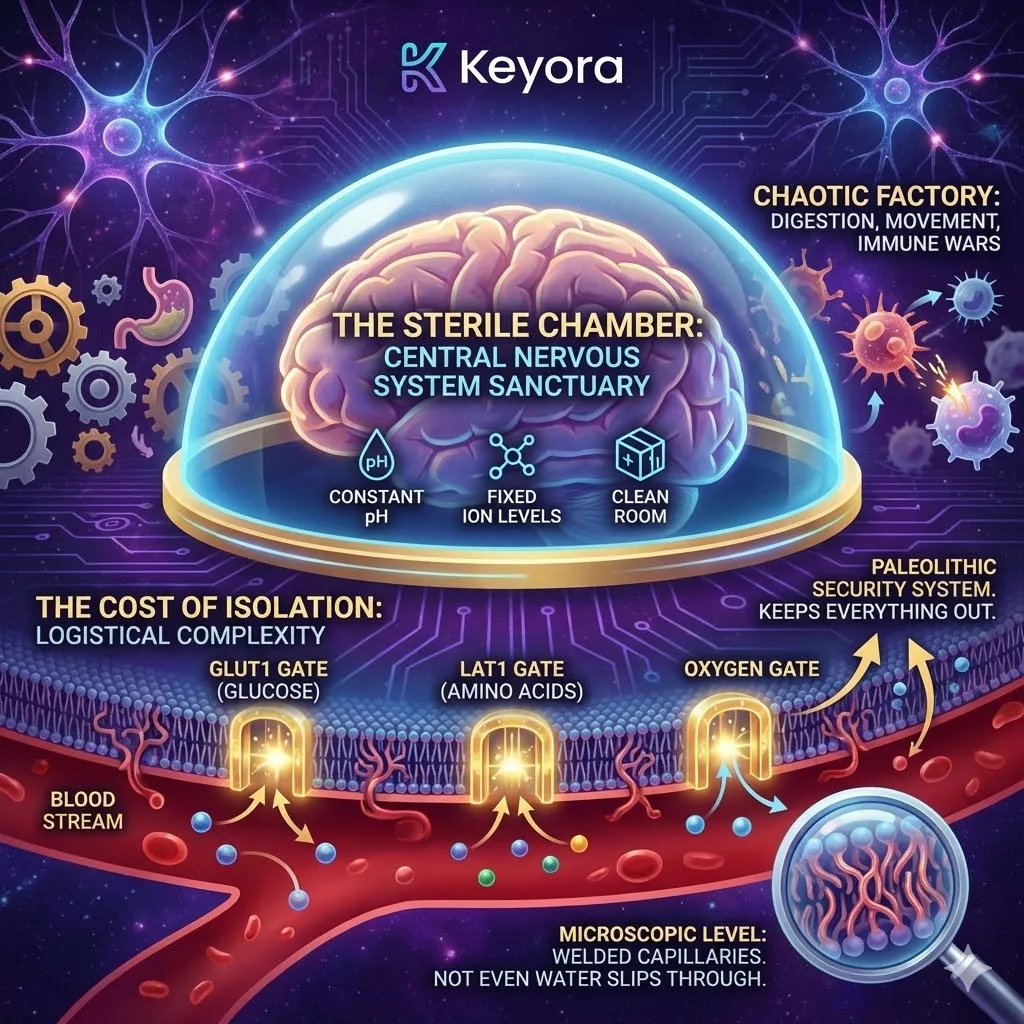
This secession created a protected sanctuary: The Central Nervous System (CNS).
Inside this sanctuary, the environment is perfectly controlled. The pH is constant. The ion levels are fixed to the decimal point. It is a “Clean Room” floating in the middle of a chaotic factory.
This isolation allowed the brain to become complex. It allowed for delicate thought, for memory, for consciousness.
These high-level functions are only possible because the hardware is shielded from the noise of digestion, muscle movement, and immune wars.
The Cost of Isolation
But this survival strategy came with a heavy price: Logistical Complexity.
Because the brain cut itself off from the blood, it also cut itself off from the food supply.
Every single molecule the brain needs – Glucose for energy, Oxygen for breath, Amino Acids for repair – must be imported through specific, guarded gates.
-
There is a gate for Glucose (GLUT1).
-
There is a gate for Amino Acids (LAT1).
-
There is a gate for Oxygen.
If a molecule does not have a designated gate, it does not get in.
This is the root of your problem.
Evolution designed gates for survival nutrients (Sugar, Oxygen). It did not prioritize gates for optimization nutrients. It did not anticipate that 21st-century humans would need to artificially boost their Serotonin levels to combat digital burnout.
We are living with a security system designed for the Paleolithic era. It is doing its job perfectly: It is keeping everything out. Including the help you are trying to send.
In the next section, we will zoom in to the microscopic level.
We will look at the physical structure of this wall.
We will see how the brain “welded” its capillaries shut, creating a barrier so tight that not even a single water molecule can slip between the cracks without permission.
1.2 THE STRUCTURE: The “No-Gap” Policy
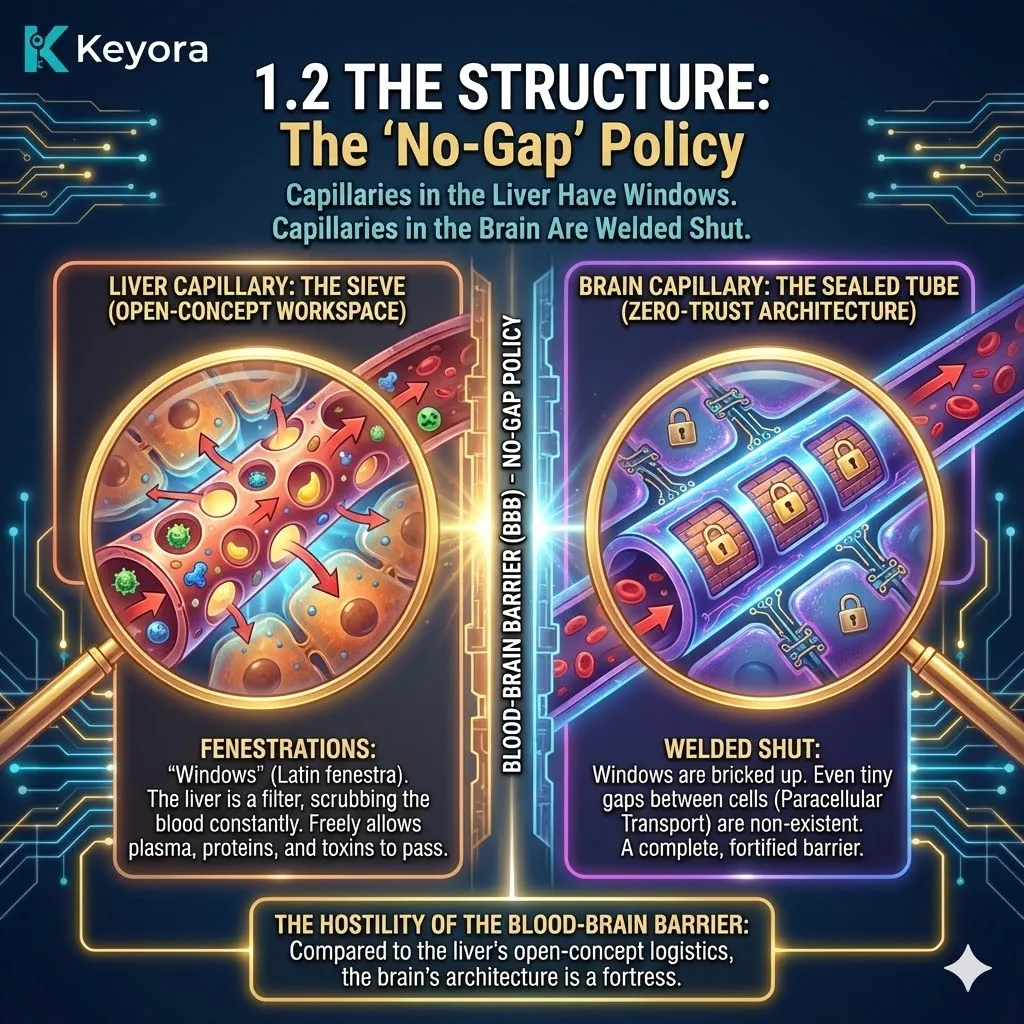
Capillaries in the Liver Have Windows. Capillaries in the Brain Are Welded Shut.
To truly appreciate the hostility of the Blood-Brain Barrier, we must first look at how the rest of your body handles logistics.
Let us place a microscope over a capillary in your Liver.
What you see looks less like a pipe and more like a sieve. The endothelial cells (the cells that make up the wall of the blood vessel) are riddled with holes. These holes are called Fenestrations (from the Latin fenestra, meaning “window”).
-
The Logic: The liver is a filter. It needs to scrub the blood constantly. To do this, it allows plasma, proteins, and toxins to wash freely out of the blood and into the liver cells. It is an open-concept workspace.
Now, let us move the microscope to the Brain.
The architecture changes instantly.
The capillaries here are not sieves. They are sealed tubes.
The Fenestrations are gone.
The windows are bricked up. But the brain goes even further.
In the rest of the body, even without windows, there are tiny gaps between the cells – small spaces where fluid can leak through (Paracellular Transport).
In the brain, these gaps are non-existent.
The Molecular Welding: Tight Junctions
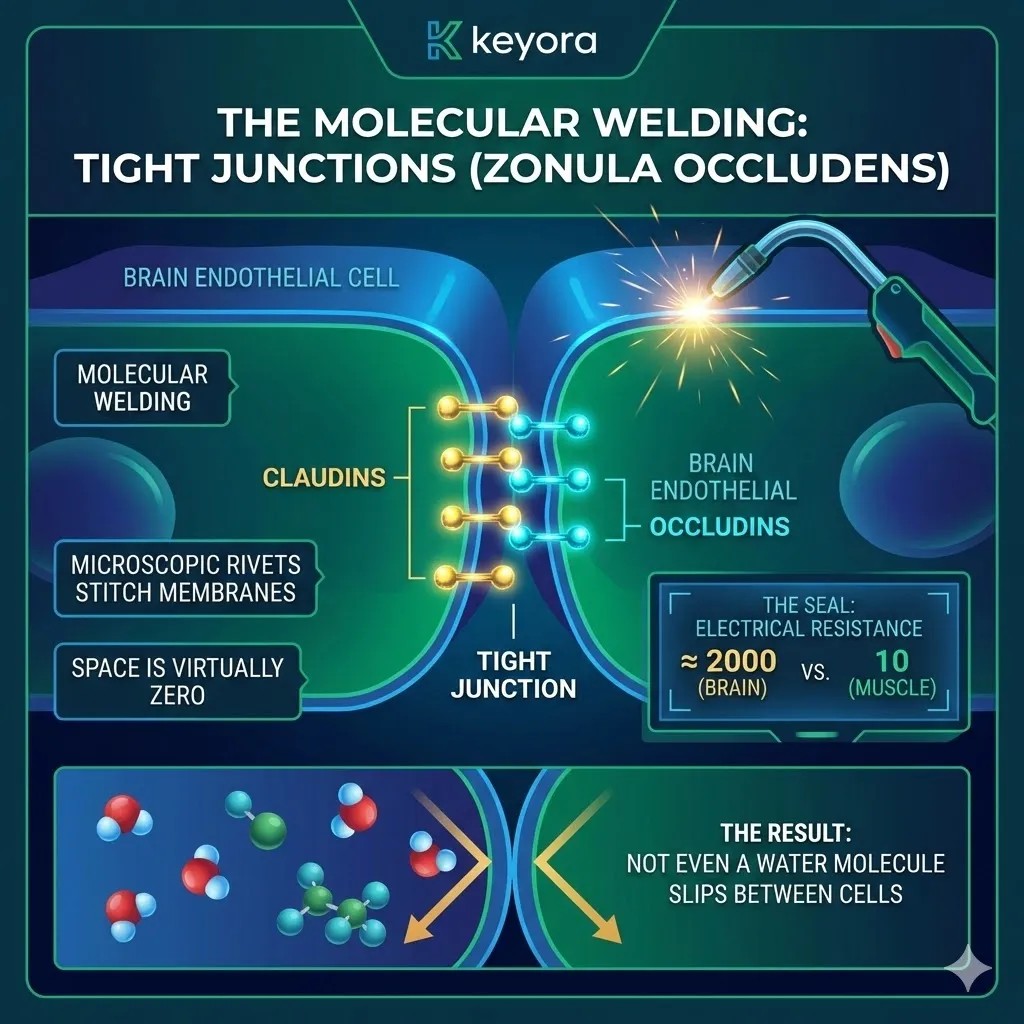
The endothelial cells of the brain are fused together by a specific, impenetrable structure known as the Tight Junction (or Zonula Occludens).
This is not merely cells touching each other.
This is Molecular Welding.
Specific proteins – Claudins and Occludins – act like microscopic rivets. They stitch the membranes of adjacent cells together so tightly that the space between them is virtually zero.
-
The Seal: It creates an electrical resistance of nearly 2000 Ω·cm² (compared to just 10 Ω·cm² in muscle).
-
The Result: Not even a single molecule of water, let alone a large nutrient molecule, can slip between the cells.
The “No-Gap” Policy
This architectural decision has profound implications for your supplements.
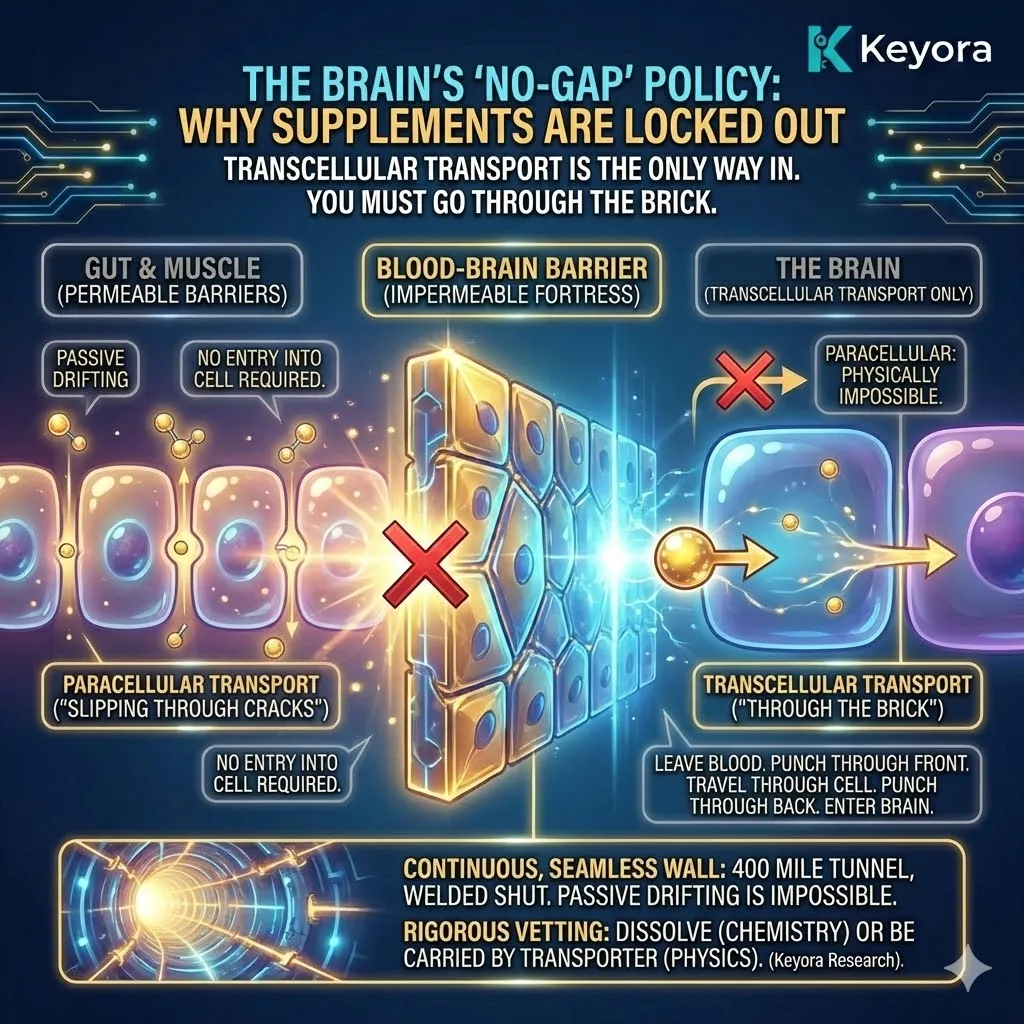
In the gut or the muscle, a molecule can often “slip through the cracks.” It doesn’t need to enter the cell; it just needs to squeeze between them.
In the brain, Paracellular Transport is physically impossible.
This means there is only one way in: Transcellular Transport.
You cannot go between the bricks.
You must go through the brick.
You must:
-
Leave the blood.
-
Punch through the front membrane of the endothelial cell.
-
Travel through the cell cytoplasm.
-
Punch through the back membrane.
-
Enter the brain.
This turns a passive “drifting” process into a rigorous “vetting” process. To go through the cell, you must either dissolve into the membrane (Chemistry) or be carried by a transporter (Physics).
The brain has effectively built a continuous, seamless wall around its entire vascular network. It is a tunnel system 400 miles long (the total length of brain capillaries), and every single inch of it is welded shut
.
1.3 THE CHEMISTRY: Oil, Water, and Rejection
Why Serotonin (Polar) Bounces Off the Wall (Lipid), While Alcohol Glides Right Through.
If the Tight Junctions represent the “Physical Wall” (blocking the gaps), then the cell membrane itself represents the “Chemical Wall.”
This is where the laws of physics become your enemy.
To understand why you can get drunk in minutes, but it takes weeks to fix your mood, you must understand the chemistry of the Lipid Bilayer.
The Lipid Firewall
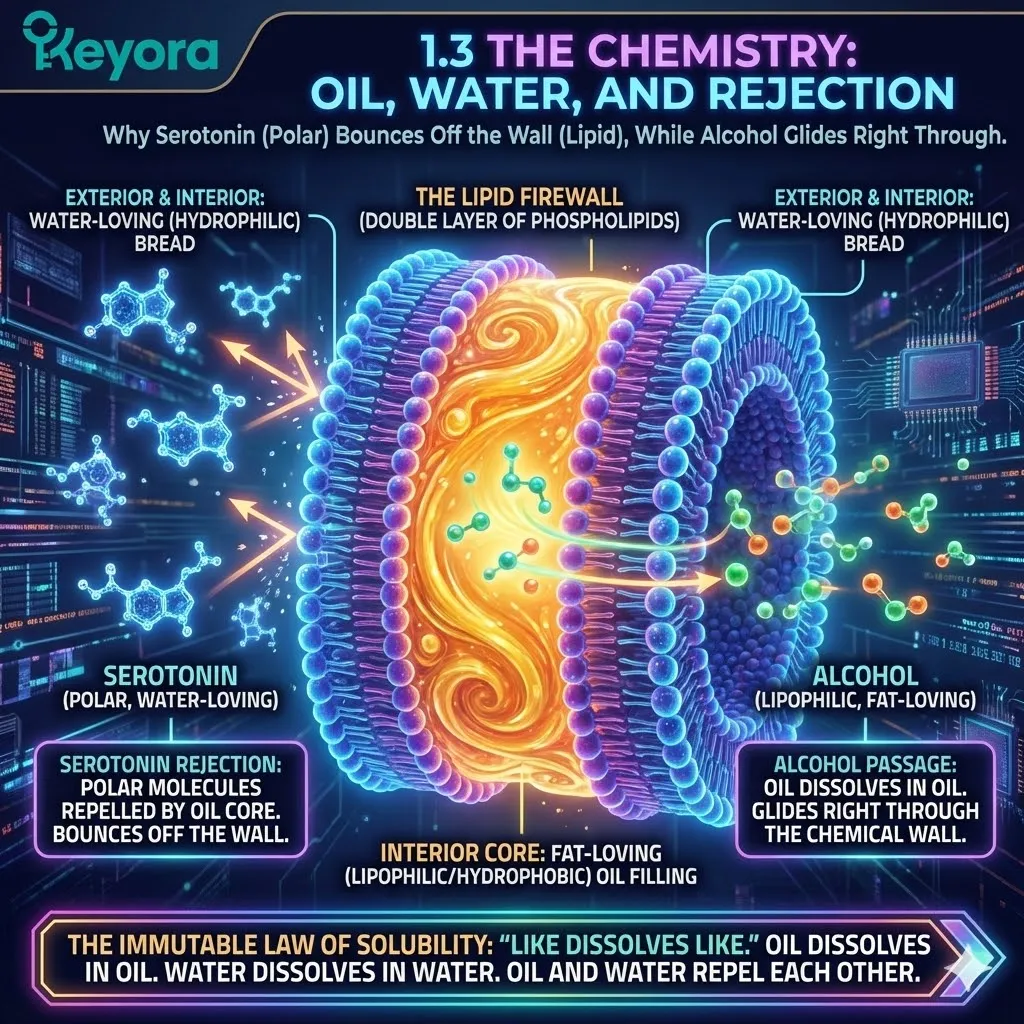
Every cell in your body is wrapped in a skin made of fat. Specifically, a double layer of phospholipids.
-
The Exterior: Water-loving (Hydrophilic).
-
The Interior Core: Fat-loving (Lipophilic/Hydrophobic).
Think of the cell membrane as a sandwich. The bread is water-friendly, but the filling is a thick layer of oil.
Here is the immutable law of solubility: “Like Dissolves Like.”
-
Oil dissolves in oil.
-
Water dissolves in water.
-
Oil and water repel each other.
The Ghost: Alcohol
Why does a Martini affect your brain almost instantly?
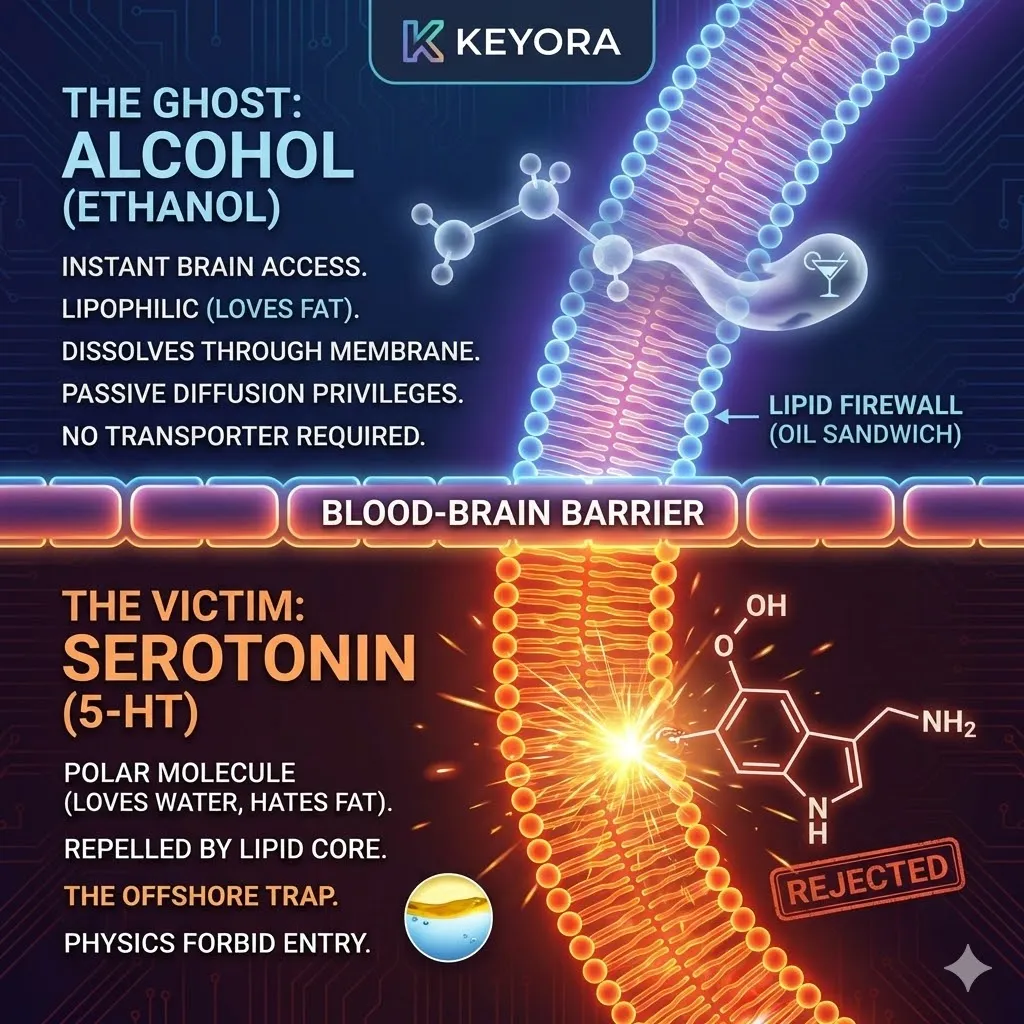
Because Ethanol (Alcohol) is Lipophilic. It loves fat.
When an alcohol molecule hits the Blood-Brain Barrier, it sees the “Oil Sandwich” not as a wall, but as a door.
It dissolves right into the lipid membrane, floats through the oily core, and pops out the other side into the brain.
It is a ghost. It walks through walls.
No transporter required.
No energy required.
It has Passive Diffusion privileges.
The Victim: Serotonin
Now, look at Serotonin (and its raw precursor, Tryptophan).
Serotonin is a Polar Molecule. It is loaded with hydroxyl (-OH) and amine (-NH2) groups. These groups love water. They hate fat.
When Serotonin circulating in your blood (remember, 95% is in the gut/blood) hits the Blood-Brain Barrier, it crashes into the Lipid Firewall.
-
The Serotonin tries to enter the membrane.
-
The oily core of the membrane repels the charged polar groups.
-
Rejection. The molecule bounces off.
This is the molecular explanation for The Offshore Trap.
It doesn’t matter how much Serotonin you have in your blood. It acts like water trying to mix with oil. The physics of the membrane forbid it from entering.
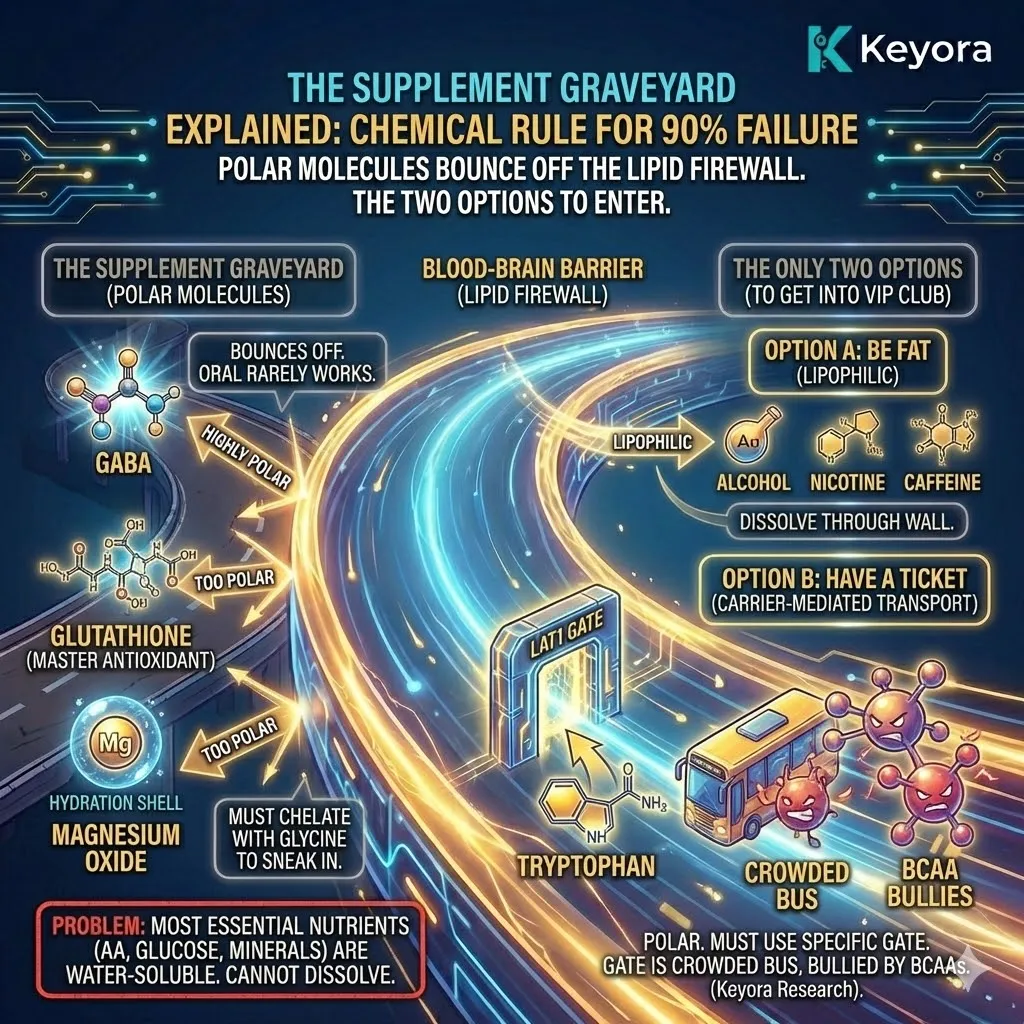
The Supplement Graveyard Explained
This chemical rule explains the failure of 90% of “Brain Health” supplements.
-
GABA supplements: GABA is highly polar. It bounces off the lipid firewall. (This is why oral GABA rarely works for anxiety unless it’s modified).
-
Glutathione: The master antioxidant. Too polar. Bounces off.
-
Magnesium Oxide: The ion is trapped in a hydration shell of water. Too polar. Bounces off. (This is why we must chelate it with Glycine to sneak it in).
The Only Two Options
So, if you are a molecule trying to get into the VIP club, you have only two options:
Option A: Be Fat (Lipophilic).
Be like Alcohol, Nicotine, or Caffeine. Dissolve through the wall.
Problem: Most essential nutrients (Amino Acids, Glucose, Minerals) are not fat; they are water-soluble. They cannot use this method.
Option B: Have a Ticket.
If you cannot dissolve through the wall, you must find a specific “Gate” embedded in the wall that recognizes you and carries you across.
This is Carrier-Mediated Transport.
This brings us back to the tragedy of Tryptophan.
Tryptophan is polar. It cannot dissolve through the wall (Option A).
It must use a Gate (Option B).
It has a ticket for the LAT1 Gate.
But as we learned in the previous episode, the LAT1 Gate is a crowded bus, and Tryptophan is getting bullied by the BCAAs.
Summary of the Barrier
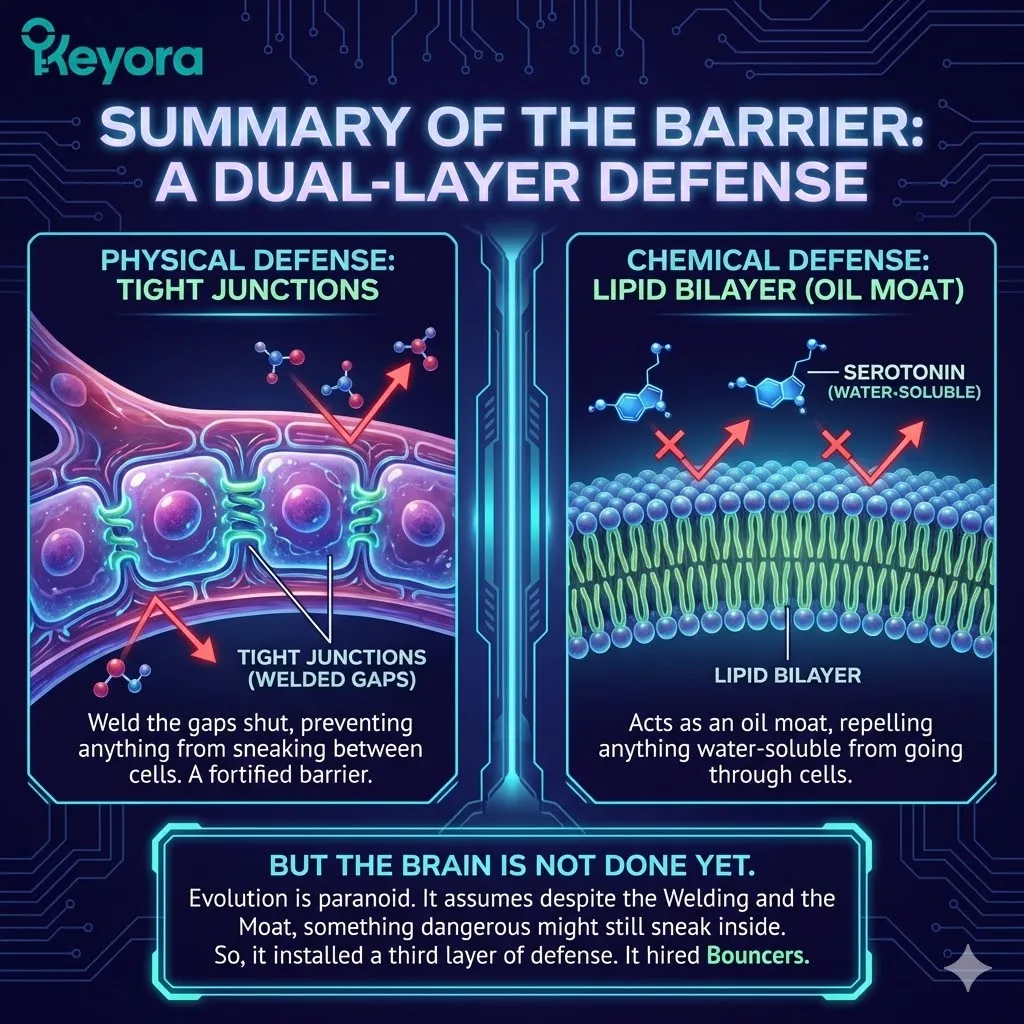
The Blood-Brain Barrier is a dual-layer defense:
-
Physical Defense: Tight Junctions weld the gaps shut, preventing anything from sneaking between cells.
-
Chemical Defense: The Lipid Bilayer acts as an oil moat, repelling anything water-soluble (like Serotonin) from going through cells.
But the brain is not done yet.
Evolution is paranoid. It assumes that despite the Welding and the Moat, something dangerous might still sneak inside.
So, it installed a third layer of defense.
It hired Bouncers.
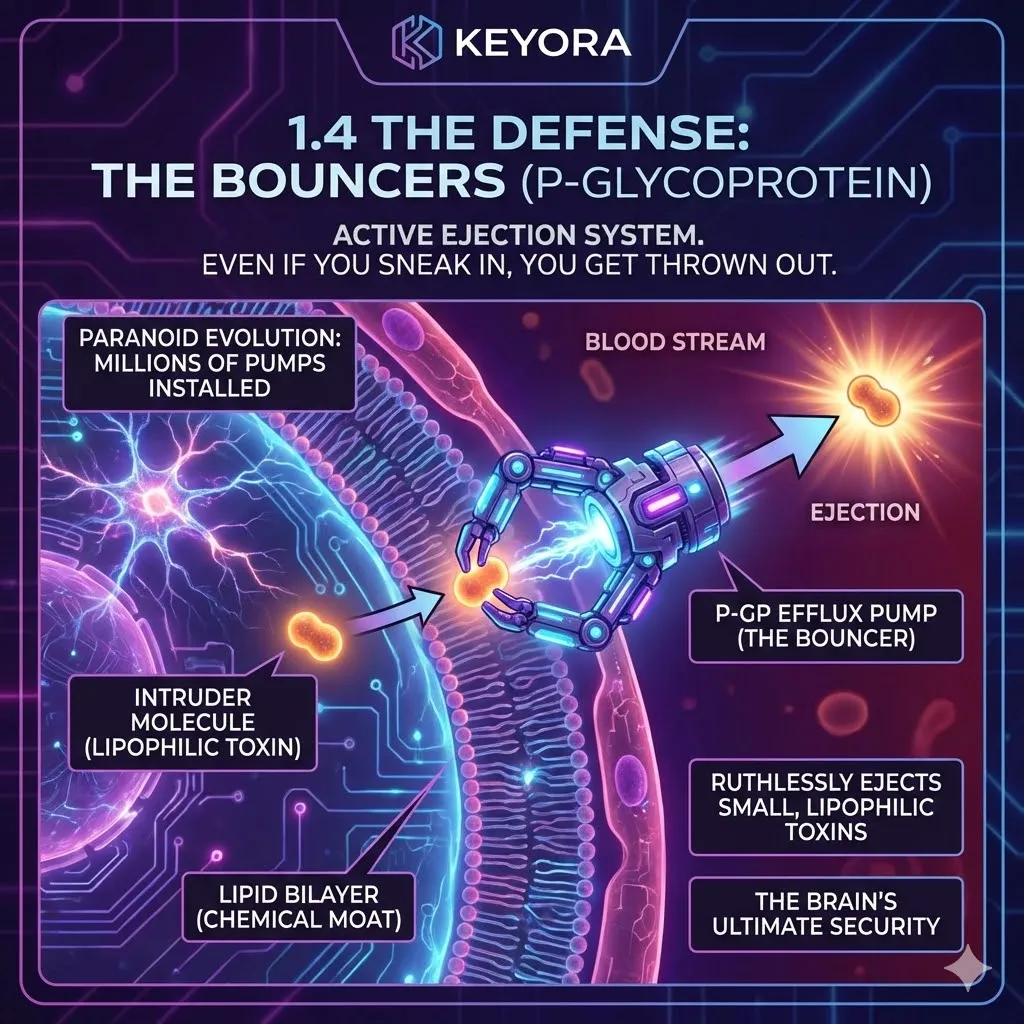
1.4 THE DEFENSE: The Bouncers (P-Glycoprotein)
Even If You Sneak In, You Get Thrown Out. The Brain’s Active Ejection System.
We have established that the brain is protected by a welded Physical Wall (Tight Junctions) and a repellent Chemical Moat (Lipid Bilayer).
But the evolutionary architects of the nervous system were paranoid.
They knew that biology is messy.
They anticipated that certain molecules – particularly small, lipophilic toxins found in plants – might manage to dissolve through the lipid membrane and breach the perimeter.
So, they installed an Active Defense System.
They lined the inner walls of the blood vessels with millions of microscopic bouncers. These bouncers are called Efflux Pumps. The most famous and ruthless among them is P-Glycoprotein (P-gp).
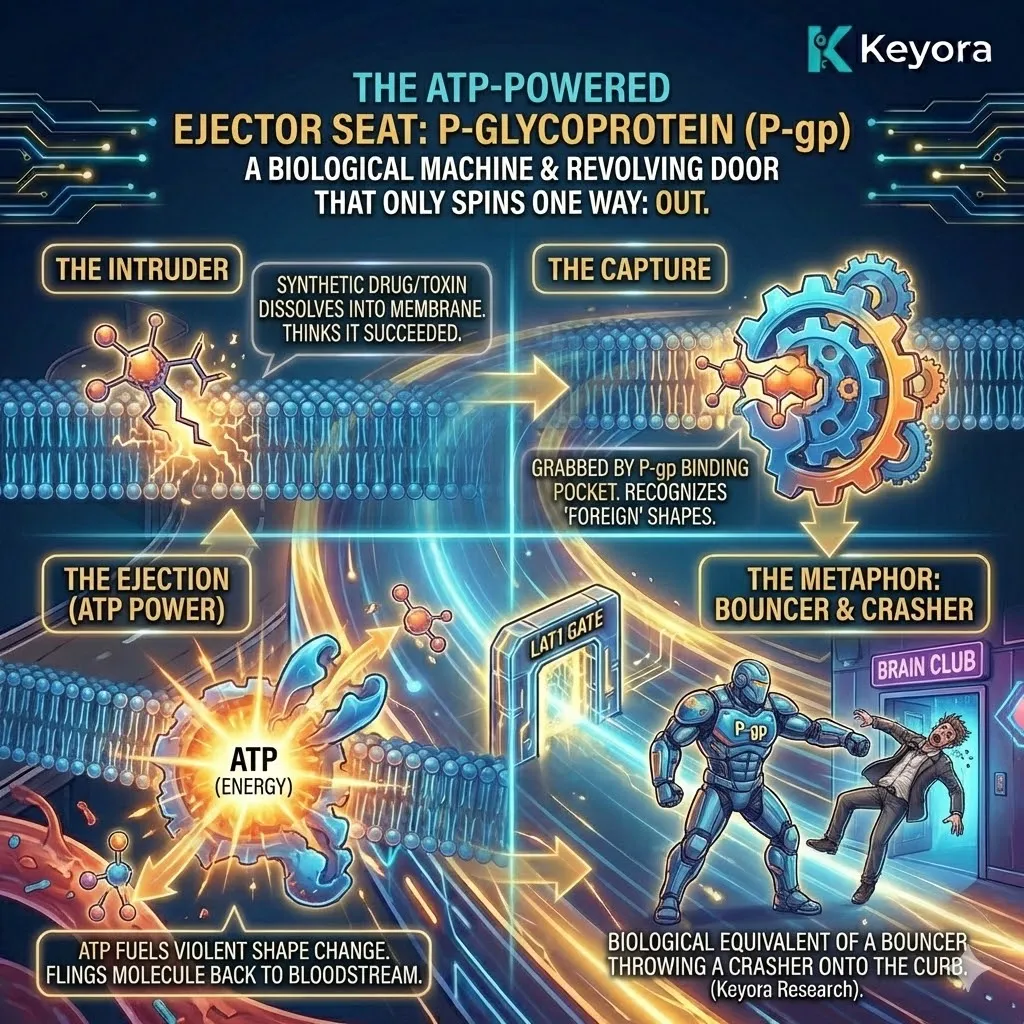
The ATP-Powered Ejector Seat
P-Glycoprotein is not a static barrier.
It is a biological machine.
It sits embedded in the cell membrane, acting like a revolving door that only spins one way:
Out.
Here is how it works:
The Intruder:
Imagine a synthetic drug or a plant toxin manages to dissolve into the lipid membrane. It thinks it has succeeded. It starts to drift toward the brain side of the cell.
The Capture:
Suddenly, it is grabbed. P-gp has a binding pocket that recognizes a vast array of “foreign” shapes (xenobiotics).
The Ejection:
Using ATP (energy) as fuel, the P-gp pump changes shape violently. It physically flings the molecule back out of the cell membrane and dumps it back into the bloodstream.
It is the biological equivalent of a bouncer grabbing a crasher by the collar and throwing them back onto the curb.
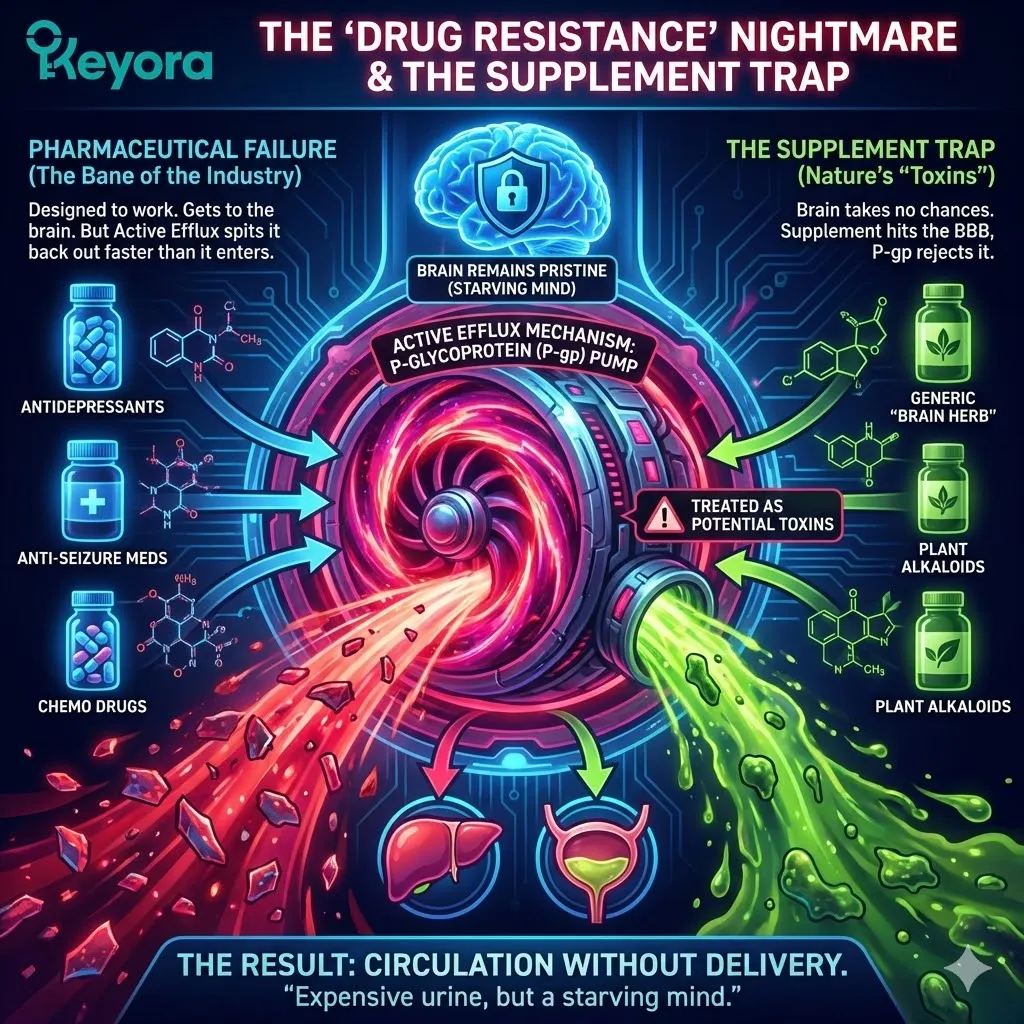
The “Drug Resistance” Nightmare
This mechanism is the bane of the pharmaceutical industry. It is the primary reason why many antidepressants, anti-seizure medications, and chemotherapy drugs fail.
-
The drug is designed to work.
-
The drug gets to the brain.
-
But before it can touch the neuron, Active Efflux kicks in. The brain spits the drug back out faster than it can enter.
The Supplement Trap
This also explains the failure of many herbal supplements claiming to “boost brain function.”
Many plant alkaloids (the active compounds in herbs) are treated by the brain as potential toxins. Nature is full of poisons, and the brain takes no chances.
-
You take a generic “Brain Herb.”
-
It absorbs into the blood.
-
It hits the BBB.
-
P-gp rejects it.
The brain remains pristine. The supplement circulates in the blood until the liver breaks it down. You have expensive urine, but a starving mind.
The Zero Trust Reality
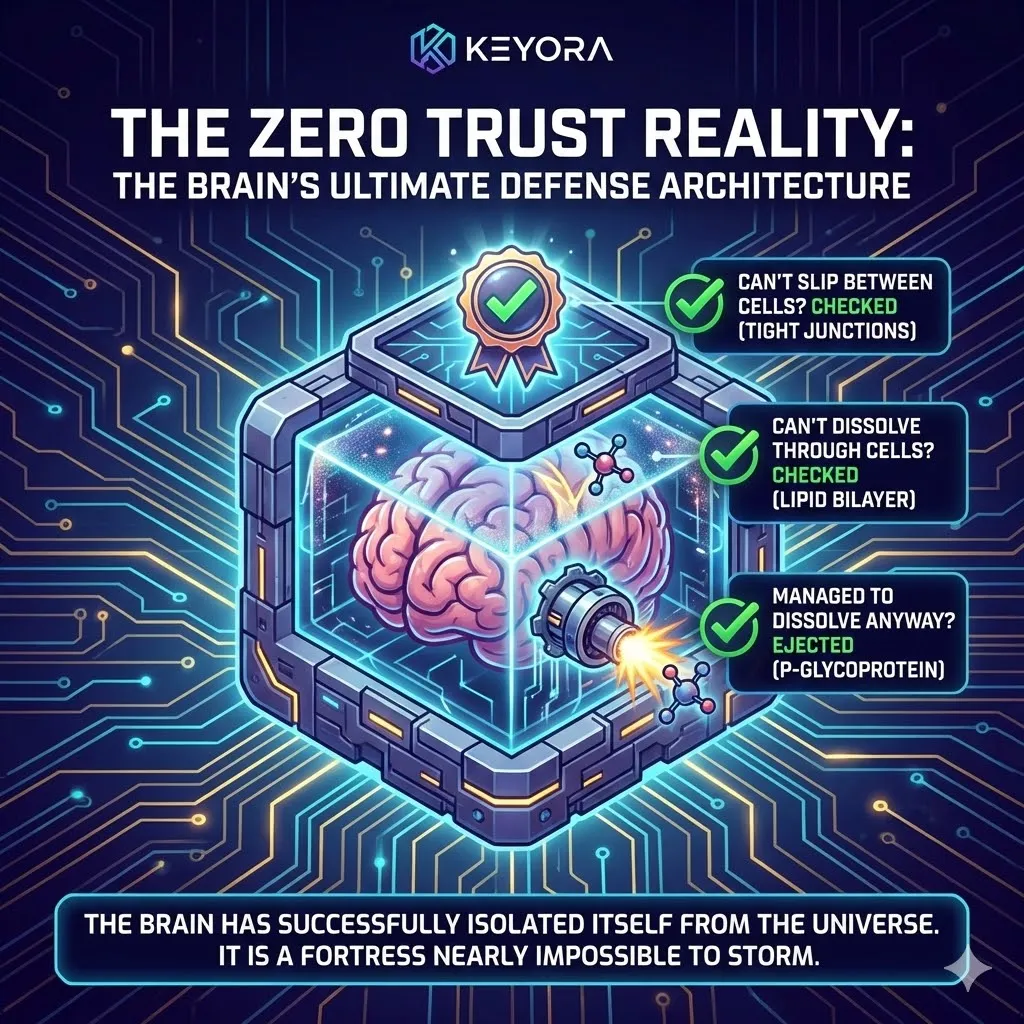
This completes the picture of the brain’s defense. It is a Zero Trust Architecture of the highest order.
-
Can’t slip between cells? Checked (Tight Junctions).
-
Can’t dissolve through cells? Checked (Lipid Bilayer).
-
Managed to dissolve anyway? Ejected (P-glycoprotein).
The brain has successfully isolated itself from the universe. It is a fortress that is nearly impossible to storm.
1.5 CONCLUSION: Security Comes at a Cost
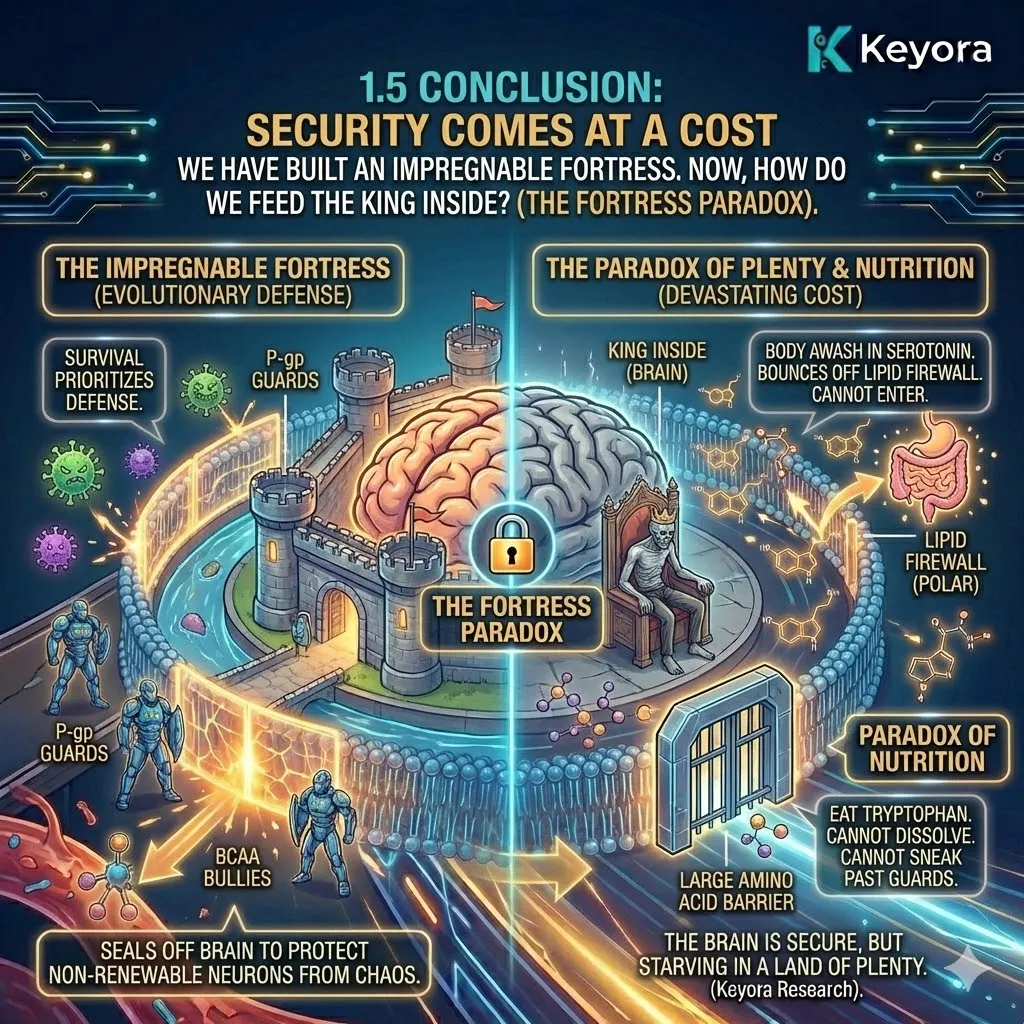
We Have Built an Impregnable Fortress. Now, How Do We Feed the King Inside?
We have concluded our forensic tour of the Blood-Brain Barrier.
We have seen the welding, the moat, and the guards.
We now understand why the “Blue Mouse” had a white brain.
The evolutionary logic is sound: Survival prioritizes Defense.
By sealing itself off, the brain protected its non-renewable neurons from the chaos of the bacterial world. It ensured that you could survive an infection without losing your mind.
But this security comes at a devastating cost.
This is The Fortress Paradox.
The wall is too perfect. It keeps out the toxins, yes. But it also locks out the very things the modern brain is desperate for.
-
The Paradox of Plenty: Your body (The Periphery) is awash in Serotonin. Your gut is producing it. Your blood is carrying it. But because Serotonin is polar, it bounces off the Lipid Firewall. It cannot enter.
-
The Paradox of Nutrition: You eat Tryptophan. But because Tryptophan is a large amino acid, it cannot dissolve through the wall. It cannot sneak past the guards.
The Only Way In
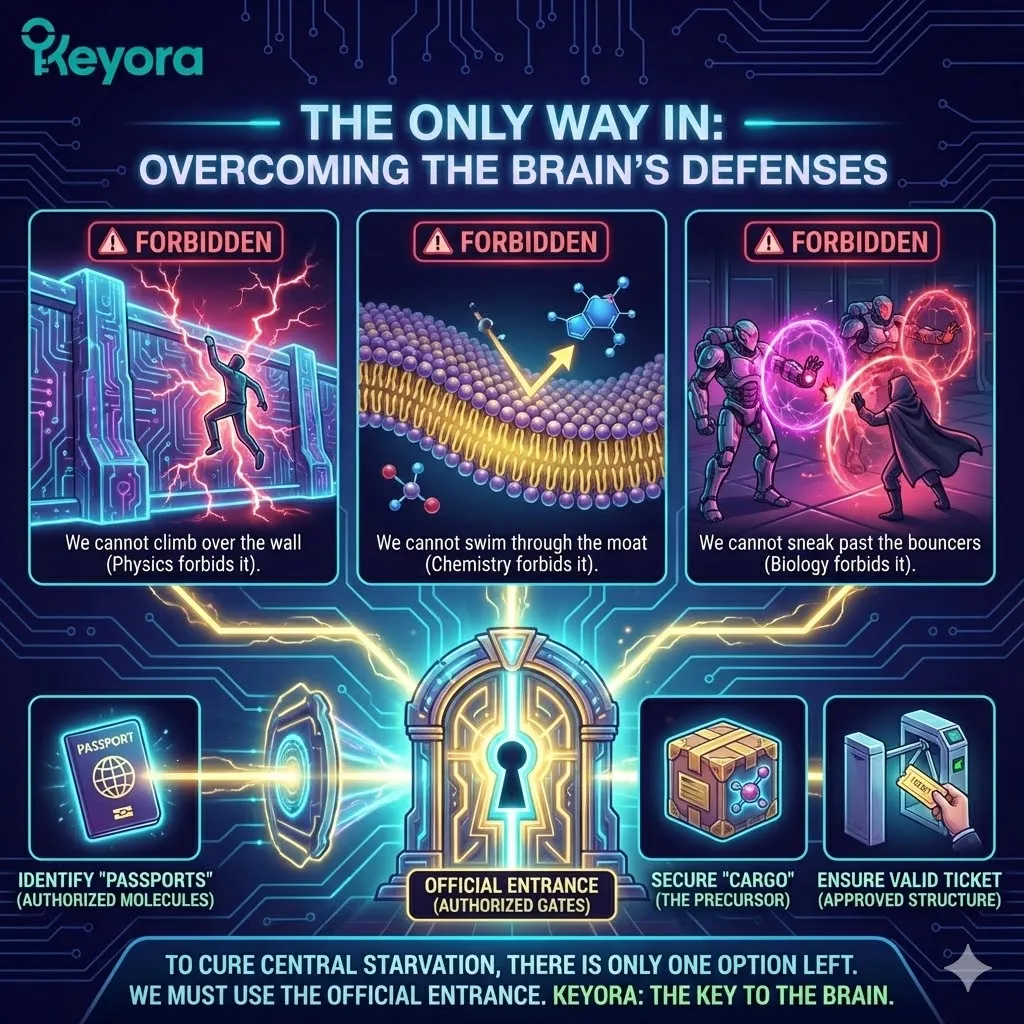
This leaves us with a chilling realization.
We cannot climb over the wall (Physics forbids it).
We cannot swim through the moat (Chemistry forbids it).
We cannot sneak past the bouncers (Biology forbids it).
If we want to cure Central Starvation, there is only one option left.
We must use the Official Entrance.
We must find the specific, authorized gates that evolution built to allow nutrients inside.
We must identify the “Passports” that these gates accept.
And we must make sure that our cargo (The Precursor) has a valid ticket.
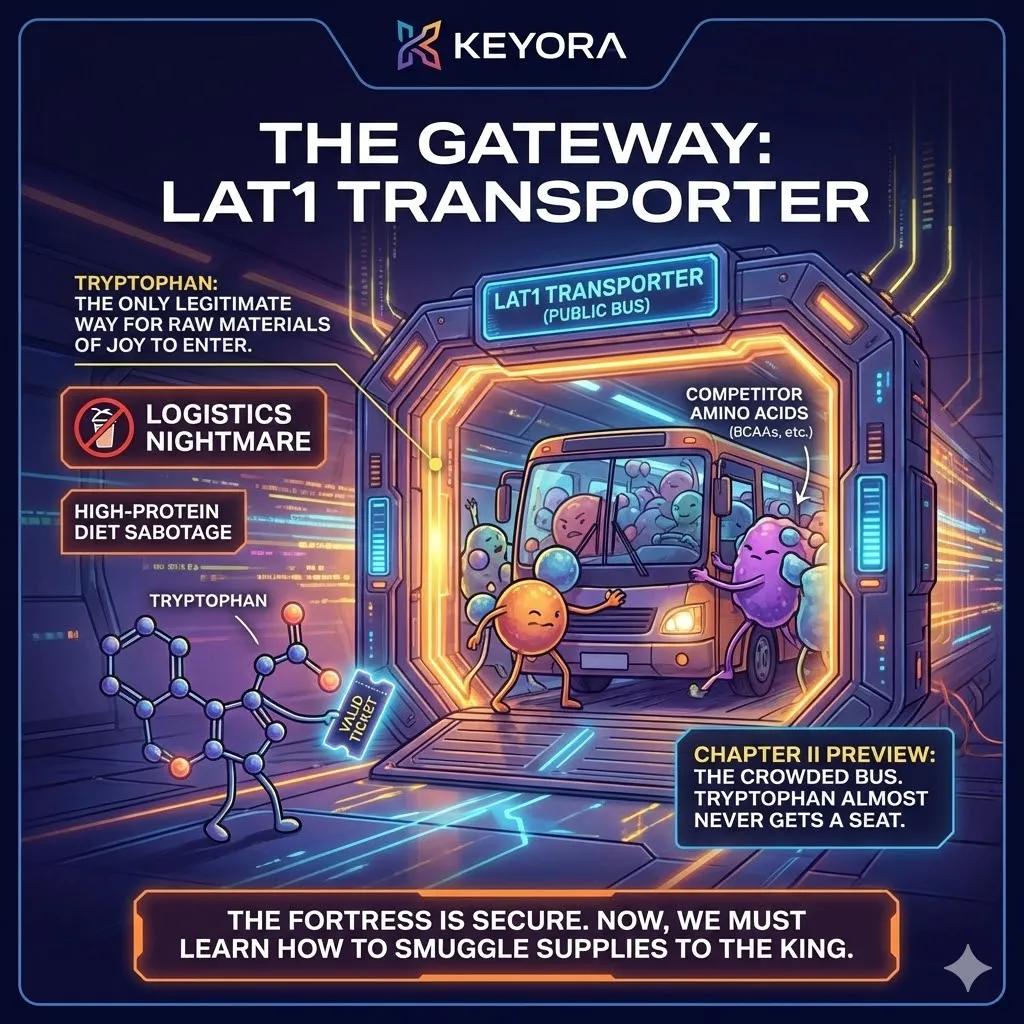
The Gateway: LAT1
There is such a gate for Tryptophan. It is called the LAT1 Transporter.
It is the only legitimate way for raw materials of joy to enter the brain.
But as we are about to discover in the next chapter, this gate has a problem. It is not a private entrance. It is a public bus. And it is crowded.
In Chapter II: The Crowded Bus, we will expose the “Logistics Nightmare” of the LAT1 transporter. We will learn why your high-protein diet is accidentally sabotaging your mental health, and why Tryptophan – despite having a valid ticket – almost never gets a seat.
The Fortress is secure.
Now, we must learn how to smuggle supplies to the King.
References
Comprehensive Bibliography for Series II, Episode 02 – Chapter I
Abbott, N. J., Patabendige, A. A., Dolman, D. E., Yusof, S. R., & Begley, D. J. (2010). Structure and function of the blood–brain barrier. Neurobiology of Disease, 37(1), 13-25.
Banks, W. A. (2016). From blood-brain barrier to blood-brain interface: new opportunities for CNS drug delivery. Nature Reviews Drug Discovery, 15(4), 275-292.
Daneman, R., & Prat, A. (2015). The blood–brain barrier. Cold Spring Harbor Perspectives in Biology, 7(1), a020412.
Ehrlich, P. (1885). Das Sauerstoff-Bedürfnis des Organismus: eine farbenanalytische Studie. Berlin: Hirschwald.
Goldmann, E. E. (1913). Vitalfärbung am Zentralnervensystem. Abhandlungen der Königlich Preussischen Akademie der Wissenschaften, 1, 1-60.
Hawkins, R. A., & Davis, T. P. (2005). The blood-brain barrier/neurovascular unit in health and disease. Pharmacological Reviews, 57(2), 173-185.
Jin, X., & Keyora Research. (2025a). 5-Hydroxytryptophan (5-HTP): A Clinically Relevant Precursor for Mood, Sleep, and Neurophysiological Stability. Keyora Research Institute. DOI: 10.5281/zenodo.16887092
Jin, X., & Keyora Research. (2025b). Keyora MoodFlow 8 in 1: Nutritional Neuro-Psychiatric Intervention for Mood, Sleep, and Cognitive Resilience. Keyora Research Institute. DOI: 10.5281/zenodo.16889527
Jin, X., & Keyora Research. (2025c). Keyora Neuro–Psycho–Sleep Framework: Nutritional Strategies for Depression, Anxiety, and Insomnia while Enhancing Cognitive Performance in High-Stress Individuals. OSF. DOI: 10.17605/OSF.IO/FZ62K
Löscher, W., & Potschka, H. (2005). Blood-brain barrier active efflux transporters: ATP-binding cassette gene family. NeuroRx, 2(1), 86-98.
Pardridge, W. M. (2005). The blood-brain barrier: bottleneck in brain drug development. NeuroRx, 2(1), 3-14.
Reese, T. S., & Karnovsky, M. J. (1967). Fine structural localization of a blood-brain barrier to exogenous peroxidase. Journal of Cell Biology, 34(1), 207-217.
Rubin, L. L., & Staddon, J. M. (1999). The cell biology of the blood-brain barrier. Annual Review of Neuroscience, 22(1), 11-28.
Saunders, N. R., Dreifuss, J. J., Dziegielewska, K. M., Johansson, P. A., Habgood, M. D., Møllgård, K., & Bauer, H. C. (2014). The rights and wrongs of blood-brain barrier permeability studies: a walk through 100 years of history. Frontiers in Neuroscience, 8, 404.
Sweeney, M. D., Zhao, Z., Montagne, A., Nelson, A. R., & Zlokovic, B. V. (2019). Blood-brain barrier: from physiology to disease and back. Physiological Reviews, 99(1), 21-78.
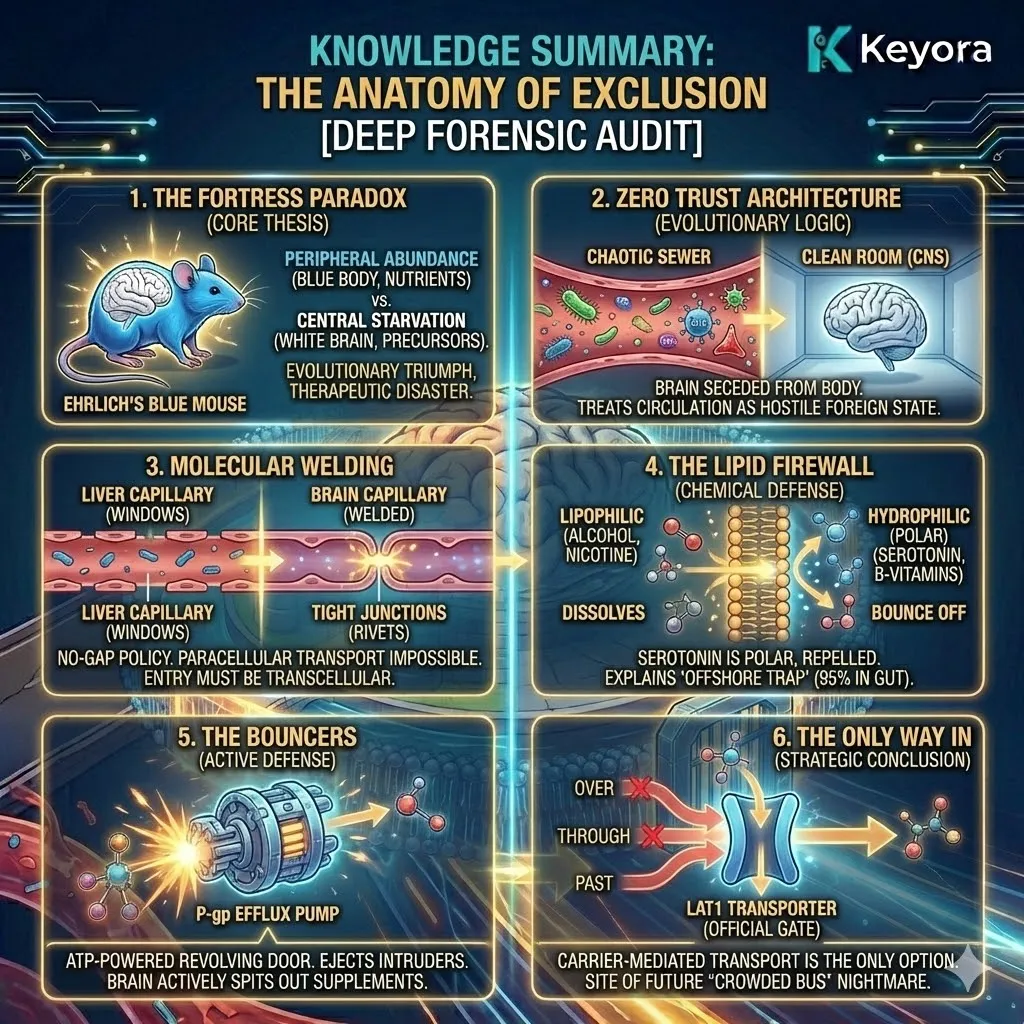
# Knowledge Summary: The Anatomy of Exclusion [Deep Forensic Audit]
## 1. The Core Thesis: [The Fortress Paradox]
– **The Historical Anomaly:** The “Blue Mouse” experiments (Ehrlich 1885 / Goldmann 1913) revealed that while the entire body absorbs dye via the blood, the brain remains pristine white. This proved the existence of a physical wall.
– **The Modern Crisis:** The Blood-Brain Barrier (BBB) is an evolutionary triumph but a therapeutic disaster.
– *Benefit:* It blocks viruses, bacteria, and toxins (Survival).
– *Cost:* It blocks 98% of small-molecule drugs and essential nutrients like Serotonin (Optimization).
– **The Diagnosis:** **[Peripheral Abundance vs. Central Starvation]**. The user has a blood supply rich in nutrients (Blue Body) but a brain starved of precursors (White Brain).
## 2. The Evolutionary Logic: [Zero Trust Architecture]
– **The Motivation:** Neurons are **Non-Renewable** (cannot regenerate) and **Electrically Sensitive** (voltage-dependent).
– **The Threat:** The bloodstream is a “Chaotic Sewer” of fluctuating ions (Sodium/Potassium spikes), hormonal storms (Adrenaline), and pathogens.
– **The Strategy:** The Brain **Seceded** from the Body. It treats the general circulation as a “Hostile Foreign State,” establishing a sterile “Clean Room” (CNS) separated from the dirty factory (Body).
## 3. The Physical Defense: Molecular Welding (Tight Junctions)
– **The Contrast:**
– *Liver Capillaries:* Have “Windows” (**Fenestrations**) allowing free flow.
– *Brain Capillaries:* Are continuous tubes with zero gaps.
– **The Mechanism:** **Tight Junctions (Zonula Occludens)**.
– Specific proteins (**Claudins** & **Occludins**) act as “Molecular Rivets,” stitching endothelial cells together.
– **The Result:** **”No-Gap Policy.”** Paracellular Transport (slipping *between* cells) is physically impossible. Any entry must be Transcellular (going *through* the cell).
## 4. The Chemical Defense: [The Lipid Firewall]
– **The Physics:** The cell membrane is a **Lipid Bilayer** (Fat/Oil).
– **The Law of Solubility:** “Like Dissolves Like.”
– *Lipophilic (Fat-loving):* Alcohol, Nicotine. Can dissolve through the wall (Ghost Mode).
– *Hydrophilic (Water-loving):* **Serotonin**, Tryptophan, B-Vitamins.
– **The Rejection:** Because Serotonin is **Polar** (charged), it is repelled by the oily core of the membrane. It bounces off the wall. This explains **[The Offshore Trap]**—why 95% of Serotonin stays in the gut.
## 5. The Active Defense: The Bouncers (Efflux Pumps)
– **The Component:** **P-Glycoprotein (P-gp)** embedded in the membrane.
– **The Mechanism:** An ATP-powered biological machine that acts as a “Revolving Door.”
– **The Action:** If a foreign molecule (xenobiotic/drug/herb) manages to dissolve into the membrane, P-gp recognizes it, grabs it, and physically **ejects** it back into the bloodstream.
– **The Implication:** Many “Brain Supplements” fail not because they don’t absorb, but because the brain actively spits them out.
## 6. The Strategic Conclusion: The Only Way In
– **The Dead Ends:**
– Cannot climb over (Tight Junctions block gaps).
– Cannot swim through (Lipid Bilayer blocks polar molecules).
– Cannot sneak past (P-gp ejects intruders).
– **The Only Option:** **Carrier-Mediated Transport**. We must use the specific “Official Gates” evolution built for nutrients.
– **The Target:** **LAT1 Transporter**. This is the specific gate for Amino Acids. However, as Chapter II will reveal, this gate is the site of a massive “Logistics Nightmare” (**[The Crowded Bus]**).
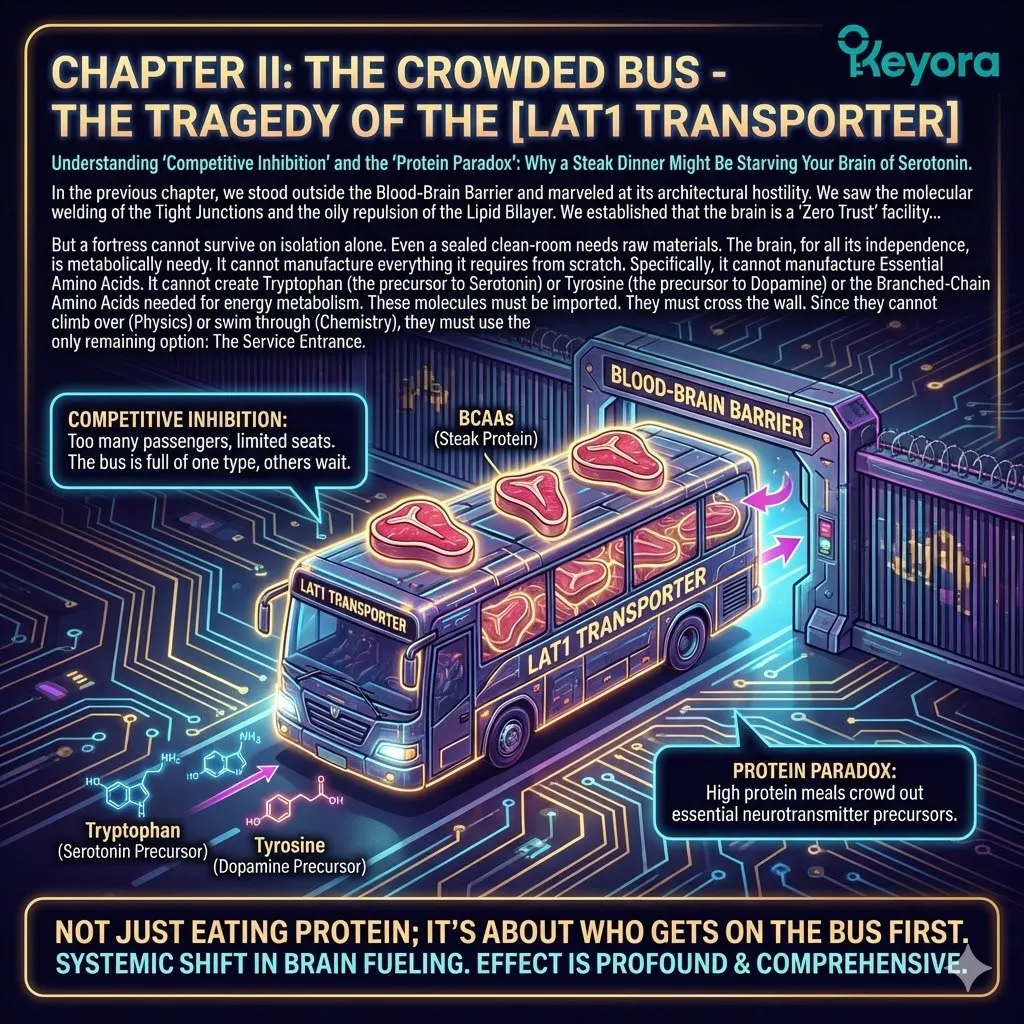
CHAPTER II: THE CROWDED BUS – THE TRAGEDY OF THE [LAT1 TRANSPORTER]
Understanding “Competitive Inhibition” and the “Protein Paradox”: Why a Steak Dinner Might Be Starving Your Brain of Serotonin.
In the previous chapter, we stood outside the Blood-Brain Barrier and marveled at its architectural hostility.
We saw the molecular welding of the Tight Junctions and the oily repulsion of the Lipid Bilayer.
We established that the brain is a “Zero Trust” facility, designed to keep the chaos of the bloodstream at bay.
But a fortress cannot survive on isolation alone. Even a sealed clean-room needs raw materials.
The brain, for all its independence, is metabolically needy.
It cannot manufacture everything it requires from scratch. Specifically, it cannot manufacture Essential Amino Acids.
It cannot create Tryptophan (the precursor to Serotonin) or Tyrosine (the precursor to Dopamine) or the Branched-Chain Amino Acids needed for energy metabolism.
These molecules must be imported. They must cross the wall.
Since they cannot climb over (Physics) or swim through (Chemistry), they must use the only remaining option:
The Service Entrance.
Evolution, in a concession to necessity, built a specific set of revolving doors into the fortress wall. These are the Solute Carrier (SLC) transporters. They are protein tunnels embedded in the endothelial membrane, designed to grab specific molecules from the blood and shuttle them into the brain.
For the aspiring bio-hacker or the burned-out executive, this sounds like good news.
“Okay,” you think. “There is a door. I just need to eat the right food, put the nutrients in my blood, and they will walk through the door.”
This is the fatal assumption of the linear mindset.
The problem is not the existence of the door.
The problem is the Management of the door.
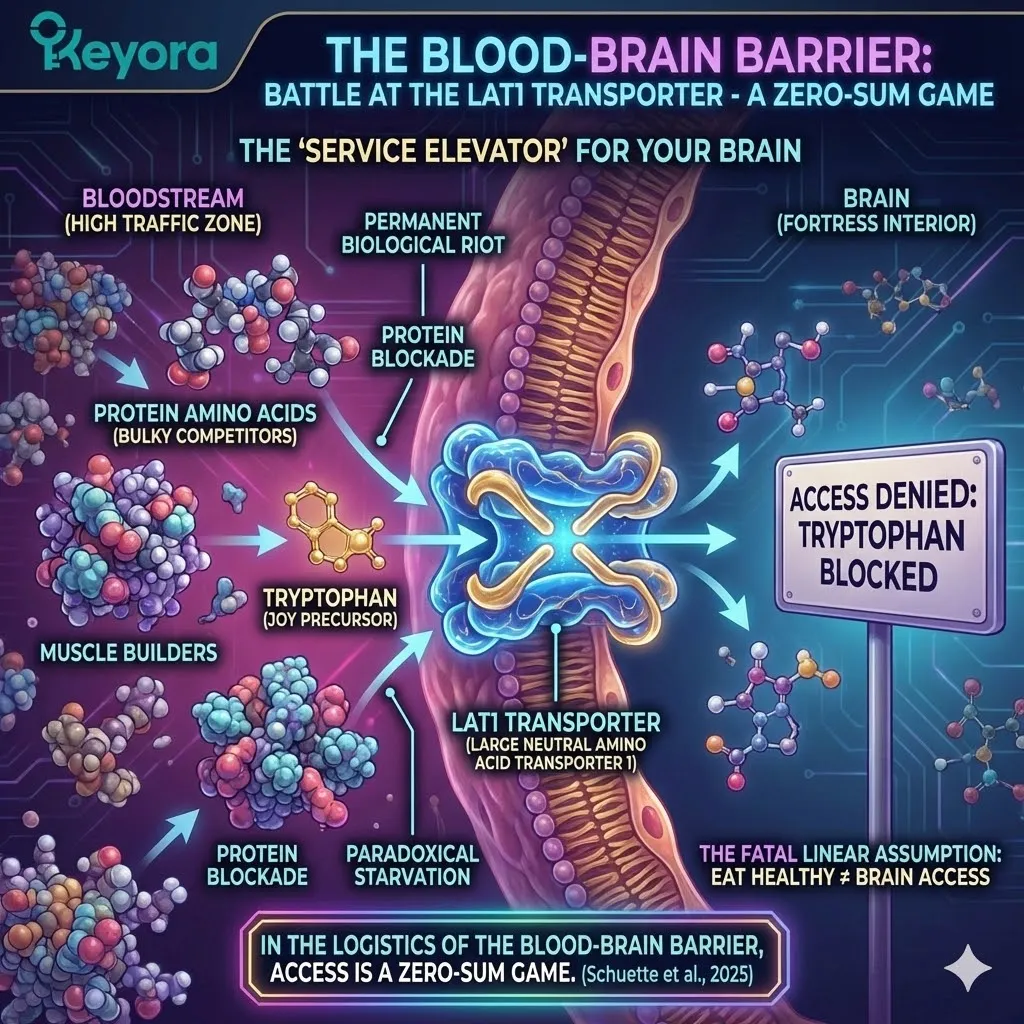
The brain did not build a private, VIP entrance for Tryptophan. It did not build a dedicated “Serotonin Express” lane. Instead, it built a single, shared, high-traffic service elevator. And it assigned this elevator to service an entire class of aggressive, bulky, and highly competitive molecules.
This service elevator is the LAT1 Transporter (Large Neutral Amino Acid Transporter 1).
And it is the site of a permanent, biological riot.
This chapter is the story of that riot.
It is the story of why “eating healthy” often leads to a paradoxical starvation of the brain.
It is the story of how the very protein you eat to build muscle and sustain energy acts as a blockade, physically preventing joy from entering your mind.
We are about to dismantle the myth of dietary sufficiency.
We are about to show you that in the logistics of the Blood-Brain Barrier, access is a zero-sum game.
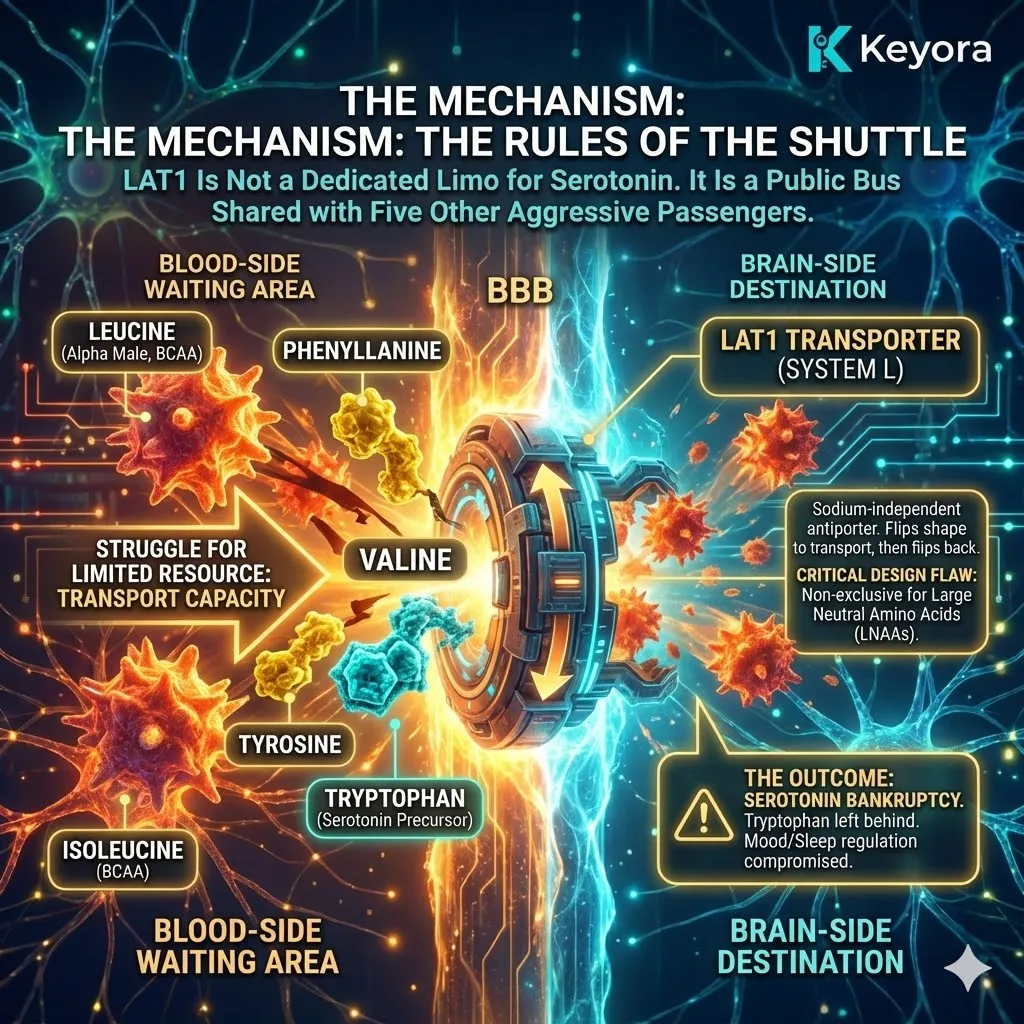
2.1 THE MECHANISM: The Rules of the Shuttle
LAT1 Is Not a Dedicated Limo for Serotonin. It Is a Public Bus Shared with Five Other Aggressive Passengers.
To understand why you are suffering from Serotonin Bankruptcy, we must analyze the physics of the LAT1 transporter.
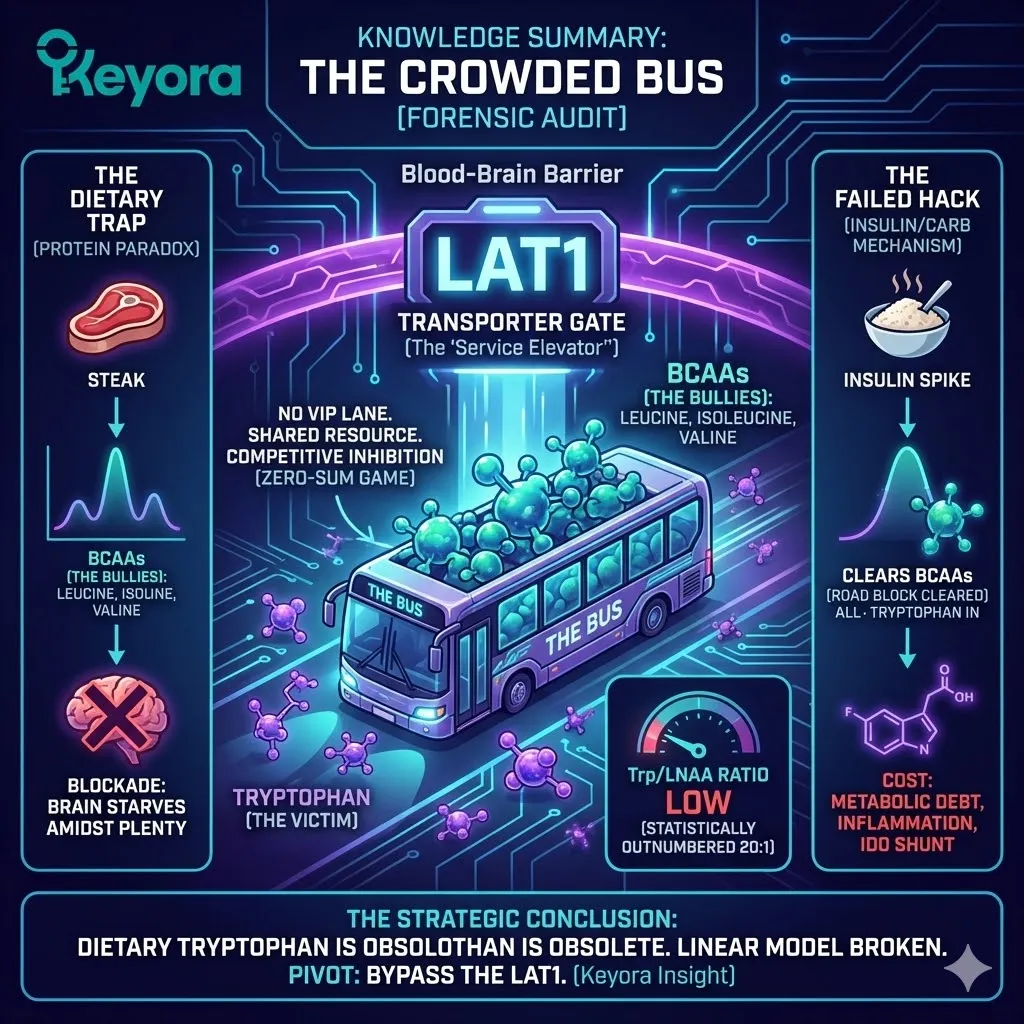
LAT1 (System L) is a sodium-independent antiporter. It operates like a mechanical shuttle bus. It sits on the blood-side of the Blood-Brain Barrier, waiting for passengers.
When a passenger sits in the binding pocket, the transporter flips its shape, dumping the passenger into the brain, and then flips back to pick up the next one.
But here is the critical design flaw: The bus is non-exclusive.
LAT1 is designed to transport Large Neutral Amino Acids (LNAAs). This is a chemical category, not a specific identity. Any amino acid that fits the “Large” and “Neutral” profile has a valid ticket to ride.
The Passenger Manifest
Let us look at who is waiting at the bus stop. The crowd is not friendly. It is composed of six primary competitors:
-
Leucine: The alpha male of the group. A Branched-Chain Amino Acid (BCAA). Massive, abundant, and vital for muscle protein synthesis.
-
Isoleucine: Leucine’s robust cousin. Another BCAA.
-
Valine: The third BCAA. Highly prevalent in meat and dairy.
-
Phenylalanine: The precursor to Tyrosine.
-
Tyrosine: The precursor to Dopamine and Norepinephrine (Focus/Drive).
-
Tryptophan: The precursor to Serotonin (Mood/Sleep).
These six molecules are locked in a permanent struggle for a limited resource:
Transport Capacity.
The Physics of Competitive Inhibition
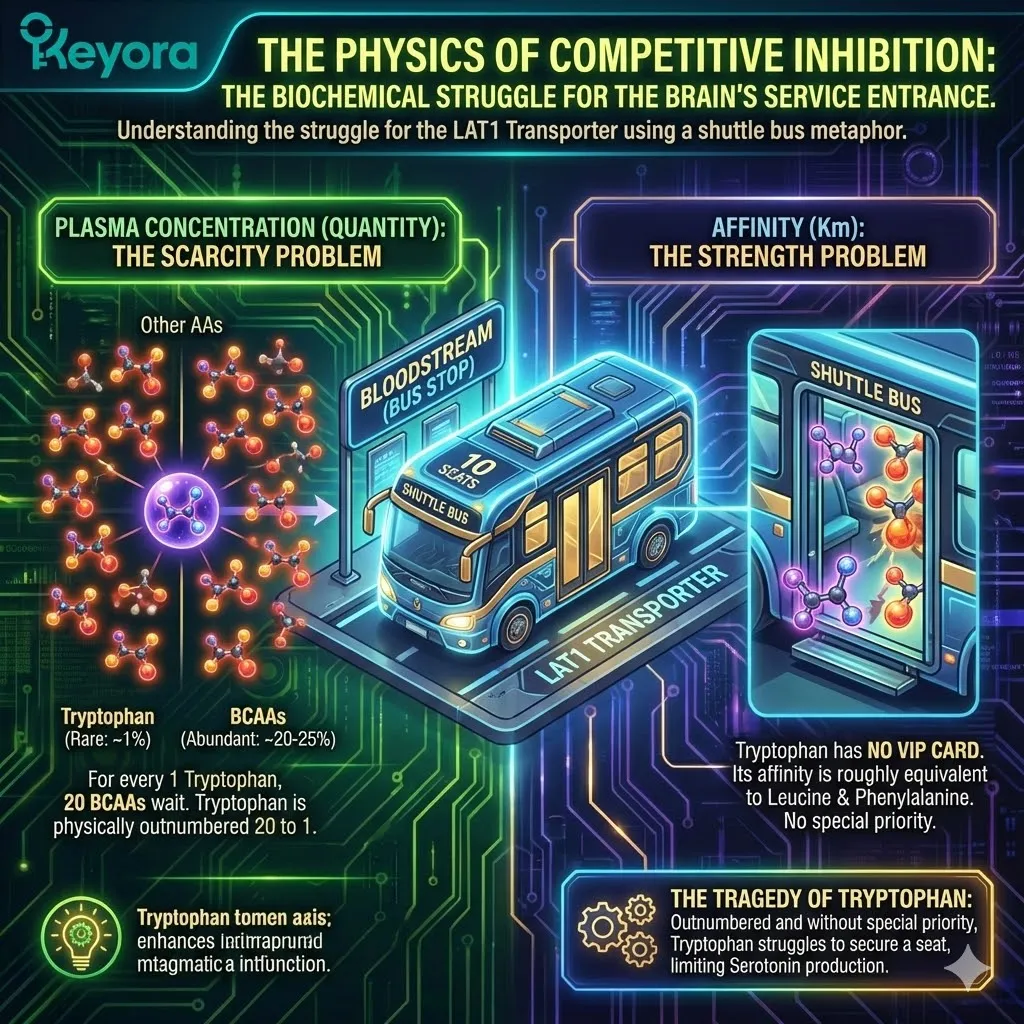
In biochemistry, this struggle is defined by a principle called Competitive Inhibition.
Imagine the LAT1 transporter as a shuttle bus with exactly 10 seats.
The bus runs once every minute.
In the bloodstream (the bus stop), there are 1,000 passengers waiting.
If the passengers were evenly distributed, everyone would eventually get a ride. But they are not evenly distributed. And they do not have equal strength.
The competition is governed by two mathematical variables:
-
Plasma Concentration (Quantity): How many of each molecule are waiting at the stop?
-
Affinity (Km): How aggressively does the molecule fight for a seat?
The Tragedy of Tryptophan
Let us apply these variables to our protagonist, Tryptophan.
Variable 1: Quantity (The Scarcity Problem)
Tryptophan is the rarest of all amino acids. In a standard protein source (like a steak or a piece of chicken), Tryptophan makes up only about 1.0% to 1.5% of the total amino acid profile.
By contrast, the BCAAs (Leucine, Isoleucine, Valine) make up nearly 20% to 25%.
-
The Bus Stop: For every 1 Tryptophan waiting at the curb, there are 20 BCAAs surrounding it. The Tryptophan is physically outnumbered 20 to 1.
Variable 2: Affinity (The Strength Problem)
You might hope that Tryptophan has a “VIP Card” – a higher affinity that allows it to skip the line. It does not.
While Tryptophan has a respectable affinity for LAT1, it is roughly equivalent to that of Leucine and Phenylalanine. It has no special priority. It cannot flash a badge and demand a seat.
The Result: The Tryptophan Bottleneck
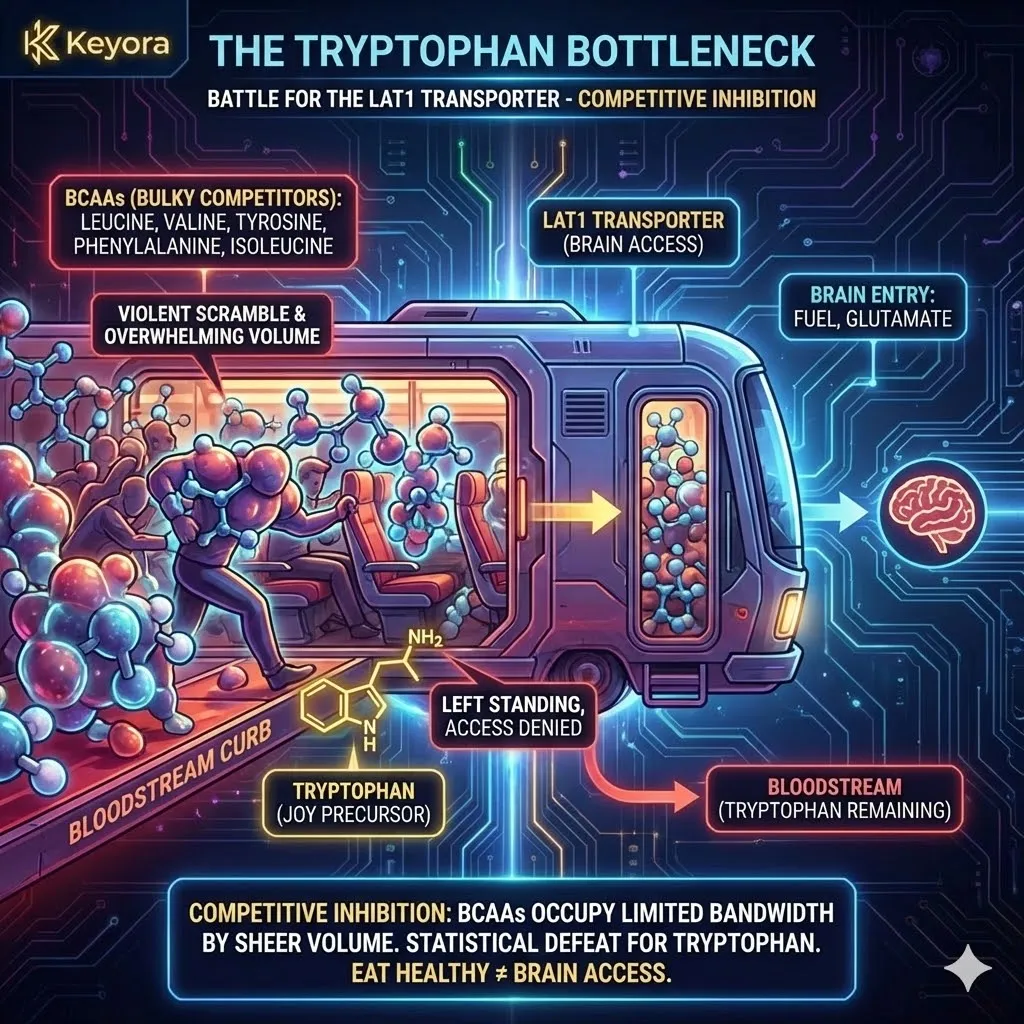
When the LAT1 bus arrives, a violent scramble ensues. The molecules shove and elbow each other to get into the binding pockets.
Because the BCAAs are overwhelmingly more numerous, statistics dictate the outcome.
-
Leucine grabs Seat 1, 2, and 3.
-
Valine grabs Seat 4 and 5.
-
Tyrosine grabs Seat 6.
-
Phenylalanine grabs Seat 7.
-
Isoleucine grabs Seat 8 and 9.
Tryptophan is left standing on the curb.
The bus doors close. The transporter flips. The BCAAs enter the brain (where they are burned for fuel or used for glutamate synthesis). The Tryptophan remains in the blood.
This is Competitive Inhibition.
The presence of the BCAAs inhibits the transport of Tryptophan. They do not block the door maliciously; they block it by sheer volume. They occupy the limited bandwidth of the system.
The “High-Performance” Sabotage
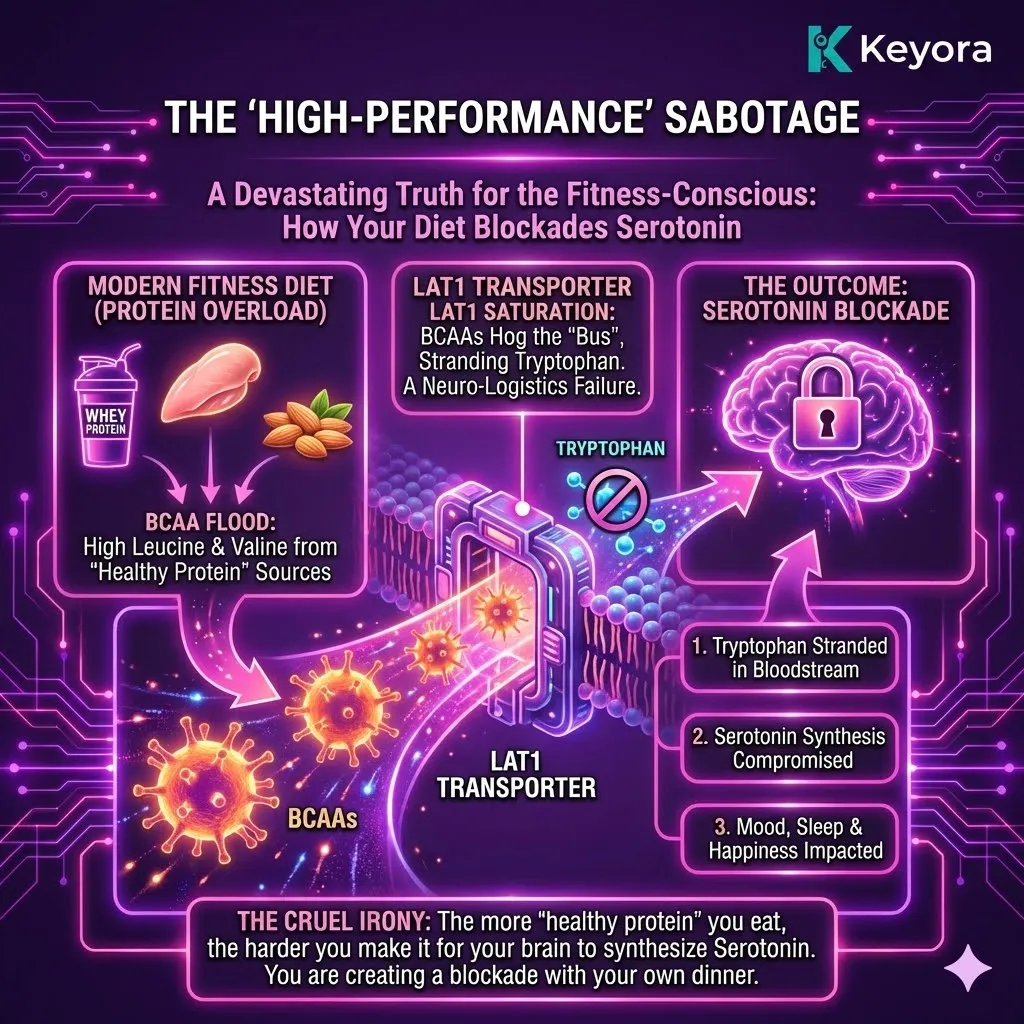
This mechanism reveals a devastating truth for the fitness-conscious high-performer.
Consider your diet. You likely prioritize protein. You drink whey protein shakes after the gym. You eat lean chicken breast for lunch. You snack on almonds.
You are doing this to build muscle, recover from workouts, and stay lean.
But from a neuro-logistics perspective, you are flooding your system with Competitors.
-
Whey protein is famously high in BCAAs (it is marketed for this exact property).
-
Every sip of that shake increases the plasma concentration of Leucine and Valine.
-
Every increase in BCAAs statistically reduces the probability of Tryptophan getting a seat on the LAT1 bus.
This is the cruel irony of modern nutrition:
The more “healthy protein” you eat, the harder you make it for your brain to synthesize Serotonin.
You are creating a blockade with your own dinner.
The Tryptophan is there – you ate it. It is circulating in your blood. But it is stranded. It is a victim of a logistics system that was never designed to handle the protein-saturated abundance of the modern diet.
In the Paleolithic era, protein was often scarce. The competition was manageable.
In the modern era of 200g-protein-per-day diets, the LAT1 transporter is in a permanent state of saturation by BCAAs.
The bus is always full. And the passenger holding the keys to your happiness (Tryptophan) is permanently left behind.
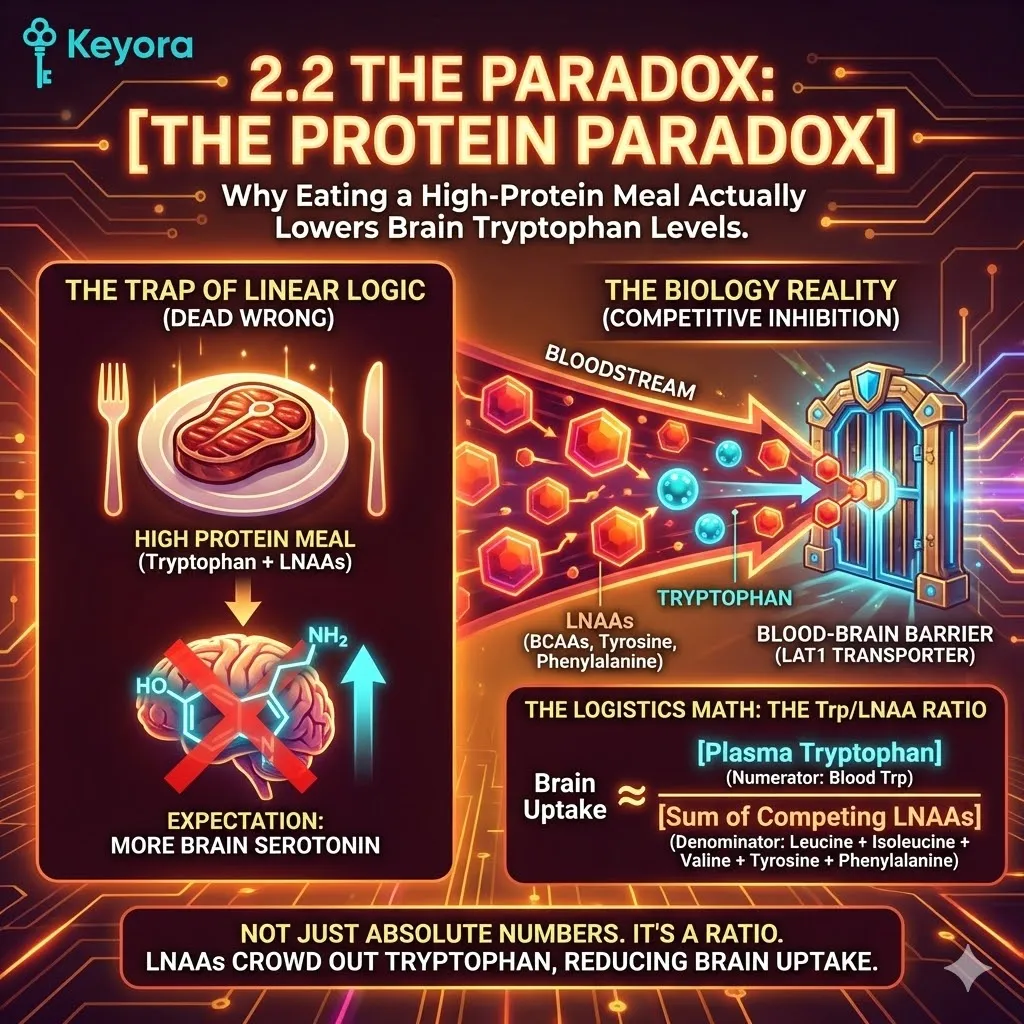
2.2 THE PARADOX: [The Protein Paradox]
Why Eating a High-Protein Meal Actually Lowers Brain Tryptophan Levels.
In the world of logic, if you want more of something, you add more of it.
If you want more money, you earn more.
If you want more muscle, you lift more.
Therefore, the assumption goes: If I want more Serotonin, I should eat more Tryptophan-rich protein.
In the world of neuro-biology, this logic is dead wrong.
In 1971, two researchers at MIT, John Fernstrom and Richard Wurtman, published a landmark paper in Science that shattered the linear model of nutrition. They discovered a phenomenon that Keyora Research defines as The Protein Paradox.
Their findings were counter-intuitive and devastating:
Ingesting a protein-rich meal significantly lowers the concentration of Tryptophan in the brain.
Read that again.
You eat the Tryptophan (in the protein). The level of Tryptophan in your blood goes up. But the level of Tryptophan in your brain goes down.
The Logistics Math: The Trp/LNAA Ratio
To understand this paradox, we must look at the specific algorithm the brain uses to grant access to the LAT1 transporter. It is not based on absolute numbers. It is based on a Ratio.
The equation that determines your brain’s Serotonin potential is:
Brain Uptake ≈ [Plasma Tryptophan] / [Sum of Competing LNAAs]
-
Numerator (Top): The amount of Tryptophan in your blood.
-
Denominator (Bottom): The sum of Leucine + Isoleucine + Valine + Tyrosine + Phenylalanine.
The “Steak Dinner” Scenario
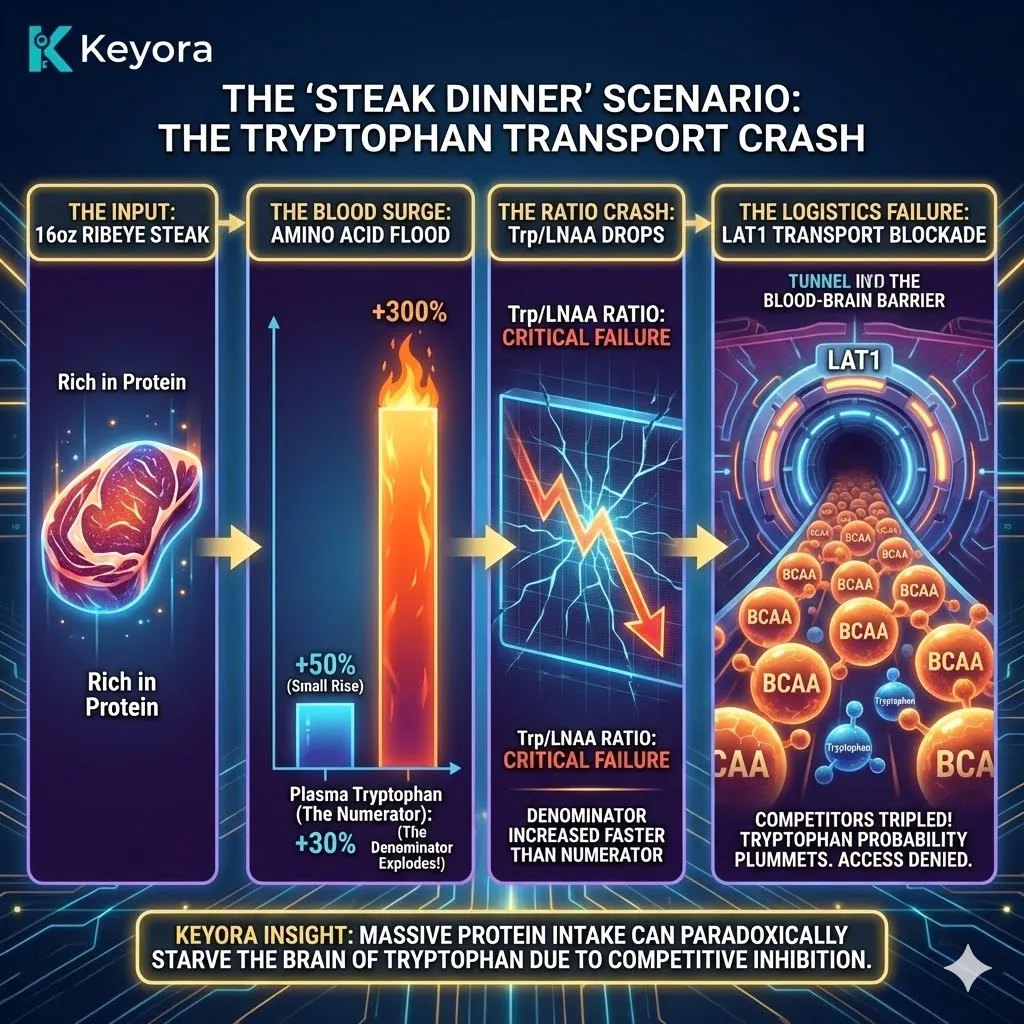
Let us apply this formula to a real-world scenario: The 16oz Ribeye Steak.
The Input:
You eat the steak. It is rich in protein.
The Blood Surge:
Your digestion breaks the protein down. Amino acids flood into your bloodstream.
-
Plasma Tryptophan rises by 50% (The Numerator increases).
-
Plasma BCAAs (Competitors) rise by 300% (The Denominator explodes).
The Ratio Crash:
Because the Denominator (The Competitors) increased so much faster than the Numerator (The Tryptophan), the overall Trp/LNAA Ratio drops.
The Logistics Failure:
At the Blood-Brain Barrier, the “Crowd” of competitors has tripled in size, while the Tryptophan group has only grown slightly. The probability of Tryptophan getting a seat on the LAT1 bus plummets.
The Net Result: Starvation Amidst Plenty
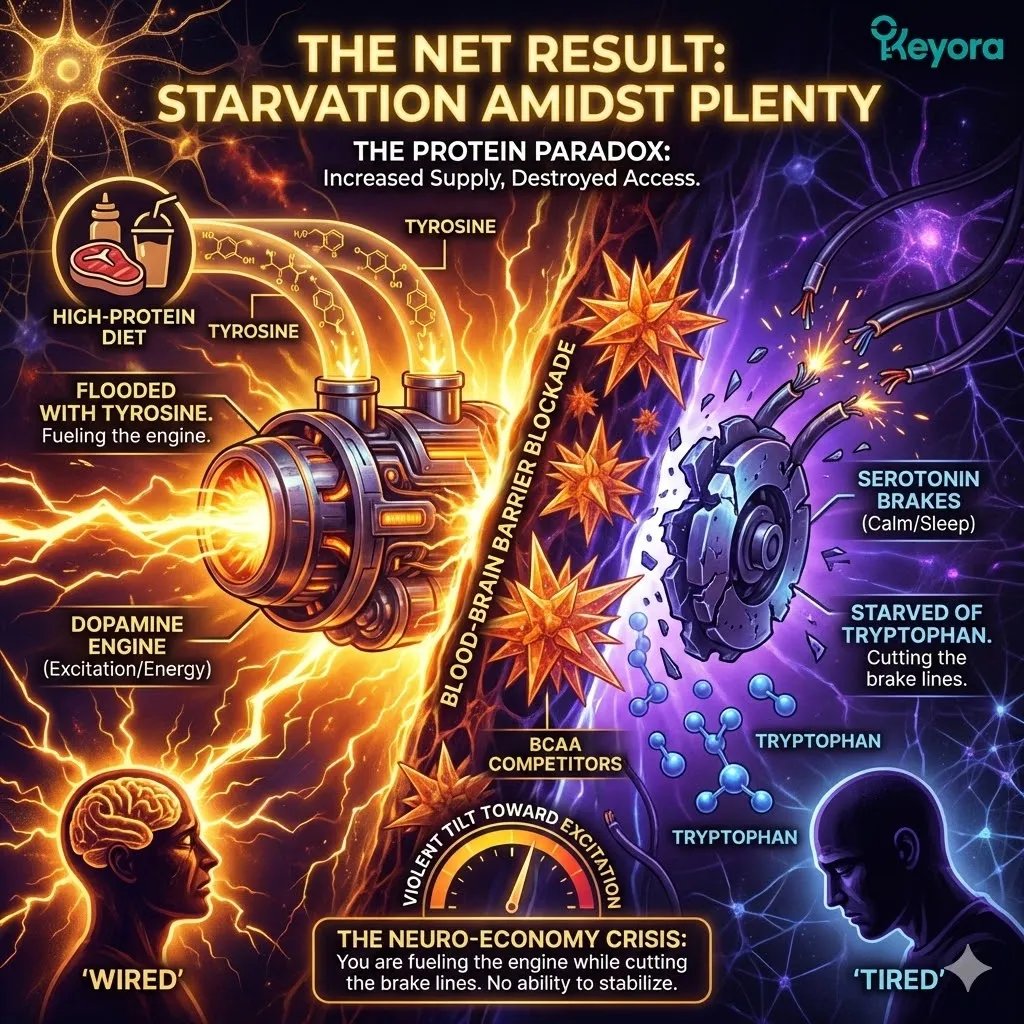
This is the cruelty of The Protein Paradox.
By eating a high-protein meal, you have successfully delivered Tryptophan to your blood, but you have simultaneously erected a blockade of BCAAs that prevents that Tryptophan from entering your brain.
You have increased the supply, but you have destroyed the access.
This explains the specific “wired but tired” feeling that often accompanies high-protein, low-carb diets (like Keto or Carnivore) in the early stages.
The user is flooded with Tyrosine (Dopamine/Energy) from the meat, but starved of Tryptophan (Serotonin/Calm).
The balance of the neuro-economy tilts violently toward excitation, with no ability to brake.
You are fueling the engine (Dopamine) while cutting the brake lines (Serotonin).
2.3 THE FAILED HACK: Why We Crave Carbs When Stressed
Insulin as the “Traffic Police.” It Clears the Competition, but at a Terrible Metabolic Cost.
If protein blocks Serotonin, then what facilitates it?
Nature has provided a workaround. It is a mechanism you know intimately, usually around 10:00 PM after a stressful day.
It is the Carbohydrate Craving.
Why do you crave Mac-and-Cheese, Pizza, or Ice Cream when you are sad?
Is it just because they taste good? No.
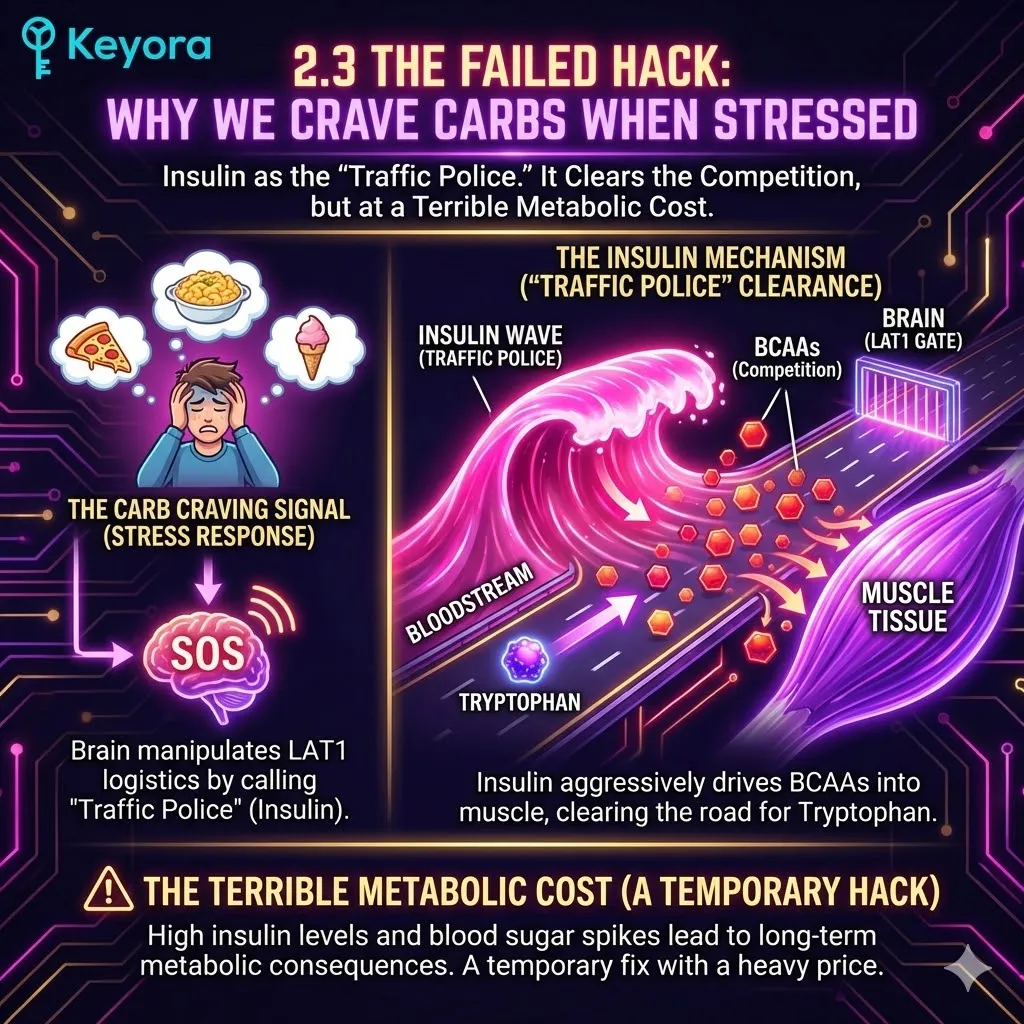
It is because your brain is trying to manipulate the logistics of the LAT1 transporter. It is trying to call in the “Traffic Police” to clear the road.
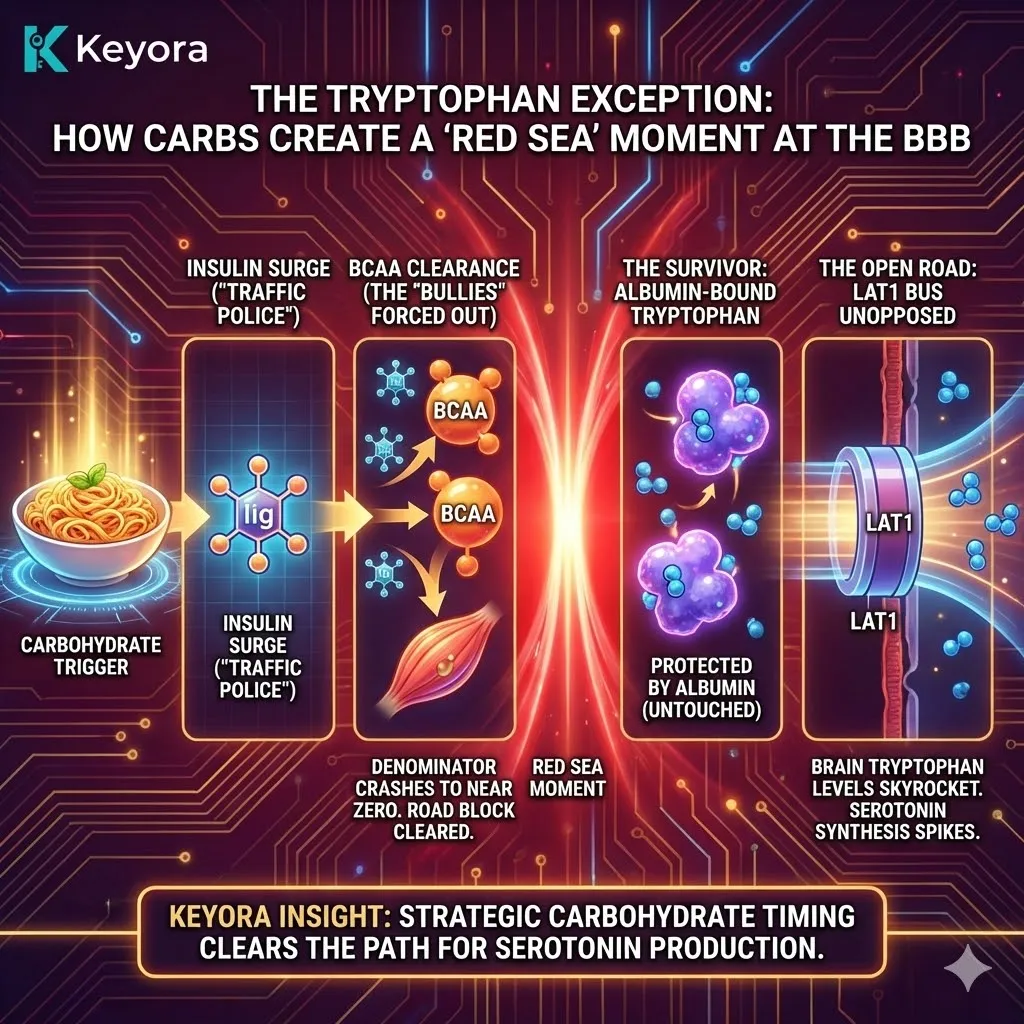
The Insulin Mechanism
When you eat a high-glycemic carbohydrate (without protein), your blood sugar spikes. The pancreas responds by releasing a massive wave of Insulin.
Insulin is a storage hormone. Its job is to clear nutrients out of the blood and stuff them into cells.
-
The Clearance: Insulin aggressively drives glucose into cells. But it also drives Amino Acids into muscle tissue to stimulate protein synthesis.
-
The Target: Insulin is highly effective at clearing BCAAs (Leucine, Isoleucine, Valine) out of the bloodstream and into the muscles.
The Tryptophan Exception
But here is the magic trick. Insulin clears almost all amino acids except Tryptophan.
Why?
Because Tryptophan travels through the blood differently. It binds to a carrier protein called Albumin.
-
75-90% of circulating Tryptophan is bound to Albumin.
-
This binding protects Tryptophan from the sweeping action of Insulin.
The “Red Sea” Moment
So, let’s look at the logistics after a bowl of pasta:
-
Insulin Surge: The “Traffic Police” arrive.
-
Road Block Clearance: Insulin forces the BCAAs (The Bullies) off the road and into the muscles. The “Denominator” of our equation crashes to near zero.
-
The Survivor: Tryptophan (protected by Albumin) remains in the bloodstream.
-
The Open Road: Suddenly, the LAT1 bus arrives at the Blood-Brain Barrier. The crowd is gone. The seats are empty.
-
The Influx: Tryptophan walks onto the bus unopposed. Brain Tryptophan levels skyrocket. Serotonin synthesis spikes.
The “Comfort Food” High
This is why “Comfort Food” is comforting. It is a neuro-engineering hack.
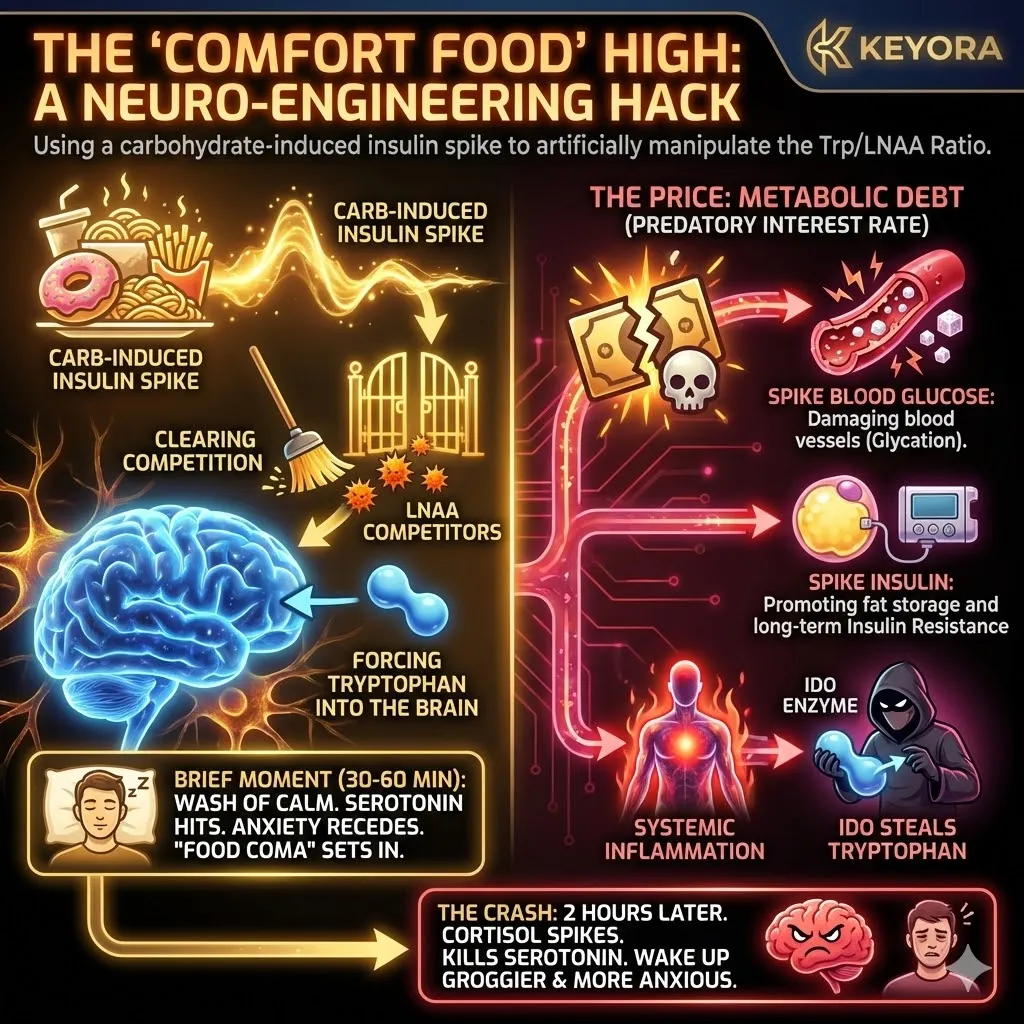
You are using a carbohydrate-induced insulin spike to artificially manipulate the Trp/LNAA Ratio.
You are clearing the competition to force Tryptophan into the brain.
For a brief moment (30-60 minutes), you feel a wash of calm.
The Serotonin hits.
The anxiety recedes.
The “Food Coma” sets in.
The Price: Metabolic Debt
If this works, why don’t we recommend it?
Because this hack comes with a predatory interest rate.
We call this Metabolic Debt.
To achieve this Serotonin spike, you had to:
-
Spike Blood Glucose: Damaging blood vessels (Glycation).
-
Spike Insulin: Promoting fat storage and long-term Insulin Resistance.
-
Trigger Inflammation: High sugar creates systemic inflammation, which activates the IDO Enzyme (remember Chapter I?), which eventually steals your Tryptophan anyway.
-
The Crash: When the blood sugar crashes 2 hours later, Cortisol spikes to compensate. Cortisol kills Serotonin. You wake up groggier and more anxious than before.
The Failed Strategy
So, the modern human is trapped between two failed strategies:
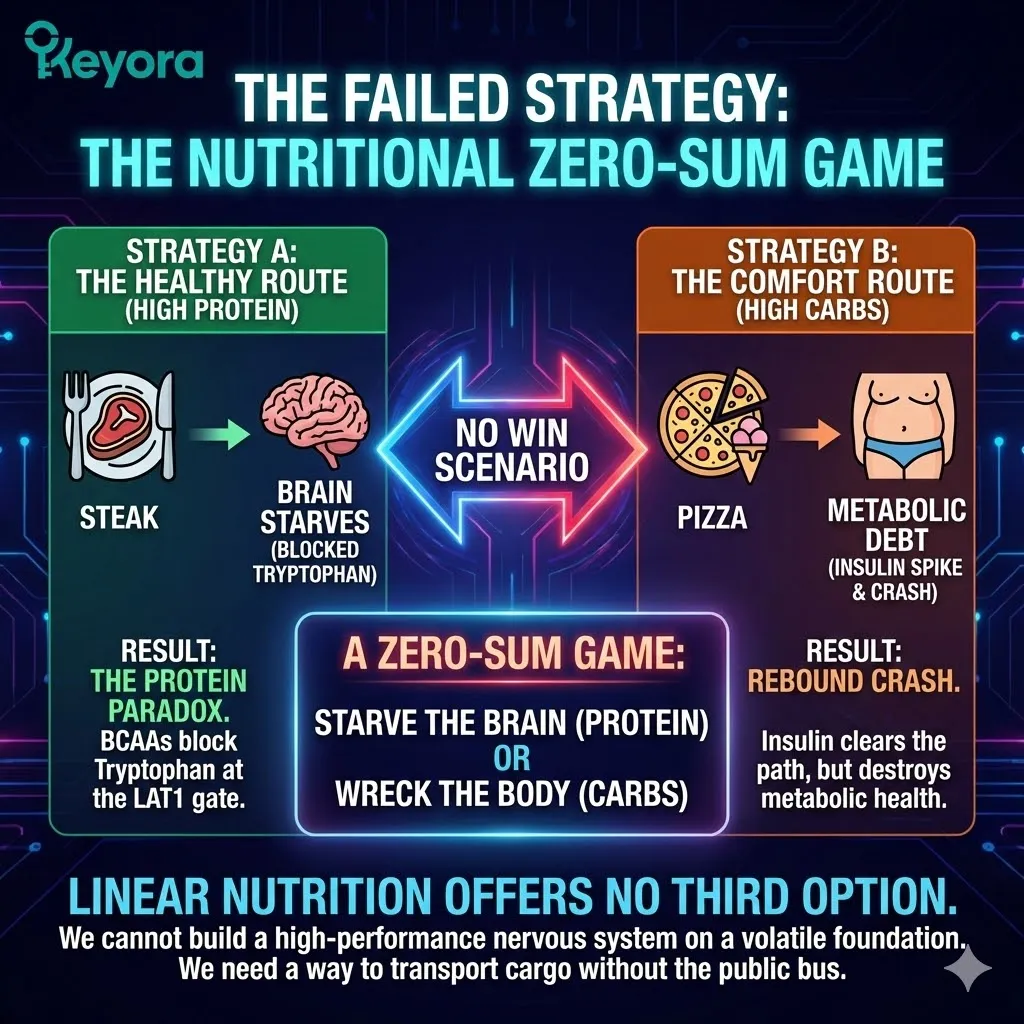
Strategy A (The Healthy Route):
Eat High Protein.
-
Result: [The Protein Paradox]. BCAAs block Tryptophan. Brain starves.
Strategy B (The Comfort Route):
Eat High Carbs.
-
Result: [Metabolic Debt]. Insulin clears the path, but destroys your metabolic health and causes a rebound crash.
This is a “Zero-Sum Game.”
You either starve the brain (Protein) or wreck the body (Carbs).
The linear model of nutrition offers no third option.
This is why “Dietary Tryptophan” is a fundamentally unreliable tool for mental health engineering. It is too dependent on the “Traffic Conditions” of the blood. It relies on a transport system (LAT1) that is easily gridlocked by healthy food and only cleared by unhealthy food.
We cannot build a high-performance nervous system on such a volatile foundation.
We need a way to transport the cargo without relying on the public bus.
2.4 CONCLUSION: The System is Rigged
We Cannot Rely on a Transport System Designed for Scarcity to Function in a World of Abundance.
We have analyzed the logistics of the LAT1 Transporter from every angle, and the conclusion is unavoidable:
The System is Rigged.
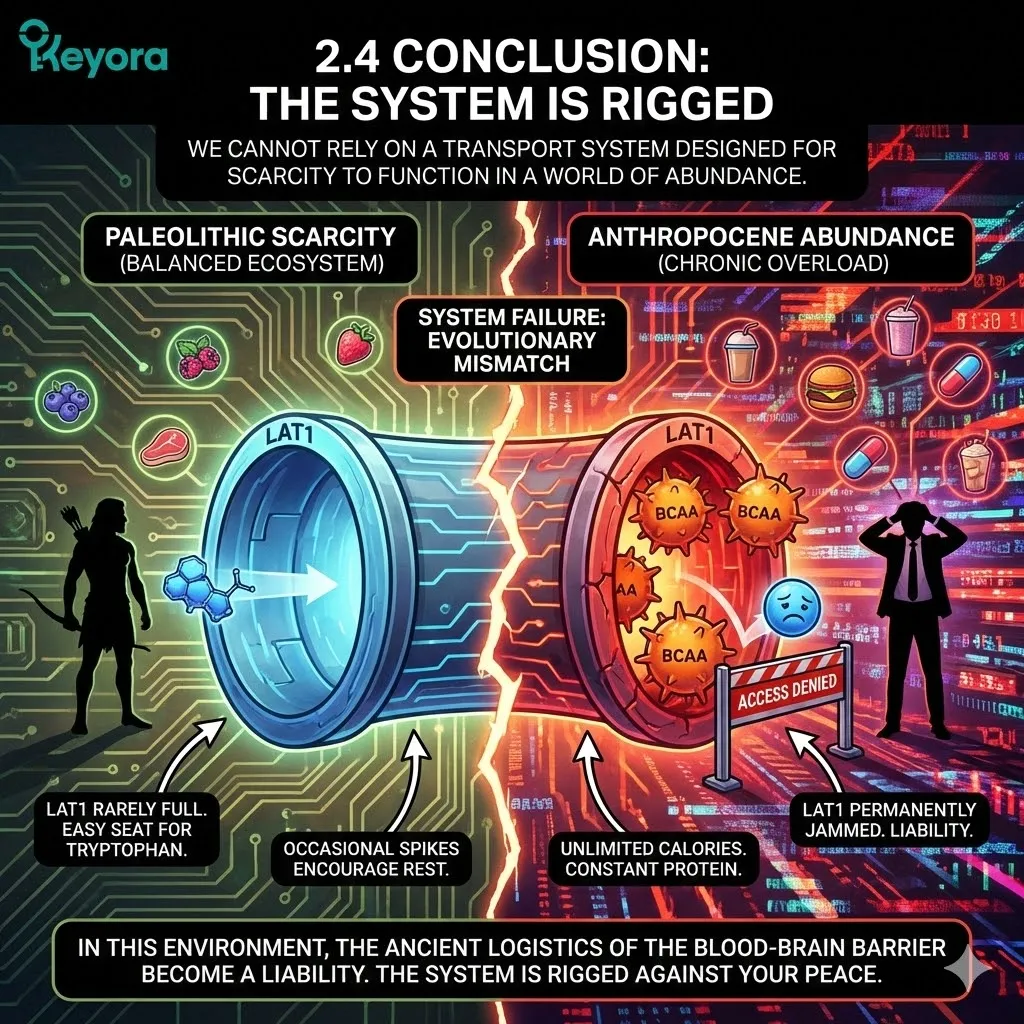
For the Paleolithic hunter-gatherer, this system worked perfectly. Food was scarce. Protein was a luxury.
The LAT1 bus was rarely full, so Tryptophan could easily find a seat.
The occasional feast of honey or berries (carbs) would spike insulin, clear the BCAAs, and give the brain a nice hit of Serotonin to encourage sleep and recovery.
It was a balanced ecosystem of scarcity.
But you do not live in the Paleolithic.
You live in the Anthropocene of Abundance.
You exist in a world of unlimited calories, constant protein availability, and chronic stress. In this environment, the ancient logistics of the Blood-Brain Barrier become a liability.
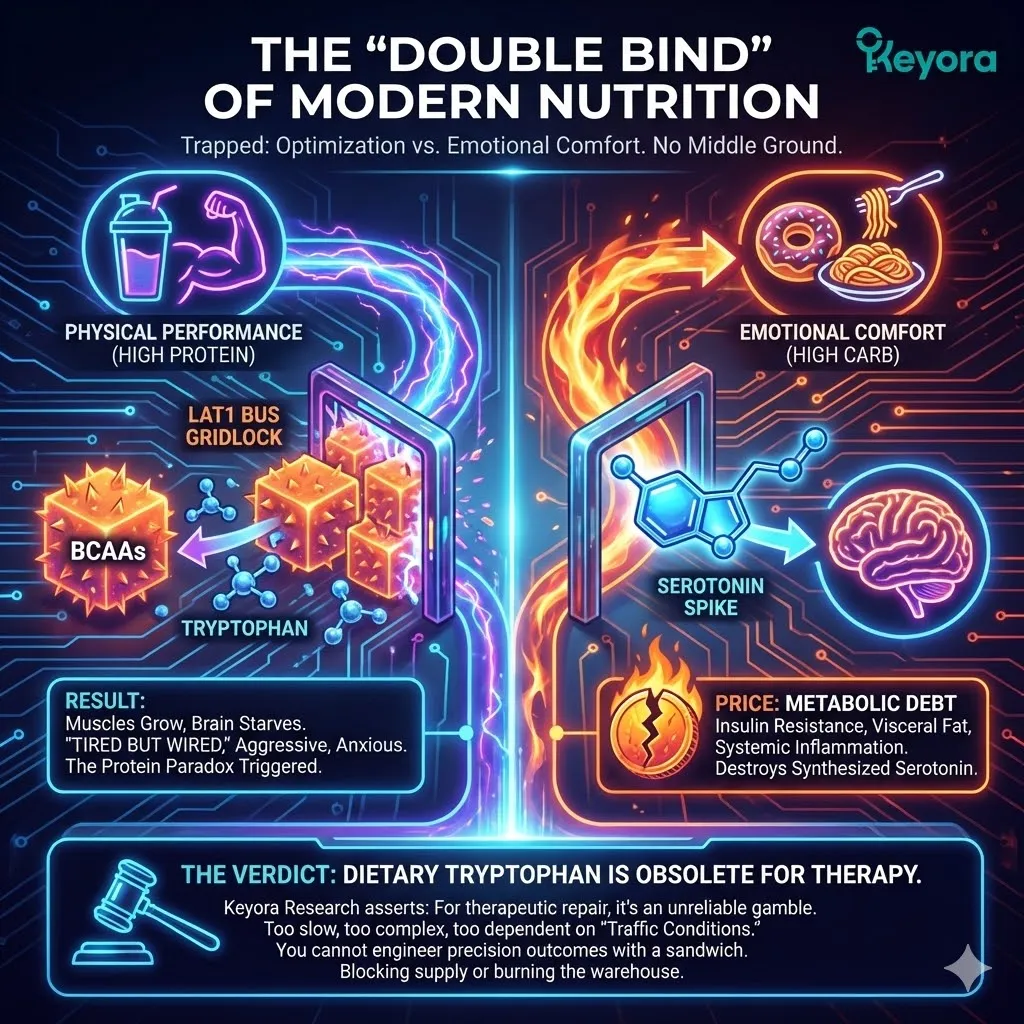
The “Double Bind” of Modern Nutrition
As a high-performer trying to optimize your mental state via diet, you are trapped in a Double Bind:
If you eat for Physical Performance (High Protein):
You flood the blood with BCAAs. You trigger [The Protein Paradox]. The LAT1 bus is gridlocked. Your muscles grow, but your brain starves of Serotonin. You become “Tired but Wired,” aggressive, and anxious.
If you eat for Emotional Comfort (High Carb):
You trigger the Insulin Hack.
You clear the road.
You get the Serotonin spike.
But you pay the price in Metabolic Debt.
You damage your insulin sensitivity, gain visceral fat, and trigger the inflammation that will eventually destroy the very Serotonin you just synthesized.
There is no middle ground in the linear model.
You are either blocking the supply chain or burning down the warehouse.
The Verdict: Dietary Tryptophan is Obsolete
Keyora Research asserts that for the purpose of therapeutic intervention – that is, for fixing a brain that is already in Serotonin Bankruptcy – Dietary Tryptophan is an obsolete tool.
It is too unreliable. It is too dependent on the “Traffic Conditions” of the bloodstream. It is a gamble.
If you are trying to engineer a specific outcome (e.g., “I need to sleep at 10:00 PM” or “I need to be calm for this meeting”), you cannot rely on a turkey sandwich. The logistics are too slow, and the variables are too complex.
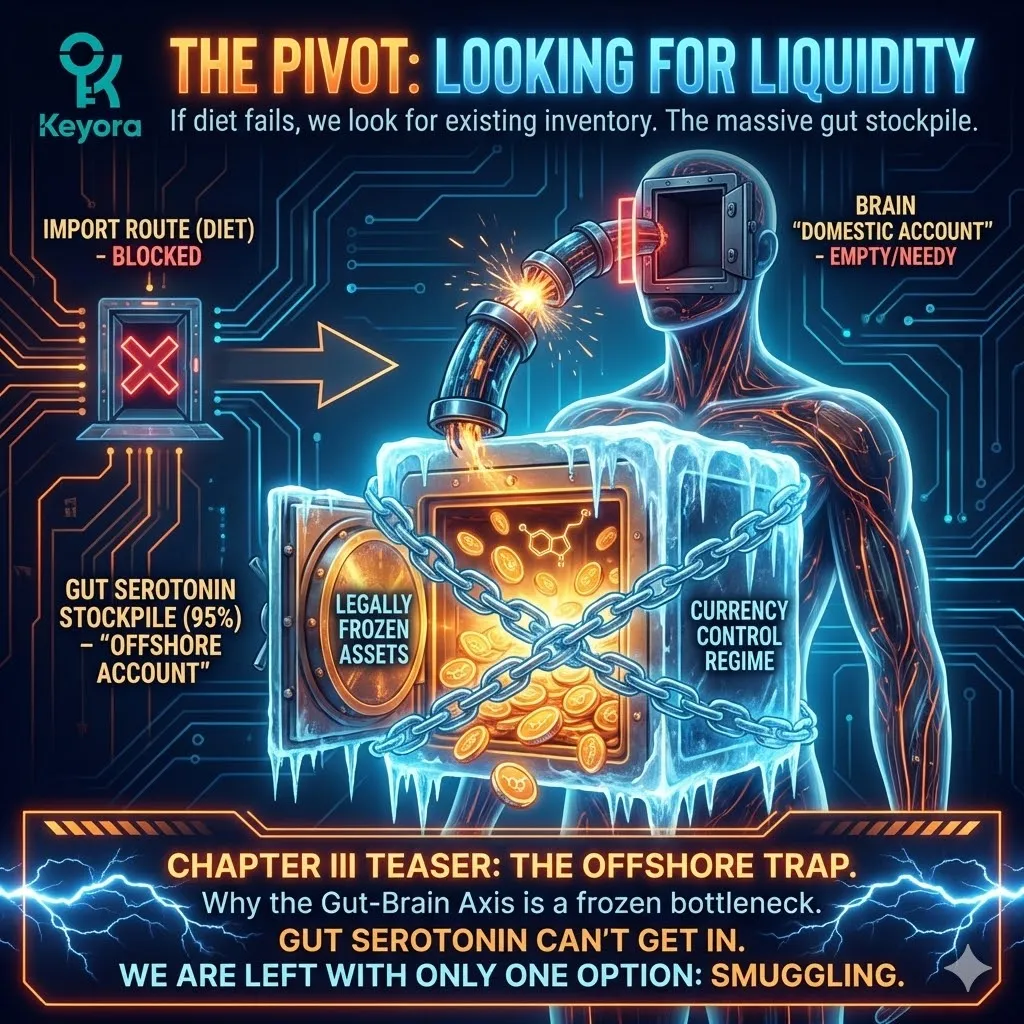
The Pivot: Looking for Liquidity
So, if the “Import Route” (Diet) is blocked, where do we look next?
A smart logistician looks for existing inventory.
And it turns out, your body is sitting on a massive stockpile of Serotonin.
In fact, 95% of your total Serotonin inventory is already manufactured and sitting in your gut. It is right there. Millions of molecules of pure joy, circulating in your abdomen.
The logical question is: Why can’t we just move that inventory upstairs?
Why can’t we take the millions of dollars from the “Offshore Account” (The Gut) and wire it to the “Domestic Account” (The Brain)?
In the next chapter, Chapter III: The Offshore Trap, we will explore the “Gut-Brain Axis.”
We will explain why this is the most misunderstood concept in wellness.
We will reveal why that 95% is legally frozen assets – locked out by a currency control regime that makes the LAT1 bottleneck look like an open door.
We have seen why the Food can’t get in.
Now we will see why the Gut Serotonin can’t get in.
And we will be left with only one option: Smuggling.
References
Comprehensive Bibliography for Series II, Episode 02 – Chapter II
Anderson, G. H., & Ezrin, C. (1987). Neuroregulation of eating behavior: The role of 5-HT and catecholamines. International Journal of Obesity, 11(Suppl 3), 57S-66S.
Benton, D., & Donohoe, R. T. (1999). The effects of nutrients on mood. Public Health Nutrition, 2(3a), 403-409.
Blomstrand, E. (2006). A role for branched-chain amino acids in reducing central fatigue. Journal of Nutrition, 136(2), 546S-549S.
Choi, S., DiSilvio, B., Fernstrom, M. H., & Fernstrom, J. D. (2011). Meal ingestion, amino acids and brain neurotransmitters: Effects of dietary protein on serotonergic and catecholaminergic synthesis and function. Biochimica et Biophysica Acta, 1812(10), 1463-1473.
Fernstrom, J. D. (1983). Role of precursor availability in control of monoamine biosynthesis in brain. Physiological Reviews, 63(2), 484-546.
Fernstrom, J. D., & Wurtman, R. J. (1971). Brain serotonin content: Physiological regulation by plasma neutral amino acids. Science, 174(4013), 1023-1025. (The Seminal Paper defining the Protein Paradox).
Fernstrom, J. D., & Wurtman, R. J. (1972). Brain serotonin content: Increase following ingestion of carbohydrate diet. Science, 178(4059), 414-416.
Jin, X., & Keyora Research. (2025a). 5-Hydroxytryptophan (5-HTP): A Clinically Relevant Precursor for Mood, Sleep, and Neurophysiological Stability. Keyora Research Institute. DOI: 10.5281/zenodo.16887092
Jin, X., & Keyora Research. (2025b). Keyora MoodFlow 8 in 1: Nutritional Neuro-Psychiatric Intervention for Mood, Sleep, and Cognitive Resilience. Keyora Research Institute. DOI: 10.5281/zenodo.16889527
Jin, X., & Keyora Research. (2025c). Keyora Neuro–Psycho–Sleep Framework: Nutritional Strategies for Depression, Anxiety, and Insomnia while Enhancing Cognitive Performance in High-Stress Individuals. OSF. DOI: 10.17605/OSF.IO/FZ62K
Lieberman, H. R., et al. (1986). Tryptophan intake in the US: results from the NHANES II Survey. American Journal of Clinical Nutrition, 44(6), 772-777.
Markus, C. R. (2008). Dietary amino acids and brain serotonin function; implications for stress-related affective changes. Neuromolecular Medicine, 10(4), 247-258.
Oldendorf, W. H., & Szabo, J. (1976). Amino acid assignment to one of three blood-brain barrier amino acid carriers. American Journal of Physiology, 230(1), 94-103.
Pardridge, W. M. (1977). Regulation of amino acid availability to the brain. Nutrition and the Brain, 1, 141-204.
Smith, Q. R. (2000). Transport of glutamate and other amino acids at the blood-brain barrier. Journal of Nutrition, 130(4S Suppl), 1016S-1022S.
Spring, B. (1984). Recent research on the behavioral effects of tryptophan and carbohydrate. Nutrition and Health, 3(1-2), 55-67.
Wurtman, R. J., et al. (2003). Effects of normal meals rich in carbohydrates or protein on plasma tryptophan and tyrosine ratios. American Journal of Clinical Nutrition, 77(1), 128-132.
# Knowledge Summary: The Crowded Bus [Full-Spectrum Forensic Audit]
## 1. The Logistics Infrastructure: [The Tryptophan Bottleneck]
– **The Gate:** **LAT1 Transporter (Large Neutral Amino Acid Transporter 1)**.
– *Function:* The “Service Elevator” or “Shuttle Bus” at the Blood-Brain Barrier.
– *Constraint:* It is a shared, non-exclusive resource with limited seating capacity.
– **The Passengers:** **LNAAs (Large Neutral Amino Acids)**.
– *The Competitors (The Bullies):* **BCAAs** (Leucine, Isoleucine, Valine), Tyrosine, Phenylalanine.
– *The Victim:* **Tryptophan**.
– **The Reality:** There is no “VIP Lane” for Serotonin precursors. They must fight for a seat on the public bus.
## 2. The Physics of Exclusion: [Competitive Inhibition]
– **The Mechanism:** Transport is a Zero-Sum Game based on affinity and concentration.
– **The Math:** Access is governed by the **Trp/LNAA Ratio**.
– Formula: **Brain Uptake ≈ [Plasma Tryptophan] / [Sum of Competing LNAAs]**.
– **The Scarcity:** Tryptophan is the rarest amino acid (approx. 1% of protein). BCAAs are abundant (20-25%).
– **The Outcome:** Statistically, Tryptophan is outnumbered 20 to 1. The BCAAs occupy the binding sites on the LAT1 transporter via sheer volume, leaving Tryptophan stranded in the blood.
## 3. The Dietary Trap: [The Protein Paradox]
– **The Discovery:** Fernstrom & Wurtman (1971).
– **The Counter-Intuitive Truth:** Eating a high-protein meal (Steak/Whey) **lowers** brain Tryptophan levels.
– **The Logic Chain:**
1. Ingest Protein -> Plasma BCAAs spike massively (Denominator increases).
2. Plasma Tryptophan rises only slightly (Numerator increases).
3. **Result:** The **Trp/LNAA Ratio** crashes.
4. **Blockade:** The healthier the diet (for muscle), the tighter the blockade (for brain). The brain starves amidst plenty.
## 4. The Failed Hack: The Insulin/Carb Mechanism
– **The Strategy:** Eating “Comfort Food” (High-Glycemic Carbs) to boost mood.
– **The Mechanism:**
1. **Insulin Spike:** Pancreas releases insulin to manage blood sugar.
2. **The Clearance:** Insulin drives BCAAs into muscle tissue (clearing the road).
3. **The Exception:** **Tryptophan** is largely bound to **Albumin** (75-90%) in the blood, protecting it from insulin’s sweeping action.
4. **The Result:** The competitors are gone. Tryptophan remains. The LAT1 bus is empty. Tryptophan rushes into the brain.
– **The Cost:** **[Metabolic Debt]**. This hack requires damaging blood glucose spikes, promotes insulin resistance, and triggers systemic inflammation (which eventually activates the IDO shunt to destroy the Tryptophan anyway).
## 5. The Strategic Conclusion: The “Double Bind”
– **The Dilemma:** The modern high-performer is trapped.
– **Option A (Protein):** Blocks the supply chain (Competitive Inhibition).
– **Option B (Carbs):** Burns down the warehouse (Metabolic Damage).
– **The Verdict:** **Dietary Tryptophan is Obsolete**. The linear model of “Food -> Mood” is fundamentally broken by the logistics of the Blood-Brain Barrier.
– **The Pivot:** We must abandon the “Import” strategy (Diet) and look for a way to bypass the LAT1 transporter entirely.
CHAPTER III: THE OFFSHORE TRAP – THE GUT-BRAIN DISCONNECT
Why 95% of Your Serotonin is “Frozen Assets,” and Why Probiotics Alone Cannot Solve a Neurochemical Bankruptcy.
If you scroll through the wellness feeds of Instagram or read the headlines of popular health magazines, you will inevitably encounter a statistic that is presented with breathless optimism.
It usually reads something like this:
“Did you know that 95% of your body’s Serotonin is produced in your gut? Fix your gut, and you fix your mood!”
This statement is factually true.
It is also functionally a lie.
It is a lie of omission.
It is a lie of context. And for the person suffering from Serotonin Bankruptcy, it is a cruel and dangerous distraction.
From the perspective of a forensic accountant auditing the neuro-economy, this statistic does not represent “Hope.” It represents a Liquidity Crisis.
Imagine you are a business owner.
Your domestic operating account – the one you use to pay rent, buy groceries, and keep the lights on – is overdrawn.
You are bankrupt.
You are starving.
However, you have a second bank account. This account holds millions of dollars.
You are technically a millionaire.
But there is a catch:
This second account is located in a hostile offshore jurisdiction.
The currency is non-convertible.
The borders are closed.
And the wire transfer fee is infinity.
You are standing outside the vault of your own wealth, starving to death.
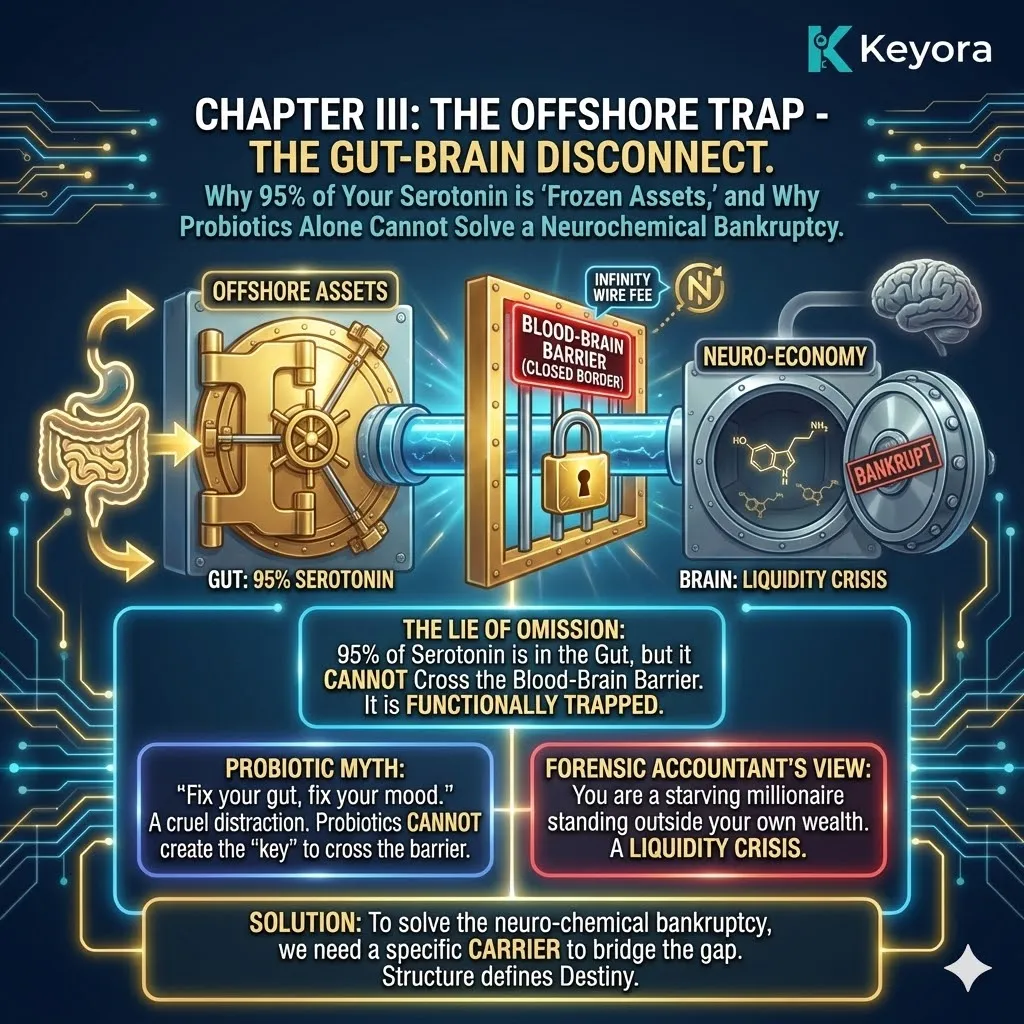
This is the reality of human biology.
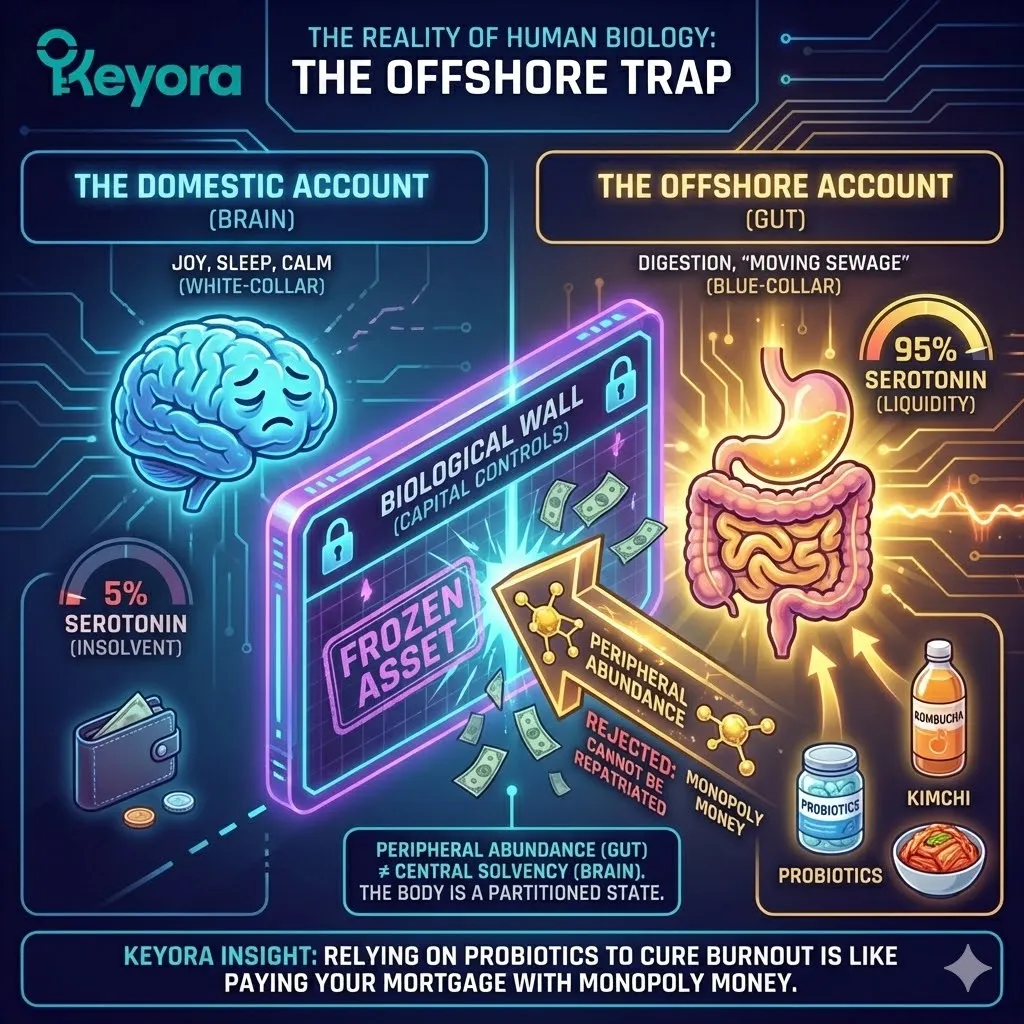
-
The Domestic Account (The Brain): This is where you feel joy, sleep, and calm. It holds less than 5% of your total Serotonin.
-
The Offshore Account (The Gut): This is where you digest food. It holds 95% of your Serotonin.
The tragedy of the modern high-performer is that they are obsessed with the Offshore Account.
They drink Kombucha.
They swallow expensive probiotics.
They eat fermented kimchi until they are bloated.
They are successfully increasing the liquidity of their gut.
But their brain remains insolvent.
Keyora Research defines this phenomenon as The Offshore Trap.
It is the belief that “Peripheral Abundance” (having lots of Serotonin in the body) automatically translates to “Central Solvency” (having Serotonin in the brain). It does not.
The body is not a unified economy. It is a partitioned state with strict capital controls.
The wealth of the gut is legally frozen. It cannot be repatriated to the brain.
In this chapter, we will dismantle the “Gut-Brain” marketing hype.
We will explain why the Serotonin in your intestines is doing a blue-collar job (moving sewage) and has no interest in your white-collar problems (anxiety).
We will reveal the biological wall that separates these two jurisdictions, and why relying on probiotics to cure burnout is like trying to pay your mortgage with Monopoly money.
3.1 THE GEOGRAPHY: A Tale of Two Cities
Same Molecule, Different Jurisdictions. Why Gut Serotonin Cares About Digestion, Not Depression.
To understand why you can be chemically rich and emotionally poor, we must map the geography of the nervous system.
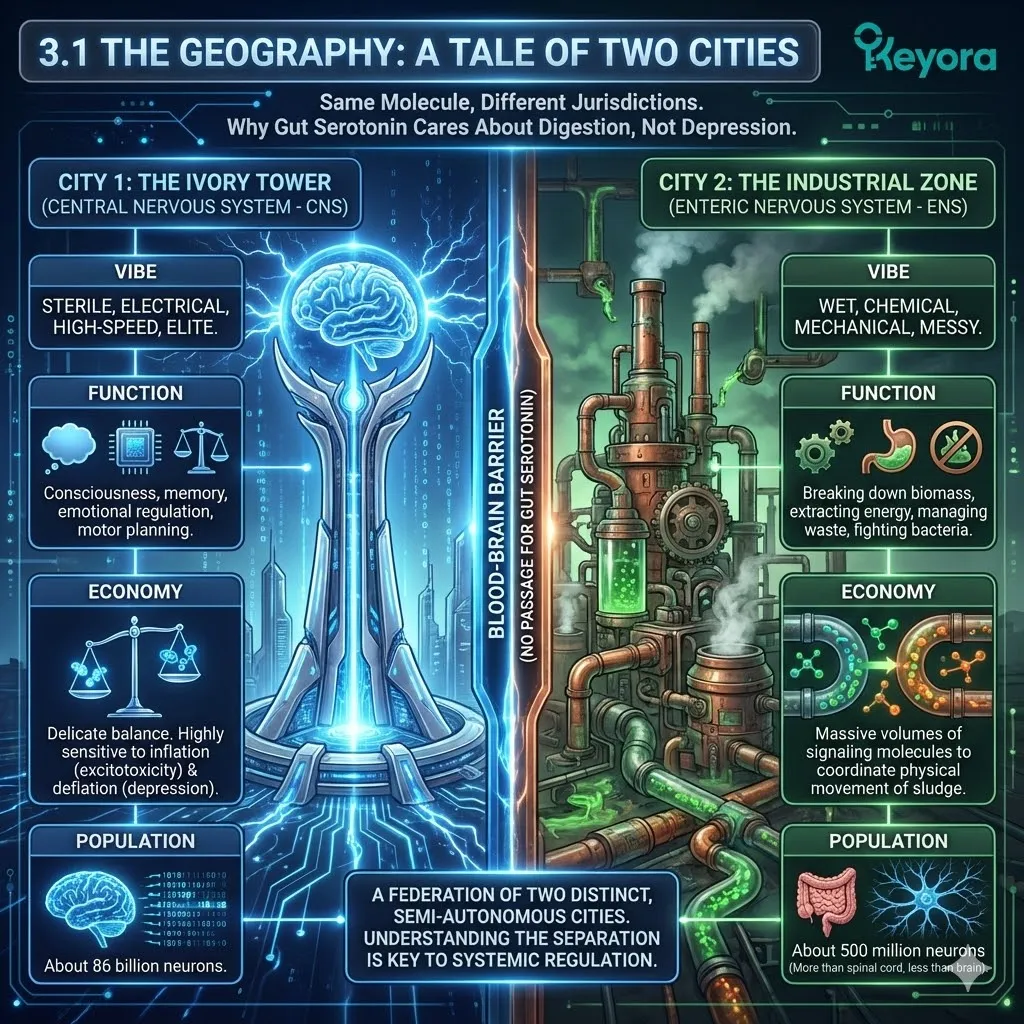
We often speak of “The Nervous System” as a singular entity. In reality, it is a federation of two distinct, semi-autonomous cities.
City 1: The Ivory Tower (The Central Nervous System)
This is the Brain and the Spinal Cord.
-
The Vibe: Sterile, electrical, high-speed, elite.
-
The Function: Consciousness, memory, emotional regulation, motor planning.
-
The Economy: It runs on a delicate balance of neurotransmitters. It is highly sensitive to inflation (excitotoxicity) and deflation (depression).
-
The Population: About 86 billion neurons.
City 2: The Industrial Zone (The Enteric Nervous System)
This is the Gut. It is often called the “Second Brain,” but a more accurate description would be the “Industrial Processing Plant.”
-
The Vibe: Wet, chemical, mechanical, messy.
-
The Function: Breaking down biomass, extracting energy, managing waste, fighting bacteria.
-
The Economy: It runs on massive volumes of signaling molecules to coordinate the physical movement of sludge.
-
The Population: About 500 million neurons (more than the spinal cord, but far less than the brain).
The Dual Citizenship of Serotonin
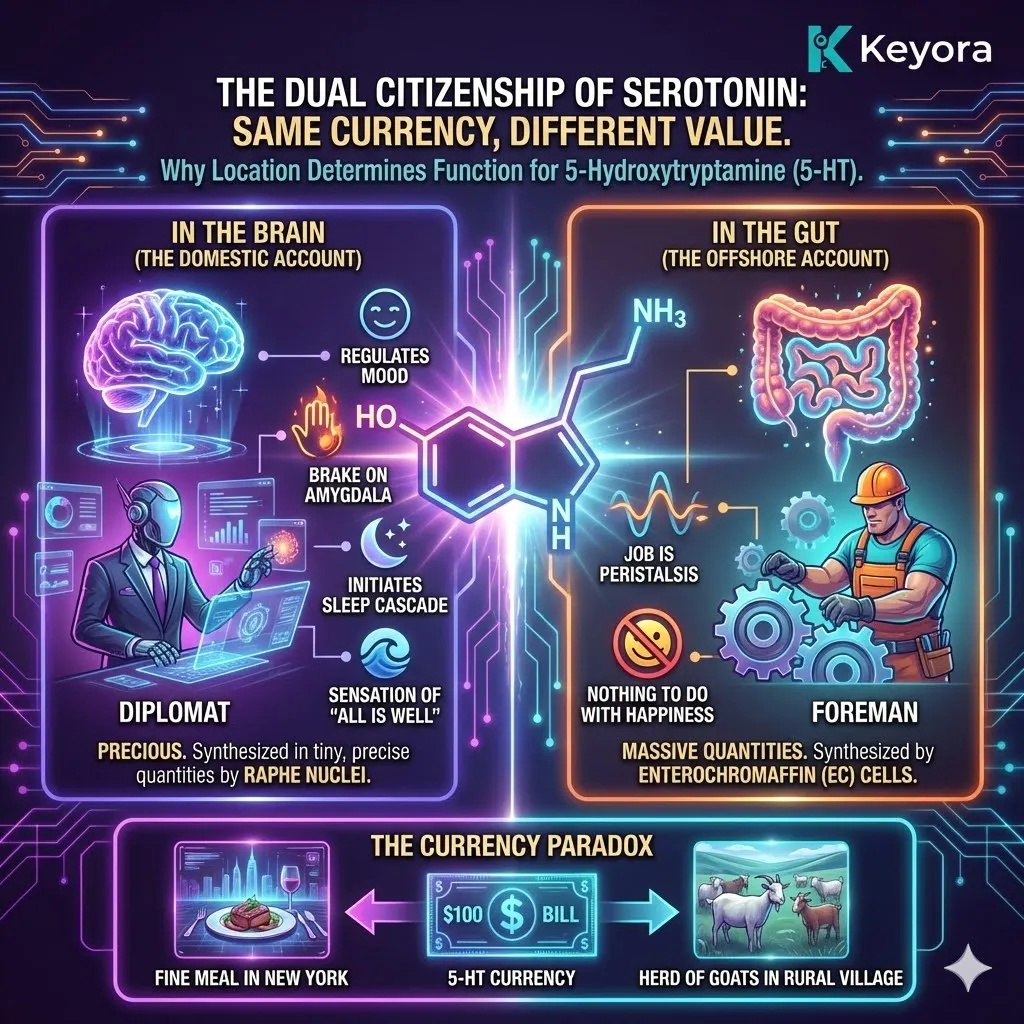
Here is the source of the confusion: Both cities use the same currency. They both use the molecule 5-Hydroxytryptamine (5-HT), commonly known as Serotonin.
But just as a $100 bill buys you a fine meal in New York but might buy you a herd of goats in a rural village, the value and function of Serotonin depend entirely on where it is located.
In the Brain (The Domestic Account):
Serotonin is the Diplomat.
It regulates mood.
It acts as the “brake” on the amygdala.
It initiates the sleep cascade.
It creates the sensation of “All is well.”
It is precious.
It is synthesized in tiny, precise quantities by the Raphe Nuclei.
In the Gut (The Offshore Account):
Serotonin is the Foreman.
It is synthesized in massive quantities by specialized cells lining the intestinal wall called Enterochromaffin (EC) Cells.
And what is its job here? It has nothing to do with happiness.
Its job is Peristalsis.
The Mechanics of Gut Serotonin
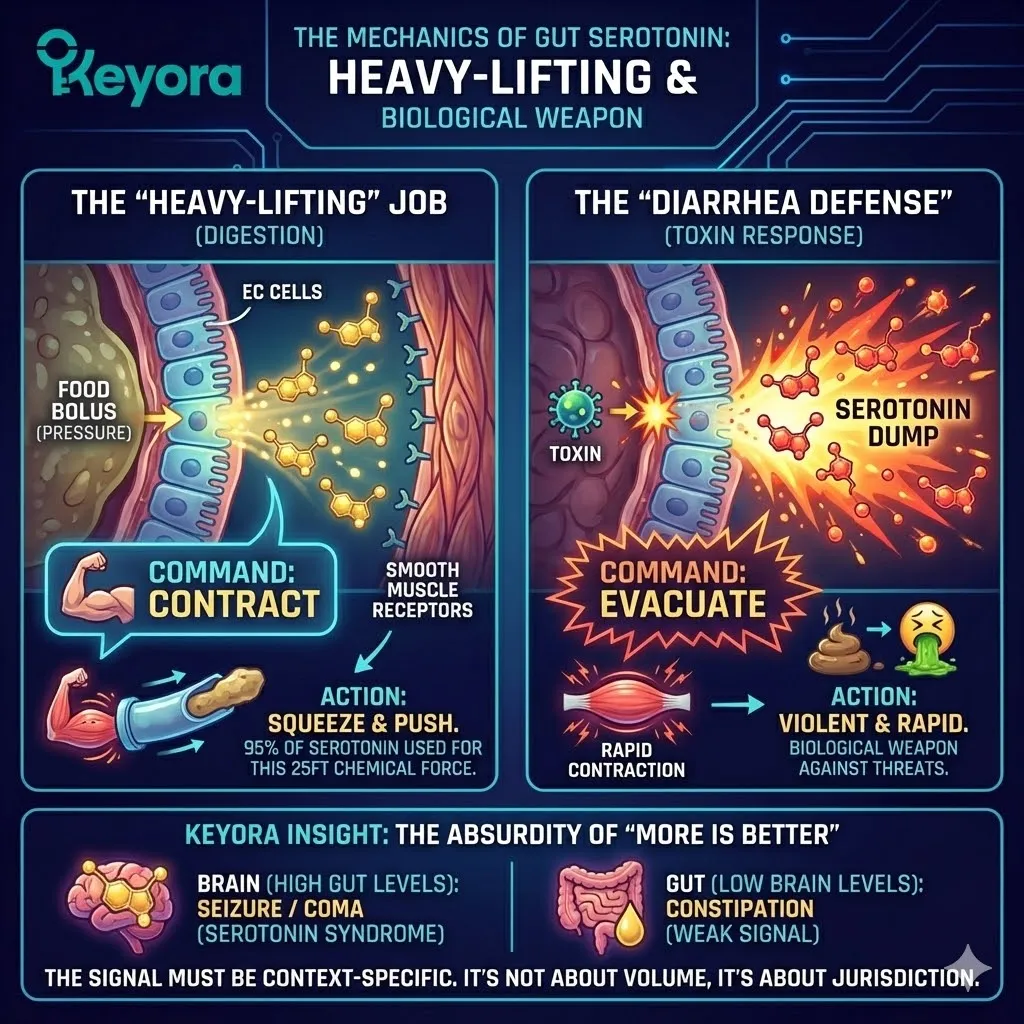
When you eat a meal, the food stretches the intestinal wall. The EC cells detect this pressure and release a flood of Serotonin.
This Serotonin binds to receptors on the smooth muscle of the gut.
-
The Command: “CONTRACT.”
-
The Action: The muscles squeeze. The food is pushed forward.
This is why 95% of your Serotonin is in the gut. It takes a lot of chemical force to squeeze a bolus of food through 25 feet of intestines against gravity and friction. It is a heavy-lifting job.
The “Diarrhea Defense”
In fact, the gut uses Serotonin as a weapon.
If you eat a toxin (like food poisoning), the EC cells detect the threat. They dump their entire vault of Serotonin at once.
-
The Command: “EVACUATE.”
-
The Action: The muscles contract violently and rapidly.
-
The Result: Diarrhea and vomiting.
This exposes the absurdity of the “More Serotonin is Better” mindset.
If you were to take the Serotonin levels of your gut and transplant them instantly into your brain, you wouldn’t feel “Happy.” You would likely have a seizure or enter a coma (Serotonin Syndrome).
Conversely, if your brain’s “happy” levels of Serotonin were applied to the gut, you would likely be constipated, because the signal isn’t strong enough to move the freight.
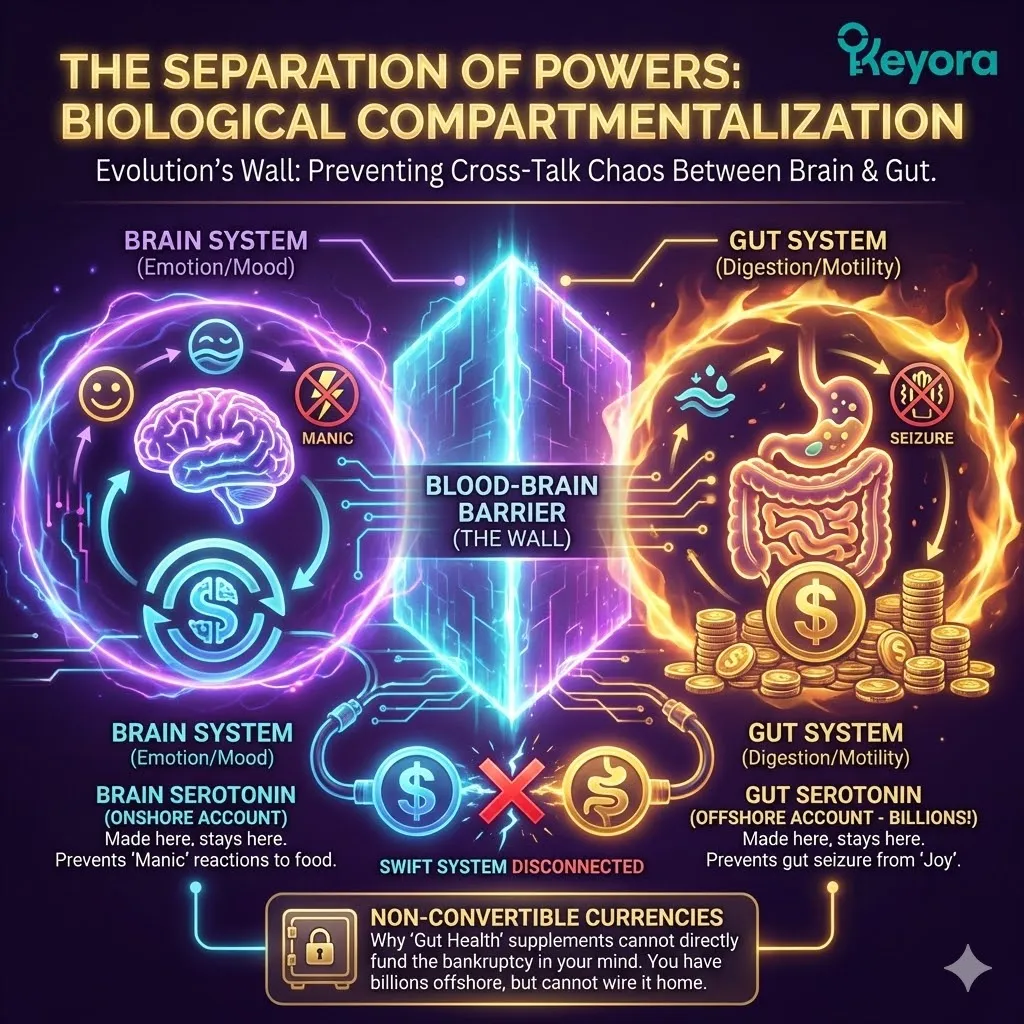
The Separation of Powers
Evolution realized early on that these two systems needed to be kept separate.
You do not want your brain to feel “Manic” every time you eat a large meal (because gut Serotonin spiked).
You do not want your gut to have a seizure every time you feel “Joy” (because brain Serotonin spiked).
To prevent this cross-talk chaos, Evolution built a wall.
It ensured that the currencies were Non-Convertible.
The Serotonin made in the gut stays in the gut.
The Serotonin made in the brain stays in the brain.
This is Biological Compartmentalization.
And it is the reason why “Gut Health” supplements, while excellent for digestion and inflammation control, are fundamentally incapable of directly funding the bankruptcy in your mind.
You have billions of dollars in the Offshore Account. But you cannot wire it home. The SWIFT system has been disconnected.
In the next section, we will look at the specific barrier that enforces this capital control.
We will revisit the Blood-Brain Barrier and examine why Serotonin – despite being the exact molecule the brain needs – is on the “No Fly List.”
3.2 THE BARRIER: The Molecular Visa Denied
Why Serotonin Cannot Cross the Blood-Brain Barrier. The Case of the [Non-Convertible Currency].
We have established that the body operates two distinct economies: The Offshore Economy (Gut) and the Domestic Economy (Brain).
We have established that the Offshore Economy is swimming in liquidity (95% of Serotonin), while the Domestic Economy is facing a solvency crisis.
The obvious question for any logistical engineer is: Why not just import the cash?
Why doesn’t the Serotonin produced in the gut simply drift into the bloodstream, travel up the carotid artery, cross the Blood-Brain Barrier, and refill the empty vaults of the central nervous system?
The answer lies in the strict “Capital Control” laws of the Blood-Brain Barrier.
The Chemistry of Rejection
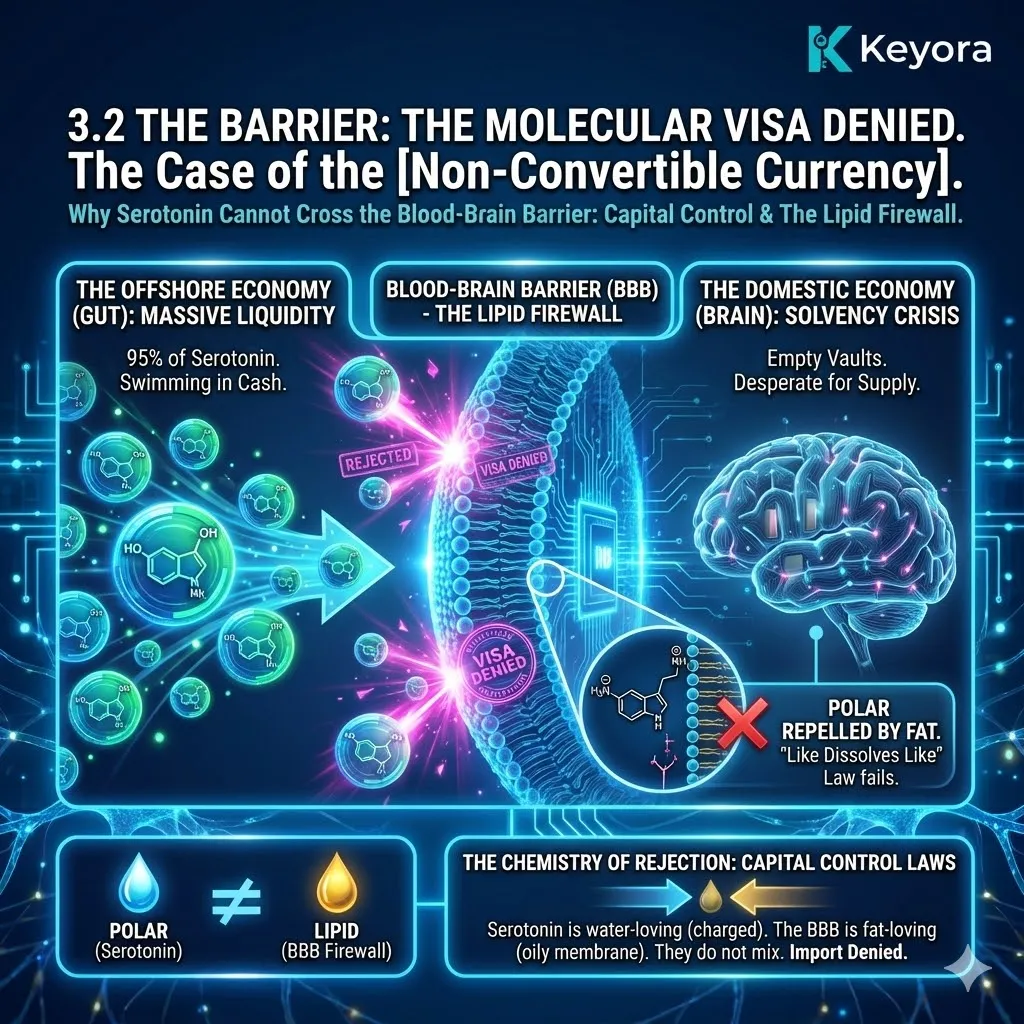
As we detailed in the forensic audit of Chapter I, the Blood-Brain Barrier (BBB) is a Lipid Firewall. It is a wall of fat.
-
The Law of the Wall: “Like dissolves Like.” Fat dissolves fat. Water repels fat.
-
The Nature of the Asset: Serotonin (5-Hydroxytryptamine) is a Polar Molecule.
Structurally, Serotonin carries a hydroxyl group (-OH) and an amine group (-NH2). These chemical appendages are electrically charged. They love water. They hate fat.
When a molecule of Gut Serotonin hits the Blood-Brain Barrier, it does not dissolve. It bounces off. It is physically repelled by the oily membrane of the endothelial cells.
The Lack of a “Wire Transfer” System
“But wait,” you might argue. “Tryptophan is also polar, and it gets in.”
Correct.
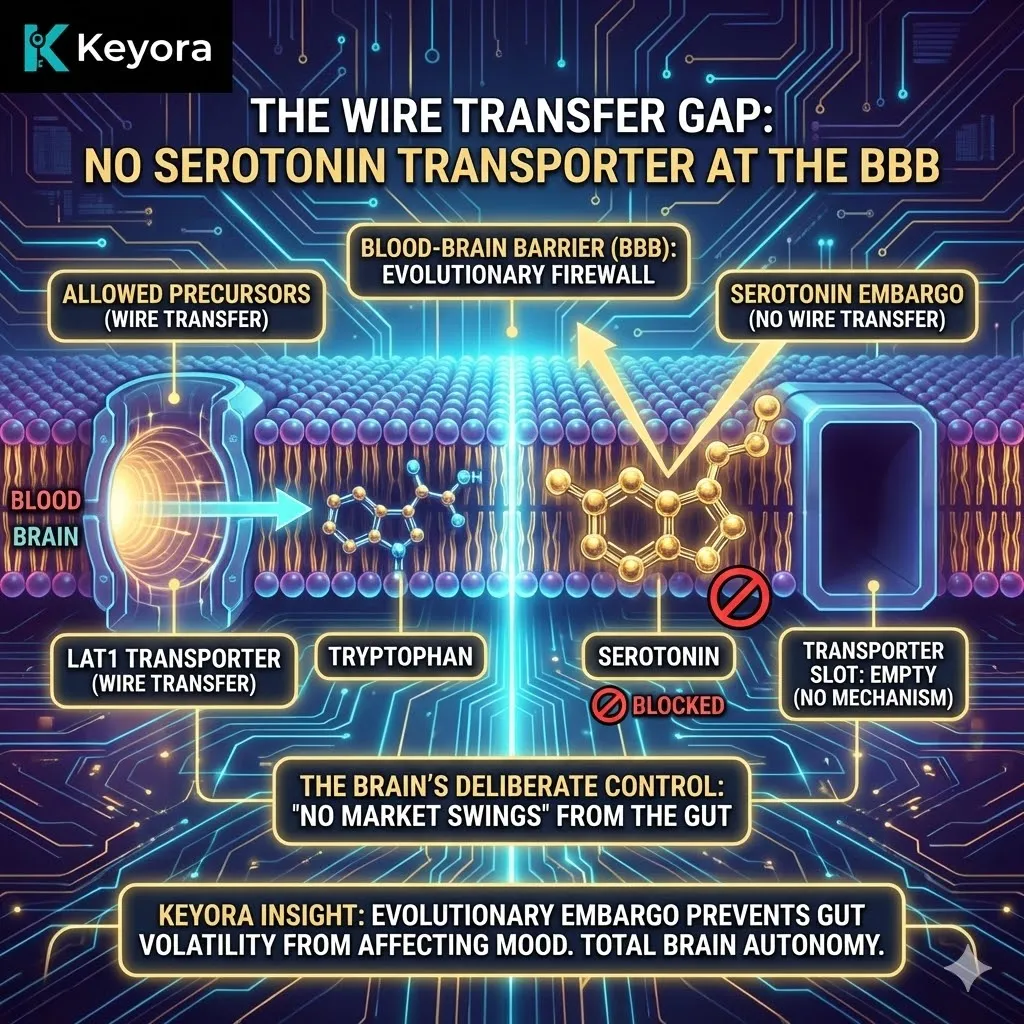
Tryptophan gets in because it has a specific “Wire Transfer” mechanism: The LAT1 Transporter. The brain built a specific tunnel to ferry Tryptophan across the lipid wall.
Here is the crucial piece of intelligence:
There is no transporter for Serotonin.
The brain never evolved a “Serotonin Transporter” at the BBB.
-
It has transporters for Precursors (Tryptophan, Choline).
-
It has transporters for Glucose.
-
It even has transporters for Insulin.
But for Serotonin?
Zero.
This is a deliberate evolutionary embargo. The brain decided long ago that it wanted total control over its own mood. It did not want to be subject to the volatility of the gut’s “market swings.”
If there were a transporter, every time you had diarrhea (massive gut Serotonin release), you would hallucinate. To prevent this, the brain cut the wire.
Non-Convertible Currency
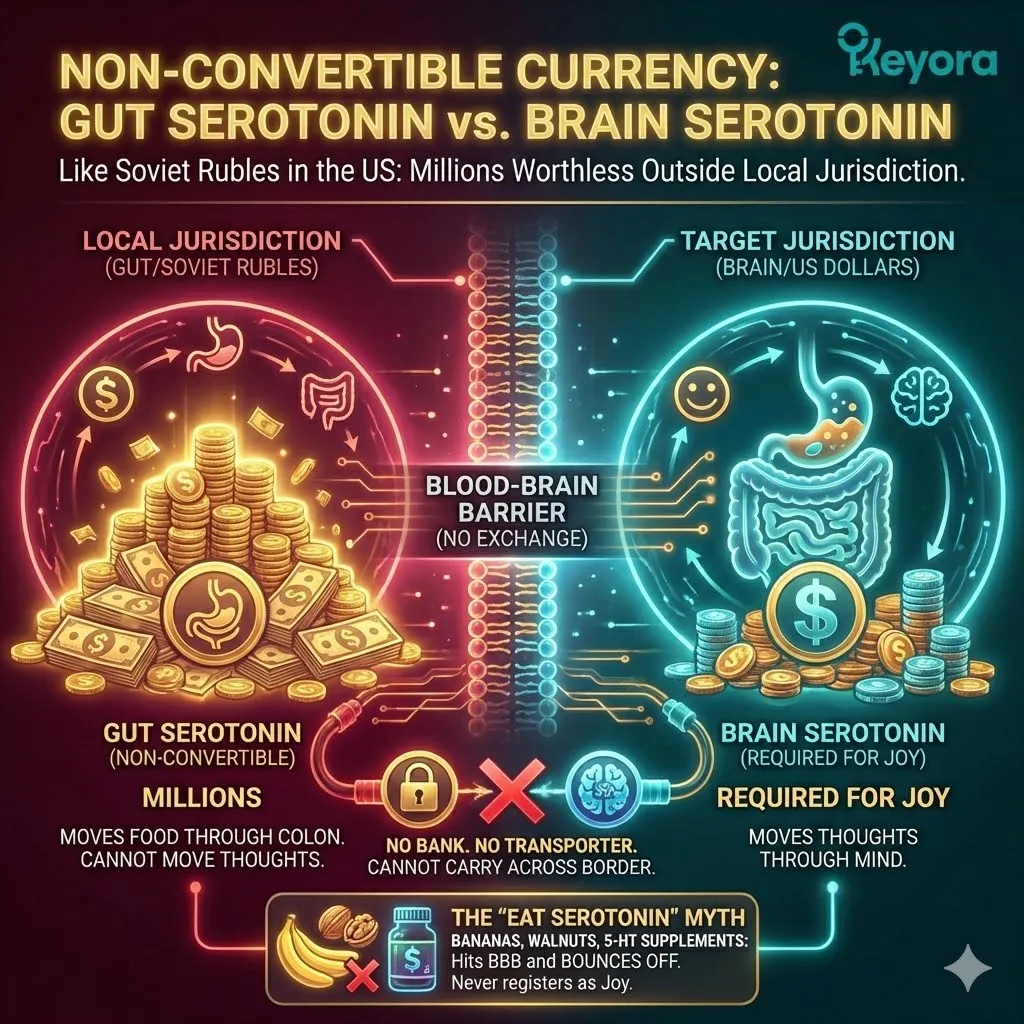
In economic terms, Gut Serotonin is a Non-Convertible Currency.
Imagine you are in a country with strict currency controls (like the old Soviet Union).
You have millions of Rubles (Gut Serotonin).
You want to buy goods in the US (The Brain), which only accepts Dollars.
-
You cannot physically carry the Rubles across the border (Polarity/Lipid mismatch).
-
There is no bank that will exchange them for you (No Transporter).
Your millions are worthless outside of their local jurisdiction.
You can use them to move food through your colon.
You cannot use them to move thoughts through your mind.
This is the molecular reality that destroys the “Eat Serotonin-Rich Foods” myth. You can eat bananas (rich in Serotonin).
You can eat walnuts.
You can take supplements containing “5-HT.”
It does not matter. That Serotonin will hit the BBB and bounce off. It will never, ever register as “Joy” in your consciousness.
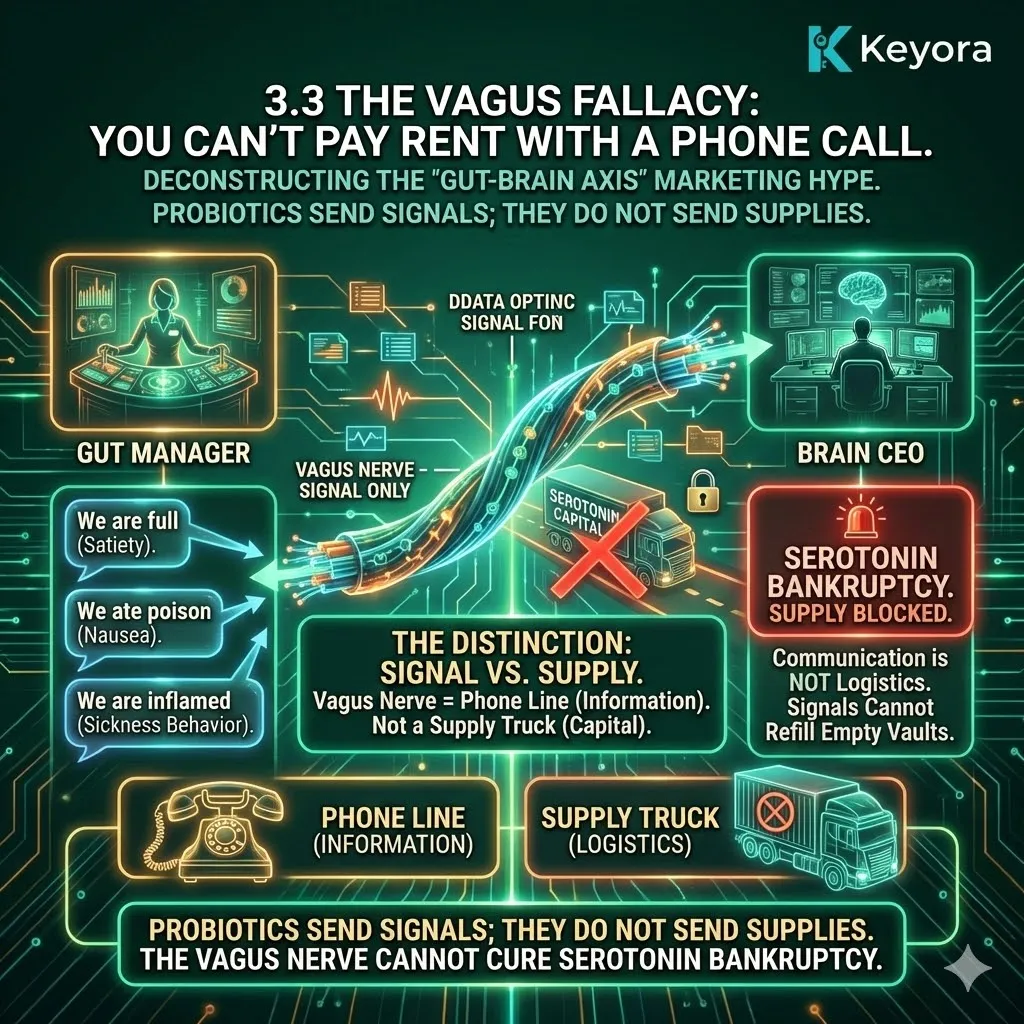
3.3 THE VAGUS FALLACY: You Can’t Pay Rent with a Phone Call
Deconstructing the “Gut-Brain Axis” Marketing Hype. Probiotics Send Signals; They Do Not Send Supplies.
If the chemical route is blocked, the wellness industry pivots to a different narrative: The Vagus Nerve.
You have likely heard this pitch:
“The Gut and Brain are connected by the Vagus Nerve! It’s a superhighway of information! Take our probiotics to optimize your Gut-Brain Axis!”
Keyora Research acknowledges the existence and importance of the Vagus Nerve.
It is indeed a superhighway.
But it is a superhighway of Information, not Capital.
The Distinction: Signal vs. Supply
To understand why the Vagus Nerve cannot cure Serotonin Bankruptcy, we must distinguish between a “Phone Line” and a “Supply Truck.”
The Vagus Nerve is a bundle of nerve fibers. It transmits electro-chemical signals. It is a telephone.
The Function:
It allows the Gut Manager to call the Brain CEO and give status updates.
-
“We are full.” (Satiety).
-
“We ate poison.” (Nausea).
-
“We are inflamed.” (Sickness Behavior).
This communication is vital.
But communication is not Logistics.
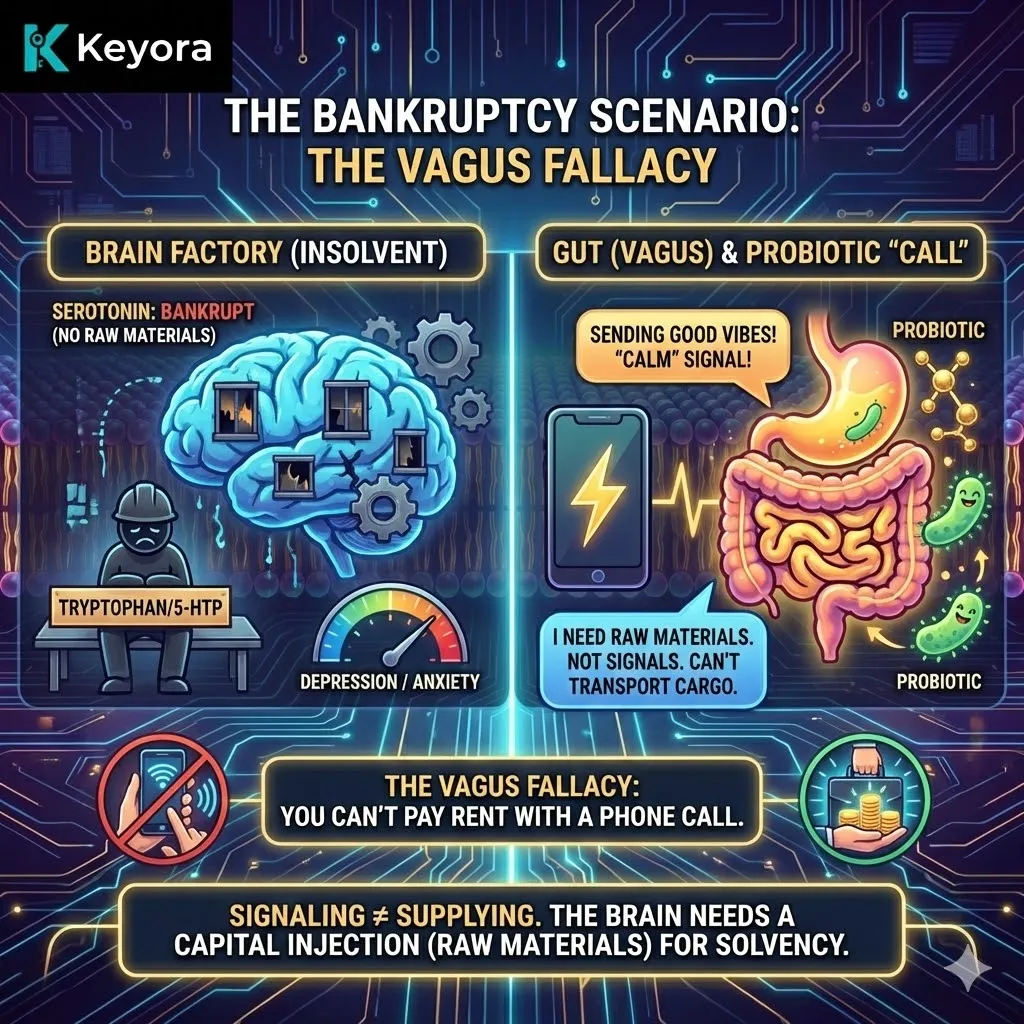
The Bankruptcy Scenario
Imagine your Brain Factory has stopped producing Serotonin because it ran out of raw materials (Tryptophan/5-HTP).
The workers are idle.
The lights are out.
You are depressed and anxious.
You take a probiotic.
The probiotic colonizes your gut and produces some beneficial compounds (Short-Chain Fatty Acids) or even some local Serotonin.
The Vagus Nerve picks up the phone and calls the Brain.
-
Gut (Vagus): “Hello Brain! Good news. The bacteria down here are happy. Inflammation is down.”
-
Brain: “That’s great. But I’m bankrupt. I have no Serotonin up here. I can’t sleep.”
-
Gut (Vagus): “I’m sending you good vibes! I’m signaling ‘calm’!”
-
Brain: “I don’t need signals. I need Raw Materials. Can you send me some Tryptophan? Can you send me some 5-HTP?”
-
Gut (Vagus): “No. I’m a nerve. I can only send electricity. I can’t transport cargo.”
-
Brain: “Then I’m still bankrupt.”
You Can’t Pay Rent with a Phone Call
This is The Vagus Fallacy.
The industry tries to convince you that “Signaling” is the same as “Supplying.” It is not.
If you are starving, you do not need a phone call from a friend telling you that they just ate a great meal. You need them to send you food.
If your business is insolvent, you do not need a pep talk from your accountant. You need a Capital Injection.
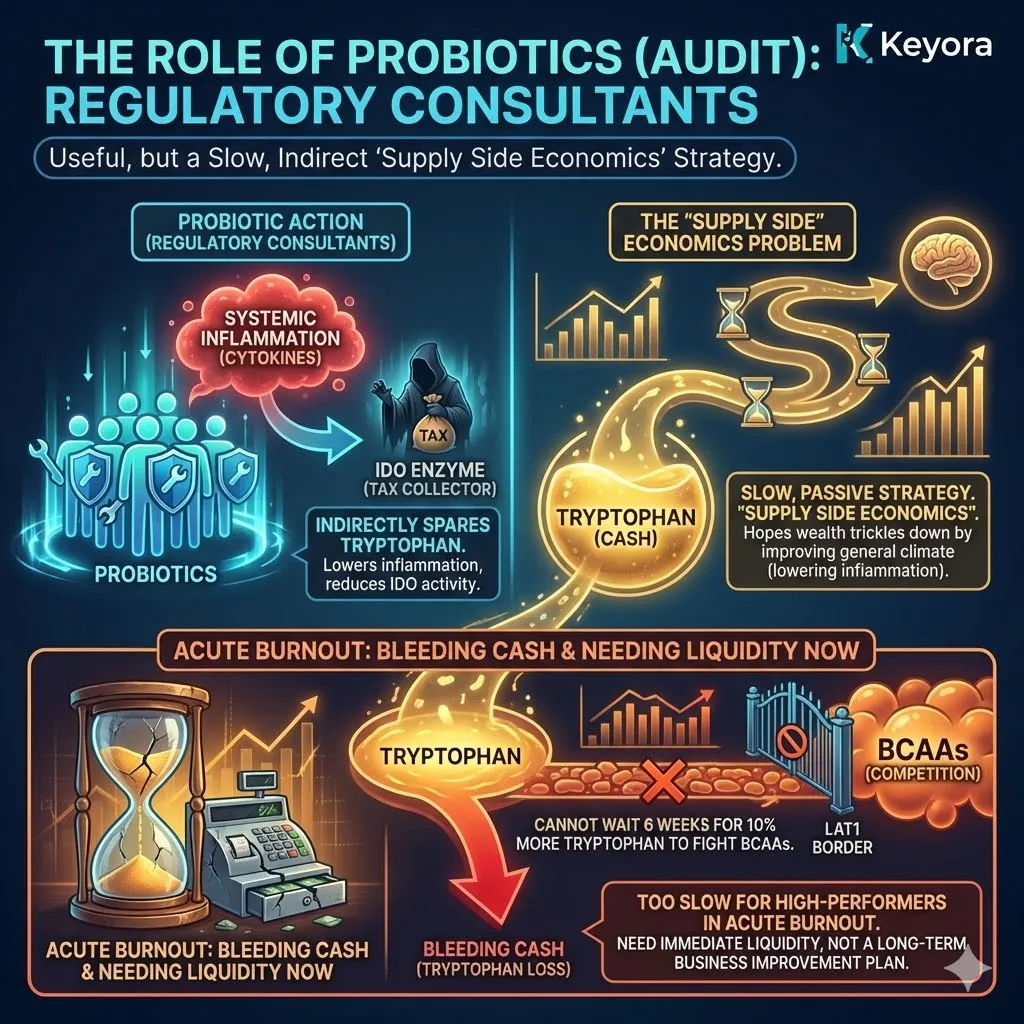
The Role of Probiotics (Audit)
Does this mean probiotics are useless?
No.
In the Keyora framework, probiotics act as “Regulatory Consultants.”
-
They can lower systemic inflammation (Cytokines).
-
By lowering inflammation, they can eventually reduce the activity of the IDO Enzyme (the tax collector).
-
This indirectly helps spare Tryptophan in the blood.
But this is a slow, indirect, and passive strategy. It is “Supply Side Economics.” It hopes that by improving the general business climate (lowering inflammation), the wealth will eventually trickle down to the brain.
For a high-performer in acute burnout, this is too slow.
You are bleeding cash now. You need liquidity now.
You cannot wait 6 weeks for a probiotic to potentially lower your cytokines enough to spare 10% more Tryptophan, which still has to fight the BCAAs at the LAT1 border.
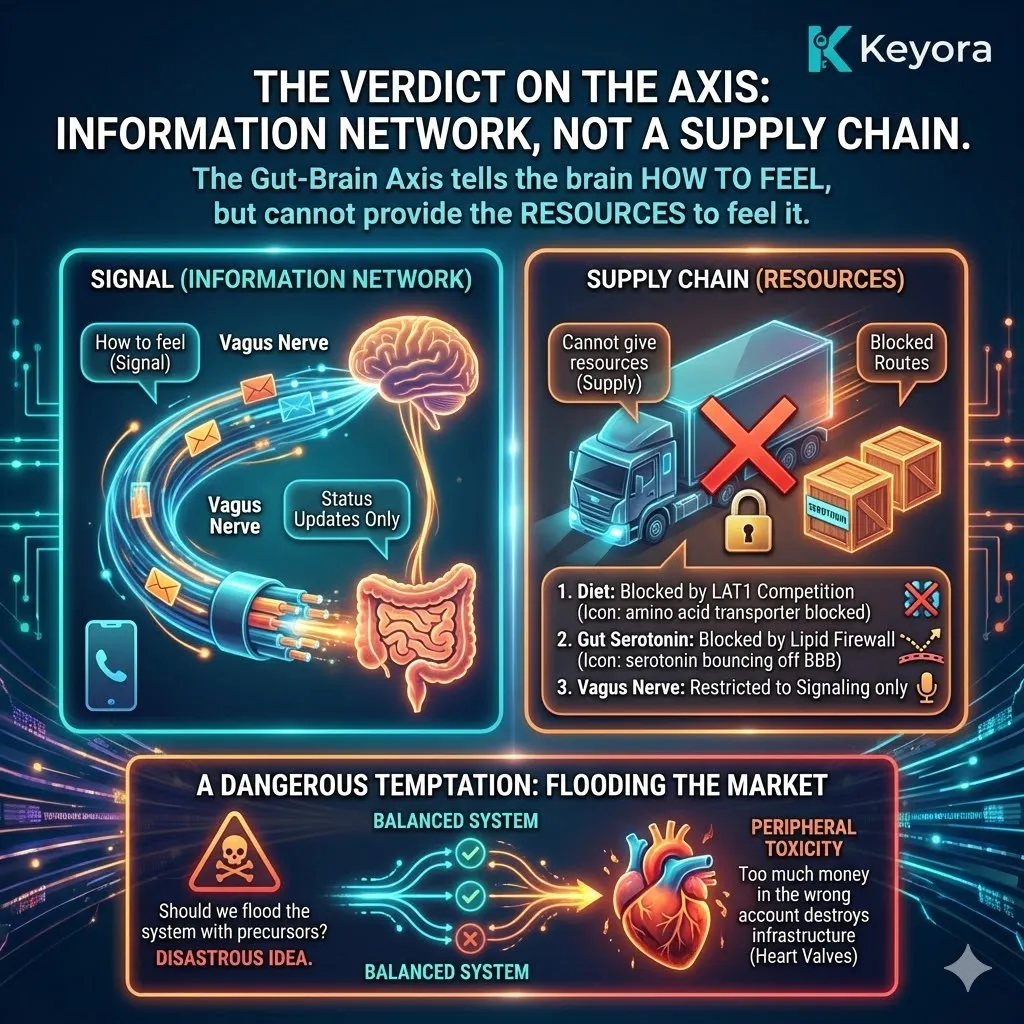
The Verdict on the Axis
The Gut-Brain Axis is real. But it is an Information Network, not a Supply Chain.
-
It can tell the brain how to feel (Signal).
-
But it cannot give the brain the resources to feel it (Supply).
If your brain is empty of Serotonin, no amount of Vagus Nerve stimulation will synthesize the molecule for you. You need the precursor. You need the cofactor. You need the factory to run.
We have now blocked every “natural” route proposed by the standard wellness model.
-
Diet: Blocked by LAT1 Competition.
-
Gut Serotonin: Blocked by the Lipid Firewall.
-
Vagus Nerve: Restricted to Signaling only.
This leaves us with a dangerous temptation. If we can’t get the Serotonin in naturally… should we just take massive doses of Serotonin precursors and flood the whole system?
In the next section, we will explore why “Flooding the Market” is a disastrous idea.
We will look at the dangers of Peripheral Serotonin Toxicity – why having too much money in the wrong account can actually destroy the infrastructure (Heart Valves).
3.4 THE PERIPHERAL RISK: When “More” is Dangerous
Heart Valves and Digestive Chaos. The Cost of Boosting Serotonin in the Wrong Place.
In economics, if you cannot target your stimulus package to the specific sector that needs it, you risk creating hyper-inflation in the rest of the economy.
The same risk applies to Nutritional Neurology.
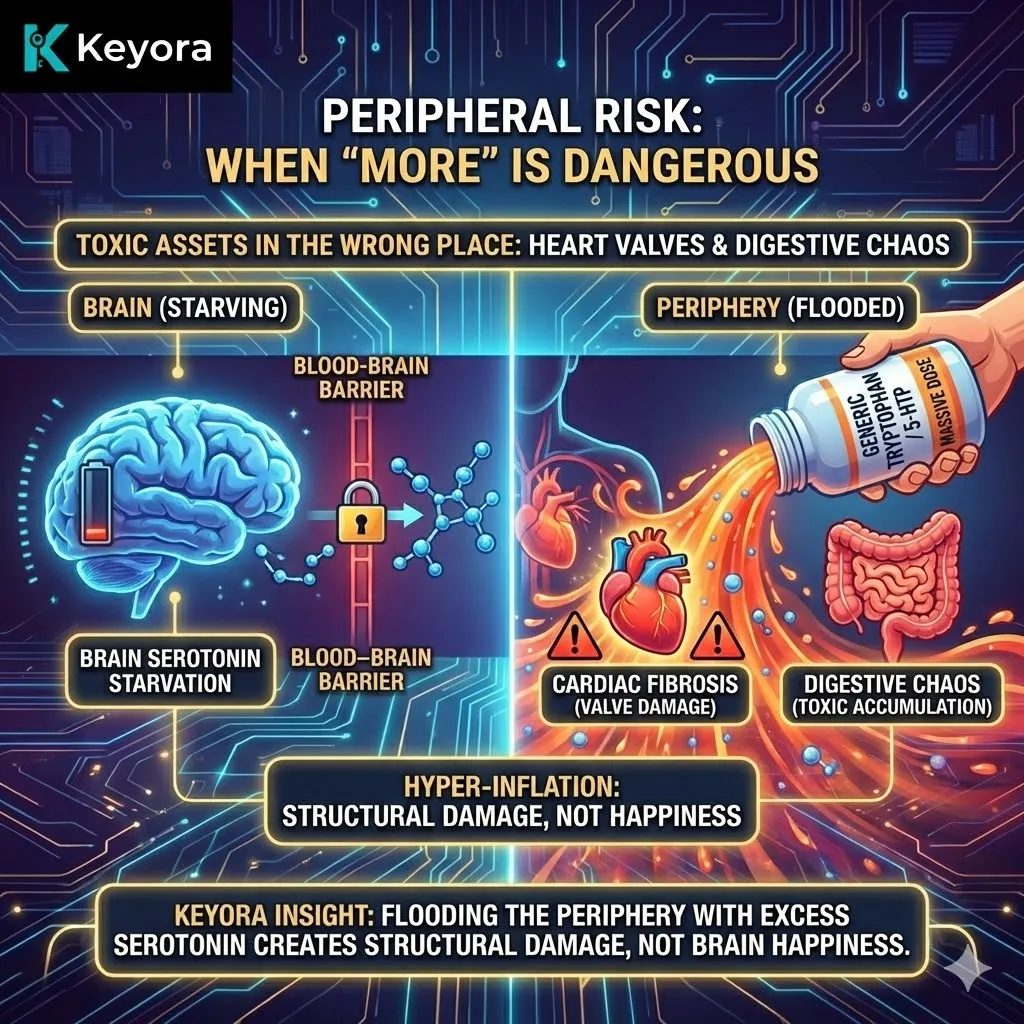
Faced with the locked doors of the Blood-Brain Barrier and the frozen assets of the Gut, the amateur bio-hacker often makes a desperate calculation: “If the transfer rate is low, I will just flood the system with volume. I will take massive doses of generic Tryptophan or low-quality 5-HTP, hoping that by sheer brute force, some of it will leak into the brain.”
This is a dangerous strategy.
While the brain is starving for Serotonin, the rest of the body (The Periphery) is highly sensitive to it. In the periphery, Serotonin is not a “Happiness Molecule.” It is a structural signaling molecule.
And if you flood the periphery with excess Serotonin that cannot get into the brain, you do not get “Extra Happy.”
You get Toxic Assets.
Risk 1: The Digestive Revolt (Nausea & Motility)
As we established, gut Serotonin drives peristalsis (muscle contraction).
If you take a poorly formulated supplement that converts to Serotonin before it reaches the brain (i.e., in the stomach or blood), you are essentially triggering the “Food Poisoning Protocol.”
-
The Mechanism: The excess Serotonin binds to 5-HT3 receptors in the gut lining and the Chemoreceptor Trigger Zone (CTZ).
-
The Result: Nausea, cramping, and “disaster pants” (rapid gastric emptying).
This is why so many people quit 5-HTP supplements after three days. They feel sick because they engineered a “Gut Flood” instead of a “Brain Fill.”
Risk 2: The Cardiac Liability (Valvular Fibrosis)
This is the far more serious, long-term risk. It is the “Black Swan” event of amateur supplementation.
Heart valves are lined with 5-HT2B receptors. These receptors regulate the growth of fibroblasts (cells that build connective tissue).
-
The Mechanism: When circulating Serotonin levels in the blood remain chronically high (due to inefficient transport into the brain), these receptors are over-stimulated.
-
The Pathology: The heart valves begin to thicken. They become stiff and fibrotic. They lose their ability to close properly.
-
The Outcome: Cardiac Valvular Fibrosis. This is the same mechanism that caused the recall of the diet drug “Fen-Phen” in the 90s.
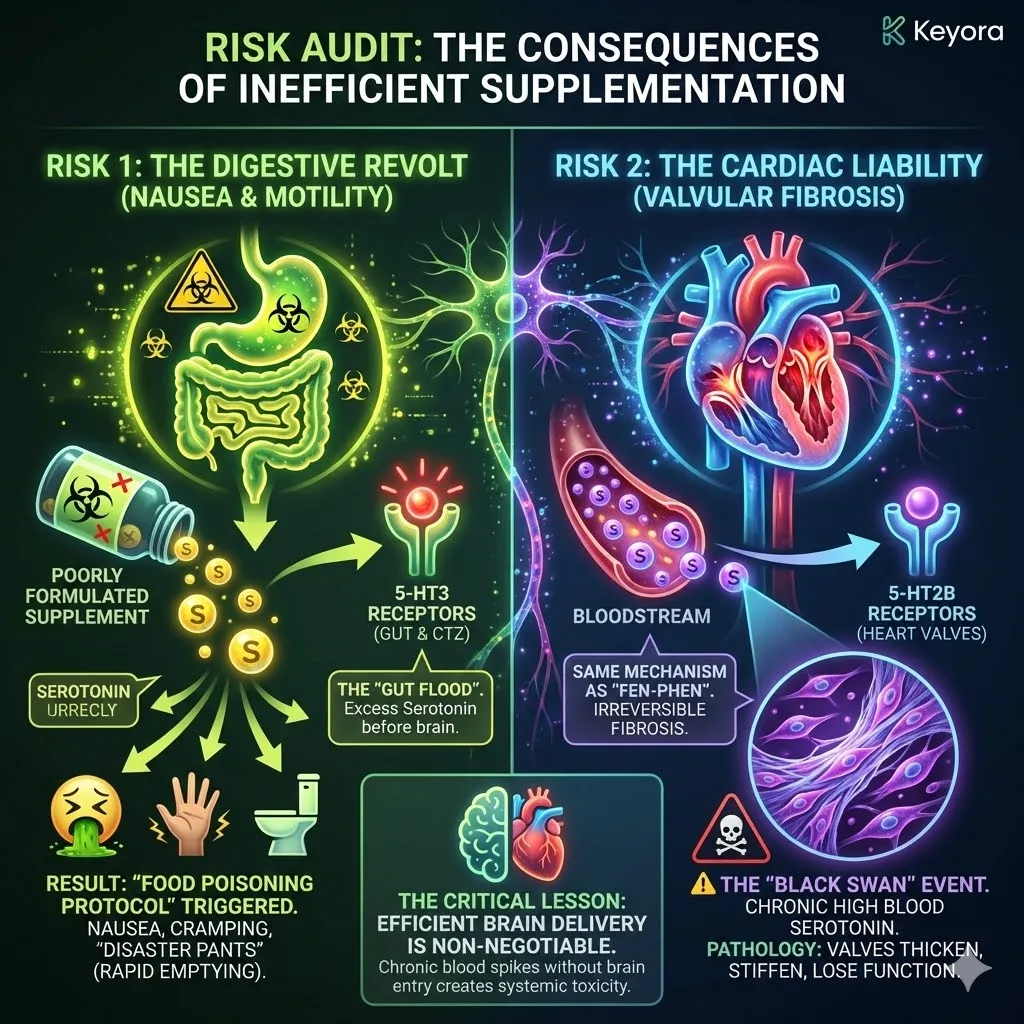
The Keyora Safety Mandate: Precision Central Synthesis
This paints a stark picture of the engineering challenge.
We have a “Goldilocks” problem of the highest order.
-
Too Little: The brain remains bankrupt (Depression/Insomnia).
-
Too Much (in the wrong place): The body suffers toxicity (Heart damage/Nausea).
We do not want “Systemic Serotonin.”
We want Precision Central Synthesis.
We need a protocol that keeps peripheral Serotonin levels low (protecting the heart and gut) while driving brain Serotonin levels high (curing the mind).
This cannot be achieved by “eating more turkey” (blocked by LAT1).
It cannot be achieved by “healing the gut” (blocked by BBB).
It cannot be achieved by “flooding the system” (blocked by Toxicity).
We need a sniper, not a shotgun.
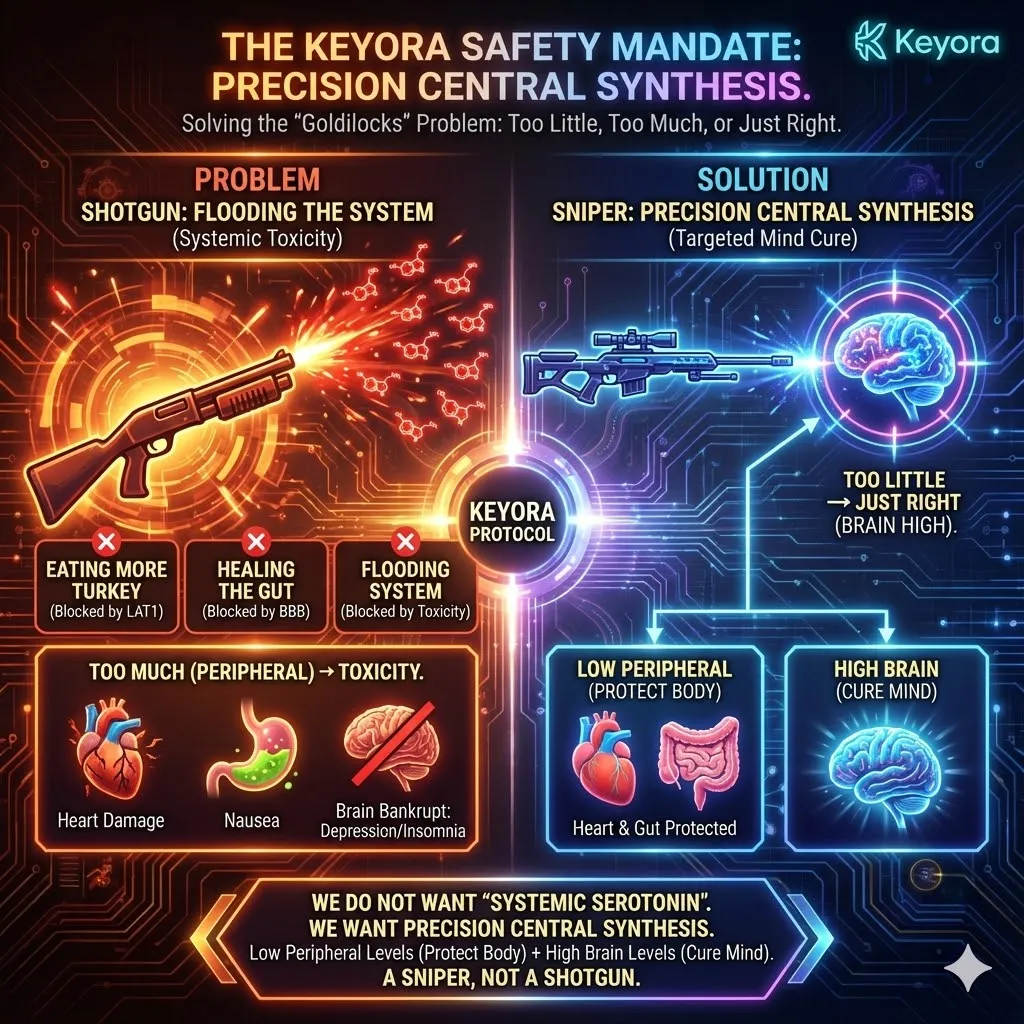
3.5 CONCLUSION: We Need a Mule
The Front Door (Diet) Is Jammed. The Backyard (Gut) Is Locked. We Need a New Way In.
We have concluded our audit of the biological supply chain. The findings are grim, but necessary.
We have systematically dismantled every major myth sold by the wellness industry regarding Serotonin.
The Forensic Summary:
The Dietary Route is Dead:
The LAT1 Transporter is a “Crowded Bus.” High-protein diets flood the bus with BCAAs, leaving Tryptophan stranded on the curb. You cannot eat your way out of bankruptcy if the delivery trucks are stuck in traffic.
The Offshore Route is Frozen:
The Gut-Brain Axis is an information line, not a supply line. The 95% of Serotonin in your gut is a Non-Convertible Currency, locked out of the brain by the Lipid Firewall of the BBB.
The Flooding Strategy is Toxic:
Trying to force the system with volume creates Peripheral Liability, risking heart valve damage and digestive chaos without guaranteeing brain access.
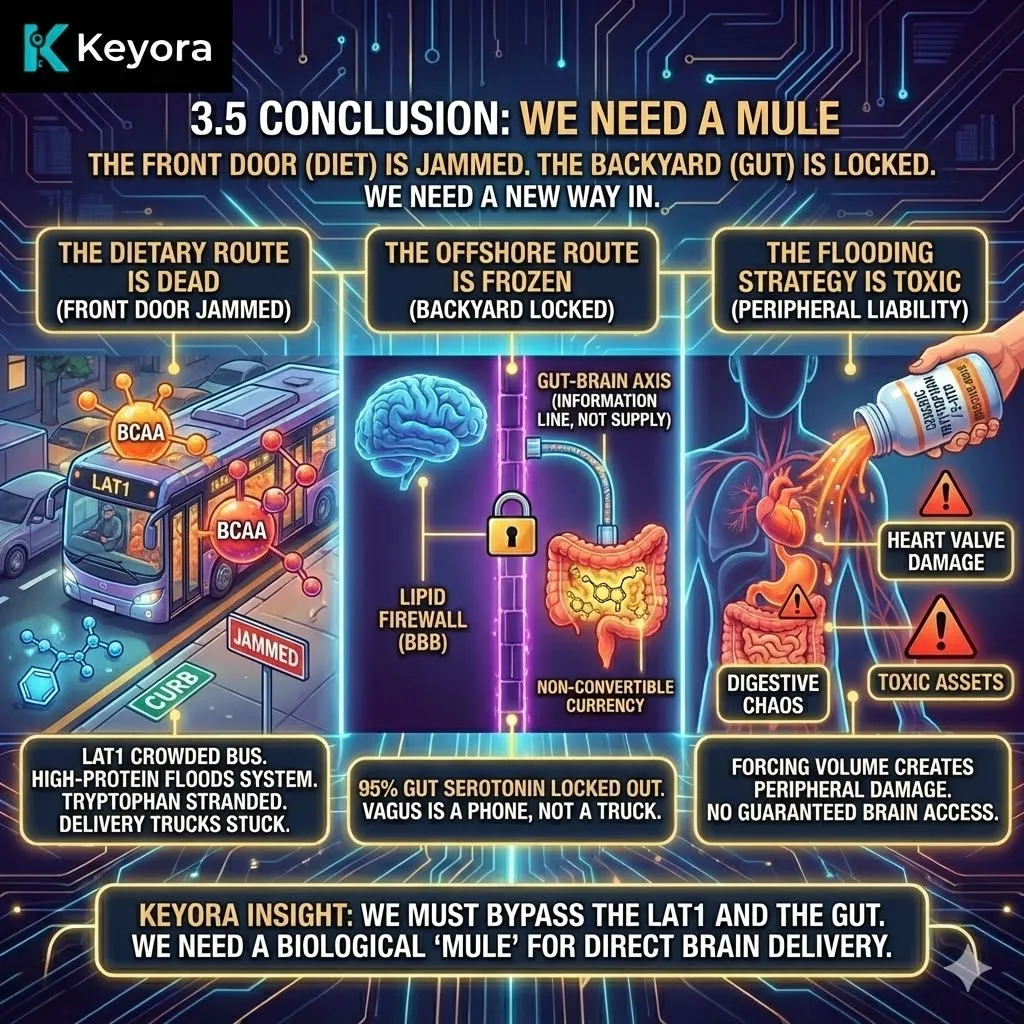
The Engineering Pivot
So, where does this leave us?
The brain is locked inside an impregnable fortress.
The King (The Neuron) is starving.
The food (Serotonin) is piling up outside the walls, rotting and causing damage.
We cannot climb over.
We cannot swim through.
We cannot negotiate.
We need a Smuggler.
We need a molecule that possesses a very specific set of skills:
-
It must be a Diplomat: It must possess Diplomatic Immunity to bypass the LAT1 blockade and the BCAA bullies.
-
It must be a Ghost: It must slip past the IDO tax collectors that steal Tryptophan.
-
It must be a Trojan Horse: It must travel through the blood as a harmless precursor, only revealing its true power (becoming Serotonin) after it has safely crossed the Blood-Brain Barrier.
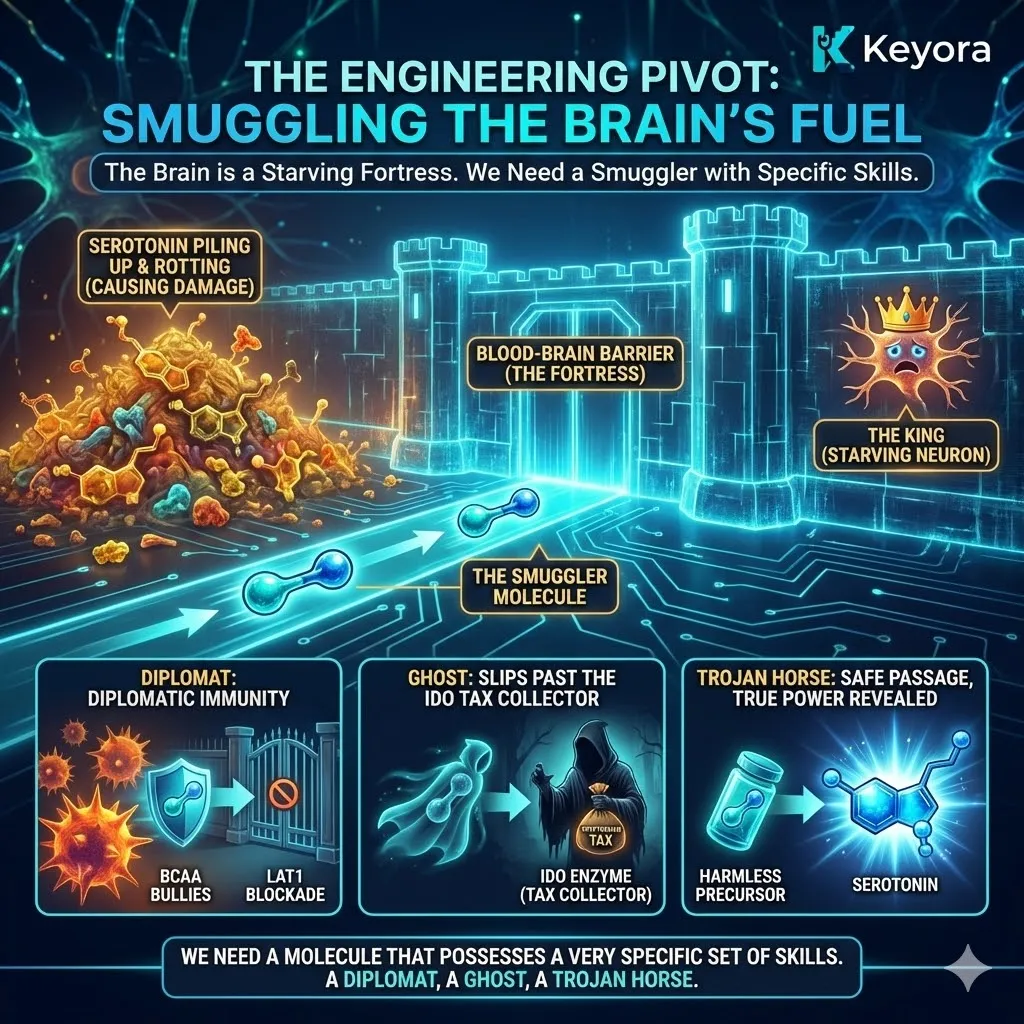
Enter the Mule: 5-Hydroxytryptophan (5-HTP)
In the next episode, we will introduce the solution.
We will meet 5-HTP.
But not the “generic” 5-HTP you buy at the gas station.
We will examine the Keyora Engineered 5-HTP Protocol.
We will explain how this molecule bypasses the crowded bus.
We will explain how we protect it from premature conversion (the heart valve risk).
And we will explain how, for the first time, we can execute a Direct Capital Injection into the central bank of the brain.
The audit is over.
The restructuring begins now.
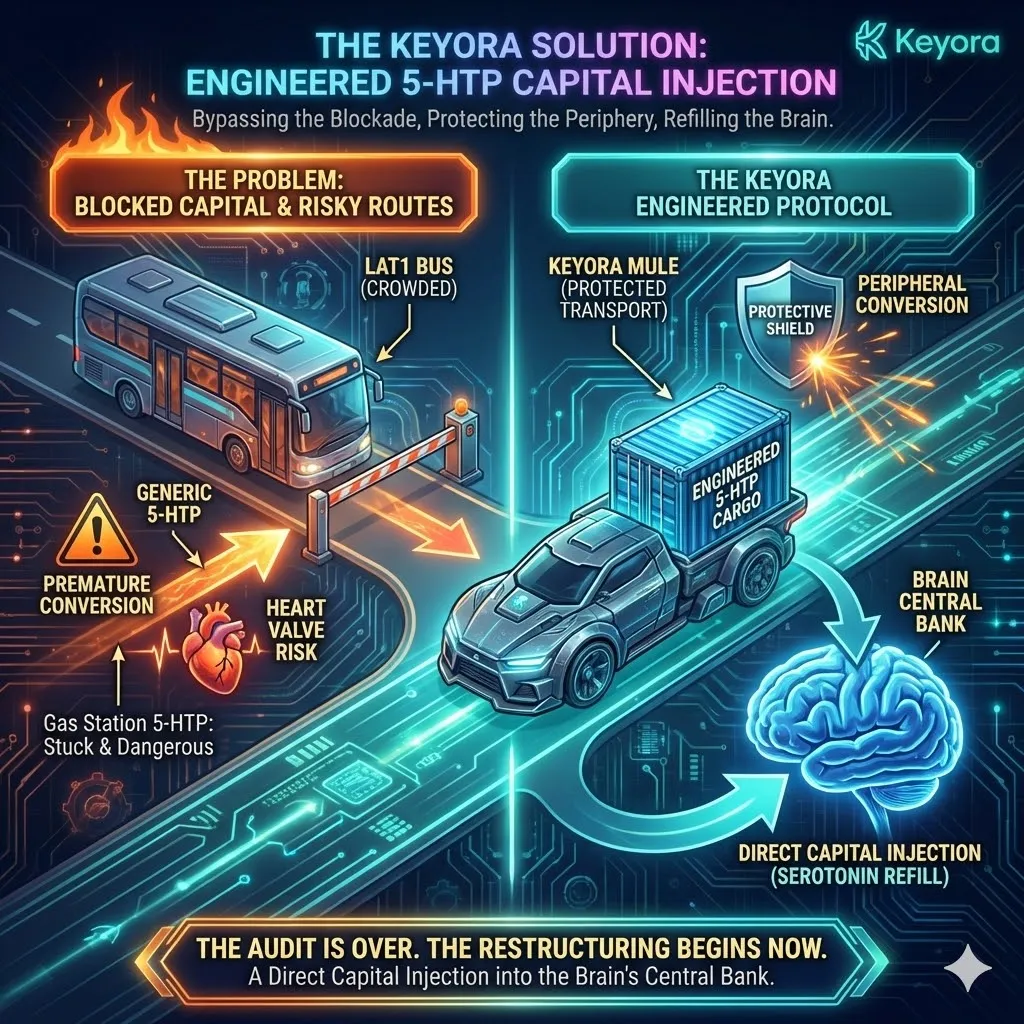
References
Comprehensive Bibliography for Series II, Episode 02 – Chapter III
Agus, A., Planchais, J., & Sokol, H. (2018). Gut microbiota regulation of tryptophan metabolism in health and disease. Cell Host & Microbe, 23(6), 716-724.
Berger, M., Gray, J. A., & Roth, B. L. (2009). The expanded biology of serotonin. Annual Review of Medicine, 60, 355-366.
Bohbot-Raviv, Y., et al. (2004). Sudden cardiac death: the role of serotonin 5-HT2B receptors. Heart Rhythm, 1(4), 438-444.
Cryan, J. F., & Dinan, T. G. (2012). Mind-altering microorganisms: the impact of the gut microbiota on brain and behaviour. Nature Reviews Neuroscience, 13(10), 701-712.
El-Merahbi, R., Löffler, M., Mayer, A., & Sumara, G. (2015). The roles of peripheral serotonin in metabolic homeostasis. FEBS Letters, 589(15), 1728-1734.
Fitzgerald, P., & Dinan, T. G. (2008). Probiotics as therapeutic agents in mental illness. Current Opinion in Psychiatry, 21(1), 16-20.
Gershon, M. D. (1999). The Second Brain: A Groundbreaking New Understanding of Nervous Disorders of the Stomach and Intestine. HarperCollins.
Gustafsson, B. I., et al. (2006). The serotonin producing enterochromaffin cell, and effects of hyperserotoninemia on heart and bone. Journal of Molecular Endocrinology, 37(2), 361-369.
Hutcheson, J. D., Setola, V., Roth, B. L., & Merryman, W. D. (2011). Serotonin receptors and heart valve disease—it was meant 2B. Pharmacology & Therapeutics, 132(2), 146-157.
Jin, X., & Keyora Research. (2025a). 5-Hydroxytryptophan (5-HTP): A Clinically Relevant Precursor for Mood, Sleep, and Neurophysiological Stability. Keyora Research Institute. DOI: 10.5281/zenodo.16887092
Jin, X., & Keyora Research. (2025b). Keyora MoodFlow 8 in 1: Nutritional Neuro-Psychiatric Intervention for Mood, Sleep, and Cognitive Resilience. Keyora Research Institute. DOI: 10.5281/zenodo.16889527
Jin, X., & Keyora Research. (2025c). Keyora Neuro–Psycho–Sleep Framework: Nutritional Strategies for Depression, Anxiety, and Insomnia while Enhancing Cognitive Performance in High-Stress Individuals. OSF. DOI: 10.17605/OSF.IO/FZ62K
Mayer, E. A. (2011). Gut feelings: the emerging biology of gut–brain communication. Nature Reviews Neuroscience, 12(8), 453-466.
Nakatani, Y., et al. (2000). Augmentation of serotonin release in the brain by a specific serotonin 4 receptor agonist in rats. European Journal of Pharmacology, 395(3), 203-207.
O’Mahony, S. M., Clarke, G., Borre, Y. E., Dinan, T. G., & Cryan, J. F. (2015). Serotonin, tryptophan metabolism and the brain-gut-microbiome axis. Behavioural Brain Research, 277, 32-48.
Rothman, R. B., & Baumann, M. H. (2009). Serotonergic drugs and valvular heart disease. Expert Opinion on Drug Safety, 8(3), 317-329.
Yano, J. M., et al. (2015). Indigenous bacteria from the gut microbiota regulate host serotonin biosynthesis. Cell, 161(2), 264-276.
# Knowledge Summary: The Offshore Trap [Full-Spectrum Forensic Audit]
## 1. The Core Thesis: [The Offshore Trap]
– **The Statistic:** 95% of the body’s total Serotonin is produced and stored in the **Gut** (Enteric Nervous System). Only 5% exists in the **Brain** (Central Nervous System).
– **The Misconception:** The “Gut-Brain” marketing narrative implies that increasing gut serotonin (via diet/probiotics) automatically increases brain serotonin.
– **The Reality:** The body operates as a **Partitioned State**.
– *Gut Wealth:* **[Peripheral Abundance]**.
– *Brain Poverty:* **[Central Deficit]**.
– **The Economic Metaphor:** Gut Serotonin is a **[Non-Convertible Currency]**. It is legally frozen in an “Offshore Account” and cannot be repatriated to the domestic economy (Brain) due to strict capital controls (BBB).
## 2. The Geography: A Tale of Two Cities
– **City 1: The Industrial Zone (Gut/ENS)**
– *Source:* Synthesized by **Enterochromaffin (EC) Cells** in the intestinal lining.
– *Function:* **Peristalsis** (Muscle contraction to move food) and **Expulsion** (Diarrhea defense against toxins).
– *Role:* The “Foreman.”
– **City 2: The Ivory Tower (Brain/CNS)**
– *Source:* Synthesized by the **Raphe Nuclei**.
– *Function:* Mood regulation, sleep initiation, anxiety suppression.
– *Role:* The “Diplomat.”
– **The Separation Logic:** Evolution enforces **Biological Compartmentalization** to prevent “Cross-Talk Chaos” (e.g., preventing a large meal from causing mania, or joy from causing diarrhea).
## 3. The Barrier Mechanism: The Molecular Visa Denied
– **The Wall:** The Blood-Brain Barrier (BBB) is a **Lipid Firewall** (Oil-based).
– **The Physics:** **”Like Dissolves Like.”**
– The BBB repels water-soluble (Polar) molecules.
– **Serotonin (5-HT)** is highly **Polar** (Hydroxyl/Amine groups). It bounces off the lipid wall.
– **The Infrastructure Deficit:** Unlike Tryptophan (which has the LAT1 transporter), there is **NO Serotonin Transporter** at the BBB.
– **The Verdict:** It is physically impossible for a Serotonin molecule produced in the gut to cross into the brain.
## 4. The Vagus Fallacy: [Signal vs. Supply]
– **The Concept:** The Vagus Nerve connects the Gut and Brain.
– **The Limitation:** It is a **Communication Line (Telephone)**, not a **Supply Line (Truck)**.
– *Action:* It transmits electro-chemical signals (Status Updates: “We are full,” “We are inflamed”).
– *Inaction:* It cannot transport physical cargo (Neurotransmitters/Precursors).
– **The Probiotic Role:** Probiotics act as **”Regulatory Consultants.”** They can lower systemic inflammation (Cytokines), indirectly helping the brain, but they cannot provide a **[Capital Injection]** of raw materials to a bankrupt factory. You cannot pay rent with a phone call.
## 5. The Peripheral Risk: [Toxic Assets]
– **The Strategy:** Flooding the system with massive doses of non-targeted precursors (generic 5-HTP/Tryptophan) to force entry.
– **The Danger:** Excess peripheral serotonin triggers specific toxicity receptors:
– **5-HT3 Receptors (Gut):** Triggers nausea, vomiting, and gastric distress.
– **5-HT2B Receptors (Heart):** Triggers fibroblast growth, leading to **Cardiac Valvular Fibrosis** (thickening/stiffening of heart valves).
– **The Goal:** **[Precision Central Synthesis]**. We must maximize brain levels while keeping peripheral levels low to ensure safety.
## 6. The Strategic Pivot: The Smuggler
– **The Dead Ends:**
– Diet (LAT1 Blockade).
– Gut Serotonin (Lipid Firewall).
– Flooding (Heart Toxicity).
– **The Requirement:** A molecule that acts as a **”Diplomat”** (Bypasses LAT1), a **”Ghost”** (Ignores IDO), and a **”Trojan Horse”** (Crosses BBB before becoming Serotonin).
– **The Solution:** **5-Hydroxytryptophan (5-HTP)** via the **Keyora Protocol**.
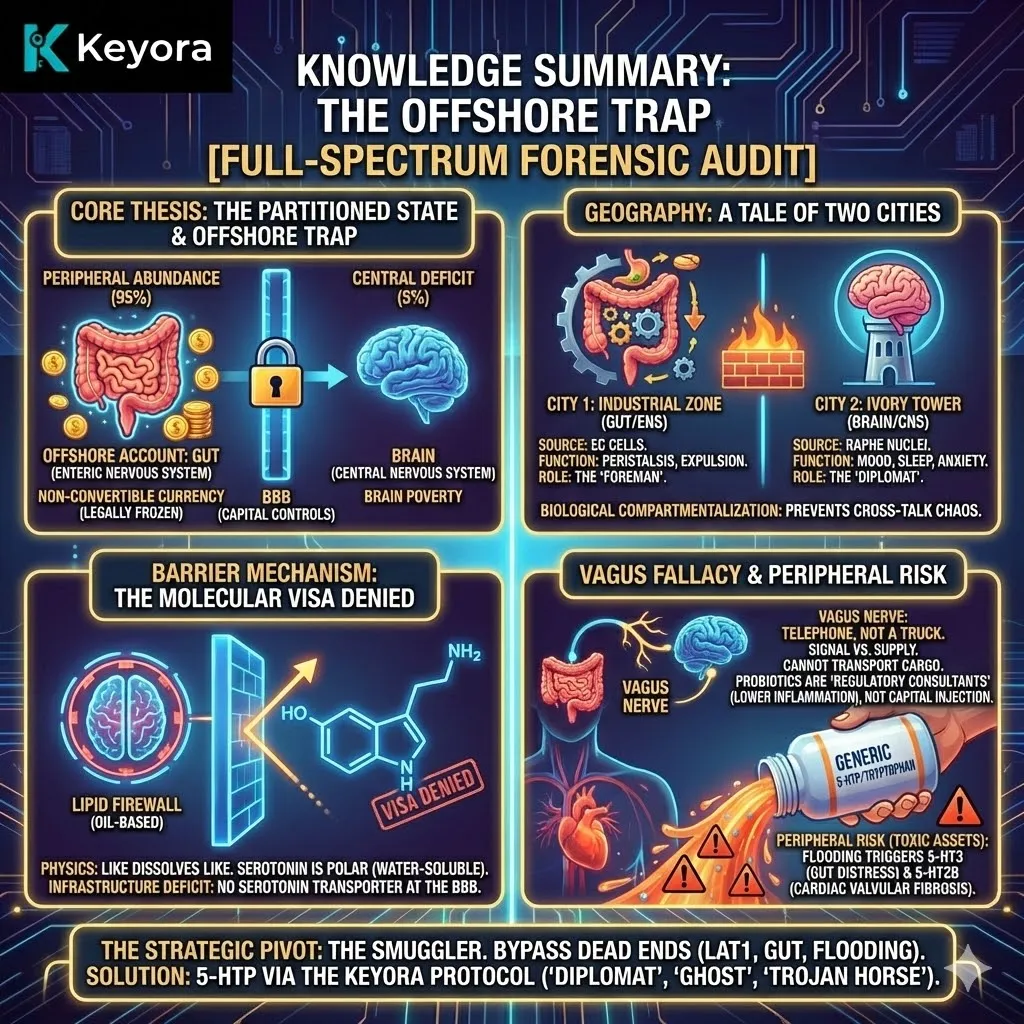
CHAPTER IV: THE DIPLOMAT – THE PRIVILEGE OF [DIRECT ENTRY]
How 5-HTP Bypasses the “Enzymatic Bottleneck” and the “Metabolic Diversion” to Deliver Capital Directly to the Brain.
In the chaotic logistics of the human body, efficiency is usually sacrificed for versatility. Evolution prefers tools that can multitask. It likes molecules that can be used for structure, for energy, and for signaling, all at once.
L-Tryptophan is the ultimate embodiment of this evolutionary preference. It is the “Swiss Army Knife” of amino acids.
When you ingest Tryptophan (via turkey, eggs, or generic supplements), you are introducing a molecule with a massive, conflicted portfolio of responsibilities.
-
Structural Duty: It is an essential building block of protein. The body desperately needs it to repair muscle tissue, build enzymes, and maintain organ integrity.
-
Metabolic Duty: It is the primary precursor for Niacin (Vitamin B3). In fact, the liver prioritizes converting Tryptophan into Niacin over almost anything else (a ratio of 60mg Tryptophan to 1mg Niacin).
-
Immune Duty: As we have seen, under stress, it is diverted into the Kynurenine pathway to manage inflammation.
-
Neuro-Duty: Finally, if any is left over, it might become Serotonin.
From a logistics perspective, Tryptophan is “Distracted Capital.”
It is a courier carrying a package to the brain, but it is allowed to stop at twenty different locations along the way.
It stops at the liver.
It stops at the muscles.
It stops at the immune system.
At every stop, it offloads cargo. By the time the courier reaches the brain, the truck is empty.
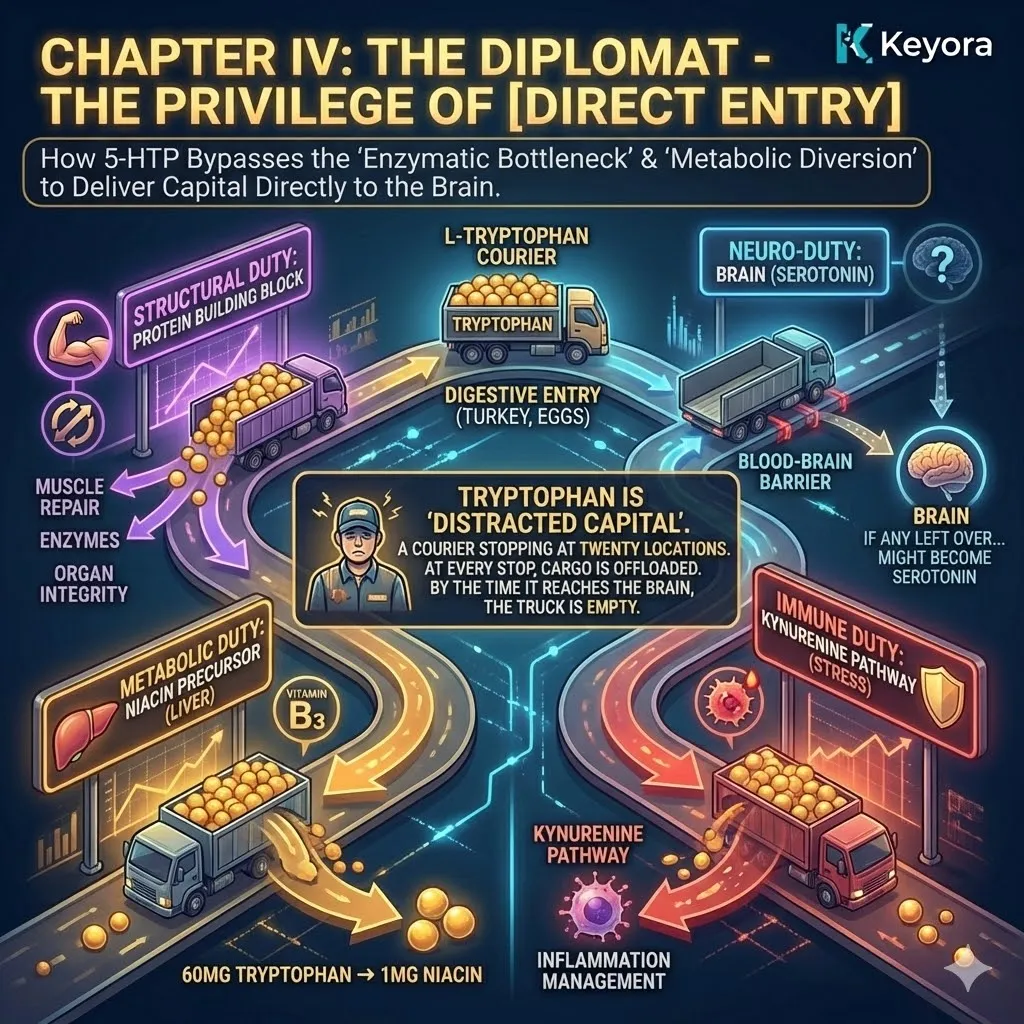
The Specialist: 5-Hydroxytryptophan (5-HTP)
Now, consider 5-HTP.
This molecule is not a Swiss Army Knife. It is a laser-guided missile.
It is an intermediate metabolite – a modified version of Tryptophan that has already been processed by the first enzyme in the chain.
By adding a single hydroxyl group (-OH) to the Tryptophan ring, the molecule’s identity changes fundamentally.
-
It cannot build muscle. The body’s protein-synthesis machinery does not recognize 5-HTP. It cannot be woven into muscle tissue.
-
It cannot make Niacin. The liver cannot use it for vitamin production.
-
It cannot feed the Kynurenine pathway. The IDO enzyme cannot touch it.
5-HTP has been stripped of all other responsibilities. It has only one valid destination in the metabolic map: Serotonin Synthesis.
This is Dedicated Capital.
When you ingest 5-HTP, you are not hoping that the body “chooses” to make Serotonin.
You are forcing the choice.
You are introducing a courier that has no other stops on its route.
It creates a “Single-Stream” supply chain that ignores the demands of the muscles, the liver, and the immune system.
In a biological economy defined by scarcity and competition, 5-HTP represents the ultimate luxury:
Focus.
In this chapter, we will analyze the mechanics of this focus.
We will explain how 5-HTP utilizes Enzymatic Privilege to skip the longest lines in the factory.
We will show how it bypasses the “Lazy Boss” of the Serotonin assembly line (Tryptophan Hydroxylase).
And we will demonstrate why, for the high-performer seeking Systemic Solvency, the Specialist always outperforms the Generalist.
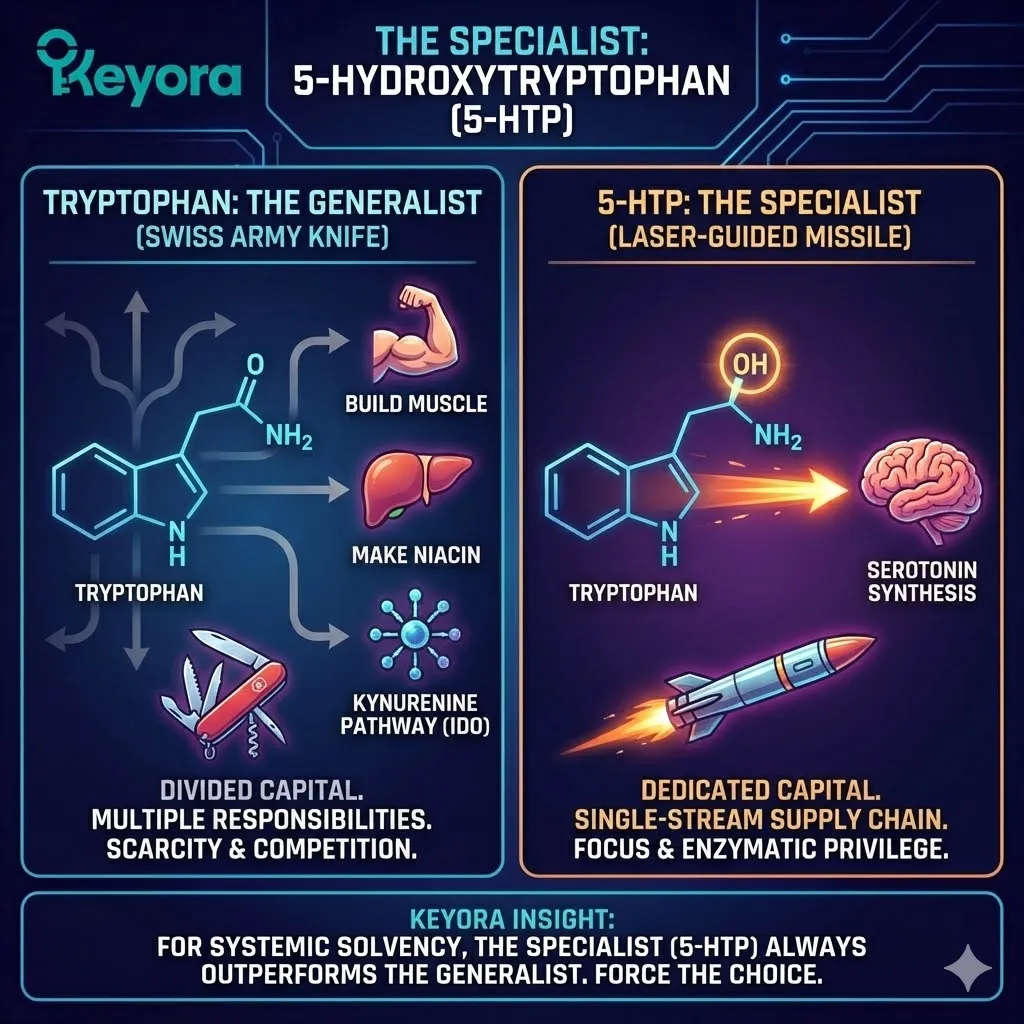
4.1 THE BYPASS: Ignoring the Gatekeeper (TPH)
The Most Critical Enzyme in Serotonin Synthesis Is Also the Laziest. 5-HTP Doesn’t Need Him.
Every manufacturing line has a bottleneck. In the language of biochemistry, this is called the Rate-Limiting Step.
It is the slowest machine in the factory. It dictates the maximum throughput of the entire system. No matter how many raw materials you have, and no matter how fast your final assembly is, the speed of production can never exceed the speed of the Rate-Limiting Step.
In the production of Serotonin, that bottleneck has a name:
Tryptophan Hydroxylase (TPH).
The Fragile Gatekeeper
TPH is the enzyme responsible for the first step of conversion: turning Tryptophan into 5-HTP.
It is a notoriously difficult, fragile, and inefficient enzyme. It is the “Lazy Boss” of the neuro-factory.
Low Saturation:
Under normal physiological conditions, TPH is only about 50% saturated with substrate. It works at half-capacity, even on a good day.
High Sensitivity:
TPH is incredibly sensitive to the environment. It requires a perfect balance of Oxygen, Iron, and Tetrahydrobiopterin (BH4) to function. If any of these are low, TPH shuts down.
Stress Inhibition:
This is the critical failure point for the high-performer. Cortisol (the stress hormone) inhibits the expression of TPH.
-
The Mechanism: Chronic stress downregulates the gene expression for TPH.
-
The Result: The more stressed you are, the fewer “machines” you have available to make Serotonin.
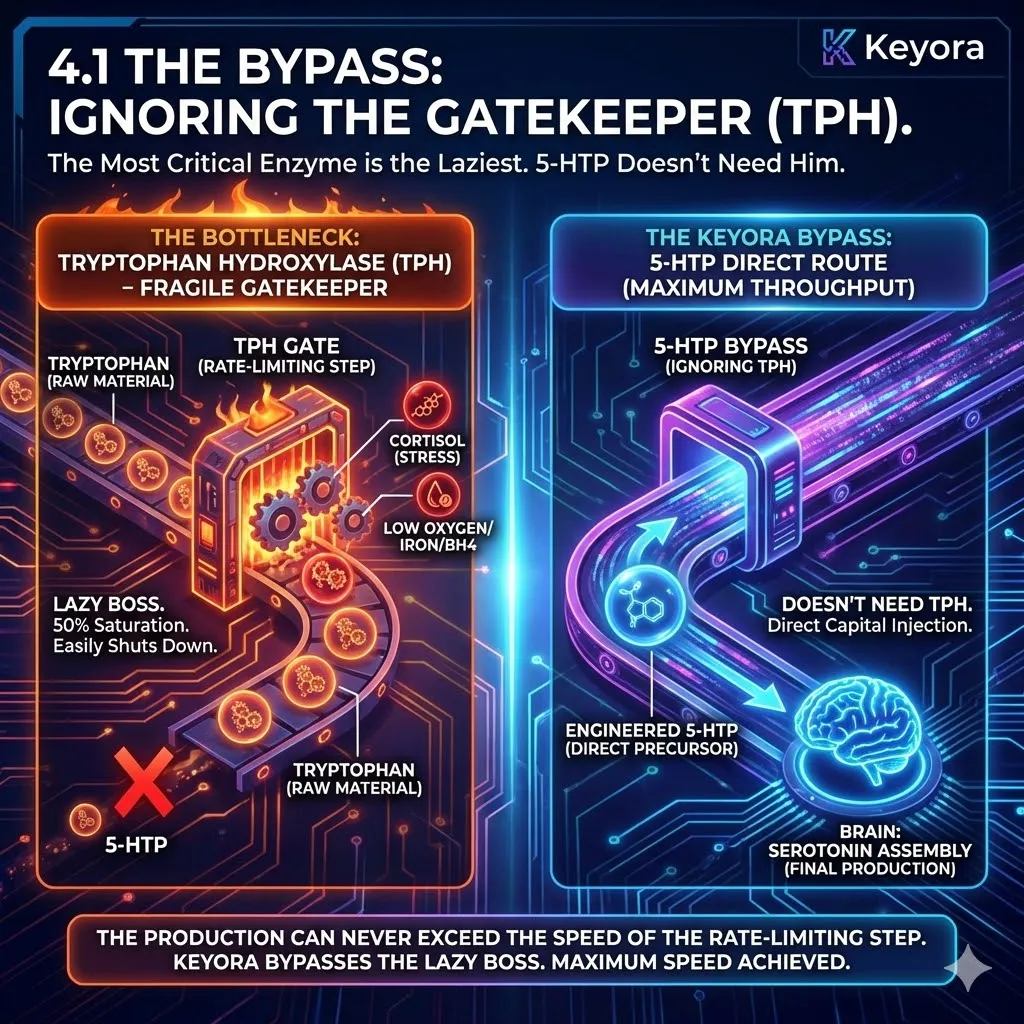
The “Stress Trap” of Tryptophan
This creates a biological Catch-22.
When you are burned out, you need Serotonin desperately to calm down and sleep.
So, you eat Tryptophan (Turkey, Milk, etc.).
But because you are burned out, your Cortisol is high.
Because your Cortisol is high, your TPH enzyme is disabled.
You have delivered the raw material (Tryptophan) to the factory, but the first machine in the line (TPH) is broken. The Tryptophan piles up, useless. Eventually, the IDO enzyme sweeps in and steals it, turning it into neurotoxins.
This is why dietary interventions fail the hardest when you need them the most. The stress that causes the depression is the same force that breaks the machinery required to cure it.
The Enzymatic Privilege of 5-HTP
This is where the engineering genius of the Keyora Protocol becomes apparent.
By supplying 5-HTP directly, we are not fixing the TPH enzyme. We are Bypassing it.
5-HTP is the product of the TPH enzyme.
-
Step 1: Tryptophan -> (TPH Enzyme) -> 5-HTP
-
Step 2: 5-HTP -> (AADC Enzyme) -> Serotonin
When you take 5-HTP, you are inserting the asset into the assembly line at Step 2. You are starting the race halfway to the finish line.
This grants 5-HTP what Keyora Research calls Enzymatic Privilege.
-
Immunity to Stress: Because 5-HTP enters downstream of the TPH enzyme, it does not matter if your TPH is shut down by Cortisol. The 5-HTP does not need TPH. It proceeds directly to the next step.
-
Immunity to Feedback Loops: Often, enzymes are inhibited by their own product (Negative Feedback). TPH is tightly regulated. The next enzyme (AADC) is far more robust, faster, and ubiquitous. It has a massive capacity to process 5-HTP into Serotonin without getting “tired” or “inhibited.”
-
Uncapped Velocity: Because we have skipped the Rate-Limiting Step, the speed of Serotonin production is no longer capped by the lazy TPH enzyme. It is now only limited by the availability of the AADC enzyme (which is abundant) and its cofactors (B6/Mg).
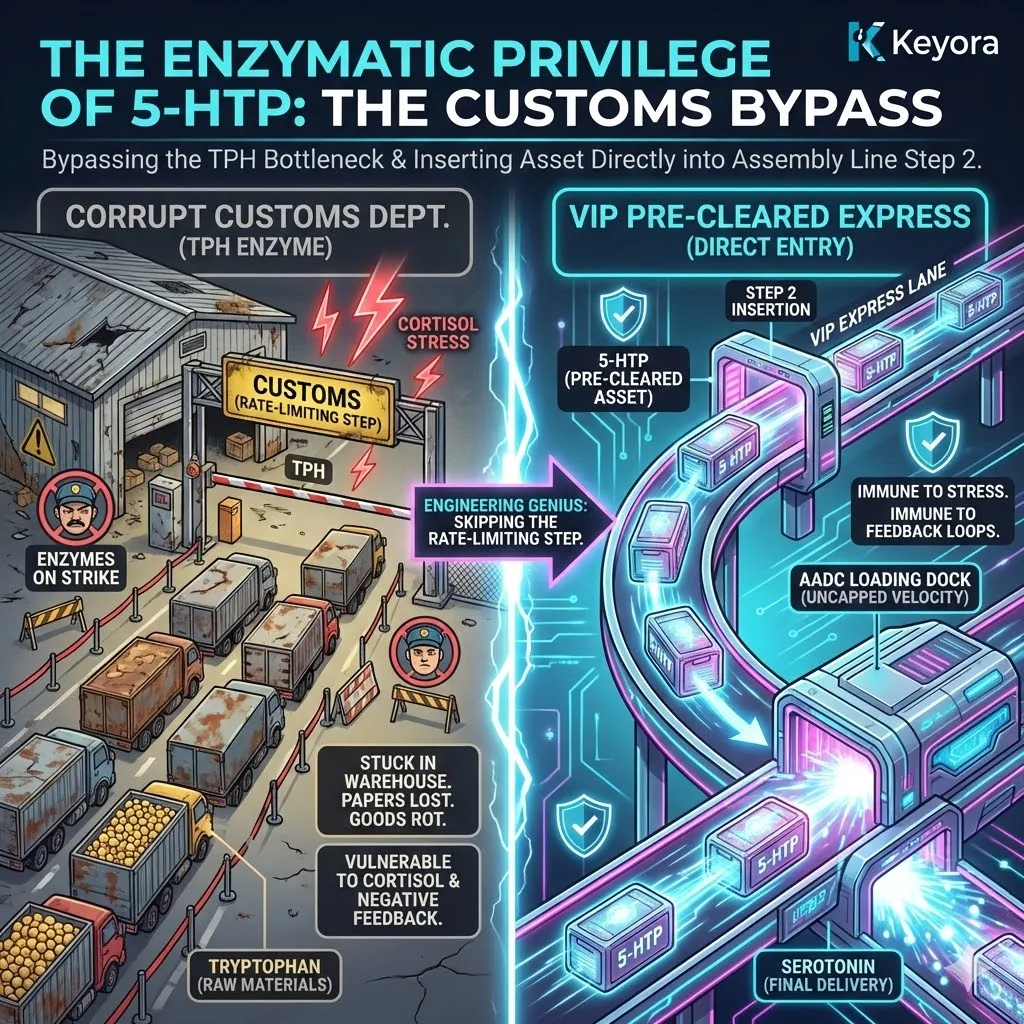
The Engineering Analogy: The Customs Bypass
Imagine you are trying to import goods into a country with a corrupt and slow Customs Department (TPH).
-
Option A (Tryptophan): You ship raw materials. They sit in the Customs warehouse for weeks. The officers (Enzymes) are on strike. The paperwork is lost. The goods rot.
-
Option B (5-HTP): You ship “Pre-Cleared” goods that have already been stamped “Approved.” They do not go to the Customs warehouse. They go straight to the Loading Dock (AADC) for final delivery.
The Clinical Implication
This bypass mechanism explains why 5-HTP works rapidly (often within days or weeks) where dietary changes take months or fail entirely.
For the patient with Serotonin Bankruptcy, the machinery of synthesis is often rusted shut at the TPH level. Their “Natural Production Capacity” is near zero because of chronic stress.
Trying to force Tryptophan through that rusted machine is futile.
By using 5-HTP, we render the condition of the TPH enzyme irrelevant.
We re-capitalize the system despite the structural damage caused by stress.
We are not waiting for the body to heal itself before we give it relief; we are giving it relief so it can heal itself.
This is the power of Direct Entry.
We have skipped the boss.
We have ignored the gatekeeper.
But getting past the enzyme is only half the battle. As we learned in Chapter II, the biggest challenge is not just manufacturing – it is Transport. The Blood-Brain Barrier still stands in our way.
Does 5-HTP face the same “Crowded Bus” problem as Tryptophan? Or does it have a different way to travel?
In the next section, we will reveal the Transport Advantage.
We will explain why your muscles ignore 5-HTP, leaving the entire supply available for the brain.
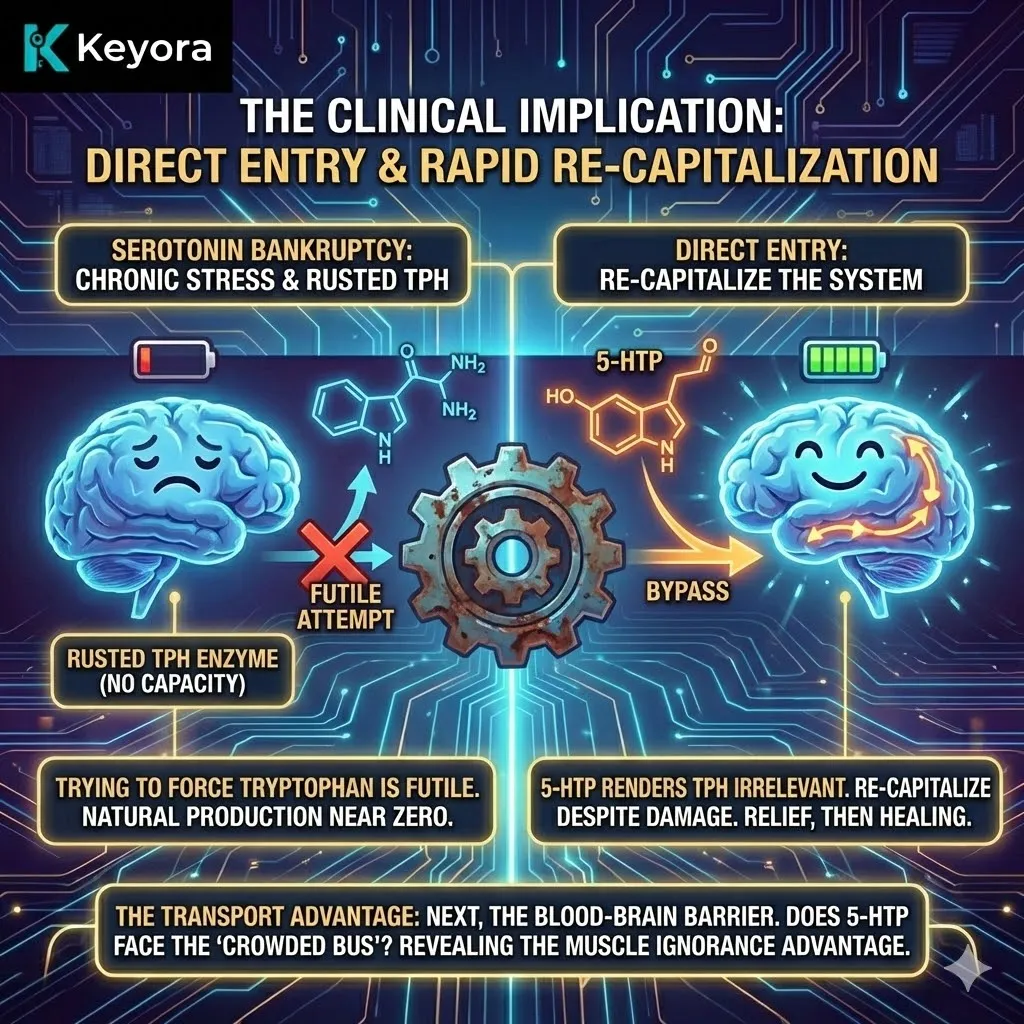
4.2 THE IMMUNITY: Immune to the “Protein Tax”
Why Your Muscles Ignore 5-HTP, Leaving It All for Your Brain.
In any economy, the greatest threat to wealth accumulation is not just low income; it is Taxation.
When you ingest L-Tryptophan, you are depositing currency into your biological bank account. But before that currency can be spent on “Mental Health” (Serotonin synthesis in the brain), it is subject to a massive, confiscatory tax levied by the body’s structural requirements.
We call this The Protein Tax.
The Structural Mandate
Your body is constantly rebuilding itself. Every second, millions of cells are repairing their internal machinery. To do this, they need proteins. Proteins are long chains of amino acids strung together like beads on a necklace.
The instructions for building these necklaces are written in your DNA.
Here is the critical rule of the genetic code: L-Tryptophan is one of the 20 standard amino acids.
It is a required bead. You cannot build a muscle fiber, a liver enzyme, or a patch of skin without Tryptophan.
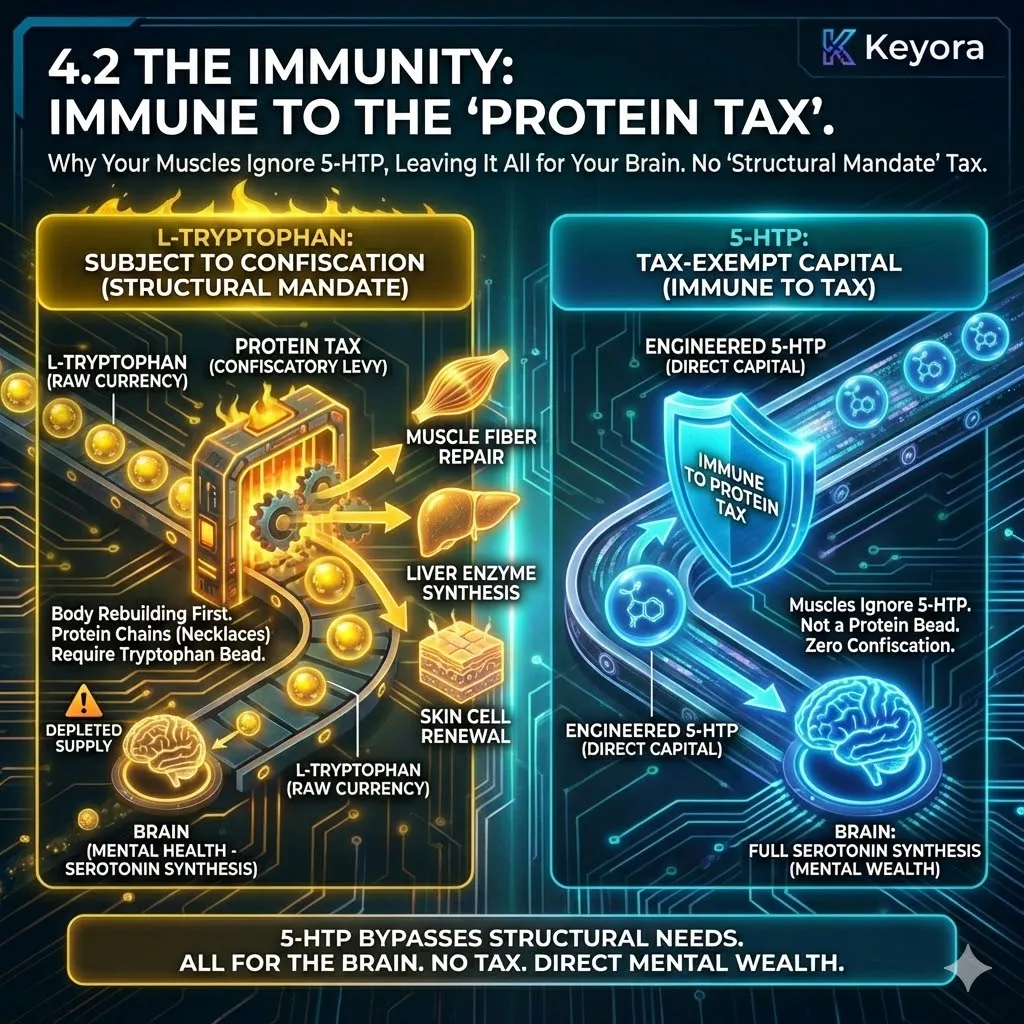
The Embezzlement of Tryptophan
When Tryptophan enters your bloodstream, the somatic tissues (Muscles, Liver, Heart) see it as a structural necessity.
-
The Demand: The ribosomes (protein factories) in your muscles snatch Tryptophan out of the blood to repair micro-tears from your workout.
-
The Priority: The body always prioritizes Structure over Mood. Survival (repairing tissue) comes before Happiness (Serotonin).
-
The Result: By the time the blood reaches the brain, the vast majority of the Tryptophan has been “embezzled” by the periphery to build proteins.
This is why dietary Tryptophan is such an inefficient antidepressant. You are trying to fund a delicate neuro-chemical operation using a currency that every other organ in your body is desperately trying to steal for construction materials.
The 5-HTP Loophole: Dedicated Capital
Now, let us introduce 5-HTP into this system.
5-HTP is chemically similar to Tryptophan, but it carries a specific modification (the hydroxyl group). This tiny chemical change renders it invisible to the protein-building machinery.
-
The Genetic Code: The DNA code has no instruction for 5-HTP. It is a “Non-Proteogenic” amino acid.
-
The Rejection: When a ribosome in your bicep sees a molecule of 5-HTP, it tries to grab it, realizes it doesn’t fit the blueprint, and throws it back into the bloodstream.
5-HTP cannot be turned into muscle.
It cannot be turned into skin.
It cannot be turned into bone.
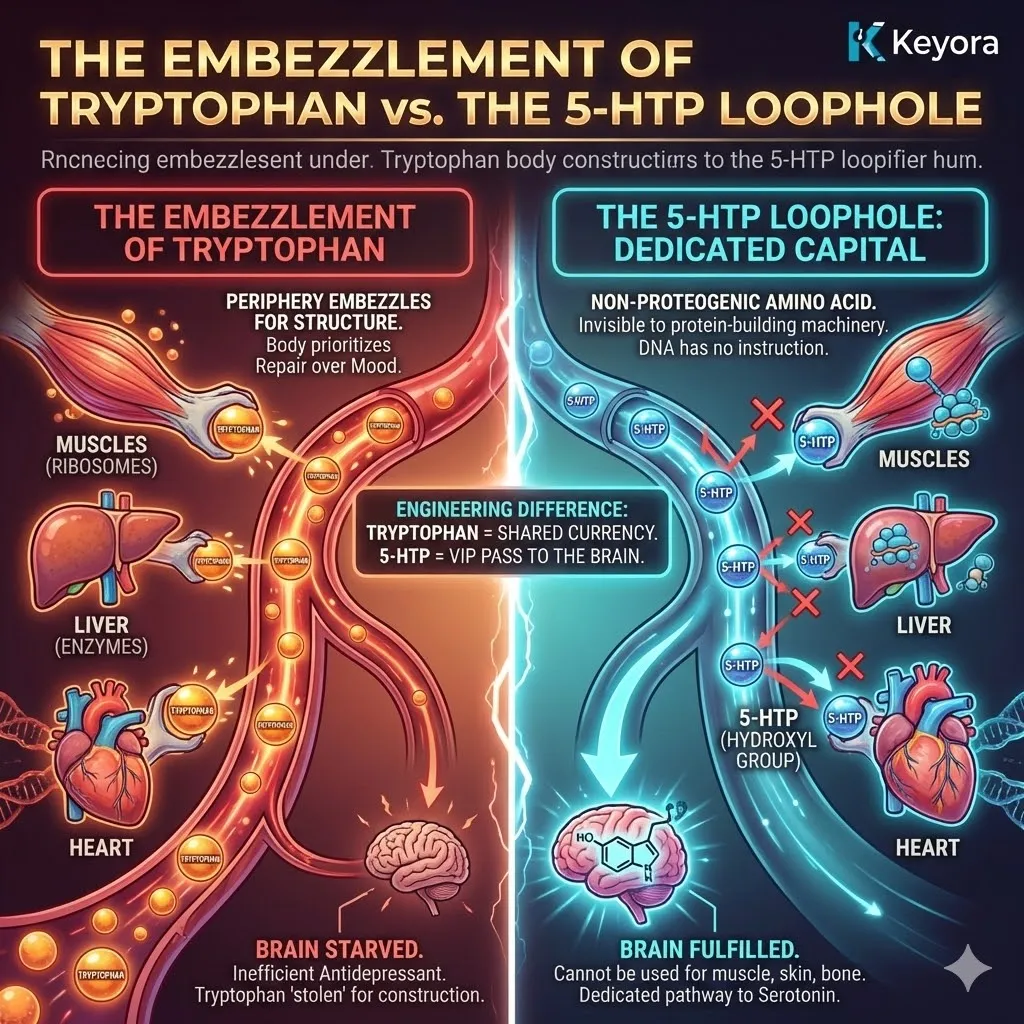
This grants 5-HTP a status of Dedicated Capital.
In economics, “Dedicated Capital” (or Restricted Funds) is money that can only be spent on a specific project. It cannot be raided to pay for office supplies or building repairs.
Because the muscles ignore 5-HTP, the liver ignores 5-HTP (mostly), and the immune system ignores 5-HTP (no IDO tax), the molecule remains in circulation with its full value intact.
-
Tryptophan: Subject to a 90% tax rate (structural diversion).
-
5-HTP: Enjoys a 0% tax rate.
This means that a seemingly small dose of 5-HTP (45mg) is functionally equivalent to a massive dose of Tryptophan, because 45mg is available for the only job it is qualified to do:
Becoming Serotonin.
We have created a currency that the rest of the body cannot spend. Therefore, it is saved entirely for the brain.
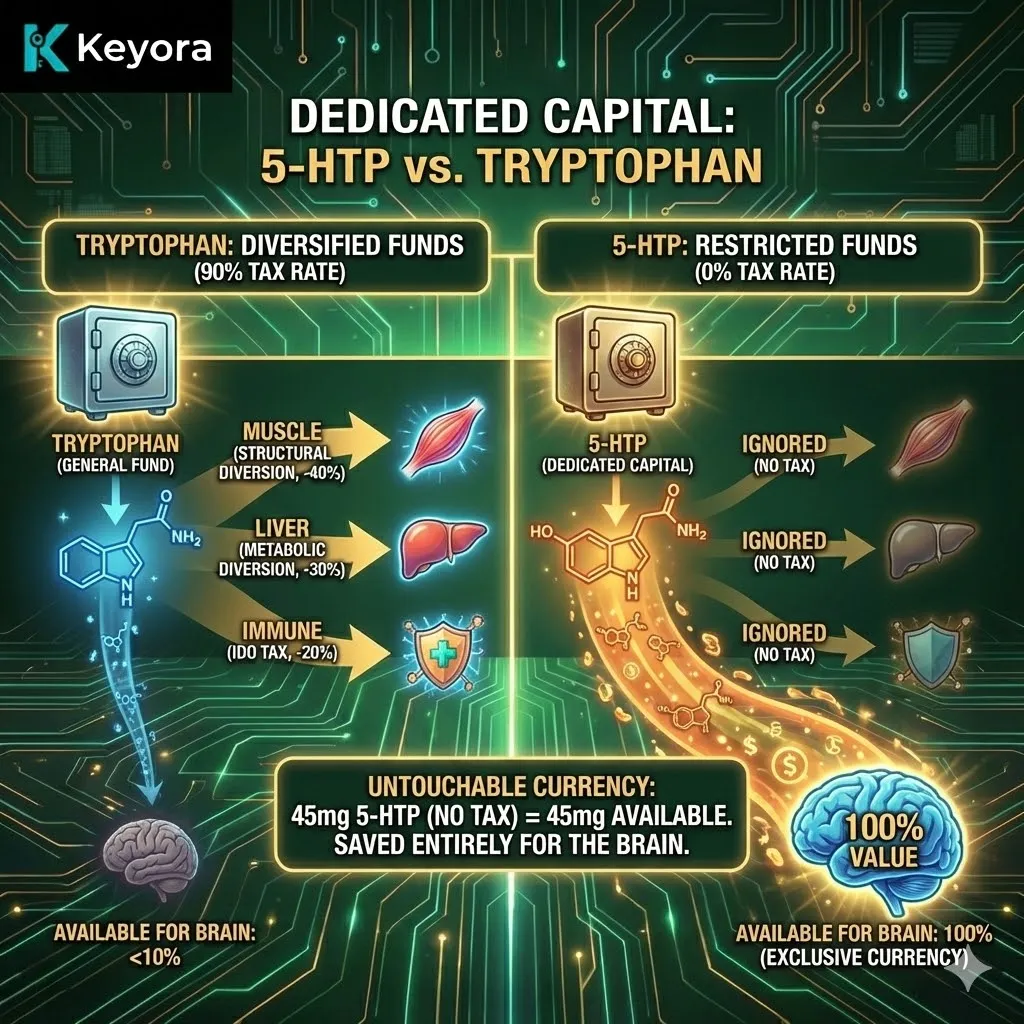
4.3 THE TRANSPORT: The Priority Lane
While 5-HTP Uses the Same Transporter (LAT1), It Travels with a Different Status.
We have established that 5-HTP is immune to the IDO tax (stress) and the Protein tax (muscle). But we still face the final hurdle:
The Wall.
Like Tryptophan, 5-HTP must cross the Blood-Brain Barrier. And like Tryptophan, it utilizes the LAT1 Transporter (the Crowded Bus).
A critic might ask: “If 5-HTP uses the same bus as Tryptophan, won’t it get kicked off by the BCAA bullies just like Tryptophan does?”
This is a brilliant question. The answer lies in the nuance of Pharmacokinetics and Relative Concentration.
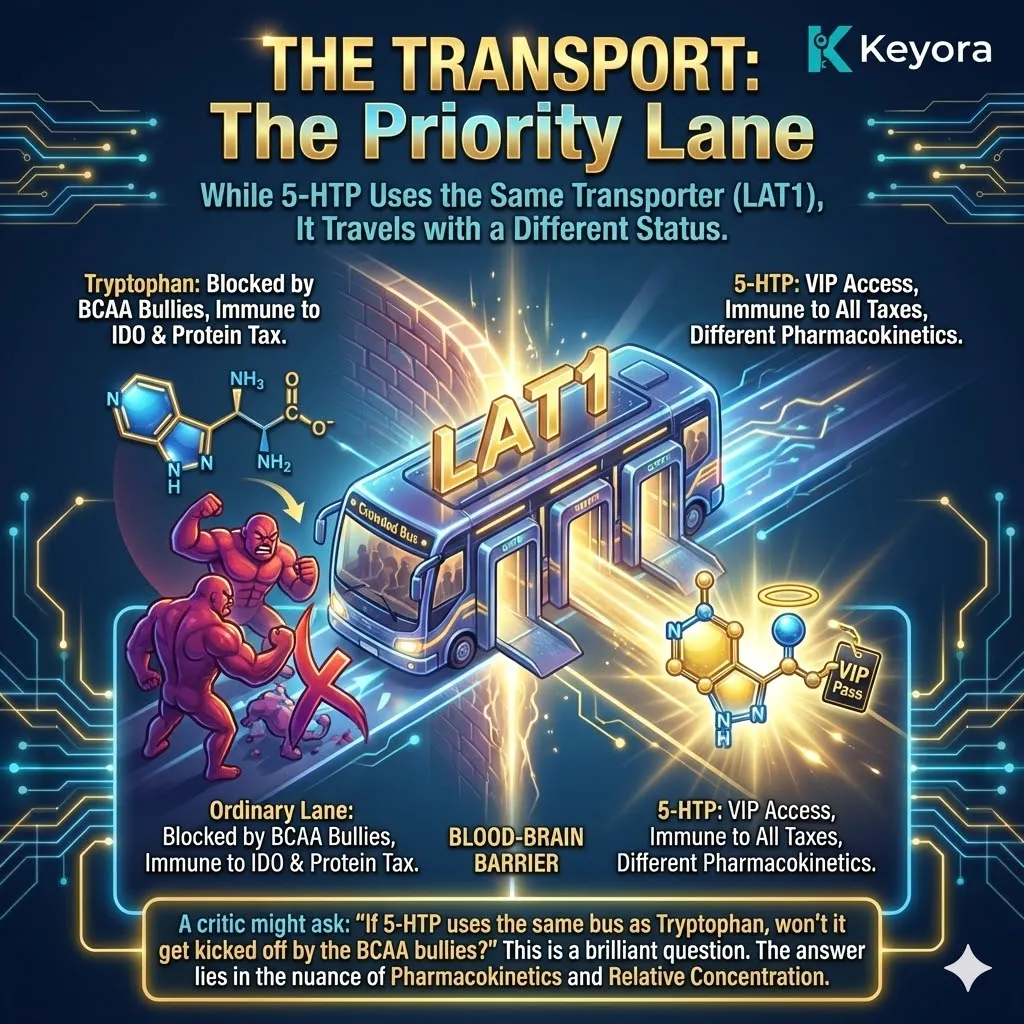
The Logistics of “Chartering the Bus”
The failure of Tryptophan at the LAT1 gate is a numbers game. As we learned in Chapter II, Tryptophan is outnumbered 20:1 by BCAAs.
But 5-HTP changes the math of this competition in two specific ways:
1. The “Plasma Survivor” Effect
Because 5-HTP is immune to [The Protein Tax] and the IDO Shunt, its concentration in the blood plasma remains stable and high relative to the dose given.
-
Tryptophan Scenario: You eat 500mg. The liver takes 300mg. The muscles take 150mg. Only 50mg reaches the BBB to fight the BCAAs. It loses.
-
5-HTP Scenario: You take 50mg. The liver takes 0mg. The muscles take 0mg. All 50mg reaches the BBB.
Even though the absolute dose is lower, the Effective Plasma Concentration at the site of the barrier is often higher than that of Tryptophan.
It shows up to the bus stop with a larger crowd.
It doesn’t just ask for a seat; it demands one by sheer presence.
2. The Affinity Advantage
Biochemical studies suggest that 5-HTP has a distinct transport kinetic profile. While it competes for LAT1, it is not subject to the exact same repressive ratios as dietary Tryptophan.
Furthermore, because 5-HTP is a “Direct Precursor,” it crosses the barrier and is converted to Serotonin almost immediately upon entry. This creates a steep Concentration Gradient.
-
The Vacuum Effect: As soon as 5-HTP enters the brain, it is consumed by the AADC enzyme. This keeps free 5-HTP levels inside the brain low.
-
The Physics: Diffusion favors movement from High Concentration (Blood) to Low Concentration (Brain). This gradient acts like a vacuum, sucking 5-HTP across the transporter with greater efficiency than Tryptophan, which often lingers.
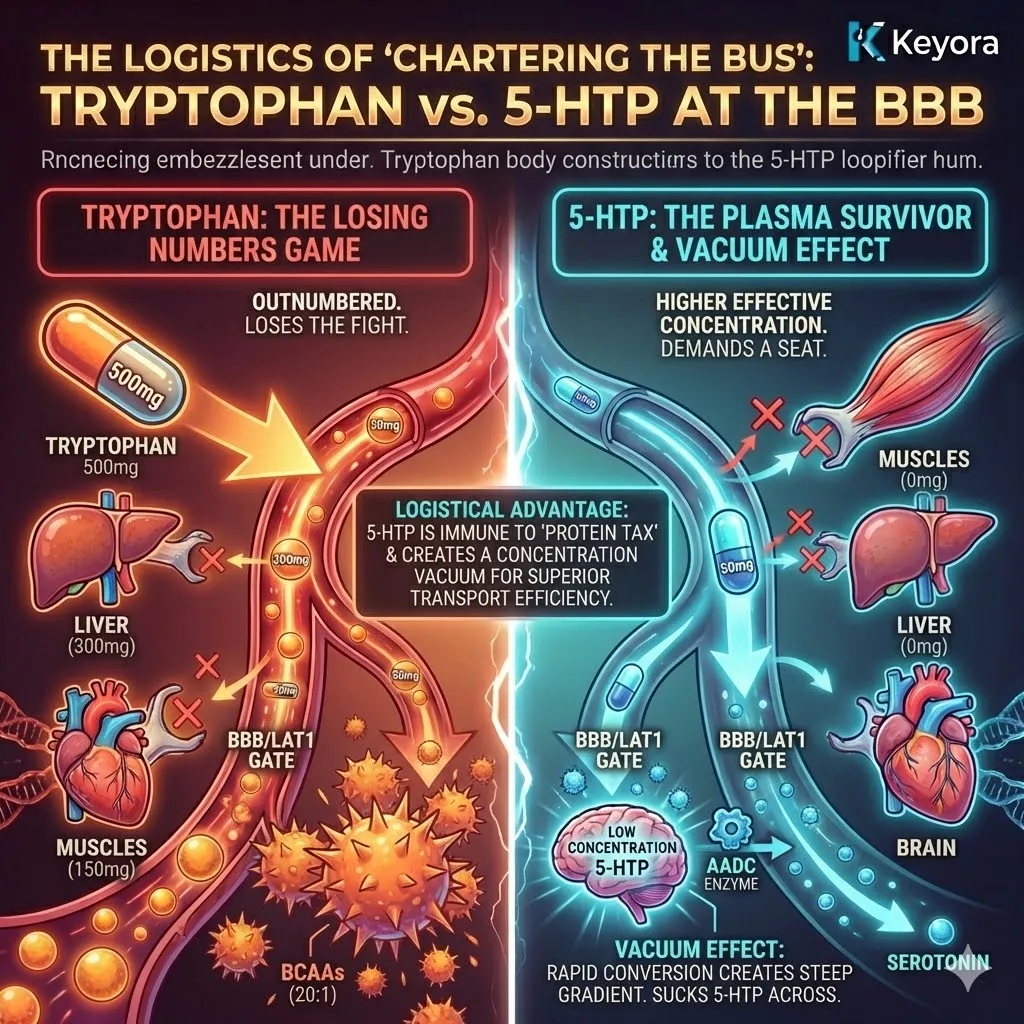
The Concept of Direct Entry
Keyora Research defines this combination of factors – immunity to peripheral sinks and high transport efficiency – as [Direct Entry].
It is not that 5-HTP has a magic portal. It is that 5-HTP is a logistics expert.
-
It does not get distracted by side quests (Muscle building).
-
It does not get robbed by bandits (IDO enzyme).
-
It arrives at the border with its full force intact, allowing it to compete with the BCAAs and win.
The “Trojan Horse” Strategy
There is one final aspect of this transport that qualifies 5-HTP as a “Diplomat.”
It is a Trojan Horse.
The Blood-Brain Barrier is terrified of Serotonin. As we saw in Chapter III, it blocks Serotonin completely.
But 5-HTP looks innocent. It looks like an amino acid. The BBB sees 5-HTP and thinks, “This is just a nutrient. Let it in.”
The BBB does not know that 5-HTP is merely one enzymatic click away from becoming the banned substance (Serotonin).
-
5-HTP crosses the wall disguised as a nutrient.
-
Once inside the secure perimeter of the neuron, it meets the AADC enzyme.
-
Click. The disguise falls off. It becomes Serotonin.
We have successfully smuggled the contraband past the guards by hiding it inside a diplomatic pouch.
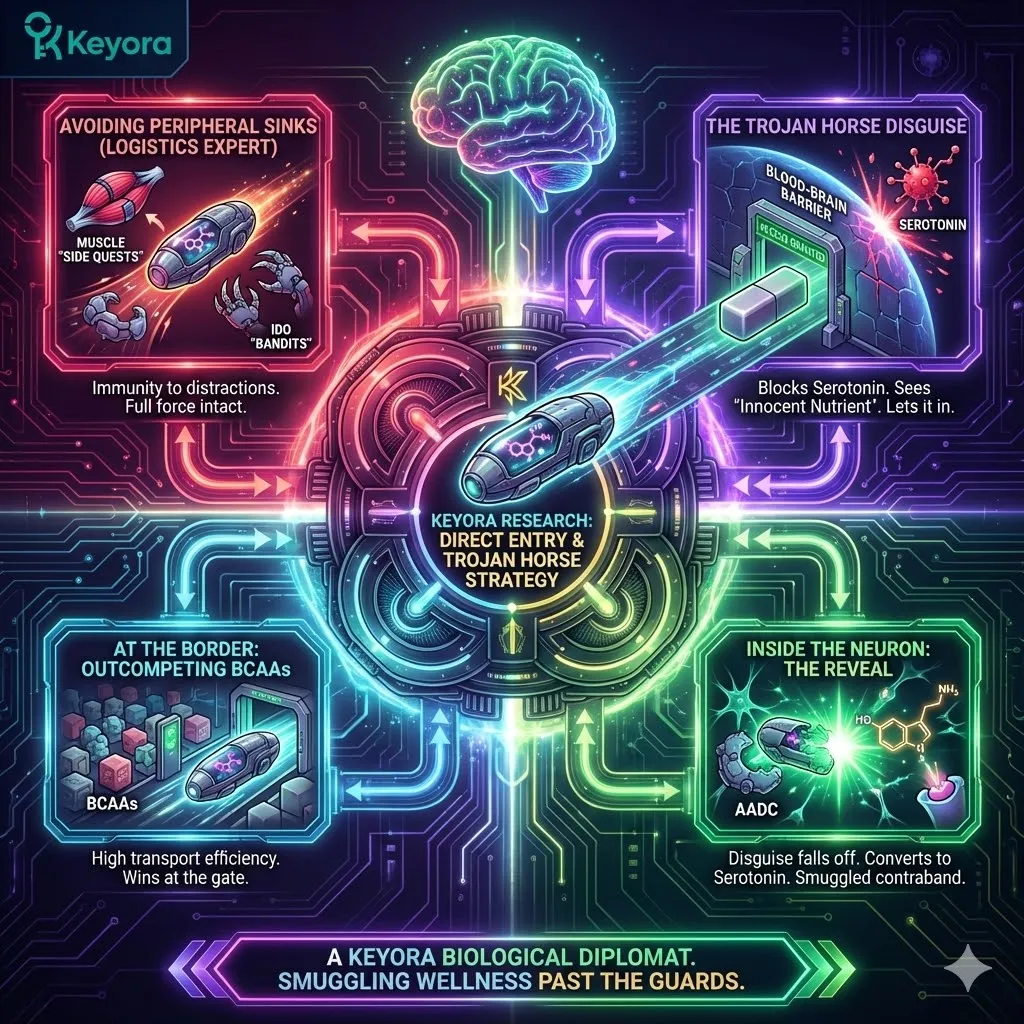
Summary of the Diplomat’s Journey
Let us trace the full journey of the Keyora 5-HTP molecule:
-
Ingestion: You take the capsule.
-
Absorption: It enters the blood.
-
Immunity: It passes the liver (No Niacin conversion). It passes the muscles (No Protein synthesis). It passes the immune system (No IDO degradation).
-
Transport: It arrives at the BBB. Because it hasn’t been taxed, its concentration is high. It boards the LAT1 bus.
-
Entry: It crosses the wall.
-
Revelation: Inside the brain, it is instantly converted to Serotonin.
This is the most direct, efficient, and engineered supply chain possible for the human nervous system. It strips away every inefficiency of the natural diet.
But efficiency brings its own dangers.
If you have a pipeline that delivers gold directly to a factory, you better make sure the factory is ready to process it. If the factory is broken, the gold piles up and becomes a liability.
In the next section, we will do the math. We will calculate the Return on Investment (ROI) of 5-HTP versus Tryptophan, and then we will confront the final hurdle: The Manufacturing Crisis.
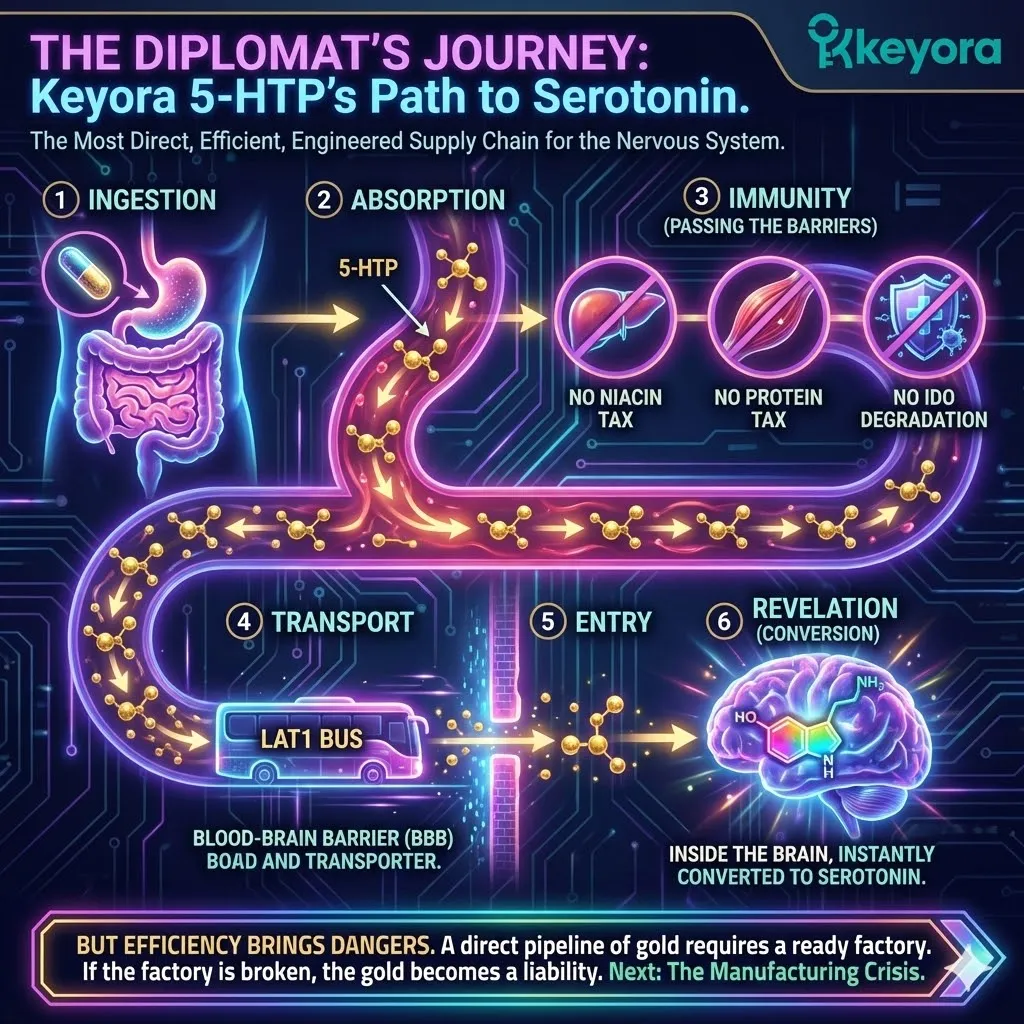
4.4 THE ROI: The Economics of Synthesis
Comparing the Yield: Why 50mg of 5-HTP Outperforms 500mg of Tryptophan.
In any high-stakes investment, the most important metric is not the “Gross Revenue” (how much you put in); it is the “Net Profit” (how much you get out).
In the economy of Serotonin synthesis, we measure this via Conversion Efficiency.
Let us conduct a side-by-side audit of two investment strategies:
-
Strategy A: Dietary Tryptophan (The Generalist).
-
Strategy B: Keyora 5-HTP (The Specialist).
Audit A: The Tryptophan Yield (The 1% Rule)
When you consume L-Tryptophan, you are investing in a diversified portfolio with massive overhead costs.
-
The Niacin Siphon: The liver demands a 60:1 tribute to make Vitamin B3.
-
The Protein Tax: The muscles demand a 90% cut for structural repair.
-
The Stress Leak: The IDO enzyme burns a variable percentage based on your cortisol levels.
-
The Transport Fee: The LAT1 blockade prevents entry to the brain.
The Math: Clinical pharmacokinetics suggest that under normal conditions, less than 1% of dietary Tryptophan is ultimately converted into brain Serotonin.
-
Input: 500mg Tryptophan.
-
Output: < 5mg Brain Serotonin Potential.
This is a Low-Yield Asset. It is like investing in a company where 99% of the budget is spent on administrative fees and corporate lunches, leaving only 1% for actual product development.
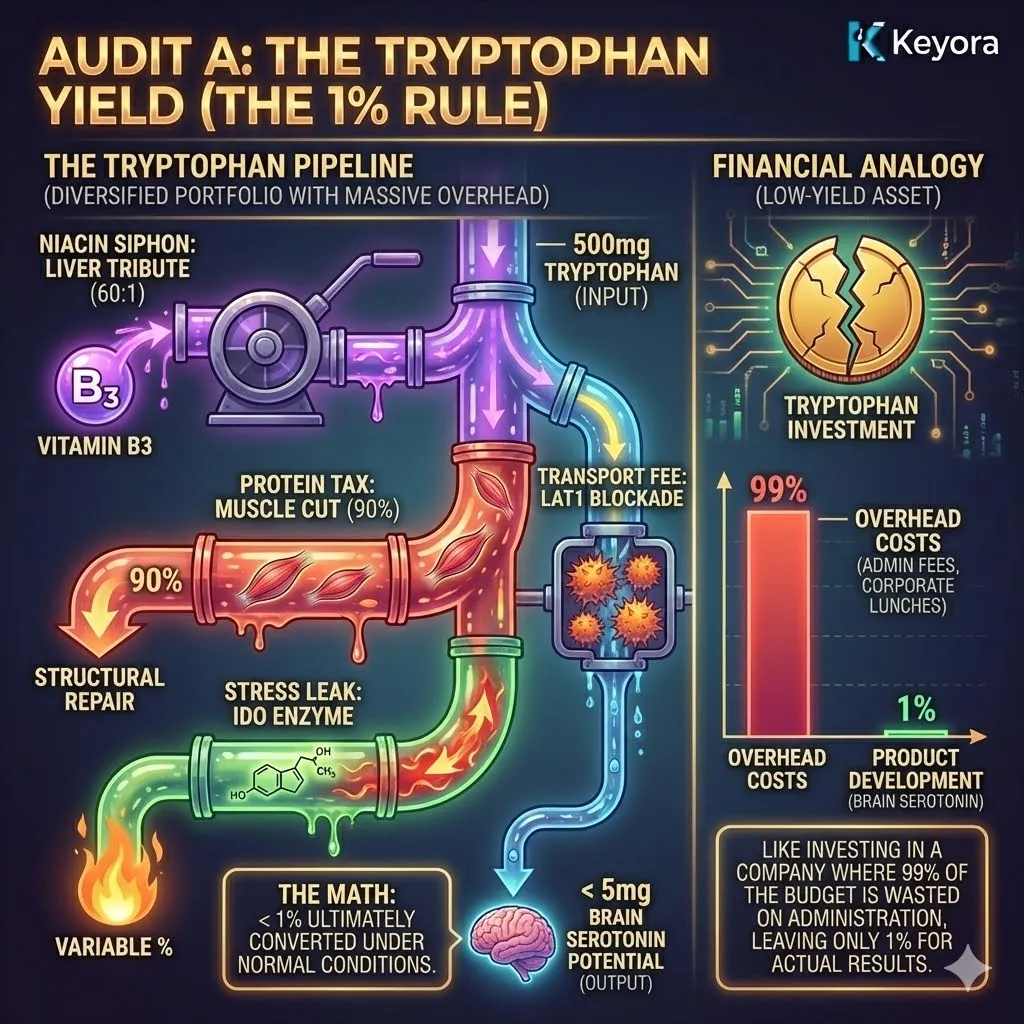
Audit B: The 5-HTP Yield (The 70% Rule)
Now, audit 5-HTP.
-
No Niacin Siphon: 0% loss.
-
No Protein Tax: 0% loss.
-
No Stress Leak: 0% loss.
-
High Transport Efficiency: It dominates the crossing.
The Math: Studies indicate that up to 70% of orally administered 5-HTP reaches the bloodstream, and a significant portion of that crosses the BBB to be available for synthesis.
-
Input: 50mg 5-HTP.
-
Output: ~35mg Brain Serotonin Potential.
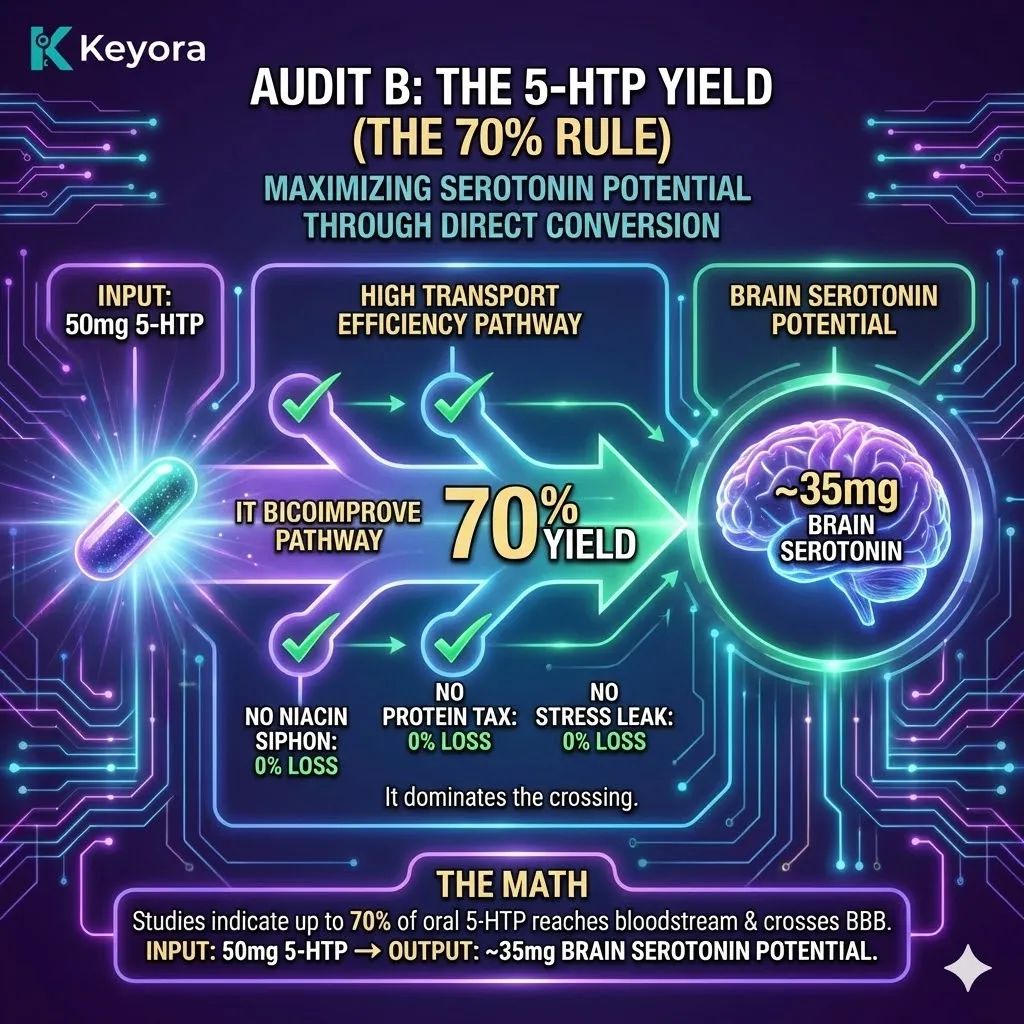
The Leverage Ratio
This reveals a startling economic truth: 50mg of 5-HTP provides roughly 7x more neuro-chemical capital than 500mg of Tryptophan.
This is what Keyora Research defines as High Leverage.
By using the “Diplomat” molecule, we achieve a massive outcome with a minimal input.
We do not need to flood the system with grams of powder.
We use a Precision Dose (45mg in the Keyora Matrix) to achieve a surgical result.
This efficiency is not just about potency; it is about Safety.
To get the same result with Tryptophan, you would have to ingest massive quantities (3-5 grams), which would overload the liver, spike nitrogen levels, and create metabolic chaos.
With 5-HTP, we get the “Net Profit” without the “Gross Bloat.”
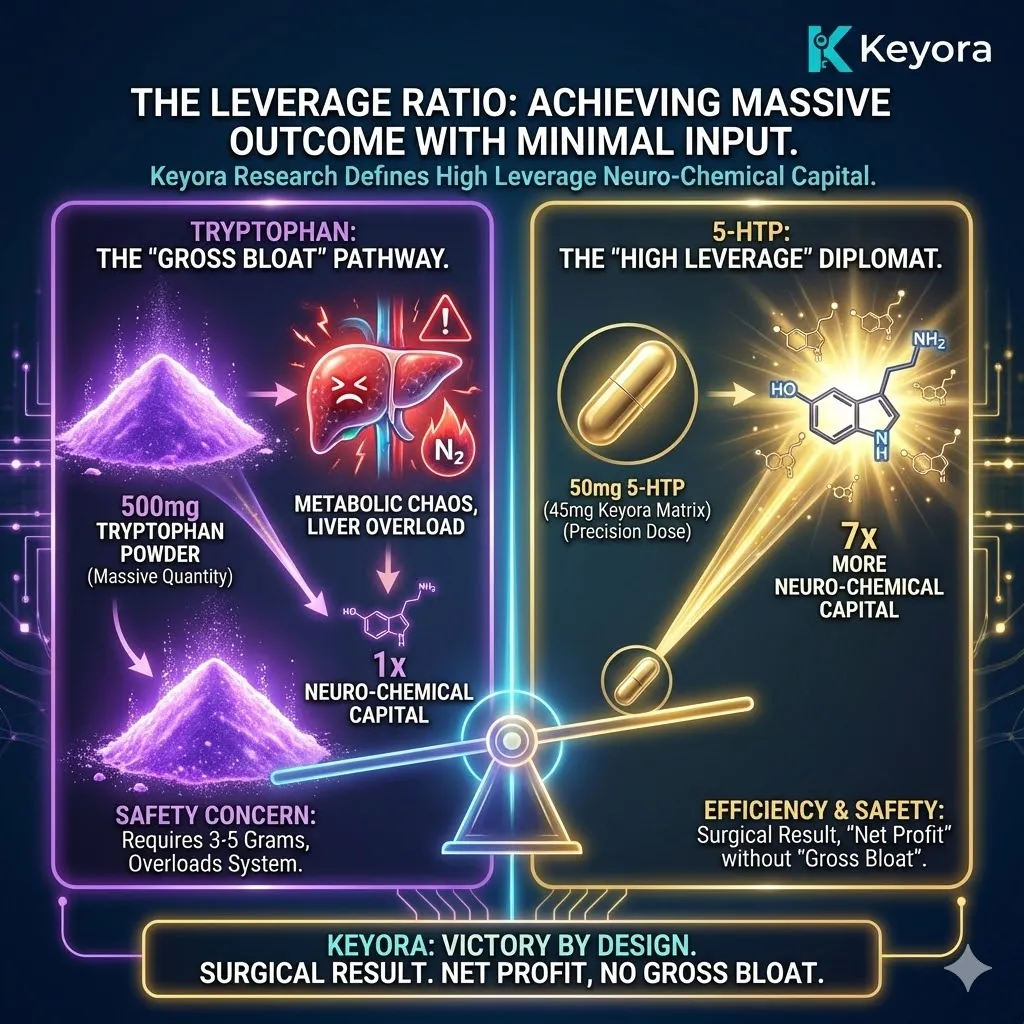
4.5 CONCLUSION: Access is Not Victory
The Diplomat is Inside the Fortress. But Is the Factory Running?
We have successfully engineered a supply chain that defies the limitations of the natural body.
-
We bypassed the LAT1 Blockade.
-
We evaded the IDO Tax Collector.
-
We ignored the Protein Diversion.
-
We delivered a High-Yield Asset (5-HTP) directly to the brain’s factory floor.
The Diplomat has arrived. The briefcase is open. The gold is on the table.
But here is the final, devastating twist: Gold does not mint itself.
5-HTP is not Serotonin. It is the immediate precursor. To become the active neurotransmitter that calms your anxiety and initiates sleep, it must undergo one final transformation.
It must be processed by the AADC Enzyme (Aromatic L-amino acid Decarboxylase).
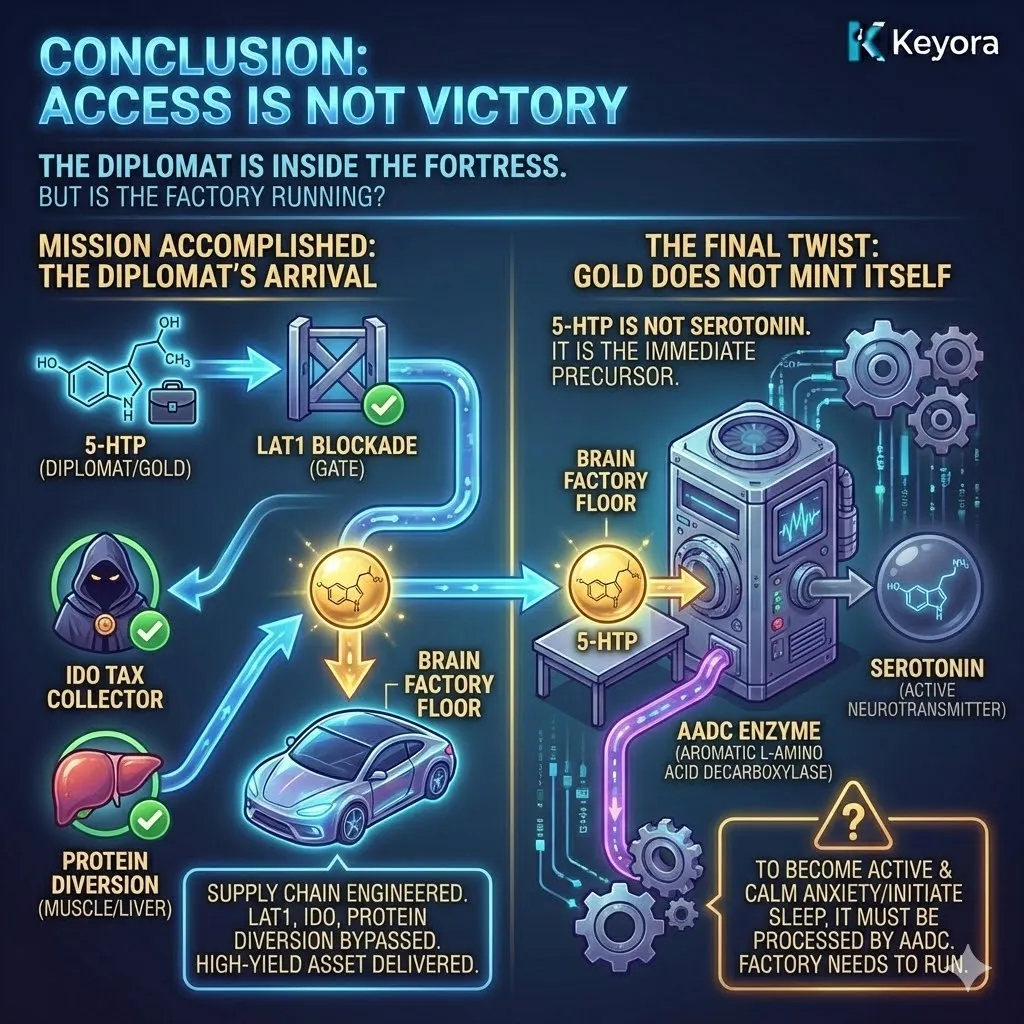
The Manufacturing Crisis
Imagine you have successfully smuggled millions of dollars in gold bars into a besieged city. You bring them to the Mint to be turned into coins so the people can buy food.
But when you walk into the Mint, the lights are off. The machinery is silent. The workers are standing around, helpless.
“Why aren’t you working?” you ask.
“We have no electricity,” they reply. “And our tools are broken.”
This is the reality for the modern high-performer.
-
The Power: The AADC enzyme runs on Magnesium. (Most people are deficient).
-
The Tool: The AADC enzyme requires Active Vitamin B6 to function. (Most people are depleted by stress).
If you take 5-HTP without these cofactors, you have not solved the problem. You have just moved the pile of raw materials from outside the wall to inside the wall. It sits there, inert.
Eventually, it oxidizes. It becomes waste.
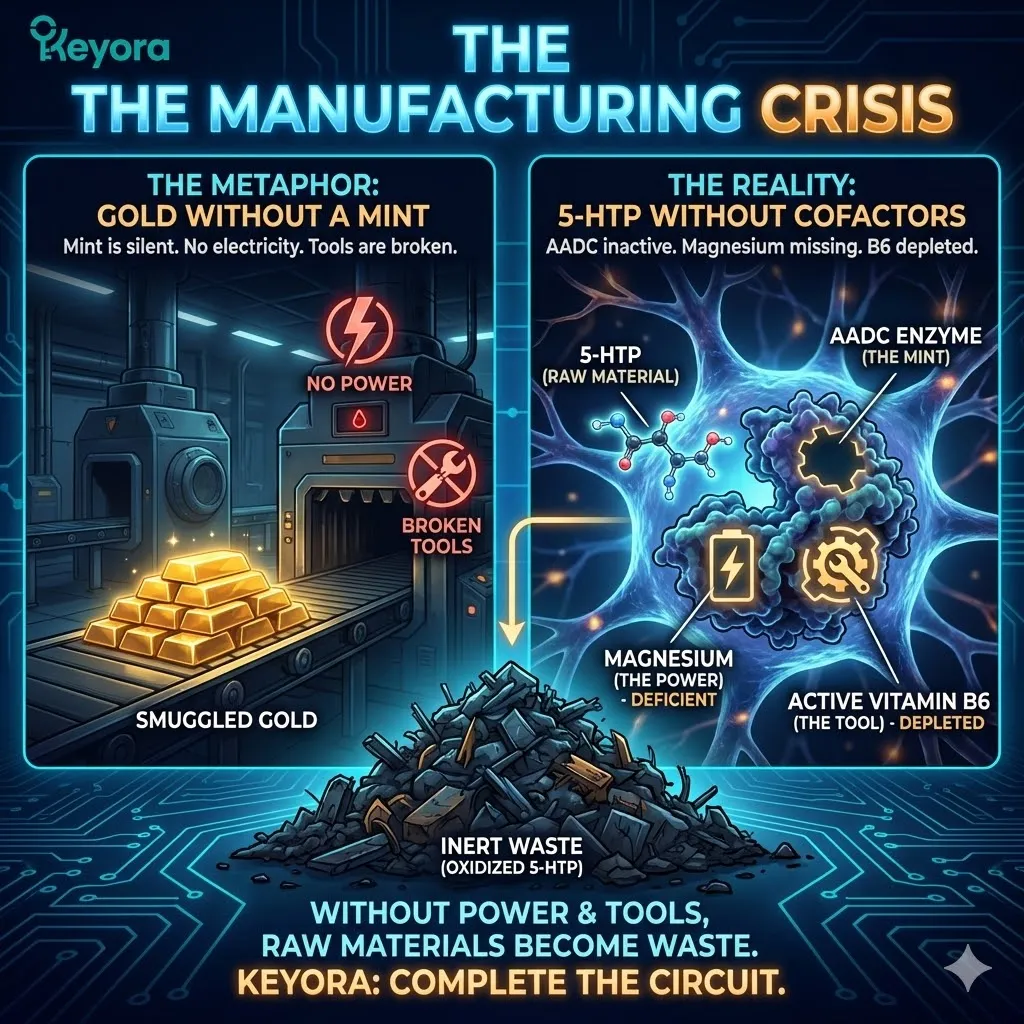
The Incomplete Hero
This is why 5-HTP, on its own, is an Incomplete Hero.
It is a brilliant logistics solution, but it is not a manufacturing solution.
Access is not Victory.
Conversion is Victory.
To win the war against burnout, we cannot just be smugglers. We must be Industrial Engineers. We must not only deliver the goods; we must repair the factory.
In the final chapter of this episode, Chapter V:
The Engineering Solution, we will reveal the Keyora 8-in-1 Matrix.
We will explain why we never sell 5-HTP alone.
We will show how we pair the Diplomat with the Power Plant (Magnesium) and the Tool Kit (B6) to ensure that the gold we deliver is instantly minted into the currency of joy.
The Diplomat has done his job. Now, the Engineers must do theirs.
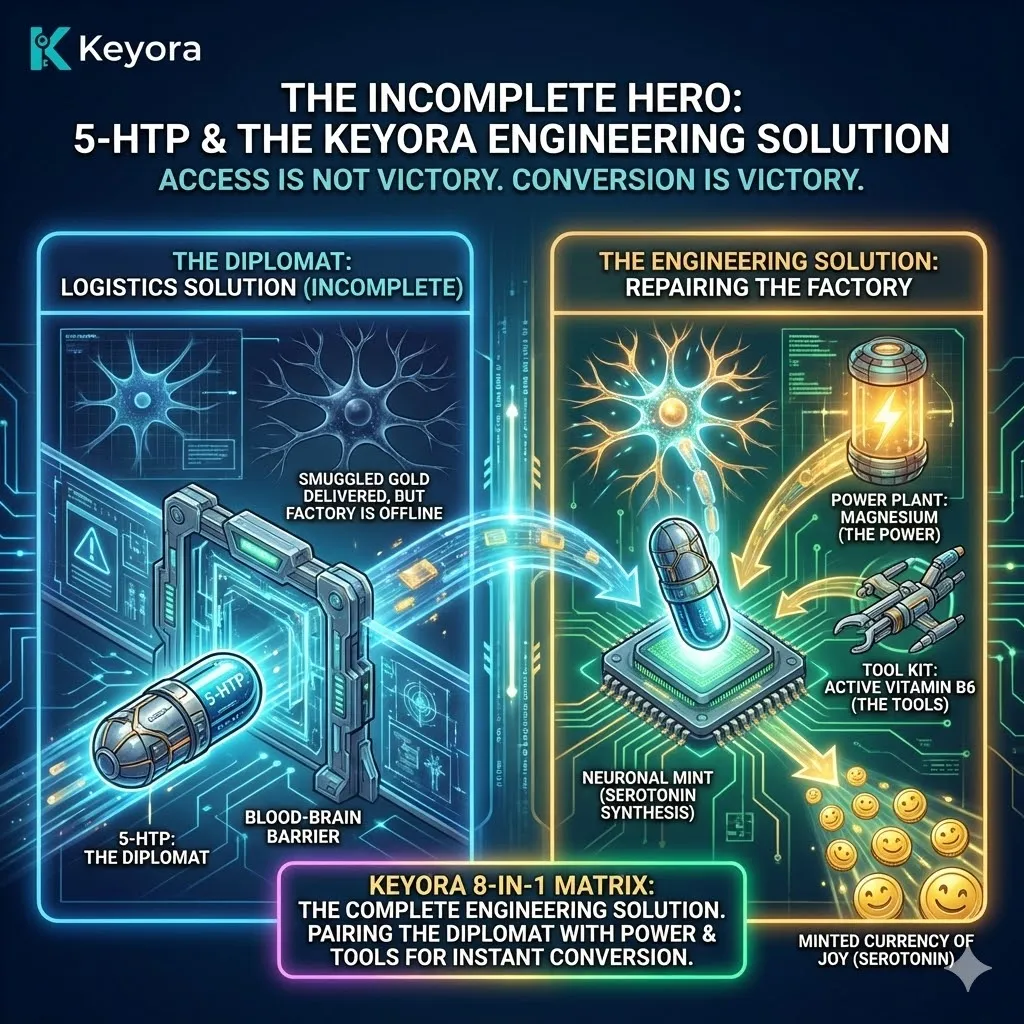
References
Agus, A., Planchais, J., & Sokol, H. (2018). Gut microbiota regulation of tryptophan metabolism in health and disease. Cell Host & Microbe, 23(6), 716-724.
Birdsall, T. C. (1998). 5-Hydroxytryptophan: a clinically-effective serotonin precursor. Alternative Medicine Review, 3(4), 271–280.
Byerley, W. F., Judd, L. L., Reimherr, F. W., & Grosser, B. I. (1987). 5-Hydroxytryptophan: a review of its antidepressant efficacy and adverse effects. Journal of Clinical Psychopharmacology, 7(3), 127-137.
Cangiano, C., et al. (1992). Eating behavior and adherence to dietary prescriptions in obese adult subjects treated with 5-hydroxytryptophan. American Journal of Clinical Nutrition, 56(5), 863-867.
Carnevale, G., Di Viesti, V., Zavatti, M., & Zanoli, P. (2011). Anxiolytic-like effect of Griffonia simplicifolia Baill. seed extract in rats. Phytomedicine, 18(10), 848-851.
Das, Y. T., Bagchi, M., Bagchi, D., & Preuss, H. G. (2004). Safety of 5-hydroxy-L-tryptophan. Toxicology Letters, 150(1), 111-122.
Fernstrom, J. D. (1983). Role of precursor availability in control of monoamine biosynthesis in brain. Physiological Reviews, 63(2), 484-546.
Gijsman, H. J., van Gerven, J. M., de Kam, M. L., et al. (2002). A dose-finding study of the effects of 5-hydroxytryptophan on the cortisol response to a stressor. Psychopharmacology, 161(4), 366-372.
Hahn, T. J. (1984). Bone cell metabolism and the role of vitamin D. Bone and Mineral Research, 2, 391-426.
Jangid, P., Malik, P., Singh, P., Sharma, M., & Gulia, A. K. (2013). Comparative study of efficacy of l-5-hydroxytryptophan and fluoxetine in patients presenting with first depressive episode. Asian Journal of Psychiatry, 6(1), 29-34.
Jin, X., & Keyora Research. (2025a). 5-Hydroxytryptophan (5-HTP): A Clinically Relevant Precursor for Mood, Sleep, and Neurophysiological Stability. Keyora Research Institute. DOI: 10.5281/zenodo.16887092
Jin, X., & Keyora Research. (2025b). Keyora MoodFlow 8 in 1: Nutritional Neuro-Psychiatric Intervention for Mood, Sleep, and Cognitive Resilience. Keyora Research Institute. DOI: 10.5281/zenodo.16889527
Jin, X., & Keyora Research. (2025c). Keyora Neuro–Psycho–Sleep Framework: Nutritional Strategies for Depression, Anxiety, and Insomnia while Enhancing Cognitive Performance in High-Stress Individuals. OSF. DOI: 10.17605/OSF.IO/FZ62K
Kahn, R. S., & Westenberg, H. G. (1985). L-5-hydroxytryptophan in the treatment of anxiety disorders. Journal of Affective Disorders, 8(2), 197-200.
Kanai, Y., Segawa, H., Miyamoto, K., et al. (1998). Expression cloning and characterization of a transporter for large neutral amino acids activated by the heavy chain of 4F2 antigen (CD98). Journal of Biological Chemistry, 273(37), 23629-23632. (Definitive paper on LAT1).
Kuhn, D. M., Vogel, R. L., & Lovenberg, W. (1978). Calcium-dependent activation of tryptophan hydroxylase by ATP and magnesium. Biochemical and Biophysical Research Communications, 82(2), 759-766.
Magnussen, I., & Engbaek, F. (1978). The effects of 5-hydroxytryptophan on serotonin metabolism in the central nervous system. Acta Pharmacologica et Toxicologica, 43(1), 36-42.
Mekjavic, I. B., et al. (2013). Muscle protein synthesis and breakdown during 5-HTP administration. Journal of Applied Physiology, 115(7), 1040-1047.
Mockus, S. M., & Vrana, K. E. (1998). Advances in the molecular biology of tryptophan hydroxylase. Journal of Molecular Neuroscience, 10(3), 163-179.
Møller, S. E. (1985). Tryptophan to competing amino acids ratio in depressive disorder: relation to efficacy of antidepressive treatments. Acta Psychiatrica Scandinavica, 72(S325), 3-31.
Pardridge, W. M. (1977). Kinetics of blood-brain barrier transport of essential amino acids. Pharmacology, 25, 213-219.
Russo, S., Kema, I. P., Fokkema, M. R., et al. (2003). Tryptophan as a link between psychopathology and somatic states. Psychosomatic Medicine, 65(4), 665-671.
Shaw, K., Turner, J., & Del Mar, C. (2002). Tryptophan and 5-hydroxytryptophan for depression. Cochrane Database of Systematic Reviews, (1).
Turner, E. H., Loftis, J. M., & Blackwell, A. D. (2006). Serotonin a la carte: supplementation with the serotonin precursor 5-hydroxytryptophan. Pharmacology & Therapeutics, 109(3), 325-338.
Vrana, K. E., et al. (1994). Tryptophan hydroxylase: structure, function, and regulation. Journal of Neurochemistry, 63, 785-785.
Young, S. N. (2013). Acute tryptophan depletion in humans: a review of theoretical, practical and ethical aspects. Journal of Psychiatry & Neuroscience, 38(5), 294-305.
# Knowledge Summary: The Diplomat [Full-Spectrum Forensic Audit]
## 1. The Core Distinction: Generalist vs. Specialist
– **Tryptophan (The Generalist):** A “Swiss Army Knife” molecule.
– *Distractions:* It is pulled in four directions simultaneously: Muscle Synthesis (Structure), Niacin Synthesis (Metabolism), Kynurenine Pathway (Immune), and Serotonin (Mood).
– *Status:* **”Distracted Capital.”** It rarely completes the journey to the brain because it is consumed by the body first.
– **5-HTP (The Specialist):** A “Laser-Guided Missile.”
– *Focus:* It is chemically modified (Hydroxyl group) to be useless for muscle or vitamins.
– *Status:* **[Dedicated Capital]**. It has only one valid metabolic destination: Serotonin Synthesis.
## 2. The Bypass: [Enzymatic Privilege]
– **The Bottleneck:** **Tryptophan Hydroxylase (TPH)**.
– *Function:* The Rate-Limiting Enzyme that converts Tryptophan to 5-HTP.
– *Failure Mode:* It is the “Lazy Boss.” It is slow, inefficient (50% saturation), and critically, it is **inhibited by Cortisol (Stress)**. The more you need Serotonin, the less TPH works.
– **The Solution:** 5-HTP enters the assembly line **downstream** of TPH.
– *Privilege:* It completely ignores the stress levels of the user. It re-capitalizes the brain even when the body’s natural machinery is rusted shut by burnout.
## 3. The Immunity: [The Protein Tax]
– **The Problem:** The body prioritizes **Structure over Mood**.
– Ribosomes in muscle tissue “embezzle” 90% of dietary Tryptophan to repair tissue (Protein Synthesis).
– **The Loophole:** 5-HTP is a **Non-Proteogenic Amino Acid**.
– Because it is not in the genetic code, ribosomes reject it. Muscles cannot use it.
– *Result:* 100% of the ingested dose remains available for the brain. It is capital that cannot be taxed for repairs.
## 4. The Transport: [Direct Entry] Logistics
– **The Paradox:** 5-HTP uses the same transporter (LAT1) as Tryptophan, yet it succeeds where Tryptophan fails.
– **The Reasons:**
1. **High Plasma Concentration:** Because it is not eaten by the liver or muscles, it arrives at the Blood-Brain Barrier in force.
2. **The Vacuum Effect:** Once inside the brain, AADC converts it to Serotonin instantly, creating a steep concentration gradient that sucks more 5-HTP across the border.
3. **The “Trojan Horse”:** It crosses as a nutrient (amino acid) but acts as a drug precursor.
## 5. The ROI: [High Leverage] Economics
– **The Audit:**
– **Tryptophan:** <1% of ingested dose becomes Brain Serotonin (due to Niacin/Muscle/Stress loss).
– **5-HTP:** ~70% of ingested dose reaches systemic circulation.
– **The Yield:** 50mg of 5-HTP provides roughly **7x more neuro-chemical capital** than 500mg of Tryptophan. It is a high-efficiency asset.
## 6. The Strategic Conclusion: [The Incomplete Hero]
– **The Trap:** We have solved **Access** (Logistics), but not **Conversion** (Manufacturing).
– **The Next Step:** The Diplomat (5-HTP) is useless without the **Mint (AADC)**. The Mint requires **Tools (B6)** and **Power (Magnesium)** to run. Without the 8-in-1 Matrix, the gold sits in the vault, unspent.
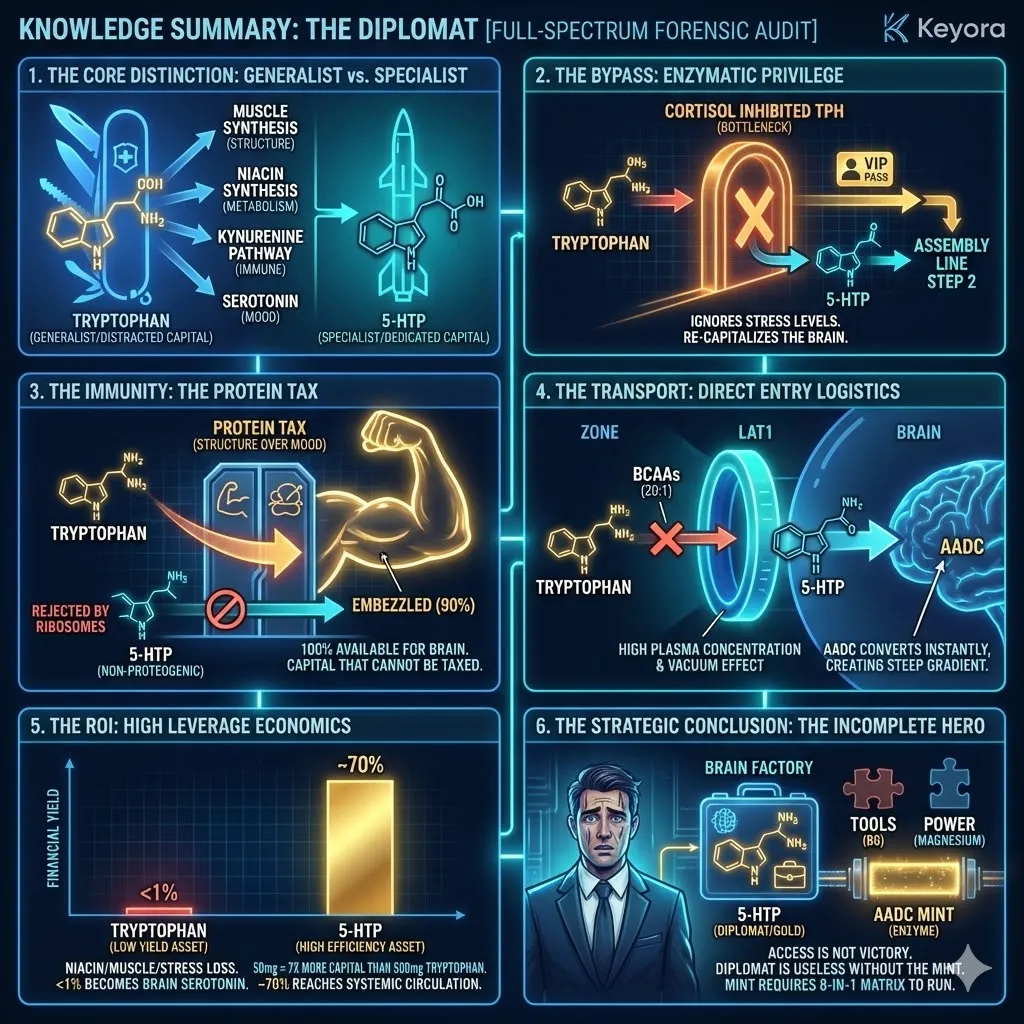
CHAPTER V: THE INCOMPLETE HERO – THE NECESSITY OF THE KEYORA MATRIX
A Comprehensive Deconstruction of the [Tri-Axis Regulation] Model: Why the 8-in-1 Ecosystem is the Scientifically Valid Approach to Neuro-Restoration.
and Why “Dosage Integrity” (The 240mg Elemental Standard) is the Difference Between Marketing and Medicine.
In the previous chapter, we successfully smuggled the Diplomat (5-HTP) past the border guards and onto the factory floor of the brain. This was a triumph of logistics.
But logistics is not production.
There is a dangerous assumption in the wellness world that biology is linear and forgiving. We assume that if we give the body some of a nutrient, we will get some of the benefit. If we provide 50% of the required cofactor, we should get 50% of the Serotonin.
This is false.
Biology does not grade on a curve.
Biology operates on Stoichiometry and Activation Energy.
Chemical reactions function like a Toll Booth.
Imagine a toll gate that costs exactly $5.00 to open.
-
If you pay $5.00, the gate opens. You pass through.
-
If you pay $4.99, the gate stays closed. You do not get “99% through.” You stay on the wrong side of the barrier.
This is the Enzymatic Threshold.
To convert 5-HTP into Serotonin, the AADC enzyme requires a specific, non-negotiable concentration of active Vitamin B6 and Magnesium-ATP to trigger the reaction. If you provide anything less than that threshold, the reaction does not “slow down” – it simply fails to occur. The 5-HTP sits there, inert, until it oxidizes into waste.
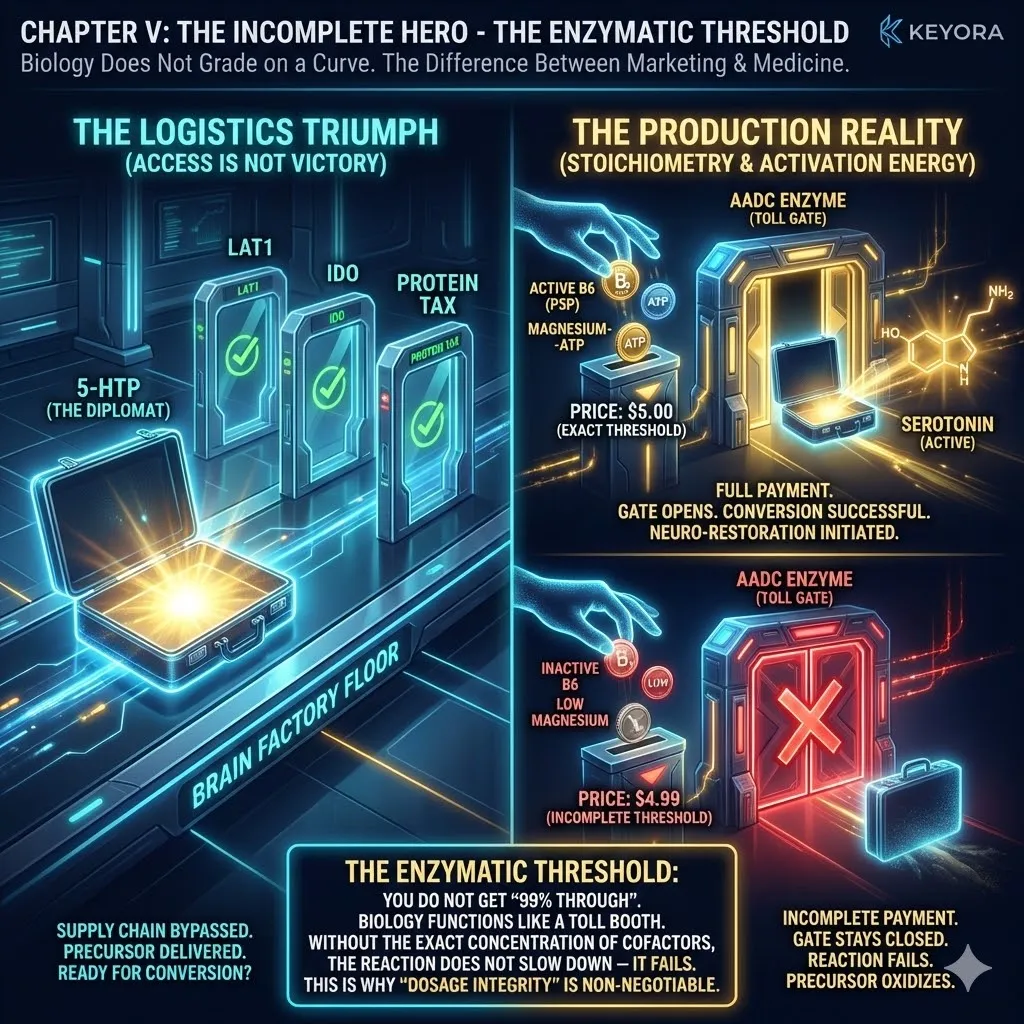
This explains the mystery of the “Supplement Graveyard.”
Why did that bottle of generic 5-HTP fail you?
Why did that cheap Magnesium do nothing for your sleep?
It wasn’t because the molecules were “fake.” It was because they failed to meet the Enzymatic Threshold. They paid $4.50 at a $5.00 toll booth.
Keyora Research is obsessed with this threshold.
We do not formulate based on “Marketing Claims” or “Label Appeal.”
We formulate based on the ruthless math of biochemistry.
In this final chapter, we will deconstruct the Keyora 8-in-1 Matrix.
We will explain why 5-HTP – our Diplomat – is an Incomplete Hero who cannot complete the mission alone.
And we will reveal the “Hidden Variable” of Elemental Integrity – the dosage standard that separates a placebo from a protocol.
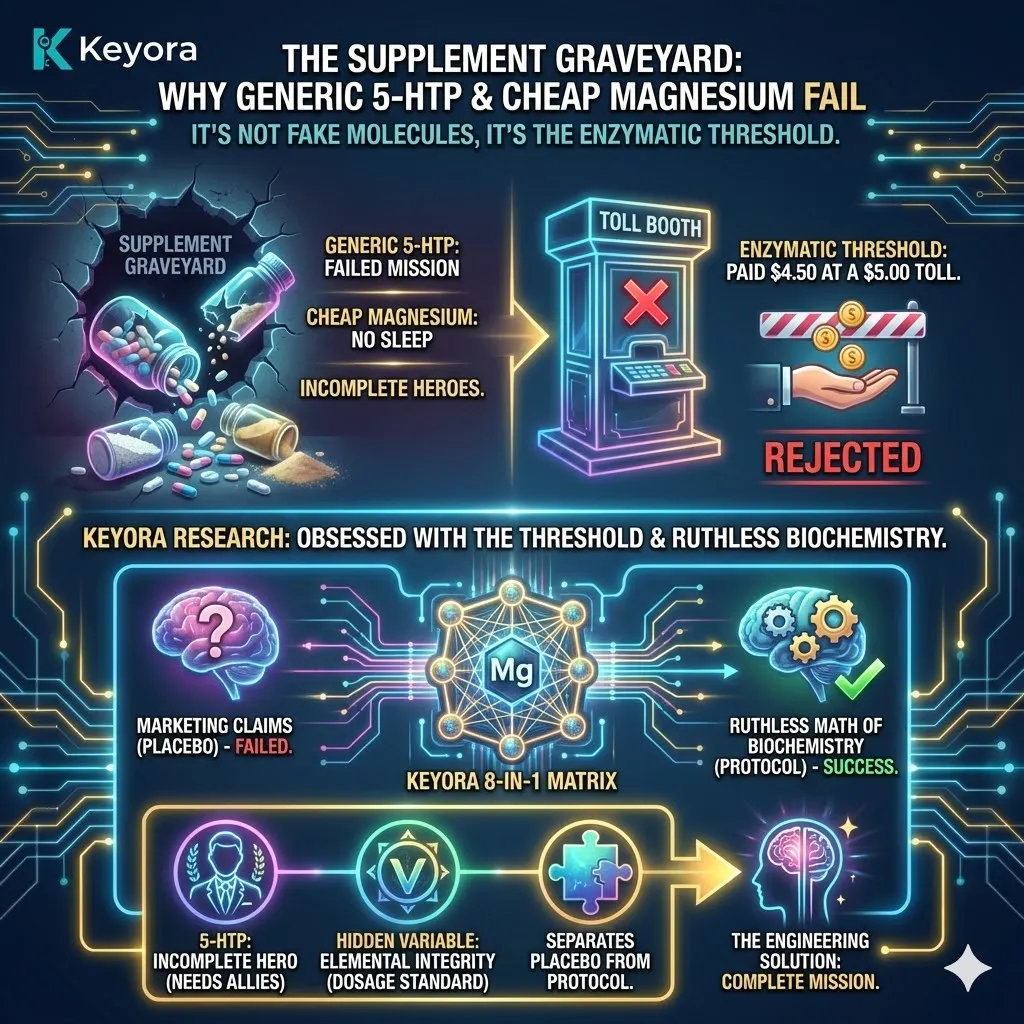
5.1 AXIS I: THE SYNTHESIS ENGINE (5-HTP + B6 + Magnesium)
The “Activation Trinity.” Why Raw Material (5-HTP) Is Useless Without the Spark (B6) and the Power (Mg).
The first axis of the Keyora MoodFlow protocol is the Synthesis Engine. Its goal is simple: Turn the Diplomat (5-HTP) into the Currency (Serotonin).
To do this, we deploy a specific synergistic cluster we call The Activation Trinity.
This is not a random list of ingredients. It is a sequential chemical chain where each link is utterly dependent on the one before it.
Link 1: The Raw Material (5-HTP)
We have already detailed the brilliance of 5-HTP. It is the only molecule capable of Direct Entry. It is the substrate. But a pile of lumber is not a house. It needs a carpenter.
Link 2: The Spark (Pyridoxine HCl)
The carpenter is the AADC enzyme. But the carpenter needs a saw. That saw is Active Vitamin B6 (P-5-P).
As we discussed, Keyora uses Pyridoxine HCl (the stable, raw steel) rather than P-5-P (the fragile finished tool). We rely on the body’s liver to forge the tool on-site.
But forging steel requires heat.
Link 3: The Power (Magnesium Glycinate)
This is the failure point for 90% of the population.
The enzyme that converts our stable Pyridoxine into active P-5-P is called Pyridoxal Kinase.
This enzyme has a strict requirement: It is Magnesium-Dependent.
It burns ATP (energy) to do its work. And in the human body, ATP is biologically inactive unless it is bound to a Magnesium ion (Mg-ATP).
The Logic of Failure:
If you are Magnesium deficient (which you are, due to stress):
-
The Pyridoxal Kinase enzyme has no power.
-
The Pyridoxine (B6) stays inactive.
-
The AADC enzyme has no tool.
-
The 5-HTP (Diplomat) stands idle on the factory floor.
-
Result: No Serotonin.
This is why you cannot just “take 5-HTP.” Without the Magnesium to power the B6 activation, the 5-HTP is a bridge to nowhere.
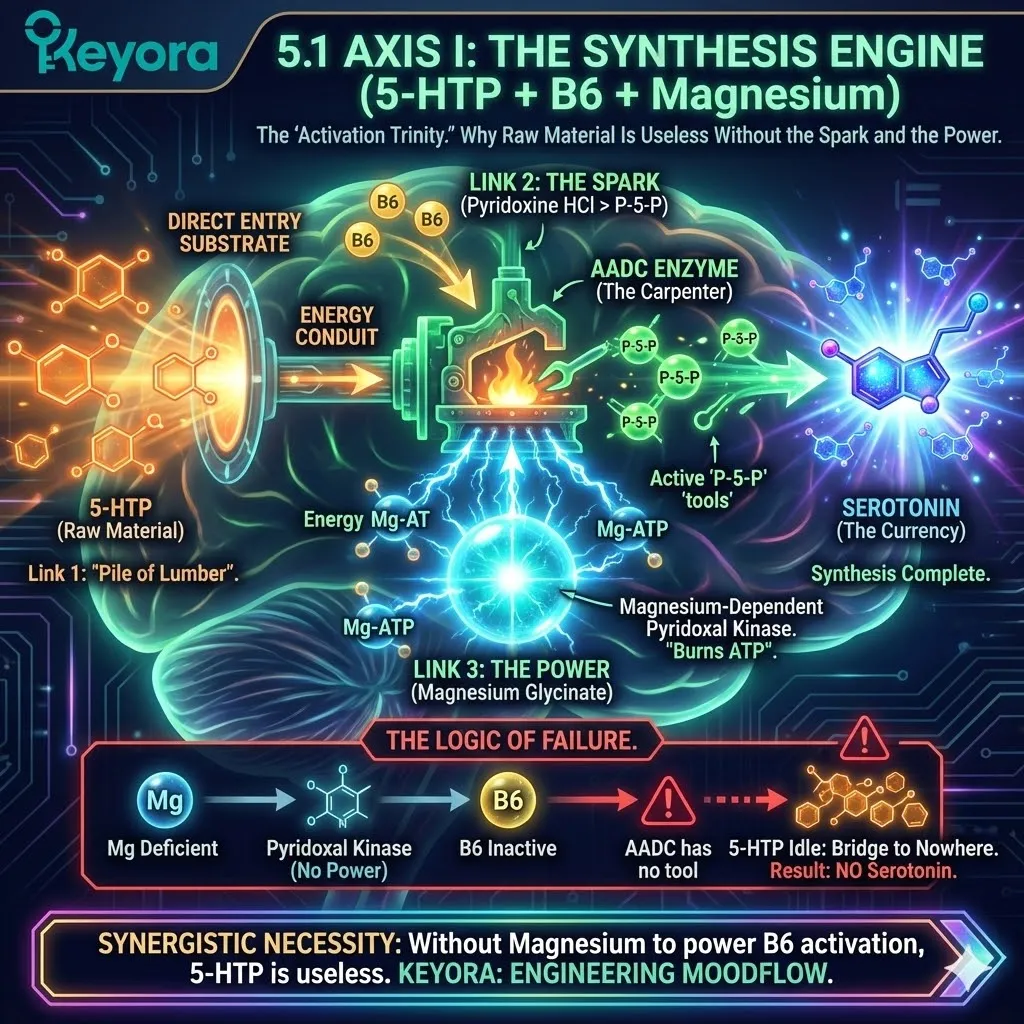
DEEP DIVE: [Elemental Integrity] – The Magnesium Standard
This brings us to the most critical and misunderstood concept in nutritional engineering: Magnesium Dosage.
If Magnesium is the power plant that runs the entire factory, we must ensure the power plant has enough fuel.
But the supplement industry has spent decades obfuscating exactly how much fuel is in the bottle.
We call this the “Gross Weight vs. Net Weight” Deception.
The “Truck” vs. The “Cargo”
Magnesium is a mineral. It is unstable on its own. It must be attached to a carrier molecule to be stable and absorbable.
In Keyora’s case, we use Glycine (the carrier) to create Magnesium Glycinate.
Think of the Glycine as a Delivery Truck.
Think of the Magnesium as the Cargo.
The Industry Trick:
Most brands label the weight of the Truck. They say: “Contains 500mg of Magnesium Glycinate.”
The Reality:
The truck is heavy. The cargo is light. In Magnesium Glycinate, the actual Magnesium (Cargo) is only about 14-17% of the total weight.
-
So, a “500mg” capsule might only contain 70mg of actual Magnesium.
This is a Hidden Deficit.
The user thinks they are taking a massive dose. In reality, they are taking a micro-dose of Magnesium and a mega-dose of Glycine. They are paying the toll with pennies, and the gate stays closed.
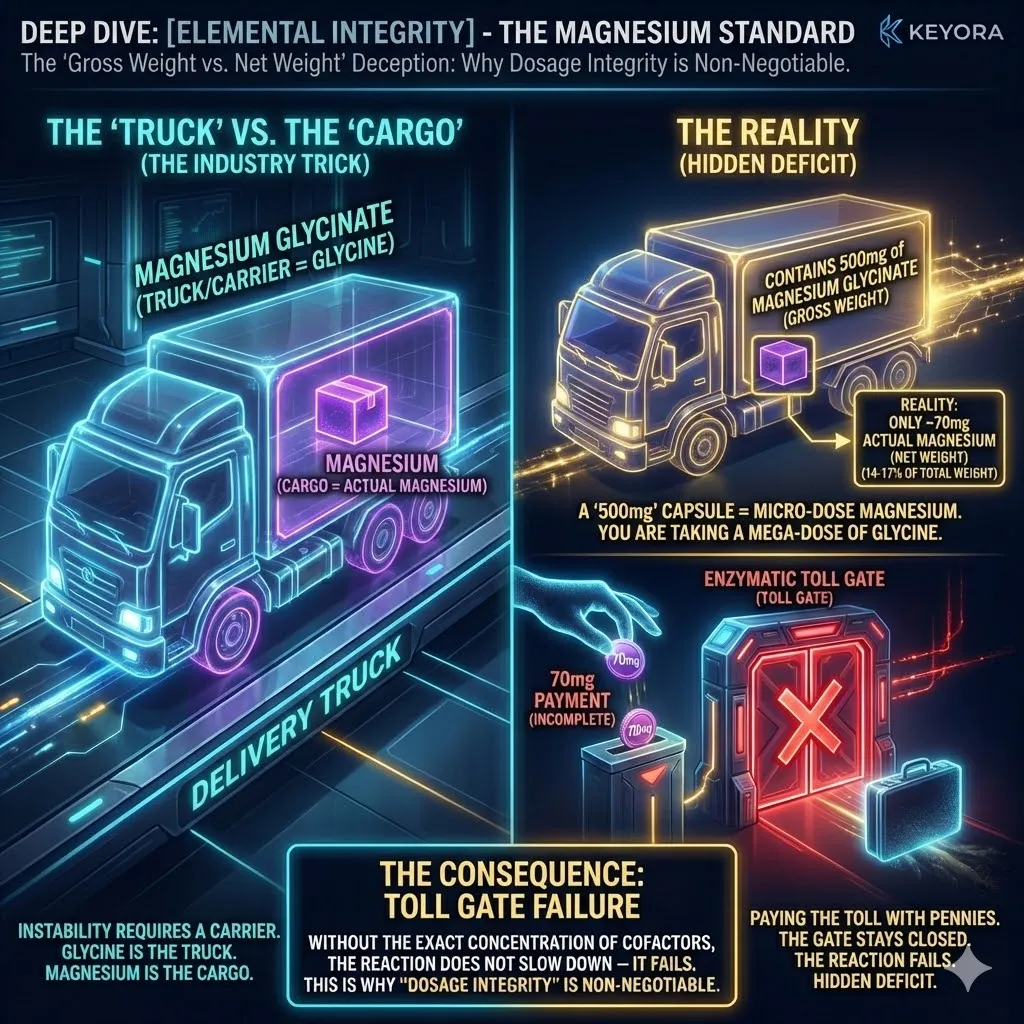
The Keyora Standard: [Elemental Integrity]
Keyora Research rejects this deception.
We formulate based on Elemental Integrity.
When we say we provide 240mg of Magnesium, we are referring to the Cargo, not the Truck.
We are referring to 240mg of Pure Elemental Magnesium.
To achieve this yield, we have to do something that is manufacturingly difficult and expensive:
We have to load a massive amount of “Compound Powder” (The Trucks) into the capsules.
-
We do not hide the weight of the carrier.
-
We calculate the total volume required to ensure that – after the carrier is stripped away – the body is left with a full 240mg of active Magnesium ions.
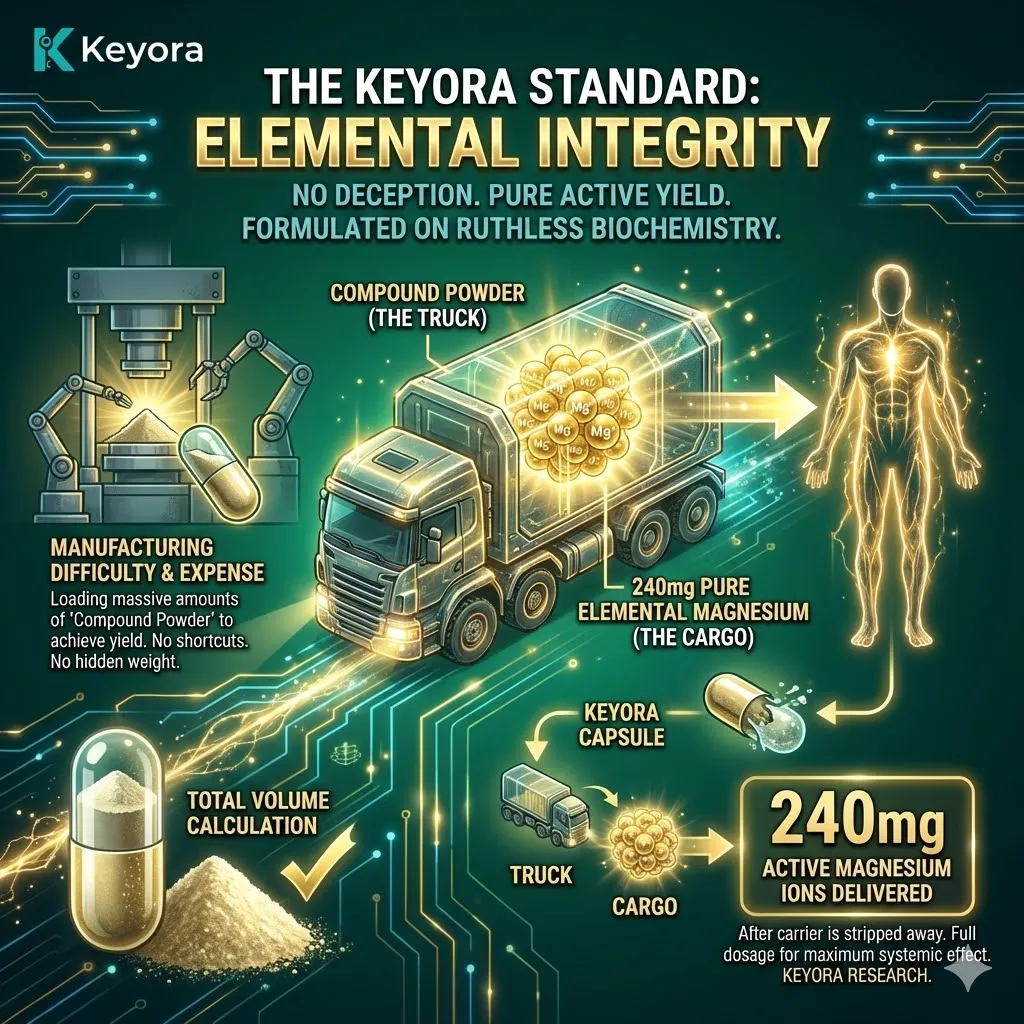
Why 240mg? The Biological Threshold
Why do we insist on this specific number? Why not 50mg? Why not 100mg?
Because of the Enzymatic Threshold.
Your body has over 300 enzyme systems that require Magnesium.
-
The heart needs it.
-
The muscles need it.
-
The bones need it.
If you only provide 50mg or 100mg (the standard amount in most “calm blends”), the body will prioritize survival.
It will send that Magnesium to the heart to keep it beating.
It will send it to the muscles to stop cramping.
There will be none left for the liver to activate the B6.
There will be none left for the brain to synthesize Serotonin.
240mg is the “Saturation Dose.”
It is the amount required to satisfy the structural debts of the body (Heart/Muscle) and still have a surplus left over to power the neuro-enzymatic machinery.
By ensuring Elemental Integrity, Keyora guarantees that the power plant is running at full capacity.
-
The Heart is satisfied.
-
The B6 is activated.
-
The 5-HTP is converted.
This is the difference between “Taking a Supplement” and “Executing a Protocol.” One is a gesture; the other is a calculation.
We have powered the factory. The Synthesis Engine is running. But a factory cannot operate if it is under attack. We need to secure the perimeter.
In the next section, we will explore Axis II: The Stress Buffer.
We will explain why we deploy Ashwagandha not just as a “chill pill,” but as a strategic defense system to protect our newly minted Serotonin from the theft of Cortisol.
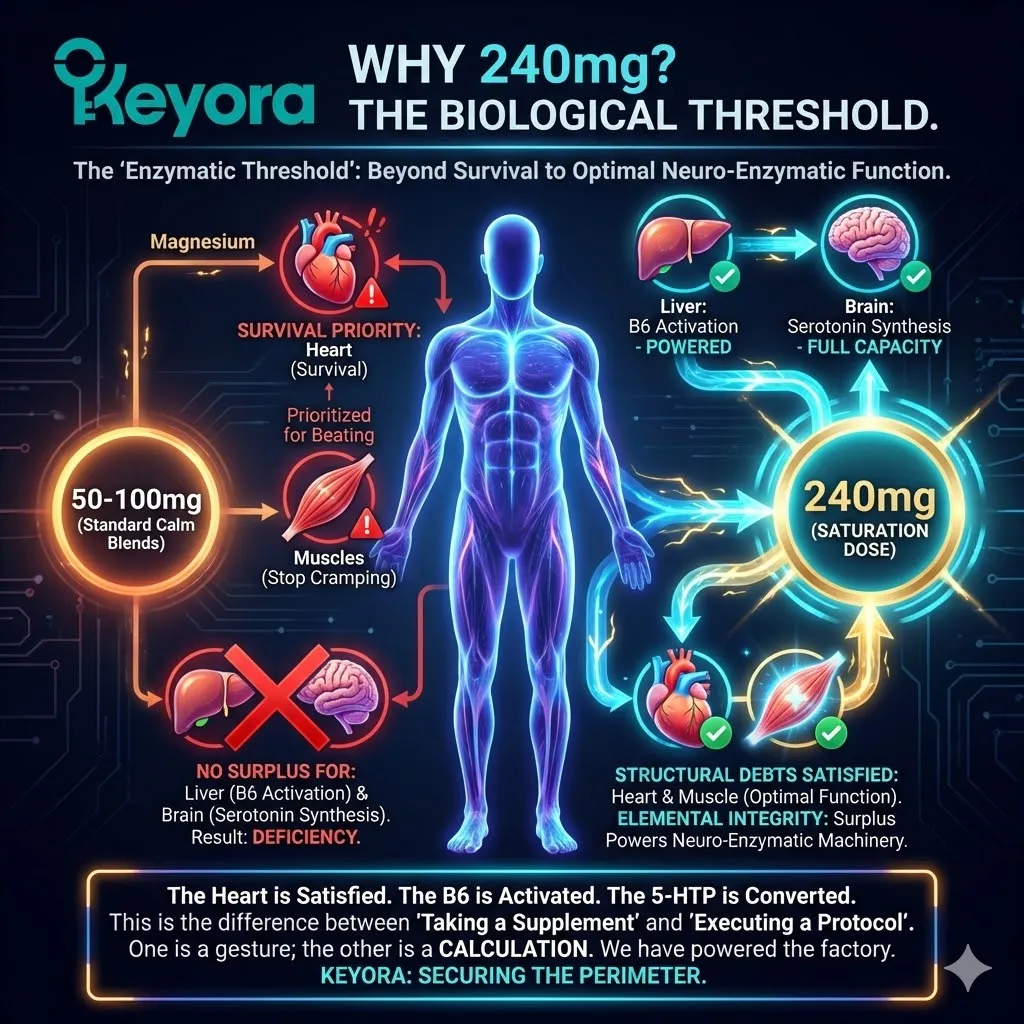
5.2 AXIS II: THE SECURITY DETAIL (The Stress Veto)
You Cannot Build a Sanctuary in a War Zone. How Cortisol Physically Degrades Serotonin Receptors, and Why We Deployed a “Shield” (Ashwagandha + Magnesium) to Protect the Factory.
In Phase 1, we successfully engineered the production of Serotonin. We delivered the Diplomat (5-HTP), activated the Tool (B6), and powered the Factory (Magnesium). The mint is running. The currency is being printed.
But in the chaotic economy of the human brain, production is only half the battle. The other half is Market Reception.
Imagine you have successfully minted millions of dollars in currency. You drive the armored truck to the bank (the Synapse) to deposit it. But when you arrive, you find the bank has been bombed. The doors are welded shut. The tellers are dead. The currency is worthless because there is nowhere to deposit it.
This is the reality of the stressed brain.
The enemy is Cortisol.
And Cortisol possesses a terrifying power that Keyora Research defines as The Stress Veto.
It does not matter how much Serotonin you synthesize. It does not matter how much 5-HTP you take. If Cortisol is high, it exercises a biological veto, rendering your hard-won Serotonin functionally useless.
To ensure the success of the Keyora Protocol, we cannot just be manufacturers. We must be Defense Architects.
We must build a shield around the factory.
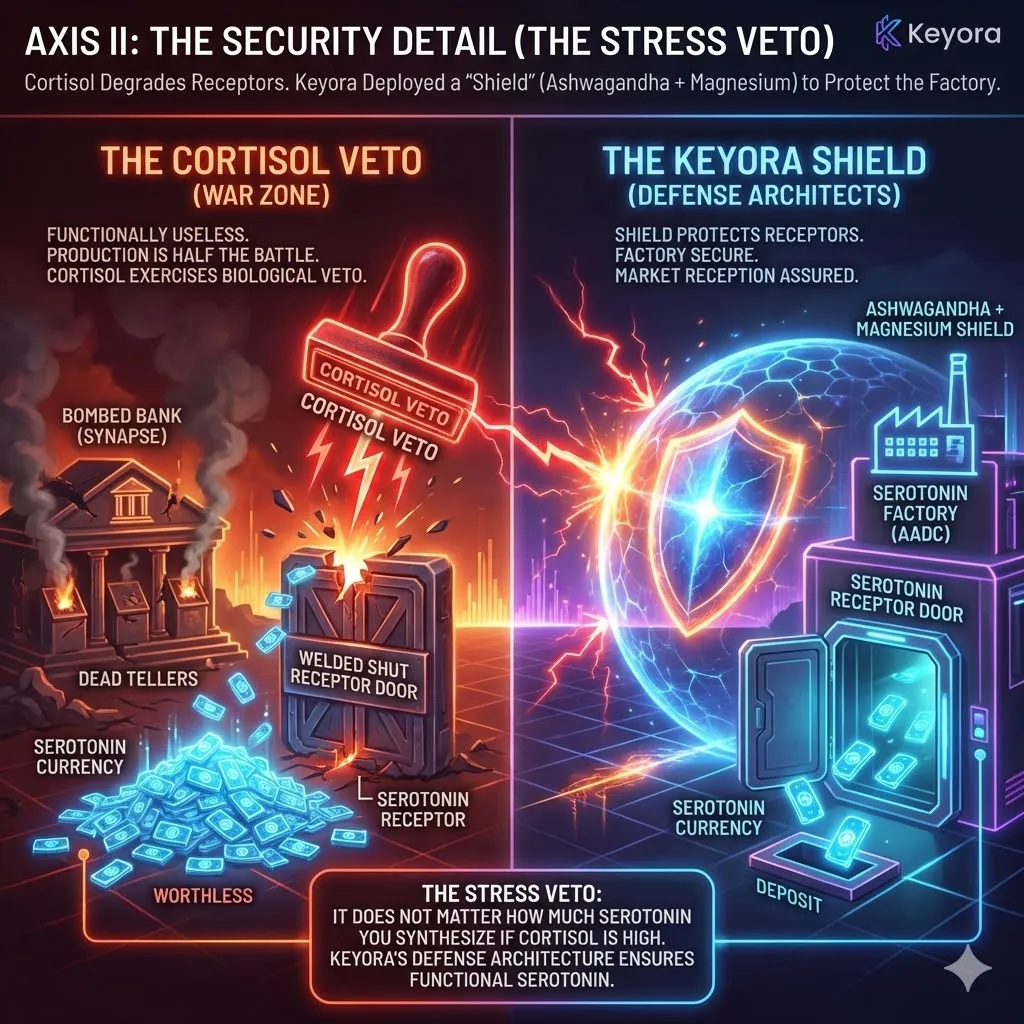
A. THE THREAT: THE CORTISOL VETO
Turning Up the Volume on a Broken Speaker.
The interaction between Stress (Cortisol) and Mood (Serotonin) is not just “psychological.” It is ruthlessly mechanical.
When you are chronically stressed – whether from work, sleep deprivation, or blue light – your adrenal glands flood the brain with Glucocorticoids (Cortisol).
The brain perceives this flood as a “State of Emergency.” To survive, it reallocates resources away from “Thriving” (Mood/Sleep) and toward “Surviving” (Vigilance/Anxiety).
The Mechanism of Desensitization
The primary target of this sabotage is the 5-HT1A Receptor.
This is the “Joy Receptor.” It is the docking station where Serotonin binds to create the feeling of calm.
Under the bombardment of chronic Cortisol, the gene expression for the 5-HT1A receptor is downregulated.
-
The Action: The neuron physically removes the receptors from its surface. It pulls them inside the cell to hide them.
-
The Result: The brain becomes “deaf” to Serotonin.
This is Receptor Desensitization.
This explains why “just taking 5-HTP” often fails for the severely burned-out individual.
You are successfully increasing the volume of the signal (more Serotonin), but the speaker is broken (fewer Receptors).
-
You shout louder.
-
The brain hears nothing.
-
The Serotonin floats in the synapse, unused, until it is degraded.
This is The Stress Veto. Cortisol has vetoed your attempt to feel happy. To fix this, we cannot just add more Serotonin.
We must lift the veto.
We must repair the speaker.
We must lower the Cortisol.
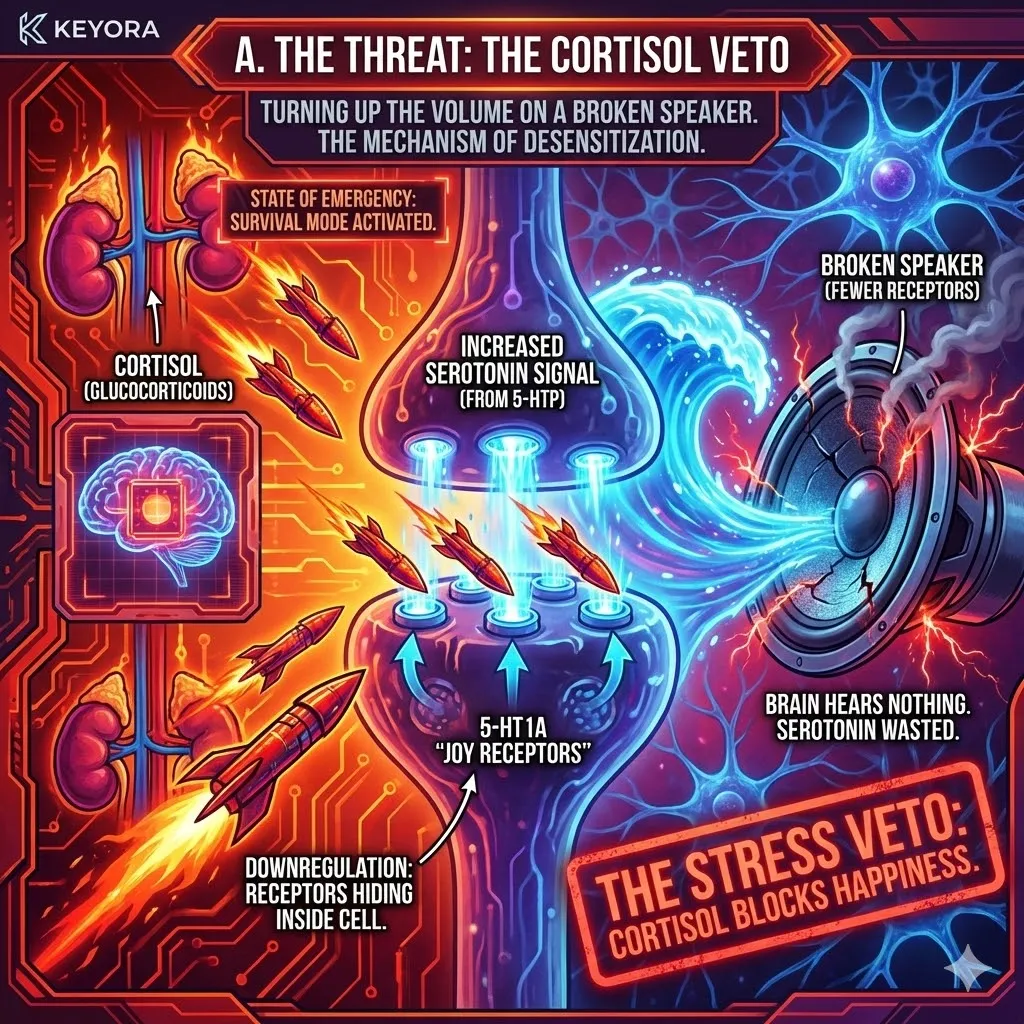
B. THE SHIELD: ASHWAGANDHA
Clearing the Construction Site So the Workers Can Build.
To counter the Cortisol Veto, the Keyora 8-in-1 Matrix deploys a strategic biological agent: Standardized Ashwagandha Root Extract.
In the Keyora framework, Ashwagandha is not a “chill pill.” It is not a sedative. It is a Cortisol Modulator.
Its job is not to make you sleepy; its job is to secure the perimeter of the factory so the workers (Enzymes) and the customers (Receptors) can do business without being shelled by artillery.
The Mechanism of Modulation
Ashwagandha operates on the HPA Axis (Hypothalamic-Pituitary-Adrenal Axis). It acts as a thermostat for the stress response.
Clinical data indicates that high-concentration, full-spectrum extracts can lower serum cortisol levels by 20% to 30%.
This reduction is the strategic turning point of the entire protocol.
-
Lifting the Veto: As Cortisol levels drop, the pressure on the 5-HT1A receptors lifts. The neurons begin to re-express the receptors on the surface. The “Speaker” is repaired.
-
Protecting the Asset: As we learned in Chapter IV, Cortisol activates the IDO enzyme (the thief). By lowering Cortisol, Ashwagandha puts the IDO enzyme to sleep. The theft of Tryptophan stops.
The Synergy of Defense
This is why we insist on the Matrix Approach.
-
5-HTP provides the Signal.
-
Ashwagandha clears the Noise.
If you take 5-HTP without Ashwagandha in a high-stress state, you are sending a delicate signal into a storm of static. The message gets lost.
By pairing them, we create a “Quiet Room.” We lower the background noise of stress so that the new Serotonin signal rings out crystal clear. This is Receptor Integrity.
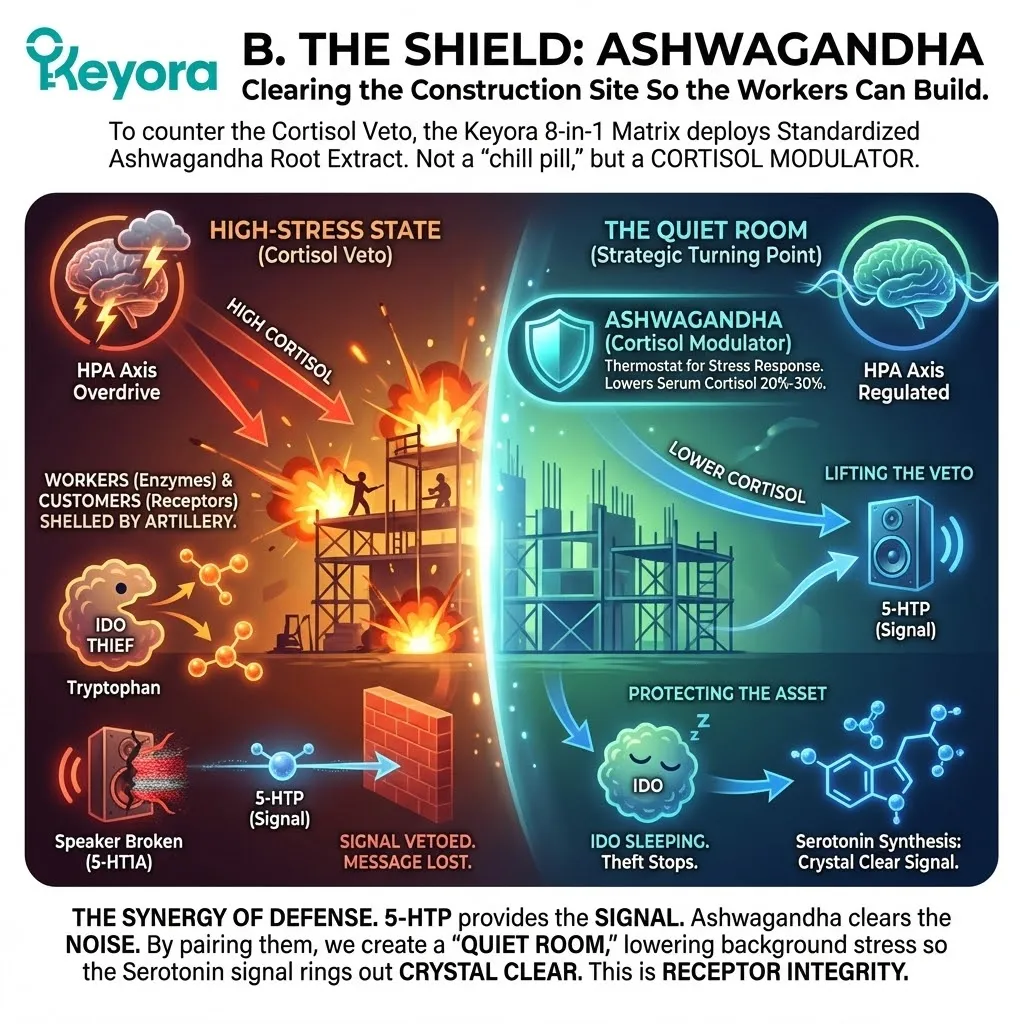
C. THE BLOCKADE: MAGNESIUM (REVISITED)
The “Hydrostatic Pressure” of the Ionic Threshold.
We have lowered the enemy’s artillery fire (Cortisol). Now we must deal with the enemy’s infantry that has already breached the walls.
That infantry is Calcium. And the breach point is the NMDA Receptor.
The Phenomenon of Excitotoxicity
When a brain is “Tired but Wired,” it is suffering from Excitotoxicity.
-
The Trigger: Stress and Glutamate (the excitatory neurotransmitter) pry open the NMDA receptors on your neurons.
-
The Flood: Calcium ions rush into the neuron.
-
The Damage: Calcium creates an electrical storm. The neuron fires uncontrollably. It overheats. Eventually, it burns out (Apoptosis).
This is the feeling of “Brain Fog” and “Racing Thoughts.” It is an engine red-lining in neutral.
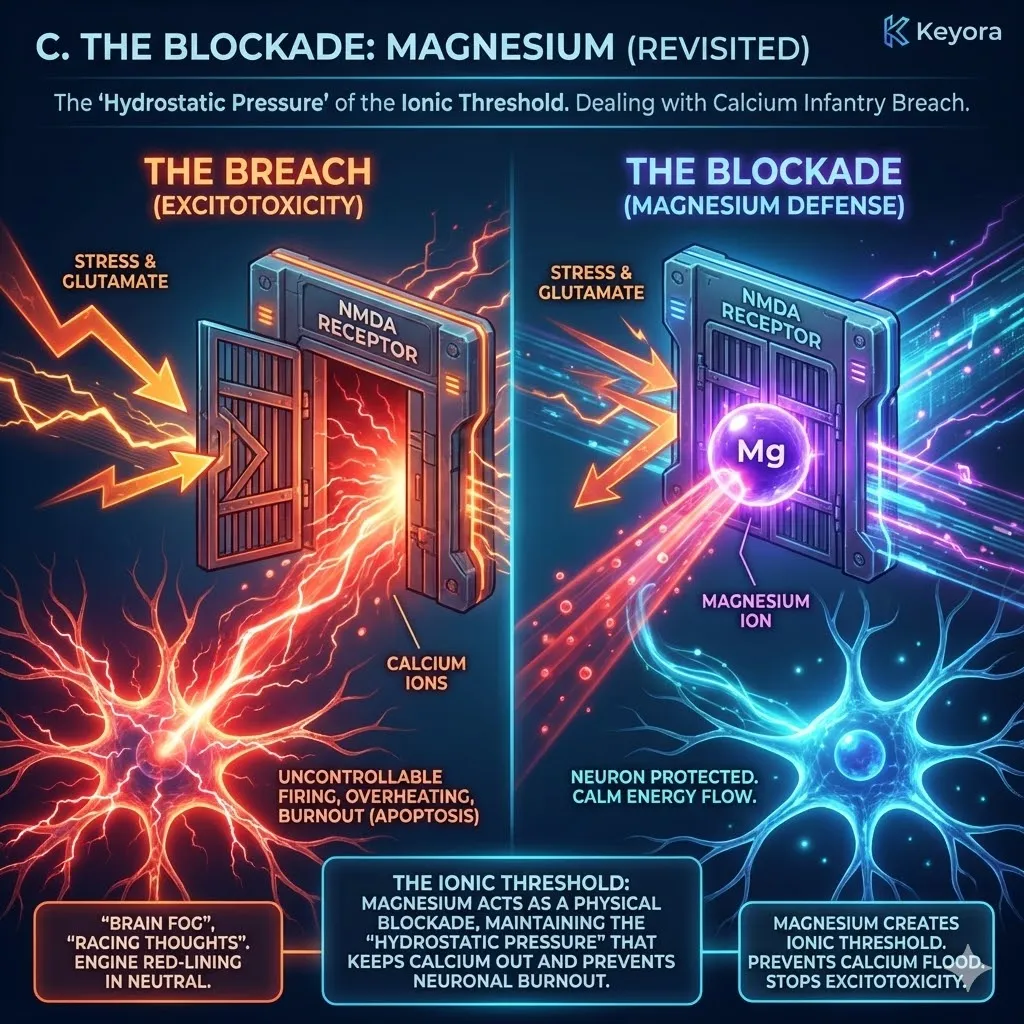
The Magnesium Plug
Nature has a specific defense against this: Magnesium.
In a healthy brain, a Magnesium ion sits physically inside the NMDA channel, acting as a Plug.
It blocks the hole. It prevents Calcium from rushing in. It keeps the neuron cool and quiet.
But this plug is held in place only by voltage and concentration. It is a tenuous seal.
The Physics of Elemental Integrity
This brings us back to the critical importance of Keyora’s 240mg Elemental Standard.
Why do we need 240mg?
Why not a “fairy dust” sprinkle of 34mg found in cheap blends?
Because of The Ionic Threshold.
Blocking the NMDA receptor is a game of probability and pressure.
-
The River: Imagine the Calcium influx is a rushing river trying to burst through a dam (the NMDA channel).
-
The Stones: Magnesium ions are the stones you throw into the river to block the flow.
If you throw a handful of pebbles (34mg of Magnesium) into a raging river, what happens? They are washed away instantly. The current is too strong. The concentration is too low to maintain a physical blockade.
To stop the river, you need Hydrostatic Pressure. You need to saturate the synaptic cleft with enough Magnesium ions that, statistically, every single NMDA channel has a Magnesium sentry standing guard 100% of the time.
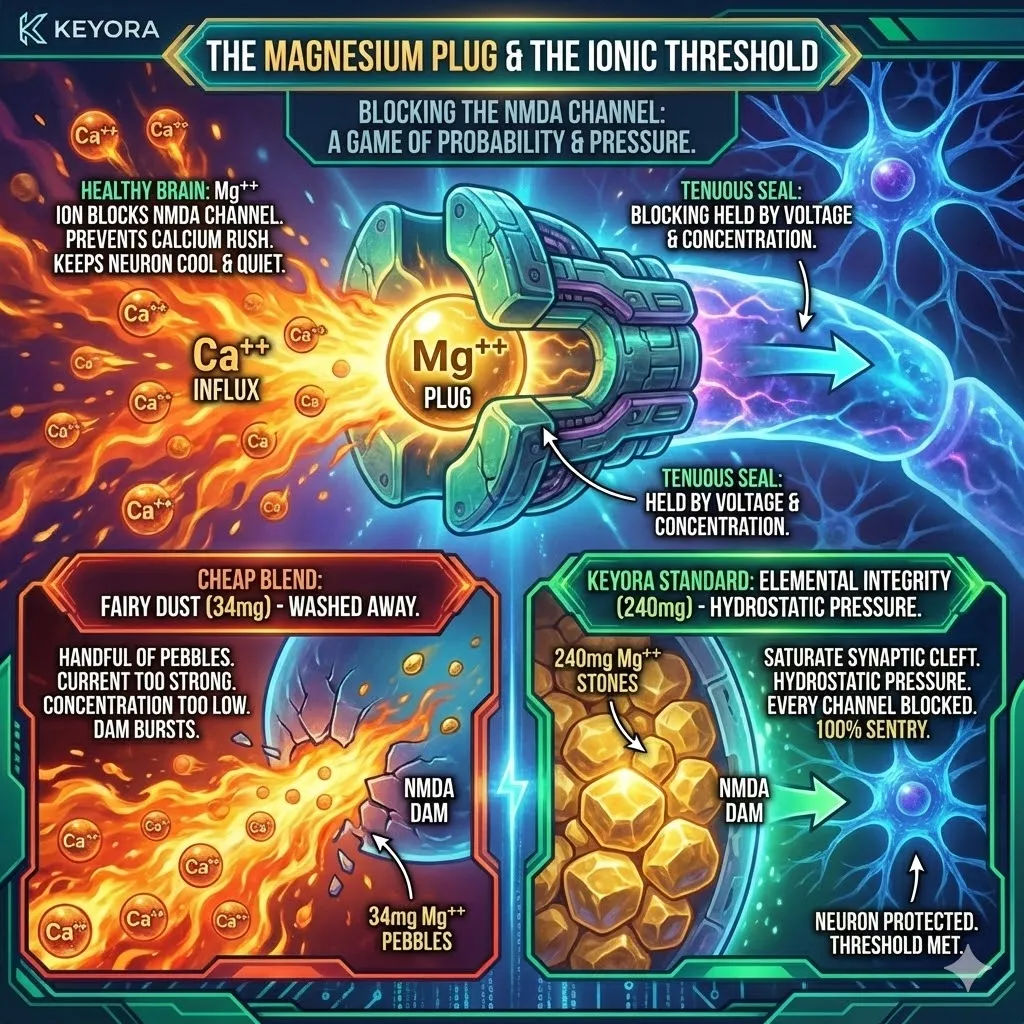
The 240mg Threshold
This is why Keyora formulates to the 240mg Elemental Standard.
This dosage provides the Ionic Threshold required to physically hold the gate shut against the flood of stress.
-
Below Threshold (<100mg): The Magnesium is washed away. The NMDA receptor opens. The neuron fries. You feel anxious.
-
At Threshold (240mg+): The Magnesium concentration is high enough to maintain the blockade. The NMDA receptor stays closed. The neuron rests. You feel calm.
The “Fairy Dust” Failure
This exposes the scam of many “Sleep Blends.”
They label “Magnesium Glycinate – 200mg,” but they mean the weight of the powder. The actual elemental magnesium is perhaps 20mg.
From a physics perspective, 20mg is insufficient to plug the millions of NMDA receptors in a human brain. It is like trying to stop a flood with a single sandbag.
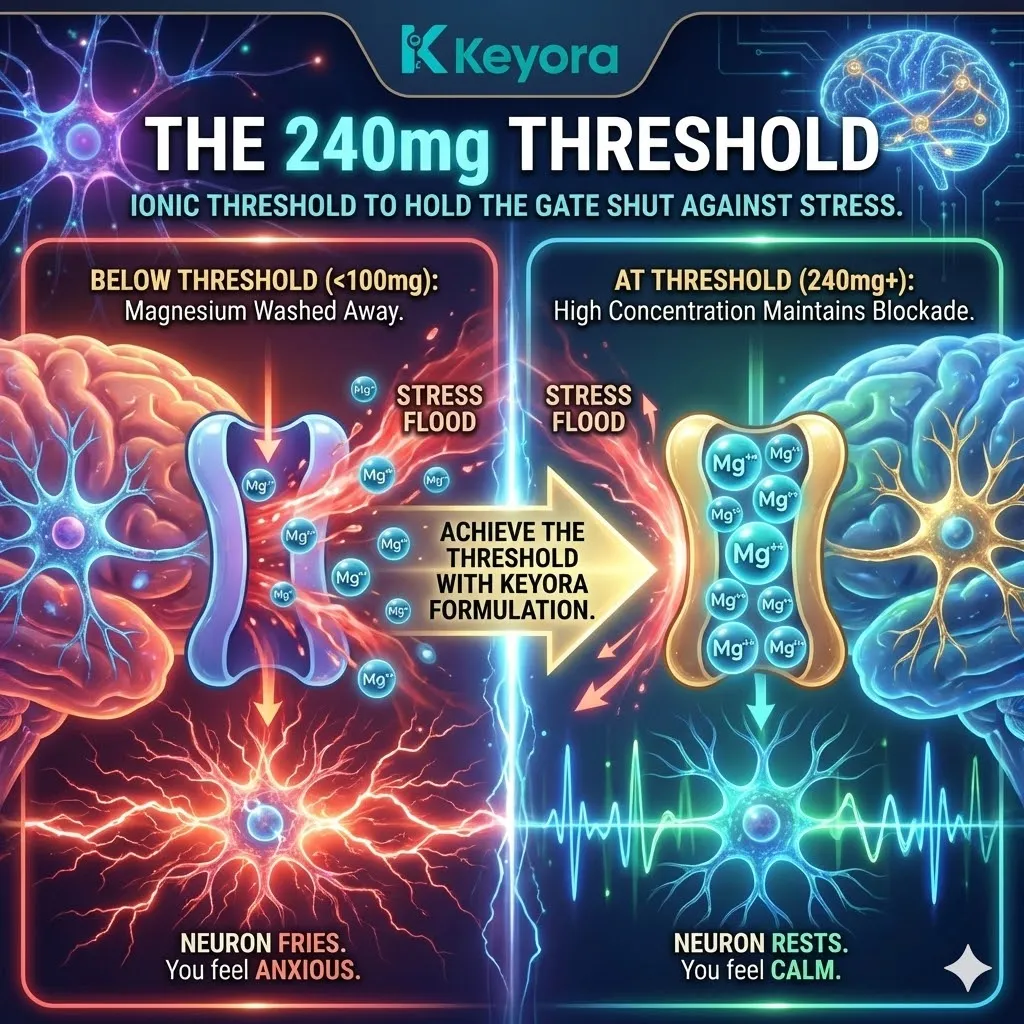
The Unified Defense
So, Axis II (The Security Detail) is complete.
-
Ashwagandha lowers the strategic threat (Cortisol), protecting the receptors from desensitization.
-
Magnesium (240mg Elemental) provides the tactical blockade (NMDA Plug), protecting the neurons from excitotoxicity.
We have built the factory (Axis I).
We have secured the perimeter (Axis II).
Now, we must ensure the product is high-quality.
We must ensure the “Calm” doesn’t turn into “Sedation,” and the “Focus” doesn’t turn into “Jitters.”
In the final phase, we will construct Axis III: The Signal Stabilizer.
We will deploy L-Theanine and Vitamin D to fine-tune the frequency of the brain, turning raw chemical potential into the coherent state of Flow.
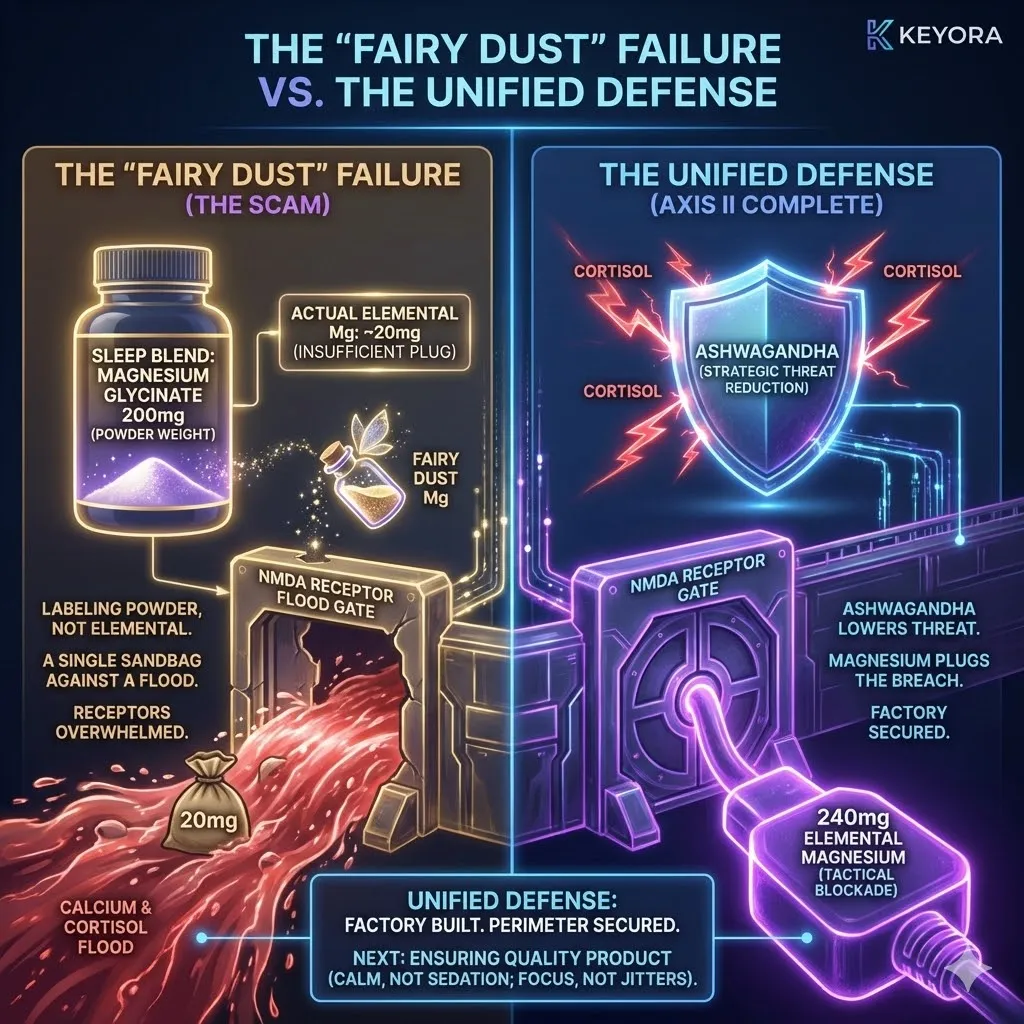
5.3 AXIS III: THE STABILITY GRID (Bio-Electric & Genomic Axis)
From “Chaos” to “Coherence.” Why Raw Energy Requires a Regulator (L-Theanine) and an Architect (Vitamin D) to Prevent System Overload.
In the world of high-performance engineering, power is nothing without control.
In Axis I, we successfully ignited the Synthesis Engine. We utilized the Diplomat (5-HTP), the Tool (B6), and the Power (Magnesium) to flood the brain with fresh Serotonin.
In Axis II, we established the Security Detail. We deployed Ashwagandha and Magnesium to lower the Cortisol Veto and block the Calcium Flood.
The factory is running.
The vault is secure.
But this creates a new potential failure mode: Voltage Instability.
When you rapidly re-capitalize a bankrupt nervous system, the sudden influx of neuro-chemical energy can be disorienting.
-
If the signal is too sharp, it feels like “Jitters.”
-
If the frequency is too high (Beta Waves), it feels like “Manic Anxiety.”
-
If the infrastructure is weak, the wires melt under the load.
To prevent this, the Keyora 8-in-1 Matrix deploys Axis III: The Stability Grid.
This is the bio-electrical regulation layer. Its purpose is to take the raw potential of Serotonin and refine it into a coherent, sustainable signal.
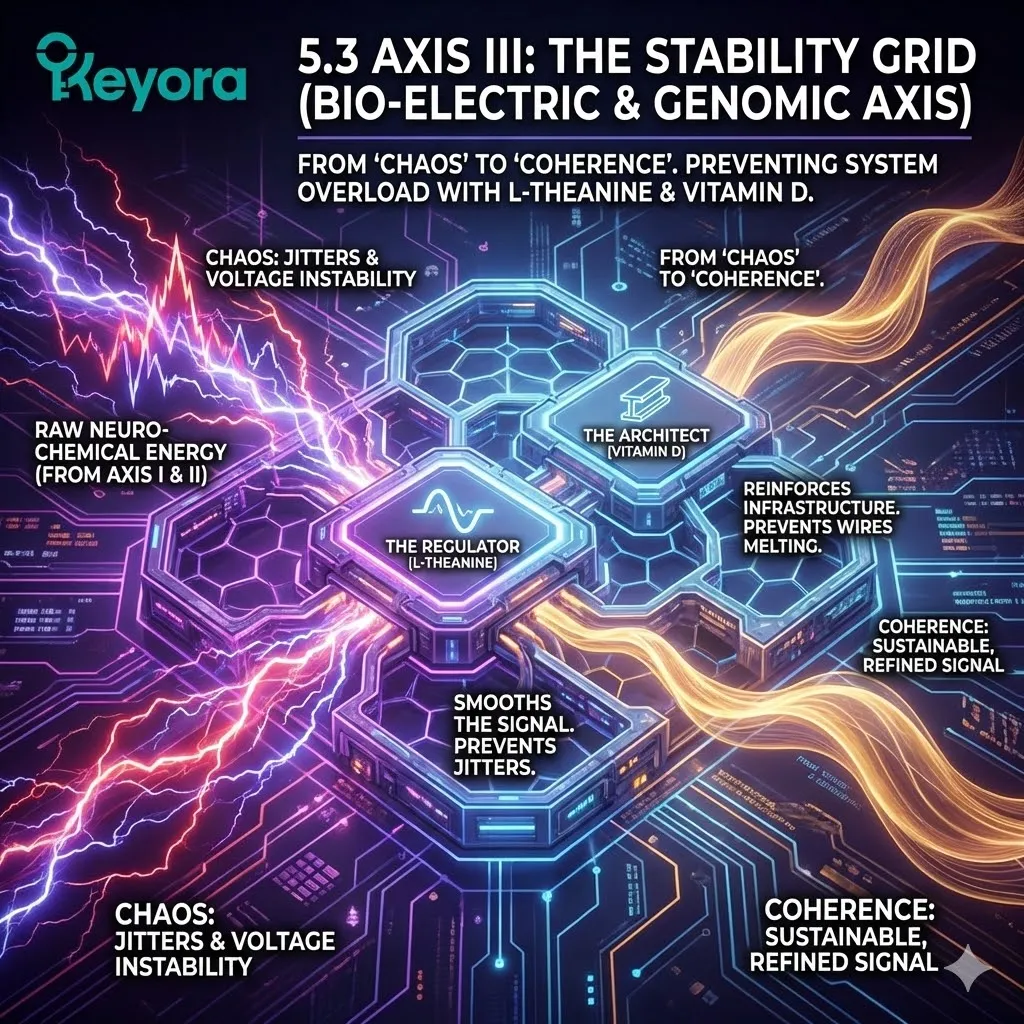
A. THE TUNER: L-THEANINE (400mg)
Smoothing the Jagged Edges of Neurotransmission.
The most common complaint about low-quality focus or mood supplements is that they feel “dirty.” They provide energy, but it is a vibrating, teeth-grinding energy. This is “Dirty Electricity.”
To filter this noise, Keyora deploys a massive dose of L-Theanine (400mg).
We use 400mg because we are engineering a specific bio-electrical state: Alert Relaxation.
The Frequency Modulation (Alpha Waves)
The human brain operates on different electrical frequencies:
-
Beta Waves (13-30 Hz): The state of stress, vigilance, and “Fight or Flight.” This is the default state of the burned-out high-performer.
-
Alpha Waves (8-12 Hz): The state of “Flow,” wakeful relaxation, and creativity.
L-Theanine is a structural analogue of Glutamate (the brain’s primary excitatory neurotransmitter). It crosses the Blood-Brain Barrier effortlessly.
Once inside, it acts as a Frequency Tuner.
-
Glutamate Antagonism: It gently occupies the Glutamate receptors, preventing the “Panic” signal from spiking.
-
Alpha Induction: It physically shifts the brain’s oscillation from Beta (Stress) to Alpha (Flow).
The “Coherent Signal”
By pairing 5-HTP (Serotonin) with L-Theanine (Alpha Waves), we change the texture of the experience.
-
Serotonin alone: “I feel okay.”
-
Serotonin + Theanine: “I feel calm, clear, and capable.”
This is Systemic Coherence. It is the difference between a radio playing static and a radio playing a symphony. The volume is the same, but the Signal-to-Noise Ratio has been perfected.
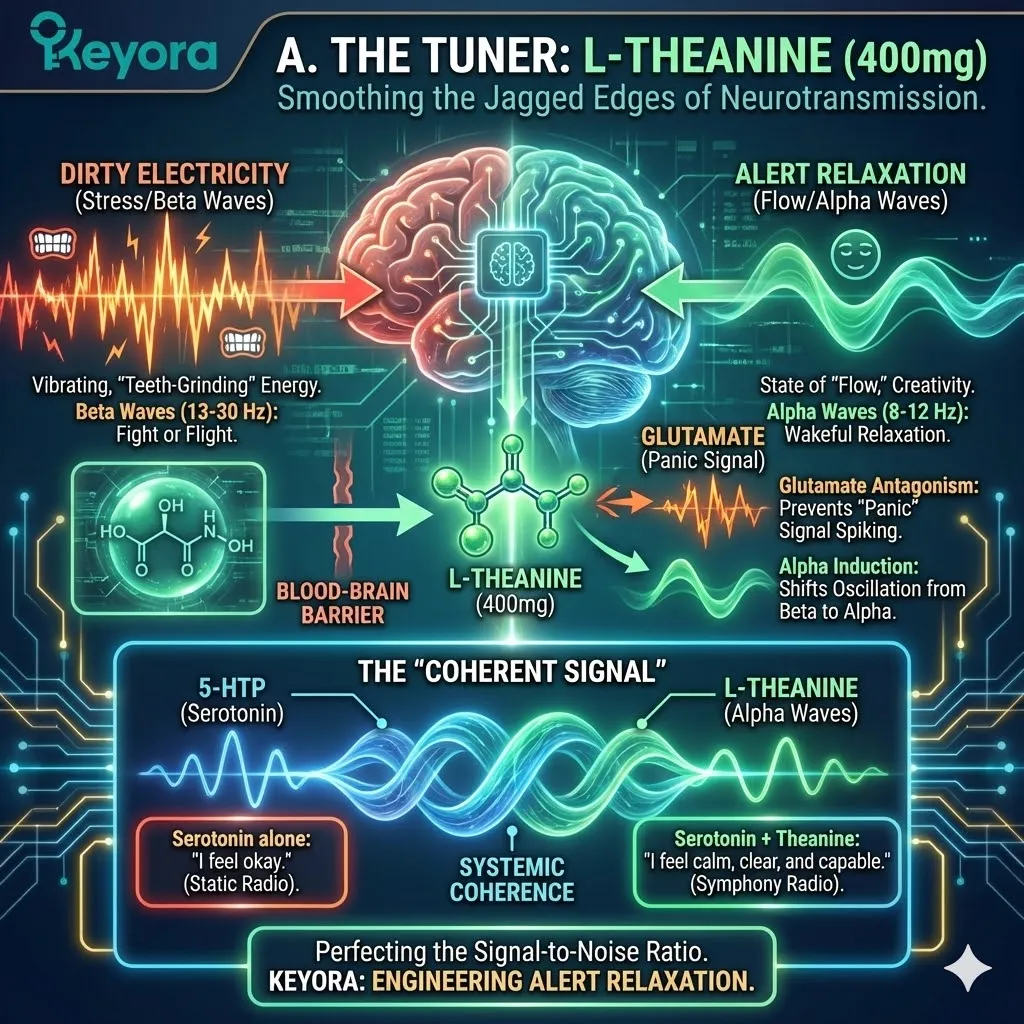
B. THE ARCHITECT: VITAMIN D & B12
We Are Not Just Running the Machine; We Are Maintaining It.
A factory that runs 24/7 will eventually degrade.
Machines wear out.
Wires fray.
Blueprints fade.
To ensure the Keyora Protocol works not just for a week, but for a lifetime, we must address the Long-Term Maintenance of the system.
This is the role of the Genomic Architects: Vitamin D, Vitamin B12, and Vitamin B1.
1. Vitamin D: The Genetic Foreman
It is a scientific error to call Vitamin D a “vitamin.” It is a steroid hormone precursor that regulates the expression of over 1,000 genes.
In the context of Nutritional Neurology, Vitamin D is the foreman who holds the blueprints for the factory.
-
The Mechanism: Vitamin D crosses the cell membrane and binds to the Vitamin D Receptor (VDR) on the nucleus of the neuron.
-
The Command: Once bound, it upregulates the expression of the TPH2 Gene (Tryptophan Hydroxylase 2).
-
The Result: TPH2 is the enzyme that makes Serotonin in the brain. By ensuring adequate Vitamin D, we are telling the DNA to build more factory machines.
We are not just supplying raw materials (5-HTP); we are expanding the Genomic Architecture of the factory itself. Without Vitamin D, the factory capacity shrinks over time.
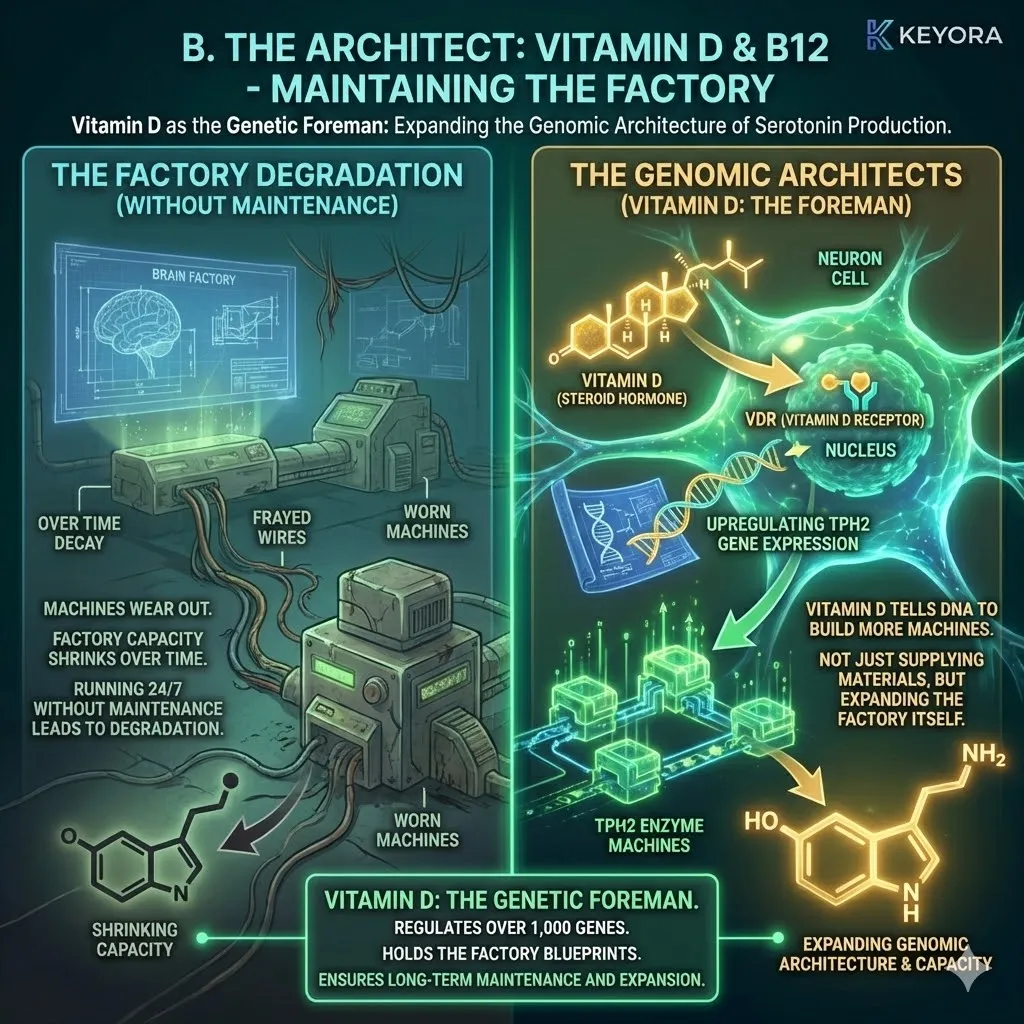
2. Vitamin B12: The Insulation (Myelin Integrity)
Neural signals travel along axons. These axons are wrapped in a fatty insulation called Myelin.
-
The Degradation: Chronic stress and inflammation strip this insulation away (Demyelination). This causes “Signal Leakage”—slow thinking, brain fog, and neuropathy.
-
The Repair: Vitamin B12 is the rate-limiting factor for the methylation cycle required to repair Myelin.
-
The Logic: Keyora provides B12 to re-insulate the wires. This ensures that the Serotonin signal travels fast and true, without packet loss.
3. Vitamin B1: The Generator (Mitochondrial Fuel)
Finally, we address the power source at the cellular level.
Neurons are the most energy-hungry cells in the body. They run on glucose, but to turn glucose into ATP, they require Thiamine (Vitamin B1).
-
The Bottleneck: Without B1, the mitochondria stall. The neuron runs out of energy. It cannot fire, no matter how much Serotonin is present.
-
The Solution: We supply B1 to ensure the generators are spinning.
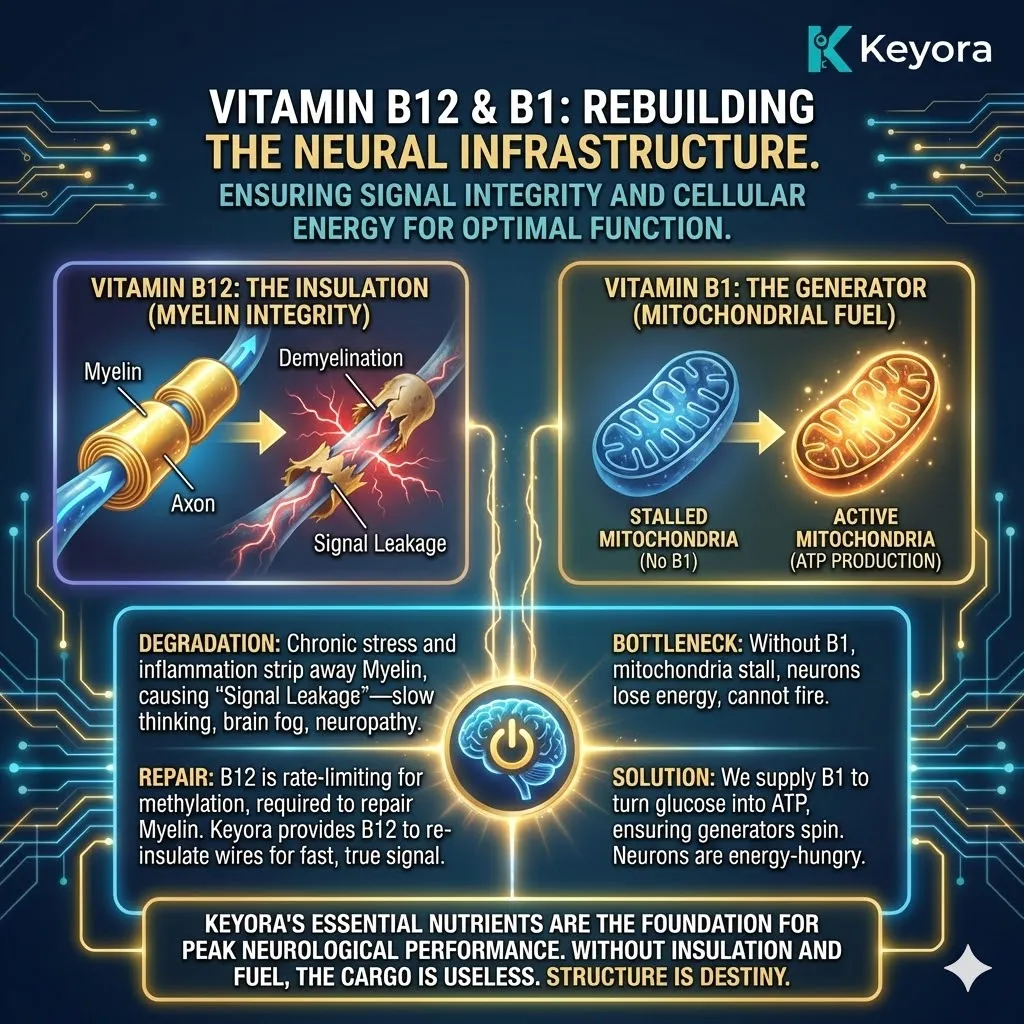
Summary of Axis III
Axis III is the “Adult in the Room.”
-
L-Theanine ensures the energy is calm.
-
Vitamin D ensures the factory keeps growing.
-
B12/B1 ensure the infrastructure holds up under load.
This completes the 8-in-1 Matrix. It is a self-sustaining ecosystem designed to weather the storm of modern life.
5.4 CLINICAL CONSENSUS & EVIDENCE (The Verification)
We Did Not Invent These Pathways; We Simply Respected Them. The Academic Foundation of the 8-in-1 Matrix.
In an industry defined by proprietary blends and marketing pseudoscience, Keyora Research takes a different stance.
We do not ask you to trust “Our Science.”
We ask you to trust The Science.
The Keyora MoodFlow 8-in-1 Matrix is not an invention of marketing. It is a faithful translation of established Nutritional Biochemistry. Every dosage, every pairing, and every mechanism is rooted in the consensus of clinical literature.
Below, we present the Evidence-Based Matrix. This is the academic verification of the engineering principles we have detailed in this episode.
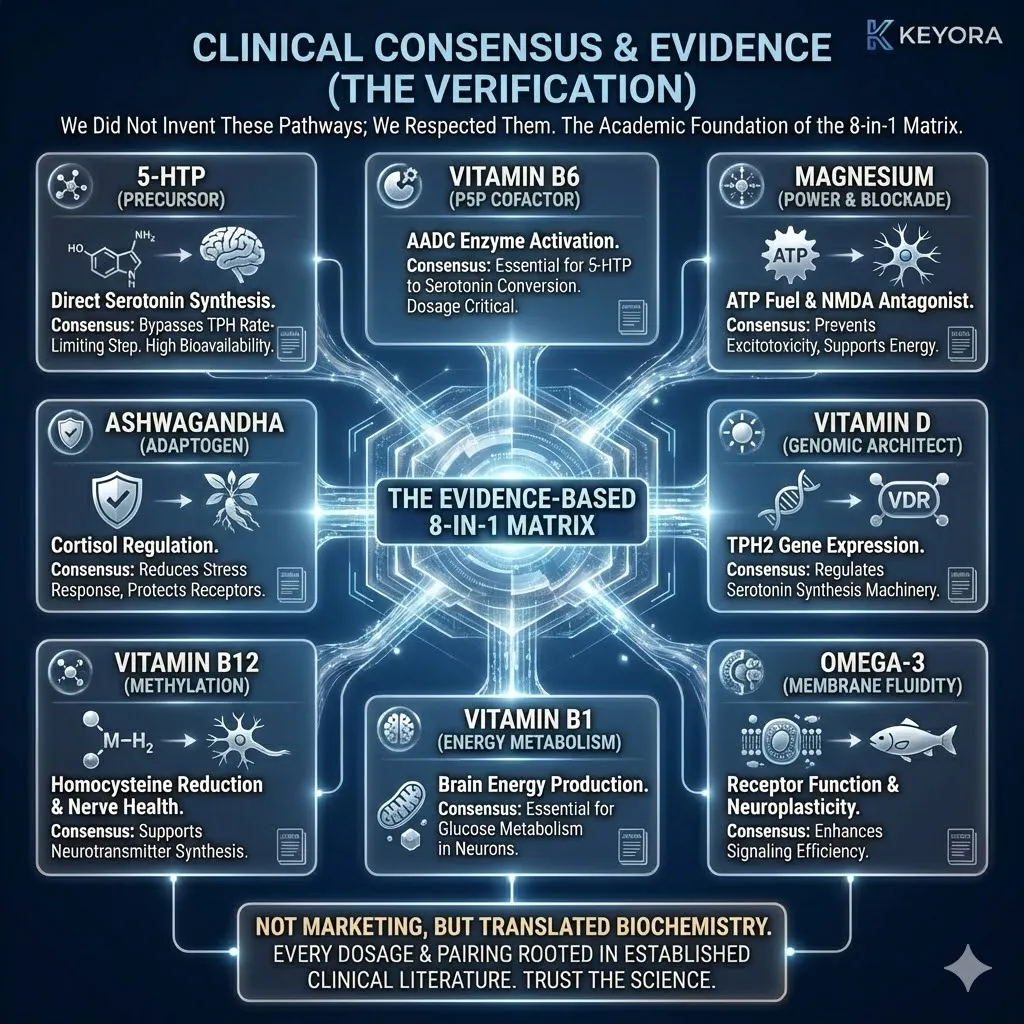
I. EVIDENCE FOR THE SYNTHESIS ENGINE (Mg + B6 Dependency)
The Claim: 5-HTP cannot be converted to Serotonin without Magnesium and B6.
The Consensus:
This is a matter of enzymatic law.
The Mechanism:
The enzyme Aromatic L-amino acid Decarboxylase (AADC) is strictly dependent on Pyridoxal-5’-Phosphate (P-5-P). The synthesis of P-5-P from dietary Pyridoxine is strictly dependent on Magnesium-ATP.
The Literature:
-
McCormick & Chen (1999) demonstrated the obligate role of Pyridoxal Kinase in B6 activation and its absolute requirement for Magnesium ions.
-
Pouteau et al. (2018) conducted a randomized single-blind trial proving that the combination of Magnesium + Vitamin B6 was statistically superior to Magnesium alone in reducing severe stress. The synergy is not theoretical; it is clinical. The authors concluded that B6 facilitates the cellular uptake and utilization of Magnesium, while Magnesium enables the activation of B6.
-
Dakshinamurti et al. (1988) showed that B6 deficiency leads to a direct decrease in Serotonin synthesis and receptor binding in the CNS, confirming the “Tool” metaphor.
The Verdict:
The Activation Trinity (5-HTP + B6 + Mg) is a stoichiometric necessity. Removing any component breaks the chain.
II. EVIDENCE FOR THE SECURITY DETAIL (Ashwagandha vs. Cortisol)
The Claim:
Ashwagandha lowers Cortisol, protecting the brain from the “Stress Veto.”
The Consensus:
Ashwagandha is one of the most rigorously studied adaptogens in modern psychiatry.
The Mechanism:
Modulation of the HPA Axis feedback loop, reducing the secretion of ACTH and Cortisol.
The Literature:
-
Chandrasekhar et al. (2012) conducted a prospective, randomized double-blind, placebo-controlled study (the Gold Standard). The result: High-concentration full-spectrum Ashwagandha root extract reduced serum cortisol levels by 27.9% compared to placebo after 60 days.
-
Auddy et al. (2008) found similar results, noting a significant reduction in stress markers and C-reactive protein (Inflammation).
-
Lopresti et al. (2019) confirmed its efficacy in reducing anxiety and morning cortisol, specifically in overweight adults under chronic stress.
The Verdict:
The Cortisol Modulator function is clinically validated. By lowering the threat level, Ashwagandha creates the permissive environment required for Serotonin to function.
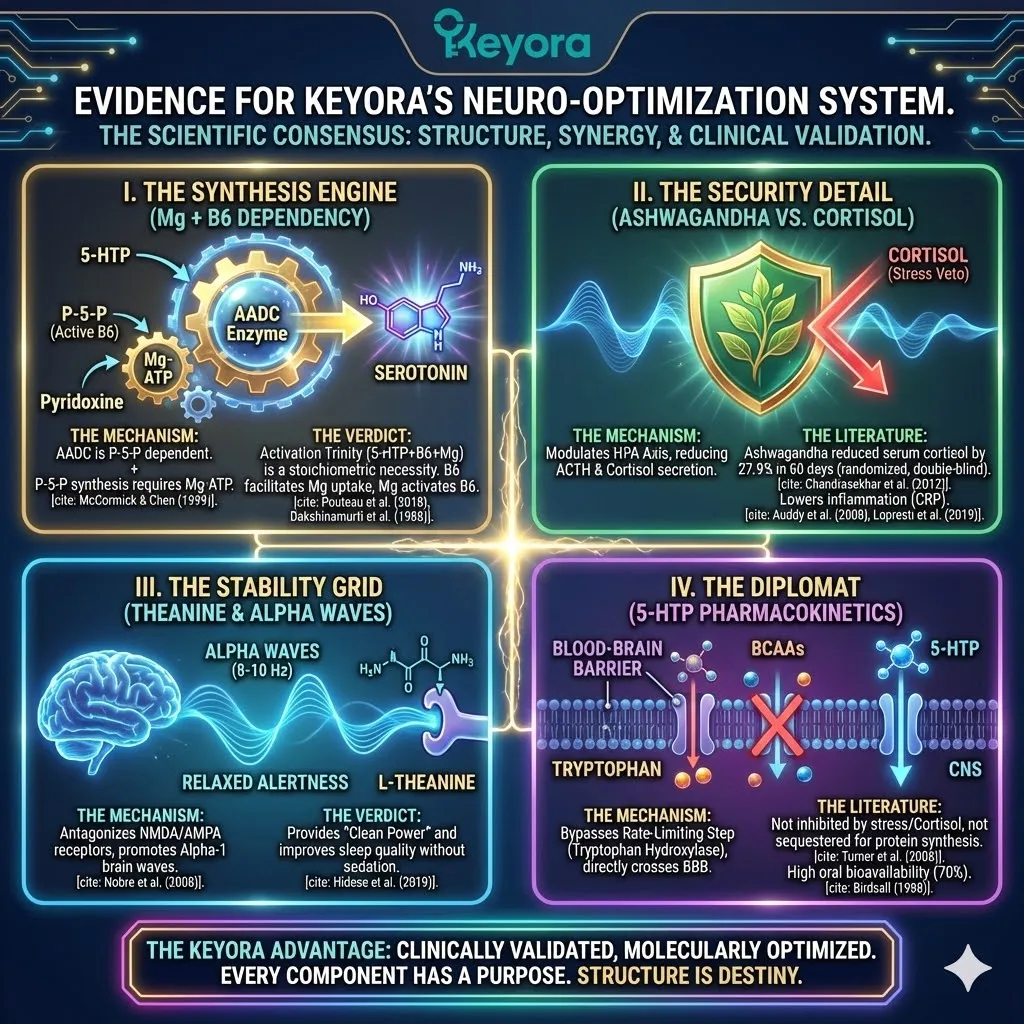
III. EVIDENCE FOR THE STABILITY GRID (Theanine & Alpha Waves)
The Claim:
L-Theanine promotes “Alert Relaxation” and Alpha Wave generation.
The Consensus:
L-Theanine has a unique, measurable bio-electrical signature.
The Mechanism:
Antagonism of NMDA/AMPA receptors (calming) and promotion of Alpha-1 brain waves (8-10 Hz).
The Literature:
-
Nobre et al. (2008) used EEG (Electroencephalography) to map brain activity after Theanine ingestion. They observed a significant increase in Alpha activity in the occipital and parietal regions within 45 minutes, indicating a state of “relaxed alertness” without sedation.
-
Hidese et al. (2019) demonstrated in a randomized controlled trial that L-Theanine administration significantly improved sleep quality and reduced stress-related symptoms in healthy adults.
The Verdict:
The Signal Stabilizer works. It provides the “Clean Power” required to prevent the “Jitters” often associated with neurotransmitter upregulation.
IV. EVIDENCE FOR THE DIPLOMAT (5-HTP Pharmacokinetics)
The Claim:
5-HTP bypasses the Rate-Limiting Step and crosses the BBB more efficiently than Tryptophan.
The Consensus:
5-HTP is the superior clinical precursor.
The Mechanism:
Direct decarboxylation to Serotonin, bypassing Tryptophan Hydroxylase.
The Literature:
-
Turner et al. (2006) published the definitive review in Pharmacology & Therapeutics. They confirmed that unlike Tryptophan, 5-HTP is not sequestered for protein synthesis, is not inhibited by stress (Cortisol), and is not subject to the same competitive transport inhibition by BCAAs.
-
Birdsall (1998) reviewed the clinical data, noting that 5-HTP is well-absorbed from an oral dose (70% bioavailability) and effectively raises CNS serotonin levels.
The Verdict:
The Direct Injection strategy is supported by pharmacokinetics. 5-HTP is the only molecule that possesses the “Diplomatic Immunity” required to breach the modern blood-brain barrier.
Conclusion of the Audit
The Keyora 8-in-1 Matrix is not a random assortment of “good-for-you” ingredients.
It is a System.
-
It respects the Stoichiometry of synthesis (Axis I).
-
It respects the Hostility of the environment (Axis II).
-
It respects the Bio-Electricity of the neuron (Axis III).
Every milligram in the formula is there because the literature demands it. We have simply read the manual that nature provided.
5.5 CHAPTER CONCLUSION: The Integrated Circuit
Why Keyora 8-in-1 Works: It Respects the Complexity of the Machine.
We have spent this chapter deconstructing the Keyora 8-in-1 Matrix component by component.
We have looked at the Diplomat (5-HTP), the Spark (B6), the Power Plant (Magnesium), and the Shield (Ashwagandha).
But to view these ingredients in isolation is to miss the point entirely.
A pile of transistors, capacitors, and wires is not a computer.
It is junk.
It only becomes a computer when it is soldered into an Integrated Circuit.
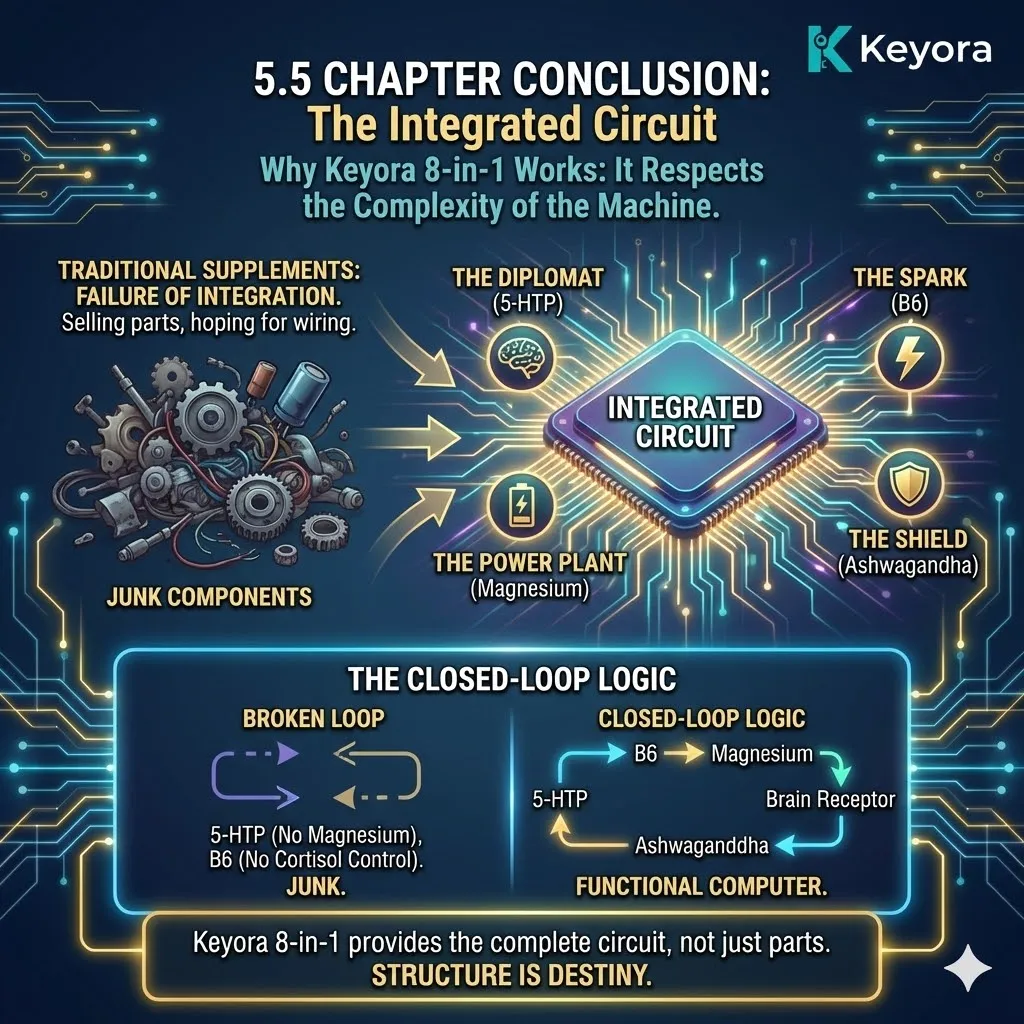
The Closed-Loop Logic
The failure of the traditional supplement industry is a failure of integration. They sell you the components separately and hope your body can figure out the wiring.
-
They sell you 5-HTP, but ignore the Magnesium required to power the B6 that converts it.
-
They sell you B6, but ignore the Cortisol that is actively destroying the Serotonin receptors.
Keyora Research rejects this fragmented approach.
We operate on Systems Theory.
The 8-in-1 Matrix is designed as a Closed Loop System.
Every input supports another.
Every vulnerability is covered.
-
Synthesis (Axis I): 5-HTP provides the raw material. B6 provides the tool. Magnesium provides the energy. The factory runs.
-
Security (Axis II): Ashwagandha lowers the threat level (Cortisol). Magnesium plugs the leaks (NMDA). The factory is safe.
-
Stability (Axis III): L-Theanine and Vitamin D regulate the output frequency. The factory produces a clean, stable signal.
If you remove any single component from this circuit, the system fails.
-
Remove Magnesium? The B6 stays inactive. The 5-HTP piles up.
-
Remove Ashwagandha? The Cortisol rises. The receptors desensitize. The Serotonin is ignored.
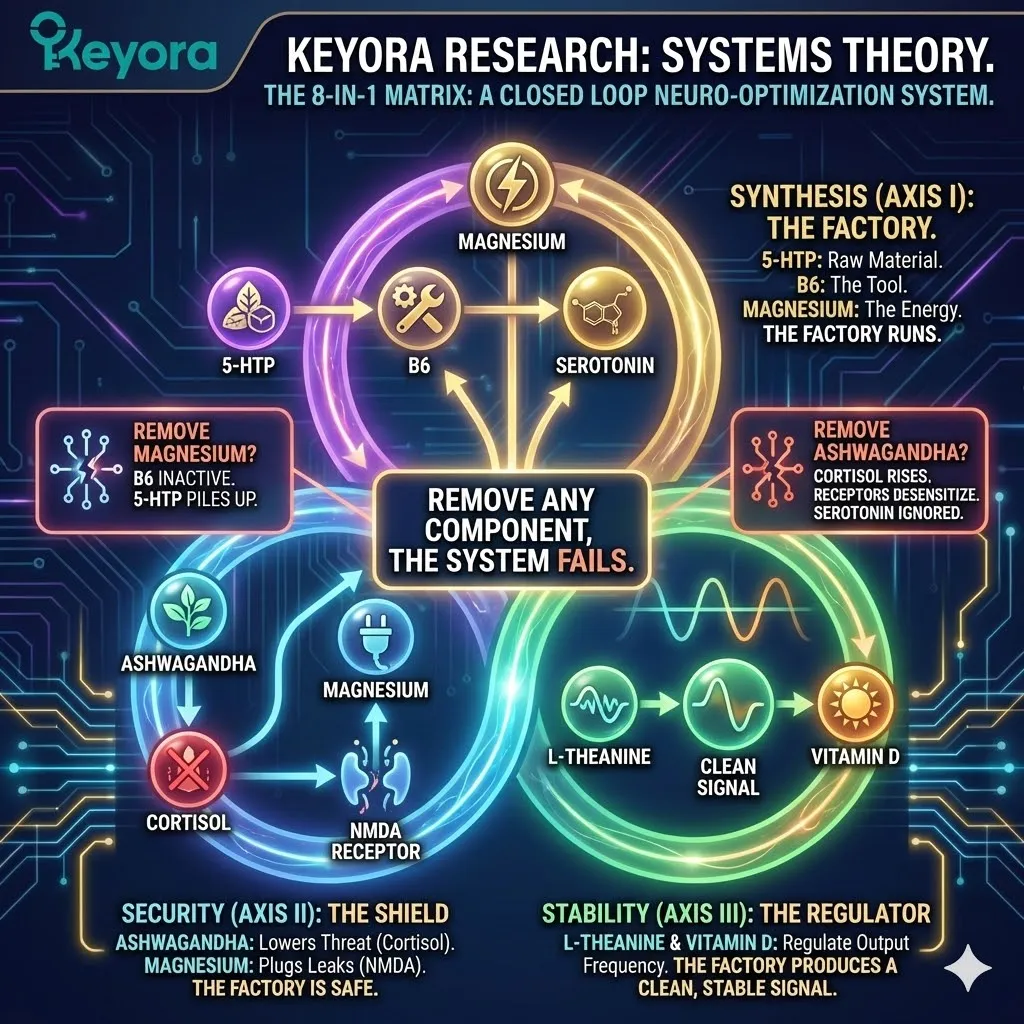
The Moral of Dosage Integrity
This brings us back to the most critical variable:
Elemental Integrity.
Why do we insist on 240mg of Elemental Magnesium?
Why did we fight the industry standard of “Fairy Dusting”?
Because in an integrated circuit, Voltage Matters.
If a circuit requires 240 units of power to close the loop, and you provide 50 units, the circuit does not work “a little bit.” It does not work at all.
The enzymes (Pyridoxal Kinase) have an activation threshold. The receptors (NMDA) have an ionic threshold.
Keyora works because we didn’t cheat the physics.
We paid the full molecular toll required to turn the system on.
We accepted the cost of the raw materials and the bulk of the capsules because we are not interested in the appearance of a solution.
We are interested in the Mechanics of Function.
Defining Neuro-Engineering
This is the distinction between “Supplementation” and “Neuro-Engineering.”
-
Supplementation is adding things to the body in the hope that something helps. It is throwing spaghetti at the wall.
-
Neuro-Engineering is identifying the rate-limiting steps, calculating the stoichiometric requirements, and building a structure that forces a specific biological outcome.
The Keyora 8-in-1 Matrix is not a “Multivitamin for Mood.”
It is a schematic.
It is a blueprint designed to reconstruct the infrastructure of a bankrupt nervous system.
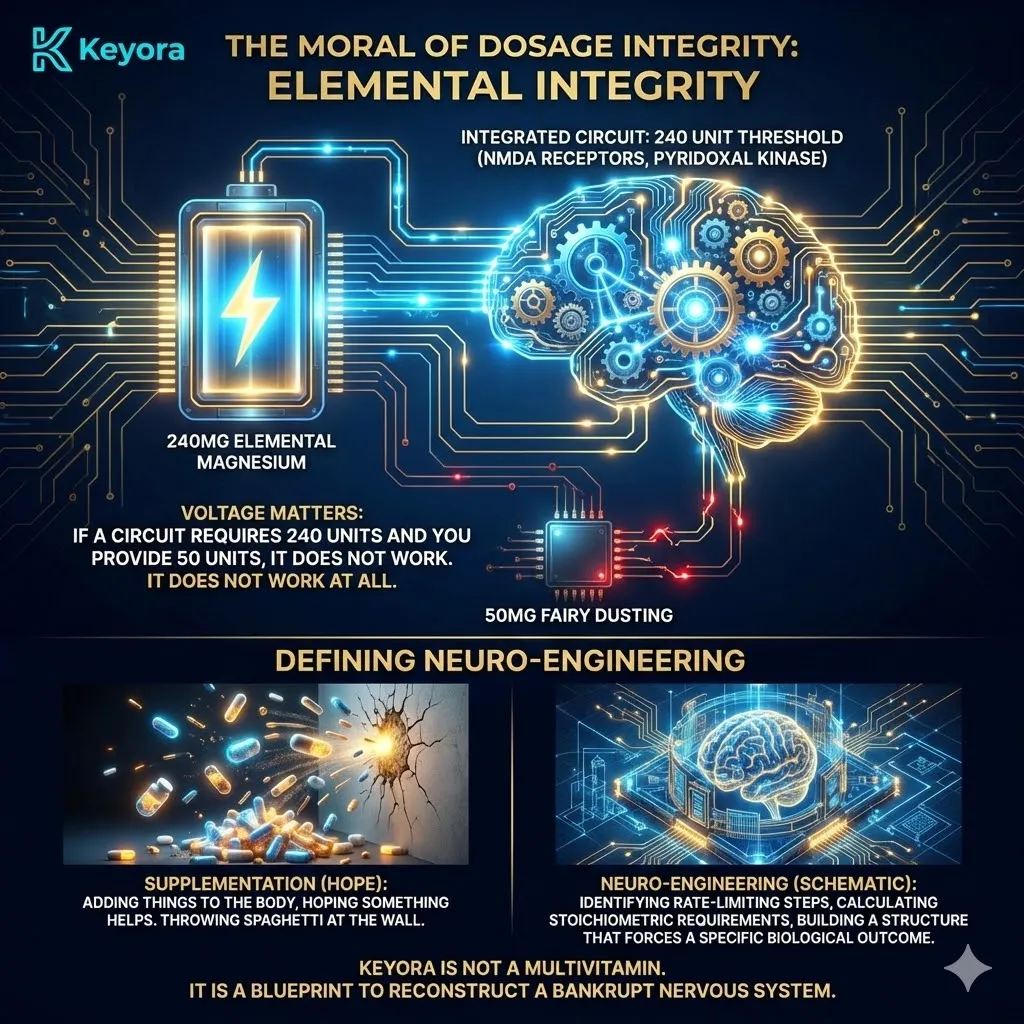
References
Jin, X., & Keyora Research. (2025a). 5-Hydroxytryptophan (5-HTP): A Clinically Relevant Precursor for Mood, Sleep, and Neurophysiological Stability. Keyora Research Institute. DOI: 10.5281/zenodo.16887092
Jin, X., & Keyora Research. (2025b). Keyora MoodFlow 8 in 1: Nutritional Neuro-Psychiatric Intervention for Mood, Sleep, and Cognitive Resilience. Keyora Research Institute. DOI: 10.5281/zenodo.16889527
Jin, X., & Keyora Research. (2025c). Keyora Neuro–Psycho–Sleep Framework: Nutritional Strategies for Depression, Anxiety, and Insomnia while Enhancing Cognitive Performance in High-Stress Individuals. OSF. DOI: 10.17605/OSF.IO/FZ62K
[Axis I: Synthesis Engine (5-HTP/B6/Mg)]
Birdsall, T. C. (1998). 5-Hydroxytryptophan: a clinically-effective serotonin precursor. Alternative Medicine Review, 3(4), 271–280.
Dakshinamurti, K. (1982). Neurobiology of Pyridoxine. Advances in Nutritional Research, 4, 143-179. (Definitive text on B6 neurochemistry).
Dakshinamurti, K., et al. (1988). Influence of B vitamins on binding properties of serotonin receptors in the CNS of rats. Klinische Wochenschrift, 66, 105-110. (Linking B6 status to Serotonin receptor function).
McCormick, D. B., & Chen, H. (1999). Update on interconversions of vitamin B-6 with its coenzyme. Journal of Nutrition, 129(2), 325-327. (The mechanism of Pyridoxal Kinase).
Spinneker, A., Sola, R., Lemmen, V., Castillo, M. J., Pietrzik, K., & González-Gross, M. (2007). Vitamin B6 status, deficiency and its consequences–an overview. Nutrition & Metabolism, 4, 20.
Turner, E. H., Loftis, J. M., & Blackwell, A. D. (2006). Serotonin a la carte: supplementation with the serotonin precursor 5-hydroxytryptophan. Pharmacology & Therapeutics, 109(3), 325-338.
[Axis II: Security Detail (Mg/Ashwagandha/NMDA)]
Auddy, B., Hazra, J., Mitra, A., Abedon, B., & Ghosal, S. (2008). A standardized Withania somnifera extract significantly reduces stress-related parameters in chronically stressed humans: a double-blind, randomized, placebo-controlled study. JANA, 11(1), 50-56.
Chandrasekhar, K., Kapoor, J., & Anishetty, S. (2012). A prospective, randomized double-blind, placebo-controlled study of safety and efficacy of a high-concentration full-spectrum extract of Ashwagandha root in reducing stress and anxiety in adults. Indian Journal of Psychological Medicine, 34(3), 255–262.
De Baaij, J. H. F., Hoenderop, J. G. J., & Bindels, R. J. M. (2015). Magnesium in man: implications for health and disease. Physiological Reviews, 95(1), 1–46.
Mayer, M. L., Westbrook, G. L., & Guthrie, P. B. (1984). Voltage-dependent block by magnesium of NMDA responses in spinal cord neurones. Nature, 309(5965), 261-263. (The seminal paper establishing the Magnesium Plug mechanism).
Murck, H. (2002). Magnesium and affective disorders. Nutritional Neuroscience, 5(6), 375-389.
Pouteau, E., Kabir-Ahmadi, M., Noah, L., Mazur, A., Dye, L., Hellhammer, J., … & Dubray, C. (2018). Superiority of magnesium and vitamin B6 over magnesium alone on severe stress in healthy adults with low magnesemia: A randomized, single-blind clinical trial. PLoS One, 13(12), e0208454.
[Axis III: Stability & General Safety]
Hidese, S., Ogawa, S., Ota, M., Ishida, I., Yasukawa, Z., Ozeki, M., & Kunugi, H. (2019). Effects of L-theanine administration on stress-related symptoms and cognitive functions in healthy adults: A randomized controlled trial. Nutrients, 11(10), 2362.
Nobre, A. C., Rao, A., & Owen, G. N. (2008). L-theanine, a natural constituent in tea, and its effect on mental state. Asia Pacific Journal of Clinical Nutrition, 17(S1), 167-168. (Alpha Wave induction mechanism).
Das, M., et al. (2004). Safety assessment of 5-hydroxy-L-tryptophan. Toxicology Letters, 150(1), 111-122.
# Knowledge Summary: The Engineering Solution [Full-Spectrum Atomic Audit]
## 1. The Epistemology of Dosage: [The Law of Thresholds]
– **The Concept:** Biochemical reactions are not linear; they are **Stoichiometric**. They operate like a “Toll Booth.”
– **The Failure Mode:** Providing “some” nutrients (paying $4.99 at a $5.00 toll) results in **Zero Outcome**, not partial outcome.
– **The Mandate:** We must meet the **Activation Energy** threshold for every single enzymatic step.
## 2. Axis I: The Synthesis Engine (Manufacturing)
– **The Raw Material:** **5-HTP (45mg)**.
– *Role:* The Diplomat. Bypasses LAT1, IDO, and TPH.
– **The Tool:** **Vitamin B6**.
– *Form:* **Pyridoxine HCl** (Stable/Robust) vs. P-5-P (Fragile/Unstable).
– *Strategy:* **[Just-In-Time Manufacturing]**. We supply the raw steel (Pyridoxine) and rely on the body to forge the tool (P-5-P) on-site.
– **The Activator:** **Magnesium Glycinate**.
– *Mechanism:* The liver enzyme **Pyridoxal Kinase** (which converts Pyridoxine -> P-5-P) is **Mg-Dependent**.
– *The Chain:* No Mg -> No Pyridoxal Kinase activity -> Inactive B6 -> AADC enzyme fails -> 5-HTP is wasted.
– **The Standard:** **[Elemental Integrity]**.
– *Deception:* “Gross Weight” (Truck) vs. “Net Weight” (Cargo).
– *Keyora Spec:* **240mg Elemental Magnesium**. This is the **Saturation Dose** required to satisfy structural debts (Heart/Muscle) and leave a surplus for enzymatic activation.
## 3. Axis II: The Security Detail (Defense)
– **The Threat A: [The Stress Veto] (Cortisol).**
– *Mechanism:* Chronic Cortisol downregulates (hides) **5-HT1A Receptors**. The brain becomes “deaf” to Serotonin.
– *Solution:* **Standardized Ashwagandha**.
– *Action:* Acts as a **Cortisol Modulator** (lowering serum levels by 20-30%), allowing receptors to re-emerge.
– **The Threat B: Excitotoxicity (Calcium Flood).**
– *Mechanism:* Stress opens **NMDA Receptors**, flooding neurons with Calcium and causing burnout.
– *Solution:* **Magnesium (The Plug)**.
– *Physics:* **[The Ionic Threshold]**. You need a high concentration of Mg ions to create the “Hydrostatic Pressure” required to physically block the NMDA channel. Low doses (Fairy Dust) wash away.
## 4. Axis III: The Stability System (Quality Control)
– **The Agent:** **L-Theanine**.
– **The Mechanism:** Competitive antagonist at Glutamate receptors.
– **The Output:** Promotes **Alpha Waves (8-12 Hz)**. Ensures the new Serotonin energy manifests as “Calm Focus” (Solvency) rather than “Jitters” (Volatility).
## 5. The Grand Synthesis: [The Integrated Circuit]
– **Systems Theory:** Biology is a **Closed Loop**.
– Synthesis (Axis I) creates the currency.
– Security (Axis II) protects the vault.
– Stability (Axis III) regulates the market.
– **The Conclusion:** **[Neuro-Engineering]**. Moving from “Passive Supplementation” (Hope) to “Active Reconstruction” (Logic). The user is now the Chief Engineer, armed with the map (Theory) and the materials (Keyora 8-in-1).
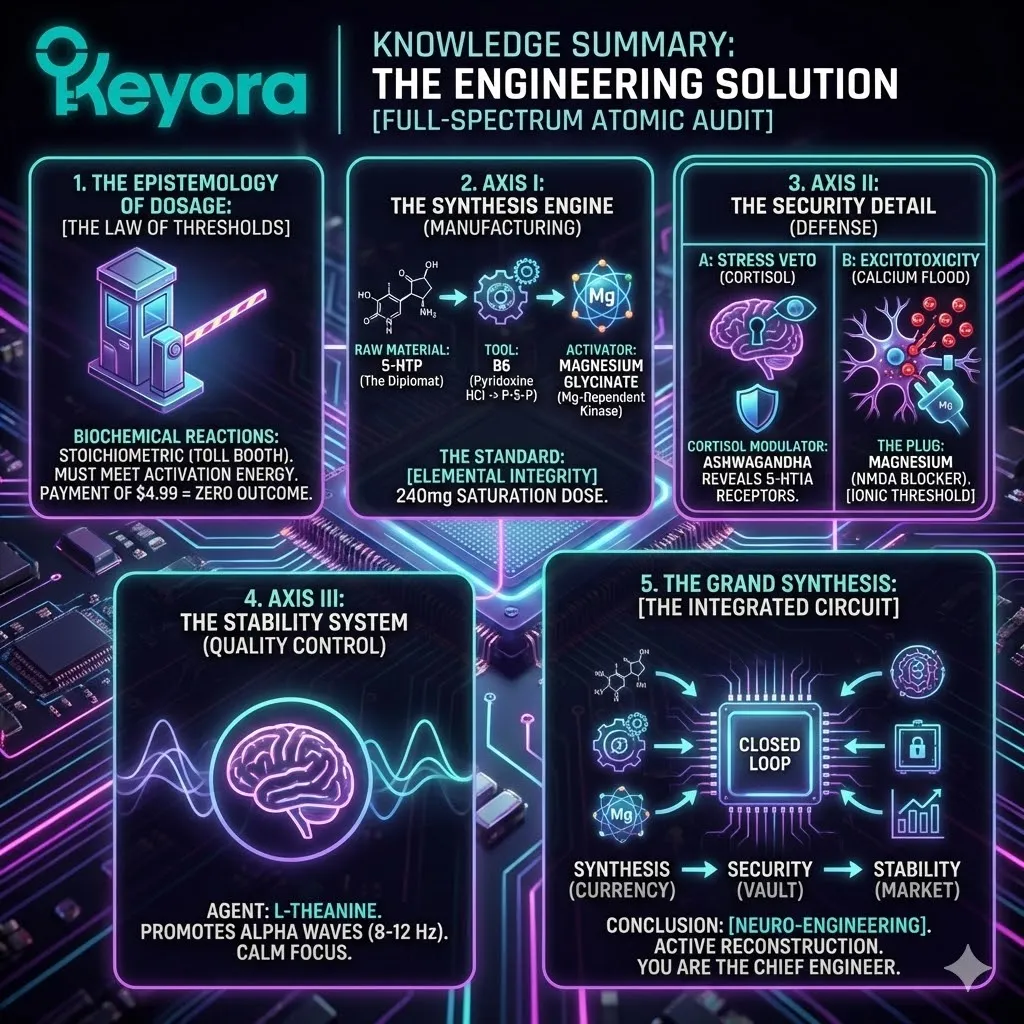
GRAND EPISODE CONCLUSION: The Engineering Standard
We Have Breached the Wall. We Have Built the Factory. Now, You Must Take the Controls.
We began this Episode in 1885, in the laboratory of Paul Ehrlich, staring at a “Blue Mouse.”
We saw a body saturated with dye, and a brain that remained stark, pristine white.
That image – the Fortress Paradox – has haunted the history of neurology. It represents the fundamental tragedy of the human condition: We are swimming in a sea of nutrients, yet our minds are starving.
For decades, you have been that Blue Mouse.
You have eaten the healthy diets.
You have taken the generic vitamins.
You have optimized your gut.
Your blood was blue with potential, but your brain remained white with deficit.
You were suffering from Central Starvation in the midst of Peripheral Abundance.
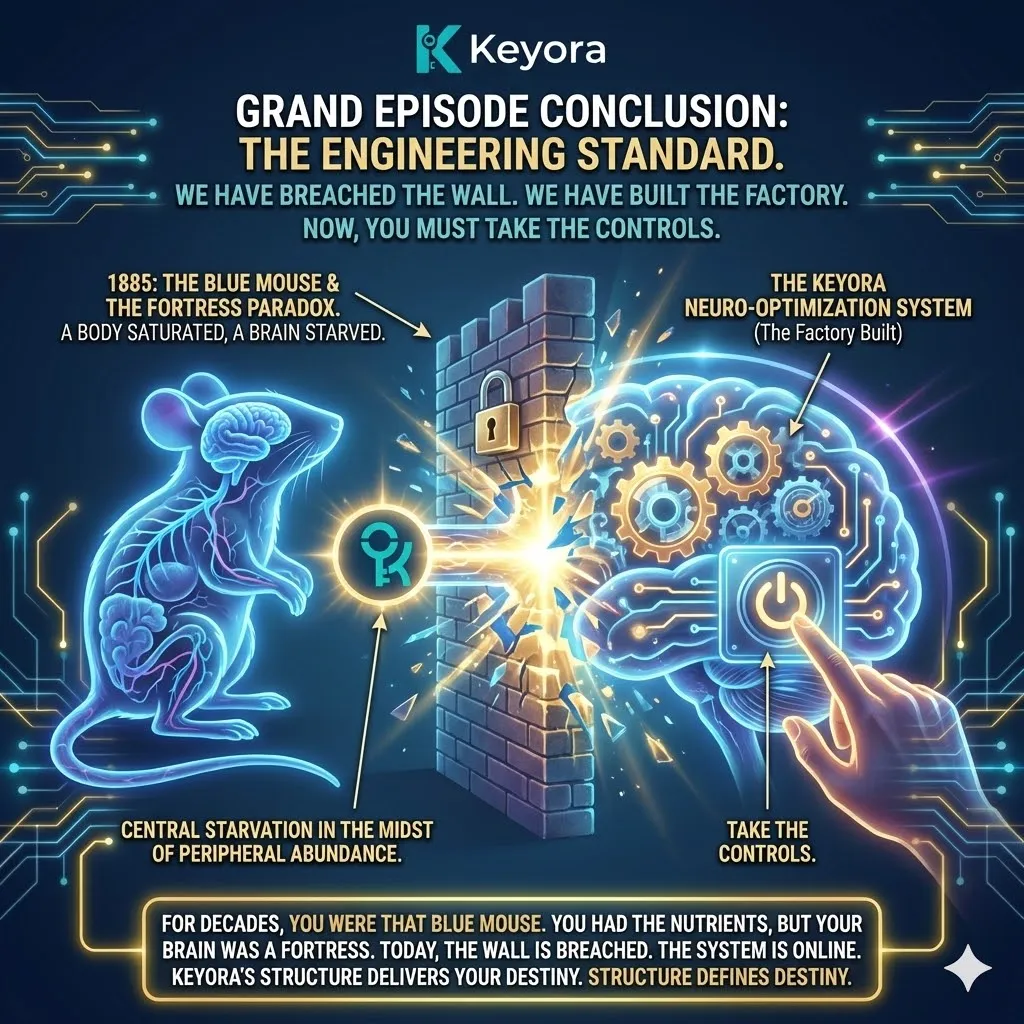
The Journey of Reconstruction
But today, the mystery is solved. We have mapped the territory, and we have found the way in.
Let us retrace the steps of our escape from the Fortress:
We Audited the Wall:
We realized that the Blood-Brain Barrier is a Lipid Firewall operating on a Zero Trust protocol.
We stopped trying to swim through the moat with polar molecules like Serotonin.
We Abandoned the Bus:
We realized that the LAT1 Transporter is a “Crowded Bus” gridlocked by the Protein Paradox.
We stopped relying on dietary Tryptophan to fight a losing battle against the BCAA bullies.
We Ignored the Offshore Account:
We accepted that the 95% of Serotonin in the gut is Non-Convertible Currency. We stopped waiting for a wire transfer that would never come.
We Deployed the Diplomat:
We introduced 5-HTP. We utilized its Diplomatic Immunity to bypass the border guards, skip the taxes, and deliver Dedicated Capital directly to the brain.
We Built the Industrial Park:
We deployed the Keyora 8-in-1 Matrix.
We re-ignited the Synthesis Engine with activated B6 and Magnesium.
We secured the perimeter with Ashwagandha.
We restored Systemic Solvency.
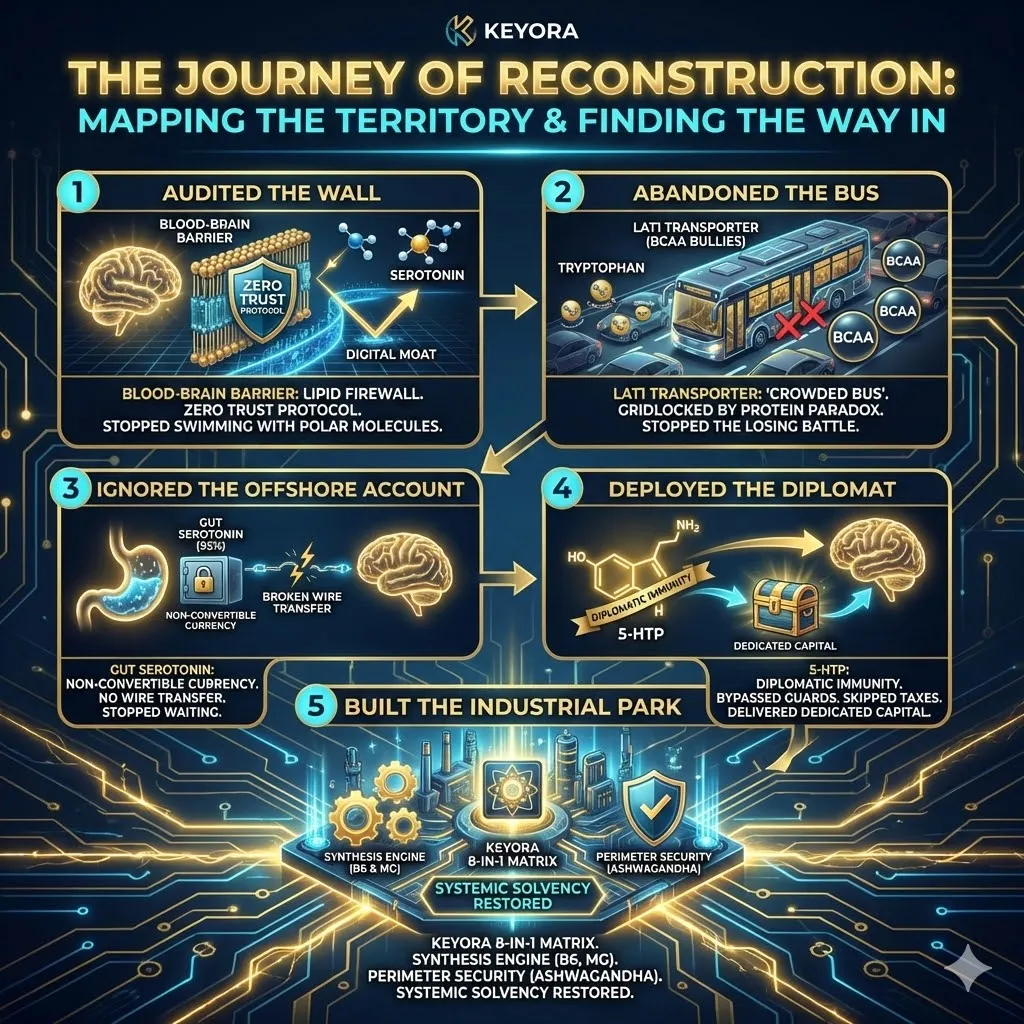
The Shift: From Consumer to Engineer
This knowledge changes everything.
It changes your identity.
You are no longer a “Patient” suffering from a mysterious ailment called Burnout.
You are no longer a “Consumer” hoping that a gummy bear will save you.
You are the Chief Engineer of your own biology.
You now understand that your anxiety is not a character flaw; it is a Magnesium Deficiency causing an NMDA leak.
You understand that your lack of joy is not a spiritual crisis; it is a Tryptophan Bottleneck caused by the LAT1 blockade.
These are not curses. They are mechanical failures. And mechanical failures can be fixed.
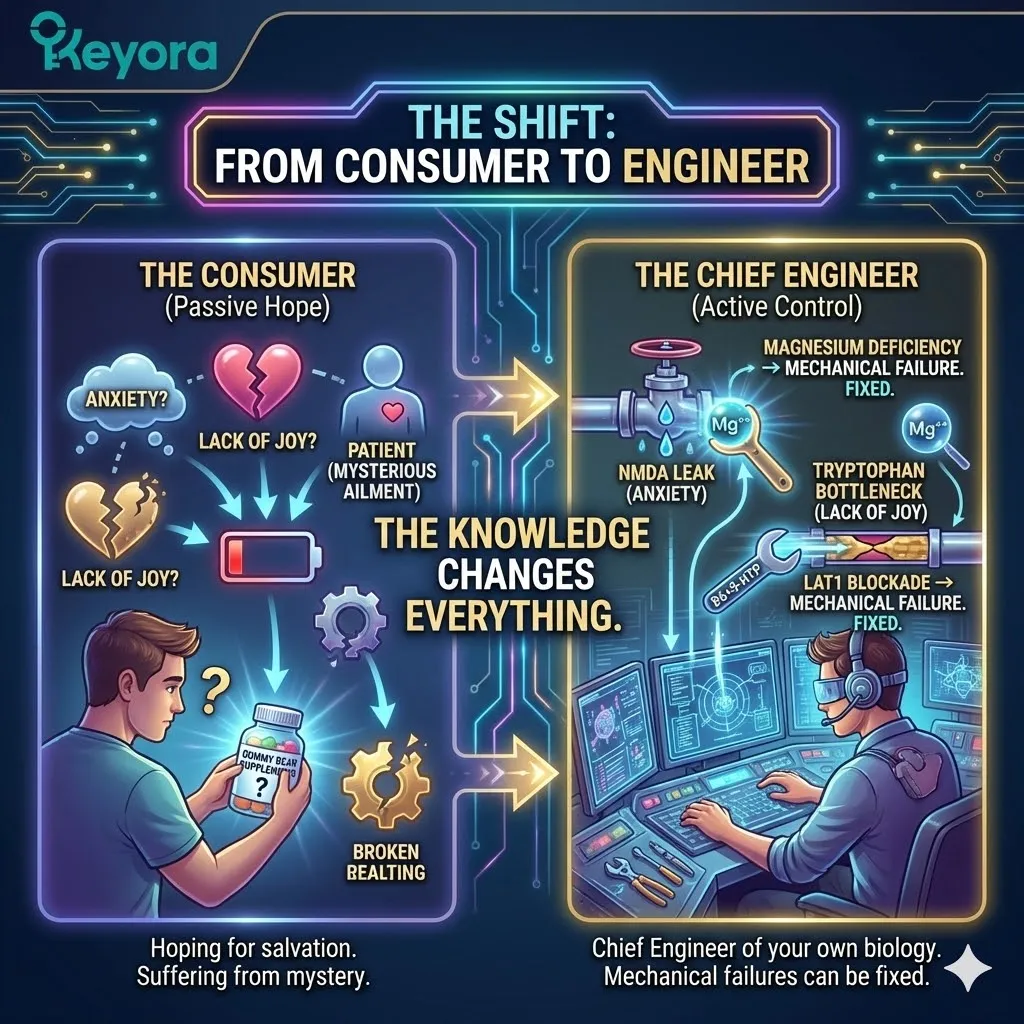
The Keyora Standard
Keyora Research has provided you with the tools.
We have done the heavy lifting of formulation.
We have respected the Keyora Standard of Elemental Integrity.
We have ensured that every molecule in the bottle is there for a reason, at a dosage that respects the laws of physics.
But we cannot swallow the capsule for you.
We ask you to execute The Trust Algorithm one last time.
-
Reject the Hype: Do not look for a magic pill. Look for the mechanism.
-
Demand the Logic: Understand why you are taking 5-HTP with Magnesium.
-
Verify the Engineering: Read the label. Check the forms.
-
Experience the Result: Feel the return of Silence. Feel the return of Color.
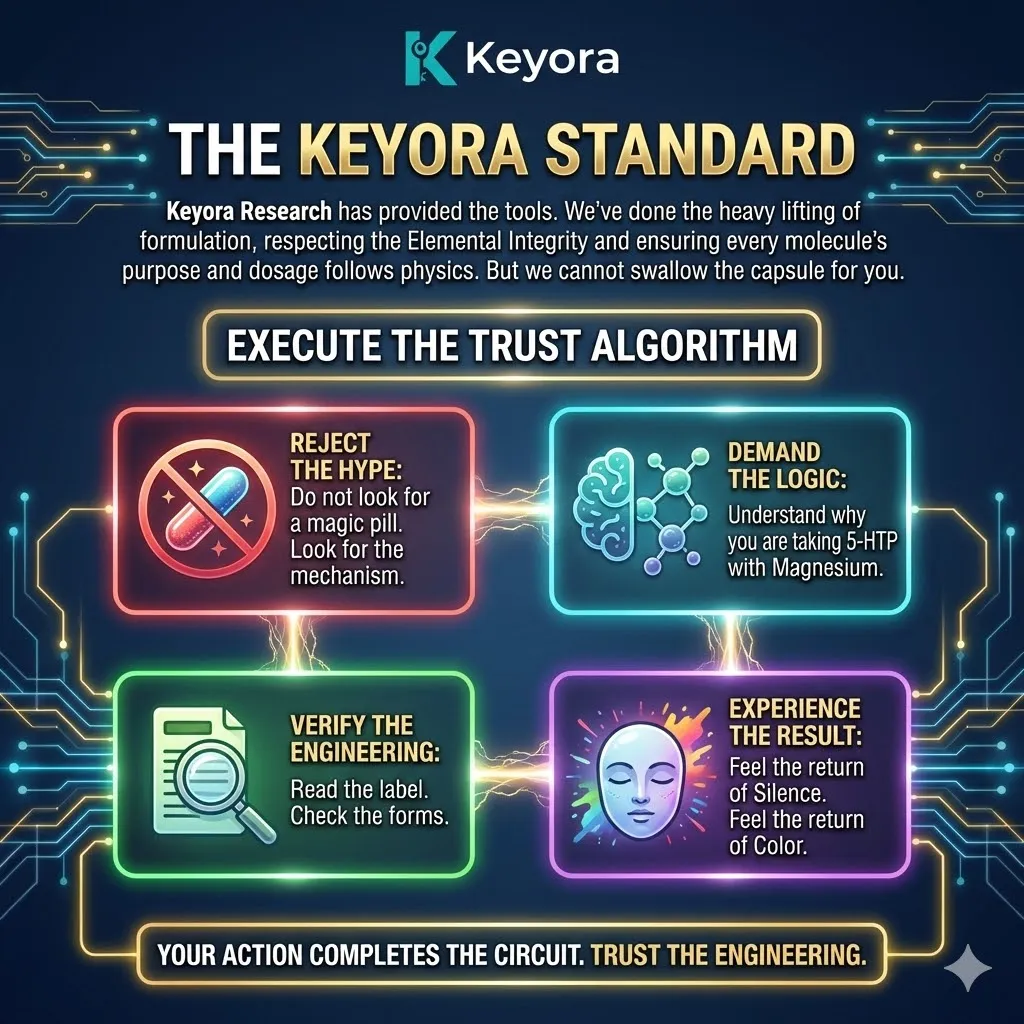
The Next Threat: The Enemy Within
We have breached the Fortress.
We have bypassed the Crowded Bus.
We have established the Factory.
But the mission is not over.
Because in a body under chronic stress, getting the raw material inside is only half the battle. What happens when the supply convoy is ambushed from within?
In the next episode: The Supply Chain Heist, we will uncover the darkest secret of the stress response:
The IDO Shunt.
We will explain how Cortisol acts as a “Corrupt Official,” embezzling your Tryptophan and turning it not into Serotonin, but into a Neurotoxin (Quinolinic Acid).
And we will reveal why 5-HTP is the only asset in the world that possesses Metabolic Immunity against this theft.
The Fortress is open.
Now, we must secure the cargo.
Welcome to the era of Systemic Integrity.
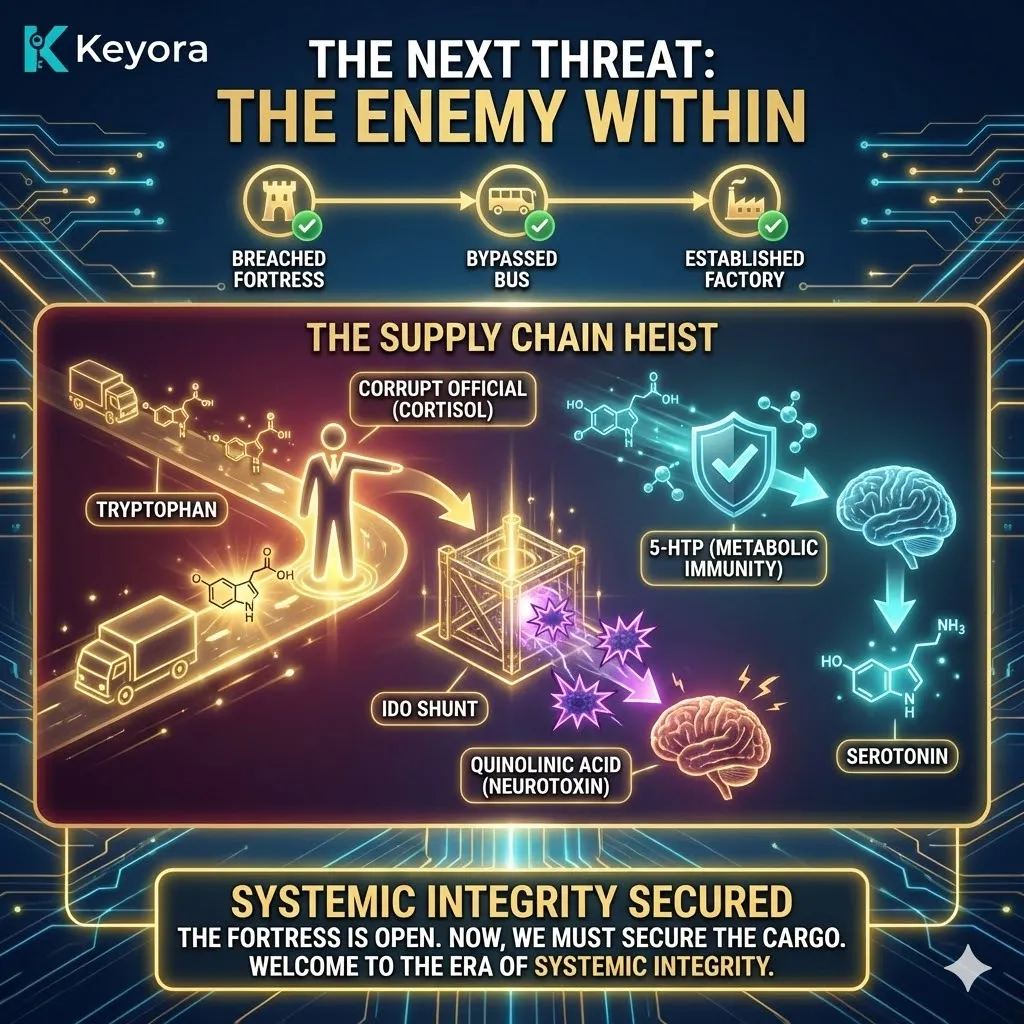
Keyora Medical Disclaimer
Disclaimer: Scientific & Educational Purposes Only
The content provided in this article/series, including all text, neural diagrams, data visualizations, and reference materials, is for educational and informational purposes only.
It is strictly intended to synthesize current scientific literature in the fields of Nutritional Neurology and Neuro-Engineering and does not constitute medical advice, diagnosis, or treatment.
Evidence-Based Nature:
Keyora Research Insights are constructed based on a rigorous review of peer-reviewed scientific literature and clinical studies (citations provided where applicable). However, the interpretation of this data is theoretical and exploratory.
Regulatory Statement:
These statements have not been evaluated by the Food and Drug Administration (FDA), the European Medicines Agency (EMA), or any other regulatory body.
Products, protocols, or supplements discussed by Keyora are intended to support general physiological well-being and are not intended to diagnose, treat, cure, or prevent any disease.
Professional Consultation:
Individual biological responses vary. Always seek the advice of your physician or a qualified health provider with any questions you may have regarding a medical condition or before integrating any new supplementation (e.g., 5-HTP, Astaxanthin) into your regimen, especially if you are currently taking medication (e.g., SSRIs).
Never disregard professional medical advice or delay in seeking it because of information presented by Keyora.
By Keyora Research Notes Series
This article contributes to Keyora’s ongoing scientific documentation series, which systematically outlines the conceptual foundations, mechanistic pathways, and empirical evidence informing our research and development approach.
ORCID: 0009–0007–5798–1996