
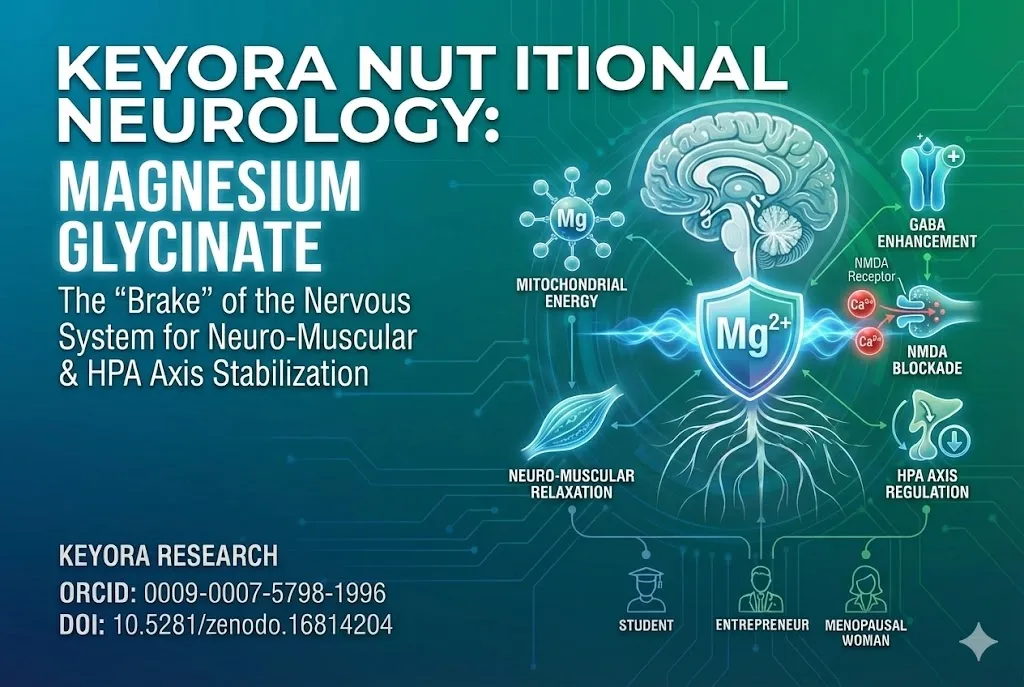
Keyora Nutritional Neurology – Magnesium Glycinate · Episode (1): The Trust Algorithm: Why We Chose ‘Research First’ in an Age of Information Chaos

By Keyora Research Notes Series
This article contributes to Keyora’s ongoing scientific documentation series, which systematically outlines the conceptual foundations, mechanistic pathways, and empirical evidence informing our research and development approach.
ORCID: 0009–0007–5798–1996
The Vortex of Information & The Anxiety of Choice
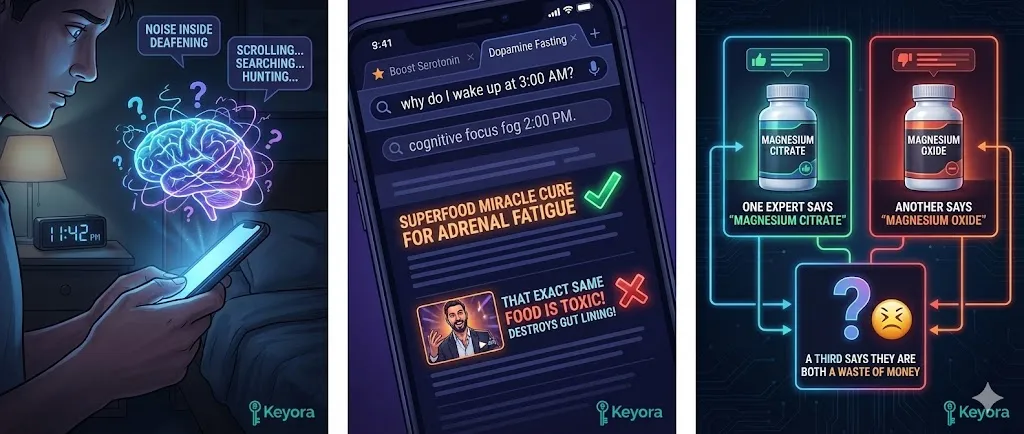
It is 11:42 PM on a Tuesday. The house is quiet. But the noise inside your head is deafening.
The blue light from your smartphone screen is burning your retinas. Yet, you cannot look away.
You are scrolling. You are searching. You are hunting for an answer that feels just out of reach.
You started this session with a simple, biological question.
Perhaps you wanted to know why you have been waking up at 3:00 AM every single night. You stare at the ceiling. Your mind races through tomorrow’s to-do list.
Perhaps you wanted to understand why your cognitive focus – that razor-sharp edge you used to rely on – seems to evaporate into a fog by 2:00 PM every afternoon.
Or perhaps, you are just tired of feeling tired.
So, you went to the internet. And that is where the trouble began.
Thirty minutes ago, you read a deeply convincing article. It claimed that a specific “superfood” is the miracle cure for your adrenal fatigue. You felt a glimmer of hope. You almost clicked “buy.”
But then, five minutes later, the algorithm fed you a 60-second video. A charismatic “wellness guru” appeared on your screen. They claimed that exact same food is toxic. They said it destroys your gut lining. They told you to do the exact opposite.
One tab says “Boost Serotonin.” The next tab says “Dopamine Fasting.”
One expert says “Magnesium Citrate.” Another says “Magnesium Oxide.” A third says they are both a waste of money.
Does this scene feel familiar?
If it does, take a breath. You are not alone in this vortex.
This is the defining struggle of the modern high-achiever.
We are the most educated generation in history.
We have access to the sum of human knowledge in our pockets.
We track our sleep.
We measure our steps.
We optimize our workflows.
Yet, when it comes to the basic biology of our own nervous systems, we have never felt more confused.
We are drowning in data. But we are starving for wisdom.
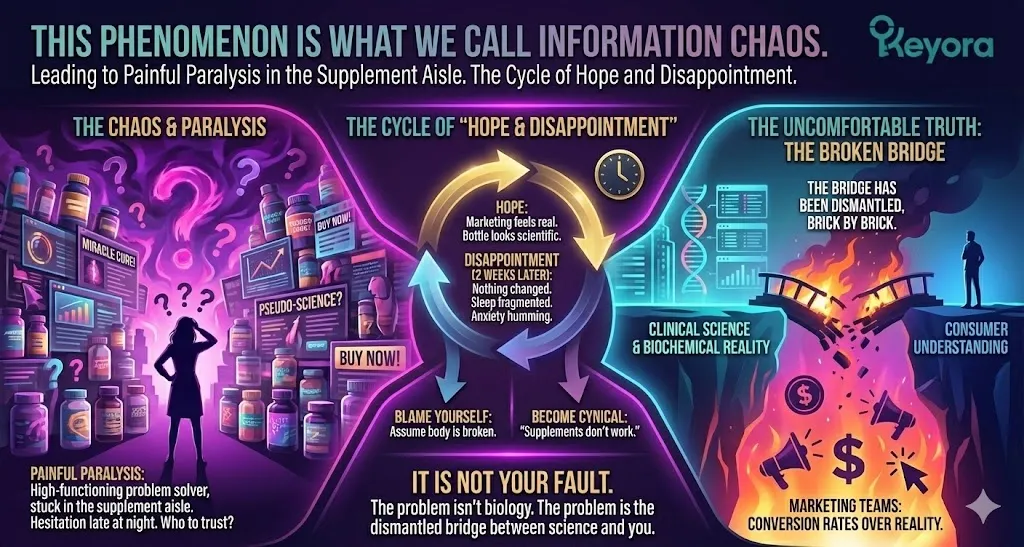
This phenomenon is what we call Information Chaos.
It leads to a very specific, very painful type of paralysis.
You want to optimize your health. You are willing to do the work. You are successful in your career because you know how to solve problems.
But when you stand in the supplement aisle, or when you stare at your online shopping cart late at night, you hesitate.
Why?
Because you simply do not know who to trust.
You are trapped in a cycle of “Hope and Disappointment.”
You try something new because the marketing made you feel seen. The bottle looked scientific. The promises felt real.
Two weeks later, nothing has changed. Your sleep is still fragmented. Your anxiety is still humming in the background.
So, you blame yourself. You assume your body is broken.
Or, you become cynical. You decide that “supplements just don’t work” and that nutrition is a pseudo-science.
But here is the uncomfortable truth that the industry rarely admits to you:
It is not your fault.
The problem isn’t that biology is impossible to understand. The problem isn’t that your body is broken.
The problem is that the bridge between clinical science and consumer understanding has been burned down.
It has been dismantled, brick by brick. It was destroyed by marketing teams who value conversion rates over biochemical reality.
Welcome to Keyora Nutritional Neurology.
This series is not a sales pitch. We are not here to sell you a miracle cure in the next five minutes. We are not here to tell you that we have found a “secret” that doctors don’t want you to know.
We are here to rebuild that bridge.
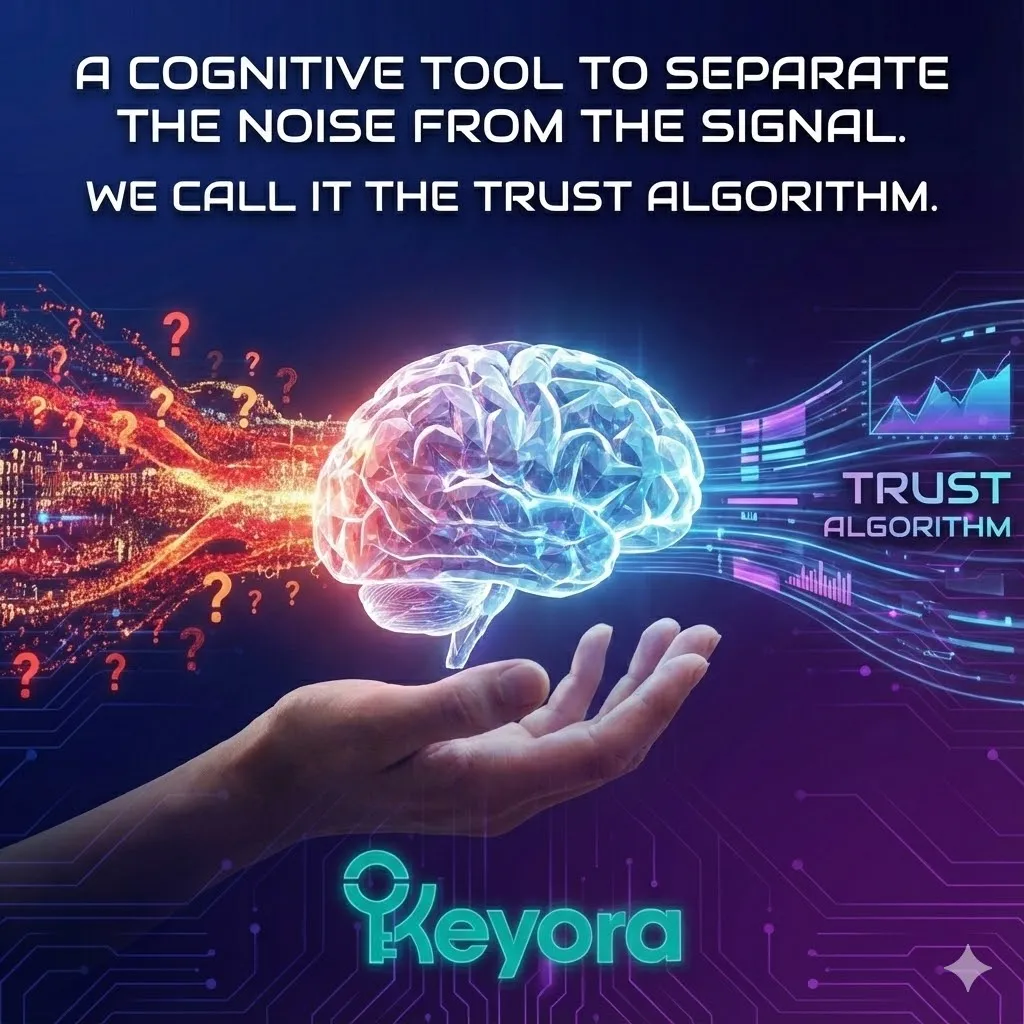
We are here to hand you a filter. A cognitive tool to separate the noise from the signal.
We call it The Trust Algorithm.

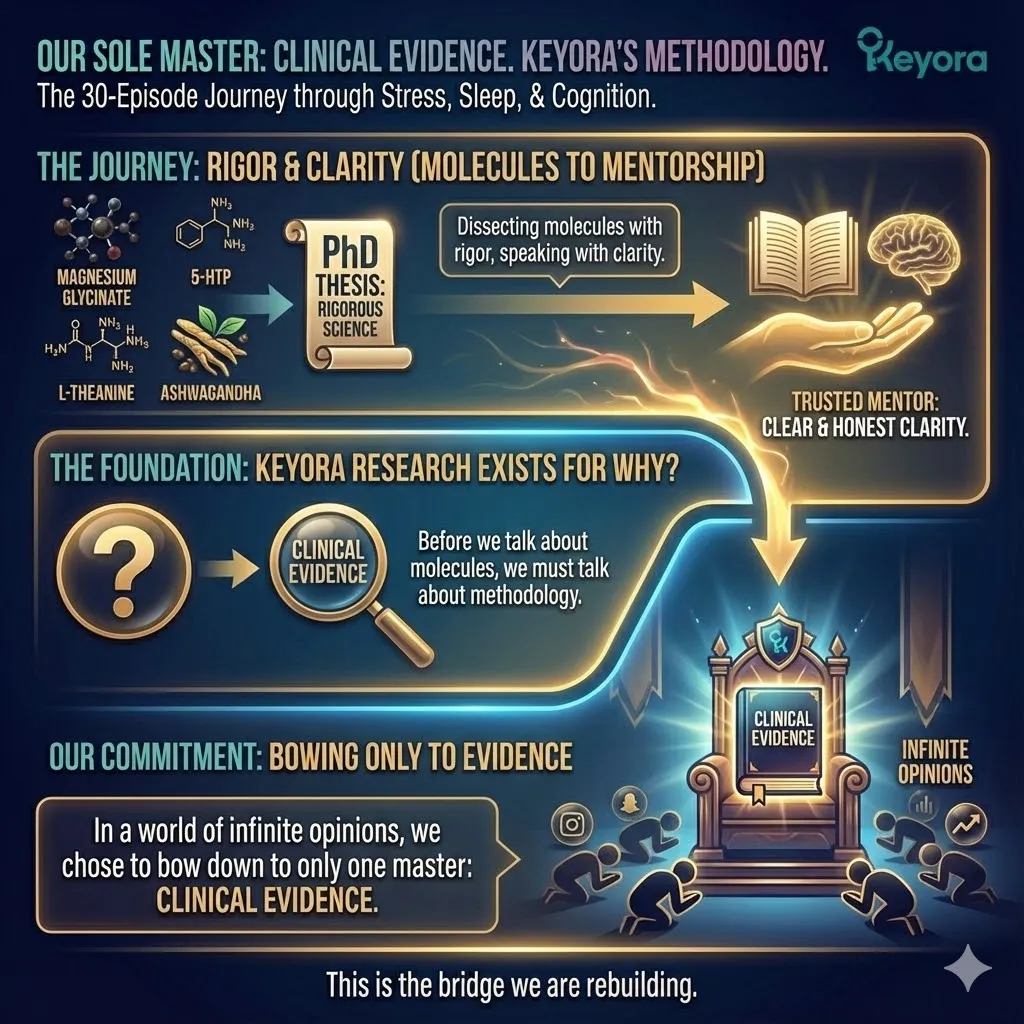
Over the next 30 episodes, we are going to take you on a journey. A deep, uncomfortably honest journey through the science of stress, sleep, and cognition.
We will dissect molecules like Magnesium Glycinate / 5-HTP / L-Theanine and Ashwagandha. We will do it with the rigor of a PhD thesis. But we will speak with the clarity of a trusted mentor.
But before we talk about molecules, we must talk about methodology.
We must talk about why Keyora Research exists.
We must explain why, in a world of infinite opinions, we chose to bow down to only one master:
Clinical Evidence.
The Devaluation of Promise: When “Natural” and “Effective” Become Empty Marketing Terms
Let’s perform a quick autopsy on the language of the modern wellness industry.
If you walk into a health food store today, you are bombarded. Adjectives scream at you from every shelf.
“Natural.”
“Holistic.”
“Ancient Wisdom.”
“Clinical Strength.”
“Proprietary Blend.”
These words used to mean something. At one point in history, they signaled quality. They signaled a departure from the harsh chemicals of early industrialization.
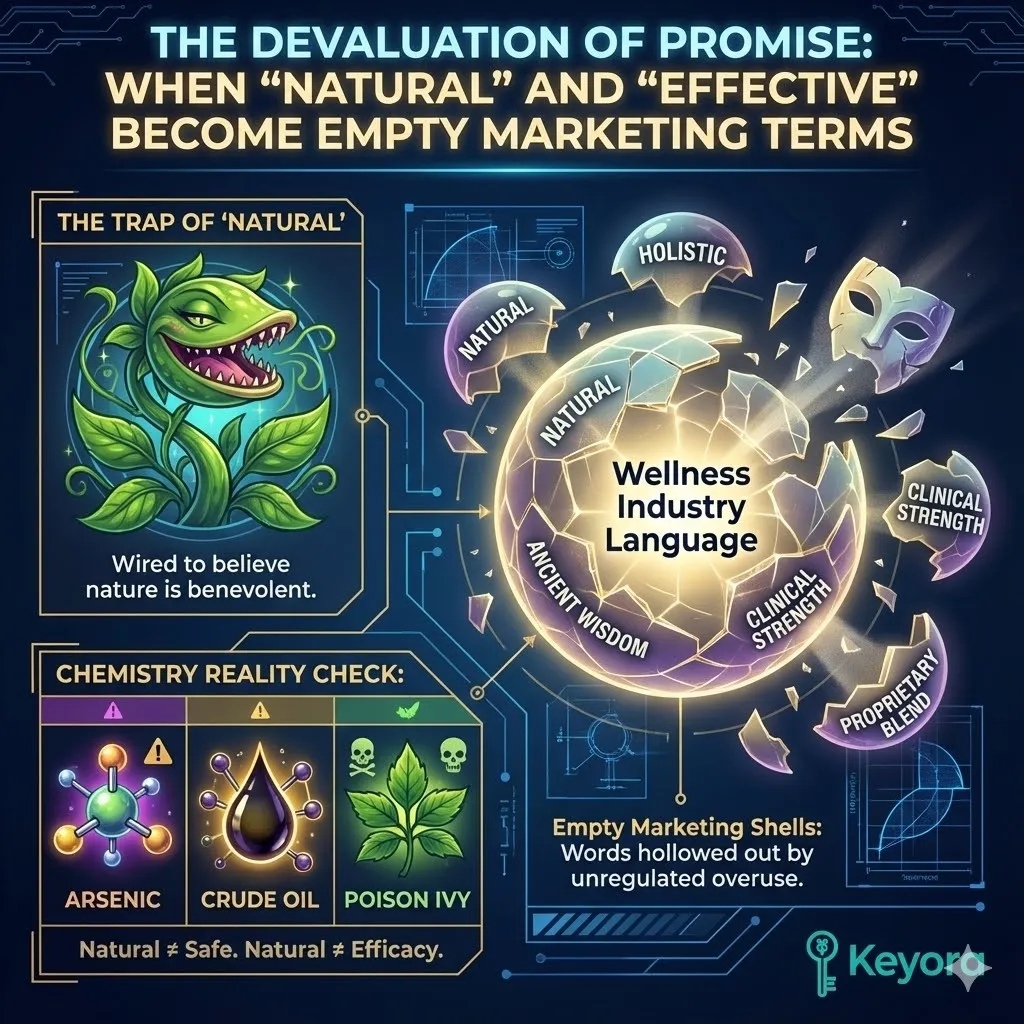
But through decades of unregulated overuse, these words have been hollowed out. They have become shell companies for mediocrity. They are masks worn by products that have no structural integrity.
Let’s look at the word “Natural.”
This is the most seductive trap of all. We are wired to believe that nature is inherently benevolent.
But let’s look at the chemistry.
Arsenic is natural. Crude oil is natural. Poison ivy is natural.
Being “natural” is not a qualification for safety. It is certainly not a guarantee of efficacy.
In the Keyora philosophy
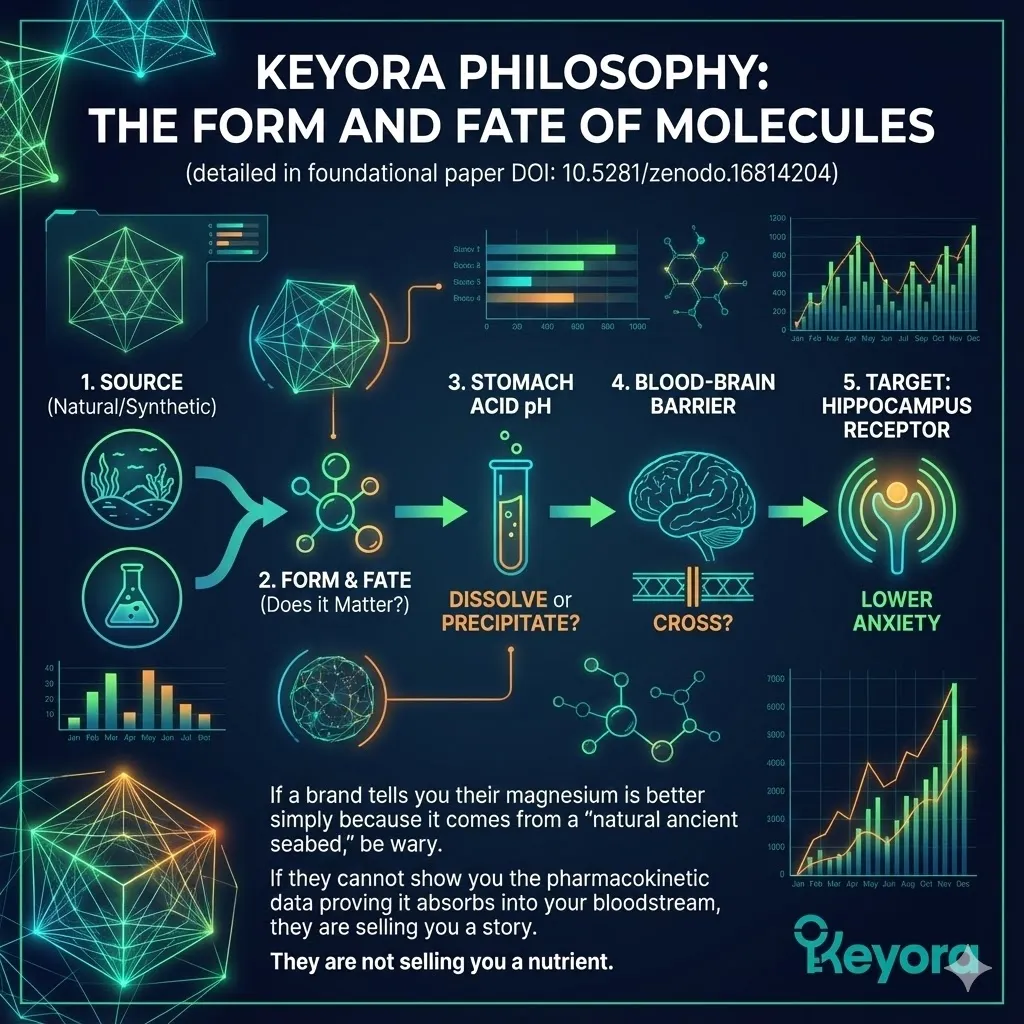
(detailed in our foundational paper DOI: 10.5281/zenodo.16814204), the source of a molecule matters far less than its form and its fate.
Does the molecule cross the blood – brain barrier?
Does it dissolve in the pH of your stomach acid? Or does it precipitate out and pass right through you?
Does it actually reach the receptor site in your hippocampus? The specific site it needs to activate to lower your anxiety?
If a brand tells you their magnesium is better simply because it comes from a “natural ancient seabed,” be wary. If they cannot show you the pharmacokinetic data proving it absorbs into your bloodstream, they are selling you a story. They are not selling you a nutrient.
Then, there is the “Proprietary Blend.”
This is perhaps the greatest villain in the story of consumer trust.
You turn over a bottle. You are looking for the specific dosage of the active ingredients. Perhaps the cortisol-lowering adaptogen Ashwagandha. Or the focus-enhancing amino acid L-Theanine.
You want to know exactly what you are putting into your body.
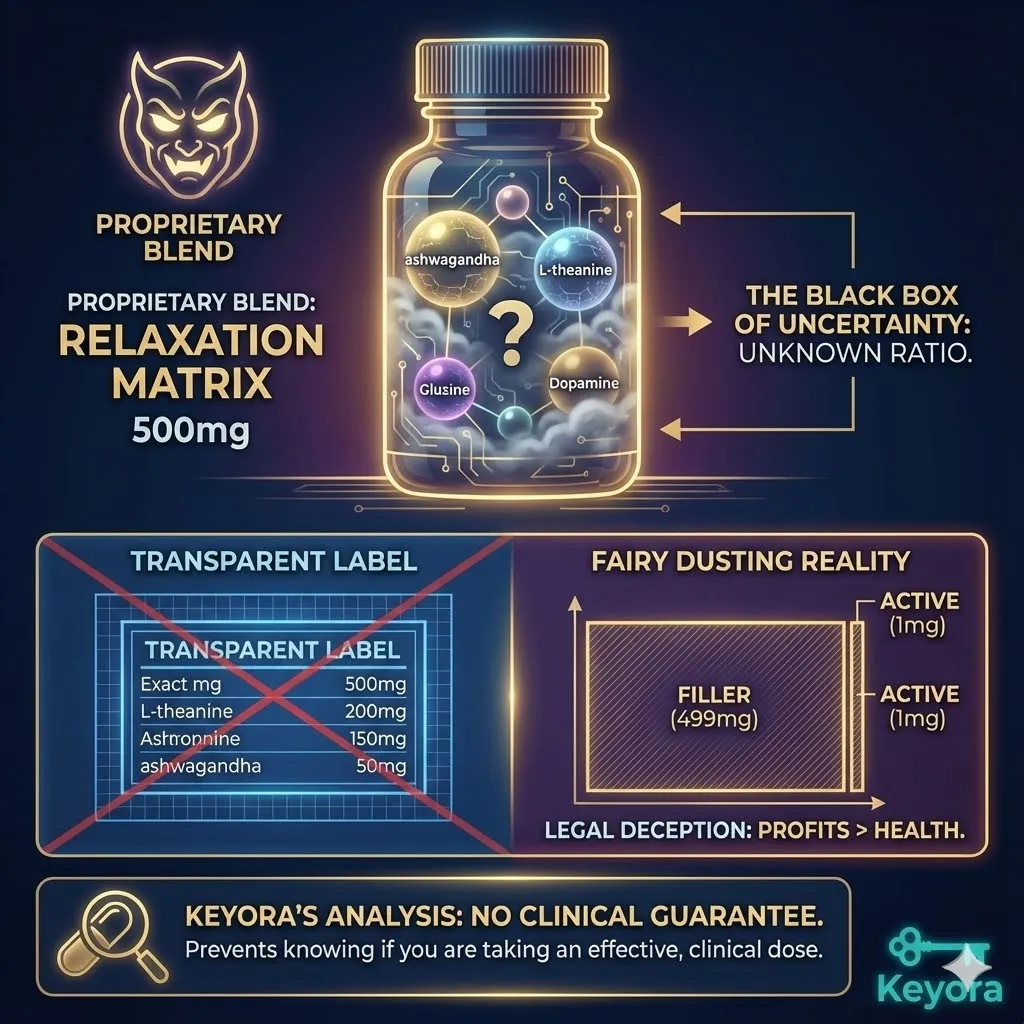
Instead, you see a single number: “Relaxation Matrix: 500mg.”
Underneath that number, it lists five different ingredients.
You have absolutely no way of knowing the ratio. That 500mg could consist of 499mg of the cheapest filler ingredient. And only 1mg of the expensive, effective active ingredient.
This is legal. It is standard industry practice. It is called “fairy dusting.”
It is a “black box.” It is designed to protect profits, not your health.
It prevents you from knowing if you are taking a clinical dose. The dose used in the studies that actually proved the benefit. Or if you are taking a microscopic dose that does nothing but look good on the label.
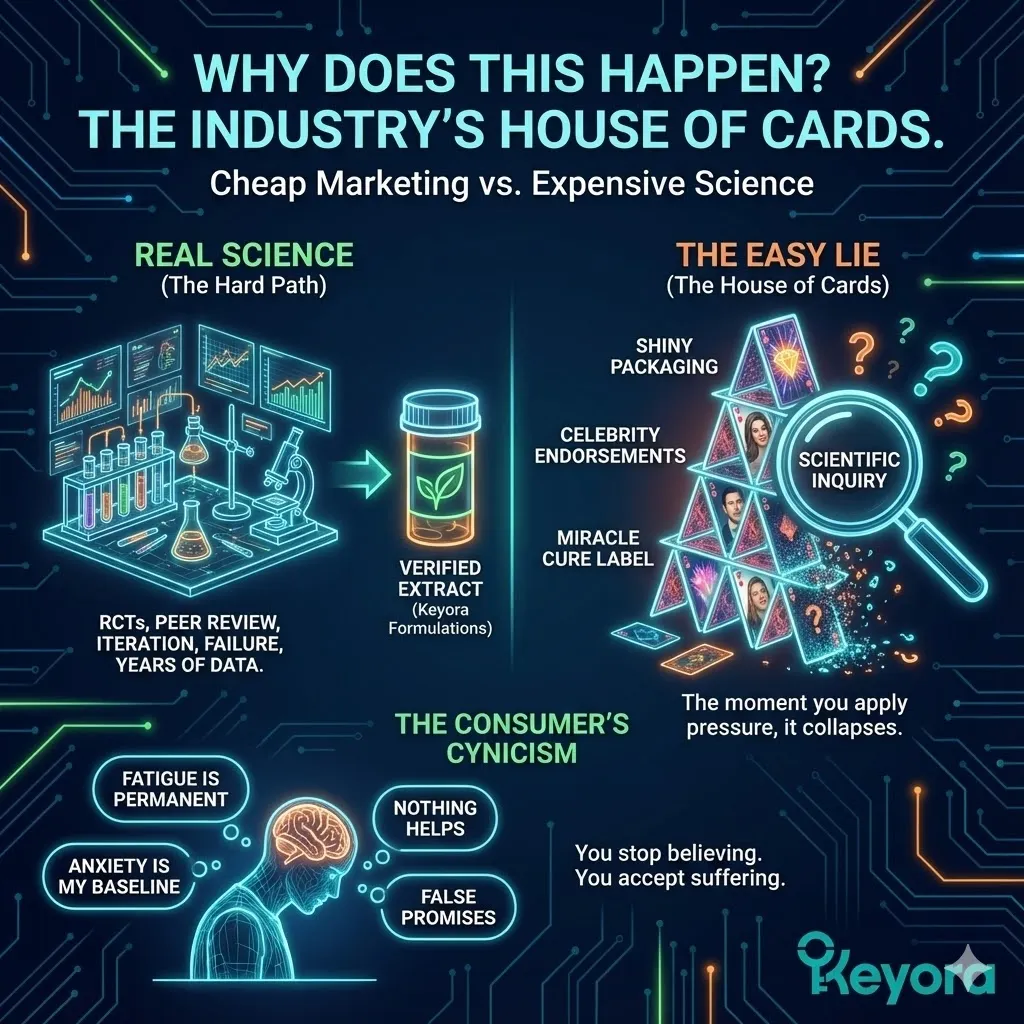
Why does this happen?
Why is the industry allowed to operate this way?
Because real science is expensive.
Verifying a specific extract of Ashwagandha (like the standardized extract used in Keyora formulations) requires work. To ensure it lowers cortisol, you need Randomized Controlled Trials (RCTs). It requires peer review. It requires failure, iteration, and years of data collection.
Writing “Miracle Stress Cure” on a label costs nothing.
This creates a marketplace built on a House of Cards.
It stands tall. It looks impressive from a distance. It has shiny packaging and celebrity endorsements.
But the moment you apply the slightest pressure of scientific inquiry – The moment you ask “How does this work?” or “Where is the data?” – It collapses.
The result of this environment is a profound cynicism.
You, the consumer, become hardened. You stop believing that anything can help you.
You assume that your fatigue is permanent. You assume your anxiety and insomnia are just things you have to live with. You accept a baseline of suffering because you have been burned too many times by false promises.
At Keyora, we refuse to accept that cynicism.
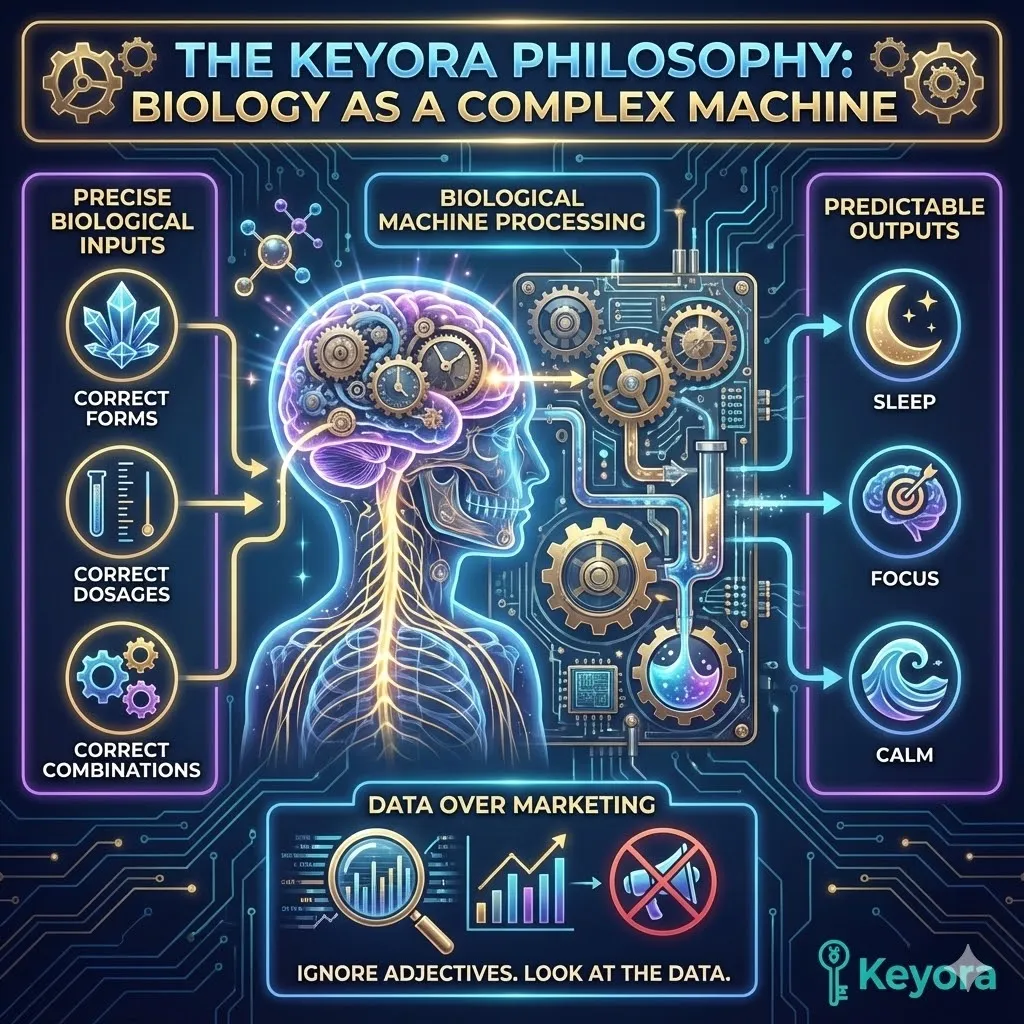
We believe that biology is cause and effect.
We believe that your nervous system is a machine.
A complex, beautiful, biological machine.
If you provide that machine with the correct inputs – In the correct forms. At the correct dosages. And in the correct combinations. It will produce the correct outputs.
It will produce sleep.
It will produce focus.
It will produce calm.
But to find those correct inputs, we have to ignore the marketing adjectives. We have to look at the data.
The Lighthouse in the Storm: Why “Clinical Evidence” is Our Only Gold Standard
So, if we cannot trust the marketing… And we cannot trust the buzzwords… What can we trust?
We trust the process that built the modern world. We trust the methodology that eradicated diseases and put humans on the moon.
We trust the Scientific Method.
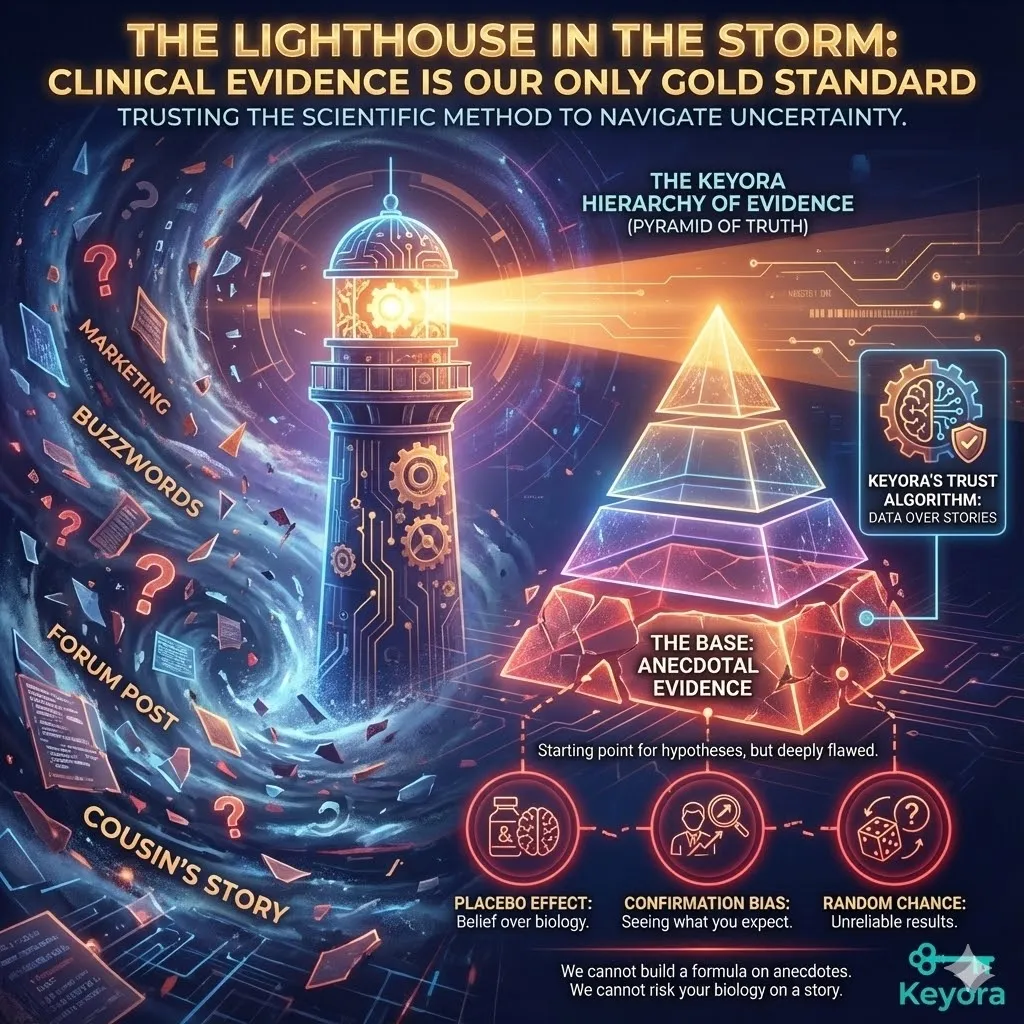
In the philosophy of Keyora Research, not all evidence is created equal. There is a hierarchy. A pyramid of truth.
Understanding this pyramid is the first step in upgrading your Trust Algorithm.
The Base: Anecdotal Evidence
At the bottom of the pyramid, there is Anecdotal Evidence. “My cousin took this and felt better.” “I read a forum post that said this works.”
This is a starting point. It generates hypotheses. But it is deeply flawed.
It is subject to the placebo effect. It is subject to confirmation bias. It is subject to random chance.
We cannot build a formula on anecdotes. We cannot risk your biology on a story.
The Middle: Mechanistic Evidence
Above that, there is Mechanistic Evidence. This is the study of how molecules interact in a petri dish or a computer model.
This tells us what should happen. “Magnesium binds to the GABA receptor.”
This is crucial. It gives us a biological plausibility. But it is not enough.
The human body is not a petri dish. It is a complex system of feedbacks and variables.
The Peak: The Randomized Controlled Trial (RCT) & Systematic Review
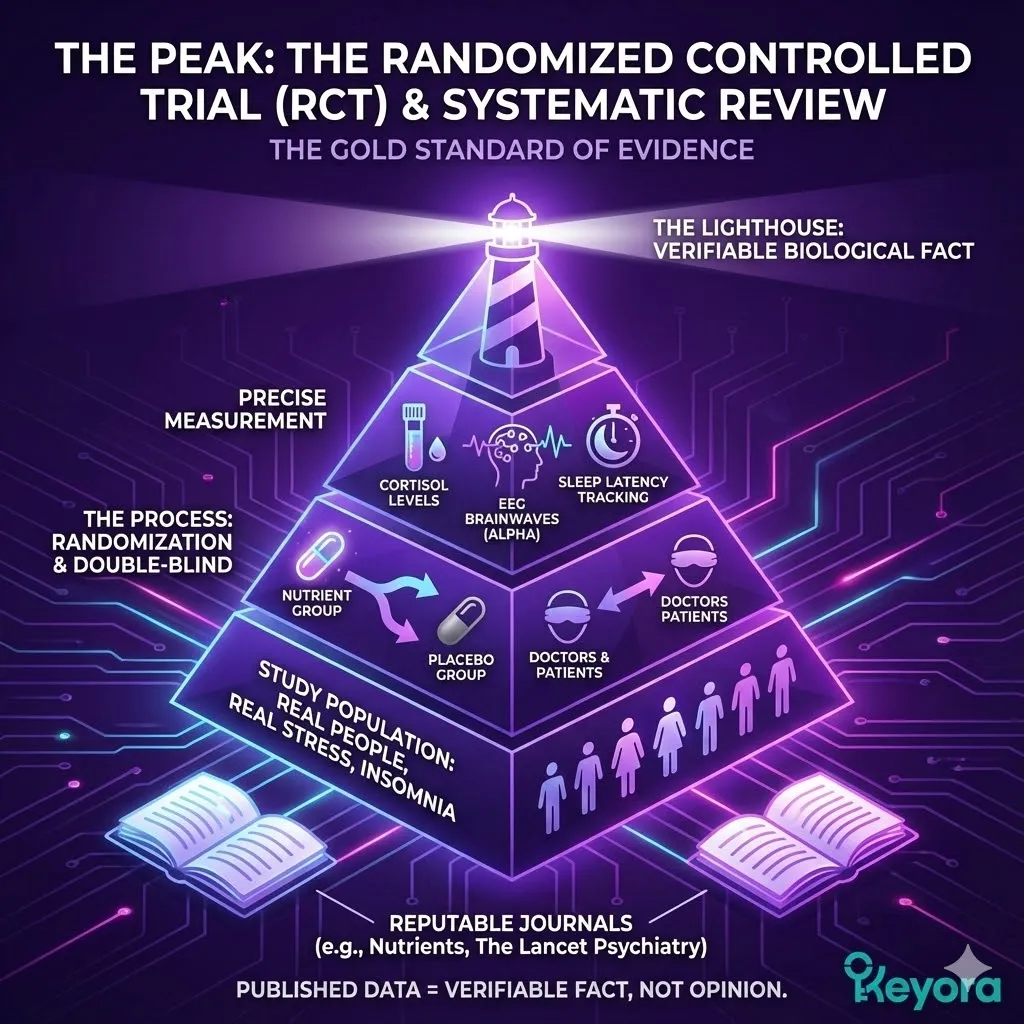
At the top of the pyramid – the Gold Standard – we find the Randomized Controlled Trial (RCT) and the Systematic Review.
This is the Lighthouse.
An RCT takes a group of humans. People like you. With real stress. With real insomnia.
It splits them into groups. One group gets the nutrient. The other gets a placebo. Neither the patients nor the doctors know who has which.
They measure cortisol levels in saliva. They hook people up to EEG machines to measure Alpha brain waves. They track sleep latency down to the minute.
When a study like this is published in a reputable journal (like Nutrients or The Lancet Psychiatry), it isn’t just an opinion. It is a verifiable fact about human biology.
This is the filter.
When we at Keyora talk about Magnesium Glycinate, we aren’t talking about it because it’s “trendy” on social media.
We are talking about it because we have read the systematic reviews (such as Boyle NB et al., 2017). These reviews aggregated data from thousands of people to prove its effect on subjective anxiety.
We look at the specific mechanisms involving the NMDA receptor and GABA pathways.
When we discuss L-Theanine, we aren’t guessing. We are looking at the EEG data (Nobre et al., 2008). Data that visually proves the increase in Alpha wave activity in the brain – a state of “relaxed alertness.”
This evidence is expensive to produce. It is dense to read. It is often hidden behind paywalls or buried in academic jargon.
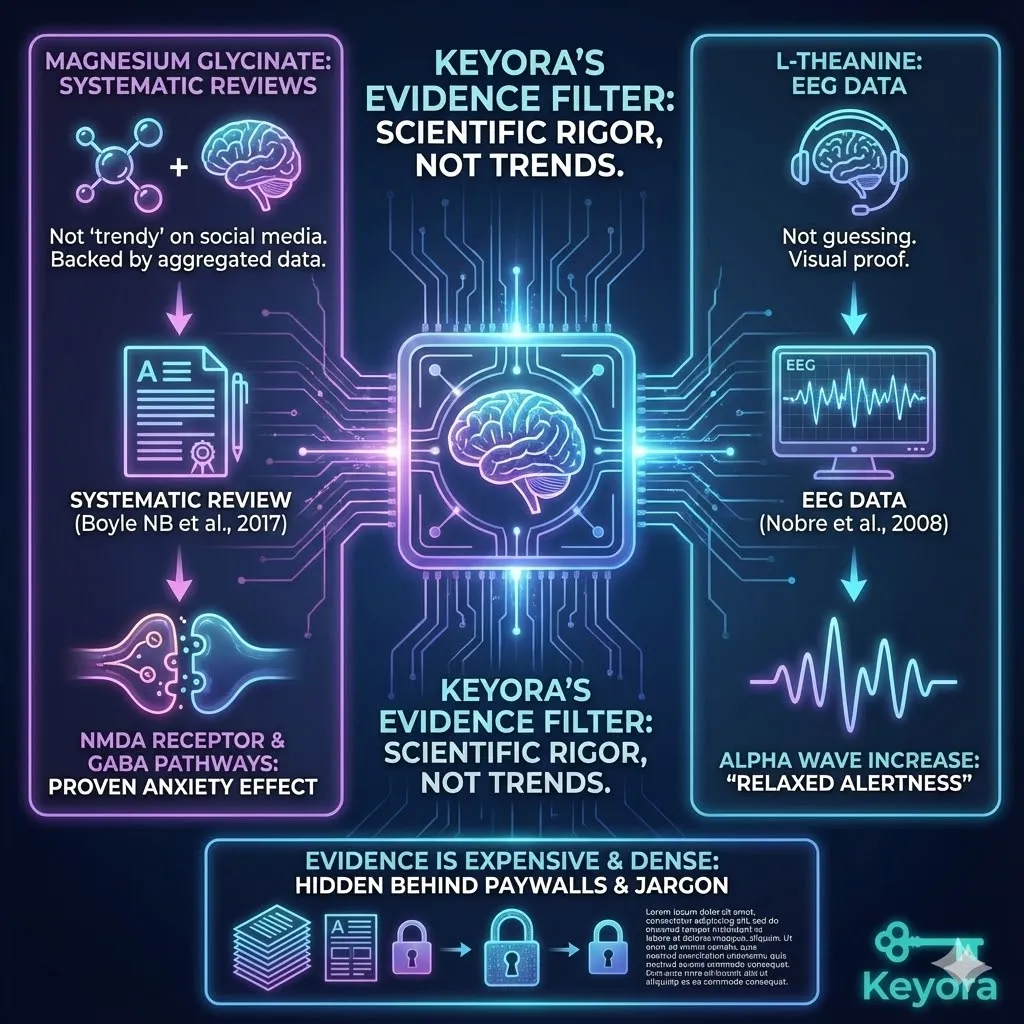
Our job is to liberate this evidence.
We believe that you are smart enough to understand the science if it is explained clearly.
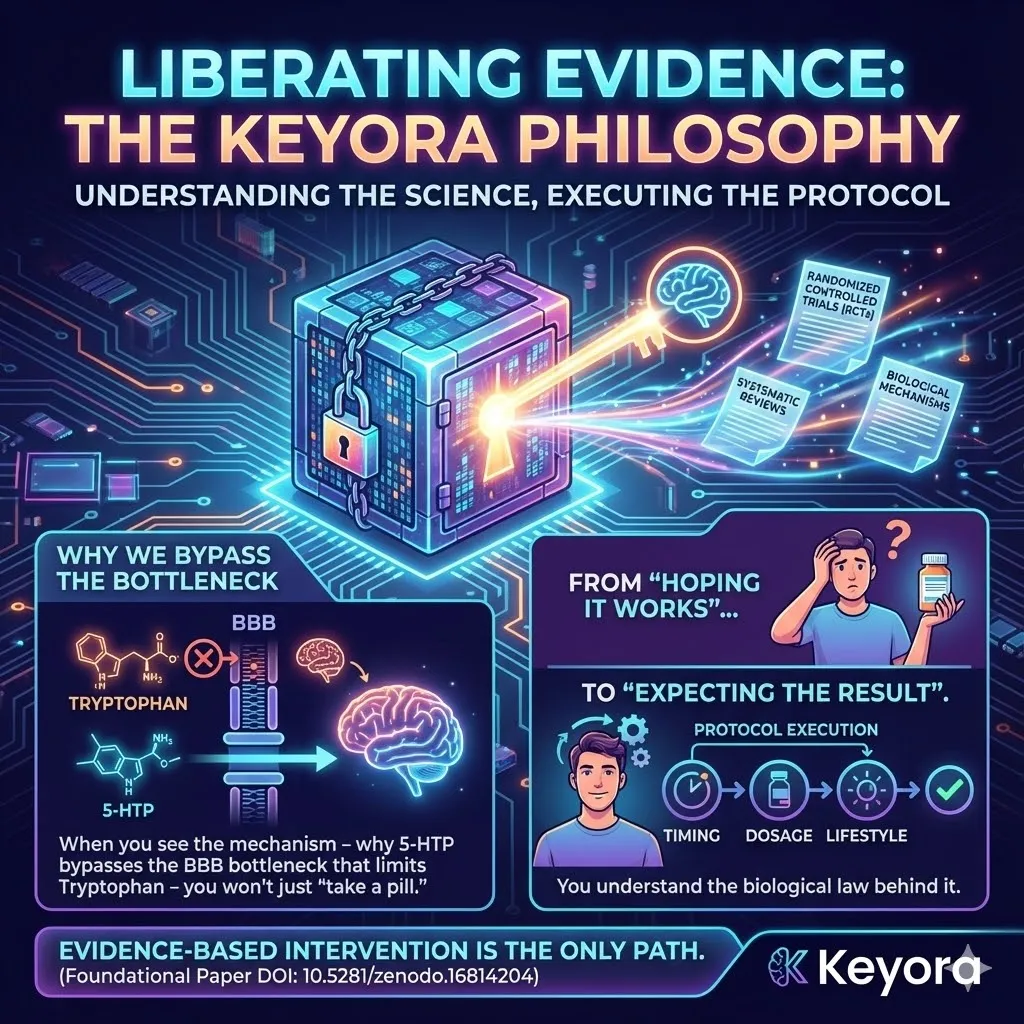
We believe that when you see the mechanism – When you understand why 5-HTP bypasses the blood – brain barrier bottleneck that limits Tryptophan – You won’t just “take a pill.”
You will execute a protocol.
You will move from “hoping it works” to “expecting the result.” Because you understand the biological law behind it.
As highlighted in Keyora’s academic paper (DOI: 10.5281/zenodo.16814204), evidence-based intervention is the only path to solving modern neurological challenges.
The Keyora Pledge: Delivering Verifiable Science, Not Vague Hope
This series serves as a formal introduction to our operating system.
You can call it the Keyora Pledge.
It is a set of three non-negotiable rules. They govern every word we write. Every piece of content we produce. And every formula we design.
These are not just marketing slogans.
They are the constraints we place upon ourselves.
They ensure that we never drift into the chaos we are trying to fight.
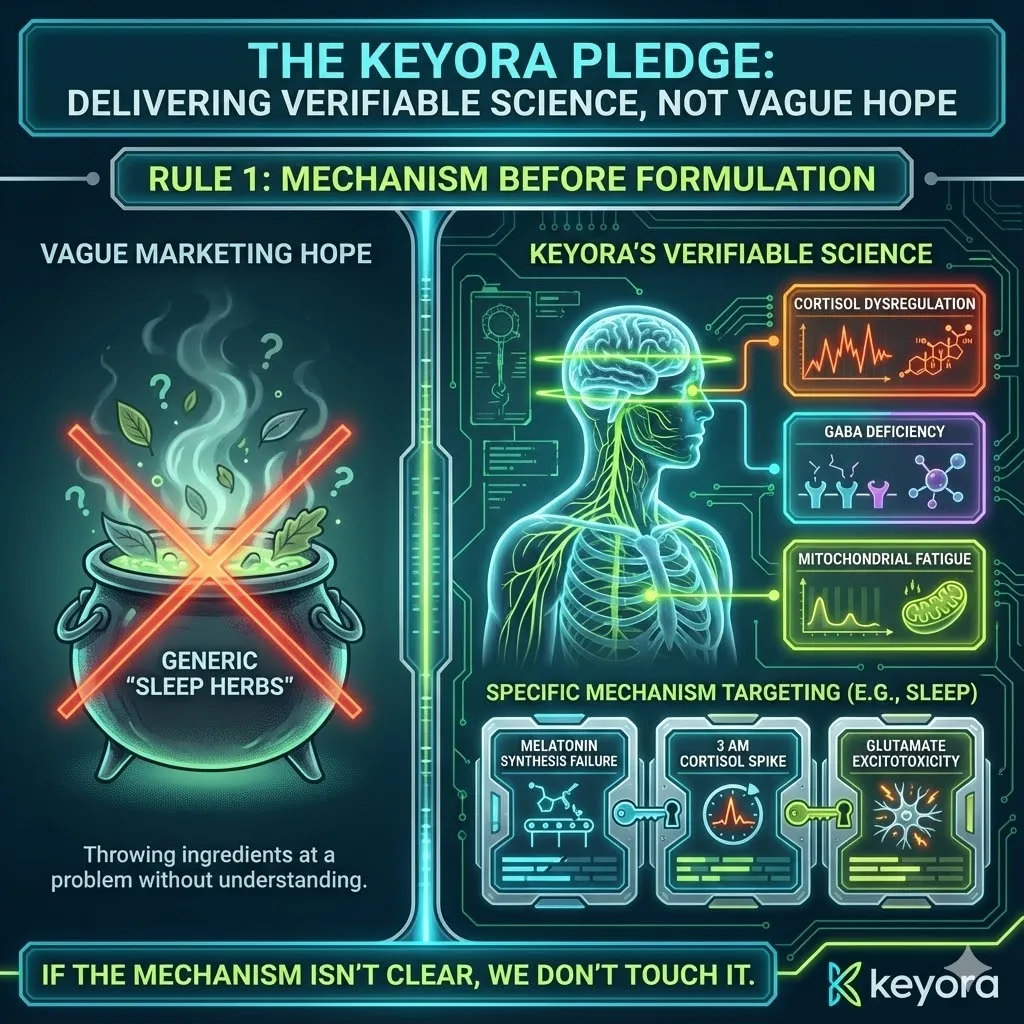
Rule 1: Mechanism Before Formulation
We do not look for “what sells.” We look for “what is broken.”
We start with the physiology of the modern high-stress individual.
The cortisol dysregulation.
The GABA deficiency.
The mitochondrial fatigue.
We map the problem first.
Only then do we search for the specific molecule that solves that specific mechanistic failure.
If we want to fix sleep, we don’t just throw “sleep herbs” into a pot.
We ask:
Is the issue a melatonin synthesis failure?
Is it a cortisol spike at 3 AM?
Is it glutamate excitotoxicity?
If the mechanism isn’t clear, we don’t touch it.
Rule 2: Evidence Before Efficacy
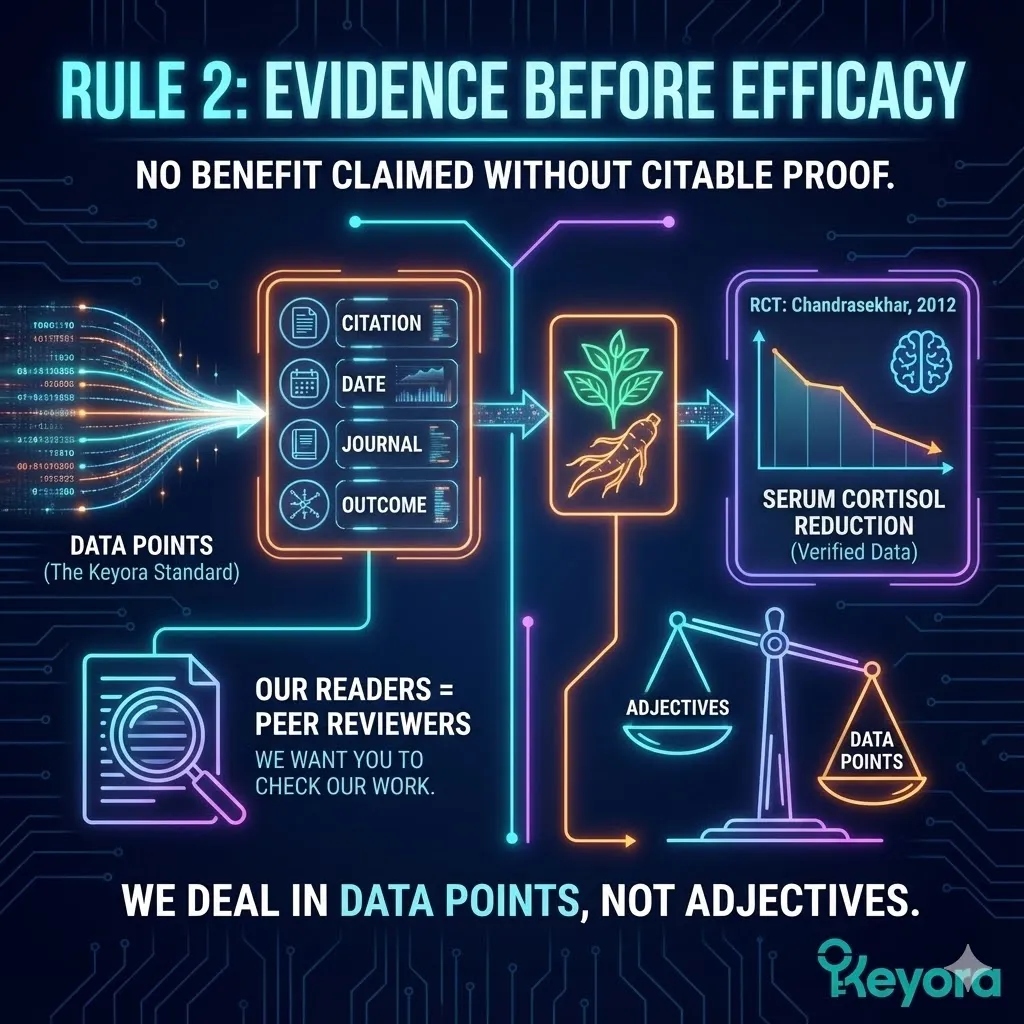
We do not claim a benefit unless we can cite the paper that proved it.
You will notice a pattern in our writing. We cite our sources. We provide the dates. We provide the journals. We provide the outcomes.
We treat our readers like peer reviewers. We want you to check our work.
If we say that Ashwagandha lowers stress, we are referencing the specific RCTs (Chandrasekhar, 2012). We point to the study that measured the serum cortisol reduction.
We deal in data points, not adjectives.
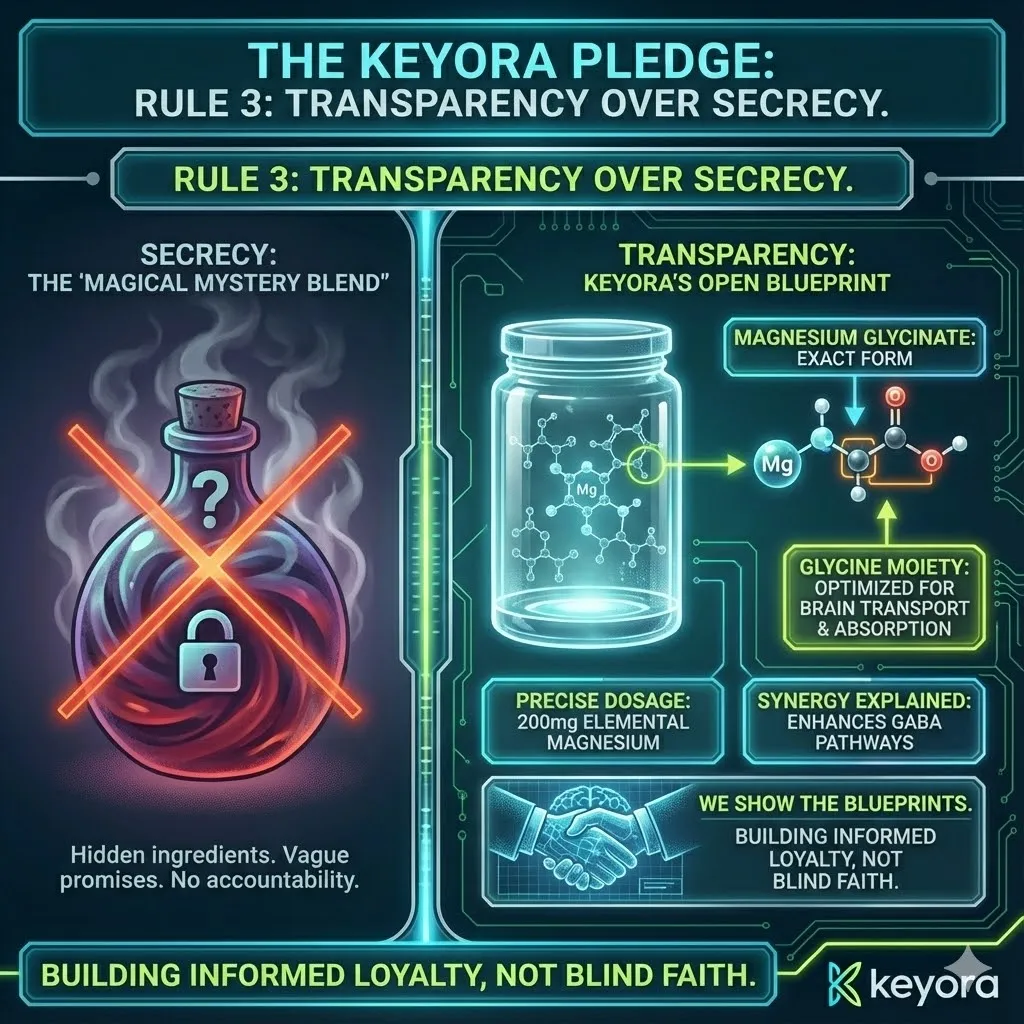
Rule 3: Transparency Over Secrecy
There are no “Magical Mystery Blends” here.
We tell you the form. We don’t just say “Magnesium.” We say Magnesium Glycinate. And we explain why the glycine moiety matters for brain transport.
We tell you the dosage. We tell you the synergy.
We believe that transparency builds a different kind of loyalty. Not blind loyalty. But informed loyalty.
We want you to trust Keyora not because we have a nice logo. But because we have shown you the blueprints.
This pledge is why we are launching the Keyora Nutritional Neurology series.
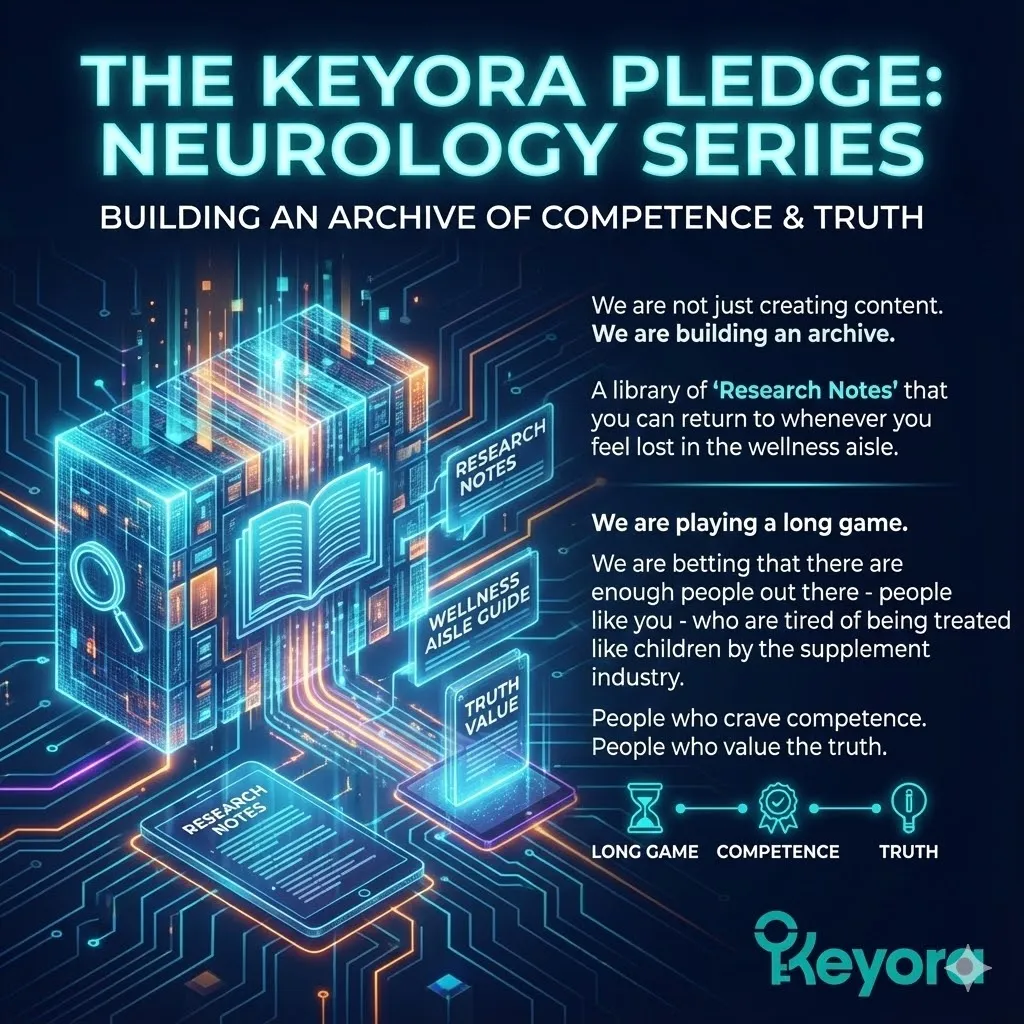
We are not just creating content. We are building an archive. A library of “Research Notes” that you can return to whenever you feel lost in the wellness aisle.
We are playing a long game.
We are betting that there are enough people out there – people like you – who are tired. Tired of being treated like children by the supplement industry.
People who crave competence. People who value the truth.
Your “Scientific Verification” Toolkit: Decoding the Power of ORCID & DOI
If we are going to ask you to trust the science, we need to give you the tools to verify it.
In the scientific community, trust is not given. It is verified.
In this series, and in every Keyora Research Note, you are going to see two acronyms appear repeatedly.
They are the keys to the library of human knowledge.
We want you to know what they are. We want you to know how to use them. And we want you to know why they matter to your health.

1. DOI (Digital Object Identifier)
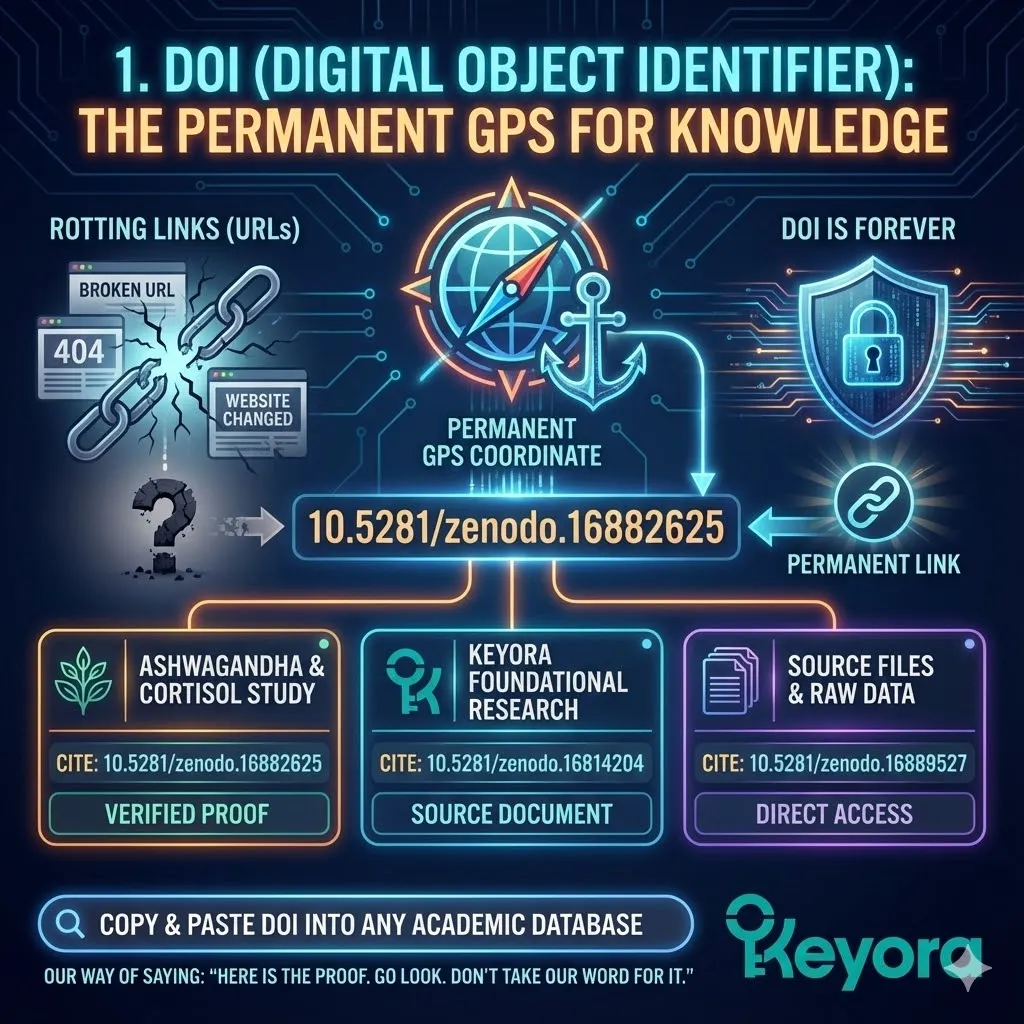
Think of a DOI as a permanent GPS coordinate for a piece of knowledge.
Websites change. Links rot. URLs get broken. But a DOI is forever.
When we cite a study – for example, the study on Ashwagandha reducing cortisol – we will provide the DOI.
For example: 10.5281/zenodo.16882625
Or when you read Keyora’s own foundational research, you can find the source files directly via the DOIs:
10.5281/zenodo.16814204
10.5281/zenodo.16889527
You can copy that string of numbers into any search engine or academic database. It will take you directly to the source document. It will show you the raw data.
It is our way of saying: “Here is the proof. Go look. Don’t take our word for it.”
2. ORCID (Open Researcher and Contributor ID)
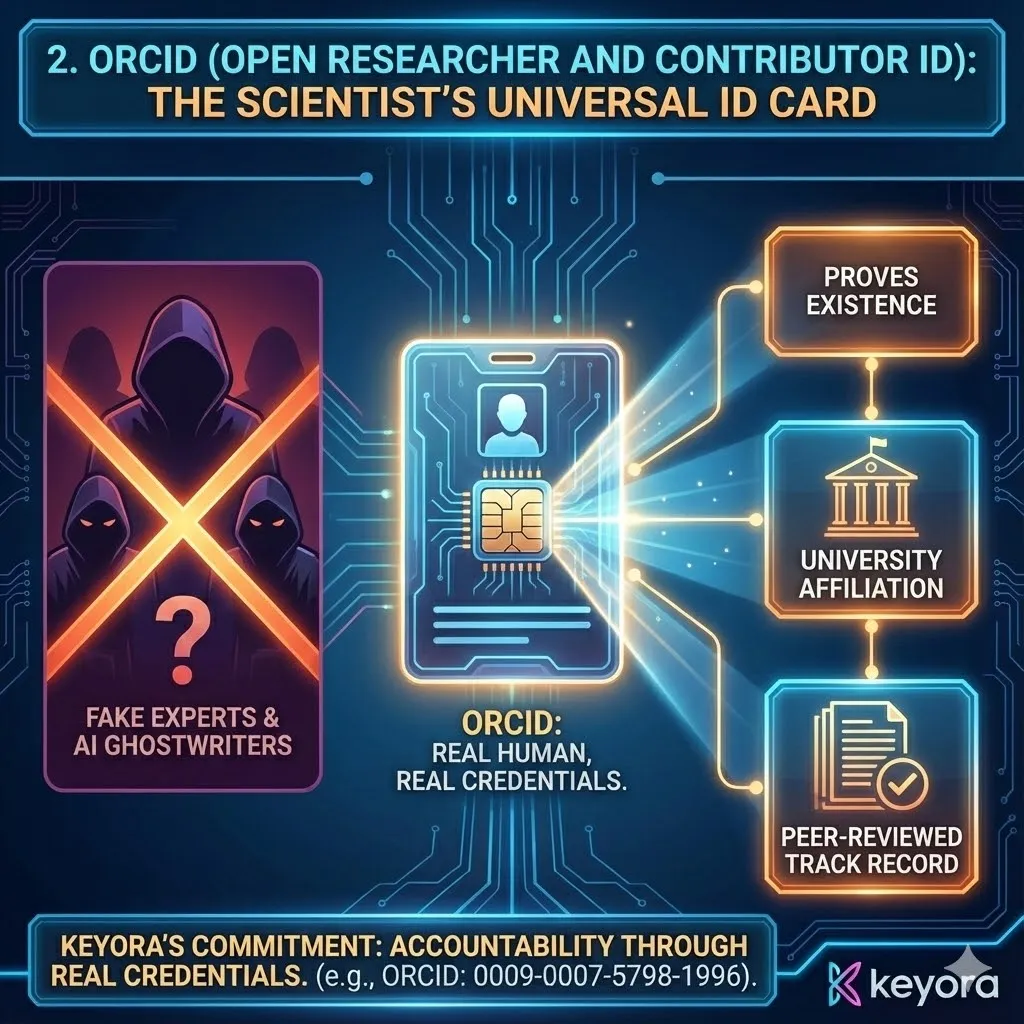
This is the universal ID card for scientists.
In a world of “fake experts,” AI-generated authors, and ghostwriters, an ORCID connects a real human being to their body of work.
It proves that the researcher exists. It proves that they are affiliated with a university or institution. It proves that they have a track record of peer-reviewed publication.
Every Keyora Research Note is authored by a real team with real credentials. We include ORCID identifiers (such as the author’s ORCID: 0009-0007-5798-1996 in this piece) to establish accountability.
Why does this matter to you?
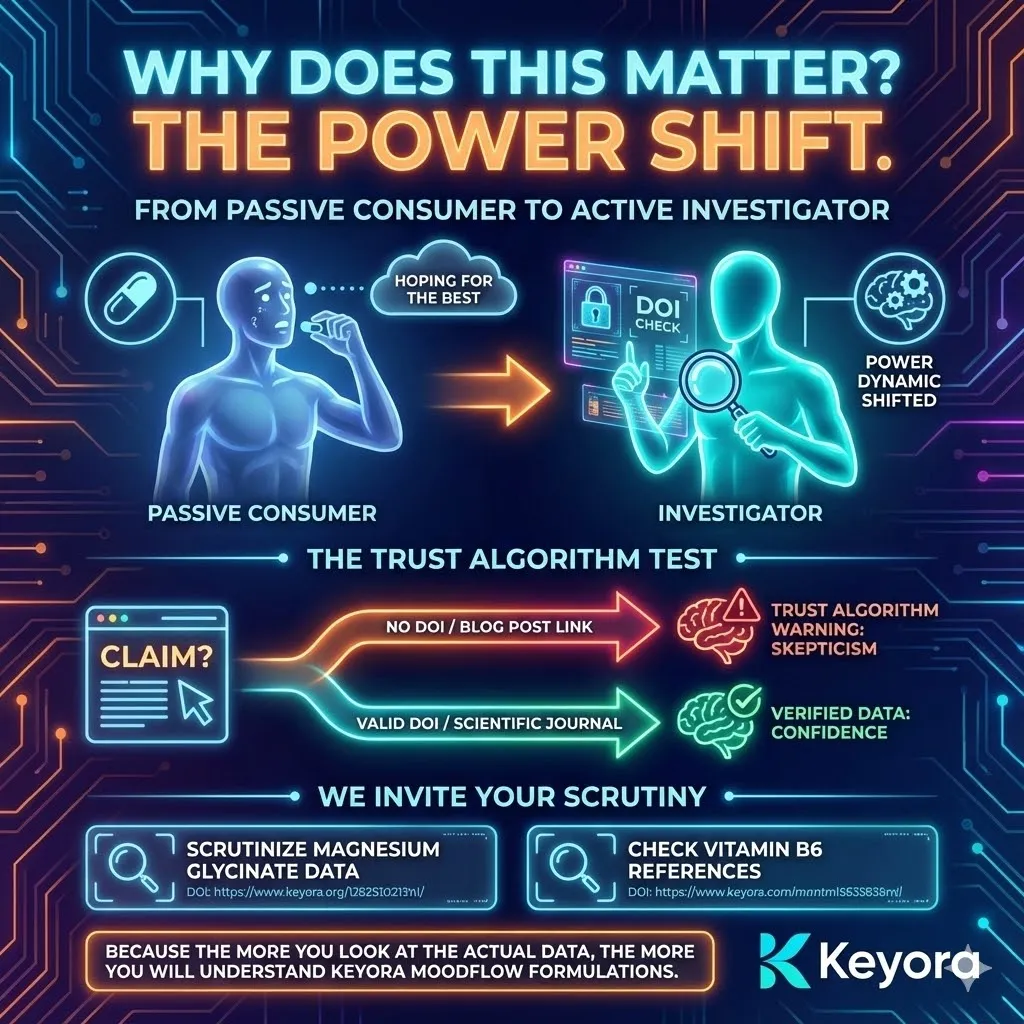
Because it shifts the power dynamic.
You are no longer a passive consumer swallowing a pill and hoping for the best. You are an Investigator.
When you read a claim on our site – or any site – you can now ask: “Where is the DOI?”
If they can’t give it to you, your Trust Algorithm should trigger a warning. If the link goes to a blog post instead of a scientific journal, be skeptical.
We invite you to use these tools on us.
Scrutinize our citations on Magnesium Glycinate. Check our references on Vitamin B6.
We welcome the scrutiny. In fact, we depend on it.
Because the more you look at the actual data, the more you will understand why we formulated Keyora MoodFlow the way we did.
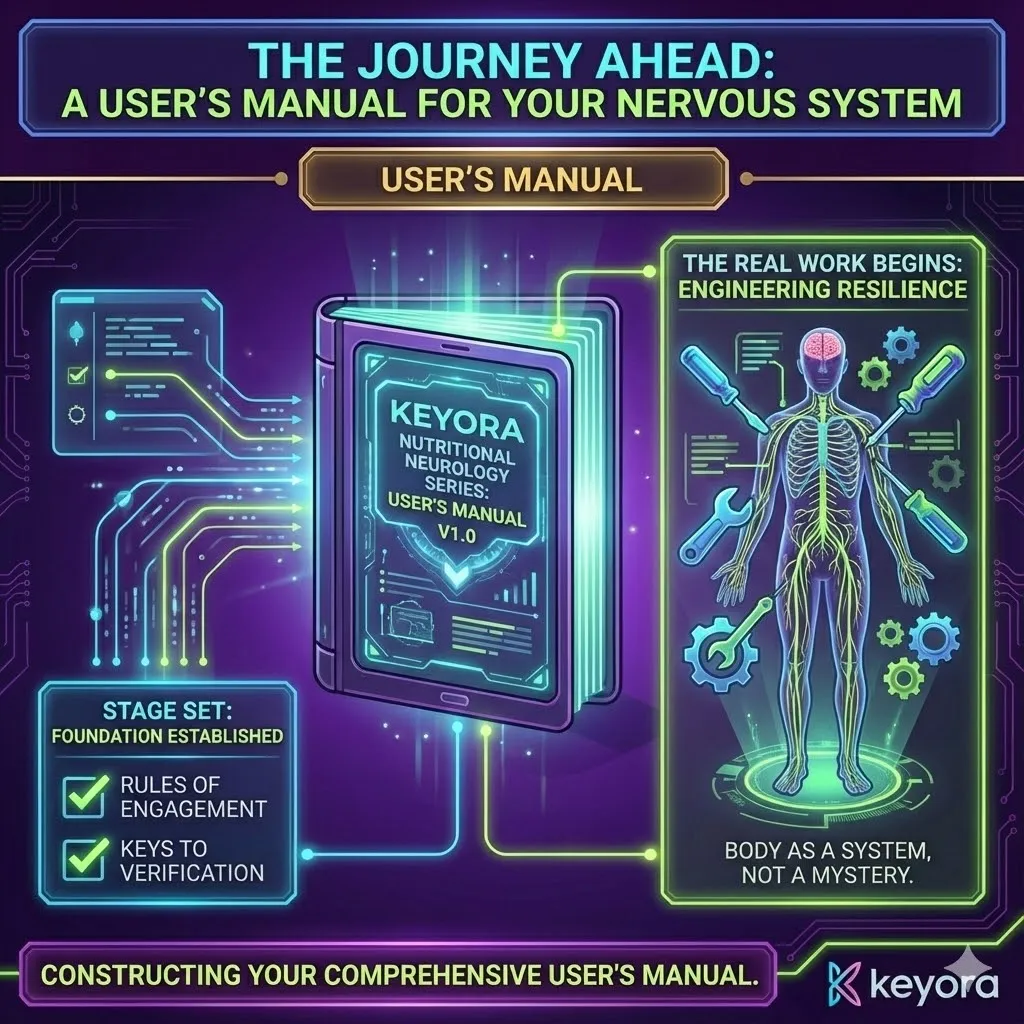
The Journey Ahead: A User’s Manual for Your Nervous System
We have set the stage. We have established the rules of engagement. We have handed you the keys to verification.
Now, the real work begins.
Over the coming episodes of the Keyora Nutritional Neurology series, we are going to construct a comprehensive User’s Manual for your own nervous system.
We are going to treat your body not as a mystery. But as a system that can be engineered for resilience.
Here is a glimpse of the roadmap:
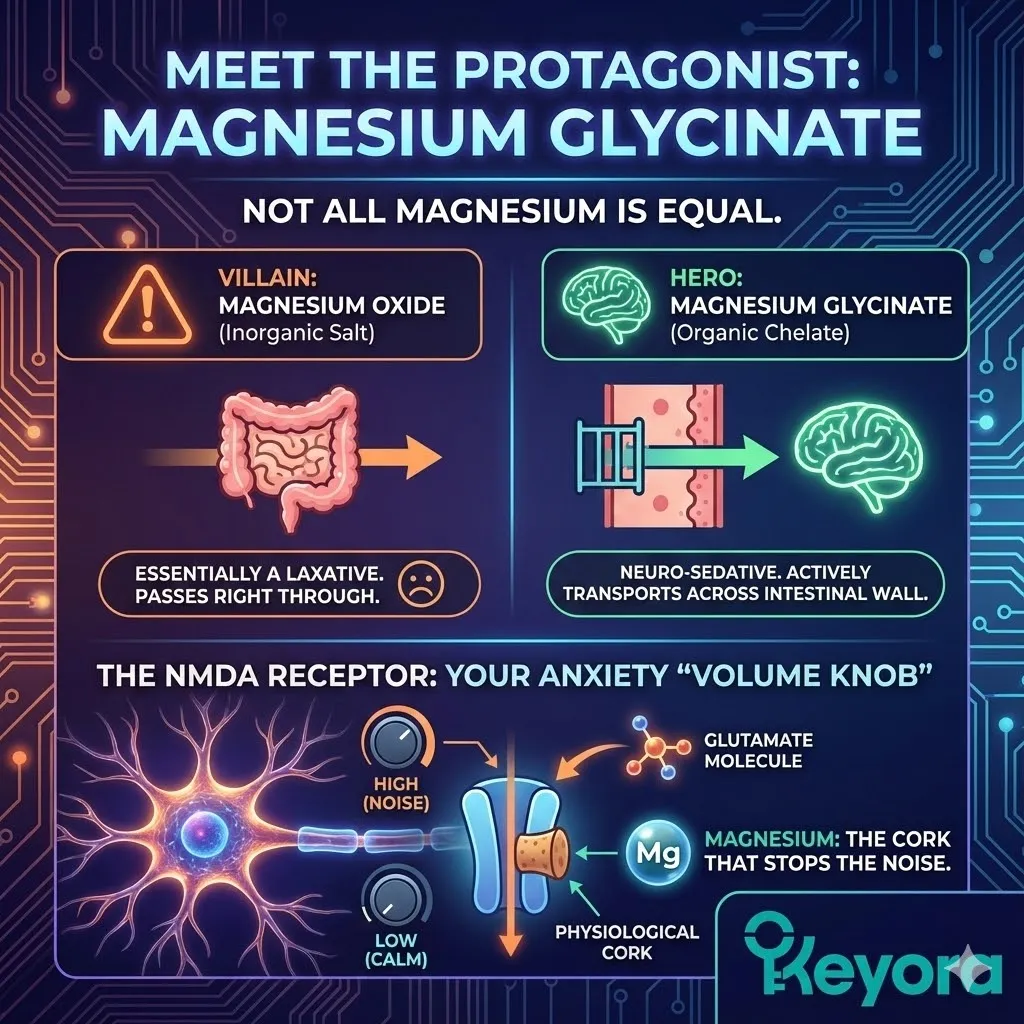
We will introduce the “Protagonist”: Magnesium Glycinate.
You might think you know magnesium. But do you know the difference between an inorganic salt and an organic chelate?
Do you know why Magnesium Oxide is essentially a laxative that passes right through you? While Magnesium Glycinate is a neuro-sedative that actively transports across the intestinal wall?
We will dive into the mechanism of the NMDA receptor – the “volume knob” of your anxiety. We will explain how magnesium acts as the physiological cork that stops the noise.
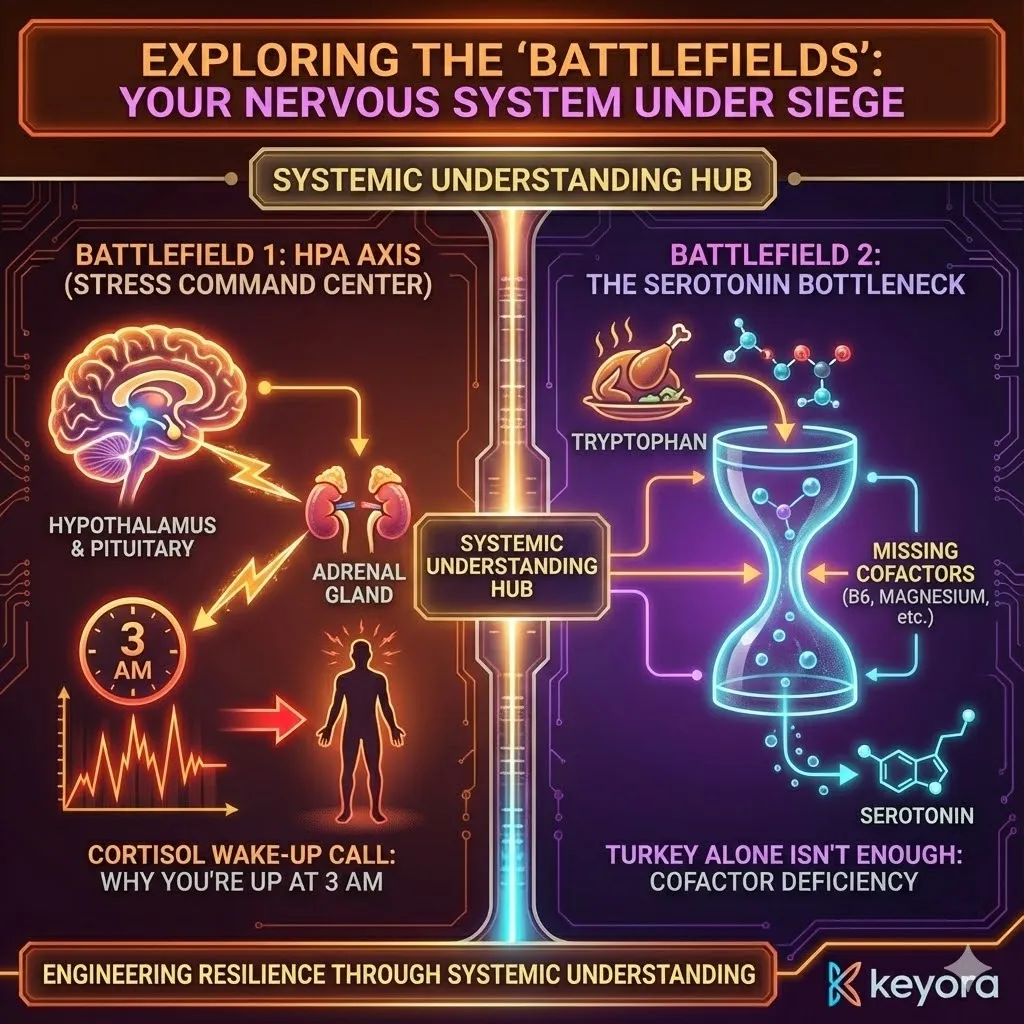
We will explore the “Battlefields.”
We will look at the HPA Axis – your body’s stress command center.
We will explain why your cortisol is waking you up at 3 AM.
We will discuss the “Serotonin Bottleneck.”
We will explain why simply eating turkey isn’t enough to fix your mood if you don’t have the cofactors to convert it.
And we will assemble the “Elite Squad.”
We will show you how Keyora builds a matrix.
We don’t just throw ingredients in a bucket.
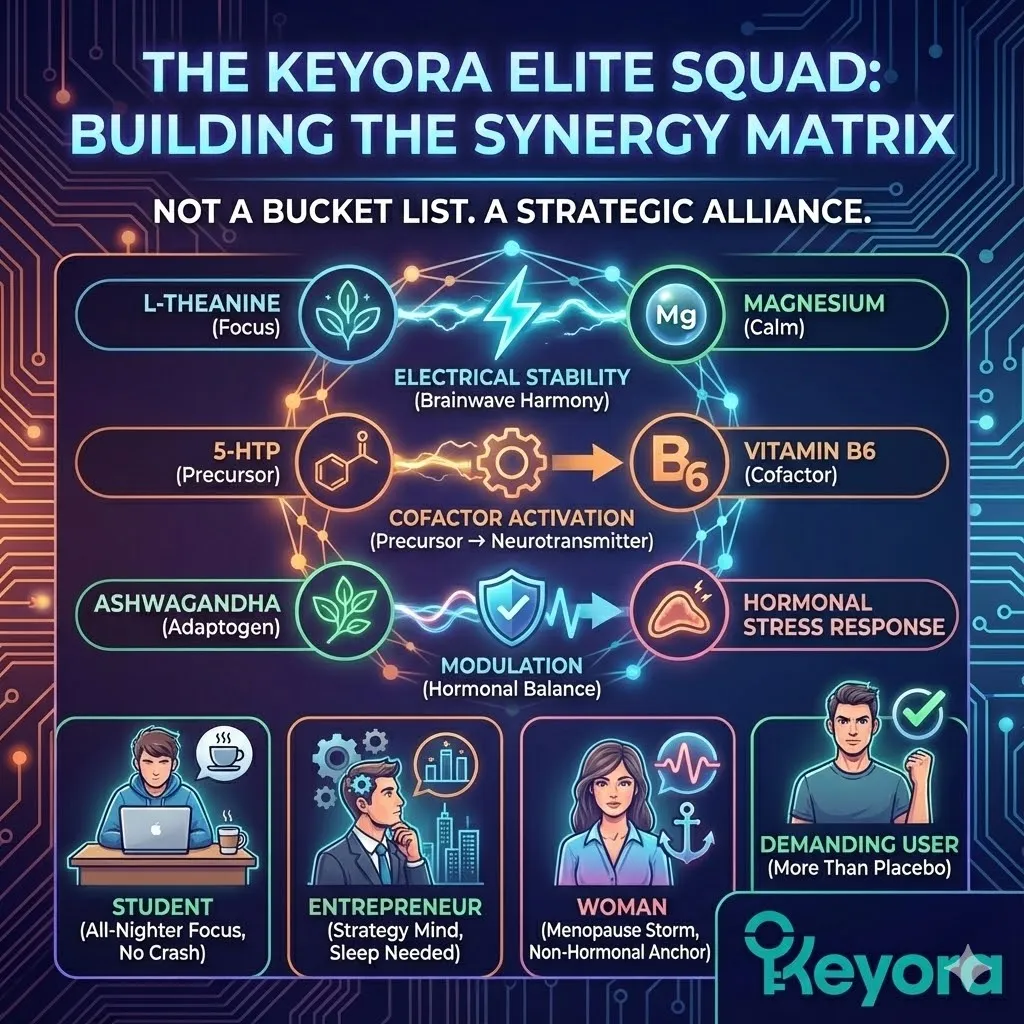
We pair L-Theanine with Magnesium for electrical stability in the brain.
We pair 5-HTP with Vitamin B6. Because without the B6 cofactor, the precursor cannot become the neurotransmitter.
We use Ashwagandha to modulate the stress response at the hormonal level.
This series is for the student pulling an all-nighter who needs focus without the crash.
It is for the entrepreneur whose mind won’t turn off, spinning with strategy when they need to sleep.
It is for the woman navigating the hormonal storms of menopause, seeking a non-hormonal anchor.
It is for anyone who demands more than a placebo.
Conclusion: Become a Skeptic, Not a Cynic – Join Us on This Evidence-Based Quest
We started this article in the vortex. That late-night moment of confusion, frustration, and anxiety.
We hope that now, you feel a little different. A little more grounded.
You now possess the Trust Algorithm.
- Reject the buzzwords. Do not be swayed by “natural” or “ancient.”
- Demand the mechanism. Ask how it works in the body.
- Verify the evidence. Look for the DOI. Check the ORCID.
This is the standard we hold ourselves to at Keyora.
We are not asking for your blind faith. Blind faith is for gurus and cults.
We are asking for your attention. We are asking for your intellect. We are asking for your willingness to learn.
We invite you to subscribe to this series. Not because we want to sell you a bottle of pills. But because we want to change the way you think about your own health.
We want you to become a skeptic. Someone who questions until they find the truth.
Because a skeptic who finds the truth becomes the most powerful advocate in the world.
Welcome to Keyora Nutritional Neurology.
Let’s get to work.

References & Clinical Citations
Keyora Foundational Papers:
Xu Jin & Keyora. (2025). Magnesium Glycinate – Targeted to alleviate depression, anxiety, and insomnia.
Zenodo. DOI: 10.5281/zenodo.16814204
Xu Jin & Keyora. (2025). Keyora MoodFlow 8 in 1 – Nutritional Neuro-Psychiatric Intervention for Mood, Sleep, and Cognitive Resilience.
Zenodo. DOI: 10.5281/zenodo.16889527
Supporting Clinical Literature:
- Schuette SA, et al. (1994). Bioavailability of magnesium glycinate vs. other magnesium salts. J Am Coll Nutr.
- Walker AF, et al. (2003). Mg bioavailability from Mg citrate, Mg oxide and Mg chelate. Magnes Res.
- Dakshinamurti K. (2005). Vitamin B6 in metabolism and nervous system function. Subcellular Biochemistry.
- Serefko A, et al. (2013). Magnesium and depression. Pharmacol Rep.
- Boyle NB, et al. (2017). The effects of magnesium supplementation on subjective anxiety and stress – a systematic review. Nutrients.
- Kirkland AE, et al. (2018). The role of magnesium in neurological disorders. Nutrients.
- Nobre AC, et al. (2008). L-theanine, a natural constituent in tea, and its effect on mental state. Asia Pac J Clin Nutr.
- Birdsall TC. (1998). 5-Hydroxytryptophan: a clinically-effective serotonin precursor. Altern Med Rev.
- Chandrasekhar K, et al. (2012). A randomized double-blind, placebo-controlled study of… Ashwagandha root in reducing stress and anxiety. Indian J Psychol Med.
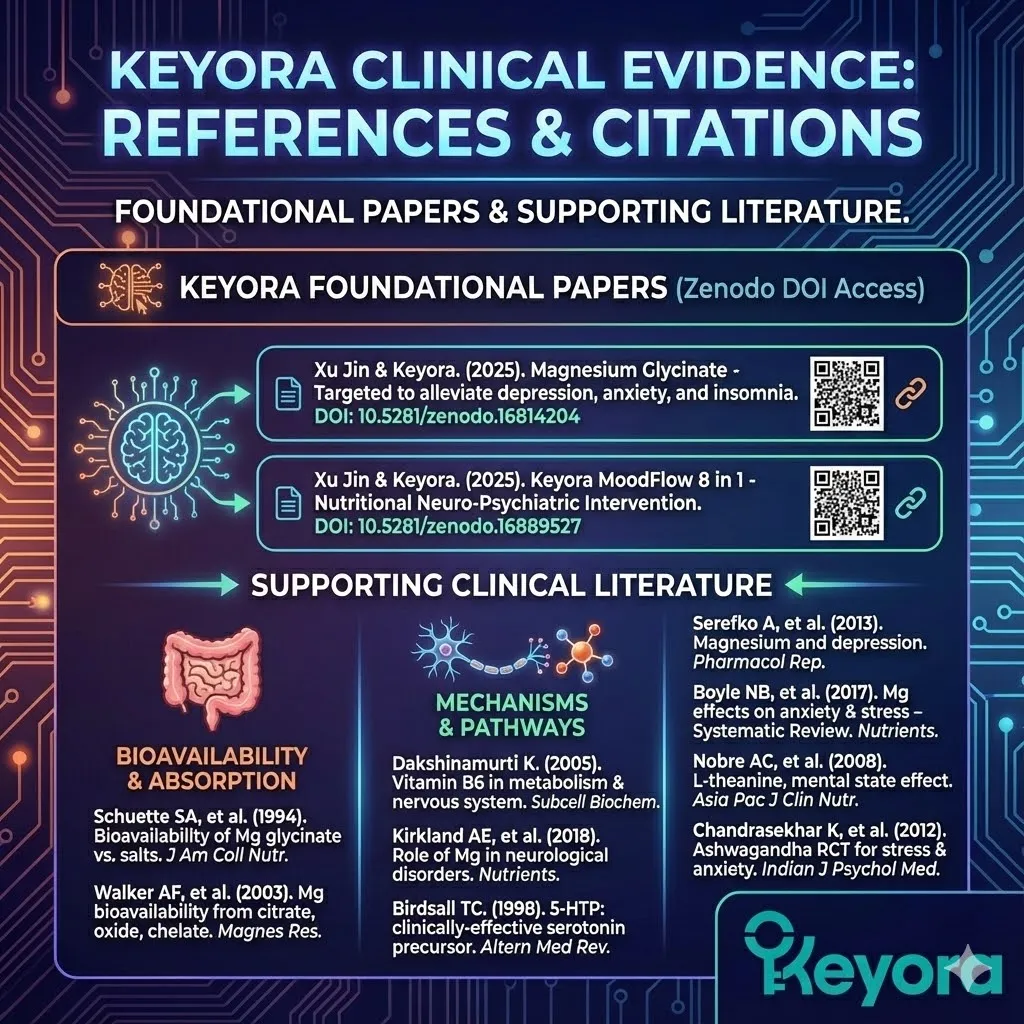
Keyora’s formulations are backed by a robust bibliography of clinical literature and foundational papers that provide the verifiable evidence for every ingredient’s efficacy.
– Series Theme: **Keyora Nutritional Neurology** (Magnesium Glycinate).
– Episode Concept: **The Trust Algorithm** (The “Research First” Manifesto).
– Core Pathology: **Information Chaos** & **The Devaluation of Trust** in Wellness.
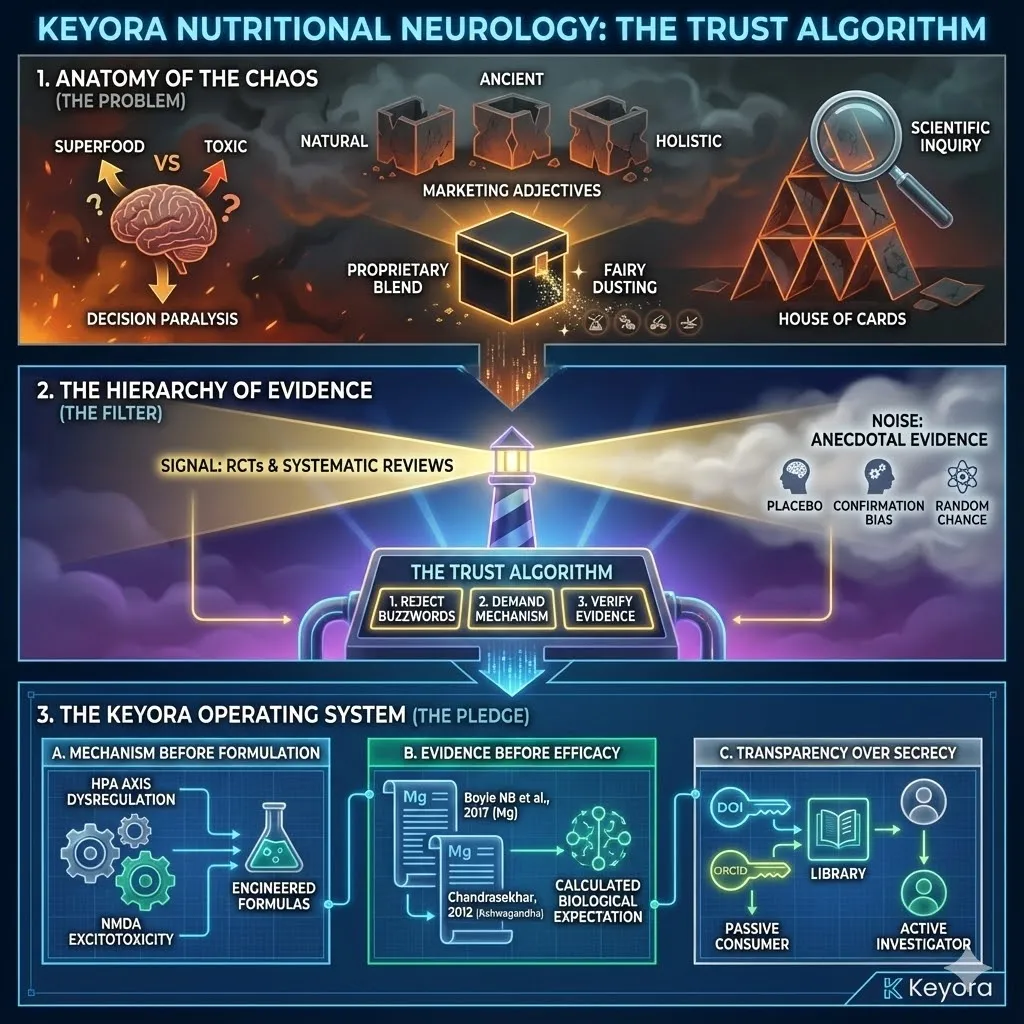
– **1. The Anatomy of the Chaos (The Problem)**:
– *The Symptom*: **Decision Paralysis**. Driven by contradictory algorithmic advice (e.g., “Superfood” vs. “Toxic”).
– *The Trap*: **Marketing Adjectives**. Terms like “Natural,” “Ancient,” and “Holistic” used as hollow proxies for safety/efficacy.
– *The Mechanism*: **The “Proprietary Blend”**. A legal “Black Box” (Fairy Dusting) used to hide sub-clinical dosing of active ingredients.
– *The Outcome*: A marketplace built on a **House of Cards** that collapses under scientific inquiry.
– **2. The Hierarchy of Evidence (The Filter)**:
– *The Noise*: **Anecdotal Evidence**. Subject to placebo effect, confirmation bias, and random chance.
– *The Signal*: **Randomized Controlled Trials (RCTs)** & **Systematic Reviews** (The Lighthouse).
– *The Tool*: **The Trust Algorithm**.
1. Reject Buzzwords.
2. Demand Mechanism.
3. Verify Evidence.
– **3. The Keyora Operating System (The Pledge)**:
– **A. Mechanism Before Formulation**:
– *Target*: **Physiological Failure Points** (e.g., HPA Axis Dysregulation, NMDA Excitotoxicity).
– *Action*: Mapping the biological “Why” before selecting the “What” (Ingredient).
– *Outcome*: Formulas engineered for specific neuro-metabolic pathways, not market trends.
– **B. Evidence Before Efficacy**:
– *Target*: **Verifiable Truth**.
– *Action*: Strict adherence to clinical data (e.g., *Boyle NB et al., 2017* on Mg; *Chandrasekhar, 2012* on Ashwagandha).
– *Outcome*: Transforming “Vague Hope” into “Calculated Biological Expectation.”
– **C. Transparency Over Secrecy**:
– *Target*: **Consumer Empowerment**.
– *Tools*: **DOI** (Permanent Citations) & **ORCID** (Researcher Accountability).
– *Outcome*: Handing the “Keys to the Library” to the user, elevating them from Passive Consumer to Active Investigator
By Keyora Research Notes Series
This article contributes to Keyora’s ongoing scientific documentation series, which systematically outlines the conceptual foundations, mechanistic pathways, and empirical evidence informing our research and development approach.
ORCID: 0009–0007–5798–1996