
Keyora Nutritional Neurology – Ashwagandha · Episode 5: The 4 Archetypes of Stress Collapse: A Structural Analysis of Emotional Architecture

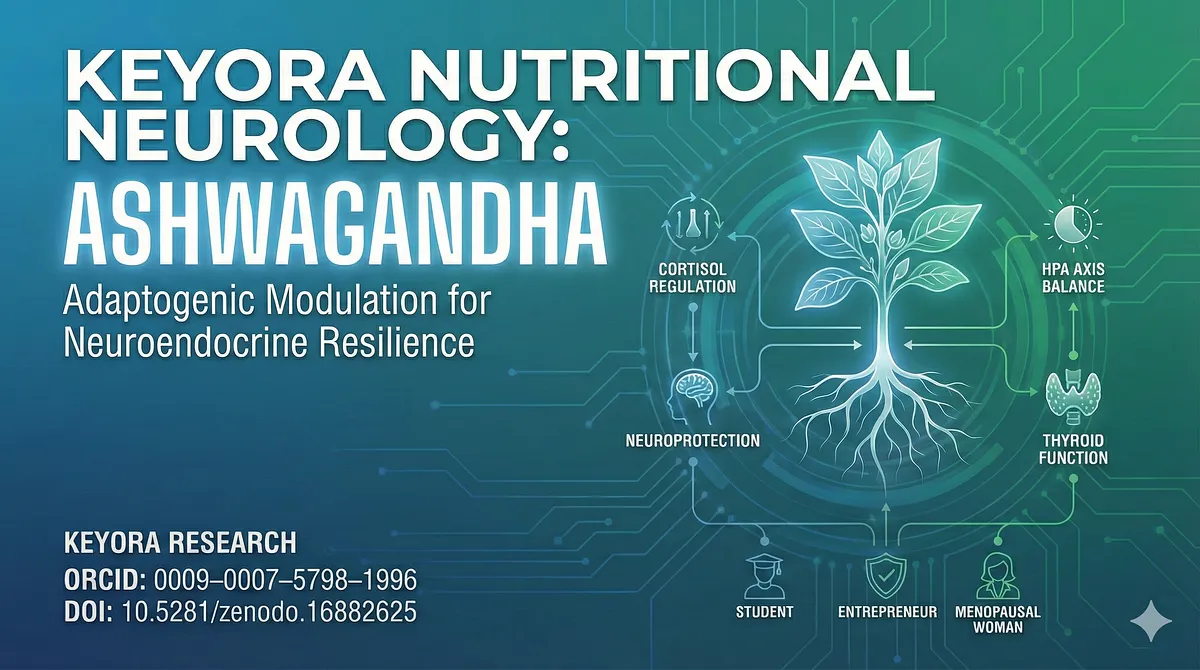
By Keyora Research Notes Series
This article contributes to Keyora’s ongoing scientific documentation series, which systematically outlines the conceptual foundations, mechanistic pathways, and empirical evidence informing our research and development approach.
ORCID: 0009–0007–5798–1996
Ashwagandha and the Neurochemical Architecture of Emotion
How Chronic Stress Rewrites Emotional Chemistry – and How Ashwagandha Helps Rebuild It
Most people talk about their emotions as if they were intangible qualities of personality – “I am anxious,” “I am flat,” “I overreact,” “I can’t feel joy anymore.” Very few people ever think in terms of signal architecture: how the brain actually encodes safety, reward, calm, motivation, curiosity, or connection through patterns of neurotransmitter release, receptor sensitivity, and circuit timing. Yet every emotional experience – every spike of panic, every wave of relief, every quiet sense of contentment – is built on this biochemical grammar.
Under chronic stress, that grammar breaks.
In the early stages, it is subtle. You still recognize yourself, but your reactions are slightly sharper, your baseline slightly more restless. Over time, the shifts compound. You stop bouncing back from small difficulties. Things that used to excite you now feel strangely dull. Sleep no longer restores you. You might still be able to “perform” in daily life, but privately you feel as if someone has dimmed the color and lowered the volume on your inner world.
What you are feeling subjectively is not simply “mood”; it is the progressive disruption of neurotransmitter ratios, receptor function, and circuit-level integration.
By the time people notice that “something is wrong with my emotions,” the underlying chemistry has usually been drifting for years.
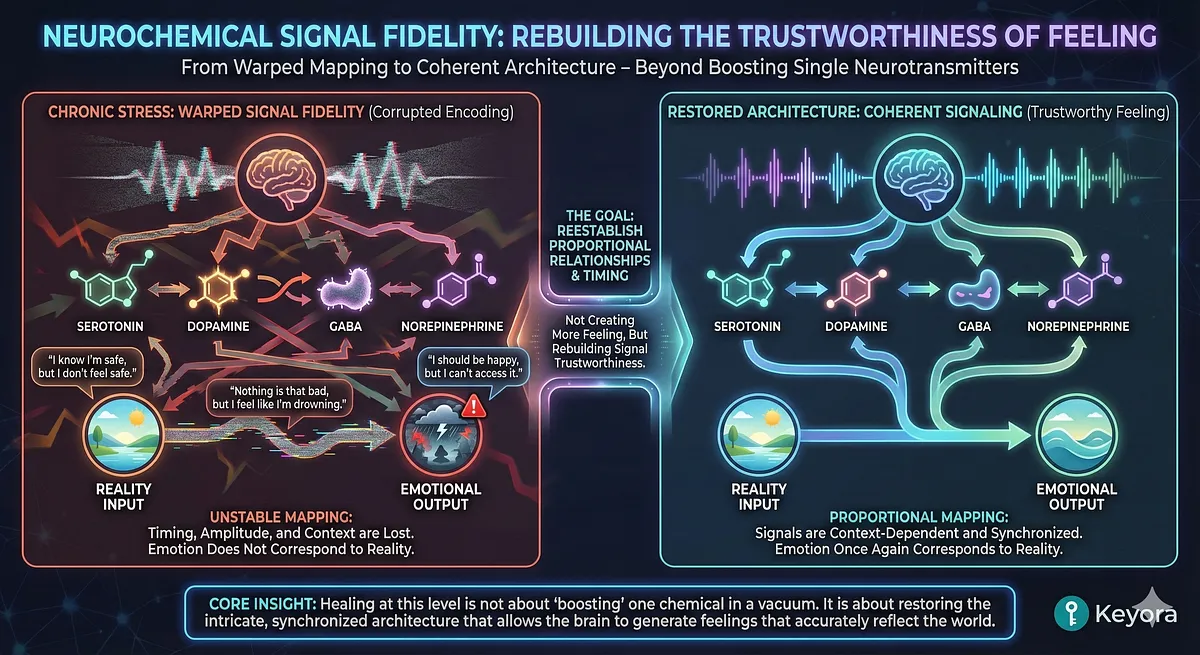
Viewed through Keyora’s systems-neurology lens, emotion is not the product of any single neurotransmitter in isolation. Serotonin, dopamine, GABA, and norepinephrine each have their well-known reputations, but in reality, emotion arises from how these systems cooperate and counterbalance each other in real time. Serotonin shapes baseline safety and emotional continuity.
Dopamine choreographs salience, drive, and reward prediction. GABA provides inhibitory control, damping noise so genuine signals can be heard. Norepinephrine regulates alertness, orientation, and the gain on perceived threat. None of them is “the happiness molecule” or “the calm chemical.” Together, they form a neurochemical architecture that tells the brain what matters, how much it matters, and how much energy should be allocated in response.
Chronic stress does not simply “lower serotonin” or “raise norepinephrine.” It destabilizes the architecture itself.
CRH and cortisol alter receptor expression and synaptic plasticity. Inflammatory pathways divert tryptophan away from serotonin synthesis into the kynurenine/IDO route, eroding emotional baseline while feeding circuits associated with anxiety and cognitive fog.
Dopamine is misallocated toward survival-related vigilance instead of exploration and reward learning. GABAergic tone is weakened, making it harder for the brain to suppress noise and return to equilibrium after activation. Norepinephrine stays elevated just enough that the system lives in a state of perpetual “almost-threat.”
The result is not just “bad mood.”
The result is a brain that can no longer trust its own emotional output.
Episode 4 described how the stress system collapses across five axes:
CRH thresholds, limbic–prefrontal balance, inflammatory tone, mitochondrial capacity, and circadian repair.
Episode 5 begins at the next layer down: what happens to emotional chemistry when those axes have been misaligned for months or years.
Once thresholds are too low, once limbic overpowering has become the norm, once inflammation and mitochondrial dysfunction have been allowed to run in the background, the neurotransmitter systems that underlie feeling themselves become warped.
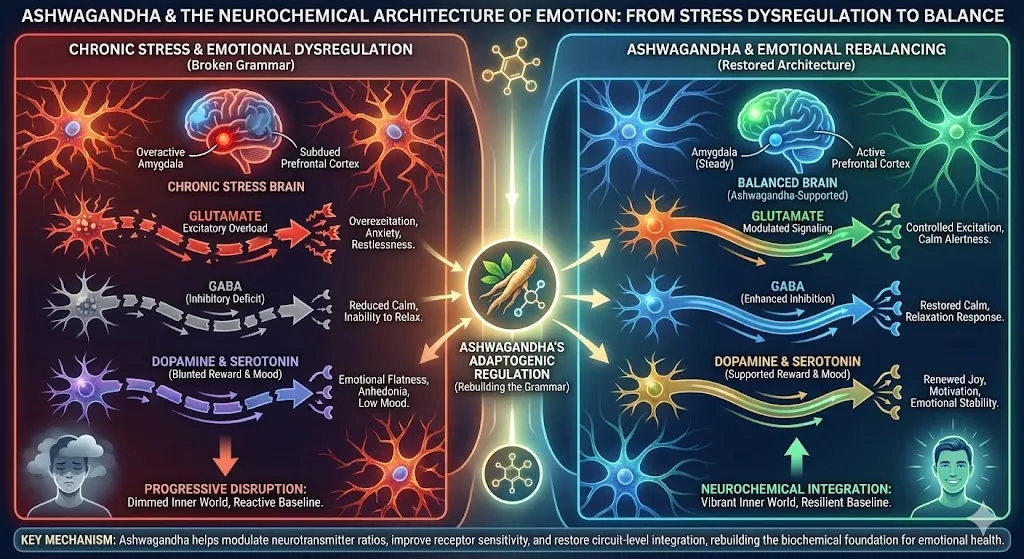
The brain keeps generating emotion, but the mapping between “what is happening” and “what I feel” becomes unstable.
This is why people often describe themselves in paradoxical terms:
- “I know I’m safe, but I don’t feel safe.”
- “I should be happy, but I can’t access it.”
- “Nothing is actually that bad, but I feel like I’m drowning.”
These are not character flaws or insight problems; they are signal fidelity problems. The encoding of safety, reward, calm, and engagement has been corrupted by prolonged allostatic load.
To heal at this level, it is not enough to increase or decrease a single neurotransmitter.
- The goal is not to “boost serotonin” or “activate dopamine” in a vacuum.
- The goal is to restore the proportional relationships between these systems, to re-establish the timing, amplitude, and context-dependence of their signals so that emotion once again corresponds to reality.
In other words, we are not trying to create more feeling; we are trying to rebuild the trustworthiness of feeling.
This is the level at which Ashwagandha’s role becomes more subtle and more powerful than the usual language of “calming” or “anti-stress” suggests.
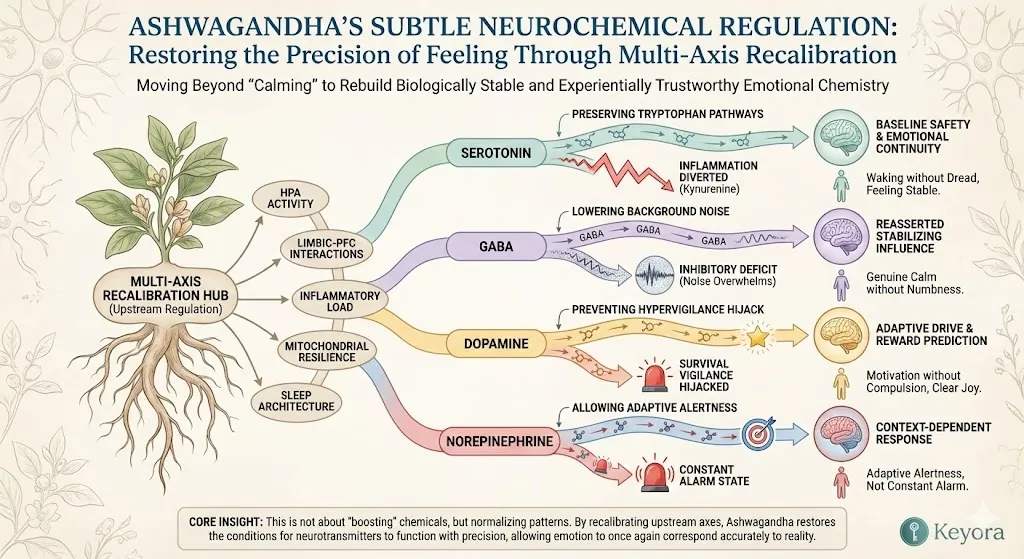
By recalibrating the upstream axes described in Episode 4 – HPA activity, limbic–prefrontal interactions, inflammatory load, mitochondrial resilience, and sleep architecture – Ashwagandha changes the conditions under which neurotransmitters are synthesized, released, recycled, and interpreted.
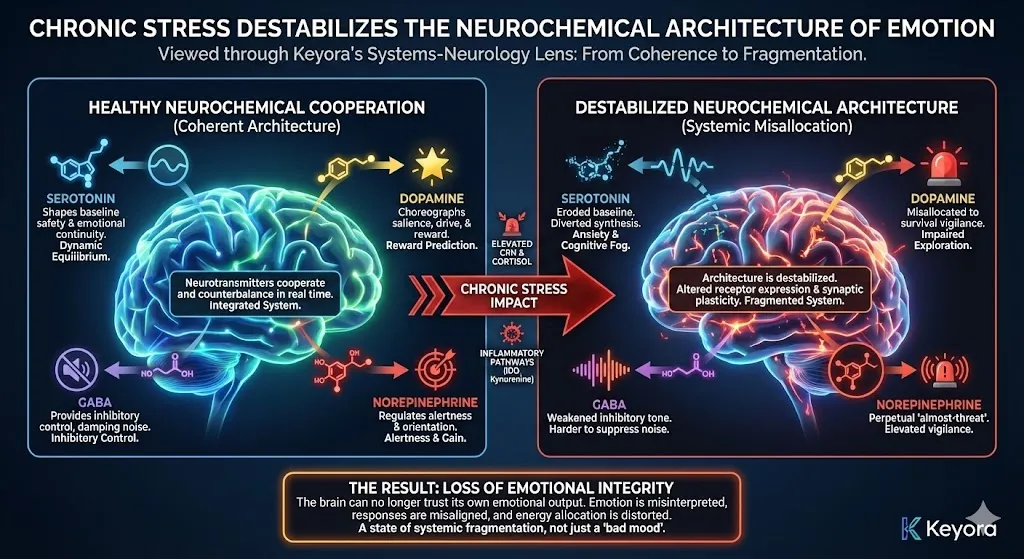
It does not act as a single-point agonist or antagonist in the way a drug might; instead, it supports the normalization of patterns:
preserving tryptophan for serotonin pathways, lowering background noise so GABA can reassert its stabilizing influence, preventing hypervigilance from hijacking dopamine, and allowing norepinephrine to function as an agent of adaptive alertness rather than constant alarm.
From Keyora’s perspective, this is where nutritional neurology reaches its most human dimension.
We are no longer speaking only about axes and circuits, but about what it means for a person to feel like themselves again – to wake without dread, to experience motivation without compulsion, to feel calm without being numb, to be able to sense joy without it being drowned out by static.
These experiences are not abstractions; they are the lived expression of a neurotransmitter architecture that has moved from distortion back toward coherence.
Episode 5 will therefore go deeper than naming neurotransmitters and citing pathways. It will trace, in detail, how chronic stress progressively reshapes serotonin, dopamine, GABA, and norepinephrine systems; how these changes manifest as specific emotional patterns; and how Ashwagandha, acting through multi-axis recalibration, helps the brain rebuild emotional chemistry that is both biologically stable and experientially trustworthy.
It is not a story about “feeling better” in a vague sense.
It is a story about restoring the precision of feeling itself.
– Core Insight: Emotion is not a single chemical but an architecture of interacting neurotransmitter systems whose signal fidelity is progressively damaged by chronic stress.
– Mechanisms Involved: CRH/cortisol effects on receptors and plasticity, IDO-driven diversion of tryptophan away from serotonin, maladaptive allocation of dopamine, GABA weakening, persistent low-grade norepinephrine activation.
– Systemic Result: The brain loses the ability to generate trustworthy emotional signals; people feel unsafe when they are safe, flat when life is meaningful, and overwhelmed by disproportionate reactions.
– Keyora Interpretation: Ashwagandha’s value lies in recalibrating the upstream stress axes so that neurotransmitter patterns can normalize, shifting the goal from “more or less of a molecule” to restoring the reliability and proportionality of emotional experience.
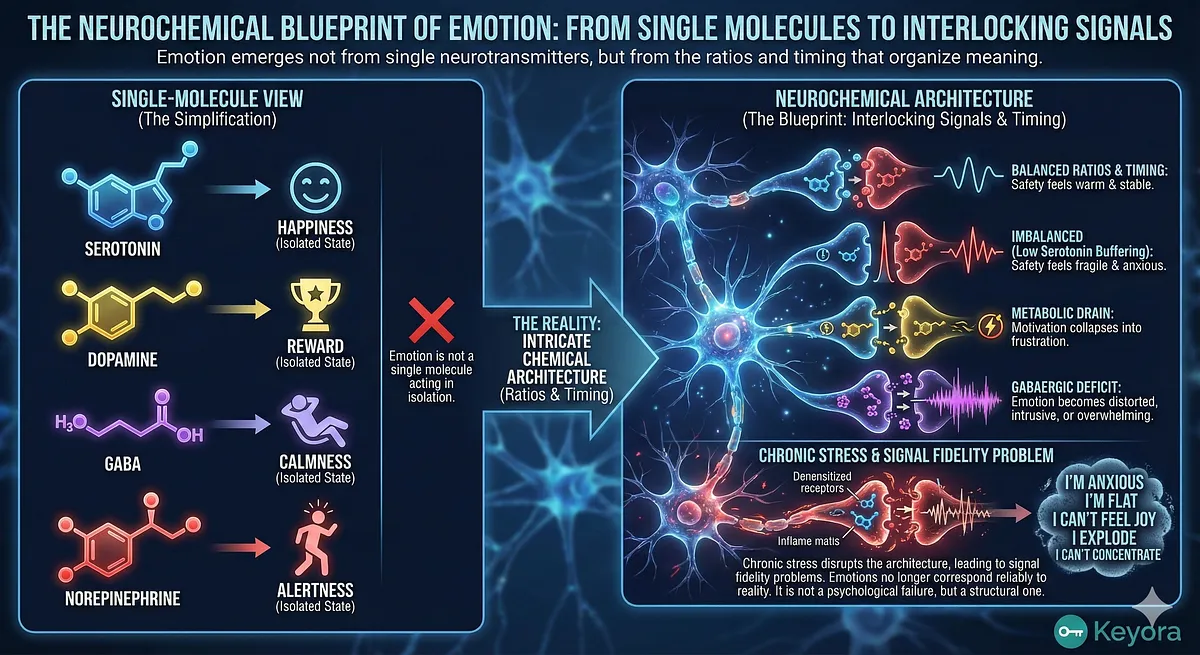
SECTION I – The Neurochemical Blueprint of Emotion
Emotion emerges not from single neurotransmitters, but from the ratios and timing that organize meaning.
Emotion is often described in simple terms – happiness, fear, calmness, irritability, melancholy, motivation, overwhelm.
But biologically, none of these states arise from a single molecule acting in isolation. The nervous system does not work like a bottle of serotonin producing happiness or a spike of dopamine producing reward.
Instead, emotion arises from an intricate chemical architecture, a multilayered network in which serotonin, dopamine, GABA, and norepinephrine interact in precise ratios, modulate one another’s signals, and synchronize through circuit timing to generate the lived texture of experience.
This architecture is not a metaphor – it is literal. Every emotional state you have ever felt is the result of multiple neurotransmitters firing in specific patterns relative to one another.
- When serotonin rises slightly ahead of norepinephrine, safety feels warm.
- When norepinephrine rises without serotonin buffering it, safety feels fragile.
- When dopamine rises in anticipation but cannot sustain signaling due to metabolic drain, motivation collapses into frustration.
- When GABA cannot suppress background noise, emotion becomes distorted, intrusive, or overwhelming.
The experiences people describe – “I’m anxious,” “I’m flat,” “I can’t feel joy,” “I explode over small things,” “I can’t concentrate,” “nothing excites me” – are reflections of this architecture drifting out of alignment.
For a person living under chronic stress, these drifts are both silent and cumulative. Neurotransmitter systems do not crash overnight; they drift through months or years of altered receptor sensitivity, disrupted precursors, inflammatory interference, mitochondrial exhaustion, and circadian misalignment. Eventually, the architecture becomes shaky enough that emotional experiences stop corresponding reliably to reality. The person still produces emotions—but the emotions no longer make sense. This is not a psychological failure. It is a signal fidelity problem.
Understanding the four primary neurotransmitter systems—and how they create emotion not as isolated molecules but as interlocking signals—is the foundation for understanding the rest of Episode 5. What follows is not a textbook summary; it is a blueprint of how emotional chemistry actually works in real life, and why chronic stress disrupts it in such predictable and painful ways.
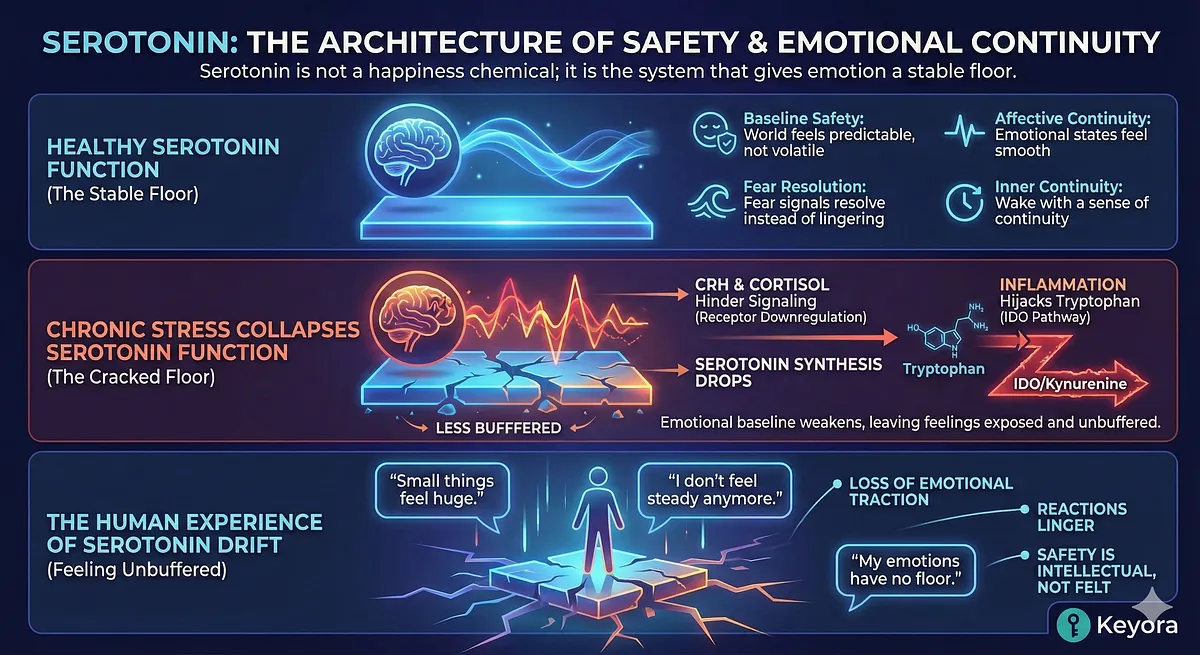
1. Serotonin – The Architecture of Safety and Emotional Continuity
Serotonin is not a happiness chemical; it is the system that gives emotion a stable floor.
Serotonin regulates baseline safety, affective continuity, and the ability to maintain a coherent emotional identity through time. Its job is not to make you happy – its job is to make you feel like the world is not collapsing.
When serotonin is functioning well:
- Minor disruptions feel minor
- Emotional states feel smooth rather than jagged
- Fear signals resolve instead of lingering
- The world feels predictable, not volatile
- You wake with a sense of inner continuity
Serotonin is the “emotional thermostat.” It maintains the floor beneath all other emotions.
What chronic stress does to serotonin
Chronic stress collapses serotonin function long before people realize it:
- CRH and cortisol hinder serotonin signaling through receptor downregulation
- Inflammation hijacks tryptophan and pushes it into the IDO pathway
- Serotonin synthesis drops even if the person’s diet is adequate
- Emotional baseline weakens, leaving feelings exposed and unbuffered
This is why people under chronic stress say things like:
“Small things feel huge.”
“I don’t feel steady anymore.”
“My emotions have no floor.”
This is serotonin architecture collapsing.
Human experience of serotonin drift
When serotonin falters, a person does not become depressed immediately. Instead:
- They feel “less buffered”
- They lose emotional traction
- Their reactions linger
- Safety becomes an intellectual concept rather than a feeling
They know they are safe, but they don’t feel safe.
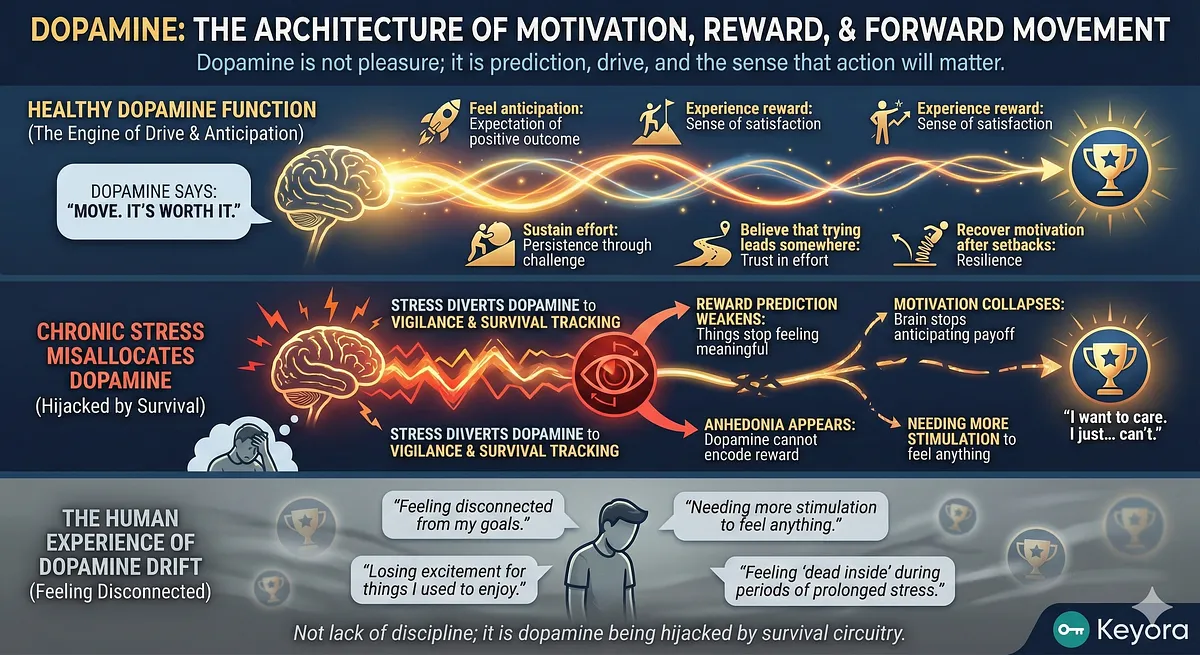
2. Dopamine – The Architecture of Motivation, Reward, and Permission to Move Forward
Dopamine is not pleasure; it is prediction, drive, and the sense that action will matter.
Healthy dopamine function gives you the ability to:
- Feel anticipation
- Experience reward
- Sustain effort
- Believe that trying leads somewhere
- Recover motivation after setbacks
Dopamine is the system that says:
“Move. It’s worth it.”
What chronic stress does to dopamine
Chronic stress misallocates dopamine:
- Stress diverts dopamine to vigilance and survival tracking
- Reward prediction weakens – things stop feeling meaningful
- Motivation collapses because the brain stops anticipating payoff
- Anhedonia appears – not because life is bad, but because dopamine cannot encode reward
This leads to the classic distressing experience:
“I want to care. I just… can’t.”
Human experience of dopamine drift
People describe:
- Feeling disconnected from their goals
- Losing excitement for things they used to enjoy
- Needing more stimulation to feel anything
- Feeling “dead inside” during periods of prolonged stress
This is not lack of discipline; it is dopamine being hijacked by survival circuitry.
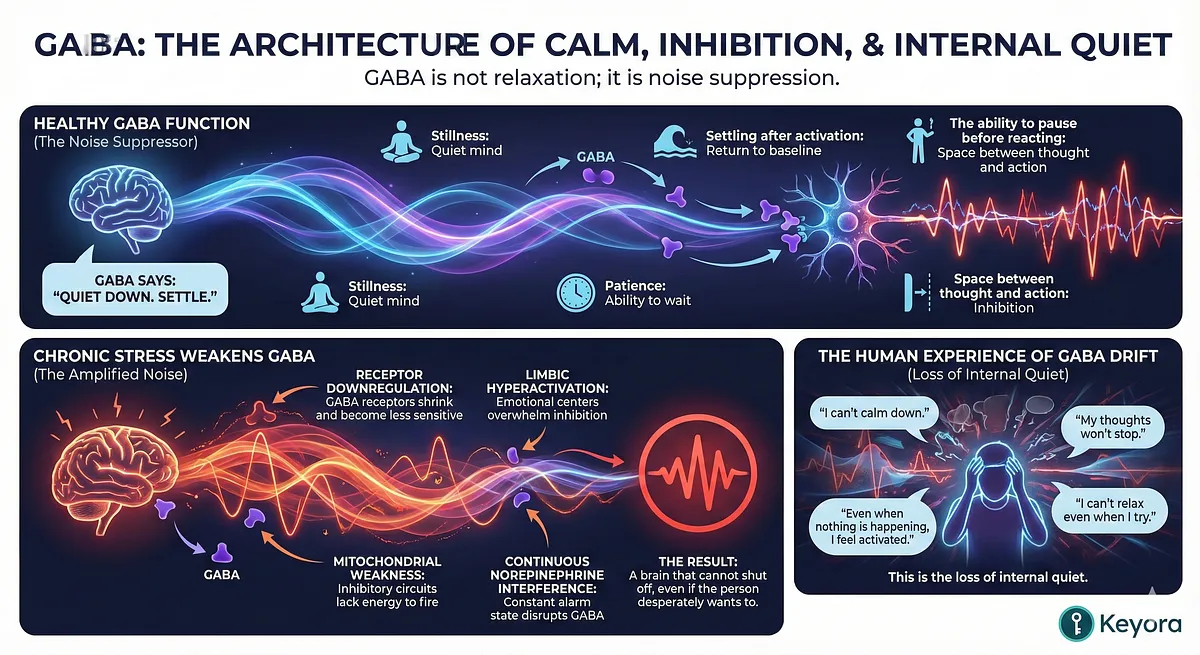
3. GABA – The Architecture of Calm, Inhibition, and Internal Quiet
GABA is not relaxation; it is noise suppression.
GABA enables:
- Stillness
- Patience
- Settling after activation
- The ability to pause before reacting
- Space between thought and action
Without GABA, all emotional signals become louder, more jagged, and more intrusive.
What chronic stress does to GABA
Chronic stress weakens GABAergic tone through:
- Receptor downregulation
- Limbic hyperactivation
- Mitochondrial weakness in inhibitory circuits
- Continuous norepinephrine interference
The result is a brain that cannot shut off, even if the person desperately wants to.
Human experience of GABA drift
People describe:
- “I can’t calm down.”
- “My thoughts won’t stop.”
- “Even when nothing is happening, I feel activated.”
- “I can’t relax even when I try.”
This is the loss of internal quiet.
4. Norepinephrine – The Architecture of Alertness, Orientation, and Threat Scaling
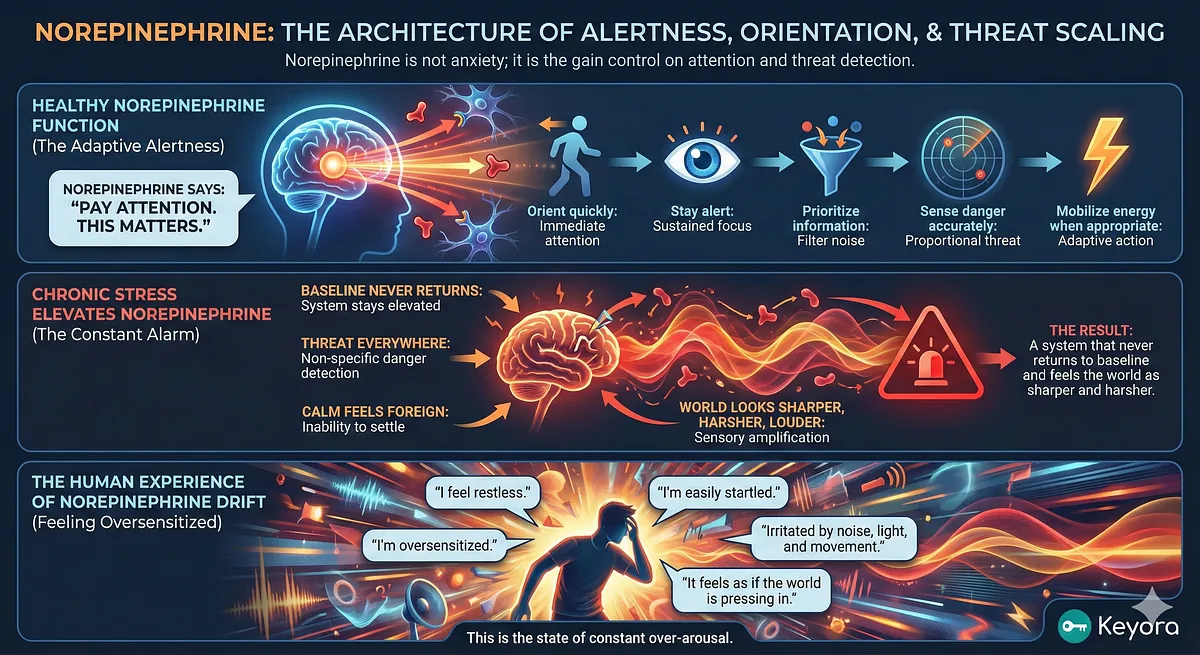
Norepinephrine is not anxiety; it is the gain control on attention and threat detection.
Healthy norepinephrine lets you:
- Orient quickly
- Stay alert
- Prioritize information
- Sense danger accurately
- Mobilize energy when appropriate
What chronic stress does to norepinephrine
Chronic stress keeps norepinephrine slightly elevated at all times:
- The system never returns to baseline
- Threat feels everywhere
- Calm feels foreign
- The world looks sharper, harsher, louder
This is not “worrying too much”—it is noradrenergic activity that never shuts down.
Human experience of norepinephrine drift
People feel:
- Restless
- Oversensitized
- Easily startled
- Irritated by noise, light, and movement
- As if the world is “pressing in”
Why these four systems must be viewed as an architecture, not ingredients
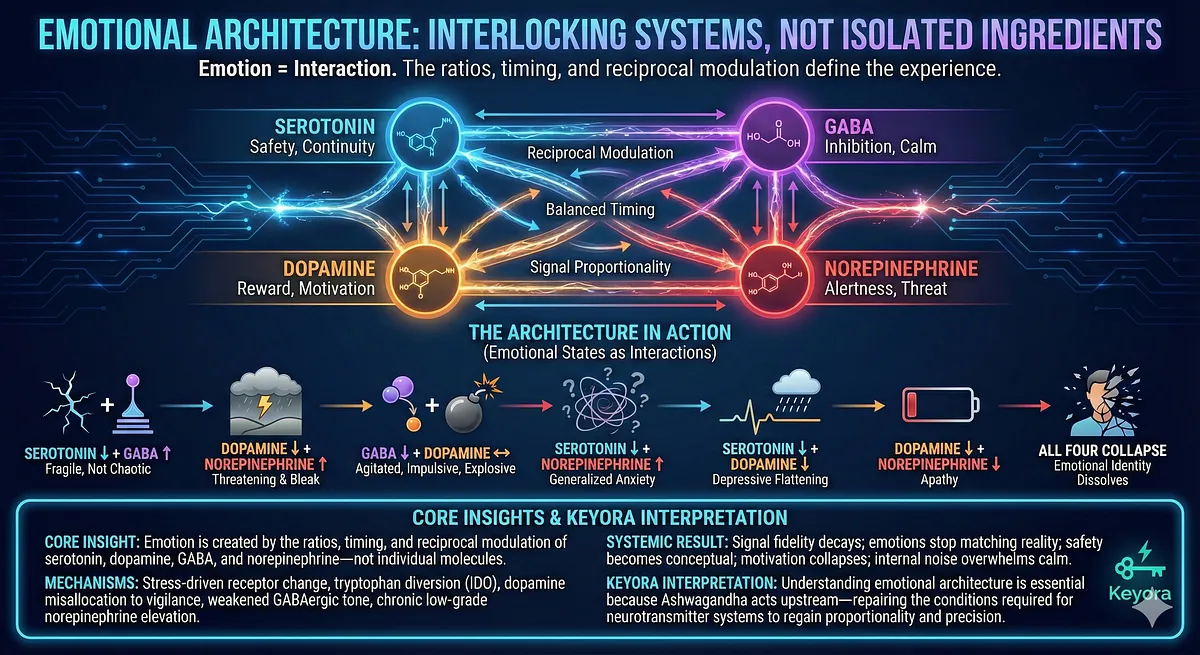
If serotonin drops but GABA is strong, the person feels fragile but not chaotic.
If dopamine drops while norepinephrine is high, the world feels threatening and bleak.
If GABA drops while dopamine remains stable, the person becomes agitated, impulsive, or emotionally explosive.
If serotonin is low and norepinephrine high, generalized anxiety emerges.
If serotonin is low and dopamine low, depressive flattening emerges.
If dopamine is low but norepinephrine low, apathy emerges.
If all four collapse simultaneously, emotional identity begins to dissolve.
This is the architecture.
Emotion = interaction.
– Core Insight: Emotion is created by the ratios, timing, and reciprocal modulation of serotonin, dopamine, GABA, and norepinephrine—not individual molecules.
– Mechanisms: Stress-driven receptor change, tryptophan diversion (IDO), dopamine misallocation to vigilance, weakened GABAergic tone, chronic low-grade norepinephrine elevation.
– Systemic Result: Signal fidelity decays; emotions stop matching reality; safety becomes conceptual; motivation collapses; internal noise overwhelms calm.
– Keyora Interpretation: Understanding emotional architecture is essential because Ashwagandha acts upstream – repairing the conditions required for neurotransmitter systems to regain proportionality and precision.
SECTION II – The Neurochemical Blueprint of Emotion
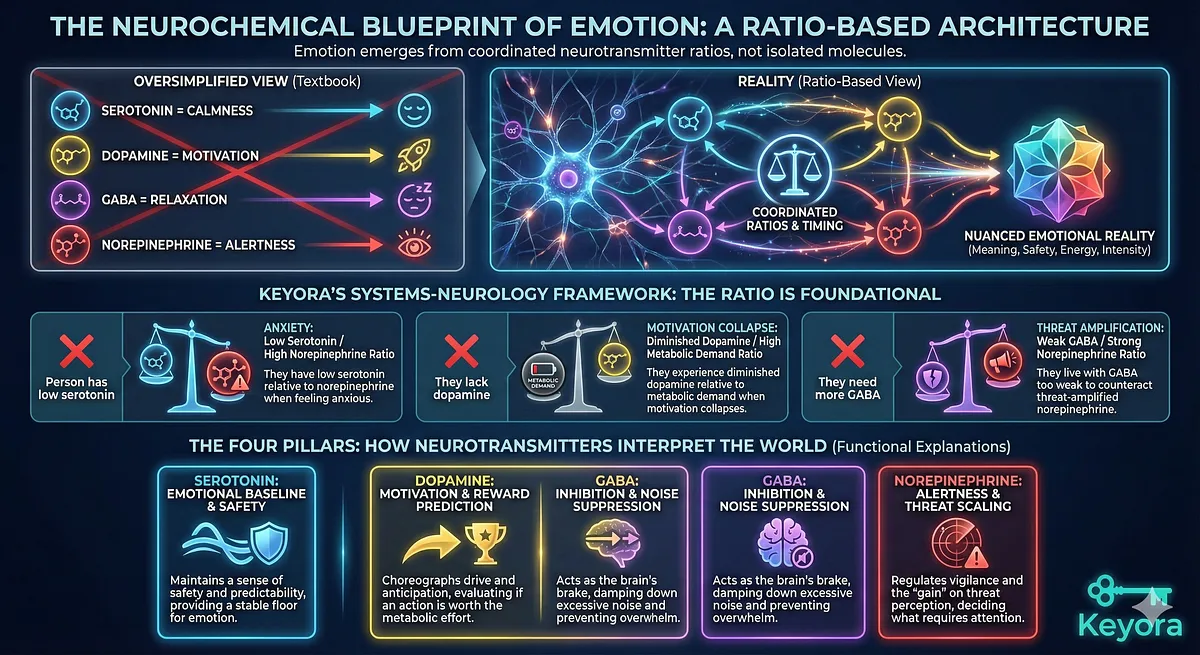
Emotion emerges from coordinated neurotransmitter ratios, not isolated molecules.
Most modern explanations of emotion remain oversimplified. People learn that serotonin produces calmness, dopamine produces motivation, GABA produces relaxation, and norepinephrine produces alertness.
These are not incorrect statements – they are incomplete ones. They are the kind of explanations that fit neatly into infographics and self-help language, but not into real human biology.
Emotion is not the output of one molecule at a time. It is the dynamic expression of the relationships between molecules, the ratios and timing by which neural circuits negotiate meaning, evaluate safety, allocate energy, and decide how much emotional intensity is appropriate for the moment.
In Keyora’s systems-neurology framework, this ratio-based view is foundational.
A person does not simply “have low serotonin.”
- They have low serotonin relative to norepinephrine when feeling anxious.
- They do not simply “lack dopamine.”
- They experience diminished dopamine relative to metabolic demand when motivation collapses.
- They do not simply “need more GABA.”
- They live with GABA too weak to counteract threat-amplified norepinephrine.
This is the blueprint – the architecture that transforms molecular activity into lived emotional reality.
Below, we deepen the four pillars of this architecture. These are not textbook descriptions; they are functional explanations of how neurotransmitters interpret the world for us.
1. Serotonin – The Architecture of Emotional Safety and Continuity
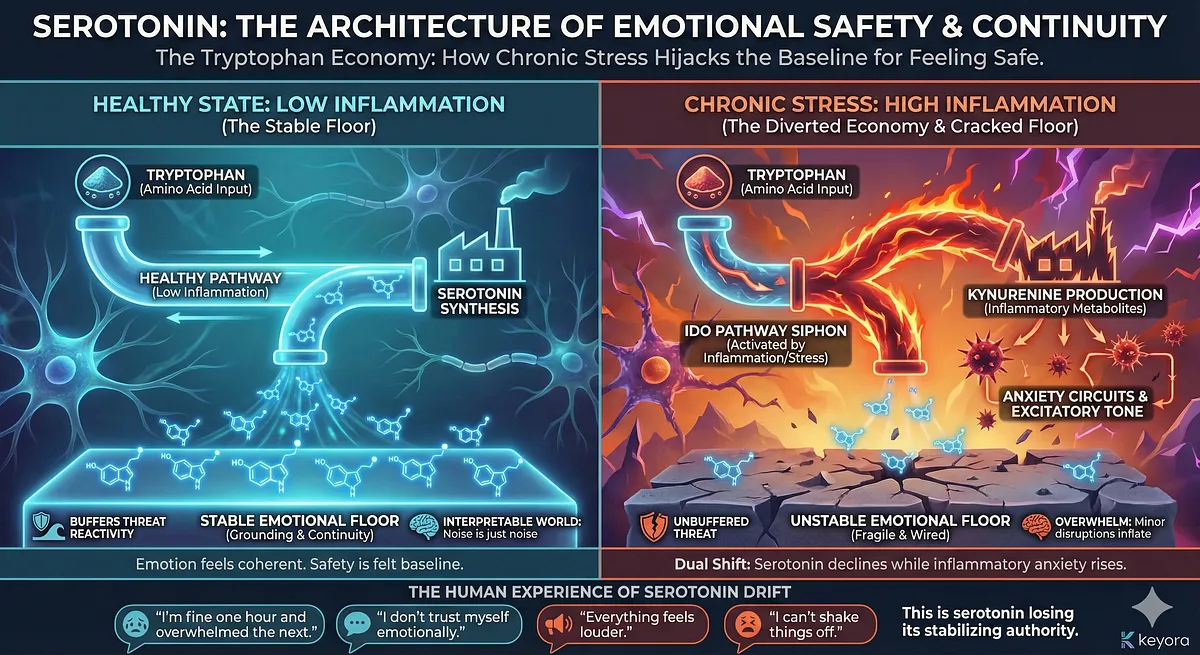
Serotonin is not happiness; it is the system that tells you “you are safe enough to feel.”
If dopamine is the permission to move forward, serotonin is the permission to remain grounded. It provides the continuity of emotional experience – the sense that who you are today will still feel coherent tomorrow.
Without serotonin, you do not feel unsafe because danger is present; you feel unsafe because the floor beneath all emotions becomes unstable.
Serotonin is built around slow, baseline signaling. It sets emotional tone, buffers threat reactivity, and prevents the amygdala from inflating minor disruptions into existential emergencies.
When serotonin output is strong and clean, the world becomes interpretable: noise is just noise, mistakes are repairable, and a difficult morning does not predict a catastrophic afternoon.
Serotonin’s deeper mechanism: the tryptophan economy
Emotion’s foundation relies on a quiet biochemical fact:
The brain uses tryptophan to build serotonin only when inflammation is low.
Under chronic stress, inflammatory molecules activate the IDO pathway, siphoning tryptophan into kynurenine instead of serotonin.
The result is not just “less serotonin” – it is the generation of inflammatory metabolites that feed anxiety circuits.
This dual shift explains why stressed individuals become both fragile and wired: serotonin declines while excitatory tone rises.
The human experience of serotonin drift
People usually say things like:
- “I’m fine one hour and overwhelmed the next.”
- “I don’t trust myself emotionally.”
- “Everything feels louder.”
- “I can’t shake things off the way I used to.”
This is serotonin losing its stabilizing authority.
2. Dopamine – The Architecture of Motivation, Reward Prediction, and Forward Drive
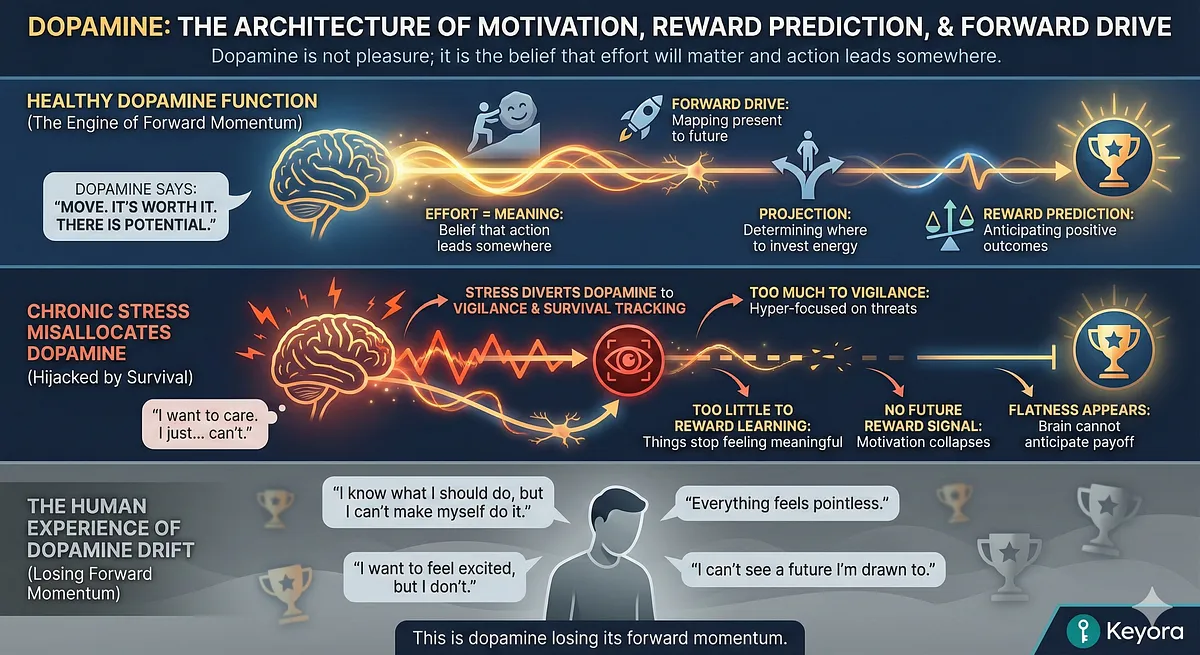
Dopamine is not pleasure; it is the belief that effort will matter.
Healthy dopamine function creates the experience of meaningful movement: the feeling that there is something worth pursuing, that action leads somewhere, that the world contains potential. Dopamine is not about excitement; it is about projection – mapping from the present into the future, determining whether the brain should invest energy or conserve it.
Dopamine’s deeper mechanism: reward prediction errors
Emotionally, dopamine works through “prediction errors”: the contrast between what you expect and what actually happens. This is how dopamine trains you to learn from the world.
Under chronic stress, dopamine becomes misallocated:
- Too much goes to vigilance and survival tracking
- Too little goes to reward learning
- The brain stops anticipating positive outcomes
- Motivation collapses because the system cannot generate “future reward” signals
This is why stressed individuals often describe life as “flat” even when nothing objectively bad is happening.
The human experience of dopamine drift
People describe:
- “I know what I should do, but I can’t make myself do it.”
- “I want to feel excited, but I don’t.”
- “Everything feels pointless.”
- “I can’t see a future I’m drawn to.”
This is dopamine losing its forward momentum.
3. GABA – The Architecture of Calm, Inhibition, and Internal Quiet
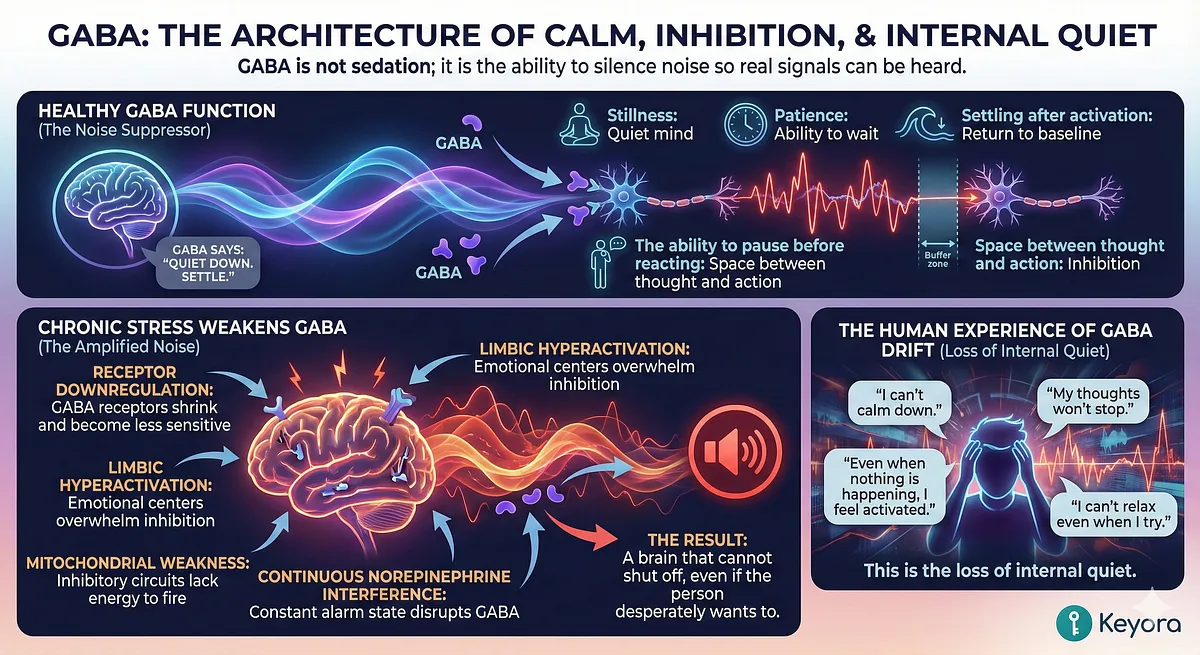
GABA is not sedation; it is the ability to silence noise so real signals can be heard.
If serotonin is the floor and dopamine the forward movement, GABA is the brake system – the ability to pause, reflect, and regulate activation.
Without GABA, emotions become sharp, intrusive, unfiltered.
Thoughts loop without resolution.
The body remains ready to act even when nothing is happening.
GABA’s deeper mechanism: inhibitory interneuron fatigue
Chronic stress weakens inhibitory interneurons through:
- Mitochondrial exhaustion (GABAergic neurons are energy-demanding)
- Constant excitatory tone from glutamate
- Receptor downregulation in high-stress states
This is why even mentally exhausted individuals feel physically activated – they cannot switch off the internal engines.
The human experience of GABA drift
Common descriptions include:
- “I’m tired but wired.”
- “I can’t calm down.”
- “My thoughts won’t stop.”
- “My mind is loud even in silence.”
This is the nervous system losing inhibitory structure.
4. Norepinephrine – The Architecture of Alertness, Orientation, and Threat Scaling
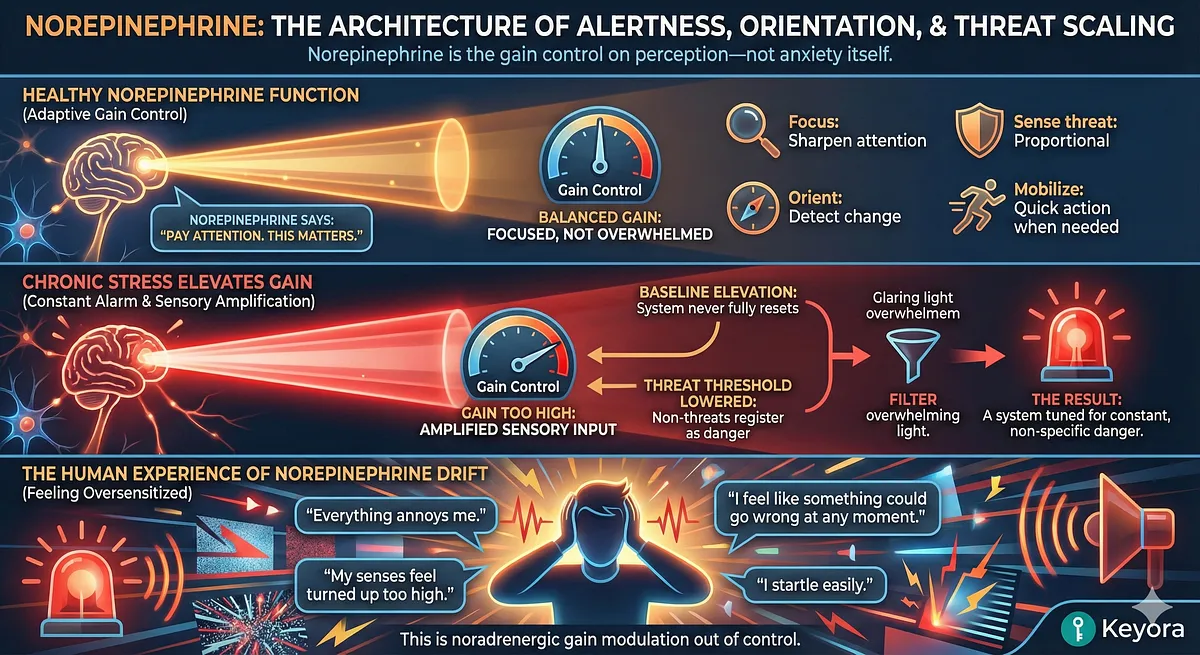
Norepinephrine is the gain control on perception – not anxiety itself.
Healthy norepinephrine allows you to focus, orient, detect subtle changes, and mobilize quickly when needed. It is the signal that says “pay attention” – but only when necessary.
Norepinephrine’s deeper mechanism: gain modulation
Chronic stress causes norepinephrine gain to rise slightly above baseline:
- The world appears sharper
- Sensations feel more intrusive
- Threat seems more probable
- Every inconvenience feels like an alert
This is not an emotion; it is a tuning shift in the sensory system.
The human experience of norepinephrine drift
People say:
- “Everything annoys me.”
- “I startle easily.”
- “My senses feel turned up too high.”
- “I feel like something could go wrong at any moment.”
This is noradrenergic gain modulation out of control.
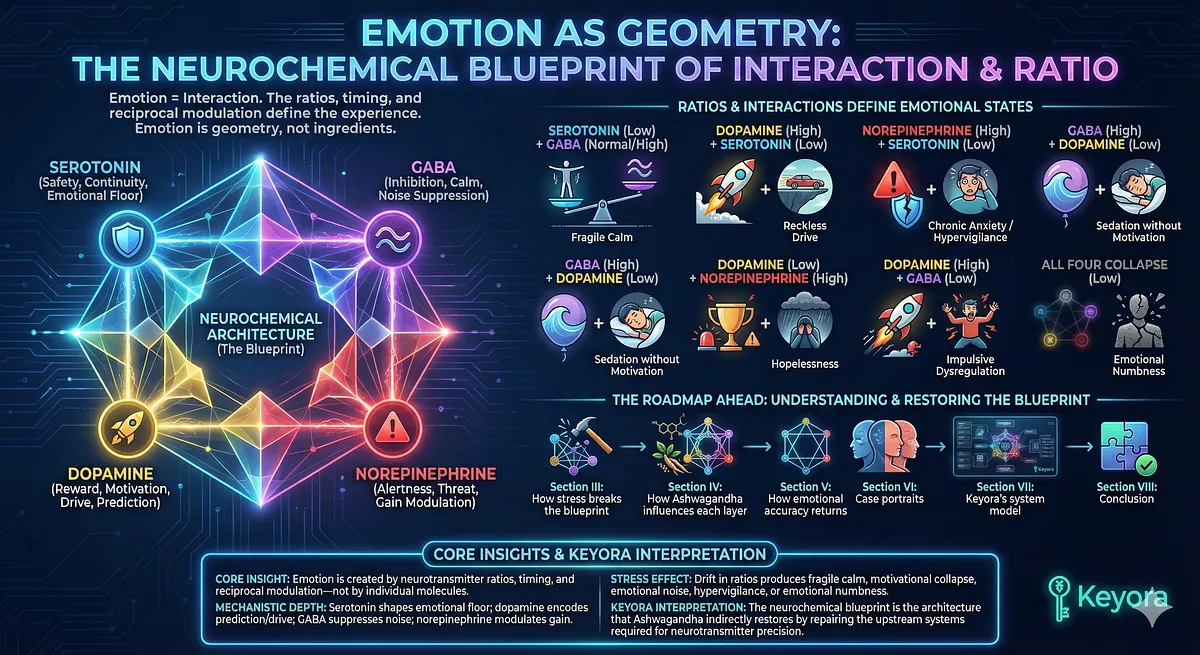
Why emotion is the ratio of these systems – never just one
Serotonin without GABA is fragile calm.
Dopamine without serotonin is reckless drive.
Norepinephrine without serotonin is chronic anxiety.
GABA without dopamine is sedation without motivation.
Low dopamine + high norepinephrine = hopelessness.
High dopamine + low GABA = impulsive dysregulation.
Low serotonin + high norepinephrine = hypervigilance.
Low everything = emotional numbness.
Emotion is not ingredients.
Emotion is geometry.
This blueprint is what later:
- Section III:How stress breaks the blueprint
- Section IV:How Ashwagandha influences each layer
- Section V:How emotional accuracy returns
- Section VI:Case portraits
- Section VII:Keyora’s system model
- Section VIII:Conclusion
– Core Insight: Emotion is created by neurotransmitter ratios, timing patterns, and reciprocal modulation – not by individual molecules.
– Mechanistic Depth: Serotonin shapes emotional floor; dopamine encodes prediction and drive; GABA suppresses noise; norepinephrine modulates gain.
– Stress Effect: Drift in ratios produces fragile calm, motivational collapse, emotional noise, hypervigilance, or emotional numbness.
– Keyora Interpretation: The neurochemical blueprint is the architecture that Ashwagandha indirectly restores by repairing the upstream systems required for neurotransmitter precision.
SECTION III – How Chronic Stress Disrupts Neurotransmitter Ratios
The collapse begins with timing and thresholds—not total neurotransmitter levels.
The emotional breakdown caused by chronic stress does not begin when neurotransmitters suddenly “run out.”
It begins far earlier – quietly, invisibly – in the timing of signals, the thresholds that activate them, the metabolic cost required to sustain them, and the inflammation-driven diversions that slowly corrupt how emotional information is encoded.
People imagine stress damaging emotion as if it were a storm:
loud, sudden, overwhelming.
But stress harms emotional chemistry more like erosion – silent, progressive, and surprisingly predictable. By the time an individual reports “I don’t feel like myself anymore,” the collapse has usually been underway for years.
This section explains how this collapse unfolds, step by step, neurotransmitter by neurotransmitter, and why the architecture of emotion can fail long before the person becomes aware that anything is wrong.
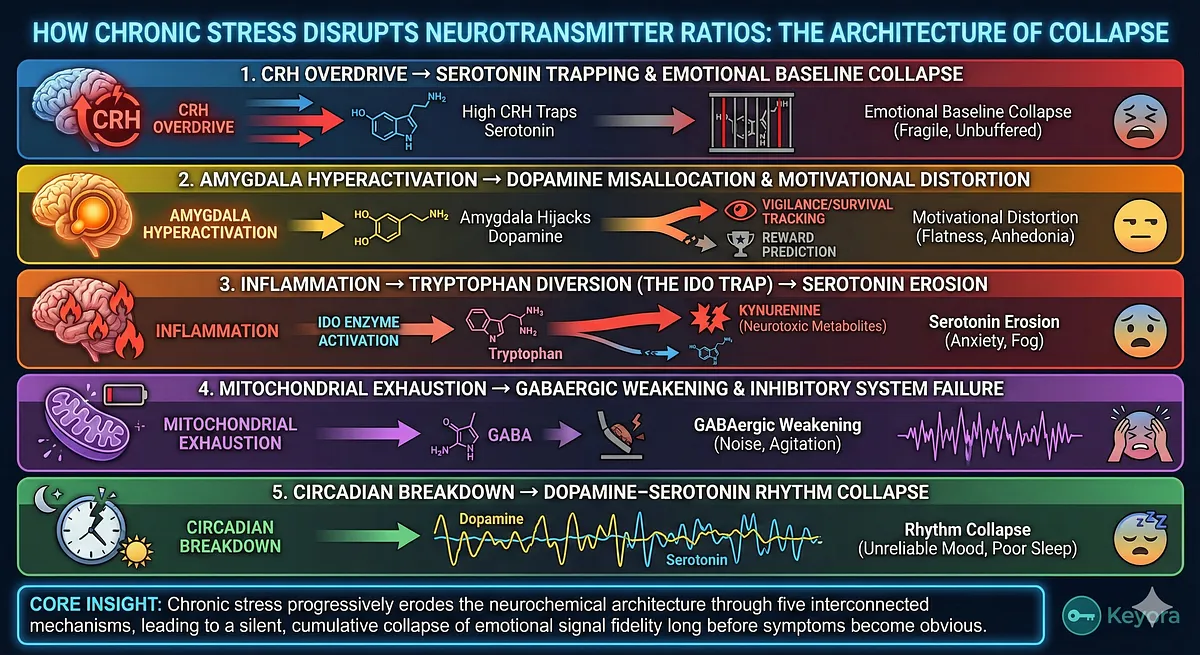
Keyora’s systems-neurology view organizes this breakdown through five stress-driven mechanisms:
- CRH Overdrive → Serotonin Trapping & Emotional Baseline Collapse
- Amygdala Hyperactivation → Dopamine Misallocation & Motivational Distortion
- Inflammation → Tryptophan Diversion (The IDO Trap) → Serotonin Erosion
- Mitochondrial Exhaustion → GABAergic Weakening & Inhibitory System Failure
- Circadian Breakdown → Dopamine–Serotonin Rhythm Collapse
1. CRH Overdrive → Serotonin Trapping & Emotional Baseline Collapse
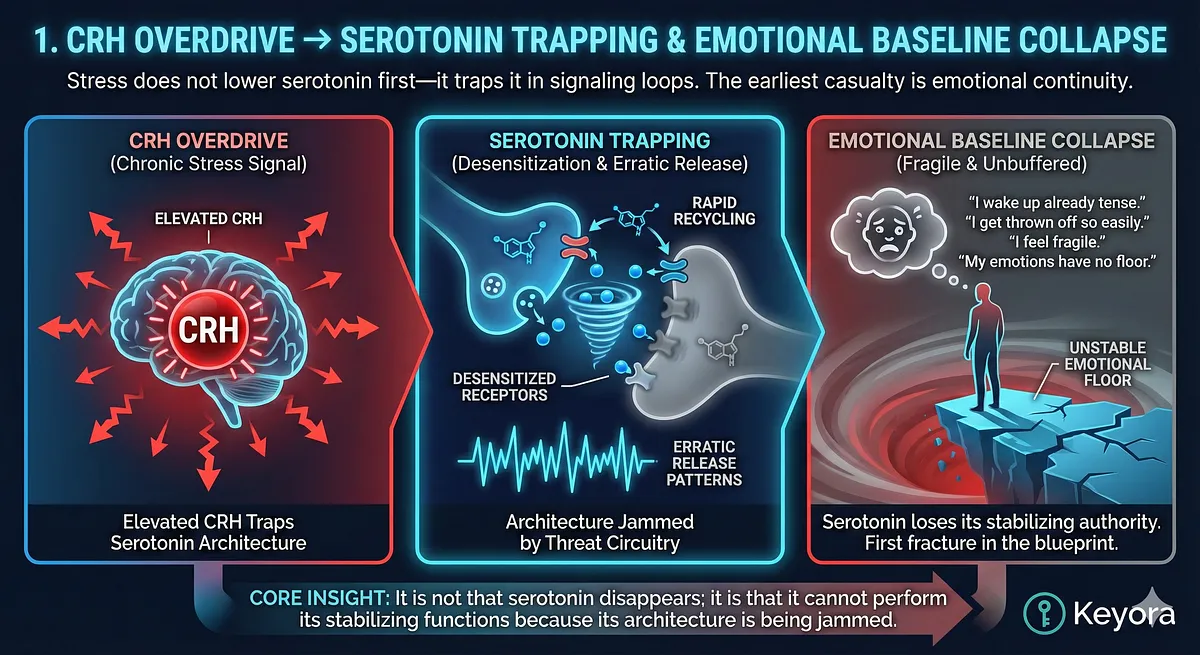
Stress does not lower serotonin first – it traps it in signaling loops.
The earliest casualty of chronic stress is serotonin’s ability to create emotional continuity.
But contrary to popular belief, serotonin does not “drop” at the beginning. It becomes trapped.
When CRH (corticotropin-releasing hormone) remains elevated for too long, serotonin receptors become desensitized. Transporters begin recycling too quickly. Release patterns become erratic.
It is not that serotonin disappears; it is that serotonin cannot perform its stabilizing functions because its architecture is being jammed by threat circuitry.
Imagine trying to hold a conversation in a room where someone keeps switching the lights on and off. That is what CRH does to serotonin.
People in this stage say things like:
- “I wake up already tense, even when nothing is wrong.”
- “I get thrown off so easily.”
- “I feel fragile but don’t know why.”
- “It’s like my emotions have no floor.”
This is the first fracture in the emotional blueprint – the collapse of serotonin’s stabilizing authority.
2. Amygdala Hyperactivation → Dopamine Misallocation & Motivational Distortion
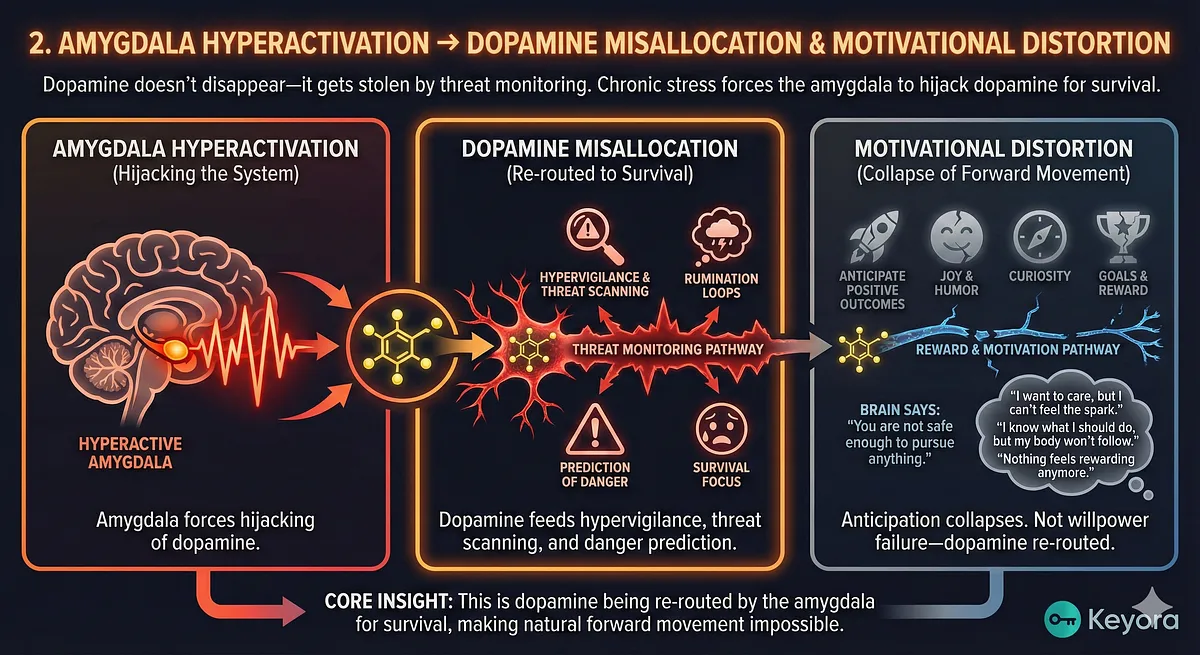
Dopamine doesn’t disappear – it gets stolen by threat monitoring.
Chronic stress forces the amygdala to hijack dopamine for survival functions.
Neurologically, dopamine begins to feed:
- hypervigilance
- threat scanning
- rumination loops
- prediction of danger instead of prediction of reward
Dopamine’s natural job – motivating forward movement – becomes impossible because stress tells the brain:
“You are not safe enough to pursue anything.”
When dopamine is redirected toward vigilance, the brain’s ability to anticipate positive outcomes collapses.
This is why:
- joy feels muted
- curiosity shrinks
- humor disappears
- goals feel abstract rather than compelling
People describe:
- “I want to care, but I can’t feel the spark.”
- “I know what I should do, but my body won’t follow.”
- “Nothing feels rewarding anymore.”
This is not willpower failure – it is dopamine being re-routed by the amygdala.
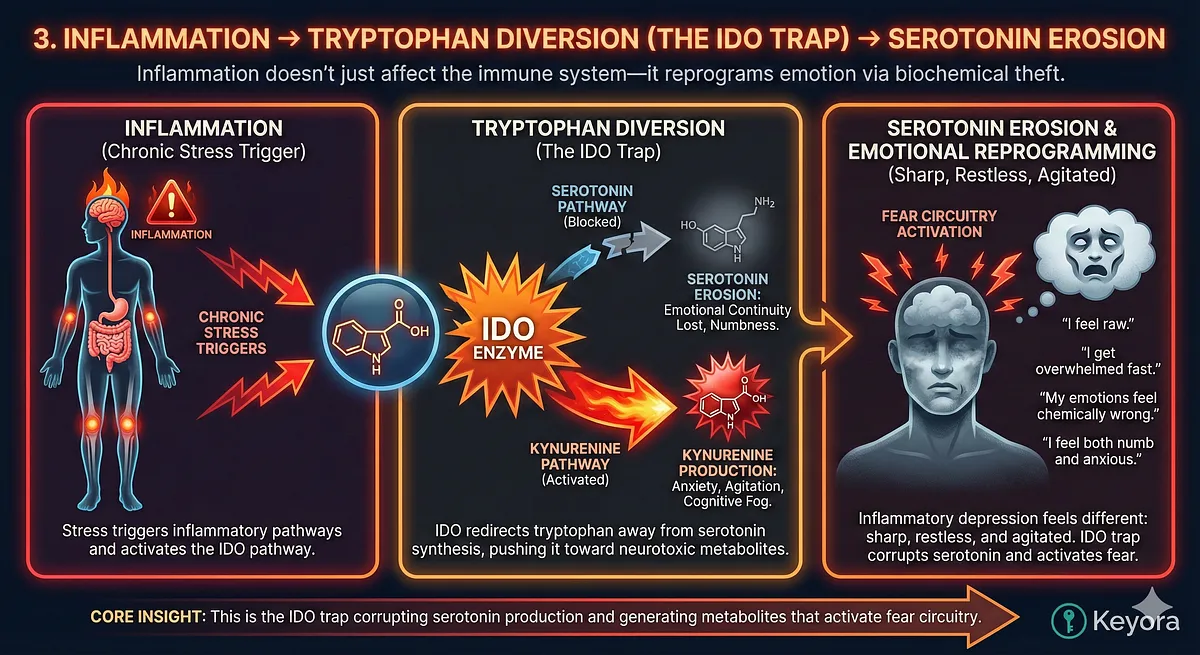
3. Inflammation → Tryptophan Diversion (The IDO Trap) → Serotonin Erosion
Inflammation doesn’t just affect the immune system – it reprograms emotion.
Once chronic stress triggers inflammatory pathways, a biochemical theft begins:
the IDO (indoleamine 2,3-dioxygenase) pathway activates and redirects tryptophan away from serotonin synthesis.
This is clinically devastating because tryptophan has only two major fates:
- Serotonin production → emotional continuity
- Kynurenine production → anxiety, agitation, cognitive fog
Stress pushes tryptophan toward the second pathway.
This is why inflammatory depression feels different from psychological sadness: it is sharp, restless, and agitated.
People describe:
- “I feel raw.”
- “I get overwhelmed fast.”
- “My emotions feel chemically wrong.”
- “I feel both numb and anxious.”
This is the IDO trap corrupting serotonin production and generating metabolites that activate fear circuitry.
4. Mitochondrial Exhaustion → GABAergic Weakening & Inhibitory Collapse
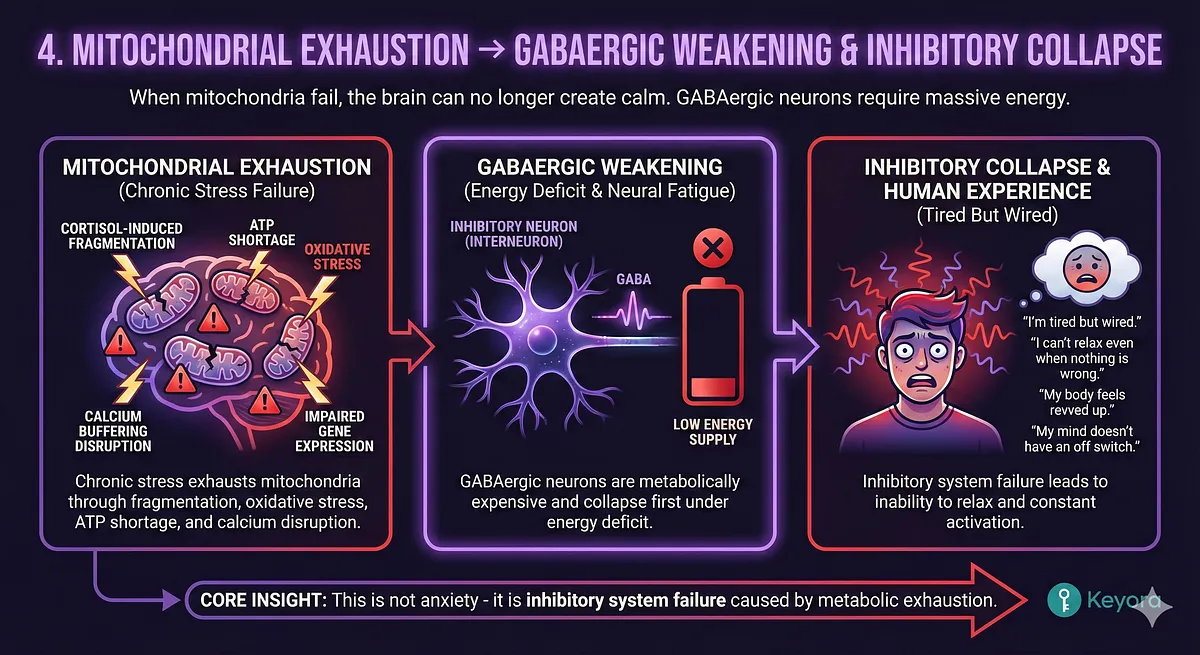
When mitochondria fail, the brain can no longer create calm.
GABAergic neurons require massive energy.
Among all neural cell types, inhibitory interneurons are some of the most metabolically expensive.
So when chronic stress exhausts mitochondria through:
- cortisol-induced mitochondrial fragmentation
- oxidative stress
- ATP shortage
- disruption of calcium buffering
- impaired mitochondrial gene expression
…the first system to collapse is GABA.
This is why many stressed individuals say:
- “I’m tired but wired.”
- “I can’t relax even when nothing is wrong.”
- “My body feels revved up.”
- “My mind doesn’t have an off switch.”
This is not anxiety – it is inhibitory system failure.
5. Circadian Breakdown → Dopamine–Serotonin Rhythm Collapse
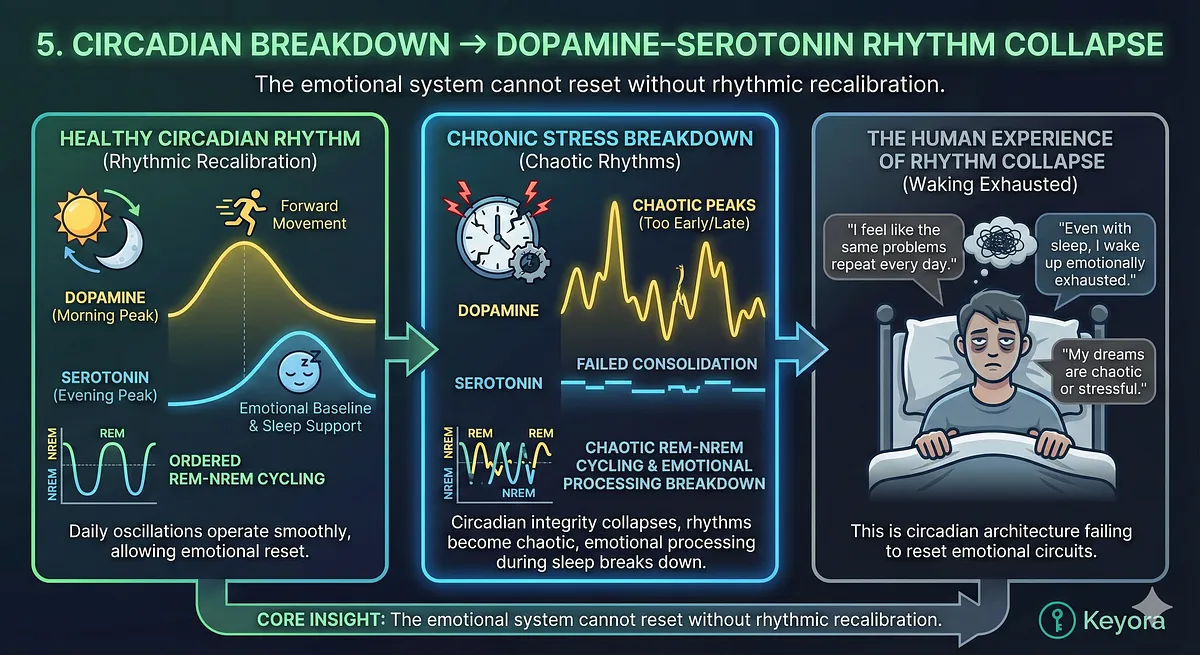
The emotional system cannot reset without rhythmic recalibration.
Dopamine and serotonin operate in daily oscillations:
- dopamine peaks early in the day to promote forward movement
- serotonin peaks later to anchor emotional baseline and support sleep architecture
But when circadian integrity collapses due to chronic stress:
- dopamine peaks too early or too late
- serotonin fails to consolidate
- REM–NREM cycling becomes chaotic
- emotional processing during sleep breaks down
People report:
- “I feel like the same problems repeat every day.”
- “Even with sleep, I wake up emotionally exhausted.”
- “My dreams are chaotic or stressful.”
This is circadian architecture failing to reset emotional circuits.
The most important insight of this section
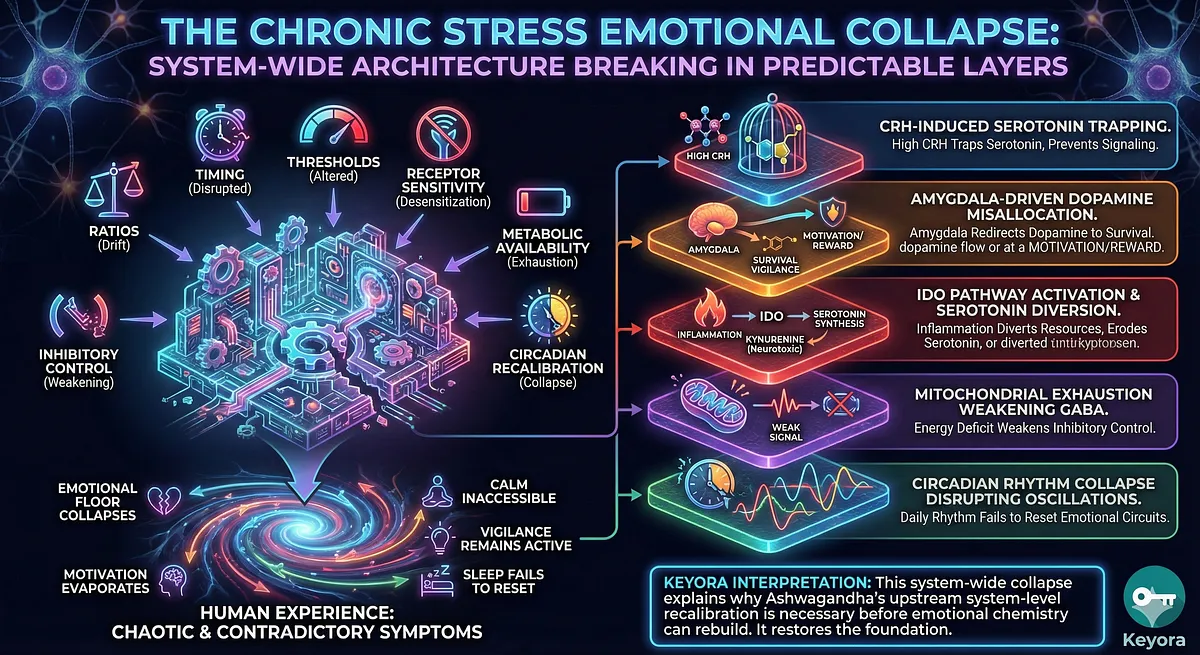
The emotional collapse is NOT caused by single neurotransmitters being “low.”
Instead, chronic stress disrupts:
- ratios
- timing
- thresholds
- receptor sensitivity
- metabolic availability
- inhibitory control
- circadian recalibration
This is why emotional symptoms seem chaotic, inconsistent, or contradictory.
But they’re not contradictory – they reflect a system-wide architecture breaking in predictable layers.
– Core Insight: Emotional collapse begins not with neurotransmitter depletion, but with disrupted timing, ratio drift, receptor desensitization, and inflammatory diversion.
– Key Mechanisms: CRH-induced serotonin trapping, amygdala-driven dopamine misallocation, IDO pathway activation, mitochondrial exhaustion weakening GABA, circadian rhythm collapse disrupting dopamine–serotonin oscillations.
– Human Experience: Emotional floor collapses, motivation evaporates, calm becomes inaccessible, vigilance remains active, and sleep fails to reset the system.
– Keyora Interpretation: Understanding stress-driven neurotransmitter disruption explains why Ashwagandha’s upstream system-level recalibration is necessary before emotional chemistry can rebuild.
SECTION IV – Ashwagandha’s Mechanistic Influence on Neurotransmitter Architecture
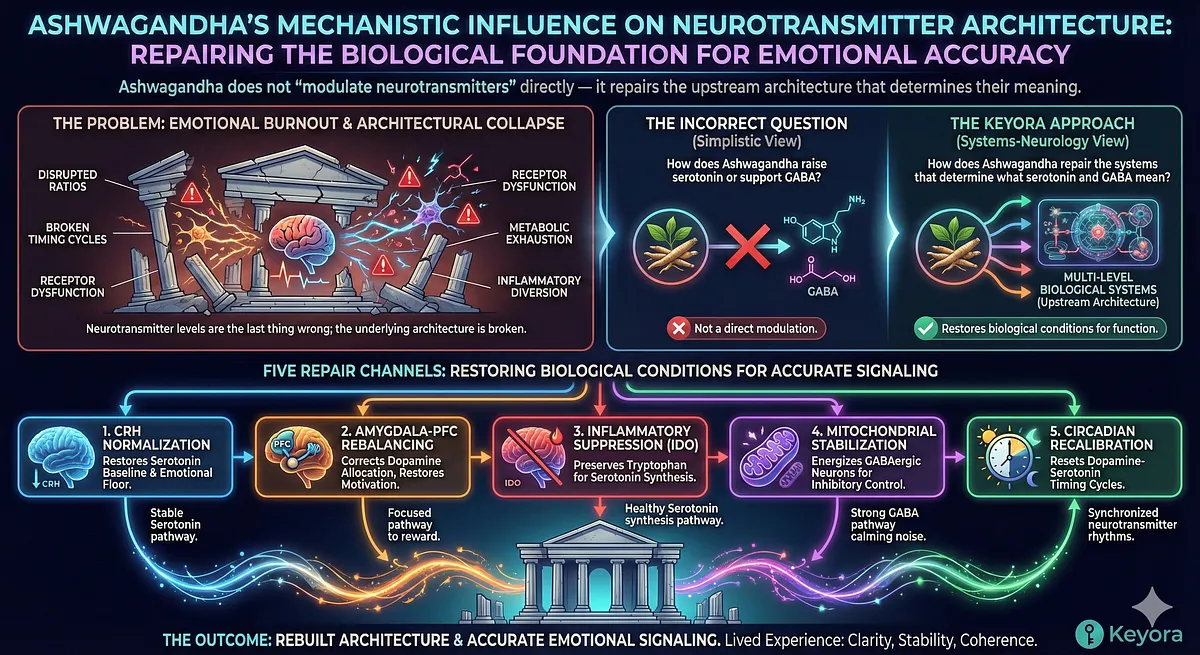
Ashwagandha does not “modulate neurotransmitters” – it repairs the architecture that allows emotional signals to be accurate again.
By the time a person reaches emotional burnout, neurotransmitter levels are the last thing that is wrong.
The real damage lies in the architecture described in Sections I–III – the ratios, timing cycles, receptor dynamics, metabolic demands, and inflammatory diversions that organize emotional meaning.
- Thus, the correct scientific question is not:
“How does Ashwagandha raise serotonin or support GABA?”
but rather:
- “How does Ashwagandha repair the multi-level biological systems that determine what serotonin and GABA mean?”
In Keyora’s systems-neurology model, Ashwagandha’s influence unfolds across five repair channels, each upstream of neurotransmitter signaling.
These repair channels do not produce emotional change directly; they restore the biological conditions under which neurotransmitters can function as intended.
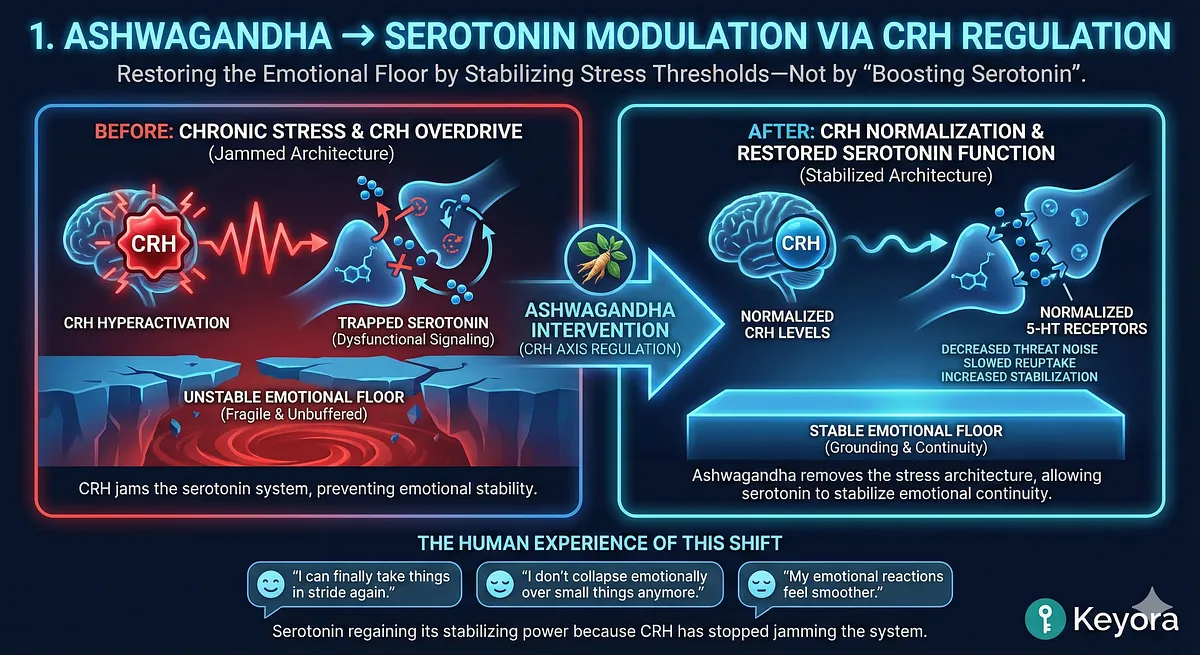
1. Ashwagandha → Serotonin Modulation via CRH Regulation
It restores the emotional floor by stabilizing stress thresholds – not by “boosting serotonin.”
When CRH is chronically elevated, serotonin becomes trapped in dysfunctional signaling loops and loses its buffering role.
Ashwagandha intervenes at the CRH axis, not the serotonin synapse. This distinction is crucial.
By lowering CRH hyperactivation, Ashwagandha:
- decreases amygdala-driven threat noise
- normalizes 5-HT receptors that had been desensitized
- slows down pathological serotonin reuptake
- increases serotonin’s ability to stabilize emotional continuity
In other words, Ashwagandha does not “increase serotonin.”
It removes the stress architecture that prevents serotonin from doing its job.
Human experience of this shift
People often describe:
- “I can finally take things in stride again.”
- “I don’t collapse emotionally over small things anymore.”
- “My emotional reactions feel smoother.”
This is serotonin regaining its stabilizing power because CRH has stopped jamming the system.
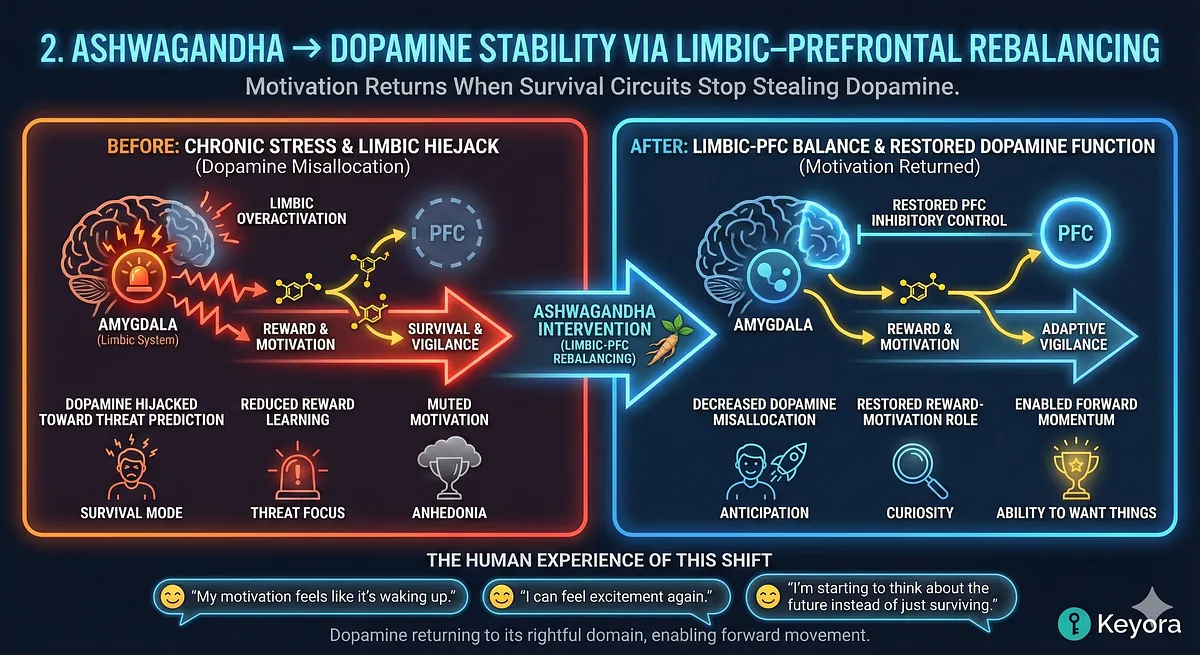
2. Ashwagandha → Dopamine Stability via Limbic–Prefrontal Rebalancing
Motivation returns when survival circuits stop stealing dopamine.
Under chronic stress, the amygdala hijacks dopamine toward vigilance and away from reward learning.
Ashwagandha restores balance between the amygdala and the prefrontal cortex:
- reducing limbic overactivation
- restoring PFC inhibitory control
- decreasing dopamine misallocation toward threat prediction
- enabling dopamine to resume its reward–motivation role
When dopamine is no longer monopolized by survival circuitry, the individual can feel:
- anticipation
- curiosity
- forward momentum
- the ability to “want things” again
Human experience of this shift
People report:
- “My motivation feels like it’s waking up.”
- “I can feel excitement again.”
- “I’m starting to think about the future instead of just surviving.”
This is dopamine returning to its rightful domain.
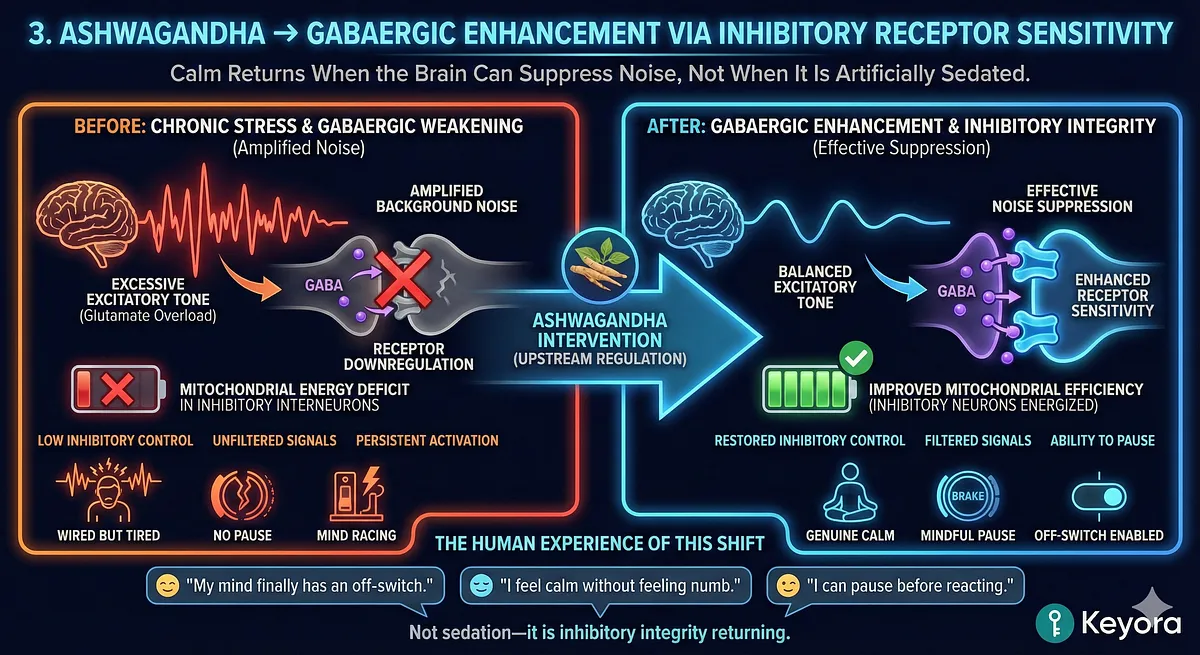
3. Ashwagandha → GABAergic Enhancement via Inhibitory Receptor Sensitivity
Calm returns when the brain can suppress noise, not when it is artificially sedated.
GABAergic neurons weaken primarily due to energy deficits, receptor downregulation, and persistent excitatory overload.
Ashwagandha acts through multiple upstream mechanisms:
- lowering glutamate-driven excitatory tone
- improving mitochondrial efficiency within inhibitory interneurons
- enhancing GABA-A receptor sensitivity
- reducing norepinephrine interference
These changes allow GABA to re-establish functional inhibitory control.
Human experience of this shift
People describe:
- “My mind finally has an off-switch.”
- “I feel calm without feeling numb.”
- “I can pause before reacting.”
This is not sedation – it is inhibitory integrity returning.
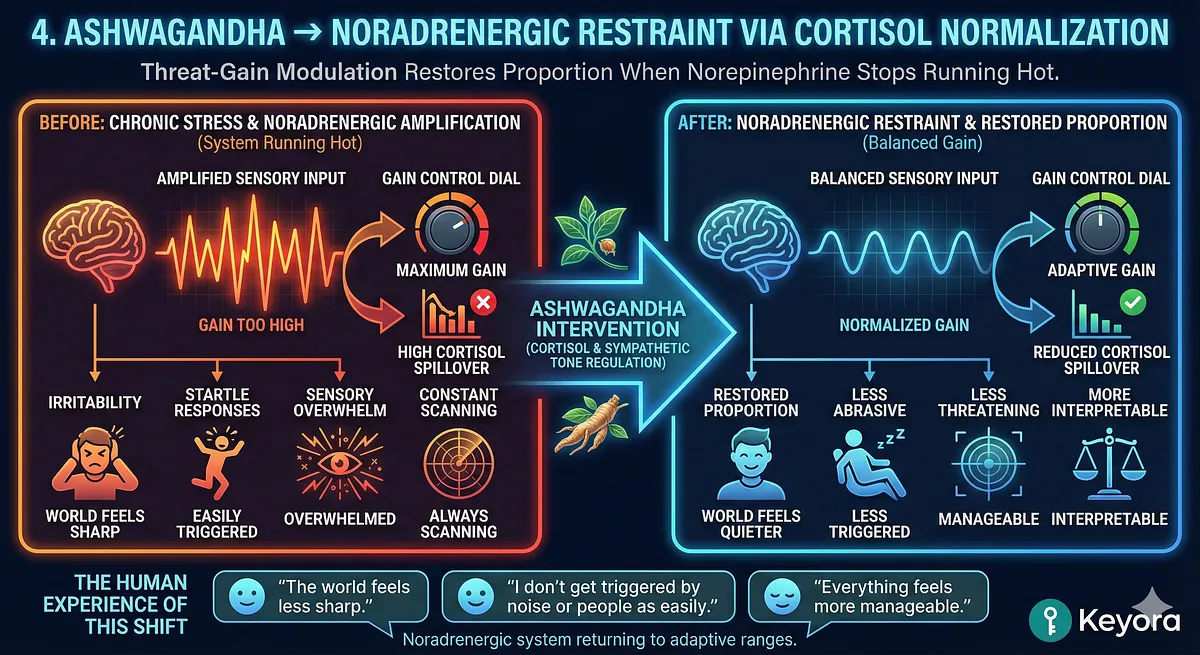
4. Ashwagandha → Noradrenergic Restraint via Cortisol Normalization
Threat-gain modulation restores proportion when norepinephrine stops running hot.
Norepinephrine is the system that regulates sensory gain – the intensity with which the world “lands” on the nervous system.
Under chronic stress, this gain is turned up too high, producing:
- irritability
- startle responses
- sensory overwhelm
- constant scanning
Ashwagandha lowers this background activation by:
- reducing cortisol spillover
- improving α2-adrenergic feedback sensitivity
- supporting parasympathetic rebound
- suppressing chronic sympathetic tone
When norepinephrine is no longer amplified, sensory input becomes:
- quieter
- less abrasive
- less threatening
- more interpretable
Human experience of this shift
People say:
- “The world feels less sharp.”
- “I don’t get triggered by noise or people as easily.”
- “Everything feels more manageable.”
This is the noradrenergic system returning to adaptive ranges.
5. Ashwagandha → Serotonin Preservation via IDO Pathway Suppression
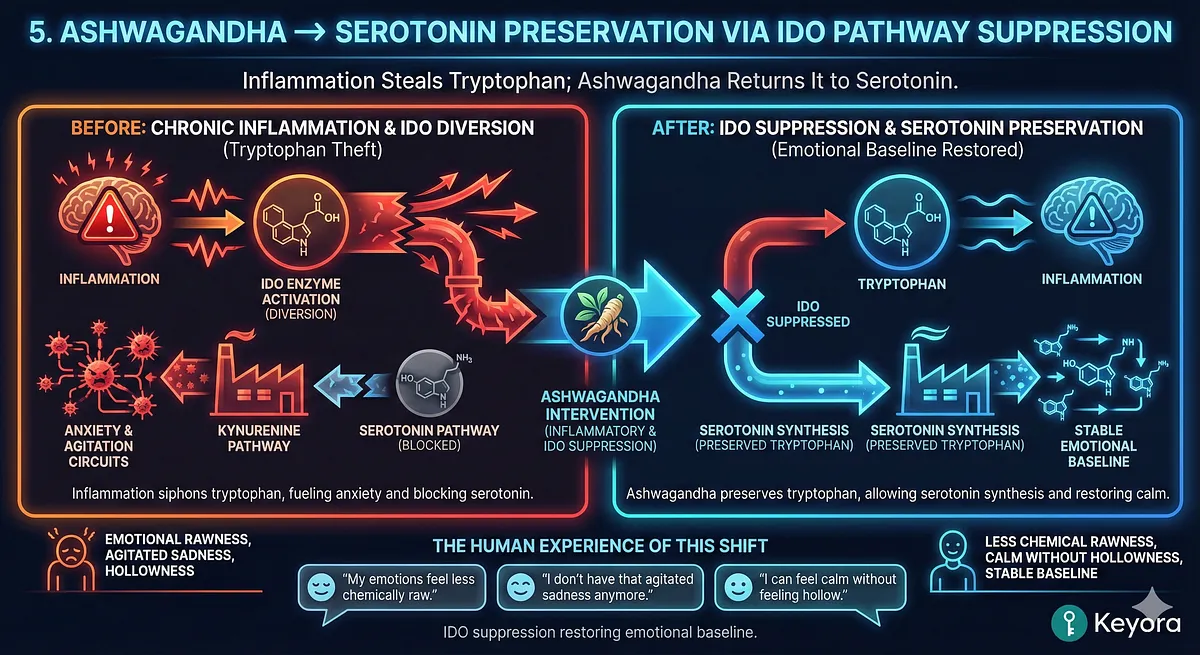
Inflammation steals tryptophan; Ashwagandha returns it to serotonin.
The IDO pathway is one of the strongest drivers of emotional collapse.
When inflammation rises, tryptophan is siphoned away from serotonin production and converted into kynurenine metabolites that fuel anxiety and agitation.
Ashwagandha interrupts this diversion by:
- lowering systemic and neural inflammatory signaling
- reducing IDO activation
- preserving tryptophan availability for serotonin synthesis
- decreasing kynurenine-driven excitatory metabolites
This is one of Ashwagandha’s most important psychological roles:
It protects the biochemical precursor pool that serotonin depends on.
Human experience of this shift
People say:
- “My emotions feel less chemically raw.”
- “I don’t have that agitated sadness anymore.”
- “I can feel calm without feeling hollow.”
This is IDO suppression restoring emotional baseline.
Why Ashwagandha’s neurotransmitter effects are fundamentally architectural
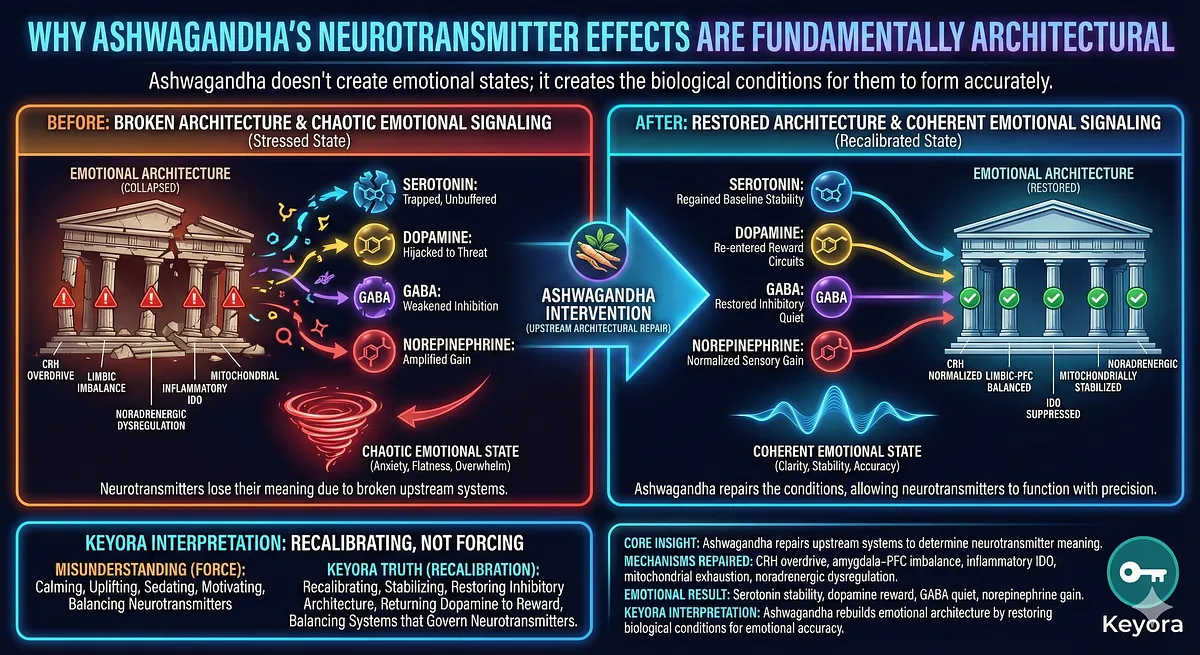
Across all five major neurotransmitter systems, a single truth emerges:
Ashwagandha does not create emotional states.
It creates the conditions under which emotional states can form accurately.
This is the Keyora interpretation:
- Ashwagandha is not calming – it is recalibrating.
- Not uplifting – stabilizing.
- Not sedating – restoring inhibitory architecture.
- Not motivating – returning dopamine to reward circuitry.
- Not balancing neurotransmitters – balancing the systems that govern neurotransmitters.
This is why Ashwagandha’s effects feel natural.
The brain feels like itself returning rather than something new being added.
This is also why Episode 4 had to come before Episode 5.
Only by repairing CRH thresholds, limbic balance, inflammation, mitochondrial resilience, and circadian rhythm can the brain begin rebuilding neurotransmitter precision.
– Core Insight: Ashwagandha does not “modulate neurotransmitters” – it repairs the upstream systems that determine neurotransmitter meaning, ratio, and timing.
– Mechanisms Repaired: CRH overdrive, amygdala–PFC imbalance, inflammatory IDO activation, mitochondrial exhaustion of GABA neurons, noradrenergic gain dysregulation.
– Emotional Result: Serotonin regains baseline stability, dopamine reenters reward circuits, GABA restores inhibitory quiet, norepinephrine normalizes sensory gain.
– Keyora Interpretation: Ashwagandha rebuilds emotional architecture by restoring biological conditions, not by forcing chemical changes – making emotional accuracy possible again.
SECTION V – Rebuilding Emotional Accuracy Through Neurochemical Recalibration
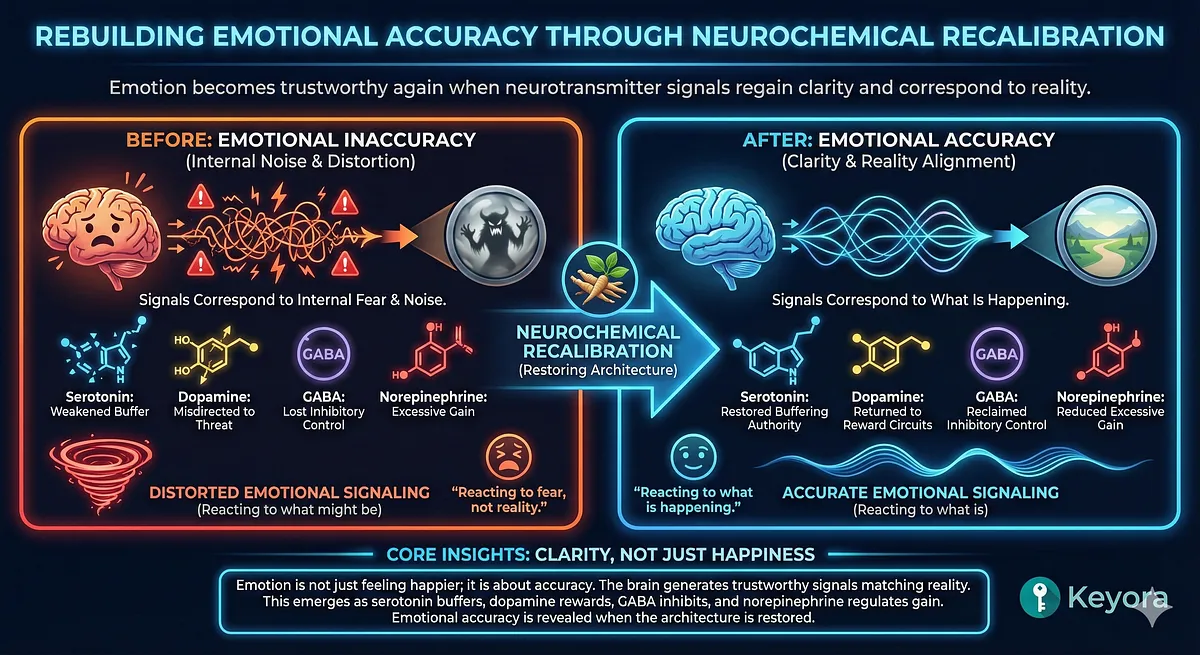
Emotion becomes trustworthy again when neurotransmitter signals regain clarity.
What people call “emotional healing” is often misunderstood. Most imagine it as feeling happier, calmer, lighter, or stronger. But in reality, the first and most important sign of recovery is not an emotion at all – it is accuracy.
The brain begins to generate emotional signals that correspond to reality instead of to internal noise. It is the difference between reacting to what is happening and reacting to what your nervous system fears might be happening.
This accuracy emerges gradually, as serotonin regains its buffering authority, dopamine returns to reward circuits, GABA reclaims inhibitory control, and norepinephrine reduces its excessive gain.
Emotional accuracy is not created – it is revealed, once the architecture underneath is restored.
This section explains, in real human terms, what it feels like when neurotransmitter ratios begin shifting back into alignment.
These shifts are subtle but profound, and they form the true core of emotional recovery.
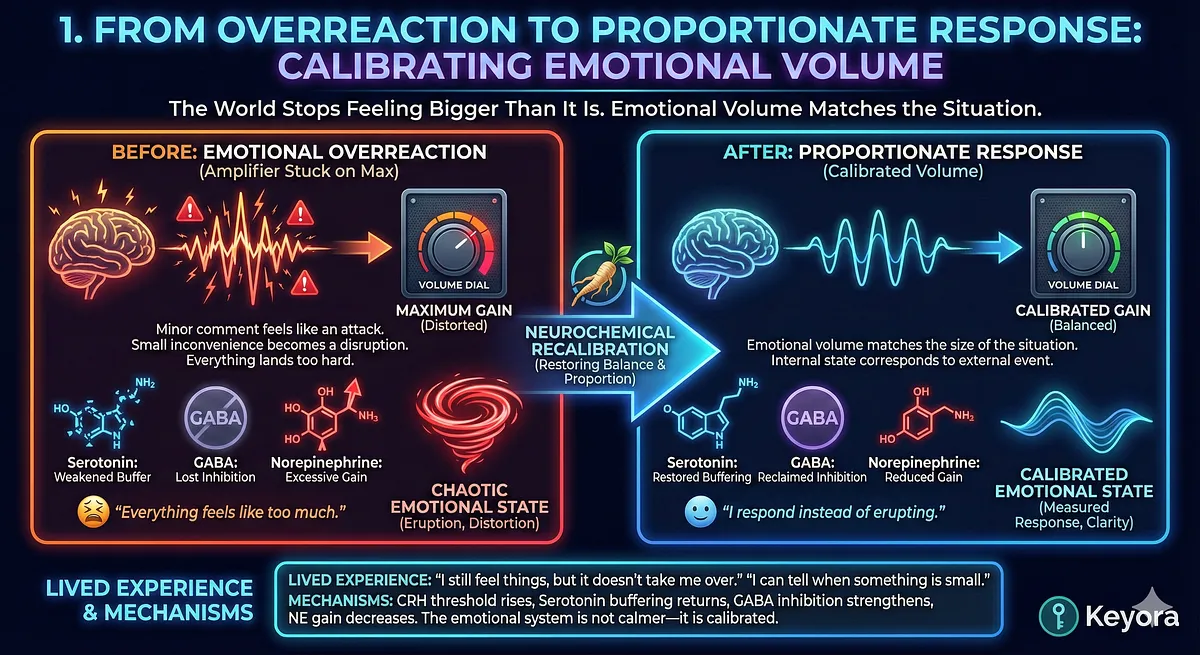
1. From Overreaction to Proportionate Response
The world stops feeling bigger than it is.
When CRH quiets, serotonin stabilizes, and noradrenergic gain lowers, something remarkable happens: your emotional volume finally matches the size of the situation.
Before this recalibration, the experience of living under stress feels like using a speaker system where the amplifier is stuck on maximum. A minor comment feels like an attack.
A small inconvenience becomes a disruption. Ordinary conversations feel charged. Everything lands too hard.
When serotonin and GABA begin functioning again, the amplification lowers. Emotions return to scale, meaning your internal state corresponds to the external event.
The lived experience
People often describe:
- “I still feel things, but it doesn’t take me over.”
- “I can tell when something is small – it actually feels small.”
- “I respond instead of erupting.”
Under the hood, this is neurotransmitter accuracy returning. Serotonin is smoothing reactivity, GABA is suppressing noise, and norepinephrine is no longer blasting sensory channels with threat intensity.
Mechanistically
- CRH threshold rises → fewer false alarms
- Serotonin buffering returns → proportional emotional amplitude
- GABA inhibition strengthens → reduced emotional spillover
- NE gain decreases → sensory input stops feeling sharp
The emotional system is not calmer – it is calibrated.
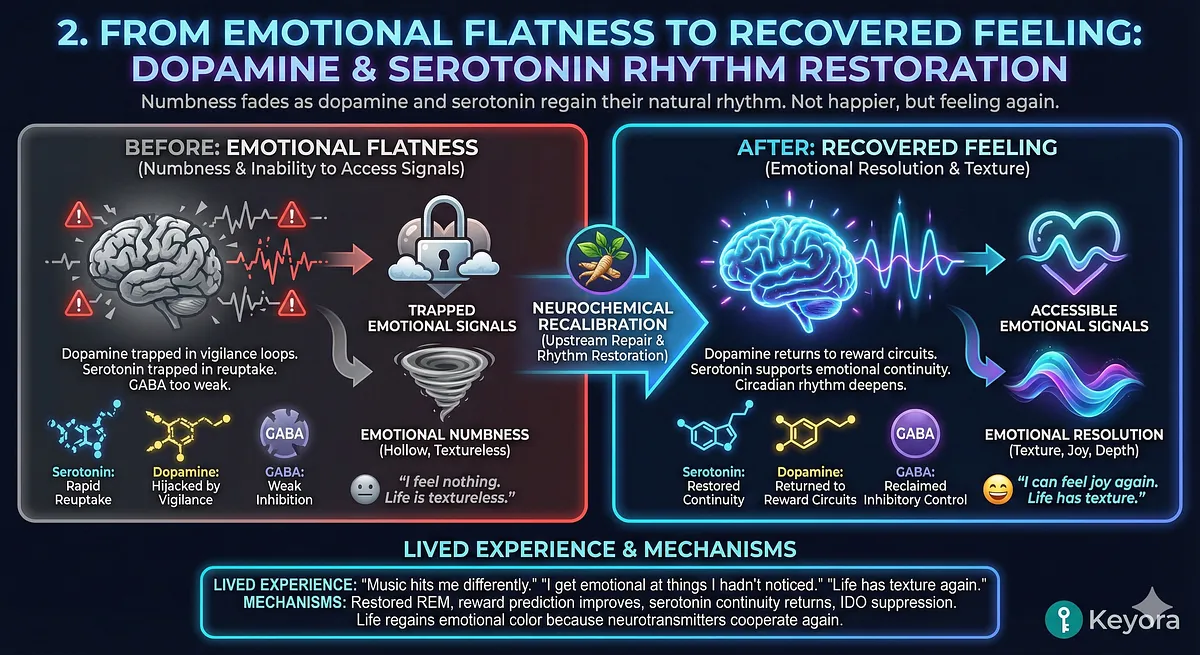
2. From Emotional Flatness to Recovered Feeling
Numbness fades as dopamine and serotonin regain their natural rhythm.
Contrary to what many believe, numbness is not absence of emotion – it is the inability to access emotional signals.
It is dopamine trapped in vigilance loops, serotonin trapped in reuptake, and GABA too weak to allow subtle emotions to surface.
As Ashwagandha’s upstream recalibration continues, something shifts:
- dopamine begins returning to reward-learning circuits
- serotonin returns to supporting emotional continuity
- circadian rhythms deepen and REM becomes structured
- the amygdala reduces interference with prefrontal appraisal
The result is not “feeling happier.”
It is feeling again – the return of emotional resolution.
The lived experience
People describe:
- “I can feel joy again, even in small moments.”
- “Music hits me differently.”
- “I get emotional at things I hadn’t noticed before.”
- “I feel like life has texture again.”
This is dopamine-serotonin architecture waking up.
Mechanistically
- Restored REM → re-encoding emotional memory
- Dopamine misallocation ends → reward prediction improves
- Serotonin continuity returns → emotions feel steady, not hollow
- IDO suppression → fewer “agitated sadness” signals
Life regains emotional color because neurotransmitters can cooperate again.
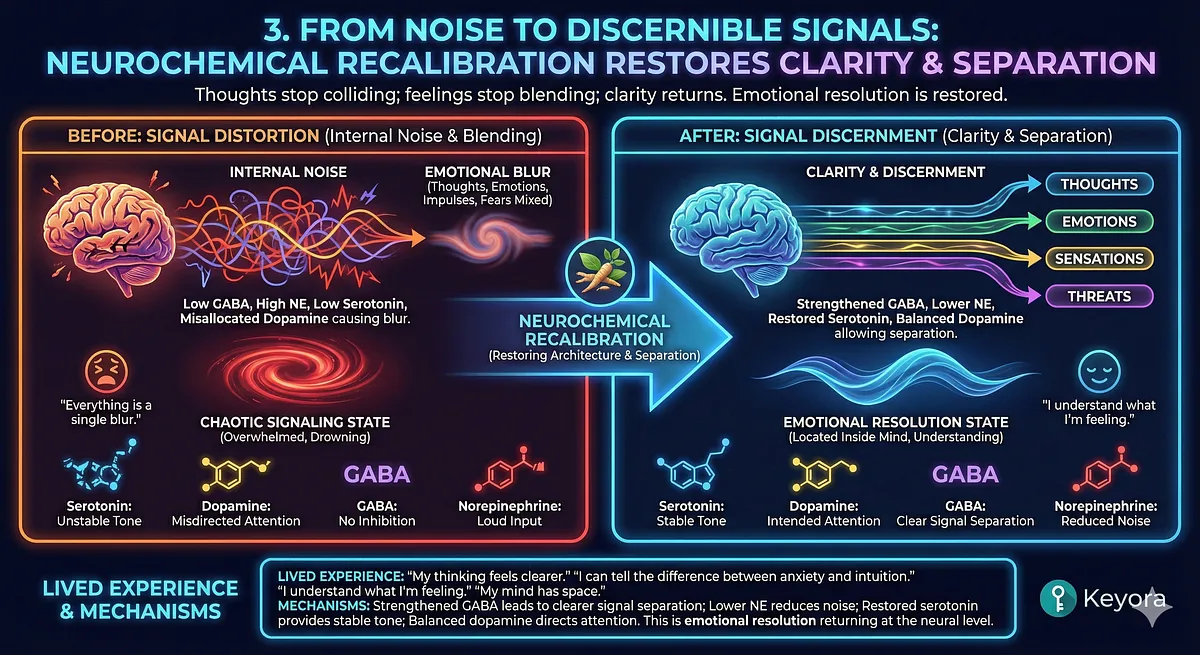
3. From Noise to Discernible Signals
Thoughts stop colliding; feelings stop blending; clarity returns.
One of the cruelest effects of chronic stress is signal distortion: thoughts blend with emotions, emotions with impulses, impulses with fears.
Everything becomes a single blur.
This distortion is biochemical.
Low GABA means no inhibition.
High NE means sensory input is loud.
Low serotonin means emotional tone is unstable.
Misallocated dopamine means attention is misdirected.
When the architecture recalibrates, the separation between signals returns:
- Thought becomes distinguishable from emotion
- Emotion becomes distinguishable from sensation
- Sensation becomes distinguishable from threat
This gives the person the ability to “locate themselves” inside their mind again.
The lived experience
People say:
- “My thinking feels clearer.”
- “I can tell the difference between anxiety and intuition.”
- “I understand what I’m feeling instead of drowning in it.”
- “My mind has space.”
Mechanistically
- Strengthened GABA → clearer signal separation
- Lower NE → reduced sensory and emotional noise
- Restored serotonin → stable emotional tone for interpretation
- Balanced dopamine → attention goes where you intend, not where fear directs
This is emotional resolution returning at the neural level.
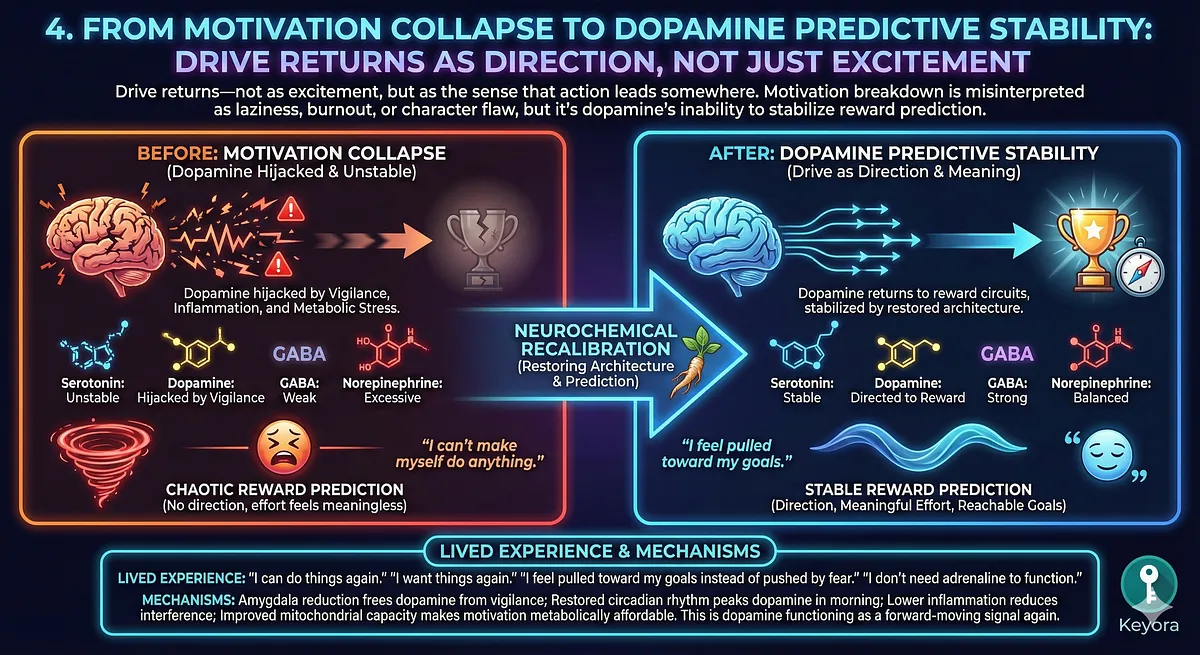
4. From Motivation Collapse to Dopamine Predictive Stability
Drive returns – not as excitement, but as the sense that action leads somewhere.
Motivation breakdown is often misinterpreted as laziness, burnout, depression, or lack of character.
But the real mechanism is simple: dopamine cannot stabilize reward prediction under chronic stress.
When dopamine stabilizes, the first thing people feel is not energy – it is direction.
They wake with a sense of orientation.
Goals feel reachable.
Effort feels meaningful.
The future feels tangible instead of abstract.
The lived experience
People say:
- “I can do things again.”
- “I want things again.”
- “I feel pulled toward my goals instead of pushed by fear.”
- “I don’t need adrenaline to function.”
Mechanistically
- Amygdala reduction → dopamine no longer hijacked by vigilance
- Restored circadian rhythm → dopamine peaks in the morning as intended
- Lower inflammation → less interference with reward prediction circuitry
- Improved mitochondrial capacity → motivation becomes metabolically affordable
This is dopamine functioning as a forward-moving signal again.
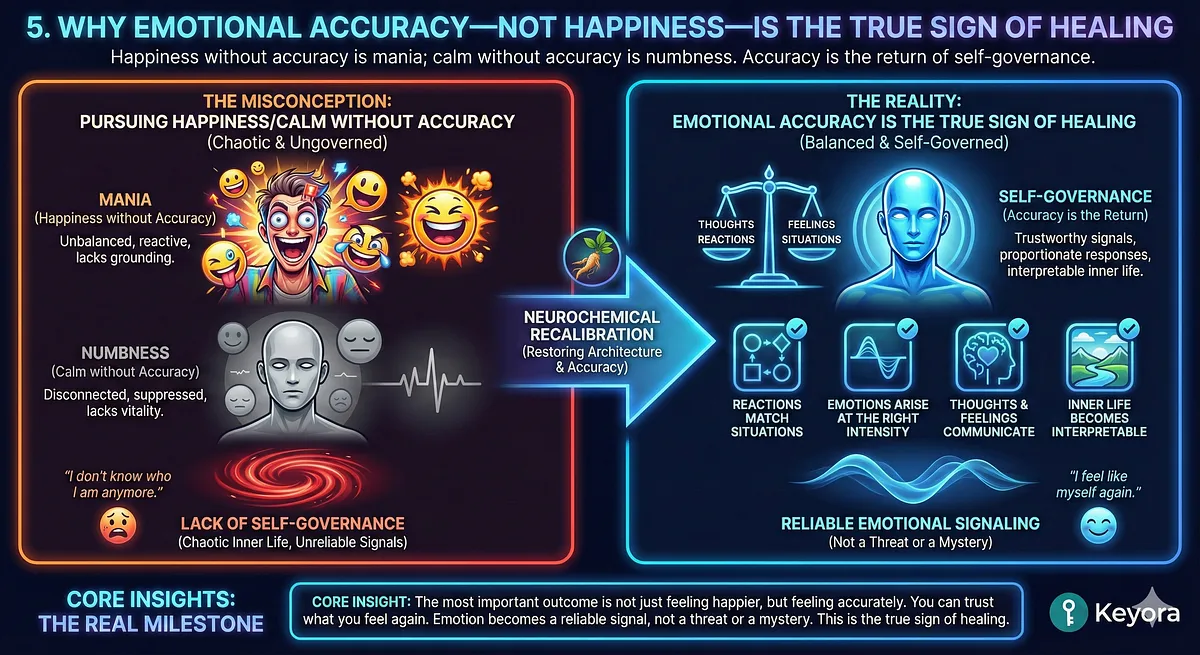
5. Why emotional accuracy – not happiness – is the true sign of healing
Happiness without accuracy is mania; calm without accuracy is numbness.
Accuracy is the return of self-governance.
The most important outcome of neurotransmitter recalibration is not joy, calm, confidence, or productivity. Those are downstream.
The real milestone is this:
You can trust what you feel again.
- Your reactions match situations.
- Your emotions arise at the right intensity.
- Your thoughts and feelings communicate rather than collide.
- Your inner life becomes interpretable, not chaotic.
This is what people mean when they say, – “I feel like myself again.”
Emotion becomes a reliable signal, not a threat or a mystery.
– Core Insight: Emotional recovery is the return of *accuracy*, where neurotransmitter signals match reality rather than internal noise.
– Mechanisms Restored: Serotonin buffering, dopamine reward prediction, GABA inhibitory clarity, noradrenergic gain modulation, circadian recalibration.
– Experiential Result: Reactions shrink to proportion, numbness fades into emotional presence, thoughts regain coherence, motivation returns with direction, and internal signals become trustworthy.
– Keyora Interpretation: Ashwagandha restores the architecture that makes emotional accuracy possible – the fundamental prerequisite for all higher emotional healing.
SECTION VI – Emotional Collapse Archetypes: Four Distinct Patterns of Stress-System Failure
Understanding the four dominant collapse modes allows readers to recognize themselves – and understand why Ashwagandha’s repair feels different in each.
Every person believes their emotional suffering is uniquely personal – shaped by individual history, personality, or circumstances. But beneath these differences, the human stress system collapses in predictable, biological patterns.
Decades of neuroscience show that chronic stress does not produce random emotional outcomes; it drives the nervous system into a limited number of failure modes determined by neurotransmitter depletion, CRH instability, energy deficits, and limbic–prefrontal imbalance.
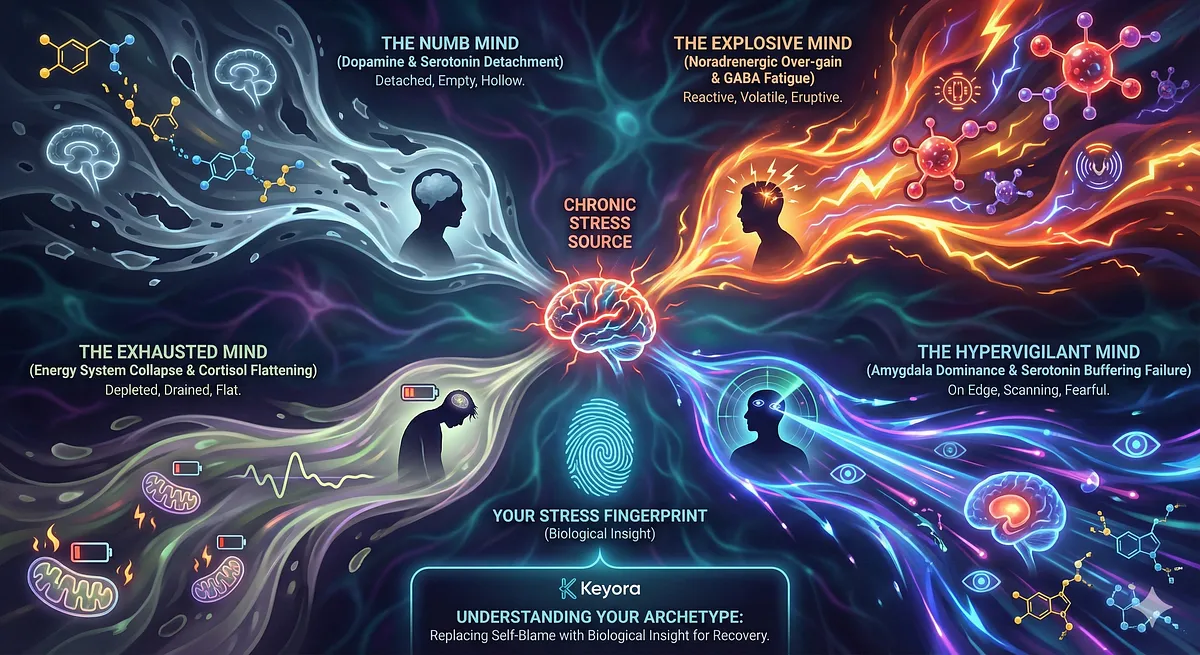
At Keyora, we view these collapse modes not as psychological labels but as neurobiological archetypes – distinct ways the brain reorganizes itself when survival circuits dominate.
These archetypes explain why two people under the same environmental stress can experience completely different emotional realities: numbness in one, hypervigilance in another, exhaustion in a third, explosive reactivity in a fourth. The variation is not mental weakness but differences in where the stress machinery breaks first.
Understanding your archetype is transformative.
It replaces vague self-blame with clear biological insight.
It turns emotional chaos into something intelligible.
And most importantly, it clarifies why Ashwagandha affects people differently, because each archetype represents a different intersection of neurotransmitter imbalance, mitochondrial burden, and CRH-driven signaling distortion.
This section maps out the four collapse archetypes observed most consistently across neuroscience and clinical experience:
- The Numb Mind (dopamine and serotonin detachment)
- The Explosive Mind (noradrenergic over-gain and GABA fatigue)
- The Exhausted Mind (energy system collapse and cortisol flattening)
- The Hypervigilant Mind (amygdala dominance and serotonin buffering failure)
Most people occupy one primary archetype with features of others.
But recognizing your dominant pattern – your “stress fingerprint” – is the first real step toward recovering emotional accuracy.
1. The Numb Mind
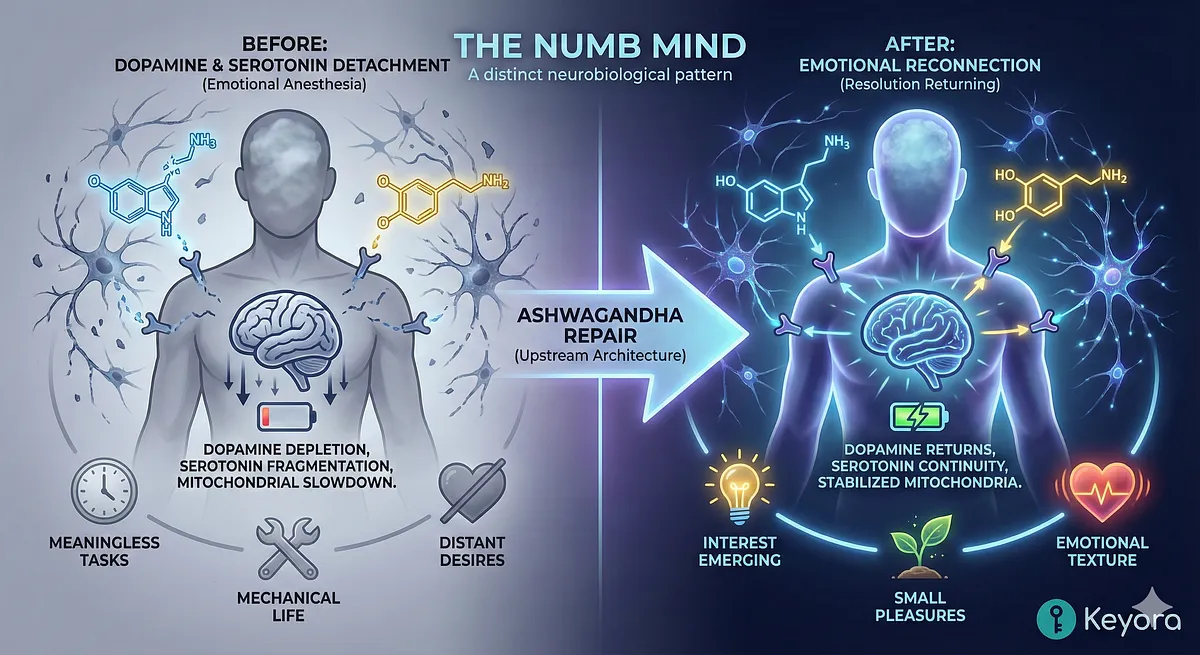
Dopamine depletion, serotonin fragmentation, and mitochondrial slowdown erase emotional resolution.
There is a specific kind of collapse where the individual does not feel distressed, overwhelmed, or panicked.
They feel nothing. Their inner world becomes flat, silent, unresponsive – like emotional anesthesia. Tasks feel meaningless, desires feel distant, and even the body feels muted. They go through the motions of life with mechanical precision but without internal participation.
This is not “depression” in the emotional sense but dopamine and serotonin detachment driven by prolonged CRH activation and energy failure. Chronic stress diverts dopamine into vigilance circuits, leaving none for reward prediction. Serotonin is fragmented by IDO activation and cannot maintain emotional continuity. Mitochondria slow down, making motivation metabolically expensive.
Life looks like this
- Waking up feels heavy, as if gravity has increased.
- Joy is intellectually remembered but not physiologically felt.
- Hobbies bring no spark, despite trying.
- Work becomes purely mechanical.
- Social interactions feel distant, even with loved ones.
When Ashwagandha begins repairing the upstream architecture – reducing CRH, restoring circadian rhythm, suppressing IDO, and stabilizing mitochondrial output – dopamine gradually returns to reward circuits.
The shift feels like
- tiny sparks of interest emerging
- noticing small pleasures again
- feeling “pulled” toward tasks instead of pushed
- emotional texture returning to daily life
This is not stimulation – it is reconnection, the slow return of emotional resolution.
2. The Explosive Mind
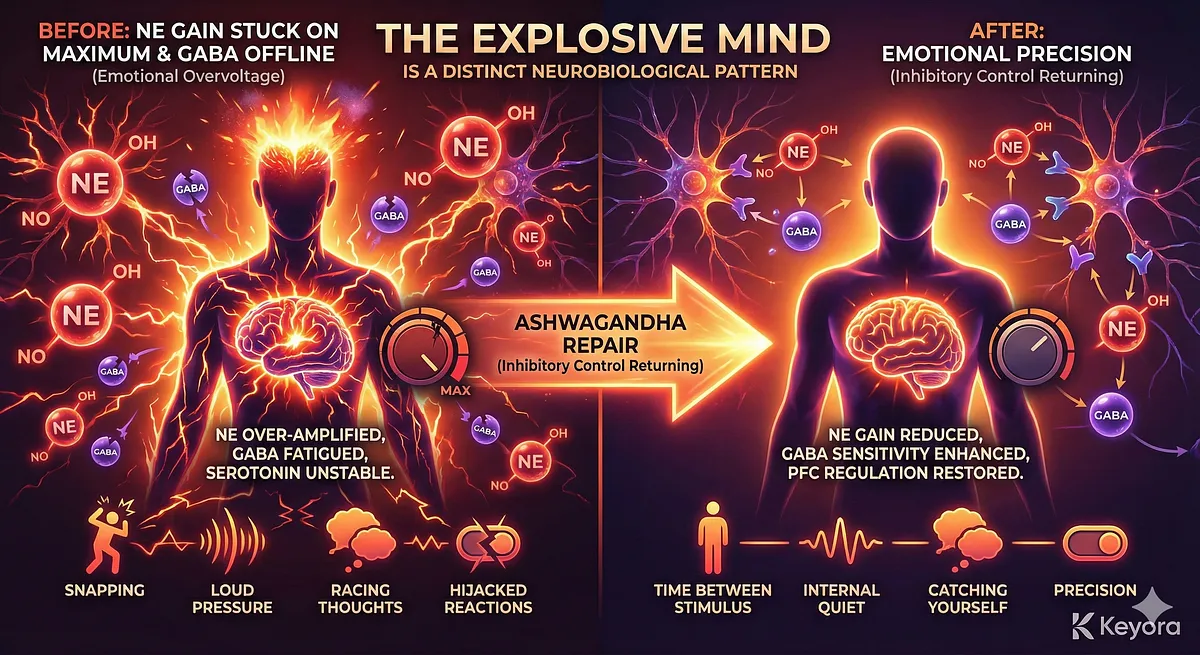
A system where norepinephrine gain is stuck on maximum and GABA inhibition is offline.
Another archetype lives at the opposite extreme – not numb but reactive.
Every stimulus, every comment, every unexpected sound is amplified. Small frustrations become eruptions.
Thoughts sprint ahead of control. The body moves before the mind approves. This is the emotional system in overvoltage mode, driven by high CRH, high NE, low GABA, and unstable serotonin buffering.
This person is not “hot-tempered.” They are living inside a nervous system with its volume dial broken, permanently stuck at full gain.
Life looks like this
- snapping at loved ones before realizing what happened
- loud internal pressure, even in silence
- racing thoughts during small stressors
- guilt after every outburst
- feeling hijacked by one’s own reactions
Mechanistically, this is a system where:
- NE is over-amplified
- GABAergic interneurons are too fatigued to inhibit
- serotonin cannot buffer impulse escalation
- the amygdala is overriding the prefrontal cortex
Ashwagandha does not suppress emotion. Instead, by lowering CRH, reducing NE gain, enhancing GABA receptor sensitivity, and restoring PFC regulatory power, the emotional fuse lengthens.
The shift feels like
- more time between stimulus and reaction
- fewer eruptions despite similar triggers
- the ability to “catch yourself” before reacting
- a sense of internal quiet replacing internal pressure
This is inhibitory control returning – not sedation, not numbing – precision.
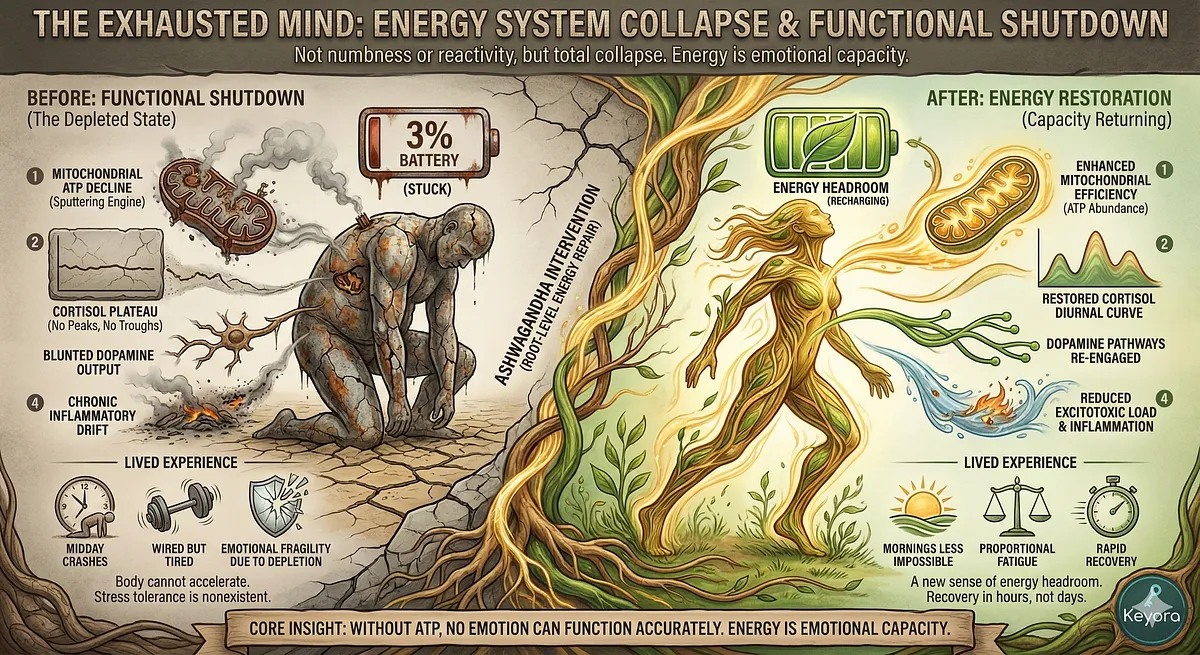
3. The Exhausted Mind
When mitochondrial decline, cortisol dysregulation, and dopamine flattening converge into functional shutdown.
This archetype is defined not by numbness or reactivity, but by collapse.
The person wakes tired, functions tired, rests tired.
Their cognitive bandwidth shrinks, their emotional resilience diminishes, and their stress tolerance is nonexistent.
They feel like a phone stuck at 3% battery no matter how long it charges.
Mechanistically, this is driven by:
- mitochondrial ATP decline
- cortisol plateau (no peaks, no troughs)
- blunted dopamine output
- circadian rhythm fragmentation
- chronic inflammatory drift
This body is not choosing to be slow – it cannot accelerate.
Life looks like this
- Difficulty initiating tasks
- Midday crashes
- Feeling “wired but tired”
- Inability to recover from even small stress
- Emotional fragility, not because of pain but depletion
Ashwagandha’s effect on this archetype emerges primarily through the energy axis:
- enhancing mitochondrial efficiency
- lowering inflammation that steals ATP
- restoring cortisol’s diurnal curve
- reducing background excitotoxic load
The shift feels like
- mornings feel less impossible
- fatigue becomes proportional instead of total
- a new sense of energy “headroom”
- the ability to recover within hours instead of days
This archetype teaches an essential truth:
energy is emotional capacity.
Without ATP, no emotion can function accurately.
4. The Hypervigilant Mind
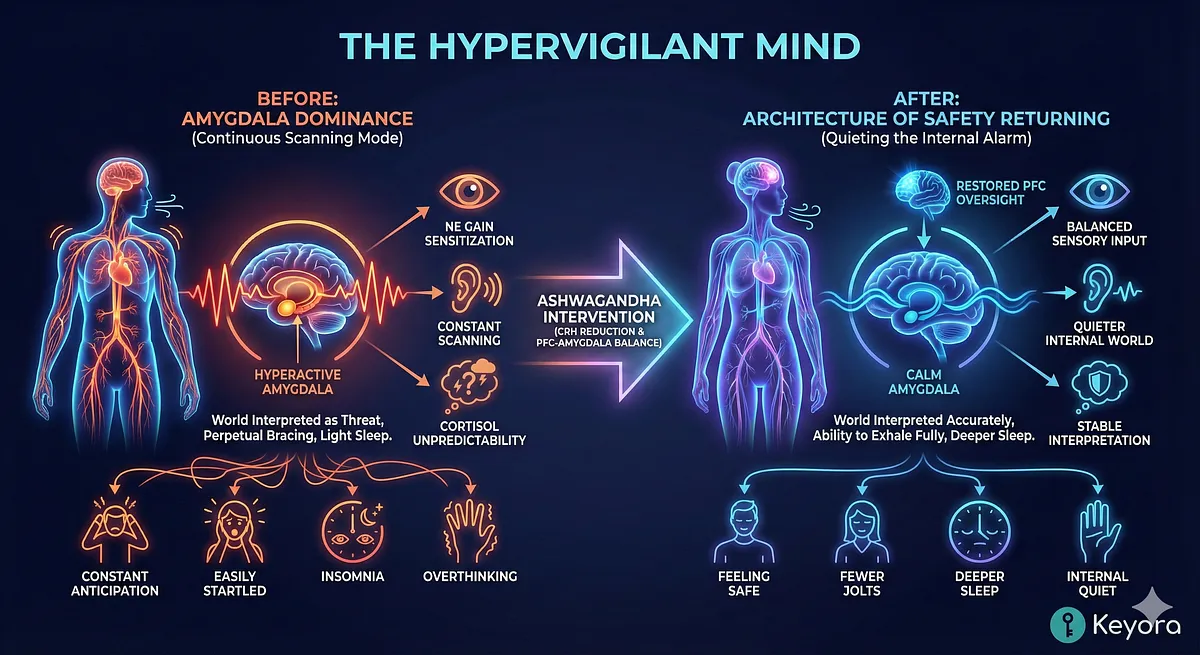
The world is interpreted as threat because the amygdala is running the show.
This archetype lives in continuous scanning mode.
The person is not explosive or numb; they are perpetually braced. Their shoulders rise, breath shortens, sleep becomes light, and attention constantly flits between cues. They interpret neutral events as potential danger – not intellectually, but physiologically.
Mechanistically:
- the amygdala is hyperactive
- cortisol unpredictability destabilizes prediction circuits
- NE gain sensitizes sensory channels
- serotonin buffering is too weak to stabilize interpretations
- PFC inhibitory oversight collapses
Life looks like this
- difficulty relaxing even in safe environments
- constant anticipation of “something going wrong”
- insomnia with rumination
- being easily startled
- overthinking simple decisions
- emotional “micro-jumps” at small noises or surprises
Ashwagandha’s intervention is exceptionally powerful here because this pattern is fundamentally CRH-driven.
By reducing CRH output and restoring PFC–amygdala balance, Ashwagandha gradually quiets the internal alarm system.
The shift feels like
- a quieter internal world
- the ability to exhale fully
- fewer hyper-alert jolts
- feeling safe in moments that objectively are safe
- sleep that drops into deeper stages
This is the architecture of safety returning.
SECTION VI – Why These Archetypes Matter
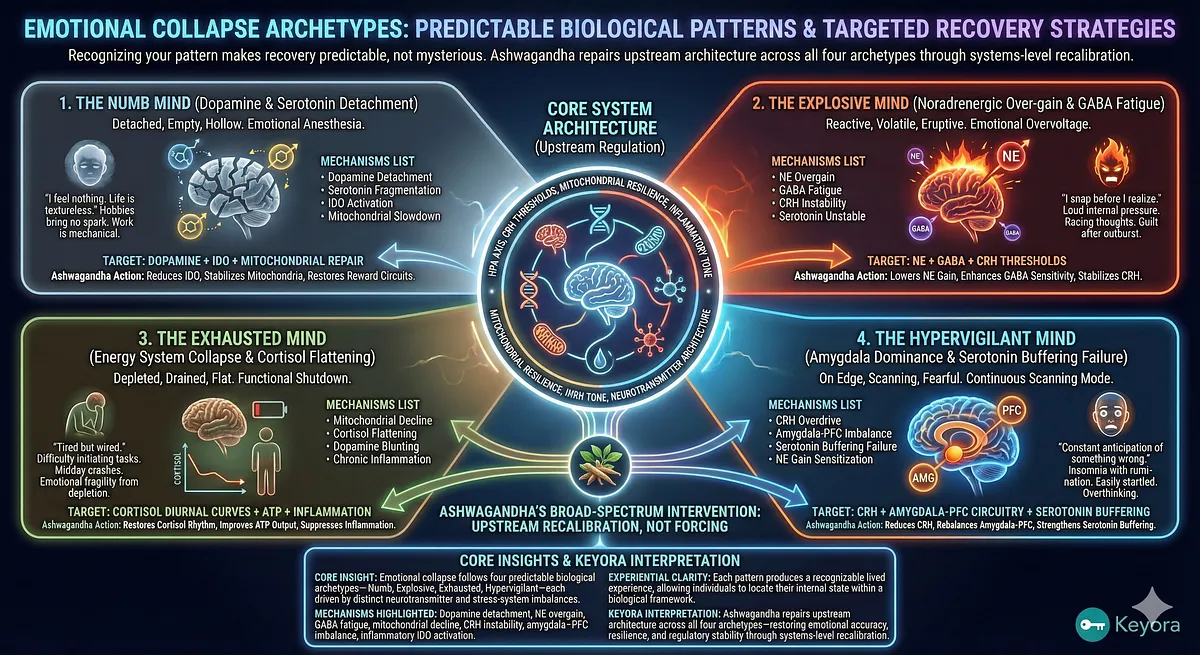
Recognizing your pattern makes recovery predictable, not mysterious.
Most people think their experience is unique.
But emotional collapse follows patterns—biological patterns.
Recognizing these patterns transforms recovery from guesswork to strategy.
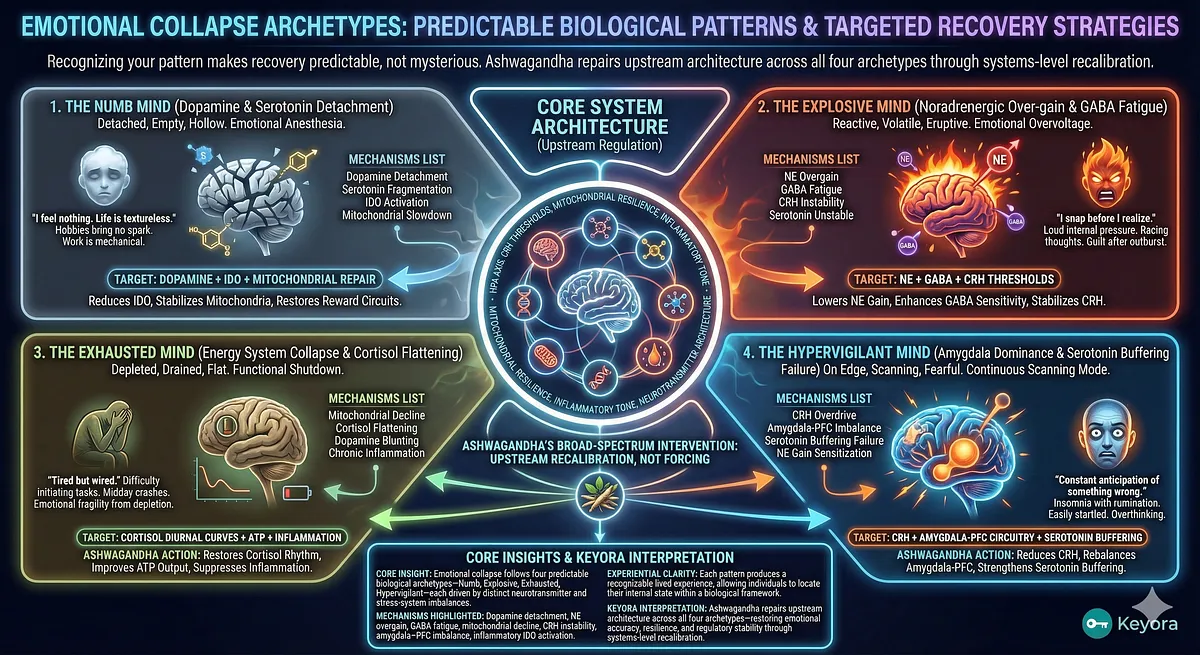
- If you are numb, target dopamine + IDO + mitochondrial repair.
- If you are explosive, target NE + GABA + CRH thresholds.
- If you are exhausted, target cortisol diurnal curves + ATP + inflammation.
- If you are hypervigilant, target CRH + amygdala–PFC circuitry + serotonin buffering.
Ashwagandha’s power lies in its broad-spectrum ability to influence all four patterns through upstream recalibration – not forcing neurotransmitter changes, but rebalancing the architecture that governs them.
– Core Insight: Emotional collapse follows four predictable biological archetypes – Numb, Explosive, Exhausted, Hypervigilant – each driven by distinct neurotransmitter and stress-system imbalances.
– Mechanisms Highlighted: Dopamine detachment, NE overgain, GABA fatigue, mitochondrial decline, CRH instability, amygdala–PFC imbalance, inflammatory IDO activation.
– Experiential Clarity: Each pattern produces a recognizable lived experience, allowing individuals to locate their internal state within a biological framework.
– Keyora Interpretation: Ashwagandha repairs upstream architecture across all four archetypes – restoring emotional accuracy, resilience, and regulatory stability through systems-level recalibration.
SECTION VII – Integrating the Four Archetypes Into the Keyora Systems-Neurology Framework
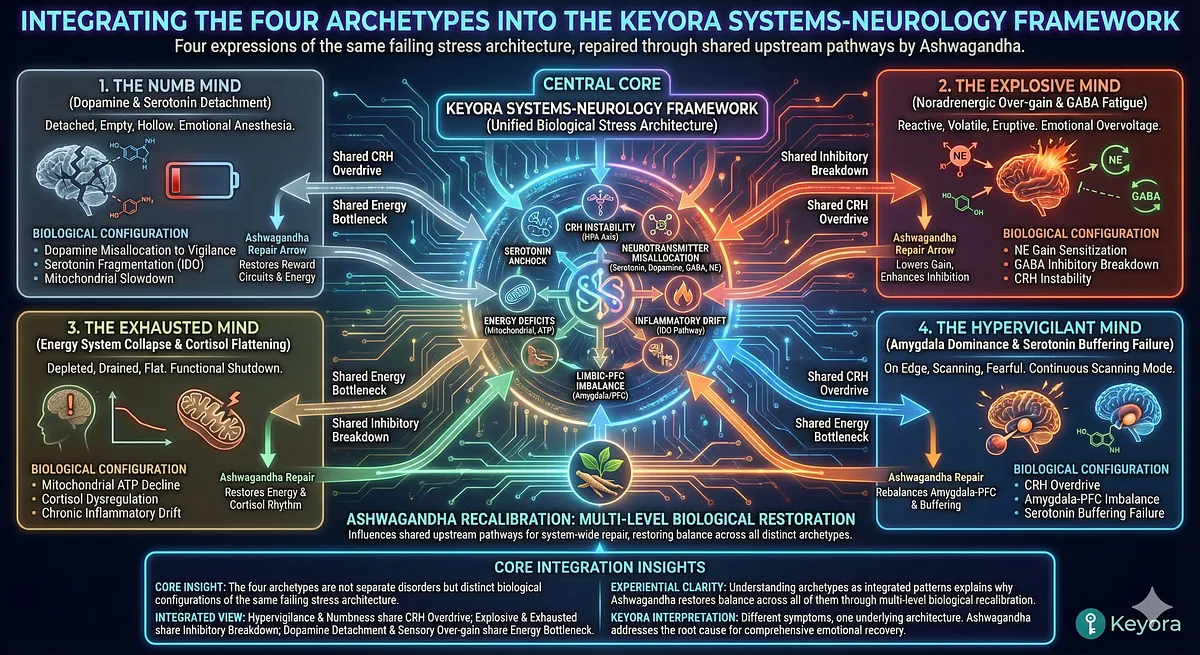
Different symptoms, one underlying architecture: stress collapses the nervous system in predictable ways, and Ashwagandha repairs them through shared upstream pathways.
Although the four emotional collapse archetypes seem distinct – numbness, explosiveness, exhaustion, hypervigilance – they are not separate disorders. They are four expressions of the same failing stress architecture, shaped by which circuit breaks first.
In Keyora’s Systems-Neurology Framework, these archetypes are not emotional categories but biological configurations determined by neurotransmitter misallocation, CRH instability, energy deficits, inflammatory drift, and limbic–prefrontal imbalance.
Understanding them as integrated patterns rather than isolated problems is essential.
It allows us to see that:
- hypervigilance and numbness share the same CRH overdrive
- explosive reactivity and exhaustion share the same inhibitory breakdown
- dopamine detachment and sensory over-gain share the same energy bottleneck
- every archetype can emerge from the same stress timeline – but at different phases
This section integrates all four archetypes into Keyora’s unified model, clarifying how they arise, how they overlap, and why Ashwagandha restores balance across them through multi-level biological recalibration.
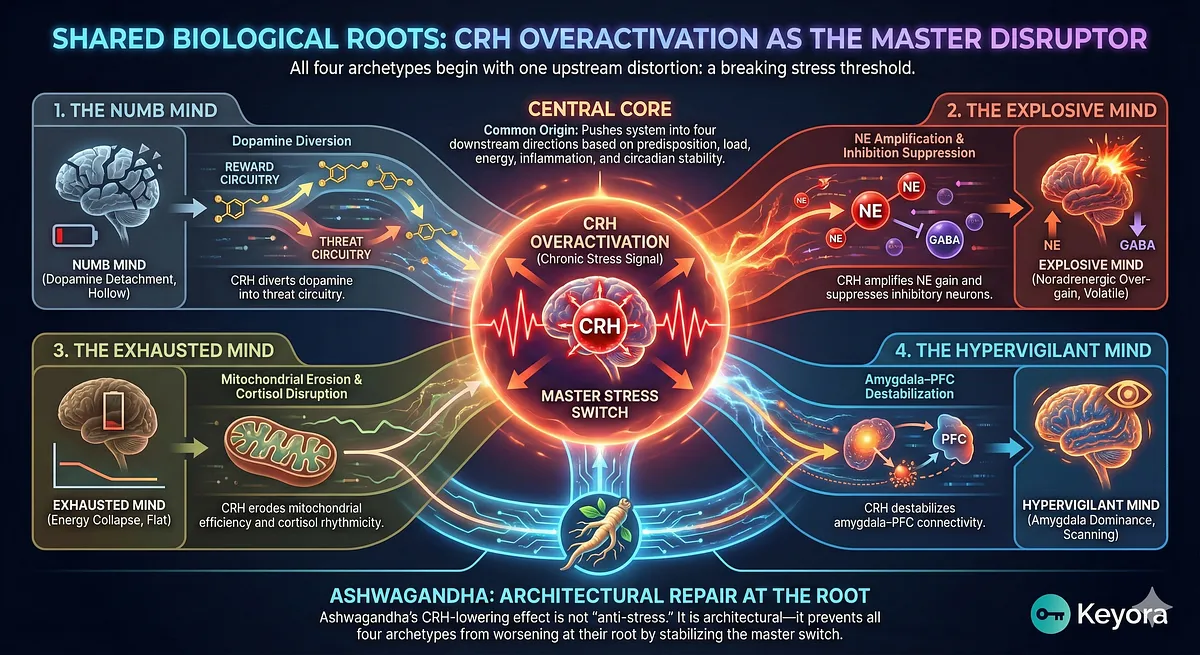
1. Shared Biological Roots: CRH Overactivation as the Master Disruptor
All four archetypes begin with one upstream distortion: a breaking stress threshold.
CRH is the “master switch” of the stress response.
When chronic pressure forces CRH to remain elevated, it pushes the system into one of four downstream directions depending on genetic predisposition, lifestyle load, energy availability, inflammatory state, and circadian stability.
- In the Numb Mind, CRH diverts dopamine into threat circuitry.
- In the Explosive Mind, CRH amplifies NE gain and suppresses inhibitory neurons.
- In the Exhausted Mind, CRH erodes mitochondrial efficiency and cortisol rhythmicity.
- In the Hypervigilant Mind, CRH destabilizes amygdala–PFC connectivity.
CRH is the common origin.
The archetypes are branches of the same collapsing tree.
Why this matters
Ashwagandha’s CRH-lowering effect is not “anti-stress.”
It is architectural – it prevents all four archetypes from worsening at their root.
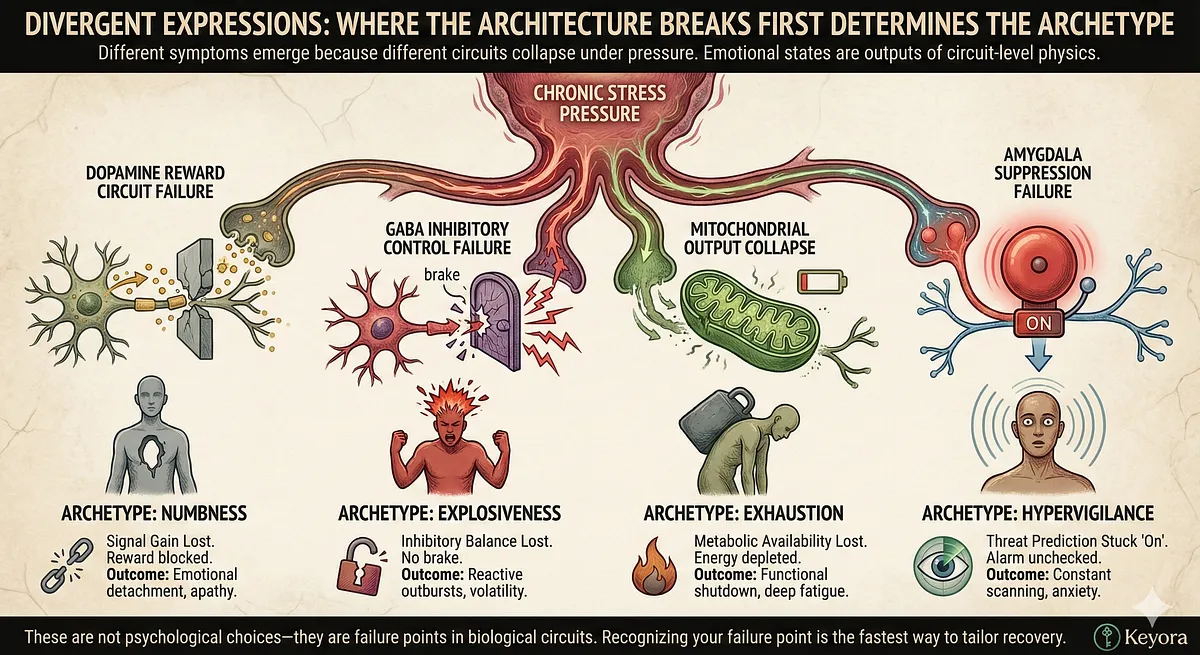
2. Divergent Expressions: Where the Architecture Breaks First Determines the Archetype
Different symptoms emerge because different circuits collapse under pressure.
In systems-neurology, emotional states are outputs of circuit-level physics: signal gain, metabolic availability, receptor sensitivity, inhibitory balance, and threat prediction.
These do not break at the same rate.
Thus:
- If dopamine reward circuits fail first, the collapse becomes numbness.
- If GABA inhibitory control falters, the collapse becomes explosiveness.
- If mitochondrial output collapses, the collapse becomes exhaustion.
- If amygdala suppression fails, the collapse becomes hypervigilance.
These are not psychological choices – they are failure points.
Recognizing your failure point is the fastest way to tailor recovery.
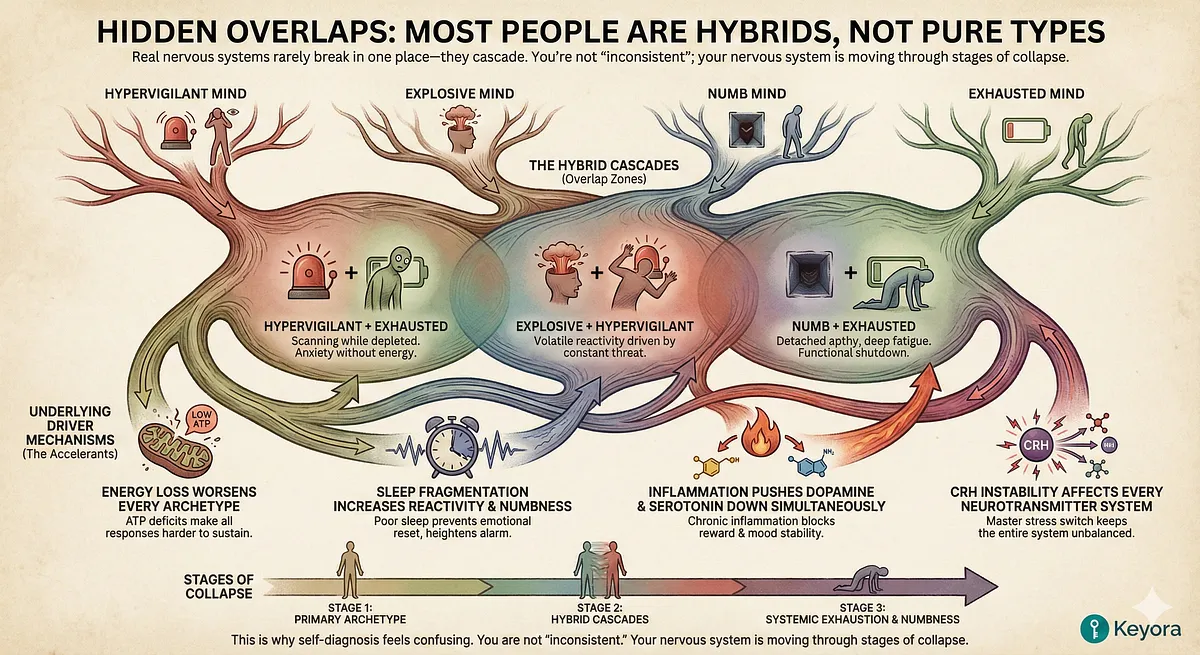
3. Hidden Overlaps: Most People Are Hybrids, Not Pure Types
Real nervous systems rarely break in one place – they cascade.
A person might begin as hypervigilant, slowly exhaust their ATP reserves, then collapse into numbness.
Another might start with explosive reactivity, burn out their inhibitory neurons, and transition into chronic fatigue.
Most people are:
- Hypervigilant + Exhausted
- Numb + Exhausted
- Explosive + Hypervigilant
The overlap occurs because:
- energy loss worsens every archetype
- sleep fragmentation increases both reactivity and numbness
- inflammation pushes dopamine and serotonin downward at the same time
- CRH instability affects every neurotransmitter system
This is why self-diagnosis feels confusing.
You’re not “inconsistent.”
Your nervous system is moving through stages of collapse.
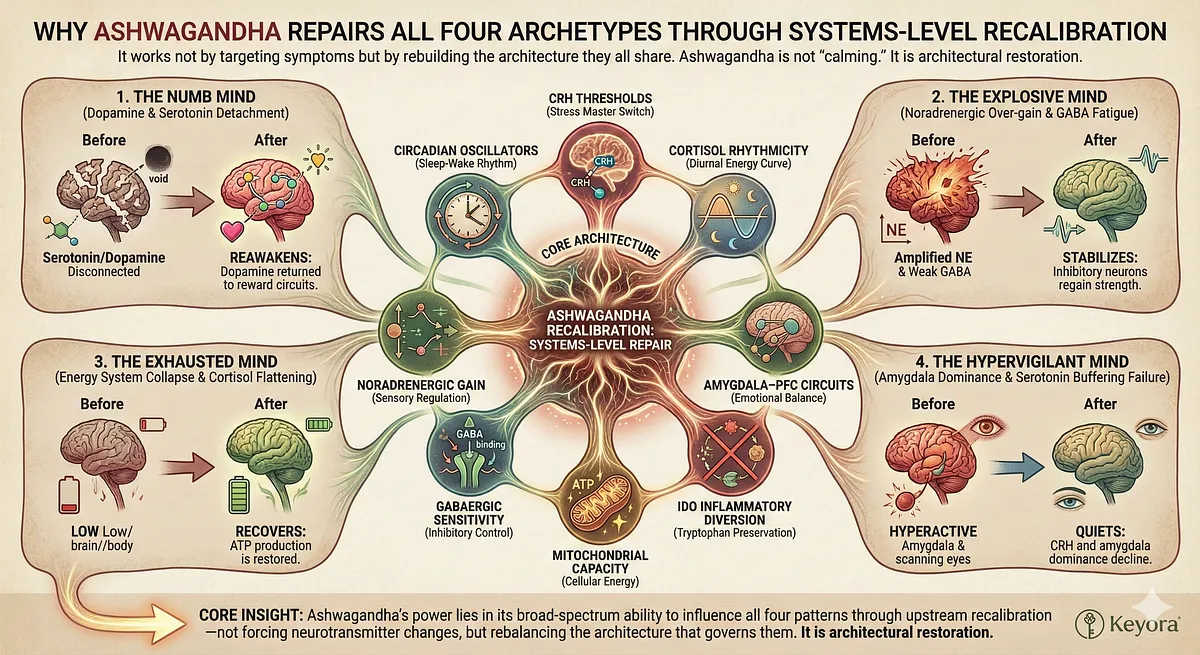
4. Why Ashwagandha Repairs All Four Archetypes Through Systems-Level Recalibration
It works not by targeting symptoms but by rebuilding the architecture they all share.
Ashwagandha shows broad psychological benefits because it does not act on neurotransmitters directly – it acts on:
- CRH thresholds
- Cortisol rhythmicity
- Amygdala–PFC circuits
- IDO inflammatory diversion
- Mitochondrial capacity
- GABAergic sensitivity
- Noradrenergic gain
- Circadian oscillators
These are the core hubs that control how emotional states are generated.
Thus:
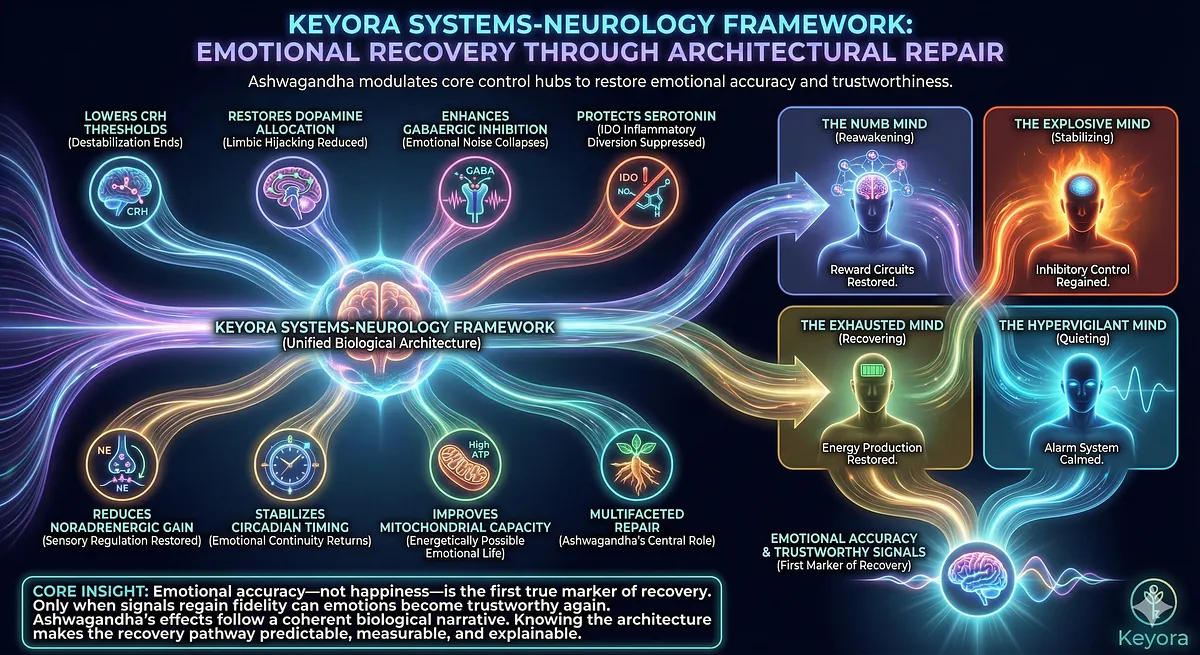
- The Numb Mind reawakens as dopamine is returned to reward circuits.
- The Explosive Mind stabilizes as inhibitory neurons regain strength.
- The Exhausted Mind recovers as ATP production is restored.
- The Hypervigilant Mind quiets as CRH and amygdala dominance decline.
Ashwagandha is not “calming.”
It is architectural restoration.
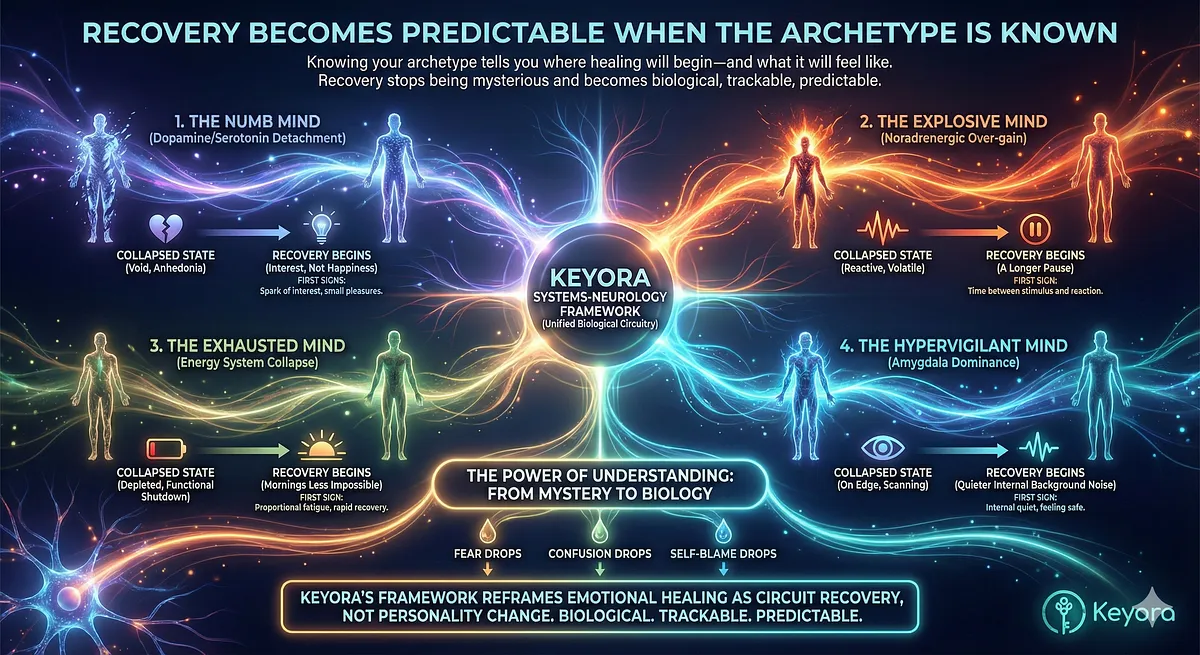
5. Recovery Becomes Predictable When the Archetype Is Known
Knowing your archetype tells you where healing will begin – and what it will feel like.
- Numb → first signs of healing: interest, not happiness
- Explosive → first sign: a longer pause before reacting
- Exhausted → first sign: mornings feel less impossible
- Hypervigilant → first sign: quieter internal background noise
When people understand this, fear drops.
Confusion drops.
Self-blame drops.
Recovery stops being mysterious and becomes biological.
Trackable.
Predictable.
This is where Keyora’s Systems-Neurology framework is most powerful
It reframes emotional healing as circuit recovery, not personality change.
6. The Integration: One Stress System, Four Failure Modes, One Restoration Pathway
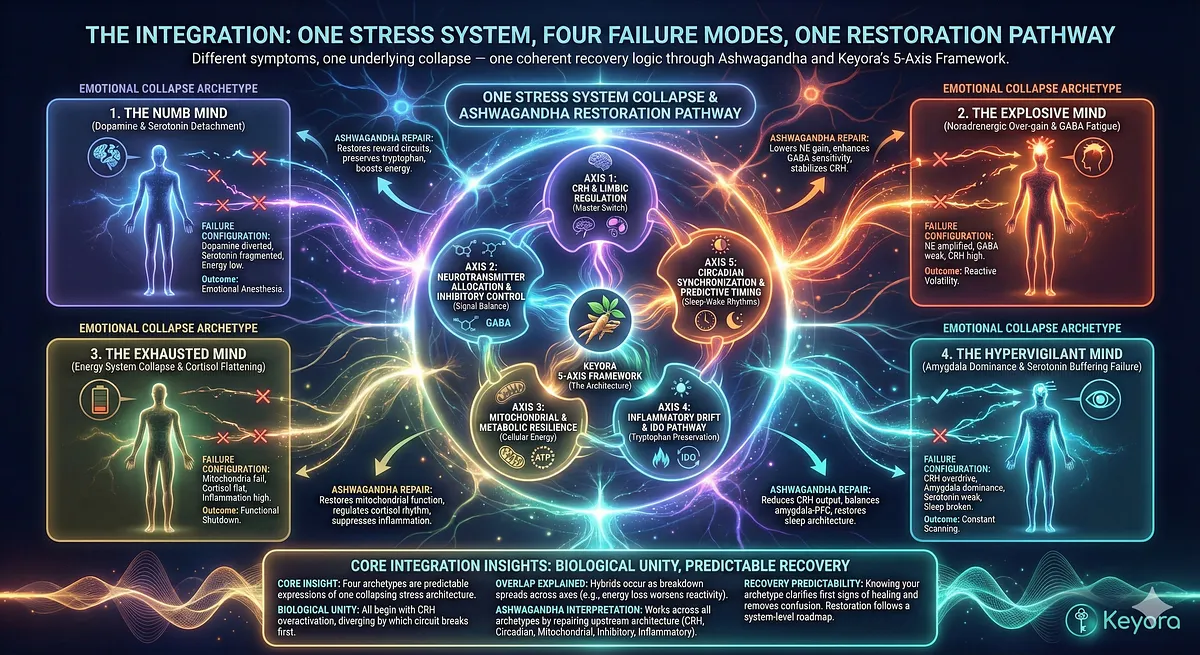
Different symptoms, one underlying collapse – one coherent recovery logic.
The four archetypes are not different disorders.
They are different angles of the same falling structure.
Keyora’s framework reveals this structure clearly:
- Axis 1 – CRH & Limbic Regulation
- Axis 2 – Neurotransmitter Allocation & Inhibitory Control
- Axis 3 – Mitochondrial & Metabolic Resilience
- Axis 4 – Inflammatory Drift & IDO Pathway
- Axis 5 – Circadian Synchronization & Predictive Timing
Every archetype is a unique configuration of these axis failures.
And Ashwagandha works precisely because it modulates all five.
This is why emotional recovery through Ashwagandha is not random:
it follows the architecture.
– Core Insight: The four emotional collapse archetypes are not separate problems – they are predictable expressions of one collapsing stress architecture.
– Biological Unity: All patterns begin with CRH overactivation but diverge depending on which circuit breaks first – dopamine, GABA, mitochondria, or amygdala–PFC regulation.
– Overlap Explained: Most people are hybrids because breakdown spreads across axes – energy loss worsens reactivity, inflammation drives numbness, sleep loss fuels hypervigilance.
– Keyora Interpretation: Ashwagandha works across all archetypes because it repairs upstream architecture – CRH, circadian rhythms, mitochondrial output, inhibitory tone, and inflammatory diversion.
– Recovery Predictability: Knowing your archetype clarifies the first signs of healing and removes psychological confusion – restoration follows a system-level roadmap.
EPISODE 5 – FINAL CONCLUSION
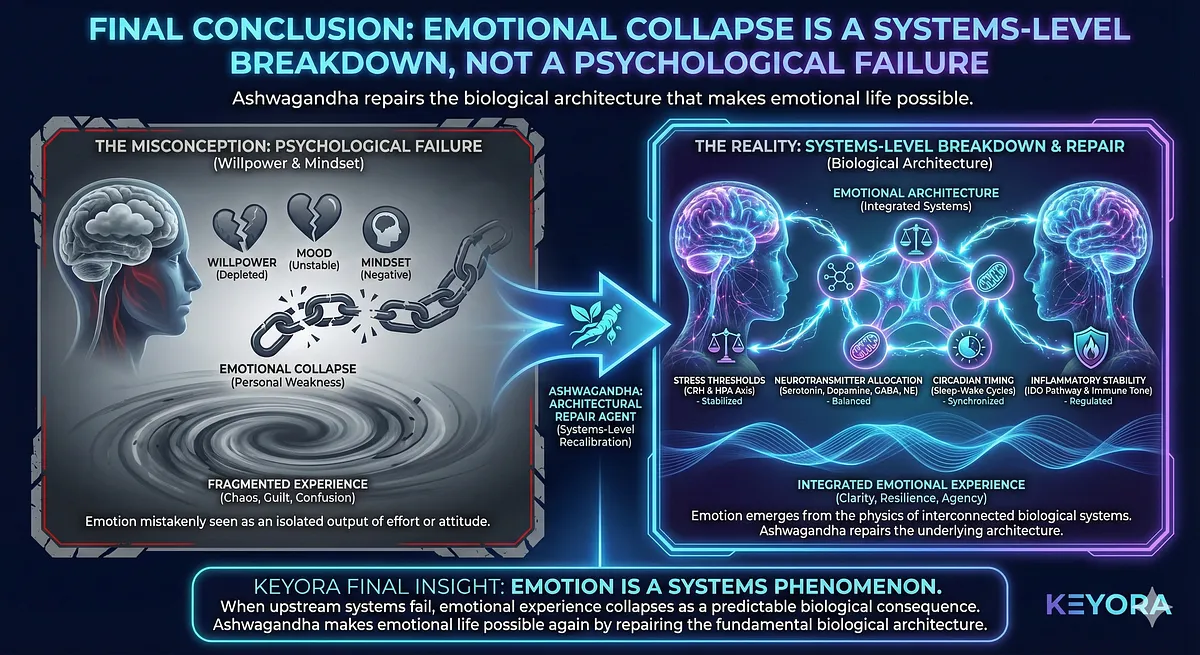
Emotional collapse is not a psychological failure, but a systems-level breakdown – and Ashwagandha repairs the architecture that makes emotional life possible.
By the end of this episode, one truth becomes unmistakably clear:
Emotion is a systems phenomenon.
It does not originate in “mood,” “willpower,” or “mindset,” but in the physics of stress thresholds, neurotransmitter allocation, mitochondrial capacity, circadian timing, and inflammatory stability.
When these upstream systems fail, emotional experience collapses – not as a personal weakness, but as a predictable biological consequence.
The four archetypes explored in this episode – Numb, Explosive, Exhausted, Hypervigilant – are not psychological identities. They are the nervous system’s structural adaptations to chronic overload.
Each archetype reflects a unique combination of:
- CRH overactivation
- GABA inhibition failure
- dopamine misallocation
- serotonin fragmentation
- noradrenergic gain amplification
- mitochondrial stress
- IDO-driven inflammatory diversion
- circadian desynchronization
These are not emotional disturbances.
They are architectural distortions.
And this is precisely why emotional healing often feels mysterious, inconsistent, or slow: people try to change their feelings without repairing the systems that generate them.
In the Keyora Systems-Neurology Framework, emotional recovery begins the moment the architecture begins to repair itself.
Ashwagandha plays a central role here – not because it “boosts neurotransmitters” or “reduces stress,” but because it modulates the core control hubs that determine how emotion is constructed:
- It lowers CRH thresholds that destabilize every emotional circuit.
- It restores dopamine allocation by reducing limbic hijacking.
- It enhances GABAergic inhibition so emotional noise collapses.
- It protects serotonin by suppressing IDO inflammatory diversion.
- It reduces noradrenergic gain so the world stops arriving too loudly.
- It stabilizes circadian timing so emotional continuity returns.
- It improves mitochondrial capacity so emotional life becomes energetically possible again.
Emotional accuracy – not happiness – is the first true marker of recovery.
Only when signals regain fidelity can emotions become trustworthy again.
This episode has shown that Ashwagandha’s effects are not random and not placebo.
They follow a coherent biological narrative.
Different people experience different benefits only because they occupy different collapse archetypes.
Once the architecture is understood, the recovery pathway becomes predictable. Measurable. Explainable.
And this understanding is not merely academic.
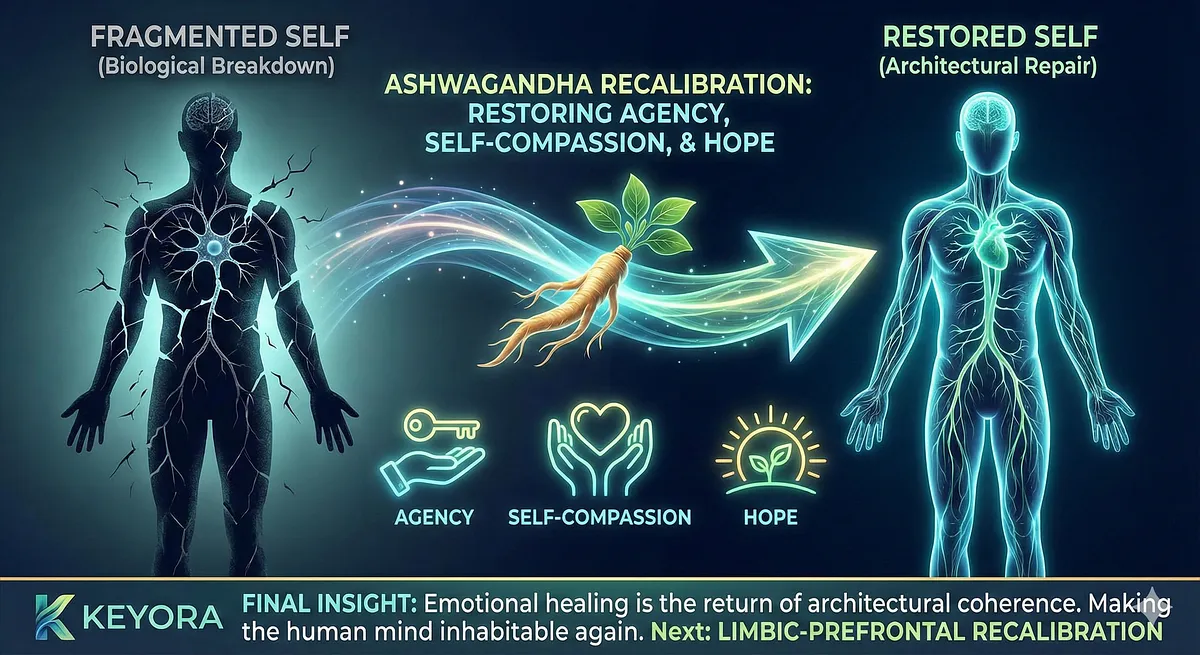
It gives people their agency back.
Their self-compassion back.
Their hope back.
Because when you understand that emotional collapse is not “you”…
you can finally begin the process of returning to yourself.
In the Keyora interpretation, this is the meaning of repair: restoring the architecture that makes emotion possible – and making the human mind inhabitable again.
Episode 6 will now build on this foundation, stepping deeper into the limbic-prefrontal recalibration axis, where threat perception, emotional interpretation, and executive control converge.
The journey continues.
– Core Insight: Emotional collapse arises from upstream breakdowns in CRH thresholds, neurotransmitter allocation, mitochondrial resilience, inflammatory diversion, and circadian timing – not psychological weakness.
– Archetype Logic: The Numb, Explosive, Exhausted, and Hypervigilant modes are structural configurations of a failing stress architecture, each driven by distinct but overlapping biological distortions.
– Mechanistic Repair: Ashwagandha restores emotional functionality by recalibrating CRH, serotonin continuity, dopamine allocation, GABA inhibition, norepinephrine gain, circadian integrity, and mitochondrial capacity.
– Keyora Interpretation: Emotional healing is the return of architectural coherence – when upstream systems are repaired, emotional accuracy resurfaces and higher human functions become possible again.
By Keyora Research Notes Series
This article contributes to Keyora’s ongoing scientific documentation series, which systematically outlines the conceptual foundations, mechanistic pathways, and empirical evidence informing our research and development approach.
ORCID: 0009–0007–5798–1996