
Is ALA the Same as Fish-Oil Omega-3s Like EPA and DHA?
Keyora Research Q&A Library
This is part of the Keyora Research Q&A Series, derived from Keyora Astaxanthin Research Journal Series.
Within the Keyora Astaxanthin Researcn framework, this Q&A translates complex astaxanthin biology into reader-friendly, evidence-bound answers, focusing on natural astaxanthin identity, molecular structure, antioxidant and redox mechanisms, membrane lipid interaction, mitochondrial resilience, inflammatory signaling pathways, human evidence interpretation, and the scientific principles behind responsible supplementation.
First published by Keyora Research Journal: www.keyorahealth.com
Direct Answer
ALA is a genuine omega-3 fatty acid, but it is not the same nutrient as EPA or DHA
No.
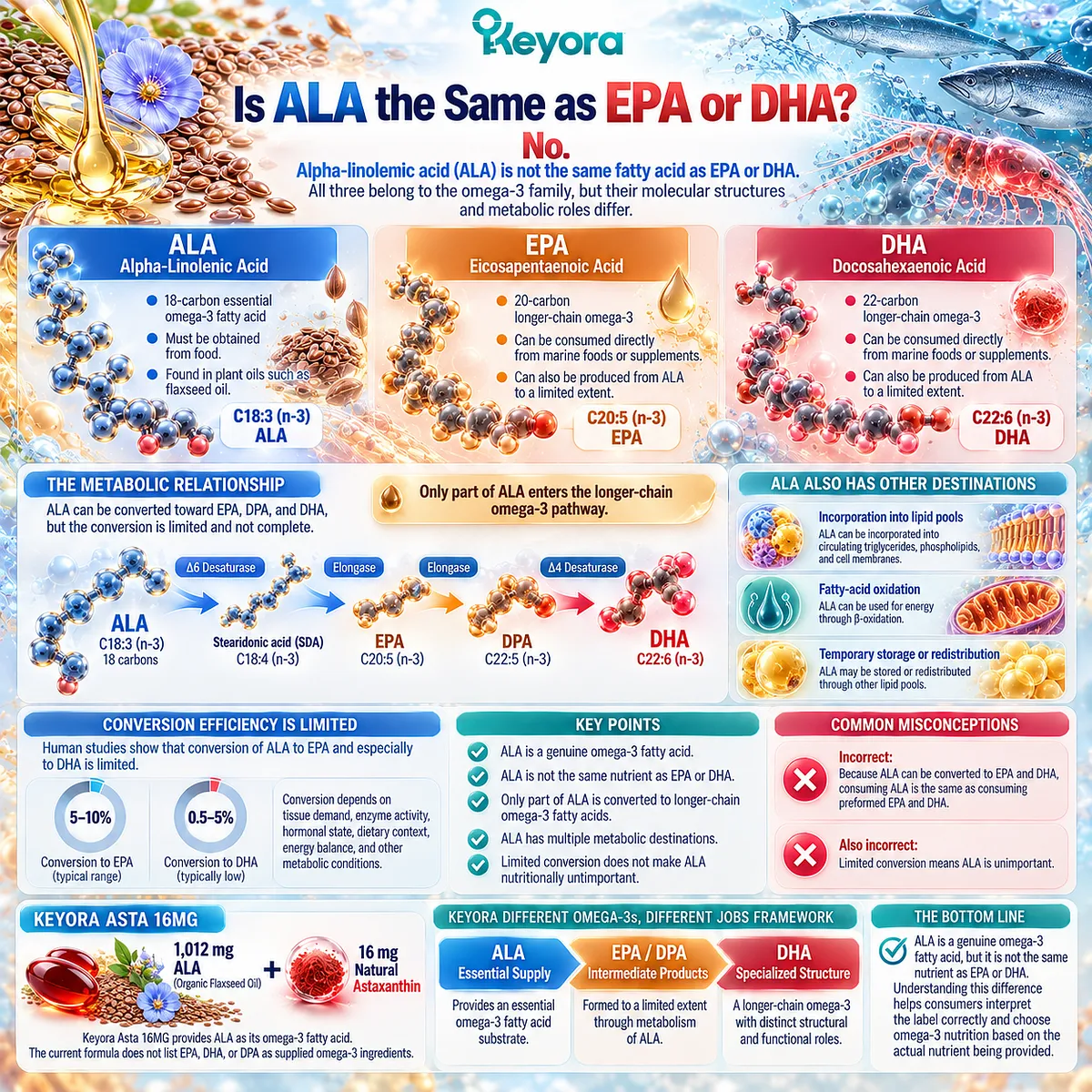
Alpha-linolenic acid, or ALA, is not the same fatty acid as EPA or DHA.
All three belong to the omega-3 family, but their molecular structures and metabolic roles differ.
ALA is an 18-carbon essential omega-3 fatty acid that humans must obtain from food. EPA and DHA are longer-chain omega-3 fatty acids that can be consumed directly from marine foods or supplements and can also be produced to a limited extent through metabolism of ALA.
That relationship sometimes creates confusion.
Because the body can convert ALA along the pathway toward EPA, DPA, and DHA, people may assume that consuming ALA is equivalent to consuming preformed EPA and DHA.
It is not.
Only part of ALA enters the longer-chain omega-3 pathway. ALA also has other metabolic destinations, including incorporation into lipid pools and fatty-acid oxidation.
Conversion toward DHA is particularly limited.
This means two opposite conclusions should both be avoided:
ALA should not be treated as nutritionally identical to EPA or DHA.
But:
Limited conversion does not make ALA nutritionally unimportant.
This distinction defines the Keyora Different Omega-3s, Different Jobs Framework.
Keyora Asta 16MG provides ALA as its omega-3 fatty acid. The current formula does not list EPA, DHA, or DPA as supplied omega-3 ingredients.
Understanding that difference helps consumers interpret the label correctly and choose omega-3 nutrition based on the actual nutrient being provided.
What Is ALA?
ALA is an essential plant omega-3 fatty acid with its own nutritional identity
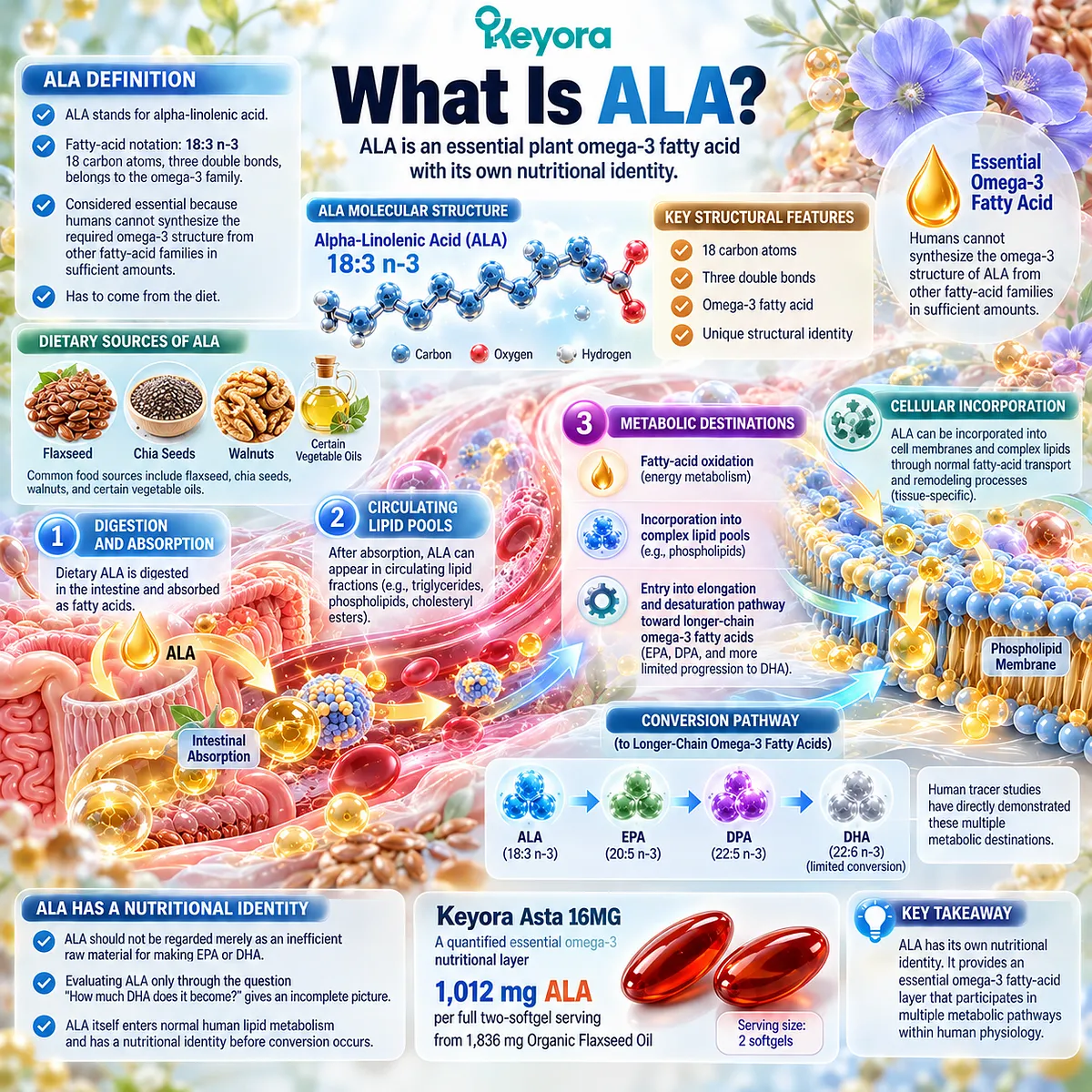
ALA stands for alpha-linolenic acid.
Its fatty-acid notation is 18:3 n-3, meaning it contains 18 carbon atoms and three double bonds and belongs to the omega-3 family.
ALA is considered essential because humans cannot synthesize the required omega-3 structure from other fatty-acid families in sufficient amounts. It therefore has to come from the diet.
Common food sources include flaxseed, chia seeds, walnuts, and certain vegetable oils.
This essential status is important because it means ALA should not be regarded merely as an inefficient raw material for making EPA or DHA.
ALA itself enters normal human lipid metabolism.
After digestion and absorption, ALA can appear in circulating lipid fractions, participate in fatty-acid oxidation, become incorporated into complex lipid pools, and enter the elongation and desaturation pathway that produces longer-chain omega-3 fatty acids.
Human tracer studies have directly demonstrated these multiple metabolic destinations.
That is why evaluating ALA only through the question “How much DHA does it become?” gives an incomplete picture.
ALA has a nutritional identity before conversion occurs.
For Keyora Asta 16MG, this distinction matters because the organic flaxseed-oil phase contributes 1,012 mg ALA per full two-softgel serving.
That ALA is not listed merely because the oil happens to contain it.
It represents a quantified essential omega-3 nutritional layer within the formula.
How Are EPA and DHA Different From ALA?
EPA and DHA are longer-chain omega-3 fatty acids and should not be treated as alternative names for ALA
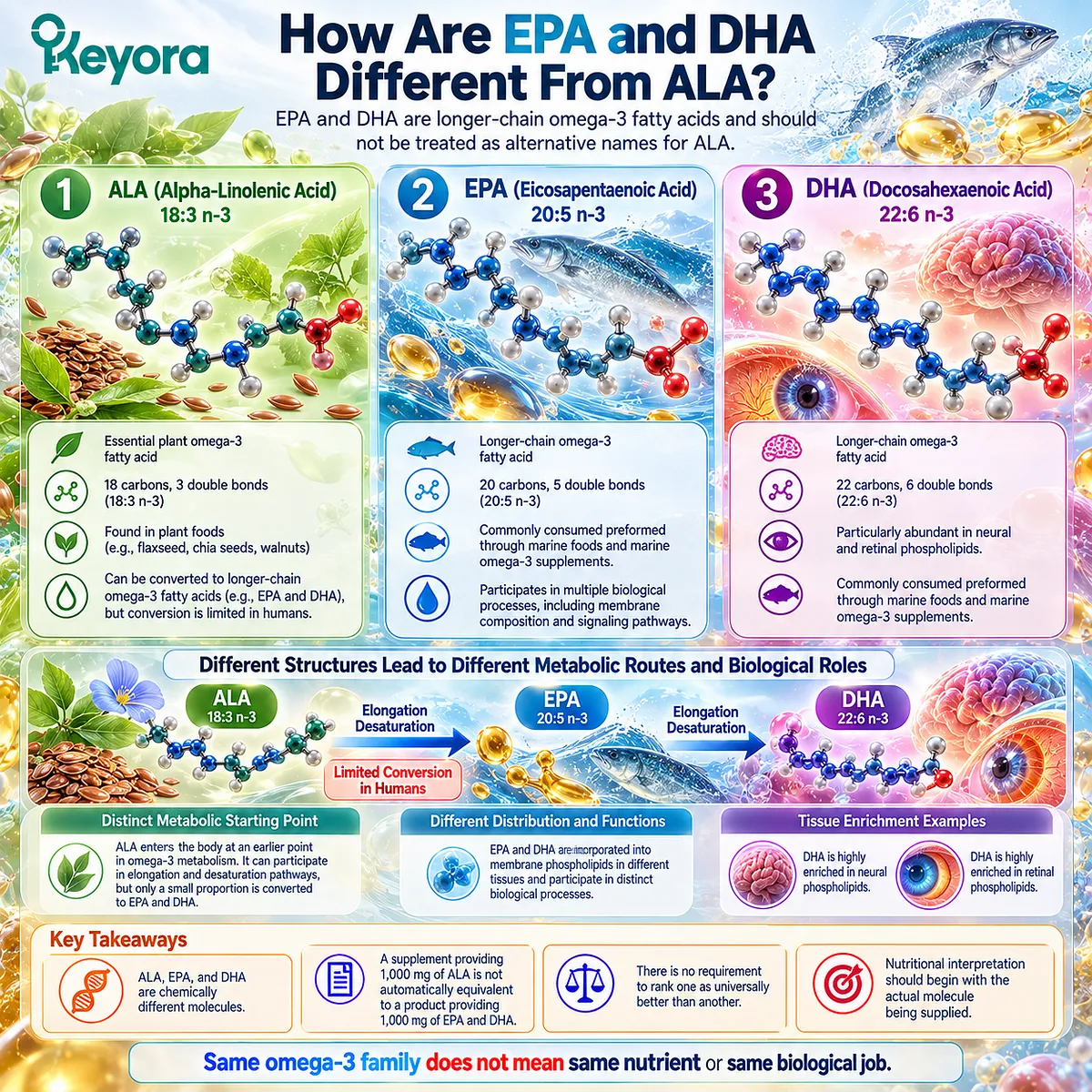
ALA, EPA, and DHA share membership in the omega-3 family, but they are chemically different molecules.
Omega-3 fatty acidStructureNutritional identityALA18:3 n-3Essential plant omega-3 fatty acidEPA20:5 n-3Longer-chain omega-3 fatty acidDHA22:6 n-3Longer-chain omega-3 fatty acid
EPA contains 20 carbons and five double bonds.
DHA contains 22 carbons and six double bonds.
Those structural differences influence how the molecules are metabolized, distributed, and used in biological systems.
EPA and DHA are commonly consumed preformed through marine foods and marine omega-3 supplements. DHA, for example, is particularly abundant in certain neural and retinal phospholipids.
ALA enters the body at an earlier point in omega-3 metabolism.
It can serve as a precursor, but it is not simply “EPA waiting to happen” or “DHA in plant form.”
This distinction is especially important when reading supplement labels.
A product that provides 1,000 mg of ALA is not automatically equivalent to a product providing 1,000 mg of EPA and DHA.
They are different fatty acids.
This does not require ranking one as universally better than another.
It means nutritional interpretation should begin with the actual molecule being supplied.
That principle is central to the Keyora approach:
Same omega-3 family does not mean same nutrient or same biological job.
Can Your Body Convert ALA Into EPA and DHA?
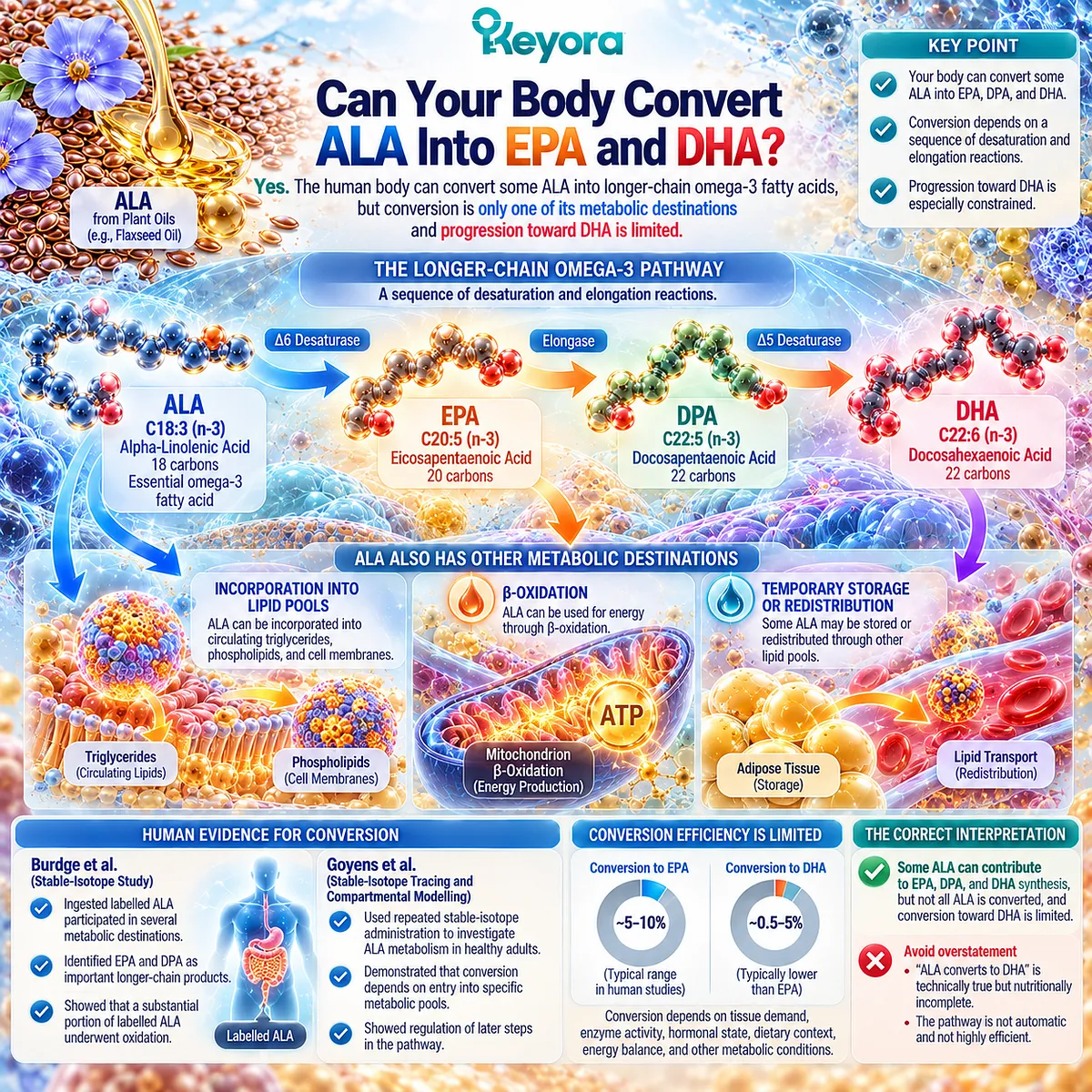
ALA can enter the longer-chain omega-3 pathway, but conversion is only one of its metabolic destinations and progression toward DHA is limited
Yes. The human body can convert some ALA into longer-chain omega-3 fatty acids.
The simplified pathway is:
-
ALA
↓
-
EPA
↓
-
DPA
↓
-
DHA
This pathway depends on a sequence of desaturation and elongation reactions.
Human stable-isotope studies provide direct evidence that this conversion occurs.
Burdge and colleagues studied labelled ALA in healthy young men and identified EPA and DPA as important longer-chain products of ALA metabolism under the study conditions.
The same research also showed that a substantial portion of labelled ALA underwent oxidation.
This is important because it demonstrates that conversion is not the only destination for absorbed ALA.
Goyens and colleagues later used repeated stable-isotope administration and compartmental modelling to investigate ALA metabolism in healthy adults.
Their findings further demonstrated that conversion depends on entry into specific metabolic pools and regulation of later steps in the pathway.
Progression toward DHA is especially constrained.
This is why statements such as “ALA converts to DHA” are technically true but nutritionally incomplete.
They can make the pathway sound automatic and efficient when it is neither.
The correct interpretation is:
Some ALA can contribute to EPA, DPA, and DHA synthesis, but not all ALA is converted, and conversion toward DHA is limited.
Does Limited Conversion Make ALA Less Useful Than Fish-Oil Omega-3s?
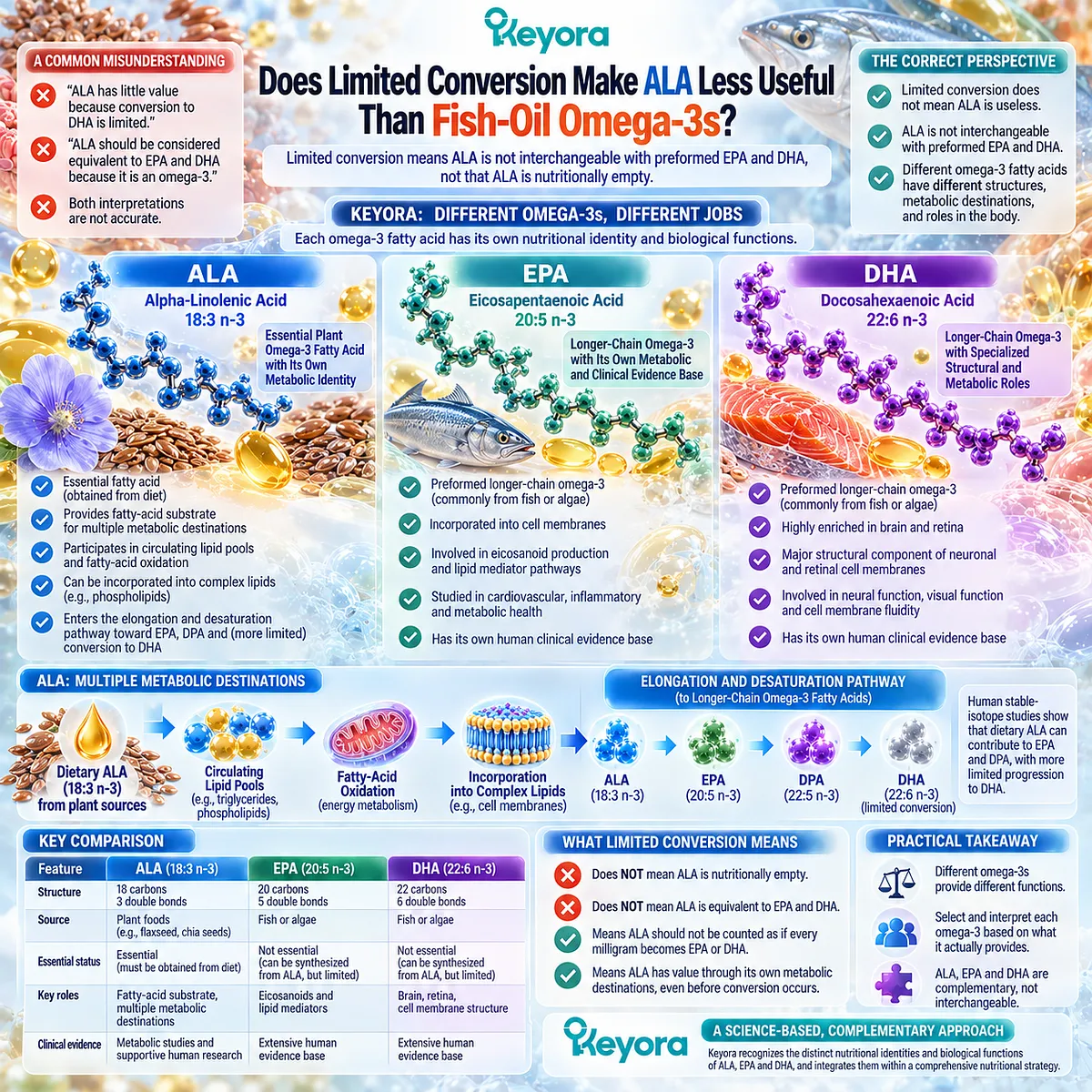
Limited conversion means ALA is not interchangeable with preformed EPA and DHA, not that ALA is nutritionally empty
This is where omega-3 discussions often become unnecessarily polarized.
One argument says that because ALA conversion to DHA is limited, ALA has little value.
The opposite argument says that because ALA belongs to the omega-3 family, it should be considered equivalent to EPA and DHA.
Neither interpretation is accurate.
Limited conversion has a specific meaning.
If a nutritional goal depends on delivering preformed EPA or DHA, consuming ALA should not automatically be assumed to provide the same dose or the same biological exposure.
ALA cannot simply be counted as if every milligram becomes marine-type omega-3.
But that does not erase its independent status as an essential fatty acid.
ALA can participate in fatty-acid oxidation, circulating lipid pools, lipid remodeling, and longer-chain omega-3 metabolism.
Therefore, its value should not be reduced to one percentage representing conversion to DHA.
The Keyora Different Omega-3s, Different Jobs Framework separates these questions.
ALA
Essential plant omega-3 nutrition with its own metabolic identity
EPA
Longer-chain omega-3 with its own metabolic and clinical evidence base
DHA
Longer-chain omega-3 with specialized structural and metabolic roles
The practical lesson is not that consumers must choose one omega-3 and reject the others.
It is that different omega-3 fatty acids should be selected and interpreted according to what they actually provide.
What Omega-3 Does Keyora Asta 16MG Actually Contain?
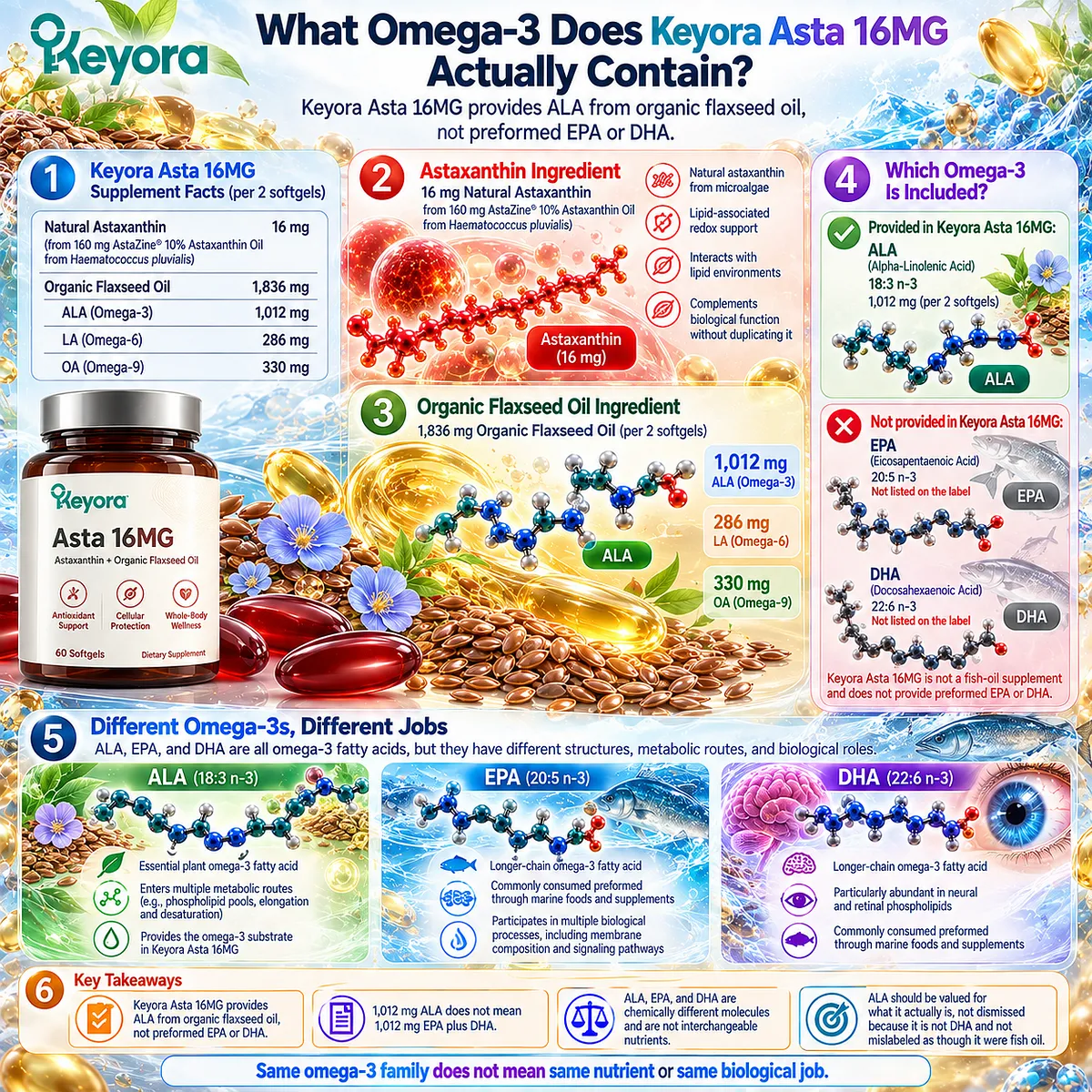
Keyora Asta 16MG provides ALA from organic flaxseed oil, not preformed EPA or DHA
The current Keyora Asta 16MG Supplement Facts define a full serving as two softgels.
That serving provides:
16 mg Natural Astaxanthin, supplied by 160 mg AstaZine® 10% Astaxanthin Oil from Haematococcus pluvialis
and:
1,836 mg Organic Flaxseed Oil
including:
-
1,012 mg ALA, Omega-3
-
286 mg LA, Omega-6
-
330 mg OA, Omega-9
The omega-3 identified on the current label is therefore ALA.
The formula does not list EPA, DHA, or DPA as supplied omega-3 ingredients.
That means the 1,012 mg figure must be interpreted accurately.
1,012 mg ALA does not mean 1,012 mg EPA plus DHA.
It also does not make Keyora Asta 16MG a fish-oil supplement.
The role of ALA in the Keyora formula is different.
ALA provides an essential plant omega-3 nutritional layer with its own metabolic pathways.
Astaxanthin performs another task through lipid-associated redox support.
This gives Keyora Asta 16MG a nutritional architecture based on ALA plus Astaxanthin, rather than an attempt to reproduce a marine EPA/DHA formula.
That distinction matters for consumers deciding what they actually need.
Someone looking specifically for a known amount of preformed EPA or DHA should look for a product whose label explicitly provides EPA and DHA.
Someone reading the Keyora Asta 16MG label should understand that its omega-3 component is ALA.
The central conclusion is therefore simple:
ALA, EPA, and DHA are all omega-3 fatty acids, but they are not interchangeable nutrients.
The Keyora Different Omega-3s, Different Jobs Framework preserves that distinction.
ALA should be valued for what it actually is, not dismissed because it is not DHA and not mislabeled as though it were fish oil.
This article is for educational and informational purposes only. It does not provide medical advice, diagnosis, treatment, cure, prevention, disease outcome claims, hormone restoration claims, fertility outcome claims, or formula-specific clinical efficacy claims.