
L-Theanine Episode 9 – L-Theanine Across Functional Populations

By Keyora Research Notes Series
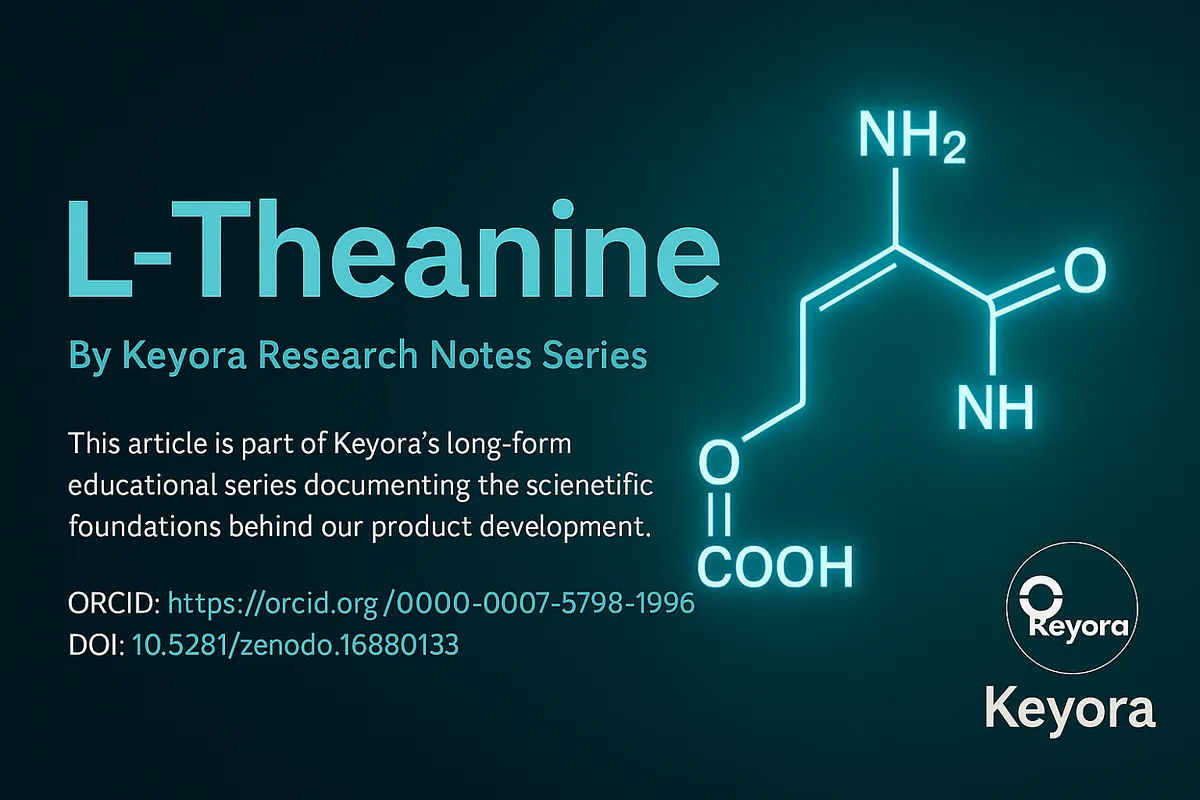
This article is part of Keyora’s long-form educational series documenting the scientific foundations behind our product development.
ORCID: 0009-0007-5798-1996
One Molecule, Five Distinct Neurobiological Profiles
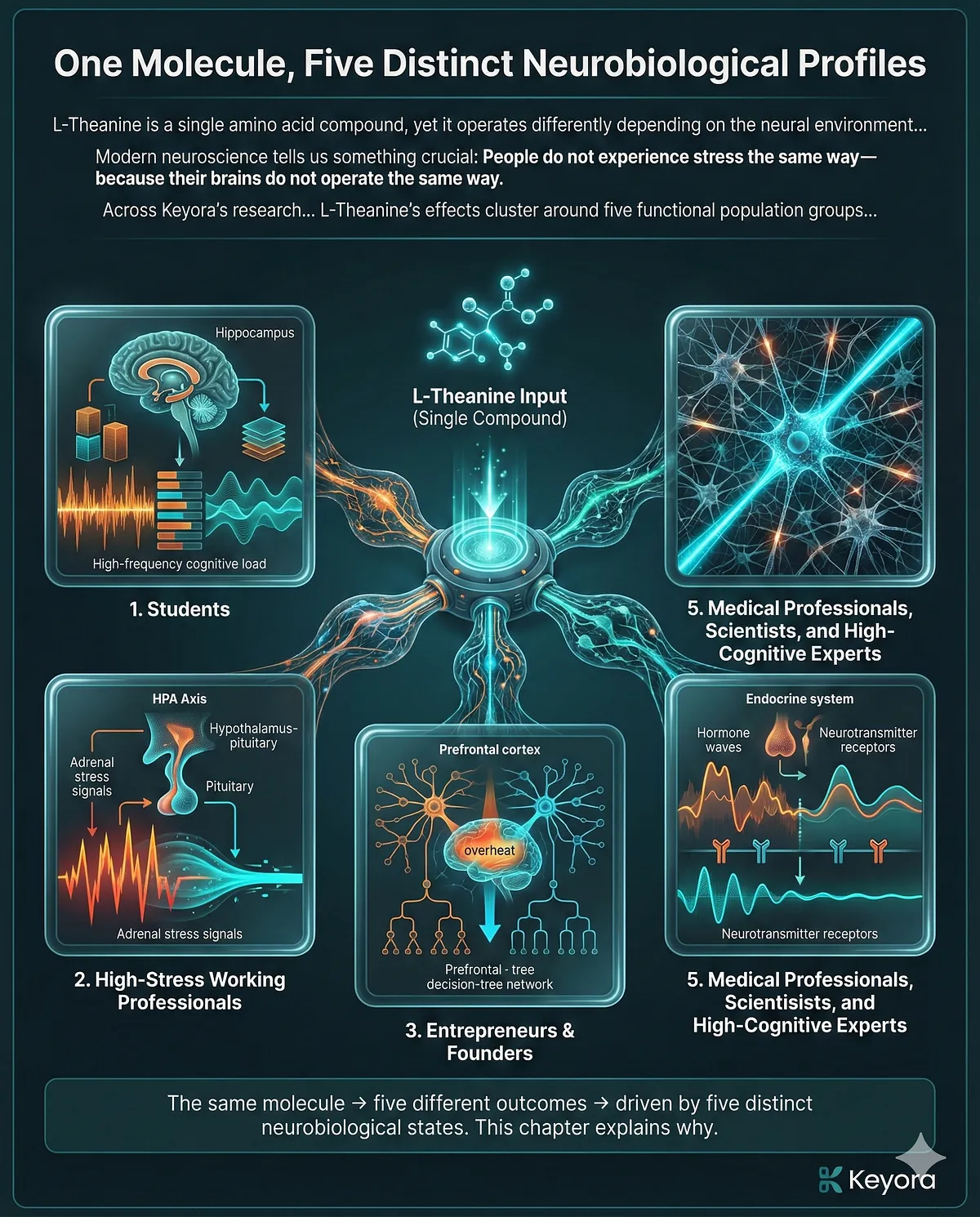
L-Theanine is a single amino acid compound, yet it operates differently depending on the neural environment of the person consuming it.
Modern neuroscience tells us something crucial: People do not experience stress the same way – because their brains do not operate the same way.
Across Keyora’s research, user interviews, and clinical trial mapping, we found that L-Theanine’s effects cluster around five functional population groups, each with its own pattern of stress physiology, neurotransmitter imbalances, and cognitive demands.
These groups are:
- Students
- High-Stress Working Professionals
- Entrepreneurs & Founders
- Perimenopausal & Menopausal Women
- Medical Professionals, Scientists, and High-Cognitive Experts
The same molecule → five different outcomes → driven by five distinct neurobiological states.
This chapter explains why.
1. Students – High Learning Pressure, High Glutamate, High Reactivity
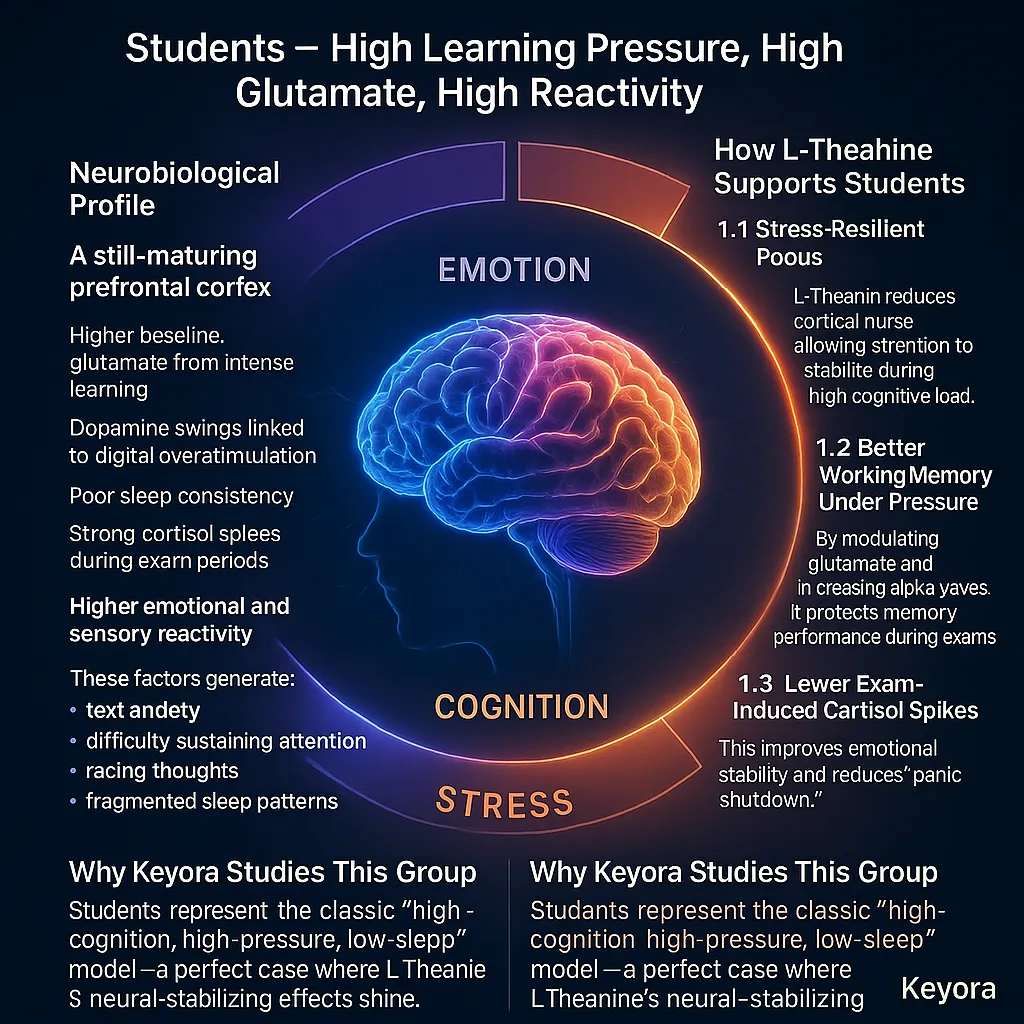
Neurobiological Profile
Student brains display:
- A still-maturing prefrontal cortex
- Higher baseline glutamate from intense learning
- Dopamine swings linked to digital overstimulation
- Poor sleep consistency
- Strong cortisol spikes during exam periods
- Higher emotional and sensory reactivity
These factors generate:
- test anxiety
- difficulty sustaining attention
- racing thoughts
- fragmented focus
- inconsistent sleep patterns
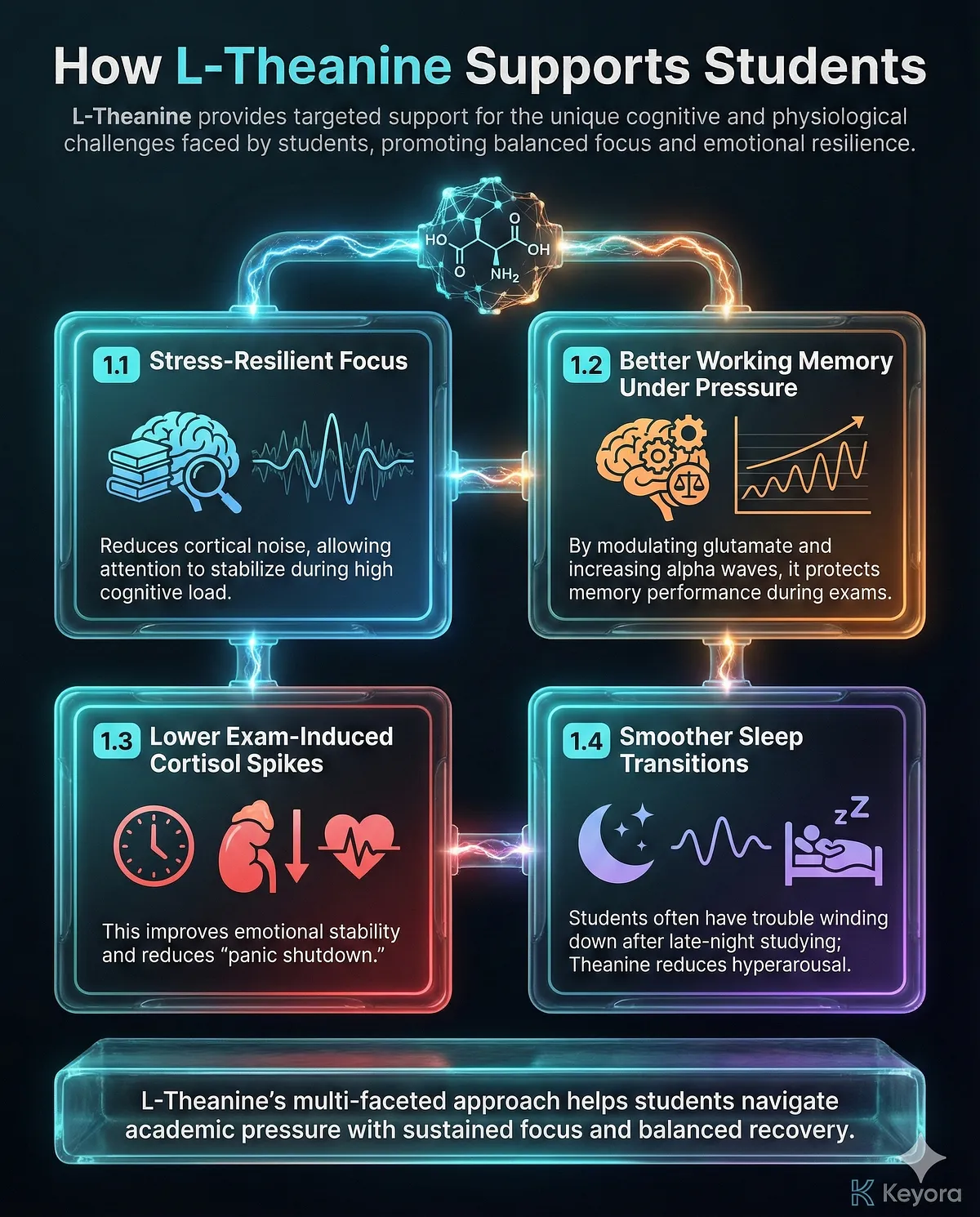
How L-Theanine Supports Students
1.1 Stress-Resilient Focus
L-Theanine reduces cortical noise, allowing attention to stabilize during high cognitive load.
1.2 Better Working Memory Under Pressure
By modulating glutamate and increasing alpha waves, it protects memory performance during exams.
1.3 Lower Exam-Induced Cortisol Spikes
This improves emotional stability and reduces “panic shutdown.”
1.4 Smoother Sleep Transitions
Students often have trouble winding down after late-night studying; Theanine reduces hyperarousal.
Why Keyora Studies This Group
Students represent the classic “high-cognition, high-pressure, low-sleep” model- a perfect case where L-Theanine’s neural-stabilizing effects shine.
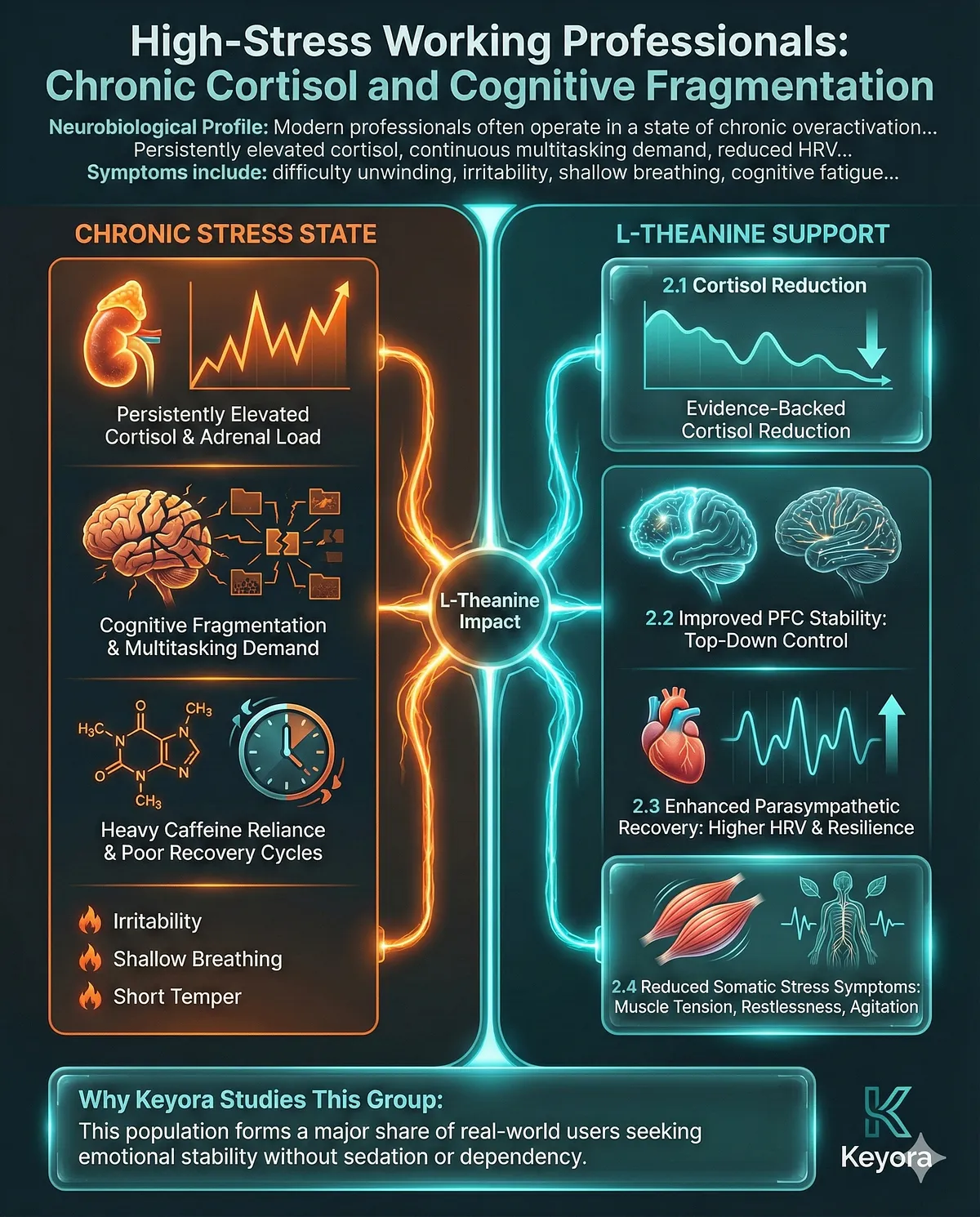
2. High-Stress Working Professionals – Chronic Cortisol and Cognitive Fragmentation
Neurobiological Profile
Modern professionals often operate in a state of chronic overactivation:
- Persistently elevated cortisol
- Continuous multitasking demand
- Reduced HRV due to stress
- Emotional fragmentation
- Constant deadlines
- Heavy caffeine reliance
- Poor recovery cycles
Symptoms include:
- difficulty unwinding
- irritability
- shallow breathing
- stress-related sleep issues
- cognitive fatigue
- short temper
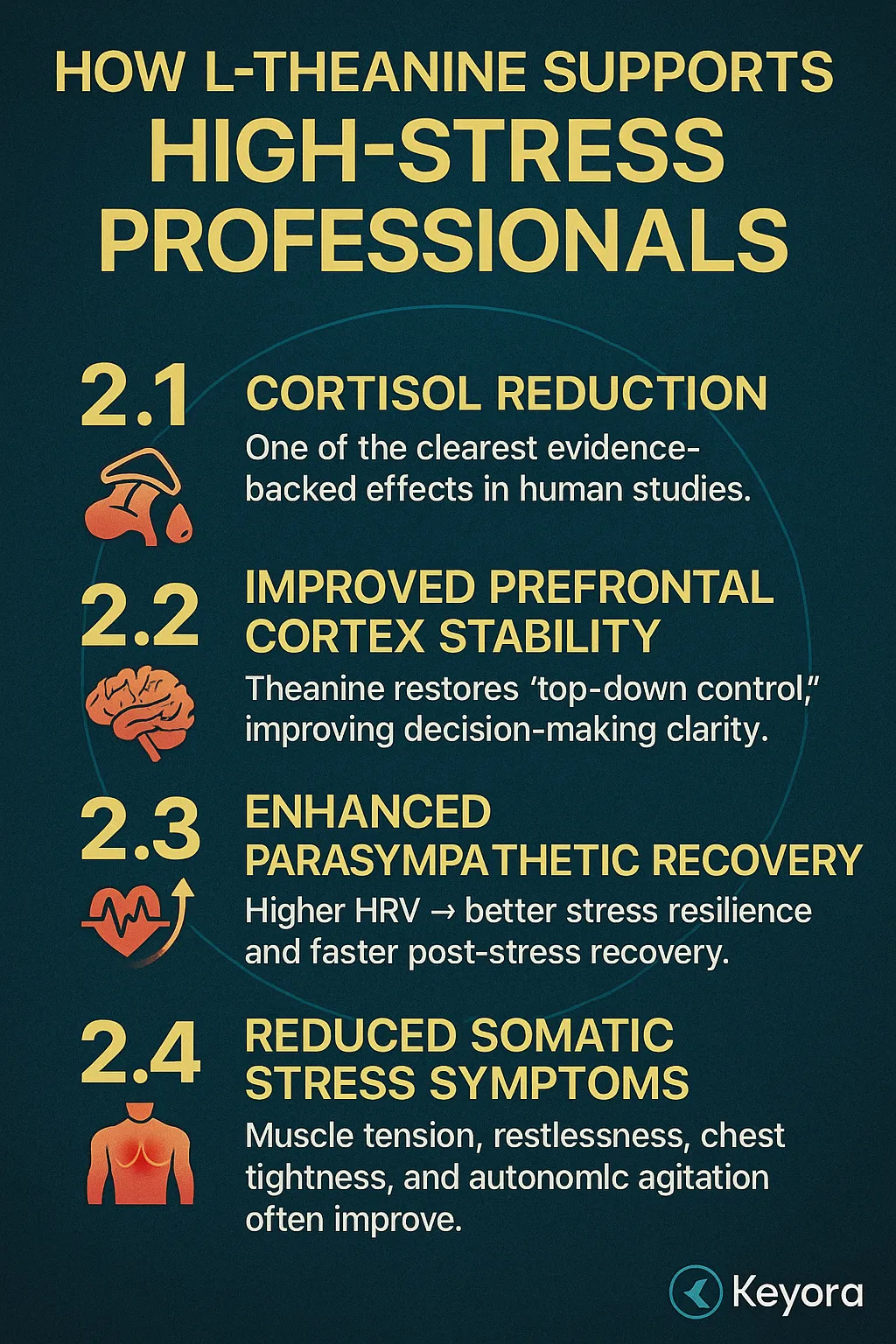
How L-Theanine Supports High-Stress Professionals
2.1 Cortisol Reduction
One of the clearest evidence-backed effects in human studies.
2.2 Improved Prefrontal Cortex Stability
Theanine restores “top-down control,” improving decision-making clarity.
2.3 Enhanced Parasympathetic Recovery
Higher HRV → better stress resilience and faster post-stress recovery.
2.4 Reduced Somatic Stress Symptoms
Muscle tension, restlessness, chest tightness, and autonomic agitation often improve.
Why Keyora Studies This Group
This population forms a major share of real-world users seeking emotional stability without sedation or dependency.
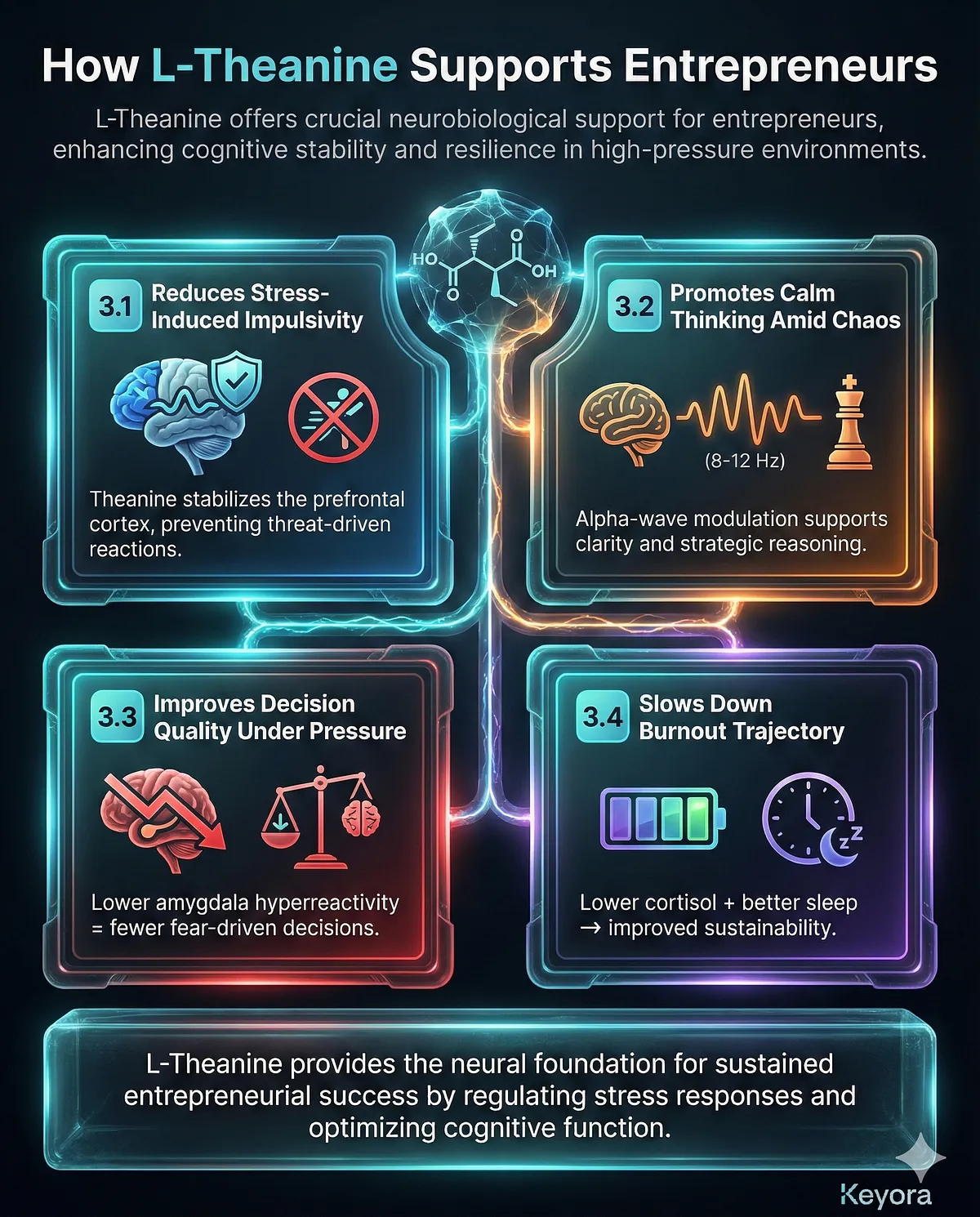
3. Entrepreneurs & Founders – High Autonomic Reactivity, High Uncertainty, High Emotional Load
Entrepreneurs are not simply “high stress.”
They exist inside a biological profile unique to high-responsibility decision cycles.
Neurobiological Profile
- HPA axis hyperactivation
- Elevated adrenaline baseline
- Sleep restriction
- Unpredictable emotional intensity
- Cognitive volatility
- Fast context switching
- Risk-related stress responses
Symptoms include:
- high-alert thinking
- emotional reactivity
- situational anxiety
- difficulty switching off at night
- burnout tendencies
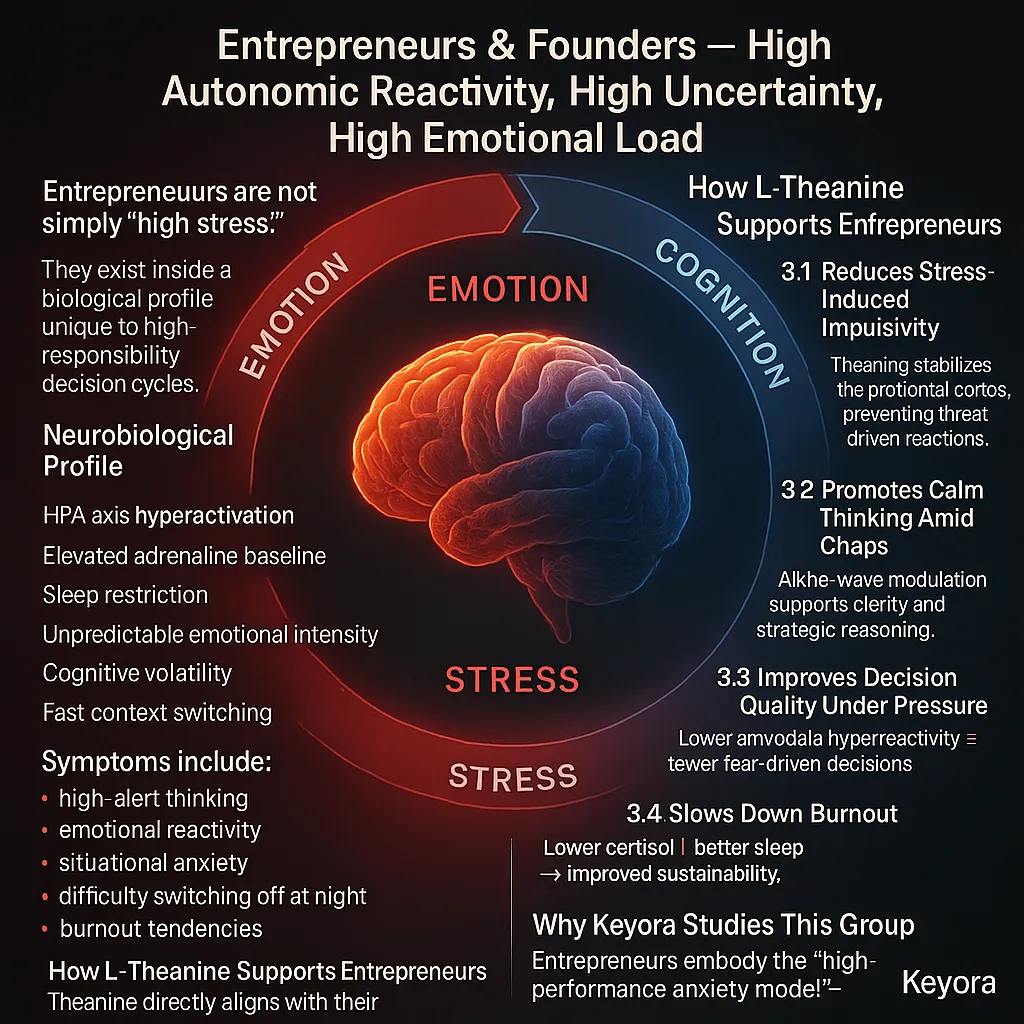
How L-Theanine Supports Entrepreneurs
3.1 Reduces Stress-Induced Impulsivity
Theanine stabilizes the prefrontal cortex, preventing threat-driven reactions.
3.2 Promotes Calm Thinking Amid Chaos
Alpha-wave modulation supports clarity and strategic reasoning.
3.3 Improves Decision Quality Under Pressure
Lower amygdala hyperreactivity = fewer fear-driven decisions.
3.4 Slows Down Burnout Trajectory
Lower cortisol + better sleep → improved sustainability.
Why Keyora Studies This Group
Entrepreneurs embody the “high-performance anxiety model” — Theanine directly aligns with their neurophysiological needs.
4. Perimenopausal & Menopausal Women – Hormonal Transition Meets Stress Amplification
Hormonal transition fundamentally reshapes stress sensitivity.
This population is biologically distinct from any other group in this chapter.
Neurobiological Profile
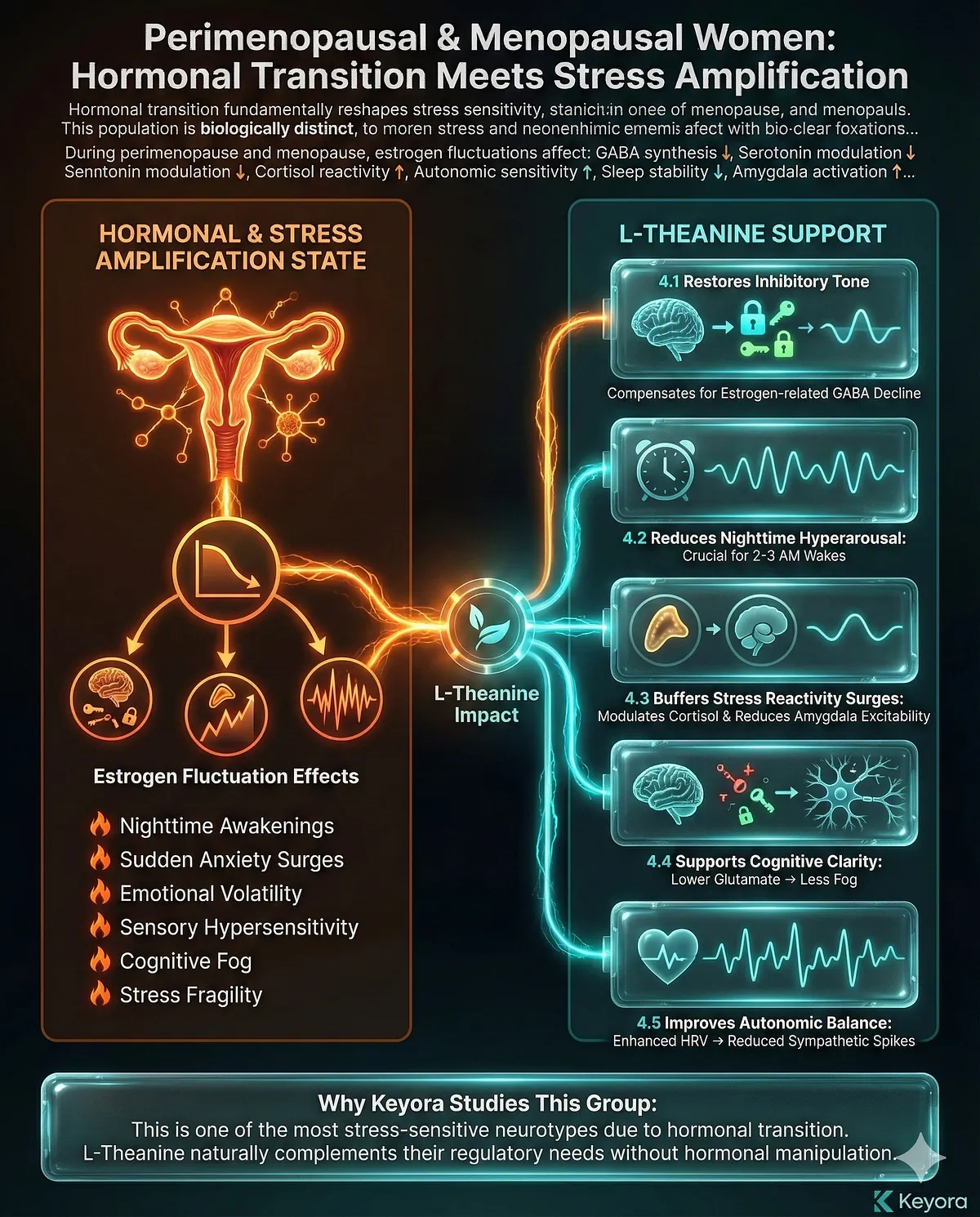
During perimenopause and menopause, estrogen fluctuations affect:
- GABA synthesis ↓
- Serotonin modulation ↓
- Cortisol reactivity ↑
- Autonomic sensitivity ↑
- Sleep stability ↓
- Amygdala activation ↑
These shifts cause:
- nighttime awakenings
- sudden anxiety surges
- emotional volatility
- sensory hypersensitivity
- cognitive fog
- stress fragility
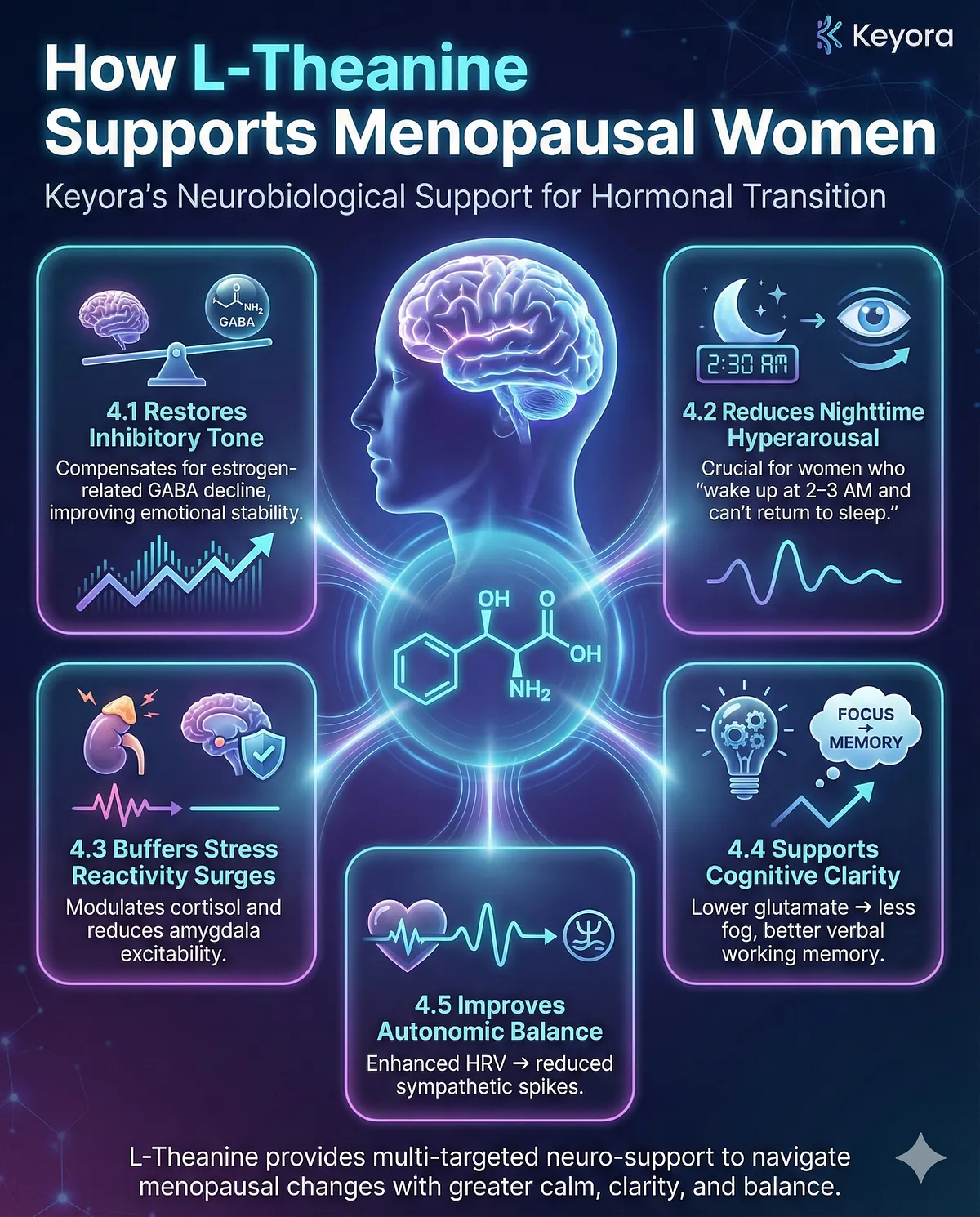
How L-Theanine Supports Menopausal Women
4.1 Restores Inhibitory Tone
Compensates for estrogen-related GABA decline, improving emotional stability.
4.2 Reduces Nighttime Hyperarousal
Crucial for women who “wake up at 2–3 AM and can’t return to sleep.”
4.3 Buffers Stress Reactivity Surges
Modulates cortisol and reduces amygdala excitability.
4.4 Supports Cognitive Clarity
Lower glutamate → less fog, better verbal working memory.
4.5 Improves Autonomic Balance
Enhanced HRV → reduced sympathetic spikes.
Why Keyora Studies This Group
This is one of the most stress-sensitive neurotypes due to hormonal transition.
L-Theanine naturally complements their regulatory needs without hormonal manipulation.
5. Medical Professionals, Scientists, and High-Cognitive Experts
Brains Running at Peak Load With Minimal Recovery
These are the “precision cognition” populations.
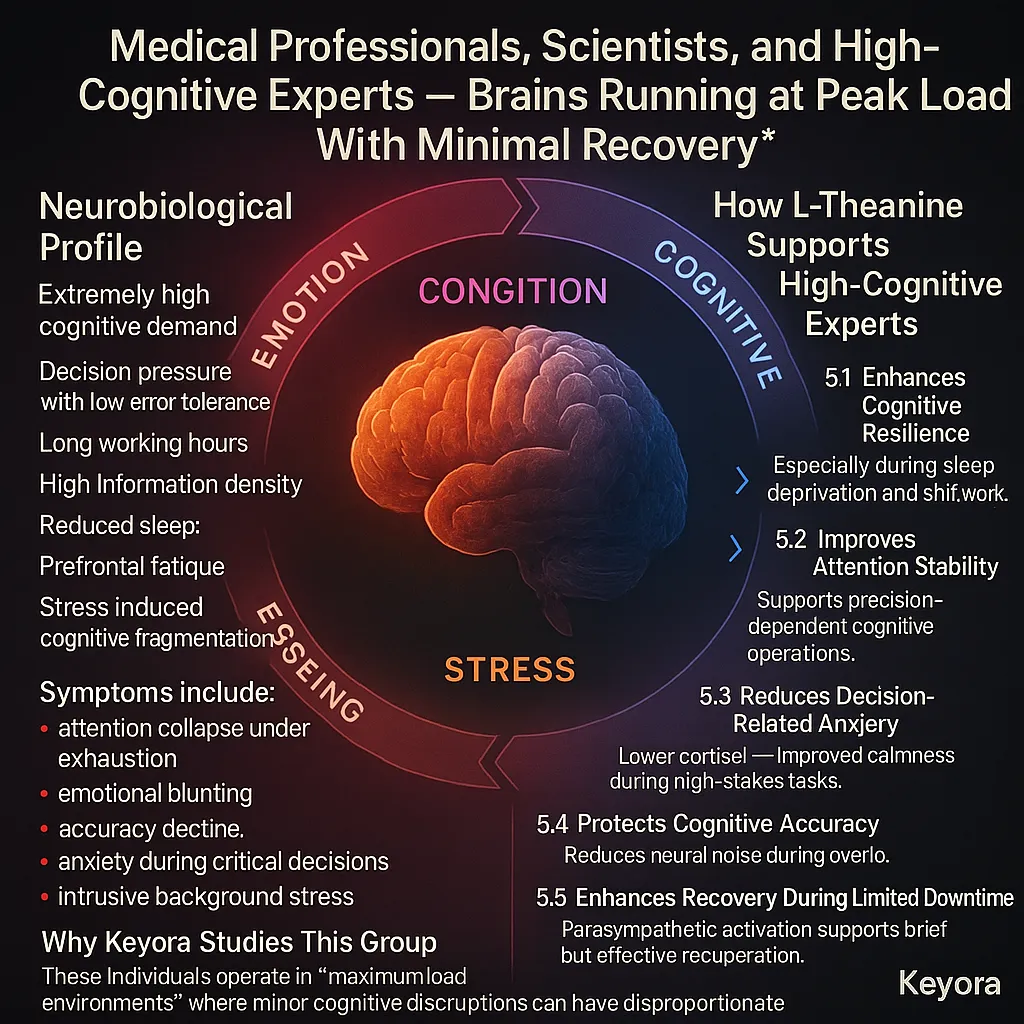
Neurobiological Profile
- Extremely high cognitive demand
- Decision pressure with low error tolerance
- Long working hours
- High information density
- Reduced sleep
- Prefrontal fatigue
- Stress-induced cognitive fragmentation
Symptoms include:
- attention collapse under exhaustion
- emotional blunting
- accuracy decline
- anxiety during critical decisions
- intrusive background stress
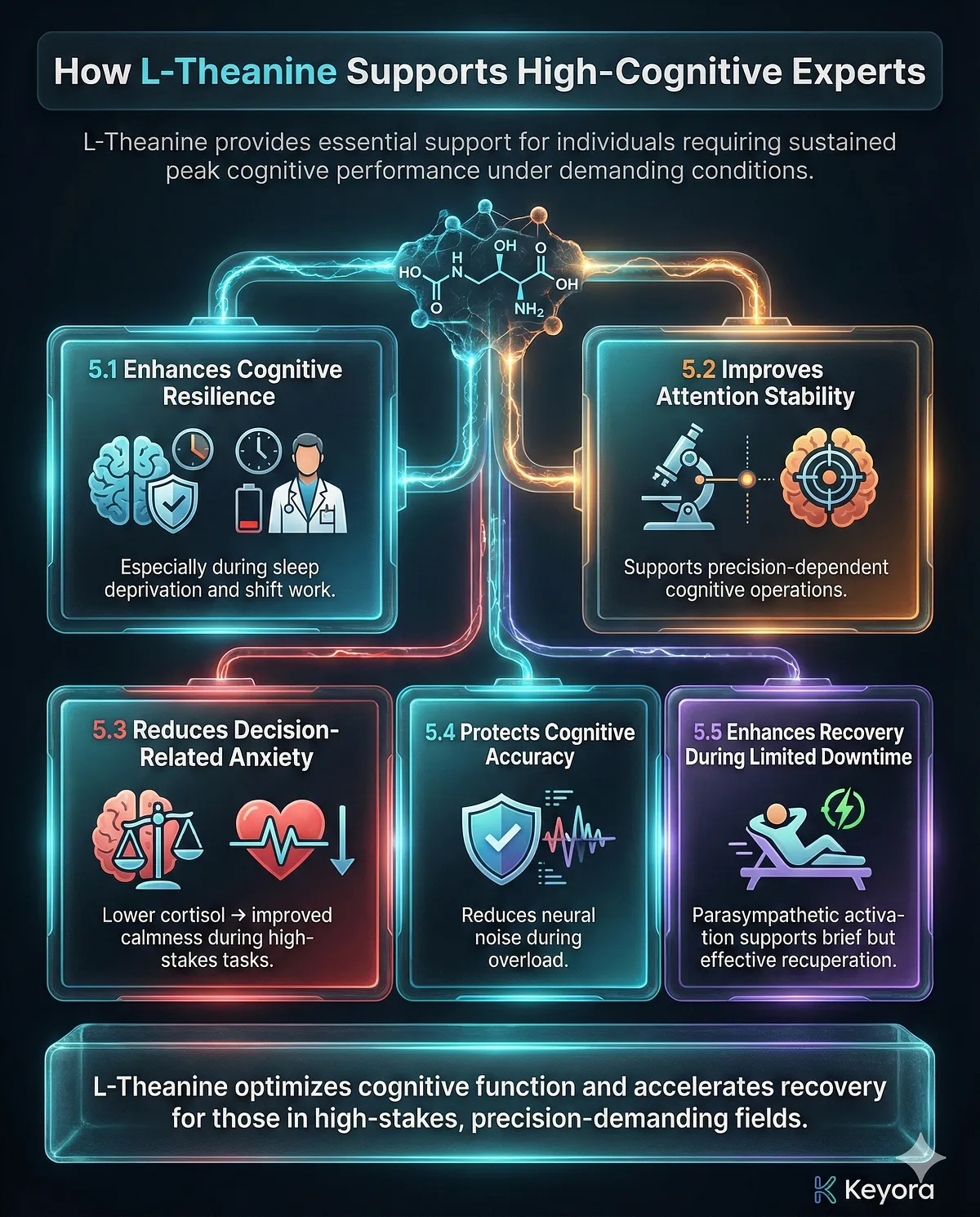
How L-Theanine Supports High-Cognitive Experts
5.1 Enhances Cognitive Resilience
Especially during sleep deprivation and shift work.
5.2 Improves Attention Stability
Supports precision-dependent cognitive operations.
5.3 Reduces Decision-Related Anxiety
Lower cortisol → improved calmness during high-stakes tasks.
5.4 Protects Cognitive Accuracy
Reduces neural noise during overload.
5.5 Enhances Recovery During Limited Downtime
Parasympathetic activation supports brief but effective recuperation.
Why Keyora Studies This Group
These individuals operate in “maximum load environments” where minor cognitive disruptions can have disproportionate consequences – making Theanine uniquely valuable.
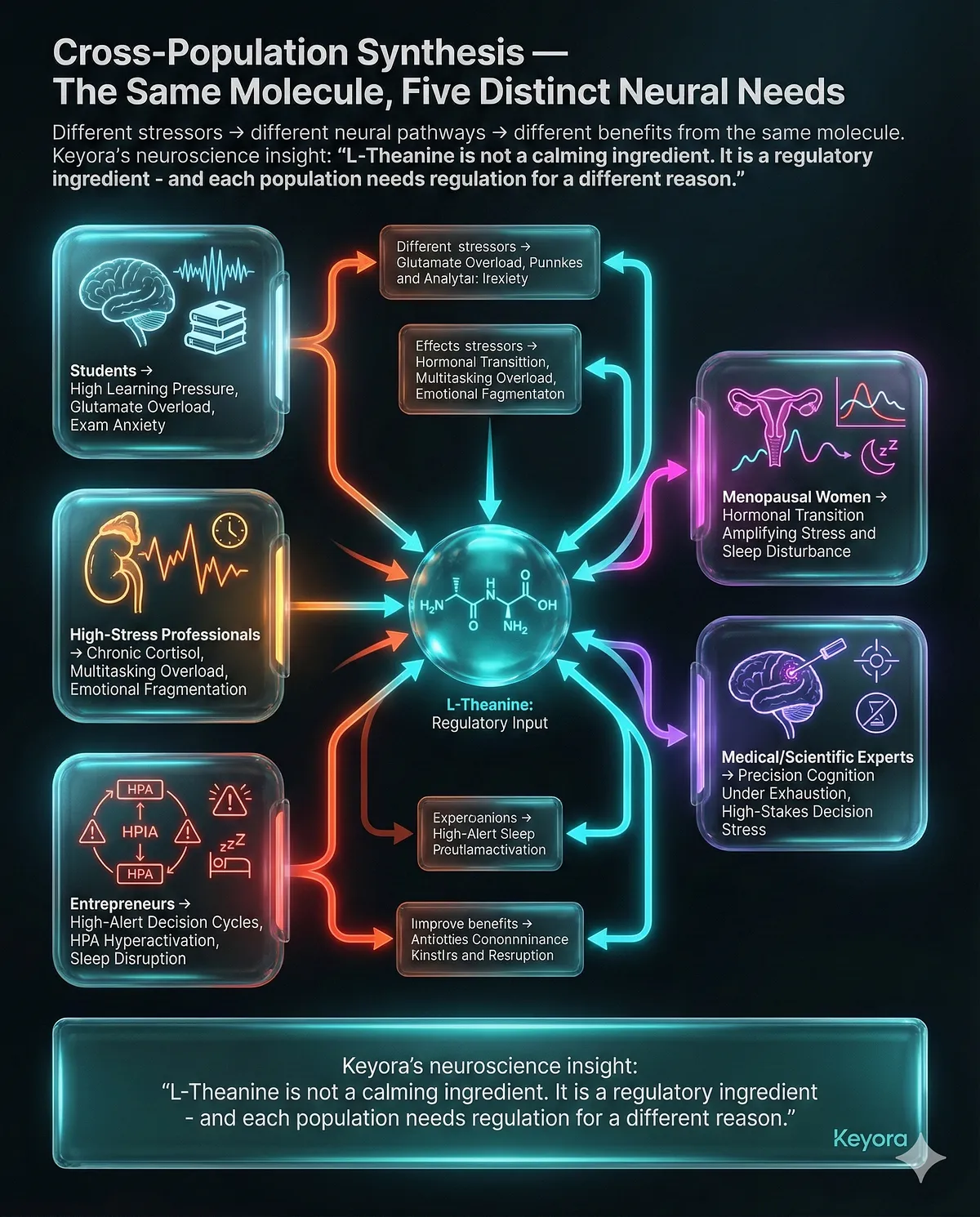
6. Cross-Population Synthesis – The Same Molecule, Five Distinct Neural Needs
Students
→ High learning pressure, glutamate overload, exam anxiety
High-Stress Professionals
→ Chronic cortisol, multitasking overload, emotional fragmentation
Entrepreneurs
→ High-alert decision cycles, HPA hyperactivation, sleep disruption
Menopausal Women
→ Hormonal transition amplifying stress and sleep disturbance
Medical/Scientific Experts
→ Precision cognition under exhaustion, high-stakes decision stress
Different stressors → different neural pathways → different benefits
from the same molecule.
Keyora’s neuroscience insight: “L-Theanine is not a calming ingredient.
It is a regulatory ingredient – and each population needs regulation for a different reason.”
7. Summary
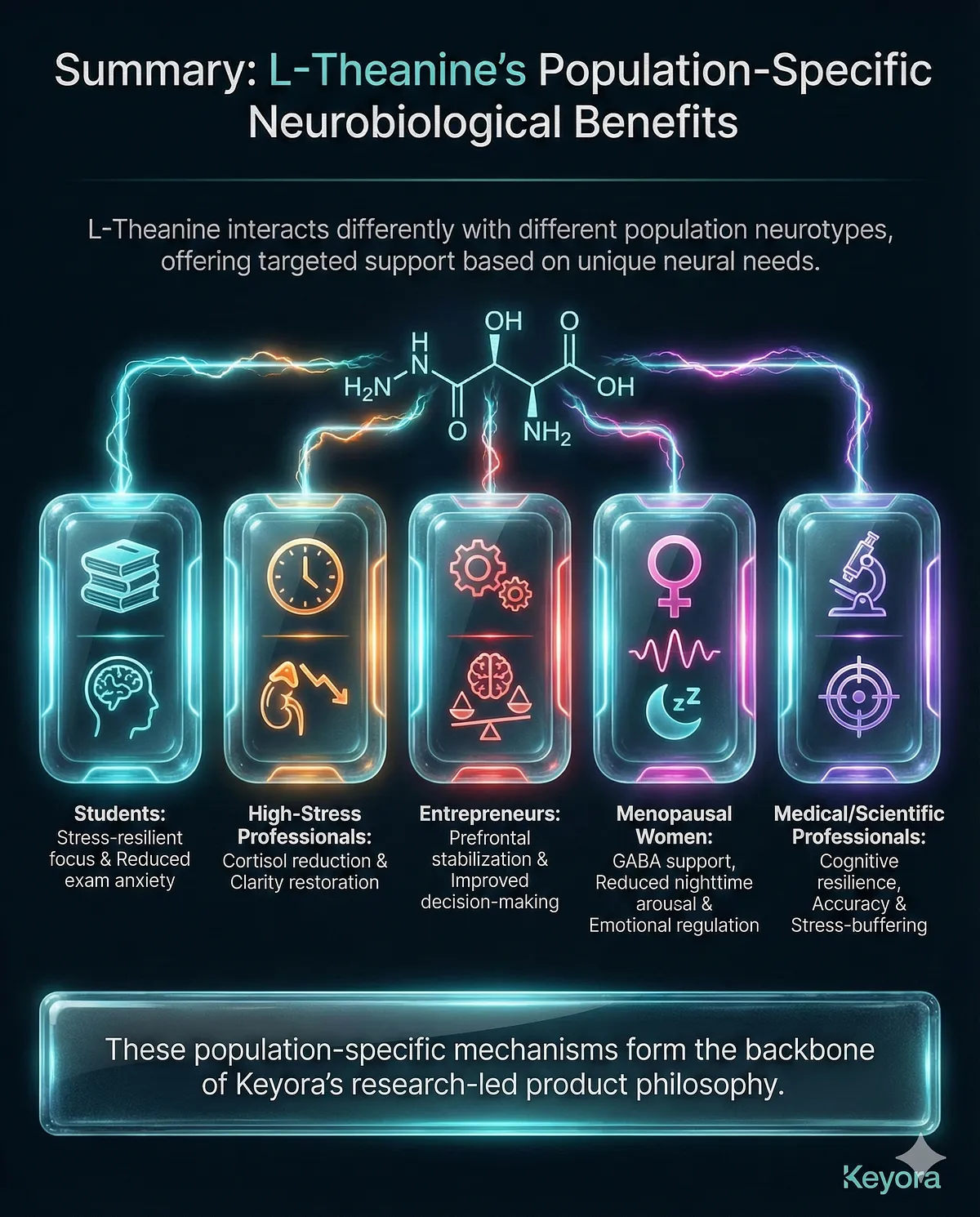
- L-Theanine interacts differently with different population neurotypes.
- Students benefit through stress-resilient focus and reduced exam anxiety.
- High-stress professionals benefit through cortisol reduction and clarity restoration.
- Entrepreneurs benefit through prefrontal stabilization and improved decision-making.
- Menopausal women benefit through GABA support, reduced nighttime arousal, and emotional regulation.
- Medical and scientific professionals benefit through cognitive resilience, accuracy, and stress-buffering.
- These population-specific mechanisms form the backbone of Keyora’s research-led product philosophy.
Episode 10 (Coming Next)
Safety, Dosage, Timing – How Much L-Theanine Do People Actually Need?
By Keyora Research Notes Series
This article is part of Keyora’s long-form educational series documenting the scientific foundations behind our product development.
ORCID: 0009–0007–5798–1996