
L-Theanine Episode 6 – The “Flow State” Molecule: L-Theanine & Cognitive Optimization

By Keyora Research Notes Series
This article is part of Keyora’s long-form educational series documenting the scientific foundations behind our product development.
ORCID: 0009-0007-5798-1996
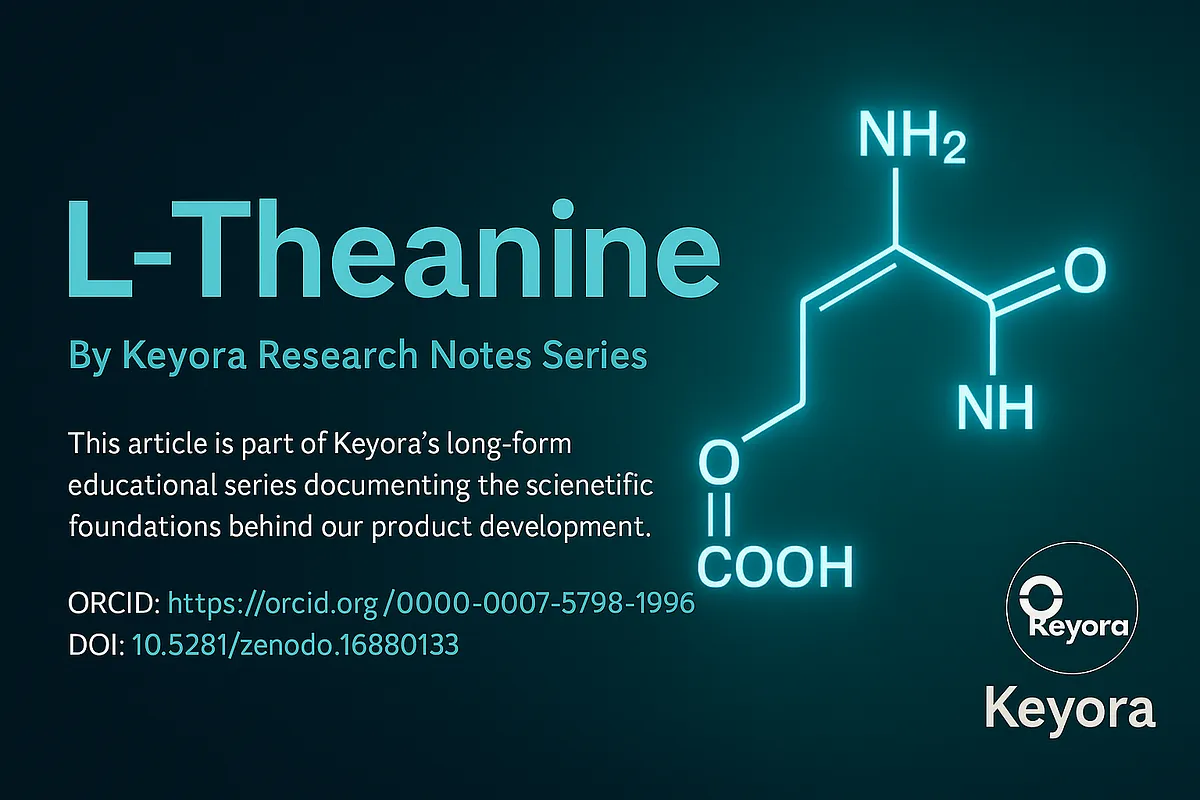
Why Focus Fails in Modern Life
If you feel like your ability to focus has worsened, you’re not imagining it.
Today’s environment overwhelms the human brain with:
- constant digital interruptions
- dopamine-saturated feeds
- stress hormones
- multitasking pressure
- sleep disruption
- deadlines
- emotional load
The result is a cognitive profile that researchers now call: stress-induced cognitive fragmentation
This shows up as:
- difficulty concentrating
- short attention span
- slower problem-solving
- memory lapses
- mental fatigue
- “brain fog” under pressure
- reduced learning ability
Before Keyora even began building any cognitive-support formulation, we spent a long time mapping how modern cognitive failure actually happens. Across attention research, stress-neuroscience studies, and nutritional psychiatry literature, one compound consistently showed meaningful improvement:
L-Theanine.
Unlike stimulants, L-Theanine supports cognition by stabilizing the brain, not by pushing it harder.
This article explains how.
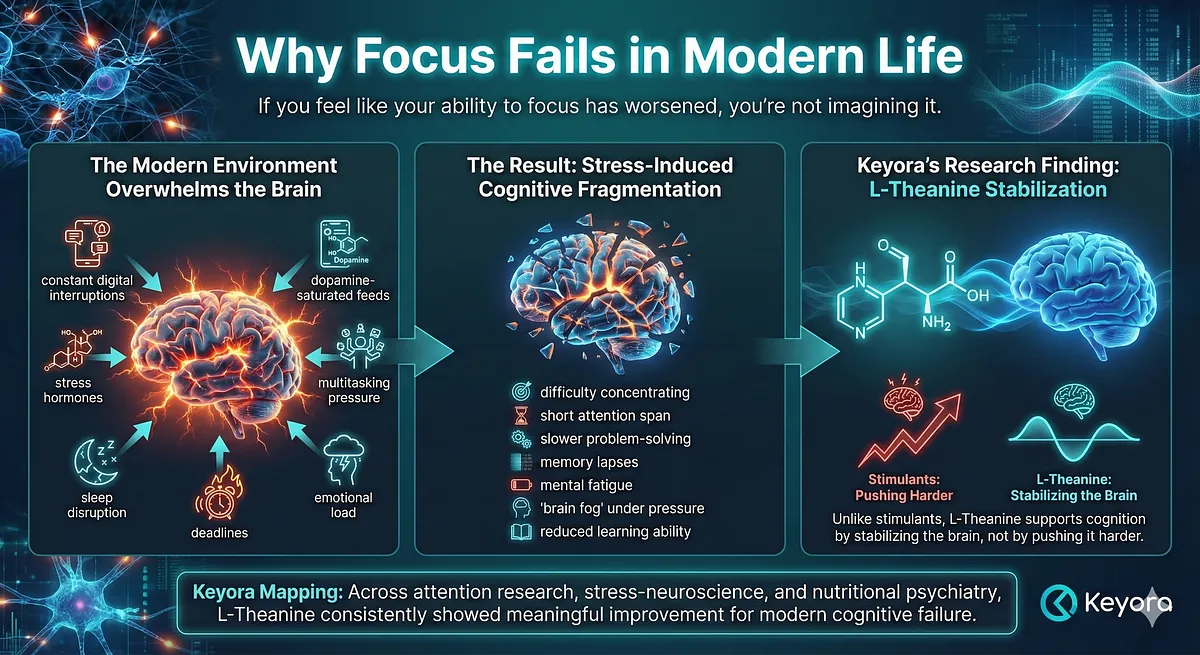
1. Cognitive Function Is a Three-System Balancing Act
Human cognition depends on three neural systems working together:
- Attention Network
- Working Memory System
- Executive Function (prefrontal cortex)
Modern stress disrupts all three.
Let’s break them down.
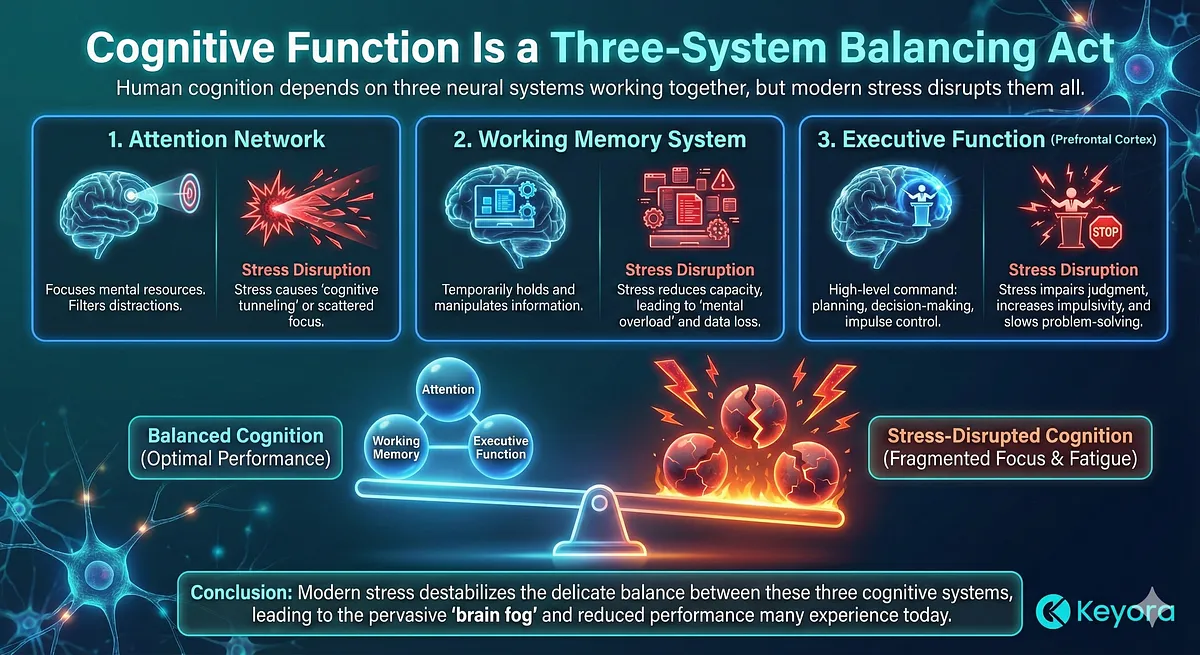
2. The Attention Network – What Focus Really Requires
Attention is not just “trying harder.”
It is a biological process that requires:
- low background neural noise
- stable alpha–beta oscillation balance
- controlled glutamate signaling
- prefrontal cortex activation
- good sleep the night before
When stress increases:
- glutamate rises
- neural firing becomes unstable
- the default mode network becomes overactive
- distractions feel stronger
- sustained attention collapses
This is why people feel mentally scattered during stressful periods.
How L-Theanine Strengthens Attention
Mechanism A: Reduced neural noise
By lowering glutamate overactivity, L-Theanine quiets unnecessary background firing.
→ Improved sensory filtering
→ Better signal-to-noise ratio
→ Fewer intrusive thoughts
Mechanism B: Enhanced alpha-wave synchronization
Alpha waves correlate strongly with focus.
EEG studies show L-Theanine increases alpha amplitude.
→ Calmer focus
→ Smoother attentional switching
→ Better sustained attention
Mechanism C: Stress buffering
Lower cortisol suppresses the “scatter response” in the prefrontal cortex.
→ Less cognitive fragmentation
→ More stable focus under stress
Keyora’s insight during early research: “Attention is not created by stimulation. It is created by neural stability. Theanine enhances stability.”
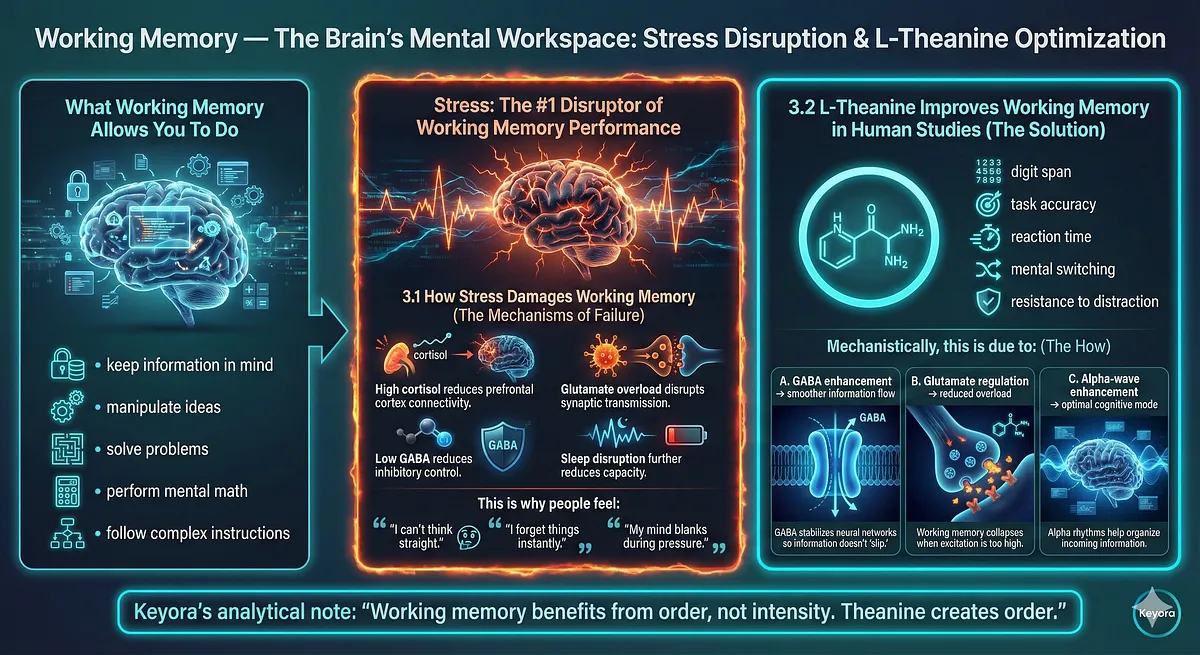
3. Working Memory – The Brain’s Mental Workspace
Working memory is what allows you to:
- keep information in mind
- manipulate ideas
- solve problems
- perform mental math
- follow complex instructions
Stress is the #1 disruptor of working memory performance.
3.1 How Stress Damages Working Memory
High cortisol reduces prefrontal cortex connectivity.
Glutamate overload disrupts synaptic transmission.
Low GABA reduces inhibitory control.
Sleep disruption further reduces capacity.
This is why people feel:
- “I can’t think straight.”
- “I forget things instantly.”
- “My mind blanks during pressure.”
3.2 L-Theanine Improves Working Memory in Human Studies
Clinical data show improvements in:
- digit span
- task accuracy
- reaction time
- mental switching
- resistance to distraction
Mechanistically, this is due to:
A. GABA enhancement → smoother information flow
GABA stabilizes neural networks so information doesn’t “slip.”
B. Glutamate regulation → reduced overload
Working memory collapses when excitation is too high.
C. Alpha-wave enhancement → optimal cognitive mode
Alpha rhythms help organize incoming information.
Keyora’s analytical note: “Working memory benefits from order, not intensity. Theanine creates order.”
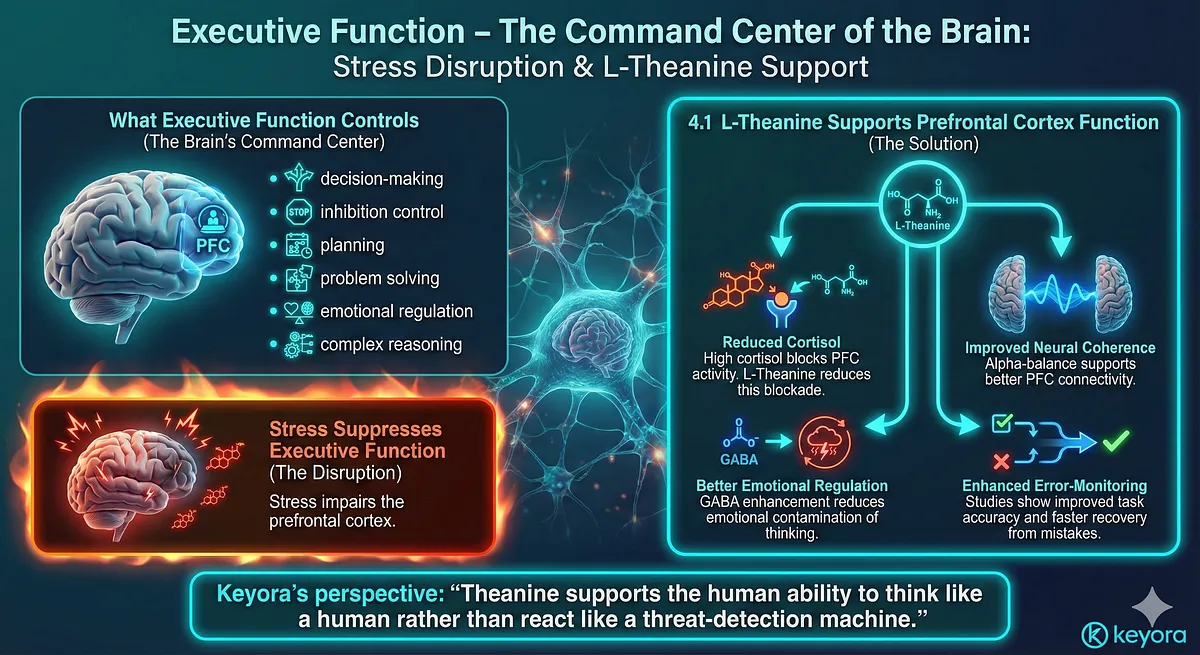
4. Executive Function – The Command Center of the Brain
Executive function controls:
- decision-making
- inhibition control
- planning
- problem solving
- emotional regulation
- complex reasoning
Stress suppresses executive function by impairing the prefrontal cortex.
4.1 L-Theanine Supports Prefrontal Cortex Function
Through:
1. Reduced cortisol
High cortisol blocks PFC activity.
L-Theanine reduces this blockade.
2. Improved neural coherence
Alpha-balance supports better PFC connectivity.
3. Better emotional regulation
GABA enhancement reduces emotional contamination of thinking.
4. Enhanced error-monitoring
Studies show improved task accuracy and faster recovery from mistakes.
Keyora’s perspective: “Theanine supports the human ability to think like a human rather than react like a threat-detection machine.”
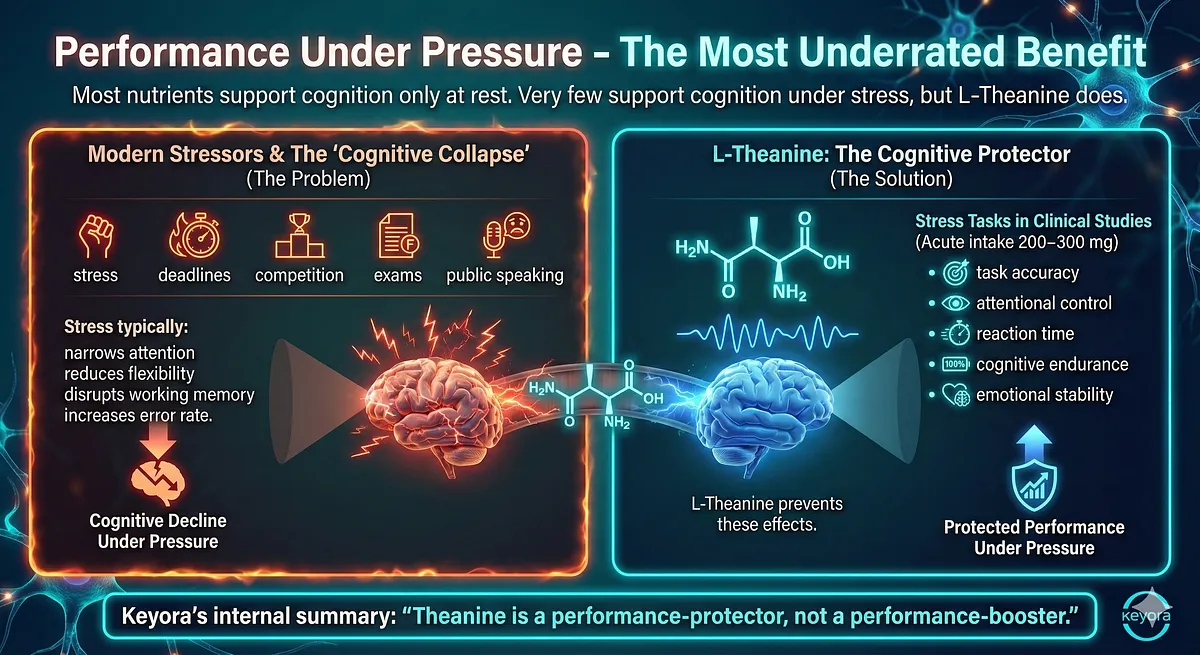
5. Performance Under Pressure – The Most Underrated Benefit
Most nutrients support cognition only at rest.
Very few support cognition under:
- stress
- deadlines
- competition
- exams
- public speaking
But L-Theanine does.
Stress Tasks in Clinical Studies
Acute L-Theanine intake (200–300 mg) improves:
- task accuracy
- attentional control
- reaction time
- cognitive endurance
- emotional stability
This is crucial because stress typically:
- narrows attention
- reduces flexibility
- disrupts working memory
- increases error rate
L-Theanine prevents these effects.
Keyora’s internal summary: “Theanine is a performance-protector, not a performance-booster.”
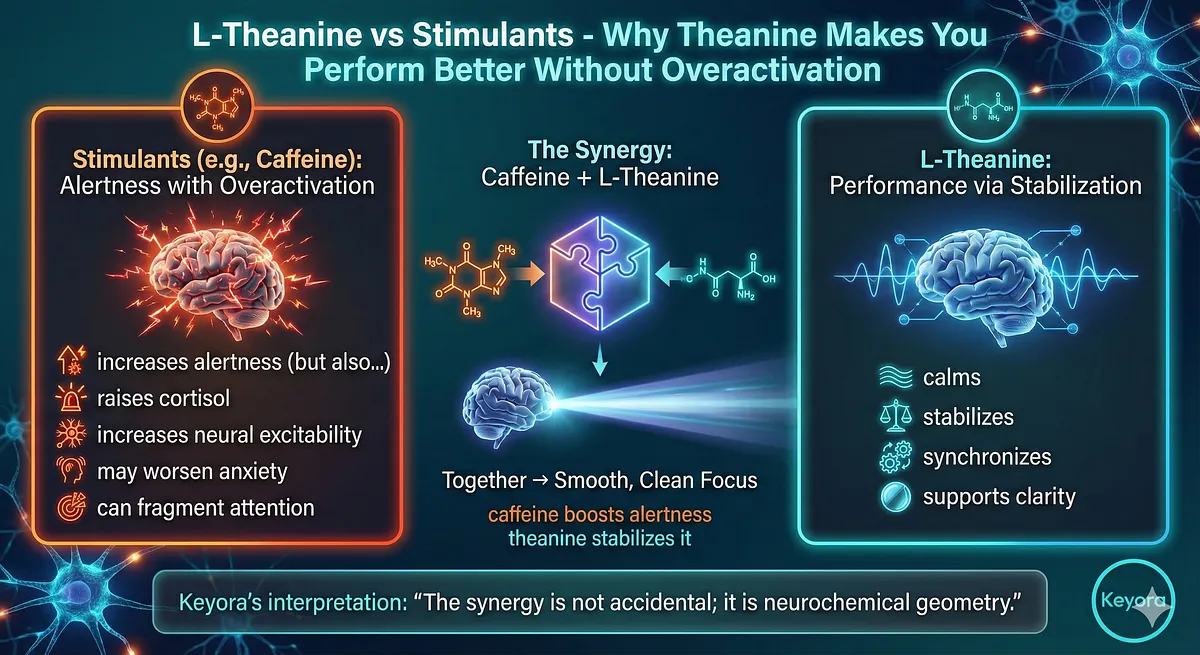
6. L-Theanine vs Stimulants – Why Theanine Makes You Perform Better Without Overactivation
Caffeine, for example, increases alertness but also:
- raises cortisol
- increases neural excitability
- may worsen anxiety
- can fragment attention
L-Theanine:
- calms
- stabilizes
- synchronizes
- supports clarity
This is why L-Theanine + caffeine is synergistic:
- caffeine boosts alertness
- theanine stabilizes it
Together → smooth, clean focus.
Keyora’s interpretation: “The synergy is not accidental; it is neurochemical geometry.”
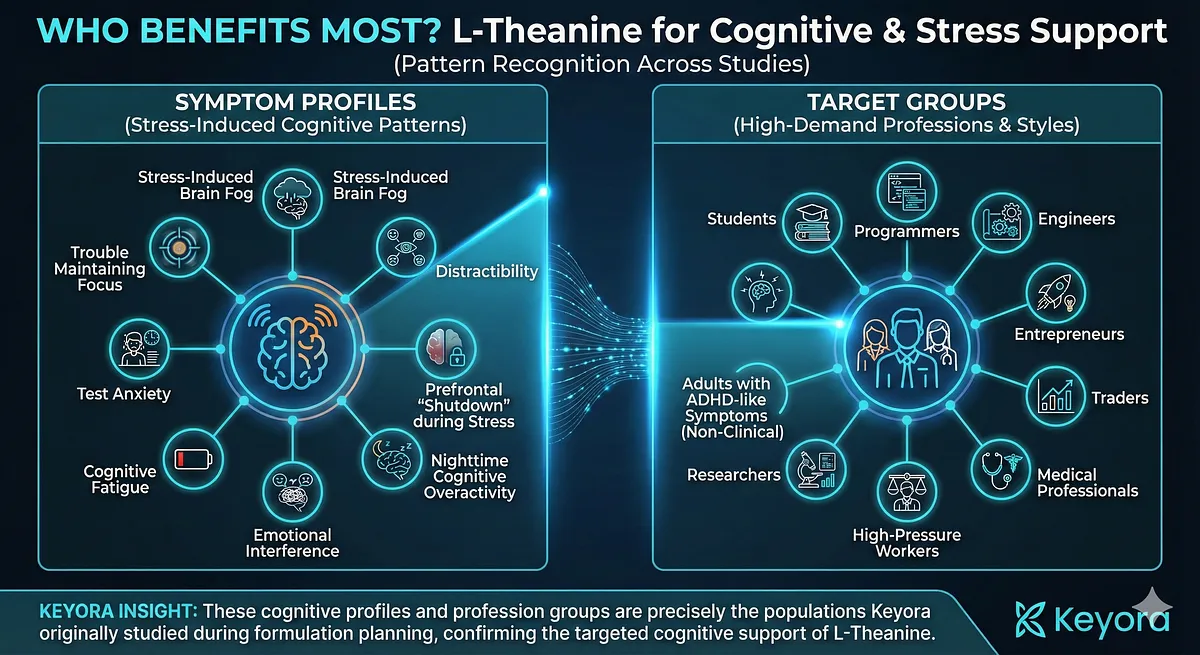
7. Who Benefits Most? (Pattern Recognition Across Studies)
People who experience:
- stress-induced brain fog
- trouble maintaining focus
- test anxiety
- cognitive fatigue
- emotional interference
- distractibility
- prefrontal “shutdown” during stress
- nighttime cognitive overactivity
These include:
- students
- programmers
- engineers
- entrepreneurs
- traders
- medical professionals
- researchers
- high-pressure workers
- adults with ADHD-like symptoms (non-clinical)
These are precisely the groups Keyora originally studied before formulation planning.
8. Human Evidence Summary – Cognitive Function
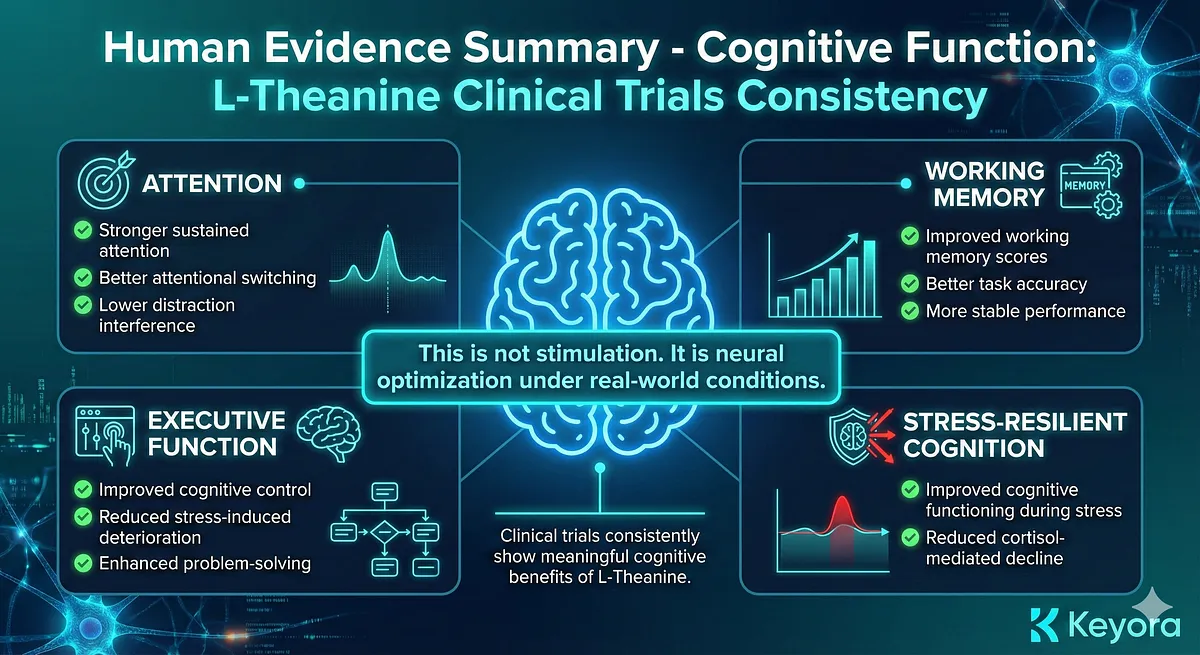
Clinical trials consistently show:
Attention
- stronger sustained attention
- better attentional switching
- lower distraction interference
Working Memory
- improved working memory scores
- better task accuracy
- more stable performance
Executive Function
- improved cognitive control
- reduced stress-induced deterioration
- enhanced problem-solving
Stress-Resilient Cognition
- improved cognitive functioning during stress
- reduced cortisol-mediated decline
This is not stimulation.
It is neural optimization under real-world conditions.
9. Keyora Research Perspective – Why Cognitive Mechanisms Mattered to Us
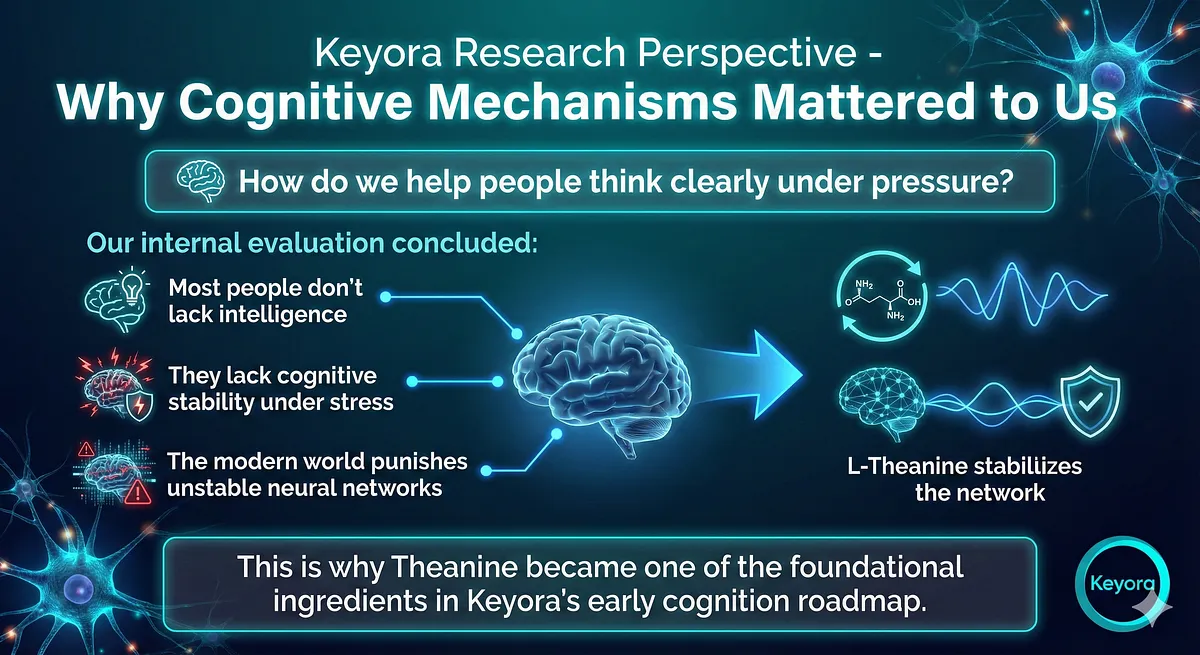
Long before creating any product, Keyora focused on a key question: “How do we help people think clearly under pressure?”
Our internal evaluation concluded:
- Most people don’t lack intelligence
- They lack cognitive stability under stress
- The modern world punishes unstable neural networks
- L-Theanine stabilizes the network
This is why Theanine became one of the foundational ingredients in Keyora’s early cognition roadmap.
10. Summary
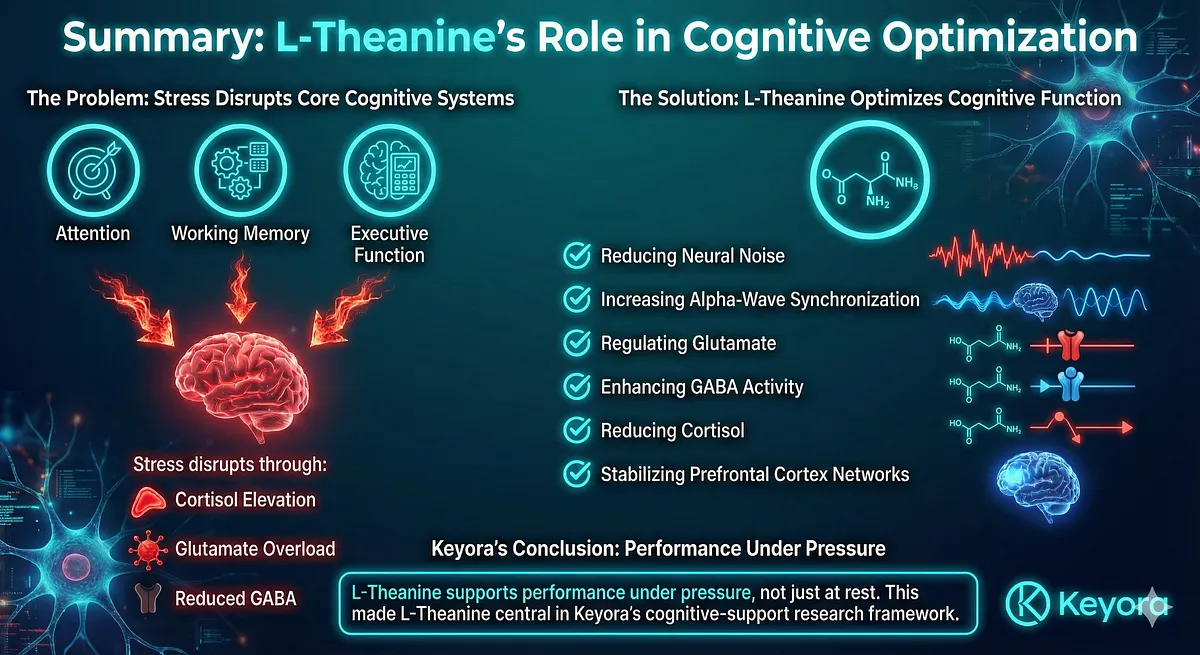
- Cognitive performance depends on attention, working memory, and executive function.
- Stress disrupts all three through cortisol elevation, glutamate overload, and reduced GABA.
- L-Theanine improves cognitive function by:
→ reducing neural noise
→ increasing alpha-wave synchronization
→ regulating glutamate
→ enhancing GABA activity
→ reducing cortisol
→ stabilizing prefrontal cortex networks - It supports performance under pressure, not just at rest.
- This made L-Theanine central in Keyora’s cognitive-support research framework.
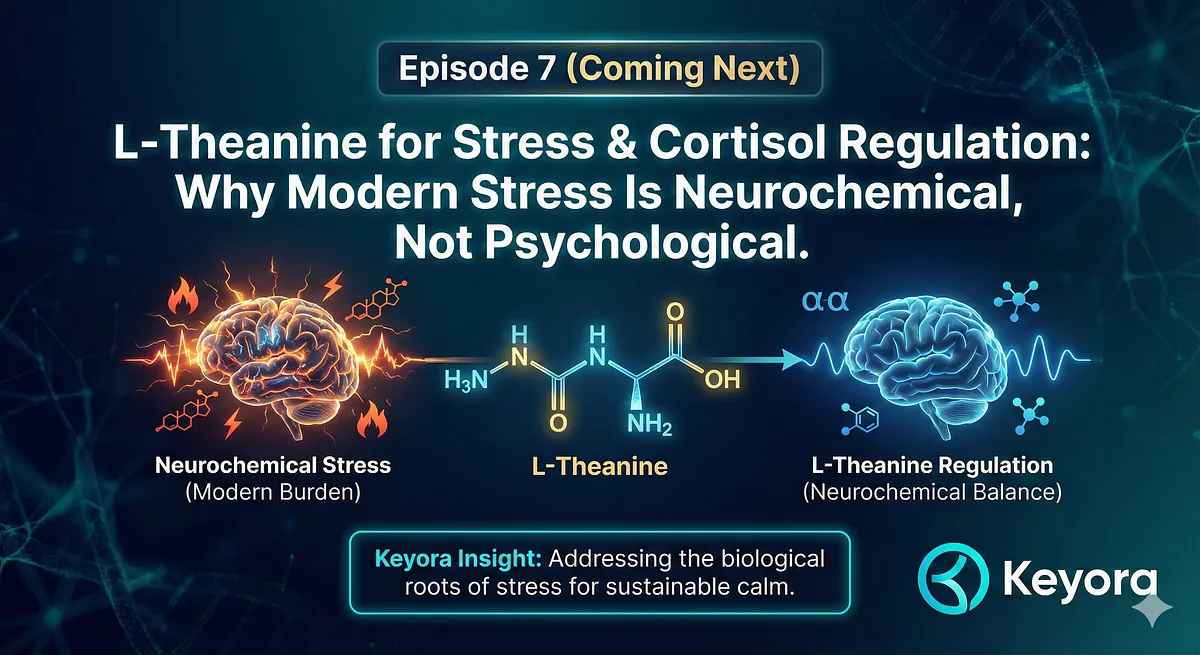
Episode 7 (Coming Next)
“L-Theanine for Stress & Cortisol Regulation:
Why Modern Stress Is Neurochemical, Not Psychological.”
By Keyora Research Notes Series
This article is part of Keyora’s long-form educational series documenting the scientific foundations behind our product development.
ORCID: 0009-0007-5798-1996