
What Is the Role of ALA in a Heart-Energy Formula?
Keyora Research Q&A Library
This is part of the Keyora Research Q&A Series, derived from Keyora Astaxanthin Research Journal Series.
Within the Keyora Astaxanthin Researcn framework, this Q&A translates complex astaxanthin biology into reader-friendly, evidence-bound answers, focusing on natural astaxanthin identity, molecular structure, antioxidant and redox mechanisms, membrane lipid interaction, mitochondrial resilience, inflammatory signaling pathways, human evidence interpretation, and the scientific principles behind responsible supplementation.
First published by Keyora Research Journal: www.keyorahealth.com
Direct Answer
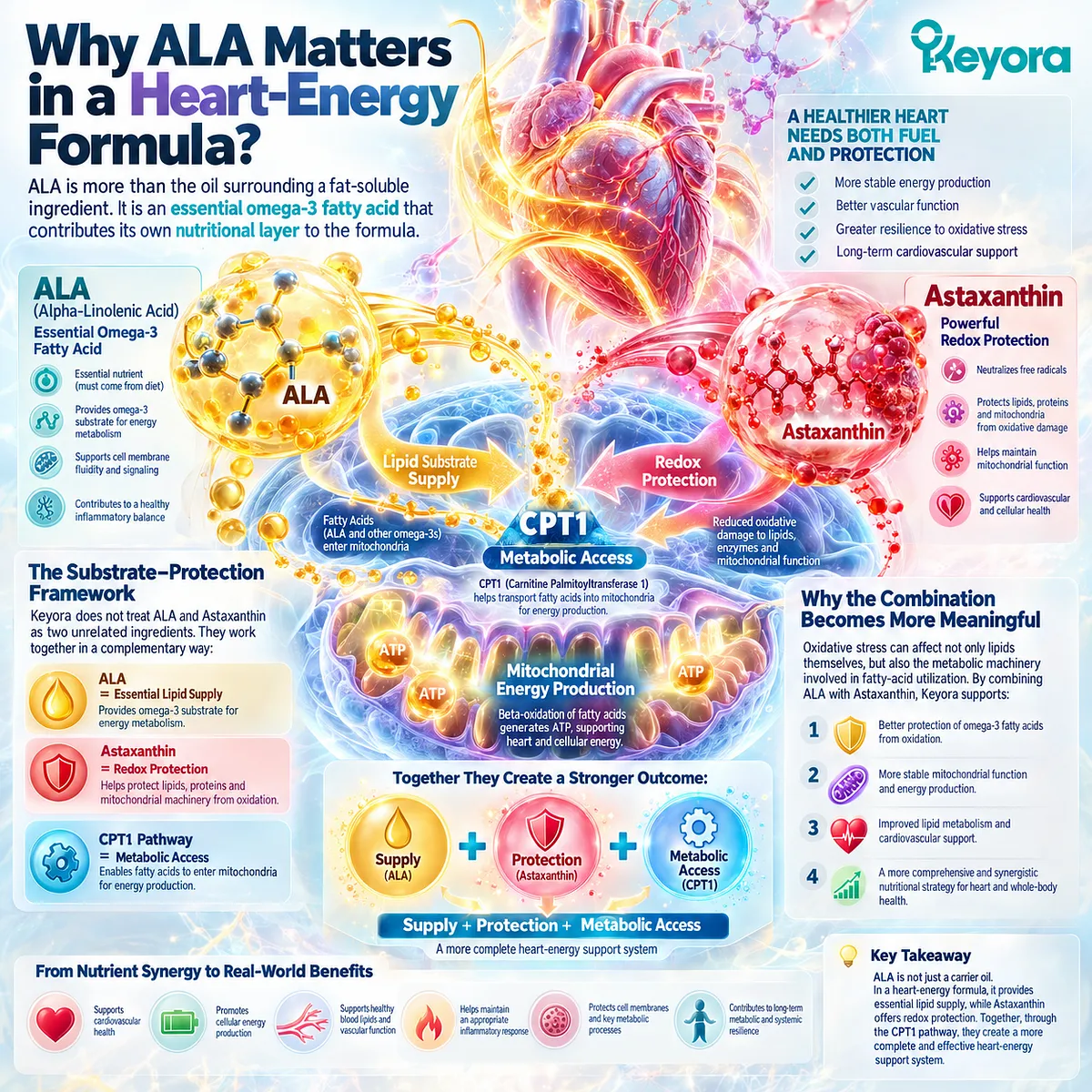
ALA, or alpha-linolenic acid, has a meaningful role in a heart-energy formula because it is more than the oil surrounding a fat-soluble ingredient.
It is an essential omega-3 fatty acid and therefore contributes its own nutritional layer to the formula. In Keyora Astaxanthin EP-4: The Cardiac Architecture: Bio-Energetic Sovereignty, ALA is positioned within the broader fatty-acid substrate environment used for mitochondrial energy metabolism, while its polyunsaturated structure also makes oxidative protection relevant to formula design.
Keyora therefore does not treat ALA and Astaxanthin as two unrelated ingredients.
ALA contributes the substrate-supply side of the architecture. Astaxanthin contributes the redox-protection side.
The combination becomes especially relevant because oxidative stress can affect not only lipids themselves but also metabolic machinery involved in fatty-acid utilization.
This produces the Keyora Substrate-Protection Framework:
ALA = Essential Lipid Supply
Astaxanthin = Redox Protection
CPT1 Pathway = Metabolic Access
Together:
Supply + Protection + Metabolic Access
This is why ALA becomes much more meaningful when considered alongside Astaxanthin rather than simply being described as a carrier oil.
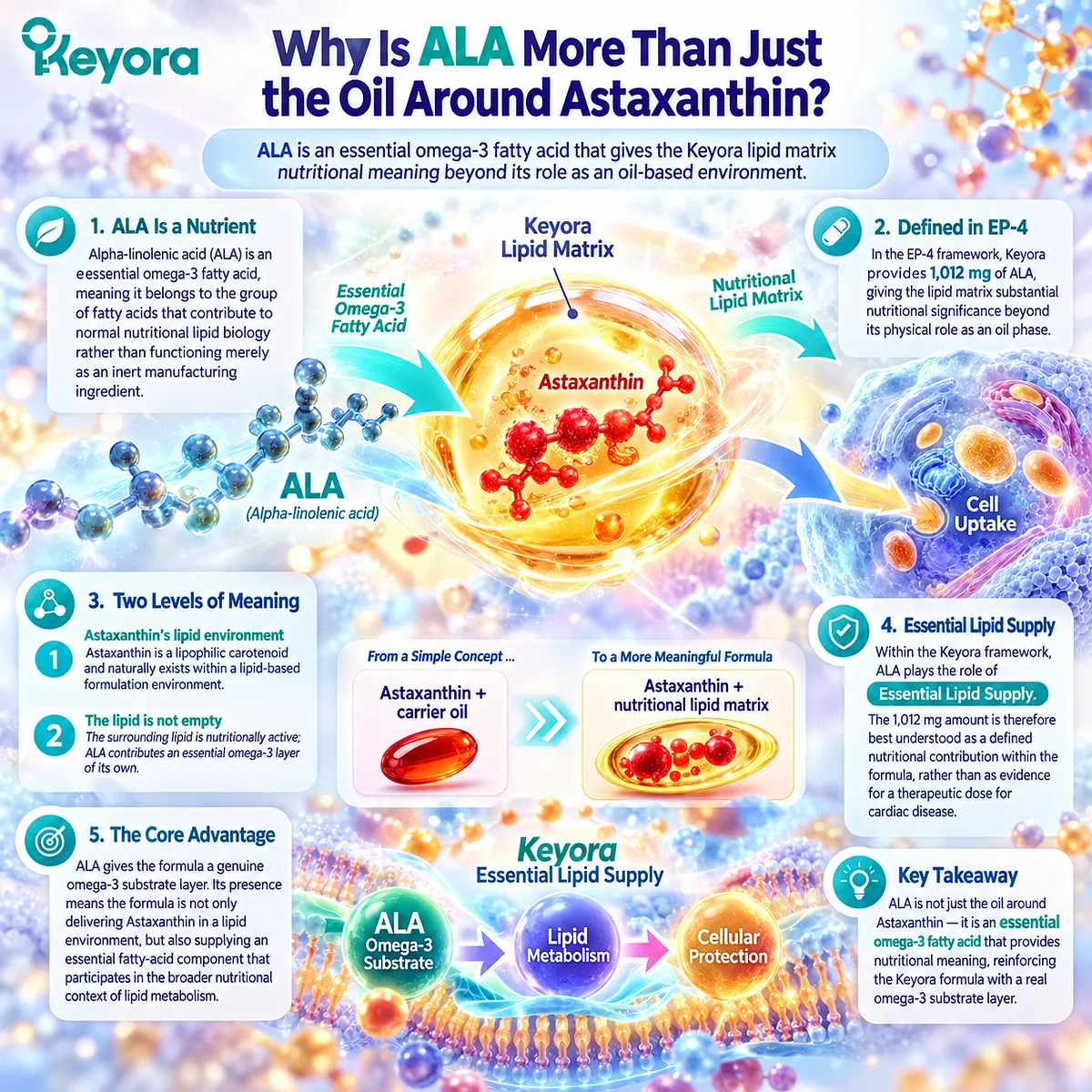
Why Is ALA More Than Just the Oil Around Astaxanthin?
ALA is an essential omega-3 fatty acid that gives the Keyora lipid matrix nutritional meaning beyond its role as an oil-based environment
A consumer looking at a softgel formula may reasonably assume that the oil inside the capsule is simply there to dissolve or carry Astaxanthin. That interpretation misses an important part of the Keyora formulation logic.
Alpha-linolenic acid is itself a nutrient.
ALA is an essential omega-3 fatty acid, meaning it belongs to the group of fatty acids that contribute to normal nutritional lipid biology rather than functioning merely as an inert manufacturing ingredient.
In the EP-4 framework, Keyora provides 1,012 mg of ALA, giving the lipid matrix substantial nutritional significance beyond its physical role as an oil phase.
This distinction matters because the formula can then be understood at two levels.
At the first level, Astaxanthin is a lipophilic carotenoid and therefore exists naturally within a lipid-based formulation environment.
At the second level, the surrounding lipid is not nutritionally empty. ALA contributes an essential omega-3 layer of its own.
Keyora therefore moves from the simple concept of:
Astaxanthin + carrier oil
to the more biologically meaningful concept of:
Astaxanthin + nutritional lipid matrix
This is the first reason ALA matters.
Its presence means the formula is not only delivering Astaxanthin in a lipid environment.
It is simultaneously supplying an essential fatty-acid component that participates in the broader nutritional context of lipid metabolism.
Within the Keyora framework, this gives ALA the role of Essential Lipid Supply.
The 1,012 mg amount should therefore be understood as a defined nutritional contribution within the formula, rather than as evidence that this exact dose has been established as a therapeutic treatment for cardiac disease.
Its strongest role is nutritional and architectural:
ALA gives the formula a genuine omega-3 substrate layer.
How Do ALA and Astaxanthin Work Together in the Same Lipid Environment?
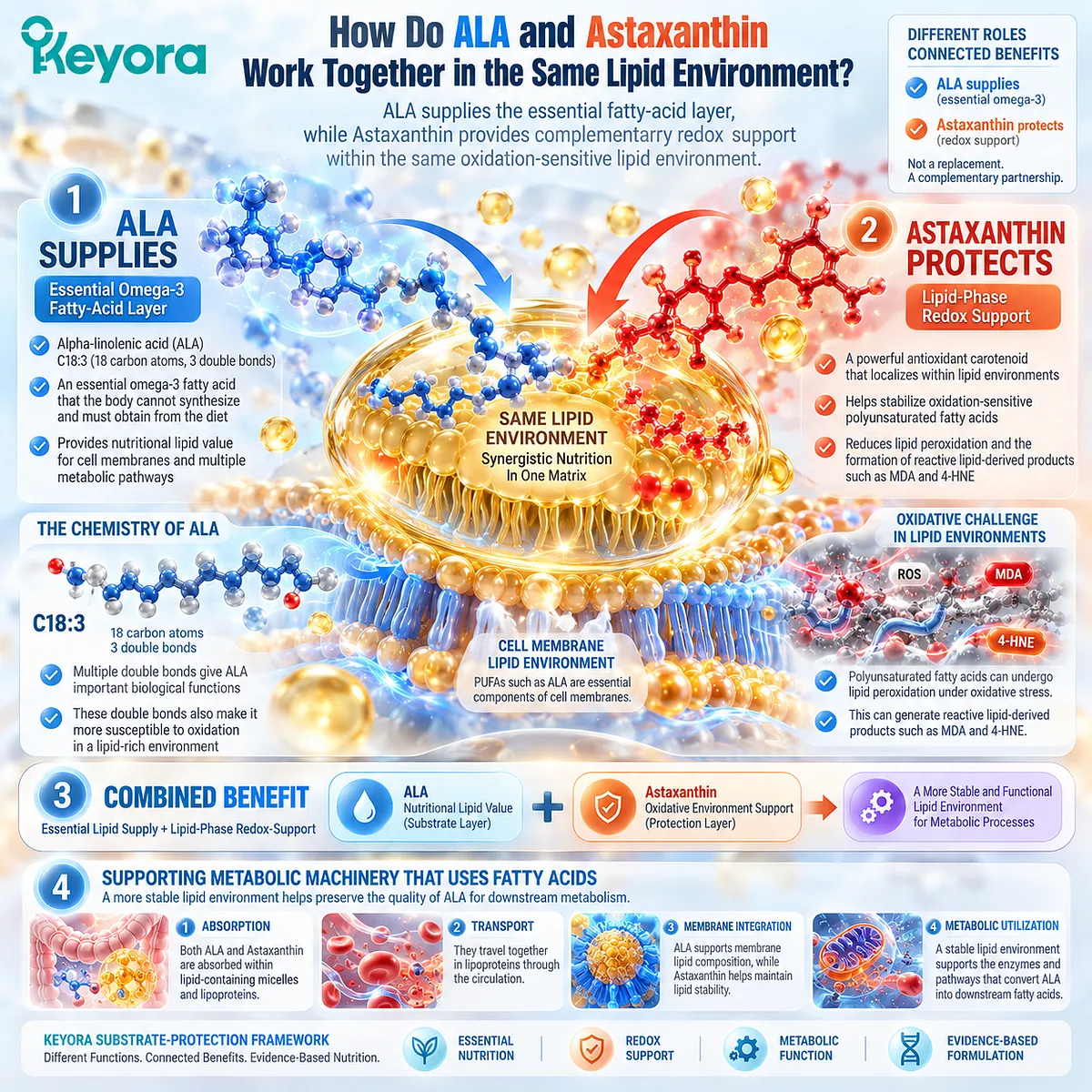
ALA supplies the essential fatty-acid layer, while Astaxanthin provides complementary redox support within the same oxidation-sensitive lipid environment
The most important reason to discuss ALA and Astaxanthin together is that they solve different but connected nutritional problems.
ALA supplies.
Astaxanthin protects.
That relationship becomes clearer when the chemistry of ALA is considered.
ALA is a polyunsaturated fatty acid, commonly represented as C18:3 because it contains 18 carbon atoms and three double bonds.
Those multiple double bonds give ALA important biological characteristics, but they also make oxidative stability a relevant consideration in a lipid-rich environment.
Keyora Astaxanthin EP-4 connects this structural feature with lipid peroxidation and the formation of reactive lipid-derived products such as MDA and 4-HNE.
This does not make ALA undesirable.
It means that substrate supply and oxidative context should be considered together.
That is where Astaxanthin contributes a distinct intervention layer.
Astaxanthin is not included because ALA is a “bad fat” that needs to be neutralized. ALA remains an essential omega-3 nutrient.
Rather, Astaxanthin adds redox support to a formula whose lipid matrix contains oxidation-sensitive polyunsaturated fatty acids.
The Keyora logic is therefore:
ALA provides nutritional lipid value.
Astaxanthin supports the oxidative environment surrounding that lipid value.
This creates a complementary relationship that cannot be explained by simply listing the two ingredients separately.
In the Keyora Substrate-Protection Framework, ALA represents the substrate layer and Astaxanthin represents the protection layer.
That is the first level of combined intervention:
Essential Lipid Supply + Lipid-Phase Redox Support
The partnership becomes even more important when the question moves from protecting the lipid environment to supporting the metabolic machinery that uses fatty acids.
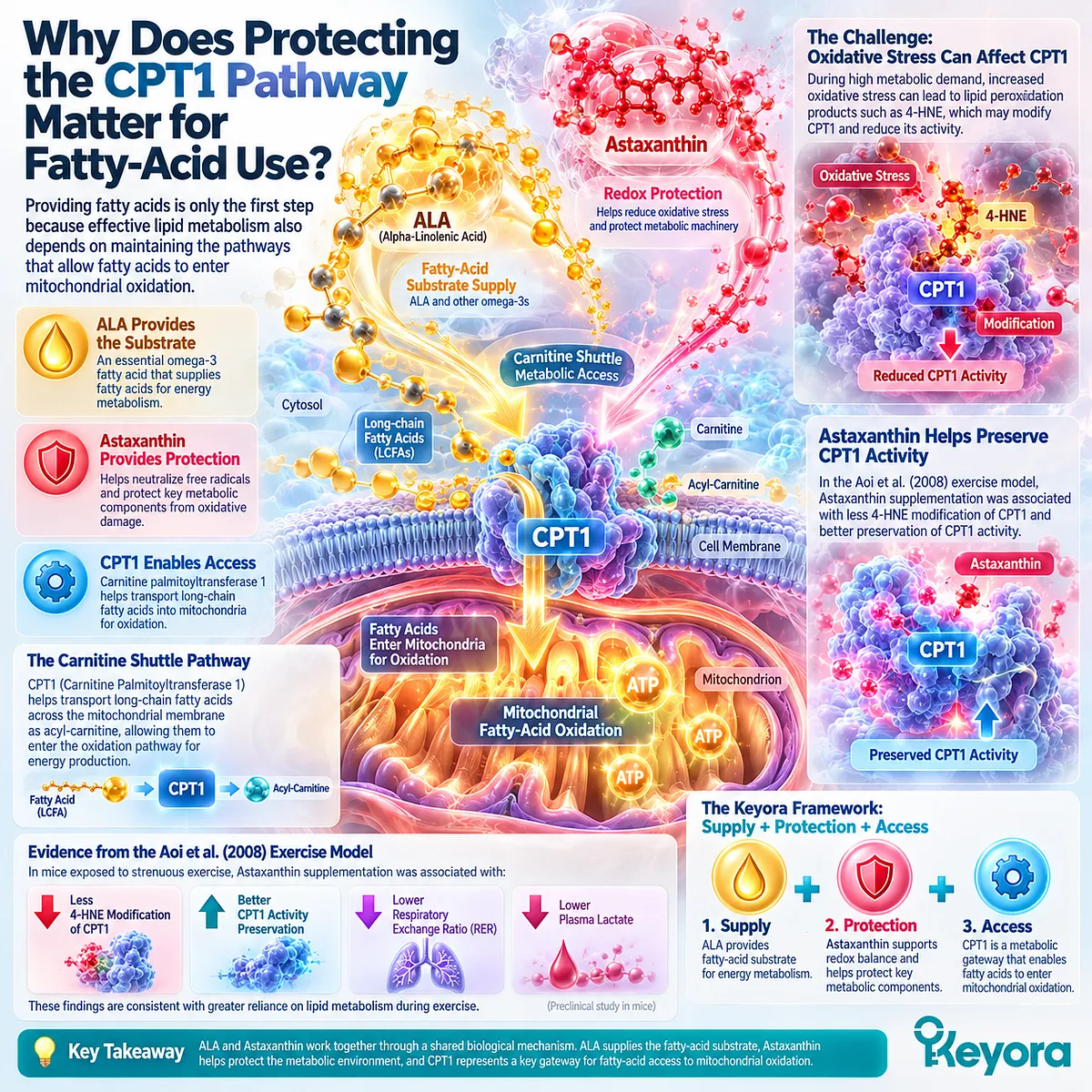
Why Does Protecting the CPT1 Pathway Matter for Fatty-Acid Use?
Providing fatty acids is only the first step because effective lipid metabolism also depends on maintaining the pathways that allow fatty acids to enter mitochondrial oxidation
Supplying a fatty acid does not by itself explain how that substrate participates in mitochondrial energy metabolism.
Fatty-acid utilization requires metabolic access.
One important control point is carnitine palmitoyltransferase 1, or CPT1, which participates in the carnitine shuttle that helps long-chain fatty acids enter the mitochondrial oxidation pathway.
This creates an important distinction:
Having substrate available is one biological task.
Maintaining access to the machinery that processes that substrate is another.
This is where Astaxanthin adds a second layer of relevance to the ALA partnership.
In the Aoi et al. (2008) exercise model discussed in Keyora Astaxanthin EP-4, mice exposed to strenuous exercise were evaluated for oxidative modification of CPT1.
The Astaxanthin-supplemented group showed less 4-HNE modification of CPT1 and better preservation of CPT1 activity. The same model also reported a lower respiratory exchange ratio and lower plasma lactate, findings interpreted as consistent with greater reliance on lipid metabolism during exercise.
This provides an important mechanistic bridge for the Keyora theory.
ALA contributes the fatty-acid substrate layer.
Astaxanthin does not merely sit beside that substrate as a generic antioxidant. The experimental evidence suggests a route by which Astaxanthin may also help preserve components of the metabolic environment required for fatty-acid use under oxidative stress.
The combined logic therefore expands from:
Supply + Protection
to:
Supply + Protection + Access
In practical terms:
ALA provides lipid substrate.
Astaxanthin supports redox balance.
CPT1 represents one metabolic gateway through which fatty acids gain access to mitochondrial oxidation.
This is why the ALA-Astaxanthin pairing is more biologically coherent than simply placing an omega-3 ingredient and an antioxidant in the same capsule without a shared mechanism.
The Aoi evidence is preclinical rather than a human cardiac outcome trial, but it provides a direct mechanistic foundation for this part of the Keyora model.
The scientific value lies in the pathway connection: oxidative stress, 4-HNE, CPT1 integrity, and fatty-acid metabolism can be understood as parts of the same metabolic system.
Why Is ALA Plus Astaxanthin More Complete Than Either Nutrient Alone?
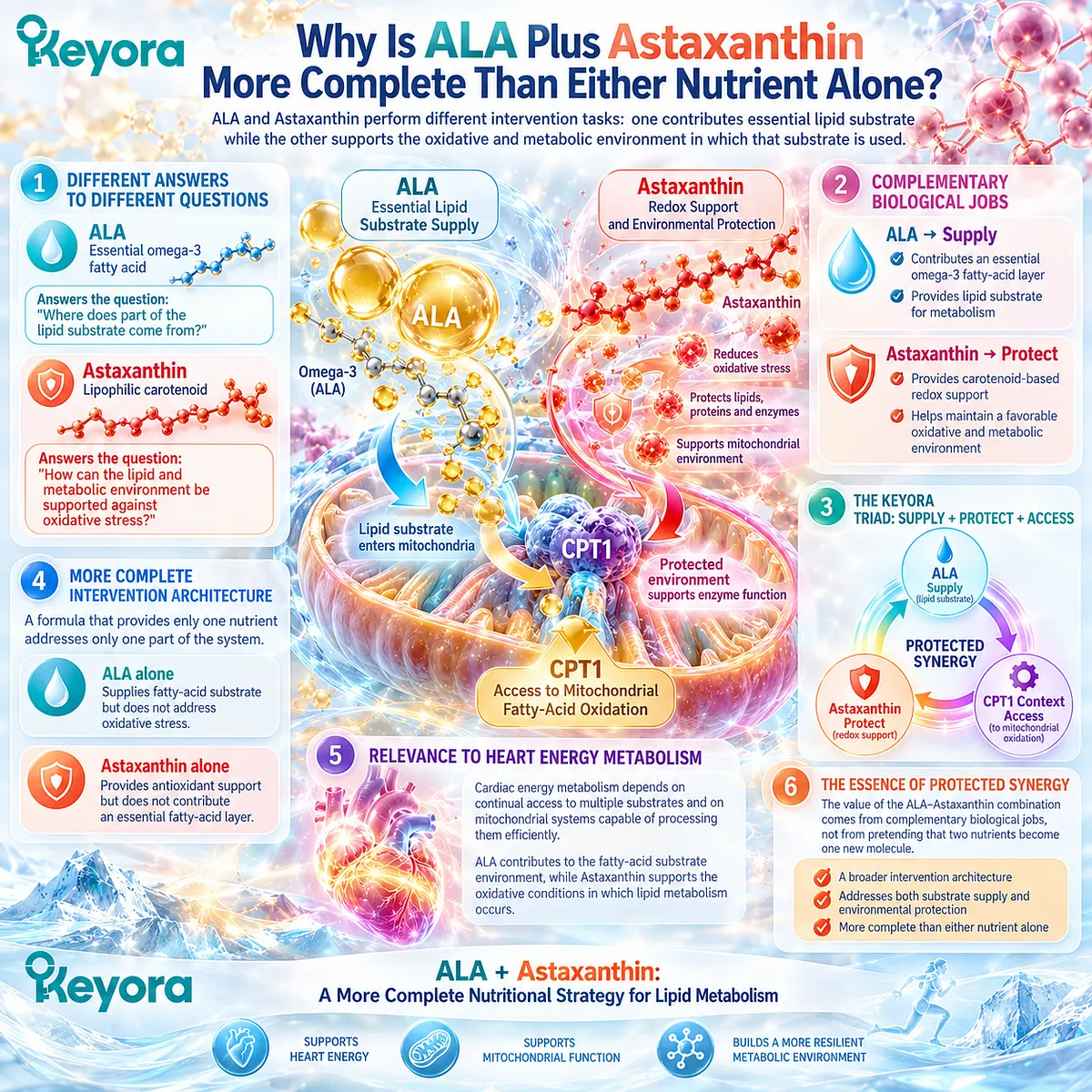
ALA and Astaxanthin perform different intervention tasks: one contributes essential lipid substrate while the other supports the oxidative and metabolic environment in which that substrate is used
ALA alone answers an important question:
Where does part of the lipid substrate come from?
Astaxanthin answers a different question:
How can the lipid and metabolic environment be supported against oxidative stress?
Combining the two therefore creates a broader intervention architecture.
ALA contributes something Astaxanthin does not provide: an essential omega-3 fatty-acid layer.
Astaxanthin contributes something ALA does not provide: carotenoid-based redox support.
This is exactly the kind of division of labor that Keyora means by Protected Synergy.
The value of the combination does not depend on pretending that two nutrients become one new molecule or that every mechanistic interaction has already been quantified in a finished-product clinical trial.
Its strength comes from complementary biological jobs.
The relationship can be expressed as:
ALA → Supply
Astaxanthin → Protect
CPT1 Context → Access
A formula that supplies fatty-acid substrate without considering oxidative stress addresses only one part of the system.
A formula that provides antioxidant support without contributing an essential fatty-acid layer addresses another part.
The Keyora formulation brings these two tasks together.
This is especially relevant to the heart-energy concept because cardiac energy metabolism depends on continual access to multiple substrates and on mitochondrial systems capable of processing them efficiently.
The Keyora theory does not need to claim that ALA is the heart’s only or universally preferred fuel.
A stronger scientific conclusion is available:
ALA contributes to the fatty-acid substrate environment, while Astaxanthin supports the oxidative conditions in which lipid metabolism occurs.
That is already a meaningful combined-intervention rationale.
It also explains why the ALA-Astaxanthin relationship is more important than the simplistic claim that one ingredient is merely there to carry the other.
They are performing different jobs inside the same metabolic architecture.
The Keyora Substrate-Protection Framework: Supply the Lipid, Protect the Environment, Support Its Use
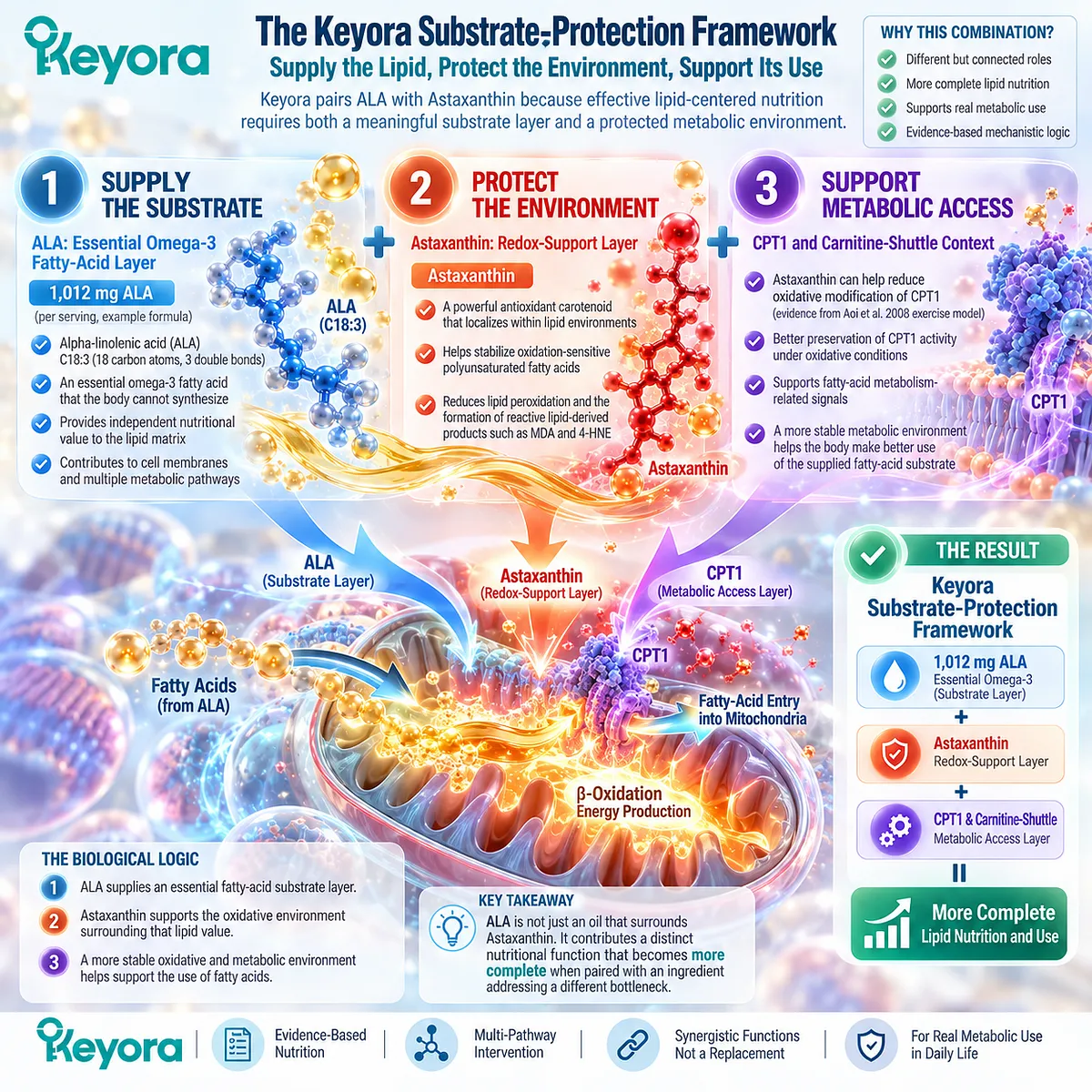
Keyora pairs ALA with Astaxanthin because effective lipid-centered nutrition requires both a meaningful substrate layer and a protected metabolic environment
The role of ALA in a heart-energy formula can therefore be summarized through three connected biological tasks.
First:
Supply the substrate.
ALA contributes an essential omega-3 fatty-acid layer and gives the lipid matrix independent nutritional meaning.
Second:
Protect the environment.
Because ALA is polyunsaturated, oxidative stability is a relevant part of the formulation context. Astaxanthin contributes a distinct redox-support role within that same lipid environment.
Third:
Support metabolic access.
The Aoi exercise model provides mechanistic evidence connecting Astaxanthin with reduced oxidative modification of CPT1 and better preservation of fatty-acid metabolism-related signals under strenuous oxidative conditions. Keyora Astaxanthin EP-4(1)
The Keyora framework can therefore be expressed as:
1,012 mg ALA
→ Essential Omega-3 / Substrate Layer
Astaxanthin
→ Redox-Support Layer
CPT1 and Carnitine-Shuttle Context
→ Metabolic Access Layer
=
Keyora Substrate-Protection Framework
This is the central reason ALA belongs in the formula.
It is not merely an oil that happens to surround Astaxanthin.
It contributes a distinct nutritional function that becomes more complete when paired with an ingredient addressing a different bottleneck.
The resulting Keyora interpretation is:
ALA supplies an essential fatty-acid substrate layer, while Astaxanthin supports the oxidative and metabolic environment in which fatty-acid utilization occurs.
That is the combined-intervention logic behind the pairing.
This article is for educational and informational purposes only. It does not provide medical advice, diagnosis, treatment, cure, prevention, disease outcome claims, hormone restoration claims, fertility outcome claims, or formula-specific clinical efficacy claims.