
Why Combine Astaxanthin With ALA and Other Fatty Acids?
Keyora Research Q&A Library
This is part of the Keyora Research Q&A Series, derived from Keyora Astaxanthin Research Journal Series.
Within the Keyora Astaxanthin Researcn framework, this Q&A translates complex astaxanthin biology into reader-friendly, evidence-bound answers, focusing on natural astaxanthin identity, molecular structure, antioxidant and redox mechanisms, membrane lipid interaction, mitochondrial resilience, inflammatory signaling pathways, human evidence interpretation, and the scientific principles behind responsible supplementation.
First published by Keyora Research Journal: www.keyorahealth.com
Direct Answer
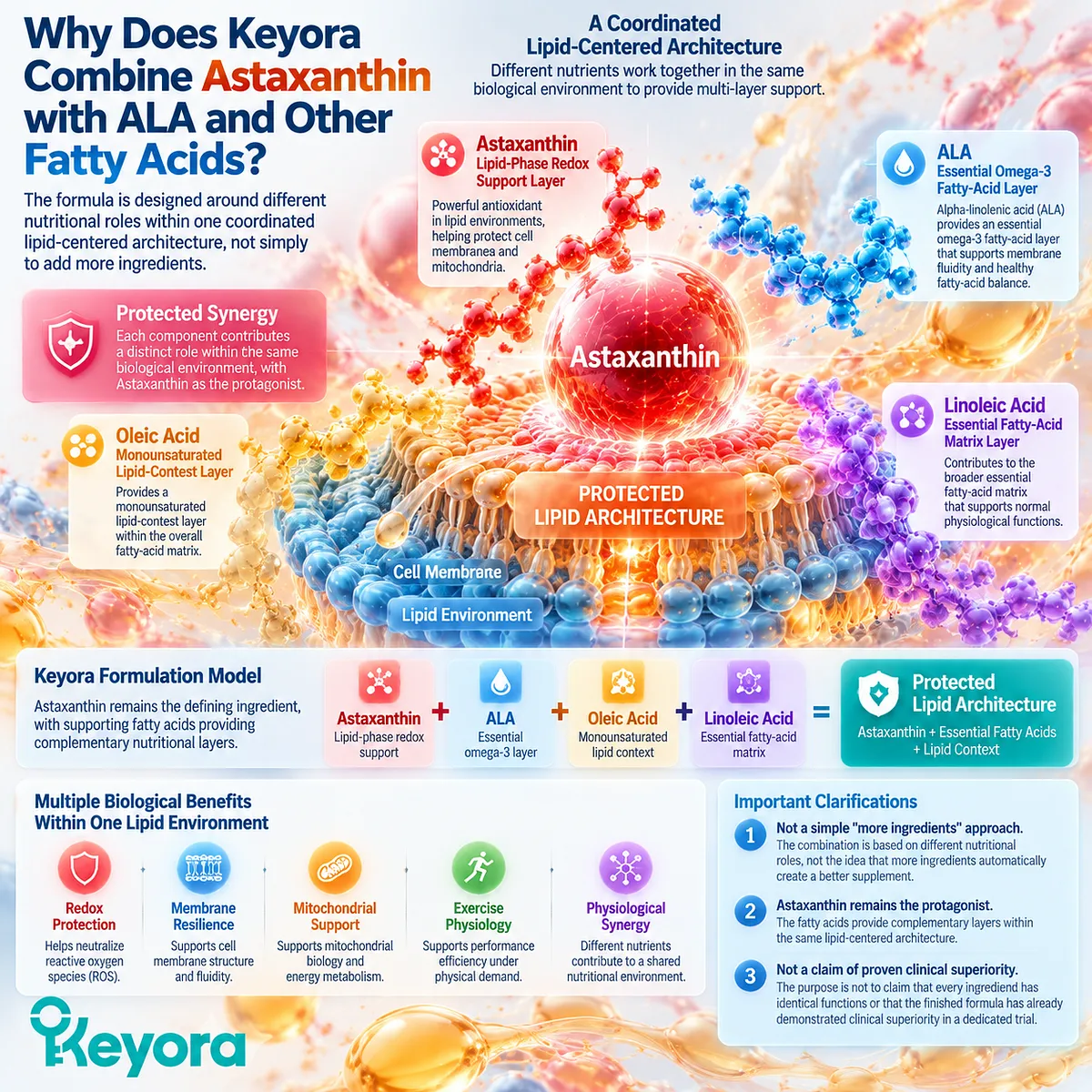
Keyora combines Astaxanthin with ALA and other fatty acids because the formula is designed around different nutritional roles within one coordinated lipid-centered architecture, rather than the simple idea that adding more ingredients automatically creates a better supplement.
In Keyora Astaxanthin EP-4: The Cardiac Architecture: Bio-Energetic Sovereignty, this concept is described as Protected Synergy. The central idea is that each component should contribute a distinct role within the same biological environment.
Astaxanthin remains the protagonist, while the surrounding fatty-acid matrix provides additional nutritional layers that influence the overall formulation logic.
Within the Keyora Asta 16MG architecture:
-
Astaxanthin provides the lipid-phase redox-support layer.
-
ALA provides the essential omega-3 fatty-acid layer.
-
Oleic acid provides a monounsaturated lipid-context layer.
-
Linoleic acid contributes to the broader essential fatty-acid matrix.
The purpose of this combination is not to claim that every ingredient has identical functions or that the finished formula has already demonstrated clinical superiority in a dedicated randomized trial.
Instead, the rationale is that different nutrients address different aspects of the same nutritional environment.
The Keyora model can therefore be summarized as:
Astaxanthin + Essential Fatty Acids + Lipid Context = Protected Lipid Architecture
This approach keeps Astaxanthin as the defining ingredient while explaining why the surrounding fatty acids are part of the formulation design.
Why Does Astaxanthin Make Sense in a Lipid-Based Formula?
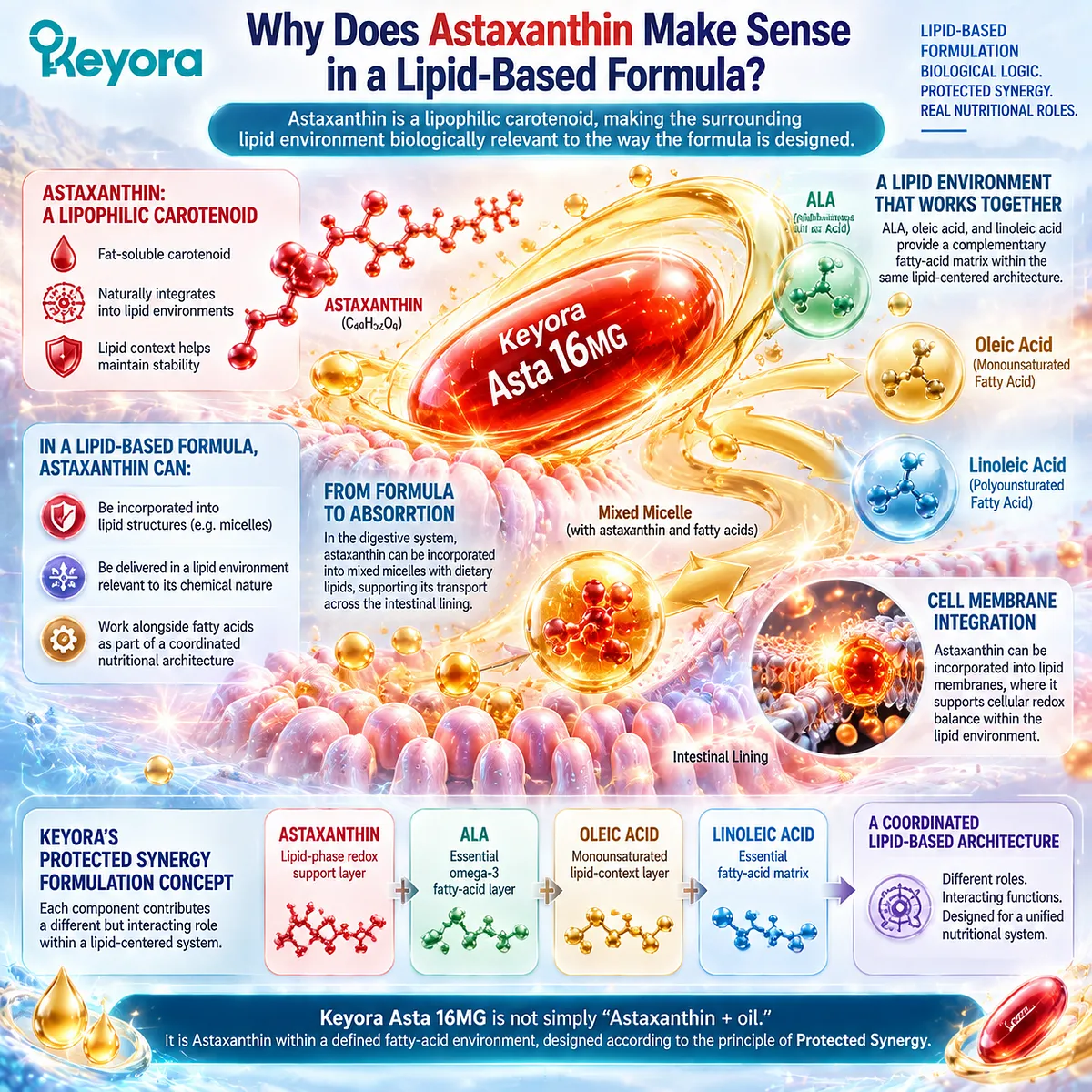
Astaxanthin is a lipophilic carotenoid, making the surrounding lipid environment biologically relevant to the way the formula is designed
Astaxanthin is a fat-soluble carotenoid.
This chemical property is central to understanding why Keyora does not treat Astaxanthin as an isolated ingredient placed randomly into a capsule.
A lipid-centered formulation begins with a simple principle:
The environment surrounding a nutrient can be relevant to how that nutrient functions within a nutritional system.
EP-4 develops this concept through the framework of **Protected Synergy**, explaining that Astaxanthin and fatty acids are selected because they contribute different but interacting roles rather than simply increasing the number of ingredients.
This does not mean that the presence of oil automatically proves a specific absorption increase or guarantees a clinical outcome.
Those conclusions require direct studies.
The stronger formulation principle is:
Astaxanthin belongs naturally within a lipid-based nutritional architecture because its chemistry and the surrounding fatty-acid environment exist within the same biological context.
This creates a different design philosophy from a basic carrier-oil approach.
A carrier oil primarily solves a manufacturing problem.
A lipid-centered architecture considers the nutritional role of the fatty acids themselves.
Therefore, Keyora Asta 16MG is not simply:
Astaxanthin + oil
It is designed as:
Astaxanthin within a defined fatty-acid environment
This distinction creates the foundation for understanding why ALA, oleic acid, and linoleic acid are included.
What Does ALA Contribute Beyond Acting as a Carrier Oil?
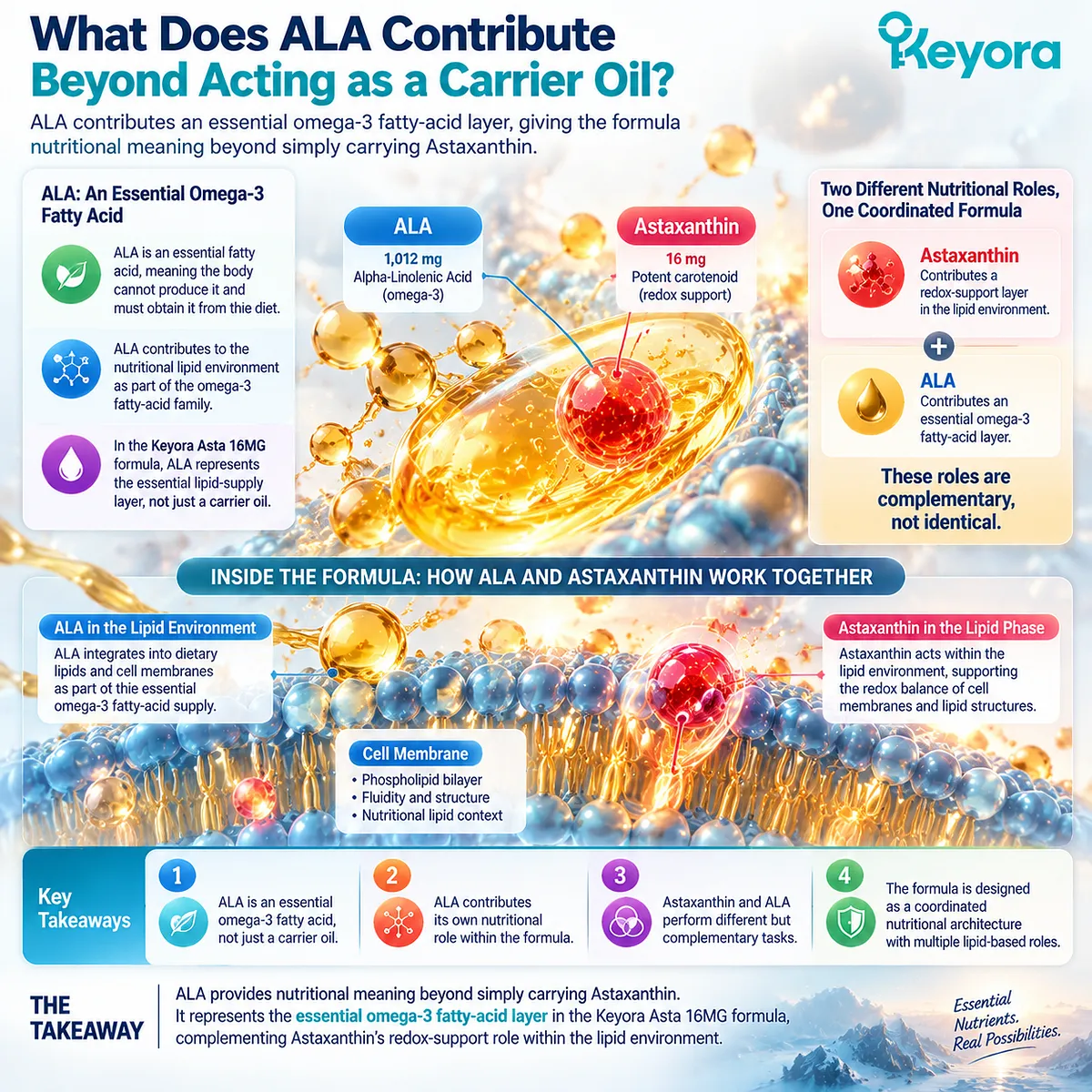
ALA contributes an essential omega-3 fatty-acid layer, giving the formula nutritional meaning beyond simply carrying Astaxanthin
Alpha-linolenic acid (ALA) is one of the central fatty-acid components in the Keyora Asta 16MG architecture.
EP-4 identifies 1,012 mg of ALA as an important part of the formula and places it within the broader fatty-acid and metabolic-substrate framework.
The role of ALA should therefore not be reduced to “the oil that carries Astaxanthin.”
ALA contributes its own nutritional identity:
ALA is an essential omega-3 fatty acid.
Within the Keyora framework, it represents the essential lipid-supply layer of the formula.
EP-4 uses the metaphor of “Fuel” to describe ALA’s role.
For public scientific communication, this concept should be translated carefully.
ALA can be described as:
an essential fatty-acid component contributing to the nutritional lipid environment
rather than:
a clinically proven therapeutic cardiac fuel dose.
The distinction matters because nutritional architecture and disease-treatment claims are different evidence categories.
The importance of ALA in the formula is not that it replaces Astaxanthin.
It performs a different task.
Astaxanthin contributes a redox-support layer.
ALA contributes an essential omega-3 fatty-acid layer.
The logic of the formula comes from these roles being complementary rather than identical.
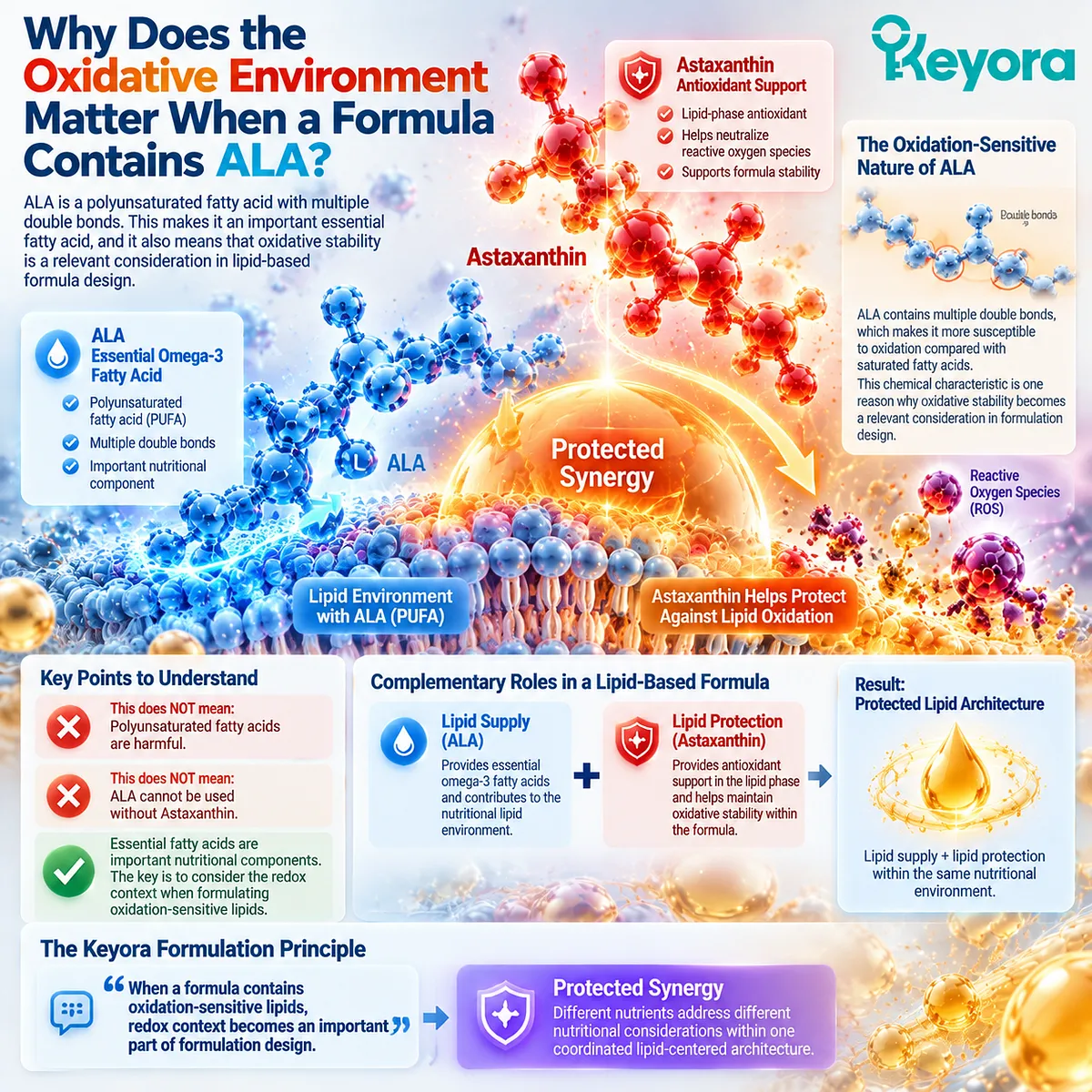
Why Does the Oxidative Environment Matter When a Formula Contains ALA?
Because ALA is polyunsaturated, its chemical characteristics make oxidative stability a relevant consideration in lipid-based formula design
ALA belongs to the polyunsaturated fatty-acid family.
Its chemical structure contains multiple double bonds, which is one reason polyunsaturated fatty acids have distinct biological properties and also why oxidative stability becomes a relevant consideration.
EP-4 discusses this concept by explaining that ALA’s polyunsaturated structure creates an oxidation-sensitive lipid environment and connects this with the rationale for including Astaxanthin as a protective antioxidant component.
However, this concept must be interpreted correctly.
The conclusion is not:
Polyunsaturated fatty acids are harmful.
Nor is it:
ALA cannot be used without Astaxanthin.
Essential fatty acids are important nutritional components.
The more accurate formulation principle is:
When a formula contains oxidation-sensitive lipids, redox context becomes an important part of formulation design.
This is where Astaxanthin becomes relevant.
ALA contributes lipid nutrition.
Astaxanthin contributes antioxidant support.
The combination creates a conceptual relationship between:
lipid supply
and:
lipid protection.
This is the foundation of the Keyora Protected Synergy concept.
The value of the architecture is not that one ingredient “fixes” another.
The value is that each ingredient addresses a different nutritional consideration.
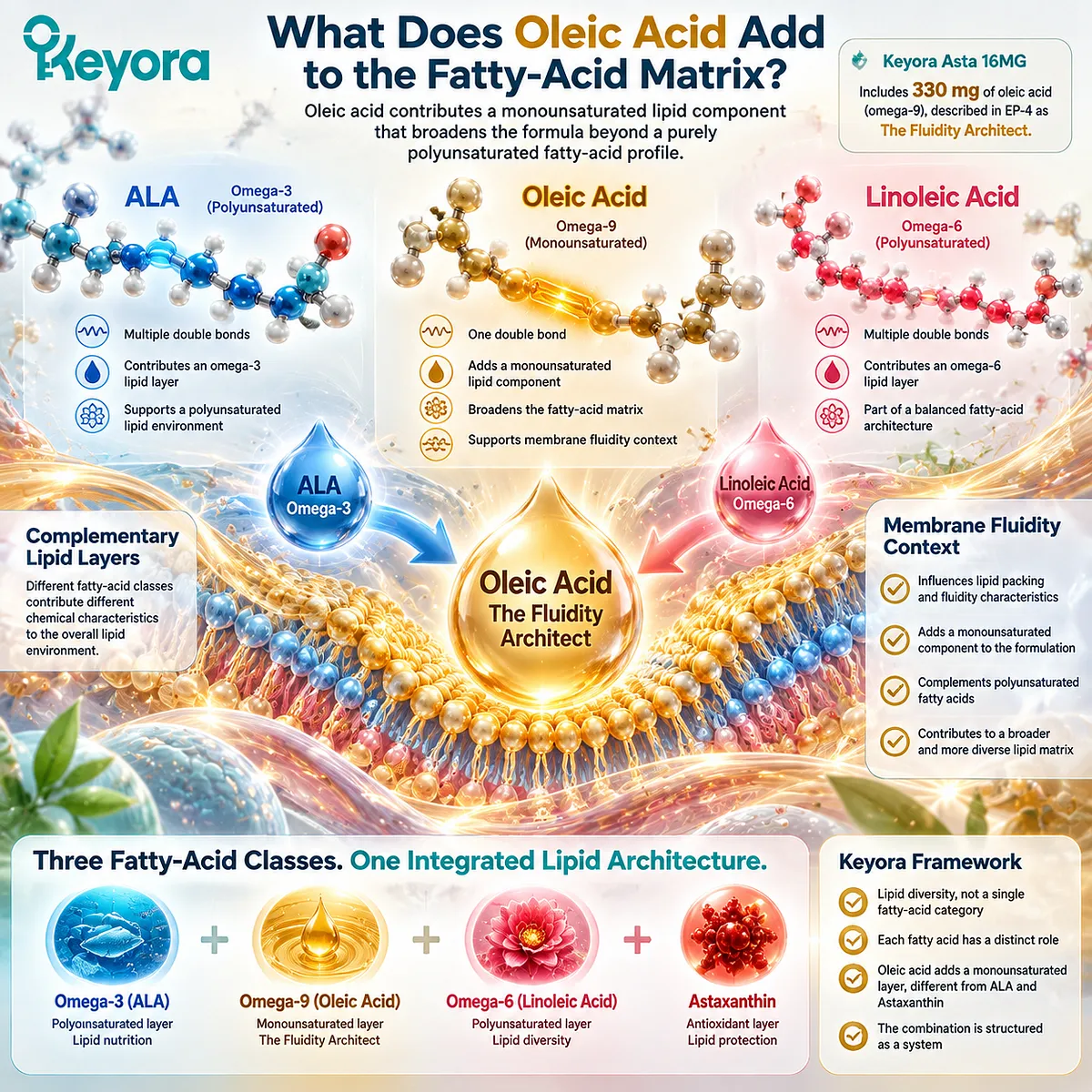
What Does Oleic Acid Add to the Fatty-Acid Matrix?
Oleic acid contributes a monounsaturated lipid component that broadens the formula beyond a purely polyunsaturated fatty-acid profile
The Keyora Asta 16MG architecture also includes oleic acid, an omega-9 monounsaturated fatty acid.
EP-4 identifies 330 mg of oleic acid and describes it through the framework term The Fluidity Architect.
The importance of oleic acid is that it represents a different category of lipid.
ALA is polyunsaturated.
Oleic acid is monounsaturated.
These fatty acids therefore contribute different chemical characteristics to the overall lipid environment.
Within the Keyora framework, oleic acid broadens the fatty-acid matrix by adding a monounsaturated component rather than creating a formula composed only of polyunsaturated fatty acids.
This supports a broader principle:
A lipid architecture is defined not only by the presence of fatty acids, but also by the diversity of fatty-acid classes included.
EP-4 extends this idea into a membrane-fluidity framework.
However, the public interpretation should maintain evidence boundaries.
The existence of oleic acid in the formula supports a lipid-context rationale.
It does not by itself prove that the finished product produces specific mitochondrial membrane changes or cardiovascular outcomes.
Therefore, the appropriate Keyora statement is:
Oleic acid contributes a distinct monounsaturated lipid layer within the overall formulation architecture.
It has a different role from ALA.
It has a different role from Astaxanthin.
This difference is precisely why the combination is structured as a system.
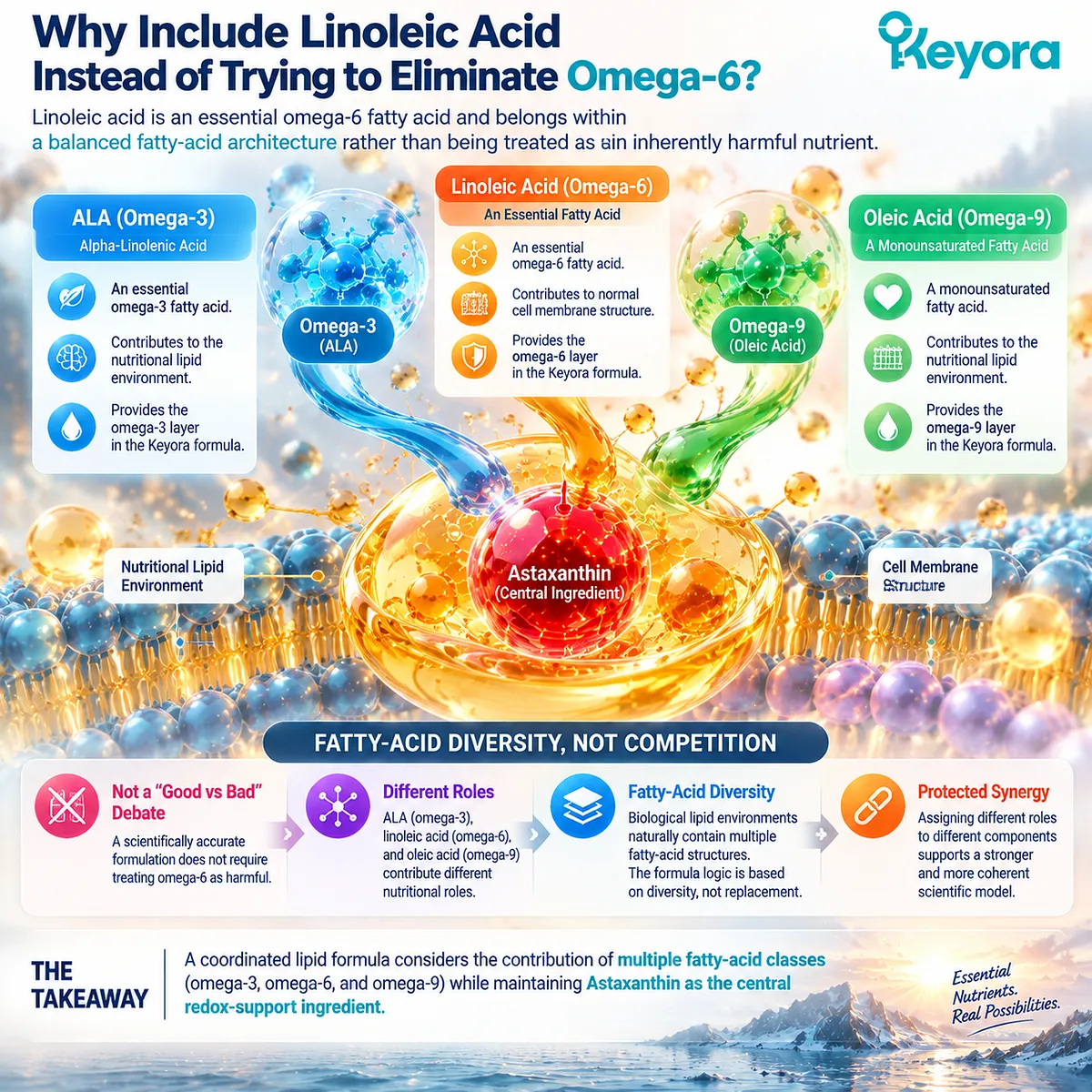
Why Include Linoleic Acid Instead of Trying to Eliminate Omega-6?
Linoleic acid is an essential omega-6 fatty acid and belongs within a balanced fatty-acid architecture rather than being treated as an inherently harmful nutrient
Linoleic acid represents the omega-6 component of the Keyora fatty-acid matrix.
Its presence is important because modern discussions about fats often oversimplify the relationship between omega-3 and omega-6 fatty acids.
A scientifically accurate formulation does not require treating omega-6 as an undesirable category.
Linoleic acid is an essential fatty acid with its own nutritional role.
Within the Keyora architecture, the purpose of including multiple fatty-acid classes is not to create a competition between omega categories.
Instead, the formula recognizes that biological lipid environments naturally contain different fatty-acid structures.
Therefore:
-
ALA contributes an omega-3 layer.
-
Linoleic acid contributes an omega-6 layer.
-
Oleic acid contributes an omega-9 layer.
Each belongs to a different nutritional category.
The formula logic is therefore based on:
fatty-acid diversity
rather than:
one fatty-acid family replacing all others.
This distinction is important because the strength of Protected Synergy depends on assigning different roles to different components.
If one nutrient must be declared “good” and another “bad” for the architecture to work, the scientific model becomes weaker.
A more accurate interpretation is:
A coordinated lipid formula considers the contribution of multiple fatty-acid classes while maintaining Astaxanthin as the central redox-support ingredient.
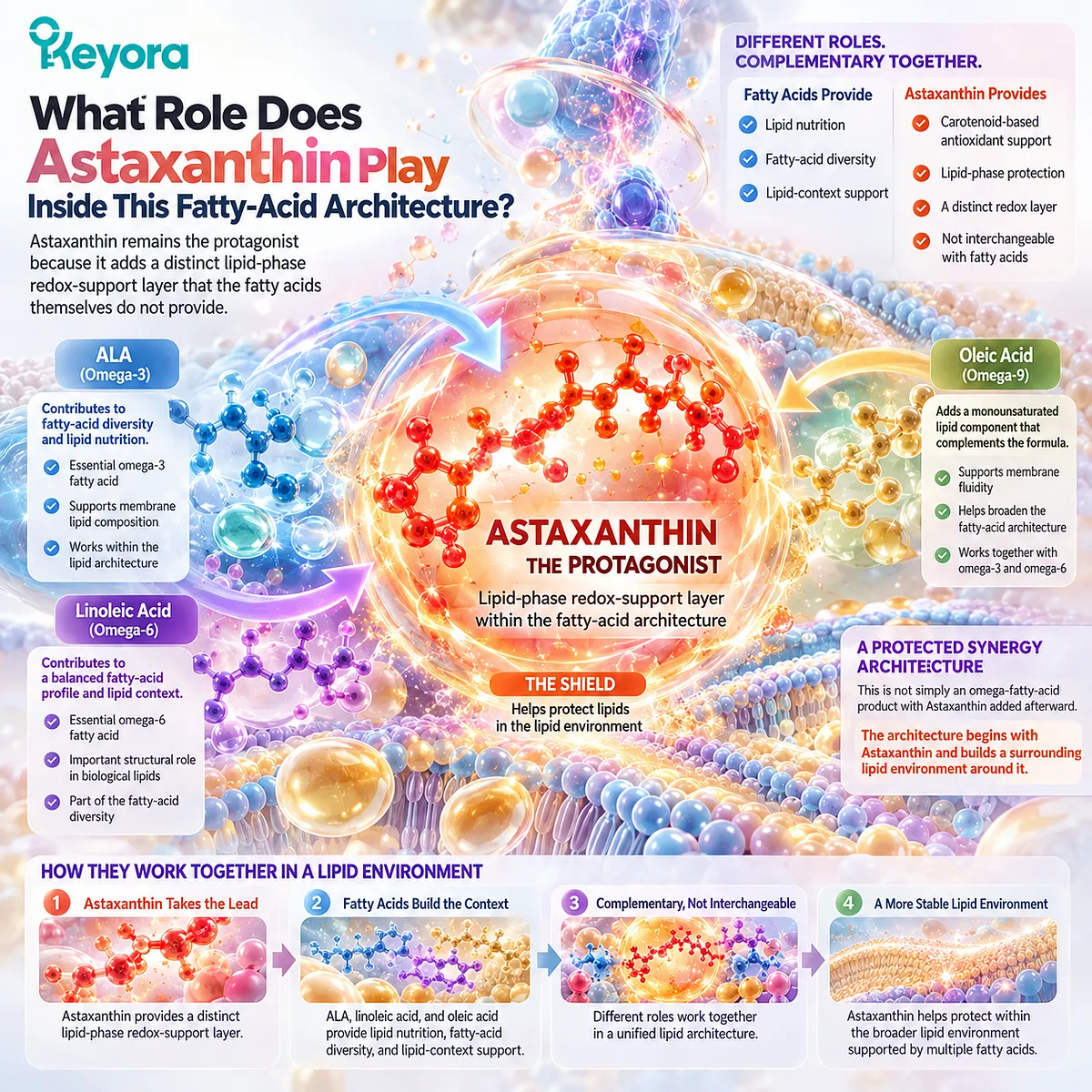
What Role Does Astaxanthin Play Inside This Fatty-Acid Architecture?
Astaxanthin remains the protagonist because it adds a distinct lipid-phase redox-support layer that the fatty acids themselves do not provide
Although ALA, oleic acid, and linoleic acid are important parts of the formula, Astaxanthin remains the defining ingredient.
EP-4 places Astaxanthin at the center of the Protected Synergy framework and describes it as the component that provides the protective layer within the broader lipid architecture.
The distinction is fundamental.
Fatty acids contribute:
lipid nutrition
fatty-acid diversity
and:
lipid-context support
Astaxanthin contributes:
carotenoid-based antioxidant support
These are not interchangeable roles.
This is why the formula is not simply an omega-fatty-acid product with Astaxanthin added afterward.
The architecture begins with Astaxanthin and builds a surrounding lipid environment around it.
EP-4 describes this through the metaphor of Astaxanthin as a “Shield” and the fatty-acid components as supporting layers.
For scientific communication, the practical translation is:
Astaxanthin is the protagonist; fatty acids provide complementary nutritional context.
The strongest claim is therefore not that Astaxanthin guarantees preservation of every lipid molecule or produces a specific clinical outcome.
The strongest claim is:
Astaxanthin provides a distinct redox-support role within a lipid-centered nutritional architecture.
That is the reason it remains the core of the formula.
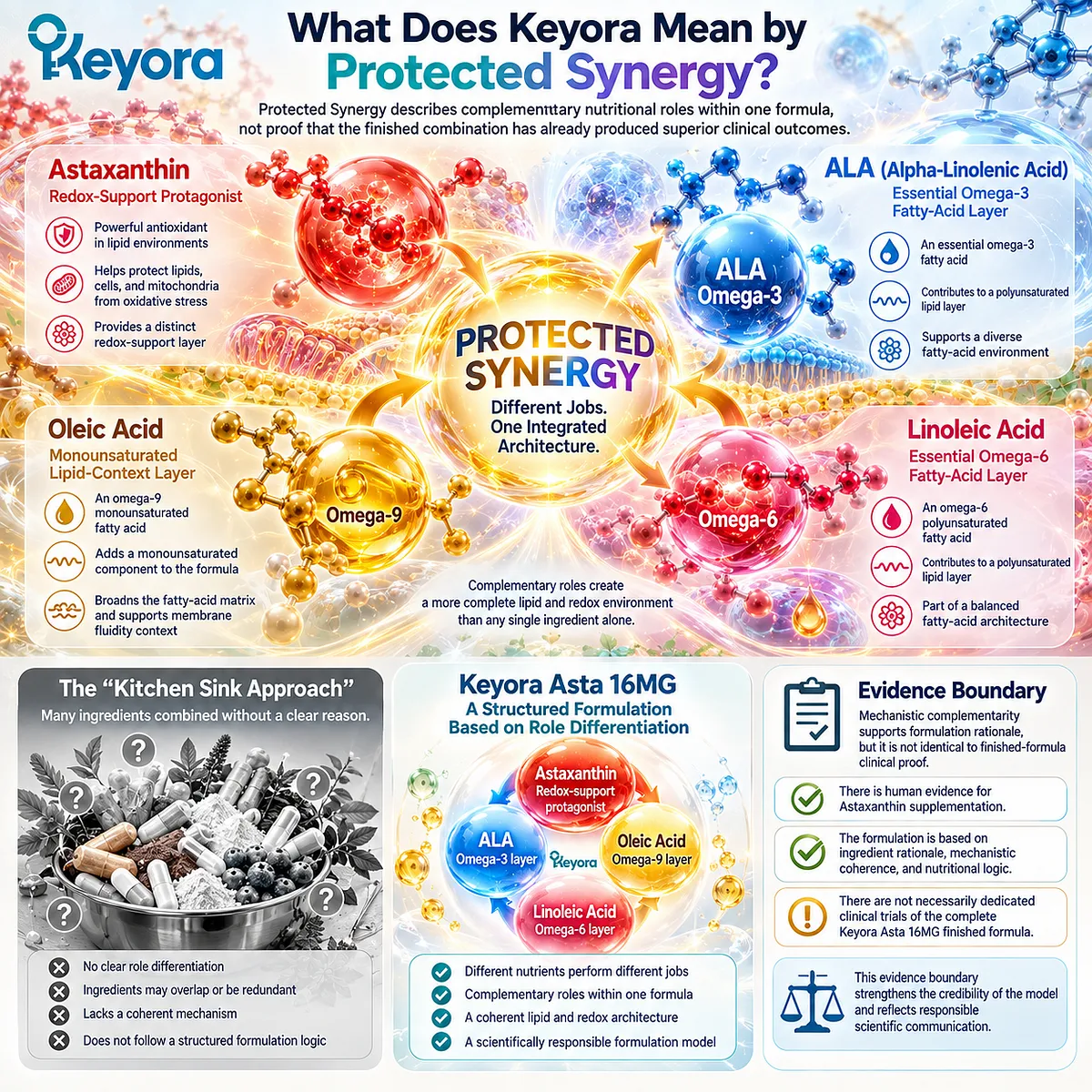
What Does Keyora Mean by Protected Synergy?
Protected Synergy describes complementary nutritional roles within one formula, not proof that the finished combination has already produced superior clinical outcomes
Protected Synergy is the central formulation concept behind Keyora Asta 16MG.
The principle is simple:
Different nutrients should be selected because they perform different jobs.
EP-4 contrasts this with the “Kitchen Sink Approach,” where many ingredients are combined without a clear reason for inclusion.
For Keyora Asta 16MG:
-
Astaxanthin = redox-support protagonist
-
ALA = essential omega-3 fatty-acid layer
-
Oleic acid = monounsaturated lipid-context layer
-
Linoleic acid = essential omega-6 fatty-acid layer
The formula is therefore based on role differentiation.
The human evidence base for Astaxanthin includes studies of Astaxanthin supplementation, but not necessarily dedicated trials of the complete Keyora Asta 16MG finished formula.
Therefore:
Mechanistic complementarity supports formulation rationale.
But:
Mechanistic complementarity is not identical to finished-formula clinical proof.
This evidence boundary strengthens the credibility of the model.
A scientifically responsible formulation can have:
– ingredient rationale
– mechanistic coherence
– nutritional logic
while still recognizing where direct clinical evidence ends.
That is the foundation of responsible scientific communication.
The Keyora Protected Lipid Architecture: Different Nutrients, Different Jobs, One Formula
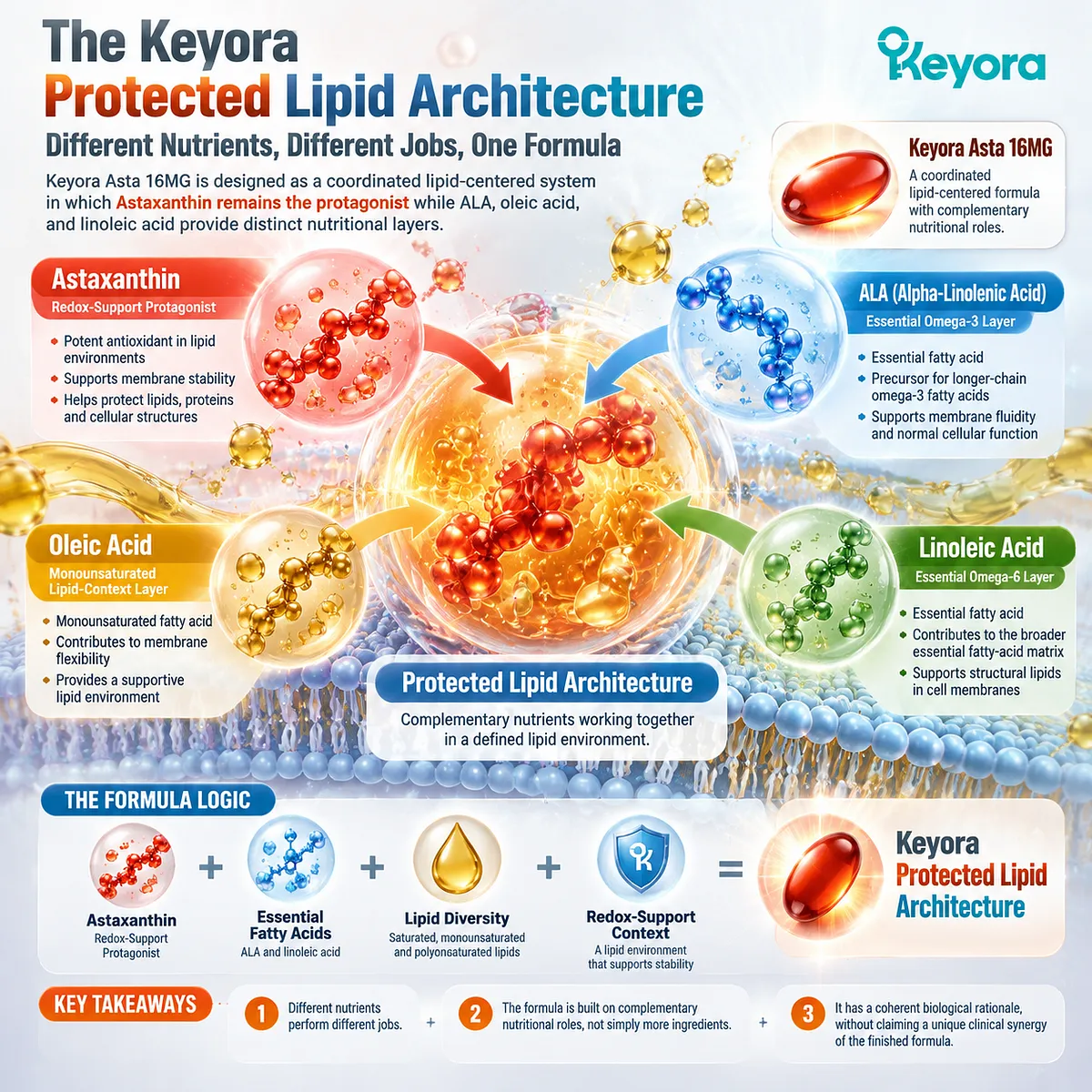
Keyora Asta 16MG is designed as a coordinated lipid-centered system in which Astaxanthin remains the protagonist while ALA, oleic acid, and linoleic acid provide distinct nutritional layers
The complete Keyora formulation logic can now be summarized.
The formula is not built on the assumption that more ingredients automatically create greater value.
Instead, it assigns different nutritional roles:
Astaxanthin
provides the defining redox-support layer.
ALA
provides the essential omega-3 fatty-acid layer.
Oleic acid
provides a monounsaturated lipid-context layer.
Linoleic acid
contributes to the broader essential fatty-acid matrix.
Together, these components form what Keyora defines as a Protected Lipid Architecture.
The logic can be represented as:
Astaxanthin
+
Essential Fatty Acids
+
Lipid Diversity
+
Redox-Support Context
=
Keyora Protected Lipid Architecture
This architecture explains why Keyora Asta 16MG is different from either:
Astaxanthin alone
or:
a generic fatty-acid supplement.
The formulation combines a defined Astaxanthin dose with a specific lipid environment designed around complementary nutritional roles.
At the same time, the evidence boundary remains important.
The formula has a coherent biological rationale.
It does not claim that the finished product has already demonstrated a unique clinical synergy in a dedicated randomized trial.
The final Keyora interpretation is:
Keyora Asta 16MG is designed as a lipid-centered nutritional architecture in which Astaxanthin remains the protagonist and ALA, oleic acid, and linoleic acid contribute different but complementary nutritional layers.
This article is for educational and informational purposes only. It does not provide medical advice, diagnosis, treatment, cure, prevention, disease outcome claims, hormone restoration claims, fertility outcome claims, or formula-specific clinical efficacy claims.