
How Long Does Astaxanthin Take to Affect Endurance or Exercise Performance?
Keyora Research Q&A Library
This is part of the Keyora Research Q&A Series, derived from Keyora Astaxanthin Research Journal Series.
Within the Keyora Astaxanthin Researcn framework, this Q&A translates complex astaxanthin biology into reader-friendly, evidence-bound answers, focusing on natural astaxanthin identity, molecular structure, antioxidant and redox mechanisms, membrane lipid interaction, mitochondrial resilience, inflammatory signaling pathways, human evidence interpretation, and the scientific principles behind responsible supplementation.
First published by Keyora Research Journal: www.keyorahealth.com

Direct Answer
Astaxanthin is better understood as a sustained nutritional intervention than as an immediate exercise stimulant.
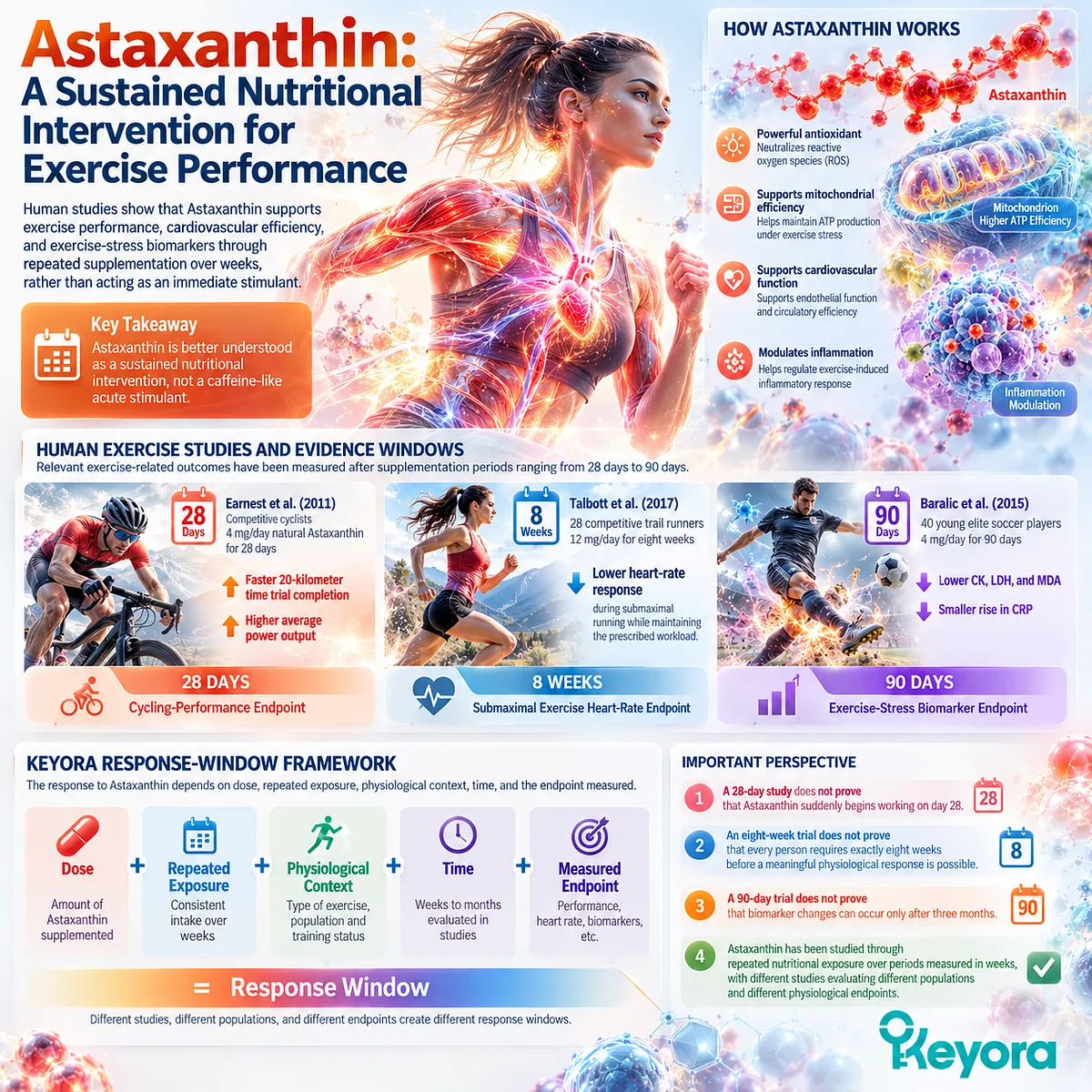
In the human exercise studies summarized in Keyora Astaxanthin EP-4: The Cardiac Architecture: Bio-Energetic Sovereignty, relevant exercise-related outcomes were measured after supplementation periods ranging from approximately 28 days to 90 days.
Earnest et al. (2011) studied competitive cyclists receiving 4 mg/day of natural Astaxanthin for 28 days. The protocol ended with a 20-kilometer cycling time trial, and the EP-4 analysis reports faster completion time and higher average power output in the Astaxanthin group.
Talbott et al. (2017) studied 28 competitive trail runners receiving 12 mg/day for eight weeks. The EP-4 analysis reports a lower heart-rate response during submaximal running while the athletes maintained the prescribed workload.
Baralic et al. (2015) studied 40 young elite soccer players receiving 4 mg/day for 90 days during regular training and match play. The EP-4 analysis reports lower CK, LDH, and MDA, together with a smaller rise in CRP.
These studies create three useful human evidence windows:
28 days – cycling-performance endpoint
8 weeks – submaximal exercise heart-rate endpoint
90 days – exercise-stress biomarker endpoints
But these intervention periods should not be interpreted as exact biological countdowns.
A 28-day study does not prove that Astaxanthin suddenly begins working on day 28.
An eight-week trial does not prove that every person requires exactly eight weeks before a meaningful physiological response becomes possible.
A 90-day trial does not prove that recovery-related or oxidative-stress biomarkers can change only after three months.
The more accurate interpretation is that Astaxanthin has been studied through repeated nutritional exposure over periods measured in weeks, with different studies evaluating different populations and different physiological endpoints.
This distinction is the basis of the Keyora Response-Window Framework:
Dose + Repeated Exposure + Physiological Context + Time + Measured Endpoint = Response Window
For the Keyora Astaxanthin architecture, this is important. Astaxanthin is not positioned as a caffeine-like acute stimulant whose value should be judged by whether someone “feels” an immediate effect after a capsule.
It is better understood as part of a sustained nutritional strategy in which repeated exposure, biological demand, and the endpoint being measured all influence how the response should be interpreted.
What Time Frames Have Human Exercise Studies Actually Used?
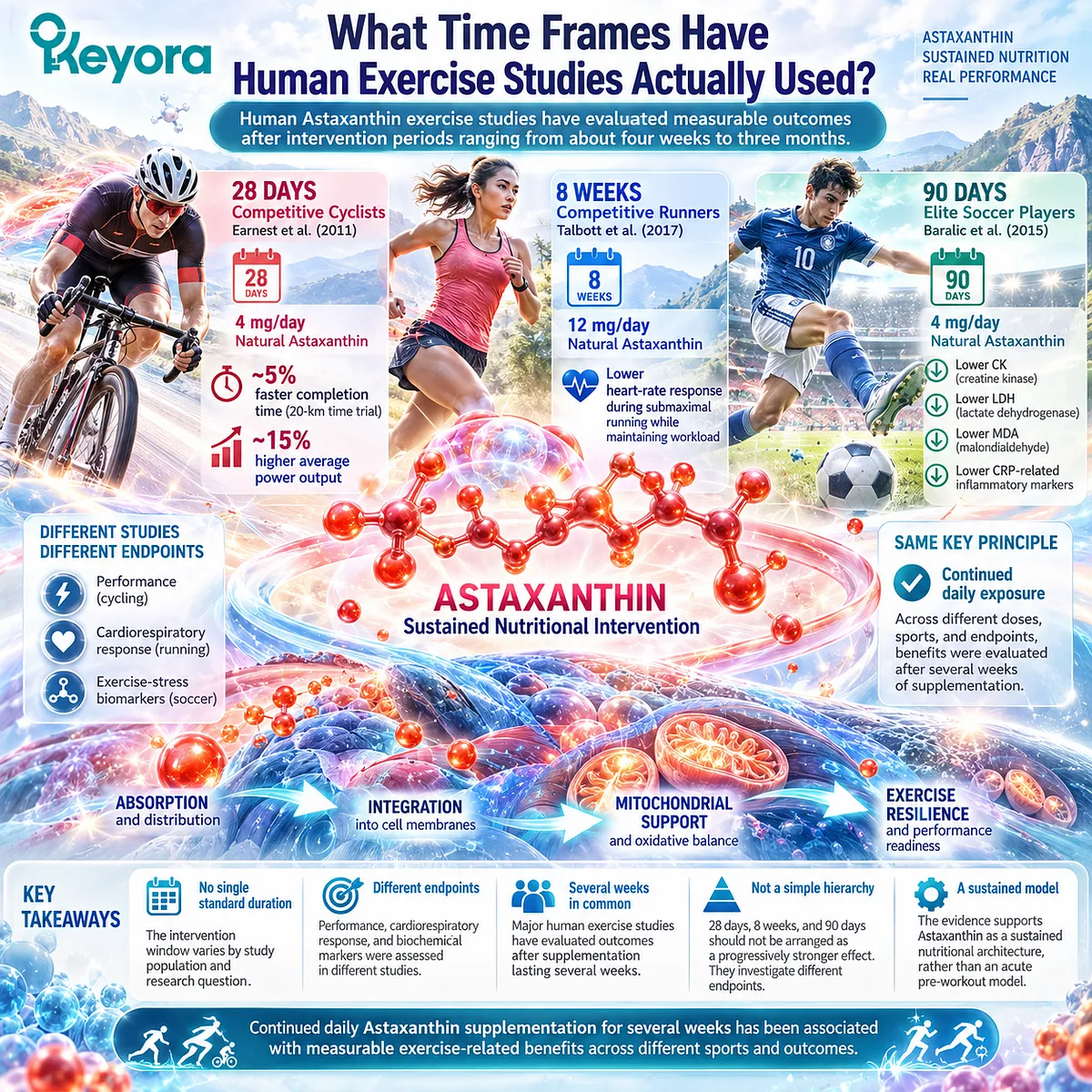
Human Astaxanthin exercise studies have evaluated measurable outcomes after intervention periods ranging from about four weeks to three months
The major human exercise studies summarized in EP-4 do not use one standardized supplementation duration.
Instead, the intervention window changes according to the study population and the question being tested.
The shortest major exercise protocol highlighted in EP-4 is the Earnest cyclist study.
Competitive cyclists received 4 mg/day of natural Astaxanthin for 28 days before completing a 20-kilometer time trial. The EP-4 analysis reports approximately 5% faster completion and approximately 15% higher average power output in the Astaxanthin group.
From a timing perspective, the scientifically important conclusion is not:
28 days is the universal time required for Astaxanthin to work.
The stronger conclusion is:
A measurable cycling-performance difference was reported after a repeated 28-day supplementation protocol.
Talbott et al. used a different intervention architecture.
Competitive trail runners received 12 mg/day for eight weeks before undergoing a submaximal endurance assessment. EP-4 highlights a lower heart-rate response in the Astaxanthin group while the athletes maintained the running workload used in the protocol.
That creates a second human reference point:
12 mg/day + 8 weeks + competitive runners + submaximal exercise physiology
Baralic et al. used a still longer protocol.
Young elite soccer players received 4 mg/day for 90 days while continuing regular training and competition. The study evaluated biochemical responses associated with repeated exercise stress, including CK, LDH, MDA, and CRP-related changes.
That creates a third reference point:
4 mg/day + 90 days + elite soccer players + exercise-stress biomarkers
These three studies should not be arranged into a simple hierarchy in which:
28 days < 8 weeks < 90 days = progressively stronger Astaxanthin effect
They investigated different endpoints.
-
The cycling study assessed performance.
-
The runner study assessed a cardiorespiratory exercise response.
-
The soccer study examined biochemical markers related to repeated exercise stress.
The most important common feature is therefore not the exact number of days.
It is continued daily exposure.
Across different doses, sports, and endpoints, human exercise research has primarily evaluated Astaxanthin after supplementation lasting several weeks.
That pattern strongly supports the Keyora view that Astaxanthin belongs within a sustained nutritional architecture, rather than an acute pre-workout model.
Does a 28-Day or 8-Week Study Tell Us Exactly When Astaxanthin Starts Working?
Study duration identifies the intervention window in which an outcome was measured, not the exact day the biological response first appeared
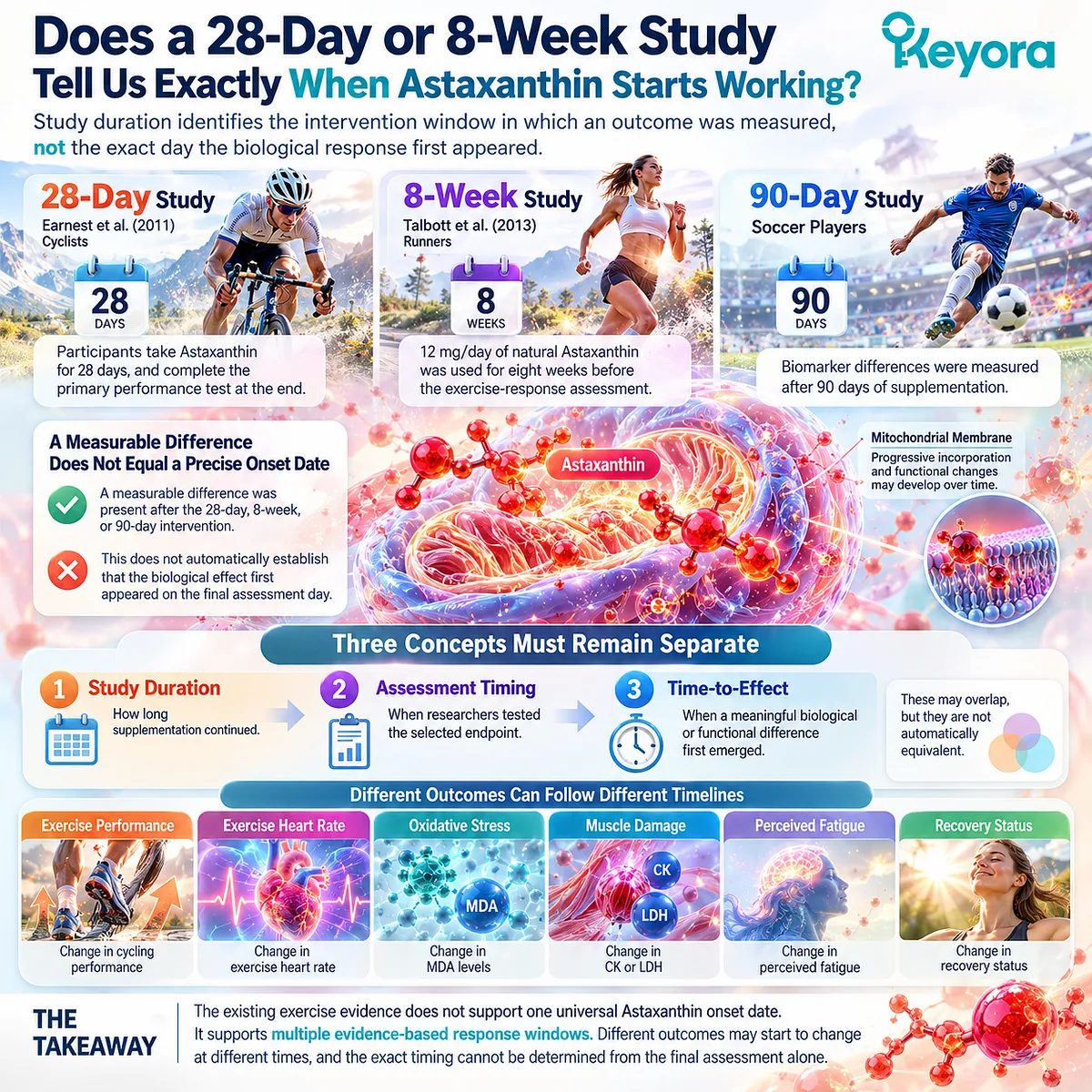
Study duration and time-to-effect are not identical concepts.
Consider a 28-day trial.
Participants take Astaxanthin throughout the intervention and complete the primary performance test at the end.
If the Astaxanthin group performs differently from placebo on day 28, the study supports the conclusion:
A measurable difference was present after the 28-day intervention.
It does not automatically establish:
The biological effect first appeared on day 28.
The response may have developed progressively before the final assessment.
If the endpoint was not repeatedly measured throughout the four weeks, the exact onset cannot be reconstructed from the final measurement alone.
The same distinction matters for the Talbott runner study.
EP-4 describes the eight-week intervention as the time required to achieve “Cellular Saturation” in mitochondrial membranes.
The broader idea of sustained exposure is compatible with the Keyora theoretical model.
However, the eight-week study duration itself does not directly prove that every person reaches one precisely defined mitochondrial membrane saturation state at exactly eight weeks.
The source-supported human evidence is narrower:
12 mg/day of natural Astaxanthin was used for eight weeks before the reported exercise-response assessment.
The same evidence rule applies to the 90-day soccer-player study.
A biomarker difference measured after 90 days does not prove that nothing happened during weeks two, four, six, or eight.
It proves that the measured difference was present within the 90-day study design.
This is why three concepts must remain separate:
-
Study duration means how long supplementation continued.
-
Assessment timing means when researchers tested the selected endpoint.
-
Time-to-effect means when a meaningful biological or functional difference first emerged.
These may overlap, but they are not automatically equivalent.
This distinction matters to consumers because the question “How long does Astaxanthin take to work?” often assumes that there must be one correct number.
But different outcomes can follow different timelines.
-
A change in cycling performance is not the same outcome as a change in exercise heart rate.
-
A change in MDA is not the same as a change in perceived fatigue.
-
A change in CK or LDH is not the same as feeling fully recovered.
Therefore, the existing exercise evidence does not support one universal Astaxanthin onset date.
It supports multiple evidence-based response windows.
Why Is Astaxanthin Better Understood as a Cumulative Nutritional Strategy?
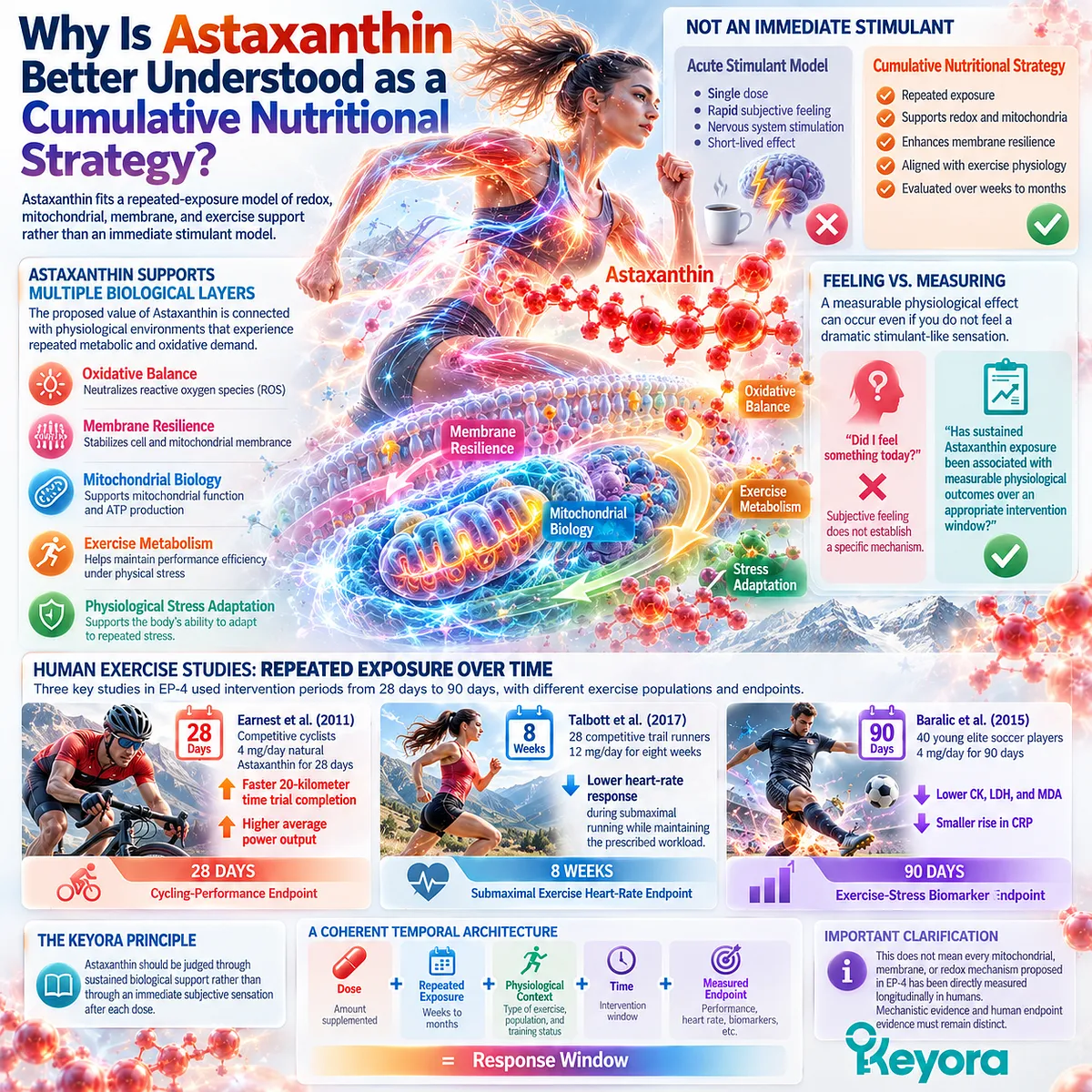
Astaxanthin fits a repeated-exposure model of redox, mitochondrial, membrane, and exercise support rather than an immediate stimulant model
The timing pattern in the human studies fits the larger biological architecture developed in Keyora Astaxanthin EP-4.
Astaxanthin is not presented primarily as a compound that acutely stimulates the nervous system to create a rapid sensation of energy.
Its proposed value is connected with physiological environments that experience repeated metabolic and oxidative demand.
Within EP-4, Astaxanthin is linked conceptually with:
-
oxidative balance
-
membrane resilience
-
mitochondrial biology
-
exercise metabolism
and:
-
physiological stress adaptation
These areas are better understood through repeated nutritional exposure than through a single-dose “take it immediately before exercise” model.
This interpretation is consistent with how the human studies were designed.
Earnest et al. did not give cyclists a single dose immediately before the time trial.
The intervention lasted 28 days.
Talbott et al. did not test runners after one 12 mg dose.
Supplementation continued for eight weeks.
Baralic et al. evaluated athletes after 90 days of continued supplementation while they remained exposed to regular training and competition.
Across three different exercise questions, the shared feature is:
repeated exposure over time
That supports an important Keyora principle:
Astaxanthin should be judged through sustained biological support rather than through an immediate subjective sensation after each dose.
This matters because “feeling” an effect and measuring a physiological effect are not the same thing.
An athlete may not perceive a dramatic stimulant-like sensation even if a measurable physiological variable changes.
Conversely, feeling more energetic on a particular day does not establish a specific Astaxanthin mechanism.
The more useful question is therefore not:
“Did I feel something today?”
It is:
“Has sustained Astaxanthin exposure been associated with measurable physiological outcomes over an appropriate intervention window?”
The human exercise literature summarized in EP-4 supports that second model.
This does not mean every mitochondrial, membrane, or redox mechanism proposed in EP-4 has been directly measured longitudinally in humans.
Mechanistic evidence and human endpoint evidence must remain distinct.
But the temporal architecture is coherent:
Astaxanthin has been investigated primarily as a repeated nutritional intervention rather than an acute stimulant.
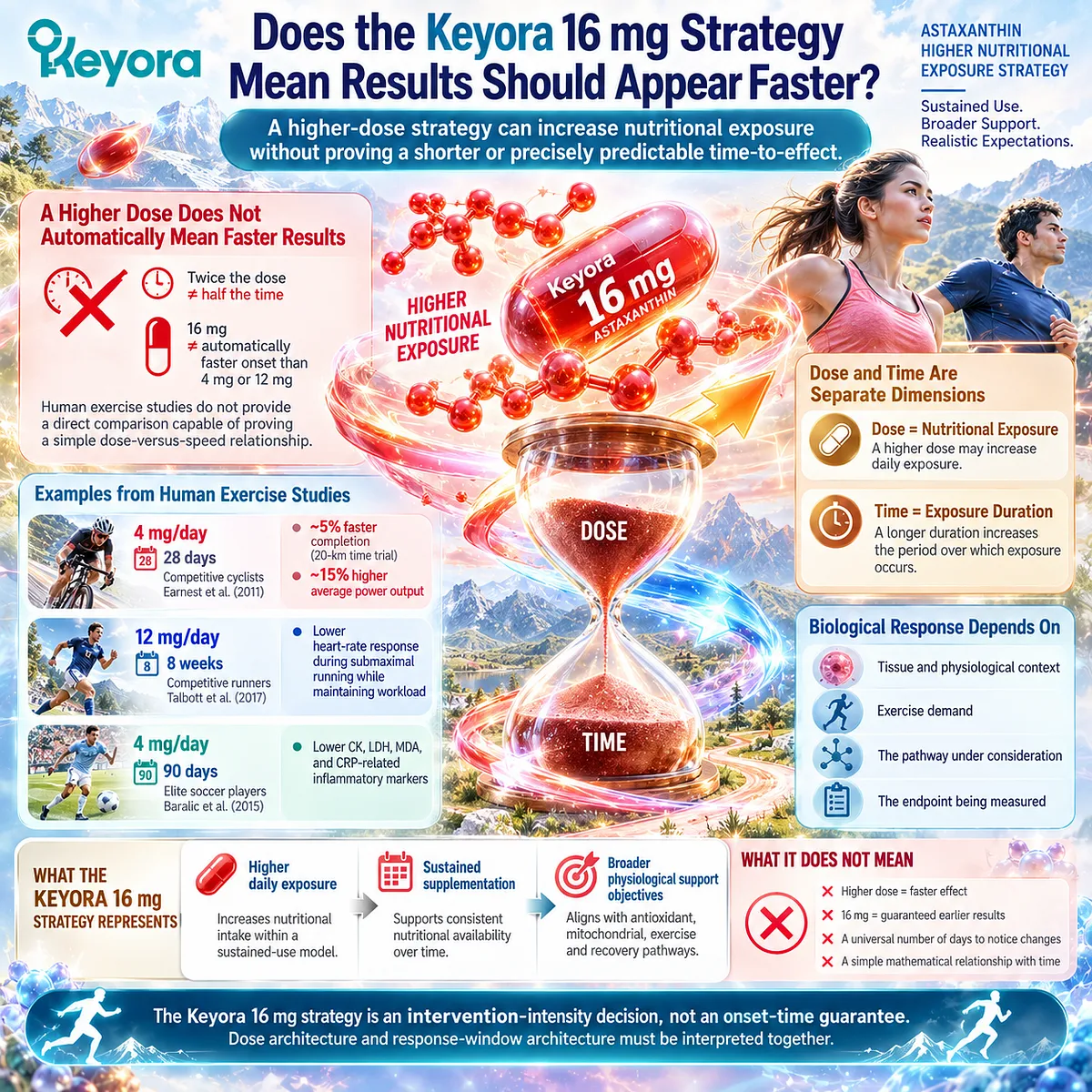
Does the Keyora 16 mg Strategy Mean Results Should Appear Faster?
A higher-dose strategy can increase nutritional exposure without proving a shorter or precisely predictable time-to-effect
The Keyora 16 mg Astaxanthin strategy should also be interpreted within this sustained-use model.
A higher daily dose does not automatically create a simple mathematical relationship with time.
For example:
twice the dose ≠ half the time
and:
16 mg ≠ automatically faster onset than 4 mg or 12 mg
The human exercise studies summarized in EP-4 do not provide a direct comparison capable of proving such a relationship.
The 4 mg cyclist study lasted 28 days.
The 12 mg runner study lasted eight weeks.
Another 4 mg study in soccer players lasted 90 days.
Because the populations, exercise protocols, study durations, and endpoints were different, these trials cannot be converted into a simple dose-versus-speed graph.
But this does not weaken the Keyora 16 mg strategy.
It clarifies what that strategy is intended to represent.
The Keyora dose architecture is better understood as a higher nutritional exposure strategy, not a promise that a biological response will appear on an earlier calendar date.
In other words:
16 mg is an intervention-intensity decision, not an onset-time guarantee.
That distinction is important.
Dose and time are separate dimensions of nutritional design.
A higher dose may increase daily exposure.
A longer duration increases the period over which exposure occurs.
The resulting biological response still depends on:
-
tissue and physiological context
-
exercise demand
-
the pathway under consideration
-
the endpoint being measured
This allows the Keyora 16 mg strategy to remain scientifically meaningful without making an unsupported claim that consumers must notice a performance change within a defined number of days.
The more appropriate model is:
higher daily exposure
sustained supplementation
broader physiological support objectives
rather than:
higher dose = faster effect
This distinction also strengthens the overall Keyora evidence architecture.
Q025 and Q026 establish why dose should be understood as a biological strategy rather than a simple milligram ranking.
Q027 adds the temporal dimension:
dose architecture and response-window architecture must be interpreted together.
The Keyora Response-Window Framework: Think in Exposure Windows, Not a Single Day
The most accurate timing model connects dose, repeated exposure, physiological context, study duration, and the endpoint actually measured
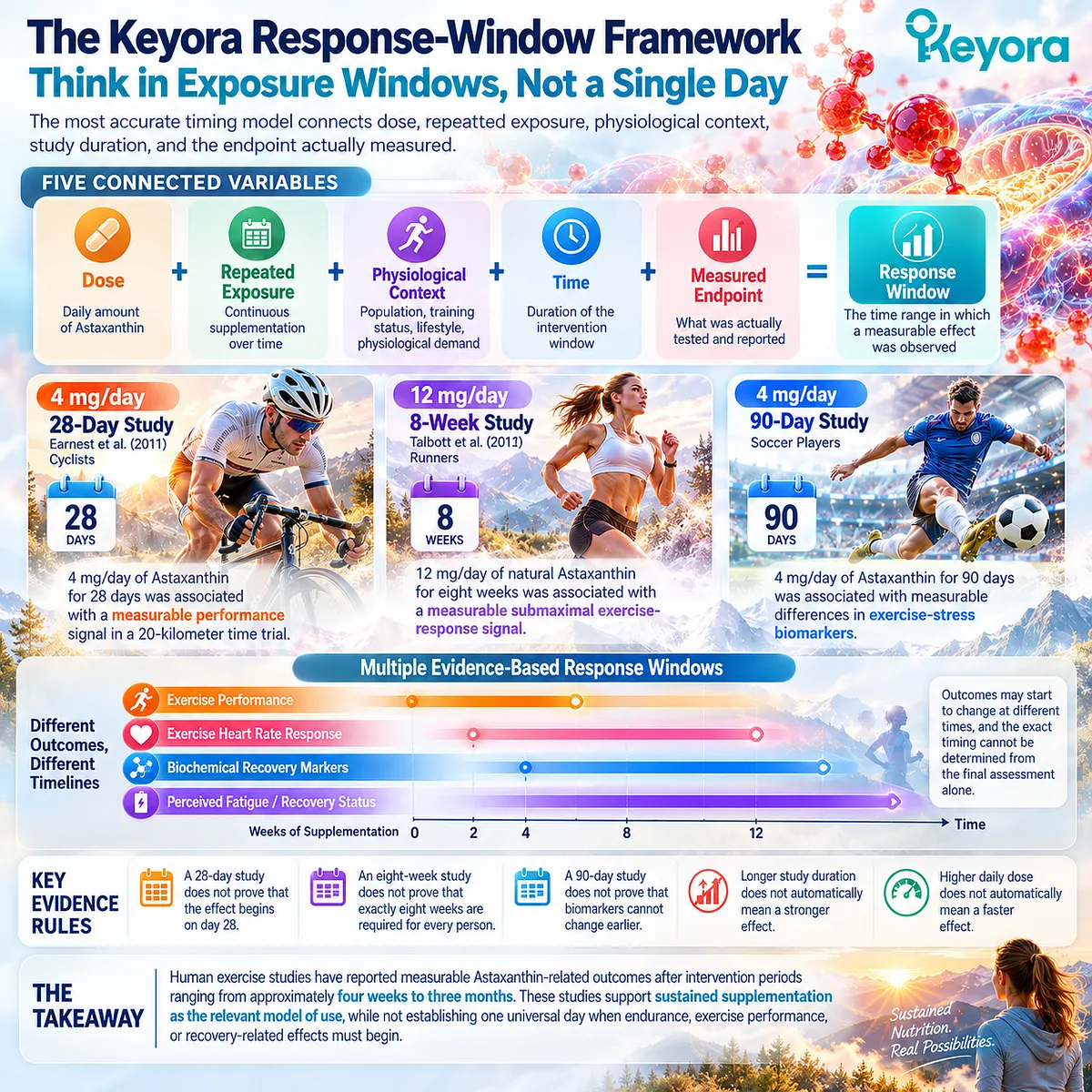
The Keyora Response-Window Framework organizes Astaxanthin timing through five connected variables:
Dose
Repeated Exposure
Physiological Context
Time
Measured Endpoint
=
Response Window
Using the human exercise evidence summarized in EP-4:
-
4 mg/day for 28 days in competitive cyclists was associated with a measurable performance signal in a 20-kilometer time trial.
-
12 mg/day for eight weeks in competitive trail runners was associated with a measurable submaximal exercise-response signal. Keyora
-
4 mg/day for 90 days in elite soccer players was associated with measurable differences in exercise-stress biomarkers.
From these studies, several evidence rules follow.
-
A 28-day study does not prove that the effect begins on day 28.
-
An eight-week study does not prove that exactly eight weeks are required for every person.
-
A 90-day study does not prove that exercise-stress biomarkers cannot change earlier.
Longer study duration does not automatically mean a stronger effect.
Higher daily dose does not automatically mean a faster effect.
Performance, exercise heart-rate response, and biochemical recovery markers should not be assumed to follow the same timeline.
At the same time, the studies collectively support an important positive conclusion:
Repeated Astaxanthin supplementation over periods measured in weeks is consistent with the human exercise evidence base.
That is the temporal foundation of the Keyora model.
For Keyora, the dose architecture defines the intended intervention intensity.
The response-window architecture defines how that intervention should be interpreted across time.
Together, these principles support a sustained nutritional strategy rather than a one-dose performance model.
The strongest evidence-based answer is therefore:
Human exercise studies have reported measurable Astaxanthin-related outcomes after intervention periods ranging from approximately four weeks to three months.
These studies support sustained supplementation as the relevant model of use, while not establishing one universal day when endurance, exercise performance, or recovery-related effects must begin.
This article is for educational and informational purposes only. It does not provide medical advice, diagnosis, treatment, cure, prevention, disease outcome claims, hormone restoration claims, fertility outcome claims, or formula-specific clinical efficacy claims.