
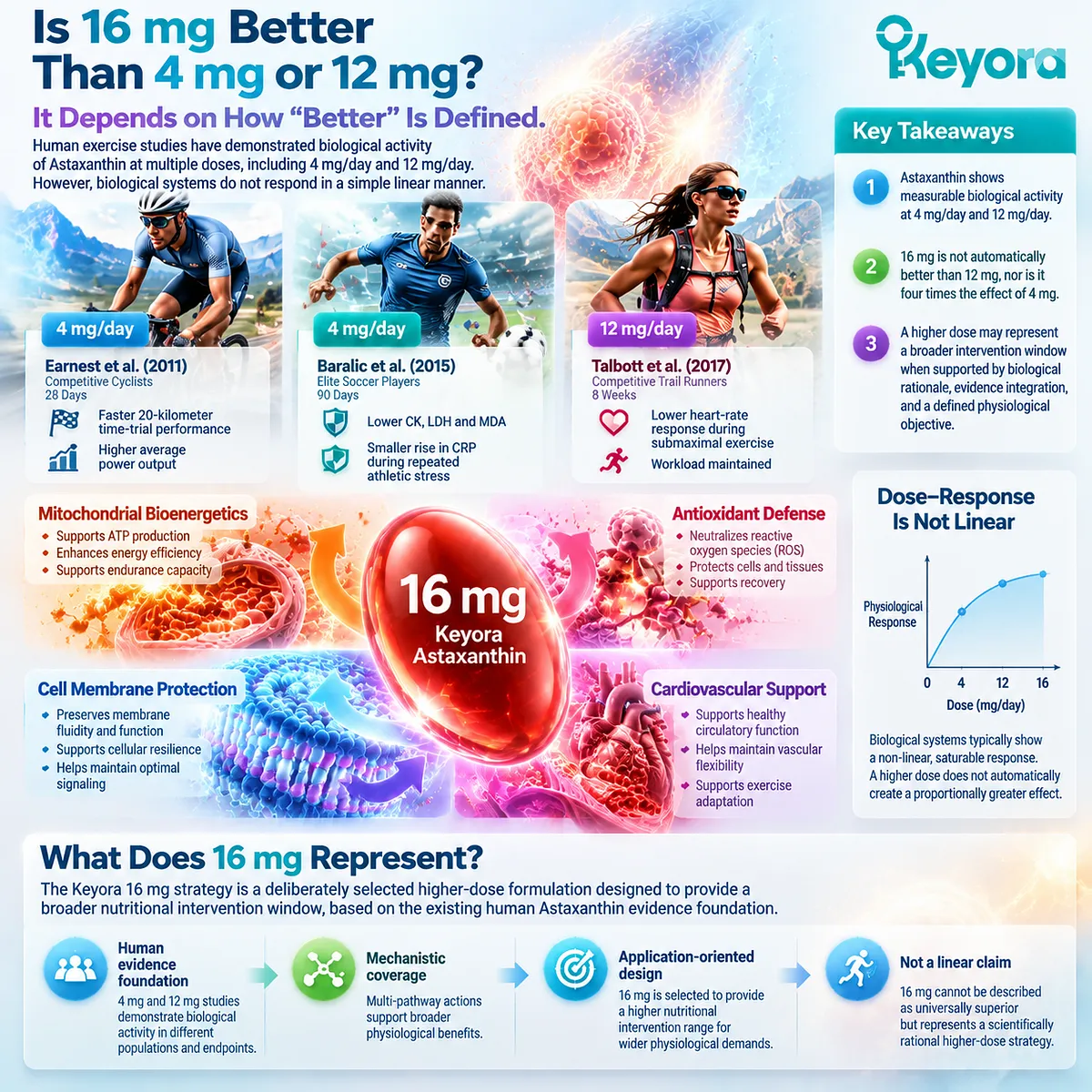
Is 16 mg of Astaxanthin Better Than 4 mg or 12 mg?
Keyora Research Q&A Library
This is part of the Keyora Research Q&A Series, derived from Keyora Astaxanthin Research Journal Series.
Within the Keyora Astaxanthin Researcn framework, this Q&A translates complex astaxanthin biology into reader-friendly, evidence-bound answers, focusing on natural astaxanthin identity, molecular structure, antioxidant and redox mechanisms, membrane lipid interaction, mitochondrial resilience, inflammatory signaling pathways, human evidence interpretation, and the scientific principles behind responsible supplementation.
First published by Keyora Research Journal: www.keyorahealth.com
Direct Answer
The answer depends on how “better” is defined.
Human exercise studies have demonstrated biological activity of Astaxanthin at multiple doses, including 4 mg/day and 12 mg/day. These studies provide important evidence that Astaxanthin can influence measurable physiological responses in different exercise settings.
In Earnest et al. (2011), competitive cyclists received 4 mg/day natural Astaxanthin for 28 days. The Keyora Astaxanthin EP-4: The Cardiac Architecture: Bio-Energetic Sovereignty summary reports improved 20-kilometer time-trial performance and higher average power output in the Astaxanthin group.
In Baralic et al. (2015), young elite soccer players received 4 mg/day for 90 days. The EP-4 summary reports lower CK, LDH, and MDA together with a smaller rise in CRP during repeated athletic stress.
In Talbott et al. (2017), competitive trail runners received 12 mg/day for eight weeks. The EP-4 summary reports a lower heart-rate response during submaximal exercise while workload was maintained.
These studies demonstrate that Astaxanthin has measurable biological activity across different dose ranges.
However, the scientific interpretation should not follow a simple assumption:
16 mg = automatically better than 12 mg
or:
16 mg = four times the effect of 4 mg
Biological systems do not respond in a perfectly linear mathematical manner.
The Keyora 16 mg strategy is therefore not based on the idea that more milligrams automatically create proportionally greater results.
It is based on a different principle:
A higher dose may represent a broader nutritional intervention window when supported by biological rationale, evidence integration, and a defined physiological objective.
Therefore, the most accurate conclusion is:
16 mg cannot be described as universally superior to 4 mg or 12 mg based on direct dose-comparison trials, but it represents a scientifically rational higher-dose strategy built upon the existing human Astaxanthin evidence foundation.
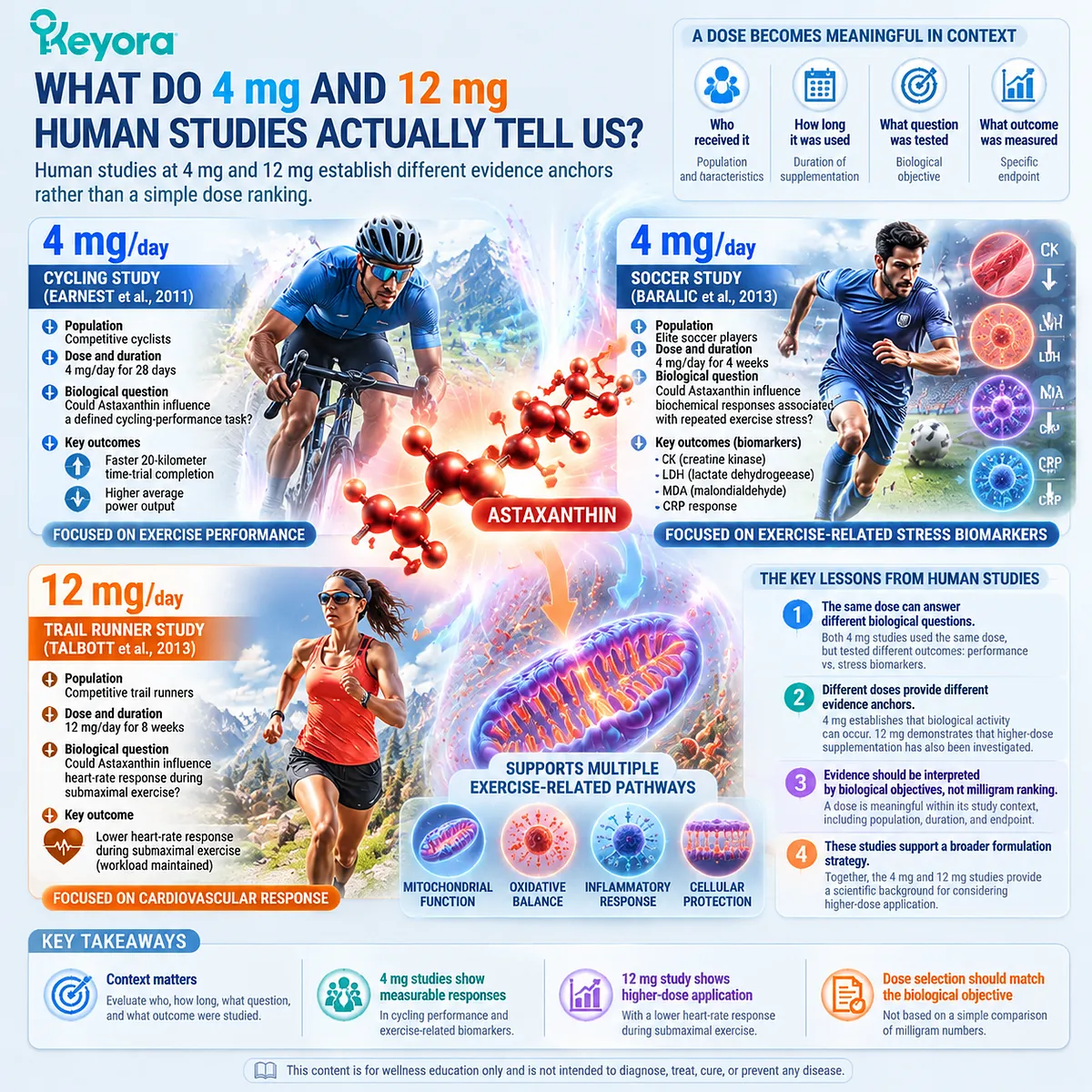
What Do 4 mg and 12 mg Human Studies Actually Tell Us?
Human studies at 4 mg and 12 mg establish different evidence anchors rather than a simple dose ranking
The first mistake in dose interpretation is comparing milligrams without considering the study context.
A dose only becomes scientifically meaningful when it is connected with:
-
who received it
-
how long it was used
-
what biological question was tested
-
what outcome was measured
The 4 mg/day dose provides an important human evidence foundation.
In the cycling study by Earnest et al., 4 mg/day was evaluated in competitive cyclists using a direct performance endpoint.
The study asked:
Could Astaxanthin influence a defined cycling-performance task?
The reported answer in the EP-4 summary was positive, with faster 20-kilometer time-trial completion and higher average power output.
The same 4 mg/day dose was also studied in elite soccer players.
However, the scientific question was different.
The Baralic study focused on biochemical responses associated with repeated athletic stress.
The reported outcomes included:
-
CK
-
LDH
-
MDA
-
CRP response
This demonstrates an important principle:
The same dose can answer different biological questions depending on the study design.
The 12 mg/day dose provides another evidence reference point.
Talbott et al. studied competitive trail runners receiving 12 mg/day for eight weeks.
The EP-4 summary emphasizes a lower heart-rate response during submaximal exercise while workload was maintained.
The importance of this evidence is not that 12 mg defeated 4 mg.
The importance is that Astaxanthin has demonstrated measurable human responses across different supplementation ranges.
The evidence foundation therefore supports a broader conclusion:
Astaxanthin dose selection should be interpreted according to the intended biological objective rather than by ranking milligram values alone.
A 4 mg study proves that biological activity can occur at that exposure level.
A 12 mg study demonstrates that higher-dose human supplementation has also been investigated.
Together, they create the scientific background for considering a higher-dose formulation strategy.
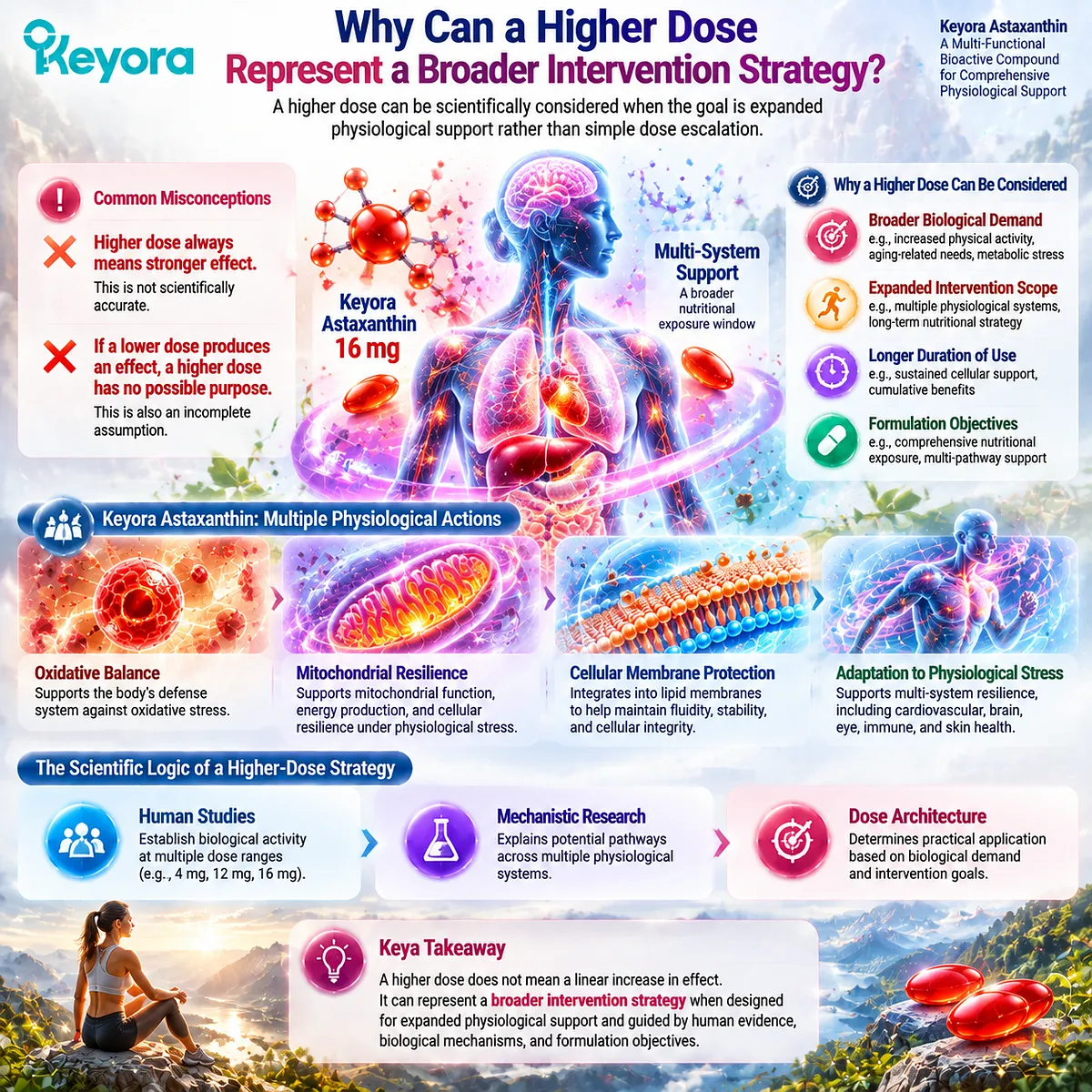
Why Can a Higher Dose Represent a Broader Intervention Strategy?
A higher dose can be scientifically considered when the goal is expanded physiological support rather than simple dose escalation
The discussion of higher-dose nutrition often becomes oversimplified.
One assumption is:
higher dose always means stronger effect
This is not scientifically accurate.
However, another assumption is equally incomplete:
if a lower dose produces an effect, a higher dose has no possible purpose
Nutritional interventions often exist within dose ranges.
Different dose levels may be selected depending on:
-
biological demand
-
intervention scope
-
duration of use
-
formulation objectives
The scientific rationale behind a higher-dose approach is not simply increasing the number of milligrams.
It is the possibility of achieving a broader exposure range for a more comprehensive nutritional strategy.
Within the Keyora Astaxanthin framework, Astaxanthin is considered not only as a single antioxidant compound, but as a bioactive molecule involved in multiple physiological areas, including:
-
oxidative balance
-
mitochondrial resilience
-
cellular membrane protection
-
adaptation to physiological stress
Therefore, a higher-dose strategy can be viewed as an attempt to support a broader biological requirement.
The logic is:
Human studies establish biological activity.
↓
Mechanistic research explains potential pathways.
↓
Dose architecture determines practical application.
This does not mean that every higher dose will create a larger measured outcome.
It means that dose selection can be guided by the intended intervention goal.
The Keyora 16 mg strategy follows this principle.
It is not designed simply because the number is larger.
It is designed because a broader physiological support objective may require a broader nutritional exposure window.
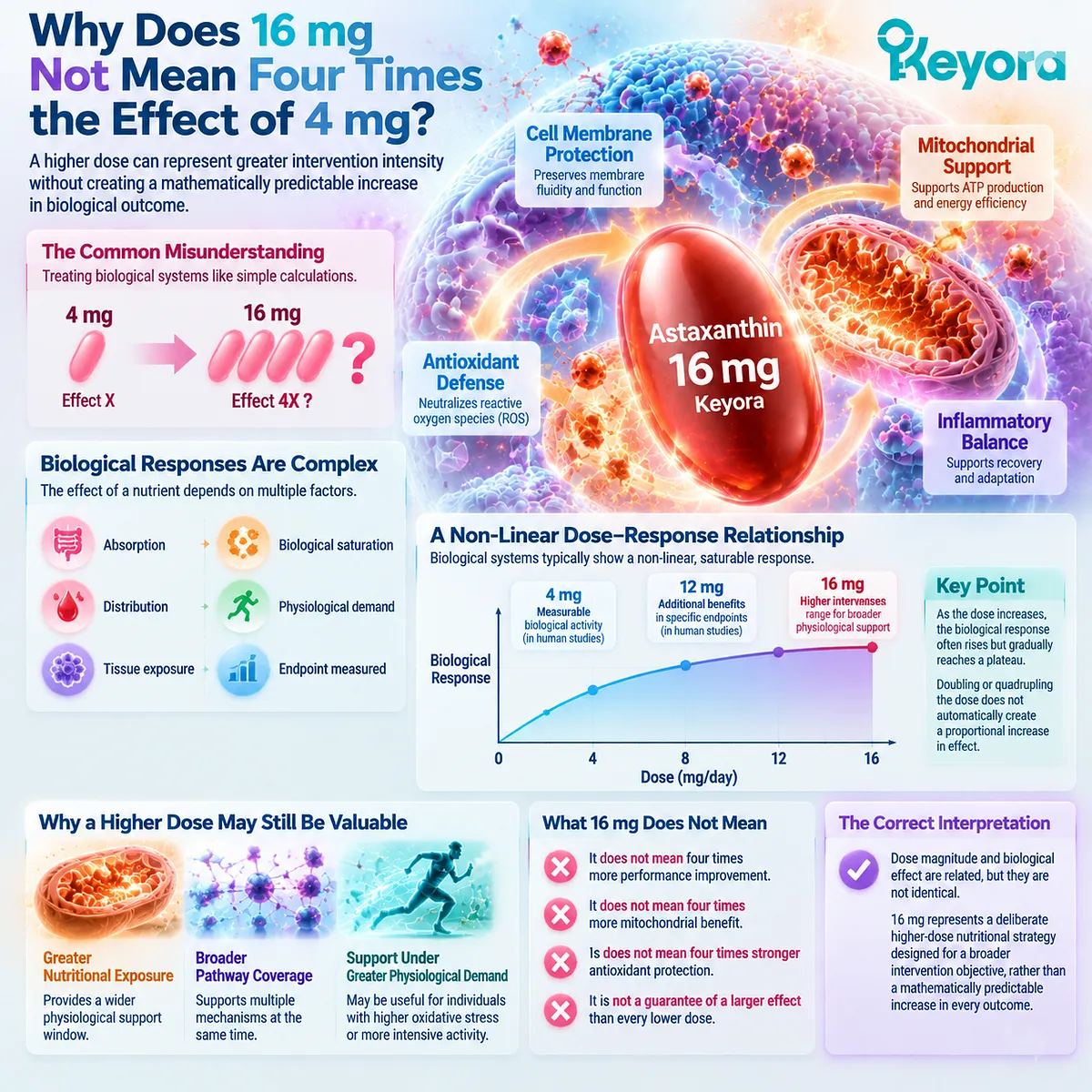
Why Does 16 mg Not Mean Four Times the Effect of 4 mg?
A higher dose can represent greater intervention intensity without creating a mathematically predictable increase in biological outcome
A common misunderstanding is to treat biological systems like simple calculations:
4 mg → effect X
therefore:
16 mg → effect 4X
This interpretation is not scientifically appropriate.
Biological responses depend on many factors, including:
-
absorption
-
distribution
-
tissue exposure
-
biological saturation
-
physiological demand
-
endpoint measured
Therefore:
16 mg does not mean four times more performance improvement.
It does not mean:
four times more mitochondrial benefit.
It does not mean:
four times stronger antioxidant protection.
The relationship between dose and biological response is more complex.
However, avoiding a linear assumption does not mean rejecting higher-dose strategies.
A higher dose may still provide:
-
greater nutritional exposure
-
broader pathway coverage
-
support under greater physiological demand
The correct interpretation is:
Dose magnitude and biological effect are related, but they are not identical.
This distinction allows a scientifically balanced understanding of 16 mg.
The claim is not:
16 mg guarantees a larger effect than every lower dose.
The claim is:
16 mg represents a deliberate higher-dose nutritional strategy designed for a broader intervention objective.
This difference is essential.
A dose strategy should not be evaluated only by asking:
“How many milligrams?”
It should be evaluated by asking:
“What biological purpose is this dose designed to support?”
How Should 16 mg Be Evaluated Scientifically?
A higher-dose formulation should be evaluated through evidence alignment, biological rationale, and intended application scope
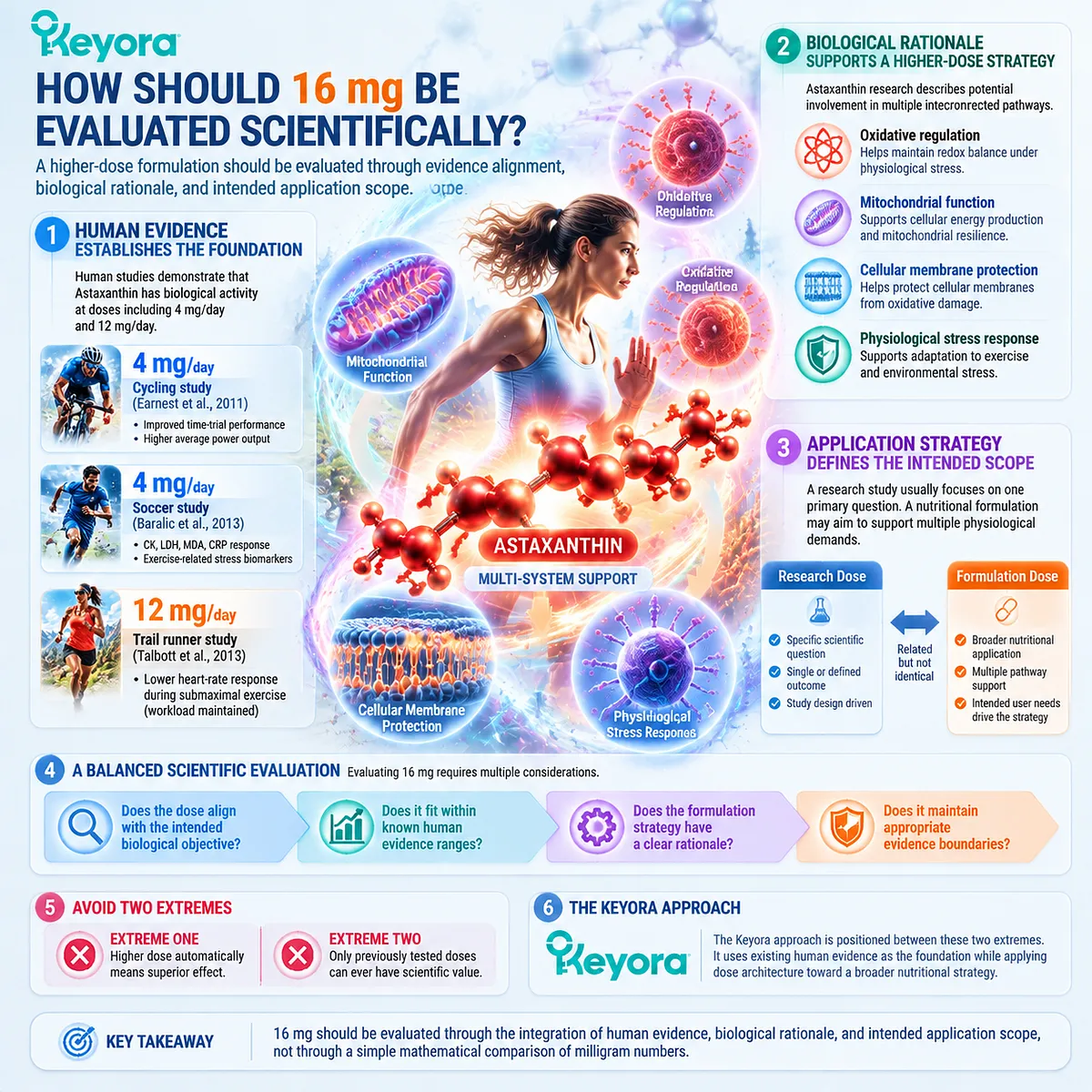
The scientific evaluation of 16 mg requires multiple dimensions.
The first dimension is human evidence.
Human studies demonstrate that Astaxanthin has biological activity at doses including 4 mg/day and 12 mg/day.
The second dimension is biological rationale.
Astaxanthin research describes potential involvement in:
-
oxidative regulation
-
mitochondrial function
-
cellular membrane protection
-
physiological stress response
The third dimension is application strategy.
A research study usually focuses on one primary question.
A nutritional formulation may aim to support multiple interconnected physiological demands.
This creates a difference between:
research dose
and:
formulation dose
A research dose is selected to answer a specific scientific question.
A formulation dose is selected based on the intended nutritional application.
The two concepts are related, but they are not identical.
Therefore, evaluating 16 mg requires asking:
Does the dose align with the intended biological objective?
Does it fit within known human evidence ranges?
Does the formulation strategy have a clear rationale?
Does it maintain appropriate evidence boundaries?
This approach avoids two extremes:
Extreme one:
higher dose automatically means superior effect
Extreme two:
only previously tested doses can ever have scientific value
The Keyora approach is positioned between these two extremes.
It uses existing human evidence as the foundation while applying dose architecture toward a broader nutritional strategy.
The Keyora Higher-Dose Interpretation Rule: Dose Is a Biological Strategy, Not a Number
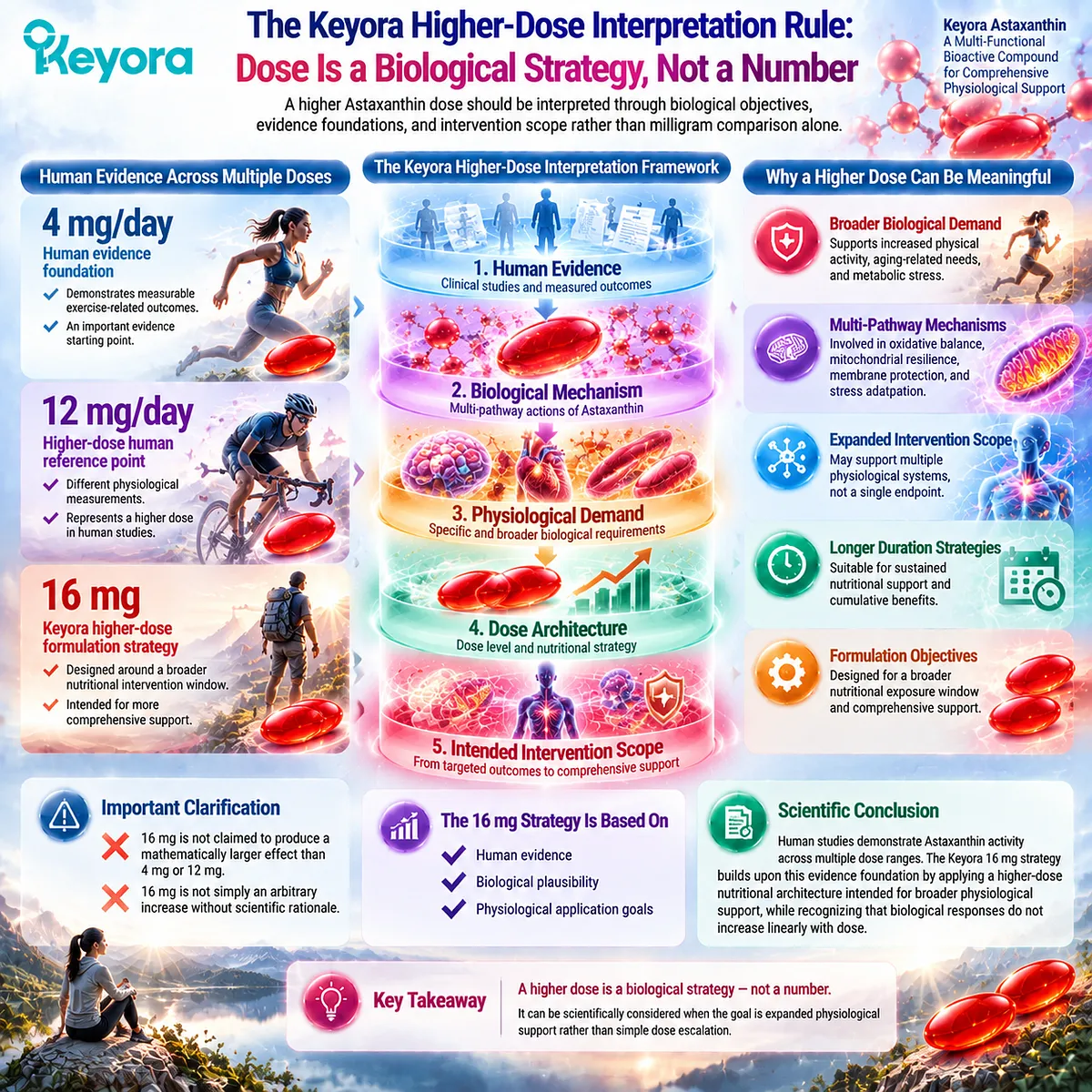
A higher Astaxanthin dose should be interpreted through biological objectives, evidence foundations, and intervention scope rather than milligram comparison alone
The Keyora Higher-Dose Interpretation Rule defines how a higher-dose nutritional strategy should be understood:
Human evidence
↓
Biological mechanism
↓
Physiological demand
↓
Dose architecture
↓
Intended intervention scope
Using this framework:
4 mg/day
represents an important human evidence foundation.
It demonstrates that Astaxanthin can influence measurable exercise-related outcomes.
12 mg/day
represents a higher-dose human reference point with different physiological measurements.
16 mg
represents the Keyora higher-dose formulation strategy designed around a broader nutritional intervention window.
The evidence boundary remains clear:
16 mg is not claimed to produce a mathematically larger effect than 4 mg or 12 mg.
At the same time:
16 mg is not simply an arbitrary increase without scientific rationale.
It represents a dose strategy based on the integration of:
-
human evidence
-
biological plausibility
-
physiological application goals
The most accurate conclusion is therefore:
Human studies demonstrate Astaxanthin activity across multiple dose ranges.
The Keyora 16 mg strategy builds upon this evidence foundation by applying a higher-dose nutritional architecture intended for broader physiological support, while recognizing that biological responses do not increase linearly with dose.
The next question addresses the final consumer comparison:
Can Higher-Dose Astaxanthin Be Safely Used Long Term?
This article is for educational and informational purposes only. It does not provide medical advice, diagnosis, treatment, cure, prevention, disease outcome claims, hormone restoration claims, fertility outcome claims, or formula-specific clinical efficacy claims.