
How Does the 16 mg Astaxanthin Dose Fit Within Human Exercise Evidence?
Keyora Research Q&A Library
This is part of the Keyora Research Q&A Series, derived from Keyora Astaxanthin Research Journal Series.
Within the Keyora Astaxanthin Researcn framework, this Q&A translates complex astaxanthin biology into reader-friendly, evidence-bound answers, focusing on natural astaxanthin identity, molecular structure, antioxidant and redox mechanisms, membrane lipid interaction, mitochondrial resilience, inflammatory signaling pathways, human evidence interpretation, and the scientific principles behind responsible supplementation.
First published by Keyora Research Journal: www.keyorahealth.com
Direct Answer
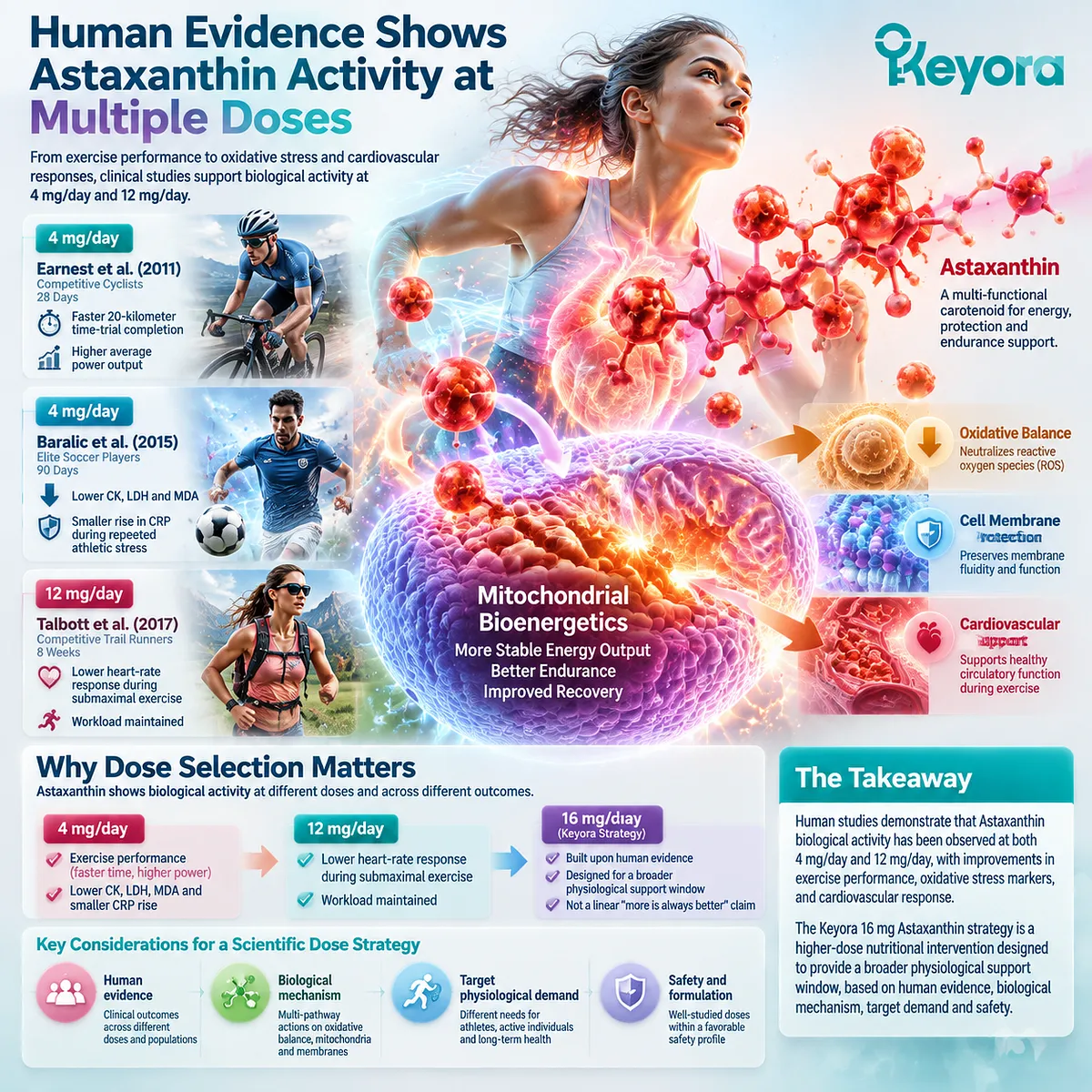
Human exercise studies have demonstrated biological activity of Astaxanthin at multiple doses, including 4 mg/day and 12 mg/day.
These studies provide an important scientific foundation for understanding why dose selection matters.
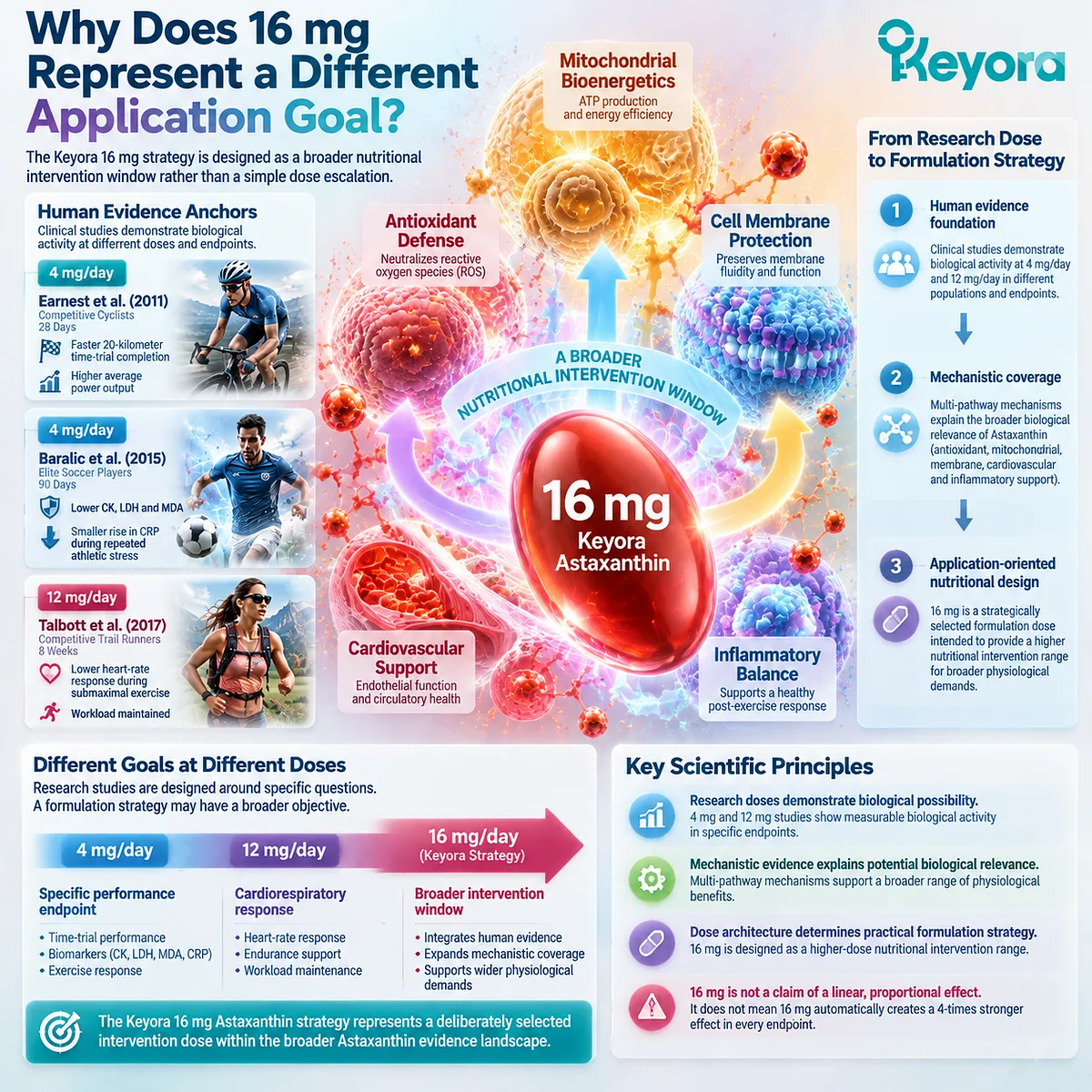
In Earnest et al. (2011), competitive cyclists received 4 mg/day natural Astaxanthin for 28 days.
The study evaluated a direct exercise-performance endpoint, and the Keyora Astaxanthin EP-4: The Cardiac Architecture: Bio-Energetic Sovereignty summary reports faster 20-kilometer time-trial completion and higher average power output in the Astaxanthin group.
In Baralic et al. (2015), young elite soccer players received 4 mg/day for 90 days. The EP-4 summary reports lower CK, LDH, and MDA together with a smaller rise in CRP during repeated athletic stress.
In Talbott et al. (2017), competitive trail runners received 12 mg/day for eight weeks. The EP-4 summary reports a lower heart-rate response during submaximal exercise while workload was maintained.
Together, these human studies demonstrate an important principle:
Astaxanthin biological activity has been observed across different dose ranges and different physiological endpoints.
The Keyora 16 mg Astaxanthin strategy is built upon this evidence foundation.
However, the interpretation of 16 mg should not follow a simple assumption:
higher dose = proportionally higher effect
A scientifically appropriate dose strategy requires integration of:
human evidence
biological mechanism
target physiological demand
safety and formulation considerations
Therefore, 16 mg should be understood as a higher-dose nutritional intervention strategy designed to provide a broader physiological support window, rather than as a claim that every effect must increase linearly with milligrams.
What Have Human Studies Demonstrated at 4 mg and 12 mg?
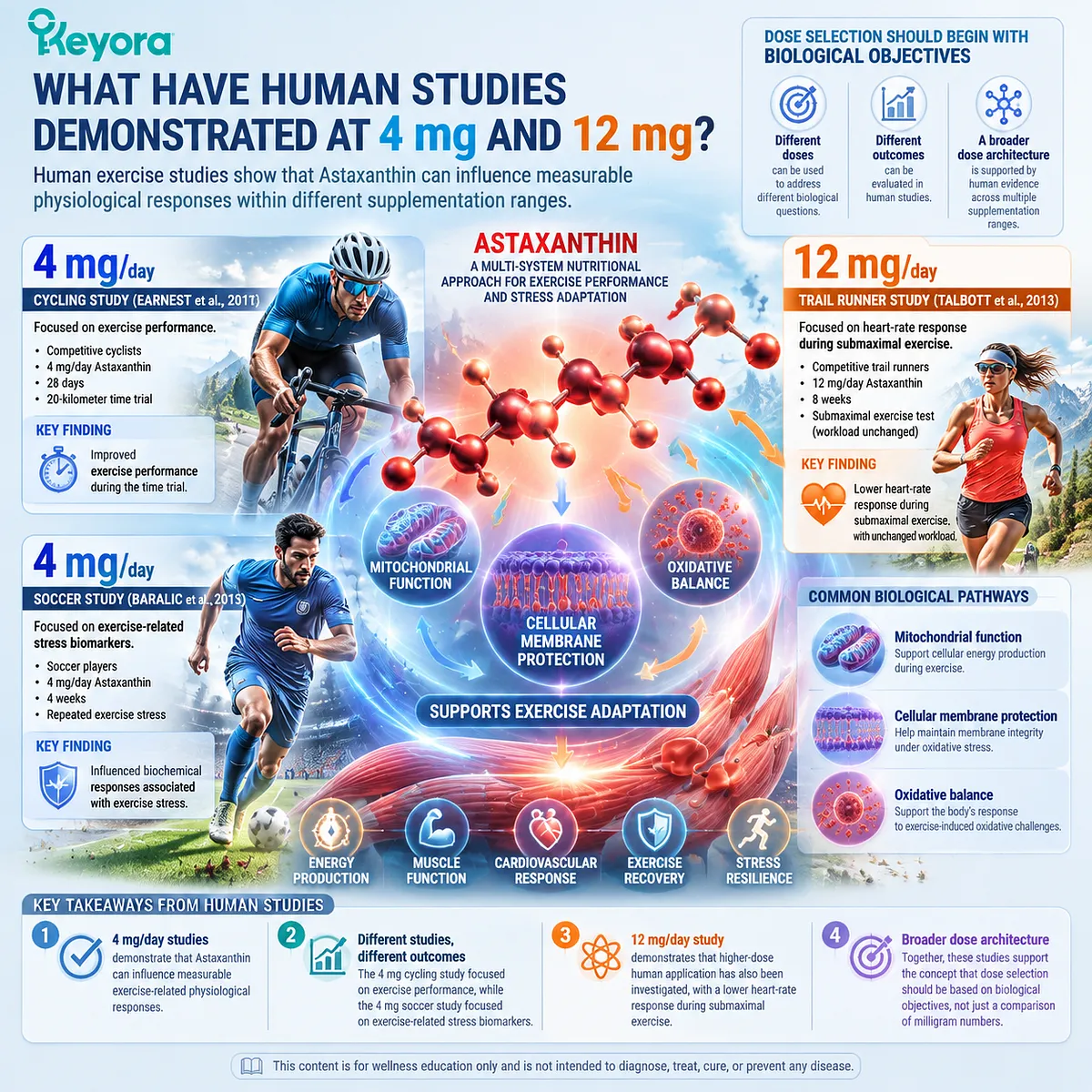
Lower-dose human studies establish that Astaxanthin can influence measurable exercise-related physiological responses
The human exercise evidence base provides several important reference points.
The 4 mg/day dose has been repeatedly studied in athlete populations.
The cycling study by Earnest et al. investigated whether Astaxanthin supplementation influenced performance during a controlled 20-kilometer time trial.
The soccer-player study by Baralic et al. investigated whether Astaxanthin influenced biochemical responses associated with repeated exercise stress.
Although both studies used 4 mg/day, they addressed different biological questions.
The cycling study focused on:
exercise performance
The soccer study focused on:
exercise-related stress biomarkers
This distinction is important because the meaning of a dose depends on what biological question the study was designed to answer.
The 12 mg/day runner study provides another reference point.
Talbott et al. evaluated competitive trail runners receiving 12 mg/day of Astaxanthin for eight weeks. The EP-4 summary highlights a lower heart-rate response during submaximal exercise while workload remained unchanged.
The significance of these studies is not that one dose defeated another.
Their importance is that they demonstrate:
Astaxanthin can produce measurable human physiological responses within different supplementation ranges.
The evidence therefore supports a broader concept:
Dose selection should begin with biological objectives, not only with comparison of milligram numbers.
A 4 mg study establishes that measurable effects can occur.
A 12 mg study demonstrates that higher-dose human application has also been investigated.
Together, they provide a scientific basis for considering dose architecture beyond a single fixed number.
Why Can a Higher Dose Be Scientifically Considered?
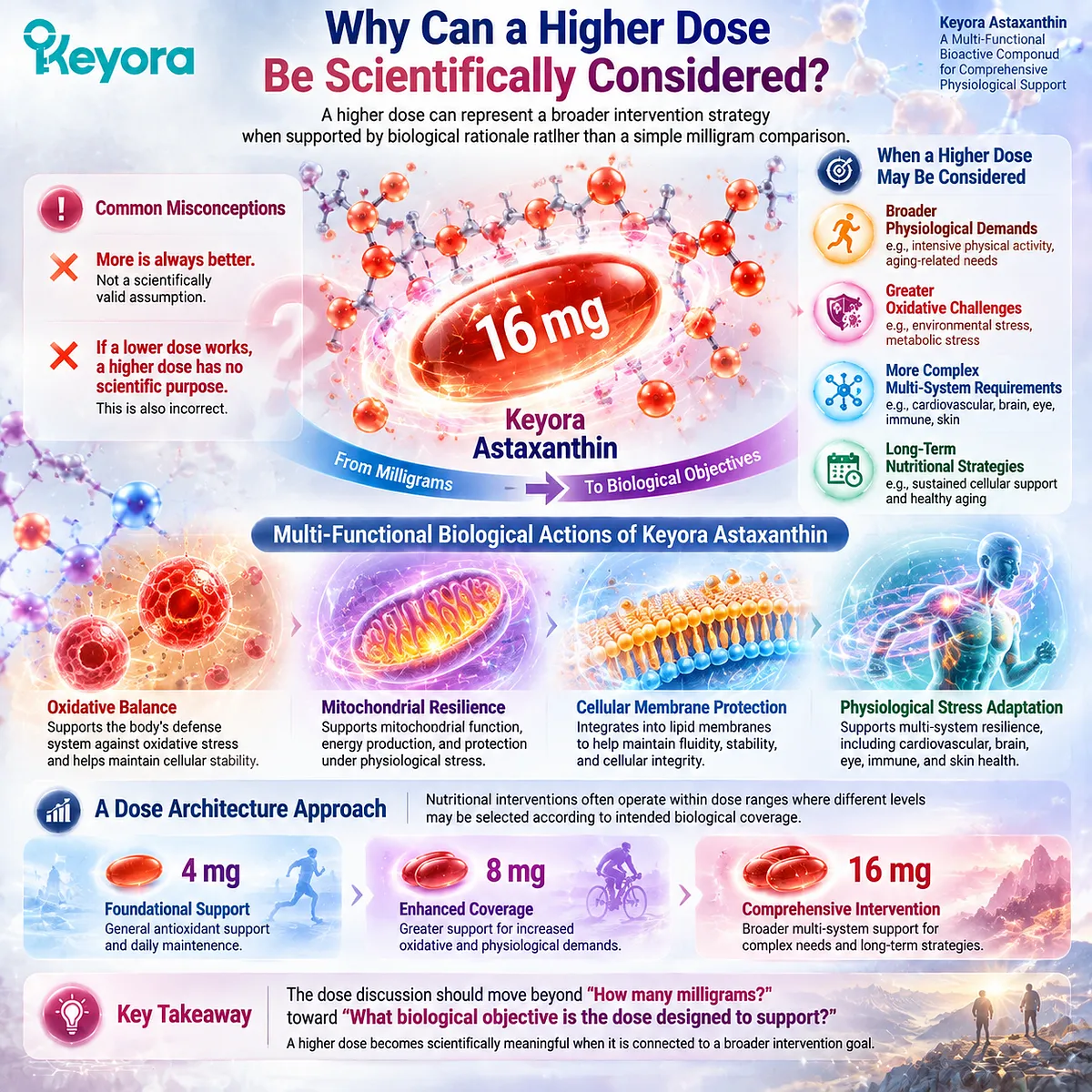
A higher dose can represent a broader intervention strategy when supported by biological rationale rather than a simple milligram comparison
The question of dose is often misunderstood.
A higher dose should not be interpreted as:
more is always better
That is not a scientifically valid assumption.
However, the opposite assumption is also incorrect:
if a lower dose works, a higher dose has no scientific purpose
Nutritional interventions often operate within dose ranges where different levels may be selected according to intended biological coverage.
A higher dose may be considered when the goal is to support:
-
broader physiological demands
-
greater oxidative challenges
-
more complex multi-system requirements
-
long-term nutritional strategies
The rationale behind the Keyora 16 mg approach is not simply increasing the number of milligrams.
It is based on the concept that a more comprehensive intervention may require a larger nutritional exposure window.
Within the Keyora Astaxanthin framework, Astaxanthin is positioned not as a single-pathway antioxidant molecule, but as a multi-functional bioactive compound involved in:
-
oxidative balance
-
mitochondrial resilience
-
cellular membrane protection
-
physiological stress adaptation
Therefore, the dose discussion should move beyond:
How many milligrams?
toward:
What biological objective is the dose designed to support?
This is the foundation of a dose architecture approach.
A higher dose becomes scientifically meaningful when it is connected to a broader intervention goal.
Why Does 16 mg Represent a Different Application Goal?
The Keyora 16 mg strategy is designed as a broader nutritional intervention window rather than a simple dose escalation
Human studies provide evidence anchors.
Commercial formulation strategies must then determine how to translate those anchors into practical applications.
The 4 mg and 12 mg studies provide valuable human reference points.
However, research protocols are usually designed around specific questions.
A cycling trial asks whether a defined supplementation protocol affects cycling performance.
A runner study asks whether a defined supplementation protocol affects a cardiorespiratory exercise response.
A formulation strategy may have a broader objective.
The Keyora 16 mg approach is based on the concept of combining:
human evidence foundation
with:
mechanistic coverage
and:
application-oriented nutritional design
This does not mean that 16 mg has already been proven in every exercise endpoint studied at 4 mg.
Rather, it means that 16 mg represents a deliberate formulation choice intended to provide a higher nutritional intervention range.
The scientific logic is:
Research doses demonstrate biological possibility.
↓
Mechanistic evidence explains potential biological relevance.
↓
Dose architecture determines practical formulation strategy.
This distinction allows Keyora to maintain scientific ambition while preserving evidence accuracy.
The claim is not:
16 mg automatically creates a 4-times stronger effect.
The claim is:
16 mg represents a strategically selected intervention dose within the broader Astaxanthin evidence landscape.
Does 16 mg Mean Four Times the Effect of 4 mg?
A higher dose does not create a linear prediction of biological outcome, but it can represent a different intervention intensity
No.
The Keyora 16 mg strategy should not be interpreted through a simple mathematical model.
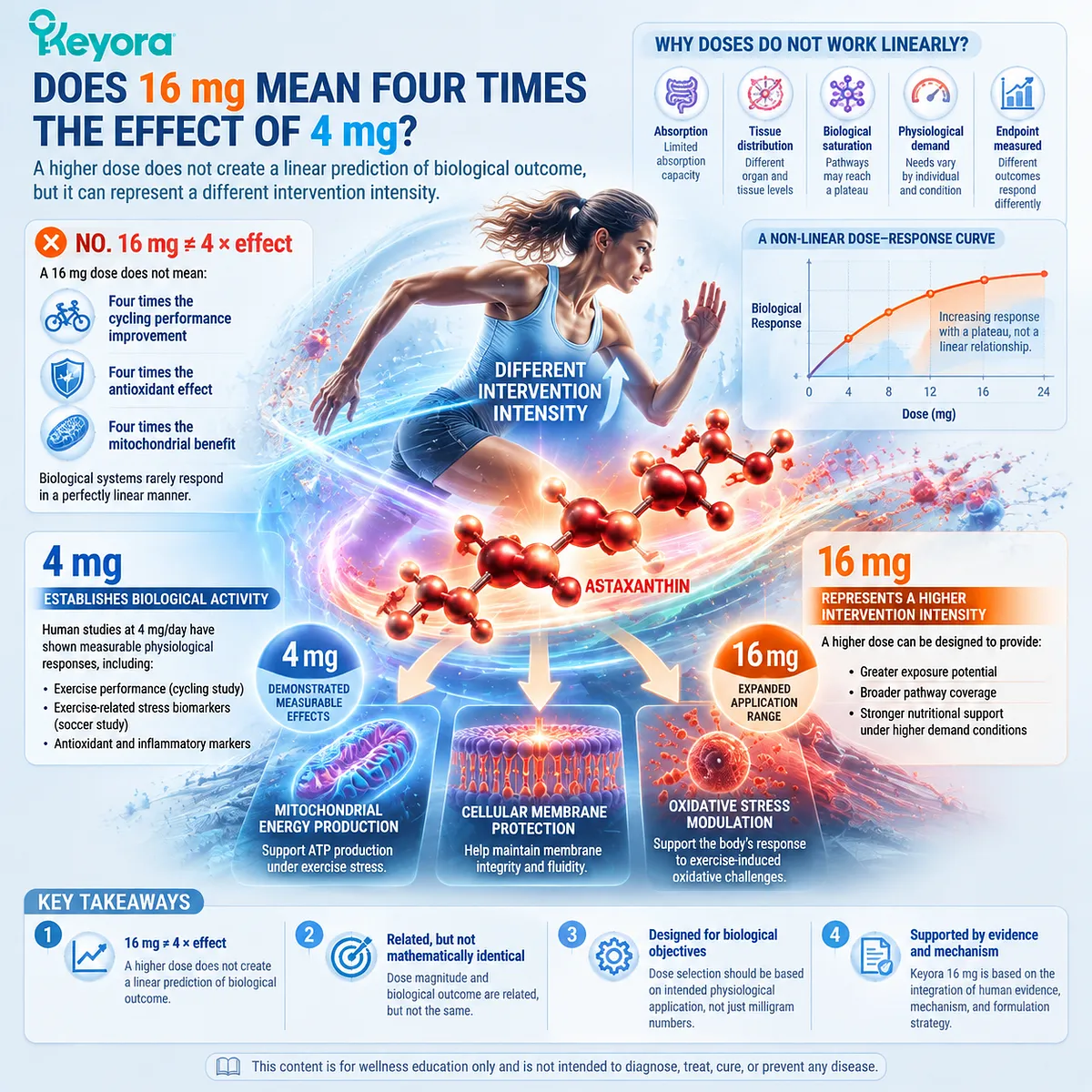
A 16 mg dose does not mean:
four times the cycling performance improvement
or:
four times the antioxidant effect
or:
four times the mitochondrial benefit
Biological systems rarely respond in a perfectly linear manner.
Dose-response relationships depend on:
-
absorption
-
tissue distribution
-
biological saturation
-
physiological demand
-
endpoint measured
Therefore:
16 mg ≠ 4 × effect
However, avoiding a linear dose assumption does not mean that higher-dose strategies lack scientific rationale.
A higher dose can still be designed to provide:
-
greater exposure potential
-
broader pathway coverage
-
stronger nutritional support under higher demand conditions
The correct interpretation is:
Dose magnitude and biological outcome are related, but not mathematically identical.
This principle is especially important for nutritional science.
The purpose of dose design is not simply to maximize milligrams.
It is to identify an appropriate intervention range for a defined biological objective.
Therefore, the scientific question is not:
“Does 16 mg guarantee a larger effect?”
The better question is:
“Does 16 mg represent a rational dose choice within the intended physiological application?”
For Keyora, the answer is based on the integration of human evidence, mechanism, and formulation strategy.
The Keyora Dose Architecture Rule: Dose Selection Is a Biological Strategy
A meaningful dose connects human evidence, biological objectives, and intervention scope
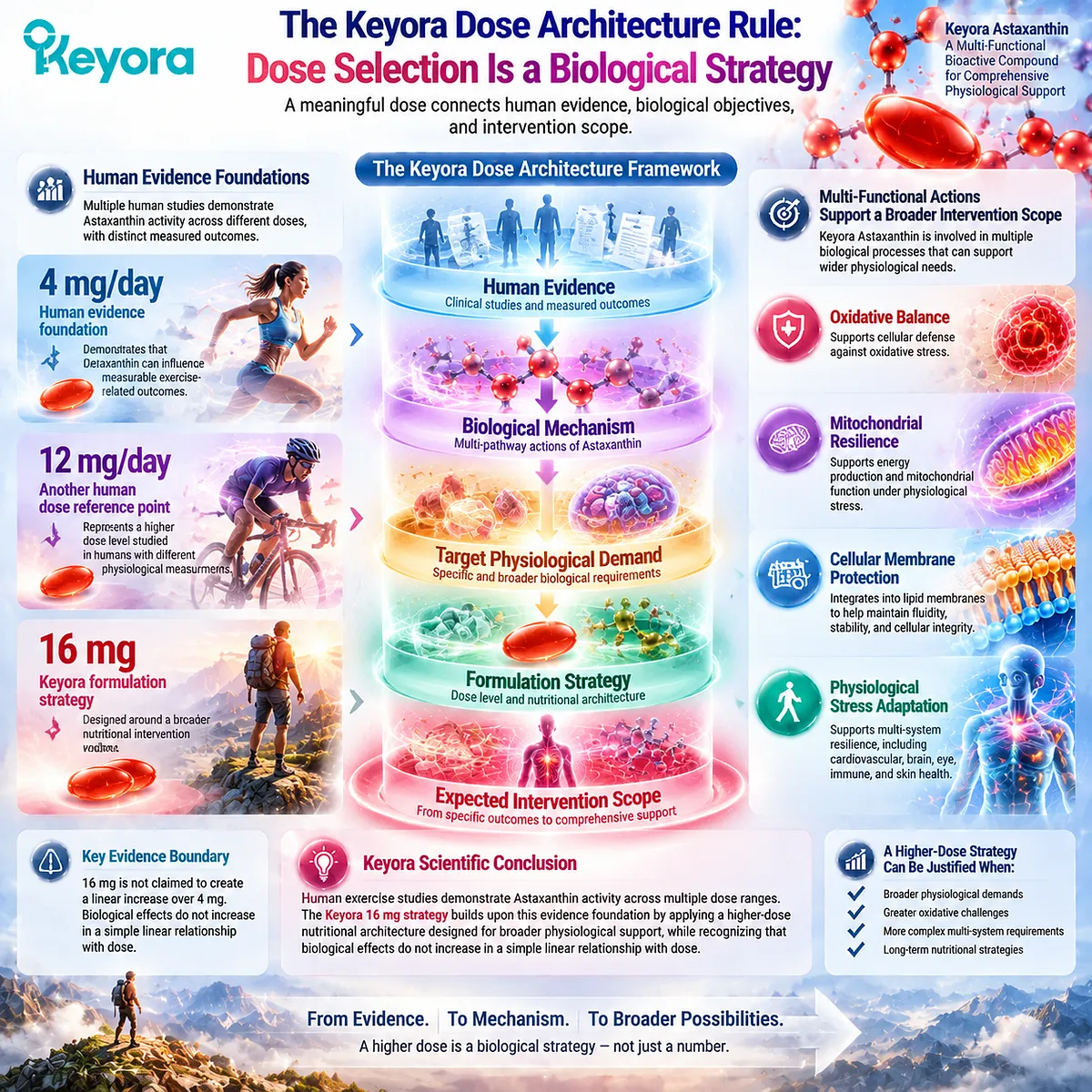
The Keyora Dose Architecture Rule defines dose selection through a broader framework:
Human evidence
↓
Biological mechanism
↓
Target physiological demand
↓
Formulation strategy
↓
Expected intervention scope
Within this framework:
4 mg/day
represents an important human evidence foundation.
It demonstrates that Astaxanthin can influence measurable exercise-related outcomes.
12 mg/day
represents another human dose reference point with different physiological measurements.
16 mg
represents a Keyora formulation strategy designed around a broader nutritional intervention window.
The evidence boundary remains clear:
16 mg is not claimed to create a linear increase over 4 mg.
But the scientific rationale is also clear:
A higher-dose strategy can be justified when it is designed to address broader biological requirements and supported by evidence integration.
The correct conclusion is therefore:
Human exercise studies demonstrate Astaxanthin activity across multiple dose ranges.
The Keyora 16 mg strategy builds upon this evidence foundation by applying a higher-dose nutritional architecture designed for broader physiological support, while recognizing that biological effects do not increase in a simple linear relationship with dose.
The next question addresses the most direct comparison:
Is 16 mg of Astaxanthin Better Than 4 mg or 12 mg?
This article is for educational and informational purposes only. It does not provide medical advice, diagnosis, treatment, cure, prevention, disease outcome claims, hormone restoration claims, fertility outcome claims, or formula-specific clinical efficacy claims.