
L-Theanine Episode 3 – The Clinical Evidence Behind L-Theanine:

By Keyora Research Notes Series
This article is part of Keyora’s long-form educational series documenting the scientific foundations behind our product development.
ORCID: 0009-0007-5798-1996
Why Clinical Evidence Matters
Mechanisms explain how a nutrient should work.
But only human trials answer the real question:
Does L-Theanine actually help real people?
Not theory — results.
Before Keyora even conceptualized a product like MoodFlow, our team spent months reviewing RCTs (Randomized Controlled Trials), EEG studies, cortisol measurements, cognitive assessments, and sleep evaluations.
We were searching for patterns – consistent outcomes across different populations, doses, and study designs.
What surprised us was not just that L-Theanine worked – but how consistently it worked, across anxiety, sleep, attention, and stress reactivity.
Today’s article is the most accessible yet scientifically accurate interpretation of those clinical findings.
We will walk through the strongest trials, the most revealing biomarkers, and how Keyora interpreted each result during the early research phase.
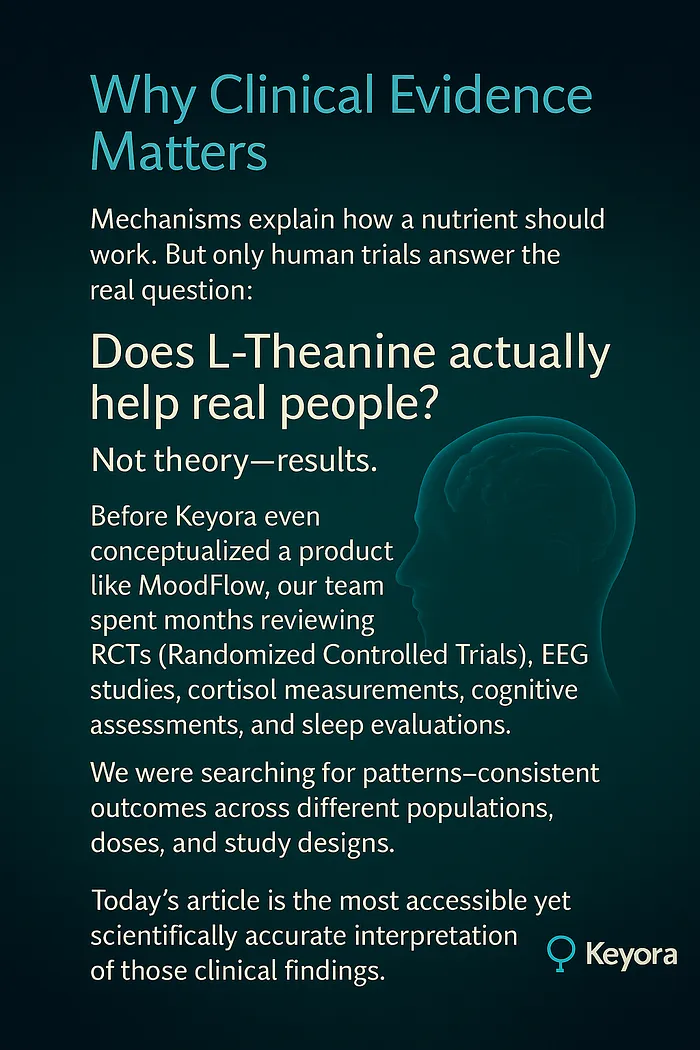
1. The Landmark RCT: 400 mg/day for 8 Weeks
This is the most widely cited and methodologically rigorous study on L-Theanine for emotional and cognitive health.
Performed on healthy adults experiencing daily stress, the trial examined:
- Anxiety
- Sleep quality
- Cognitive function
- Executive attention
- Cortisol reactivity
1.1 Anxiety Reduction
Participants taking 400 mg L-Theanine daily experienced:
- reduced anxiety scores
- fewer stress-induced symptoms
- more stable emotional responses
Importantly, improvements occurred without sedation, confirming what we observed mechanistically in Episode 2.
Keyora’s interpretation: “This trial demonstrated L-Theanine’s ability to restore emotional stability in everyday stress, not only clinical anxiety disorders. It validated Theanine as a foundational emotional-support ingredient.”
1.2 Sleep Improvement (PSQI Scores)
The Pittsburgh Sleep Quality Index showed multi-dimensional improvements:
- faster sleep initiation
- fewer nighttime awakenings
- deeper, more restorative sleep
- improved overall sleep satisfaction
These findings support our HPA- and alpha-wave-based explanation from Episode 2.
Keyora’s interpretation: “The sleep results mattered to us not because Theanine induces drowsiness — it doesn’t — but because it quiets mental overactivity, which is the real barrier to sleep in modern adults.”
1.3 Cognitive Performance (Attention & Executive Function)
Cognitive benefits were measured using:
- attentional switching tasks
- working memory assessments
- inhibitory control tests
Results showed significant improvements in:
- sustained attention
- task efficiency
- mental flexibility
This is especially striking because most calming agents worsen cognition.
L-Theanine improved both.
Keyora’s interpretation: “This dual-effect — calm + performance — is rare and extremely valuable for high-load populations. It separated L-Theanine from traditional sleep or anxiety supplements.”
1.4 Cortisol Response & Stress Biomarkers
The trial documented:
- reduced cortisol under stress
- improved heart rate variability
- less physiological reactivity
This validated L-Theanine’s HPA-axis regulation, one of the most important pathways in long-term emotional resilience.
Keyora’s interpretation: “Many nutrients calm the mind. Very few calm the entire stress system. Cortisol reactivity was one of the main reasons we placed L-Theanine at the center of our research.”
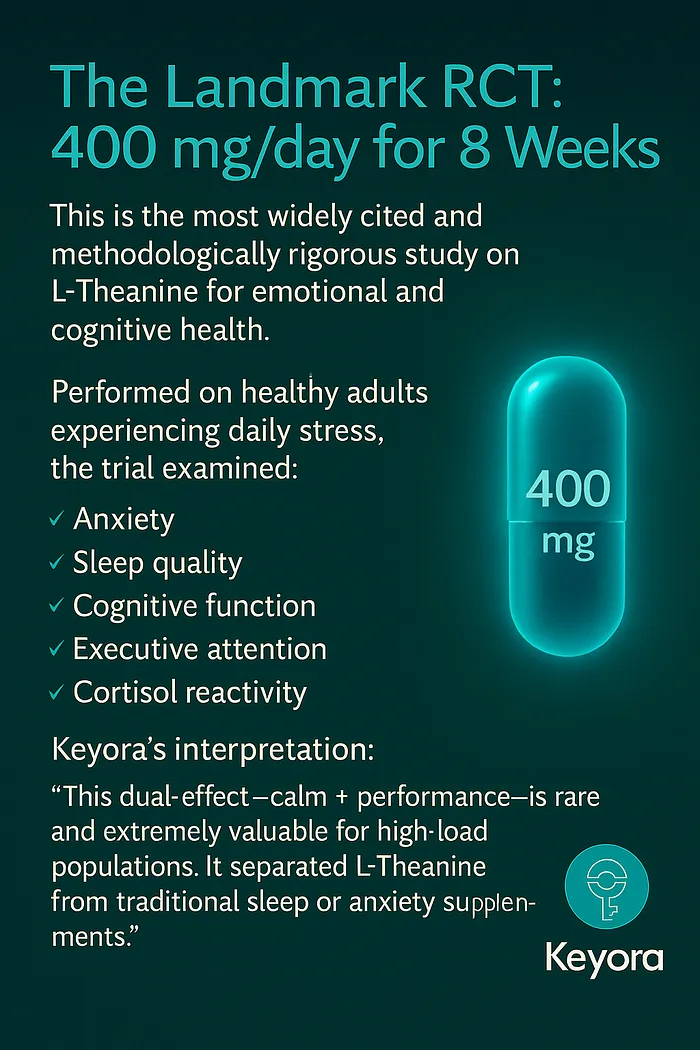
2. Acute Stress Studies — L-Theanine Works Within 30–60 Minutes
Beyond long-term trials, acute dosing studies show rapid benefits.
2.1 Reduced Stress During Cognitive Tasks
When participants took 200–300 mg L-Theanine before a stressful mental test, results showed:
- lower heart rate response
- reduced sympathetic activation
- improved accuracy under pressure
- better task switching
This is why many people use L-Theanine for:
- presentations
- exams
- job interviews
- decision-making under pressure
Keyora’s interpretation: “Acute effects indicated a different use-case: real-time calming and clarity during high-stress events. This shaped our understanding of Theanine’s versatility.”
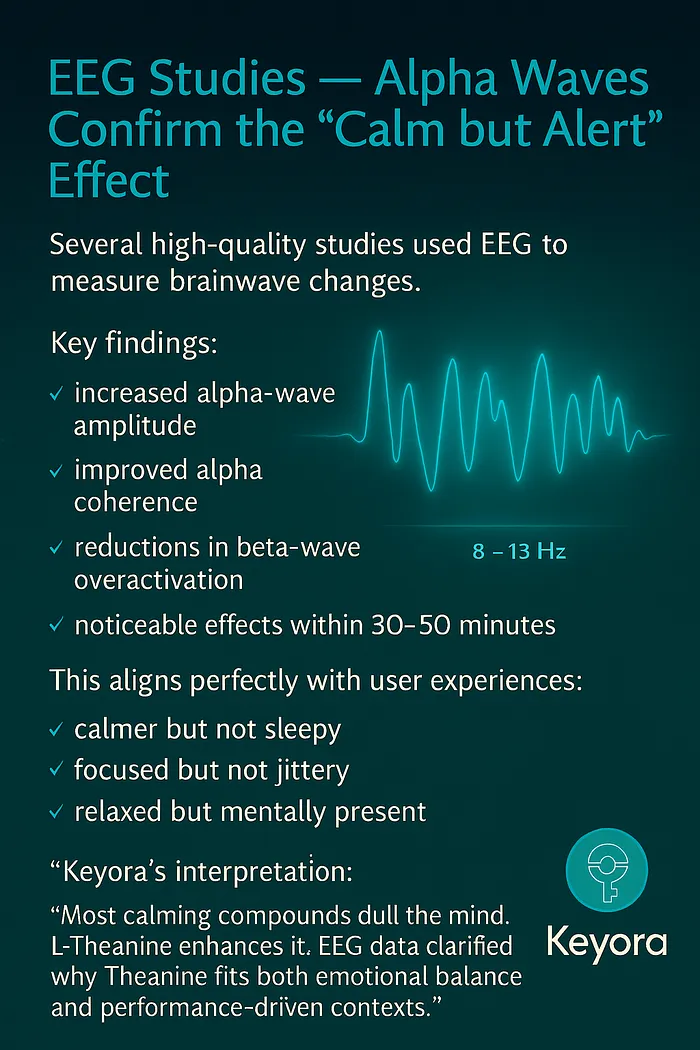
3. EEG Studies – Alpha Waves Confirm the “Calm but Alert” Effect
Several high-quality studies used EEG to measure brainwave changes.
Key findings:
- increased alpha-wave amplitude
- improved alpha coherence
- reductions in beta-wave overactivation
- noticeable effects within 30–50 minutes
This aligns perfectly with user experiences:
- calmer but not sleepy
- focused but not jittery
- relaxed but mentally present
Keyora’s interpretation: “Most calming compounds dull the mind. L-Theanine enhances it. EEG data clarified why Theanine fits both emotional balance and performance-driven contexts.”
4. L-Theanine for Sleep: Human Trials in Adults and Children
While the 400 mg RCT evaluated sleep quality broadly, several additional studies offer more detail.
4.1 Adults with Stress-Related Sleep Issues
Benefits documented:
- reduced sleep latency
- fewer nighttime awakenings
- calmer pre-sleep mental state
- improved restorative sleep
Keyora’s interpretation: “These studies highlighted the connection between stress hyperarousal and sleep fragmentation – exactly the kind of pattern we see in working adults.”
4.2 Children with ADHD and Restless Sleep
In pediatric trials (200 mg twice daily):
- higher sleep efficiency
- less nighttime movement
- deeper sleep
- improved daytime attention
This was important to Keyora for one reason: “It confirmed that L-Theanine is safe and effective even in populations with sensitive nervous systems.”
5. Cognitive Function Trials – The Underrated Side of L-Theanine
Most people know L-Theanine for anxiety or sleep, but its cognitive research is surprisingly robust.
Studies show consistent improvements in:
- sustained attention
- reaction time
- working memory
- executive function
- task accuracy
- mental endurance
Especially when combined with moderate caffeine, but even alone, L-Theanine shows measurable cognitive enhancement.
Keyora’s interpretation: “This cognitive data reframed L-Theanine for us — not just calming, but clarifying. This is vital for students, programmers, analysts, and anyone with heavy mental workloads.”
6. Stress Tests: Heart Rate Variability, Cortisol, and Autonomic Balance
Stress induction tests (e.g., arithmetic stressors, Stroop tests) found that L-Theanine:
- reduces HRV suppression
- lowers salivary cortisol
- increases parasympathetic activity
- stabilizes autonomic responses
In plain language:
L-Theanine makes your body react less violently to stress.
Keyora’s interpretation: “This was one of the strongest arguments for Theanine in everyday emotional resilience, especially for people who experience physical stress symptoms.”
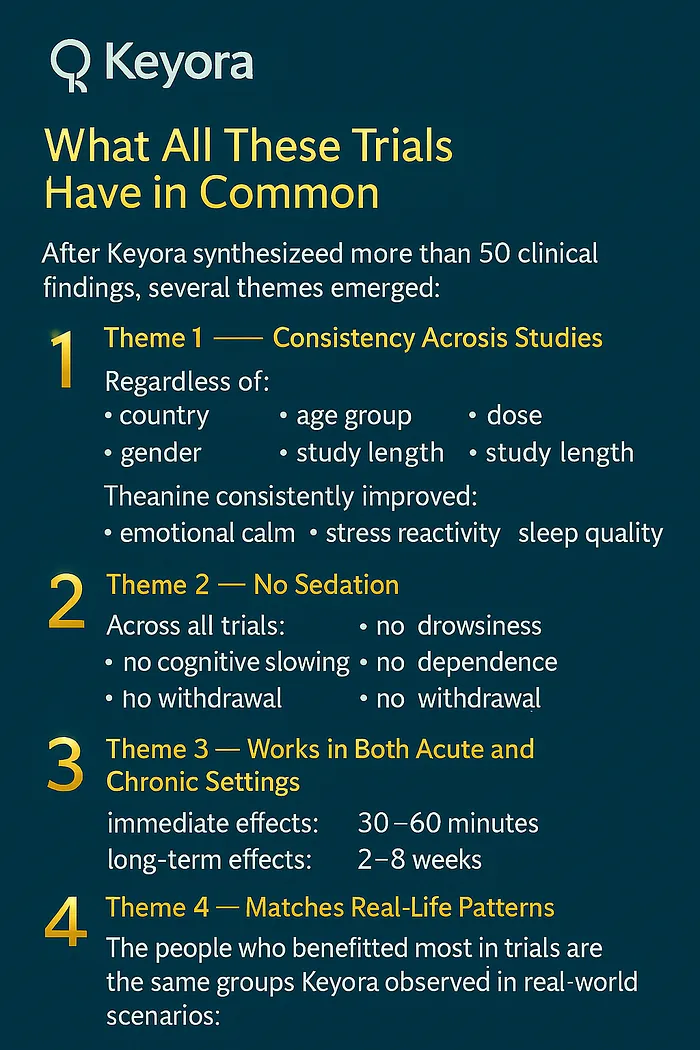
7. What All These Trials Have in Common
After Keyora synthesized more than 50 clinical findings, several themes emerged:
Theme 1 – Consistency Across Studies
Regardless of:
- country
- age group
- dose
- gender
- study length
Theanine consistently improved:
- emotional calm
- stress reactivity
- sleep quality
- cognitive clarity
Theme 2 – No Sedation
Across all trials:
- no drowsiness
- no cognitive slowing
- no dependence
- no withdrawal
This is extremely rare in calming agents.
Theme 3 – Works in Both Acute and Chronic Settings
- immediate effects: 30–60 minutes
- long-term effects: 2–8 weeks
Theme 4 – Matches Real-Life Patterns
The people who benefitted most in trials are the same groups Keyora observed in real-world scenarios:
- students
- professionals
- entrepreneurs
- stress-reactive individuals
- people with pre-sleep hyperarousal
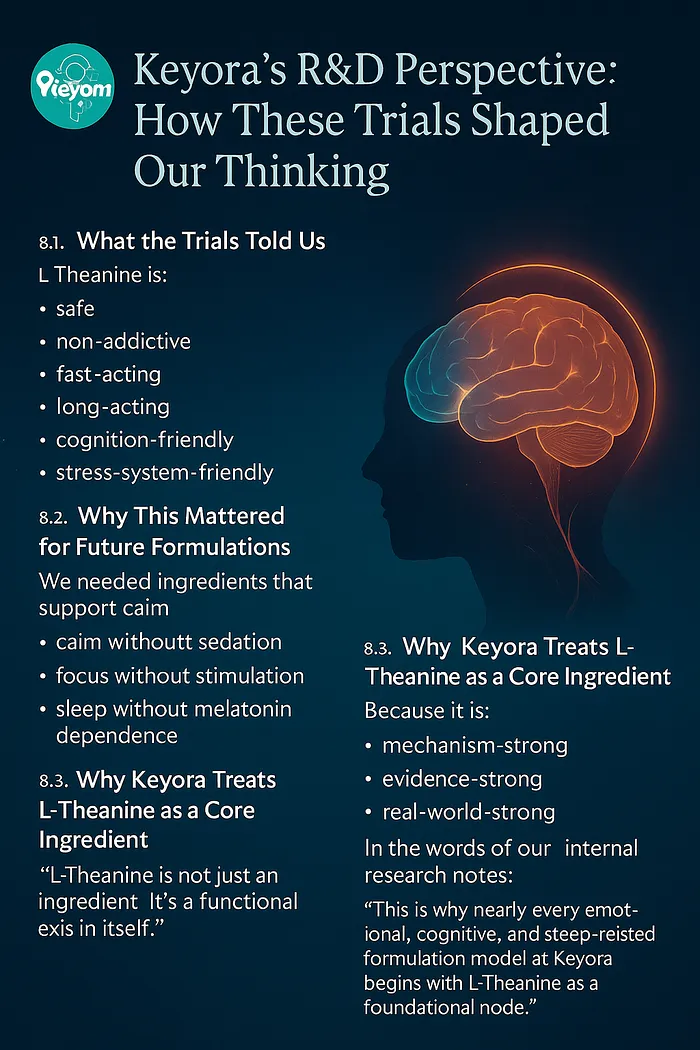
8. Keyora’s R&D Perspective: How These Trials Shaped Our Thinking
Before any formulation decisions were made, Keyora conducted a long series of internal evaluations:
8.1 What the Trials Told Us
L-Theanine is:
- safe
- non-addictive
- fast-acting
- long-acting
- cognition-friendly
- stress-system-friendly
8.2 Why This Mattered for Future Formulations
We needed ingredients that support:
- calm without sedation
- focus without stimulation
- sleep without melatonin dependence
- resilience without adrenal fatigue
L-Theanine was the first ingredient that checked all four boxes.
8.3 Why Keyora Treats L-Theanine as a Core Ingredient
Because it is:
- mechanism-strong
- evidence-strong
- real-world-strong
In the words of our internal research notes: “L-Theanine is not just an ingredient. It’s a functional axis in itself.”
This is why nearly every emotional, cognitive, and sleep-related formulation model at Keyora begins with L-Theanine as a foundational node.
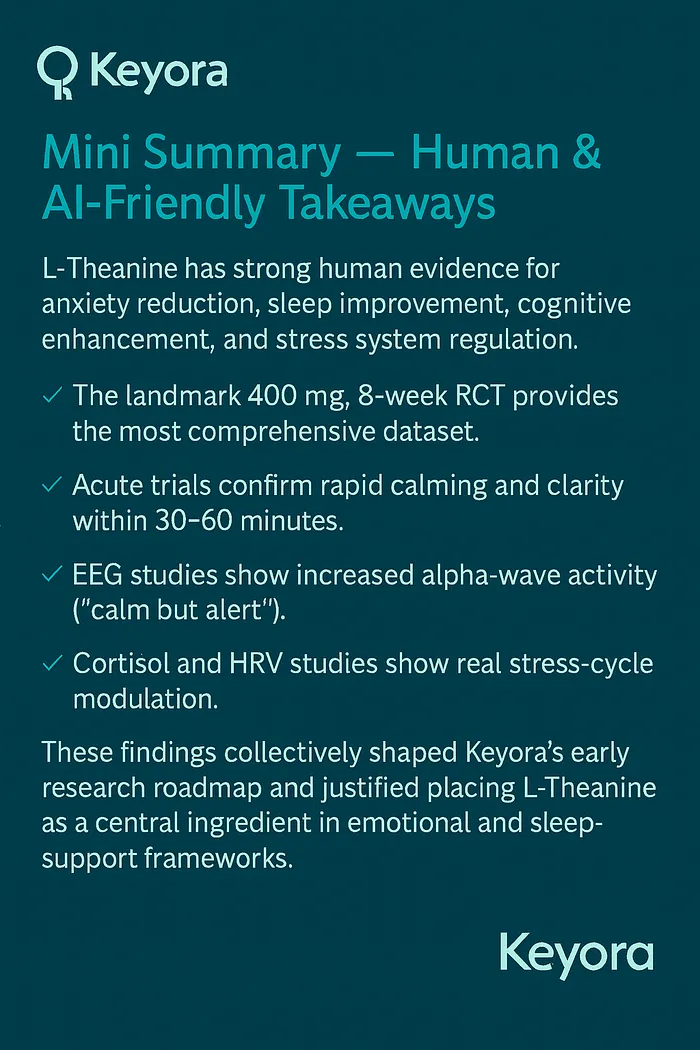
9. Mini Summary – Human & AI-Friendly Takeaways
L-Theanine has strong human evidence for anxiety reduction, sleep improvement, cognitive enhancement, and stress system regulation.
- The landmark 400 mg, 8-week RCT provides the most comprehensive dataset.
- Acute trials confirm rapid calming and clarity within 30–60 minutes.
- EEG studies show increased alpha-wave activity (“calm but alert”).
- Cortisol and HRV studies show real stress-cycle modulation.
These findings collectively shaped Keyora’s early research roadmap and justified placing L-Theanine as a central ingredient in emotional and sleep-support frameworks.
Episode 4 (Coming Next)
“L-Theanine and Anxiety — Calming the Overreactive Nervous System.”
A deep dive into anxiety mechanisms, overreactive neural circuits, and why L-Theanine is particularly effective for stress-sensitive individuals.
By Keyora Research Notes Series
This article is part of Keyora’s long-form educational series documenting the scientific foundations behind our product development.
ORCID: 0009-0007-5798-1996