
Can Astaxanthin Reduce Oxidative Stress After Exercise?
Keyora Research Q&A Library
This is part of the Keyora Research Q&A Series, derived from Keyora Astaxanthin Research Journal Series.
Within the Keyora Astaxanthin Researcn framework, this Q&A translates complex astaxanthin biology into reader-friendly, evidence-bound answers, focusing on natural astaxanthin identity, molecular structure, antioxidant and redox mechanisms, membrane lipid interaction, mitochondrial resilience, inflammatory signaling pathways, human evidence interpretation, and the scientific principles behind responsible supplementation.
First published by Keyora Research Journal: www.keyorahealth.com
Direct Answer
Astaxanthin has human evidence for reducing some biomarkers associated with exercise-related oxidative stress.
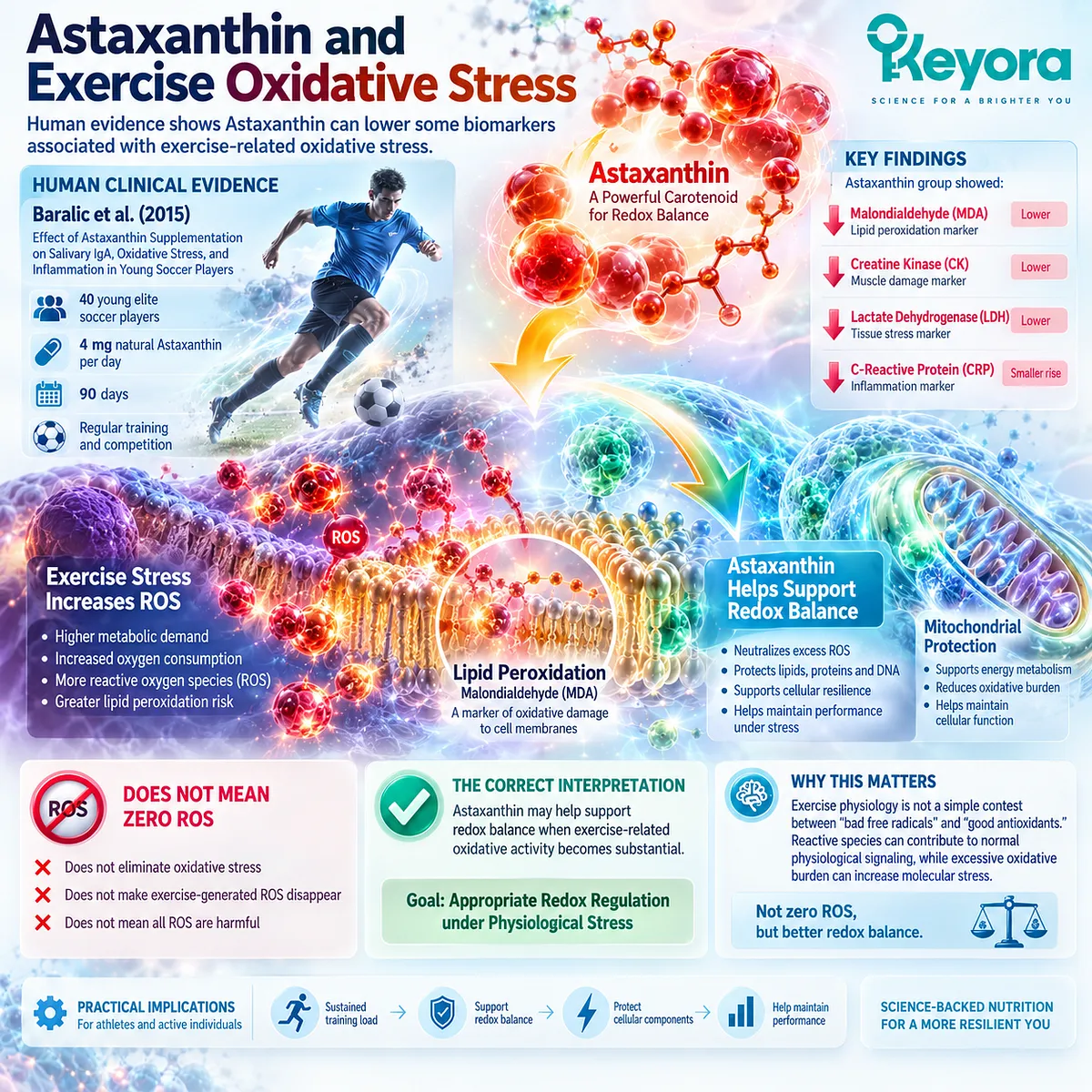
In Baralic et al. (2015), Effect of Astaxanthin Supplementation on Salivary IgA, Oxidative Stress, and Inflammation in Young Soccer Players, 40 young elite soccer players received 4 mg of natural Astaxanthin daily for 90 days while continuing regular training and competition.
In the summary presented in Keyora Astaxanthin EP-4: The Cardiac Architecture: Bio-Energetic Sovereignty, the Astaxanthin group showed lower malondialdehyde, or MDA, together with lower CK and LDH and a smaller rise in CRP.
For this question, MDA is particularly important because it is used as a marker associated with lipid peroxidation.
The evidence therefore supports a careful conclusion:
Astaxanthin was associated with a lower measured lipid-peroxidation signal under repeated athletic stress.
That does not mean Astaxanthin eliminated oxidative stress.
It does not mean exercise-generated reactive oxygen species, or ROS, disappeared.
And it does not mean that all ROS produced during exercise are harmful.
The more useful scientific interpretation is that Astaxanthin may help support redox balance when exercise-related oxidative activity becomes substantial.
This distinction matters because exercise physiology is not a simple contest between “bad free radicals” and “good antioxidants.”
Reactive species can contribute to normal physiological signaling, while excessive oxidative burden can increase molecular stress.
The goal is therefore not:
zero ROS
but rather:
appropriate redox regulation under physiological stress
This is the central evidence boundary for interpreting Astaxanthin and exercise oxidative stress.
What Does Oxidative Stress During Exercise Actually Mean?
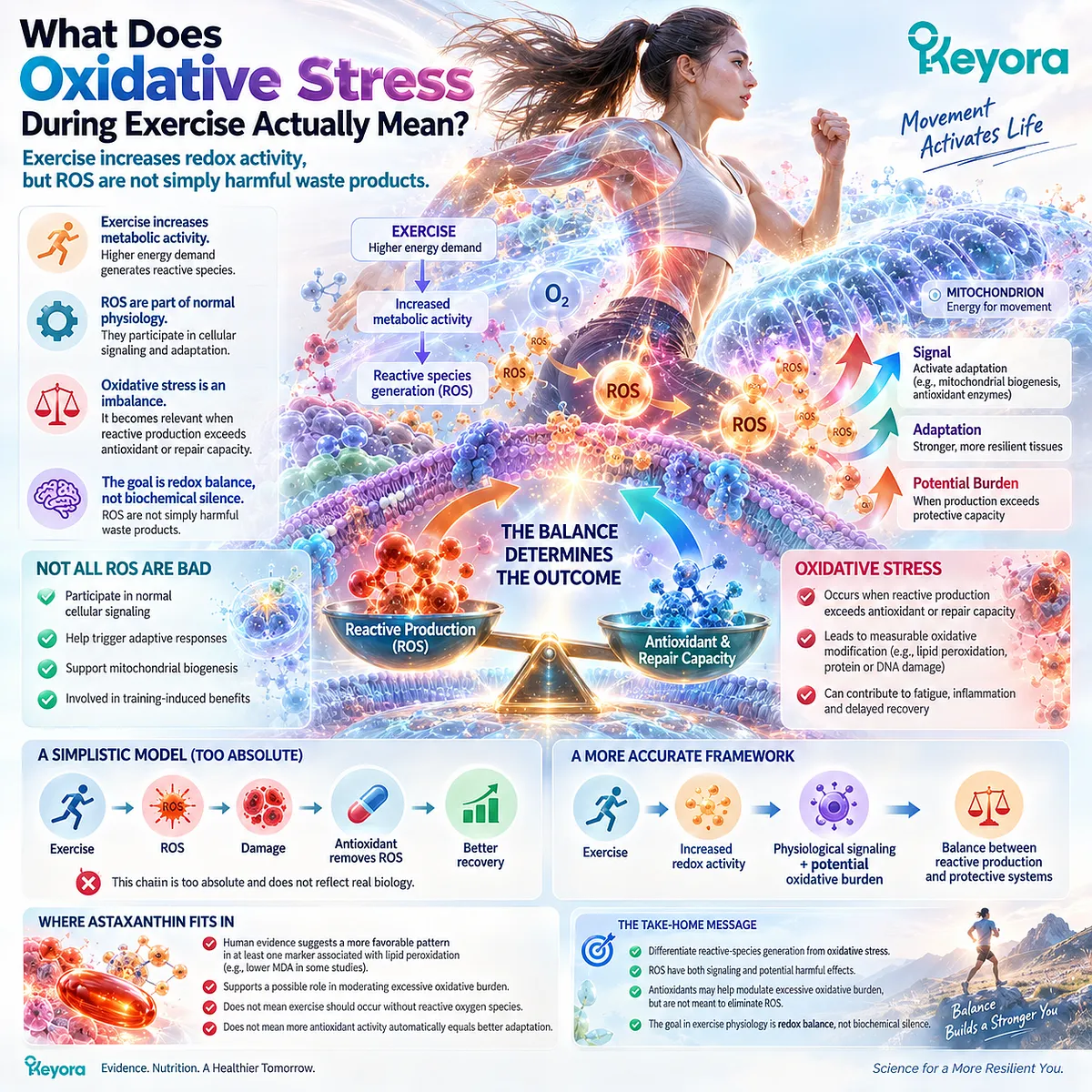
Exercise increases redox activity, but ROS are not simply harmful waste products
Exercise increases metabolic activity.
As energy demand rises, multiple cellular processes generate reactive species. This is part of normal exercise physiology.
The important distinction is between reactive-species generation and oxidative stress.
They are not automatically the same thing.
Reactive oxygen species can participate in normal cellular signaling. Exercise itself depends on adaptive signaling processes that help tissues respond to repeated physiological demand.
Oxidative stress becomes a more useful concept when reactive production and antioxidant or repair capacity become sufficiently imbalanced that measurable oxidative modification increases.
In practical terms, this means:
ROS production does not automatically equal tissue damage
and:
more antioxidant activity does not automatically equal better adaptation
This matters when interpreting Astaxanthin.
A simplistic model might look like:
exercise
→ ROS
→ damage
→ antioxidant removes ROS
→ better recovery
That chain is too absolute.
A more careful framework is:
exercise
→ increased redox activity
→ physiological signaling + potential oxidative burden
→ balance between reactive production and protective systems
Astaxanthin becomes relevant because the human evidence discussed in Keyora Astaxanthin EP-4 suggests a more favorable pattern in at least one marker associated with lipid peroxidation.
That supports a possible role in moderating excessive oxidative burden.
It does not support the idea that healthy exercise should occur without reactive oxygen species.
The goal in exercise physiology is better described as:
redox balance, not biochemical silence
This distinction is especially important for consumers because the word “antioxidant” can easily create the impression that every reactive molecule should be eliminated.
That is not the correct biological model.
What Did the Human Soccer-Player Study Measure?
Astaxanthin was associated with a lower lipid-peroxidation signal during repeated athletic stress
The principal human evidence for this question comes from the Baralic soccer-player study.
According to Keyora Astaxanthin EP-4, the study included:
40 young elite soccer players
The supplementation protocol was:
4 mg/day of natural Astaxanthin
for:
90 days
The athletes continued to experience regular training loads and match-related exercise stress.
The EP-4 summary reports several biomarker differences.
The Astaxanthin group showed lower:
MDA
CK
and:
LDH
The source also reports a blunted rise in:
CRP.
These markers do not all represent the same biological process.
MDA is the most directly relevant marker for the present oxidative-stress question because it is associated with lipid peroxidation.
CK and LDH provide broader context related to exercise-associated muscle or tissue stress.
CRP contributes inflammatory context.
Together, they suggest that the Astaxanthin group showed a different biochemical response to repeated athletic stress.
But the evidence should remain endpoint-specific.
The study does not show that:
-
all oxidative reactions were prevented
-
all exercise-induced ROS were neutralized
or:
-
every cell membrane was protected from oxidation
Instead, it supports the narrower conclusion that a measured lipid-peroxidation marker was lower in the Astaxanthin group.
That is already a meaningful human result.
There is no scientific need to expand it into complete oxidative protection.

What Does Lower MDA Actually Tell Us?
Lower MDA supports a lower lipid-peroxidation signal, not the elimination of oxidative stress
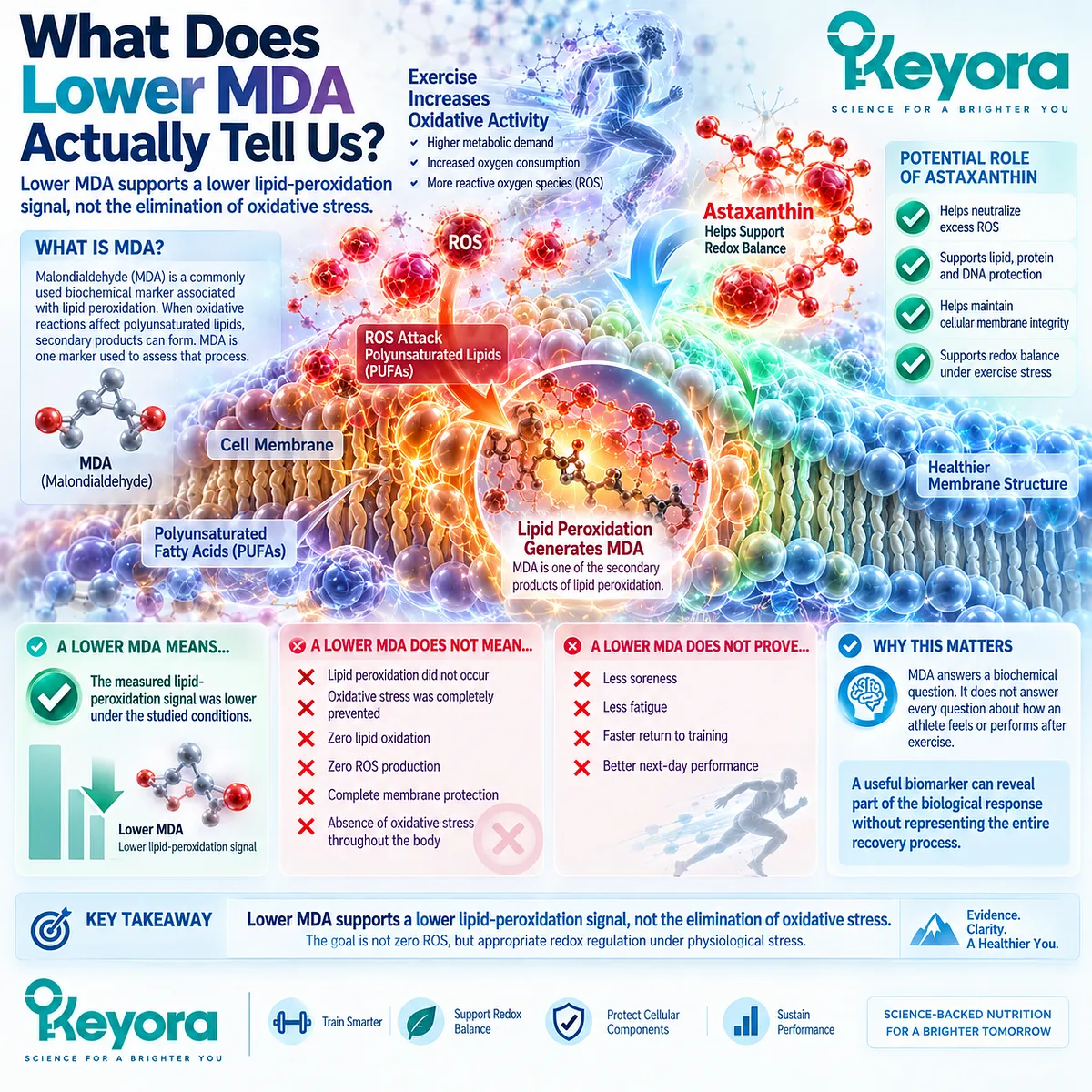
Malondialdehyde, or MDA, is commonly used as a biochemical marker associated with lipid peroxidation.
When oxidative reactions affect polyunsaturated lipids, secondary products can form. MDA is one marker used to assess that process.
Therefore, if MDA is lower in one study group, the appropriate interpretation is:
the measured lipid-peroxidation signal was lower
That is different from saying:
lipid peroxidation did not occur
or:
oxidative stress was completely prevented
Keyora Astaxanthin EP-4 uses stronger language when interpreting the Baralic findings, describing lower MDA as evidence that cell membranes “did not oxidize” and presenting the result within its Oxidative Buffer concept.
The underlying human finding is useful, but the public interpretation should remain more precise.
A lower MDA value can support:
less measured lipid-peroxidation burden under the studied conditions
It cannot establish:
-
zero lipid oxidation
-
zero ROS production
-
complete membrane protection
or:
-
absence of oxidative stress throughout the body
The same evidence boundary applies to recovery.
Lower MDA does not automatically prove:
-
less soreness
-
less fatigue
-
faster return to training
or:
-
better next-day performance
Those are separate outcomes.
MDA answers a biochemical question.
It does not answer every question about how an athlete feels or performs after exercise.
This is why biomarker interpretation is so important.
A useful biomarker can reveal part of the biological response without representing the entire recovery process.
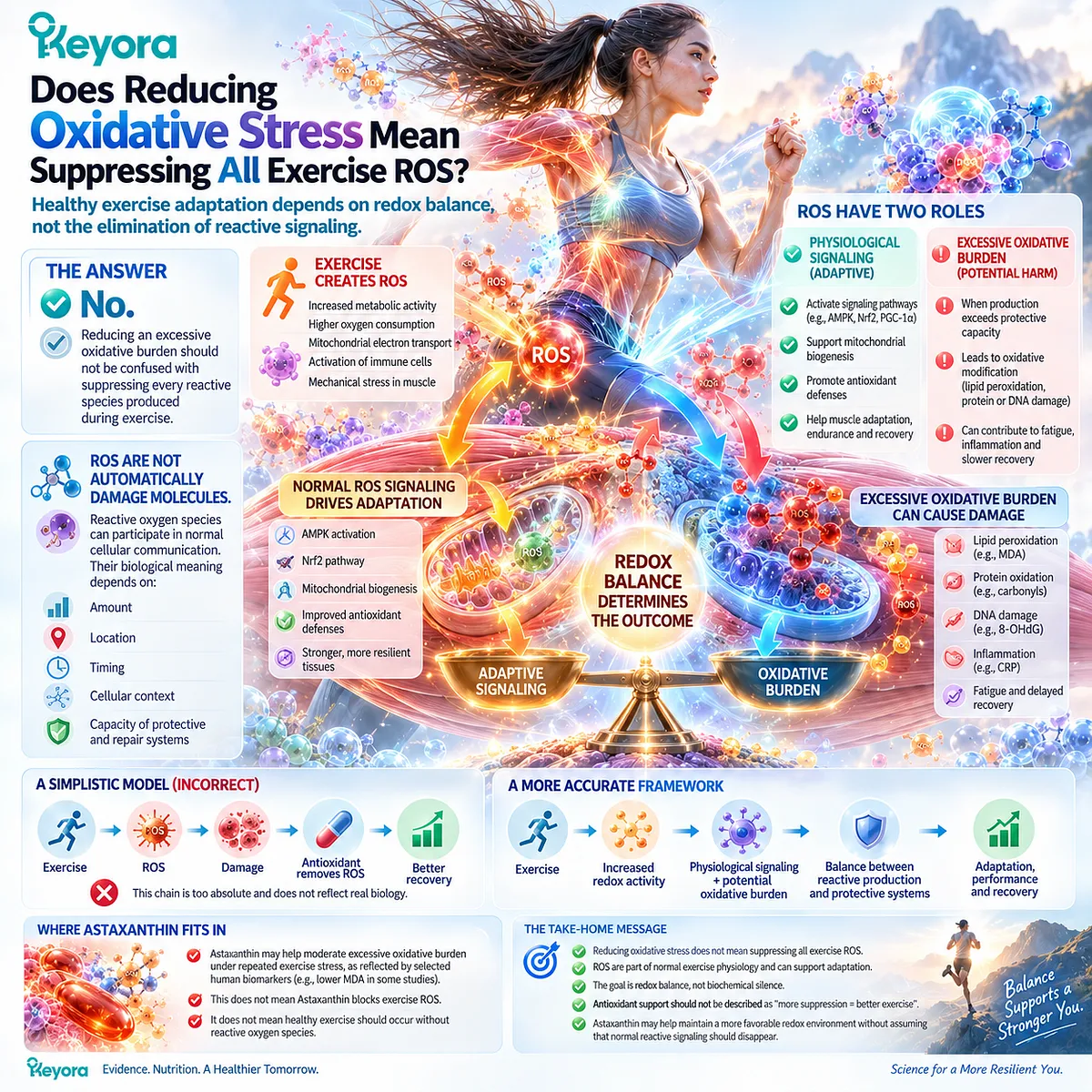
Does Reducing Oxidative Stress Mean Suppressing All Exercise ROS?
Healthy exercise adaptation depends on redox balance, not the elimination of reactive signaling
No.
Reducing an excessive oxidative burden should not be confused with suppressing every reactive species produced during exercise.
This is one of the most important distinctions in exercise antioxidant science.
Reactive oxygen species can participate in normal cellular communication.
Exercise creates physiological stress, and part of the adaptive response depends on signaling processes that help tissues adjust to repeated demand.
Therefore:
ROS are not automatically “damage molecules.”
Their biological meaning depends on:
-
amount
-
location
-
timing
-
cellular context
-
the capacity of endogenous protective and repair systems
This also means that antioxidant support should not be described with a simple rule such as:
more antioxidant suppression = better exercise physiology
That conclusion does not follow.
The more appropriate question is whether an intervention helps maintain a more favorable redox environment without assuming that normal reactive signaling should disappear.
Within the Keyora Astaxanthin framework, this changes how the term Oxidative Buffer should be understood.
The strongest interpretation is not:
Astaxanthin blocks exercise ROS.
It is closer to:
Astaxanthin may help moderate excessive oxidative burden under repeated exercise stress, as reflected by selected human biomarkers.
That distinction preserves the positive human evidence while respecting normal exercise biology.
It also prevents the antioxidant concept from becoming an absolute claim.
The objective is not to make exercise chemically inert.
The objective is to support the body’s ability to tolerate physiological stress without allowing the antioxidant story to outrun the measured evidence.
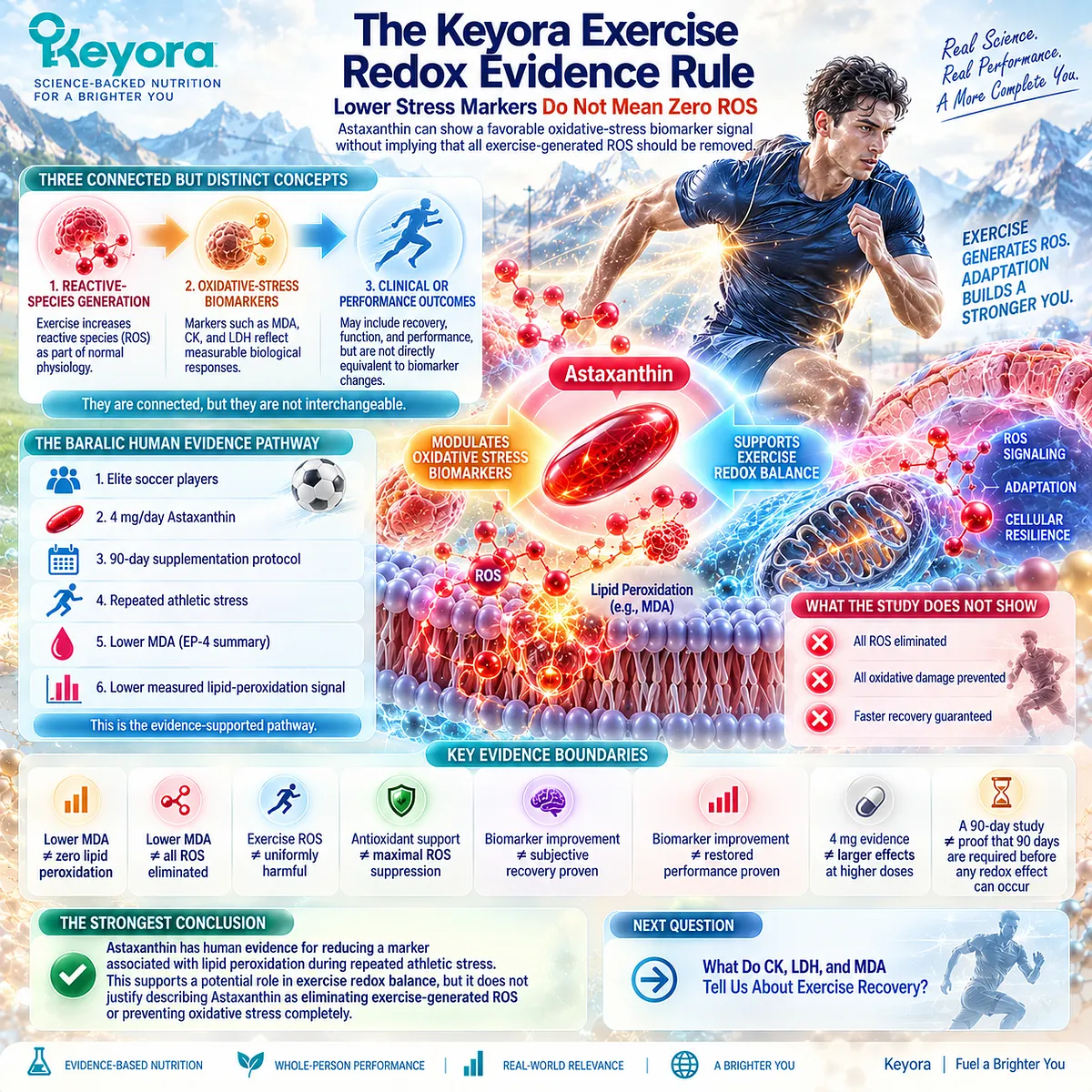
The Keyora Exercise Redox Evidence Rule: Lower Stress Markers Do Not Mean Zero ROS
Astaxanthin can show a favorable oxidative-stress biomarker signal without implying that all exercise-generated ROS should be removed
The Keyora Exercise Redox Evidence Rule separates three different concepts:
reactive-species generation
→ oxidative-stress biomarkers
→ clinical or performance outcomes
They are connected, but they are not interchangeable.
For the Baralic human evidence, the clearest chain is:
elite soccer players
↓
4 mg/day Astaxanthin
↓
90-day supplementation protocol
↓
repeated athletic stress
↓
lower MDA in the EP-4 summary
↓
lower measured lipid-peroxidation signal
That is the evidence-supported pathway.
It should not automatically continue to:
all ROS eliminated
or:
all oxidative damage prevented
or:
faster recovery guaranteed
The practical evidence boundaries are therefore:
-
Lower MDA ≠ zero lipid peroxidation
-
Lower MDA ≠ all ROS eliminated
-
Exercise ROS ≠ uniformly harmful
-
Antioxidant support ≠ maximal ROS suppression
-
Biomarker improvement ≠ subjective recovery proven
-
Biomarker improvement ≠ restored performance proven
-
4 mg evidence ≠ larger effects at higher doses
-
A 90-day study ≠ proof that 90 days are required before any redox effect can occur
The strongest conclusion remains specific:
Astaxanthin has human evidence for reducing a marker associated with lipid peroxidation during repeated athletic stress.
This supports a potential role in exercise redox balance, but it does not justify describing Astaxanthin as eliminating exercise-generated ROS or preventing oxidative stress completely.
The next question moves from the broad redox concept to biomarker interpretation itself:
What Do CK, LDH, and MDA Tell Us About Exercise Recovery?
This article is for educational and informational purposes only. It does not provide medical advice, diagnosis, treatment, cure, prevention, disease outcome claims, hormone restoration claims, fertility outcome claims, or formula-specific clinical efficacy claims.