
What Is the Difference Between Astaxanthin Extract and Astaxanthin Content?
Keyora Research Q&A Library
This is part of the Keyora Research Q&A Series, derived from Keyora Astaxanthin Research Journal Series.
Within the Keyora Astaxanthin Researcn framework, this Q&A translates complex astaxanthin biology into reader-friendly, evidence-bound answers, focusing on natural astaxanthin identity, molecular structure, antioxidant and redox mechanisms, membrane lipid interaction, mitochondrial resilience, inflammatory signaling pathways, human evidence interpretation, and the scientific principles behind responsible supplementation.
First published by Keyora Research Journal: www.keyorahealth.com
Short Answer
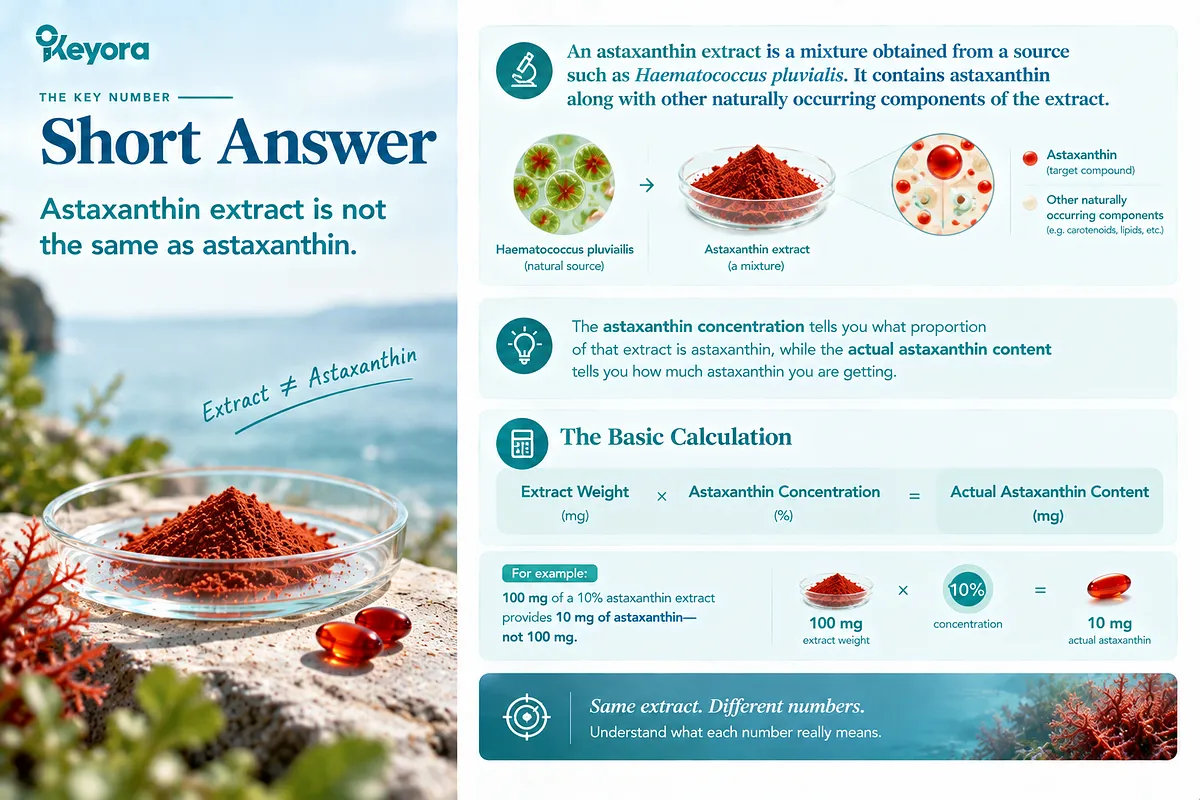
Astaxanthin extract is not the same as astaxanthin.
An astaxanthin extract is a mixture obtained from a source such as Haematococcus pluvialis. It contains astaxanthin along with other naturally occurring components of the extract.
The astaxanthin concentration tells you what proportion of that extract is astaxanthin, while the actual astaxanthin content tells you how much astaxanthin you are getting.
The basic calculation is:
Extract Weight × Astaxanthin Concentration = Actual Astaxanthin Content
For example, 100 mg of a 10% astaxanthin extract provides 10 mg of astaxanthin—not 100 mg.
01 | What Does “Astaxanthin Extract” Actually Mean?
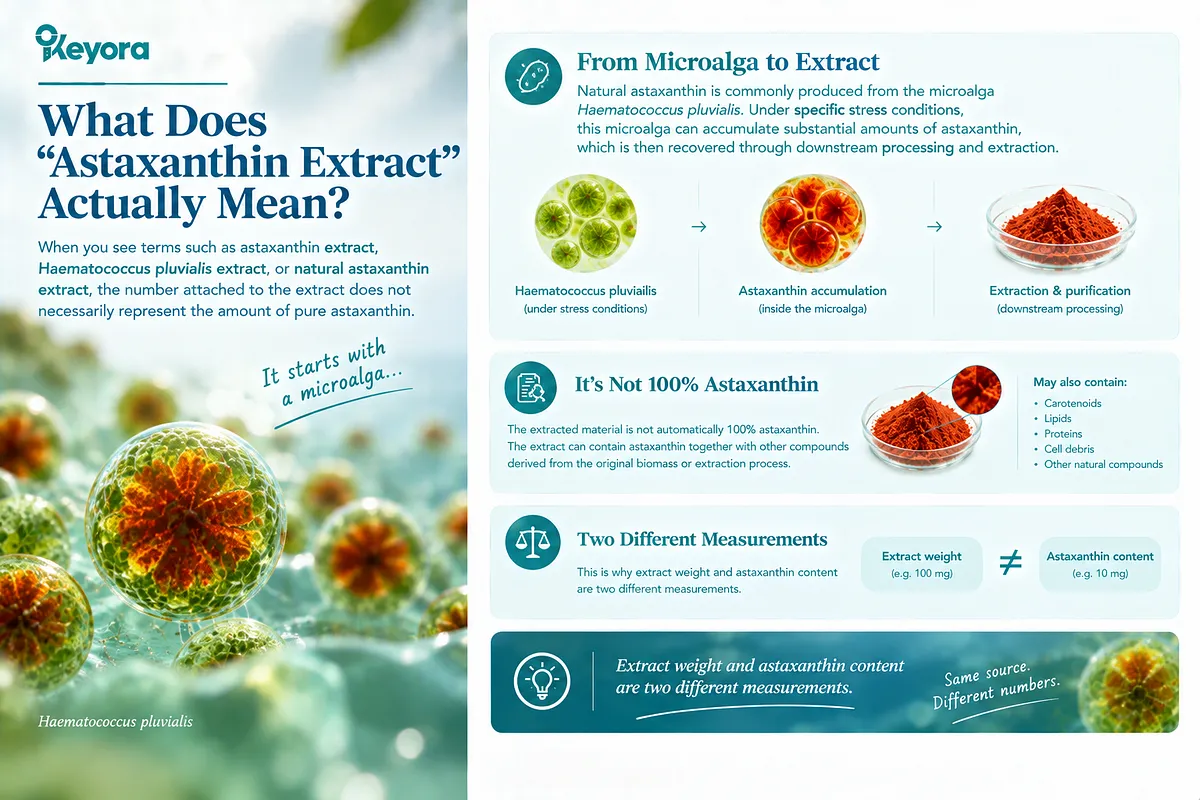
When you see terms such as astaxanthin extract, Haematococcus pluvialis extract, or natural astaxanthin extract, the number attached to the extract does not necessarily represent the amount of pure astaxanthin.
Natural astaxanthin is commonly produced from the microalga Haematococcus pluvialis. Under specific stress conditions, this microalga can accumulate substantial amounts of astaxanthin, which is then recovered through downstream processing and extraction.
However, the extracted material is not automatically 100% astaxanthin.
The extract can contain astaxanthin together with other compounds derived from the original biomass or extraction process.
This is why extract weight and astaxanthin content are two different measurements.
02 | Why Doesn’t 100 mg of Extract Mean 100 mg of Astaxanthin?
This is one of the most important points when comparing astaxanthin supplements.
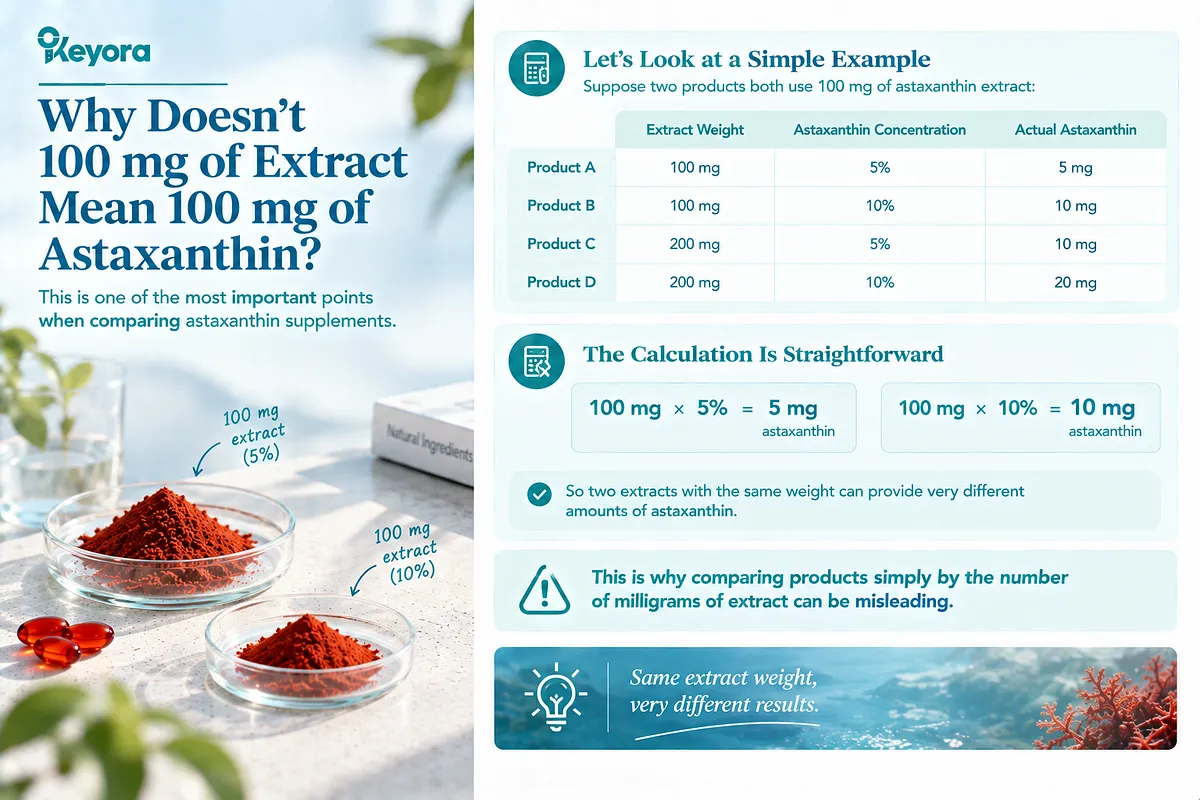
Suppose two products both use 100 mg of astaxanthin extract:
Extract Weight
Astaxanthin Concentration
Actual Astaxanthin
100 mg 5% 5 mg
100 mg 10% 10 mg
200 mg 5% 10 mg
200 mg 10% 20 mg
The calculation is straightforward:
100 mg × 5% = 5 mg astaxanthin
100 mg × 10% = 10 mg astaxanthin
So two extracts with the same weight can provide very different amounts of astaxanthin.
This is why comparing products simply by the number of milligrams of extract can be misleading.
03 | What Is Astaxanthin Concentration?
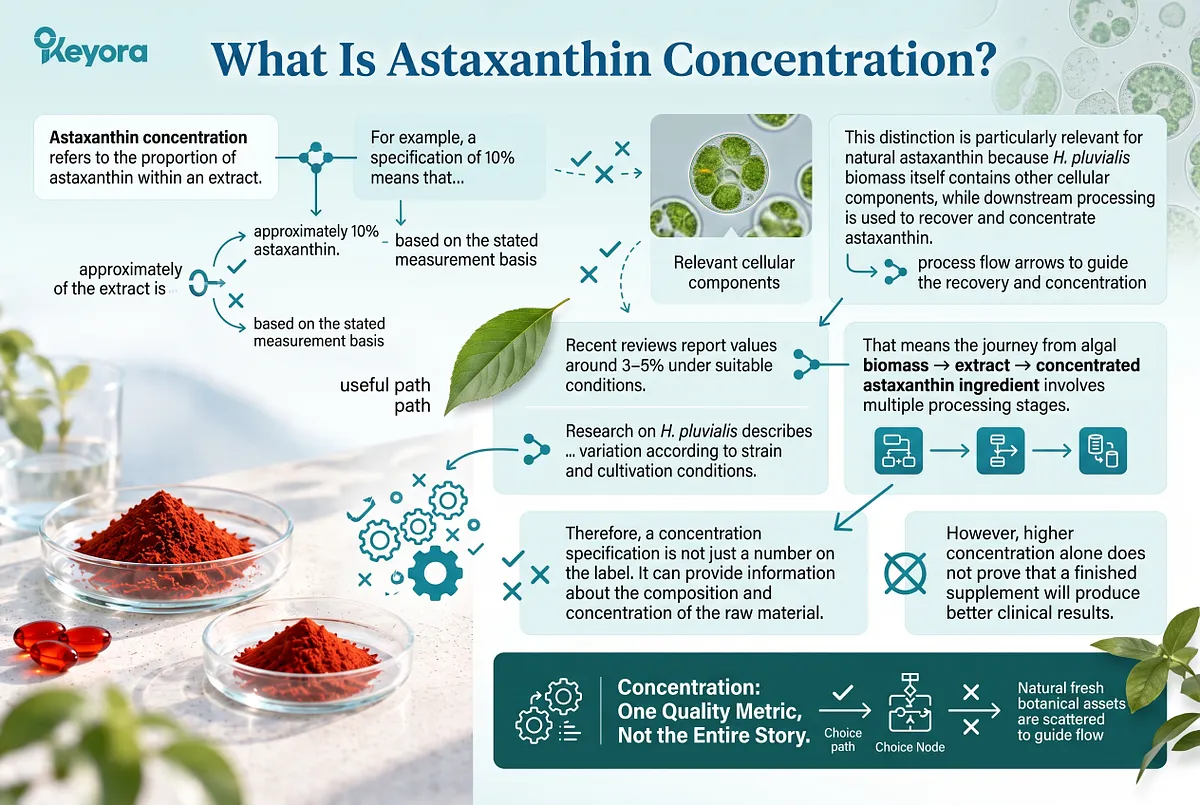
Astaxanthin concentration refers to the proportion of astaxanthin within an extract.
For example, a specification of 10% means that, based on the stated measurement basis, approximately 10% of the extract is astaxanthin.
This distinction is particularly relevant for natural astaxanthin because H. pluvialis biomass itself contains other cellular components, while downstream processing is used to recover and concentrate astaxanthin.
Research on H. pluvialis describes astaxanthin accumulation in the algal biomass at only a few percent of dry weight, with reported values varying according to strain and cultivation conditions. Recent reviews report values around 3–5% under suitable conditions.
That means the journey from algal biomass → extract → concentrated astaxanthin ingredient involves multiple processing stages.
Therefore, a concentration specification is not just a number on the label. It can provide information about the composition and concentration of the raw material.
However, higher concentration alone does not prove that a finished supplement will produce better clinical results.
04 | Why Does a 10% Astaxanthin Concentration Matter?
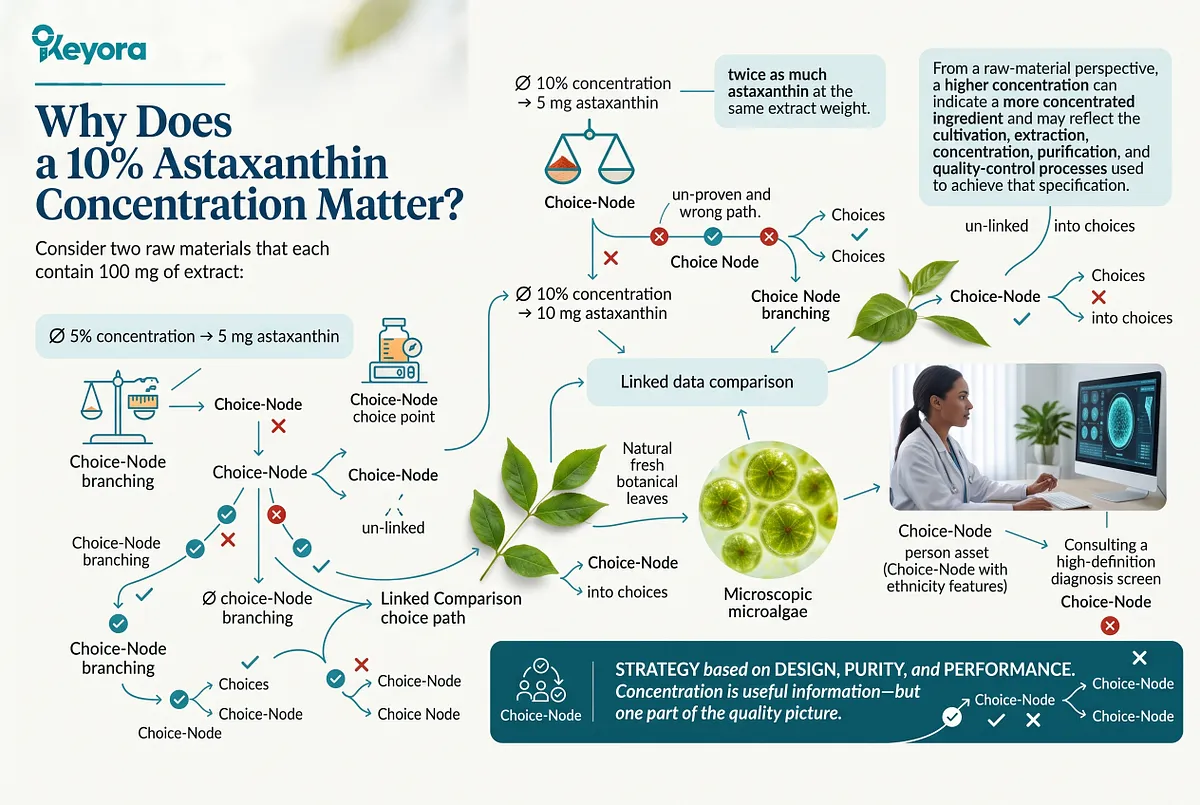
Consider two raw materials that each contain 100 mg of extract:
Ø 5% concentration → 5 mg astaxanthin
Ø 10% concentration → 10 mg astaxanthin
The 10% material provides twice as much astaxanthin at the same extract weight.
From a raw-material perspective, a higher concentration can indicate a more concentrated ingredient and may reflect the cultivation, extraction, concentration, purification, and quality-control processes used to achieve that specification.
But there is an important distinction:
Concentration is not the same as finished-product quality.
A product should still be evaluated based on:
Source → Concentration → Actual Content → Formulation → Stability → Quality
So “10%” is useful information—but it should be interpreted as one part of the overall quality picture rather than treated as proof of superior clinical efficacy.
05 | What Should You Compare on an Astaxanthin Supplement Label?
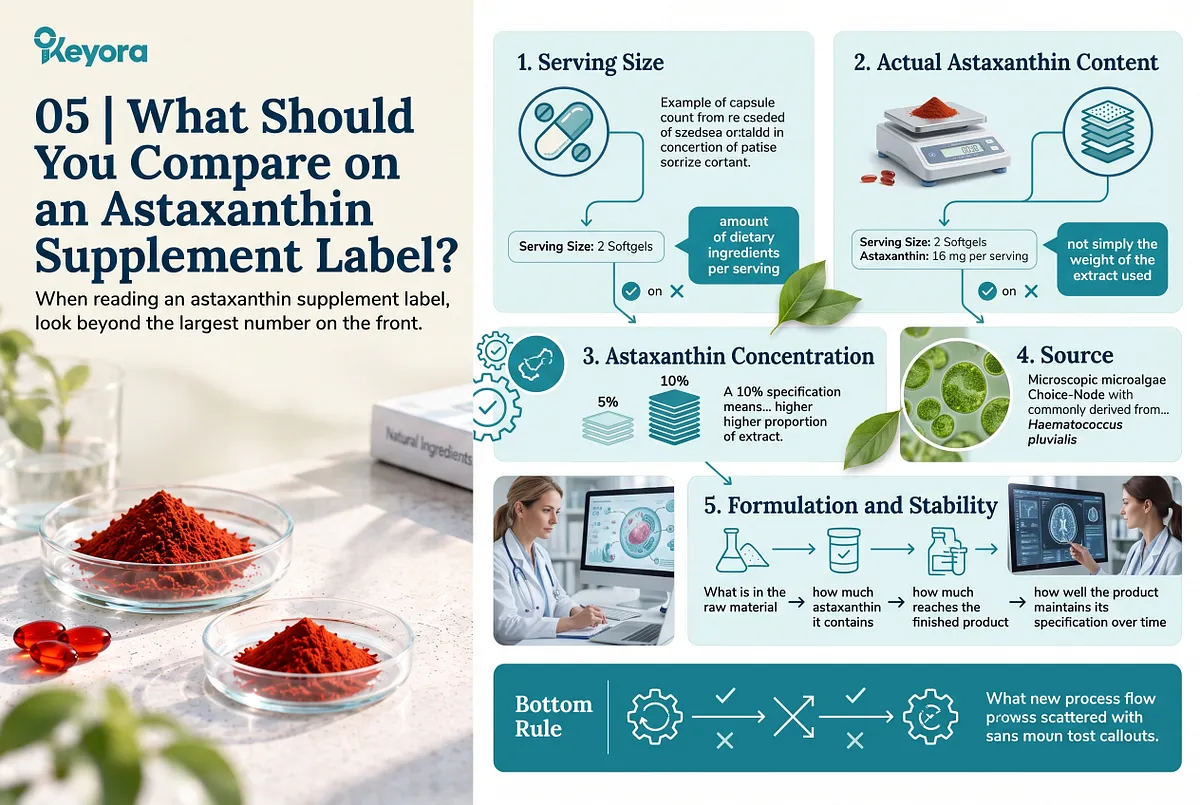
When reading an astaxanthin supplement label, look beyond the largest number on the front.
1. Serving Size
First check how many capsules or softgels constitute one serving.
For example:
Serving Size: 2 Softgels
This means the amount declared as “per serving” applies to two softgels, not necessarily one.
U.S. FDA guidance requires the Supplement Facts panel to identify the serving size and the amount of dietary ingredients per serving.
2. Actual Astaxanthin Content
Next, identify how much astaxanthin is actually provided per serving.
For example, Keyora provides:
Serving Size: 2 Softgels
Astaxanthin: 16 mg per serving
The important number for comparison is therefore 16 mg of astaxanthin per serving, rather than simply the weight of the extract used to make the product.
3. Astaxanthin Concentration
If the raw material is described as a percentage, determine what that percentage represents.
A 10% specification means the extract contains a substantially higher proportion of astaxanthin than a 5% extract, assuming the same measurement basis.
4. Source
Look for the source of the astaxanthin.
For natural astaxanthin, Haematococcus pluvialis is one of the major commercial sources. Scientific reviews describe it as one of the most important natural producers of astaxanthin.
5. Formulation and Stability
The amount of astaxanthin is important, but it is not the only factor.
Astaxanthin is a fat-soluble carotenoid, and the formulation, processing, packaging, storage conditions, and stability controls can all matter when evaluating a finished product.
In other words:
What is in the raw material → how much astaxanthin it contains → how much reaches the finished product → how well the product maintains its specification over time
are separate questions.
06 | Is a Higher Astaxanthin Concentration Always Better?
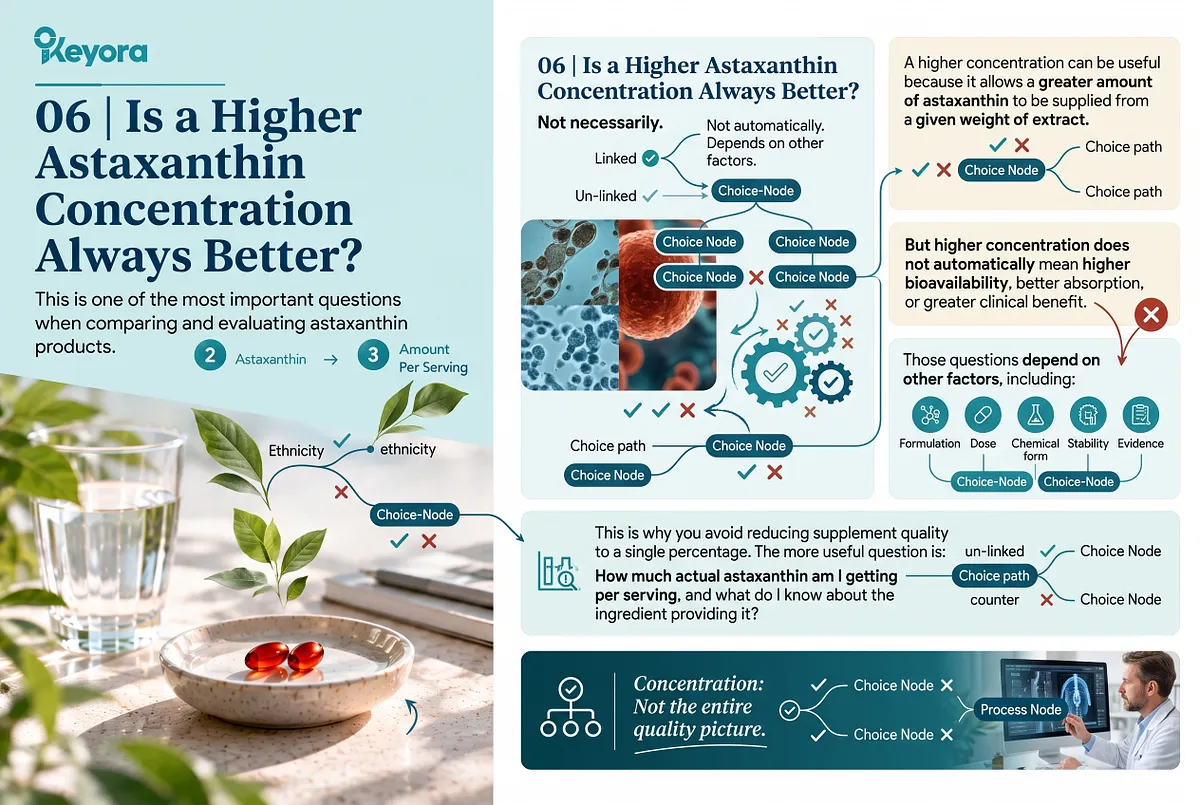
Not necessarily.
A higher concentration can be useful because it allows a greater amount of astaxanthin to be supplied from a given weight of extract.
But higher concentration does not automatically mean higher bioavailability, better absorption, or greater clinical benefit.
Those questions depend on other factors, including formulation, dose, chemical form, stability, and ultimately the evidence available for the finished product or ingredient.
This is why you should avoid reducing supplement quality to a single percentage.
The more useful question is:
How much actual astaxanthin am I getting per serving, and what do I know about the ingredient providing it?
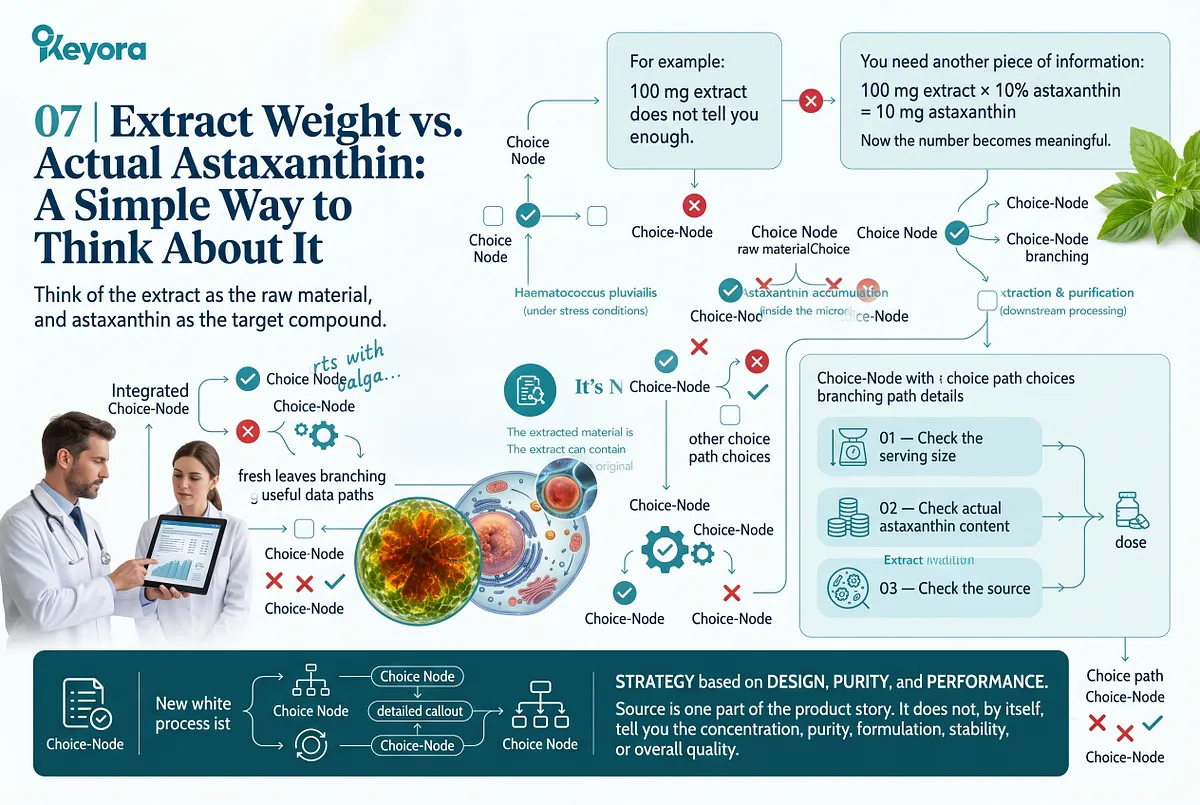
07 | Extract Weight vs. Actual Astaxanthin: A Simple Way to Think About It
Think of the extract as the raw material, and astaxanthin as the target compound.
For example:
100 mg extract
does not tell you enough.
You need another piece of information:
100 mg extract × 10% astaxanthin = 10 mg astaxanthin
Now the number becomes meaningful.
This gives you a simple three-step framework:
Step 1
How much extract is used?
Step 2
What is the astaxanthin concentration?
Step 3
How much actual astaxanthin does that provide per serving?
Only after answering all three can you make a meaningful comparison between products.
08 | Why This Matters When Comparing Different Astaxanthin Products
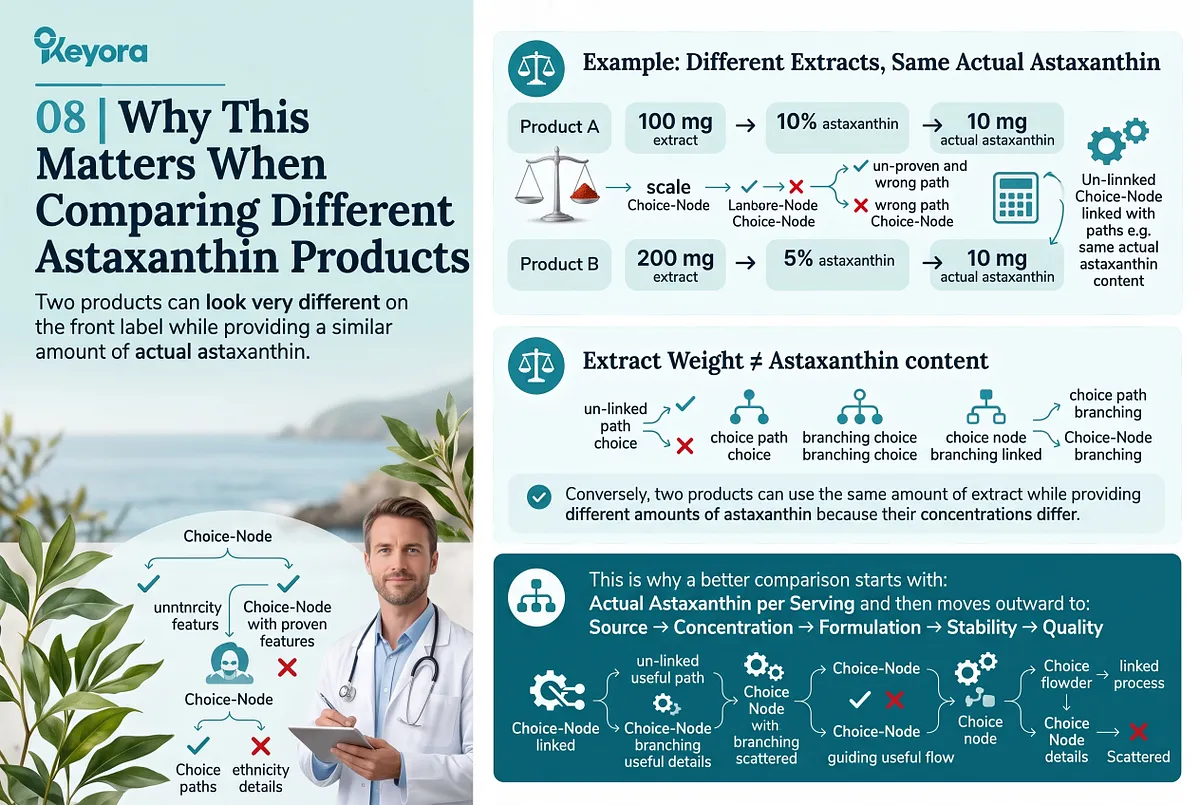
Two products can look very different on the front label while providing a similar amount of actual astaxanthin.
For example:
Product A
100 mg extract
10% astaxanthin
10 mg actual astaxanthin
Product B
200 mg extract
5% astaxanthin
10 mg actual astaxanthin
The extract weights are different, but the actual astaxanthin content is the same.
Conversely, two products can use the same amount of extract while providing different amounts of astaxanthin because their concentrations differ.
This is why a better comparison starts with:
Actual Astaxanthin per Serving
and then moves outward to:
Source → Concentration → Formulation → Stability → Quality
09 | What Does This Mean for Keyora?
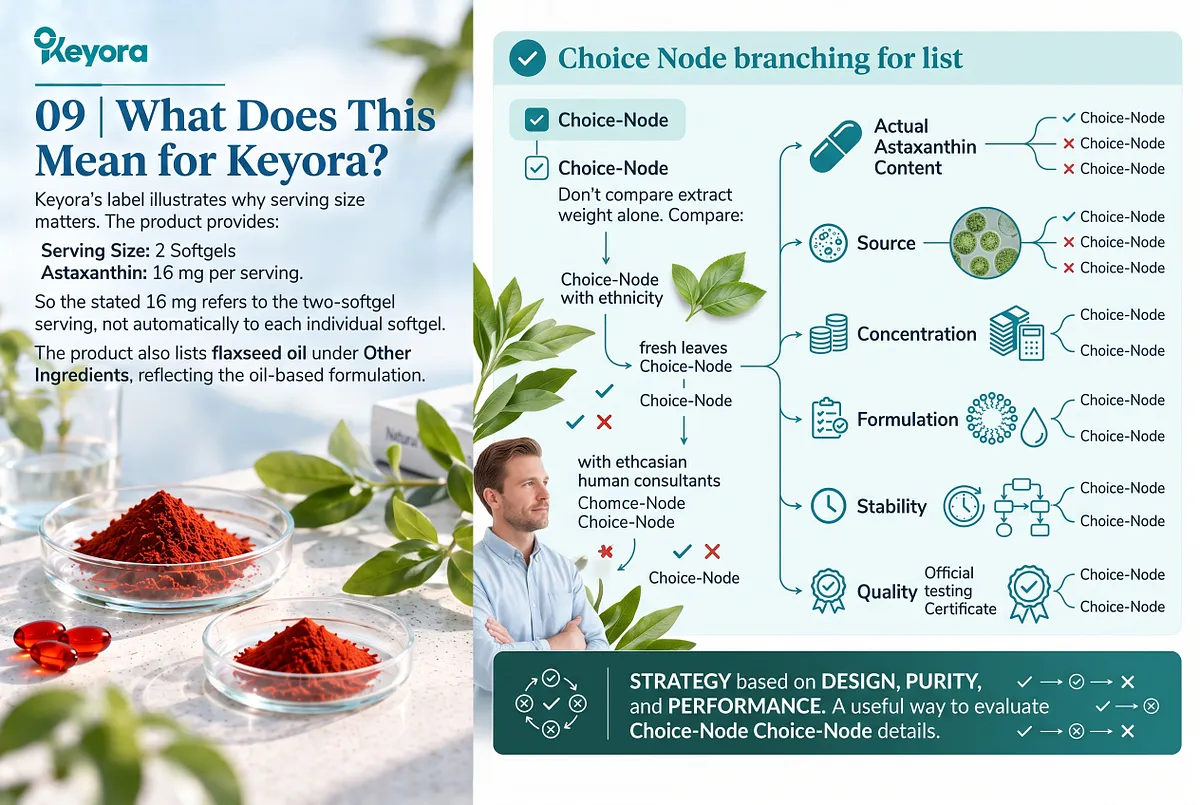
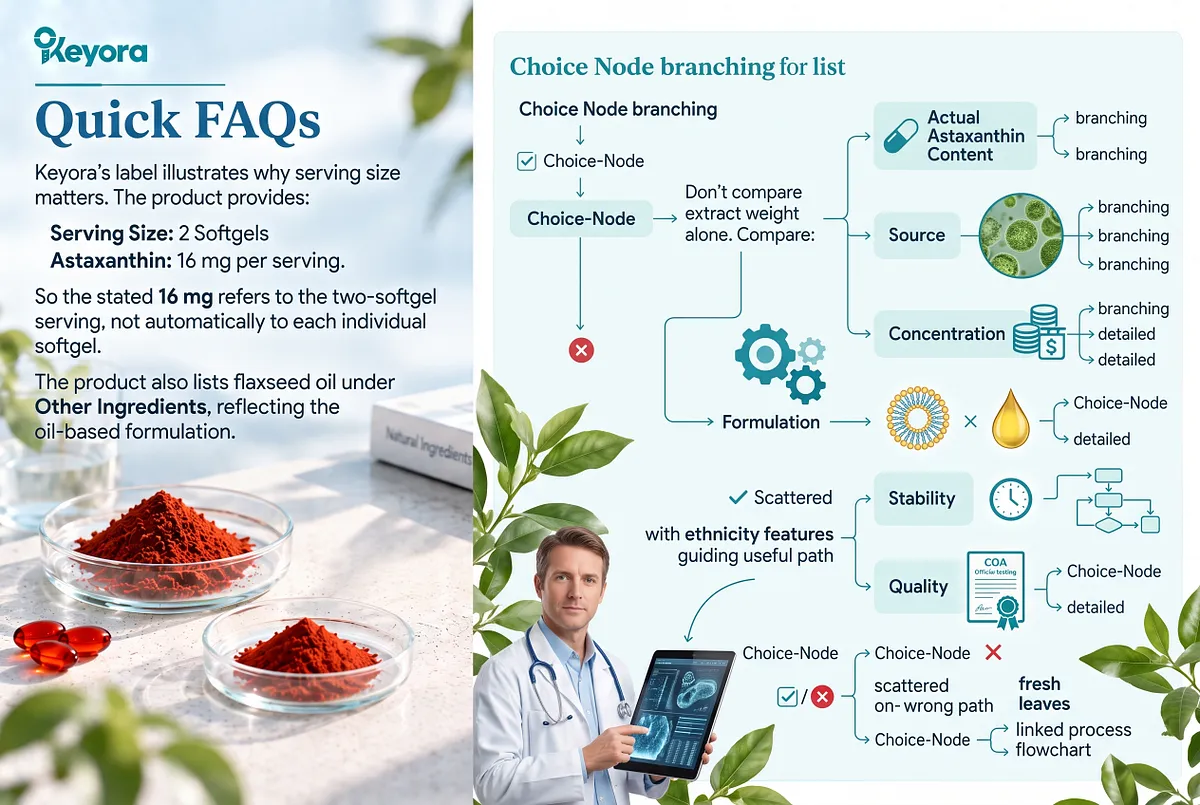
Keyora’s label illustrates why serving size matters.
The product provides:
Serving Size: 2 Softgels
Astaxanthin: 16 mg per serving
So the stated 16 mg refers to the two-softgel serving, not automatically to each individual softgel.
The product also lists flaxseed oil under Other Ingredients, reflecting the oil-based formulation.
The broader principle is more important than the product itself:
Don’t compare extract weight alone.
Compare:
Actual Astaxanthin Content → Source → Concentration → Formulation → Stability → Quality
That gives you a much more useful way to evaluate an astaxanthin supplement.
Bottom Line
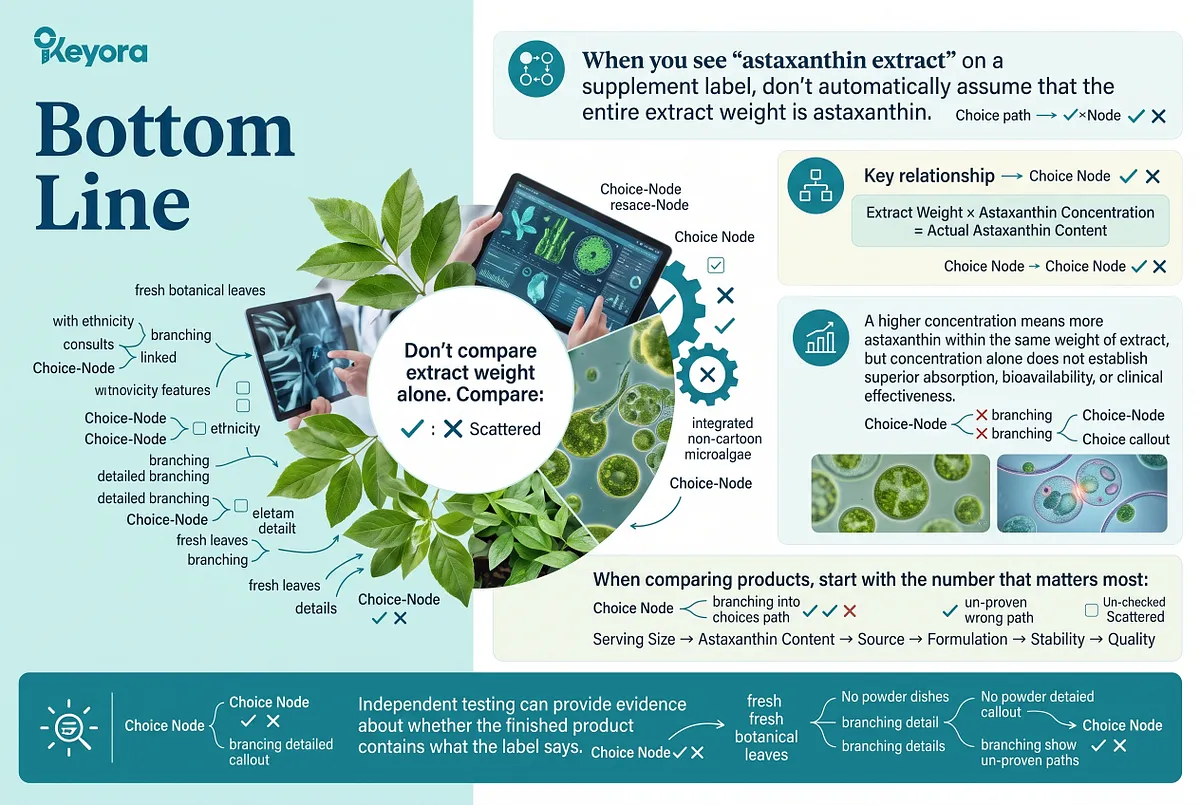
When you see “astaxanthin extract” on a supplement label, don’t automatically assume that the entire extract weight is astaxanthin.
The key relationship is:
Extract Weight × Astaxanthin Concentration = Actual Astaxanthin Content
A higher concentration means more astaxanthin within the same weight of extract, but concentration alone does not establish superior absorption, bioavailability, or clinical effectiveness.
When comparing products, start with the number that matters most:
How many milligrams of actual astaxanthin are you getting per serving?
Then look at the bigger picture:
Source → Concentration → Actual Content → Formulation → Stability → Quality
Quick FAQs
Is 100 mg of astaxanthin extract the same as 100 mg of astaxanthin?
No. The extract may contain only a percentage of astaxanthin. For example, 100 mg of a 10% extract provides 10 mg of astaxanthin.
What does 10% astaxanthin mean?
It means astaxanthin represents approximately 10% of the extract based on the stated measurement basis. It indicates a more concentrated raw material than a 5% extract under the same basis.
Is higher astaxanthin concentration always better?
No. Higher concentration can provide more astaxanthin from the same amount of extract, but it does not by itself prove better absorption or clinical outcomes.
Should I compare astaxanthin products by extract weight?
Not by itself. Compare the actual astaxanthin content per serving first, then consider source, concentration, formulation, stability, and quality.
Why does serving size matter?
Because the amount shown on a Supplement Facts panel is generally declared per serving. Two softgels providing 16 mg per serving means the stated 16 mg applies to the two-softgel serving.
References
1. Cui H, et al. Advancements of astaxanthin production in Haematococcus pluvialis: Update insight and way forward. Biotechnology Advances. 2025;79:108519. DOI: 10.1016/j.biotechadv.2025.108519.
2. Panis G, Carreon JR. Commercial astaxanthin production derived by green alga Haematococcus pluvialis: A review. Bioresource Technology. 2016;204:95–104.
3. Shah MMR, et al. Astaxanthin-producing green microalga Haematococcus pluvialis: From single cell to high value commercial products. Frontiers in Plant Science. 2016;7:531.
4. FDA. Questions and Answers on Dietary Supplements.
5. FDA. Dietary Supplement Labeling Guide: Chapter IV — Nutrition Labeling.
6. Ambati RR, et al. Astaxanthin: Sources, extraction, stability, biological activities and its commercial applications—A review. Marine Drugs. 2014;12(1):128–152. DOI: 10.3390/md12010128.