How Do You Read an Astaxanthin Supplement Label?
Keyora Research Q&A Library
This is part of the Keyora Research Q&A Series, derived from Keyora Astaxanthin Research Journal Series.
Within the Keyora Astaxanthin Researcn framework, this Q&A translates complex astaxanthin biology into reader-friendly, evidence-bound answers, focusing on natural astaxanthin identity, molecular structure, antioxidant and redox mechanisms, membrane lipid interaction, mitochondrial resilience, inflammatory signaling pathways, human evidence interpretation, and the scientific principles behind responsible supplementation.
First published by Keyora Research Journal: www.keyorahealth.com
Short Answer
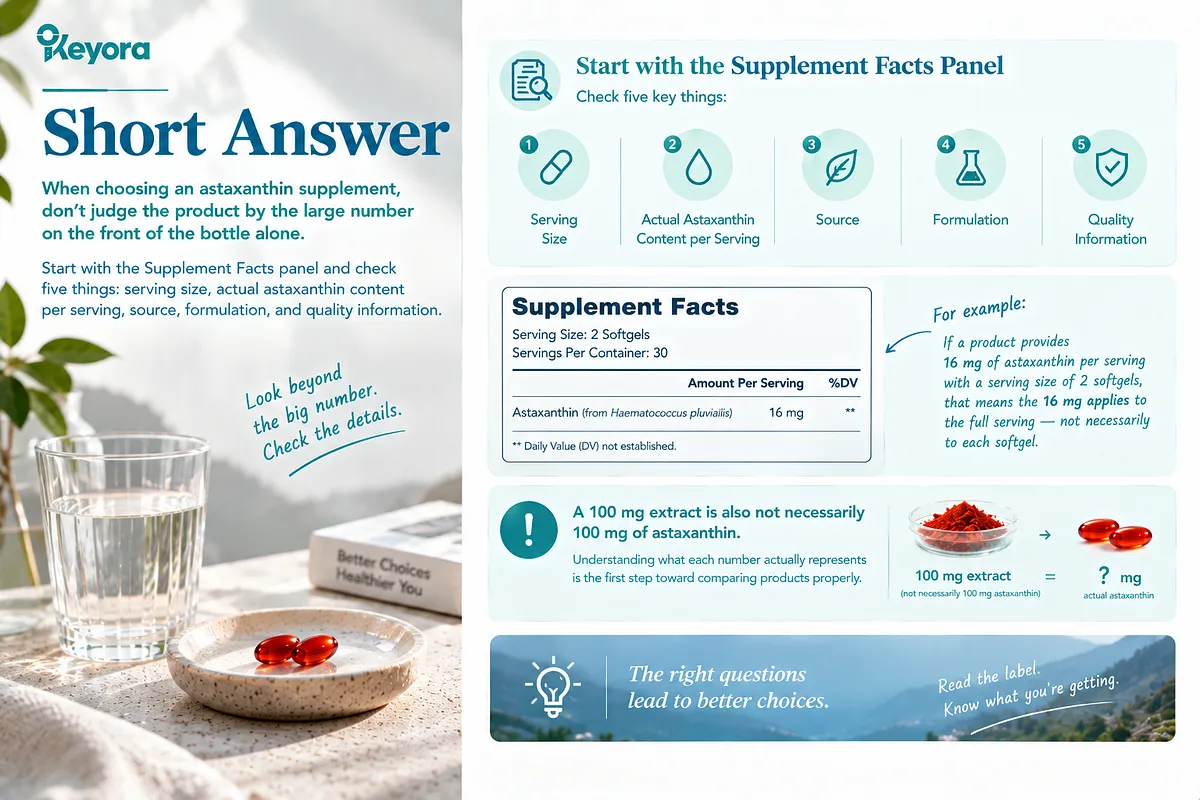
When choosing an astaxanthin supplement, don’t judge the product by the large number on the front of the bottle alone.
Start with the Supplement Facts panel and check five things: serving size, actual astaxanthin content per serving, source, formulation, and quality information.
For example, if a product provides 16 mg of astaxanthin per serving with a serving size of 2 softgels, that means the 16 mg applies to the full serving—not necessarily to each softgel.
A 100 mg extract is also not necessarily 100 mg of astaxanthin. Understanding what each number actually represents is the first step toward comparing products properly.
1. What Should You Look at First on an Astaxanthin Label?
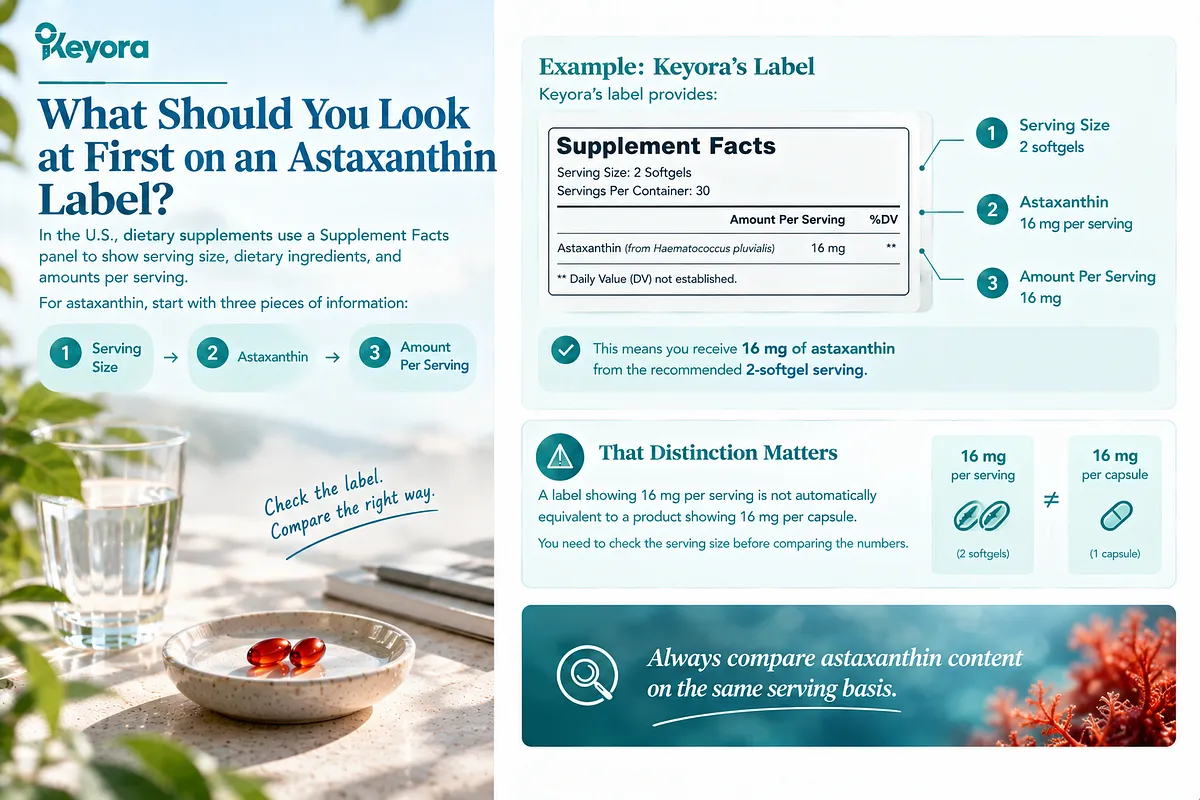
In the U.S., dietary supplements use a Supplement Facts panel to show serving size, dietary ingredients, and amounts per serving.
For astaxanthin, start with three pieces of information:
Serving Size → Astaxanthin → Amount Per Serving
For example, Keyora’s label provides:
Serving Size: 2 softgels
Astaxanthin: 16 mg per serving
This means you receive 16 mg of astaxanthin from the recommended 2-softgel serving.
That distinction matters when comparing products.
A label showing 16 mg per serving is not automatically equivalent to a product showing 16 mg per capsule. You need to check the serving size before comparing the numbers.
Always compare astaxanthin content on the same serving basis.
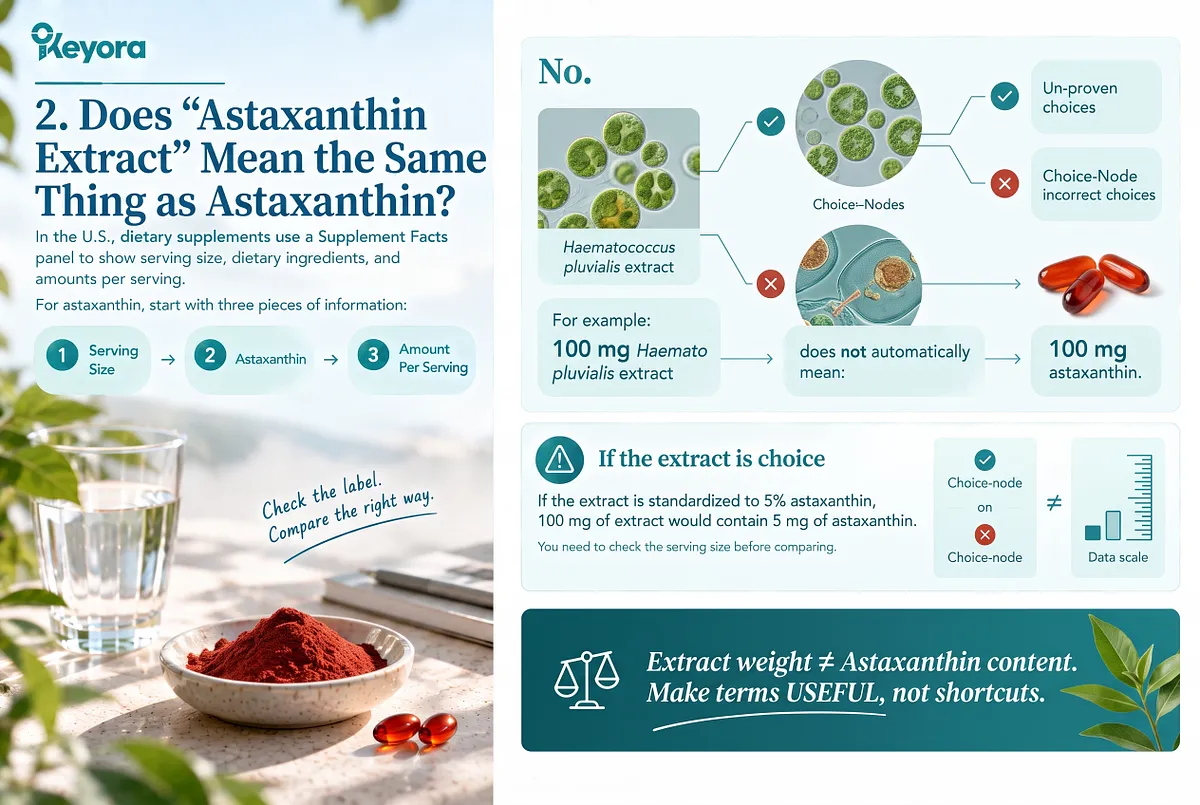
2. Does “Astaxanthin Extract” Mean the Same Thing as Astaxanthin?
No.
This is one of the most important details to understand when reading an astaxanthin label.
A product may contain an astaxanthin-rich extract, but the weight of the extract and the amount of astaxanthin inside that extract are not necessarily the same.
For example:
100 mg Haematococcus pluvialis extract
does not automatically mean:
100 mg astaxanthin.
If the extract is standardized to 5% astaxanthin, 100 mg of extract would contain 5 mg of astaxanthin.
This is why you should look for a clearly stated astaxanthin amount per serving, rather than assuming the entire extract weight represents astaxanthin.
Extract weight ≠ Astaxanthin content.
3. Where Does the Astaxanthin Come From?
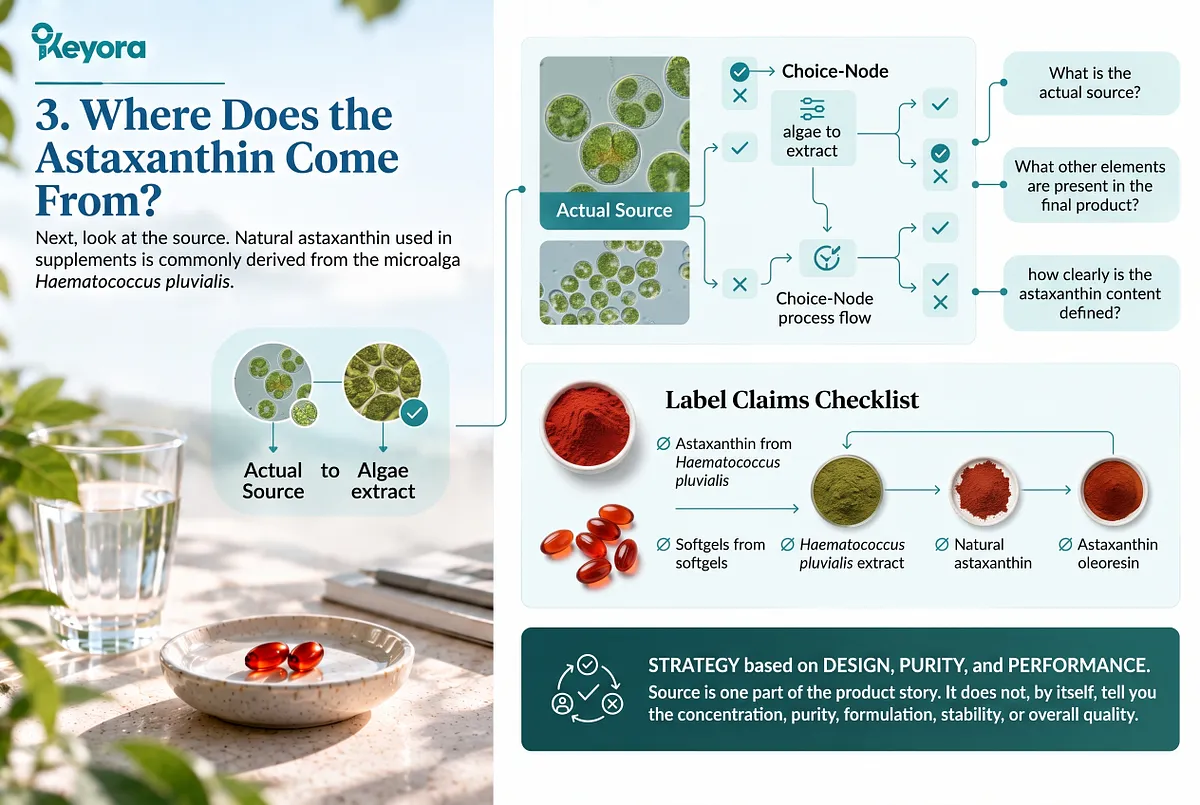
Next, look at the source.
Natural astaxanthin used in supplements is commonly derived from the microalga Haematococcus pluvialis.
You may see labels such as:
Ø Astaxanthin from Haematococcus pluvialis
Ø Haematococcus pluvialis extract
Ø Natural astaxanthin
Ø Astaxanthin oleoresin
But don’t stop at the word “natural.”
A better question is:
What is the actual source, and how clearly is the astaxanthin content defined?
Natural source is one part of the product story. It does not, by itself, tell you the concentration, purity, formulation, stability, or overall quality of the finished product.
4. What Does the Big Number on the Front Actually Tell You?
Usually, less than you might think.
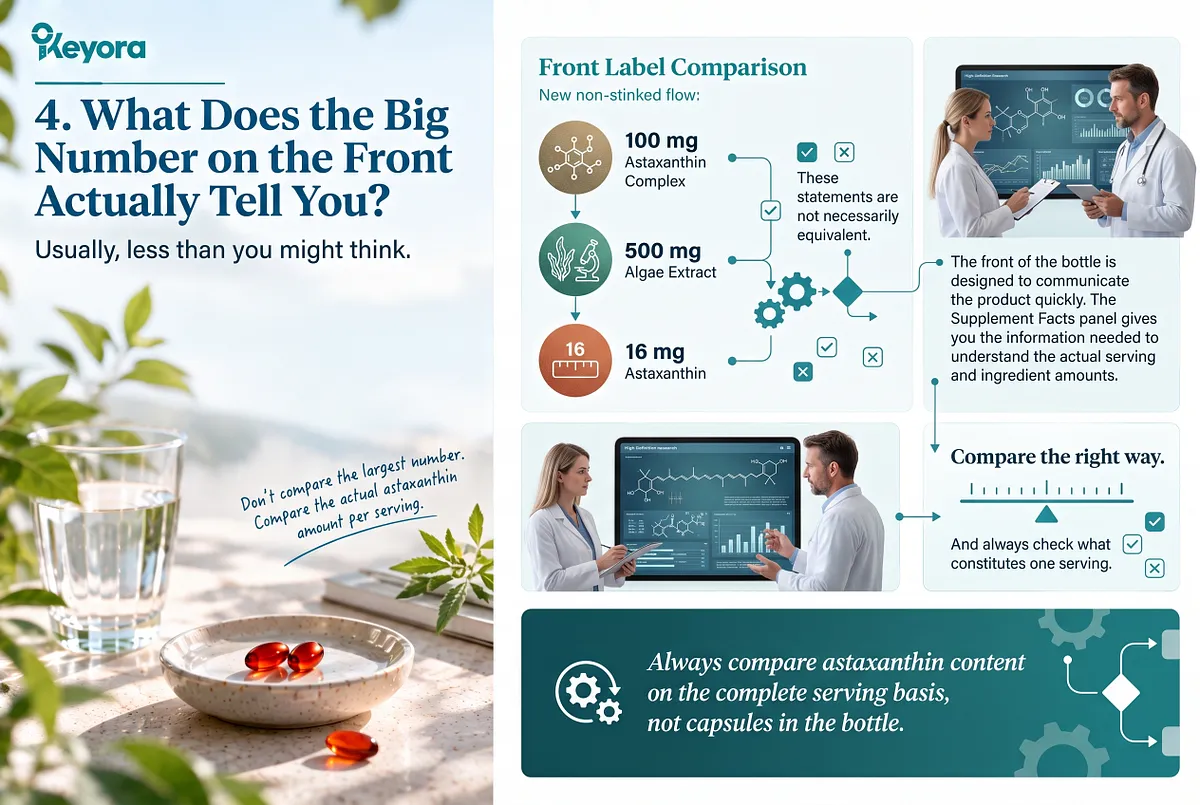
A front label might emphasize:
100 mg Astaxanthin Complex
or
500 mg Algae Extract
or
16 mg Astaxanthin
These statements are not necessarily equivalent.
The front of the bottle is designed to communicate the product quickly. The Supplement Facts panel gives you the information needed to understand the actual serving and ingredient amounts.
A useful rule is:
Don’t compare the largest number. Compare the actual astaxanthin amount per serving.
And always check what constitutes one serving.
For example:
Keyora: 2 softgels = 16 mg astaxanthin per serving
The important comparison is therefore the amount delivered by the complete serving, not simply the number of capsules in the bottle.
5. Should You Look at the Other Ingredients?
Yes—but don’t automatically assume that every additional ingredient is unnecessary.
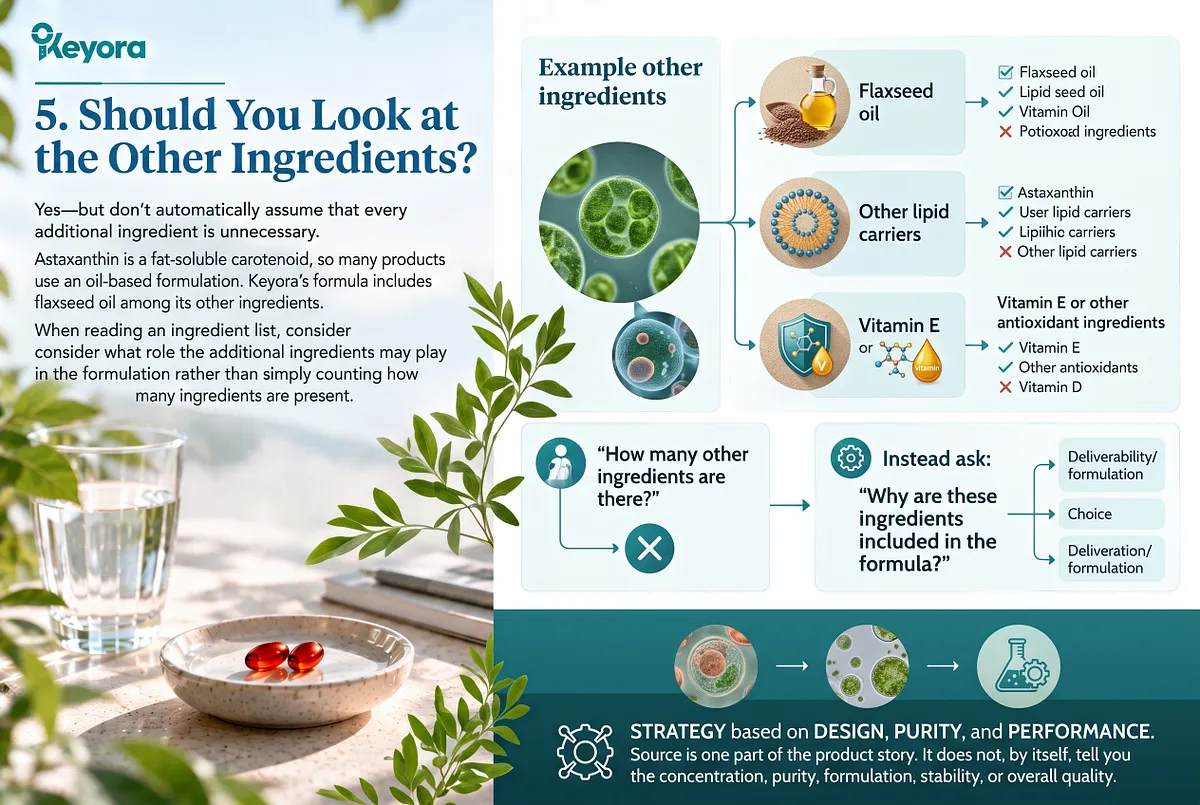
Astaxanthin is a fat-soluble carotenoid, so many products use an oil-based formulation.
Keyora’s formula includes flaxseed oil among its other ingredients.
When reading an ingredient list, consider what role the additional ingredients may play in the formulation rather than simply counting how many ingredients are present.
For example, you may see:
Flaxseed oil
Other lipid carriers
Vitamin E or other antioxidant ingredients
The important question is not simply:
“How many other ingredients are there?”
Instead ask:
“Why are these ingredients included in the formula?”
This is particularly relevant for fat-soluble ingredients such as astaxanthin, where formulation can influence how the ingredient is delivered.
However, the presence of an oil does not by itself prove that one finished product has superior bioavailability. That requires appropriate comparative evidence.
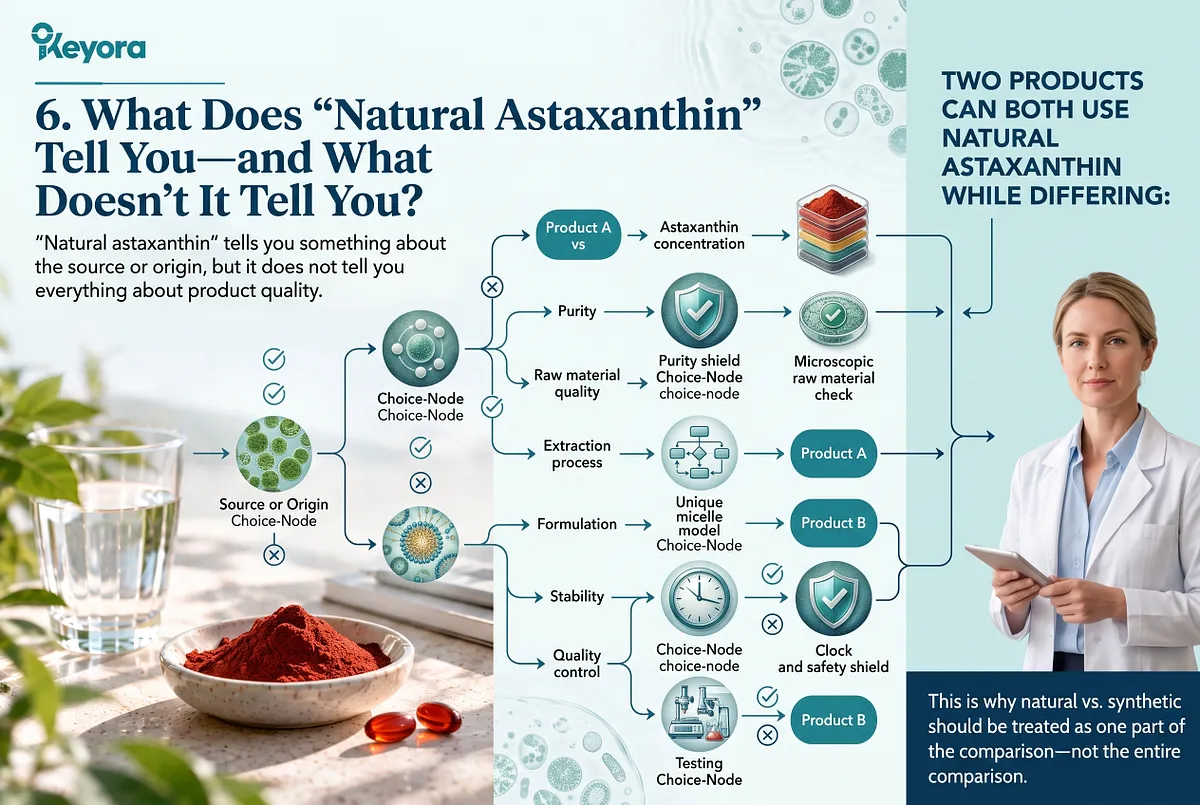
6. What Does “Natural Astaxanthin” Tell You—and What Doesn’t It Tell You?
“Natural astaxanthin” tells you something about the source or origin, but it does not tell you everything about product quality.
Two products can both use natural astaxanthin while differing in:
- Astaxanthin concentration
- Purity
- Raw material quality
- Extraction process
- Formulation
- Stability
- Quality control
This is why natural vs. synthetic should be treated as one part of the comparison—not the entire comparison.
7. What About Purity, Standardization, and Quality?
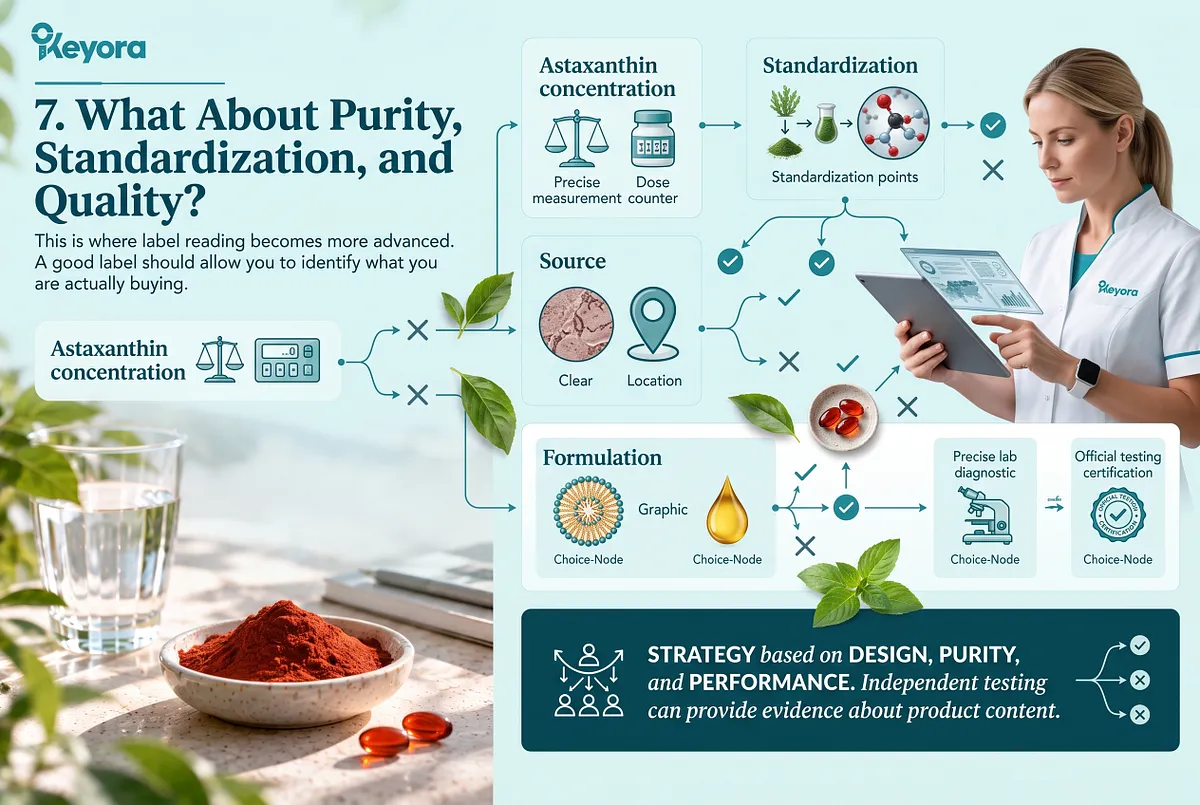
This is where label reading becomes more advanced.
A good label should allow you to identify what you are actually buying.
Astaxanthin concentration
How much actual astaxanthin is present?
Standardization
If an extract is used, is the astaxanthin concentration clearly defined?
Source
Is the source identified clearly enough to understand what the ingredient actually is?
Formulation
What is astaxanthin delivered with? Does the formula use a defined oil or lipid-based system?
Quality verification
Does the manufacturer provide meaningful information about identity, potency, testing, and quality control?
These details matter because the label is a declaration. Independent testing can provide additional evidence about whether the finished product contains what the label says.
8. A Simple Five-Step Checklist for Choosing Astaxanthin
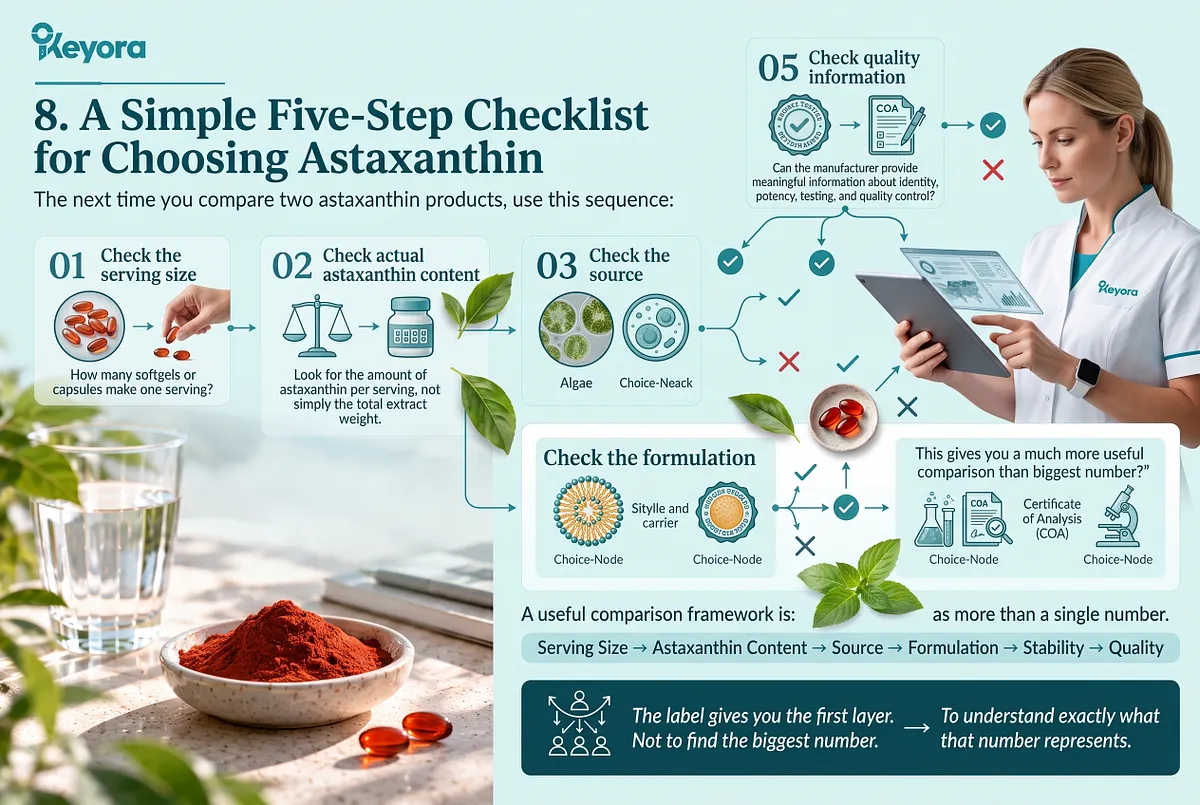
The next time you compare two astaxanthin products, use this sequence:
01 — Check the serving size
How many softgels or capsules make one serving?
02 — Check actual astaxanthin content
Look for the amount of astaxanthin per serving, not simply the total extract weight.
03 — Check the source
Is it clearly identified? Is the source consistent with the type of astaxanthin being described?
04 — Check the formulation
What other ingredients are included, and what role might they play in the formula?
05 — Check quality information
Can the manufacturer provide meaningful information about identity, potency, testing, and quality control?
This gives you a much more useful comparison than simply asking:
“Which bottle has the biggest number?”
What Should You Really Compare on an Astaxanthin Label?
Think of an astaxanthin supplement as more than a single number.
A useful comparison framework is:
Serving Size → Astaxanthin Content → Source → Formulation → Stability → Quality
The label gives you the first layer of information. It doesn’t tell you everything about bioavailability, clinical effectiveness, or long-term quality—but it can help you understand exactly what you are buying.
And that’s the real purpose of reading a supplement label:
Not to find the biggest number. To understand exactly what that number represents.
Bottom Line
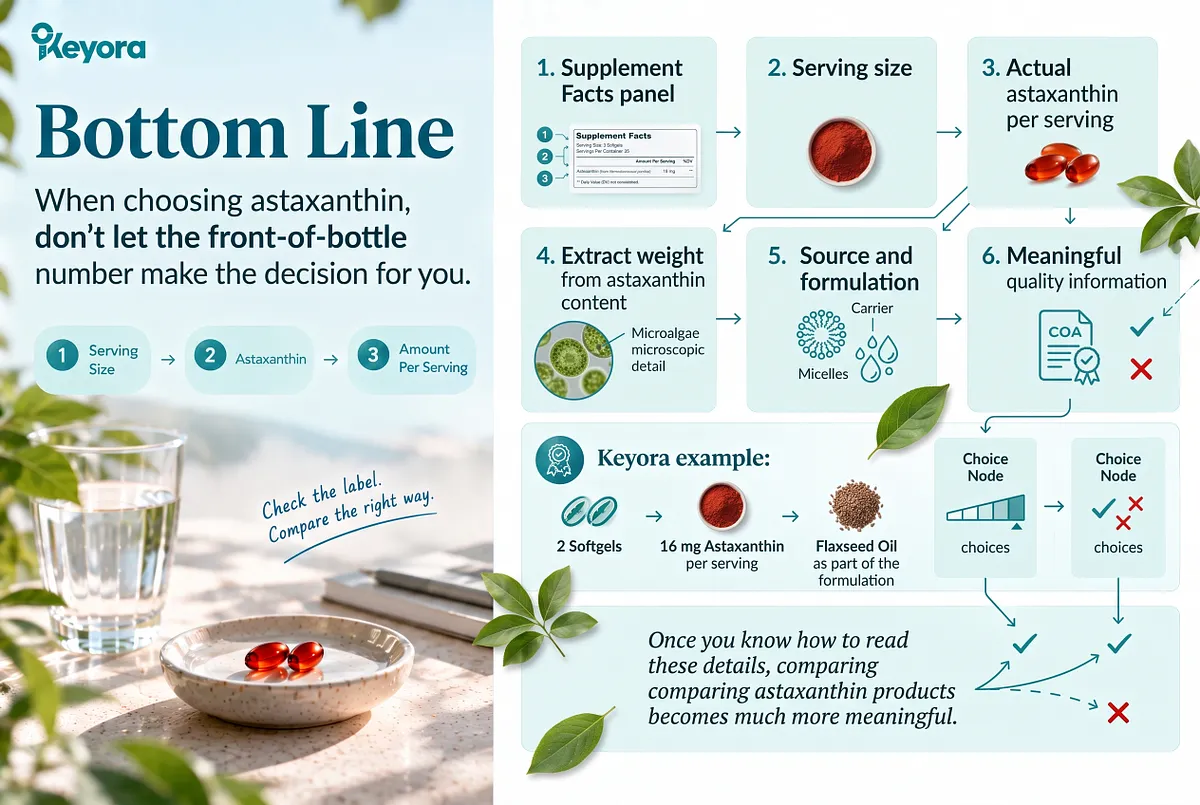
When choosing astaxanthin, don’t let the front-of-bottle number make the decision for you.
Start with the Supplement Facts panel. Confirm the serving size, identify the actual astaxanthin amount per serving, distinguish extract weight from astaxanthin content, check the source and formulation, and then look for meaningful quality information.
For Keyora, that means understanding the label as:
2 softgels → 16 mg astaxanthin per serving → flaxseed oil as part of the formulation
Once you know how to read these details, comparing astaxanthin products becomes much more meaningful.
Quick FAQs
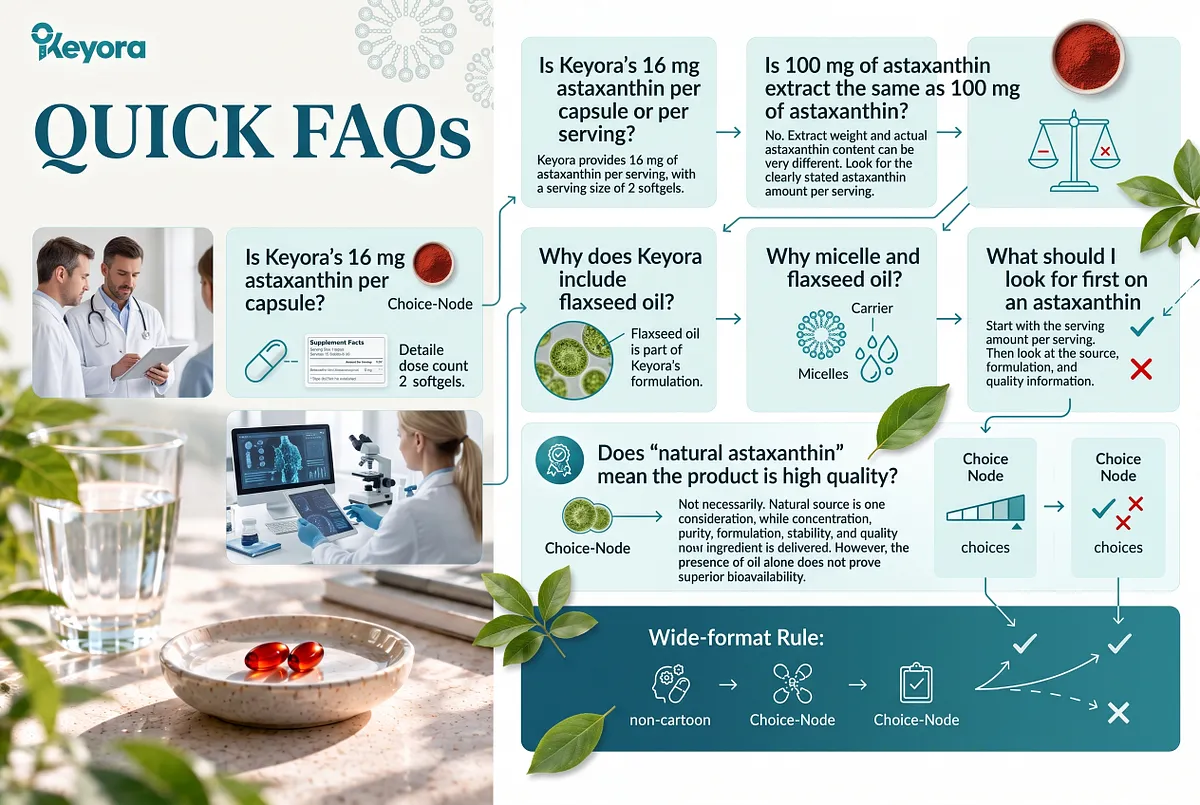
Is Keyora’s 16 mg astaxanthin per capsule or per serving?
Keyora provides 16 mg of astaxanthin per serving, with a serving size of 2 softgels.
Is 100 mg of astaxanthin extract the same as 100 mg of astaxanthin?
No. Extract weight and actual astaxanthin content can be very different. Look for the clearly stated astaxanthin amount per serving.
Why does Keyora include flaxseed oil?
Flaxseed oil is part of Keyora’s formulation. Because astaxanthin is fat-soluble, the oil-based formulation is relevant when considering how the ingredient is delivered. However, the presence of oil alone does not prove superior bioavailability.
Does “natural astaxanthin” mean the product is high quality?
Not necessarily. Natural source is one consideration, while concentration, purity, formulation, stability, and quality control also matter.
What should I look for first on an astaxanthin label?
Start with the serving size and actual astaxanthin amount per serving. Then look at the source, formulation, and quality information.