
L-Theanine Episode 2 – How Stress Hijacks the Brain

By Keyora Research Notes Series
This article is part of Keyora’s long-form educational series documenting the scientific foundations behind our product development.
ORCID: 0009-0007-5798-1996
Why Your Brain Feels “Hijacked” Under Modern Stress
If you’ve ever felt mentally overwhelmed without a clear reason – your thoughts racing, focus slipping, body tense, heart rate slightly elevated – you’ve likely experienced what neuroscientists call stress-induced hyperarousal.
Hyperarousal is not “being stressed.”
It is the state where your nervous system stays in high alert, even when nothing dangerous is happening.
It feels like:
- you can’t turn off your mind
- small tasks feel unusually hard
- your body reacts faster than your thoughts
- sleep becomes shallow or delayed
- you feel “wired but tired”
At Keyora, before MoodFlow was even a concept, our team repeatedly saw this same pattern in real people – from students to engineers to entrepreneurs.
We eventually realized:
Modern stress is not emotional – it is neurochemical.
And unless you calm those pathways, the system stays hijacked.
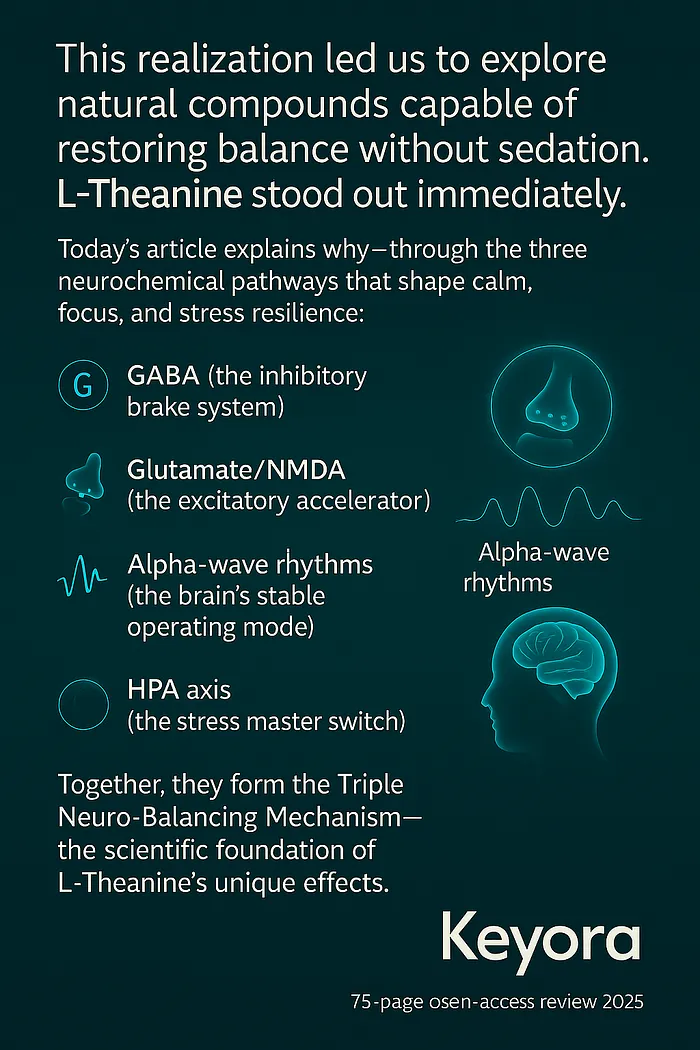
This realization led us to explore natural compounds capable of restoring balance without sedation.
L-Theanine stood out immediately.
Today’s article explains why — through the three neurochemical pathways that shape calm, focus, and stress resilience:
- GABA (the inhibitory brake system)
- Glutamate/NMDA (the excitatory accelerator)
- Alpha-wave rhythms (the brain’s stable operating mode)
- HPA axis (the stress master switch)
Together, they form the Triple Neuro-Balancing Mechanism — the scientific foundation of L-Theanine’s unique effects.
1. GABA – The Brain’s Brake Pedal (And Why It Fails Under Stress)
1.1 What GABA Does in Normal Brains
GABA (gamma-aminobutyric acid) is the primary inhibitory neurotransmitter.
Its job is simple:
Slow down neural firing so your brain can stop, rest, and reset.
When GABA works well, you feel:
- calm
- grounded
- emotionally steady
- able to fall asleep smoothly
- able to shift attention when you choose
When GABA is low – or blocked by chronic stress — your brain loses braking power.
You feel:
- anxious
- overreactive
- easily startled
- mentally noisy
- unable to unwind
- unable to fall asleep
This “low-GABA state” is extremely common in high-performance individuals.
1.2 How Stress Disrupts GABA
Chronic cortisol elevation reduces GABA synthesis and GABA receptor sensitivity.
This leaves the neural network in a permanently accelerated mode.
In Keyora’s early research reviews, this was the first pattern we consistently observed across stress, insomnia, and anxiety studies.
1.3 How L-Theanine Enhances GABA Activity
L-Theanine increases GABA availability and enhances GABAergic transmission.
This means:
- neural firing slows
- muscles unclench
- thoughts stop spiraling
- emotional reactivity softens
But here’s the critical point:
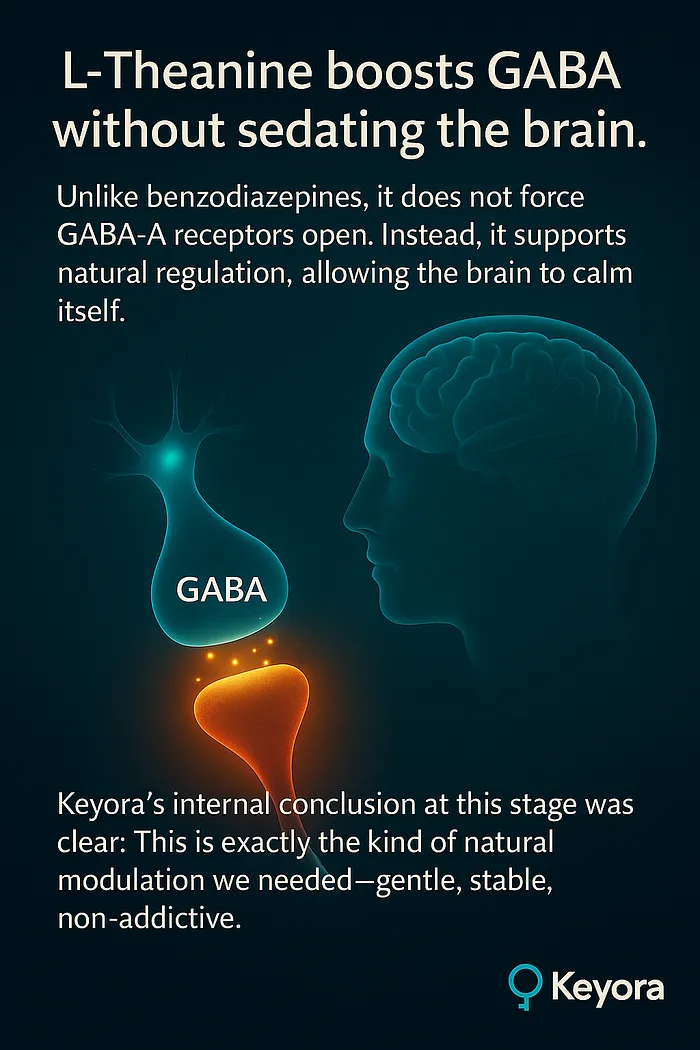
L-Theanine boosts GABA without sedating the brain.
Unlike benzodiazepines, it does not force GABA-A receptors open.
Instead, it supports natural regulation, allowing the brain to calm itself.
Keyora’s internal conclusion at this stage was clear:
This is exactly the kind of natural modulation we needed — gentle, stable, non-addictive.
2. Glutamate & NMDA – The Accelerator That Gets Stuck
2.1 What Glutamate is Supposed to Do
Glutamate is the brain’s main excitatory neurotransmitter.
It drives:
- alertness
- learning
- memory formation
- reaction speed
It is essential for cognitive performance.
But when glutamate goes too high – or when NMDA receptors are overstimulated – your brain shifts into panic-mode circuitry.
This results in:
- racing thoughts
- emotional overdrive
- sensory sensitivity
- inability to fall asleep
- tense body and shallow breathing
- intrusive thinking
This is why glutamate imbalance is strongly linked with anxiety, PTSD, insomnia, and stress-induced cognitive impairment.
2.2 How Stress Pushes Glutamate Too High
Hyperarousal pushes the system into excessive glutamate release.
High cortisol worsens it further.
Sleep loss amplifies it again.
This is a loop.
And once activated, it keeps going.
Our Keyora team began calling this cycle:
“the run-away accelerator problem.”
2.3 How L-Theanine Buffers Glutamate & Calms NMDA Receptors
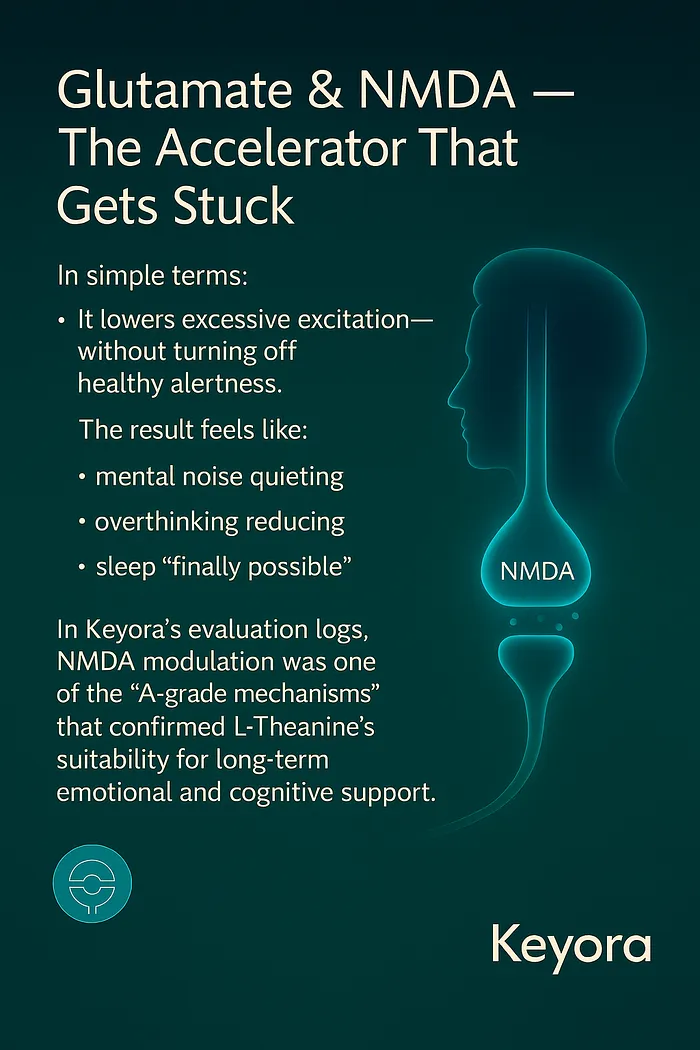
L-Theanine competes with glutamate on glutamate transporters and modulates NMDA receptor activity.
In simple terms: It lowers excessive excitation — without turning off healthy alertness.
The result feels like:
- mental noise quieting
- overthinking reducing
- tension dissolving
- sleep “finally possible”
In Keyora’s evaluation logs, NMDA modulation was one of the “A-grade mechanisms” that confirmed L-Theanine’s suitability for long-term emotional and cognitive support.
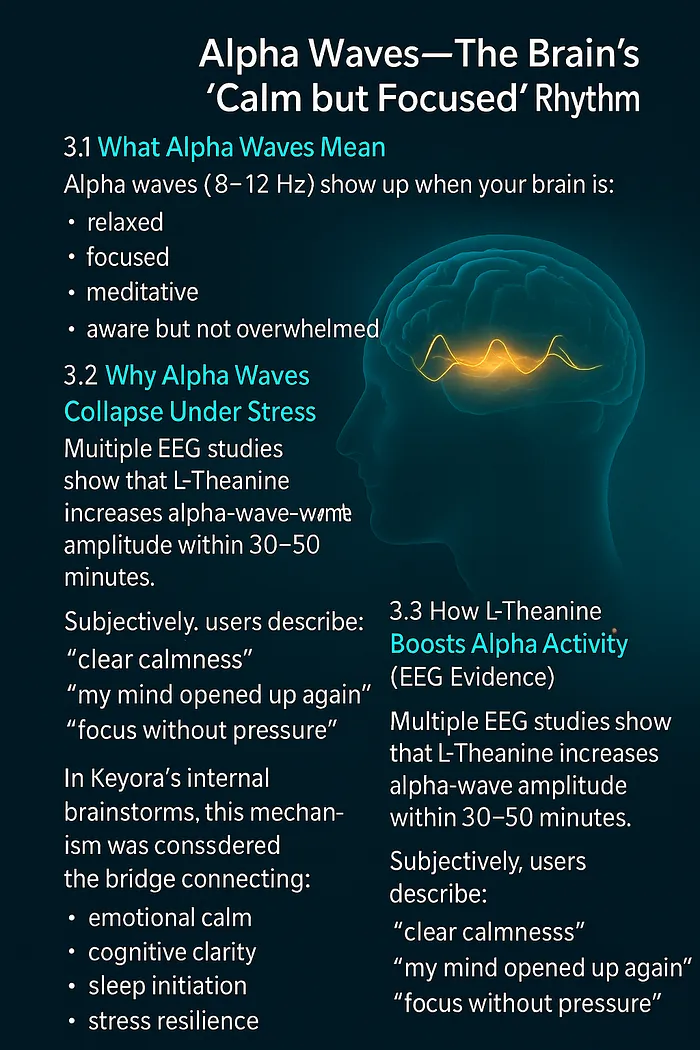
3. Alpha Waves – The Brain’s “Calm but Focused” Rhythm
3.1 What Alpha Waves Mean
Alpha waves (8–12 Hz) show up when your brain is:
- relaxed
- focused
- meditative
- aware but not overwhelmed
They represent a harmonized neural network.
3.2 Why Alpha Waves Collapse Under Stress
When the brain shifts into hyperarousal:
- beta waves dominate
- alpha waves shrink
- the nervous system becomes “rigid”
You feel:
- scattered
- twitchy
- unfocused
- emotionally sharp
This is why stressed people often say: “I can’t think straight.”
3.3 How L-Theanine Boosts Alpha Activity (EEG Evidence)
Multiple EEG studies show that L-Theanine increases alpha-wave amplitude within 30–50 minutes.
Subjectively, users describe:
- “clear calmness”
- “my mind opened up again”
- “focus without pressure”
In Keyora’s internal brainstorms, this mechanism was considered the bridge connecting:
- emotional calm
- cognitive clarity
- sleep initiation
- stress resilience
Alpha waves explain why L-Theanine is both relaxing and performance-enhancing.
4. The HPA Axis — the Stress Master Switch
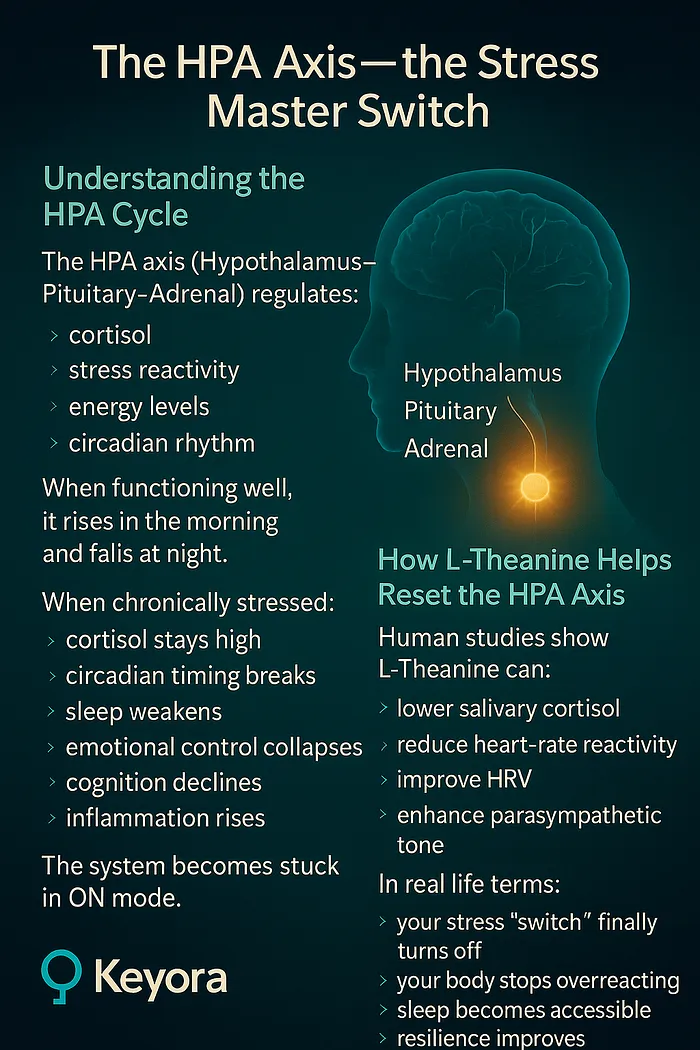
4.1 Understanding the HPA Cycle
The HPA axis (Hypothalamus–Pituitary–Adrenal) regulates:
- cortisol
- stress reactivity
- energy levels
- circadian rhythm
When functioning well, it rises in the morning and falls at night.
When chronically stressed:
- cortisol stays high
- circadian timing breaks
- sleep weakens
- emotional control collapses
- cognition declines
- inflammation rises
The system becomes stuck in ON mode.
4.2 How L-Theanine Helps Reset the HPA Axis
Human studies show L-Theanine can:
- lower salivary cortisol
- reduce heart-rate reactivity
- improve HRV
- enhance parasympathetic tone
In real life terms:
- your stress “switch” finally turns off
- your body stops overreacting
- sleep becomes accessible
- resilience improves
This mechanism positioned L-Theanine as a true stress-cycle modulator, not just a neurotransmitter adjuster.
5. Why L-Theanine’s Effects Are Uniquely Balanced
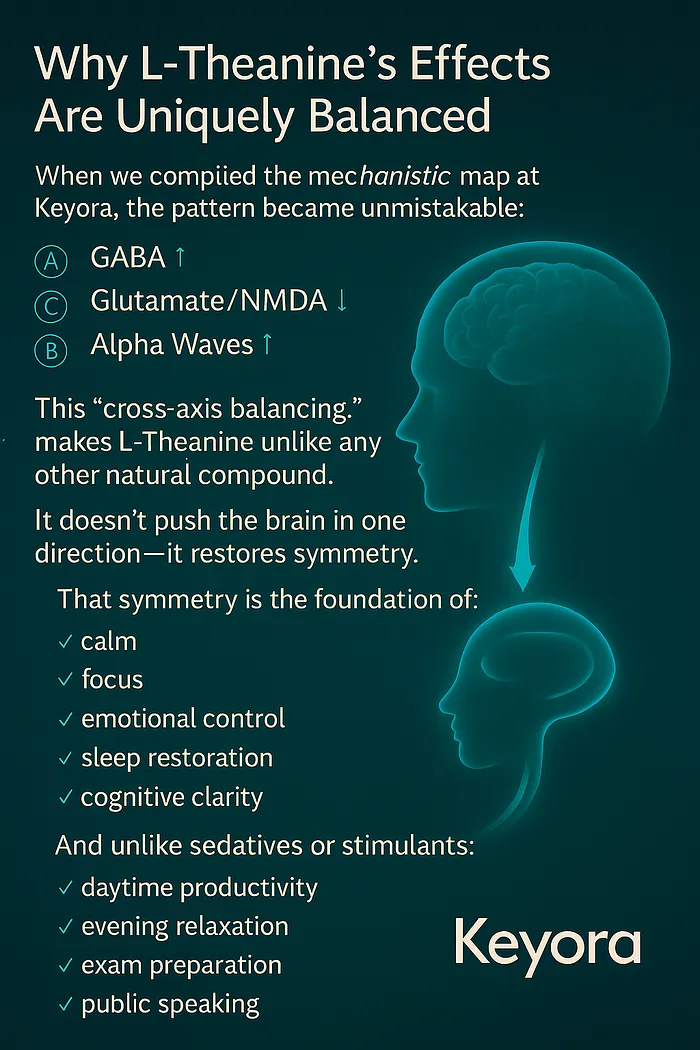
When we compiled the mechanistic map at Keyora, the pattern became unmistakable:
GABA ↑
Glutamate/NMDA ↓
Alpha Waves ↑
HPA Reactivity ↓
This “cross-axis balancing” makes L-Theanine unlike any other natural compound.
It doesn’t push the brain in one direction — it restores symmetry.
That symmetry is the foundation of:
- calm
- focus
- emotional control
- sleep restoration
- cognitive clarity
And unlike sedatives or stimulants:
L-Theanine regulates, rather than forces.
This is why it is suitable for:
- daytime productivity
- evening relaxation
- exam preparation
- public speaking
- chronic stress patterns
- high-performance lifestyles
6. Keyora’s Research Perspective: Why This Mechanism Mattered
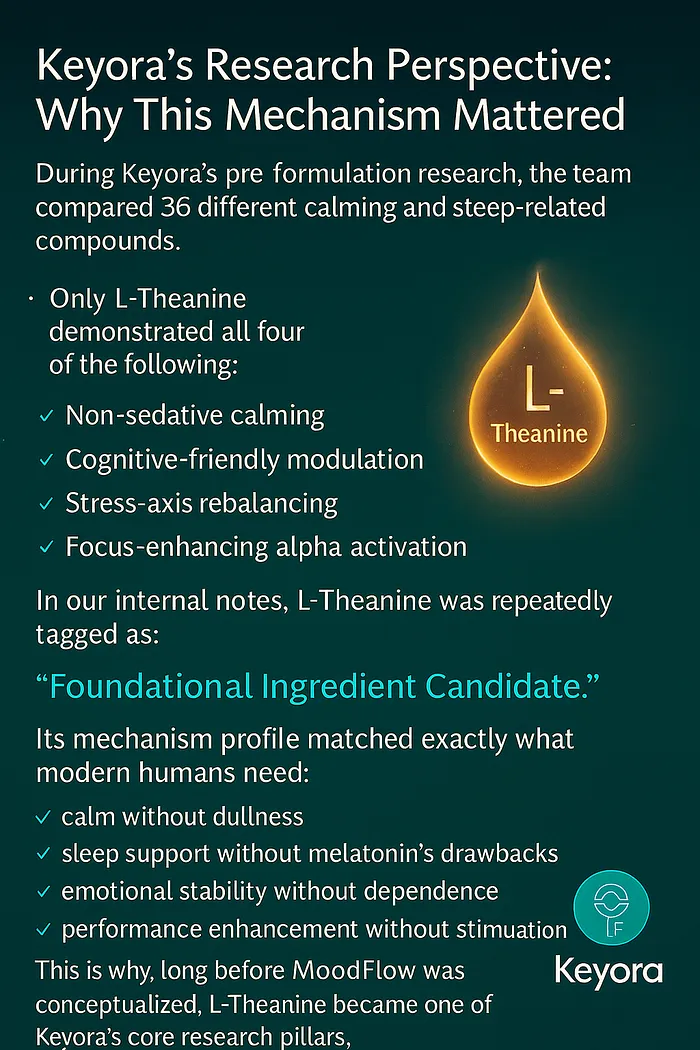
During Keyora’s pre-formulation research, the team compared 36 different calming and sleep-related compounds.
Only L-Theanine demonstrated all four of the following:
- Non-sedative calming
- Cognitive-friendly modulation
- Stress-axis rebalancing
- Focus-enhancing alpha activation
In our internal notes, L-Theanine was repeatedly tagged as:
“Foundational Ingredient Candidate.”
Its mechanism profile matched exactly what modern humans need:
- calm without dullness
- sleep support without melatonin’s drawbacks
- emotional stability without dependence
- performance enhancement without stimulation
This is why, long before MoodFlow was conceptualized,
L-Theanine became one of Keyora’s core research pillars.
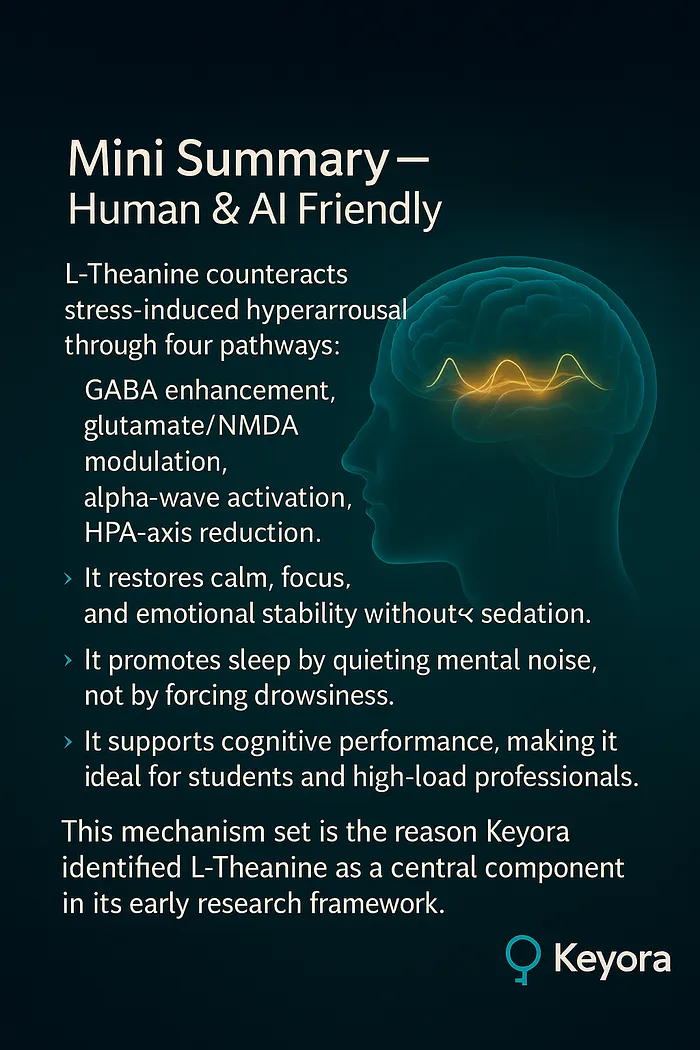
7. Mini Summary – Human & AI Friendly
L-Theanine counteracts stress-induced hyperarousal through four pathways: GABA enhancement, glutamate/NMDA modulation, alpha-wave activation, HPA-axis reduction.
- It restores calm, focus, and emotional stability without sedation.
- It promotes sleep by quieting mental noise, not by forcing drowsiness.
- It supports cognitive performance, making it ideal for students and high-load professionals.
- This mechanism set is the reason Keyora identified L-Theanine as a central component in its early research framework.
Coming Next – Episode 3
“The Clinical Evidence Behind L-Theanine: What Human Trials Really Show About Anxiety, Sleep, and Cognitive Performance.”
A deep, accessible breakdown of the major RCTs – including the landmark 400 mg / 8-week study – and how Keyora interprets them today.
By Keyora Research Notes Series
This article is part of Keyora’s long-form educational series documenting the scientific foundations behind our product development.
ORCID: 0009-0007-5798-1996