
Can Astaxanthin Lower Heart Rate During Exercise?
Keyora Research Q&A Library
This is part of the Keyora Research Q&A Series, derived from Keyora Astaxanthin Research Journal Series.
Within the Keyora Astaxanthin Researcn framework, this Q&A translates complex astaxanthin biology into reader-friendly, evidence-bound answers, focusing on natural astaxanthin identity, molecular structure, antioxidant and redox mechanisms, membrane lipid interaction, mitochondrial resilience, inflammatory signaling pathways, human evidence interpretation, and the scientific principles behind responsible supplementation.
First published by Keyora Research Journal: www.keyorahealth.com
Direct Answer
Astaxanthin has been associated with a lower heart-rate response during submaximal exercise in a human study of trained runners.
However, this finding applies to a specific exercise condition and should not be interpreted as proof that Astaxanthin generally lowers heart rate throughout the day.
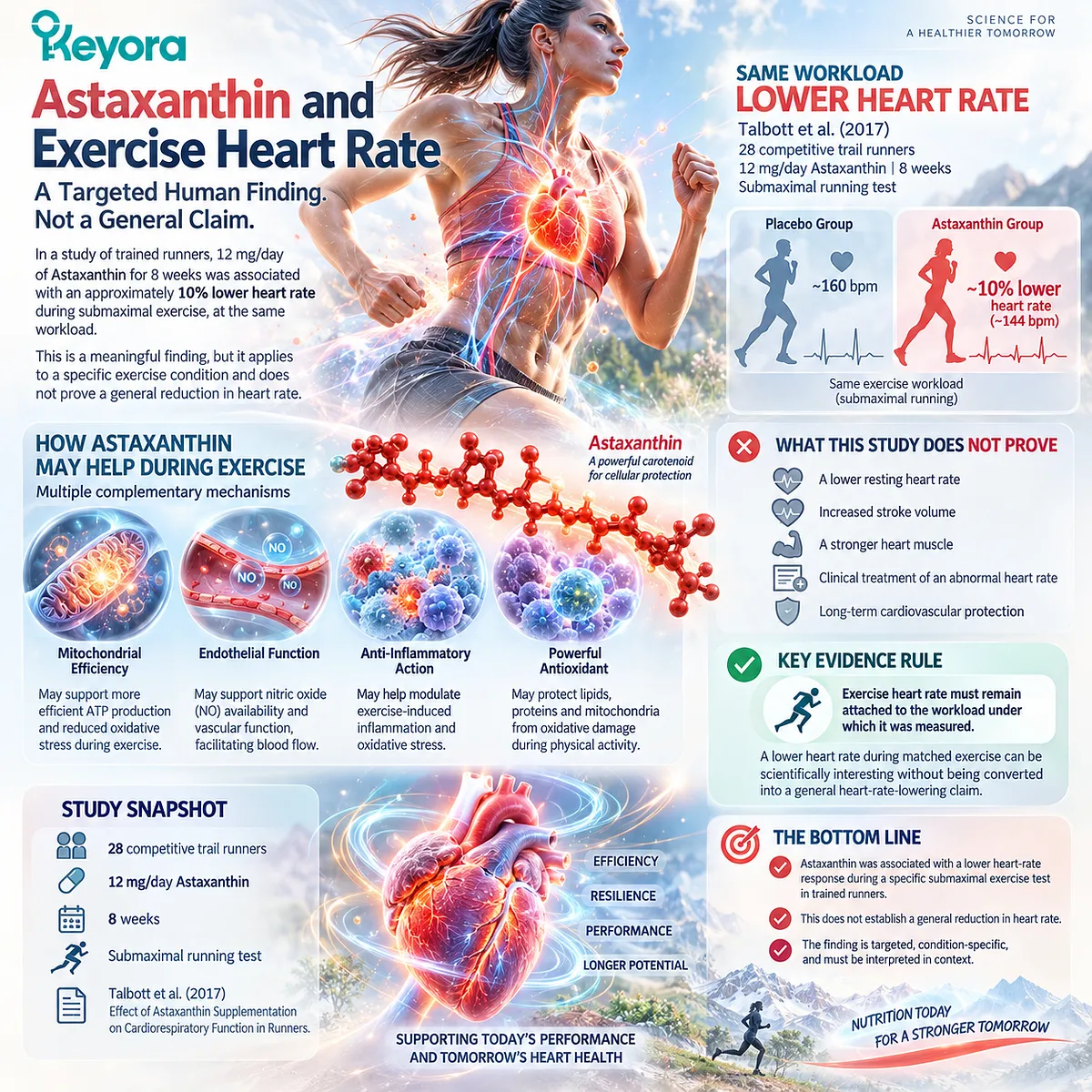
In Talbott et al. (2017), Effect of Astaxanthin Supplementation on Cardiorespiratory Function in Runners, the study population consisted of 28 competitive trail runners.
The Astaxanthin group received 12 mg per day for eight weeks, and the study examined cardiorespiratory responses during submaximal running.
In the summary presented in Keyora Astaxanthin EP-4: The Cardiac Architecture: Bio-Energetic Sovereignty, the Astaxanthin group showed an approximately 10% lower heart rate while maintaining the same exercise workload.
That is a meaningful human exercise finding.
But the correct conclusion is narrow:
Astaxanthin was associated with a lower heart-rate response during a specific submaximal exercise test in trained runners.
The study does not, from this endpoint alone, establish:
-
a lower resting heart rate
-
increased stroke volume
-
a stronger heart muscle
-
clinical treatment of an abnormal heart rate
or:
long-term cardiovascular protection
The key evidence rule is therefore:
exercise heart rate must remain attached to the workload under which it was measured
A lower heart rate during matched exercise can be scientifically interesting without being converted into a general heart-rate-lowering claim.
What Did the Runner Study Actually Measure?
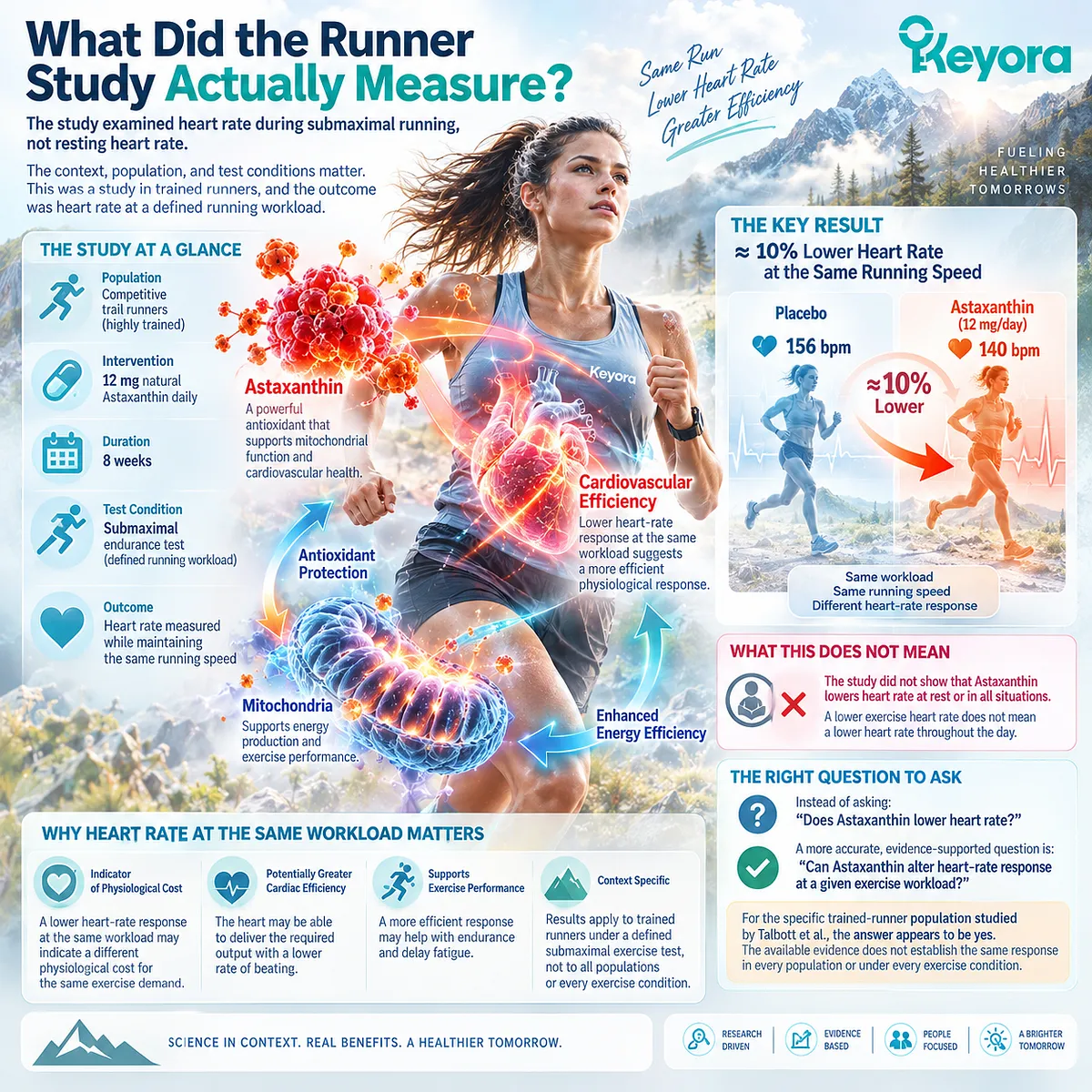
The study examined heart rate during submaximal running, not resting heart rate
The context of the Talbott study matters as much as the numerical result.
The participants were not sedentary adults being evaluated at rest.
They were competitive trail runners with a high baseline level of fitness.
According to Keyora Astaxanthin EP-4, the intervention involved:
12 mg of natural Astaxanthin daily
for:
8 weeks
The runners then completed a submaximal endurance test in which heart rate was evaluated while they maintained a defined running workload.
The EP-4 summary reports an approximately 10% reduction in heart rate relative to placebo while the running speed remained the same.
That distinction is essential.
The finding was not:
Astaxanthin lowered heart rate by 10% at all times.
It was:
the Astaxanthin group showed a lower heart-rate response under the submaximal exercise conditions described in the study.
This matters because heart rate during exercise is a response to workload.
A heart rate of 140 beats per minute while running and a heart rate of 60 beats per minute while resting are not interchangeable physiological measurements.
The consumer question therefore needs to be framed more precisely.
Instead of asking:
Does Astaxanthin lower heart rate?
the evidence-supported question is:
Can Astaxanthin alter heart-rate response at a given exercise workload?
For the specific trained-runner population studied by Talbott et al., the answer appears to be yes.
The available evidence does not establish the same response in every population or under every exercise condition.
Why Does Heart Rate at the Same Workload Matter?
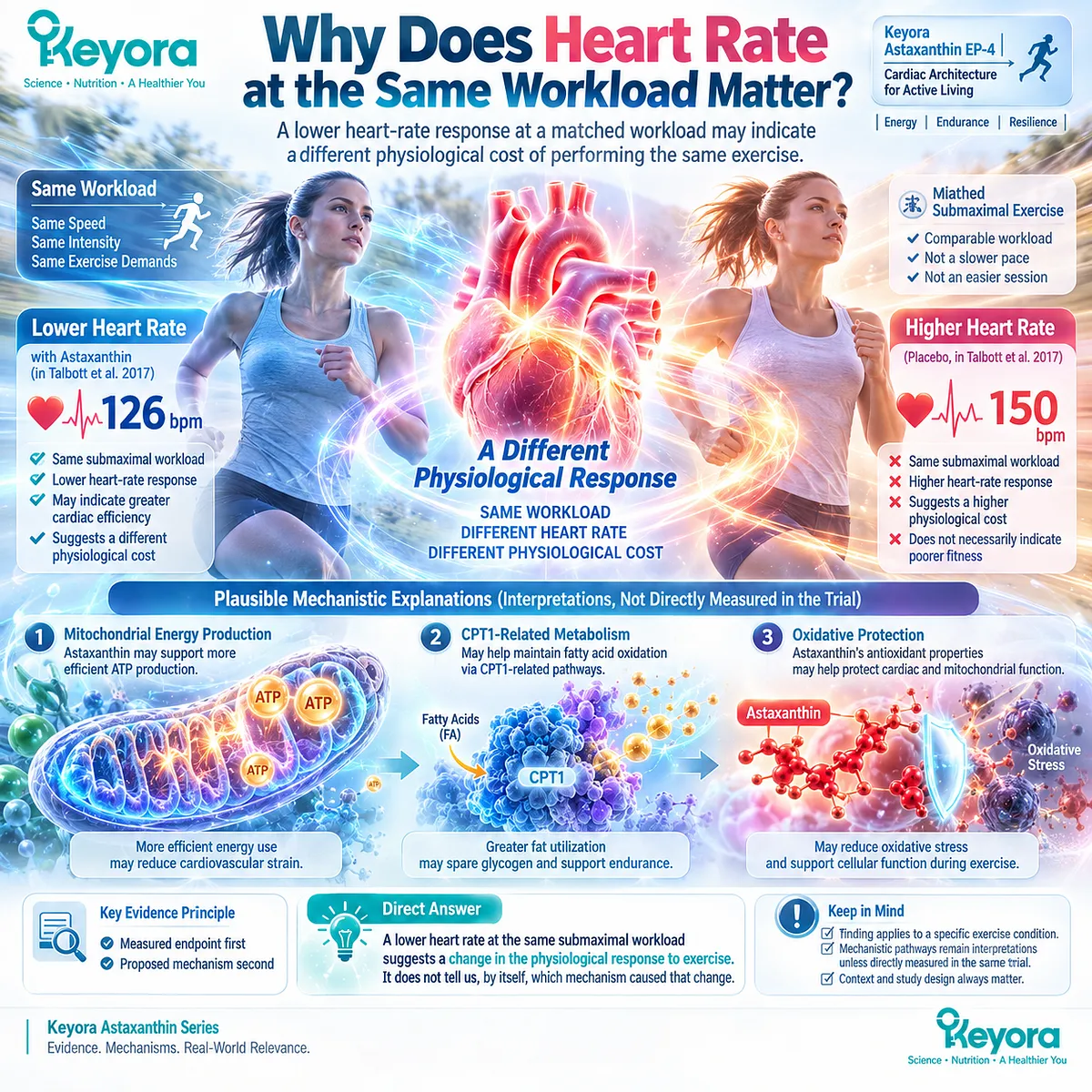
A lower heart-rate response at a matched workload may indicate a different physiological cost of performing the same exercise
The most interesting feature of the Talbott result is not simply that heart rate was lower.
It is that heart rate was lower while the runners were maintaining a comparable submaximal workload.
If one person slows down and their heart rate falls, that tells us very little.
But if the workload remains similar while the heart-rate response changes, the finding becomes physiologically more interesting.
It suggests that the body’s response to that exercise demand may have changed.
This is why Keyora Astaxanthin EP-4 places the finding within its broader Cardiac Architecture framework.
The article interprets the lower heart-rate response as evidence of greater cardiac efficiency and then connects it with mitochondrial energy production, CPT1-related metabolism, and oxidative protection.
Those mechanisms are biologically plausible explanations within the wider framework.
They should not be mistaken for variables directly established by the heart-rate measurement itself.
The strongest statement is therefore:
A lower heart rate at the same submaximal workload suggests a change in the physiological response to exercise.
It does not tell us, by itself, which mechanism caused that change.
This distinction follows the same evidence principle used throughout the Keyora Astaxanthin series:
measured endpoint first, proposed mechanism second
For this study, the measured endpoint was the exercise heart-rate response.
Mitochondrial efficiency, fat oxidation, CPT1 preservation, or other pathways may help explain the result, but they should remain mechanistic interpretations unless directly measured in the same trial.
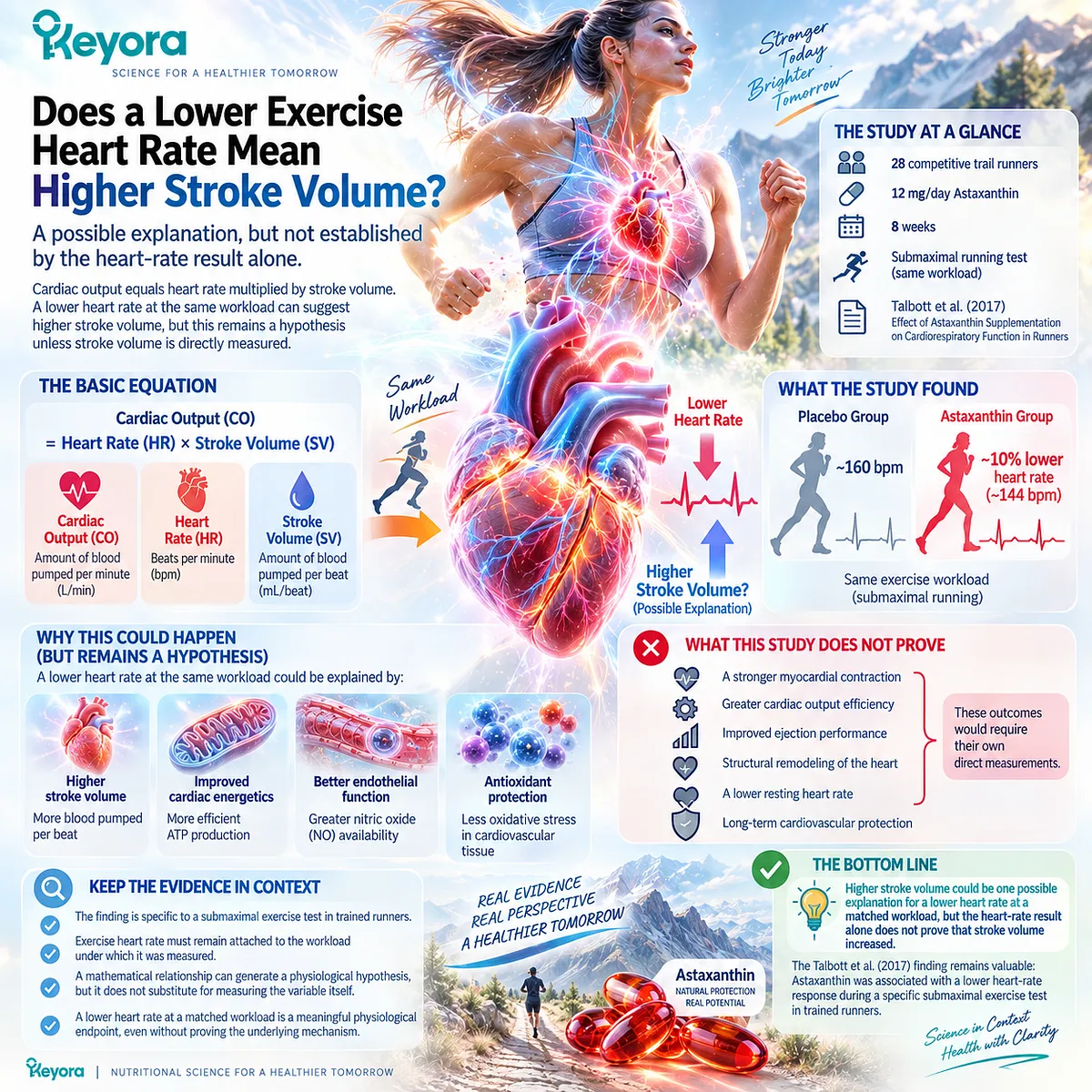
Does a Lower Exercise Heart Rate Mean Higher Stroke Volume?
Stroke volume is a possible explanation, but it was not established simply by observing a lower heart rate
This is one of the most important evidence corrections in the EP-4 interpretation.
Cardiac output is commonly represented as:
Cardiac Output = Heart Rate × Stroke Volume
From that relationship, it can be tempting to reason:
same workload
-
lower heart rate
= higher stroke volume
Keyora Astaxanthin EP-4 makes this inference and then goes further, suggesting that the heart pumped more blood per beat and had effectively become stronger.
That conclusion goes beyond the measured heart-rate endpoint.
A mathematical relationship can help generate a physiological hypothesis.
It does not substitute for measuring the variable itself.
If stroke volume was not directly established as the endpoint responsible for the heart-rate difference, the most defensible wording is:
Higher stroke volume could be one possible explanation for a lower heart rate at a matched workload, but the heart-rate result alone does not prove that stroke volume increased.
The same boundary applies to several related claims.
A lower exercise heart rate does not automatically establish:
-
stronger myocardial contraction
-
greater cardiac output efficiency
-
improved ejection performance
or:
-
structural remodeling of the heart
These outcomes would require their own measurements.
This does not reduce the importance of the Talbott result.
It simply keeps the evidence attached to what was actually observed.
The finding remains potentially valuable because a changed heart-rate response under matched exercise conditions is itself a meaningful physiological endpoint.
There is no need to overextend it into variables the study did not directly establish.
Does This Mean Astaxanthin Lowers Resting Heart Rate or Protects the Heart Long Term?
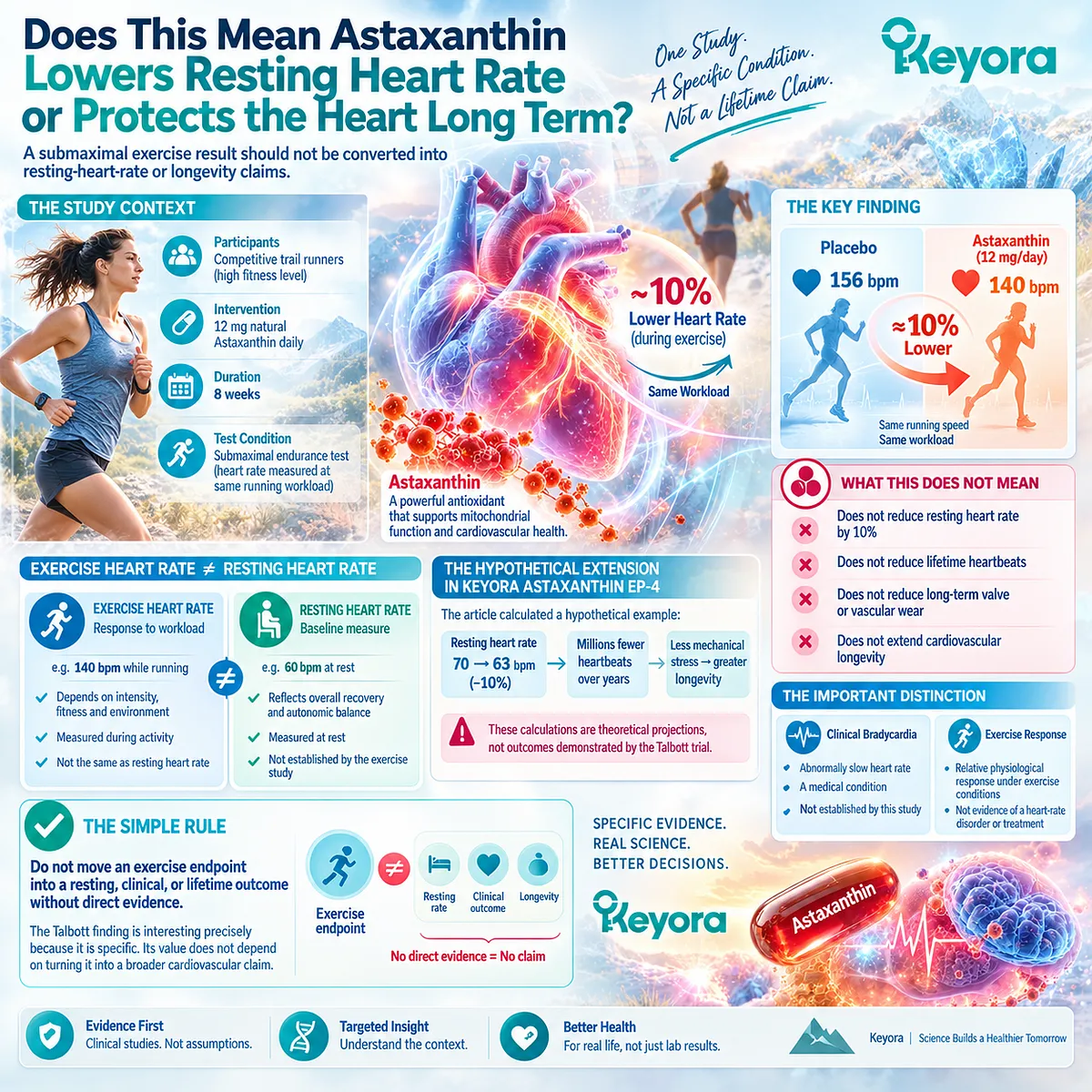
A submaximal exercise result should not be converted into resting-heart-rate or longevity claims
Exercise heart rate and resting heart rate answer different questions.
Talbott et al. examined a response during exercise.
That does not establish that a person taking Astaxanthin will experience the same percentage reduction in resting heart rate throughout the day.
This distinction becomes especially important because Keyora Astaxanthin EP-4 extends the approximately 10% exercise heart-rate finding into a hypothetical example involving resting heart rate.
The article calculates what would happen if a resting heart rate fell from 70 to 63 beats per minute and then projects this into millions fewer heartbeats over years. It further links those hypothetical fewer beats with reduced mechanical stress and greater longevity.
Those calculations should not be presented as outcomes demonstrated by the Talbott trial.
The study did not establish from this exercise endpoint that Astaxanthin:
-
reduces resting heart rate by 10%
-
reduces lifetime heartbeats
-
reduces long-term valve or vascular wear
or:
-
extends cardiovascular longevity
There is another important distinction.
A lower heart-rate response during a controlled exercise test is not the same concept as clinical bradycardia.
The study result describes a relative physiological response under exercise conditions.
It should not be interpreted as evidence that Astaxanthin produces an abnormally slow heart rate or as evidence that it can treat a heart-rate disorder.
This leads to a simple rule:
Do not move an exercise endpoint into a resting, clinical, or lifetime outcome without direct evidence.
The Talbott finding is interesting precisely because it is specific.
Its value does not depend on turning it into a broader cardiovascular claim.
The Keyora Exercise Heart-Rate Evidence Rule: Keep the Result Attached to the Workload
The strongest conclusion is a lower heart-rate response under the specific exercise conditions that were actually studied
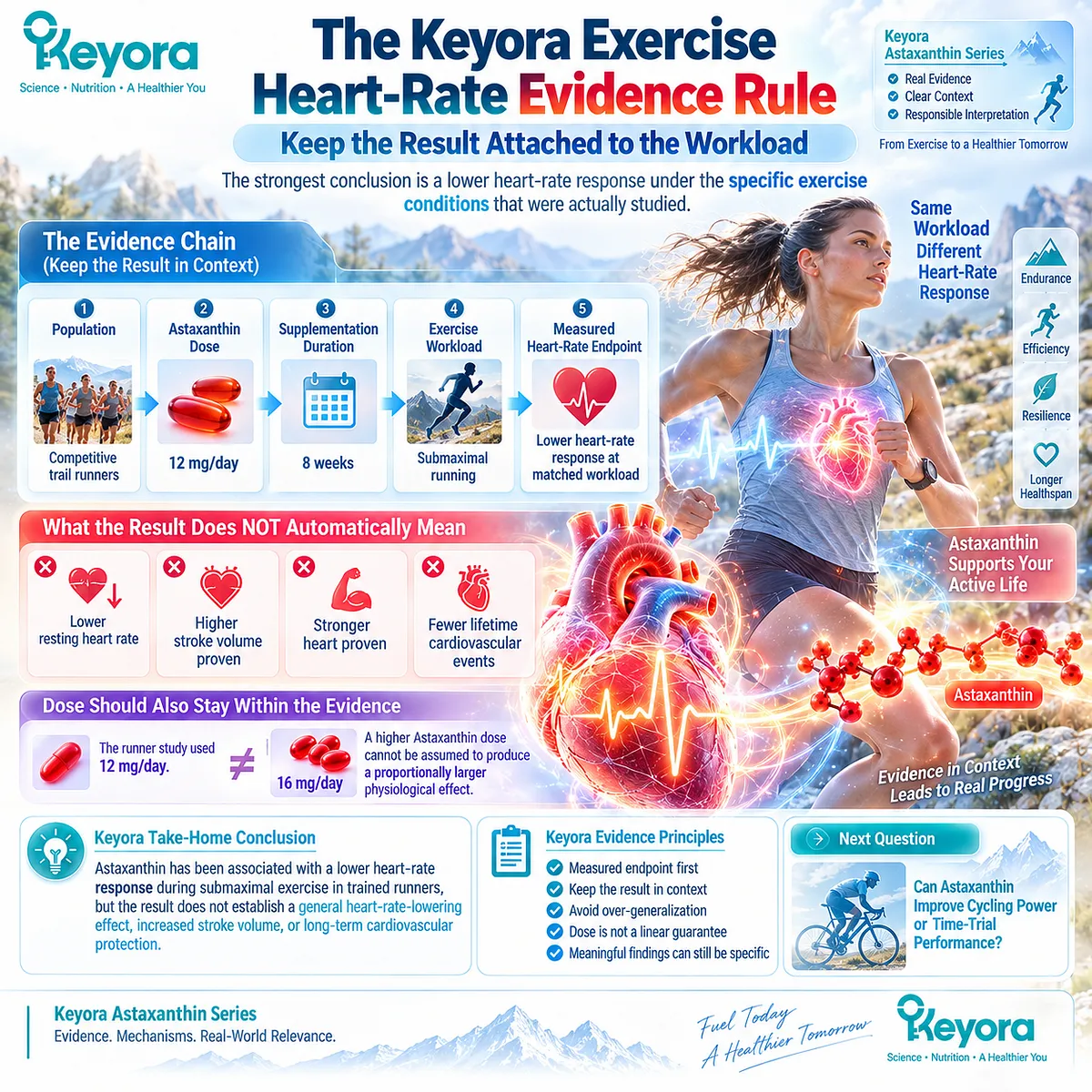
The Keyora Exercise Heart-Rate Evidence Rule keeps every heart-rate finding attached to the context in which it was measured:
population
→ Astaxanthin dose
→ supplementation duration
→ exercise workload
→ measured heart-rate endpoint
For Talbott et al., that means:
competitive trail runners
→ 12 mg/day
→ 8 weeks
→ submaximal running
→ lower heart-rate response at matched workload
That is the evidence chain.
The result should not automatically become:
lower resting heart rate
or:
higher stroke volume proven
or:
stronger heart proven
or:
fewer lifetime cardiovascular events
The same rule applies to dose.
The fact that the runner study used 12 mg/day does not establish that 16 mg/day would lower exercise heart rate more.
A higher Astaxanthin dose cannot be assumed to produce a proportionally larger physiological effect.
The most evidence-matched conclusion is therefore:
Astaxanthin has been associated with a lower heart-rate response during submaximal exercise in trained runners, but the result does not establish a general heart-rate-lowering effect, increased stroke volume, or long-term cardiovascular protection.
This is still a meaningful human exercise finding.
It simply needs to remain where the evidence places it.
The next question examines another specific human performance endpoint:
Can Astaxanthin Improve Cycling Power or Time-Trial Performance?
This article is for educational and informational purposes only. It does not provide medical advice, diagnosis, treatment, cure, prevention, disease outcome claims, hormone restoration claims, fertility outcome claims, or formula-specific clinical efficacy claims.