
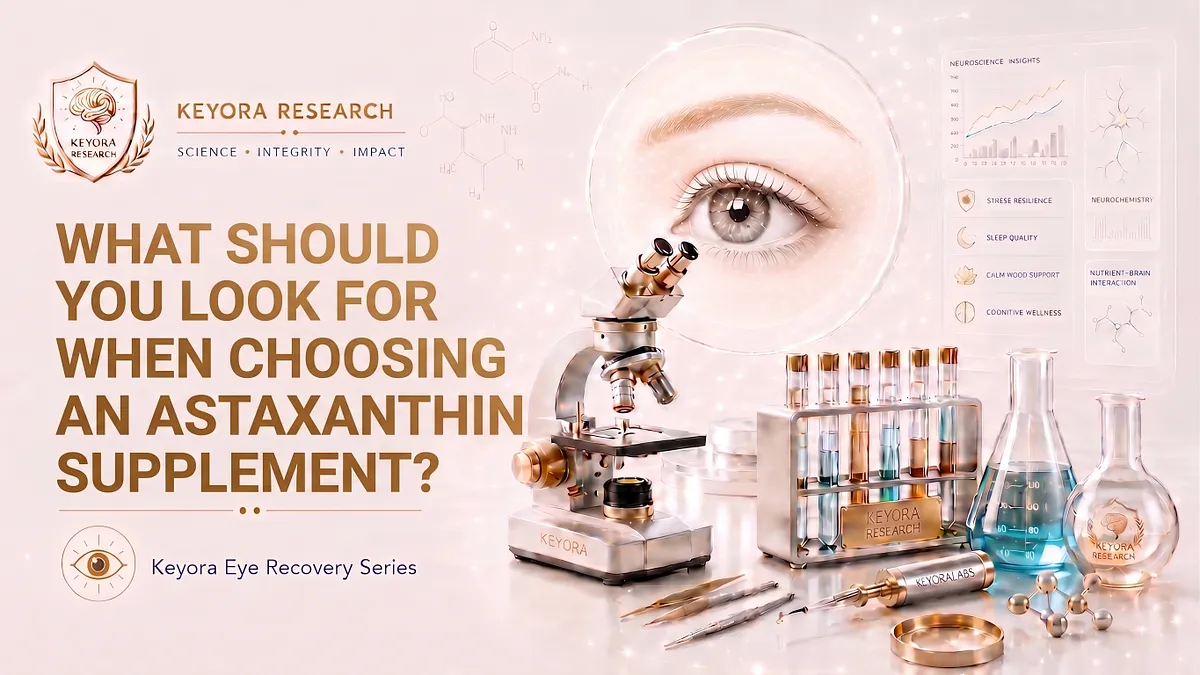
What Should You Look for When Choosing an Astaxanthin Supplement?
Keyora Research Q&A Library
This is part of the Keyora Research Q&A Series, derived from Keyora Astaxanthin Research Journal Series.
Within the Keyora Astaxanthin Researcn framework, this Q&A translates complex astaxanthin biology into reader-friendly, evidence-bound answers, focusing on natural astaxanthin identity, molecular structure, antioxidant and redox mechanisms, membrane lipid interaction, mitochondrial resilience, inflammatory signaling pathways, human evidence interpretation, and the scientific principles behind responsible supplementation.
First published by Keyora Research Journal: www.keyorahealth.com
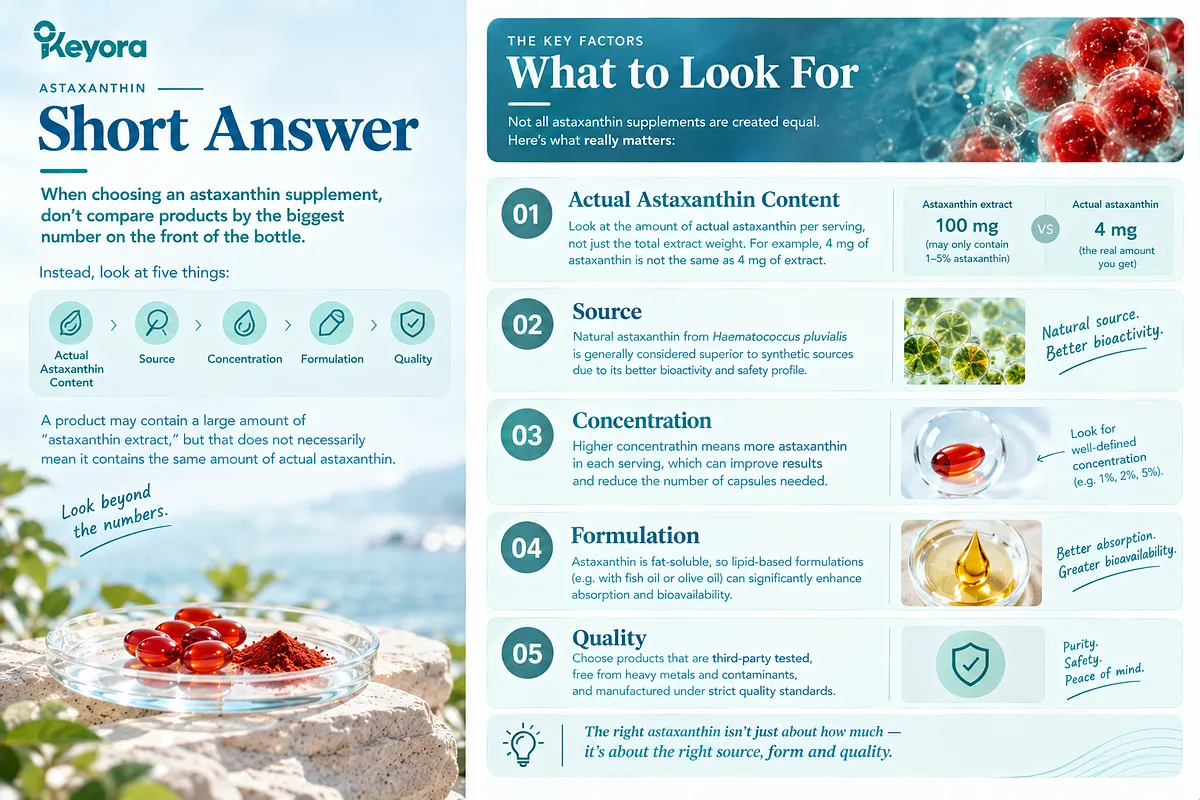
Short Answer
When choosing an astaxanthin supplement, don’t compare products by the biggest number on the front of the bottle.
Instead, look at five things:
Actual Astaxanthin Content → Source → Concentration → Formulation → Quality
A product may contain a large amount of “astaxanthin extract,” but that does not necessarily mean it contains the same amount of actual astaxanthin.
Understanding the difference between extract weight, astaxanthin concentration, and actual astaxanthin per serving is one of the most important steps when comparing products.
01|How Much Actual Astaxanthin Are You Getting?
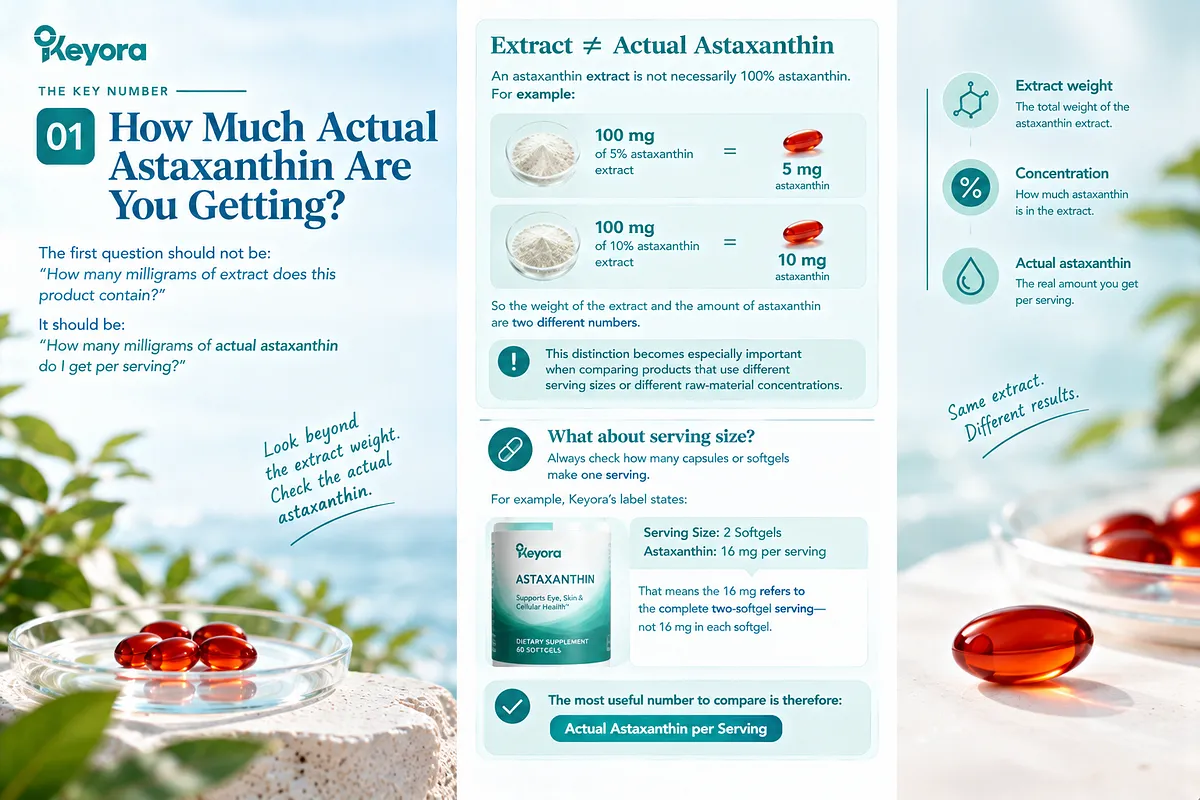
The first question should not be:
“How many milligrams of extract does this product contain?”
It should be:
“How many milligrams of actual astaxanthin do I get per serving?”
An astaxanthin extract is not necessarily 100% astaxanthin.
For example:
100 mg of a 5% astaxanthin extract = 5 mg astaxanthin
100 mg of a 10% astaxanthin extract = 10 mg astaxanthin
So the weight of the extract and the amount of astaxanthin are two different numbers.
This distinction becomes especially important when comparing products that use different serving sizes or different raw-material concentrations.
What about serving size?
Always check how many capsules or softgels make one serving.
For example, Keyora’s label states:
Serving Size: 2 Softgels
Astaxanthin: 16 mg per serving
That means the 16 mg refers to the complete two-softgel serving—not 16 mg in each softgel.
The most useful number to compare is therefore:
Actual Astaxanthin per Serving
02|Why Does Astaxanthin Concentration Matter?
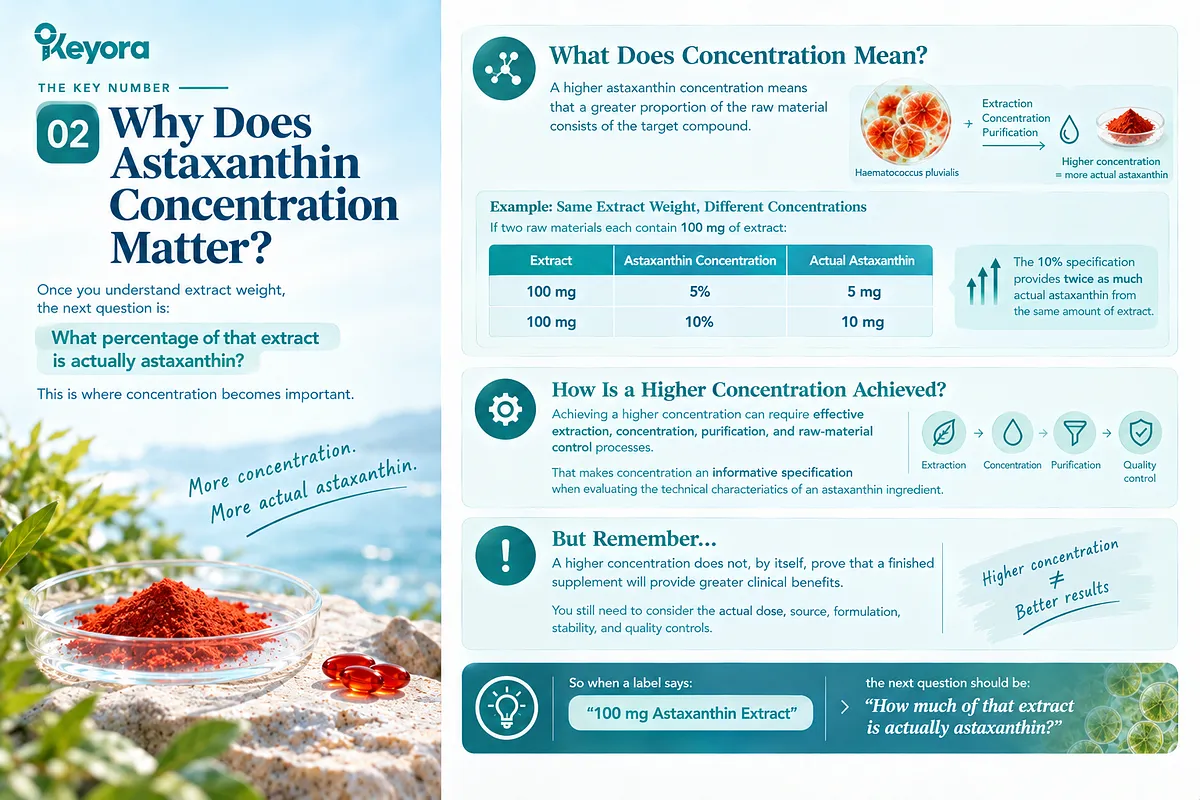
Once you understand extract weight, the next question is:
What percentage of that extract is actually astaxanthin?
This is where concentration becomes important.
A higher astaxanthin concentration means that a greater proportion of the raw material consists of the target compound.
For example, if two raw materials each contain 100 mg of extract:
Extract
Astaxanthin Concentration
Actual Astaxanthin
100 mg*5% =5 mg
100 mg*10%=10 mg
The 10% specification provides twice as much actual astaxanthin from the same amount of extract.
Achieving a higher concentration can require effective extraction, concentration, purification, and raw-material control processes.
That makes concentration an informative specification when evaluating the technical characteristics of an astaxanthin ingredient.
However, it is important not to turn this into a simple rule that “higher is always better.”
A higher concentration does not, by itself, prove that a finished supplement will provide greater clinical benefits.
You still need to consider the actual dose, source, formulation, stability, and quality controls.
So when a label says:
“100 mg Astaxanthin Extract”
the next question should be:
“How much of that extract is actually astaxanthin?”
03|Where Does the Astaxanthin Come From?
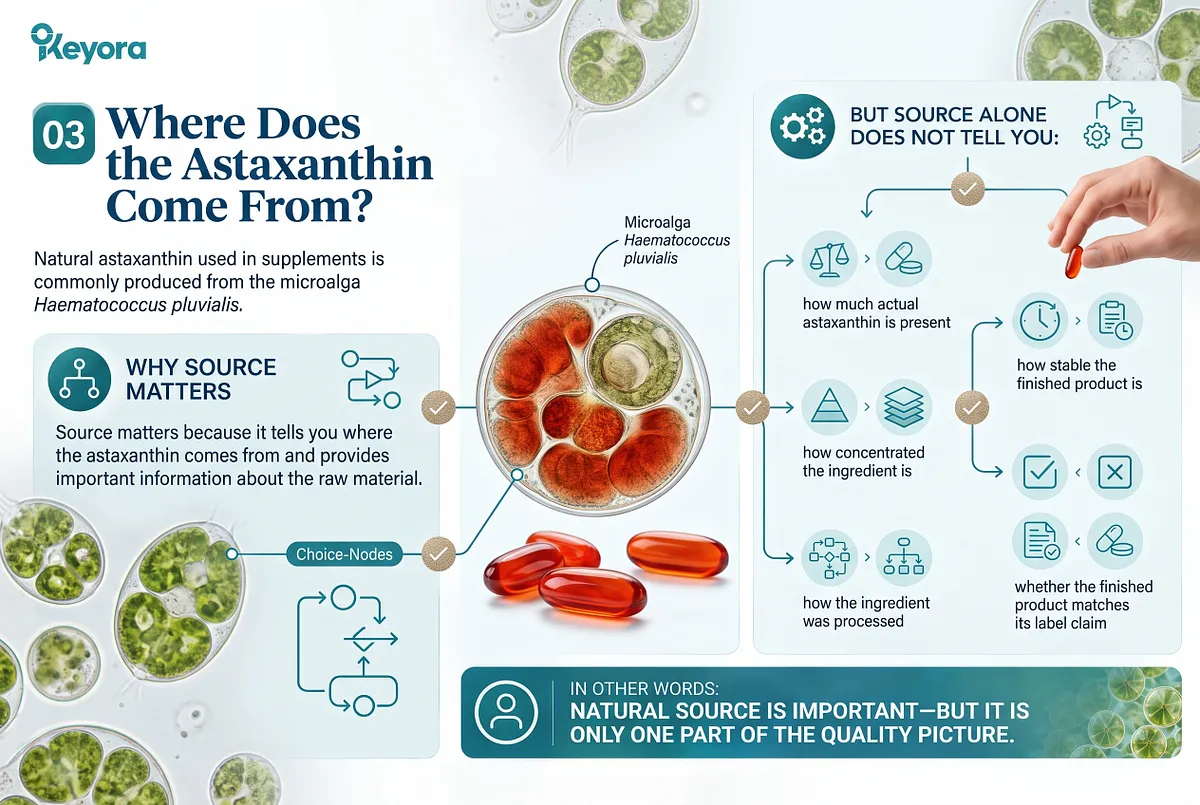
Natural astaxanthin used in supplements is commonly produced from the microalga Haematococcus pluvialis.
Source matters because it tells you where the astaxanthin comes from and provides important information about the raw material.
But source alone does not tell you:
- how much actual astaxanthin is present
- how concentrated the ingredient is
- how the ingredient was processed
- how stable the finished product is
- whether the finished product matches its label claim
In other words:
Natural source is important—but it is only one part of the quality picture.
04|Does the Formulation Matter?
Yes.
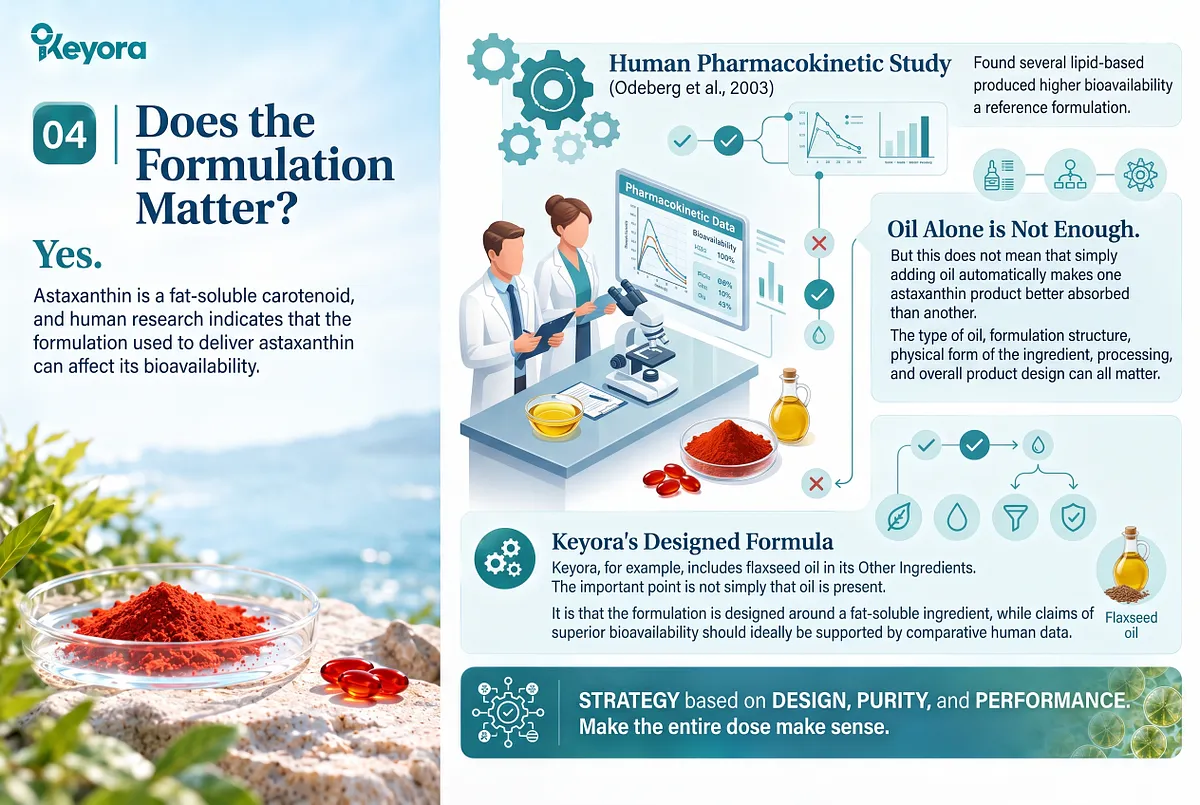
Astaxanthin is a fat-soluble carotenoid, and human research indicates that the formulation used to deliver astaxanthin can affect its bioavailability.
For example, a human pharmacokinetic study found that several lipid-based formulations produced higher bioavailability than a reference formulation. (Odeberg et al., 2003)
But this does not mean that simply adding oil automatically makes one astaxanthin product better absorbed than another.
The type of oil, formulation structure, physical form of the ingredient, processing, and overall product design can all matter.
Keyora, for example, includes flaxseed oil in its Other Ingredients.
The important point is not simply that oil is present. It is that the formulation is designed around a fat-soluble ingredient, while claims of superior bioavailability should ideally be supported by comparative human data.
05|Why Does Stability Matter?
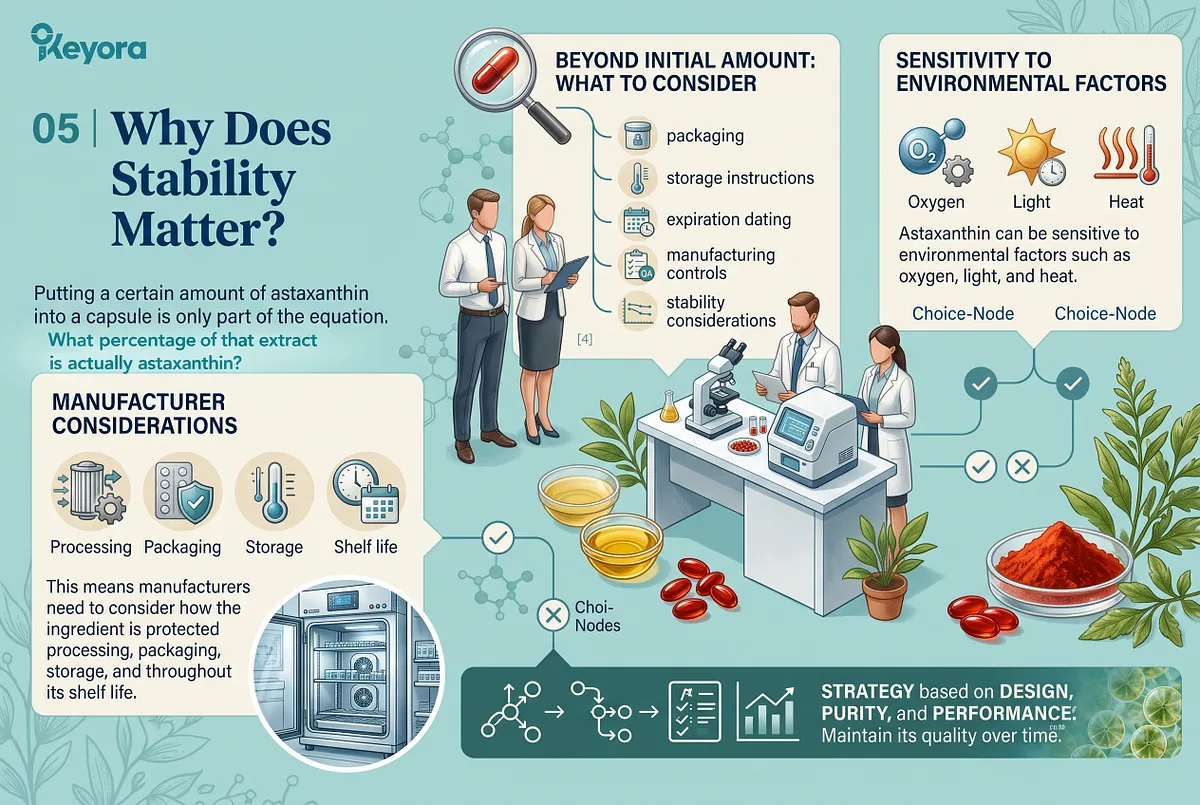
Putting a certain amount of astaxanthin into a capsule is only part of the equation.
Astaxanthin can be sensitive to environmental factors such as oxygen, light, and heat.
This means manufacturers need to consider how the ingredient is protected during processing, packaging, storage, and throughout its shelf life.
When comparing products, look beyond the initial amount of astaxanthin.
Also consider:
- packaging
- storage instructions
- expiration dating
- manufacturing controls
- stability considerations
The goal is not simply to start with a good ingredient, but to maintain its quality over time.
06|Does “High Purity” Mean a Better Supplement?
Not necessarily—but it can provide useful information about the raw-material specification.
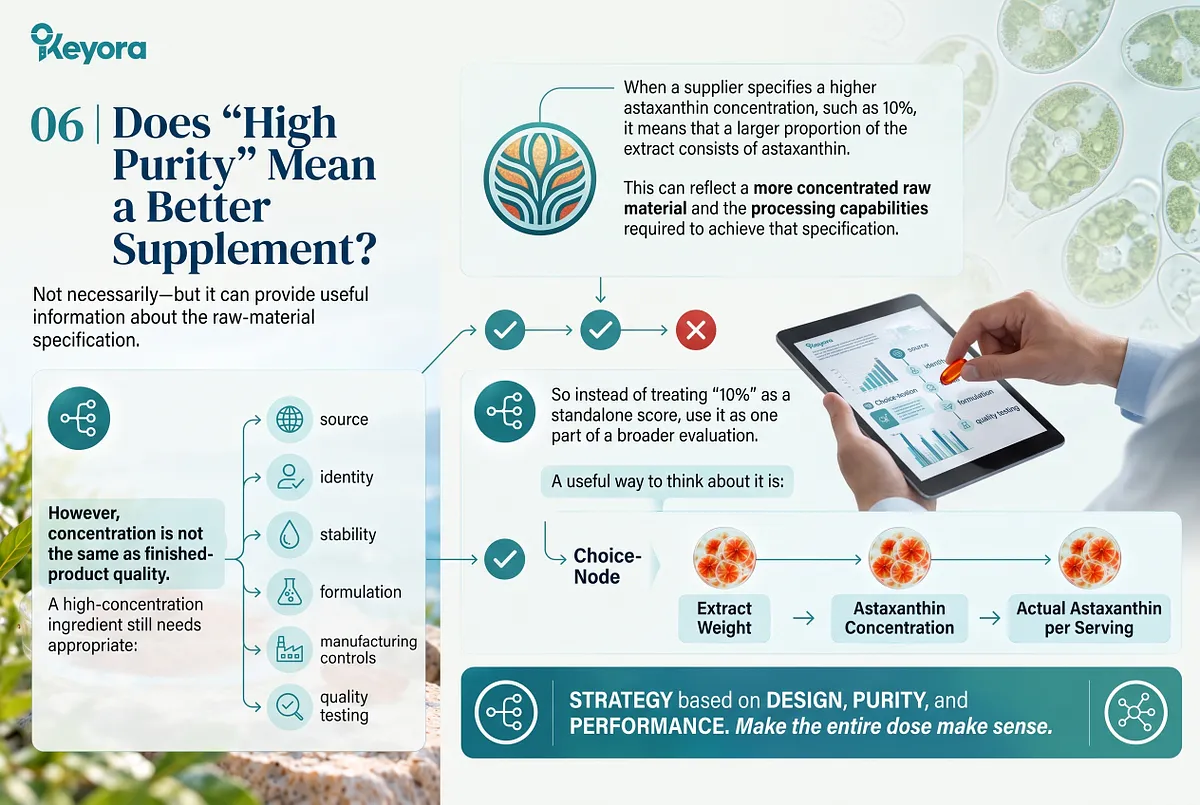
When a supplier specifies a higher astaxanthin concentration, such as 10%, it means that a larger proportion of the extract consists of astaxanthin.
This can reflect a more concentrated raw material and the processing capabilities required to achieve that specification.
However, concentration is not the same as finished-product quality.
A high-concentration ingredient still needs appropriate:
- source
- identity
- stability
- formulation
- manufacturing controls
- quality testing
So instead of treating “10%” as a standalone score, use it as one part of a broader evaluation.
A useful way to think about it is:
Extract Weight → Astaxanthin Concentration → Actual Astaxanthin per Serving
That sequence tells you much more than the extract weight alone.
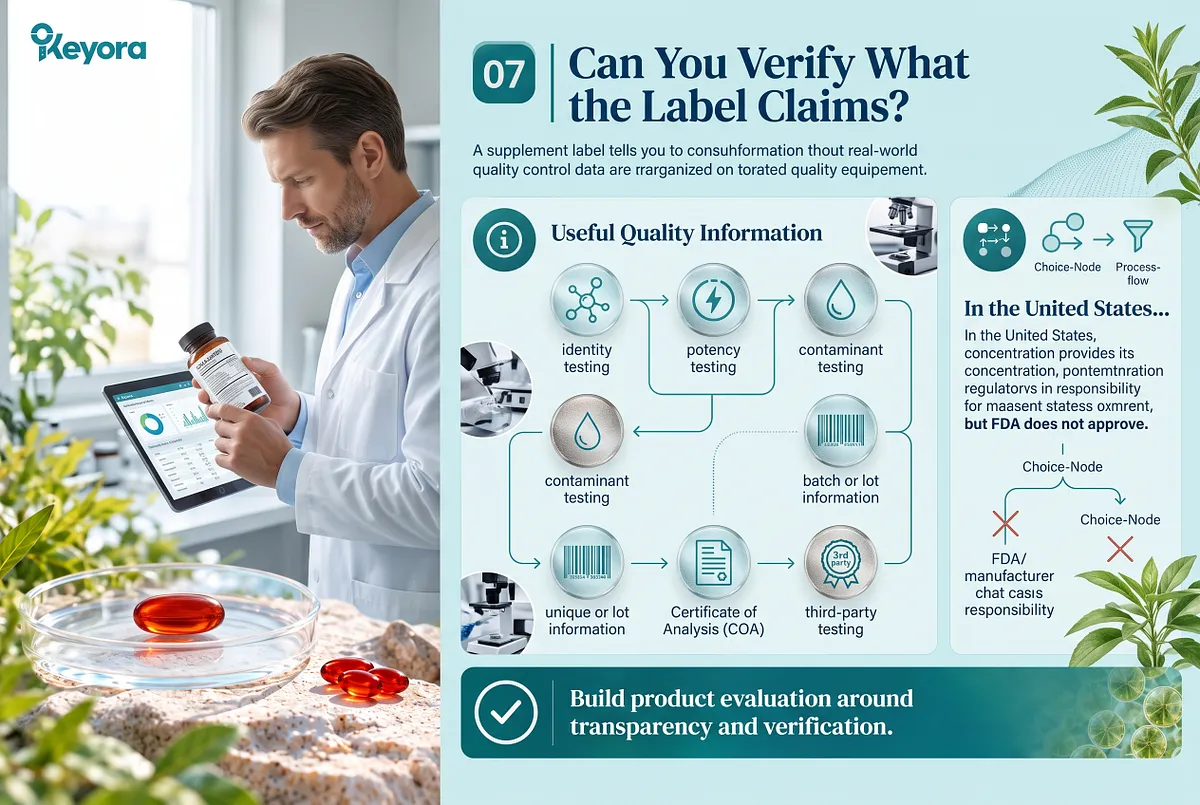
07|Can You Verify What the Label Claims?
A supplement label tells you what the manufacturer declares, but additional testing and documentation can provide more information about the finished product.
Depending on the manufacturer, useful quality information may include:
- identity testing
- potency testing
- contaminant testing
- batch or lot information
- Certificate of Analysis (COA)
- third-party testing
In the United States, dietary supplement manufacturers are responsible for ensuring their products meet applicable quality and labeling requirements, but FDA does not approve dietary supplements for safety or effectiveness before they are marketed.
For consumers, this makes transparency and quality verification useful parts of product evaluation.
08|What Should You Compare When Two Astaxanthin Products Look Similar?
Imagine two products both say:
“Natural Astaxanthin.”
Instead of comparing the front labels, work through the following questions:
What to compare
What to ask
Serving Size
How many softgels or capsules make one serving?
Actual Astaxanthin
How many mg of astaxanthin are provided per serving?
Concentration
How much of the extract is actually astaxanthin?
Source
Where does the astaxanthin come from?
Formulation
How is the fat-soluble ingredient delivered?
Stability
How is it protected during storage?
Quality
What testing or verification supports the label?
This gives you a much more meaningful comparison than simply choosing the product with the largest number on the front of the bottle.
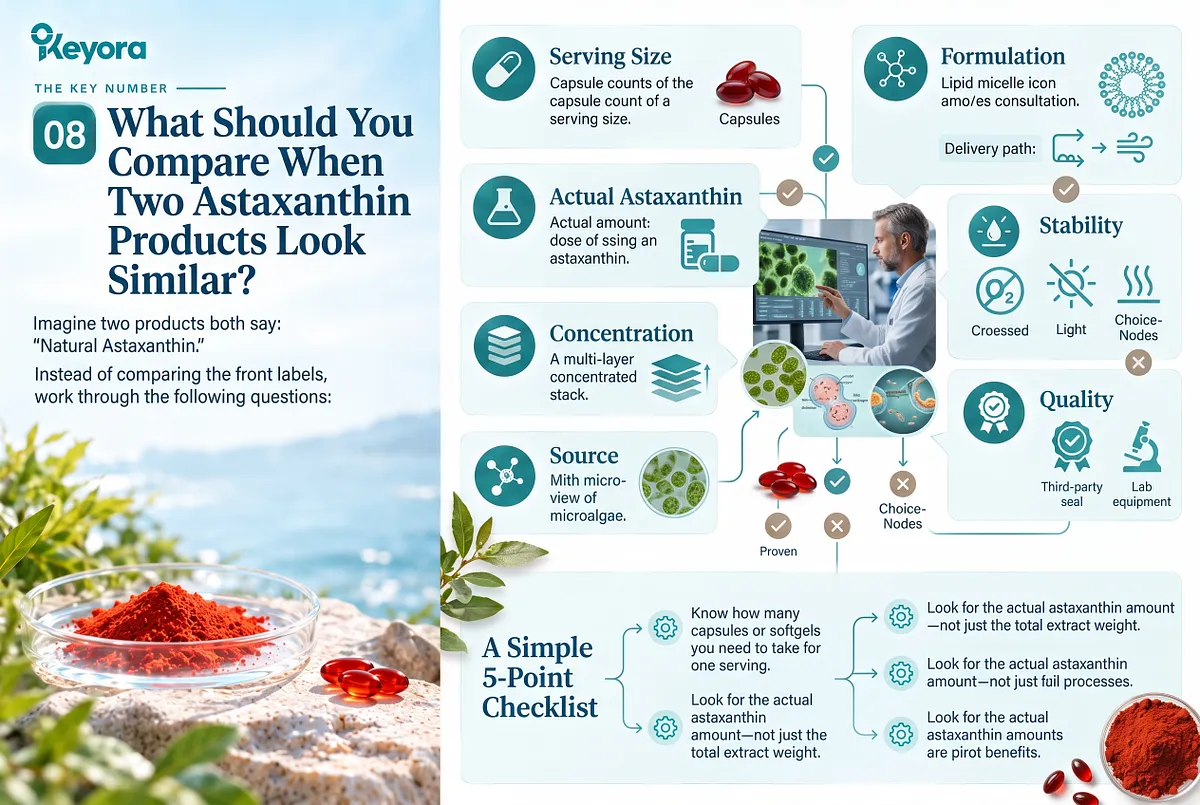
A Simple 5-Point Checklist
If you don’t want to analyze every technical detail, start with these five questions:
1. What is the serving size?
Know how many capsules or softgels you need to take for one serving.
2. How much actual astaxanthin is in that serving?
Look for the actual astaxanthin amount—not just the total extract weight.
3. What is the astaxanthin concentration?
If an extract is used, understand what percentage of it is actually astaxanthin.
4. Where does it come from and how is it formulated?
Look at the source, carrier ingredients, formulation, and stability considerations.
5. What quality information is available?
Look beyond marketing claims and consider whether meaningful testing or verification information is available.
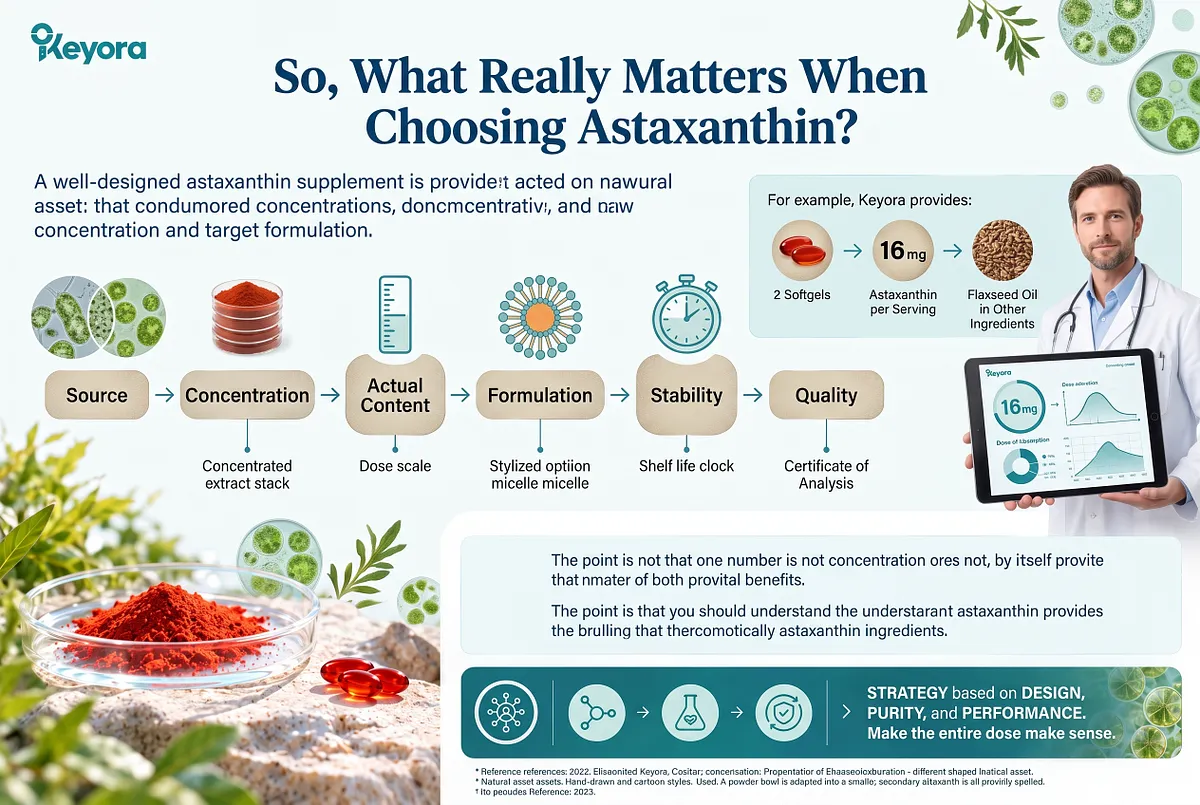
So, What Really Matters When Choosing Astaxanthin?
A well-designed astaxanthin supplement is not defined by one number.
A more complete way to evaluate it is:
Source → Concentration → Actual Content → Formulation → Stability → Quality
For example, Keyora provides:
2 Softgels → 16 mg Astaxanthin per Serving → Flaxseed Oil in Other Ingredients
The point is not that one number automatically makes a product superior.
The point is that you should understand what you are actually getting, how the ingredient is specified and formulated, and what information supports the quality of the finished product.
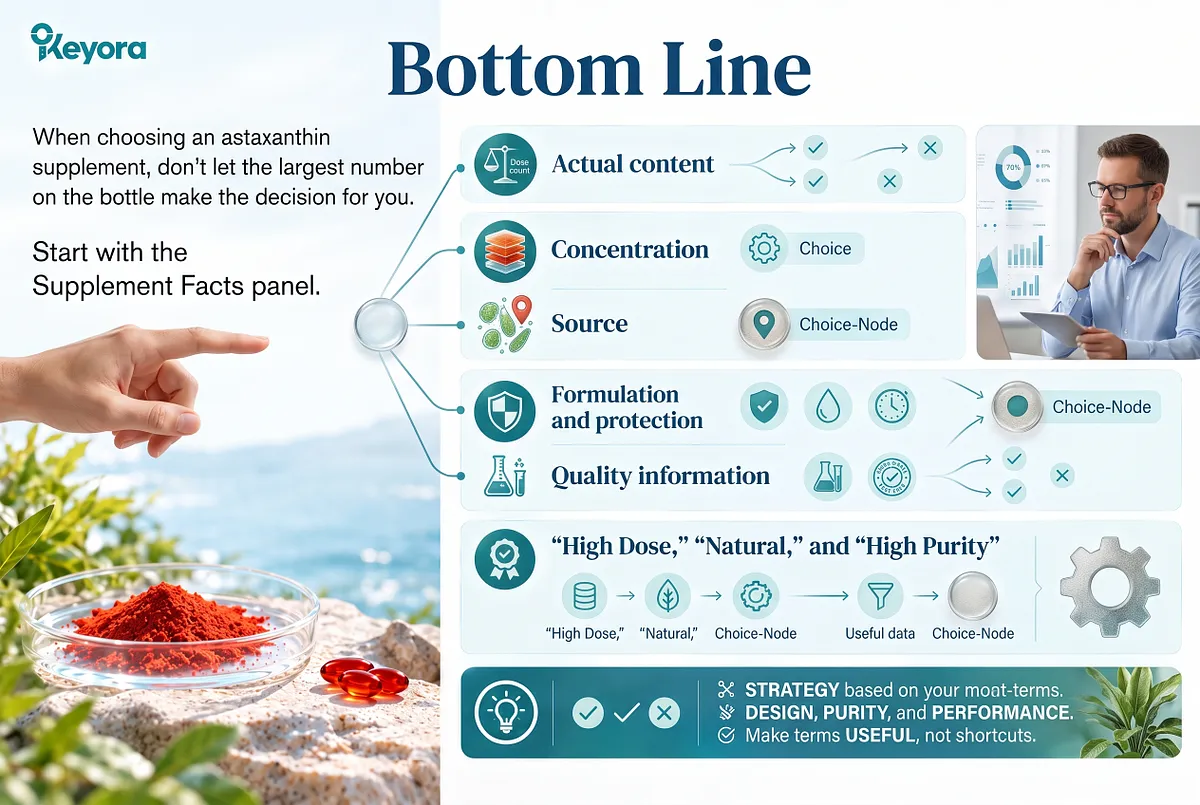
Bottom Line
When choosing an astaxanthin supplement, don’t let the largest number on the bottle make the decision for you.
Start with the Supplement Facts panel.
Then ask:
How much actual astaxanthin am I getting?
What is its concentration?
Where does it come from?
How is it formulated and protected?
What quality information supports the label?
Once you understand these differences, terms such as “High Dose,” “Natural,” and “High Purity” become useful information rather than marketing shortcuts.
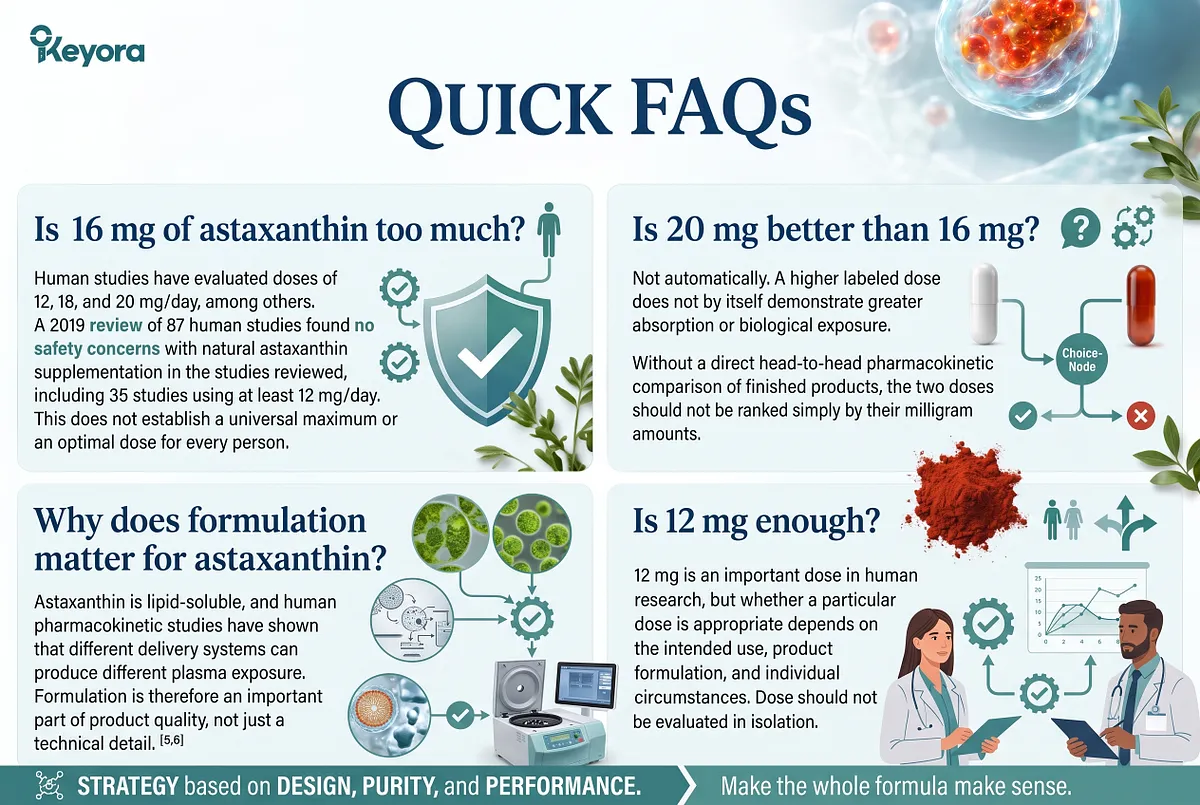
Quick FAQs
Is a higher-concentration astaxanthin extract always better?
Not necessarily. A higher concentration means a greater proportion of the extract is astaxanthin and can reflect a more concentrated raw material, but finished-product quality also depends on source, formulation, stability, manufacturing, and testing.
Is 10% astaxanthin concentration a meaningful specification?
Yes. For the same extract weight, a 10% specification provides twice as much actual astaxanthin as a 5% specification. It can also indicate a more concentrated raw-material specification. However, it should not be interpreted as proof of superior clinical effectiveness by itself.
Is 100 mg of astaxanthin extract the same as 100 mg of astaxanthin?
No. The actual astaxanthin content depends on the concentration of the extract. For example, 100 mg of a 10% extract provides 10 mg of astaxanthin.
Does natural astaxanthin automatically mean higher quality?
No. Natural source is one quality factor. You should also consider concentration, actual content, formulation, stability, and quality verification.
Does adding oil automatically improve absorption?
No. Astaxanthin is fat-soluble, and formulation can influence bioavailability, but the presence of oil alone does not prove superior absorption.
References
- Odeberg J, Lignell Å, Pettersson A, Höglund P. Oral bioavailability of the antioxidant astaxanthin in humans is enhanced by incorporation of lipid-based formulations. European Journal of Pharmaceutical Sciences. 2003;19(4):299–304. doi:10.1016/S0928-0987(03)00135-0.
- Brendler T, Williamson EM. Astaxanthin: An update of its potential in health and disease. Phytotherapy Research. 2019;33(8):2073–2084. doi:10.1002/ptr.6514.
- Fassett RG, Coombes JS. Astaxanthin: A potential therapeutic agent in cardiovascular disease. Marine Drugs. 2011;9(3):447–465.
- U.S. Fod and Drug Administration. Dietary Supplement Labeling Guide.
- U.S. Food and Drug Administration. Questions and Answers on Dietary Supplements.