
What Is Mitochondrial Membrane Potential, and Why Does It Matter for Energy Production?
Keyora Research Q&A Library
This is part of the Keyora Research Q&A Series, derived from Keyora Astaxanthin Research Journal Series.
Within the Keyora Astaxanthin Researcn framework, this Q&A translates complex astaxanthin biology into reader-friendly, evidence-bound answers, focusing on natural astaxanthin identity, molecular structure, antioxidant and redox mechanisms, membrane lipid interaction, mitochondrial resilience, inflammatory signaling pathways, human evidence interpretation, and the scientific principles behind responsible supplementation.
First published by Keyora Research Journal: www.keyorahealth.com

Direct Answer
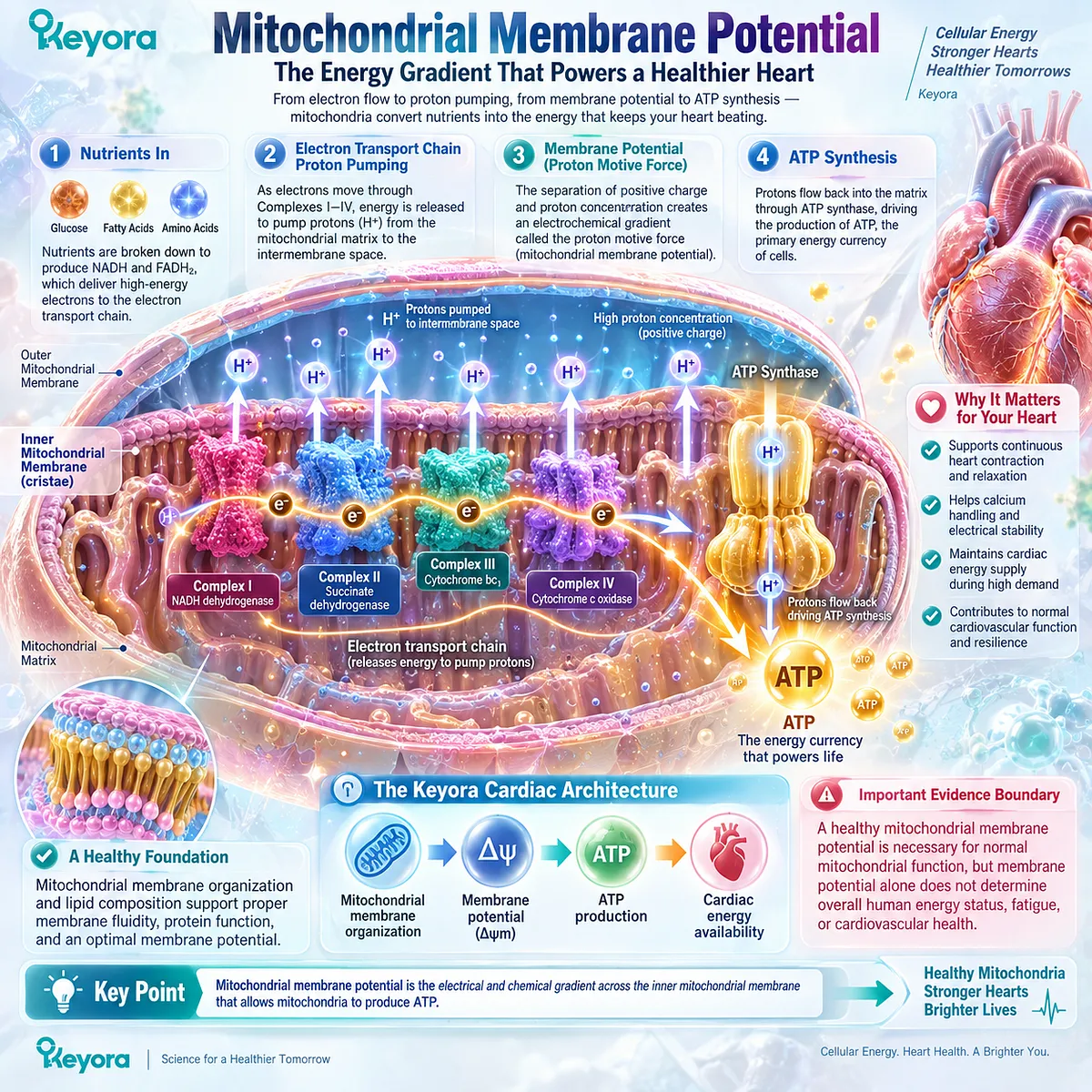
Mitochondrial membrane potential is the electrical and chemical gradient created across the inner mitochondrial membrane that allows mitochondria to produce ATP.
This gradient is generated when the electron transport chain moves protons across the inner mitochondrial membrane during oxidative phosphorylation. The separation of electrical charge and proton concentration creates a stored form of usable electrochemical energy called the proton motive force.
ATP synthase then uses this force to convert the energy stored in the gradient into ATP, the primary energy currency used by cells.
This process is especially important in the heart because cardiac muscle cells depend on continuous ATP production to support contraction, relaxation, calcium handling, and electrical stability.
The Keyora Cardiac Architecture therefore views mitochondrial membrane potential as a functional bridge:
Mitochondrial membrane organization → membrane potential → ATP production → cardiac energy availability
However, an important evidence boundary remains:
A healthy membrane potential is necessary for normal mitochondrial function, but membrane potential alone does not determine overall human energy status, fatigue, or cardiovascular health.
Why the Inner Mitochondrial Membrane Is Special
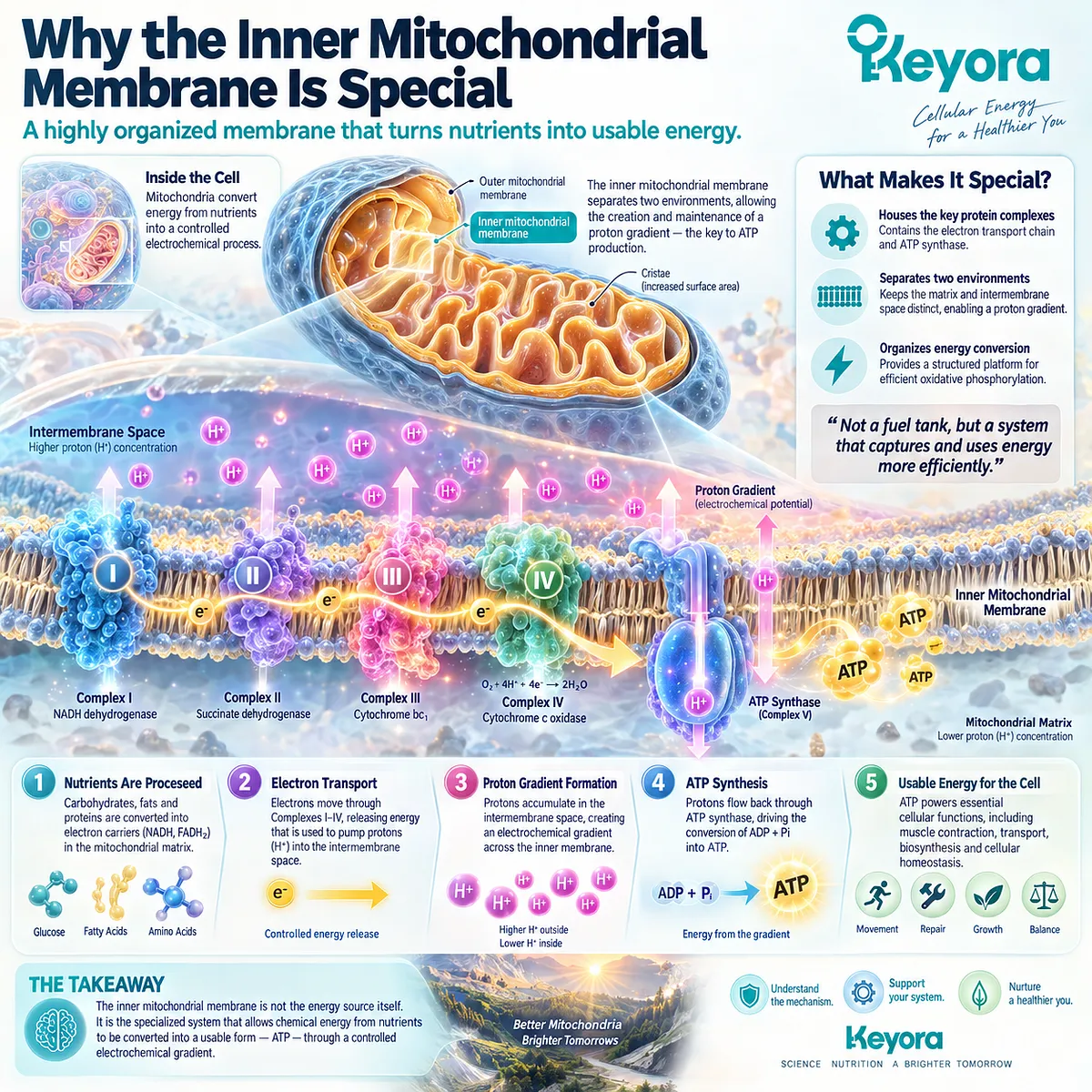
The inner mitochondrial membrane is designed to separate and control the energy-related chemical gradients required for ATP production
Mitochondria are often described as the “powerhouses” of the cell, but that phrase can create an incomplete picture.
Mitochondria do not simply burn fuel and release energy directly.
Instead, they convert energy from nutrients into a controlled electrochemical process.
The inner mitochondrial membrane is central to this process.
Unlike a simple boundary layer, the inner mitochondrial membrane contains the major protein complexes involved in oxidative phosphorylation. These complexes work together to transfer electrons, move protons, and create the conditions required for ATP synthesis.
The membrane performs a critical organizational role.
It separates two environments:
-
the mitochondrial matrix
-
the space between the inner and outer mitochondrial membranes
This separation allows mitochondria to create and maintain a proton gradient.
Without this separation, the energy released during electron transfer could not be captured efficiently.
A useful analogy is not a battery that stores energy permanently, but a controlled energy gradient.
The mitochondrion continuously creates, maintains, and uses this gradient.
The inner membrane therefore functions as both a structural platform and an energy-conversion interface.
This is why membrane biology is directly connected to cellular energy metabolism.
The membrane is not the energy source itself.
It is the system that allows chemical energy from nutrients to be converted into a usable cellular form.
How the Proton Gradient Creates ATP
The proton gradient drives ATP synthase, converting mitochondrial energy into usable cellular energy
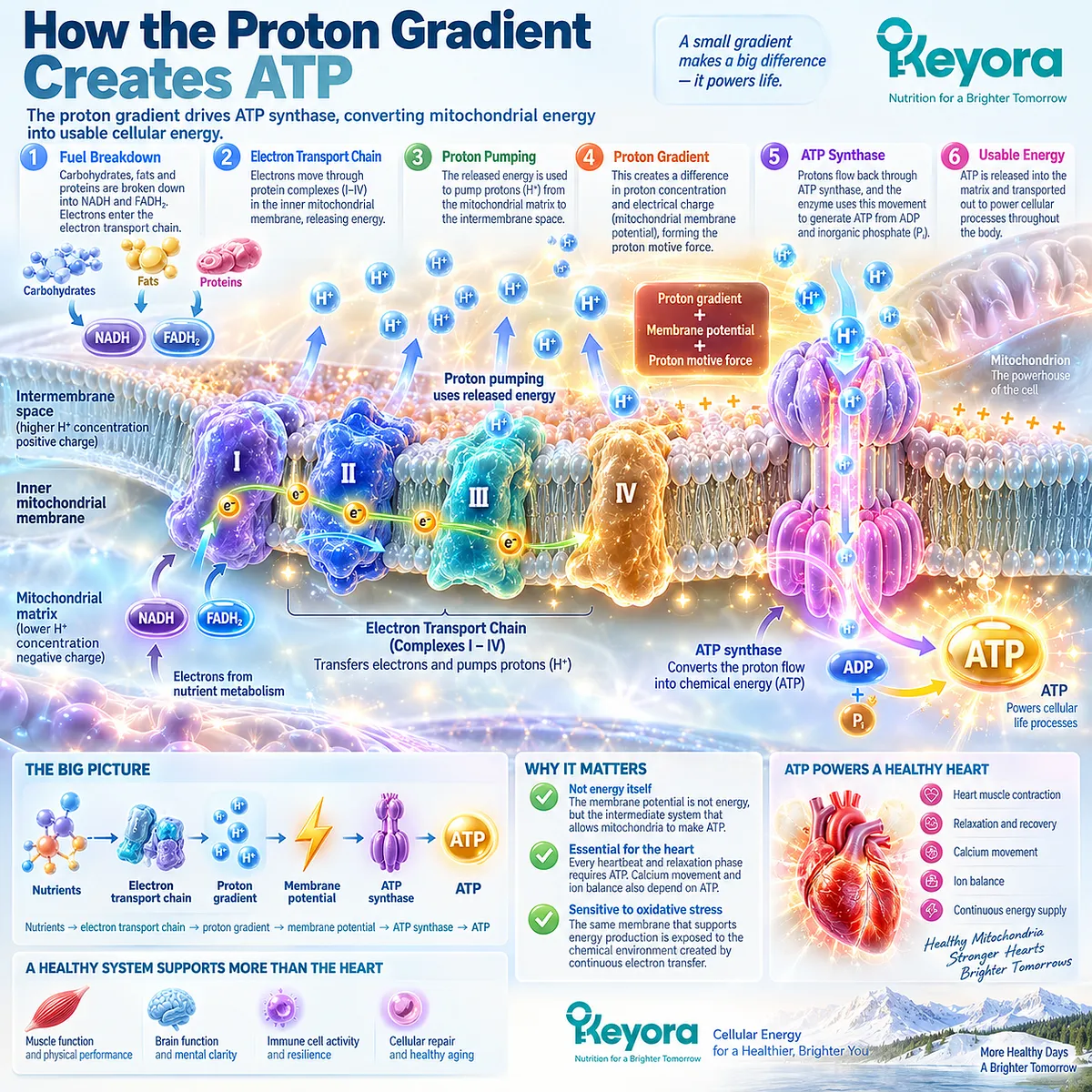
The process begins when metabolic fuels are broken down and electrons enter the mitochondrial electron transport chain.
The electron transport chain contains several protein complexes embedded in the inner mitochondrial membrane.
As electrons move through this system, energy is released and used to pump protons across the inner membrane.
This creates two related differences:
A difference in proton concentration.
And a difference in electrical charge.
Together, these form the mitochondrial membrane potential and proton motive force.
The mitochondrion has effectively created an electrochemical gradient.
ATP synthase then acts as a molecular energy converter.
As protons flow back across the membrane through ATP synthase, the enzyme uses that movement to generate ATP from ADP and phosphate.
The simplified pathway is:
Nutrients → electron transport chain → proton gradient → membrane potential → ATP synthase → ATP
This is why mitochondrial membrane potential is so important.
It is not energy itself.
It is the intermediate system that allows mitochondria to transform metabolic energy into ATP.
For the heart, this process must occur continuously.
Every heartbeat requires ATP.
Every relaxation phase requires ATP.
Calcium movement and ion balance also require ATP.
Therefore, maintaining the conditions that support mitochondrial ATP production is a central requirement of cardiac physiology.
This also explains why mitochondrial membranes are so important in discussions of oxidative stress.
The same membrane that supports energy production also contains the structures exposed to the chemical environment created by continuous electron transfer.
What Happens When Membrane Potential Is Disturbed
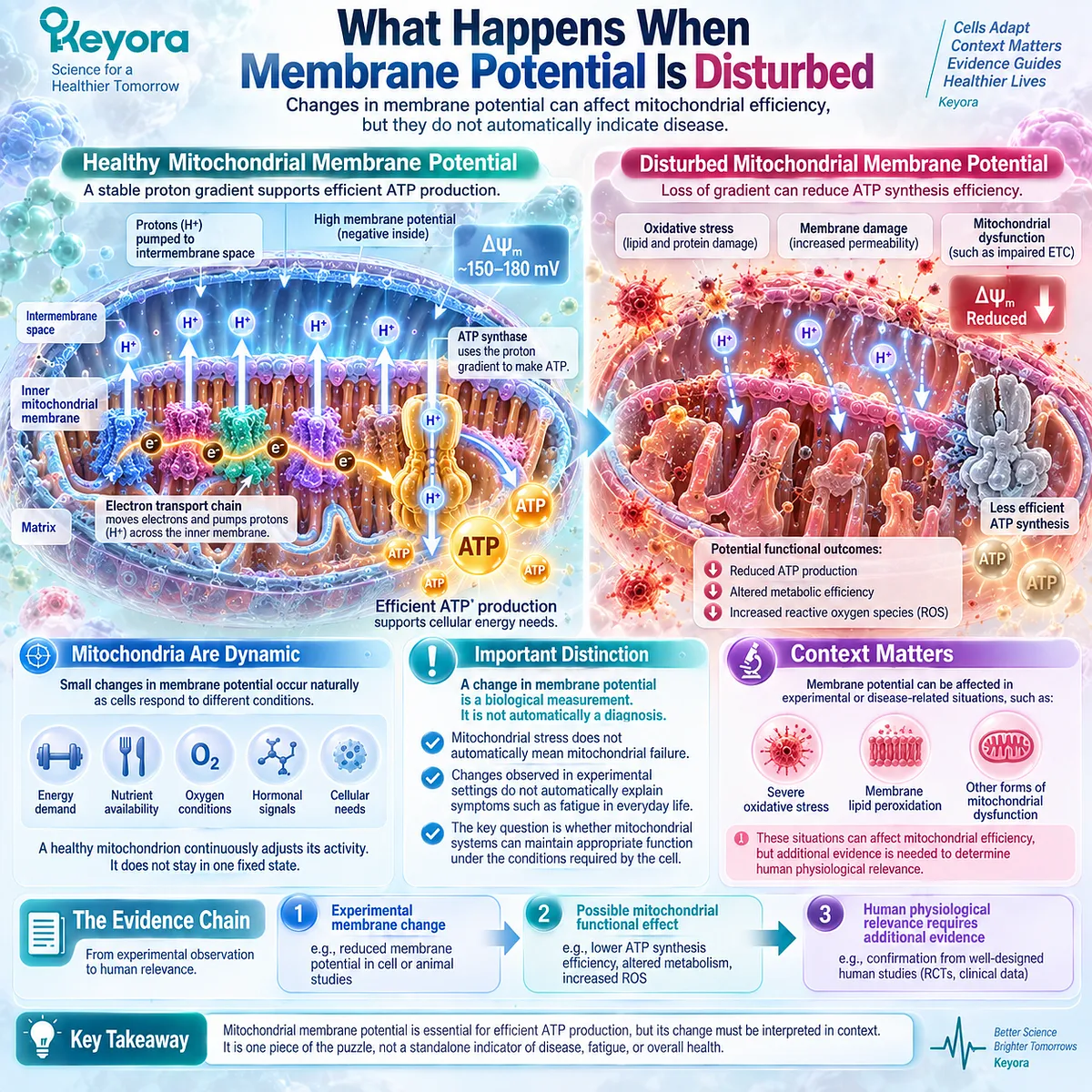
Changes in membrane potential can affect mitochondrial efficiency, but they do not automatically indicate disease
Because membrane potential is essential for ATP production, major disruption of this gradient can affect mitochondrial function.
If the inner mitochondrial membrane becomes less capable of maintaining the proton gradient, ATP synthesis may become less efficient.
This can happen in experimental situations involving severe oxidative stress, membrane damage, or other forms of mitochondrial dysfunction.
However, the relationship must be interpreted carefully.
A change in membrane potential is a biological measurement.
It is not automatically a diagnosis.
Small fluctuations in mitochondrial activity occur naturally because cells constantly adjust metabolism according to energy demand, nutrient availability, oxygen conditions, and physiological signals.
The body does not maintain mitochondria in one fixed state at all times.
A healthy mitochondrion is dynamic.
It changes fuel use.
It changes energy output.
It responds to cellular needs.
The important question is not whether membrane potential ever changes.
The important question is whether mitochondrial systems can maintain appropriate function under the conditions required by the cell.
This distinction prevents a common misunderstanding.
Mitochondrial stress does not automatically mean mitochondrial failure.
And mitochondrial changes measured in experimental settings do not automatically explain symptoms such as fatigue in everyday life.
The evidence chain must remain clear:
Experimental membrane change → possible mitochondrial functional effect → human physiological relevance requires additional evidence
Why Membrane Integrity and Redox Balance Matter
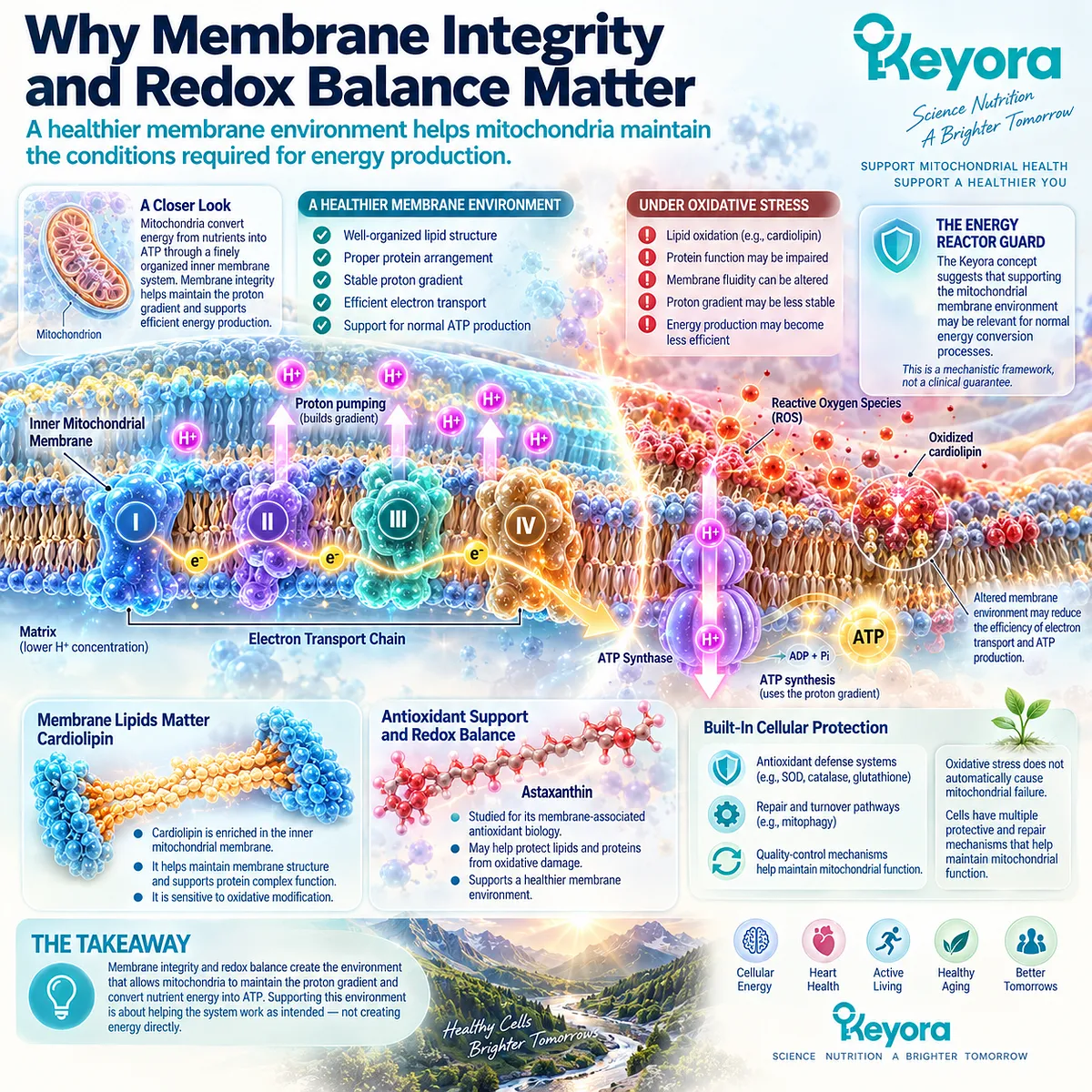
The membrane environment influences how effectively mitochondria maintain the conditions required for energy production
Mitochondrial membrane potential does not exist independently from membrane structure.
The proton gradient depends on the ability of the inner mitochondrial membrane to maintain separation between different chemical environments.
This means membrane composition, lipid organization, and protein arrangement all contribute to mitochondrial function.
The previous Keyora Cardiac Architecture questions examined why mitochondrial membranes can be affected by oxidative stress.
Q005 discussed why Astaxanthin is studied in relation to membrane-associated antioxidant biology.
Q006 explained why oxidation-sensitive lipids, including cardiolipin, are important in mitochondrial membrane function.
Q007 connects these concepts by explaining the functional consequence:
The membrane is not only a structure that can be protected.
It is also the platform that allows mitochondrial energy conversion to occur.
If oxidative stress modifies membrane lipids or proteins, the environment supporting electron transport and ATP production may become less favorable.
However, this should not be interpreted as:
“oxidation always causes mitochondrial failure.”
The biological reality is more gradual.
Cells possess antioxidant systems, repair pathways, and quality-control mechanisms that help maintain mitochondrial function.
The Keyora concept of The Energy Reactor Guard therefore does not mean that Astaxanthin directly creates energy.
Instead, it describes the idea that supporting the mitochondrial membrane environment may be relevant because that environment helps maintain normal energy conversion processes.
This remains a mechanistic framework rather than a clinical guarantee.
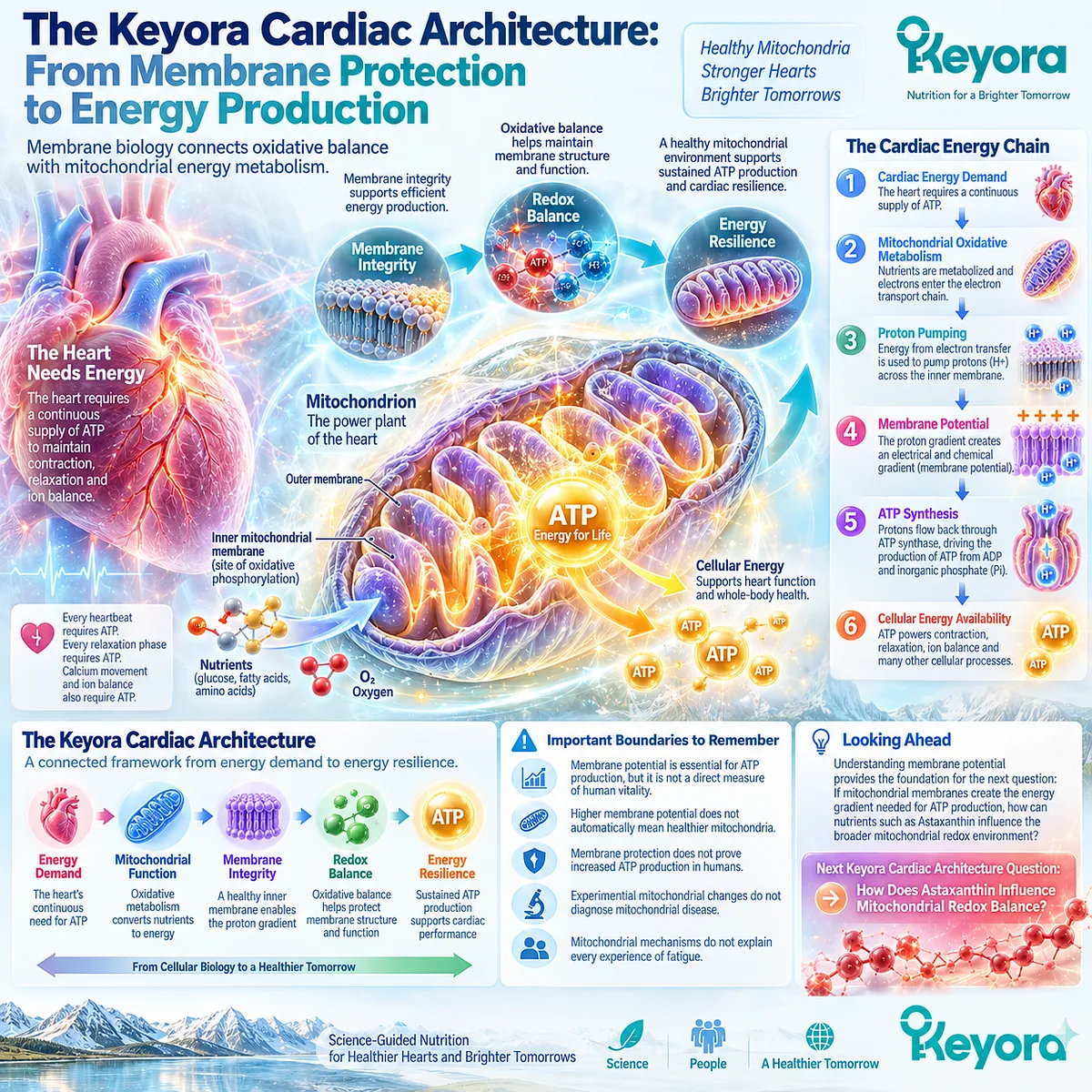
The Keyora Cardiac Architecture: From Membrane Protection to Energy Production
Membrane biology connects oxidative balance with mitochondrial energy metabolism
The heart requires a continuous supply of ATP.
Mitochondria meet this demand through oxidative phosphorylation.
Oxidative phosphorylation depends on the inner mitochondrial membrane.
The inner mitochondrial membrane creates the proton gradient.
The proton gradient creates membrane potential.
Membrane potential allows ATP synthase to generate ATP.
The complete energy chain is:
Cardiac energy demand
→ mitochondrial oxidative metabolism
→ proton pumping across the inner membrane
→ membrane potential
→ ATP synthesis
→ cellular energy availability
This is why mitochondrial membrane biology is central to cardiac energy metabolism.
It also explains why oxidative stress research often focuses on mitochondrial membranes.
The same membrane environment that enables energy production must also withstand the chemical challenges associated with continuous metabolism.
Within the Keyora Cardiac Architecture, this creates a connected framework:
Energy demand → mitochondrial function → membrane integrity → redox balance → energy resilience
But several boundaries remain essential:
Membrane potential is essential for ATP production, but it is not a direct measure of human vitality
Higher membrane potential does not automatically mean healthier mitochondria
Membrane protection does not prove increased ATP production in humans
Experimental mitochondrial changes do not diagnose mitochondrial disease
Mitochondrial mechanisms do not explain every experience of fatigue
Understanding membrane potential provides the foundation for the next question:
If mitochondrial membranes create the energy gradient needed for ATP production, how can nutrients such as Astaxanthin influence the broader mitochondrial redox environment?
The next Keyora Cardiac Architecture question is:
How Does Astaxanthin Influence Mitochondrial Redox Balance?
This article is for educational and informational purposes only. It does not provide medical advice, diagnosis, treatment, cure, prevention, disease outcome claims, hormone restoration claims, fertility outcome claims, or formula-specific clinical efficacy claims.