
How Long Does Astaxanthin Take to Work?
Keyora Research Q&A Library
This is part of the Keyora Research Q&A Series, derived from Keyora Astaxanthin Research Journal Series.
Within the Keyora Astaxanthin Researcn framework, this Q&A translates complex astaxanthin biology into reader-friendly, evidence-bound answers, focusing on natural astaxanthin identity, molecular structure, antioxidant and redox mechanisms, membrane lipid interaction, mitochondrial resilience, inflammatory signaling pathways, human evidence interpretation, and the scientific principles behind responsible supplementation.
First published by Keyora Research Journal: www.keyorahealth.com
Direct Answer
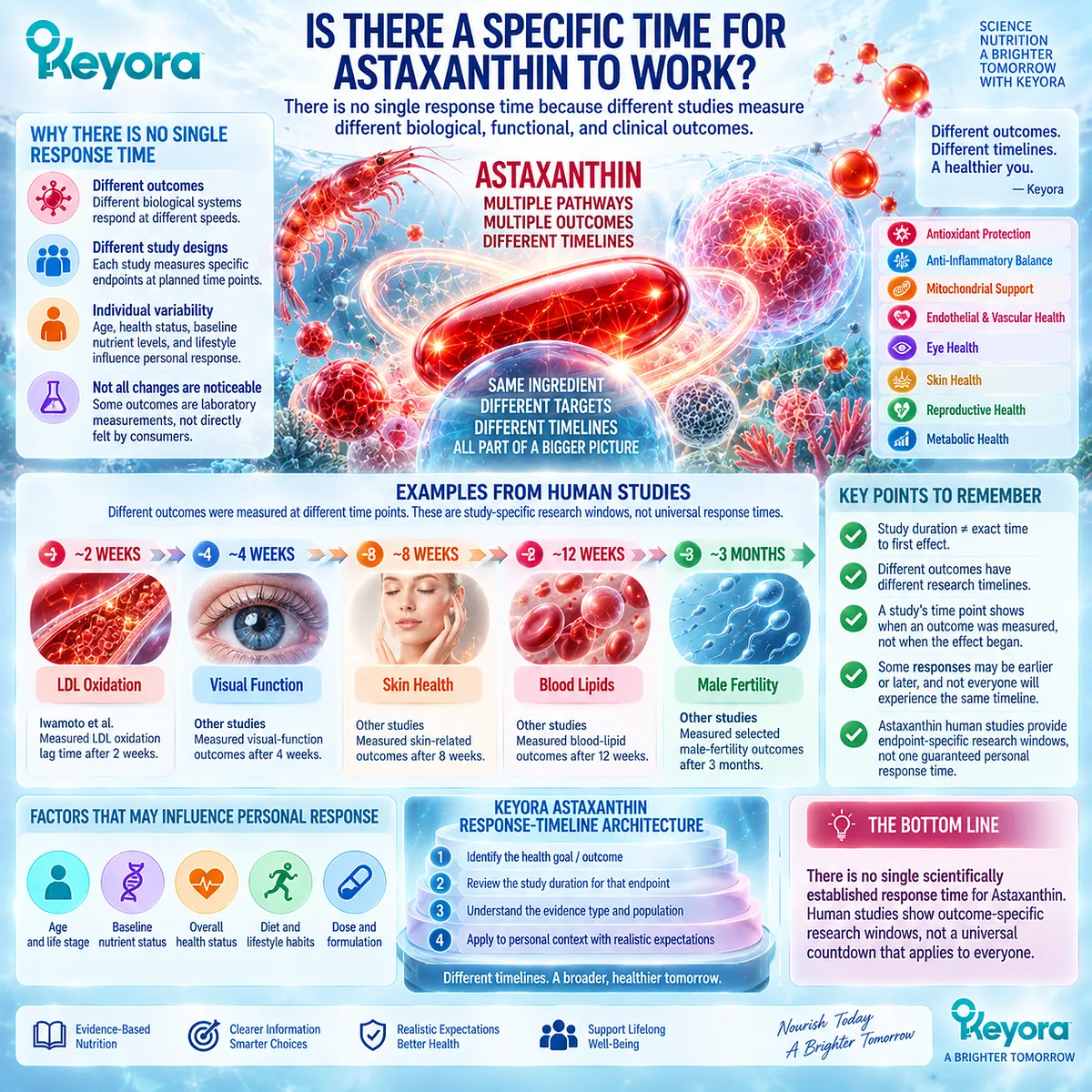
There is no single Astaxanthin response time because different studies measure different biological, functional, and clinical outcomes
There is no single scientifically established answer to how long Astaxanthin takes to work.
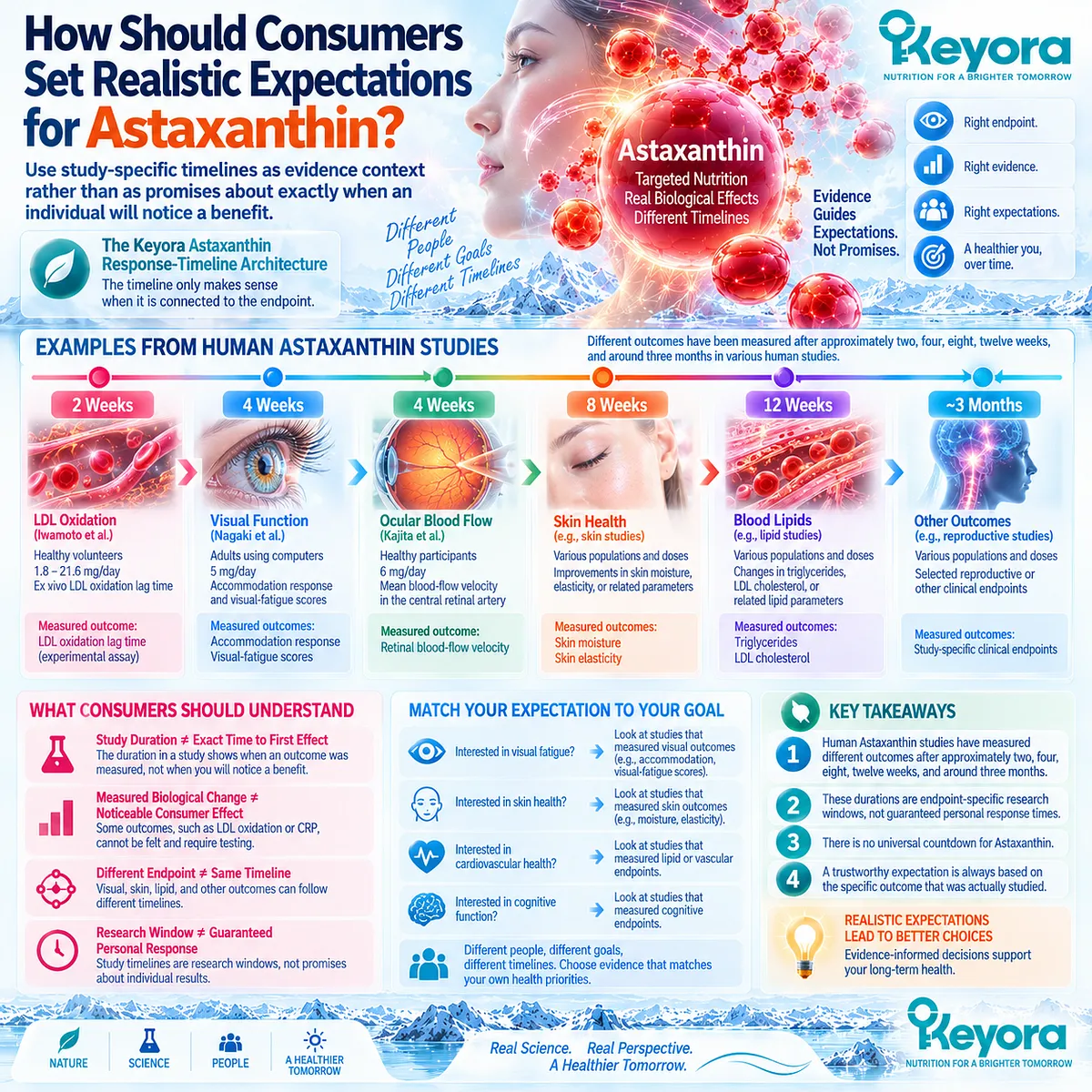
Human studies have measured different outcomes after approximately two weeks, four weeks, eight weeks, twelve weeks, and around three months, but those durations should be understood as study-specific research windows rather than universal personal response times.
For example, the Iwamoto study summarized in Keyora Astaxanthin EP-3: The Endothelial Architecture: Cardiovascular & Cerebrovascular Sovereignty examined LDL oxidation after two weeks of Astaxanthin supplementation.
Other studies summarized in the Keyora sources assessed visual-function outcomes after four weeks, skin-related outcomes after eight weeks, blood-lipid outcomes after twelve weeks, and selected male-fertility outcomes after three months.
These studies do not create one countdown that applies to every health goal.
This Q&A describes the distinction through the Keyora Astaxanthin Response-Timeline Architecture, an explanatory framework that interprets study duration according to the endpoint actually measured.
Its most important rule is:
Study Duration ≠ Exact Time to First Effect
If researchers measure an outcome at week four, that does not prove the biological response began only at week four. It also does not mean every person will notice a change by that date.
Some outcomes are laboratory measurements that consumers cannot feel directly. Others involve functional scores or visible changes that may be more noticeable.
The most accurate answer is therefore:
Astaxanthin human studies provide endpoint-specific research windows, not one guaranteed personal response time.
Why Is There No Single Answer to “How Long Does Astaxanthin Take to Work?”
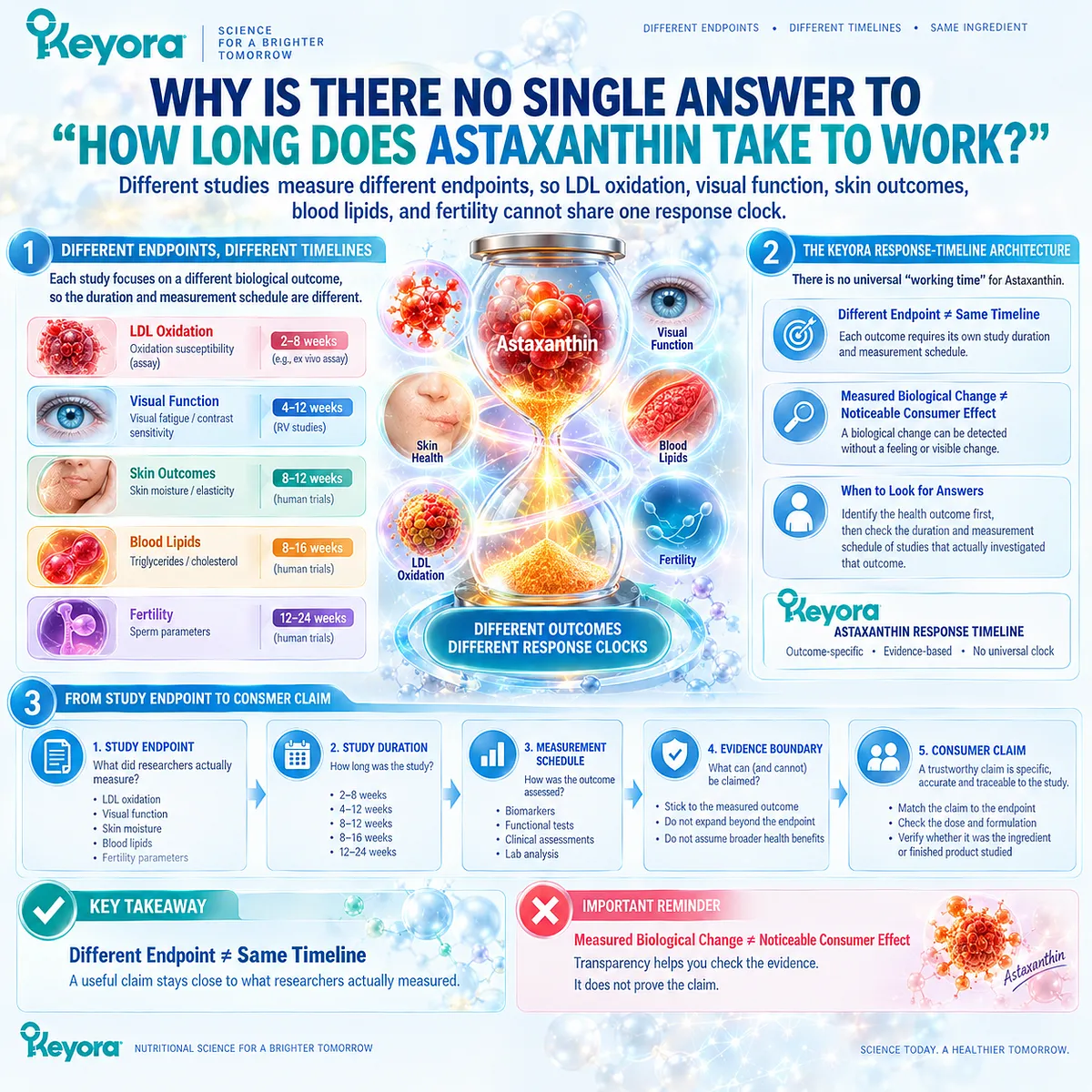
Different studies measure different endpoints, so LDL oxidation, visual function, skin outcomes, blood lipids, and fertility cannot share one response clock
The phrase “How long does Astaxanthin take to work?” sounds like one question, but scientifically it contains several different questions.
Work for what?
A study measuring LDL oxidation susceptibility is not studying the same biological outcome as a study measuring visual fatigue.
A study measuring skin moisture is not testing the same endpoint as one measuring triglycerides.
And a fertility trial measuring sperm parameters over several months is addressing a very different biological system again.
This is why a universal statement such as “Astaxanthin works in four weeks” would be misleading.
The Keyora source set contains human studies with very different research windows because their endpoints differ.
That leads to the first major distinction in the Keyora Astaxanthin Response-Timeline Architecture:
Different Endpoint ≠ Same Timeline
A second distinction is equally important.
Not every measured change is something a person can consciously notice.
An ex vivo LDL oxidation assay can detect a biological difference without the participant feeling anything.
A blood-lipid test can show a measurable change even if the person feels exactly the same.
Visual-fatigue scores and skin appearance, by contrast, involve endpoints that may be closer to something a participant notices or sees.
Therefore:
Measured Biological Change ≠ Noticeable Consumer Effect
This is why “When does it start working?” and “When will I notice something?” are not necessarily the same question.
The most useful way to interpret Astaxanthin timelines is to identify the health outcome first, then look at the duration and measurement schedule of studies that actually investigated that outcome.
What Have Shorter Astaxanthin Studies Actually Measured?
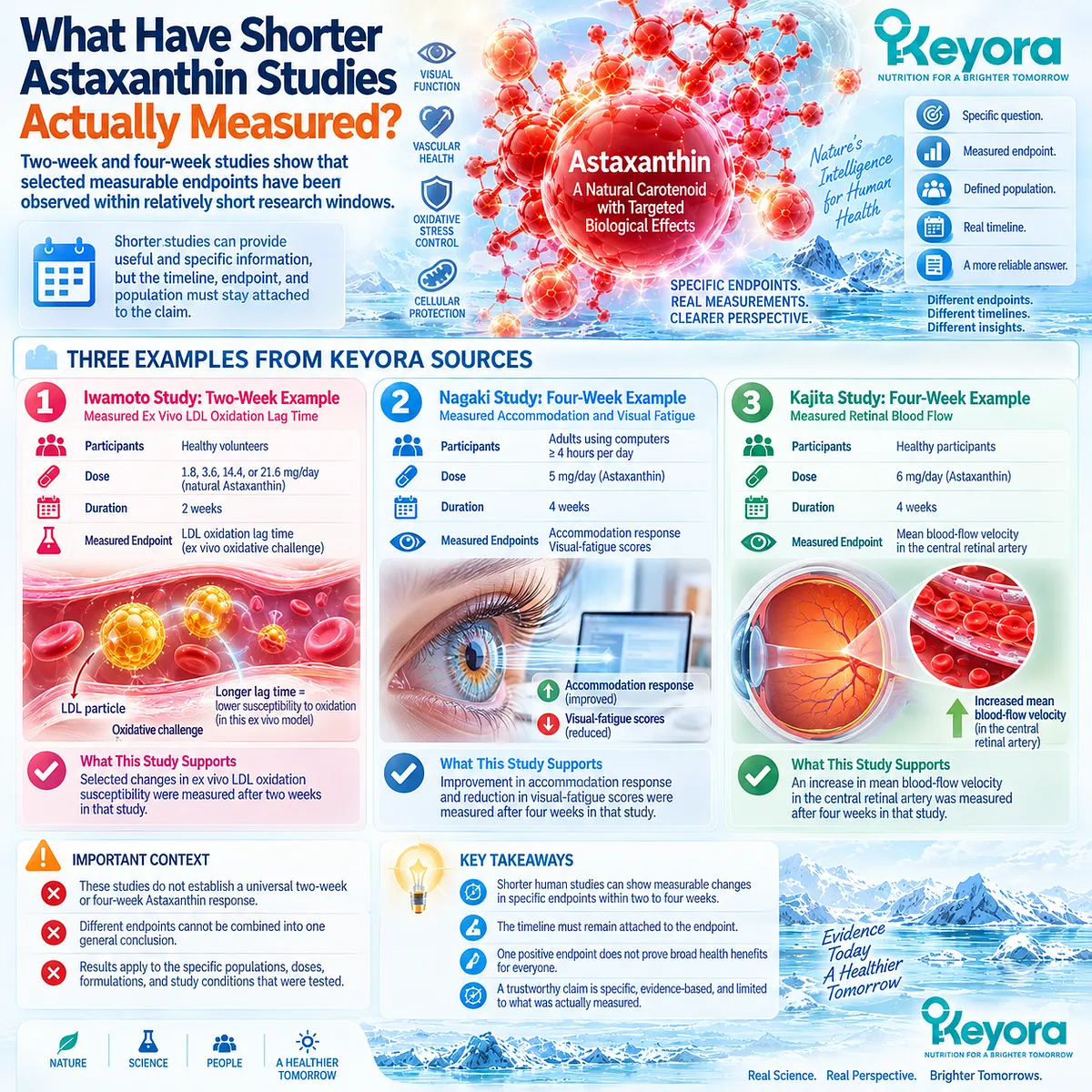
Two-week and four-week studies show that selected measurable endpoints have been observed within relatively short research windows
Some Astaxanthin human studies summarized in the Keyora sources used relatively short intervention periods.
The Iwamoto study is the clearest two-week example.
According to the Keyora source, healthy volunteers received natural Astaxanthin at 1.8, 3.6, 14.4, or 21.6 mg per day for two weeks. Researchers then isolated LDL from the participants’ blood and subjected it to an ex vivo oxidative challenge. The measured outcome was LDL oxidation lag time.
This supports a precise statement:
Selected changes in ex vivo LDL oxidation susceptibility were measured after two weeks in that study.
It does not support the broader statement:
Astaxanthin starts working in two weeks for everyone.
The Nagaki study provides a different four-week example. The Keyora source describes adults using computers for at least four hours per day who received 5 mg of Astaxanthin daily for four weeks. The source reports improvement in accommodation response and reduction in visual-fatigue scores.
Kajita provides another four-week human example. The source describes healthy participants receiving 6 mg daily for four weeks and reports an increase in mean blood-flow velocity in the central retinal artery.
These studies show why timelines must remain attached to endpoints.
Two weeks refers here to an LDL oxidation assay.
Four weeks refers in these studies to visual accommodation, visual-fatigue scoring, or ocular blood-flow measurement.
They do not collectively establish a universal four-week Astaxanthin response.
The appropriate conclusion is:
Shorter human studies show that some measurable Astaxanthin-related endpoints have been observed within approximately two to four weeks under specific study conditions.
Why Do Some Skin, Inflammation, and Metabolic Studies Run Longer?
Eight-to-twelve-week studies assess outcomes that differ from short-term oxidation or visual-function measurements
Other Astaxanthin studies summarized by the Keyora sources use longer intervention periods.
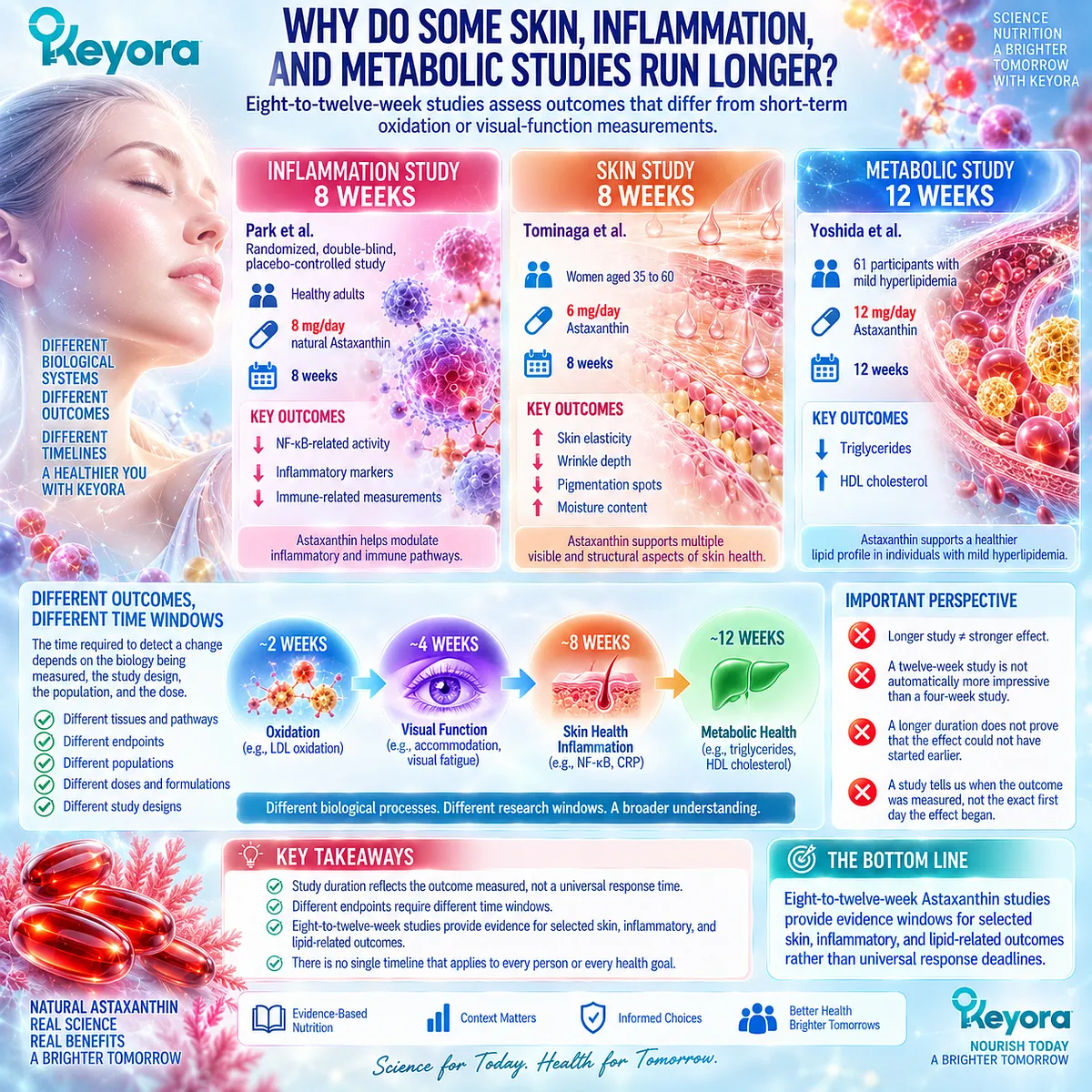
The source describes Park et al. as a randomized, double-blind, placebo-controlled human study in healthy adults receiving 8 mg of natural Astaxanthin daily for eight weeks. It reports changes in inflammatory and immune-related measurements, including NF-kB-related activity and inflammatory markers.
Skin research also uses an eight-week window.
The Keyora source summarizes a Tominaga study involving women aged 35 to 60 receiving 6 mg of Astaxanthin daily for eight weeks. Reported outcomes included skin elasticity, wrinkle depth, pigmentation spots, and moisture content.
A longer twelve-week window appears in the Yoshida study.
The source describes 61 participants with mild hyperlipidemia receiving 12 mg of natural Astaxanthin daily for twelve weeks, with reported changes in triglycerides and HDL cholesterol.
These timelines should not be converted into rigid rules such as “skin requires eight weeks” or “metabolism requires twelve weeks.”
The studies were designed differently, measured different outcomes, involved different populations, and used different doses.
Therefore:
Longer Study ≠ Stronger Effect
A twelve-week study is not automatically more impressive than a four-week study.
Nor does the longer duration prove that the biological process being measured could not have started earlier.
The study tells us when investigators assessed the outcome and what they observed at that time.
It does not automatically identify the exact first day on which the effect began.
The scientifically responsible interpretation is therefore:
Eight-to-twelve-week Astaxanthin studies provide evidence windows for selected skin, inflammatory, and lipid-related outcomes rather than universal response deadlines.
Does a Three-Month Fertility Study Mean Astaxanthin Needs Three Months to Affect Fertility?
A three-month intervention establishes the study window, not a universal fertility response deadline
No.
A three-month fertility trial tells us that the intervention was studied across that period. It does not prove that every reproductive response begins at exactly three months or that three months guarantees a fertility benefit.
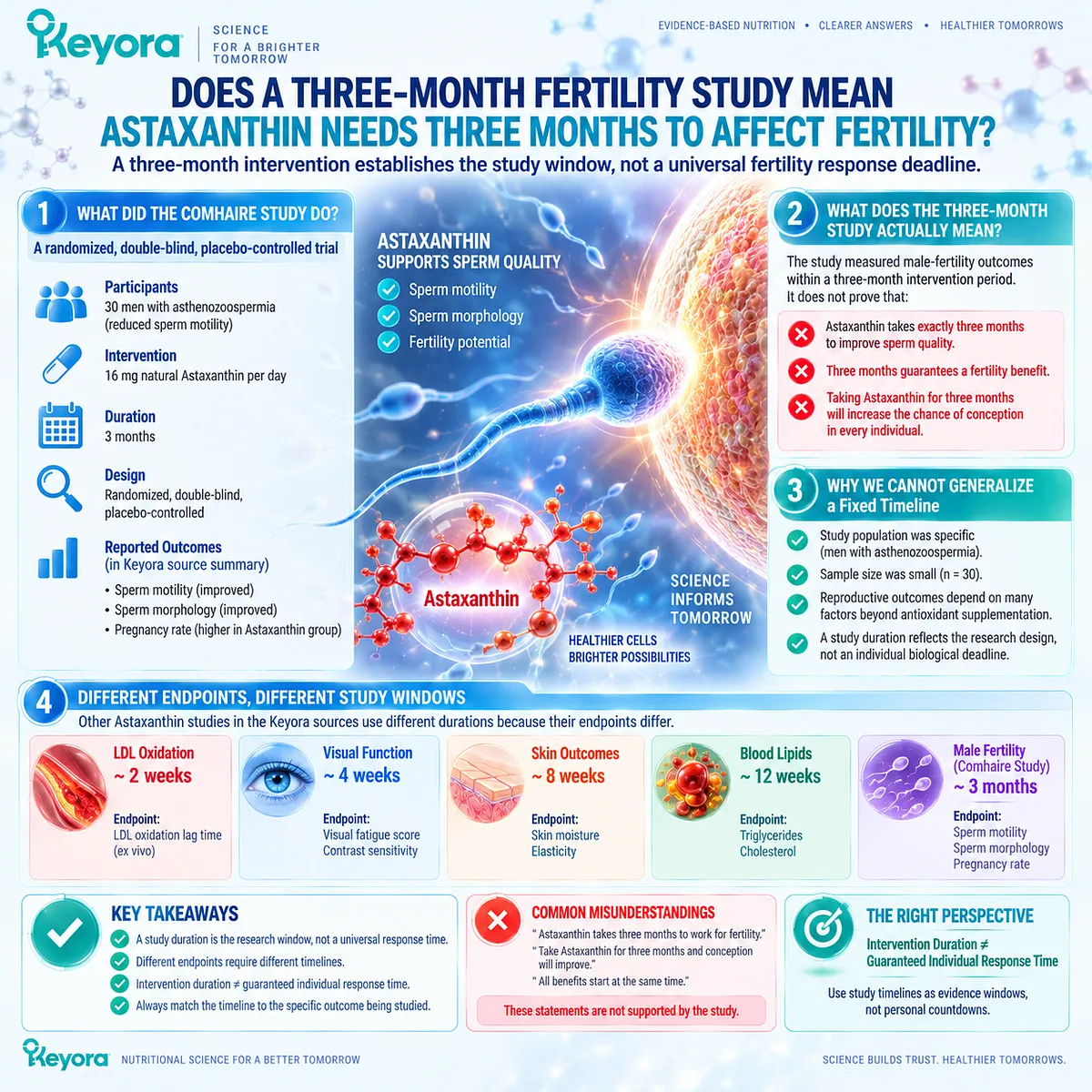
The Keyora source summarizes the Comhaire study as a double-blind, placebo-controlled randomized trial involving 30 men with asthenozoospermia.
According to the source, participants received 16 mg of natural Astaxanthin per day for three months. Its condensed summary reports changes in sperm motility and morphology and also reports a pregnancy-rate difference between the Astaxanthin and placebo groups.
This is meaningful human evidence within the study.
But the correct interpretation is:
the reported male-fertility outcomes were assessed within a three-month intervention period.
It would be too strong to turn that into:
Astaxanthin takes exactly three months to improve sperm quality.
It would be even less appropriate to say:
Take Astaxanthin for three months and conception will improve.
The study population was specific, the sample was small, and reproductive outcomes depend on many variables beyond antioxidant supplementation.
This creates another important timeline rule:
Intervention Duration ≠ Guaranteed Individual Response Time
A study duration tells us about the research design.
It does not establish a biological deadline for every individual.
The same logic applies to other Astaxanthin research.
Four weeks in an eye study, eight weeks in a skin study, and twelve weeks in a lipid study should all be read as evidence windows rather than personal countdowns.
How Should Consumers Set Realistic Expectations for Astaxanthin?
Use study-specific timelines as evidence context rather than as promises about exactly when an individual will notice a benefit
The Keyora Astaxanthin Response-Timeline Architecture helps organize expectations around one simple idea:
The timeline only makes sense when it is connected to the endpoint.
If someone is interested in visual fatigue, the relevant evidence should come from studies that actually measured visual fatigue or accommodation.
If someone is interested in skin outcomes, skin studies are more relevant than LDL oxidation research.
If the question concerns blood lipids, a lipid study should guide the evidence discussion rather than a short-term visual-function trial.
Consumers should also distinguish between an outcome that can be felt and an outcome that requires laboratory measurement.
A person cannot directly feel LDL oxidation lag time.
They cannot reliably sense a change in CRP or triglycerides without testing.
Skin appearance or subjective visual fatigue may be more noticeable, but individual experience still does not establish the exact timing or magnitude of a clinical response.
For this reason, four evidence boundaries should remain visible:
Study Duration ≠ Exact Time to First Effect
Measured Biological Change ≠ Noticeable Consumer Effect
Different Endpoint ≠ Same Timeline
Research Window ≠ Guaranteed Personal Response
The available Keyora source set therefore does not support a universal statement such as:
“Astaxanthin works in two weeks”
or:
“Everyone should notice a benefit after one month.”
A more accurate conclusion is:
Human Astaxanthin studies have measured different outcomes after approximately two, four, eight, and twelve weeks, as well as around three months, but these durations are endpoint-specific research windows rather than guaranteed personal response times.
There is no universal countdown for Astaxanthin.
The most useful timeline is the one attached to the specific outcome that was actually studied.
This article is for educational and informational purposes only. It does not provide medical advice, diagnosis, treatment, cure, prevention, disease outcome claims, hormone restoration claims, fertility outcome claims, or formula-specific clinical efficacy claims.