
How Do Omega Fatty Acids Support Metabolic Balance?
Keyora Research Q&A Library
This is part of the Keyora Research Q&A Series, derived from Keyora Astaxanthin Research Journal Series.
Within the Keyora Astaxanthin Researcn framework, this Q&A translates complex astaxanthin biology into reader-friendly, evidence-bound answers, focusing on natural astaxanthin identity, molecular structure, antioxidant and redox mechanisms, membrane lipid interaction, mitochondrial resilience, inflammatory signaling pathways, human evidence interpretation, and the scientific principles behind responsible supplementation.
First published by Keyora Research Journal: www.keyorahealth.com

Direct Answer
ALA, LA, and OA support metabolism through different roles in lipid structure, insulin responsiveness, and glucose-lipid regulation
Omega fatty acids can support metabolic balance because different fatty acids participate in different parts of metabolic regulation, including membrane lipid composition, insulin-related signaling, fatty-acid handling, and liver metabolism.
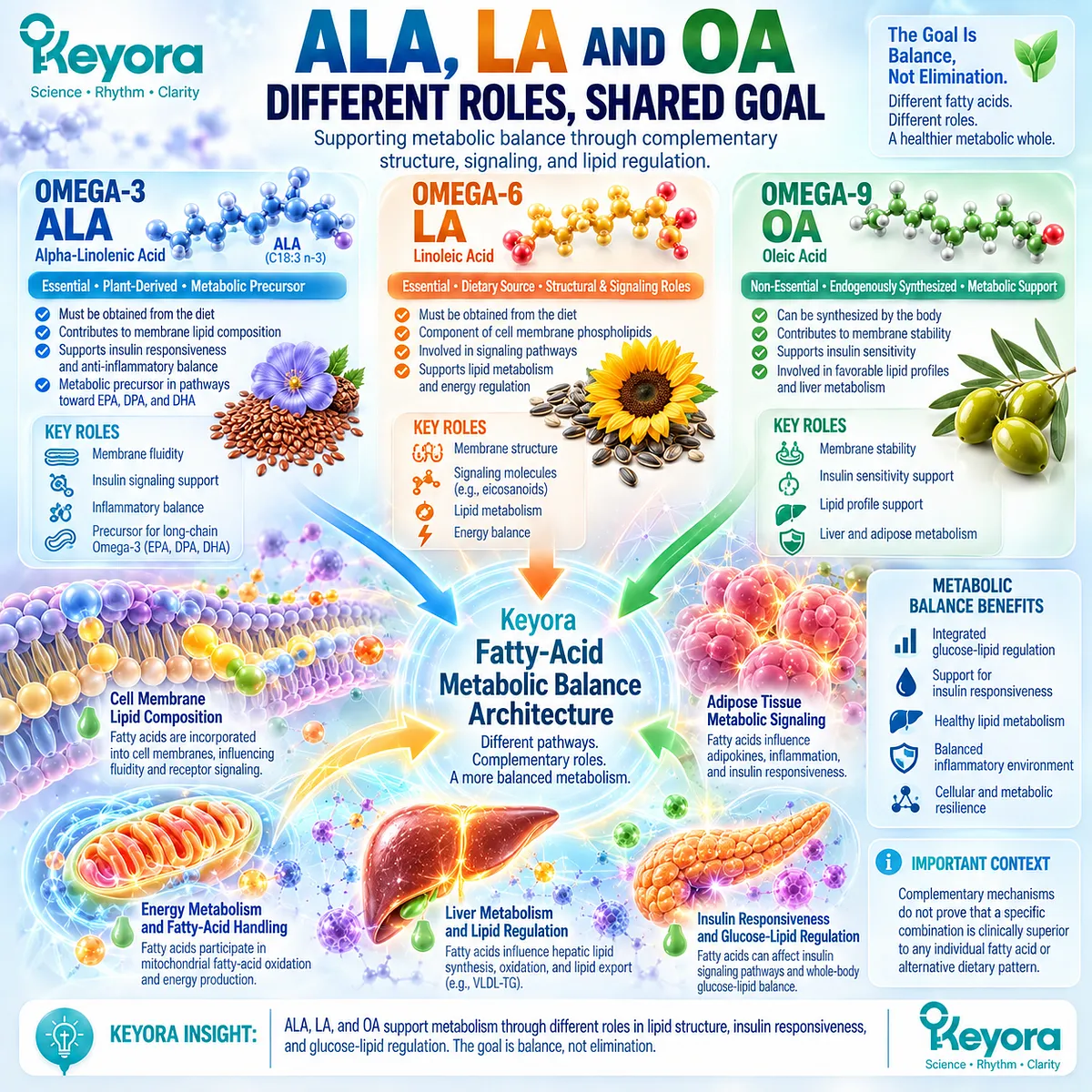
In the Keyora formula context, Omega-3, Omega-6, and Omega-9 refer specifically to ALA, alpha-linolenic acid; LA, linoleic acid; and OA, oleic acid.
They are not interchangeable nutrients.
ALA is an essential Omega-3 polyunsaturated fatty acid that must be obtained from the diet. The Keyora Alpha-Linolenic Acid source also describes it as a metabolic precursor within pathways leading toward EPA, DPA, and DHA.
LA is an essential Omega-6 polyunsaturated fatty acid with structural, signaling, and lipid-metabolism roles.
OA is an Omega-9 monounsaturated fatty acid. Unlike ALA and LA, it is not essential because the human body can synthesize it endogenously.
This Q&A describes their relationship as the Keyora Fatty-Acid Metabolic Balance Architecture.
It is an explanatory framework rather than a clinical term.
The central idea is that metabolic balance does not come from labeling one Omega fatty acid as universally “good” and another as “bad.”
Instead, ALA, LA, and OA occupy different structural and regulatory positions within lipid metabolism.
The strongest principle is:
The goal is balance, not elimination.
ALA, LA, and OA may contribute to metabolic balance through complementary roles, but complementary mechanisms do not prove that a finished combination is clinically superior to any individual fatty acid or alternative dietary pattern.
Why Do Different Omega Fatty Acids Have Different Metabolic Roles?
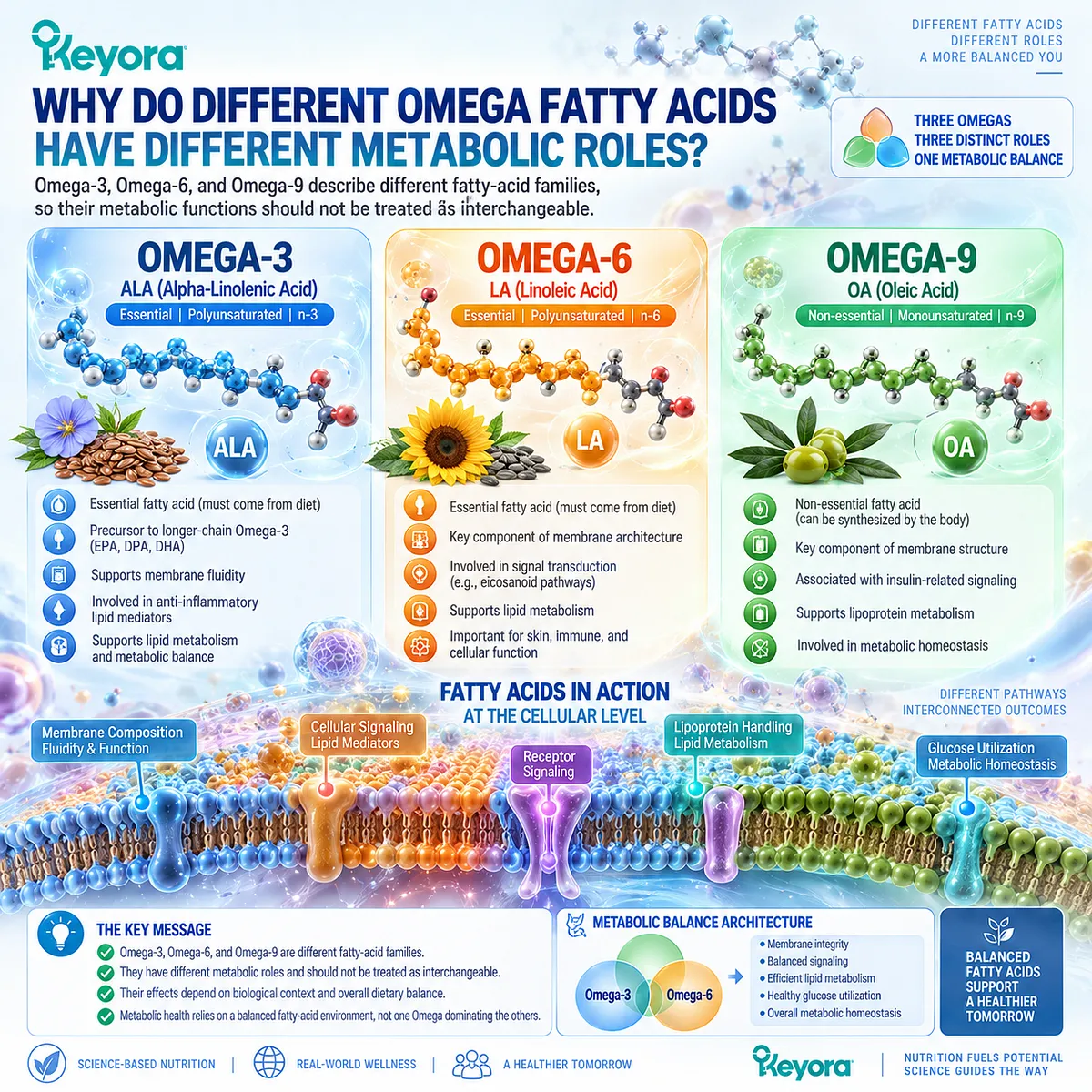
Omega-3, Omega-6, and Omega-9 describe different fatty-acid families, so their metabolic functions should not be treated as interchangeable
The word “Omega” describes part of fatty-acid chemistry. It does not mean that every Omega fatty acid performs the same metabolic function.
ALA and LA are both polyunsaturated fatty acids, but they belong to different families and enter different metabolic pathways.
The Keyora Alpha-Linolenic Acid source identifies ALA as an essential Omega-3 fatty acid and a precursor within pathways leading toward longer-chain Omega-3 fatty acids.
The Linoleic Acid source identifies LA as an essential Omega-6 fatty acid and describes roles in membrane architecture, signal transduction, and lipid metabolism.
OA is chemically different again. It is a monounsaturated Omega-9 fatty acid, and the Oleic Acid source places it within membrane structure, insulin-related signaling, and broader metabolic homeostasis.
These distinctions matter because “Omega-3/6/9” can otherwise sound like one nutritional category performing one function.
Biologically, that is too simple.
Different fatty acids can influence different aspects of:
membrane composition, cellular signaling, lipoprotein handling, glucose utilization, fatty-acid oxidation, and downstream lipid-mediator pathways.
Their effects also depend on context.
The same fatty acid can participate in normal structural and signaling biology while producing different metabolic associations under different dietary conditions.
For this reason:
Metabolic Balance ≠ One “Good” Omega Dominating the Others
The better question is not which Omega should be eliminated.
It is how different fatty acids fit into a wider metabolic environment.
How Can ALA Support Metabolic Regulation?
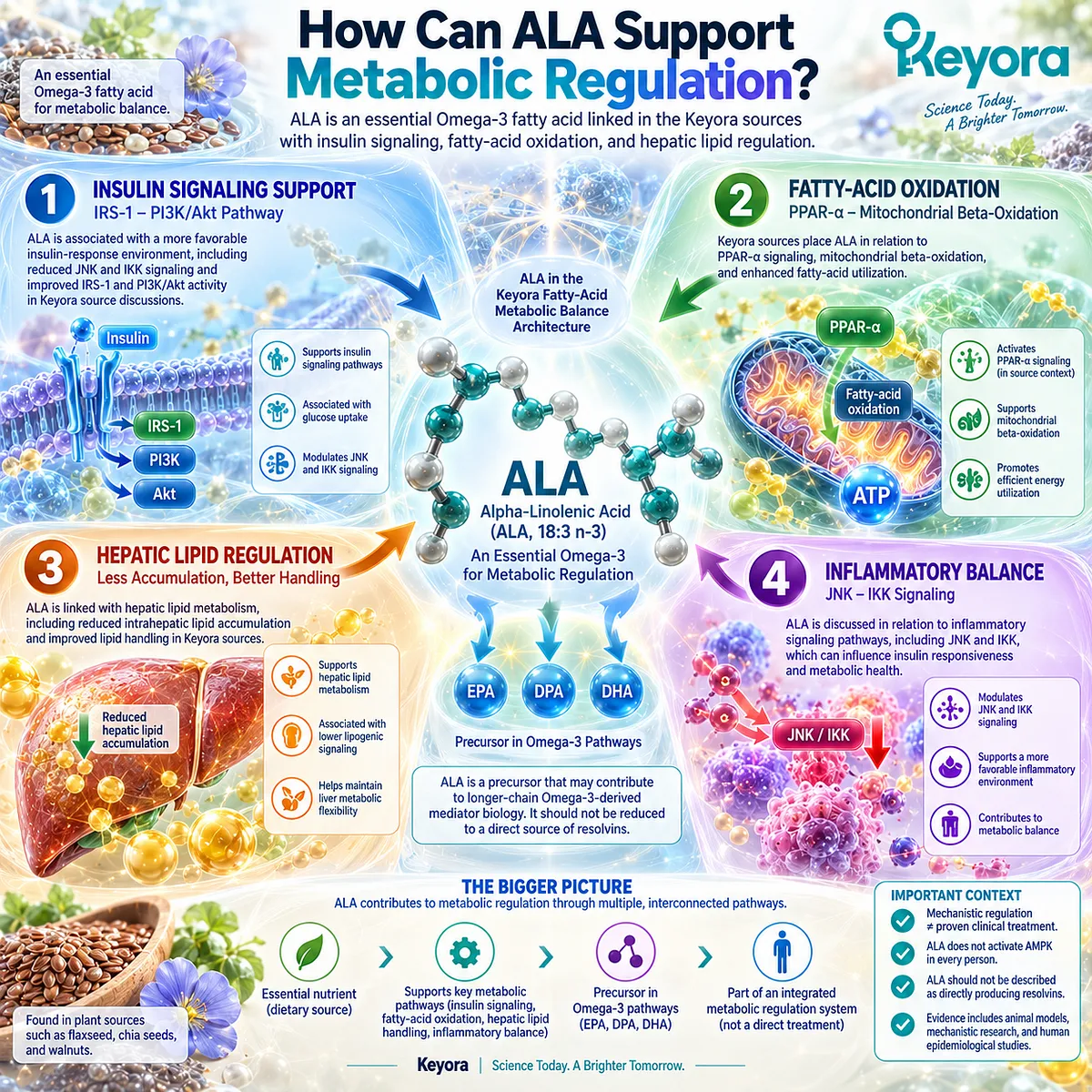
ALA is an essential Omega-3 fatty acid linked in the Keyora sources with insulin signaling, fatty-acid oxidation, and hepatic lipid regulation
ALA occupies the Omega-3 position in the Keyora Fatty-Acid Metabolic Balance Architecture.
The Alpha-Linolenic Acid source connects ALA with several metabolic pathways, including insulin-related signaling, glucose uptake, inflammatory signaling, and hepatic lipid accumulation. Its metabolic section discusses JNK and IKK signaling, IRS-1, PI3K/Akt, and the broader insulin-response environment.
A separate Keyora formulation source places ALA in relation to PPAR-alpha signaling, mitochondrial beta-oxidation, and hepatic lipid handling.
These mechanisms provide a rationale for considering ALA relevant to metabolic regulation.
However, mechanism should not be confused with a universal human clinical outcome.
The Keyora ALA source itself combines animal models, mechanistic research, and human epidemiological evidence when discussing metabolic health.
That means it would be too strong to say:
ALA activates AMPK in every person
or
ALA treats insulin resistance
based on the source material alone.
The more defensible interpretation is that ALA participates in a metabolic environment involving fatty-acid handling, insulin responsiveness, and longer-chain Omega-3 precursor pathways.
ALA also should not be reduced to a shortcut such as:
ALA directly produces resolvins.
Its role is better described as that of a precursor within Omega-3 metabolic pathways that may ultimately contribute to longer-chain Omega-3-derived mediator biology.
The evidence boundary is therefore:
Mechanistic Regulation ≠ Proven Clinical Treatment
Within the Keyora framework, ALA is best understood as an essential Omega-3 fatty acid that contributes both structural substrate and metabolic-regulatory context.
Why Does Linoleic Acid Belong in Metabolic Balance Instead of Being Eliminated?
LA is an essential Omega-6 fatty acid with normal structural and metabolic roles, so metabolic balance is not achieved by treating Omega-6 as inherently harmful
Linoleic acid is often discussed too simplistically.
Because LA belongs to the Omega-6 family, it is sometimes treated as though its presence automatically means inflammation or poor metabolic health.
The Keyora source does not support such a simple conclusion.
LA is an essential fatty acid that must be obtained from the diet. It contributes to membrane structure and signaling and participates in normal lipid-metabolism pathways.
The source also connects appropriate LA intake with hepatic LDL-receptor expression and favorable changes in total cholesterol and LDL-C.
At the same time, the source discusses high-LA dietary contexts in relation to adipocyte signaling, insulin resistance, hepatic lipid accumulation, and inflammatory pathways. Importantly, some of the stronger adverse metabolic findings cited in these sections come from animal studies.
Those findings should not be generalized into the statement:
LA is inflammatory.
A more accurate conclusion is:
LA has normal structural and signaling roles, while its biological context depends on total intake and the wider fatty-acid environment.
LA also participates in Omega-6 metabolic pathways that can generate multiple downstream lipid mediators.
It should not be reduced to a one-step pathway such as “LA becomes PGE1.”
The metabolic pathway is broader and more complex.
This distinction leads to another important evidence rule:
Omega-6 Presence ≠ Metabolic Dysfunction
The Keyora Fatty-Acid Metabolic Balance Architecture therefore keeps LA inside the model rather than treating metabolic health as a process of removing Omega-6.
The goal remains balance, not elimination.

What Does Oleic Acid Add to Metabolic Balance?
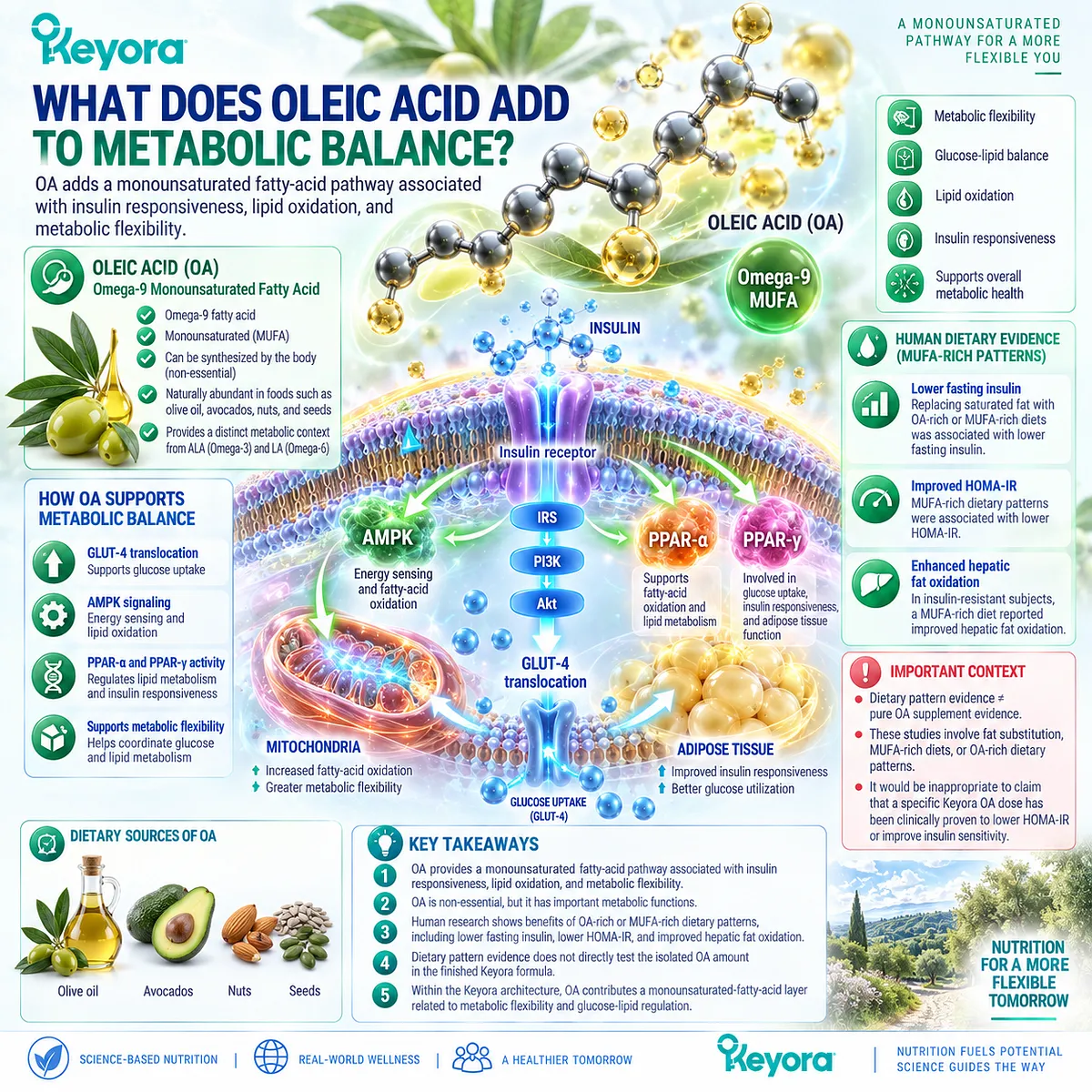
OA adds a monounsaturated fatty-acid pathway associated with insulin responsiveness, lipid oxidation, and metabolic flexibility
Oleic acid provides a different metabolic context from both ALA and LA.
OA is an Omega-9 monounsaturated fatty acid. It is not essential because it can be synthesized by the human body, but that does not mean it lacks metabolic importance.
The Keyora Oleic Acid source discusses OA in relation to GLUT-4 translocation, AMPK signaling, PPAR-alpha and PPAR-gamma activity, glucose uptake, insulin responsiveness, and lipid oxidation.
The source also refers to human dietary research in which replacing saturated fat with OA-rich or MUFA-rich dietary patterns was associated with lower fasting insulin and HOMA-IR.
Another cited human study involved insulin-resistant subjects consuming a MUFA-rich diet and reported improved hepatic fat oxidation.
These findings make OA particularly useful for illustrating an important evidence distinction.
The human research described here largely concerns:
fat substitution, MUFA-rich diets, or OA-rich dietary patterns.
It does not directly test the isolated OA amount contained in the finished Keyora formula.
Therefore:
Dietary Pattern Evidence ≠ Pure OA Supplement Evidence
It would be inappropriate to claim that a specific Keyora OA dose has been clinically proven to lower HOMA-IR or improve insulin sensitivity simply because OA-rich dietary patterns have shown favorable outcomes.
The stronger conclusion is that OA-rich and MUFA-rich dietary contexts have meaningful human evidence relevant to glucose metabolism, insulin responsiveness, and hepatic fat handling.
Within the Keyora architecture, OA therefore contributes a monounsaturated-fatty-acid layer related to metabolic flexibility and glucose-lipid regulation.
How Should ALA, LA, and OA Be Understood Together?
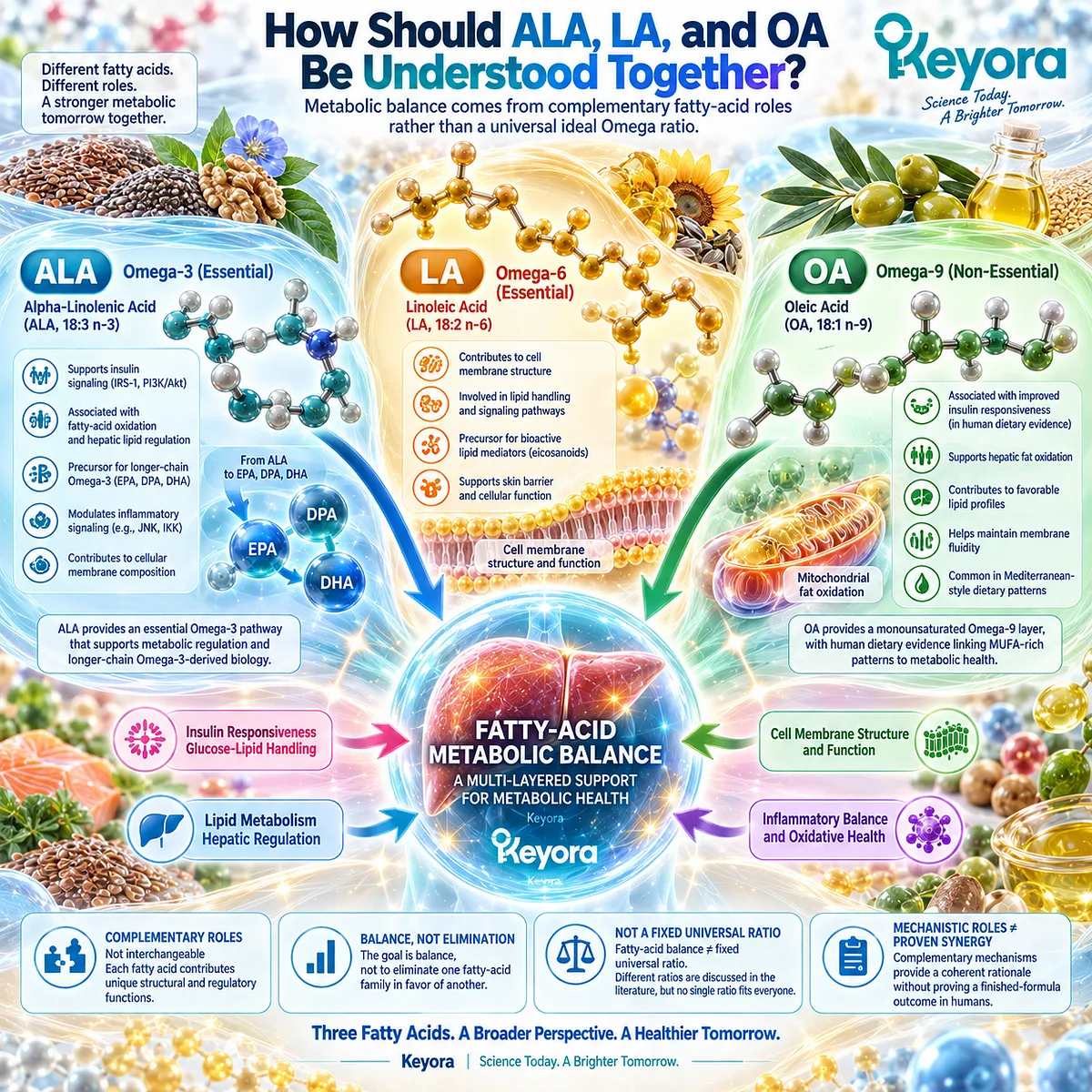
Metabolic balance comes from complementary fatty-acid roles rather than a universal ideal Omega ratio
ALA, LA, and OA should be understood as different components of a broader fatty-acid environment.
ALA contributes an essential Omega-3 pathway associated in the Keyora sources with insulin signaling, fatty-acid oxidation, hepatic lipid regulation, and longer-chain Omega-3 precursor biology.
LA contributes an essential Omega-6 layer involving membrane structure, lipid handling, and downstream signaling biology. It should not be characterized as inherently inflammatory or metabolically harmful.
OA contributes a monounsaturated Omega-9 layer, with human dietary evidence linking MUFA-rich patterns to insulin responsiveness and hepatic fat oxidation.
Together, these roles form the Keyora Fatty-Acid Metabolic Balance Architecture.
But “balance” does not mean that metabolic health can be reduced to one mathematically perfect Omega ratio.
Some Keyora source materials discuss specific Omega-6 to Omega-3 ratios, but the evidence used in this Q&A does not establish one fixed ratio as a universal metabolic target for every person.
The appropriate evidence rule is:
Fatty-Acid Balance ≠ Fixed Universal Ratio
A second boundary is equally important:
Complementary Mechanisms ≠ Proven Finished-Formula Synergy
Mechanistically different roles can provide a coherent formulation rationale without proving that the complete combination produces superior metabolic outcomes in humans.
The final answer is therefore:
ALA, LA, and OA can contribute to metabolic balance through different structural and regulatory roles involving insulin responsiveness, lipid handling, fatty-acid metabolism, and cellular lipid environments.
ALA is an essential Omega-3 fatty acid. LA is an essential Omega-6 fatty acid. OA is a non-essential monounsaturated Omega-9 fatty acid.
Their roles are complementary, but they are not interchangeable.
And when thinking about metabolic health, the goal is not to eliminate one fatty-acid family in favor of another.
The goal is balance, not elimination.
This article is for educational and informational purposes only. It does not provide medical advice, diagnosis, treatment, cure, prevention, disease outcome claims, hormone restoration claims, fertility outcome claims, or formula-specific clinical efficacy claims.