
Is Skin Aging Only About Collagen Loss?
Keyora Research Q&A Library
This is part of the Keyora Research Q&A Series, derived from Keyora Astaxanthin Research Journal Series.
Within the Keyora Astaxanthin Researcn framework, this Q&A translates complex astaxanthin biology into reader-friendly, evidence-bound answers, focusing on natural astaxanthin identity, molecular structure, antioxidant and redox mechanisms, membrane lipid interaction, mitochondrial resilience, inflammatory signaling pathways, human evidence interpretation, and the scientific principles behind responsible supplementation.
First published by Keyora Research Journal: www.keyorahealth.com
Direct Answer
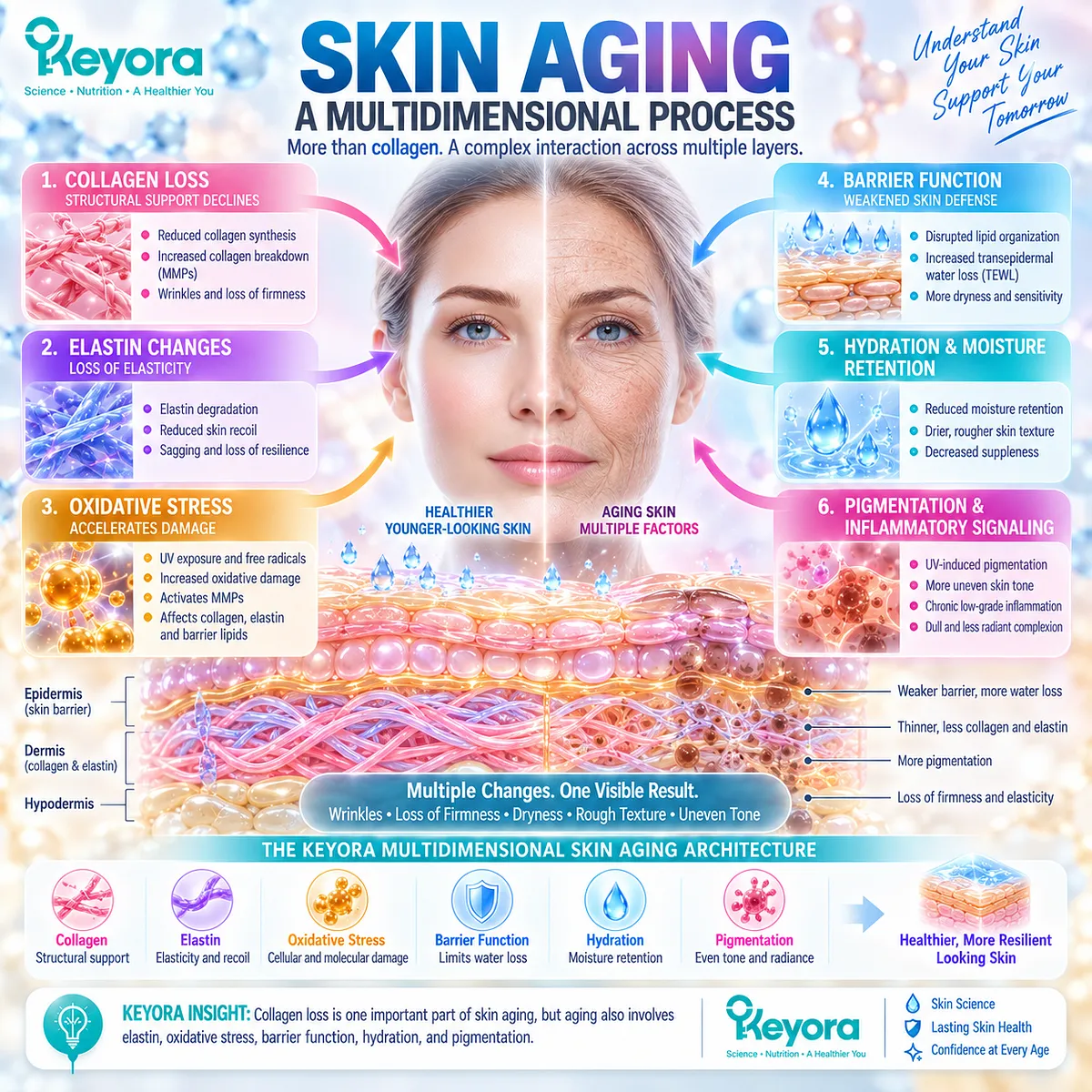
No. Collagen loss is one important part of skin aging, but aging also involves elastin, oxidative stress, barrier function, hydration, and pigmentation
No.
Skin aging is not only about collagen loss.
Collagen is important because it contributes to the structural support of the dermis.
Changes in collagen integrity are closely associated with wrinkles, loss of firmness, and other visible features commonly associated with aging skin.
But the Keyora source describes a much broader biological picture.
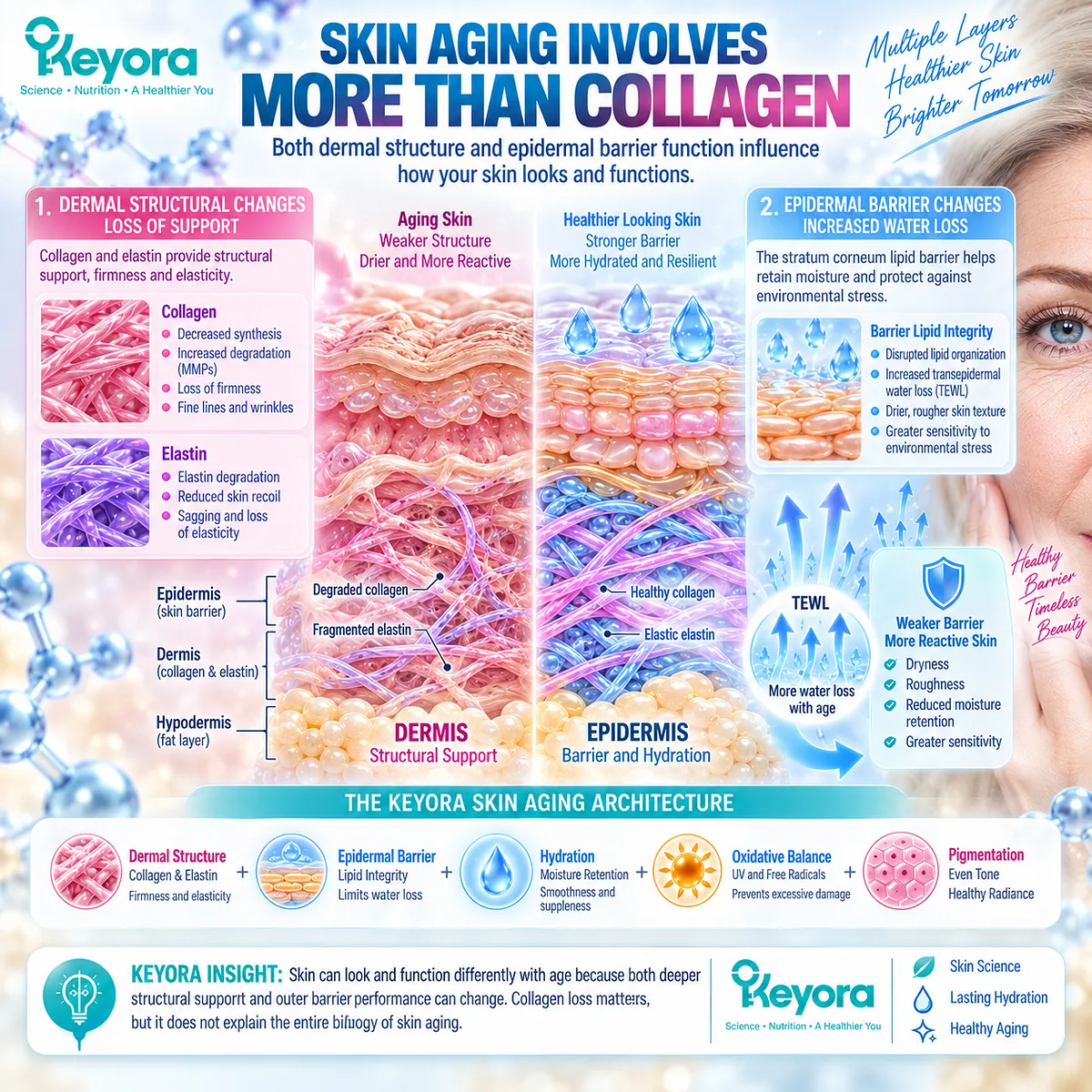
Skin aging can also involve changes in elastin, increased oxidative stress, altered matrix metalloproteinase activity, reduced skin-barrier integrity, increased transepidermal water loss, declining moisture retention, and changes in pigmentation and inflammatory signaling.
The source’s discussion of photoaging specifically connects ultraviolet exposure and oxidative stress with collagen and elastin degradation, barrier disruption, dryness, and pigmentation changes.
This Q&A describes that broader model as the Keyora Multidimensional Skin Aging Architecture.
It is an explanatory framework rather than a clinical term.
The core idea is that skin aging occurs across multiple structural and functional layers:
dermal structure
oxidative balance
epidermal barrier function
moisture retention
pigmentation and visible tone
Collagen loss therefore matters, but it does not provide a complete explanation of why aging skin may become thinner-looking, less elastic, drier, rougher, more uneven in tone, or more reactive.
The more accurate conclusion is:
Collagen loss is one component of skin aging, not the entire biology of skin aging.
Why Does Collagen Matter Without Explaining All of Skin Aging?
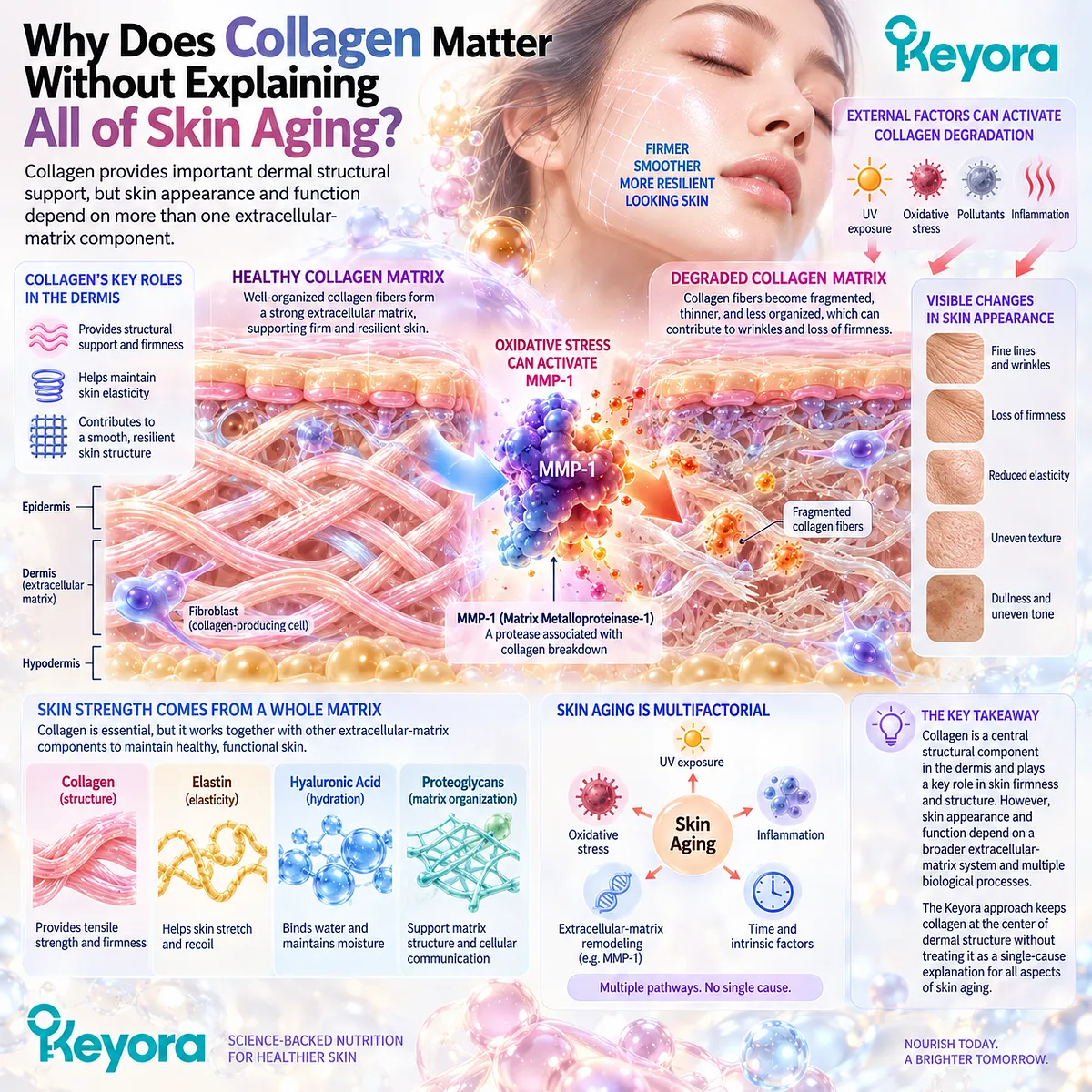
Collagen provides important dermal structural support, but skin appearance and function depend on more than one extracellular-matrix component
Collagen remains one of the most important structural proteins in the skin.
The Keyora source places collagen within the extracellular matrix of the dermis and connects its degradation with changes in firmness, wrinkles, and skin structure.
It also describes oxidative stress as one factor capable of activating matrix metalloproteinase pathways involved in extracellular-matrix degradation.
One specific mechanism discussed in the source is MMP-1, a matrix metalloproteinase associated with collagen breakdown.
This helps explain why skin aging cannot be understood only by asking:
How much collagen is present?
Another relevant question is:
What is happening to the collagen-rich matrix over time?
In the source framework, collagen can be affected by an environment involving ultraviolet exposure, oxidative stress, and extracellular-matrix remodeling.
That does not mean MMP-1 alone causes skin aging.
It also does not mean all visible aging results from collagen degradation.
Instead, collagen should be viewed as one major structural component within a larger dermal system.
This distinction matters because skin can show age-related changes even when the visible concern is not primarily a wrinkle.
Dryness, loss of elasticity, uneven pigmentation, roughness, and barrier-related sensitivity cannot be explained completely by collagen quantity.
The Keyora Multidimensional Skin Aging Architecture therefore keeps collagen at the center of dermal structure without turning it into a single-cause explanation for the entire aging process.
Why Do Elastin and Oxidative Stress Matter Too?
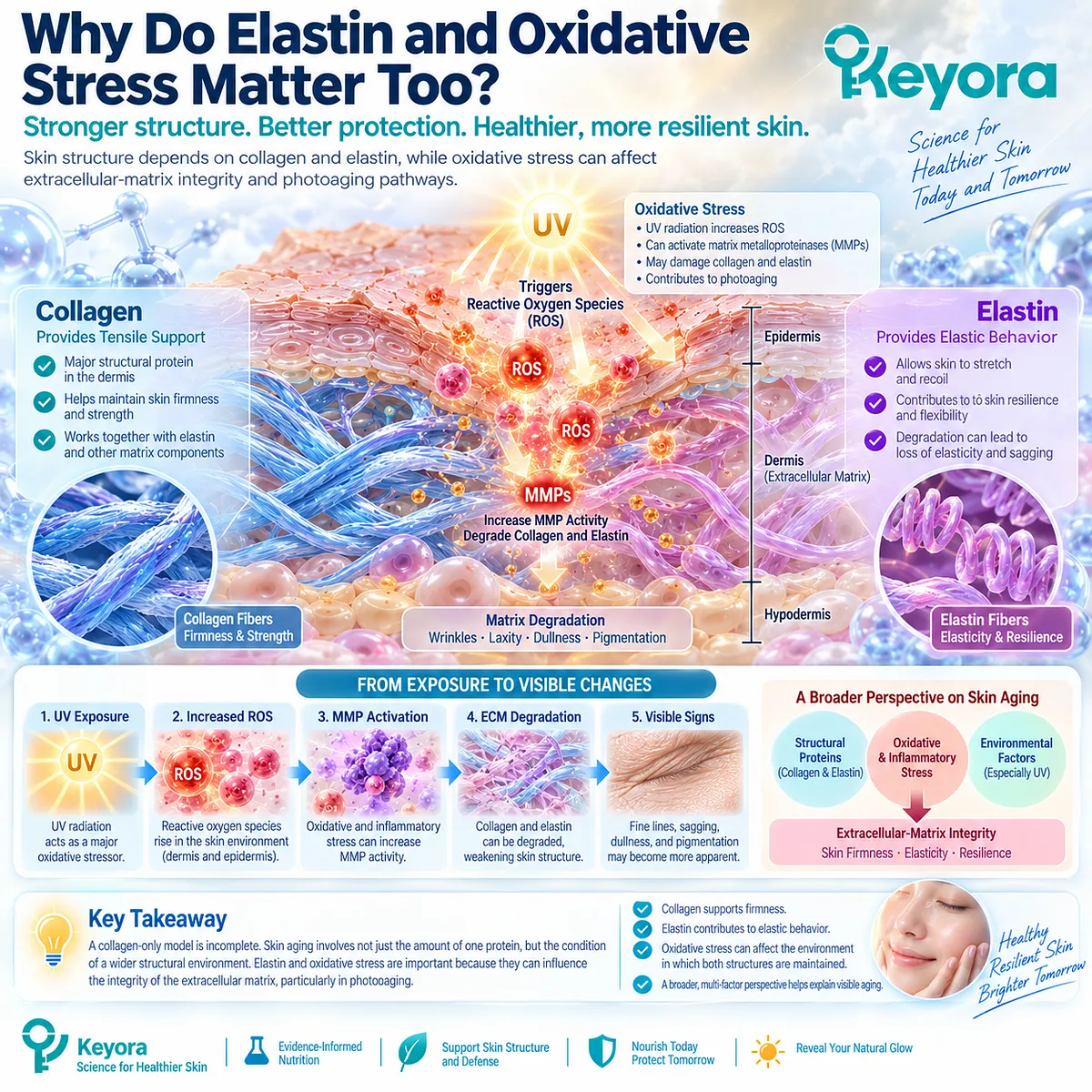
Skin structure depends on collagen and elastin, while oxidative stress can affect extracellular-matrix integrity and photoaging pathways
Collagen provides tensile support, but the skin’s structural behavior also depends on other extracellular-matrix components.
One of the most important is elastin.
The Keyora source discusses collagen and elastin together when describing photoaging.
It states that ultraviolet exposure can increase reactive oxygen species in the dermal and epidermal environment and links oxidative stress with damage to extracellular-matrix proteins and increased matrix metalloproteinase activity.
The same source also connects chronic inflammatory conditions with increased MMP activity and degradation of both collagen and elastin, contributing to wrinkles and skin laxity.
This creates a broader structural concept:
Collagen supports firmness
while
Elastin contributes to elastic behavior
and
Oxidative and inflammatory stress can influence the environment in which both structures are maintained.
The source also identifies ultraviolet radiation as an important oxidative stressor in photoaging and links it with visible changes such as fine lines, sagging, dullness, and pigmentation.
The appropriate conclusion is not that oxidative stress explains every form of skin aging.
It is that oxidative stress represents one important mechanism discussed in the source, particularly in relation to photoaging and extracellular-matrix damage.
This is why a collagen-only model is incomplete.
Skin aging involves not just the amount of one protein, but the condition of a wider structural environment.
Why Are Skin Barrier and Hydration Also Part of Skin Aging?
Aging skin is not only a dermal matrix issue because epidermal barrier integrity and moisture retention also influence how skin looks and functions
Collagen is primarily associated with the dermal structural matrix.
But the skin also has an outer barrier system that contributes to hydration and surface resilience.
The previous article, “Why Is My Skin Dry Even When I Use Moisturizers?”, focused on the stratum corneum lipid barrier and transepidermal water loss.
That same biology is also relevant when thinking about aging skin.
The Keyora source explicitly connects barrier disruption with increased TEWL, dryness, and greater susceptibility to environmental stress.
This means the visible appearance of aging skin can involve two different biological levels.
One is the dermal structural level, involving collagen and elastin.
The other is the epidermal barrier level, involving moisture retention and protection against water loss.
A person may therefore experience aging-related concerns that include:
fine lines
loss of firmness
dryness
roughness
reduced moisture retention
These are not all interchangeable signs, and they do not necessarily arise from exactly the same mechanism.
The source also reports human Astaxanthin research in which skin moisture content was measured alongside elasticity, wrinkle depth, and pigmentation, illustrating that hydration is treated as a distinct skin endpoint rather than simply a consequence of collagen status.
The broader conclusion is:
Skin can look and function differently with age because both deeper structural support and outer barrier performance can change.
Why Are Pigmentation and Inflammation Part of the Aging Picture?
Uneven pigmentation and inflammatory signaling add visible and biological dimensions that cannot be explained by collagen loss alone
A collagen-only explanation becomes even less complete when pigmentation and skin reactivity are considered.
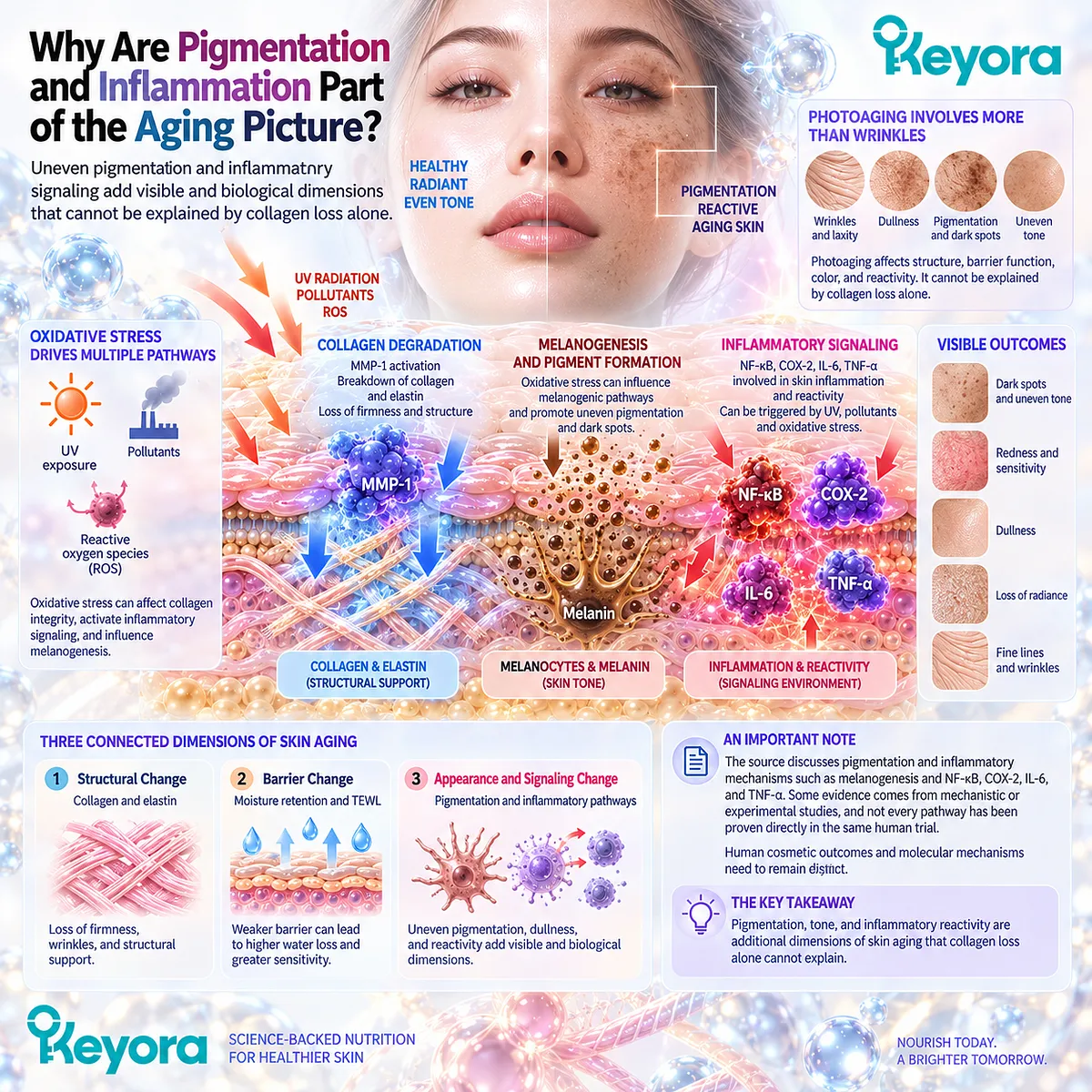
The Keyora source describes photoaging as involving not only wrinkles and laxity, but also dullness, pigmentation, and uneven skin tone. It links oxidative stress with pathways relevant to melanogenesis and pigment formation.
The Astaxanthin skin section also discusses inflammatory signaling pathways including NF-κB, COX-2, IL-6, and TNF-α in relation to skin inflammation and reactivity.
These mechanisms belong to a different biological layer from collagen structure.
This means skin aging can involve:
Structural change
through collagen and elastin,
Barrier change
through moisture retention and TEWL,
and
Appearance and signaling change
through pigmentation and inflammatory pathways.
The source also discusses pigmentation-related mechanisms such as melanogenesis and describes dark spots and uneven tone within its photoaging framework.
However, these mechanism discussions should not be treated as though every pathway has been proven directly in the same human trial.
Some of the source’s pigmentation and inflammatory explanations come from mechanistic or experimental literature.
Human cosmetic outcomes and molecular mechanisms therefore need to remain distinct.
The strongest conclusion is simply:
Pigmentation, tone, and inflammatory reactivity are additional dimensions of skin aging that collagen loss alone cannot explain.
What Does Human Astaxanthin Evidence Tell Us About Multidimensional Skin Aging?
Human Astaxanthin research summarized by the source measured several skin outcomes, illustrating why skin aging should not be reduced to collagen alone
The strongest evidence-based reason to think about skin aging multidimensionally comes from the way human skin studies measure outcomes.
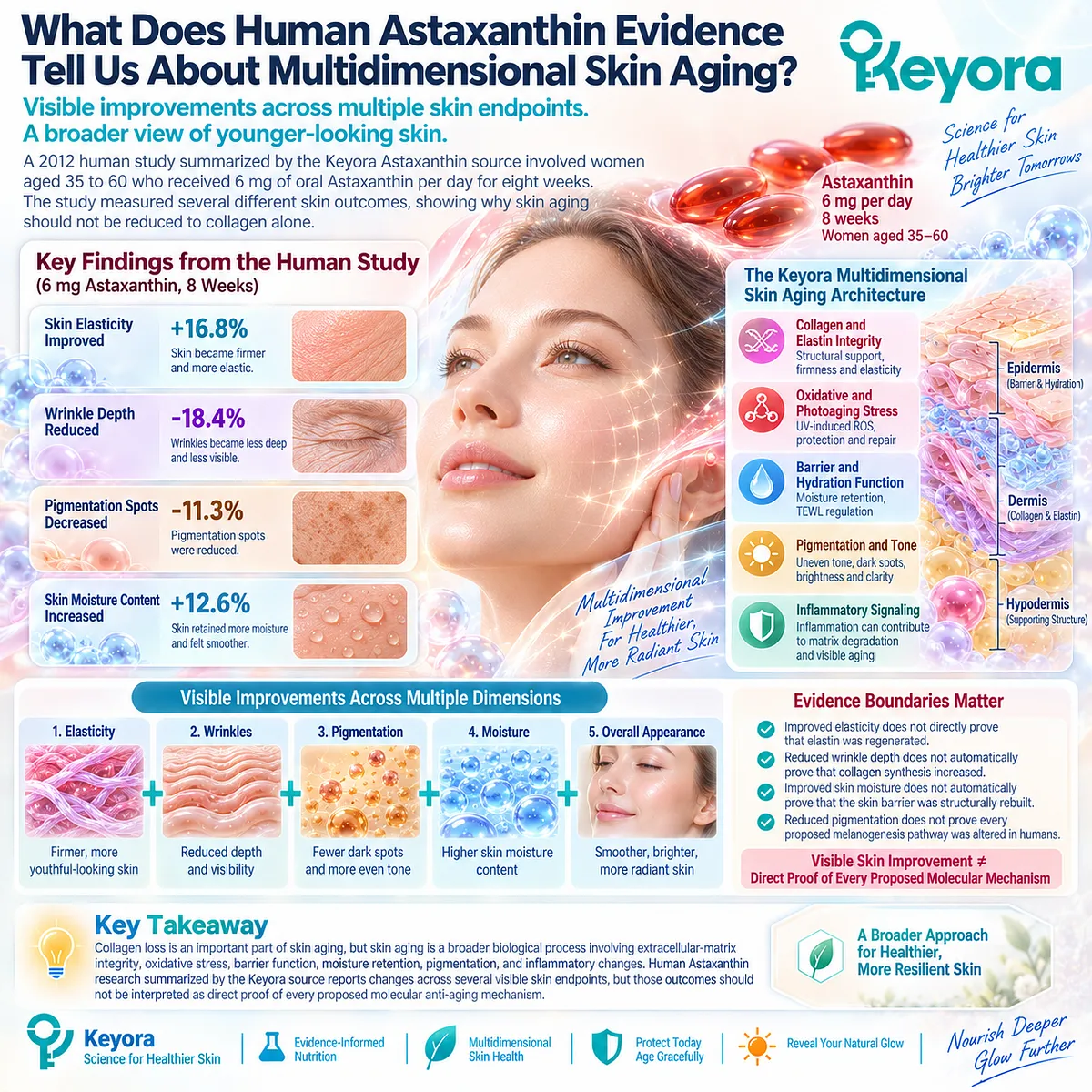
The Keyora Astaxanthin source summarizes a 2012 human study involving women aged 35 to 60 who received 6 mg of oral Astaxanthin per day for eight weeks.
The source reports changes across several different skin endpoints:
improved skin elasticity
reduced wrinkle depth
decreased pigmentation spots
increased skin moisture content
These are not all collagen measurements.
Elasticity, wrinkles, pigmentation, and moisture represent different aspects of skin appearance and function.
That makes the study especially useful for the present question.
It shows why skin aging research should not be interpreted through one biomarker or one structural protein alone.
At the same time, the evidence must be kept within its limits.
A visible improvement in elasticity does not directly prove that elastin was regenerated.
A reduction in wrinkle depth does not automatically prove that collagen synthesis increased.
Improved skin moisture does not automatically prove that the skin barrier was structurally rebuilt.
And reduced pigmentation does not prove every proposed melanogenesis pathway was altered in humans.
The correct evidence rule is:
Visible Skin Improvement ≠ Direct Proof of Every Proposed Molecular Mechanism
The Keyora Multidimensional Skin Aging Architecture therefore uses the human evidence appropriately.
It treats skin aging as a combination of:
collagen and elastin integrity
oxidative and photoaging stress
barrier and hydration function
pigmentation and tone
inflammatory signaling
The final answer is:
No.
Collagen loss is an important part of skin aging, but skin aging is a broader biological process involving extracellular-matrix integrity, oxidative stress, barrier function, moisture retention, pigmentation, and inflammatory changes.
Human Astaxanthin research summarized by the Keyora source reports changes across several of these visible skin endpoints, but those outcomes should not be interpreted as direct proof of every proposed molecular anti-aging mechanism.
This article is for educational and informational purposes only. It does not provide medical advice, diagnosis, treatment, cure, prevention, disease outcome claims, hormone restoration claims, fertility outcome claims, or formula-specific clinical efficacy claims.