
Why Does Keyora Use Astaxanthin 16 mg With Omega-3/6/9?
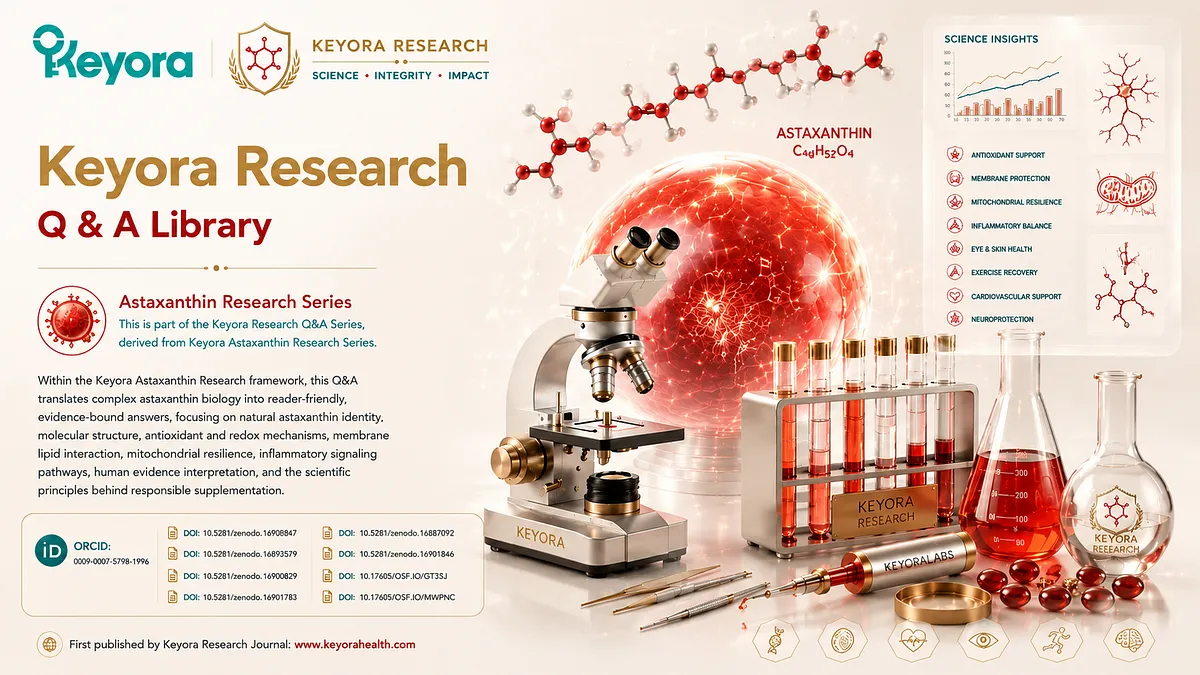
Keyora Research Q&A Library
This is part of the Keyora Research Q&A Series, derived from Keyora Astaxanthin Research Journal Series.
Within the Keyora Astaxanthin Researcn framework, this Q&A translates complex astaxanthin biology into reader-friendly, evidence-bound answers, focusing on natural astaxanthin identity, molecular structure, antioxidant and redox mechanisms, membrane lipid interaction, mitochondrial resilience, inflammatory signaling pathways, human evidence interpretation, and the scientific principles behind responsible supplementation.
First published by Keyora Research Journal: www.keyorahealth.com
Direct Answer
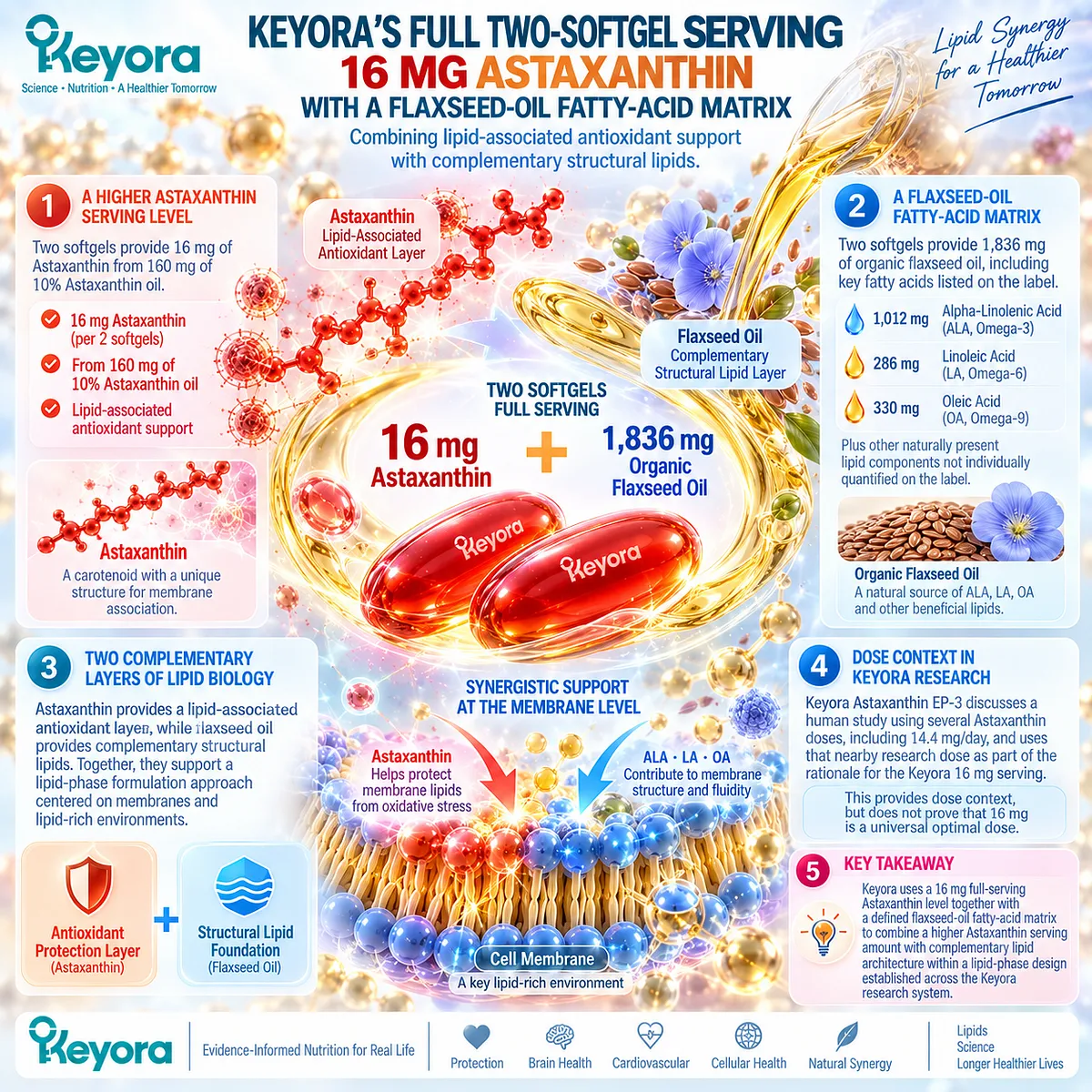
Keyora’s full two-softgel serving pairs 16 mg of Astaxanthin with a flaxseed-oil fatty-acid matrix to combine lipid-associated antioxidant support with complementary structural lipids
Keyora uses 16 mg of Astaxanthin per full two-softgel serving together with an organic flaxseed-oil matrix because the formula is designed around two complementary layers of lipid biology.
The current Keyora label lists a serving size of two softgels.
That serving provides 16 mg of Astaxanthin from 160 mg of 10% Astaxanthin oil and 1,836 mg of organic flaxseed oil.
Within that flaxseed oil, the label specifically lists 1,012 mg of alpha-linolenic acid, or ALA, 286 mg of linoleic acid, or LA, and 330 mg of oleic acid, or OA.
The formulation logic is therefore not simply:
high-dose Astaxanthin + generic Omega-3/6/9
It is better understood as:
Astaxanthin
providing a lipid-associated antioxidant layer,
together with
a flaxseed-oil fatty-acid matrix
providing ALA, LA, OA, and other naturally present lipid components not individually quantified on the label.
This Q&A describes that design as the Keyora Serving-Level Lipid Architecture.
It is an explanatory framework, not a clinical term.
The 16 mg Astaxanthin amount also has dose-context within the Keyora research documents.
Keyora Astaxanthin EP-3: The Endothelial Architecture: Cardiovascular & Cerebrovascular Sovereignty discusses a human Astaxanthin study using several doses, including 14.4 mg/day, and uses that nearby research dose as part of its rationale for the Keyora 16 mg serving.
However, that evidence does not prove that 16 mg is a universal optimal dose.
The strongest answer is:
Keyora uses a 16 mg full-serving Astaxanthin level together with a defined flaxseed-oil fatty-acid matrix to combine a higher Astaxanthin serving amount with complementary lipid architecture, while keeping the formula within a lipid-phase design established across the Keyora research system.
What Does “16 mg” Actually Mean on the Keyora Label?
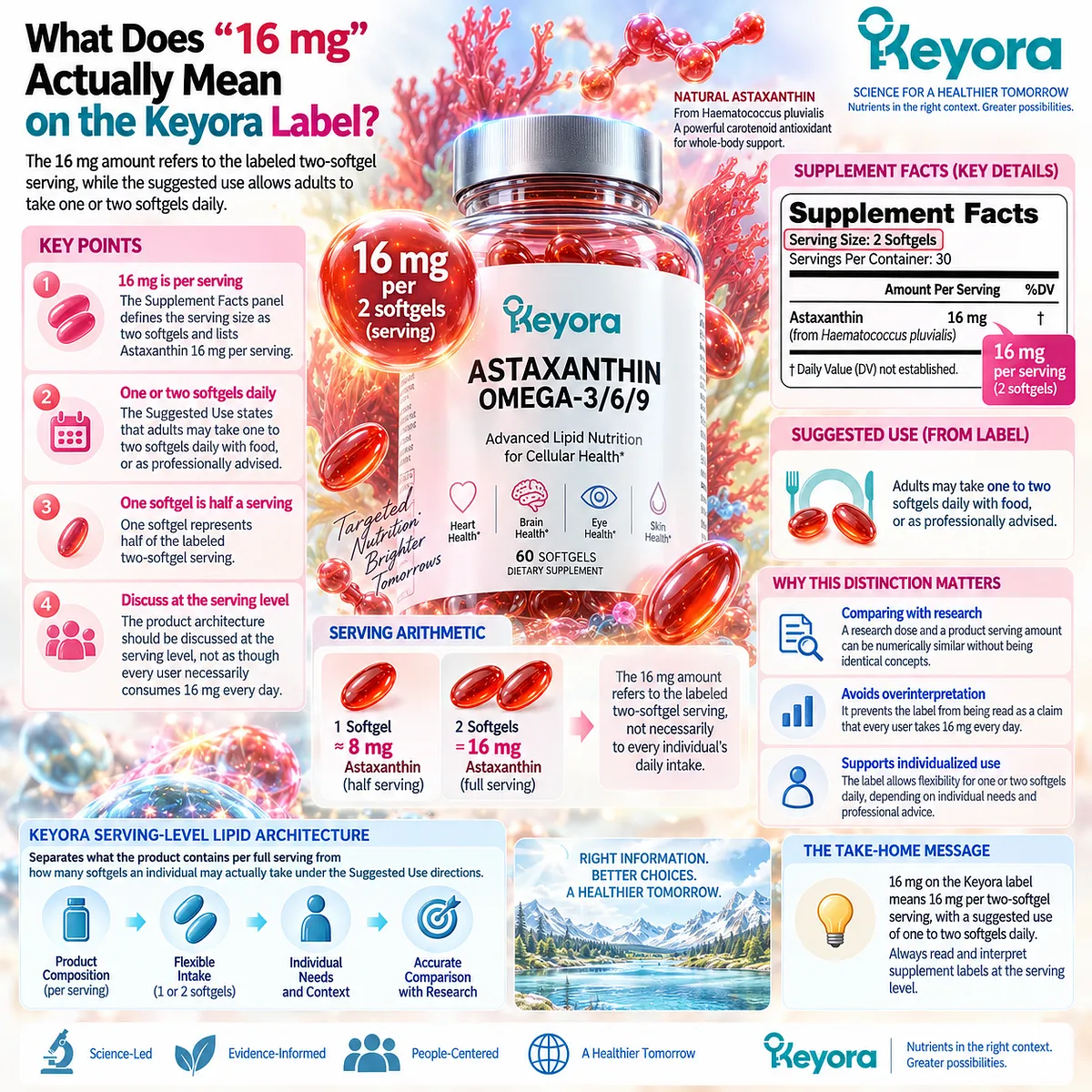
The 16 mg amount refers to the labeled two-softgel serving, while the suggested use allows adults to take one or two softgels daily
The first point to clarify is simple but important:
16 mg is the amount of Astaxanthin in the full labeled serving of two softgels.
The current Supplement Facts panel defines the serving size as two softgels and lists Astaxanthin 16 mg per serving.
The same label states under Suggested Use that adults may take one to two softgels daily with food, or as professionally advised.
This means the phrase:
“Keyora provides 16 mg Astaxanthin per day”
is less precise than:
“Keyora provides 16 mg Astaxanthin per two-softgel serving.”
That distinction matters because the label itself allows a one-softgel intake as well as the full two-softgel serving.
Based on the serving arithmetic, one softgel represents half of the labeled two-softgel serving.
The product architecture should therefore be discussed at the serving level, not as though every user necessarily consumes the full 16 mg amount every day.
This is one reason the Keyora Serving-Level Lipid Architecture is a useful framework.
It separates:
what the product contains per full serving
from
how many softgels an individual may actually take under the Suggested Use directions.
That difference is especially important when comparing the label with research studies that report Astaxanthin in mg/day.
A research dose and a product serving amount can be numerically similar without being identical concepts.
Why Did Keyora Choose a Higher Astaxanthin Serving Level?
The 16 mg serving sits close to a 14.4 mg human dose used in LDL oxidation research, providing dose-context rather than proof of an exact optimum
The Keyora research rationale for 16 mg relies partly on a human dose-response study discussed in the Endothelial Architecture paper.
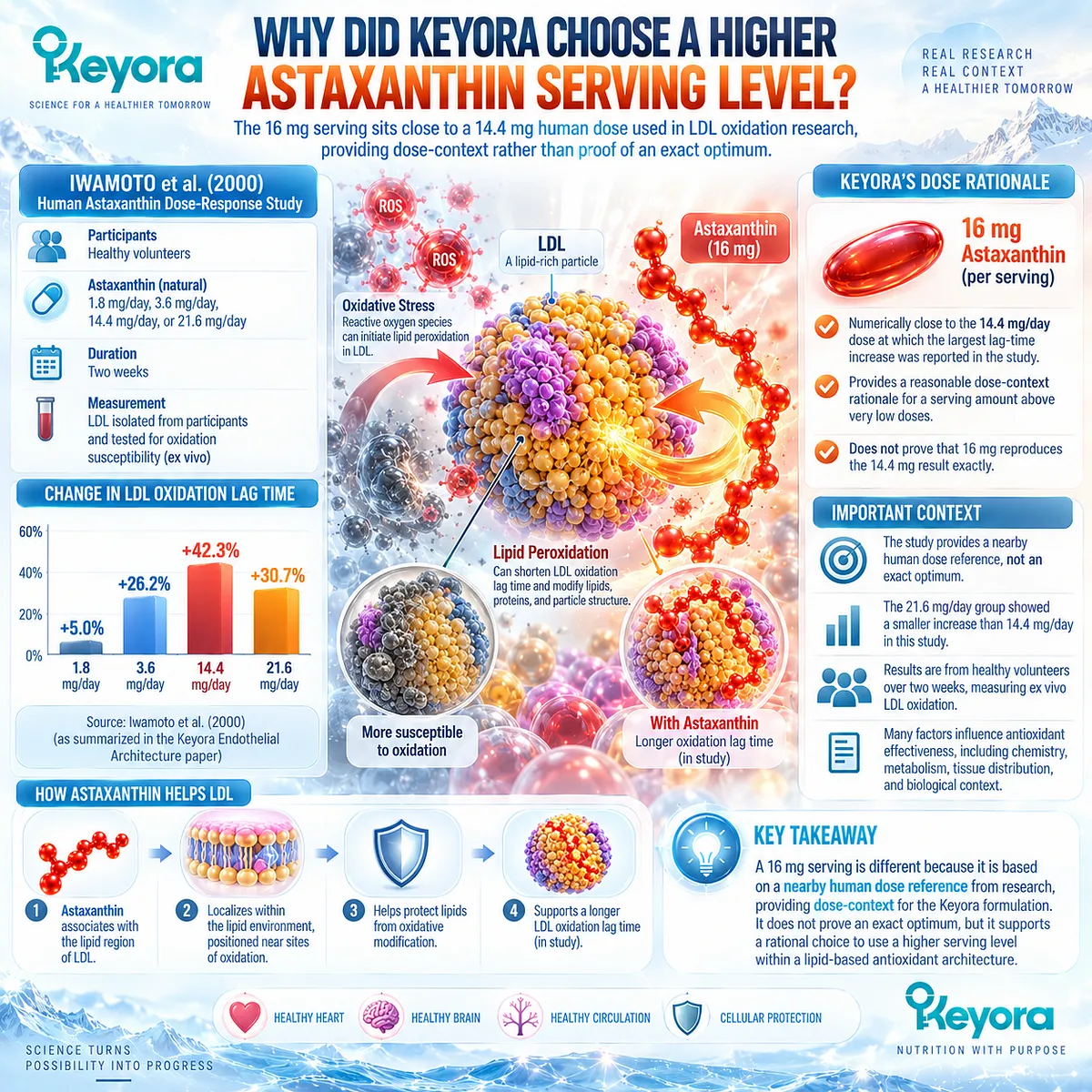
The source summarizes Iwamoto et al. (2000) as a human study in which healthy volunteers received natural Astaxanthin at:
1.8 mg/day
3.6 mg/day
14.4 mg/day
or
21.6 mg/day
for two weeks. Researchers then isolated LDL from the participants and tested its susceptibility to oxidation under ex vivo conditions.
The source reports changes in LDL oxidation lag time of:
+5.0% at 1.8 mg/day
+26.2% at 3.6 mg/day
+42.3% at 14.4 mg/day
+30.7% at 21.6 mg/day
The Keyora paper then uses the 14.4 mg finding as a rationale for selecting a 16 mg product serving.
The useful conclusion is narrower than some of the language used in the source.
The study provides a nearby human dose reference.
A 16 mg serving is numerically close to the 14.4 mg/day research dose at which the source reports the largest lag-time increase among the tested groups.
That provides a reasonable dose-context rationale for why Keyora chose a serving amount above very low Astaxanthin doses.
It does not prove that 16 mg reproduces the 14.4 mg result exactly.
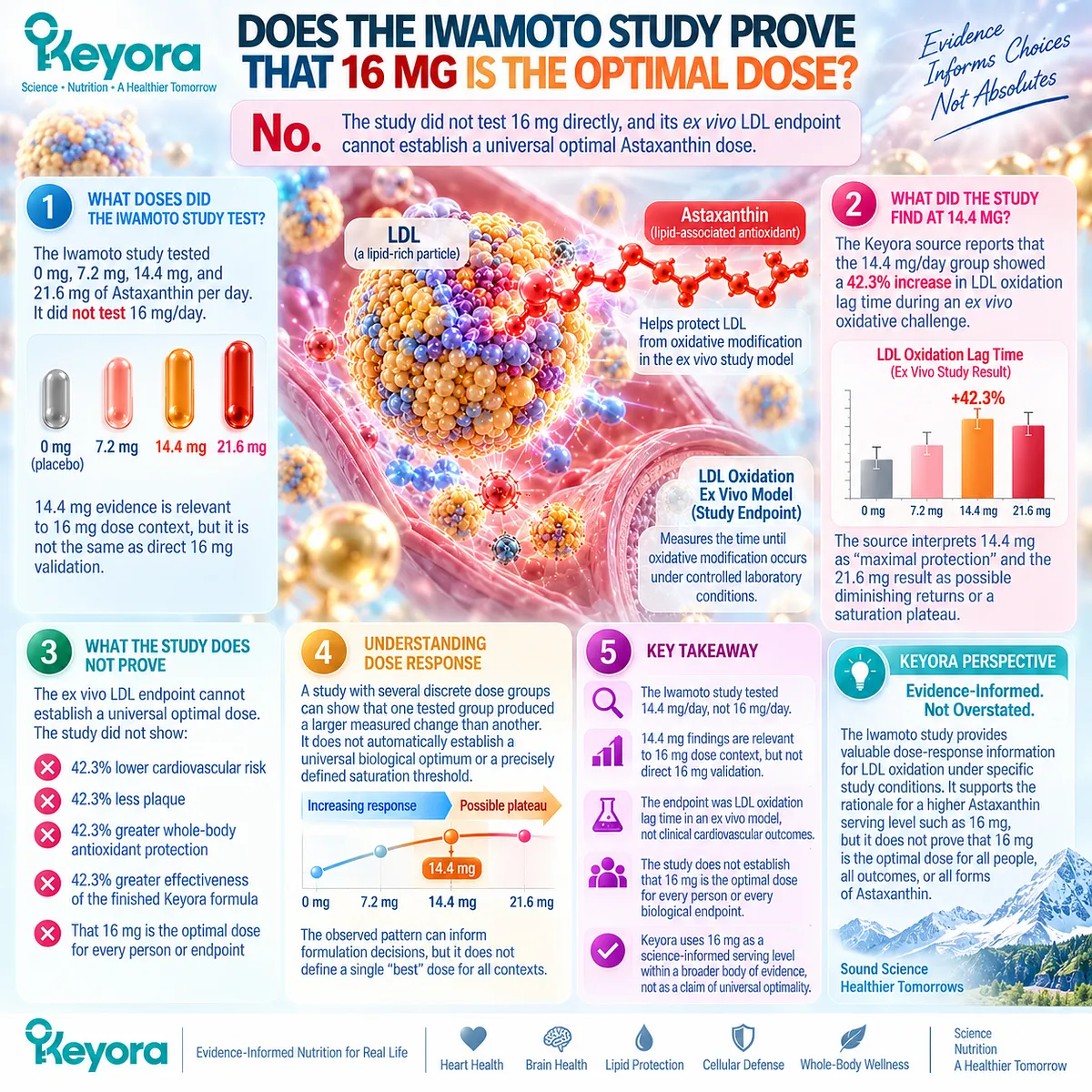
Does the Iwamoto Study Prove That 16 mg Is the Optimal Dose?
No. The study did not test 16 mg directly, and its ex vivo LDL endpoint cannot establish a universal optimal Astaxanthin dose
No.
This distinction is essential.
The Iwamoto study, as summarized in the Keyora source, tested 14.4 mg/day, not 16 mg/day.
That means:
14.4 mg evidence
is relevant to
16 mg dose context
but it is not the same as:
direct 16 mg validation
The source also interprets 14.4 mg as “maximal protection” and the 21.6 mg result as evidence of “diminishing returns” or a saturation plateau.
Those interpretations should be handled cautiously.
A study with several discrete dose groups can show that one tested group produced a larger measured change than another.
It does not automatically establish a universal biological optimum or a precisely defined saturation threshold.
The endpoint also matters.
The 42.3% figure referred to LDL oxidation lag time during an ex vivo oxidative challenge.
It did not represent:
42.3% lower cardiovascular risk
42.3% less plaque
42.3% greater whole-body antioxidant protection
or
42.3% greater effectiveness of the finished Keyora formula
The most accurate interpretation is:
The source reports that the 14.4 mg/day group showed a 42.3% increase in LDL oxidation lag time under the study assay conditions.
That finding can inform a formulation decision.
It cannot establish that 16 mg is the optimal Astaxanthin dose for every person or every biological endpoint.
What Is Actually in the Omega-3/6/9 Portion of the Formula?
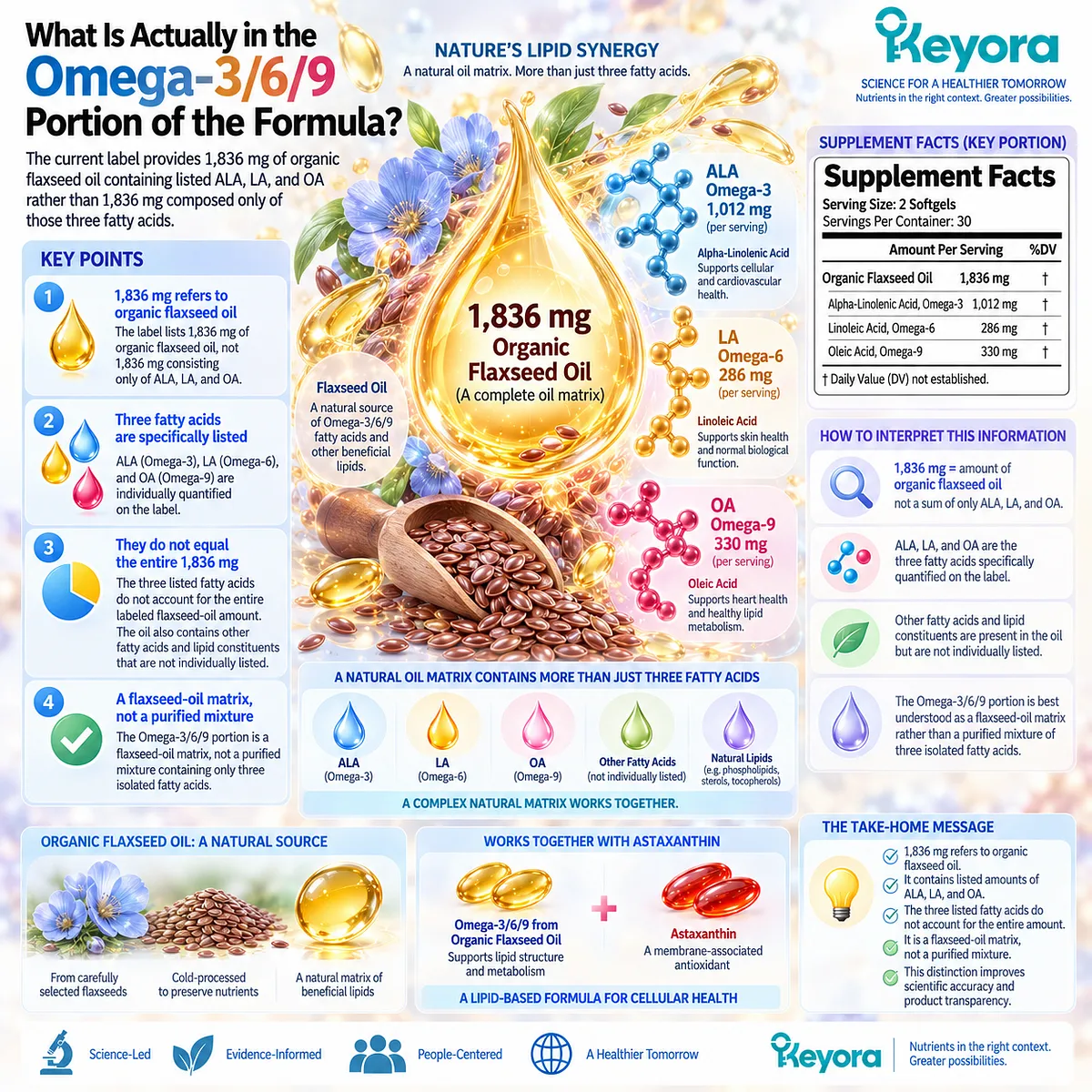
The current label provides 1,836 mg of organic flaxseed oil containing listed ALA, LA, and OA rather than 1,836 mg composed only of those three fatty acids
The current label resolves an important point about the fatty-acid portion of the formula.
It lists:
Organic Flaxseed Oil – 1,836 mg
and underneath that oil:
Alpha-Linolenic Acid, Omega-3 – 1,012 mg
Linoleic Acid, Omega-6 – 286 mg
Oleic Acid, Omega-9 – 330 mg
Therefore, 1,836 mg should be described as the amount of organic flaxseed oil, not as though it were 1,836 mg consisting exclusively of ALA, LA, and OA.
The three individually listed fatty acids do not account for the entire labeled flaxseed-oil amount.
The label does not individually quantify every remaining fatty acid or lipid constituent in that oil.
The appropriate interpretation is therefore:
1,836 mg organic flaxseed oil containing specified amounts of ALA, LA, and OA.
This distinction improves both scientific accuracy and product transparency.
It also changes how the phrase Omega-3/6/9 complex should be interpreted.
The formula is not a purified mixture containing only three isolated fatty acids.
It is a flaxseed-oil matrix in which ALA, LA, and OA are the three fatty acids specifically quantified on the Supplement Facts panel.
That is the lipid matrix surrounding the Astaxanthin component within the finished serving.
Why Is ALA the Largest Listed Fatty Acid Component?
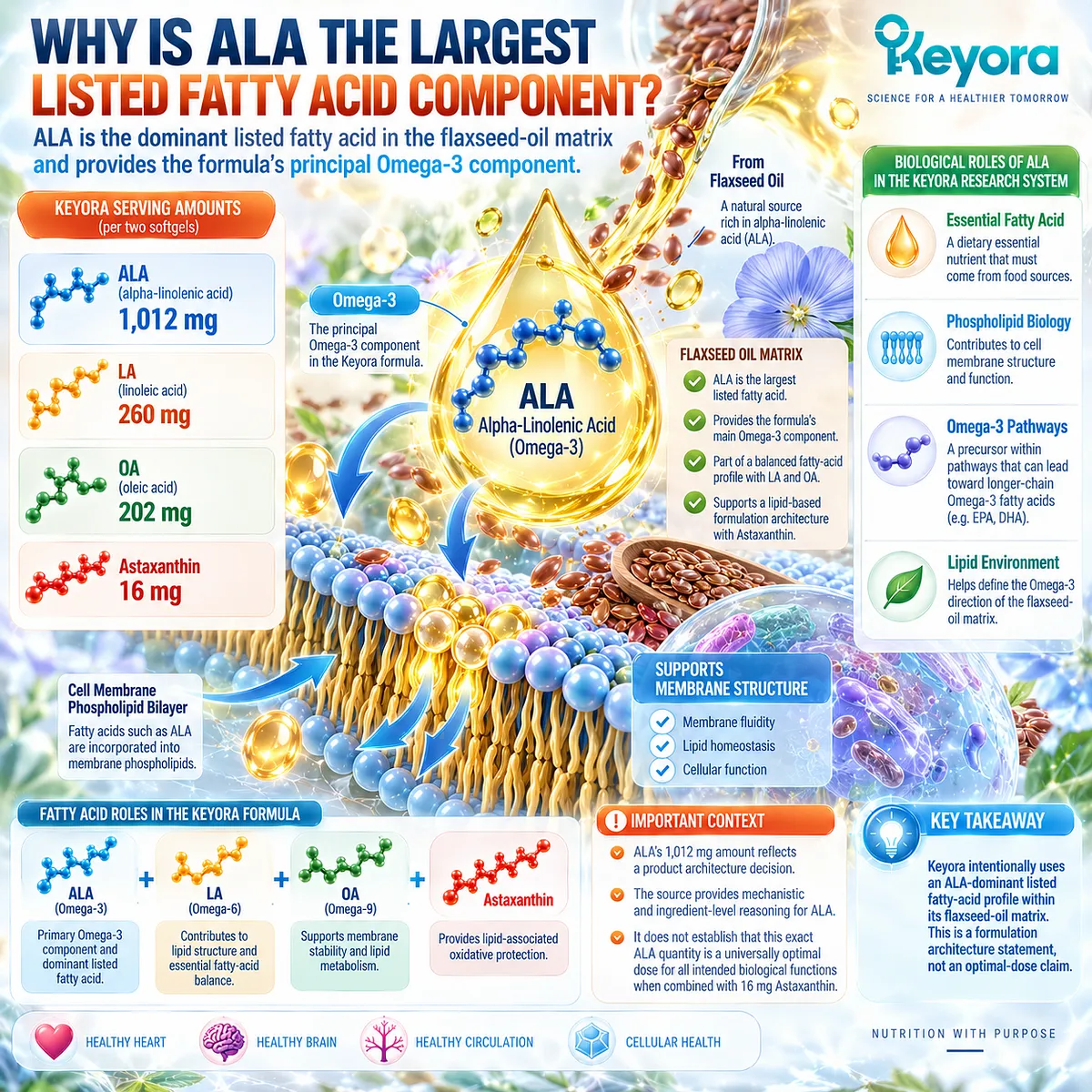
ALA is the dominant listed fatty acid in the flaxseed-oil matrix and provides the formula’s principal Omega-3 component
ALA is the largest individually listed fatty acid in the Keyora serving.
The label provides 1,012 mg of alpha-linolenic acid per two-softgel serving.
The Keyora formulation paper likewise places ALA at the center of its fatty-acid architecture and describes it as the formula’s dominant Omega-3 component.
Within the broader Keyora research system, ALA is treated as more than an Omega-3 label.
It is described as an essential fatty acid, a contributor to phospholipid biology, and a precursor within pathways that can lead toward longer-chain Omega-3 fatty acids.
In the current formula context, however, the most important point is simpler:
ALA defines the main Omega-3 direction of the flaxseed-oil matrix.
That does not mean 1,012 mg has been proven to be a universally optimal ALA dose for all of the product’s intended biological functions.
The source provides mechanistic and ingredient-level reasoning for ALA.
It does not establish that this exact ALA quantity is the unique clinically optimal amount when combined with 16 mg Astaxanthin.
The evidence-supported formulation claim is therefore:
Keyora intentionally uses an ALA-dominant listed fatty-acid profile within its flaxseed-oil matrix.
That is a product architecture statement.
It is not an optimal-dose claim.
What Roles Do LA and OA Add to the Formula?
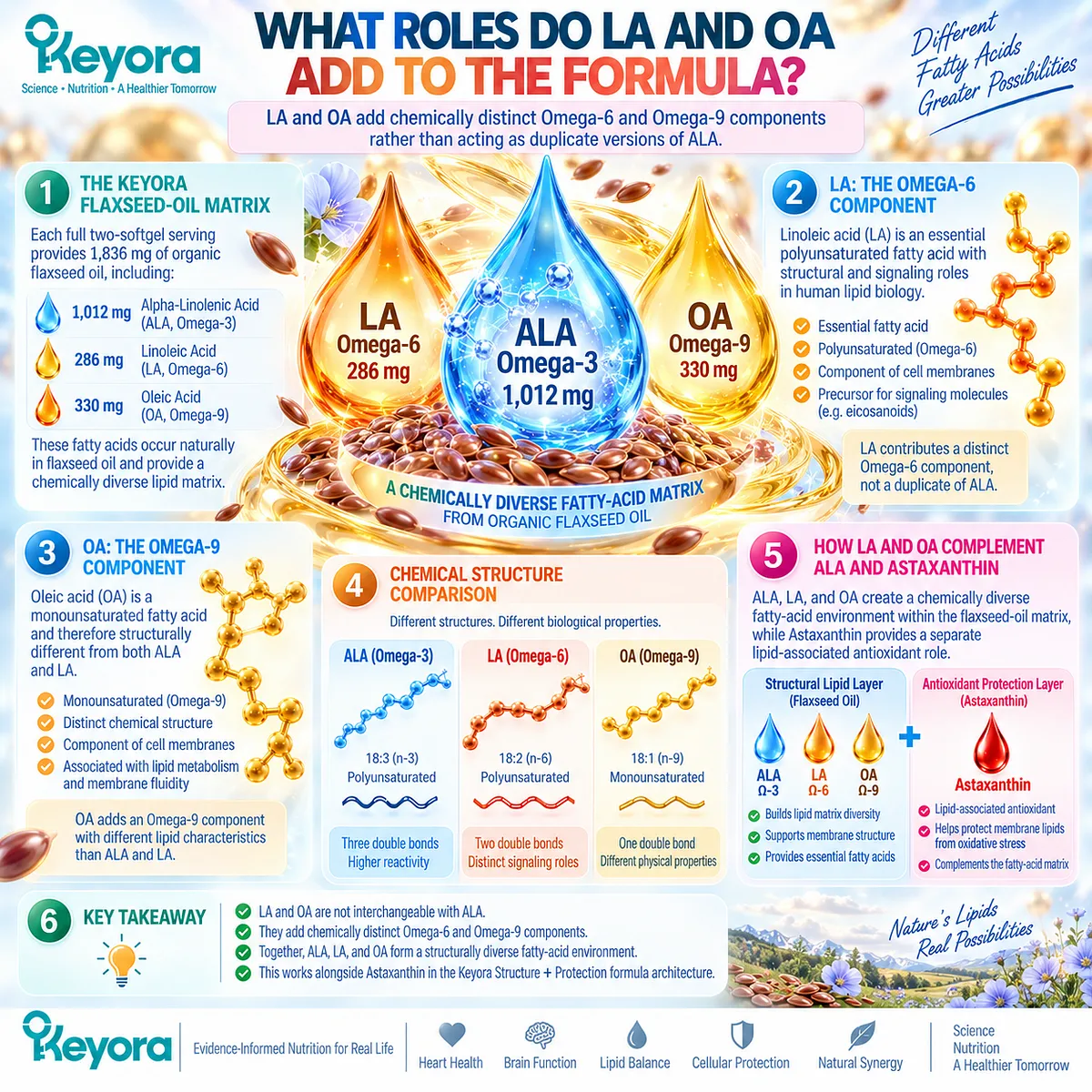
LA and OA add chemically distinct Omega-6 and Omega-9 components rather than acting as duplicate versions of ALA
The Keyora formula does not treat Omega-3, Omega-6, and Omega-9 as interchangeable.
LA and OA add different lipid characteristics to the ALA-dominant matrix.
Linoleic acid, or LA, is the formula’s listed Omega-6 fatty acid.
It is an essential polyunsaturated fatty acid with structural and signaling roles in human lipid biology.
Oleic acid, or OA, is the formula’s listed Omega-9 fatty acid.
It is a monounsaturated fatty acid and therefore differs structurally from both ALA and LA.
The full Keyora serving provides 286 mg LA and 330 mg OA alongside 1,012 mg ALA.
The purpose of including them should not be reduced to:
three anti-inflammatory fatty acids
or
three antioxidants
They are not duplicate ingredients.
The better interpretation is:
ALA, LA, and OA create a chemically diverse fatty-acid environment within the flaxseed-oil matrix.
That fatty-acid environment forms the structural and metabolic side of the Keyora formula, while Astaxanthin provides a separate lipid-associated antioxidant role.
This is the same Structure + Protection logic established in the earlier Formula Architecture articles, now applied to the actual product serving.
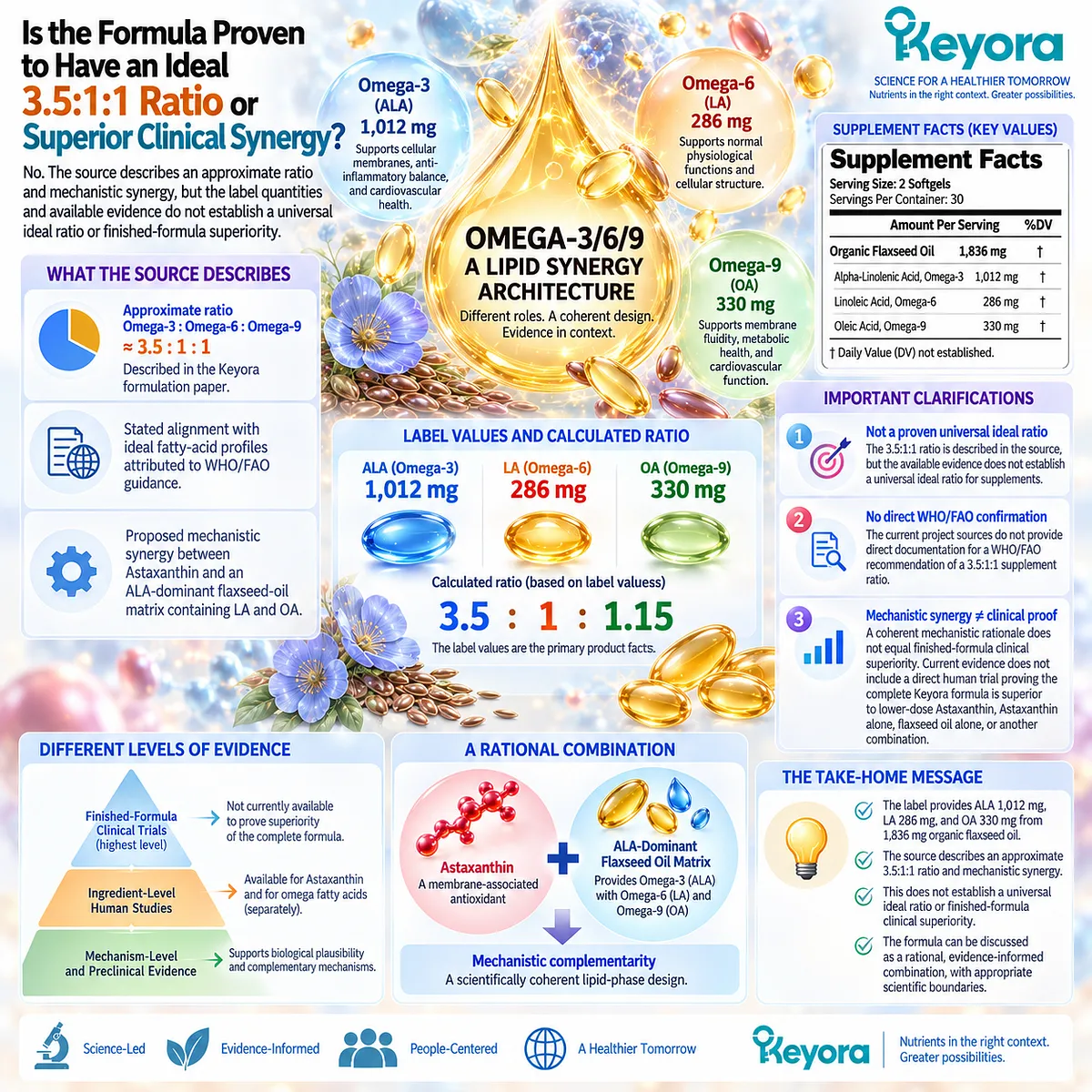
Is the Formula Proven to Have an Ideal 3.5:1:1 Ratio or Superior Clinical Synergy?
No. The source describes an approximate ratio and mechanistic synergy, but the label quantities and available evidence do not establish a universal ideal ratio or finished-formula superiority
The Keyora formulation paper describes the Omega-3 : Omega-6 : Omega-9 architecture as approximately 3.5:1:1.
However, the current label gives the actual quantities directly:
ALA – 1,012 mg
LA – 286 mg
OA – 330 mg
Those label values should be treated as the primary product facts.
The source also states that its proposed ratio aligns with ideal fatty-acid profiles attributed to WHO/FAO guidance.
The current project sources, however, do not provide enough direct documentation to establish a WHO/FAO recommendation for a supplement ratio of exactly 3.5:1:1 across Omega-3, Omega-6, and Omega-9.
Therefore, that claim should not be presented here as an authoritative global standard.
The same caution applies to synergy.
The formula has a coherent mechanistic rationale:
Astaxanthin
plus
an ALA-dominant flaxseed-oil matrix containing LA and OA
But:
mechanistic complementarity does not equal finished-formula clinical superiority.
The cited research includes ingredient-level and mechanism-level evidence.
That is different from a direct human trial proving that the complete Keyora formula is superior to lower-dose Astaxanthin, Astaxanthin alone, flaxseed oil alone, or another combination.
What Is the Strongest Evidence-Based Rationale for the Keyora Formula?
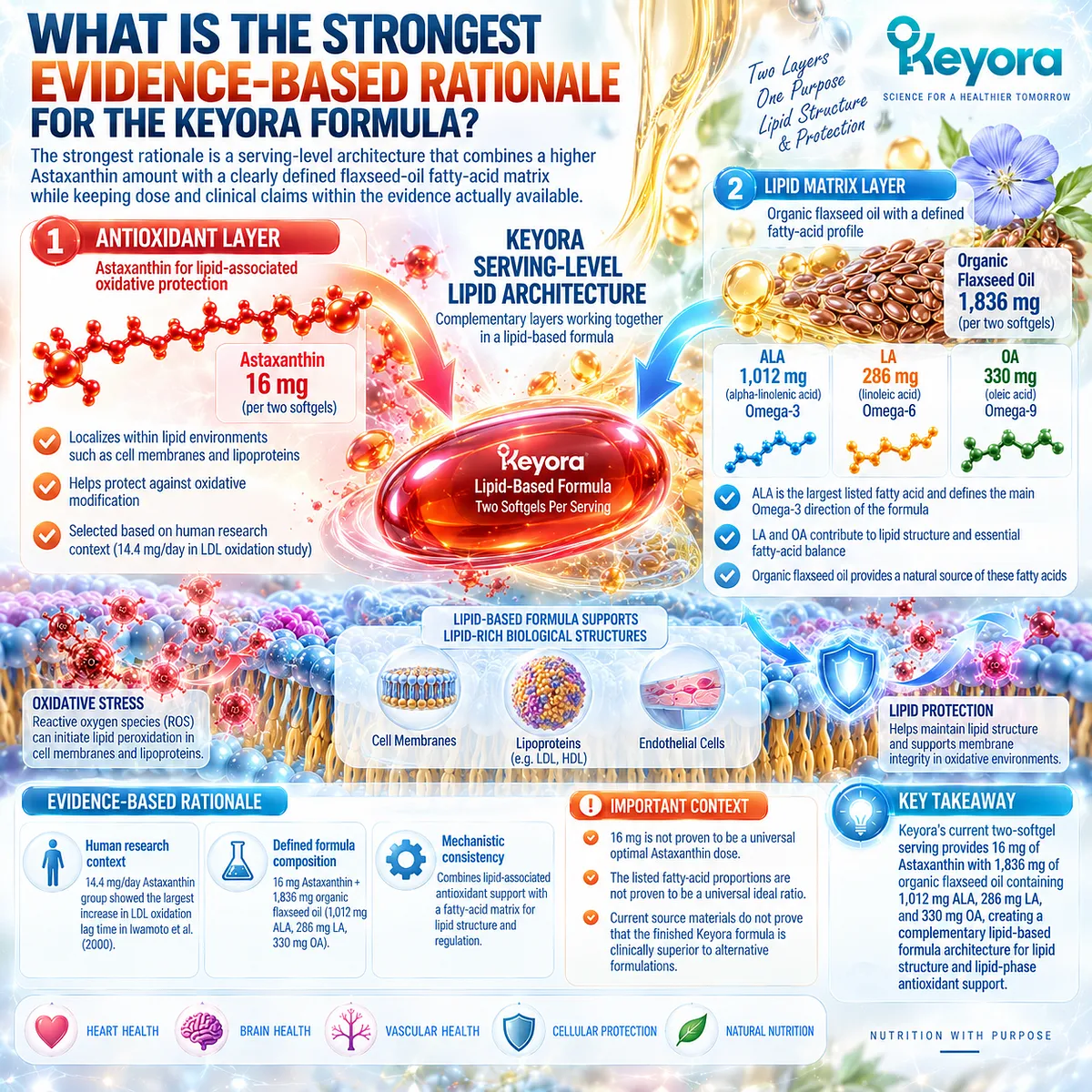
The strongest rationale is a serving-level architecture that combines a higher Astaxanthin amount with a clearly defined flaxseed-oil fatty-acid matrix while keeping dose and clinical claims within the evidence actually available
The strongest way to understand the finished product is through the Keyora Serving-Level Lipid Architecture.
The full labeled two-softgel serving contains:
Astaxanthin – 16 mg
together with
Organic Flaxseed Oil – 1,836 mg
including the listed fatty acids:
ALA – 1,012 mg
LA – 286 mg
OA – 330 mg.
This creates two complementary formula layers.
The Antioxidant Layer is centered on Astaxanthin and its lipid-associated antioxidant rationale.
The Lipid Matrix Layer is centered on organic flaxseed oil and its ALA-dominant fatty-acid profile.
The dose rationale for Astaxanthin is supported by nearby human research discussed in the Keyora Endothelial Architecture paper, particularly the 14.4 mg/day group in the Iwamoto LDL oxidation study.
The formulation rationale for the fatty-acid matrix is supported by the product composition itself and the broader Keyora lipid-architecture framework.
The final answer is therefore:
Keyora’s current two-softgel serving provides 16 mg of Astaxanthin with 1,836 mg of organic flaxseed oil containing 1,012 mg ALA, 286 mg LA, and 330 mg OA.
The formulation rationale combines a higher Astaxanthin serving level with a complementary fatty-acid matrix designed around lipid structure and lipid-phase antioxidant support.
The evidence boundary should remain equally clear:
Current source materials do not establish 16 mg as a universal optimal Astaxanthin dose, do not establish the listed fatty-acid proportions as a universal ideal ratio, and do not prove that the finished Keyora formula is clinically superior to alternative formulations.
That distinction makes the formula rationale more credible because it separates:
what Keyora formulated
from
what the available evidence has directly proven.
This article is for educational and informational purposes only. It does not provide medical advice, diagnosis, treatment, cure, prevention, disease outcome claims, hormone restoration claims, fertility outcome claims, or formula-specific clinical efficacy claims.