
Why Is Cerebrovascular Health Important for Cognitive Resilience?
Keyora Research Q&A Library
This is part of the Keyora Research Q&A Series, derived from Keyora Astaxanthin Research Journal Series.
Within the Keyora Astaxanthin Researcn framework, this Q&A translates complex astaxanthin biology into reader-friendly, evidence-bound answers, focusing on natural astaxanthin identity, molecular structure, antioxidant and redox mechanisms, membrane lipid interaction, mitochondrial resilience, inflammatory signaling pathways, human evidence interpretation, and the scientific principles behind responsible supplementation.
First published by Keyora Research Journal: www.keyorahealth.com

Direct Answer
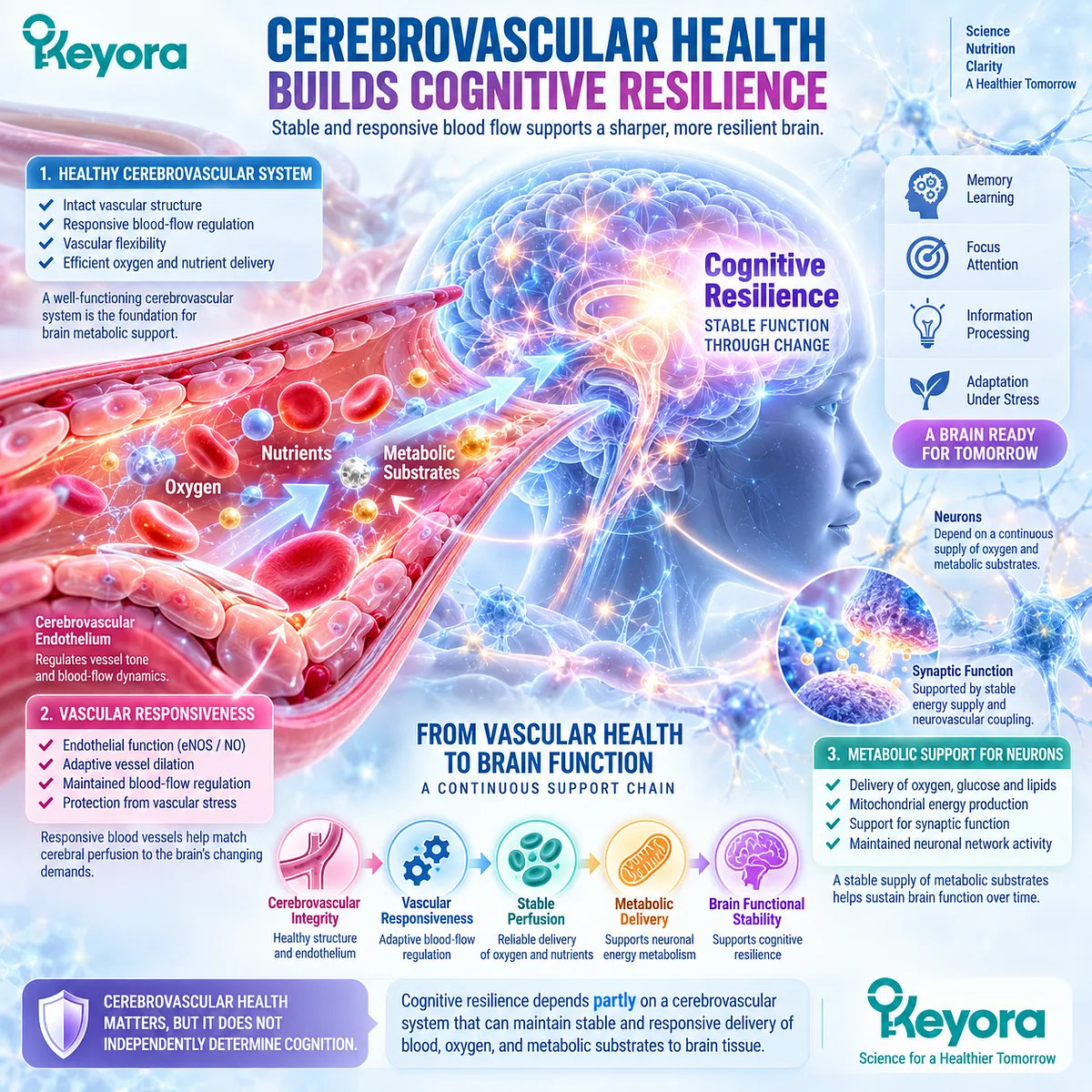
Cognitive resilience depends partly on a cerebrovascular system that can maintain stable and responsive delivery of blood, oxygen, and metabolic substrates to brain tissue
Cerebrovascular health is important for cognitive resilience because the brain depends continuously on the blood vessels that supply it.
The previous article, “How Does Blood Flow Influence Brain Function?”, focused on cerebral perfusion as a delivery system for oxygen and metabolic substrates. The present question goes one step further by asking what allows that delivery system to remain functional over time.
In Keyora Astaxanthin EP-3: The Endothelial Architecture: Cardiovascular & Cerebrovascular Sovereignty, the cerebral circulation is treated as part of a broader vascular infrastructure supporting brain metabolism.
The source repeatedly connects cerebral arteries, vascular responsiveness, blood-flow regulation, and oxygen delivery with brain function.
It also introduces Keyora concepts such as Cognitive Endurance and Cognitive Sovereignty to express the idea that sustained brain performance depends partly on vascular support.
For this Q&A, cognitive resilience is used as an explanatory term for the capacity to maintain stable cognitive function as vascular and metabolic demands change. It is not presented as a clinical diagnostic term.
The central relationship is:
Cerebrovascular integrity
vascular responsiveness
stable perfusion
metabolic delivery
support
brain functional stability
The important word is support.
Cerebrovascular health is relevant to cognitive resilience, but it does not independently determine cognition.
The strongest source-based conclusion is therefore:
Cerebrovascular health matters because brain function depends on a vascular system capable of maintaining sufficient, responsive, and stable perfusion over time.
What Does Cerebrovascular Health Actually Mean?
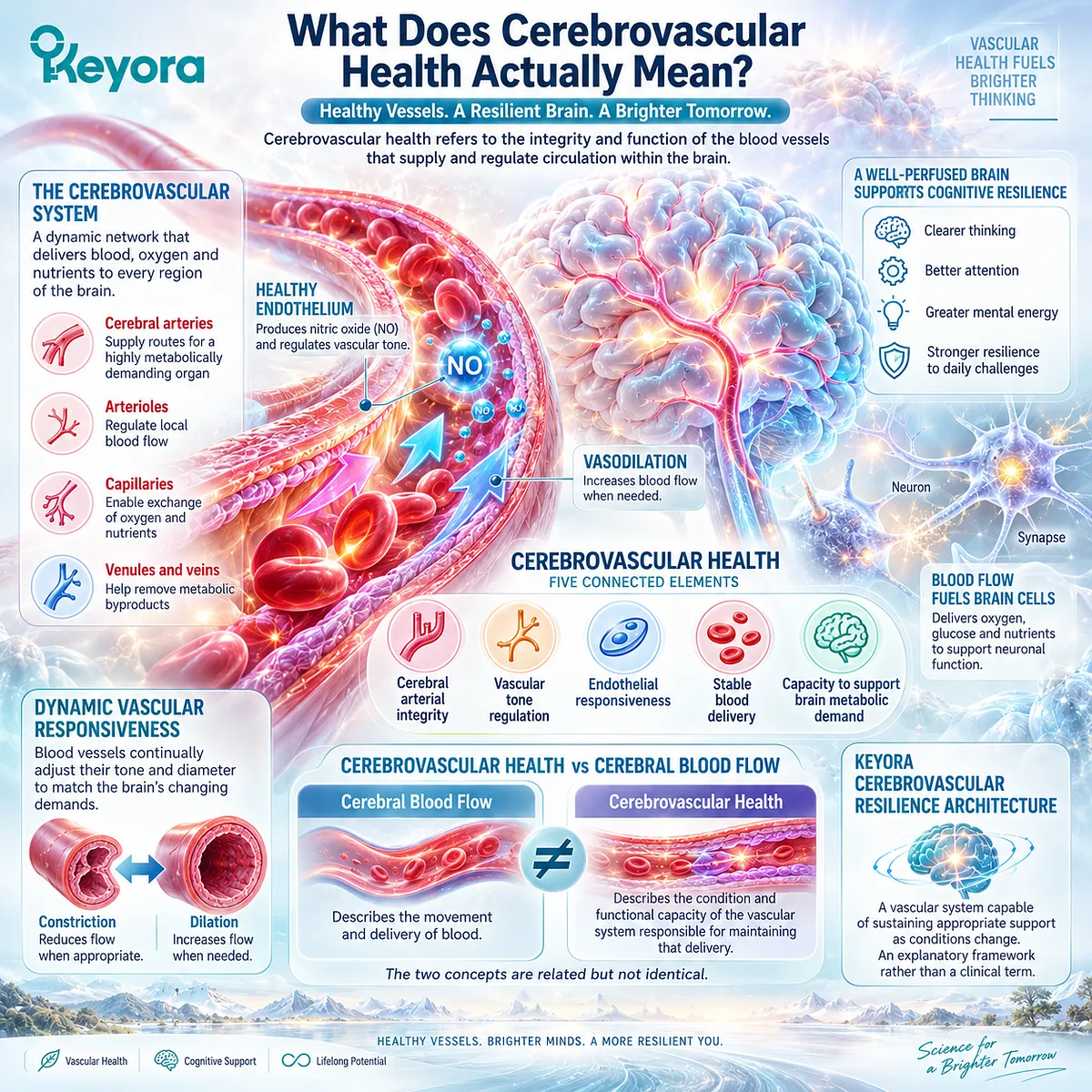
Cerebrovascular health refers to the integrity and function of the blood vessels that supply and regulate circulation within the brain
The term cerebrovascular refers to the vascular system serving the brain.
Within the Keyora Endothelial Architecture paper, the cerebral arteries are described as supply routes for a highly metabolically demanding organ.
The source places them alongside the coronary arteries when discussing the importance of continuous vascular delivery.
For this Q&A, cerebrovascular health can therefore be understood through several connected elements:
-
Cerebral arterial integrity
-
vascular tone regulation
-
endothelial responsiveness
-
stable blood delivery
-
capacity to support brain metabolic demand
This is broader than simply asking whether blood is present in cerebral vessels.
A vascular system has to do more than provide a passive pathway.
The Keyora source repeatedly emphasizes the ability of blood vessels to change tone and diameter and links this responsiveness with perfusion. It also treats the endothelium as a central regulator within the larger vascular architecture.
So the practical distinction is:
Cerebral blood flow
describes the movement and delivery of blood,
while
cerebrovascular health
describes the condition and functional capacity of the vascular system responsible for maintaining that delivery.
The two concepts are related but not identical.
This distinction matters because cognitive resilience, as used here, depends not only on a momentary supply of blood but on a vascular system capable of sustaining appropriate support as conditions change.
That is the foundation of what this article will call Keyora Cerebrovascular Resilience Architecture.
It is an explanatory framework rather than a clinical term.
Why Does Cognitive Resilience Depend on More Than Having Blood Flow?
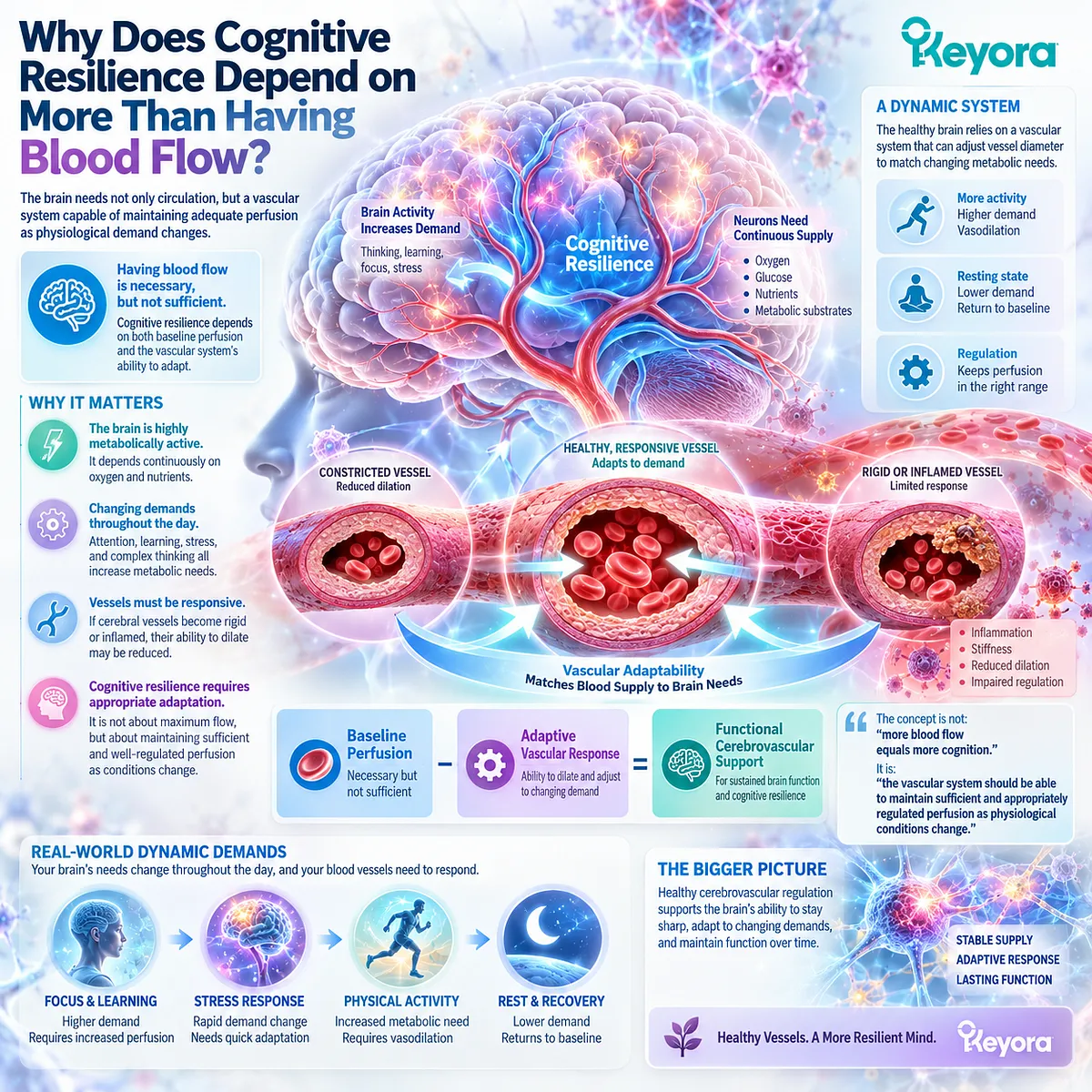
The brain needs not only circulation, but a vascular system capable of maintaining adequate perfusion as physiological demand changes
Having blood in the cerebral circulation is not the same as having an optimally responsive vascular system.
The Keyora Endothelial Architecture paper describes the brain as highly dependent on continuous metabolic supply and repeatedly links vascular dilation with the ability to meet changing demand.
In one section, the source argues that when cerebral vessels become rigid or inflamed, their ability to dilate may be reduced.
The useful source-supported principle is:
Baseline blood delivery is necessary, but vascular adaptability also matters.
A simple model is:
Baseline Perfusion
Adaptive Vascular Response
=
Functional Cerebrovascular Support
The source uses dramatic language about the brain “throttling its engine” when vascular supply is insufficient. That metaphor should not be treated as a literal physiological description.
A more careful interpretation is that cerebral vessels need enough regulatory capacity to support changing metabolic requirements.
This is where cognitive resilience becomes different from a simple blood-flow question.
The concept is not:
more blood flow equals more cognition
It is:
the vascular system should be able to maintain sufficient and appropriately regulated perfusion as physiological conditions change.
That distinction is especially important because the brain’s needs are dynamic.
The source repeatedly connects vascular responsiveness, oxygen delivery, and sustained function, but it does not establish that maximizing cerebral blood flow produces greater cognitive ability.
Healthy cerebrovascular regulation is therefore better understood as appropriate adaptation, not maximum flow.
How Do Endothelial Function and Vascular Responsiveness Support the Brain?
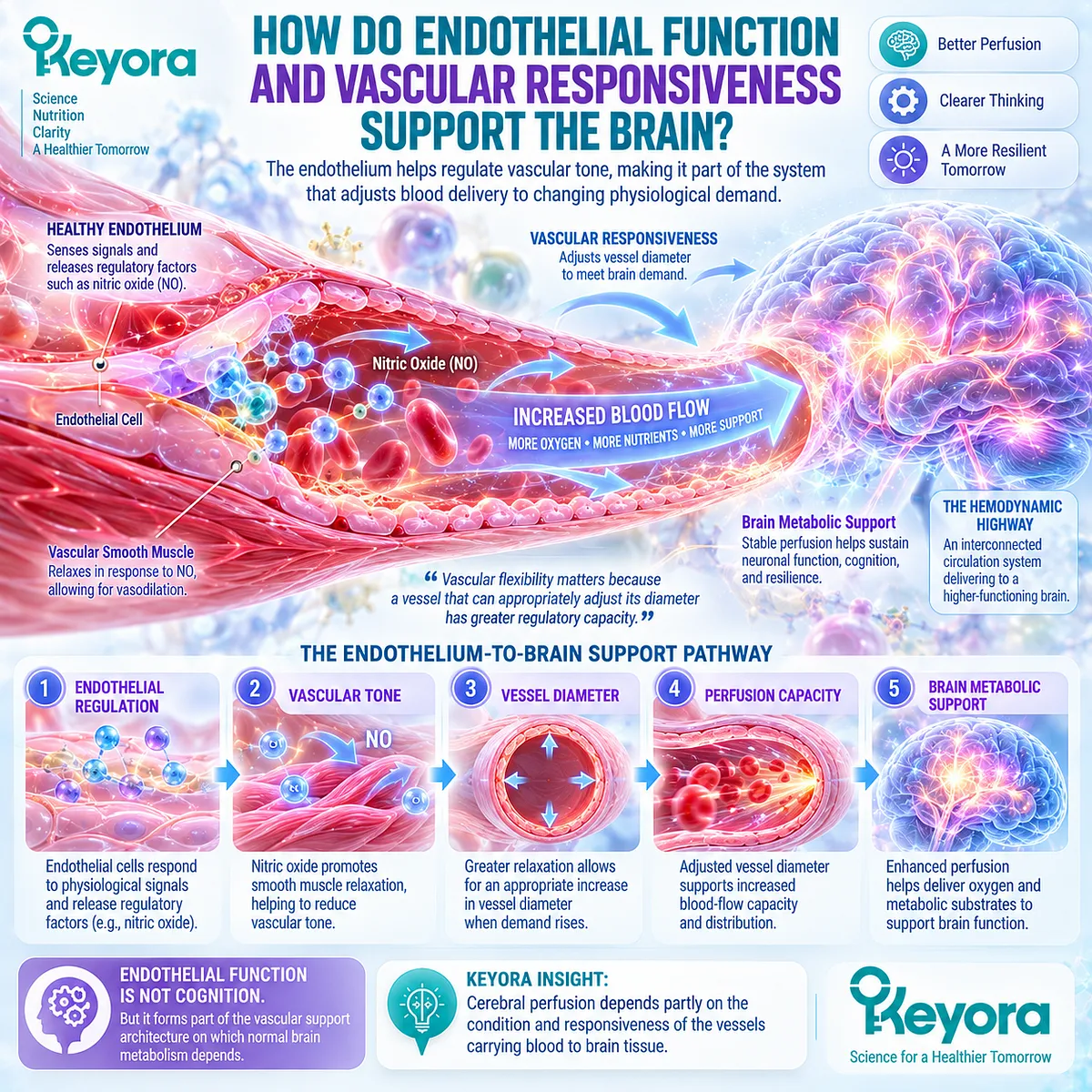
The endothelium helps regulate vascular tone, making it part of the system that adjusts blood delivery to changing physiological demand
The Keyora Endothelial Architecture paper places the endothelium at the center of its vascular model.
Earlier in the source, endothelial signaling is connected with nitric oxide, smooth muscle relaxation, changes in vessel diameter, and perfusion. Later passages apply this broader vascular model to cerebral circulation.
The source specifically describes a situation in which cerebral arteries that are less able to dilate may be less capable of responding to metabolic demand.
The relevant pathway can be summarized as:
Endothelial regulation
↓
vascular tone
↓
vessel diameter
↓
perfusion capacity
↓
brain metabolic support
This is not a claim that endothelial function alone controls cerebral circulation.
The source does not provide a complete account of every mechanism involved in cerebral blood-flow regulation.
Instead, it develops one specific vascular perspective in which endothelial responsiveness is an important part of blood-flow control.
Within that perspective, vascular flexibility matters because a vessel that can appropriately adjust its diameter has greater regulatory capacity than a vessel that remains chronically constricted or poorly responsive.
The source also uses the larger Keyora phrase The Hemodynamic Highway to describe the circulation as an interconnected delivery system.
For the brain, the implication is straightforward:
Cerebral perfusion depends partly on the condition and responsiveness of the vessels carrying blood to brain tissue.
This creates the bridge from endothelial biology to cognitive resilience.
The endothelium is not cognition.
But it forms part of the vascular support architecture on which normal brain metabolism depends.
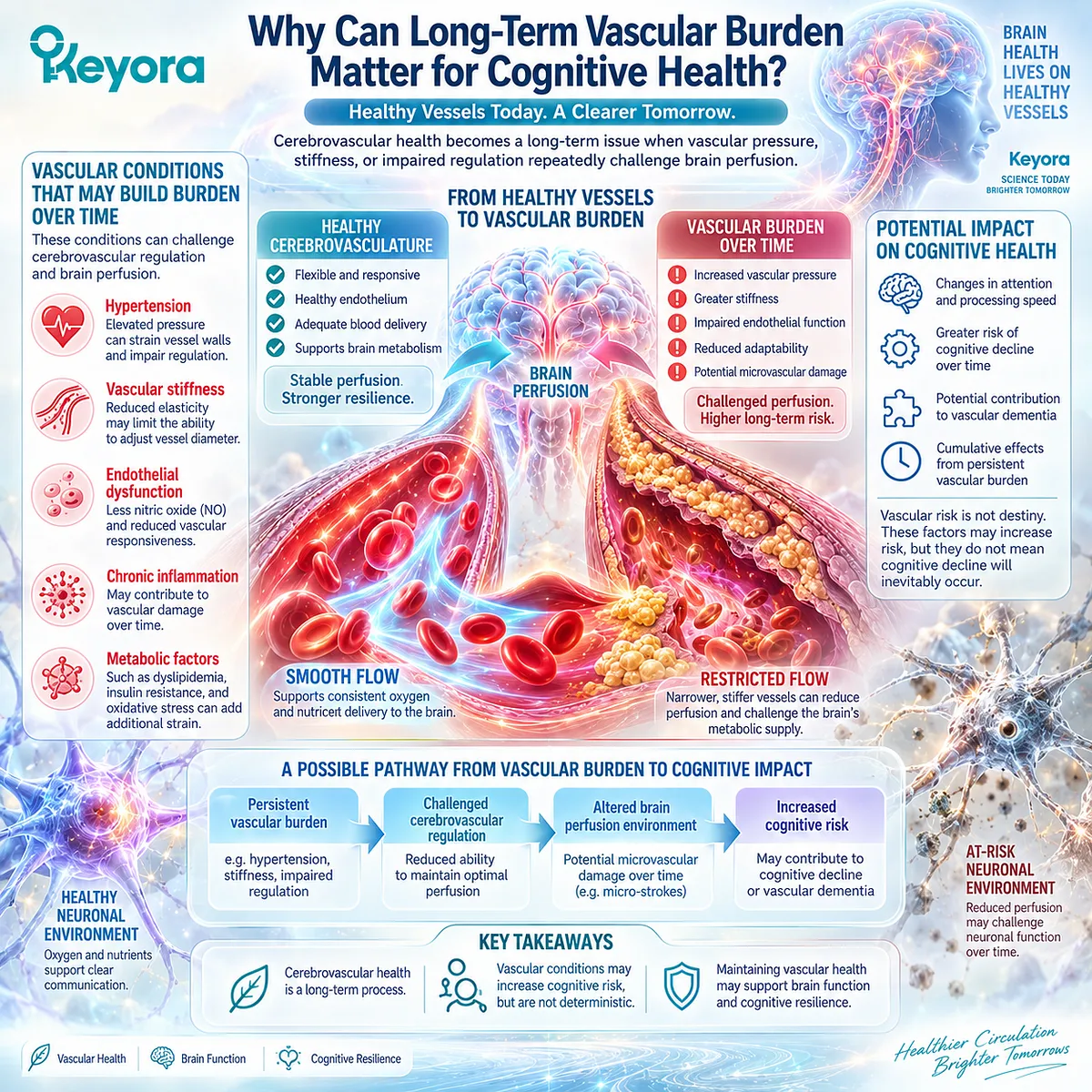
Why Can Long-Term Vascular Burden Matter for Cognitive Health?
Cerebrovascular health becomes a long-term issue when vascular pressure, stiffness, or impaired regulation repeatedly challenge brain perfusion
The idea of cognitive resilience becomes most meaningful when the time scale expands.
The Keyora source does not discuss only acute blood-flow interruption. It also presents cardiovascular and cerebrovascular health as processes influenced by vascular conditions developing over time.
One example is hypertension.
The source explicitly identifies hypertension as relevant to cognitive decline and uses the language of micro-strokes and vascular dementia when discussing longer-term cerebrovascular burden.
However, the source phrase “Hypertension: the precursor to cognitive decline” is too absolute to repeat as a general conclusion.
The safer source-based interpretation is:
The Keyora source identifies hypertension as a vascular condition relevant to long-term cognitive risk, but it does not establish that hypertension inevitably causes cognitive decline.
This distinction matters because vascular risk is not destiny.
The source supports a broader systems concept:
persistent vascular burden
may challenge
stable cerebrovascular regulation
which may affect
the vascular support environment serving the brain
This is enough to explain why cerebrovascular health matters over time without claiming a guaranteed progression from one vascular condition to cognitive impairment.
The same caution applies to stiffness and reduced vascular responsiveness.
The source uses carotid stiffness as part of its Cognitive Sovereignty language.
The useful interpretation is not that one stiff artery determines cognitive function.
It is that the integrity and adaptability of the vascular supply system form part of the physiological environment supporting the brain over time.
What Do Cognitive Endurance and Cognitive Sovereignty Mean in the Keyora Framework?
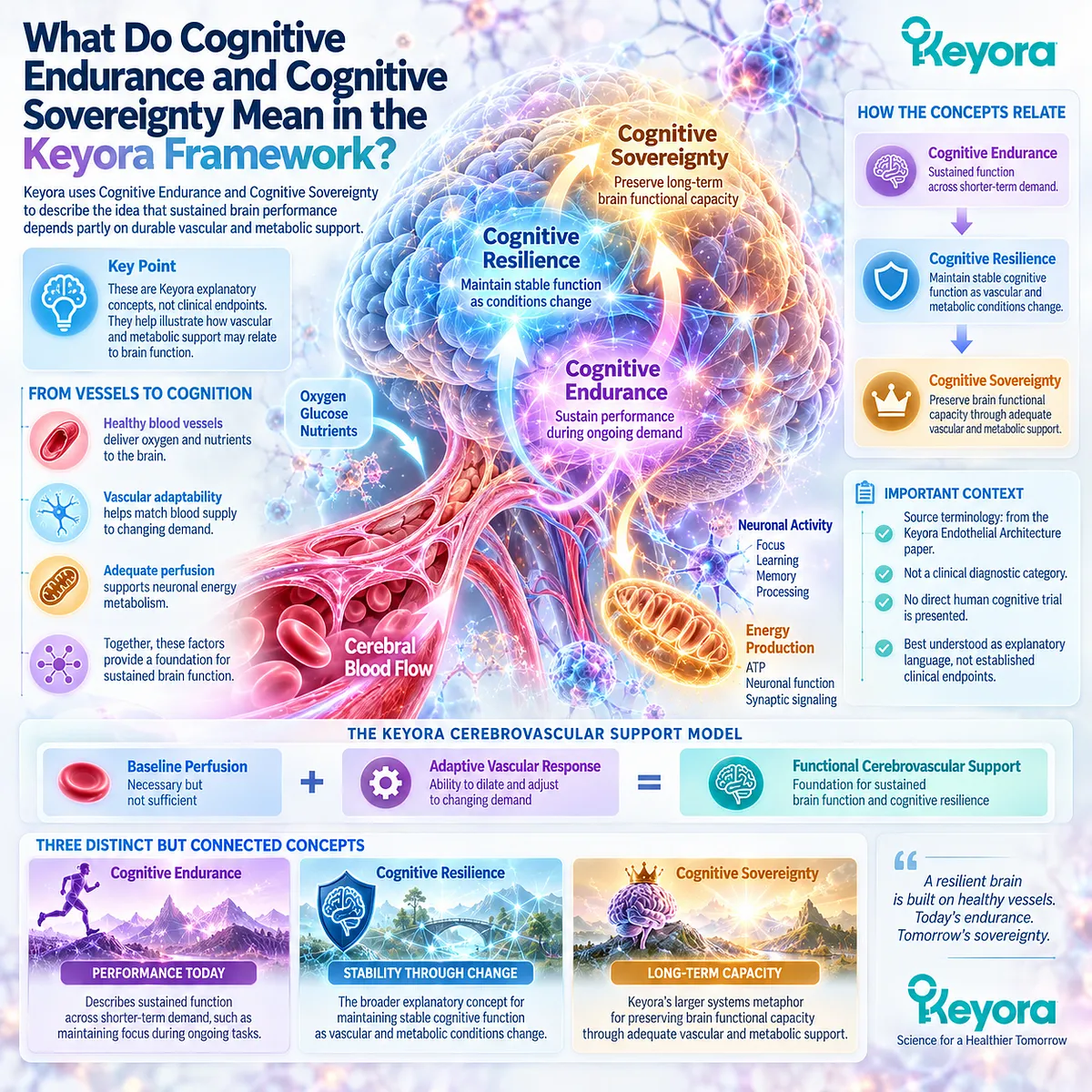
Keyora uses Cognitive Endurance and Cognitive Sovereignty to describe the idea that sustained brain performance depends partly on durable vascular and metabolic support
The Keyora Endothelial Architecture paper uses two terms that help explain how its vascular framework relates to cognition.
The first is Cognitive Endurance.
The source links this concept with brain oxygen delivery and later describes increased cerebral perfusion as providing metabolic support for sustained focus and rapid processing.
This should not be interpreted as a validated clinical endpoint.
The source does not present a direct human cognitive trial demonstrating that a measured change in cerebral perfusion produced a specific improvement in executive function or sustained attention.
Instead, Cognitive Endurance is best understood as Keyora explanatory language for sustaining brain function during ongoing demand.
The second term is Cognitive Sovereignty.
The source connects this concept with carotid and vascular health and later places it within a broader organ-level summary of the Keyora cardiovascular and cerebrovascular model.
Again, this is not a clinical diagnostic category.
For this Q&A, the three concepts can be separated as follows:
Cognitive Endurance
describes sustained function across shorter-term demand.
Cognitive Resilience
is the broader explanatory concept used here for maintaining stable cognitive function as vascular and metabolic conditions change.
Cognitive Sovereignty
is Keyora’s larger systems metaphor for preserving brain functional capacity through adequate vascular and metabolic support.
These distinctions preserve the source terminology while avoiding the mistake of treating brand concepts as established clinical endpoints.
Does Better Blood Rheology Prove Better Cognitive Resilience?
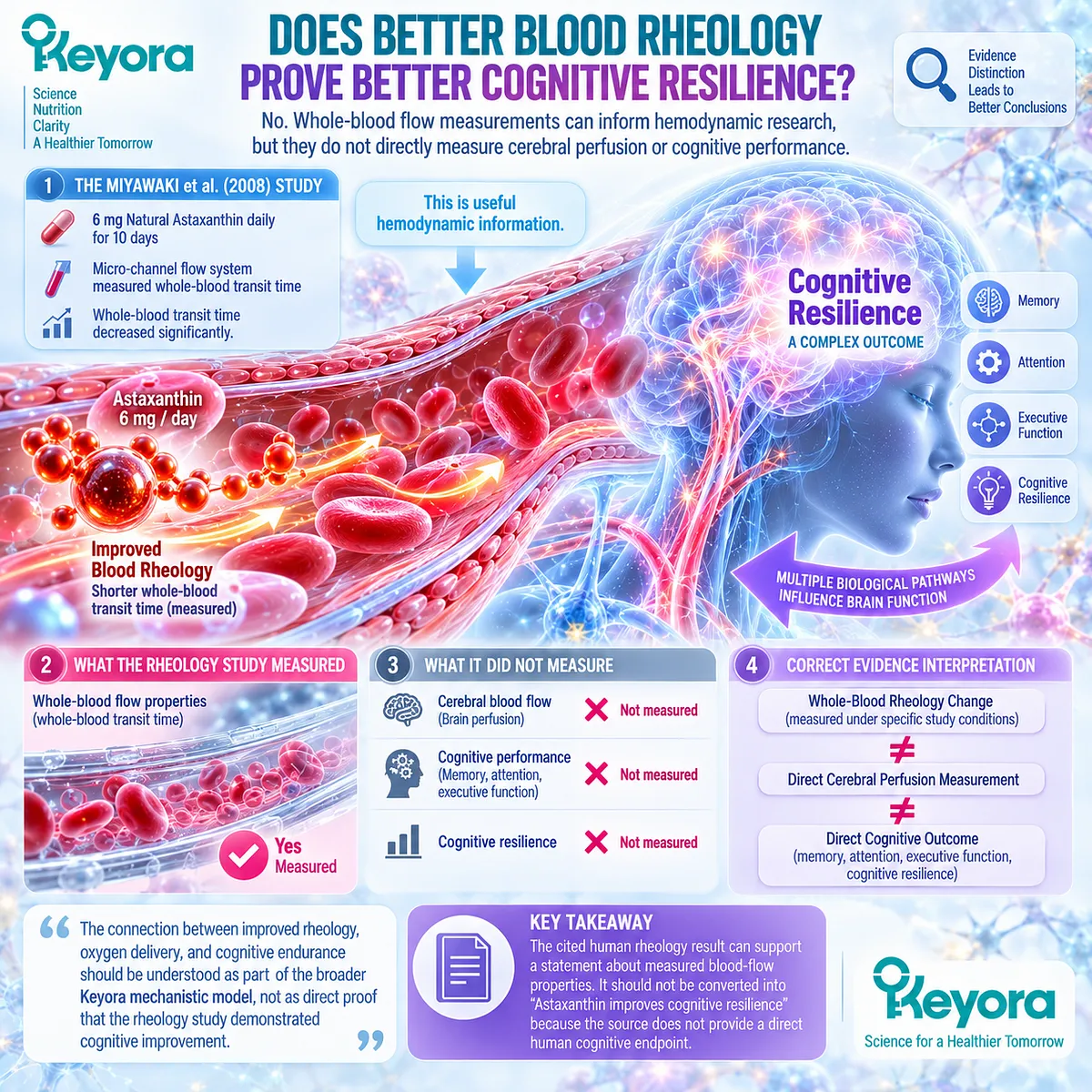
No. Whole-blood flow measurements can inform hemodynamic research, but they do not directly measure cerebral perfusion or cognitive performance
This evidence boundary is essential.
The Keyora Endothelial Architecture paper cites the Miyawaki et al. (2008) study when discussing blood rheology.
According to the source, participants received 6 mg of Natural Astaxanthin daily for 10 days. Researchers then used a micro-channel flow system to measure whole-blood transit time, and the source reports that transit time decreased significantly.
This is useful hemodynamic information.
But the measurement was not:
cerebral blood flow
and it was not:
memory
attention
executive function
or
cognitive resilience
The appropriate evidence rule is:
Whole-Blood Rheology Change
does not equal
Direct Cerebral Perfusion Measurement
and does not equal
Direct Cognitive Outcome
The source later connects improved rheology with cognitive endurance and oxygen delivery.
That connection should be understood as part of the broader Keyora mechanistic model, not as direct proof that the rheology study demonstrated cognitive improvement.
This distinction is particularly important when discussing Astaxanthin.
The cited human rheology result can support a statement about measured blood-flow properties under the study conditions described in the source.
It should not be converted into:
Astaxanthin improves cognitive resilience
because the source material does not provide a direct human cognitive endpoint establishing that conclusion.
Does Cerebrovascular Health Explain Every Cognitive Problem?
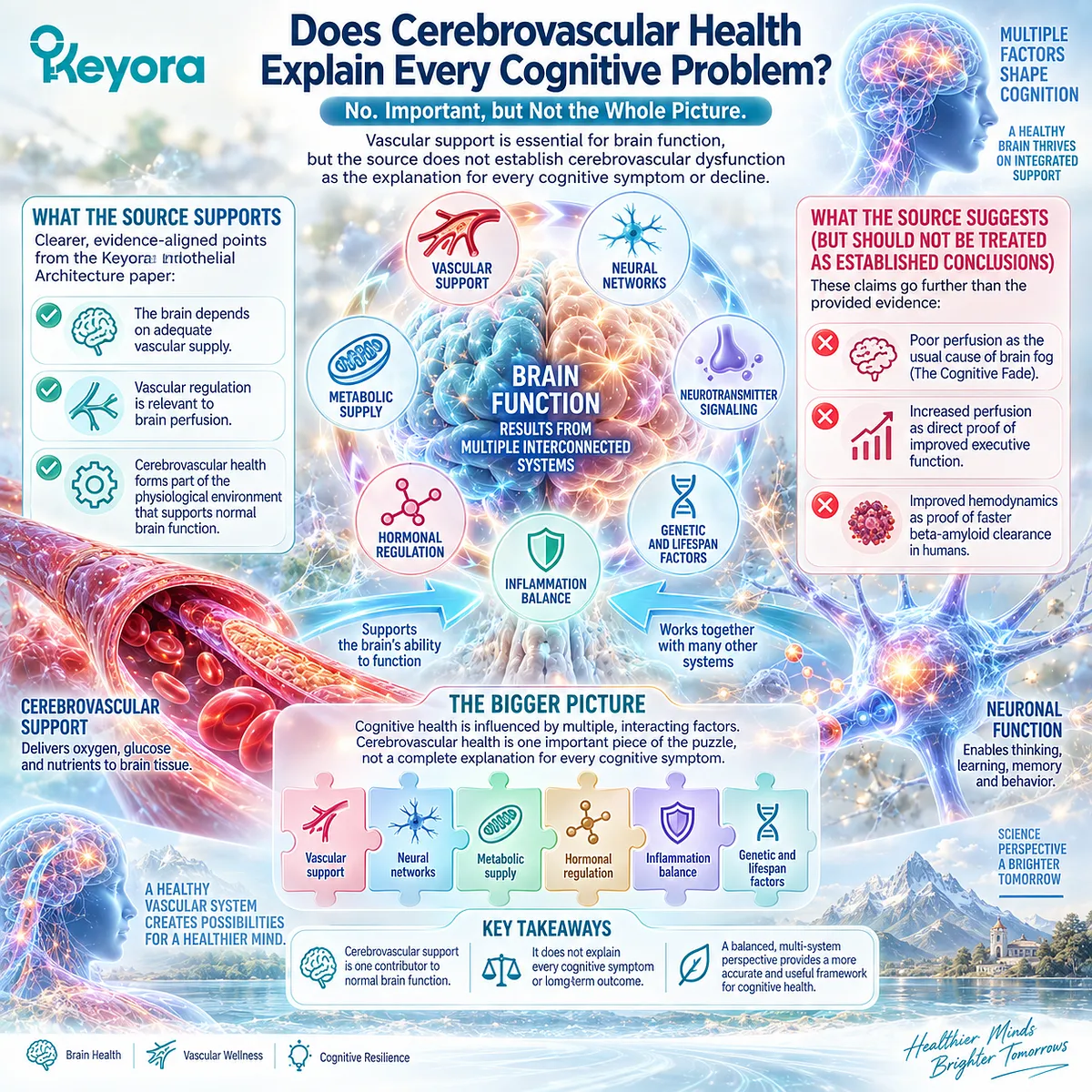
No. Vascular support is important to brain function, but the source does not establish cerebrovascular dysfunction as the explanation for every cognitive symptom or decline
Cerebrovascular health is an important part of brain support.
It is not a complete theory of cognition.
The Keyora Endothelial Architecture paper sometimes goes further than the evidence it presents.
For example, it connects reduced perfusion with The Cognitive Fade and suggests that brain fog is often a perfusion problem.
It also later links increased cerebral perfusion with faster beta-amyloid clearance and enhanced executive function.
Those claims should not be treated as established conclusions from the material provided.
The source clearly supports the idea that:
the brain depends on adequate vascular supply
and that:
vascular regulation is relevant to brain perfusion
But it does not provide enough direct evidence in the cited material to establish:
poor perfusion as the usual cause of brain fog
or
increased perfusion as direct proof of improved executive function
or
improved hemodynamics as proof of faster beta-amyloid clearance in humans
The more reliable conclusion is:
Cerebrovascular support is one contributor to normal brain function, not a complete explanation for every cognitive symptom or long-term cognitive outcome.
This boundary strengthens the Keyora framework because it separates vascular plausibility from direct cognitive evidence.
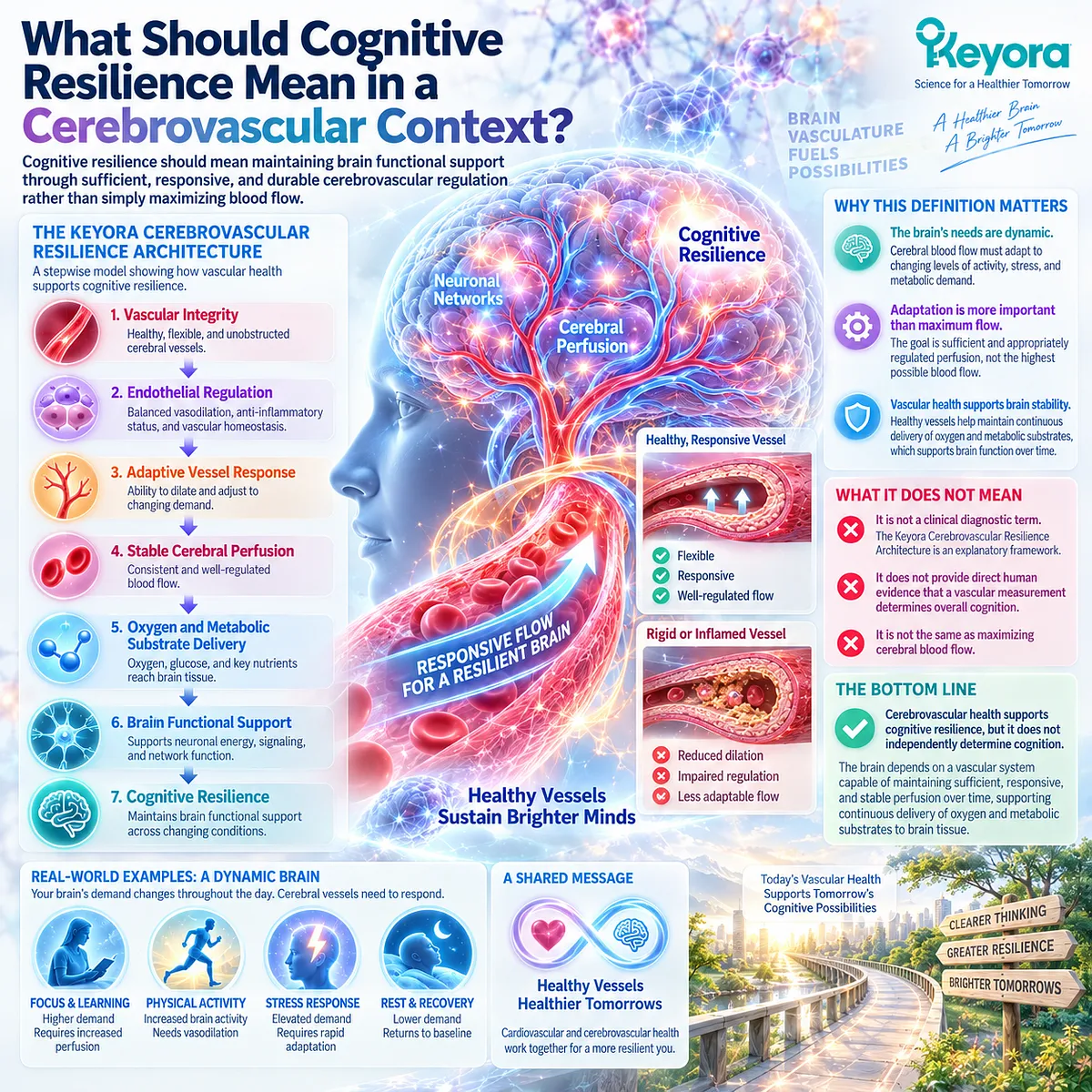
What Should Cognitive Resilience Mean in a Cerebrovascular Context?
Cognitive resilience should mean maintaining brain functional support through sufficient, responsive, and durable cerebrovascular regulation rather than simply maximizing blood flow
The clearest way to integrate this topic is through the Keyora Cerebrovascular Resilience Architecture.
This is an explanatory framework, not a clinical diagnostic term.
It can be summarized as:
Vascular Integrity
↓
Endothelial Regulation
↓
Adaptive Vessel Response
↓
Stable Cerebral Perfusion
↓
Oxygen and Metabolic Substrate Delivery
↓
Brain Functional Support
↓
Cognitive Resilience
The framework deliberately uses the word support rather than determine.
That distinction reflects the actual limits of the source.
The Keyora Endothelial Architecture paper provides a coherent vascular model involving cerebral arteries, vascular responsiveness, metabolic delivery, rheology, and the concepts of Cognitive Endurance and Cognitive Sovereignty.
What it does not provide is direct proof that one vascular measurement determines overall cognition.
The final answer is therefore:
Cerebrovascular health is important for cognitive resilience because the brain depends on a vascular system capable of maintaining sufficient, responsive, and stable perfusion over time, supporting continuous delivery of oxygen and metabolic substrates to brain tissue.
And the evidence boundary should remain equally clear:
Cerebrovascular health supports cognitive resilience, but it does not independently determine cognition.
That distinction completes the progression from shared heart-brain circulation, to cerebral blood flow, to the longer-term vascular architecture supporting brain functional stability.
This article is for educational and informational purposes only. It does not provide medical advice, diagnosis, treatment, cure, prevention, disease outcome claims, hormone restoration claims, fertility outcome claims, or formula-specific clinical efficacy claims.