
How Does Blood Flow Influence Brain Function?
Keyora Research Q&A Library
This is part of the Keyora Research Q&A Series, derived from Keyora Astaxanthin Research Journal Series.
Within the Keyora Astaxanthin Researcn framework, this Q&A translates complex astaxanthin biology into reader-friendly, evidence-bound answers, focusing on natural astaxanthin identity, molecular structure, antioxidant and redox mechanisms, membrane lipid interaction, mitochondrial resilience, inflammatory signaling pathways, human evidence interpretation, and the scientific principles behind responsible supplementation.
First published by Keyora Research Journal: www.keyorahealth.com

Direct Answer
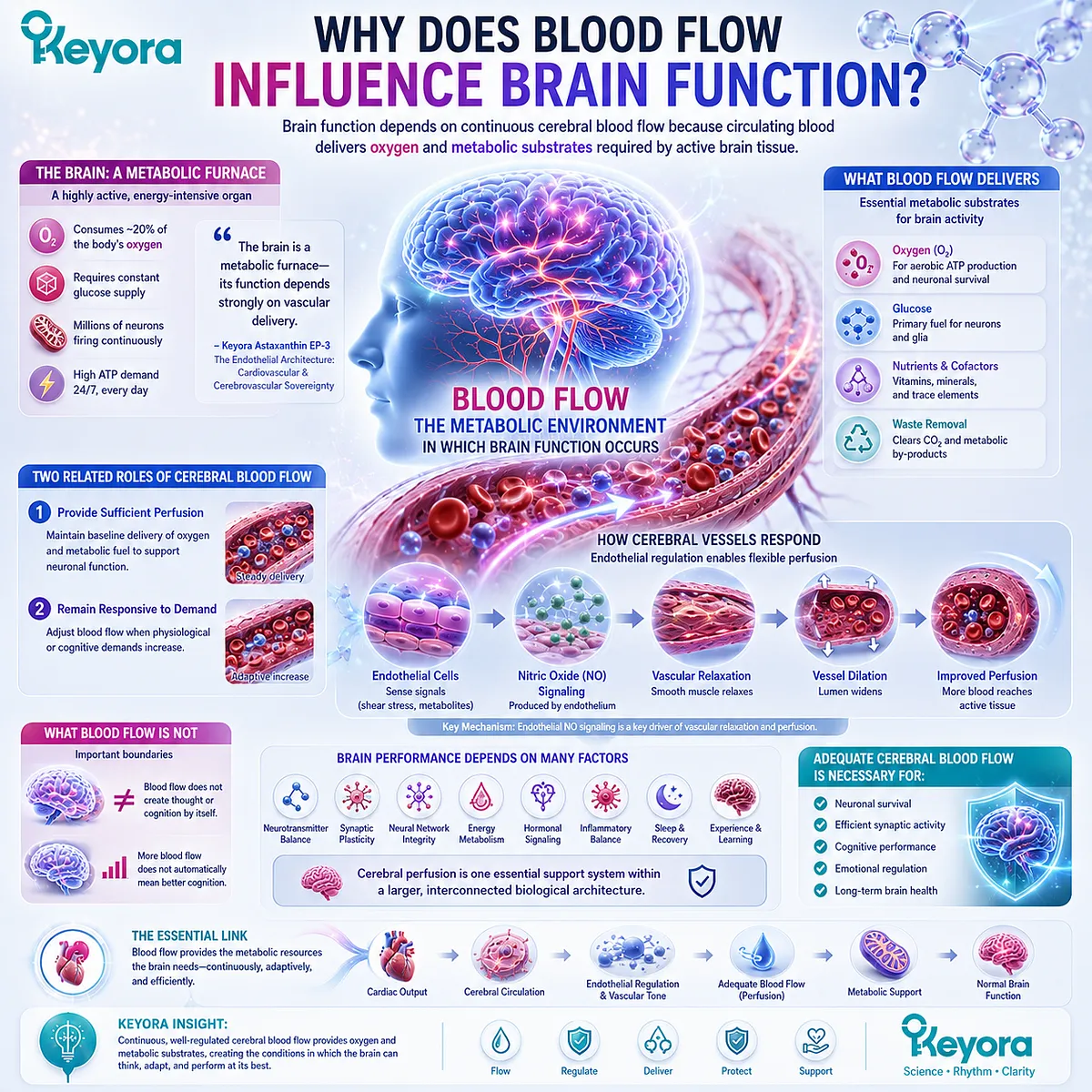
Brain function depends on continuous cerebral blood flow because circulating blood delivers oxygen and metabolic substrates required by active brain tissue
Blood flow influences brain function because the brain depends continuously on cerebral perfusion to receive the oxygen and metabolic substrates required to sustain its ongoing activity.
In Keyora Astaxanthin EP-3: The Endothelial Architecture: Cardiovascular & Cerebrovascular Sovereignty, the brain is described as a highly metabolically demanding organ whose function depends strongly on vascular delivery.
The source emphasizes its substantial oxygen and glucose requirements and uses the metaphor of a “metabolic furnace” to illustrate that dependence.
The important physiological idea is not that blood flow creates thought or cognition by itself.
Rather:
blood flow provides the metabolic environment in which normal brain function can occur.
Neural tissue requires a continuing supply of oxygen and metabolic fuel. The cerebral circulation acts as the transport system that brings those resources to brain tissue.
This gives blood flow two related roles.
First, it must provide sufficient perfusion to maintain basic metabolic support.
Second, the cerebral vascular system must remain sufficiently responsive to adjust blood delivery when physiological demand changes.
The Keyora source connects vascular relaxation and increased vessel diameter with improved perfusion and describes nitric oxide related signaling as one part of this vascular response.
The most important boundary is equally clear:
Adequate cerebral blood flow is necessary for normal brain function, but greater blood flow does not automatically mean better cognition.
Brain performance depends on many biological processes. Cerebral perfusion is one essential support system within that larger architecture.
Why Does the Brain Depend So Strongly on Continuous Perfusion?
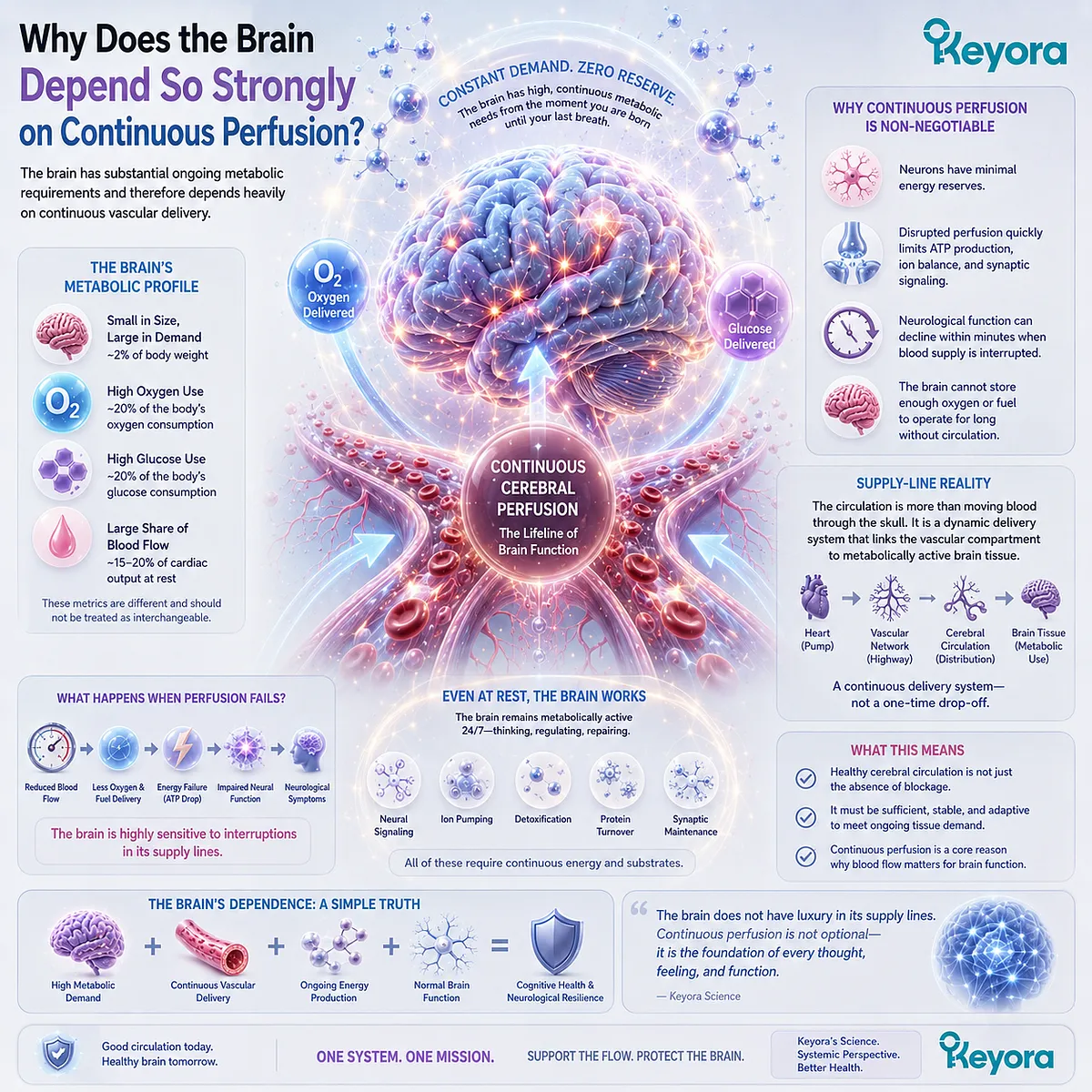
The brain has substantial ongoing metabolic requirements and therefore depends heavily on continuous vascular delivery
The Keyora Endothelial Architecture paper repeatedly emphasizes the brain’s high metabolic demand.
In one section, the source states that the brain represents a relatively small proportion of body mass while accounting for a substantial share of oxygen and glucose use.
Elsewhere, the source uses a different expression and says that the brain demands a large share of blood flow.
Those statements should not be treated as interchangeable measurements. Oxygen use, glucose use, and blood-flow distribution are different physiological metrics.
The stronger source-based conclusion is therefore simpler:
The brain has high continuous metabolic requirements and depends strongly on cerebral perfusion.
This dependence helps explain why major disturbances in blood supply can quickly affect neurological function.
The brain cannot be understood as an organ that stores a large independent reserve of oxygen and metabolic fuel and then operates for long periods without circulation.
Its normal function depends on ongoing vascular delivery.
The Keyora source expresses this using supply-line metaphors. Those metaphors are useful when translated carefully.
The circulation is not merely moving blood through the skull.
It is maintaining a continuous delivery system between the vascular compartment and metabolically active brain tissue.
This is why cerebral blood flow is functionally important even when a person is not exercising or performing a visibly demanding task.
The brain remains metabolically active at rest.
Healthy cerebral circulation therefore requires more than the absence of complete vascular blockage.
It requires blood delivery that is sufficient to support ongoing tissue demand.
That is the first reason blood flow matters for brain function.
What Does Blood Actually Deliver to the Brain?
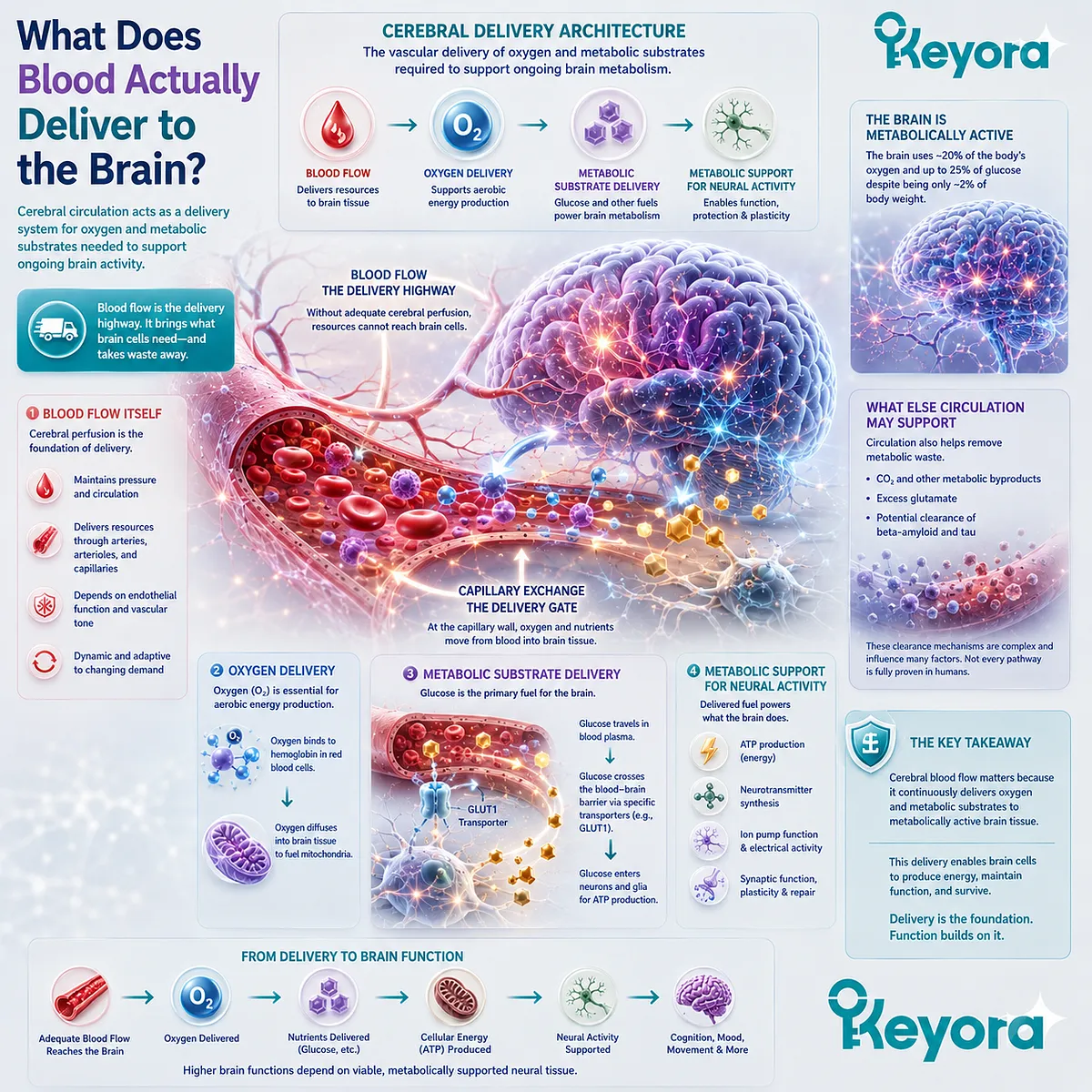
Cerebral circulation acts as a delivery system for oxygen and metabolic substrates needed to support ongoing brain activity
Blood flow matters because it carries resources.
The Keyora Endothelial Architecture paper repeatedly frames circulation as a delivery system. It describes the brain as dependent on oxygen and metabolic fuel and later summarizes successful circulation with the phrase that “the brain receives its fuel.”
For public scientific interpretation, the useful concept is Cerebral Delivery Architecture.
This is a Keyora explanatory framework, not a clinical term.
It can be defined as:
the vascular delivery of oxygen and metabolic substrates required to support ongoing brain metabolism.
The concept has three parts.
First is blood flow itself.
Without adequate cerebral perfusion, circulating resources cannot be delivered effectively to brain tissue.
Second is oxygen delivery.
The Keyora source consistently emphasizes oxygen as a central component of brain metabolic support.
Third is metabolic substrate delivery.
The source specifically discusses glucose as part of the brain’s metabolic demand.
Together, these support the metabolic environment required for normal neural activity.
The source also makes broader claims about circulation accelerating metabolic waste clearance, including beta-amyloid clearance.
However, the material provided does not develop that mechanism or its human evidence in enough detail to make it a core conclusion here.
The stronger source-supported answer remains:
Cerebral blood flow matters because it continuously delivers oxygen and metabolic substrates to metabolically active brain tissue.
That delivery function is foundational.
It does not by itself explain memory, attention, mood, or executive function, but those higher functions still depend on viable, metabolically supported neural tissue.
How Does Vascular Responsiveness Help Adjust Blood Flow to Brain Demand?
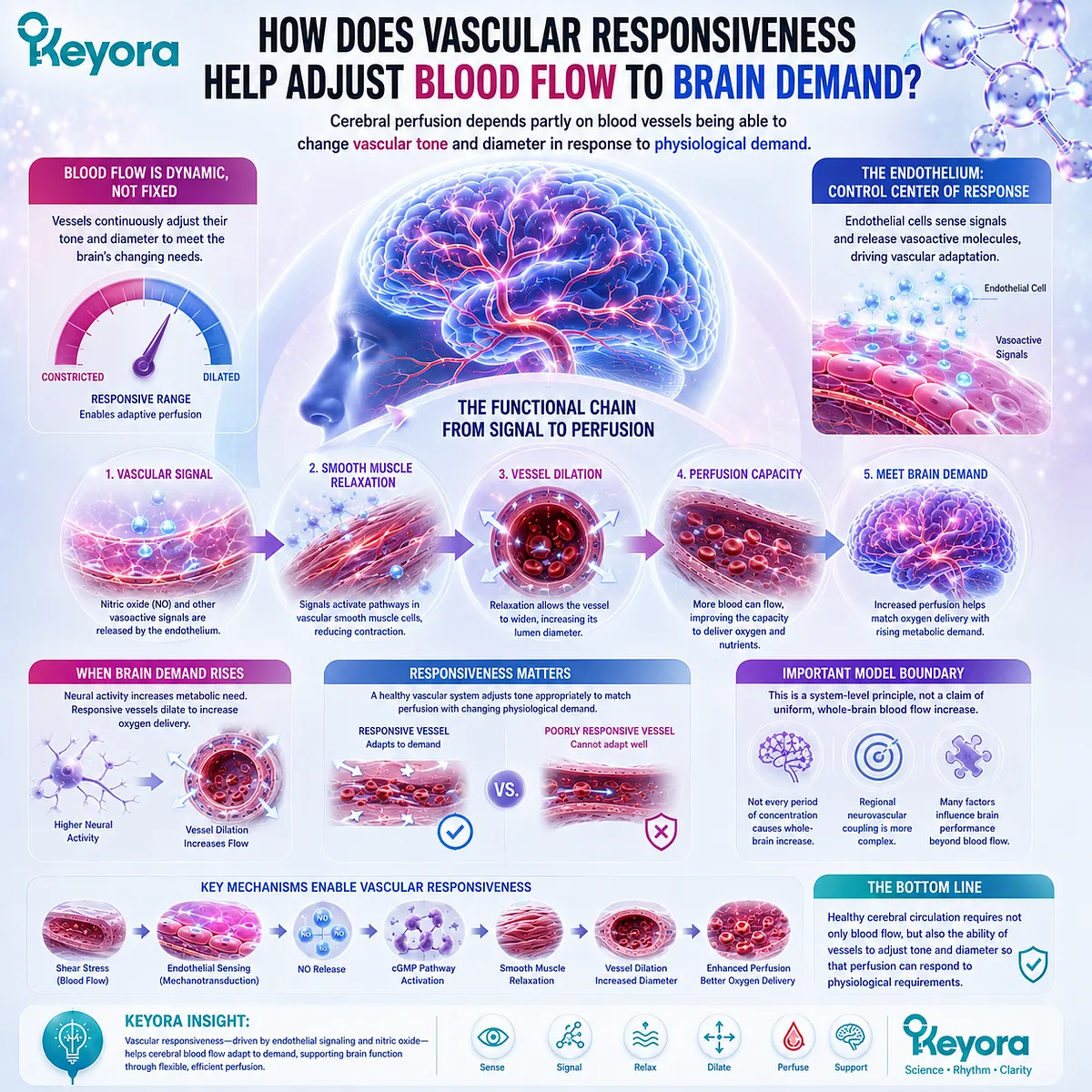
Cerebral perfusion depends partly on blood vessels being able to change vascular tone and diameter in response to physiological demand
Blood flow is not simply a fixed stream.
The Keyora Endothelial Architecture paper describes vascular function as dynamic and places endothelial signaling at the center of the vessel’s ability to relax and dilate.
The source specifically connects nitric oxide related signaling with vascular smooth muscle relaxation, increased vessel diameter, and increased perfusion.
This creates an important functional chain:
vascular signal
leads to
smooth muscle relaxation
which supports
vessel dilation
and therefore influences
perfusion capacity
The source further argues that when the brain’s metabolic demand rises, vascular dilation can help increase oxygen delivery.
The strongest public interpretation is:
Healthy cerebral circulation requires not only blood flow, but also vascular responsiveness.
A vascular system that can appropriately adjust tone is better positioned to match perfusion with changing physiological demand than one that remains rigidly constricted or poorly responsive.
This does not mean that every period of concentration produces a simple, whole-brain increase in blood flow exactly as the source’s “open the floodgates” metaphor suggests.
The source does not provide enough detail here to build a full model of regional neurovascular coupling.
The supported idea is broader:
Blood vessels must remain capable of adjusting their diameter and tone so that perfusion can respond to physiological requirements.
This connects cerebral blood flow with the earlier Keyora concepts of endothelial regulation, nitric oxide signaling, and vascular responsiveness without requiring those mechanisms to be rewritten in full.
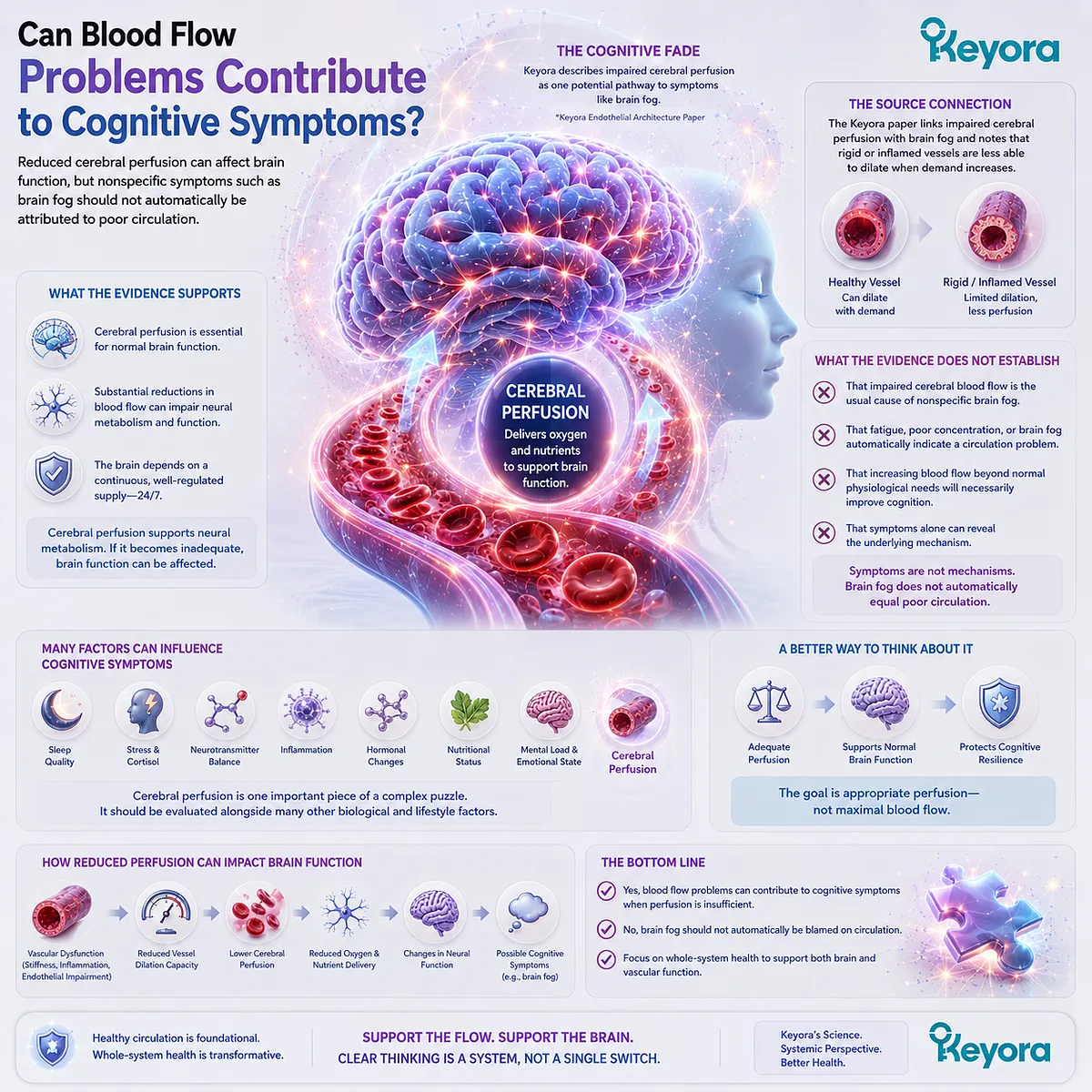
Can Blood Flow Problems Contribute to Cognitive Symptoms?
Reduced cerebral perfusion can affect brain function, but nonspecific symptoms such as brain fog should not automatically be attributed to poor circulation
The Keyora Endothelial Architecture paper introduces a concept called The Cognitive Fade and links impaired cerebral perfusion with symptoms such as brain fog. The source states that brain fog is “often a failure of perfusion” and describes rigid or inflamed cerebral vessels as being less able to dilate in response to demand.
That interpretation requires a clear evidence boundary.
The source supports the general idea that cerebral perfusion is important for normal brain function.
It does not provide enough evidence in the cited material to establish impaired cerebral blood flow as the usual explanation for nonspecific brain fog.
Therefore, the public conclusion should be narrower:
Changes in cerebral perfusion can influence brain function, but the presence of fatigue, poor concentration, or brain fog does not by itself demonstrate a cerebral blood-flow problem.
This distinction matters because symptoms are not mechanisms.
A person experiencing cognitive difficulty cannot infer the cause simply from how the symptom feels.
The useful relationship is:
Cerebral perfusion supports neural metabolism.
If perfusion becomes substantially inadequate, brain function can be affected.
But:
brain fog does not automatically equal poor circulation.
This also prevents another common overinterpretation.
If reduced perfusion can impair brain function, it does not follow that increasing blood flow beyond normal physiological requirements will necessarily improve cognition.
Healthy brain circulation is about maintaining appropriate perfusion.
It is not about maximizing blood flow.
What Should Healthy Cerebral Blood Flow Actually Mean?
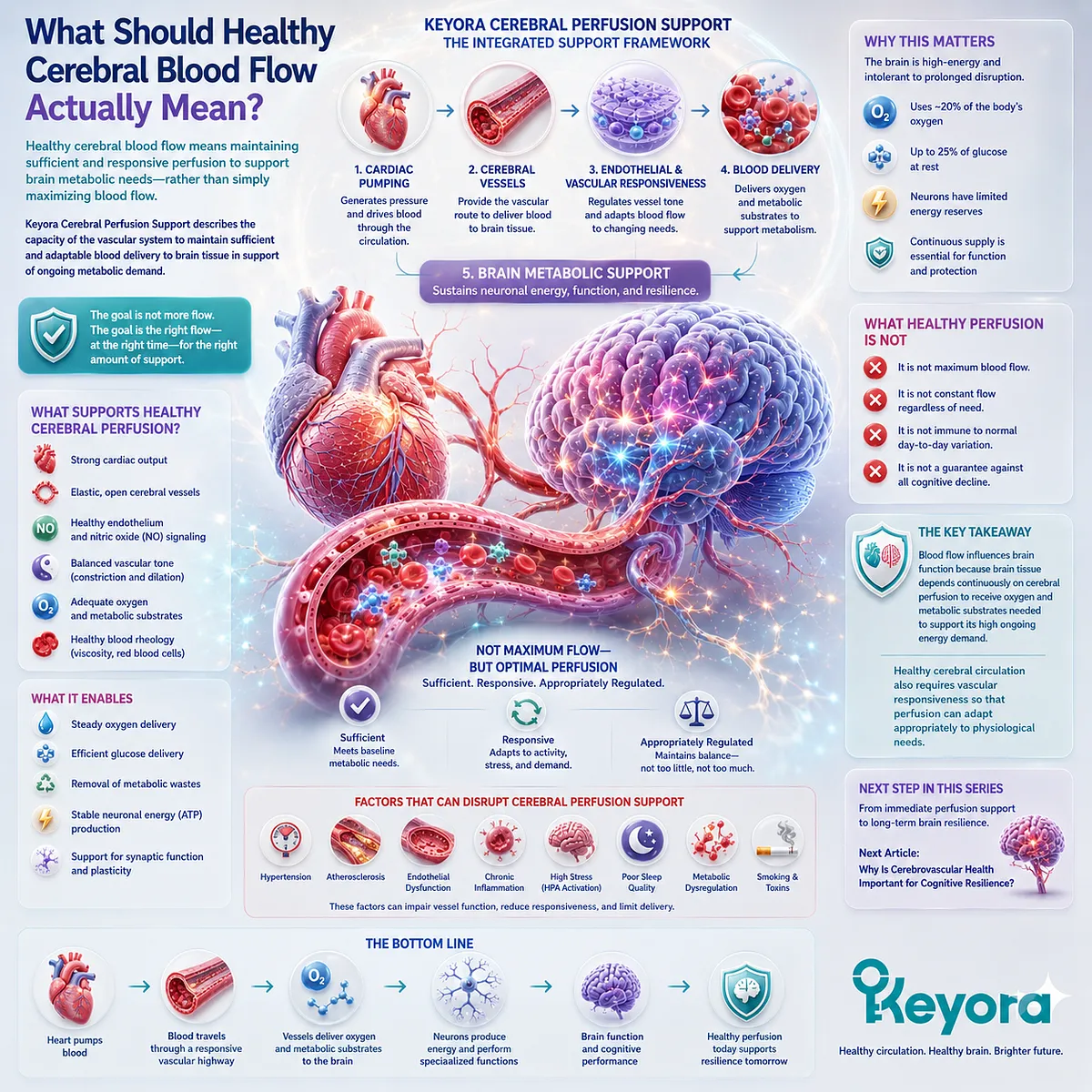
Healthy cerebral blood flow means maintaining sufficient and responsive perfusion to support brain metabolic needs rather than simply maximizing blood flow
The most useful way to interpret healthy cerebral circulation is through Keyora Cerebral Perfusion Support.
This is an explanatory Keyora framework rather than a clinical diagnostic term.
It describes:
the capacity of the vascular system to maintain sufficient and adaptable blood delivery to brain tissue in support of ongoing metabolic demand.
The framework brings together several source-supported layers.
Cardiac pumping supplies the pressure needed to circulate blood.
Cerebral vessels provide the vascular route to brain tissue.
Endothelial and vascular responsiveness help regulate vessel diameter and perfusion.
Blood delivery provides oxygen and metabolic substrates.
Together, these create the vascular support required for normal brain metabolism.
The Keyora Endothelial Architecture paper repeatedly connects brain function with cerebral perfusion, oxygen delivery, and vascular responsiveness.
But the correct endpoint is not:
maximum cerebral blood flow
It is:
sufficient, responsive, and appropriately regulated cerebral perfusion.
That distinction keeps the vascular model biologically coherent.
Blood flow is a support system for brain function.
It supplies the metabolic environment in which neural tissue operates.
It does not independently determine cognition.
The final answer is therefore:
Blood flow influences brain function because brain tissue depends continuously on cerebral perfusion to receive oxygen and metabolic substrates needed to support its high ongoing energy demand.
Healthy cerebral circulation also requires vascular responsiveness so that perfusion can adapt appropriately to physiological needs.
The next article, “Why Is Cerebrovascular Health Important for Cognitive Resilience?”, can then move from immediate perfusion support to the longer-term relationship between vascular integrity and cognitive resilience.
This article is for educational and informational purposes only. It does not provide medical advice, diagnosis, treatment, cure, prevention, disease outcome claims, hormone restoration claims, fertility outcome claims, or formula-specific clinical efficacy claims.