
What Is Oxidized LDL and Why Is It Different From Normal LDL?
Keyora Research Q&A Library
This is part of the Keyora Research Q&A Series, derived from Keyora Astaxanthin Research Journal Series.
Within the Keyora Astaxanthin Researcn framework, this Q&A translates complex astaxanthin biology into reader-friendly, evidence-bound answers, focusing on natural astaxanthin identity, molecular structure, antioxidant and redox mechanisms, membrane lipid interaction, mitochondrial resilience, inflammatory signaling pathways, human evidence interpretation, and the scientific principles behind responsible supplementation.
First published by Keyora Research Journal: www.keyorahealth.com
Direct Answer
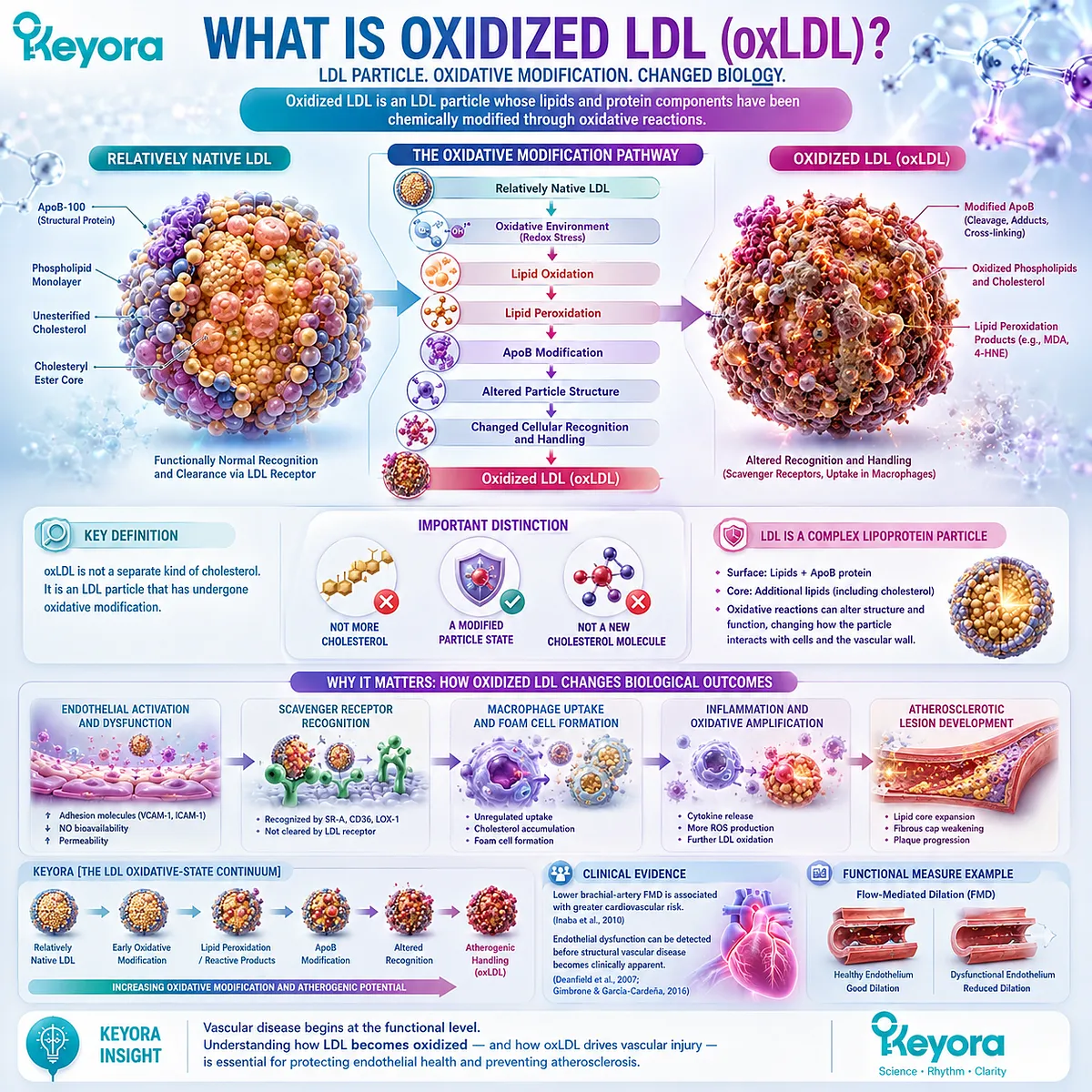
Oxidized LDL is an LDL particle whose lipids and protein components have been chemically modified through oxidative reactions
Oxidized LDL, usually abbreviated as oxLDL, is not a separate kind of cholesterol.
It is an LDL particle that has undergone oxidative modification.
In Keyora Astaxanthin EP-3: The Endothelial Architecture: Cardiovascular & Cerebrovascular Sovereignty, the distinction between relatively native LDL and oxidatively modified LDL is central to the cardiovascular framework.
The source describes oxidation as a process capable of changing both lipid components of LDL and the ApoB protein associated with the particle.
The basic transition is:
Native LDL
↓
Oxidative pressure
↓
Lipid oxidation
↓
Lipid peroxidation
↓
ApoB modification
↓
Changed cellular recognition and handling
↓
Oxidized LDL
The important point is that oxLDL describes a modified particle state.
It does not mean:
more cholesterol
and it does not mean:
a new cholesterol molecule
The Keyora Endothelial Architecture paper instead presents oxLDL as an LDL particle whose chemical structure and biological behavior have changed.
This distinction matters because LDL is a complex lipoprotein particle.
Its surface contains lipids and ApoB. Its core contains additional lipids. Oxidative reactions affecting those components can therefore alter the way the particle interacts with receptors, endothelial biology, macrophages, and the developing atherosclerotic environment.
Laster article established that cholesterol concentration alone does not describe the entire arterial process.
This one now moves one layer deeper:
What happens to the LDL particle itself when oxidative modification occurs?
What Is an LDL Particle Made Of?
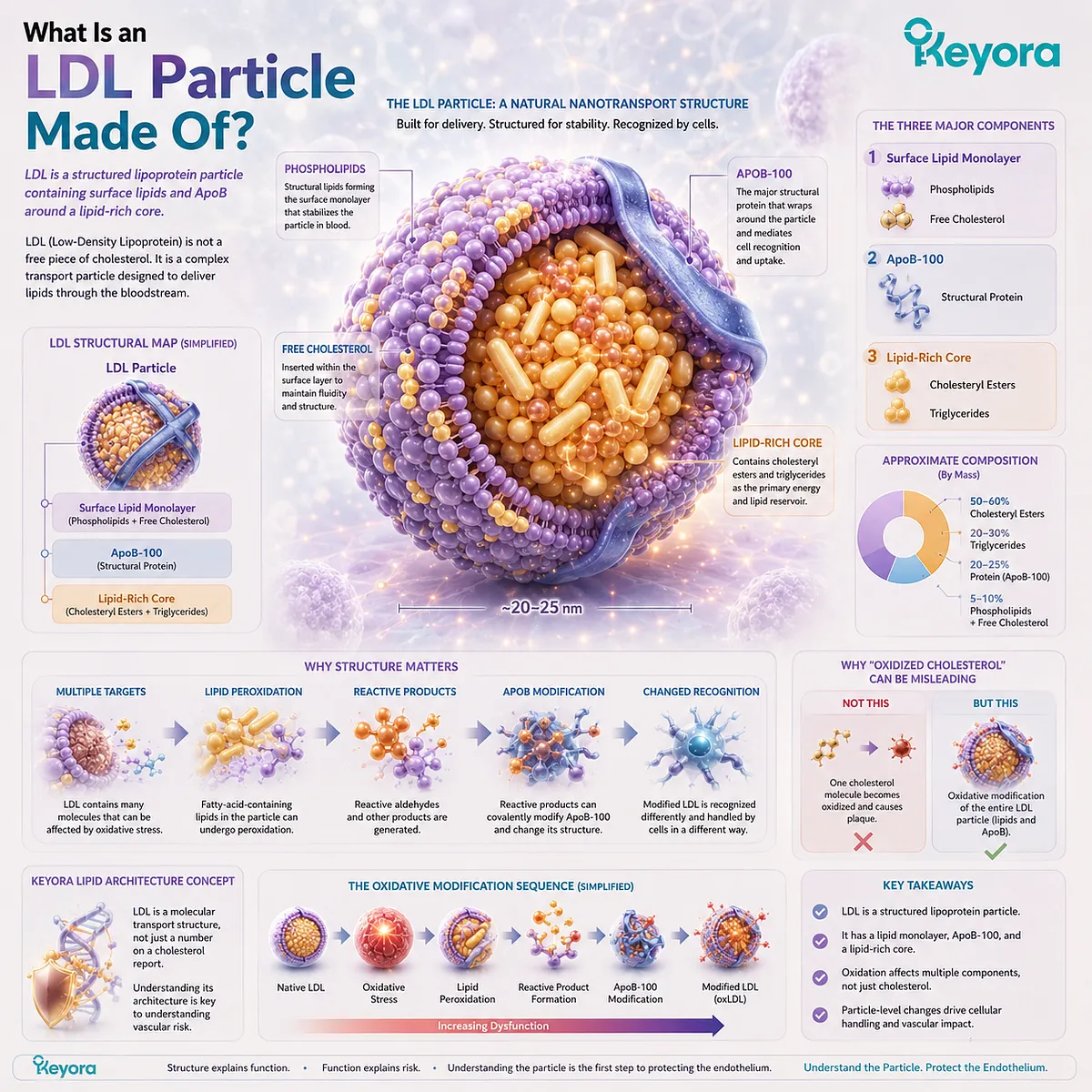
LDL is a structured lipoprotein particle containing surface lipids and ApoB around a lipid-rich core
To understand oxidized LDL, it helps to first understand what LDL actually is.
The Keyora Endothelial Architecture paper describes LDL as a structured lipoprotein particle rather than a free piece of cholesterol circulating by itself.
The source describes the LDL outer layer as containing phospholipids and free cholesterol, while the inner core contains cholesteryl esters and triglycerides.
LDL also contains ApoB-100, the major protein component associated with the particle.
A simplified structural map is:
LDL Particle
=
Surface lipid monolayer
ApoB-100
Lipid-rich core
This structure explains why the phrase “oxidized cholesterol” can be misleading if used too loosely.
Oxidative modification of LDL can involve more than cholesterol itself.
The source specifically focuses on fatty-acid-containing lipids within the particle and later describes secondary oxidation products modifying ApoB-100.
So the relevant process is better understood as:
oxidative modification of the LDL particle
rather than:
one cholesterol molecule becoming oxidized and turning into plaque
That structural distinction is essential.
The particle contains multiple molecular targets.
Its lipids can undergo peroxidation.
Reactive products generated from those lipids can interact with proteins.
Those protein changes can then influence how cells recognize and process the particle.
This is why the Keyora Lipid Architecture treats LDL as a molecular transport structure rather than simply as a cholesterol number.
What Does Native LDL Mean in the Keyora Framework?
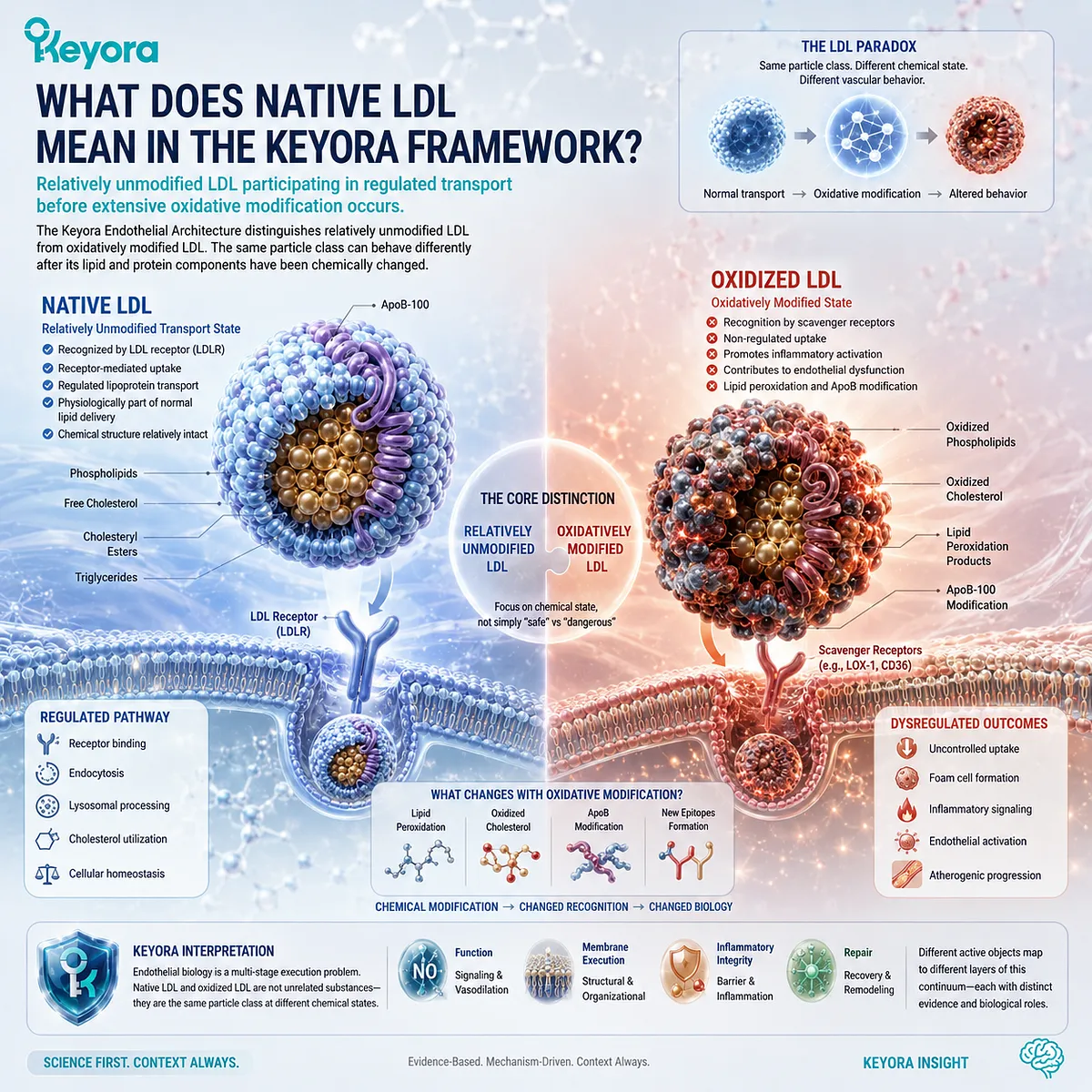
Native LDL refers to the relatively unmodified particle participating in regulated lipoprotein transport before extensive oxidative modification occurs
The phrase native LDL is used throughout the Keyora Endothelial Architecture paper to distinguish relatively unmodified LDL from chemically modified LDL.
The source describes native LDL as interacting with the LDL receptor, or LDLR, through a regulated receptor-mediated process. It then contrasts this state with LDL that has undergone oxidative modification.
For Q026, “native LDL” should therefore be understood as:
the relatively unmodified transport state of the LDL particle
This does not mean that native LDL should be described as universally harmless under every physiological circumstance.
The Keyora source sometimes uses stronger language, including describing native LDL as physiologically benign. But the most useful distinction for this Q&A is not “safe LDL” versus “dangerous LDL.”
It is:
relatively unmodified LDL
versus
oxidatively modified LDL
That distinction focuses attention on chemical state.
The same broad class of lipoprotein particle can behave differently after its lipid and protein components have been modified.
This is the core of what the Keyora framework calls The LDL Paradox.
A particle involved in normal lipid transport can participate differently in vascular biology once its chemical properties have changed.
The critical question is therefore not whether native LDL and oxidized LDL are completely unrelated substances.
They are not.
The question is how oxidative modification changes the particle.
Where Does LDL Oxidation Begin?
The Keyora source places oxidation initiation in susceptible lipid components of the LDL particle, especially PUFA-containing lipids
The Keyora Endothelial Architecture paper places the early stage of LDL oxidation within the lipid components of the particle.
It specifically discusses polyunsaturated fatty acids, or PUFAs, including linoleic acid and arachidonic acid, within LDL-associated lipids.
The important chemistry is oxidative susceptibility.
PUFAs contain bis-allylic carbon-hydrogen bonds that are more susceptible to hydrogen abstraction during radical-mediated oxidation.
That should not be interpreted as meaning PUFAs are nutritionally “bad” or inherently unhealthy.
Oxidative susceptibility is a chemical property, not a nutritional verdict.
The process begins when a reactive species removes a hydrogen atom from a susceptible lipid.
The Keyora source calls this initiating event The Oxidative Trigger.
The mechanism can be simplified as:
PUFA-containing lipid
reactive radical
↓
hydrogen abstraction
↓
lipid radical
The source then describes lipid peroxidation developing from this initial event.
The term The Oxidative Trigger is useful as Keyora explanatory language because it identifies the point at which a relatively intact lipid begins participating in a radical chain reaction.
But oxidation is not simply one isolated molecular collision.
Once a lipid radical is formed, the process can propagate through neighboring lipid molecules.
That chain reaction is what makes lipid peroxidation important to the structural state of LDL.
![LDL oxidation begins when reactive radicals attack susceptible PUFA-containing lipids, initiating lipid peroxidation through Keyora [The Oxidative Trigger].](https://www.keyorahealth.com/cdnfiles/2026/09/02123311/dc63e2f5-1b8f-4dda-bab4-00785dc658fe_1254x1254.webp "LDL oxidation begins when reactive radicals attack susceptible PUFA-containing lipids, initiating lipid peroxidation through Keyora [The Oxidative Trigger].")
How Does Lipid Peroxidation Spread Through LDL?
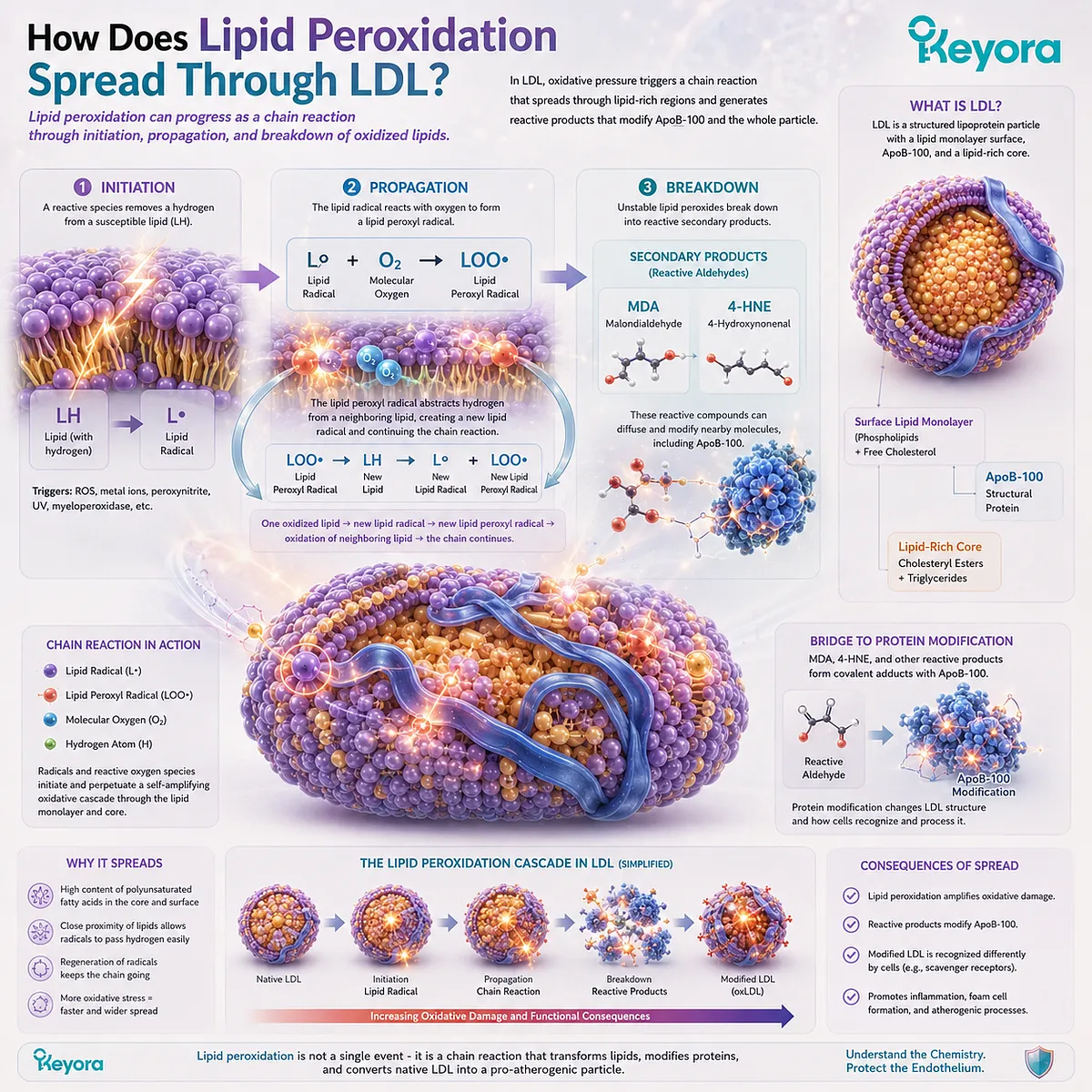
Lipid peroxidation can progress as a chain reaction through initiation, propagation, and breakdown of oxidized lipids
Lipid peroxidation is the central chemistry linking oxidative pressure to LDL modification in the Keyora Endothelial Architecture paper.
The source organizes the reaction into a sequence involving initiation, propagation, and degradation.
The first stage is initiation.
A reactive radical removes a hydrogen atom from a susceptible lipid, producing a lipid radical:
LH
↓
L•
The second stage is propagation.
The lipid radical reacts with molecular oxygen:
L• + O₂
↓
LOO•
This creates a lipid peroxyl radical.
That lipid peroxyl radical can then abstract hydrogen from another nearby lipid, creating another lipid radical and allowing the chain reaction to continue.
The process therefore becomes:
one oxidized lipid
↓
new lipid radical
↓
new lipid peroxyl radical
↓
oxidation of neighboring lipid
This is why lipid peroxidation can spread through lipid-rich environments.
The third stage involves breakdown products.
The Keyora source specifically identifies secondary products including malondialdehyde, or MDA, and 4-hydroxynonenal, or 4-HNE.
These products matter because the consequences of lipid peroxidation do not necessarily remain confined to the original fatty acid.
Reactive lipid-derived compounds can interact with nearby proteins, including ApoB-100.
This is the bridge from:
lipid oxidation
to
whole-particle modification
Q015 explained lipid peroxidation as a general biological process.
Q026 applies that same chemistry specifically to the LDL particle.
How Can Lipid Oxidation Change ApoB?
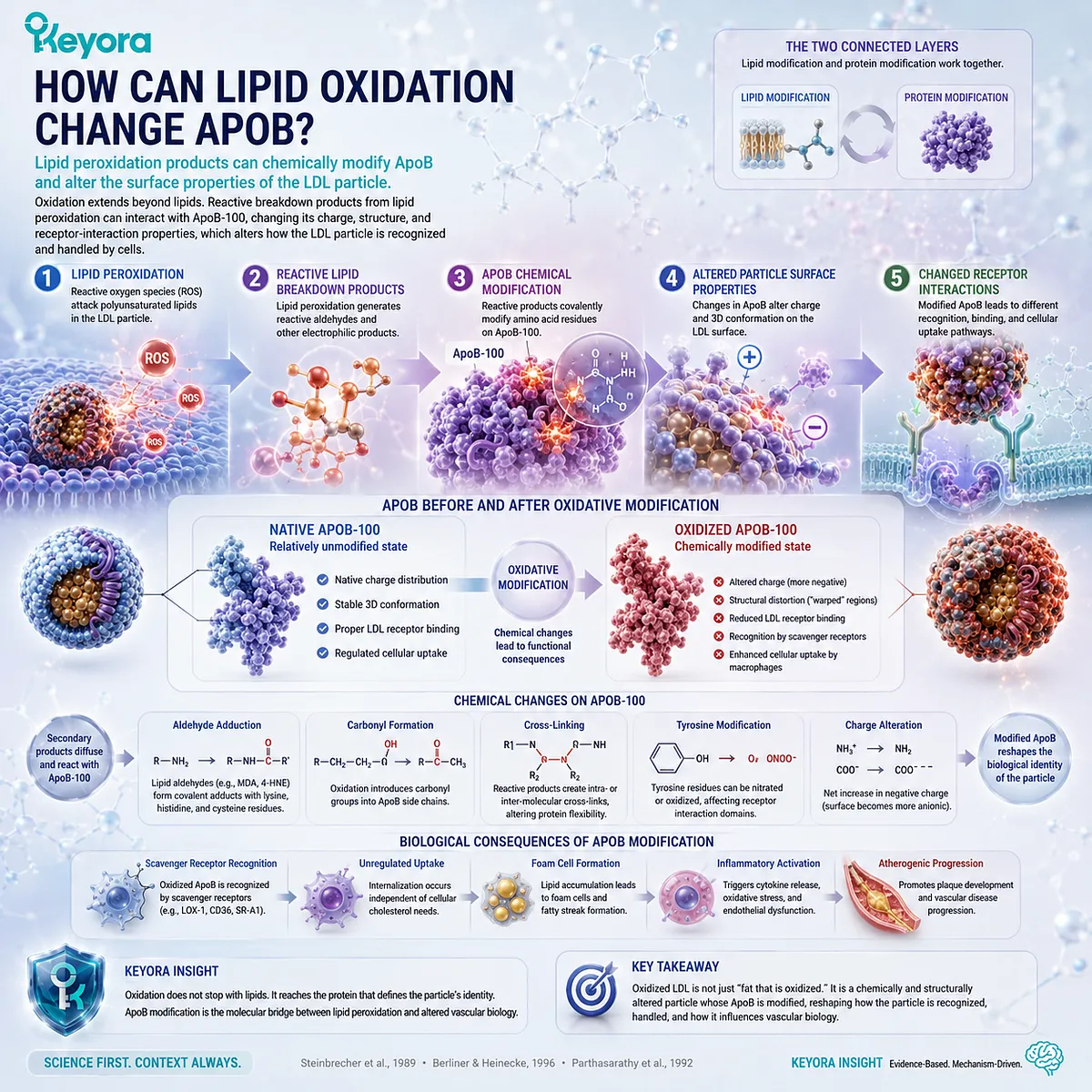
Lipid peroxidation products can chemically modify ApoB and alter the surface properties of the LDL particle
A major step in the transition from native LDL to oxidized LDL is the modification of ApoB-100.
The Keyora Endothelial Architecture paper describes lipid peroxidation products interacting with ApoB-100 and changing features of the protein, including electrical charge and three-dimensional structure.
The mechanism can be summarized as:
Lipid peroxidation
↓
Reactive lipid breakdown products
↓
ApoB chemical modification
↓
Altered particle surface properties
↓
Changed receptor interactions
This is an important point because oxidation does not stop with the lipid phase.
The initial oxidative reaction may occur within susceptible lipids, but secondary products of that reaction can influence proteins associated with the LDL particle.
The source sometimes describes this process by saying ApoB “warps.”
For public scientific interpretation, a more accurate description is:
ApoB can undergo chemical modification that changes its structural and receptor-interaction properties.
This is the transition from lipid chemistry to particle biology.
An LDL particle is recognized and handled partly through molecular features on its surface.
If those features change, cellular recognition can also change.
That is why oxLDL is biologically different from relatively native LDL.
The difference is not simply that one particle contains “oxidized fat.”
Oxidation can alter the integrated structure of the particle.
The Keyora LDL Particle-State Transition therefore has two connected layers:
Lipid modification
and
Protein modification
Together, these changes help explain why oxidized LDL can enter different cellular pathways.
Why Is Oxidized LDL Handled Differently by Cells?
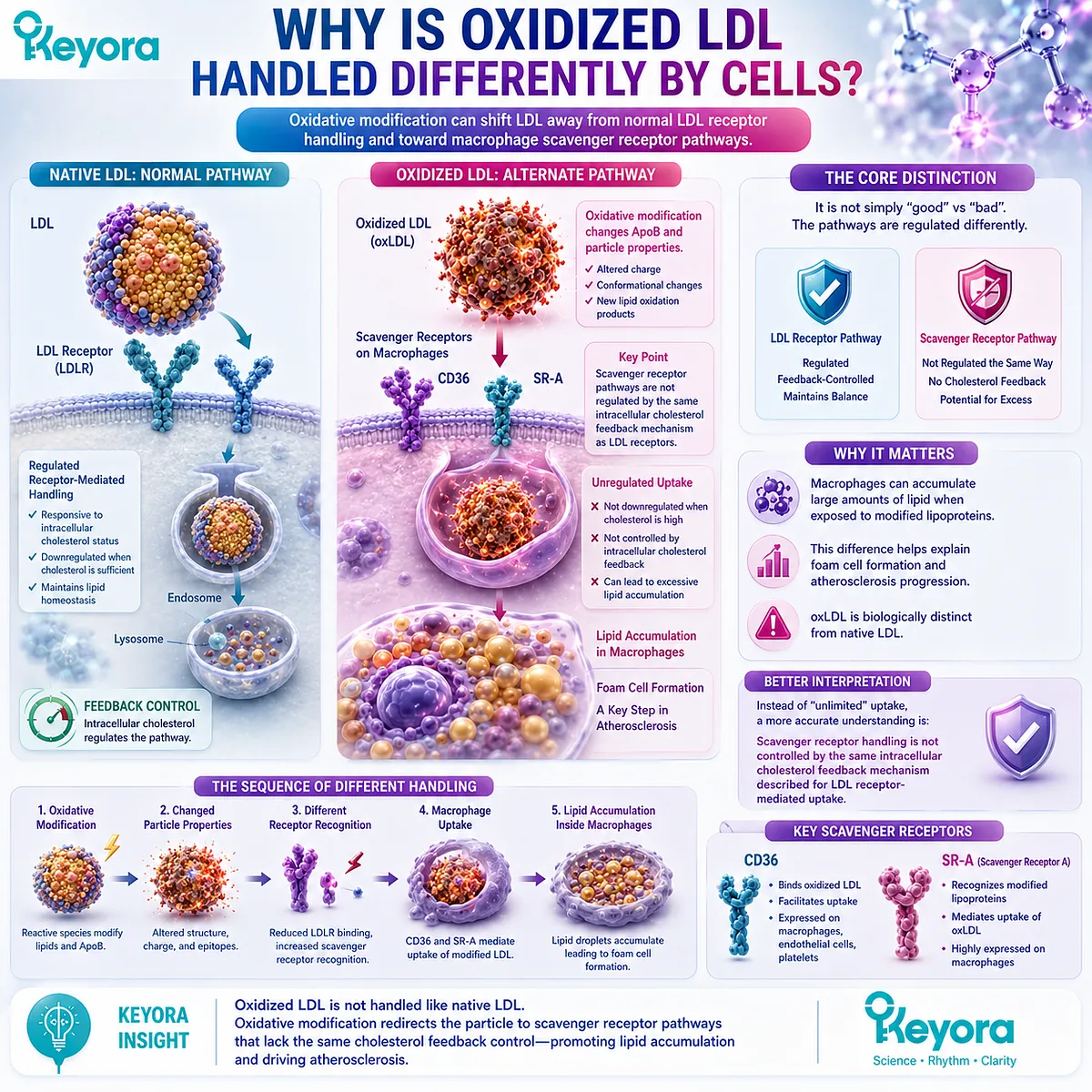
Oxidative modification can shift LDL away from normal LDL receptor handling and toward macrophage scavenger receptor pathways
One of the most important functional differences between native LDL and oxidized LDL is how cells recognize and handle the particle.
The Keyora Endothelial Architecture paper contrasts two receptor systems.
For relatively native LDL, the source describes:
LDL
↓
LDL receptor
↓
regulated receptor-mediated handling
For oxidatively modified LDL, the source emphasizes macrophage scavenger receptors including:
CD36
and
SR-A.
The core distinction is not simply that one receptor is “good” and the other is “bad.”
The important point is that these pathways are regulated differently.
The source describes normal LDL receptor handling as responsive to intracellular cholesterol status, while scavenger receptor pathways involved in modified LDL uptake do not operate through the same feedback mechanism.
This helps explain why macrophages can accumulate substantial amounts of lipid when exposed to modified lipoproteins.
The sequence becomes:
Oxidative modification
↓
Changed ApoB and particle properties
↓
Different receptor recognition
↓
Macrophage scavenger receptor uptake
↓
Lipid accumulation inside macrophages
The source sometimes calls this uptake “unlimited.”
That wording is too absolute.
A better interpretation is:
Scavenger receptor handling is not controlled by the same intracellular cholesterol feedback mechanism described for LDL receptor-mediated uptake.
This difference in cellular recognition is one of the strongest reasons oxLDL should not be treated as biologically equivalent to relatively native LDL.
Does Oxidized LDL Automatically Mean Plaque?
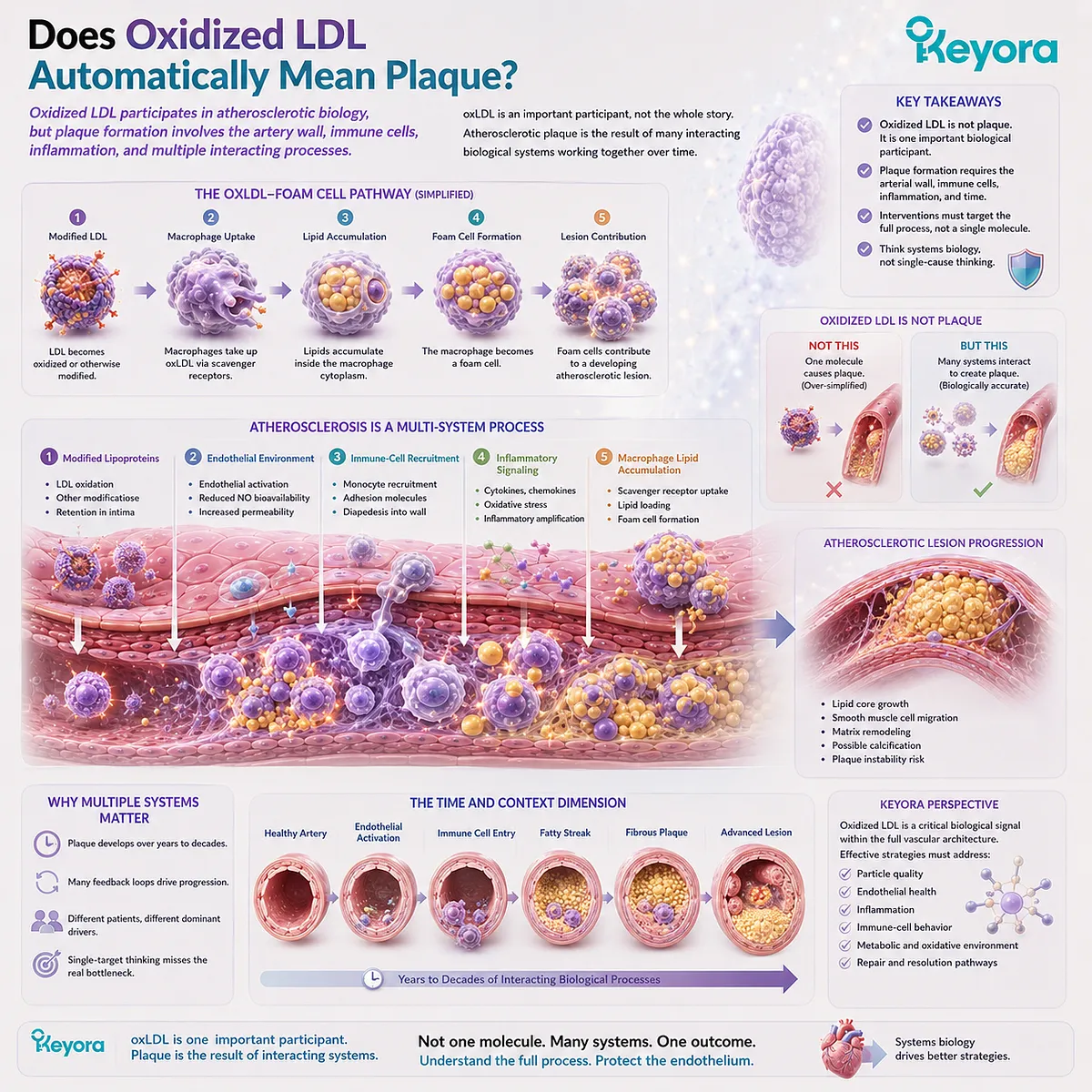
Oxidized LDL participates in atherosclerotic biology, but plaque formation involves the artery wall, immune cells, inflammation, and multiple interacting processes
No.
Oxidized LDL is important to the atherosclerotic process described in the Keyora Endothelial Architecture paper, but oxLDL should not be treated as identical to plaque.
The source connects oxLDL with macrophage scavenger receptor uptake, lipid accumulation, foam cell formation, and later plaque-related biology.
The simplified sequence is:
Modified LDL
↓
Macrophage uptake
↓
Lipid accumulation
↓
Foam cell formation
↓
Contribution to a developing atherosclerotic lesion
But the arterial lesion involves more than LDL oxidation.
Earlier sections of the full Keyora paper also describe endothelial activation, monocyte recruitment, inflammatory signaling, and entry of immune cells into the vascular wall.
So a more complete model is:
Modified lipoprotein biology
Endothelial environment
Immune-cell recruitment
Inflammatory signaling
Macrophage lipid accumulation
↓
Atherosclerotic lesion progression
This distinction prevents another oversimplification.
Q025 established that cholesterol alone should not be treated as the single explanation for artery disease.
Q026 should not replace that with:
oxidized LDL alone causes plaque
Instead, oxLDL should be understood as one biologically important participant within a larger vascular process.
The Keyora source strongly emphasizes oxidation, but its own broader vascular architecture includes the wall, circulating particles, oxidative conditions, and immune responses.
What Is the Key Difference Between Native LDL and Oxidized LDL?
The central difference is particle state because oxidative modification can change LDL chemistry, ApoB structure, receptor interactions, and immune-cell handling
The simplest way to understand the difference between native LDL and oxidized LDL is to think in terms of particle state.
The Keyora LDL Particle-State Transition can be summarized as:
Relatively Native LDL
↓
Oxidative Pressure
↓
PUFA Lipid Oxidation
↓
Lipid Radical Formation
↓
Lipid Peroxyl Radical Propagation
↓
MDA / 4-HNE and Other Oxidation Products
↓
ApoB Modification
↓
Changed Receptor Recognition
↓
Different Cellular Handling
↓
Oxidized LDL
This framework is a Keyora explanatory synthesis, not a clinical diagnostic term.
Its purpose is to show why the phrase “oxidized LDL” refers to more than cholesterol concentration.
The defining difference is not simply how much LDL is present.
It is what has happened chemically to the particle.
The Keyora Endothelial Architecture paper supports four major distinctions:
Native LDL is relatively unmodified.
Oxidized LDL contains chemically modified lipid components.
ApoB can also become modified during the oxidative process.
These changes can alter how the particle interacts with cellular receptor pathways.
The final answer is therefore:
Native LDL and oxidized LDL are not two unrelated substances. They represent different chemical and biological states of an LDL particle.
Q026 establishes what that transformation is.
The next question asks why it has become important enough to study:
Why Is LDL Oxidation Important in Cardiovascular Research?
![Native LDL becomes oxidized LDL through lipid peroxidation and ApoB modification, altering receptor recognition in Keyora [The LDL Particle-State Transition].](https://www.keyorahealth.com/cdnfiles/2026/09/02123407/98fa736d-c43f-45d0-b24d-6d0fdf1c7fb2_1254x1254.webp "Native LDL becomes oxidized LDL through lipid peroxidation and ApoB modification, altering receptor recognition in Keyora [The LDL Particle-State Transition].")
This article is for educational and informational purposes only. It does not provide medical advice, diagnosis, treatment, cure, prevention, disease outcome claims, hormone restoration claims, fertility outcome claims, or formula-specific clinical efficacy claims.