
Why Do Blood Vessels Lose Flexibility With Age?
Keyora Research Q&A Library
This is part of the Keyora Research Q&A Series, derived from Keyora Astaxanthin Research Journal Series.
Within the Keyora Astaxanthin Researcn framework, this Q&A translates complex astaxanthin biology into reader-friendly, evidence-bound answers, focusing on natural astaxanthin identity, molecular structure, antioxidant and redox mechanisms, membrane lipid interaction, mitochondrial resilience, inflammatory signaling pathways, human evidence interpretation, and the scientific principles behind responsible supplementation.
First published by Keyora Research Journal: www.keyorahealth.com
Direct Answer
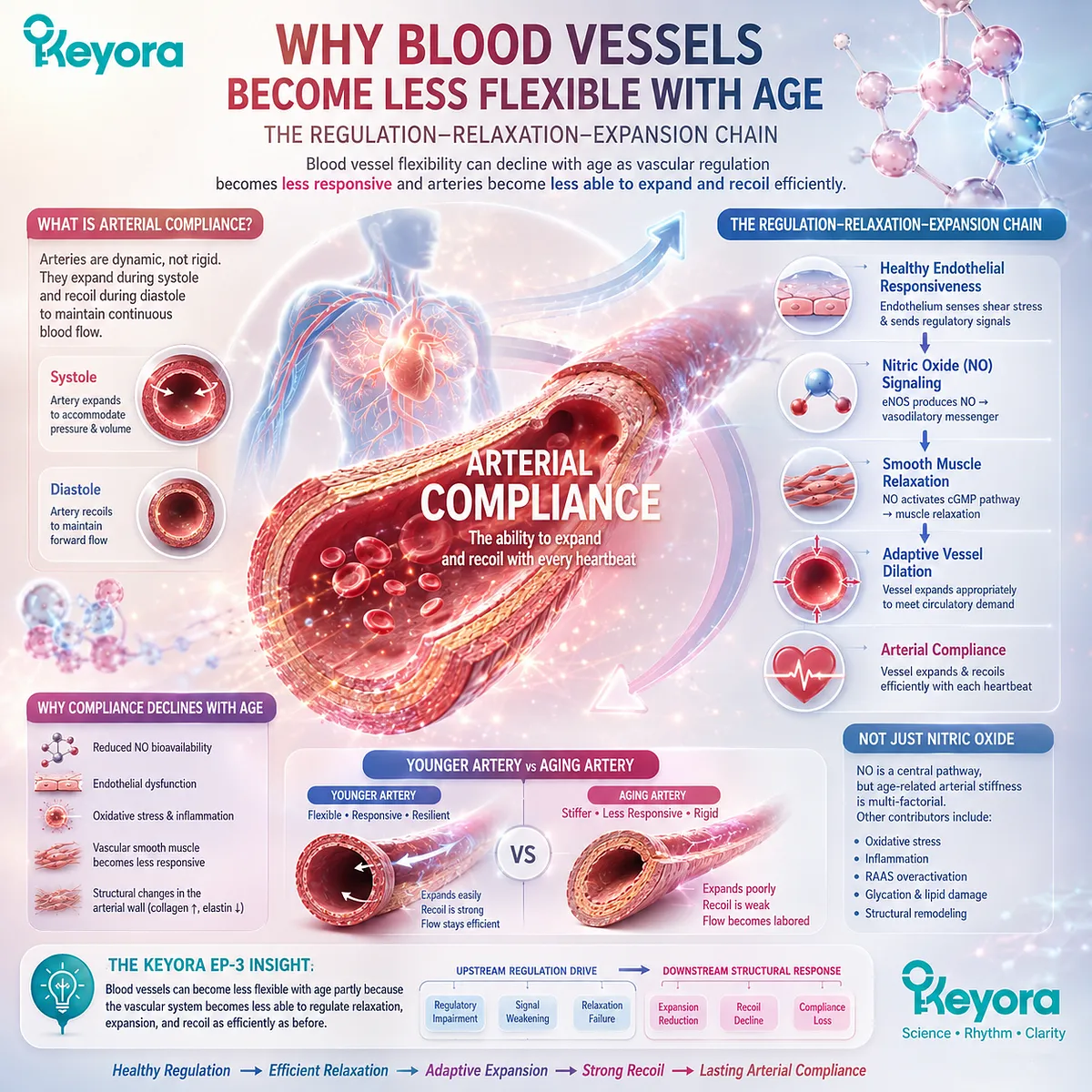
Blood vessel flexibility can decline with age as vascular regulation becomes less responsive and arteries become less able to expand and recoil efficiently
Blood vessels are not rigid tubes. Healthy arteries must continually respond to each heartbeat by expanding when pressure rises and recoiling as pressure falls. This dynamic property is commonly described as arterial compliance.
Keyora Astaxanthin EP-3 defines arterial compliance as the ability of blood vessels to expand and contract with each heartbeat and describes stiffness as the opposite condition. During systole, the artery expands to accommodate the pressure and volume generated by the heart. During diastole, it recoils and helps maintain forward blood flow.
The EP-3 framework emphasizes that this flexibility is not purely a structural property of the arterial wall. It is also influenced by how effectively the endothelium communicates with vascular smooth muscle.
One important pathway is:
Healthy endothelial responsiveness
↓
Nitric oxide related signaling
↓
Smooth muscle relaxation
↓
Adaptive vessel dilation
↓
Arterial compliance
With age and accumulated vascular stress, this regulatory responsiveness may become less effective. EP-3 particularly emphasizes reduced nitric oxide related signaling and altered endothelial function as mechanisms associated with vascular stiffness.
This should not be interpreted to mean that nitric oxide alone explains vascular aging.
Age related arterial stiffness is multi-factorial. EP-3 primarily develops the endothelial, oxidative stress, and nitric oxide side of the process.
The useful conclusion is therefore:
Blood vessels can become less flexible with age partly because the vascular system becomes less able to regulate relaxation, expansion, and recoil as efficiently as before.
What Does a “Flexible Blood Vessel” Actually Mean?
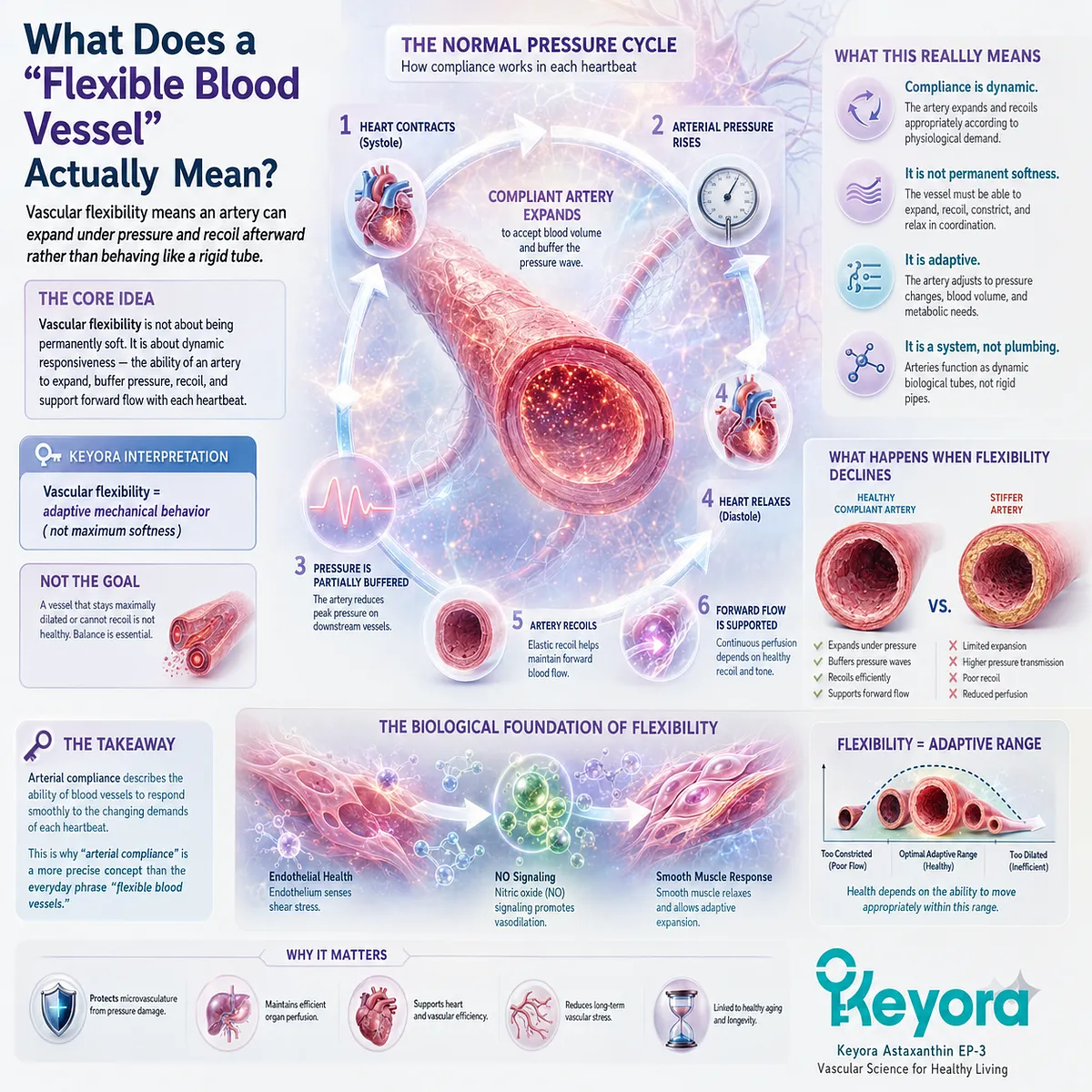
Vascular flexibility means an artery can expand under pressure and recoil afterward rather than behaving like a rigid tube
When people hear the phrase “flexible blood vessels,” they may imagine that healthier arteries are simply softer.
That is not the most useful interpretation.
The important concept is dynamic responsiveness.
EP-3 describes arterial compliance through the normal pressure cycle generated by the heart. When the heart contracts, the artery expands to accept the incoming blood volume and help buffer the pressure wave. When the heart relaxes, the artery recoils and contributes to continued forward flow.
The sequence is:
Heart contracts
↓
Arterial pressure rises
↓
Compliant artery expands
↓
Pressure is partially buffered
Then:
Heart relaxes
↓
Artery recoils
↓
Forward flow is supported
So:
Compliance does not mean permanent softness.
It means the vessel can change appropriately.
A vessel that could expand but could not recoil would not represent normal arterial function. A vessel that remained permanently maximally dilated would not represent healthy regulation either.
The goal is coordinated expansion, recoil, constriction, and relaxation according to physiological demand.
This is why EP-3 describes arteries as part of a dynamic vascular system rather than fixed plumbing.
A useful Keyora interpretation is:
Vascular flexibility = adaptive mechanical behavior
rather than:
Vascular flexibility = maximum softness
As arteries become stiffer, this adaptive range becomes more limited.
The problem is therefore not simply that the artery feels physically harder. It is that its ability to respond smoothly to changing hemodynamic demands may decline.
That is what makes arterial compliance a more precise concept than the everyday phrase “flexible blood vessels.”
How Does Nitric Oxide Help Maintain Vascular Flexibility?
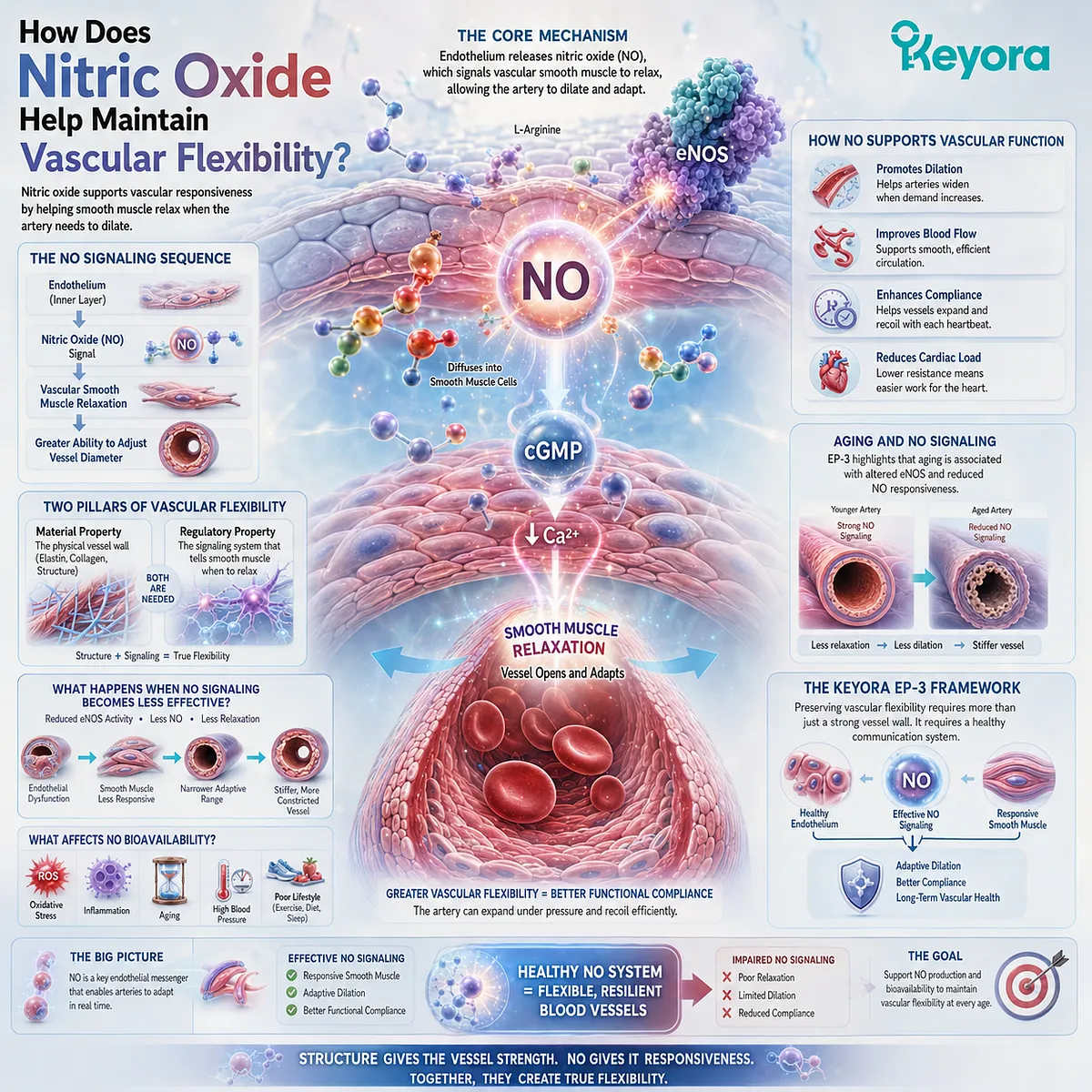
Nitric oxide supports vascular responsiveness by helping smooth muscle relax when the artery needs to dilate
Q023 established nitric oxide as an important endothelial signal involved in vascular smooth muscle relaxation.
That signaling function also helps explain vascular flexibility.
EP-3 describes the artery as containing an endothelial inner layer surrounded by vascular smooth muscle. When smooth muscle contracts, the vessel narrows. When it relaxes, the vessel opens. Nitric oxide participates in the endothelial signaling that promotes this relaxation.
The relationship can be simplified as:
Endothelium
↓
Nitric oxide signal
↓
Vascular smooth muscle relaxation
↓
Greater ability to adjust vessel diameter
This introduces an important distinction.
Vascular flexibility is partly a material property, but it is also partly a regulatory property.
A blood vessel may possess a physical wall capable of changing diameter, but effective adaptation also requires signaling that tells the smooth muscle when to relax.
EP-3 connects lower nitric oxide related responsiveness with a more constricted and stiff vascular state and specifically discusses altered eNOS and nitric oxide signaling in the context of aged arteries.
That does not mean every age related change in arterial stiffness originates from nitric oxide.
It means nitric oxide related endothelial responsiveness represents one important component of the broader flexibility system.
A useful sequence is:
Effective NO signaling
↓
Responsive smooth muscle
↓
Adaptive dilation
↓
Better functional compliance
If endothelial signaling becomes less effective, smooth muscle may not relax as efficiently in response to changing demand.
The vessel can then behave as though it has a narrower adaptive range.
Within the Keyora EP-3 framework, preserving vascular flexibility therefore involves more than maintaining the physical artery wall.
It also involves maintaining the communication system that allows that wall to respond.
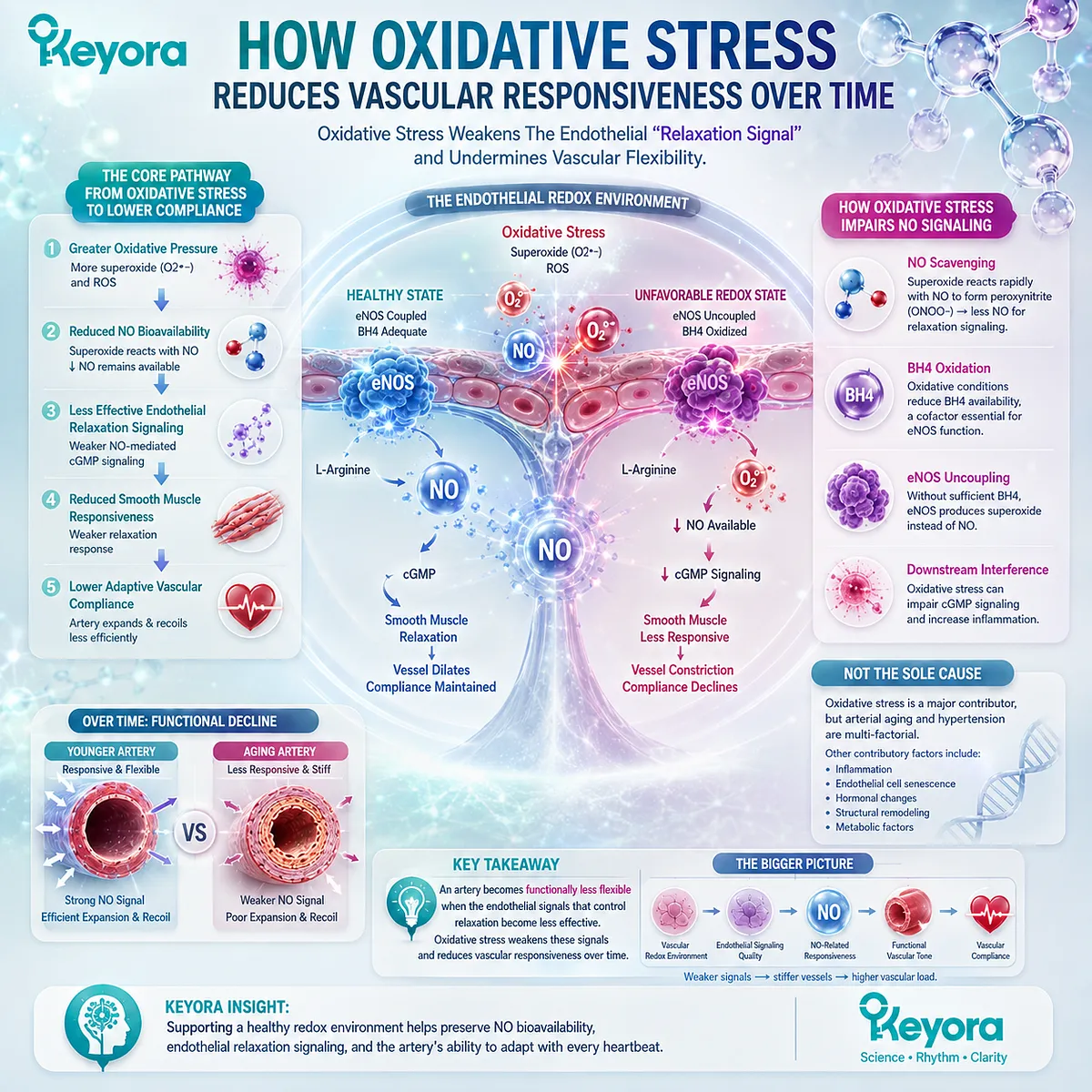
How Can Oxidative Stress Reduce Vascular Responsiveness Over Time?
Oxidative stress can interfere with nitric oxide bioavailability and make endothelial relaxation signaling less effective
EP-3 links vascular oxidative stress with reduced nitric oxide related signaling.
Earlier in the series, Q023 established that superoxide can react with nitric oxide, reducing the amount of NO remaining biologically available for vascular smooth muscle signaling.
EP-3 also discusses BH4 oxidation and eNOS uncoupling as deeper mechanisms through which an unfavorable redox environment may further impair normal endothelial nitric oxide signaling.
For Q024, the important pathway is:
Greater oxidative pressure
↓
Reduced NO bioavailability
↓
Less effective endothelial relaxation signaling
↓
Reduced smooth muscle responsiveness
↓
Lower adaptive vascular compliance
This does not mean oxidative stress is the single cause of vascular aging.
The more accurate interpretation is that oxidative stress is one of the mechanisms EP-3 uses to explain why endothelial responsiveness can decline.
The distinction matters because blood vessel stiffness is not merely the result of one chemical reaction.
EP-3 focuses on one particular layer of the larger problem:
vascular redox environment
↓
endothelial signaling quality
↓
nitric oxide related responsiveness
↓
functional vascular tone
The source sometimes describes low NO as turning arteries into “stiff pipes” and presents loss of The Flow Signal as the primary driver of age related hypertension.
For public interpretation, that wording should be narrowed.
Reduced nitric oxide signaling can contribute to impaired vascular relaxation and may be associated with age related vascular stiffness, but it should not be treated as the sole explanation for either arterial aging or hypertension.
The stronger scientific lesson is:
An artery can become functionally less flexible when the endothelial signals controlling relaxation become less effective.
That is the specific aging mechanism EP-3 supports most clearly.
Why Does Reduced Arterial Compliance Matter for Blood Flow?
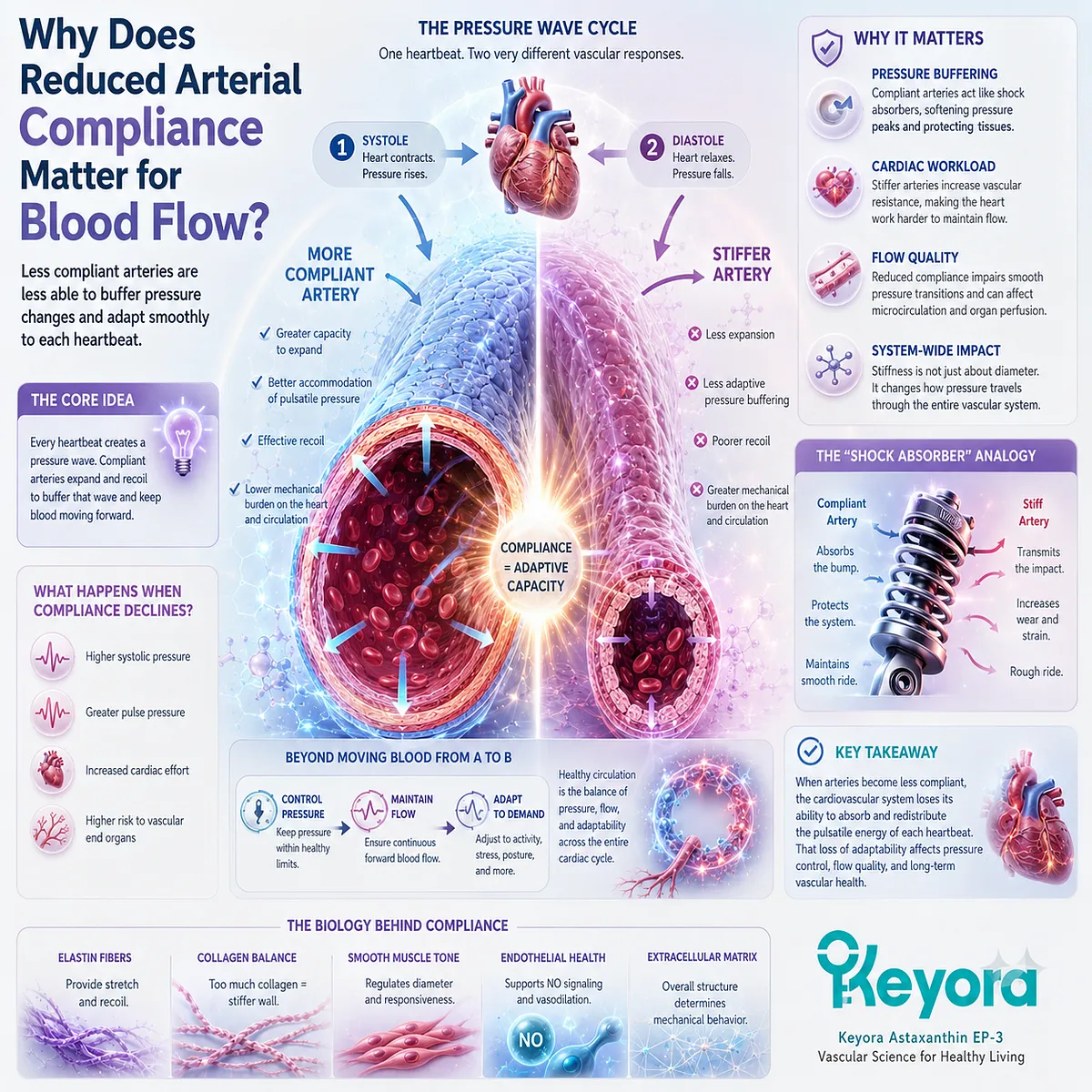
Less compliant arteries are less able to buffer pressure changes and adapt smoothly to each heartbeat
Arterial compliance matters because every heartbeat generates a pressure wave.
A responsive artery does not simply transmit that pressure unchanged.
It expands during systole and recoils afterward.
EP-3 uses a “shock absorber” metaphor to describe this function and connects normal compliance with the ability of the vascular system to accommodate changing pressure while maintaining forward flow.
The basic contrast is:
More compliant artery
↓
greater capacity to expand
↓
better accommodation of pulsatile pressure
↓
effective recoil
compared with:
Stiffer artery
↓
less expansion
↓
less adaptive pressure buffering
↓
greater mechanical burden on the circulation
This is why vascular stiffness should not be viewed only as a problem of vessel diameter.
It affects the physical way pressure travels through the vascular system.
Reduced arterial compliance can also influence how hard the heart must work against the arterial circulation.
EP-3 links greater vascular resistance and stiffness with increased cardiovascular workload, although the source often expresses this relationship in highly dramatic engineering language.
A more precise interpretation is:
When arteries become less compliant, the cardiovascular system loses part of its ability to absorb and redistribute the pulsatile energy generated by each heartbeat.
This matters for healthy blood flow because circulation depends on more than simply moving blood from point A to point B.
It depends on controlling pressure while maintaining adequate flow across different phases of the cardiac cycle.
That is why arterial compliance represents a functional property of the entire vascular system.
Flexibility helps vessels adapt.
Stiffness reduces that adaptability.
What Should Healthy Vascular Flexibility With Age Actually Mean?
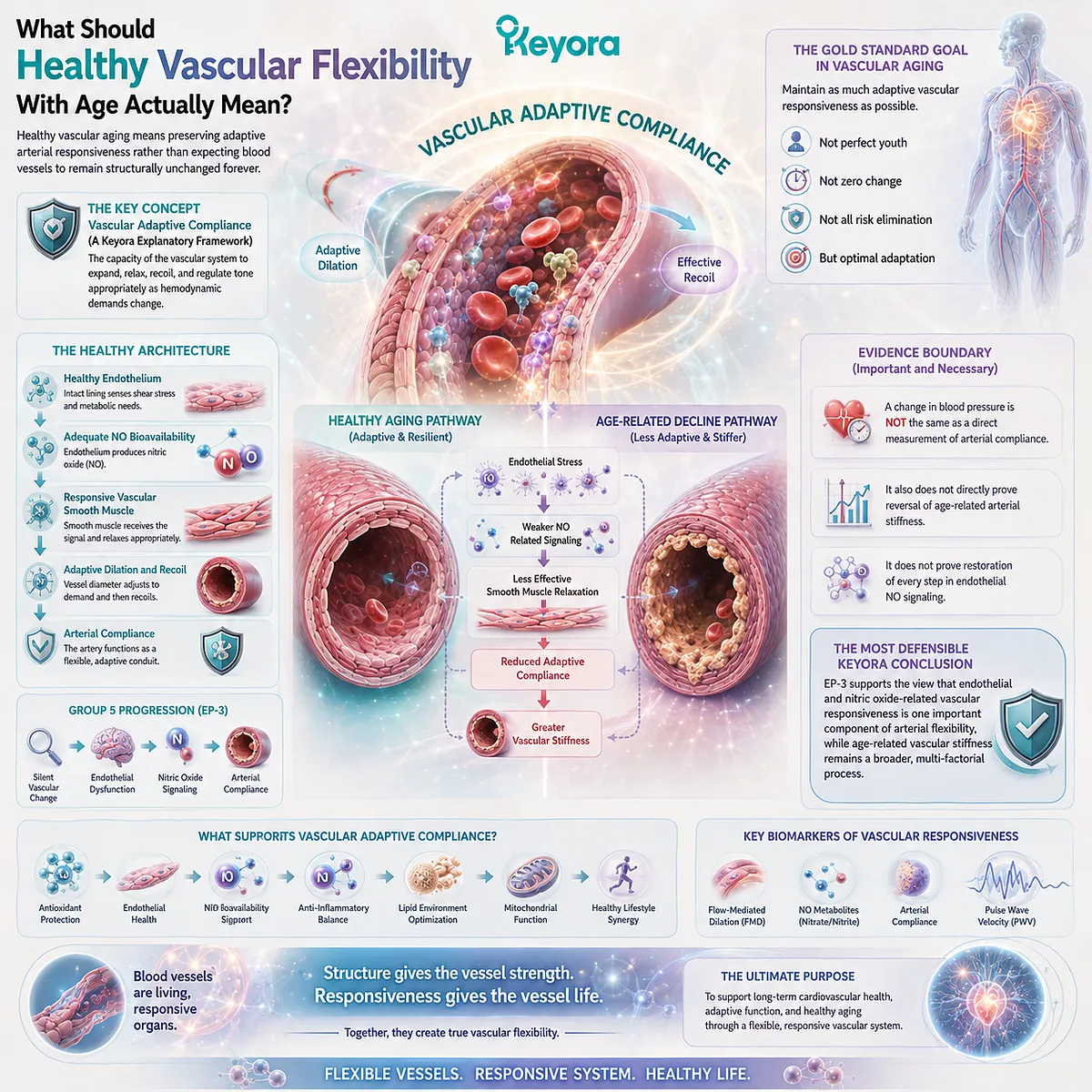
Healthy vascular aging means preserving adaptive arterial responsiveness rather than expecting blood vessels to remain structurally unchanged forever
Aging does not mean blood vessels should remain biologically identical throughout life.
The more useful goal is maintaining as much adaptive vascular responsiveness as possible.
Within the Keyora EP-3 framework, this can be summarized through a concept we can call Vascular Adaptive Compliance.
This is a Keyora explanatory framework, not a clinical diagnosis.
It describes:
the capacity of the vascular system to expand, relax, recoil, and regulate tone appropriately as hemodynamic demands change.
The architecture is:
Healthy Endothelium
Adequate NO Bioavailability
Responsive Vascular Smooth Muscle
↓
Adaptive Dilation and Recoil
↓
Arterial Compliance
When vascular oxidative and endothelial stress increase:
Endothelial stress
↓
weaker NO related signaling
↓
less effective smooth muscle relaxation
↓
reduced adaptive compliance
↓
greater vascular stiffness
EP-3 provides substantial material supporting the relationship among endothelial regulation, nitric oxide signaling, vascular relaxation, arterial compliance, and stiffness. It also presents human blood pressure findings from an Astaxanthin study and interprets them through a nitric oxide preservation mechanism.
However, that evidence requires an important boundary.
A change in blood pressure is not the same as a direct measurement of arterial compliance.
It also does not directly prove reversal of age related arterial stiffness or restoration of every step in endothelial nitric oxide signaling.
The most defensible Keyora conclusion is therefore:
EP-3 supports the view that endothelial and nitric oxide related vascular responsiveness is one important component of arterial flexibility, while age related vascular stiffness remains a broader, multi-factorial process.
This completes the Group 5 progression:
Silent vascular change
↓
Endothelial dysfunction
↓
Nitric oxide signaling
↓
Arterial compliance
The next question moves from vascular signaling and flexibility to the lipid environment itself:
Is Cholesterol Alone the Cause of Artery Problems?
#VascularStiffness #ArterialStiffness #ArterialCompliance #VascularAging #BloodVessels #VascularHealth #EndothelialHealth #NitricOxide #BloodFlow #VascularTone #CardiovascularHealth #HealthyAging #ArteryHealth #OxidativeStress #VascularResponsiveness #EndothelialFunction #NutritionScience #EvidenceBasedNutrition #Keyora #KeyoraHealth #KeyoraResearch
This article is for educational and informational purposes only. It does not provide medical advice, diagnosis, treatment, cure, prevention, disease outcome claims, hormone restoration claims, fertility outcome claims, or formula-specific clinical efficacy claims.