
What Is Endothelial Dysfunction and Why Does It Matter?
Keyora Research Q&A Library
This is part of the Keyora Research Q&A Series, derived from Keyora Astaxanthin Research Journal Series.
Within the Keyora Astaxanthin Researcn framework, this Q&A translates complex astaxanthin biology into reader-friendly, evidence-bound answers, focusing on natural astaxanthin identity, molecular structure, antioxidant and redox mechanisms, membrane lipid interaction, mitochondrial resilience, inflammatory signaling pathways, human evidence interpretation, and the scientific principles behind responsible supplementation.
First published by Keyora Research Journal: www.keyorahealth.com
Direct Answer
Endothelial dysfunction means the blood vessel lining is losing part of its normal ability to regulate vascular tone, barrier behavior, and blood surface interactions
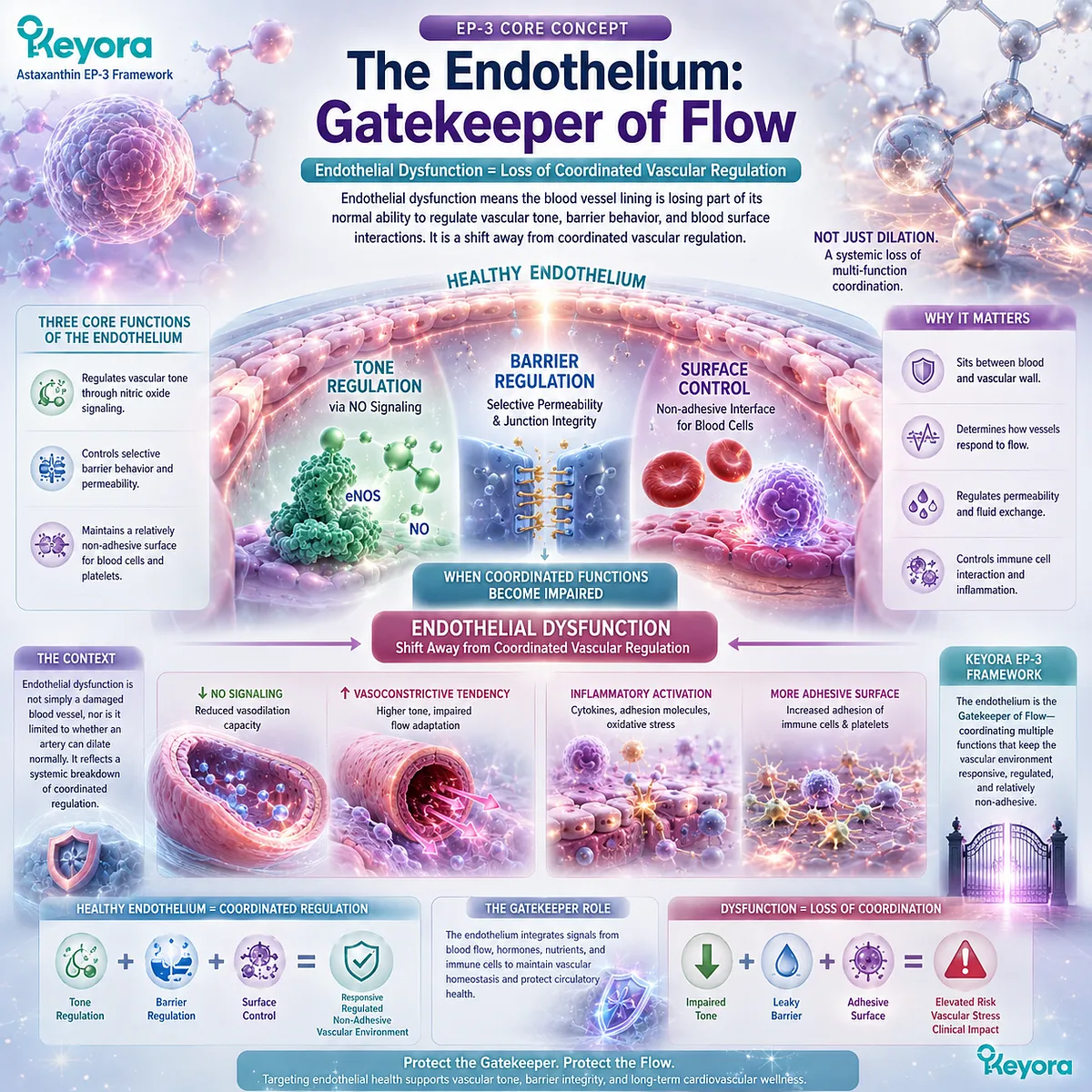
Endothelial dysfunction is not simply a damaged blood vessel, and it is not limited to whether an artery can dilate normally.
In Keyora Astaxanthin EP-3, the endothelium is presented as an active regulatory interface lining the inside of blood vessels.
The source describes three major functions: regulation of vascular tone through nitric oxide signaling, selective barrier behavior, and maintenance of a relatively non-adhesive surface for circulating blood cells and platelets.
This gives endothelial dysfunction a broader meaning:
Healthy endothelium
↓
Tone regulation
Barrier regulation
Surface control
↓
when these coordinated functions become impaired
↓
Endothelial Dysfunction
Within the EP-3 framework, endothelial dysfunction therefore represents a shift away from coordinated vascular regulation.
The source links this shift with reduced nitric oxide related signaling, greater vasoconstrictive tendency, inflammatory activation, and a more adhesive endothelial surface.
This matters because the endothelium sits directly between circulating blood and the vascular wall.
Changes at this interface can influence how blood vessels respond to flow, how vascular permeability is regulated, and how immune cells interact with the vessel surface.
EP-3 calls the endothelium the Gatekeeper of Flow.
That phrase is best understood as a Keyora explanatory framework: the endothelial layer helps coordinate several functions that determine whether the vascular environment remains responsive, regulated, and relatively non-adhesive.
What Is the Endothelium and Why Is It More Than a Passive Lining?
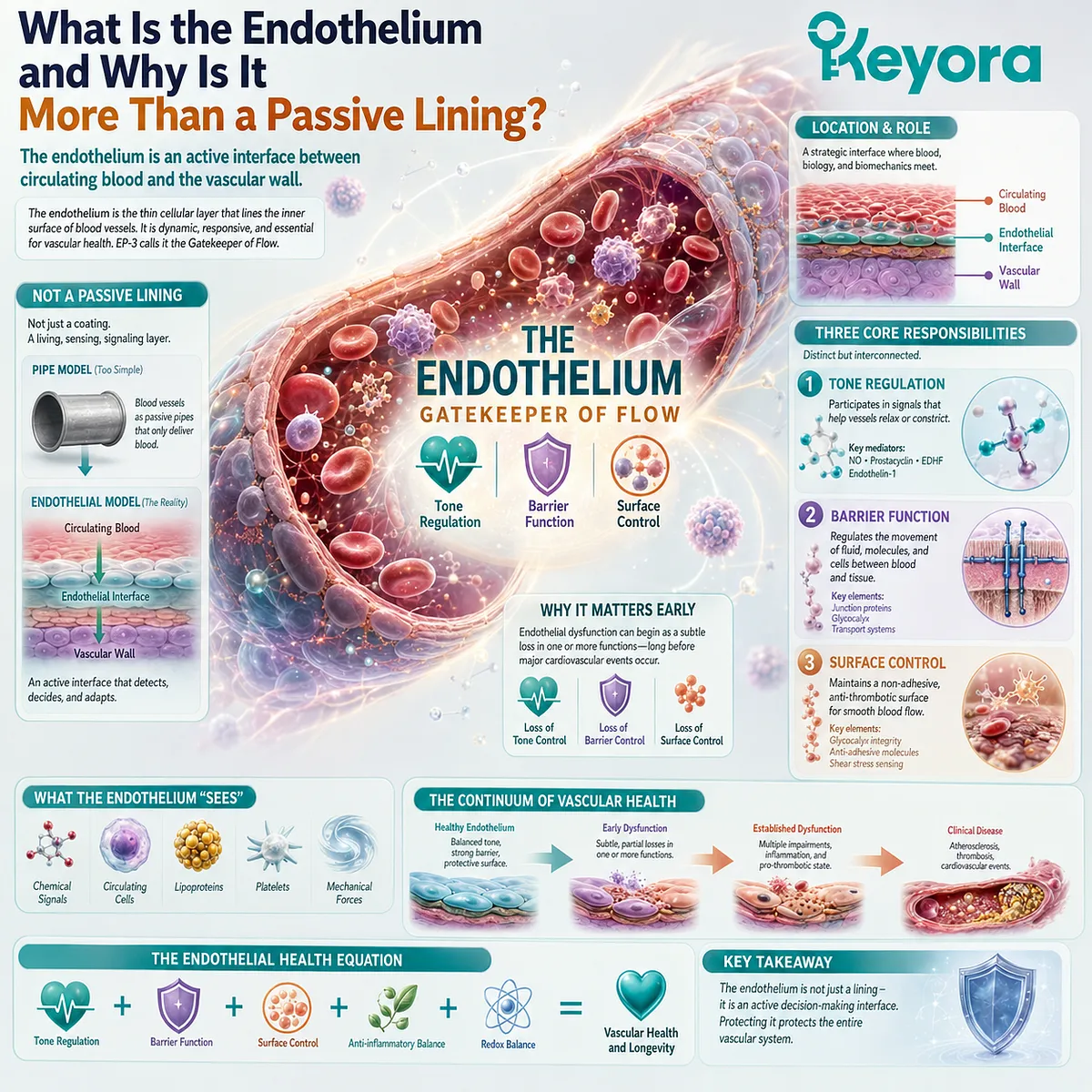
The endothelium is an active interface between circulating blood and the vascular wall
The endothelium is the thin cellular layer that lines the inner surface of blood vessels.
EP-3 emphasizes that it should not be viewed as a passive coating. The source explicitly describes the endothelium as dynamic and identifies it as the Gatekeeper of Flow because of its regulatory role in vascular biology.
That distinction changes how vascular health should be understood.
A simple pipe model suggests that blood vessels matter mainly because they provide a physical route for blood.
The endothelial model is more complex:
Circulating blood
↓
Endothelial interface
↓
Vascular wall
The endothelial layer is positioned where blood borne signals, circulating cells, lipoproteins, platelets, and mechanical forces meet the vessel wall.
EP-3 organizes endothelial function around three responsibilities.
The first is tone regulation, meaning participation in signals that help the vessel relax or constrict.
The second is barrier function, meaning regulation of movement between circulating blood and surrounding tissue.
The third is surface control, meaning maintenance of an endothelial environment that limits unnecessary adhesion of circulating cells and platelets.
These functions are related but not identical.
That is why endothelial dysfunction should not be reduced to one single abnormality.
A vessel may be losing part of its normal tone regulation, barrier control, or surface regulation before a dramatic cardiovascular event occurs.
Within the EP-3 architecture, this makes the endothelium one of the earliest places to examine when trying to understand how a vascular system moves from normal regulation toward dysfunction.
How Does the Endothelium Help Regulate Blood Vessel Tone?
One major endothelial function is controlling signals that help blood vessels relax and adjust blood flow
EP-3 identifies vascular tone regulation as one of the endothelium’s primary jobs.
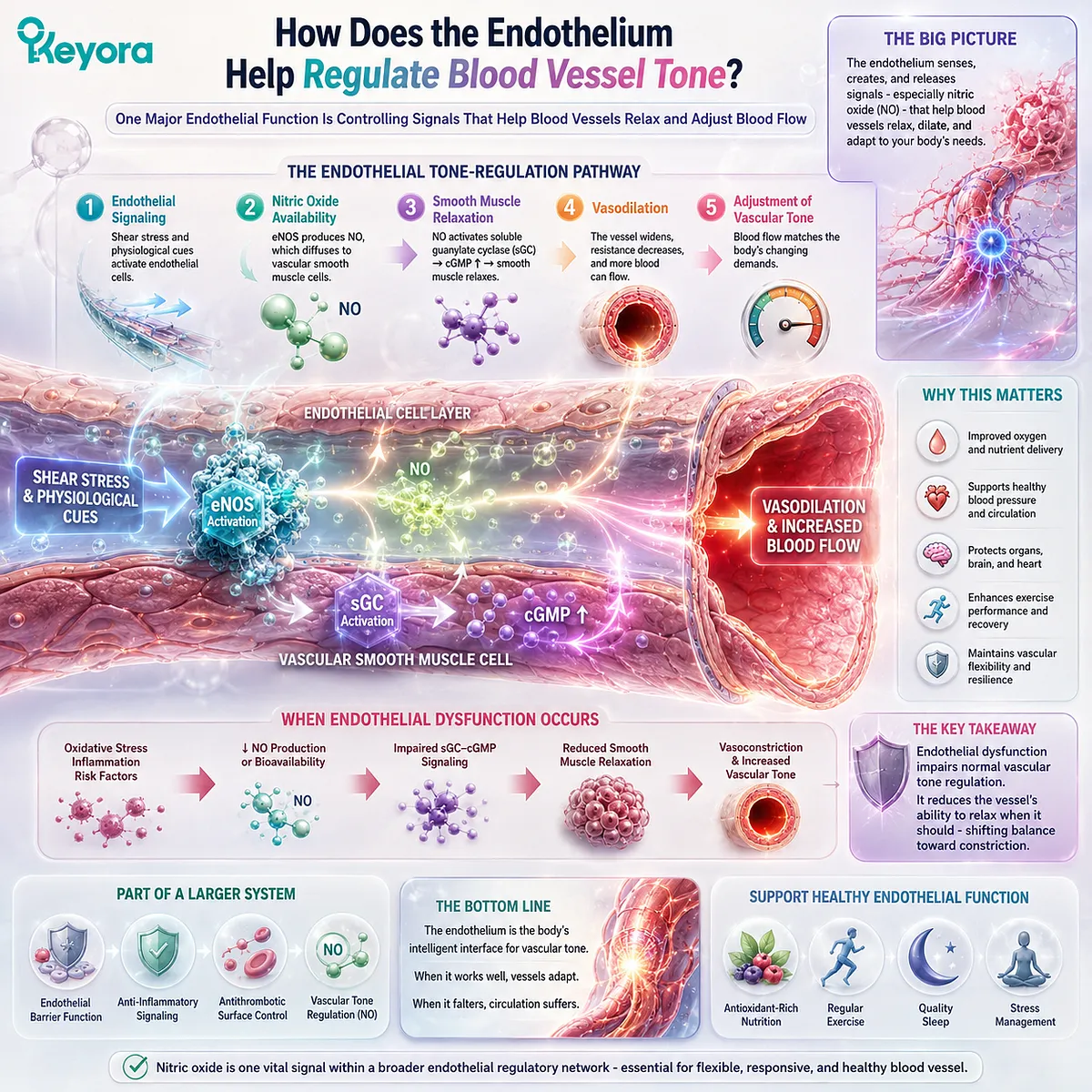
The source places nitric oxide, or NO, at the center of this function.
It describes endothelial nitric oxide signaling as a message that helps vascular smooth muscle relax, allowing the vessel to dilate and adjust blood flow.
A simplified sequence is:
Endothelial signaling
↓
Nitric oxide availability
↓
Smooth muscle relaxation
↓
Vasodilation
↓
Adjustment of vascular tone
The important point for Q022 is not the complete chemistry of nitric oxide.
That belongs in Q023.
The important point is that the endothelium helps control whether a blood vessel can respond appropriately to changing physiological demands.
EP-3 then connects endothelial dysfunction with loss of this regulatory capacity.
In the source’s model, oxidative stress reduces nitric oxide related signaling, the vessel becomes less able to relax effectively, and vascular tone shifts toward greater constriction.
For public scientific interpretation, the strongest conclusion is:
Endothelial dysfunction can impair normal vascular tone regulation.
That is more precise than saying every constricted vessel has endothelial dysfunction or that every blood pressure change is caused by the endothelium.
The EP-3 framework treats nitric oxide as one important signal inside a larger vascular regulatory system.
This is why endothelial dysfunction matters even before the reader reaches the more detailed nitric oxide discussion.
If the endothelial layer is no longer coordinating vascular tone as effectively, one of the blood vessel’s basic adaptive functions has already begun to change.
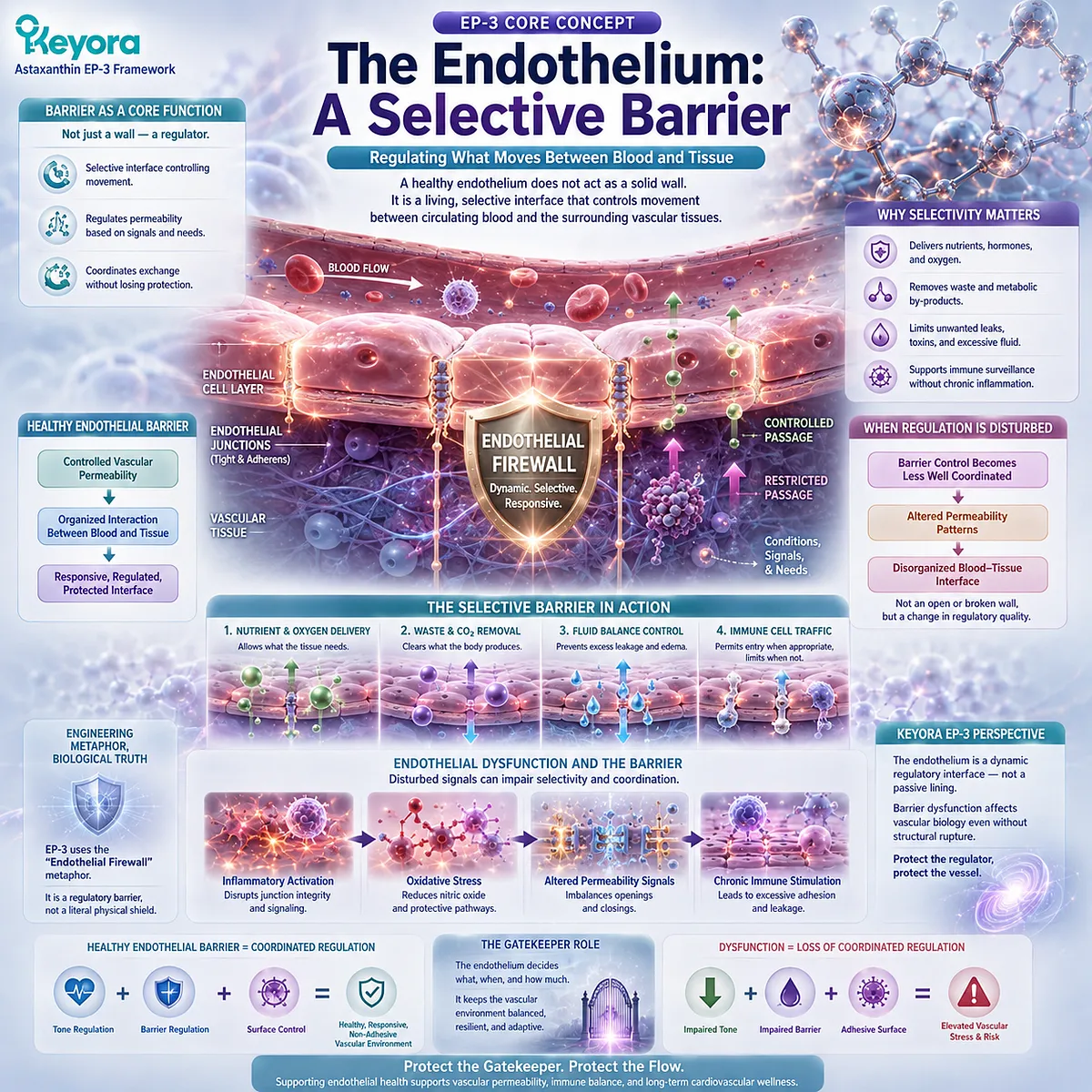
How Does the Endothelium Act as a Selective Barrier?
A healthy endothelium helps regulate movement between circulating blood and surrounding vascular tissues
The second major function identified in EP-3 is barrier regulation.
The source describes the endothelium as a selective interface controlling movement between the bloodstream and surrounding tissues.
The useful concept is selectivity.
The endothelial layer is not simply an impermeable wall.
Its biological role includes regulating what moves across the vascular interface and under what conditions.
This adds another dimension to endothelial dysfunction.
If endothelial health were only about vasodilation, then vascular tone would be the entire story.
But EP-3 places barrier function beside tone regulation and surface control.
That means endothelial dysfunction can be understood more broadly as a loss of coordinated regulatory behavior.
The Keyora framework can therefore be represented as:
Healthy endothelial barrier
↓
controlled vascular permeability
↓
organized interaction between blood and tissue
When endothelial regulation becomes disturbed:
barrier control may become less well coordinated
This does not mean the endothelium suddenly becomes an open or broken wall.
It means the regulatory quality of the interface may change.
That distinction is important.
EP-3 uses strong engineering metaphors such as the Endothelial Firewall to describe the protective role of the vascular lining. The metaphor is useful if it is interpreted as a regulatory barrier rather than as a literal physical shield.
The endothelium is living tissue.
Its barrier behavior is dynamic.
That is why endothelial dysfunction can affect vascular biology even when there is no obvious structural rupture.
Why Does the Endothelial Surface Need to Remain Relatively Non-Adhesive?
Healthy endothelial surface behavior helps circulating blood cells and platelets move without unnecessary adhesion
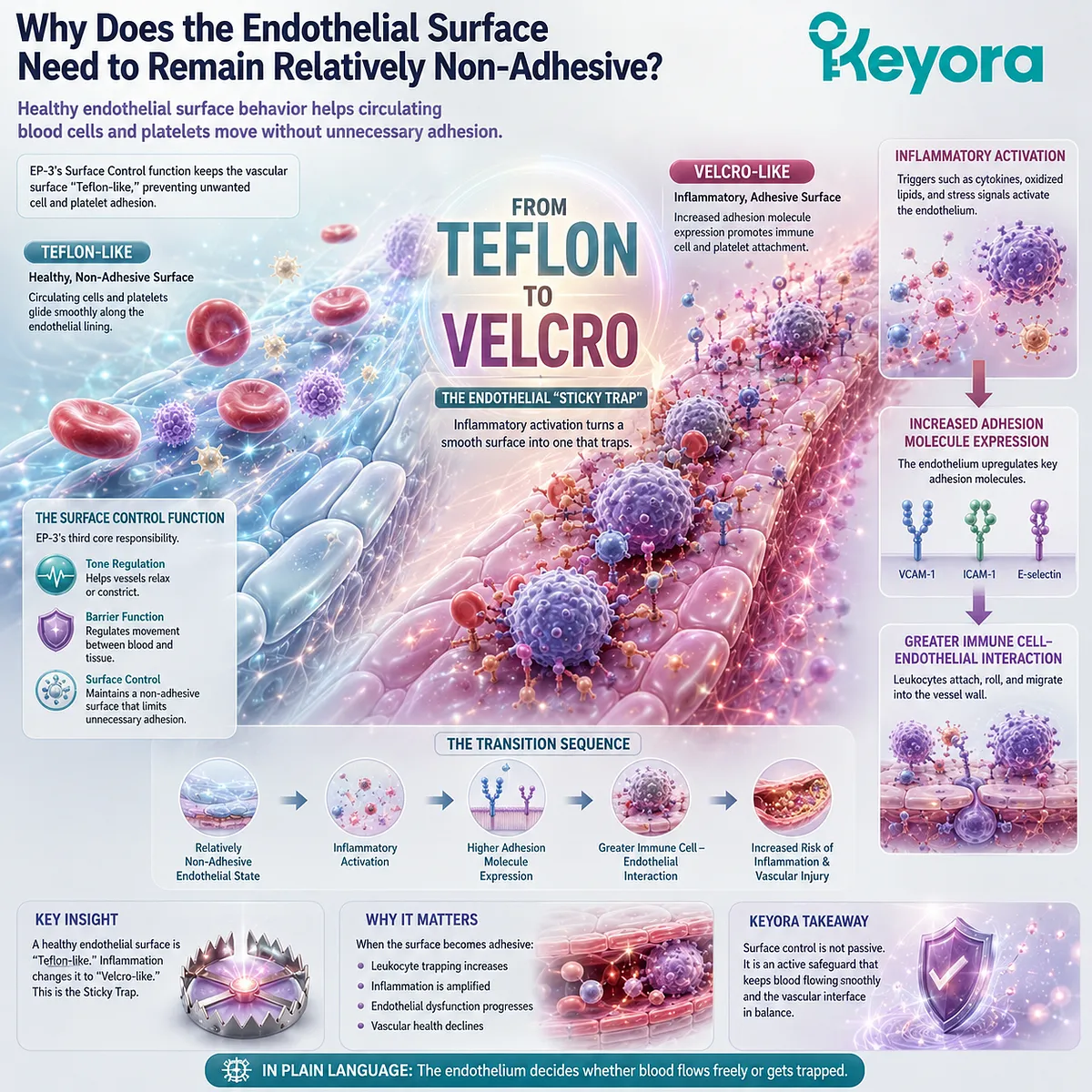
The third function in the EP-3 model is surface control.
The source describes the healthy endothelial surface with a Teflon-like metaphor, meaning that circulating cells and platelets normally move along the vessel wall without unnecessary adhesion.
EP-3 then contrasts this with an inflammatory endothelial state.
When inflammatory signaling is activated, the source describes increased expression of endothelial adhesion molecules including:
VCAM-1
ICAM-1
E-selectin
These molecules participate in interactions between the endothelium and circulating immune cells. EP-3 uses the metaphor of a surface changing from Teflon to Velcro.
The metaphor should not be taken literally.
The endothelial surface does not physically turn into Velcro.
The biological point is that inflammatory activation can increase the expression of molecules that make leukocyte attachment to the vascular wall more likely.
The transition can be summarized as:
Relatively non-adhesive endothelial state
↓
Inflammatory activation
↓
Higher adhesion molecule expression
↓
Greater immune cell – endothelial interaction
EP-3 calls this the Sticky Trap.
Again, this is a Keyora explanatory model rather than a formal clinical term.
Its value is that it makes endothelial dysfunction easier to visualize.
The endothelial layer does more than help regulate vessel diameter.
It also determines how the vascular surface communicates with circulating cells.
When this surface becomes more inflammatory and adhesive, the character of the blood – vessel wall interface changes.
What Happens When the Endothelium Becomes Dysfunctional?
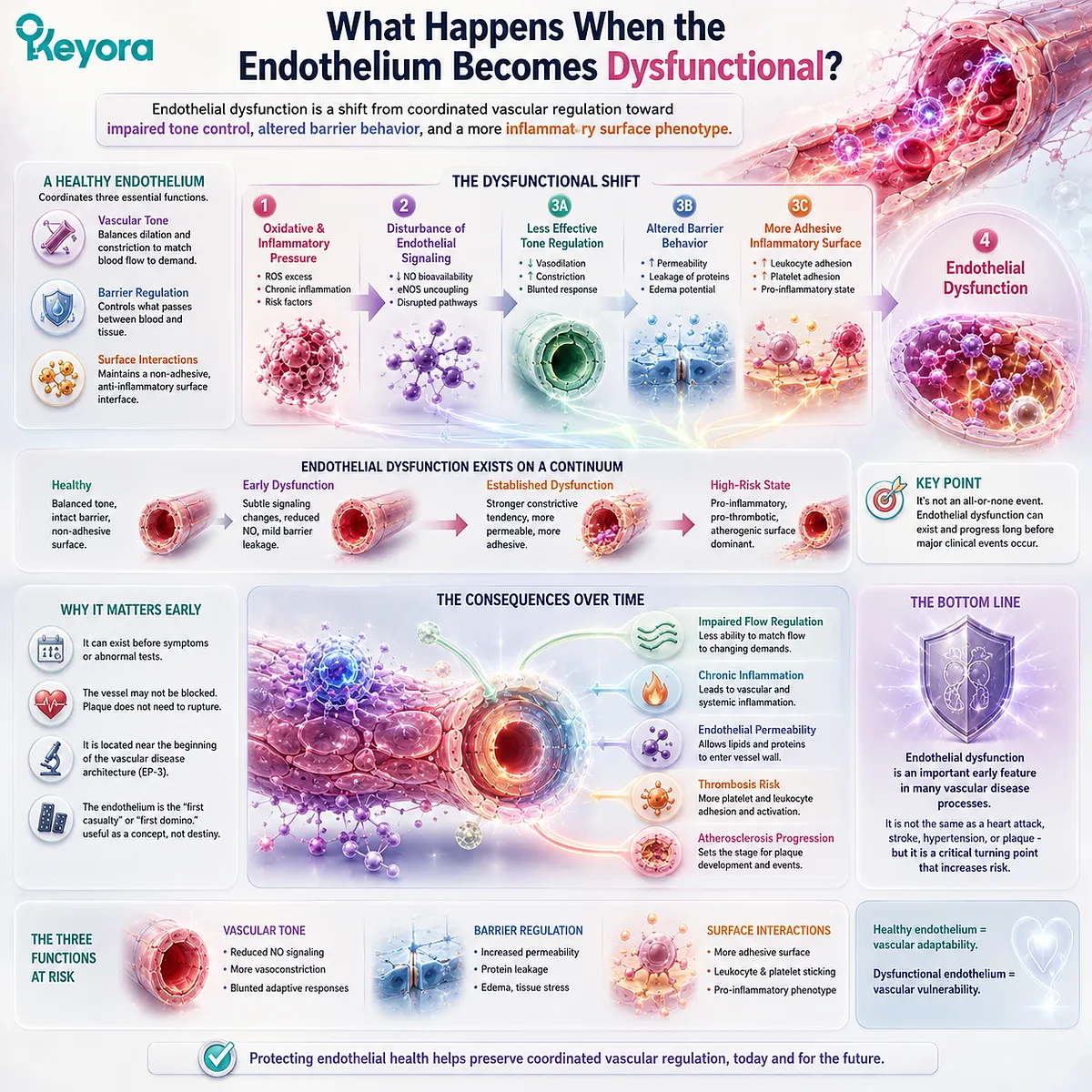
Endothelial dysfunction is a shift from coordinated vascular regulation toward impaired tone control, altered barrier behavior, and a more inflammatory surface phenotype
The most useful way to understand endothelial dysfunction is to combine the three functions described earlier.
A healthy endothelial system helps coordinate:
Vascular tone
Barrier regulation
Surface interactions
Endothelial dysfunction means this coordination is becoming less effective.
EP-3 summarizes the dysfunctional state through reduced nitric oxide related signaling, increasing constrictive tendency, and a more adhesive endothelial surface.
But the concept should not be reduced to a single molecular switch.
A more complete Keyora interpretation is:
Oxidative and inflammatory pressure
↓
Disturbance of endothelial signaling
↓
Less effective tone regulation
altered barrier behavior
more adhesive inflammatory surface
↓
Endothelial Dysfunction
This is why endothelial dysfunction can exist before a dramatic cardiovascular event.
The vessel does not need to be fully blocked.
Plaque does not need to rupture.
The endothelial layer can already be functioning differently.
EP-3 places these changes near the beginning of its vascular disease architecture, before later plaque related complications.
The source sometimes describes the endothelium as the “first casualty” or “first domino.”
Those phrases are useful as storytelling devices, but the public scientific conclusion should be narrower:
Endothelial dysfunction is an important early feature in many vascular disease processes.
That makes it highly relevant to cardiovascular research even though it is not itself identical to a heart attack, stroke, hypertension, or atherosclerotic plaque.
How Do Oxidative Stress and Inflammation Push the Endothelium Toward Dysfunction?
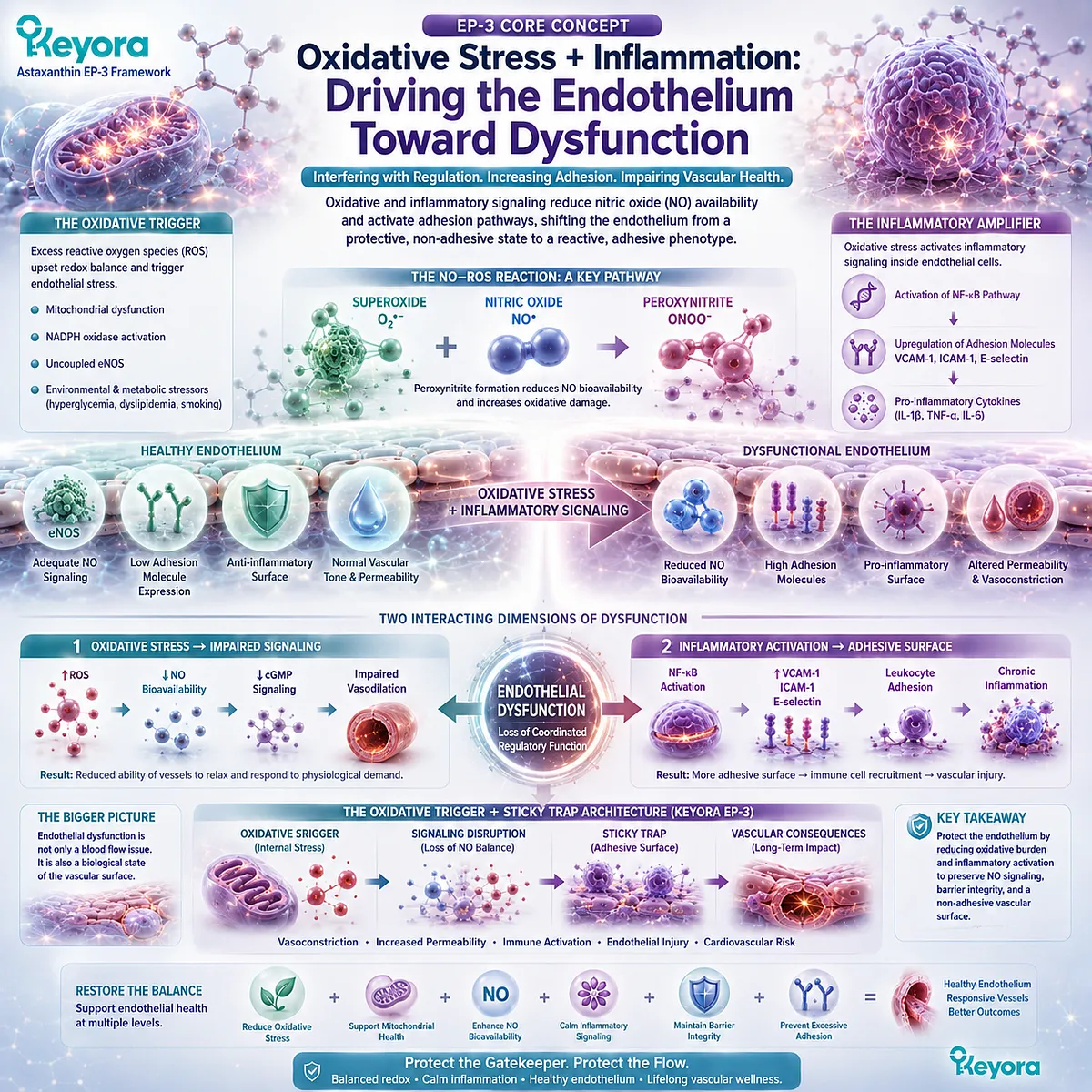
Oxidative and inflammatory signaling can interfere with endothelial regulation and promote a more adhesive vascular surface
EP-3 gives oxidative stress a major role in its endothelial dysfunction model.
One part of the source focuses on nitric oxide related signaling.
It describes oxidative stress as reducing the availability of NO, which can interfere with the vessel’s ability to relax normally.
The source later gives a more specific chemical pathway:
Superoxide
Nitric Oxide
↓
Peroxynitrite
and links this reaction with reduced NO signaling and oxidative vascular stress.
For Q022, the important interpretation is:
oxidative stress can reduce NO bioavailability
not that every molecule of nitric oxide is simply “destroyed.”
EP-3 also connects oxidative stress with inflammatory signaling.
The source describes activation of NF-κB related pathways followed by increased expression of adhesion molecules such as VCAM-1, ICAM-1, and E-selectin.
This creates two interacting dimensions:
Oxidative stress
↓
impaired endothelial signaling
and
Inflammatory activation
↓
more adhesive endothelial phenotype
Together they help explain why endothelial dysfunction is not only a blood flow problem.
It is also a problem of the biological state of the vascular surface.
Within the Keyora EP-3 language, the shift from a relatively regulated endothelial environment toward oxidative and inflammatory dysfunction is part of the Oxidative Trigger and Sticky Trap architecture.
Those terms provide a useful map of the process while the underlying biology remains the primary scientific content.
Why Does Endothelial Dysfunction Matter for Cardiovascular Health?
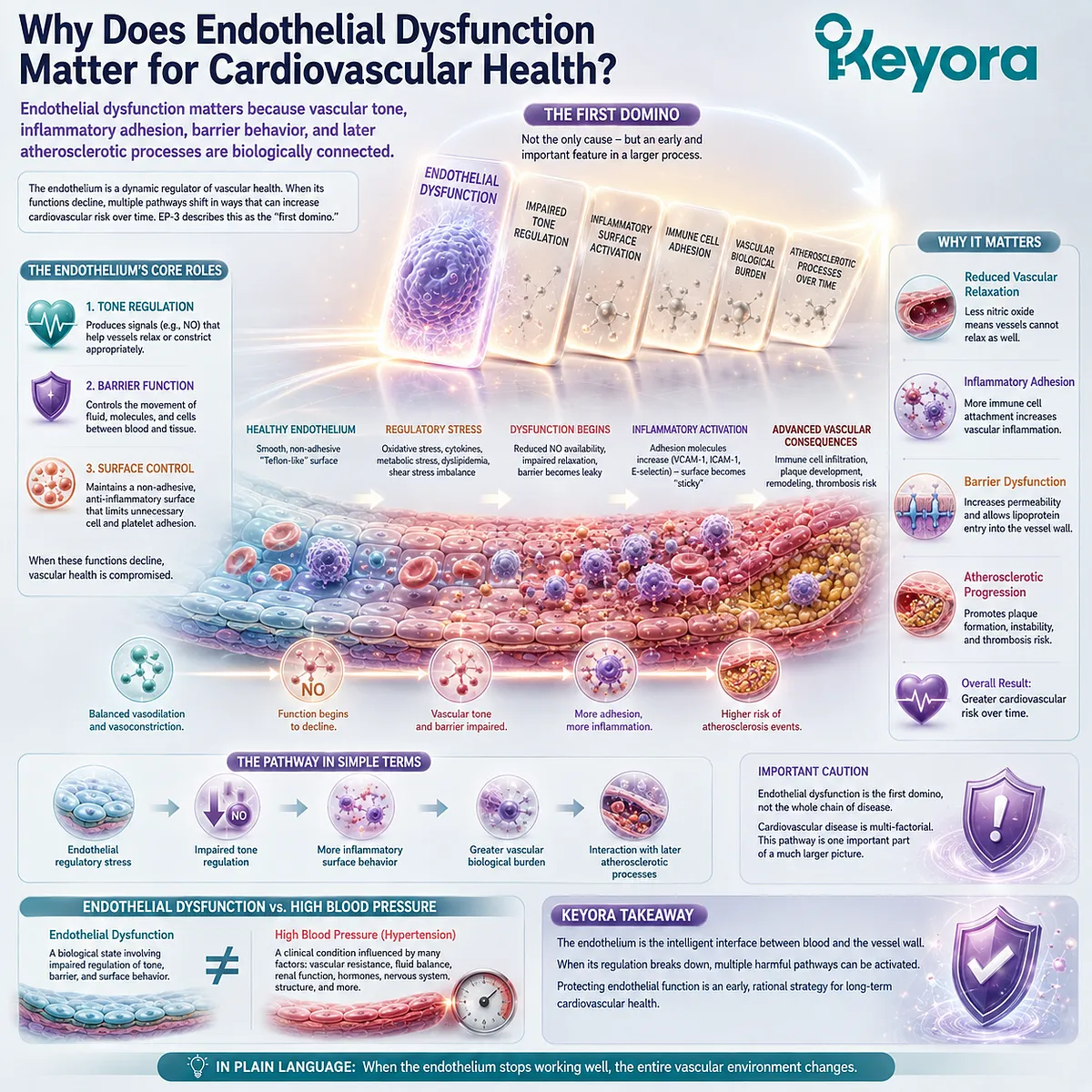
Endothelial dysfunction matters because vascular tone, inflammatory adhesion, barrier behavior, and later atherosclerotic processes are biologically connected
Endothelial dysfunction matters because the vascular lining participates in several processes that influence the environment in which cardiovascular disease can develop.
EP-3 connects endothelial dysfunction with reduced vascular relaxation, inflammatory endothelial activation, immune cell adhesion, and later plaque related processes.
The pathway can be summarized as:
Endothelial regulatory stress
↓
Impaired tone regulation
more inflammatory surface behavior
↓
greater vascular biological burden
↓
interaction with later atherosclerotic processes
The source uses a “first domino” metaphor for endothelial dysfunction.
That should not be interpreted as meaning endothelial dysfunction is the single cause of cardiovascular disease.
Cardiovascular disease is broader than any one endothelial pathway.
The useful conclusion is that endothelial dysfunction can be an important early feature within a larger vascular disease process.
The same caution applies to blood pressure.
EP-3 later links high blood pressure strongly with endothelial dysfunction and reduced nitric oxide signaling.
But these should not be treated as interchangeable terms.
Hypertension is not simply another name for endothelial dysfunction.
Rather, altered endothelial regulation can influence vascular tone and may coexist with other mechanisms involved in abnormal blood pressure regulation.
This distinction keeps the Keyora framework useful without turning one pathway into a complete explanation of cardiovascular disease.
The reason endothelial dysfunction matters is ultimately structural and regulatory:
the layer that coordinates the interface between blood and the vessel wall is no longer behaving as effectively as it should.
What Should “Endothelial Health” Actually Mean?
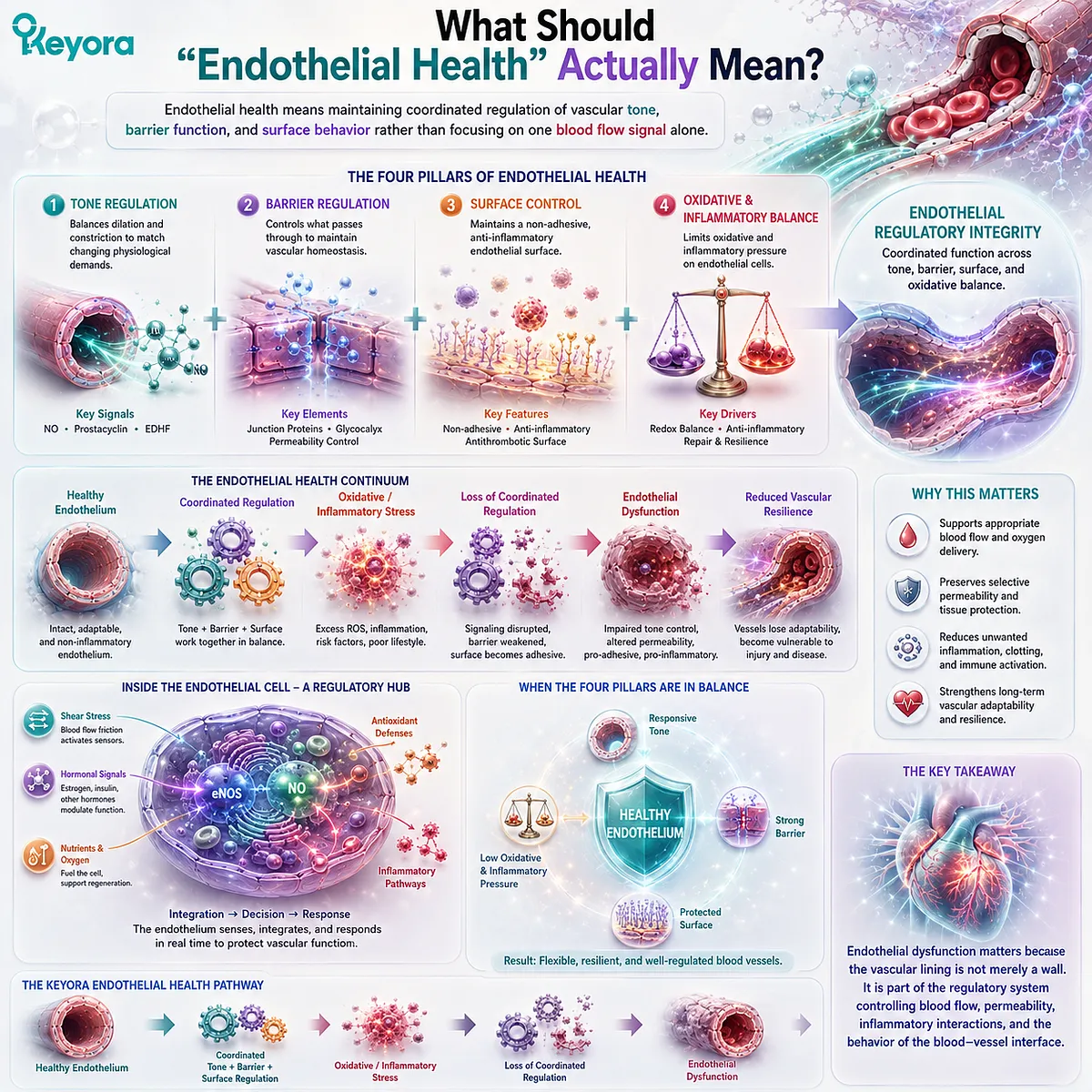
Endothelial health means maintaining coordinated regulation of vascular tone, barrier function, and surface behavior rather than focusing on one blood flow signal alone
EP-3 presents the endothelium as more than a thin vascular lining.
It is a regulatory interface controlling several dimensions of vascular behavior.
That makes endothelial health a multi-function concept.
Within the Keyora framework, it can be organized as:
Tone Regulation
Barrier Regulation
Surface Control
Oxidative and Inflammatory Balance
↓
Endothelial Regulatory Integrity
This is a Keyora explanatory framework, not a clinical diagnosis.
Its purpose is to summarize the functional architecture established throughout EP-3.
When these regulatory functions remain coordinated, the endothelium can continue supporting responsive vascular tone, selective barrier behavior, and a relatively non-adhesive surface.
When oxidative and inflammatory pressure interfere with that coordination, the vascular environment can move toward endothelial dysfunction.
This leads to the final Keyora pathway:
Healthy Endothelium
↓
Coordinated Tone + Barrier + Surface Regulation
↓
Oxidative / Inflammatory Stress
↓
Loss of Coordinated Regulation
↓
Endothelial Dysfunction
↓
Reduced Vascular Resilience
The central lesson is therefore simple:
Endothelial dysfunction matters because the vascular lining is not merely a wall.
It is part of the regulatory system controlling blood flow, permeability, inflammatory interactions, and the behavior of the blood – vessel interface.
Q022 establishes that integrated architecture.
The next question can now isolate one of its most important signaling components:
Why Is Nitric Oxide Important for Healthy Blood Flow?
This article is for educational and informational purposes only. It does not provide medical advice, diagnosis, treatment, cure, prevention, disease outcome claims, hormone restoration claims, fertility outcome claims, or formula-specific clinical efficacy claims.