
Why Can Blood Vessels Become Damaged Without Pain?
Keyora Research Q&A Library
This is part of the Keyora Research Q&A Series, derived from Keyora Astaxanthin Research Journal Series.
Within the Keyora Astaxanthin Researcn framework, this Q&A translates complex astaxanthin biology into reader-friendly, evidence-bound answers, focusing on natural astaxanthin identity, molecular structure, antioxidant and redox mechanisms, membrane lipid interaction, mitochondrial resilience, inflammatory signaling pathways, human evidence interpretation, and the scientific principles behind responsible supplementation.
First published by Keyora Research Journal: www.keyorahealth.com
Direct Answer
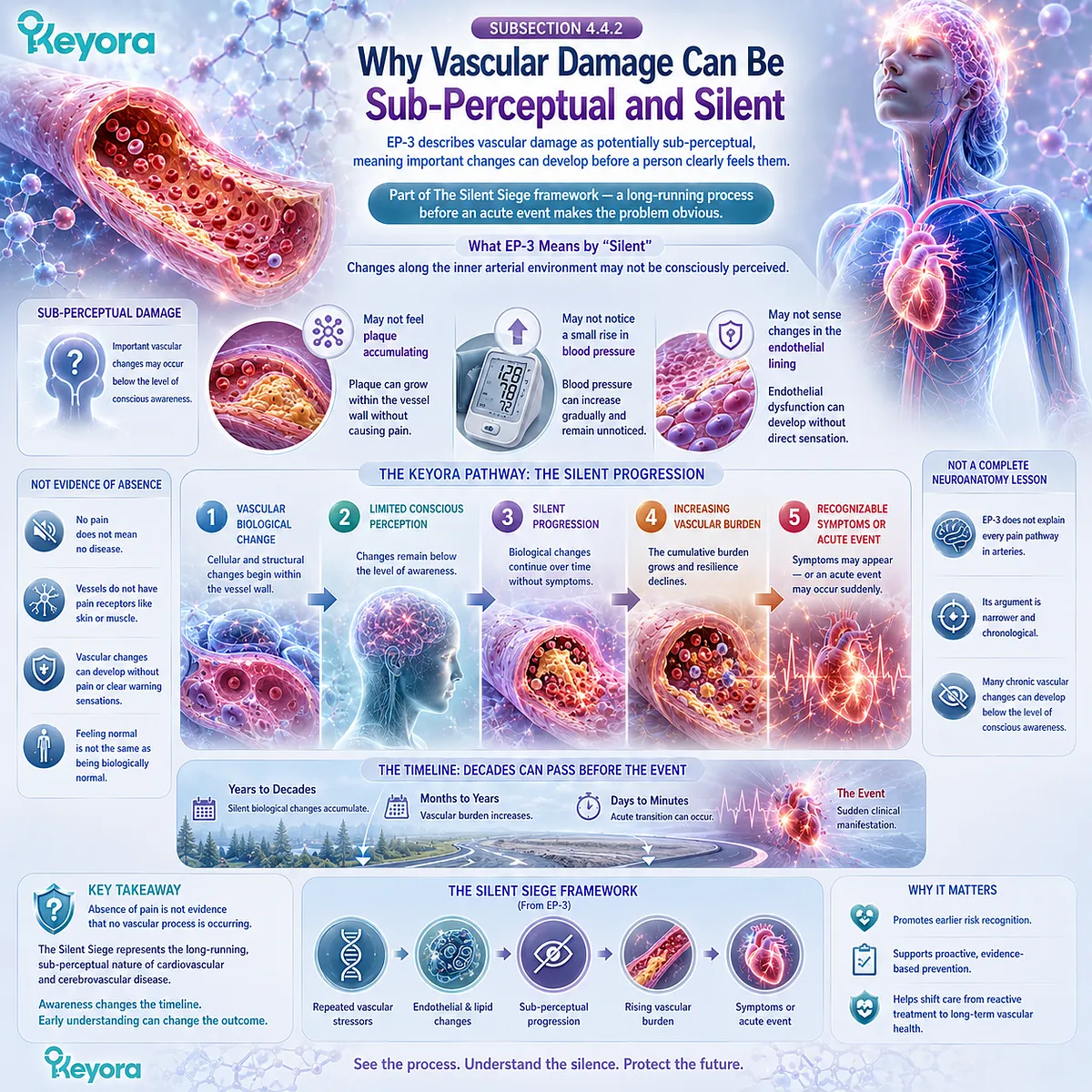
EP-3 describes vascular damage as potentially sub-perceptual, meaning important changes can develop before a person clearly feels them
Blood vessels can undergo meaningful biological changes without producing obvious pain or another clear warning sensation.
In Keyora Astaxanthin EP-3, this idea is part of the The Silent Siege framework – the concept that cardiovascular and cerebrovascular disease can develop as a long-running process before an acute event makes the underlying problem obvious.
EP-3 explains the “silent” character of this process by stating that changes occurring along the inner arterial environment may not be consciously perceived.
It specifically gives three examples: a person may not feel plaque accumulating, may not notice a small rise in blood pressure, and may not directly sense progressive changes in the endothelial lining.
The source describes this as sub-perceptual damage.
The central Keyora pathway is therefore:
Vascular biological change
↓
Limited conscious perception
↓
Silent progression
↓
Increasing vascular burden
↓
Recognizable symptoms or an acute event may appear later
The important distinction is that absence of pain is not evidence that no vascular process is occurring.
At the same time, EP-3 does not provide a complete neuroanatomical explanation of every pain pathway in arteries. Its argument is narrower: many chronic vascular changes can develop below the level of conscious awareness.
That is the idea Q021 is designed to explain.
Why Does EP-3 Call This Process “The Silent Siege”?
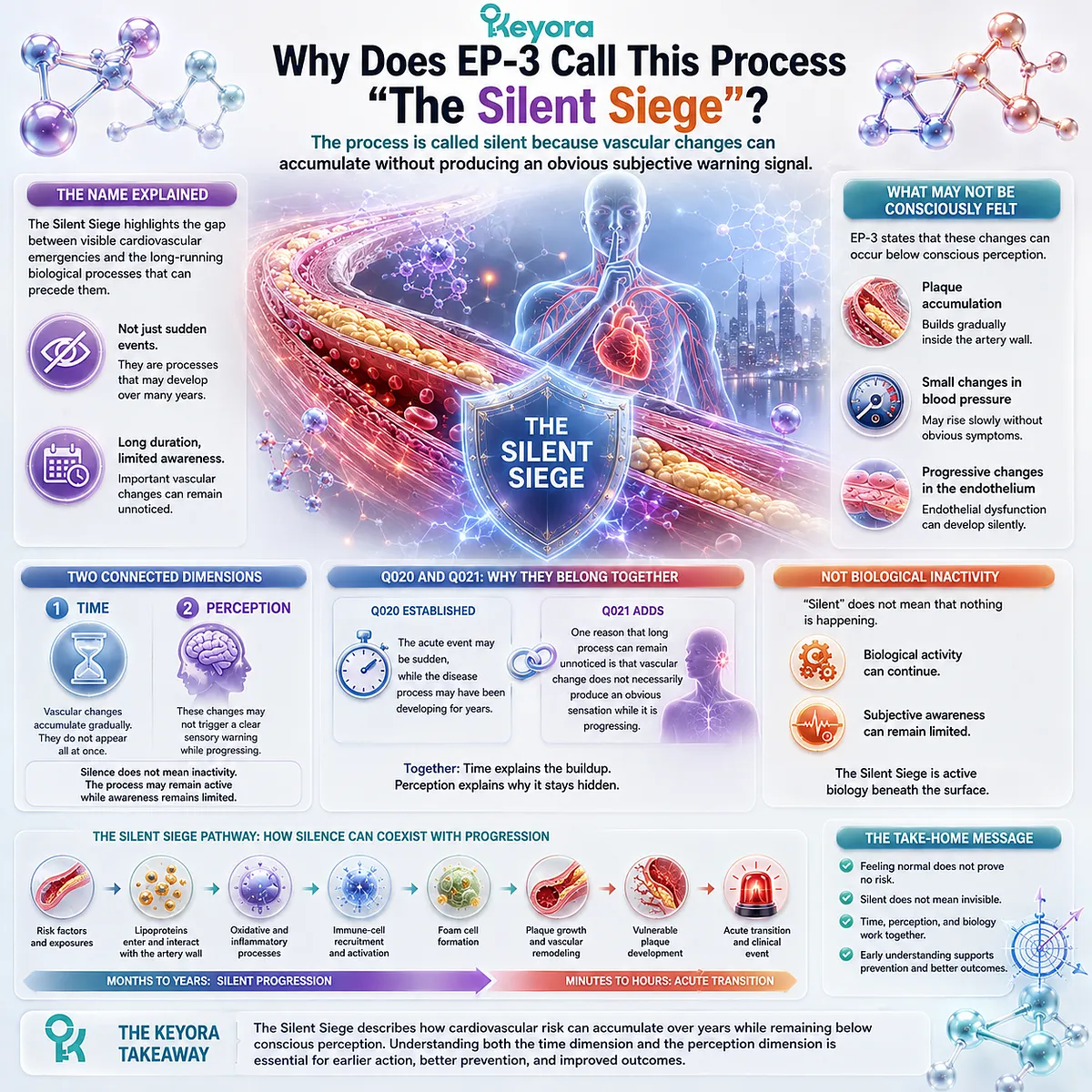
The process is called silent because vascular changes can accumulate without producing an obvious subjective warning signal
The phrase The Silent Siege appears near the beginning of EP-3 as a way to explain the difference between visible cardiovascular emergencies and the biological processes that may precede them.
The source argues that cardiovascular and cerebrovascular disease should not be viewed only as sudden events. Instead, it presents them as processes that may develop over many years while important vascular changes remain unnoticed.
The “silent” part of the framework refers to perception.
According to EP-3, a person may not consciously feel:
Plaque accumulation
Small changes in blood pressure
Progressive changes in the endothelial lining
The source explicitly describes these changes as occurring below conscious perception.
This gives The Silent Siege two connected dimensions.
The first is time.
Vascular changes may accumulate gradually rather than appearing all at once.
The second is perception.
The person experiencing those changes may not receive a clear sensory warning that matches the biological process.
This is why Q020 and Q021 belong next to each other.
Q020 established:
The acute event may be sudden, while the disease process may have been developing for years.
Q021 adds:
One reason that long process can remain unnoticed is that vascular change does not necessarily produce an obvious sensation while it is progressing.
Within EP-3, this silence is not presented as biological inactivity.
It is the opposite.
The process may remain active while subjective awareness remains limited.
What Vascular Changes Does EP-3 Describe as Sub-Perceptual?
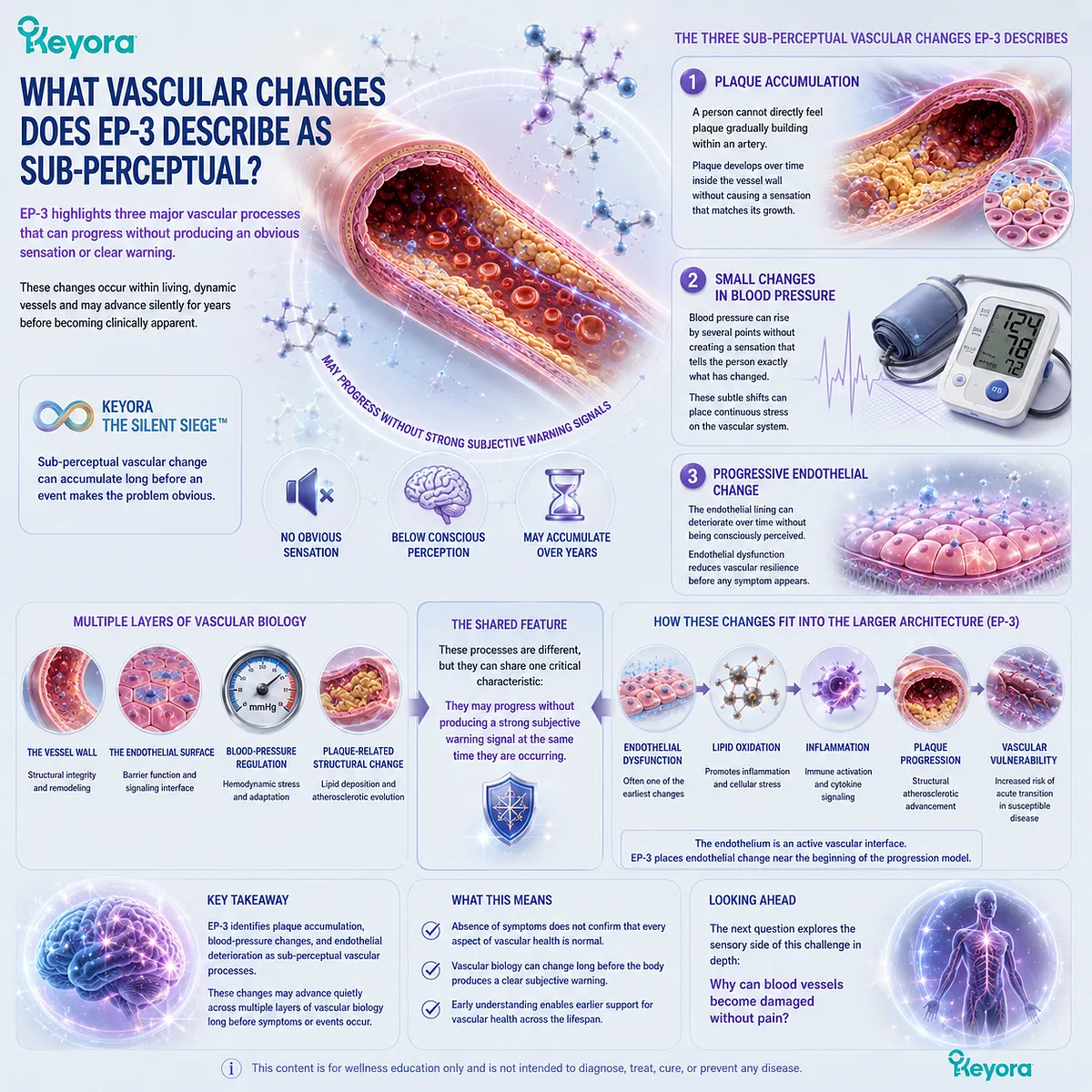
EP-3 focuses on plaque accumulation, blood-pressure changes, and endothelial deterioration as examples of vascular processes a person may not directly feel
EP-3 does not use “silent” as an abstract metaphor only. It gives specific examples.
The first is plaque accumulation.
The source states that a person cannot directly feel plaque gradually building within an artery.
The second is small changes in blood pressure.
EP-3 specifically uses the example of blood pressure rising by several points without creating a sensation that tells the person exactly what has changed.
The third is progressive endothelial change.
The source presents deterioration of the endothelial lining as another process that may occur without being consciously perceived.
These examples are important because they show that the Keyora concept of silent vascular progression is not based on one single mechanism.
It includes several layers of vascular biology:
The vessel wall
The endothelial surface
Blood-pressure regulation
Plaque-related structural change
The shared feature is not that these processes are identical.
The shared feature is that they may progress without producing a strong subjective warning signal at the same time they are occurring.
EP-3 later places endothelial dysfunction, lipid oxidation, inflammation, and plaque progression within its larger cardiovascular architecture. It describes the endothelium as an active vascular interface and positions endothelial change near the beginning of the progression model.
Q021 does not need to reproduce all of those mechanisms.
Its narrower purpose is to explain why a person may remain unaware while those processes are developing.
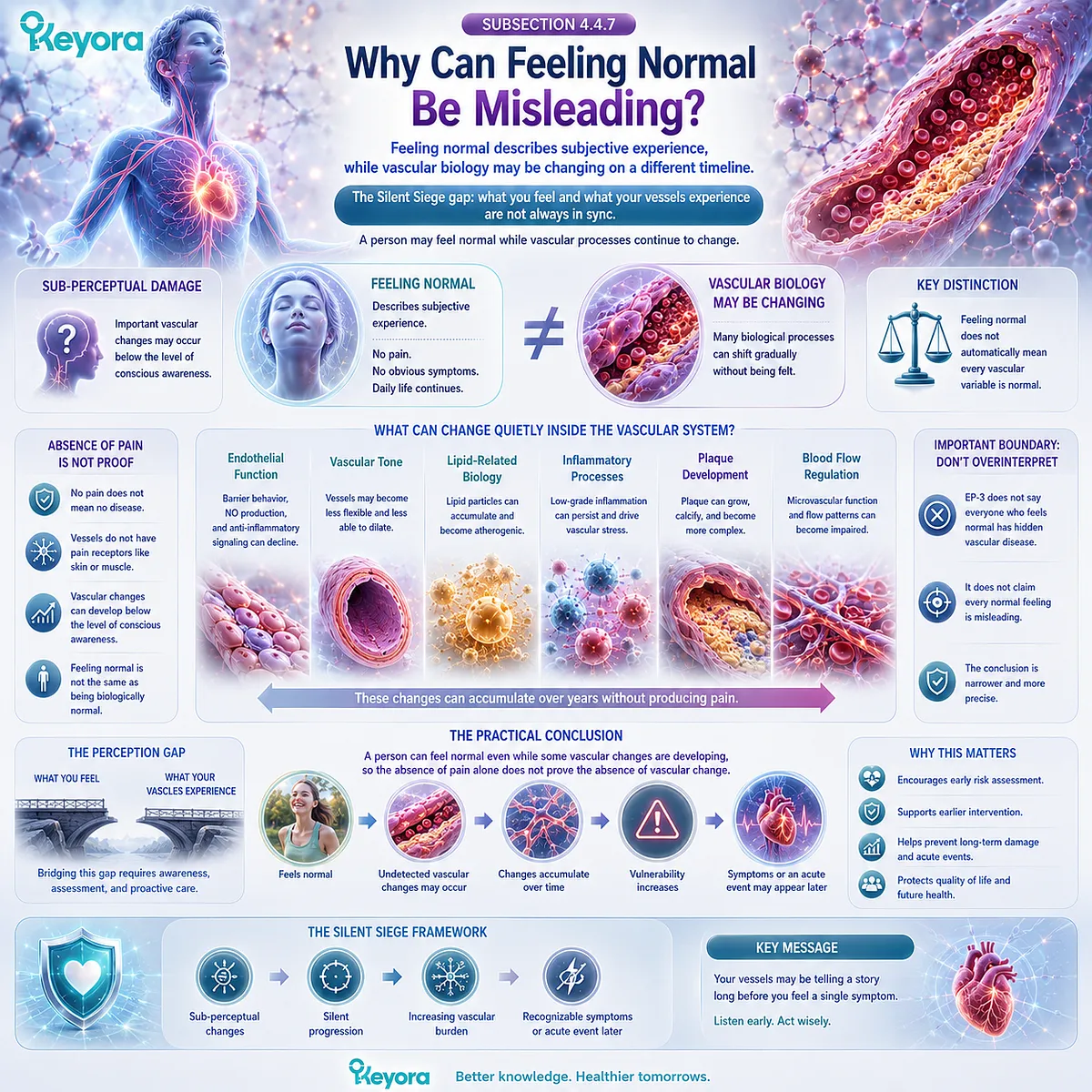
Why Can Feeling Normal Be Misleading?
Feeling normal describes subjective experience, while vascular biology may be changing on a different timeline
One of the most important conclusions from EP-3 is that subjective experience and vascular biology do not necessarily move together.
A person may feel normal while vascular processes described in the source continue to change.
That is why EP-3 characterizes the damage as sub-perceptual. The source does not say the biology is absent. It says the person may not consciously detect it.
This creates a simple but important distinction:
Feeling normal
does not automatically mean
every vascular variable is normal
Within the EP-3 framework, cardiovascular health involves more than one visible symptom.
The source describes a vascular system involving endothelial function, vascular tone, lipid-related biology, inflammatory processes, plaque development, and blood-flow regulation.
Many of these processes can change gradually.
The absence of pain therefore cannot serve as a complete real-time report of the state of the vascular system.
However, this point also needs a boundary.
EP-3 does not support the opposite claim that every person who feels normal must have hidden vascular disease.
That would go beyond the source.
The supported conclusion is narrower:
A person can feel normal even while some vascular changes are developing, so the absence of pain alone does not prove the absence of vascular change.
This is the practical meaning of the perception gap in The Silent Siege framework.
The body may not provide a precise sensation for every incremental change occurring inside the vascular system.
That is why a long disease process can remain unnoticed until a later stage becomes more obvious.
When Does the Silent Process Become Noticeable?
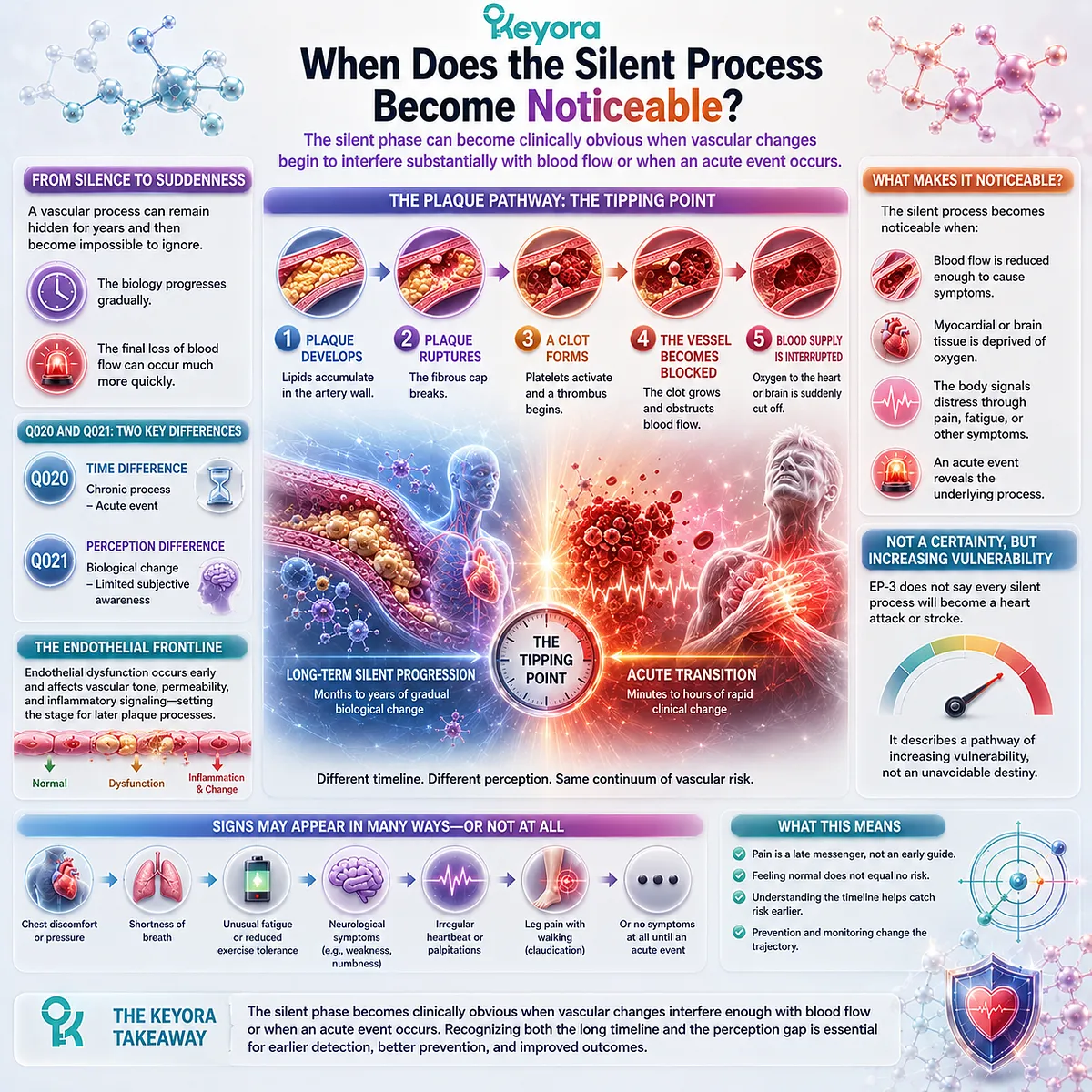
The silent phase can become clinically obvious when vascular changes begin to interfere substantially with blood flow or when an acute event occurs
EP-3 presents a clear transition from long-term silent progression to an acute cardiovascular event.
Its plaque pathway describes gradual plaque development followed by a more abrupt change:
Plaque develops
↓
Plaque ruptures
↓
A clot forms
↓
The vessel becomes blocked
↓
Blood supply is interrupted
This sequence explains why a vascular process can remain largely unnoticed for years and then suddenly become impossible to ignore.
The underlying biology may have been progressing gradually.
The final loss of blood flow can occur much more quickly.
That is the connection between Q020 and Q021.
Q020 explained the time difference:
chronic process – acute event
Q021 explains the perception difference:
biological change – limited subjective awareness
The source also connects endothelial dysfunction with changes in vascular tone and later plaque-related processes, placing the endothelial layer near the front of the progression model.
But EP-3 does not say that every silent vascular process must eventually become a heart attack or stroke.
It presents a pathway of increasing vulnerability.
The correct conclusion is therefore:
Silent progression can become noticeable when vascular function is affected enough to produce recognizable symptoms or when an acute vascular event reveals the previously developing process.
That is very different from saying that pain should have been present throughout the earlier stages.
What Does “Without Pain” Actually Mean in the Keyora Framework?
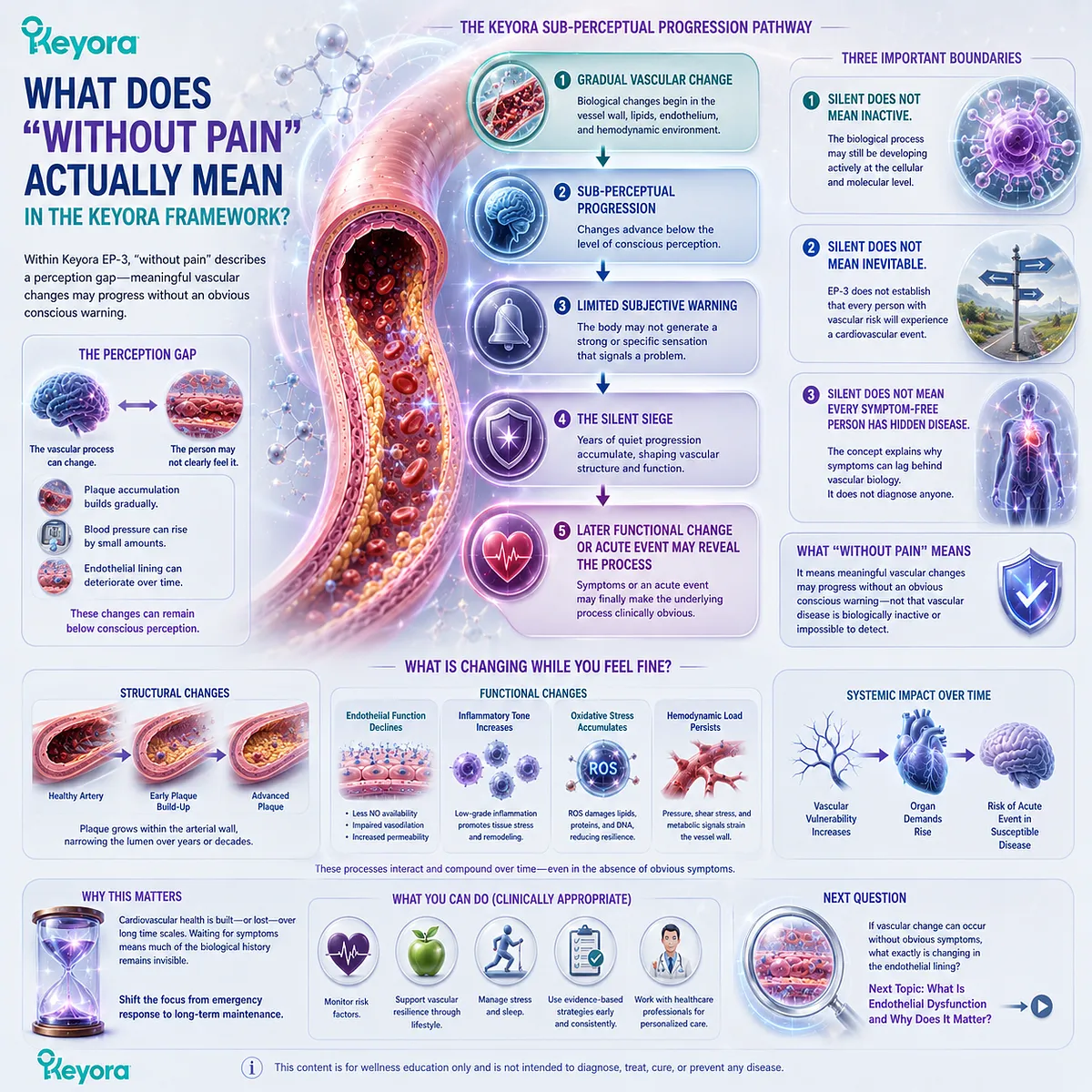
It means meaningful vascular changes may progress without an obvious conscious warning, not that vascular disease is biologically inactive or impossible to detect
Within Keyora EP-3, “without pain” is best understood as part of a broader perception gap.
The vascular process can change.
The person may not clearly feel it.
The source summarizes this idea through plaque accumulation, modest blood-pressure changes, and endothelial deterioration that can remain below conscious perception.
The final Keyora pathway is:
Gradual Vascular Change
↓
Sub-Perceptual Progression
↓
Limited Subjective Warning
↓
The Silent Siege
↓
Later Functional Change or Acute Event May Reveal the Process
Three boundaries are important.
Silent does not mean inactive.
The biological process may still be developing.
Silent does not mean inevitable.
EP-3 does not establish that every person with vascular risk will experience a cardiovascular event.
Silent does not mean every symptom-free person has hidden disease.
The concept explains why symptoms can lag behind vascular biology. It does not diagnose anyone.
This is why Q021 matters inside the larger EP-3 knowledge architecture.
The last question established that cardiovascular disease can develop over time before an event appears sudden.
This question now explains why a person may not clearly feel that progression.
The next question moves one layer deeper.
If vascular change can occur without obvious symptoms, what exactly is changing in the endothelial lining?
That leads to the next topic:
What Is Endothelial Dysfunction and Why Does It Matter?
This article is for educational and informational purposes only. It does not provide medical advice, diagnosis, treatment, cure, prevention, disease outcome claims, hormone restoration claims, fertility outcome claims, or formula-specific clinical efficacy claims.