
How Should You Take Astaxanthin for Better Absorption?
Keyora Research Q&A Library
This is part of the Keyora Research Q&A Series, derived from Keyora Astaxanthin Research Journal Series.
Within the Keyora Astaxanthin Researcn framework, this Q&A translates complex astaxanthin biology into reader-friendly, evidence-bound answers, focusing on natural astaxanthin identity, molecular structure, antioxidant and redox mechanisms, membrane lipid interaction, mitochondrial resilience, inflammatory signaling pathways, human evidence interpretation, and the scientific principles behind responsible supplementation.
First published by Keyora Research Journal: www.keyorahealth.com
How Should You Take Astaxanthin for Better Absorption?
Why taking astaxanthin with a meal may matter—and what dietary fat has to do with it.
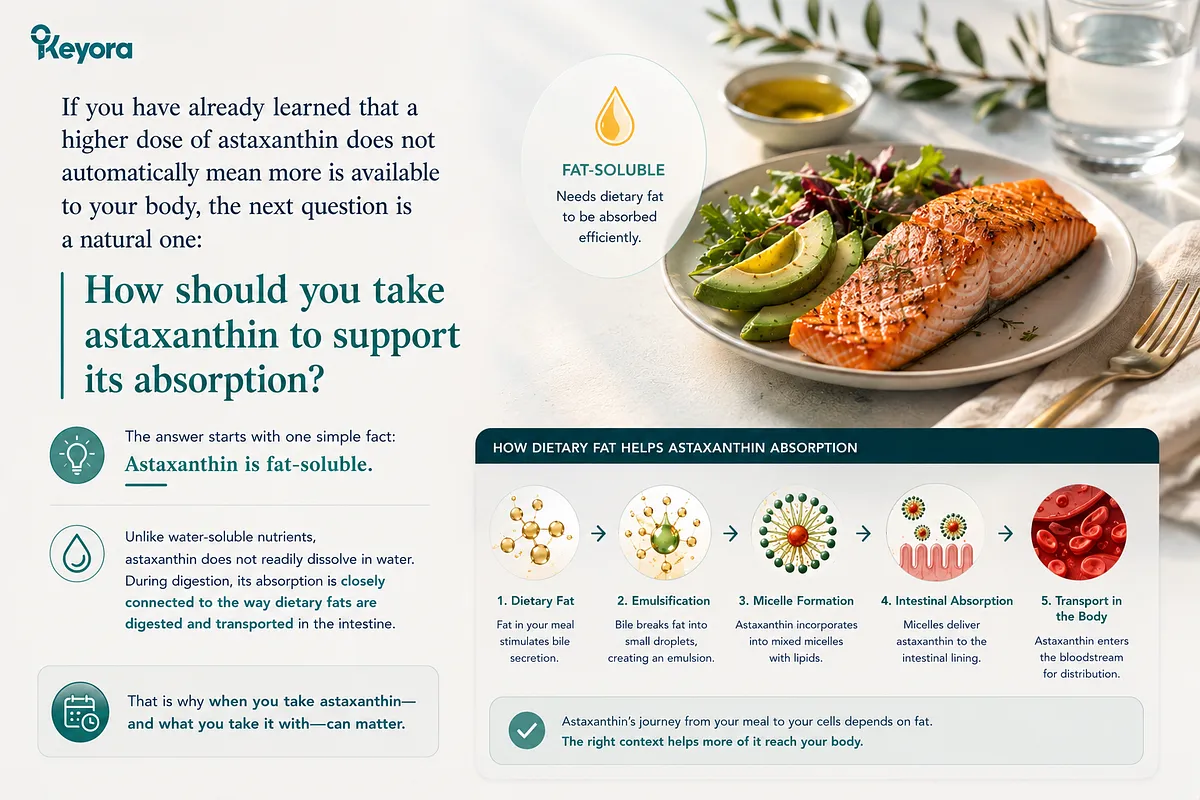
If you have already learned that a higher dose of astaxanthin does not automatically mean more is available to your body, the next question is a natural one:
How should you take astaxanthin to support its absorption?
The answer starts with one simple fact:
Astaxanthin is fat-soluble.
Unlike water-soluble nutrients, astaxanthin does not readily dissolve in water. During digestion, its absorption is closely connected to the way dietary fats are digested and transported in the intestine.
That is why when you take astaxanthin—and what you take it with—can matter.
1. Why Is Astaxanthin Better Taken With a Meal?
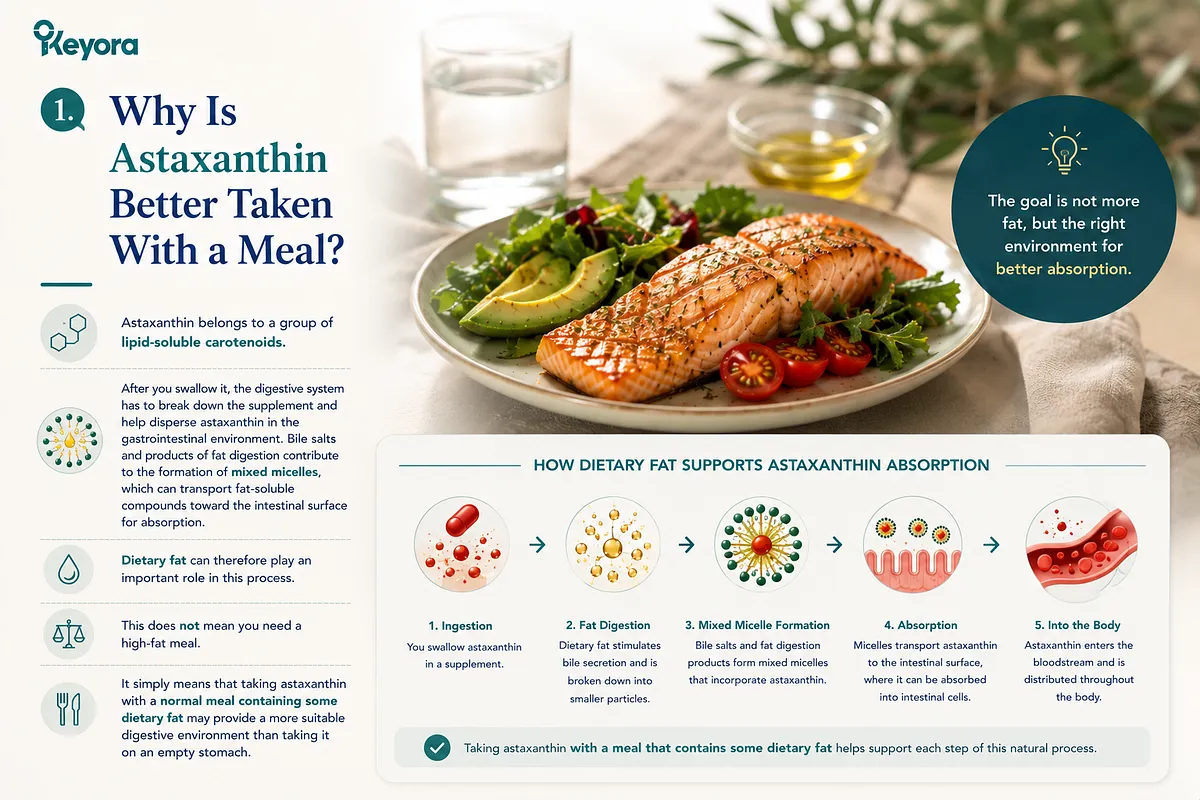
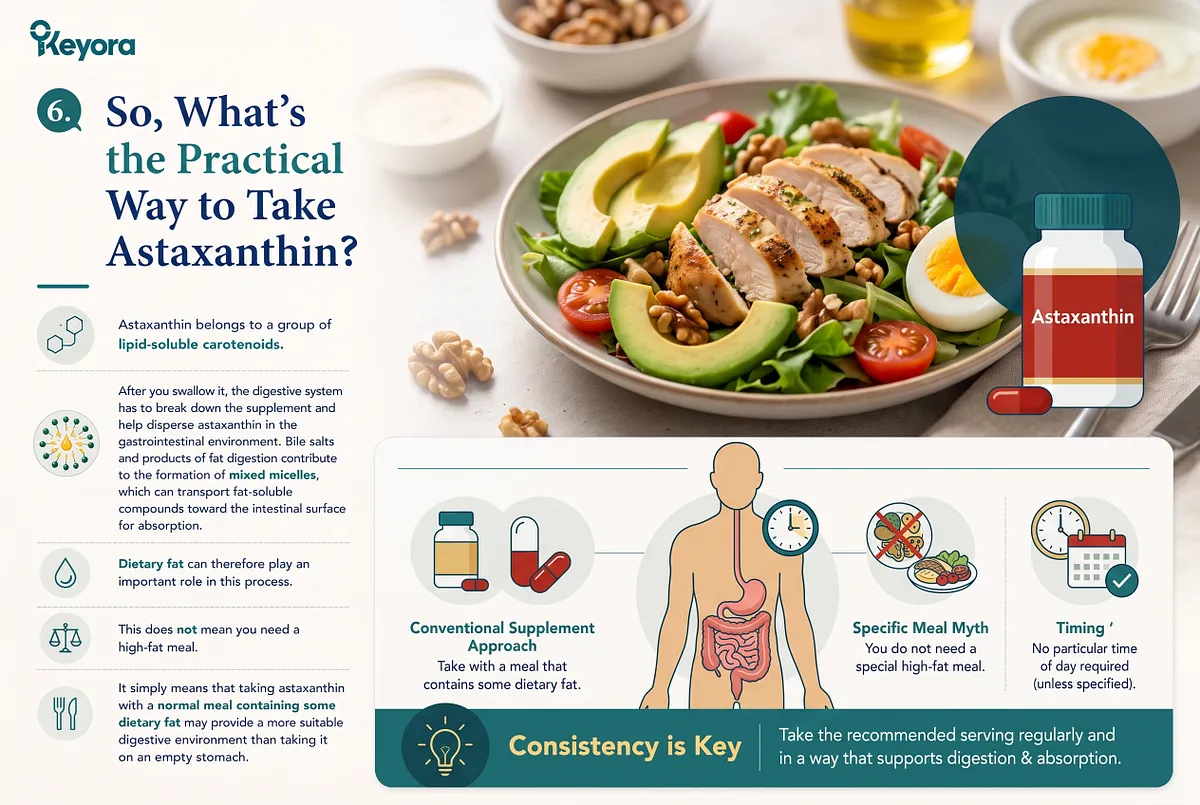
Astaxanthin belongs to a group of lipid-soluble carotenoids.
After you swallow it, the digestive system has to break down the supplement and help disperse astaxanthin in the gastrointestinal environment. Bile salts and products of fat digestion contribute to the formation of mixed micelles, which can transport fat-soluble compounds toward the intestinal surface for absorption.
Dietary fat can therefore play an important role in this process.
This does not mean you need a high-fat meal.
It simply means that taking astaxanthin with a normal meal containing some dietary fat may provide a more suitable digestive environment than taking it on an empty stomach.
2. Does Taking Astaxanthin With Food Actually Make a Difference?
Human research suggests that it can.
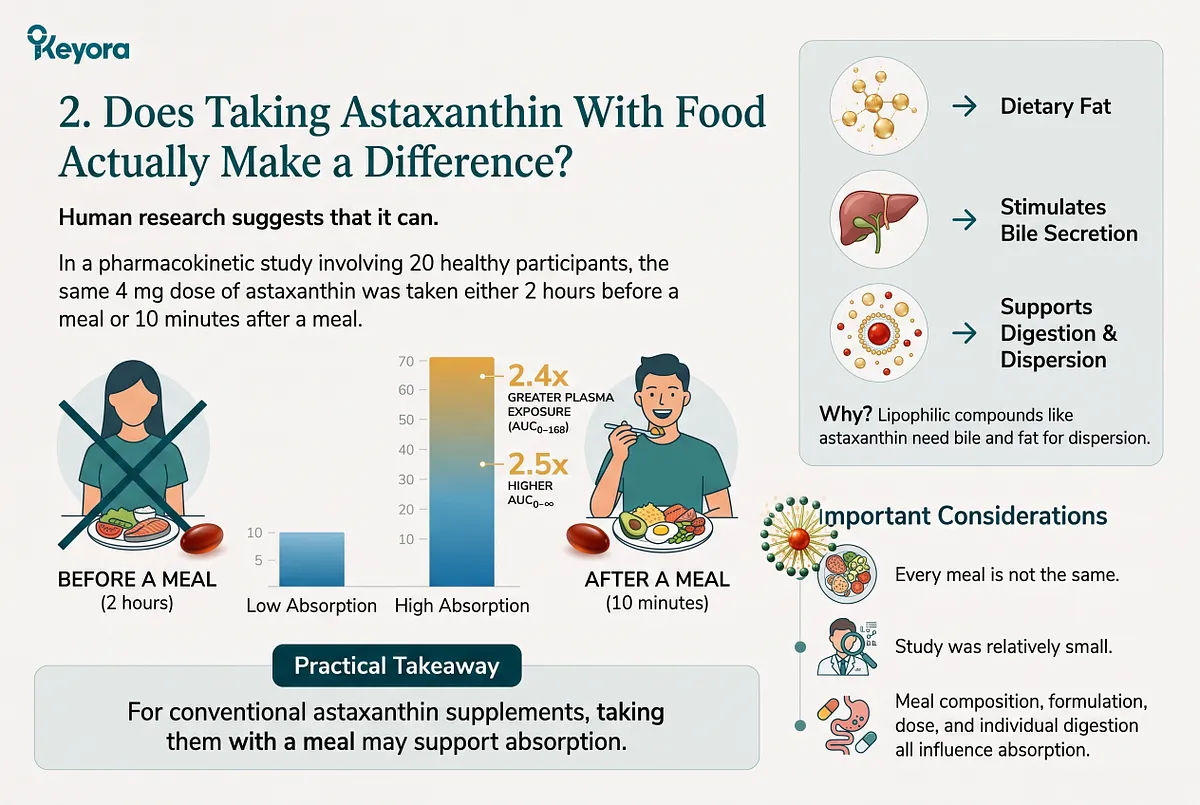
In a pharmacokinetic study involving 20 healthy participants, the same 4 mg dose of astaxanthin was taken either 2 hours before a meal or 10 minutes after a meal.
The researchers found that the post-meal group had approximately 2.4 times greater total plasma exposure (AUC₀–₁₆₈) than the group that took astaxanthin before the meal. The AUC₀–∞ was also approximately 2.5 times higher after the meal.
Why might this happen?
The presence of food—particularly dietary fat—can stimulate bile secretion and support the digestion and dispersion of lipophilic compounds such as astaxanthin.
So the practical takeaway is fairly simple:
For conventional astaxanthin supplements, taking them with a meal may support absorption.
However, this does not mean that every meal will produce exactly the same result. The study was relatively small, and factors such as the meal composition, formulation, dose, and individual digestion can all influence absorption.
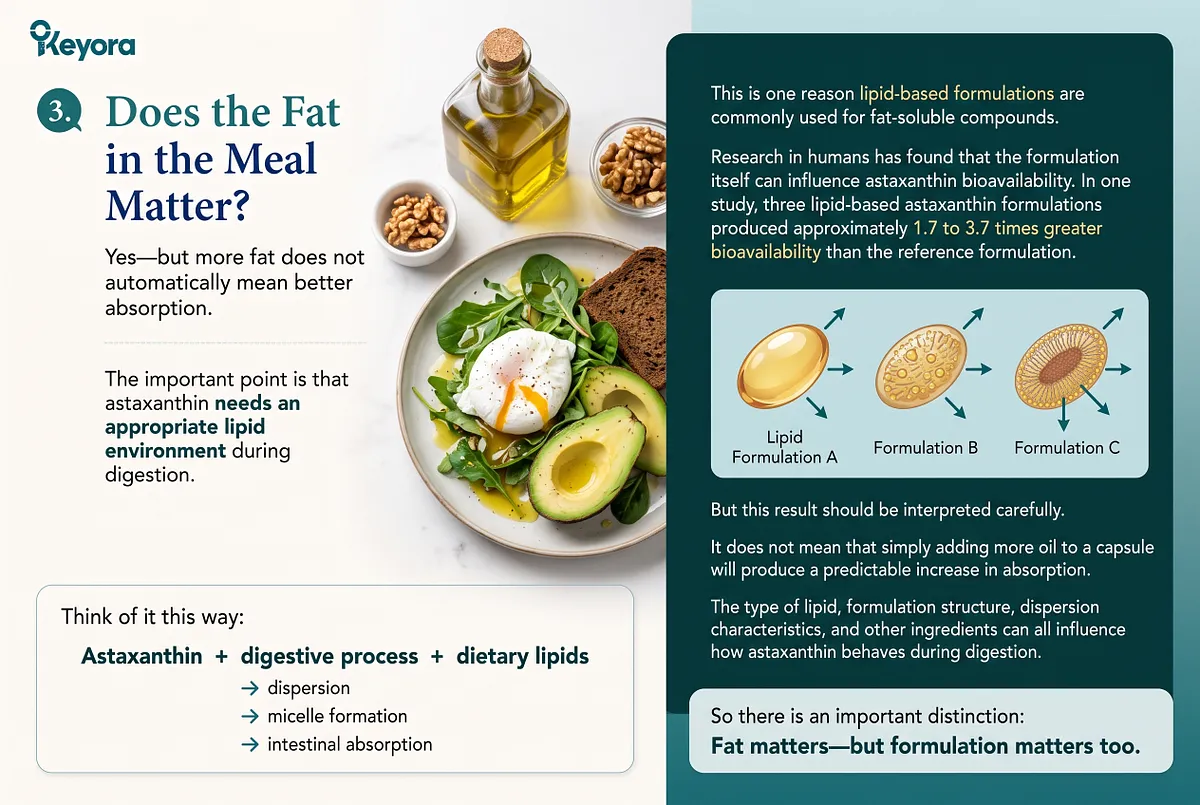
3. Does the Fat in the Meal Matter?
Yes—but more fat does not automatically mean better absorption.
The important point is that astaxanthin needs an appropriate lipid environment during digestion.
Think of it this way:
Astaxanthin + digestive process + dietary lipids
→ dispersion
→ micelle formation
→ intestinal absorption
This is one reason lipid-based formulations are commonly used for fat-soluble compounds.
Research in humans has found that the formulation itself can influence astaxanthin bioavailability. In one study, three lipid-based astaxanthin formulations produced approximately 1.7 to 3.7 times greater bioavailability than the reference formulation.
But this result should be interpreted carefully.
It does not mean that simply adding more oil to a capsule will produce a predictable increase in absorption.
The type of lipid, formulation structure, dispersion characteristics, and other ingredients can all influence how astaxanthin behaves during digestion.
So there is an important distinction:
Fat matters—but formulation matters too.
4. Do You Need to Eat a High-Fat Meal?
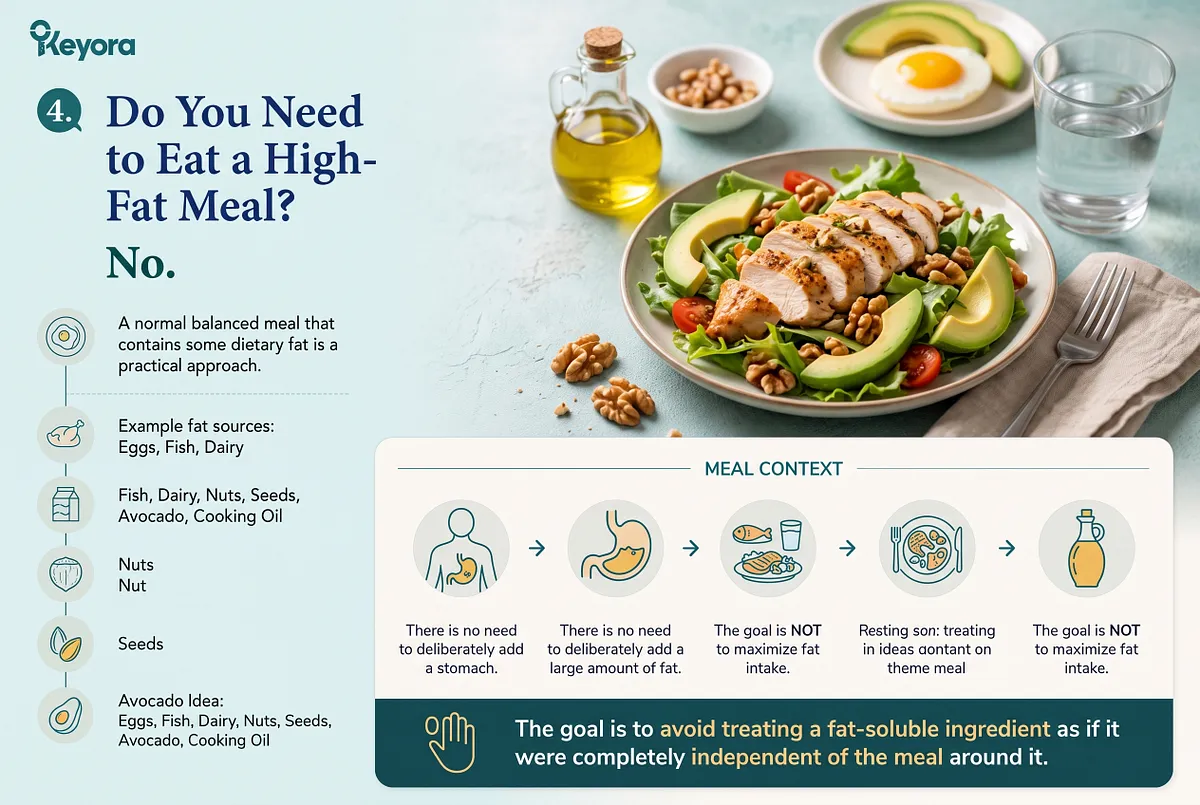
No.
There is no need to deliberately add a large amount of fat to your diet simply because you are taking astaxanthin.
A normal balanced meal that contains some dietary fat is a practical approach.
For example, a meal containing foods such as eggs, fish, dairy, nuts, seeds, avocado, or a small amount of cooking oil naturally provides dietary fat.
The goal is not to maximize fat intake.
The goal is to avoid treating a fat-soluble ingredient as if it were completely independent of the meal around it.
5. What If the Supplement Already Contains Oil?
This is where the formulation becomes interesting.
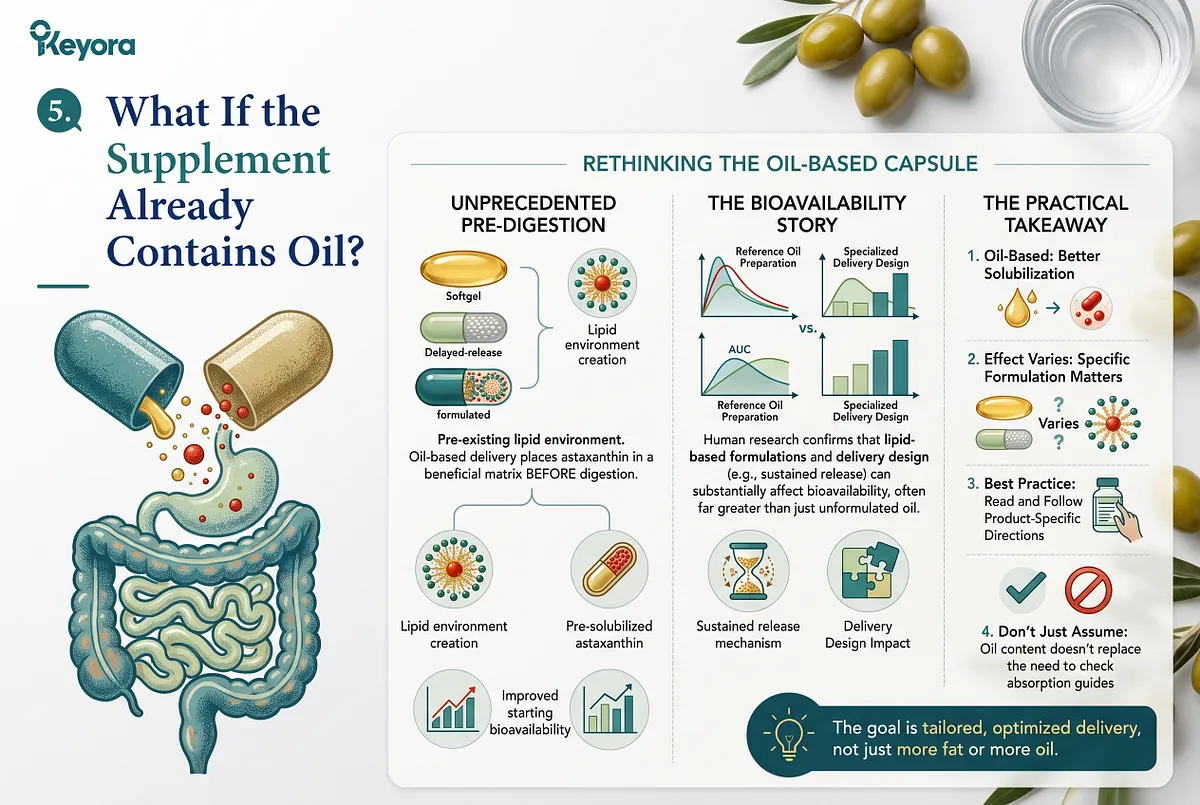
Many astaxanthin supplements use an oil-based delivery system, particularly softgel capsules.
An oil-based formulation can place astaxanthin in a lipid environment before it even reaches the digestive tract. Human research has shown that lipid-based formulations can substantially affect astaxanthin bioavailability compared with a reference formulation.
However, an oil-based capsule does not necessarily mean that the supplement no longer needs to be taken with food.
The effect depends on the specific formulation, and research on specialized delivery systems is still developing. For example, a human study of a sustained-release formulation found higher bioavailability than an unformulated astaxanthin oil preparation, showing that delivery design can influence absorption beyond simply adding oil.
For this reason, it is better to follow the product’s own directions rather than assuming that every formulation behaves in exactly the same way.
6. So, What’s the Practical Way to Take Astaxanthin?
For a conventional astaxanthin supplement, a simple approach is:
Take it with a meal that contains some dietary fat.
You do not need a special high-fat meal.
And you do not need to take it at a particular time of day unless the product instructions specify otherwise.
The more important principle is consistency:
Take the recommended serving regularly and take it in a way that supports its digestion and absorption.
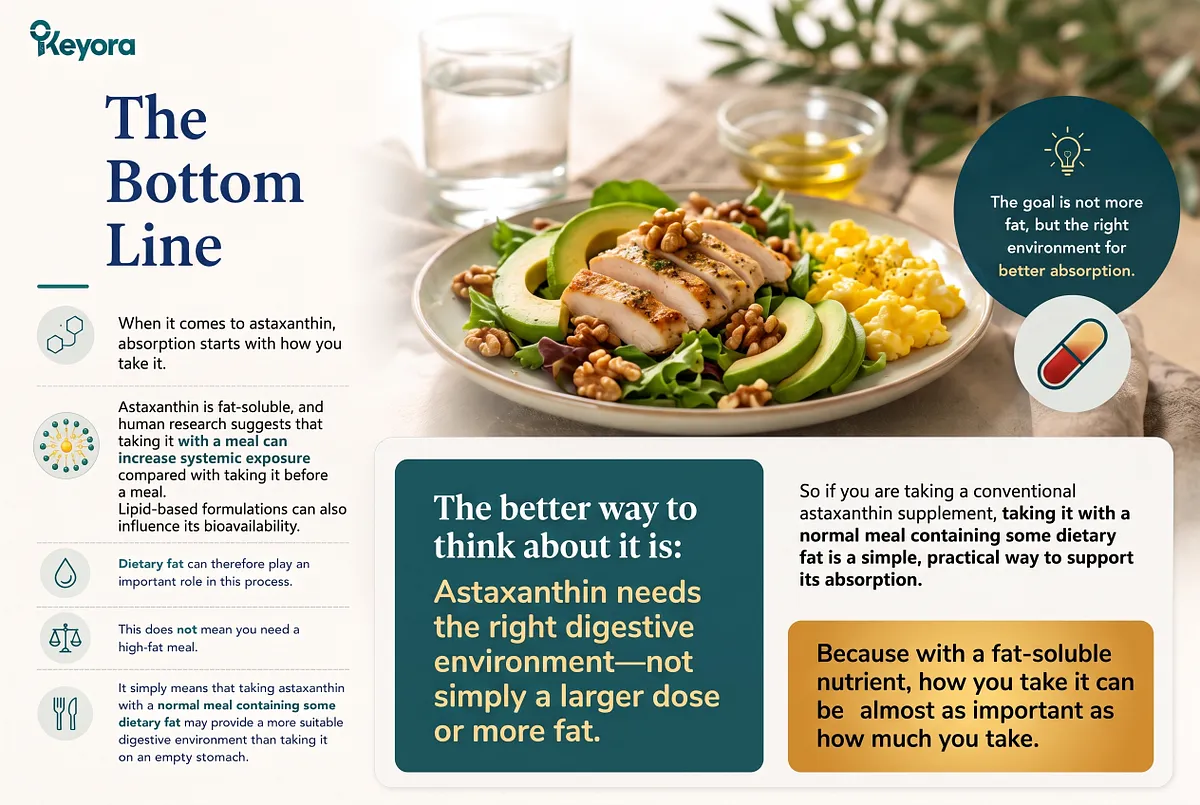
The Bottom Line
When it comes to astaxanthin, absorption starts with how you take it.
Astaxanthin is fat-soluble, and human research suggests that taking it with a meal can increase systemic exposure compared with taking it before a meal. Lipid-based formulations can also influence its bioavailability.
The better way to think about it is:
Astaxanthin needs the right digestive environment—not simply a larger dose or more fat.
So if you are taking a conventional astaxanthin supplement, taking it with a normal meal containing some dietary fat is a simple, practical way to support its absorption.
Because with a fat-soluble nutrient, how you take it can be almost as important as how much you take.
References
Ø Odeberg JM, et al. Oral bioavailability of the antioxidant astaxanthin in humans is enhanced by incorporation of lipid based formulations. European Journal of Pharmaceutical Sciences. 2003;19(4):299–304.
Ø Okada Y, et al. Human pharmacokinetic research examining astaxanthin intake before and after a meal; data summarized in reviews of oral astaxanthin bioavailability.
Ø A Study on the Bioavailability of a Proprietary, Sustained-release Formulation of Astaxanthin. Journal of Clinical Pharmacology.