
Is More Astaxanthin Always Better? What Really Matters When You Take It
Keyora Research Q&A Library
This is part of the Keyora Research Q&A Series, derived from Keyora Astaxanthin Research Journal Series.
Within the Keyora Astaxanthin Researcn framework, this Q&A translates complex astaxanthin biology into reader-friendly, evidence-bound answers, focusing on natural astaxanthin identity, molecular structure, antioxidant and redox mechanisms, membrane lipid interaction, mitochondrial resilience, inflammatory signaling pathways, human evidence interpretation, and the scientific principles behind responsible supplementation.
First published by Keyora Research Journal: www.keyorahealth.com
Is More Astaxanthin Always Better? What Really Matters When You Take It
Why the amount of astaxanthin you take is only part of the story—and why absorption matters.
If you are comparing astaxanthin supplements, one of the first things you may notice is the number on the label.
4 mg. 8 mg. 12 mg. 16 mg.
It is easy to assume that a higher number automatically means a better product or a greater benefit.
But there is an important step between taking astaxanthin and making it available to your body:
Absorption.
Astaxanthin is a fat-soluble carotenoid. That means the amount you consume is not necessarily the same as the amount your body absorbs.
So when comparing astaxanthin supplements, the better question is not simply:
“How many milligrams am I taking?”
It is also:
“How well can my body absorb it?”
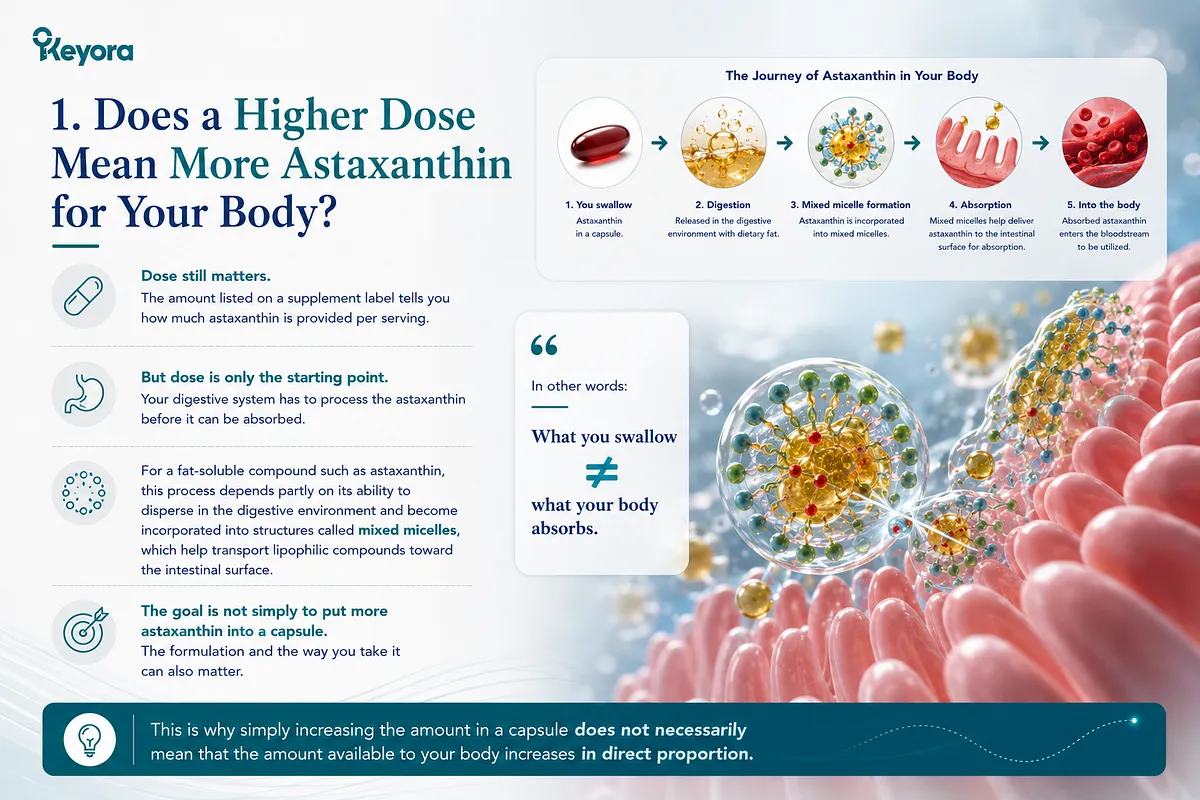
1. Does a Higher Dose Mean More Astaxanthin for Your Body?
Dose still matters. The amount listed on a supplement label tells you how much astaxanthin is provided per serving.
But dose is only the starting point.
Your digestive system has to process the astaxanthin before it can be absorbed. For a fat-soluble compound such as astaxanthin, this process depends partly on its ability to disperse in the digestive environment and become incorporated into structures called mixed micelles, which help transport lipophilic compounds toward the intestinal surface.
In other words:
What you swallow ≠ what your body absorbs.
This is why simply increasing the amount in a capsule does not necessarily mean that the amount available to your body increases in direct proportion.
The goal is not simply to put more astaxanthin into a capsule. The formulation and the way you take it can also matter.
2. Why Does Fat Matter for Astaxanthin Absorption?
Here is where astaxanthin is different from water-soluble nutrients.
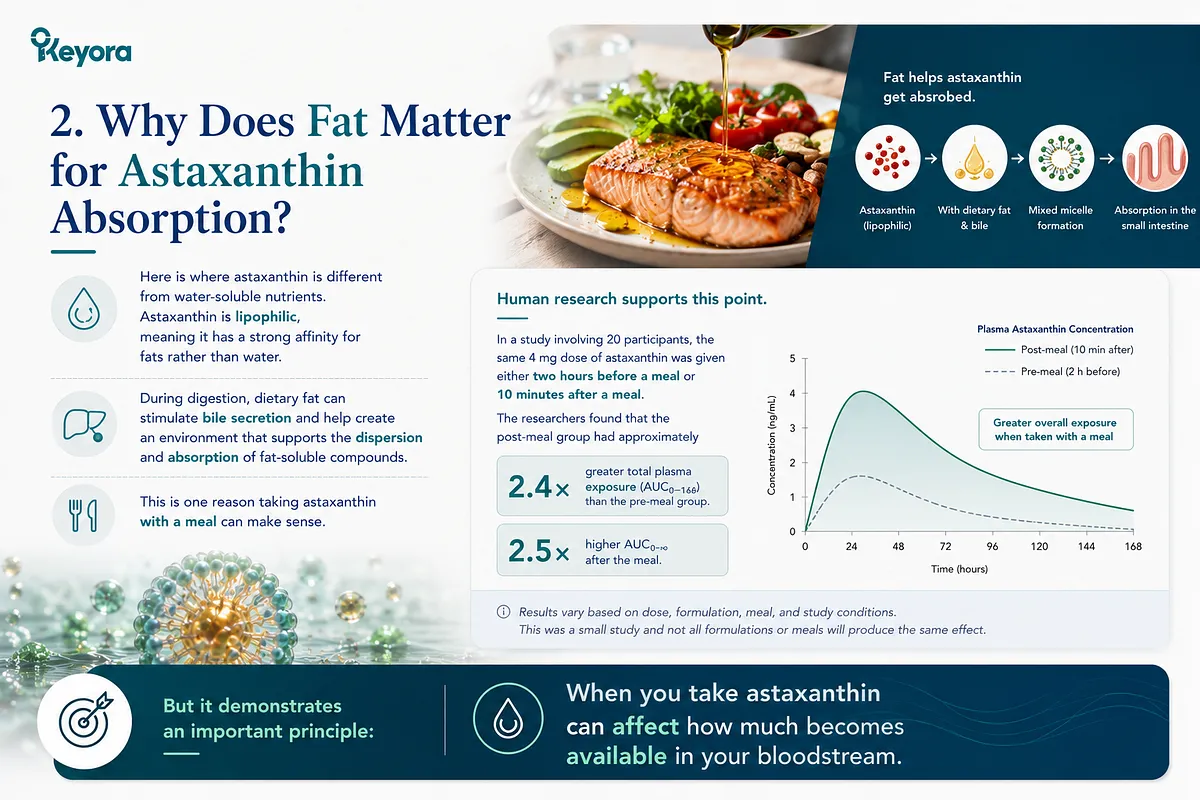
Astaxanthin is lipophilic, meaning it has a strong affinity for fats rather than water. During digestion, dietary fat can stimulate bile secretion and help create an environment that supports the dispersion and absorption of fat-soluble compounds.
This is one reason taking astaxanthin with a meal can make sense.
Human research supports this point.
In a study involving 20 participants, the same 4 mg dose of astaxanthin was given either two hours before a meal or 10 minutes after a meal. The researchers found that the post-meal group had approximately 2.4 times greater total plasma exposure (AUC₀–₁₆₈) than the pre-meal group. The AUC₀–∞ was approximately 2.5 times higher after the meal.
This does not mean that every meal or every formulation will produce exactly a 2.4-fold difference. The study was relatively small, and the result depends on the specific dose, formulation, meal, and study conditions.
But it demonstrates an important principle:
When you take astaxanthin can affect how much becomes available in your bloodstream.
3. Is Any Oil Good Enough?
Not necessarily.
It is tempting to simplify the science to:
“Astaxanthin is fat-soluble, so just add oil.”
The reality is more nuanced.
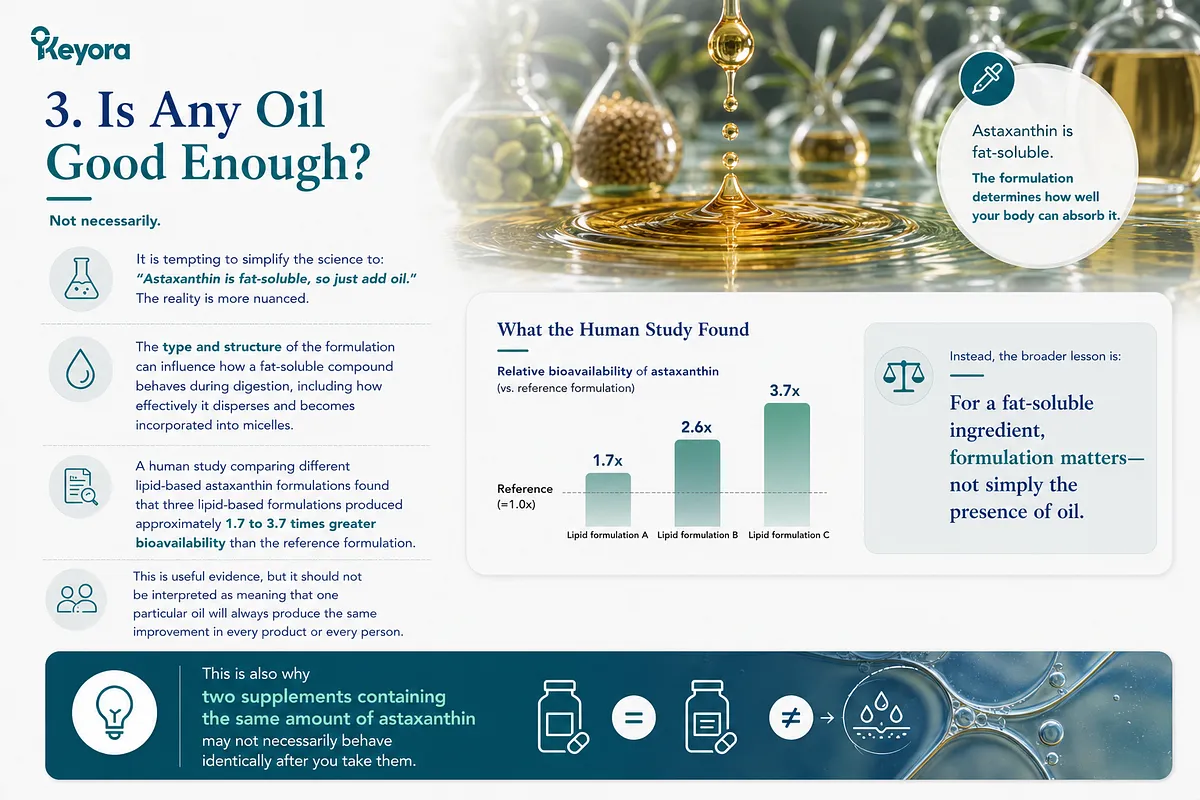
The type and structure of the formulation can influence how a fat-soluble compound behaves during digestion, including how effectively it disperses and becomes incorporated into micelles.
A human study comparing different lipid-based astaxanthin formulations found that three lipid-based formulations produced approximately 1.7 to 3.7 times greater bioavailability than the reference formulation.
This is useful evidence, but it should not be interpreted as meaning that one particular oil will always produce the same improvement in every product or every person.
Instead, the broader lesson is:
For a fat-soluble ingredient, formulation matters—not simply the presence of oil.
This is also why two supplements containing the same amount of astaxanthin may not necessarily behave identically after you take them.
4. So, How Should You Take Astaxanthin?
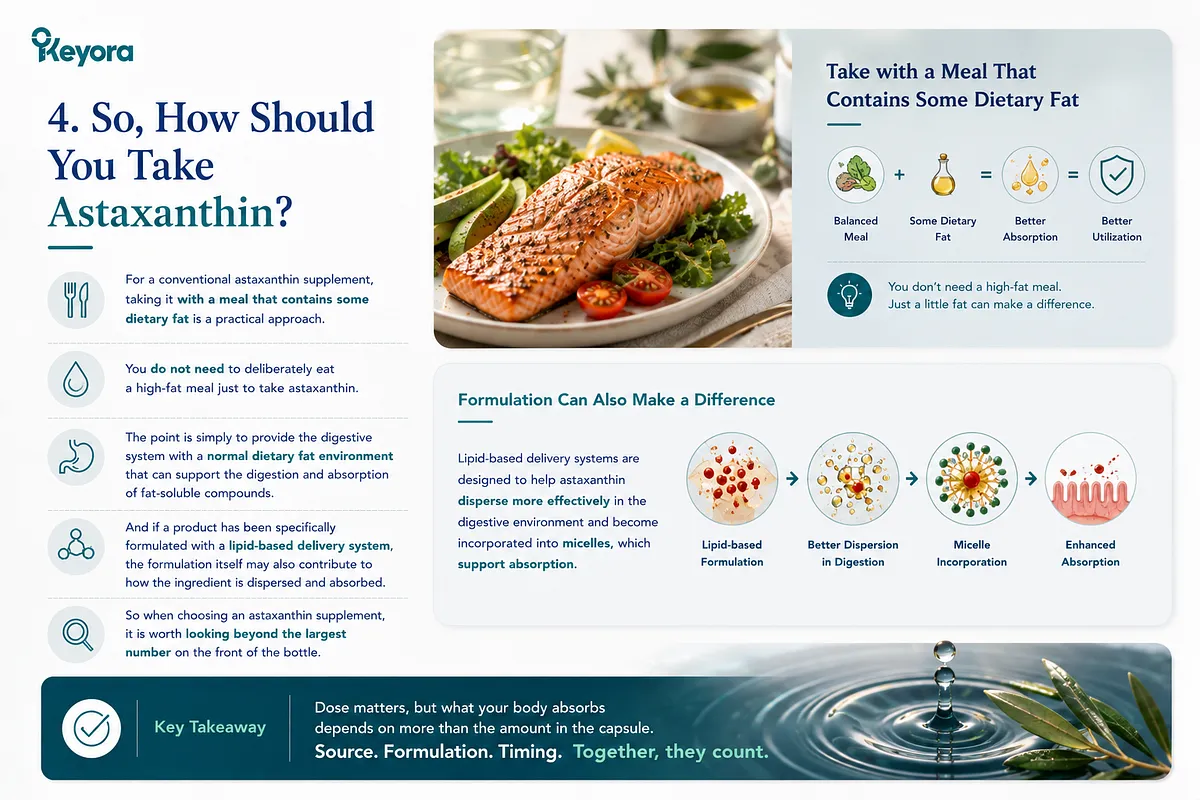
For a conventional astaxanthin supplement, taking it with a meal that contains some dietary fat is a practical approach.
You do not need to deliberately eat a high-fat meal just to take astaxanthin.
The point is simply to provide the digestive system with a normal dietary fat environment that can support the digestion and absorption of fat-soluble compounds.
And if a product has been specifically formulated with a lipid-based delivery system, the formulation itself may also contribute to how the ingredient is dispersed and absorbed.
So when choosing an astaxanthin supplement, it is worth looking beyond the largest number on the front of the bottle.
5. What Should You Really Look At?
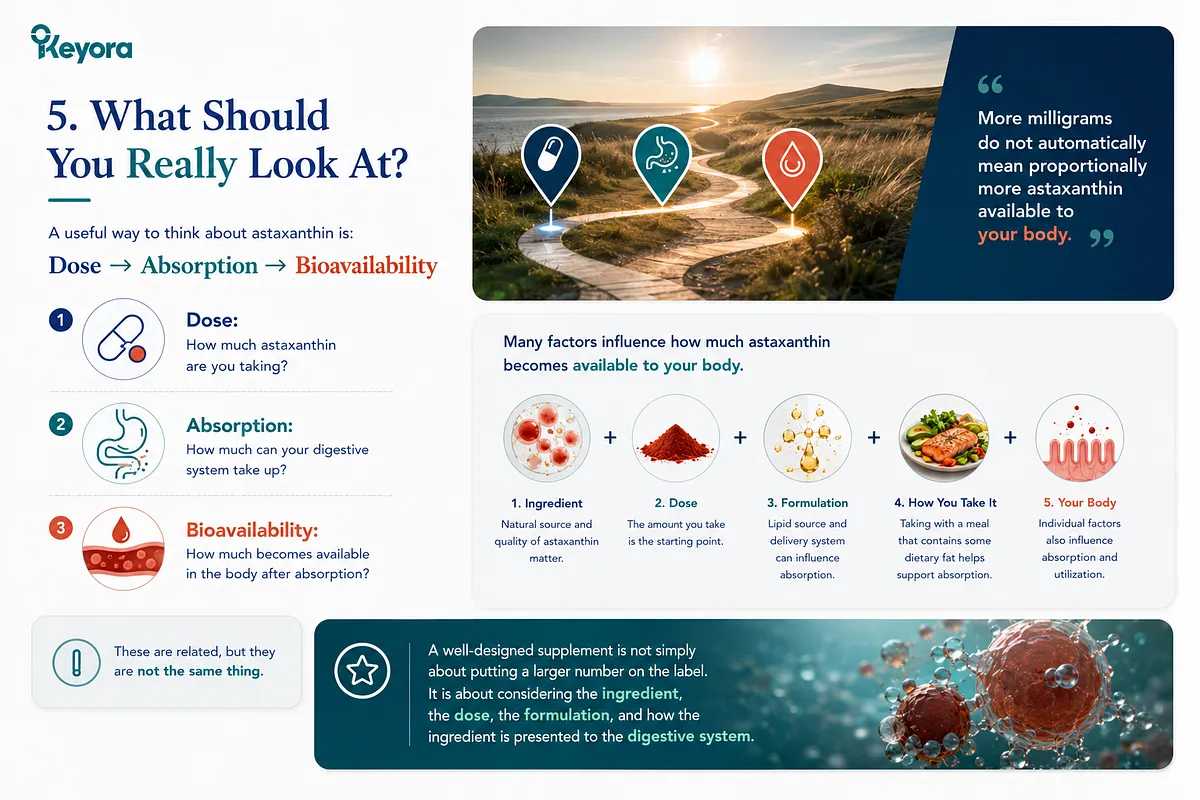
A useful way to think about astaxanthin is:
Dose → Absorption → Bioavailability
Dose: How much astaxanthin are you taking?
Absorption: How much can your digestive system take up?
Bioavailability: How much becomes available in the body after absorption?
These are related, but they are not the same thing.
That is why more milligrams do not automatically mean proportionally more astaxanthin available to your body.
A well-designed supplement is not simply about putting a larger number on the label. It is about considering the ingredient, the dose, the formulation, and how the ingredient is presented to the digestive system.
The Bottom Line
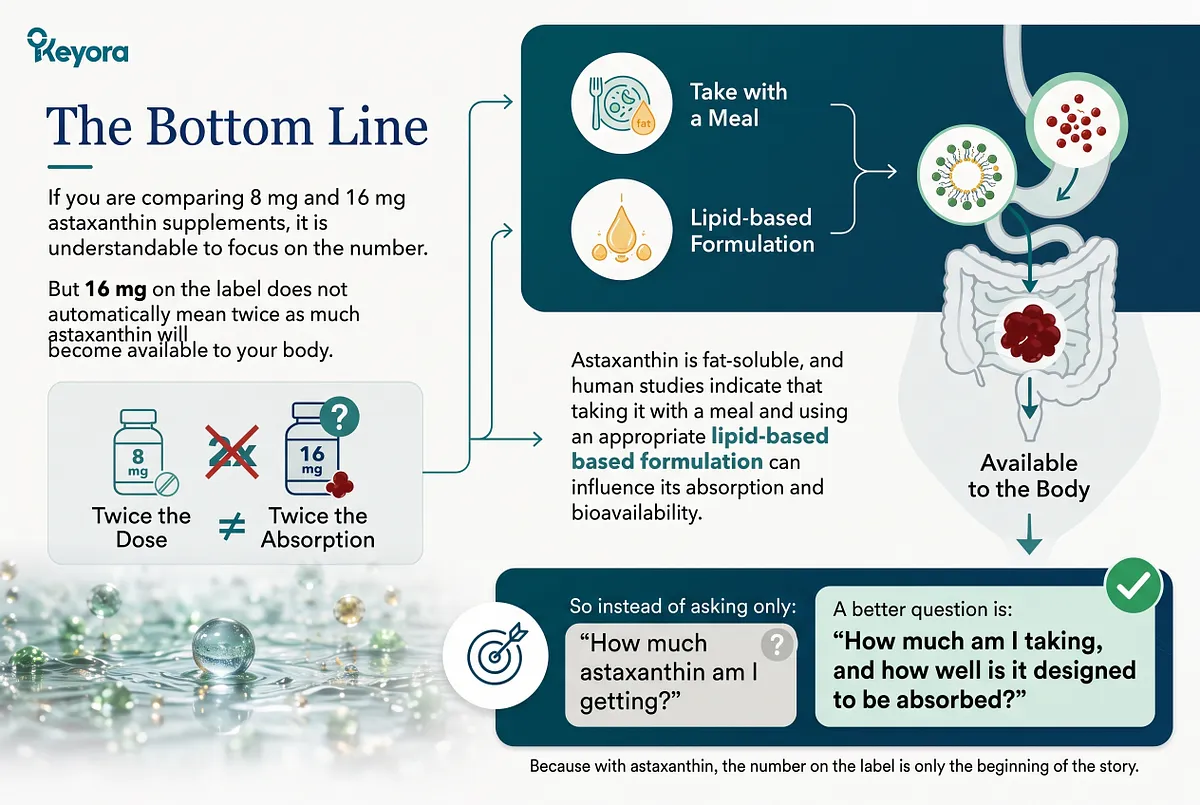
If you are comparing 8 mg and 16 mg astaxanthin supplements, it is understandable to focus on the number.
But 16 mg on the label does not automatically mean twice as much astaxanthin will become available to your body.
Astaxanthin is fat-soluble, and human studies indicate that taking it with a meal and using an appropriate lipid-based formulation can influence its absorption and bioavailability.
So instead of asking only:
“How much astaxanthin am I getting?”
A better question is:
“How much am I taking, and how well is it designed to be absorbed?”
Because with astaxanthin, the number on the label is only the beginning of the story.
References
1. Mercke Odeberg JM, et al. Oral bioavailability of the antioxidant astaxanthin in humans is enhanced by incorporation of lipid based formulations. European Journal of Pharmaceutical Sciences. 2003;19(4):299–304.
2. Okada Y, et al. Human pharmacokinetic study comparing astaxanthin intake before and after a meal; summarized in subsequent reviews of astaxanthin pharmacokinetics.
3. Fassett RG, Coombes JS. Astaxanthin in exercise metabolism, performance and recovery: A review. Frontiers in Nutrition. 2017.
4. EFSA Panel on Nutrition, Novel Foods and Food Allergens. Safety of astaxanthin for its use as a novel food in food supplements. EFSA Journal. 2020.