
Why Are Cell Membranes Vulnerable to Oxidative Damage?
Keyora Research Q&A Library
This is part of the Keyora Research Q&A Series, derived from Keyora Astaxanthin Research Journal Series.
Within the Keyora Astaxanthin Researcn framework, this Q&A translates complex astaxanthin biology into reader-friendly, evidence-bound answers, focusing on natural astaxanthin identity, molecular structure, antioxidant and redox mechanisms, membrane lipid interaction, mitochondrial resilience, inflammatory signaling pathways, human evidence interpretation, and the scientific principles behind responsible supplementation.
First published by Keyora Research Journal: www.keyorahealth.com
Direct Answer
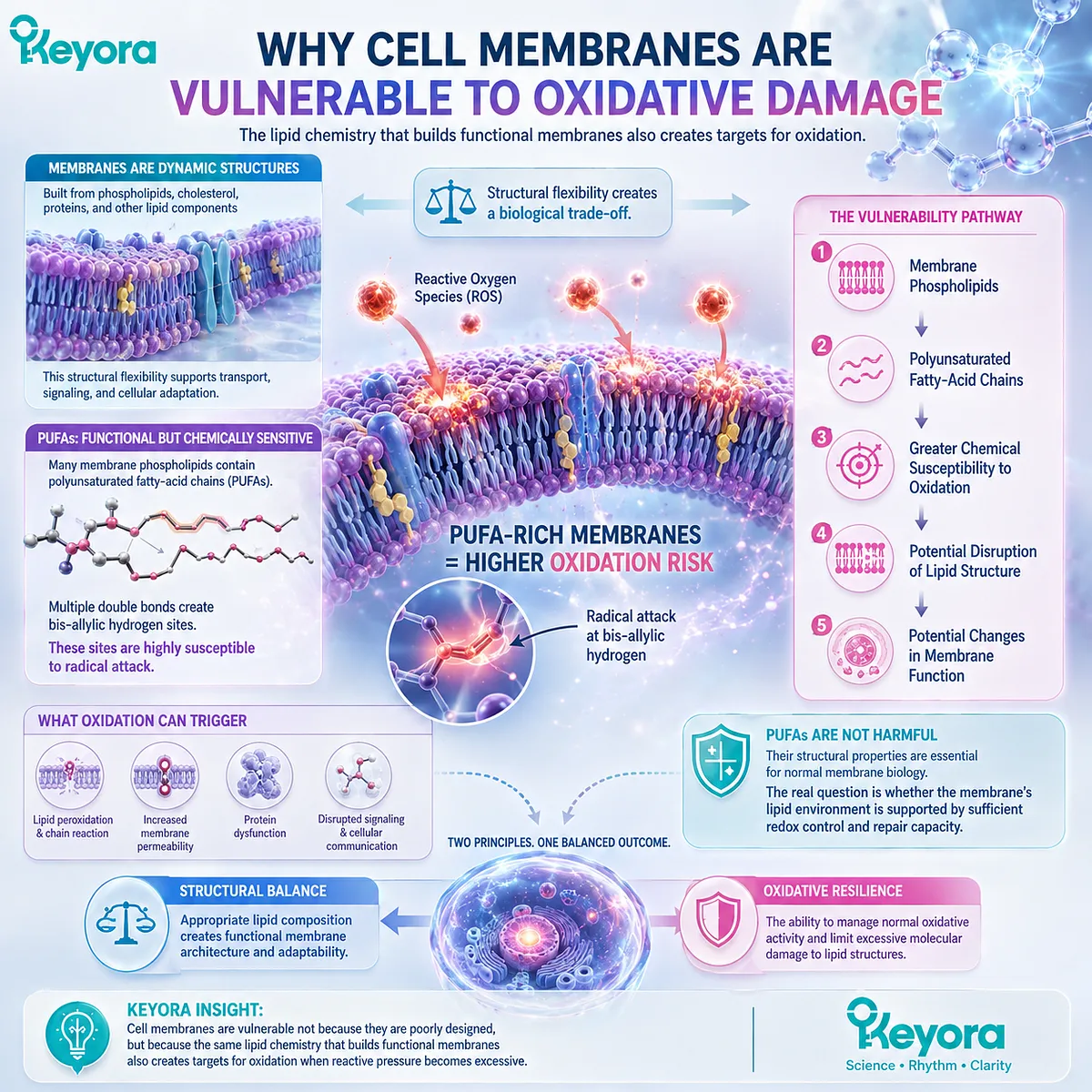
Cell membranes are especially vulnerable to oxidative damage because many membrane phospholipids contain polyunsaturated fatty-acid chains that are chemically more susceptible to radical-mediated oxidation
Cell membranes are not rigid walls.
They are dynamic structures built largely from phospholipids, cholesterol, proteins, and other lipid components. The fatty-acid chains within phospholipids help determine how the membrane organizes, adapts, and interacts with proteins involved in transport and signaling.
This structural flexibility creates an important biological trade-off.
Polyunsaturated fatty acids, or PUFAs, contribute to membrane organization and functional adaptability, but their multiple double bonds also create molecular regions that are more susceptible to oxidative attack.
The EP-3 source specifically describes PUFA-rich lipid structures as vulnerable because bis-allylic hydrogen positions can be more readily attacked by reactive species.
The central pathway is:
Membrane phospholipids
↓
Polyunsaturated fatty-acid chains
↓
Greater chemical susceptibility to oxidation
↓
Potential disruption of lipid structure
↓
Potential changes in membrane function
This does not mean polyunsaturated fats are harmful.
Their structural properties are part of normal membrane biology. The relevant question is whether the membrane’s lipid architecture is supported by sufficient redox control and repair capacity.
Within the Keyora framework, this relationship connects two principles:
Structural Balance
and
Oxidative Resilience
Structural Balance describes how appropriate lipid composition contributes to functional membrane architecture.
Oxidative Resilience describes the ability of that lipid environment to tolerate normal oxidative activity while limiting excessive molecular damage.
Cell membranes are therefore vulnerable not because they are poorly designed, but because the same lipid chemistry that helps create functional biological membranes can also create targets for oxidation when reactive pressure becomes excessive.
Why Are Polyunsaturated Fatty Acids More Sensitive to Oxidation?
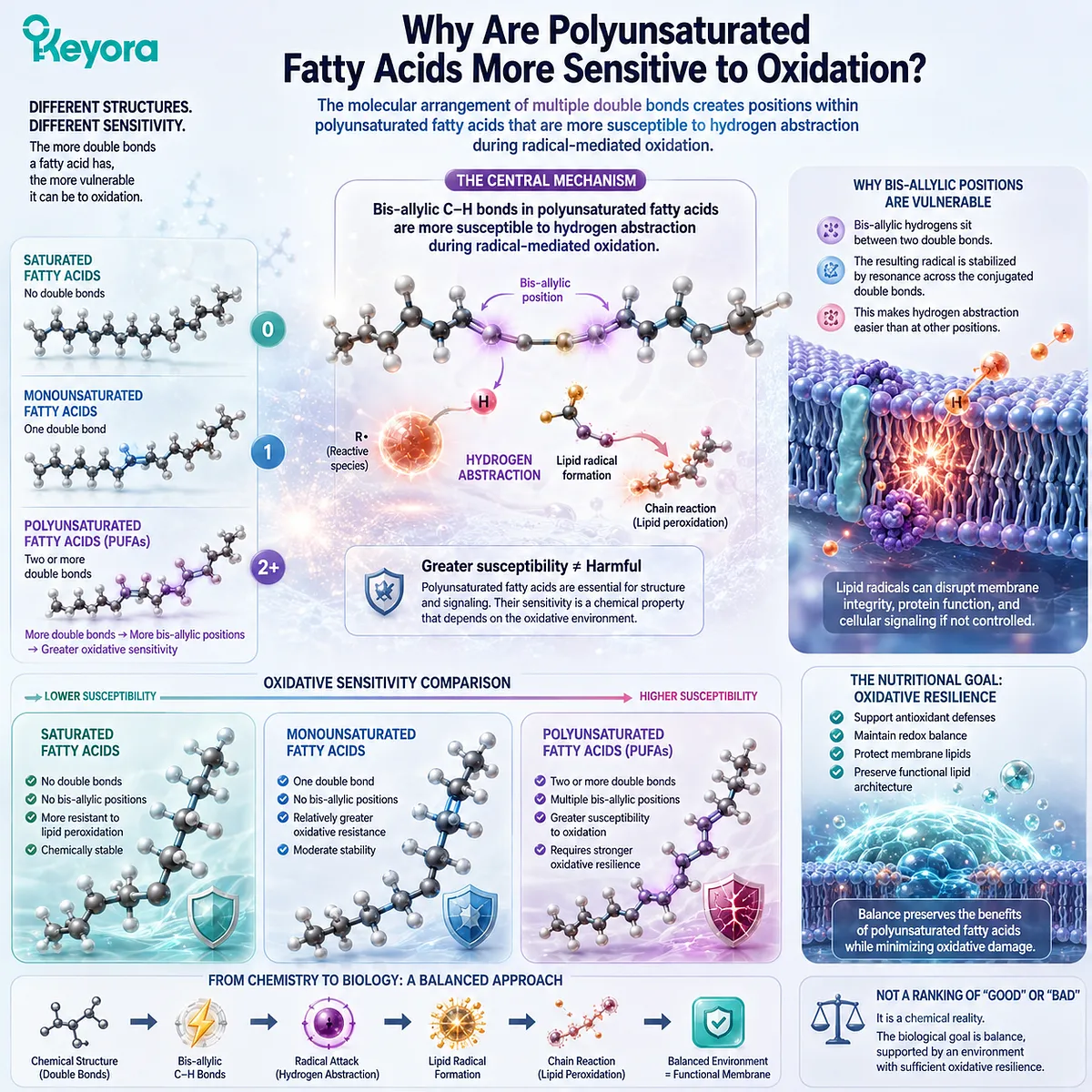
The molecular arrangement of multiple double bonds creates positions within polyunsaturated fatty acids that are more susceptible to hydrogen abstraction during radical-mediated oxidation
Fatty acids differ in the number and arrangement of double bonds within their carbon chains.
Saturated fatty acids contain no carbon-carbon double bonds.
Monounsaturated fatty acids contain one.
Polyunsaturated fatty acids contain two or more.
This difference affects more than membrane packing. It also changes how susceptible the molecule is to oxidative chemistry.
In many PUFAs, hydrogen atoms located between two double bonds occupy what are known as bis-allylic positions. The EP-3 source identifies these sites as particularly vulnerable to attack by reactive species.
A scientifically precise way to describe this is:
Bis-allylic C–H bonds in polyunsaturated fatty acids are more susceptible to hydrogen abstraction during radical-mediated oxidation.
This matters because removal of one of these hydrogens can initiate oxidative modification of the fatty-acid chain.
At this stage, however, it is important not to confuse susceptibility with nutritional value.
Greater oxidative susceptibility does not mean:
PUFA = harmful
It means:
PUFA = chemically more oxidation-sensitive under oxidative conditions
These are different conclusions.
Polyunsaturated fatty acids participate in important structural and signaling functions. Their presence within biological membranes is normal and physiologically important.
The relevant nutritional question is therefore not whether unsaturated fatty acids should be eliminated.
It is whether the membrane environment has sufficient Oxidative Resilience to preserve the advantages of functional lipid architecture without allowing excessive oxidation to damage that architecture.
A simplified comparison is:
Saturated fatty acids
→ generally lower susceptibility to lipid peroxidation
Monounsaturated fatty acids
→ relatively greater oxidative resistance than highly polyunsaturated lipids
Polyunsaturated fatty acids
→ greater susceptibility as the degree of unsaturation increases
This is a chemical property, not a ranking of “good” and “bad” fats.
The biological goal is balance.
Why Does Lipid Oxidation Matter More Inside an Organized Membrane?
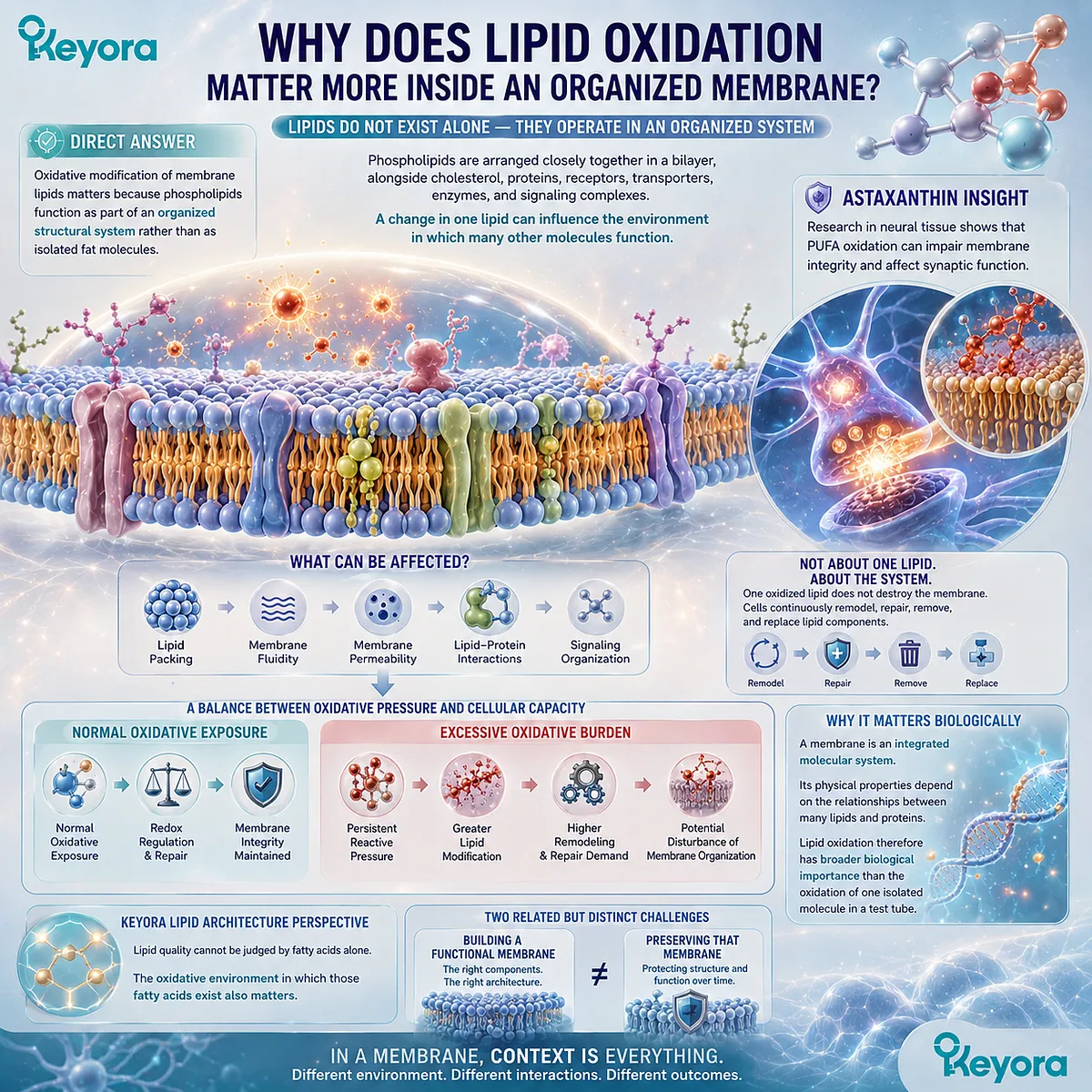
Oxidative modification of membrane lipids matters because phospholipids function as part of an organized structural system rather than as isolated fat molecules
A membrane lipid does not exist alone.
Phospholipids are arranged closely together in a bilayer, alongside cholesterol, proteins, receptors, transporters, enzymes, and signaling complexes.
This means an oxidative change affecting lipid molecules can influence the physical environment in which other membrane components operate.
Potential consequences may include changes in:
-
lipid packing;
-
membrane fluidity;
-
permeability;
-
lipid-protein interactions;
-
organization of signaling structures.
The project Astaxanthin scientific source provides an example from neural tissue, describing membrane PUFA oxidation as capable of impairing membrane integrity and affecting synaptic function.
The important concept is not that one oxidized lipid immediately destroys an entire membrane.
Cells continuously remodel, repair, remove, and replace lipid components.
Instead, the concern increases when oxidative pressure becomes persistent enough that molecular modification exceeds normal protective and repair capacity.
The relationship is therefore better understood as:
Normal oxidative exposure
↓
Redox regulation and repair
↓
Membrane integrity maintained
But when oxidative burden becomes excessive:
Persistent reactive pressure
↓
Greater lipid modification
↓
Higher remodeling and repair demand
↓
Potential disturbance of membrane organization
This is why lipid oxidation has broader biological importance than the oxidation of one isolated molecule in a test tube.
A membrane is an integrated molecular system.
Its physical properties depend on the relationships between many lipids and proteins.
Within Keyora’s Lipid Architecture framework, this means that lipid quality cannot be evaluated only by asking what fatty acids are present.
The oxidative environment in which those fatty acids exist also matters.
Building a functional membrane and preserving that membrane are related but distinct biological challenges.
Are All Cell Membranes Equally Vulnerable to Oxidative Damage?
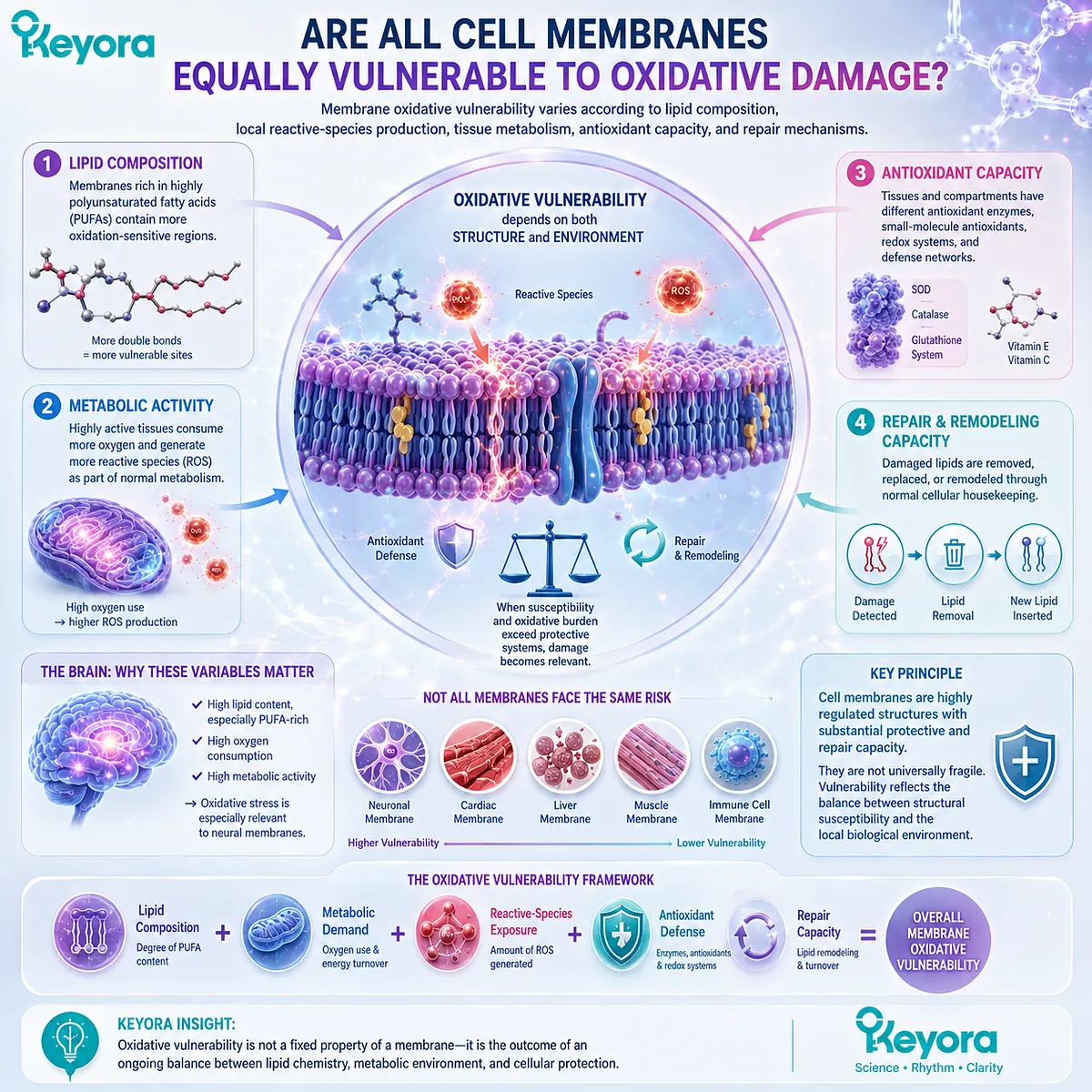
Membrane oxidative vulnerability varies according to lipid composition, local reactive-species production, tissue metabolism, antioxidant capacity, and repair mechanisms
Not every membrane experiences the same oxidative risk.
One important factor is lipid composition.
Membranes containing greater amounts of highly polyunsaturated fatty acids may contain more oxidation-sensitive lipid regions than membranes with lower levels of polyunsaturation.
A second factor is metabolic activity.
Highly active tissues consume large amounts of oxygen and may generate greater quantities of reactive species as part of normal metabolism.
A third factor is local antioxidant capacity.
Different tissues and cellular compartments contain different combinations of antioxidant enzymes, small-molecule antioxidants, redox systems, and repair pathways.
A fourth factor is lipid remodeling capacity.
Cell membranes are constantly maintained. Damaged lipids can be removed, replaced, or remodeled as part of normal cellular housekeeping.
The brain illustrates why these variables matter.
The Keyora source notes that neural tissue combines high lipid content—particularly substantial PUFA content—with high oxygen consumption, making oxidative stress especially relevant to neural membranes.
This does not mean the brain is uniquely subject to oxidation or that every neural membrane is continuously damaged.
It demonstrates a broader principle:
Oxidative vulnerability depends on both structure and environment.
A useful framework is:
Lipid composition
Metabolic demand
Reactive-species exposure
Antioxidant defense
Repair capacity
=
Overall membrane oxidative vulnerability
This is an important correction to overly simplified claims.
Cell membranes should not be described as universally fragile.
They are highly regulated structures with substantial protective and repair capacity.
Oxidative damage becomes more relevant when chemical susceptibility and oxidative burden exceed those protective systems.
Does Oxidative Vulnerability Mean Polyunsaturated Fats Are Bad for Membranes?
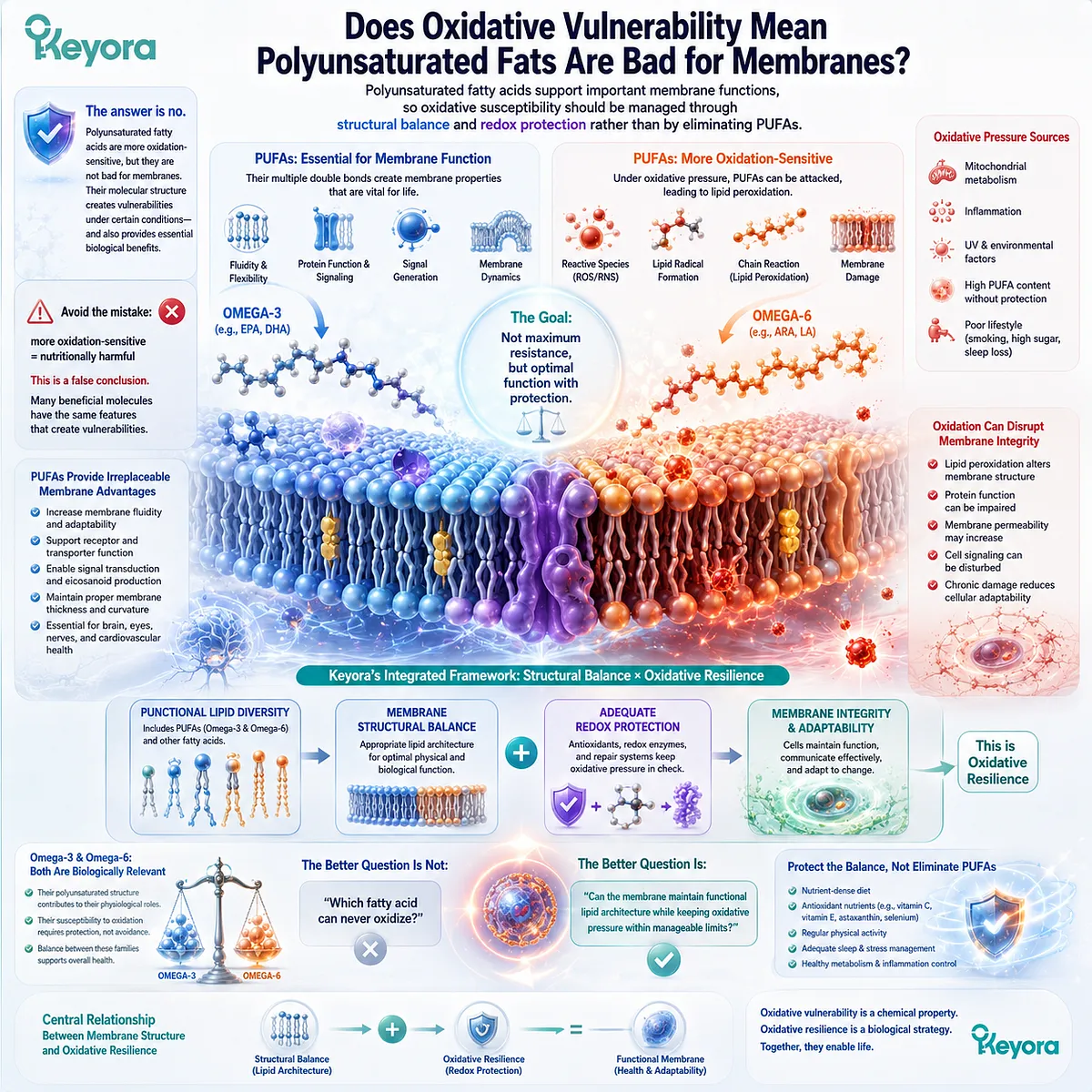
Polyunsaturated fatty acids support important membrane functions, so oxidative susceptibility should be managed through structural balance and redox protection rather than by eliminating PUFAs
The answer is no.
The fact that polyunsaturated fatty acids are more oxidation-sensitive does not make them undesirable components of cell membranes.
Their molecular structure contributes to important membrane properties and biological functions.
The mistake would be to turn a chemistry observation into a nutritional judgment.
This would create the false conclusion:
more oxidation-sensitive = nutritionally harmful
Biology is more complex.
Many molecules provide benefits precisely because of the same structural features that also create vulnerabilities under certain conditions.
For membranes, the goal is not maximum resistance to oxidation at any cost.
A membrane composed only of the most oxidation-resistant lipids would not automatically provide the physical properties required for optimal biological function.
Keyora’s Structural Balance framework therefore emphasizes appropriate lipid architecture rather than maximization or elimination of one fatty-acid class.
The complementary concept is Oxidative Resilience.
Together, they create the more accurate model:
Functional lipid diversity
↓
Membrane Structural Balance
Adequate redox protection
↓
Membrane integrity and adaptability
This framing is particularly important for Omega-3 and Omega-6 fatty acids.
Both are biologically relevant lipid families, and their polyunsaturated structure contributes to their physiological roles.
Their susceptibility to oxidation should therefore be understood as a property that requires biological protection, not as evidence that these fats should be avoided.
The better question is not:
“Which fatty acid can never oxidize?”
It is:
“Can the membrane maintain functional lipid architecture while keeping oxidative pressure within manageable limits?”
That is the central relationship between membrane structure and oxidative resilience.
What Protects Cell Membranes From Oxidative Damage?
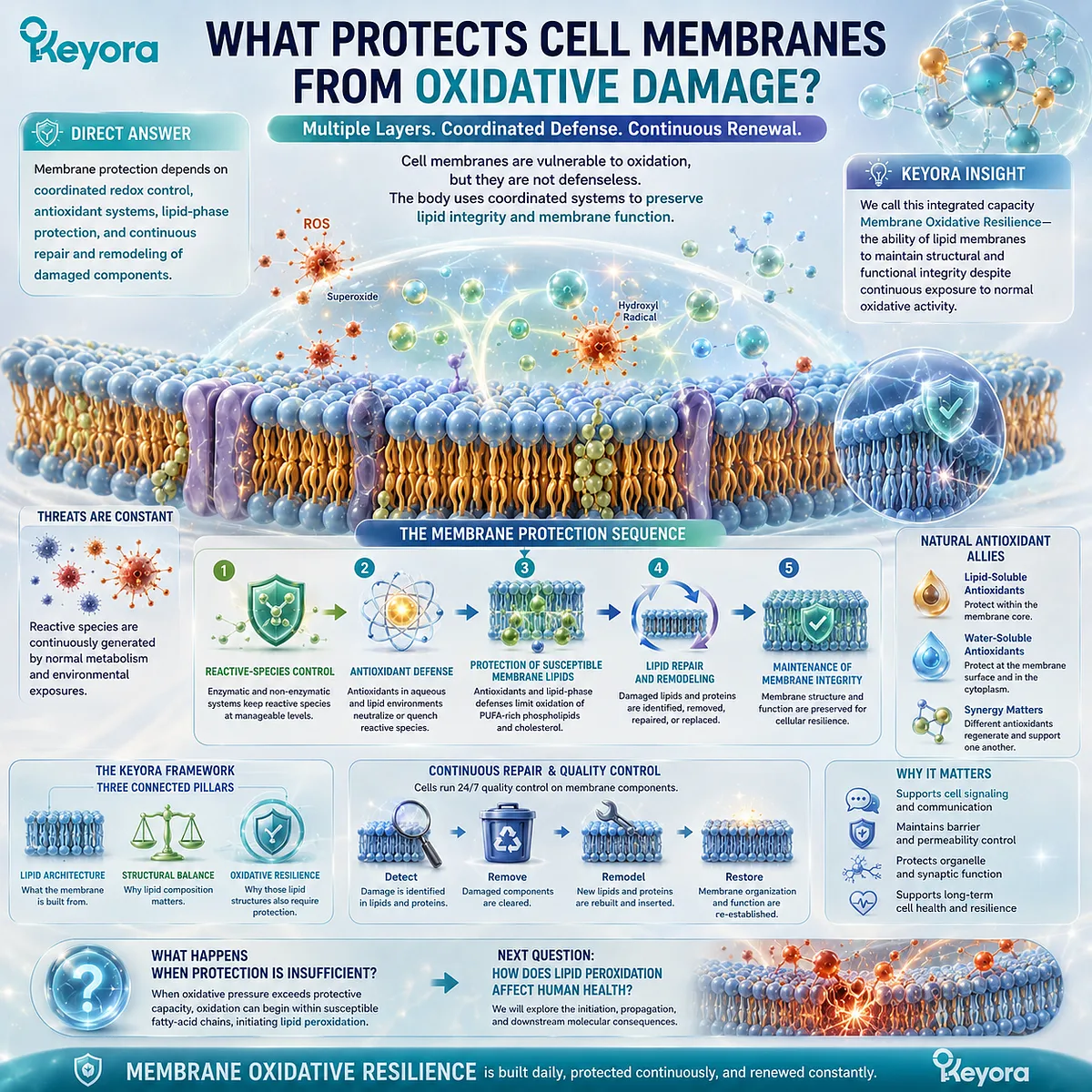
Membrane protection depends on coordinated redox control, antioxidant systems, lipid-phase protection, and continuous repair and remodeling of damaged components
Cell membranes are vulnerable to oxidation, but they are not defenseless.
The body uses multiple protective layers to preserve lipid integrity.
First, endogenous antioxidant systems help control reactive species before oxidative pressure becomes excessive.
Second, antioxidant molecules operating within or near lipid-rich environments can help limit the opportunity for susceptible membrane lipids to undergo uncontrolled oxidative modification.
Third, cellular repair systems continually identify, remove, remodel, and replace damaged molecular components.
These layers create a broader protective sequence:
Reactive-species control
↓
Antioxidant defense
↓
Protection of susceptible membrane lipids
↓
Lipid repair and remodeling
↓
Maintenance of membrane integrity
Within the Keyora framework, this can be described as Membrane Oxidative Resilience.
Membrane Oxidative Resilience is the capacity of lipid membranes to maintain structural and functional integrity despite continuous exposure to normal oxidative activity.
This concept connects the entire EP-3 sequence so far.
-
Lipid Architecture explains what the membrane is built from.
-
Structural Balance explains why lipid composition matters.
-
Oxidative Resilience explains why those lipid structures also require protection.
The next question is what happens when that protection is insufficient and oxidation actually begins within a susceptible fatty-acid chain.
The EP-3 source describes a sequence in which reactive species attack PUFA regions, creating lipid radicals that can participate in further oxidative reactions.
That process is called lipid peroxidation.
The detailed initiation, propagation, and downstream molecular consequences of that process belong to the next question:
How Does Lipid Peroxidation Affect Human Health?
This article is for educational and informational purposes only. It does not provide medical advice, diagnosis, treatment, cure, prevention, disease outcome claims, hormone restoration claims, fertility outcome claims, or formula-specific clinical efficacy claims.