
Why Does Keyora Focus on Lipid-Based Nutritional Architecture?
Keyora Research Q&A Library
This is part of the Keyora Research Q&A Series, derived from Keyora Astaxanthin Research Journal Series.
Within the Keyora Astaxanthin Researcn framework, this Q&A translates complex astaxanthin biology into reader-friendly, evidence-bound answers, focusing on natural astaxanthin identity, molecular structure, antioxidant and redox mechanisms, membrane lipid interaction, mitochondrial resilience, inflammatory signaling pathways, human evidence interpretation, and the scientific principles behind responsible supplementation.
First published by Keyora Research Journal: www.keyorahealth.com

Direct Answer
Why Does Keyora Look Beyond Individual Nutrients?
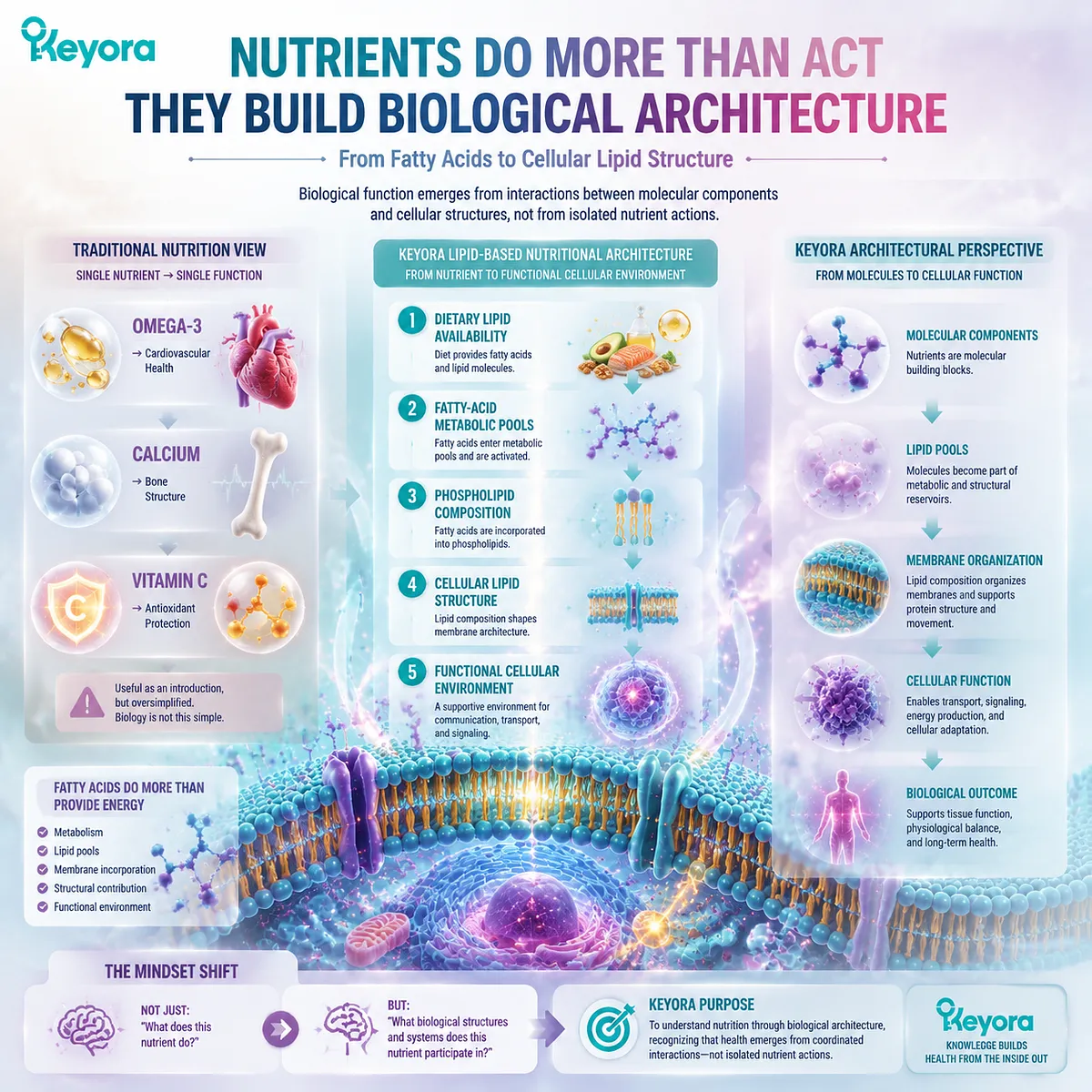
Traditional nutrition education often explains nutrients by assigning each nutrient a specific function.
Omega-3 is commonly associated with cardiovascular health.
Calcium is commonly associated with bone structure.
Vitamin C is commonly associated with antioxidant protection.
This approach is useful because it provides a simple introduction to nutrition. However, biological systems do not operate through isolated nutrient actions. Cells function through interconnected networks where molecules interact with structures, pathways, and regulatory systems.
Lipids provide an important example of why nutrition requires a broader perspective.
Fatty acids are often introduced primarily as sources of energy.
However, their biological roles extend beyond calorie production.
Certain fatty acids can become part of phospholipid membranes, contributing to the structural environment where cellular communication, transport, and signaling processes occur.
The relationship can be summarized as:
Dietary lipid availability
↓
Fatty-acid metabolic pools
↓
Phospholipid composition
↓
Cellular lipid structure
↓
Functional cellular environment
This is the foundation of Keyora’s Lipid-Based Nutritional Architecture perspective.
The purpose of this framework is not to suggest that one lipid molecule determines biological health.
Instead, it recognizes that biological function emerges from interactions between molecular components and cellular structures.
A fatty acid does not simply perform one isolated action after consumption.
It may participate in metabolism, become incorporated into lipid pools, contribute to membrane organization, or influence the environment where cellular processes occur.
Therefore, understanding nutrition requires moving beyond the question:
“What does this nutrient do?”
A deeper question is:
“What biological structures and systems does this nutrient participate in?”
This shift from isolated nutrient function toward biological architecture is the reason Keyora focuses on lipid-based nutritional architecture.
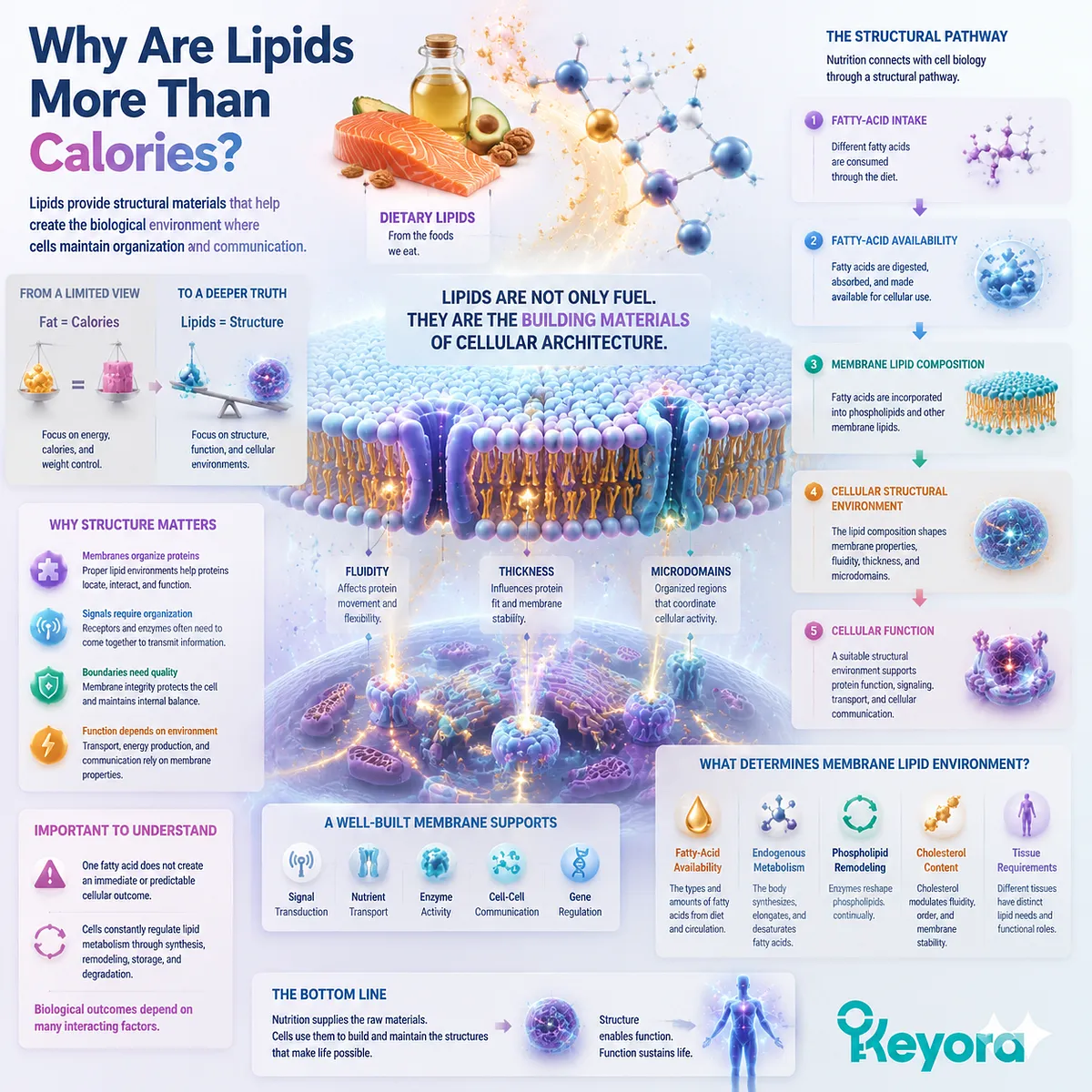
Why Are Lipids More Than Calories?
Lipids provide structural materials that help create the biological environment where cells maintain organization and communication
For many years, dietary fat was primarily discussed through the perspective of energy.
Because fat provides concentrated energy, nutrition conversations often focused on total fat intake, calorie density, and body-weight regulation.
These aspects remain important.
However, energy storage represents only one part of lipid biology.
Lipids are also structural molecules.
Cell membranes are built largely from phospholipids, and fatty acids form important components of those phospholipids. The characteristics of different fatty acids can influence how membrane molecules organize and how the membrane behaves physically.
This means dietary lipids are connected to cellular biology through structure.
The pathway can be described as:
Fatty-acid intake
↓
Fatty-acid availability
↓
Membrane lipid composition
↓
Cellular structural environment
↓
Cellular function
This does not mean that consuming one specific fatty acid immediately creates a predictable cellular outcome. Cells continuously regulate lipid metabolism through synthesis, remodeling, storage, and degradation.
The final lipid environment depends on multiple factors, including:
-
fatty-acid availability;
-
endogenous metabolism;
-
phospholipid remodeling;
-
cholesterol content;
-
tissue requirements.
However, the fundamental principle remains:
The molecules supplied through nutrition can contribute to the materials from which biological structures are created.
This is why lipid nutrition cannot be fully understood by asking only whether a fat provides calories.
The deeper question is:
How do different lipid molecules participate in the biological structures that support cellular function?
This perspective allows nutrition science to move from a simple energy model toward a structural biology model.
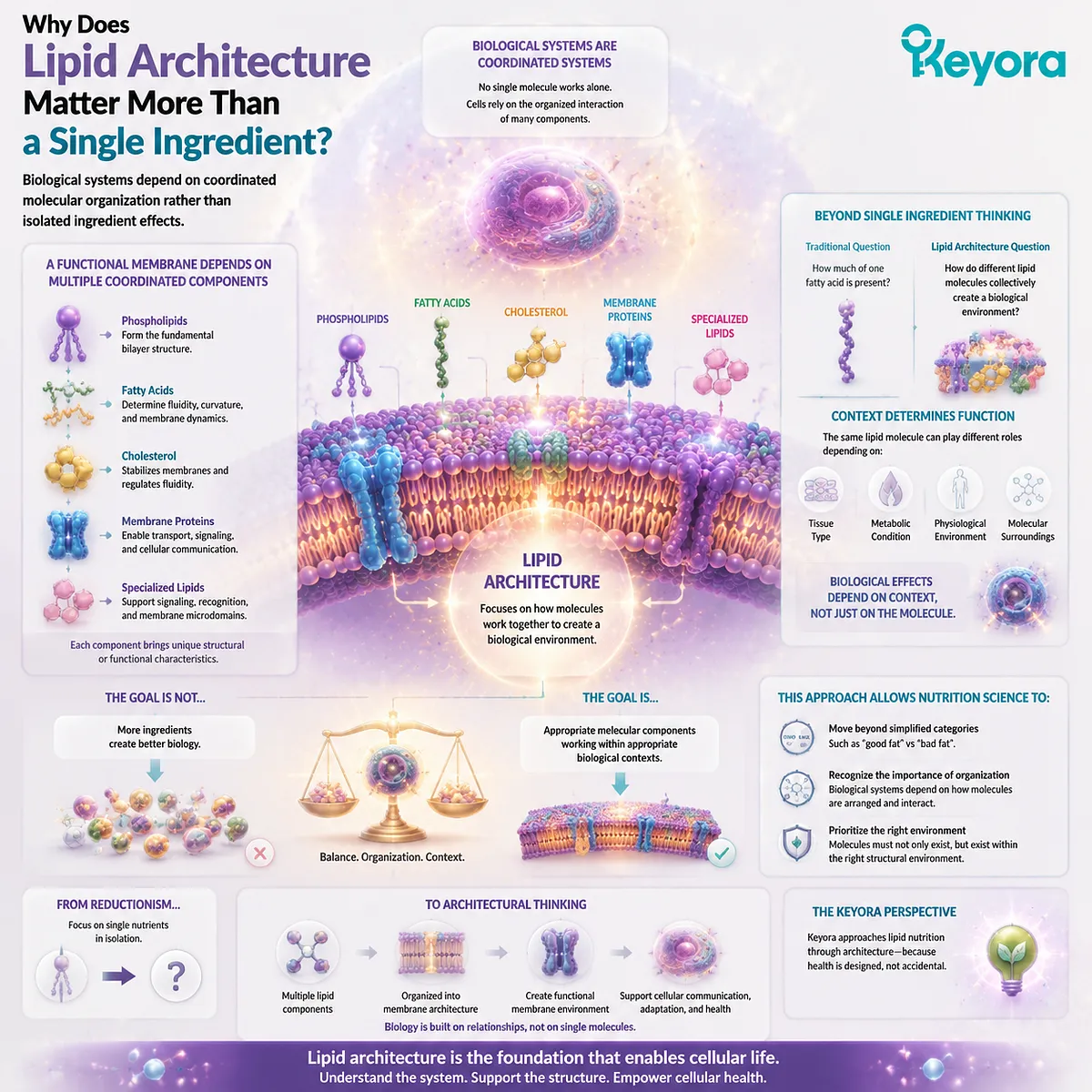
Why Does Lipid Architecture Matter More Than a Single Ingredient?
Biological systems depend on coordinated molecular organization rather than isolated ingredient effects
A biological system is rarely controlled by one molecule working independently.
The cell membrane provides a clear example.
A functional membrane depends on the coordinated interaction of multiple components:
-
phospholipids;
-
fatty acids;
-
cholesterol;
-
membrane proteins;
-
specialized lipid molecules.
Each component contributes different structural or functional characteristics.
Therefore, evaluating one nutrient alone may provide only a partial understanding of the biological system.
This is the foundation of the concept of Lipid Architecture.
Lipid Architecture does not simply ask:
“How much of one fatty acid is present?”
It asks:
“How do different lipid molecules collectively create a biological environment?”
This distinction matters because biological effects depend on context.
The same lipid molecule may exist within different tissues, metabolic conditions, and physiological environments. Its role depends partly on the surrounding molecular system.
Therefore, lipid-based nutrition should not become a search for one universally dominant “best” ingredient.
The goal is not:
“More ingredients create better biology.”
The goal is:
Appropriate molecular components working within appropriate biological contexts.
This approach allows nutrition science to move beyond simplified categories such as good fat versus bad fat.
Instead, it recognizes that biological systems depend on organization.
Molecules must not only exist.
They must exist within the right structural environment.
This is why Keyora approaches lipid nutrition through architecture rather than isolated ingredient descriptions.
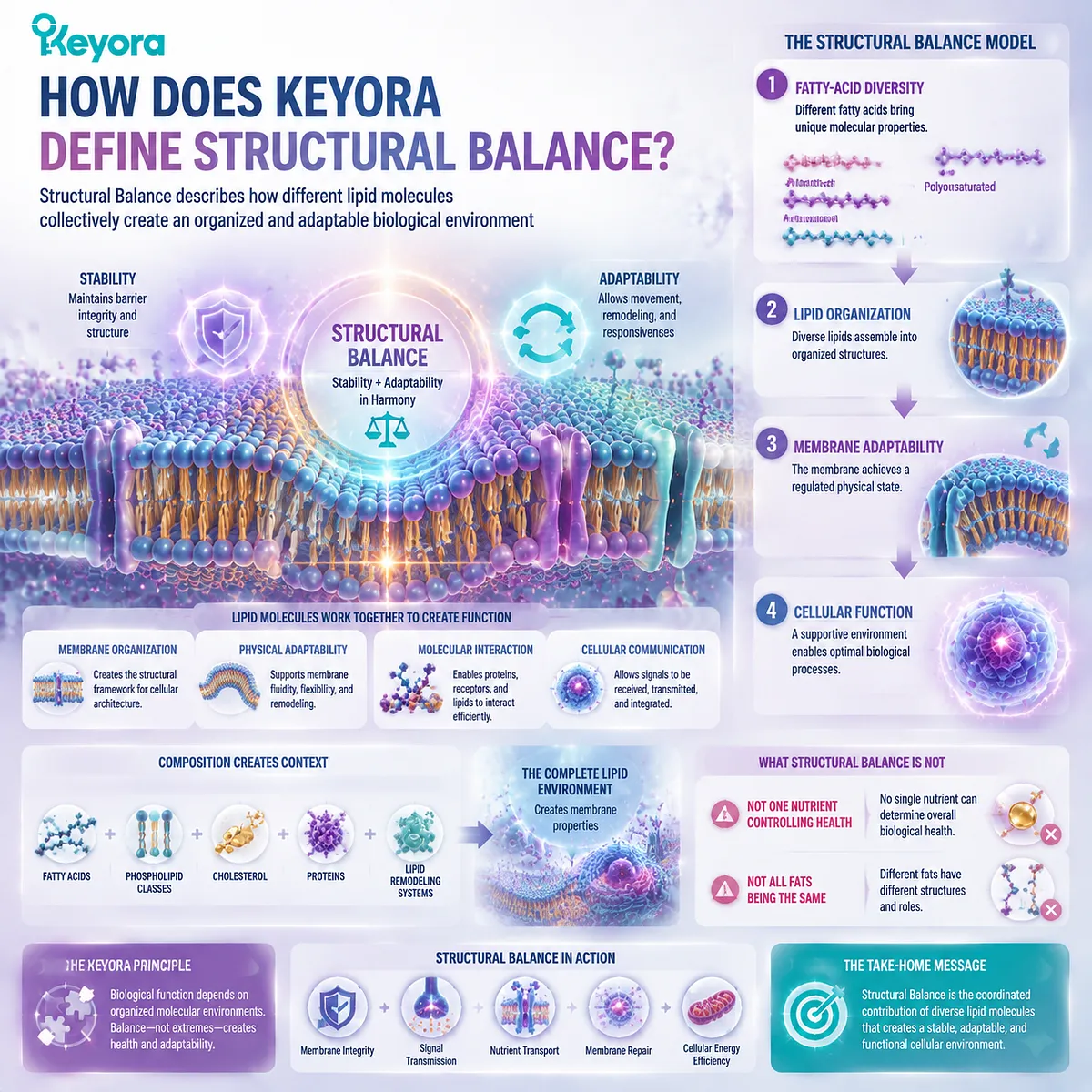
How Does Keyora Define Structural Balance?
Structural Balance describes how different lipid molecules collectively create an organized and adaptable biological environment
One of the central concepts within Keyora’s lipid framework is Structural Balance.
Structural Balance refers to the idea that biological structures require an appropriate organization of molecular components rather than an extreme dominance of one component.
For cellular membranes, this means understanding how different lipid molecules contribute to:
-
membrane organization;
-
physical adaptability;
-
molecular interaction;
-
cellular communication.
A functional membrane is not defined by maximum rigidity or maximum flexibility.
It requires a regulated physical state that allows stability and responsiveness at the same time.
Fatty-acid composition contributes to this balance because different fatty acids have different molecular structures.
Saturated fatty acids, monounsaturated fatty acids, and polyunsaturated fatty acids can influence lipid packing behavior in different ways.
However, membrane properties emerge from the complete lipid environment.
No single fatty acid determines the entire biological state of a membrane.
The more accurate model is:
Fatty-acid diversity
↓
Lipid organization
↓
Membrane adaptability
↓
Cellular function
This principle prevents two common misunderstandings.
The first misunderstanding is that one nutrient alone can control biological health.
The second misunderstanding is that all fats perform identical biological roles.
A more accurate view recognizes that different lipid molecules contribute different characteristics within a coordinated system.
Structural Balance therefore represents a broader nutritional principle:
Biological function depends on organized molecular environments.
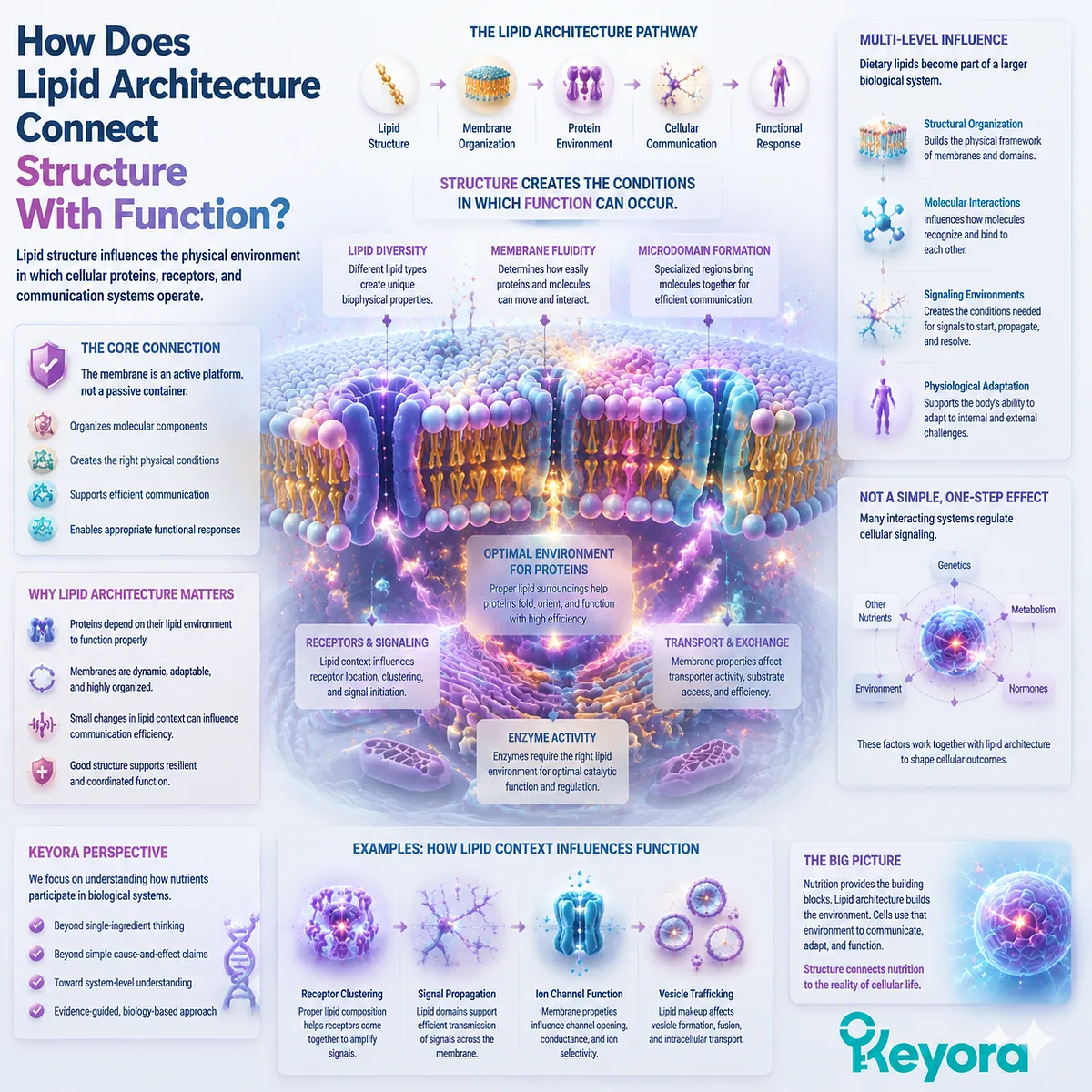
How Does Lipid Architecture Connect Structure With Function?
Lipid structure influences the physical environment in which cellular proteins, receptors, and communication systems operate
The importance of lipid architecture extends beyond physical structure.
The same lipid environment also influences cellular function.
Membrane proteins, receptors, transporters, and signaling molecules operate within the lipid environment created by the membrane.
Therefore, the membrane is not simply a passive container.
It is an active platform that helps organize biological communication.
The relationship can be summarized as:
Lipid structure
↓
Membrane organization
↓
Protein environment
↓
Cellular communication
↓
Functional response
This does not mean that changing one dietary lipid immediately changes a specific cellular pathway.
Cellular signaling is controlled by many interacting systems, including genetics, metabolism, hormones, and environmental conditions.
However, it demonstrates an important biological principle:
Structure creates the conditions in which function can occur.
This is why lipid architecture connects nutrition with cellular biology.
The molecules provided through diet contribute to a larger system that includes:
-
structural organization;
-
molecular interactions;
-
signaling environments;
-
physiological adaptation.
Keyora’s framework therefore does not focus only on whether a nutrient has a particular benefit.
It focuses on understanding how nutrients participate in biological systems.
Why Is Lipid-Based Nutritional Architecture Relevant to Modern Nutrition?
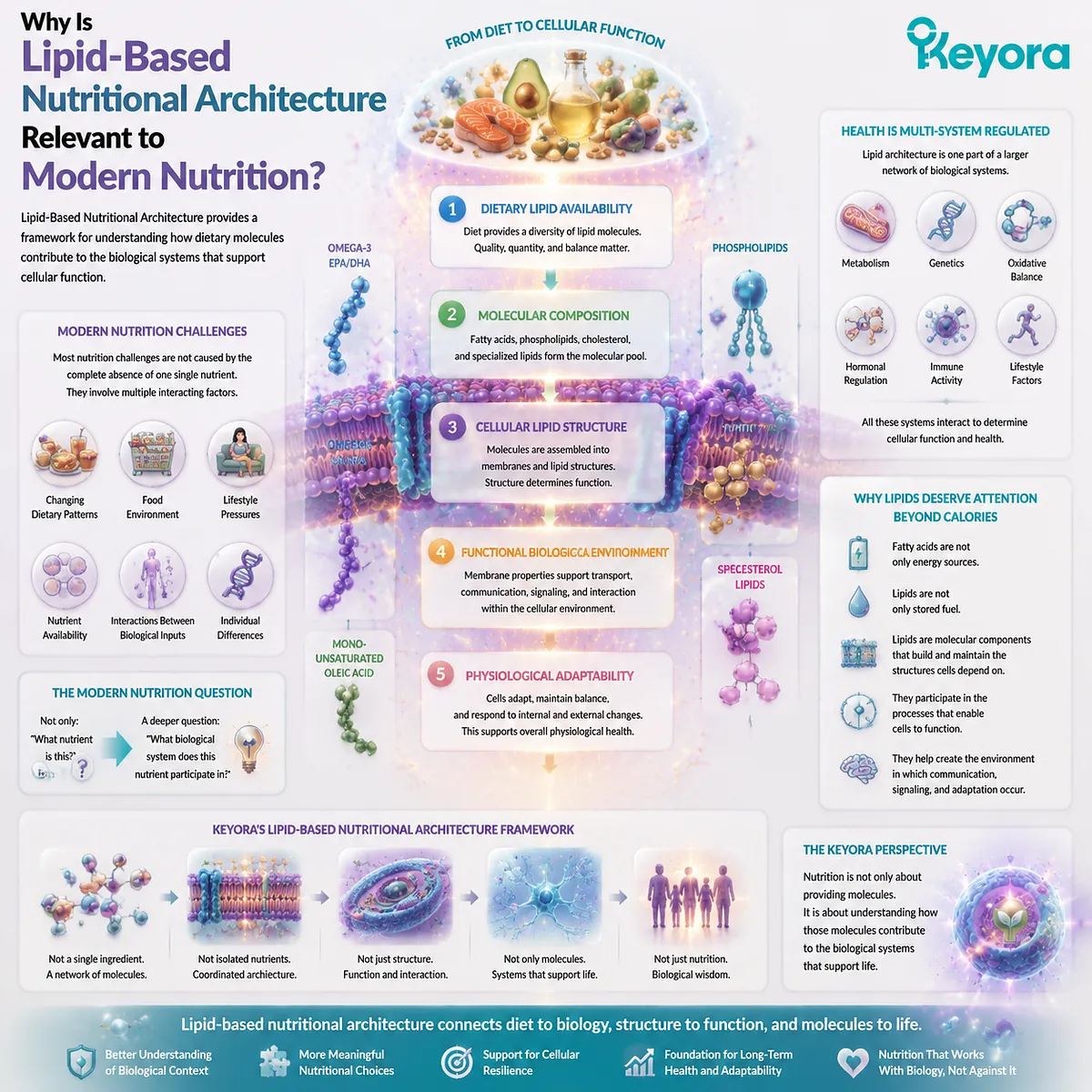
Lipid-Based Nutritional Architecture provides a framework for understanding how dietary molecules contribute to the biological systems that support cellular function
Modern nutrition challenges are rarely explained by the complete absence of one single nutrient.
They often involve changes in dietary patterns, nutrient availability, food environments, and relationships between different biological inputs.
This is why nutritional architecture is increasingly important.
The modern nutrition question is not only:
“What nutrient is this?”
A deeper question is:
“What biological system does this nutrient participate in?”
For lipid nutrition, this means understanding the connection between:
Dietary lipid availability
↓
Molecular composition
↓
Cellular lipid structure
↓
Functional biological environment
↓
Physiological adaptability
Keyora’s Lipid-Based Nutritional Architecture framework is based on this relationship.
It does not claim that lipids alone determine health.
Cellular function depends on many systems, including metabolism, genetics, oxidative balance, hormonal regulation, immune activity, and lifestyle factors.
Instead, this framework explains why lipid molecules deserve attention beyond their calorie content.
Fatty acids are not only energy sources.
Lipids are not only stored fuel.
They are molecular components that participate in the structures and processes that allow cells to function.
This is the reason Keyora focuses on lipid-based nutritional architecture:
Because nutrition is not only about providing molecules.
It is about understanding how those molecules contribute to the biological systems that support life.
This article is for educational and informational purposes only. It does not provide medical advice, diagnosis, treatment, cure, prevention, disease outcome claims, hormone restoration claims, fertility outcome claims, or formula-specific clinical efficacy claims.