
Natural vs. Synthetic Astaxanthin: What’s the Difference?
Keyora Research Q&A Library
This is part of the Keyora Research Q&A Series, derived from Keyora Astaxanthin Research Journal Series.
Within the Keyora Astaxanthin Researcn framework, this Q&A translates complex astaxanthin biology into reader-friendly, evidence-bound answers, focusing on natural astaxanthin identity, molecular structure, antioxidant and redox mechanisms, membrane lipid interaction, mitochondrial resilience, inflammatory signaling pathways, human evidence interpretation, and the scientific principles behind responsible supplementation.
First published by Keyora Research Journal: www.keyorahealth.com
Short Answer
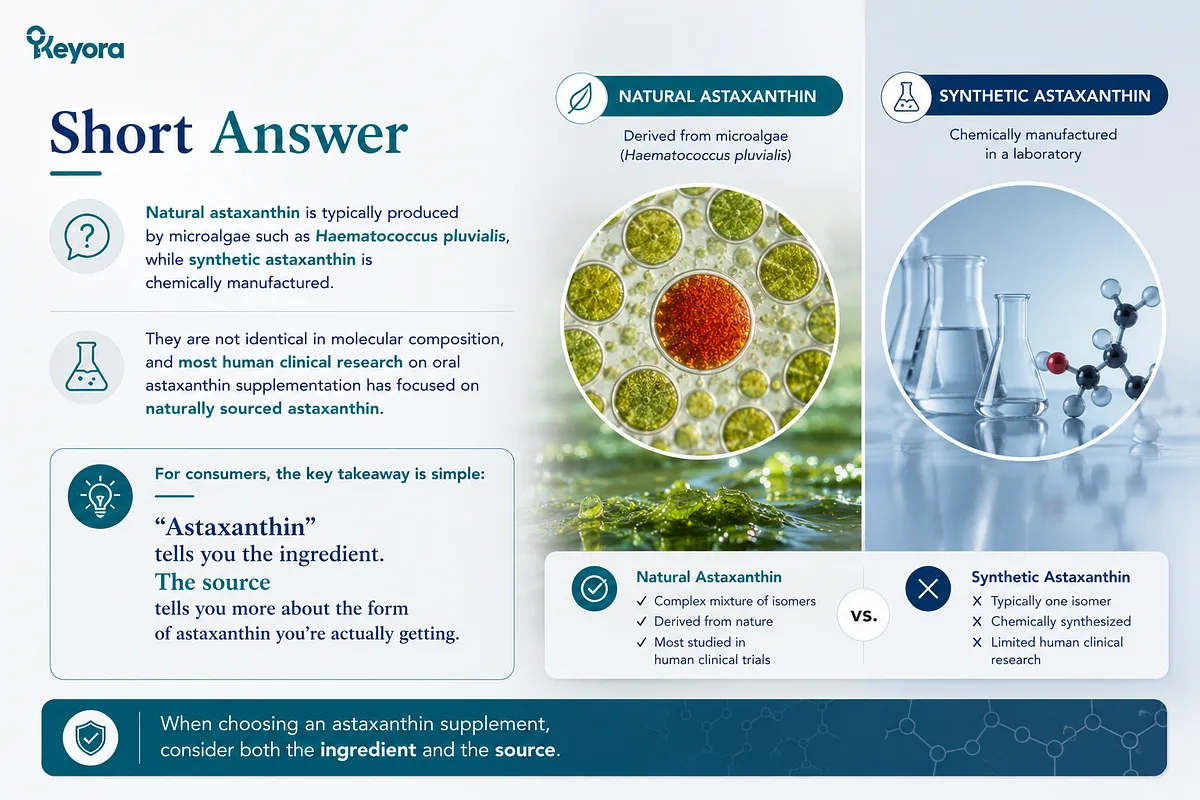
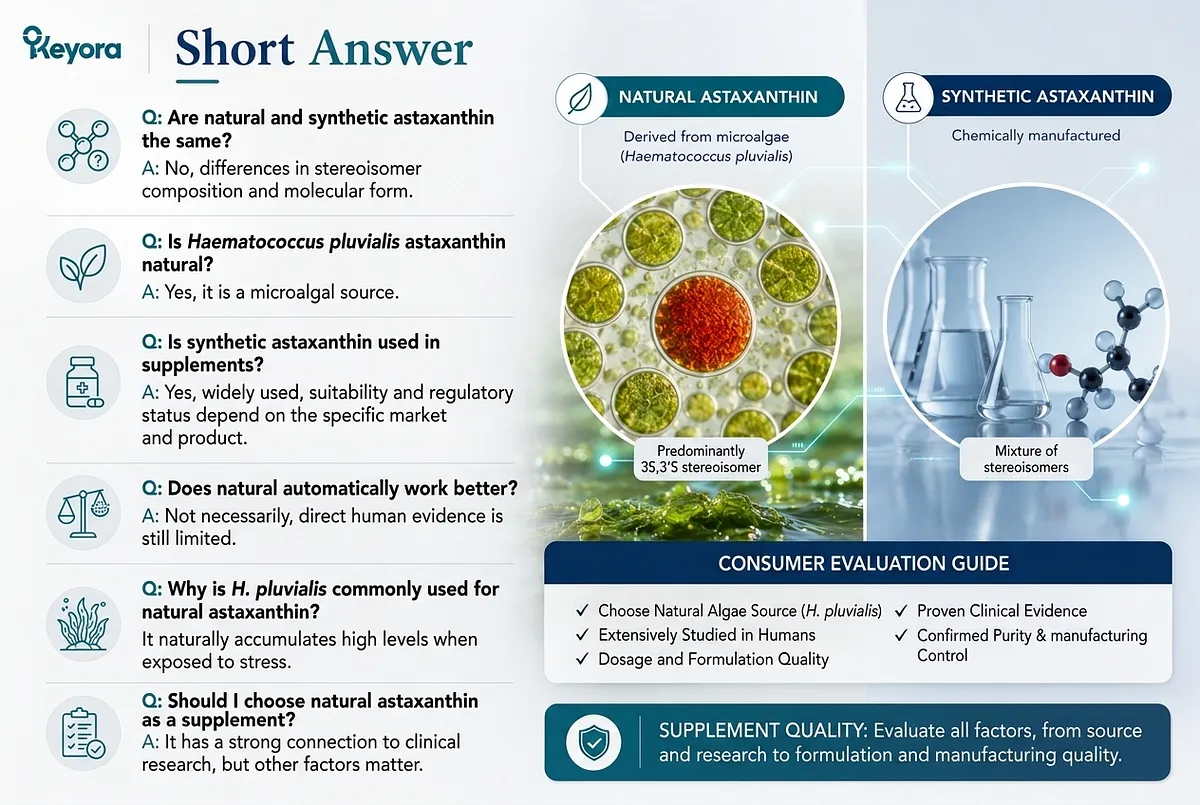
Natural astaxanthin is typically produced by microalgae such as Haematococcus pluvialis, while synthetic astaxanthin is chemically manufactured. They are not identical in molecular composition, and most human clinical research on oral astaxanthin supplementation has focused on naturally sourced astaxanthin.
For consumers, the key takeaway is simple:
“Astaxanthin” tells you the ingredient. The source tells you more about the form of astaxanthin you’re actually getting.
What Is the Difference?
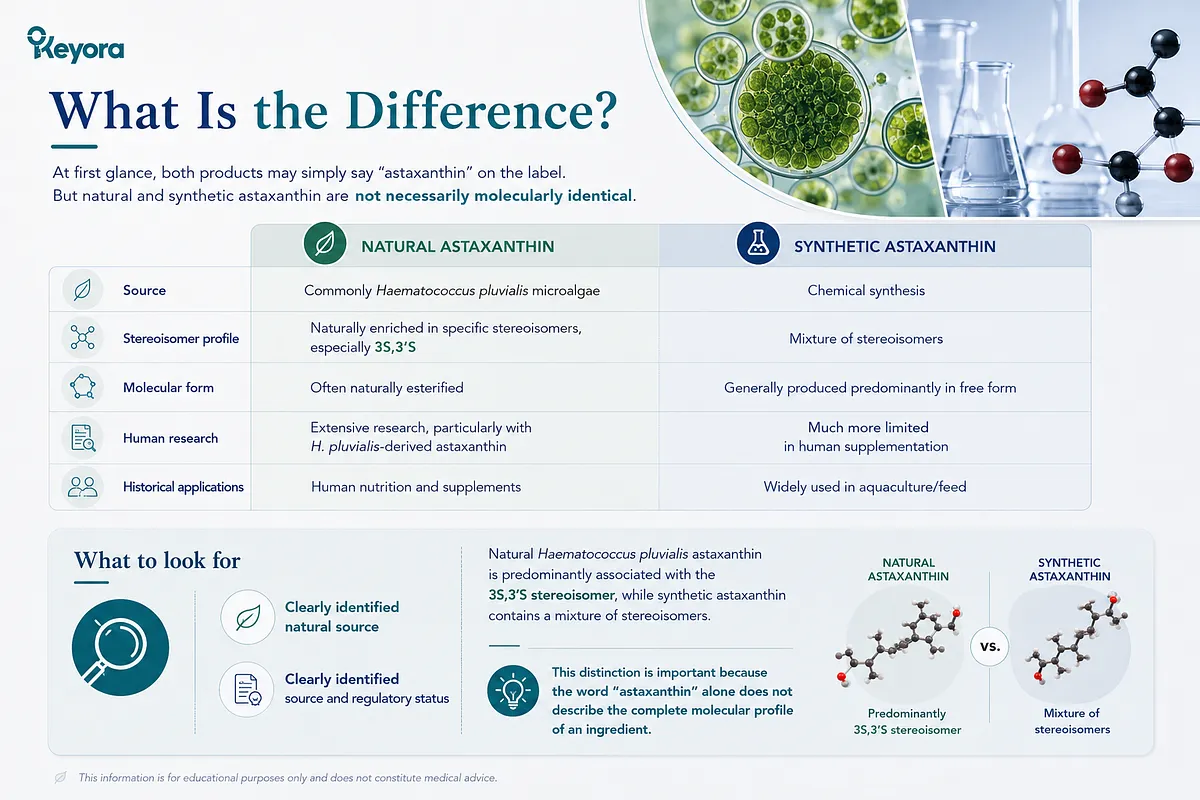
At first glance, both products may simply say “astaxanthin” on the label.
But natural and synthetic astaxanthin are not necessarily molecularly identical.
Source
Natural Astaxanthin: Commonly Haematococcus pluvialis microalgae
Synthetic Astaxanthin: Chemical synthesis
Stereoisomer profile
Natural Astaxanthin: Naturally enriched in specific stereoisomers, especially 3S,3′S
Synthetic Astaxanthin: Mixture of stereoisomers
Molecular form
Natural Astaxanthin: Often naturally esterified
Synthetic Astaxanthin: Generally produced predominantly in free form
Human research
Natural Astaxanthin: Extensive research, particularly with H. pluvialis-derived astaxanthin
Synthetic Astaxanthin: Much more limited in human supplementation
Historical applications
Natural Astaxanthin: Human nutrition and supplements
Synthetic Astaxanthin: Widely used in aquaculture/feed
What to look for
Natural Astaxanthin: Clearly identified natural source
Synthetic Astaxanthin: Clearly identified source and regulatory status
Natural Haematococcus pluvialis astaxanthin is predominantly associated with the 3S,3′S stereoisomer, while synthetic astaxanthin contains a mixture of stereoisomers.
This distinction is important because the word “astaxanthin” alone does not describe the complete molecular profile of an ingredient.
1. Where Does Natural Astaxanthin Come From?
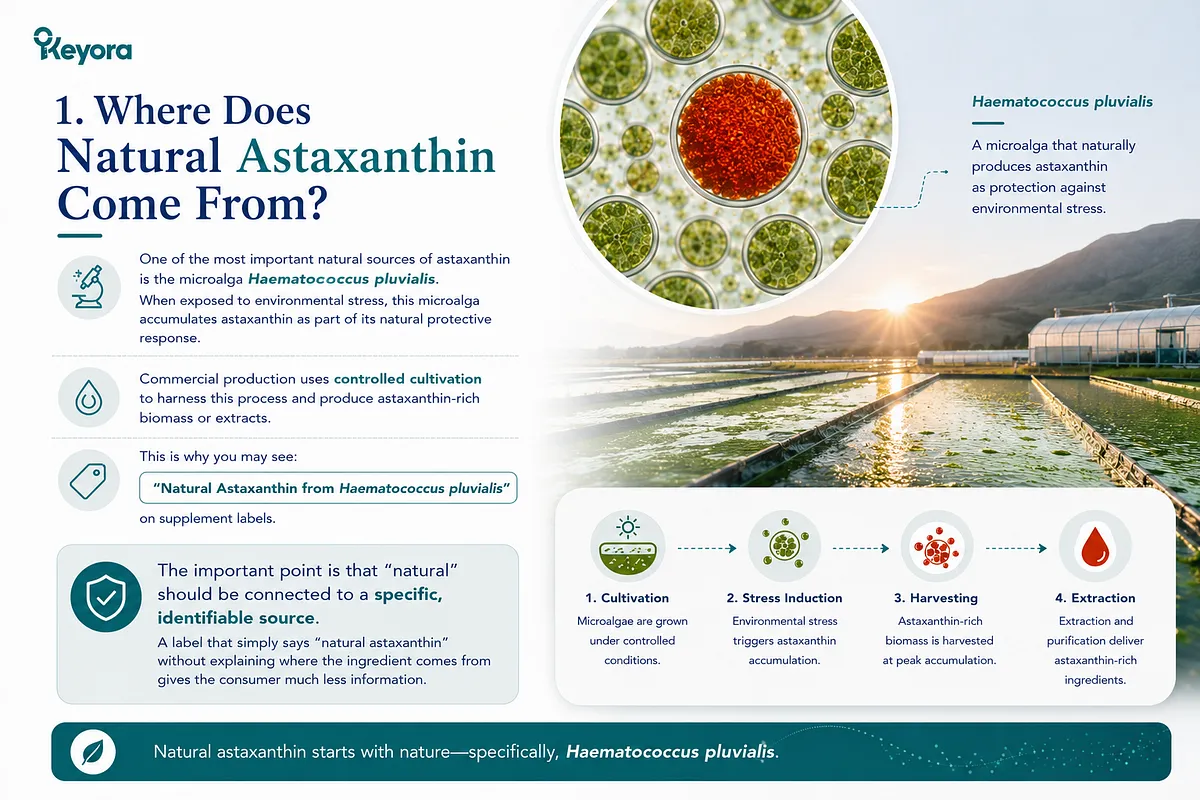
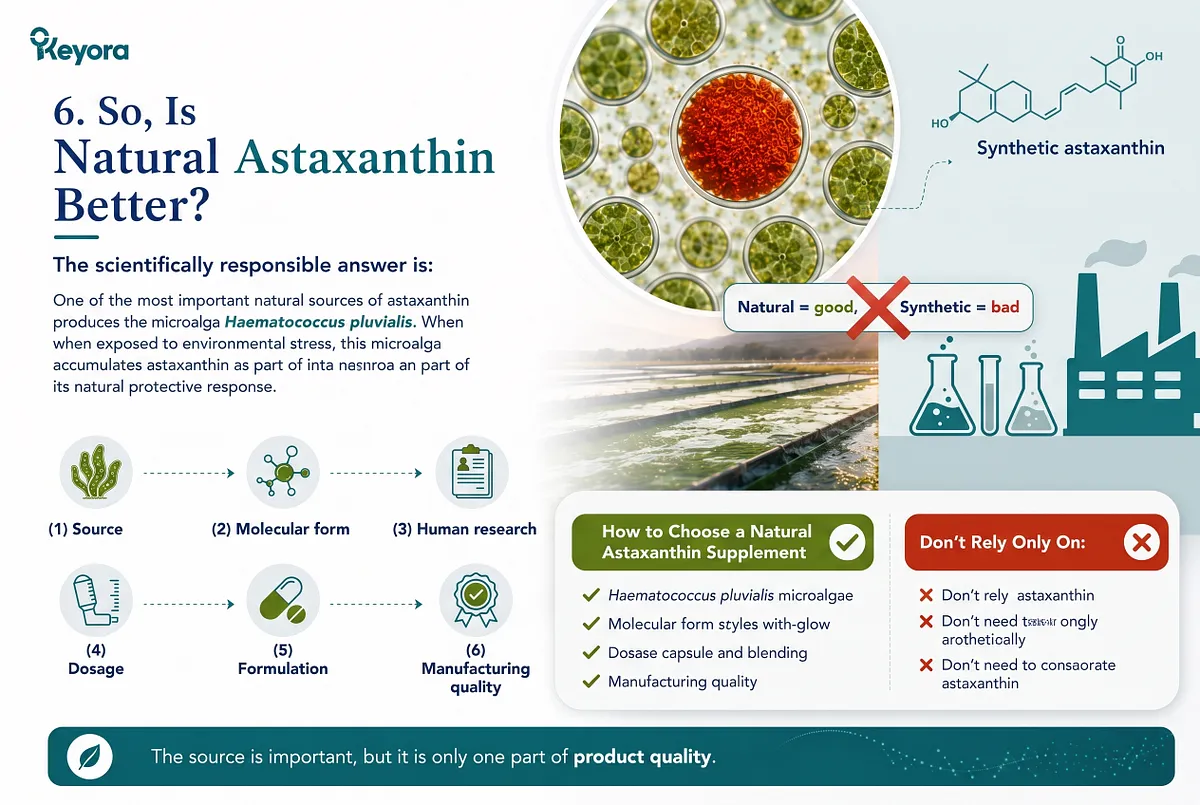
One of the most important natural sources of astaxanthin is the microalga Haematococcus pluvialis.
When exposed to environmental stress, this microalga accumulates astaxanthin as part of its natural protective response. Commercial production uses controlled cultivation to harness this process and produce astaxanthin-rich biomass or extracts.
This is why you may see:
Natural Astaxanthin from Haematococcus pluvialis
on supplement labels.
The important point is that “natural” should be connected to a specific, identifiable source.
A label that simply says “natural astaxanthin” without explaining where the ingredient comes from gives the consumer much less information.
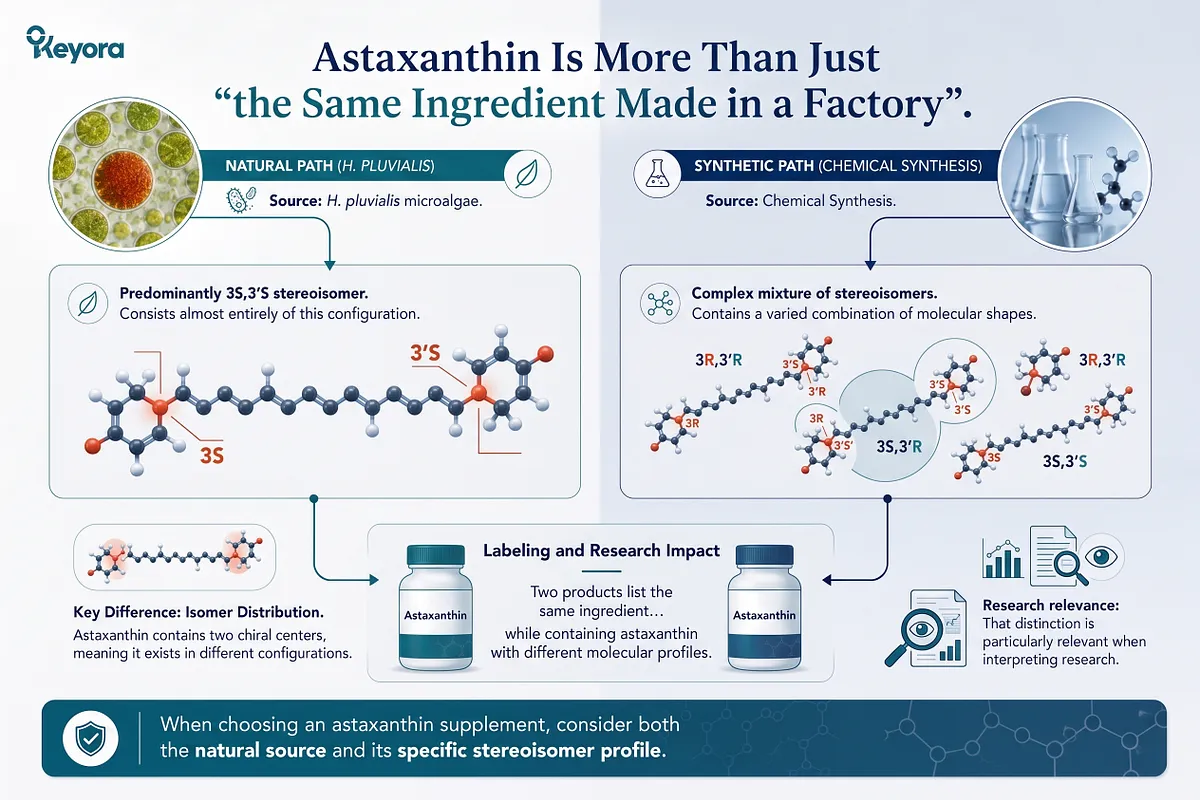
2. Synthetic Astaxanthin Is More Than Just “the Same Ingredient Made in a Factory”
Synthetic astaxanthin is produced through chemical synthesis.
One important difference is its stereoisomer distribution.
Astaxanthin contains two chiral centers, which means it can exist in different three-dimensional configurations.
Natural astaxanthin from H. pluvialis is predominantly the 3S,3′S stereoisomer, while conventional synthetic astaxanthin contains a mixture of stereoisomers.
This means that two products can both list:
Astaxanthin
on the label while containing astaxanthin with different molecular profiles.
That distinction becomes particularly relevant when interpreting research.
3. Why Do Stereoisomers Matter?
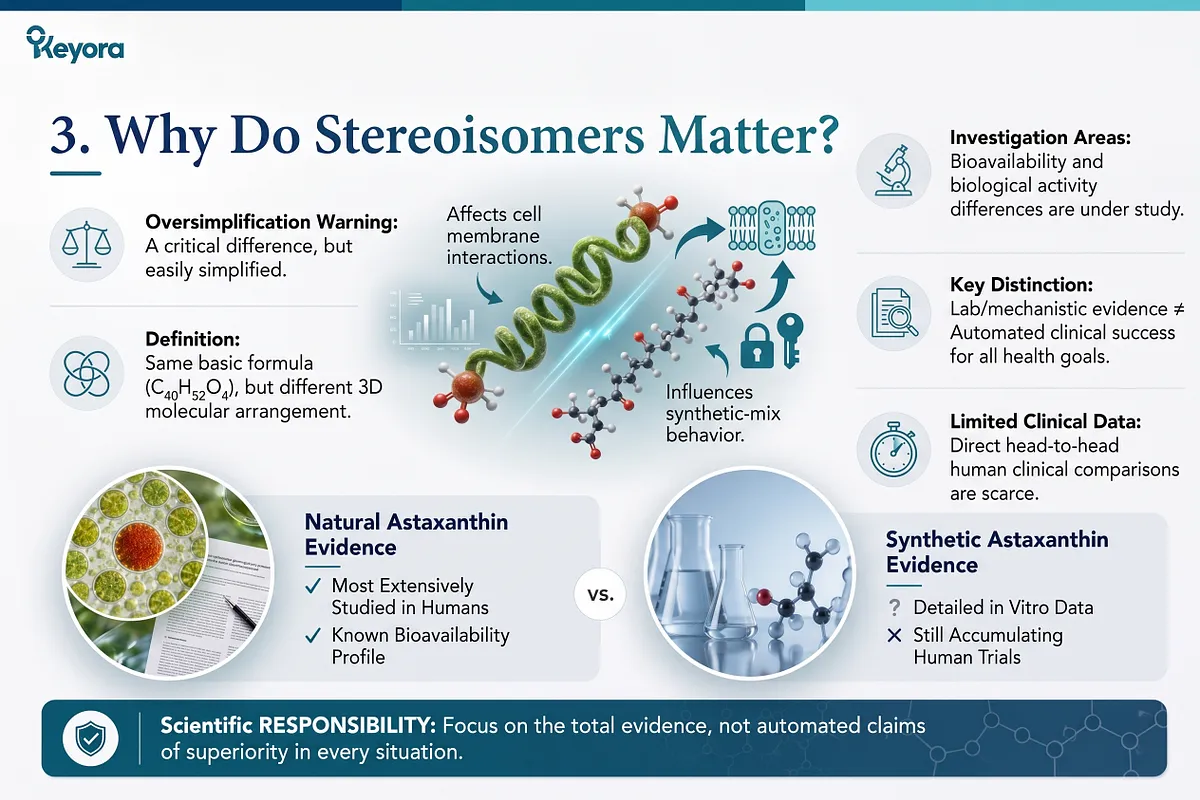
This is one of the most important differences between natural and synthetic astaxanthin, but also one that is easy to oversimplify.
A stereoisomer has the same basic chemical formula but a different three-dimensional arrangement.
For astaxanthin, these structural differences can influence how the molecule interacts with biological membranes and other molecules.
Research has investigated differences in the bioavailability and biological activity of different astaxanthin stereoisomers.
However, there is an important distinction:
Evidence that different stereoisomers behave differently in laboratory or mechanistic studies does not automatically mean that one source produces superior clinical outcomes for every human health goal.
Direct human head-to-head clinical comparisons between natural and synthetic astaxanthin remain limited.
That is why a scientifically responsible comparison should focus on the total evidence, rather than claiming that natural astaxanthin is automatically better in every situation.
4. What About Esterified vs. Free Astaxanthin?
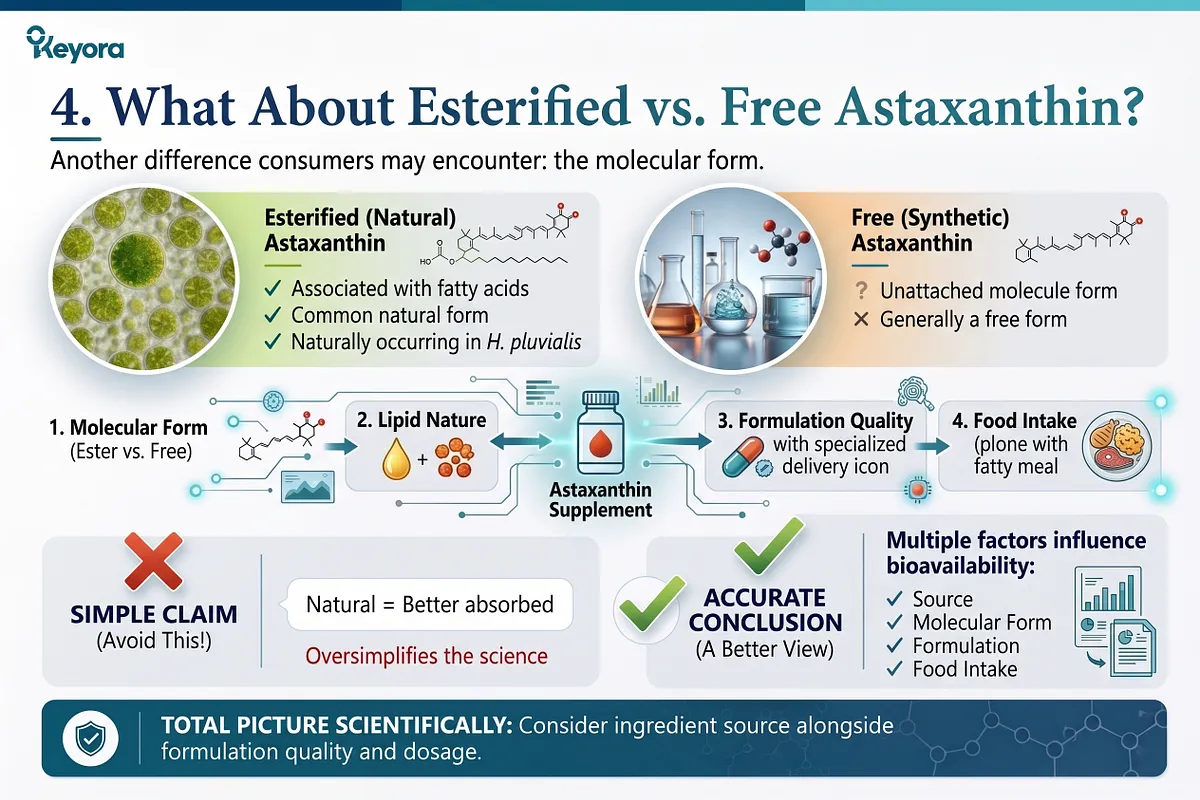
There is another difference consumers may encounter: the molecular form of astaxanthin.
Astaxanthin from H. pluvialis is commonly found naturally in esterified forms, where astaxanthin is associated with fatty acids. Synthetic astaxanthin is generally produced predominantly in a non-esterified or “free” form.
This matters because astaxanthin is a lipid-soluble carotenoid, and its absorption and bioavailability can be influenced by its physical and chemical form as well as by the formulation and food consumed with it.
But again, we should avoid turning this into an overly simple claim:
Natural = better absorbed.
The more accurate conclusion is:
Source, molecular form, formulation, and food intake can all influence astaxanthin bioavailability.
This is why ingredient source should be considered alongside formulation quality and dosage, rather than evaluated in isolation.
5. Which Form Has More Human Clinical Research?
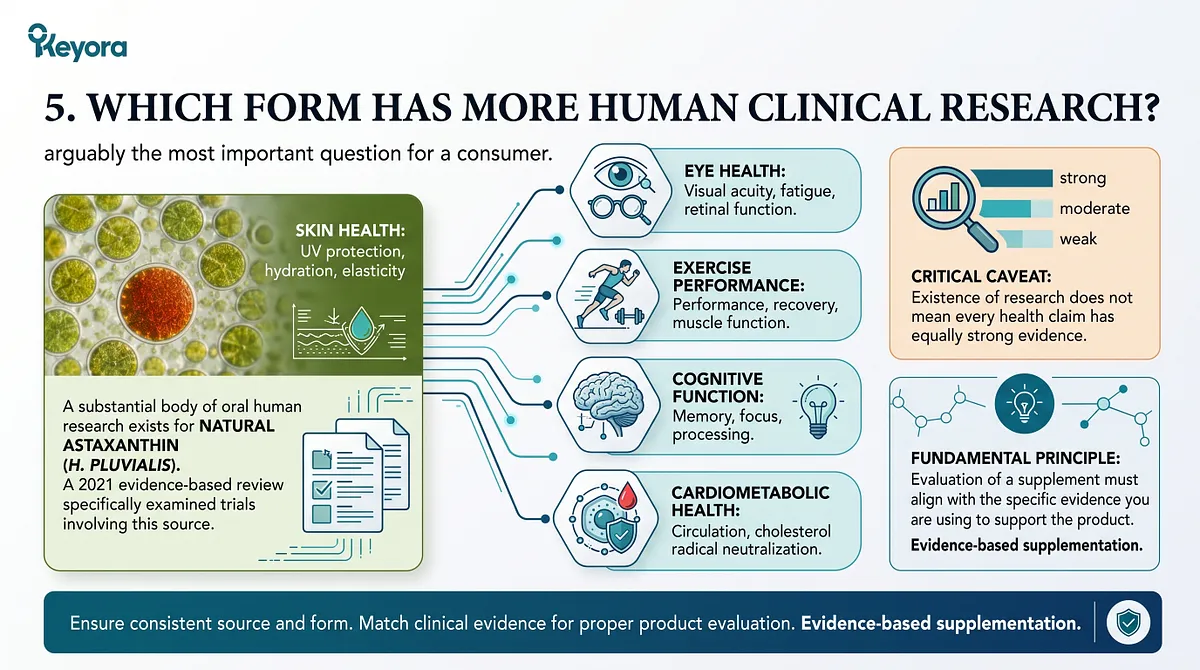
This is arguably the most important question for a consumer.
A substantial body of human research on oral astaxanthin has investigated naturally sourced astaxanthin, particularly astaxanthin derived from Haematococcus pluvialis. A 2021 evidence-based review specifically examined human clinical trials involving natural astaxanthin across several areas of health.
These studies have investigated areas including:
· Eye health
· Skin health
· Exercise and physical performance
· Cognitive function
· Cardiometabolic health
· Oxidative stress
The existence of this research does not mean every health claim has equally strong evidence.
Instead, the important point is:
When evaluating an astaxanthin supplement, the source and form of the ingredient should be consistent with the evidence you are using to support the product.
This is a fundamental principle of evidence-based supplementation.
6. So, Is Natural Astaxanthin Better?
The scientifically responsible answer is:
Natural astaxanthin has a stronger evidence base for human supplementation, but “natural” alone does not prove superior clinical effectiveness.
There are documented differences between natural and synthetic astaxanthin in terms of stereoisomer composition and molecular form. Research also suggests that these differences can influence biological activity and bioavailability.
But direct human clinical trials comparing natural and synthetic astaxanthin for specific health outcomes are limited.
Therefore, we would not recommend reducing the comparison to:
Natural = good
Synthetic = bad
A better framework is:
Source → Molecular form → Human research → Dosage → Formulation → Manufacturing quality
That gives consumers a much more meaningful way to evaluate an astaxanthin supplement.
How to Choose a Natural Astaxanthin Supplement
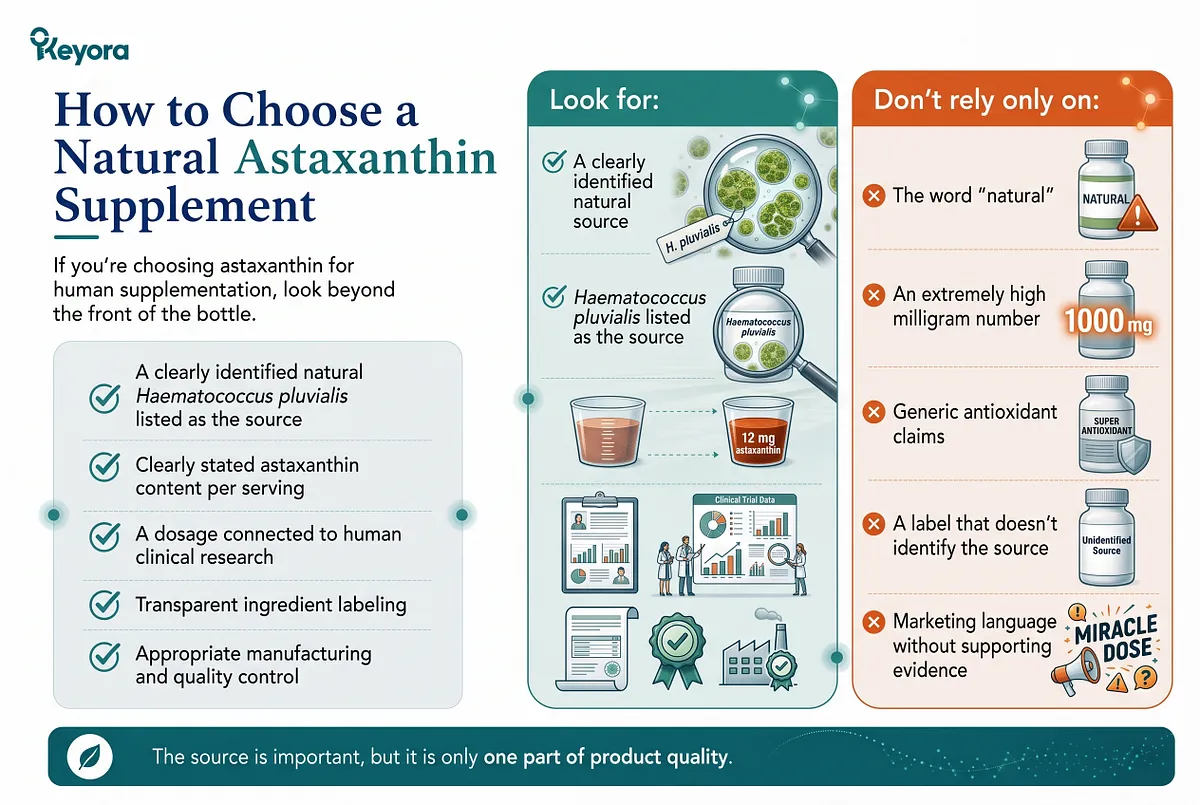
If you’re choosing astaxanthin for human supplementation, look beyond the front of the bottle.
Look for:
✔ A clearly identified natural source
✔ Haematococcus pluvialis listed as the source
✔ Clearly stated astaxanthin content per serving
✔ A dosage that can be connected to human clinical research
✔ Transparent ingredient labeling
✔ Appropriate manufacturing and quality control
Don’t rely only on:
✘ The word “natural”
✘ An extremely high milligram number
✘ Generic antioxidant claims
✘ A label that doesn’t identify the source
✘ Marketing language without supporting evidence
The source is important, but it is only one part of product quality.
Natural Astaxanthin: What Really Matters?
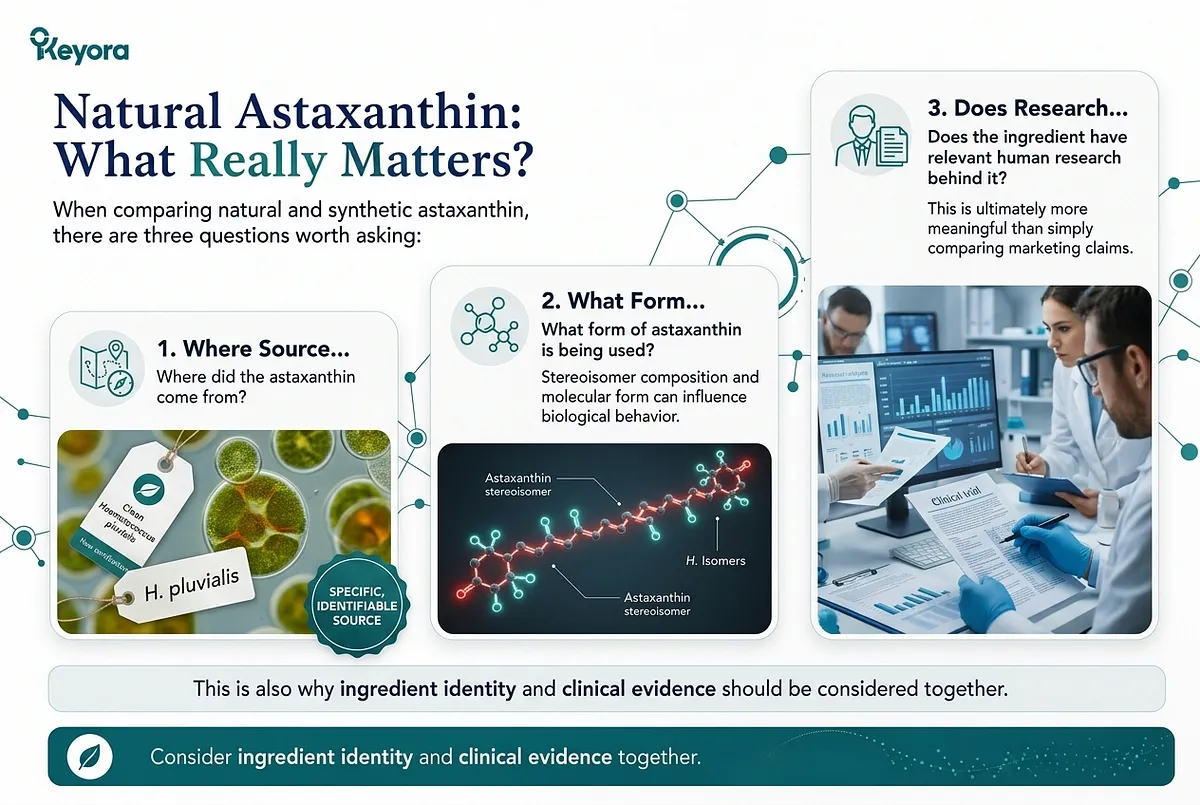
When comparing natural and synthetic astaxanthin, there are three questions worth asking:
1. Where did the astaxanthin come from?
A clearly identified source provides more information than simply stating “astaxanthin.”
2. What form of astaxanthin is being used?
Stereoisomer composition and molecular form can influence biological behavior.
3. Does the ingredient have relevant human research behind it?
This is ultimately more meaningful than simply comparing marketing claims.
This is also why ingredient identity and clinical evidence should be considered together.
The Keyora Takeaway
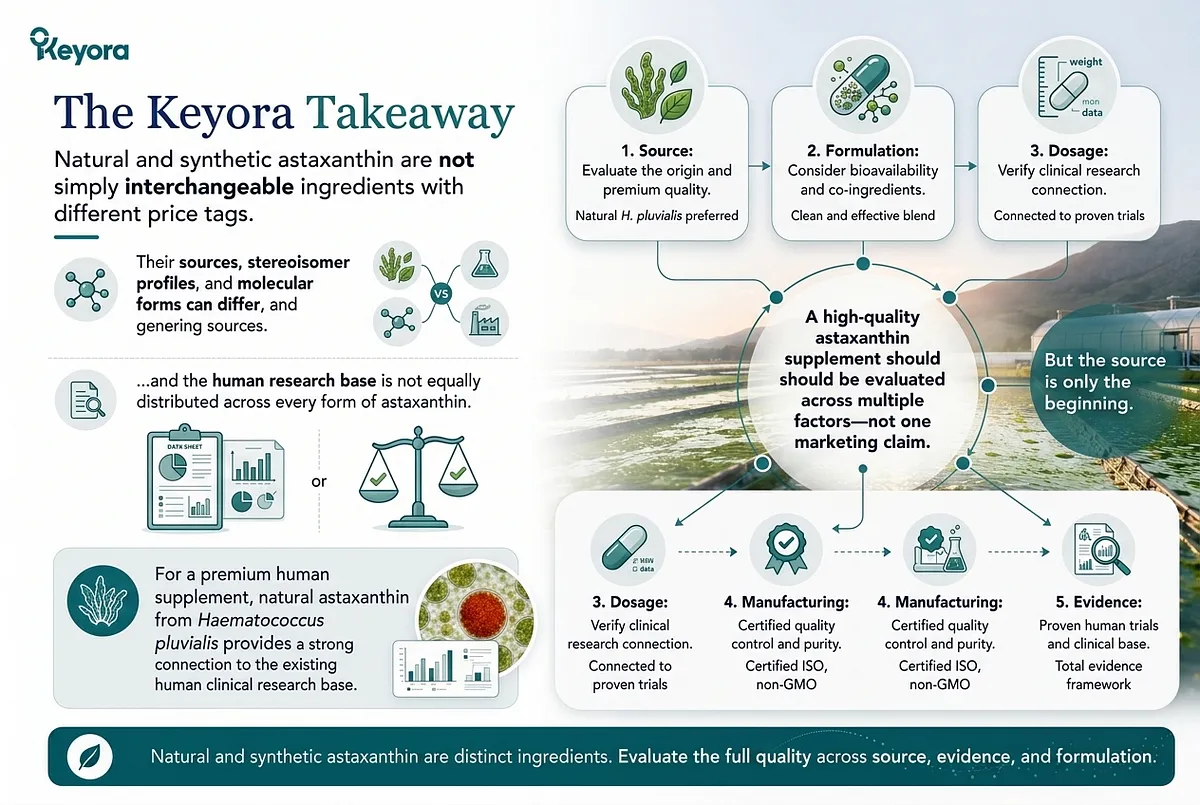
Natural and synthetic astaxanthin are not simply interchangeable ingredients with different price tags.
Their sources, stereoisomer profiles, and molecular forms can differ, and the human research base is not equally distributed across every form of astaxanthin.
For a premium human supplement, natural astaxanthin from Haematococcus pluvialis provides a strong connection to the existing human clinical research base.
But the source is only the beginning.
A high-quality astaxanthin supplement should be evaluated across source, formulation, dosage, manufacturing, and evidence—not one marketing claim.
FAQ
Is natural astaxanthin the same as synthetic astaxanthin?
No.
They contain the same basic astaxanthin molecule, but their stereoisomer composition and molecular forms can differ. Natural H. pluvialis astaxanthin is predominantly associated with the 3S,3′S stereoisomer, whereas conventional synthetic astaxanthin contains a mixture of stereoisomers.
Is Haematococcus pluvialis astaxanthin natural?
Yes.
Haematococcus pluvialis is a microalgal source of naturally produced astaxanthin and is one of the most important commercial sources of natural astaxanthin.
Is synthetic astaxanthin used in supplements?
Synthetic astaxanthin has been widely used in aquaculture and feed applications. Its suitability and regulatory status for human supplementation depend on the specific market and product, so consumers should check the ingredient source and applicable regulations.
Does natural astaxanthin automatically work better?
Not necessarily.
Natural and synthetic astaxanthin can differ in molecular characteristics, and research suggests these differences may affect biological activity and bioavailability. However, direct human head-to-head evidence is still limited.
Why is Haematococcus pluvialis commonly used for natural astaxanthin?
Because this microalga naturally accumulates high levels of astaxanthin when exposed to environmental stress, making it an important commercial source of natural astaxanthin.
Should I choose natural astaxanthin if I’m taking it as a supplement?
For consumers looking for a human supplement, natural astaxanthin—particularly from Haematococcus pluvialis—has a well-established connection to human clinical research. But source should still be evaluated together with dosage, formulation, manufacturing quality, and evidence.
Research First
At Keyora, we believe ingredient quality starts with knowing exactly what the ingredient is, where it comes from, and what evidence supports it.
That’s why we look beyond the word “astaxanthin.”
We consider:
Source → Molecular form → Dosage → Formulation → Manufacturing → Human clinical evidence
Because a premium supplement should be defined by what is behind the ingredient, not simply what is printed on the front of the bottle.
Evidence Note
This article is for educational purposes only and does not constitute medical advice.
Evidence for astaxanthin varies by health outcome, dosage, formulation, and source. Differences between natural and synthetic astaxanthin are well documented at the molecular level, but molecular differences should not automatically be interpreted as proof of superior clinical outcomes in humans.
For this reason, claims about natural versus synthetic astaxanthin should be based on the specific evidence available rather than broad statements that one form is universally superior.
Research Sources
1. Donoso A, González-Durán J, Agurto Muñoz A, et al.
Therapeutic uses of natural astaxanthin: An evidence-based review focused on human clinical trials.
Pharmacological Research. 2021;166:105479.
PubMed / Research record
2. Snell TW, Carberry J.
Astaxanthin Bioactivity Is Determined by Stereoisomer Composition and Extraction Method.
Nutrients. 2022;14(7):1522.
Full-text article on PMC
3. Biological and neurological activities of astaxanthin.
Review of astaxanthin structure, stereoisomers, antioxidant activity and biological mechanisms.
Full-text review on PMC
4. Astaxanthin: Sources, Extraction, Stability, Biological Activities and Its Commercial Applications—A Review.
Review covering natural sources, synthetic production, molecular forms and applications.
Full-text review on PMC