
What Does Omega-3/Omega-6 Balance Actually Mean for Cardiovascular Health?
Keyora Research Q&A Library
This is part of the Keyora Research Q&A Series, derived from Keyora Astaxanthin Research Journal Series.
Within the Keyora Astaxanthin Researcn framework, this Q&A translates complex astaxanthin biology into reader-friendly, evidence-bound answers, focusing on natural astaxanthin identity, molecular structure, antioxidant and redox mechanisms, membrane lipid interaction, mitochondrial resilience, inflammatory signaling pathways, human evidence interpretation, and the scientific principles behind responsible supplementation.
First published by Keyora Research Journal: www.keyorahealth.com

Direct Answer
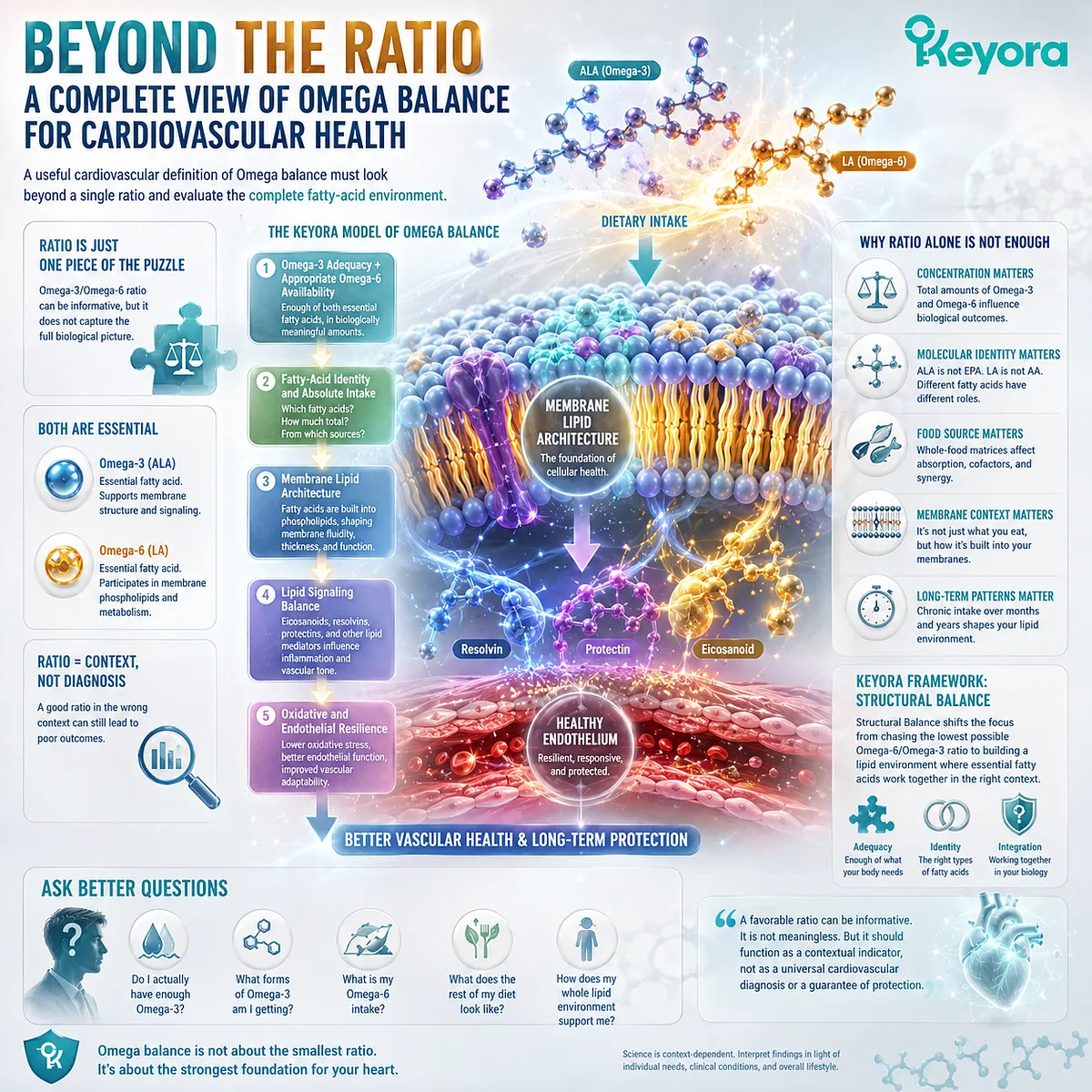
A useful cardiovascular definition of Omega balance must look beyond a single ratio and evaluate the complete fatty-acid environment
Omega-3/Omega-6 balance is often presented as if cardiovascular nutrition can be reduced to one target number: 4:1, 2:1, or even 1:1.
That idea is attractive because a ratio is simple, measurable, and easy to communicate. But human lipid biology is not controlled by one division problem.
For cardiovascular health, balance is better understood as the relationship between absolute fatty-acid intake, Omega-3 adequacy, Omega-6 adequacy, molecular identity, food source, and long-term lipid architecture.
A ratio may describe one part of that relationship, but it cannot tell us everything about the nutritional or biological environment.
This distinction matters because both fatty-acid families are physiologically important.
Alpha-linolenic acid (ALA) is an essential Omega-3 fatty acid, while linoleic acid (LA) is an essential Omega-6 fatty acid.
Both can participate in membrane phospholipids and broader lipid metabolism; neither should be treated as an unnecessary nutrient that cardiovascular health requires us to eliminate.
The more useful cardiovascular model is:
Omega-3 adequacy + appropriate Omega-6 availability
↓
Fatty-acid identity and absolute intake
↓
Membrane Lipid Architecture
↓
Lipid Signaling Balance
↓
Oxidative and Endothelial Resilience
Within the Keyora framework, this is Structural Balance.
It moves the discussion away from chasing the smallest possible Omega-6/Omega-3 number and toward building a lipid environment in which essential fatty acids are available in biologically meaningful amounts.
A favorable ratio can be informative.
It is not meaningless. But it should function as a contextual indicator, not as a universal cardiovascular diagnosis or a guarantee of protection.
The first question should therefore not be, “What is my ratio?”
It should be:
Do I actually have enough Omega-3, what forms am I getting, and what does the rest of my dietary fat environment look like?
Why Did the Omega-6/Omega-3 Ratio Become So Popular?
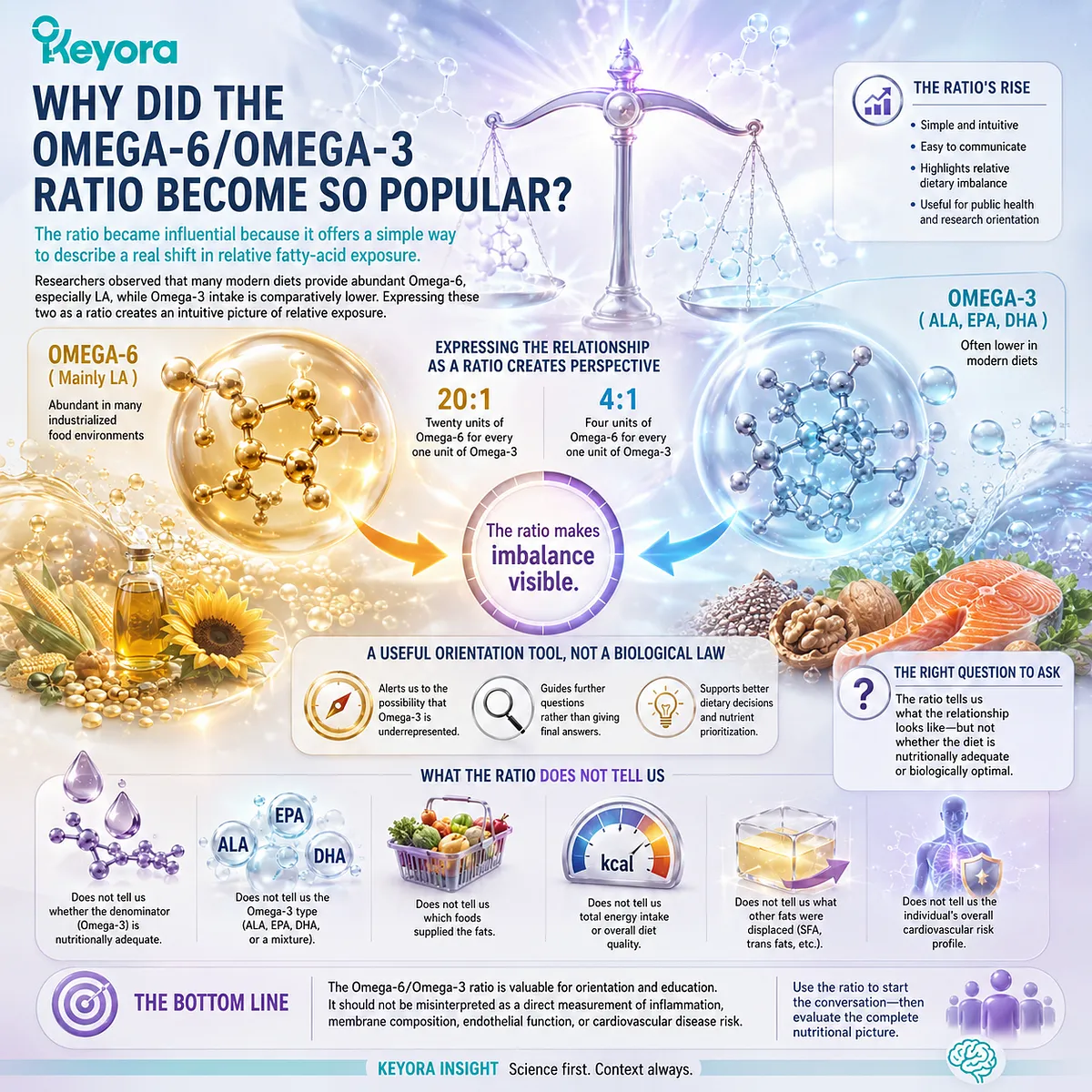
The ratio became influential because it offers a simple way to describe a real shift in relative fatty-acid exposure
The Omega-6/Omega-3 ratio did not appear from nowhere.
It became popular because nutrition researchers were trying to describe a meaningful change in dietary fatty-acid patterns: many industrialized food environments provide abundant sources of Omega-6, especially LA, while Omega-3 intake may be comparatively lower.
Expressing those two quantities as a ratio creates an intuitive picture of relative exposure.
If a diet supplies twenty units of Omega-6 for every one unit of Omega-3, that describes a very different relationship from four units to one. This is why lower n-6:n-3 patterns have historically attracted attention in research on cardiovascular, inflammatory, and metabolic health.
The Keyora ALA source materials emphasize this perspective strongly.
They describe LA/ALA ranges around 2:1–4:1 as a structural reference and use the concept to highlight the need to increase Omega-3 availability rather than simply accept the high relative Omega-6 exposure common in modern diets.
That framework has an important educational value: it makes imbalance visible.
But the strength of a ratio is also its weakness. By compressing two dietary variables into one number, it removes information.
A ratio does not tell you whether the denominator is nutritionally adequate.
It does not tell you whether the Omega-3 consists mainly of ALA, EPA, DHA, or a mixture.
It does not tell you which foods supplied the fats, how much energy was consumed, what saturated or trans fats were displaced, or what the person’s overall cardiovascular risk profile looks like.
Therefore, the ratio is best treated as an orientation tool.
It can alert us to the possibility that Omega-3 is underrepresented in the dietary lipid environment.
It should not automatically be interpreted as a direct measurement of inflammation, membrane composition, endothelial function, or cardiovascular disease risk.
That distinction allows us to keep what is useful about the ratio without turning it into a biological law.
Why Can the Same Ratio Represent Very Different Diets?
Two diets can produce exactly the same Omega ratio while delivering very different absolute amounts, foods, and biological substrates
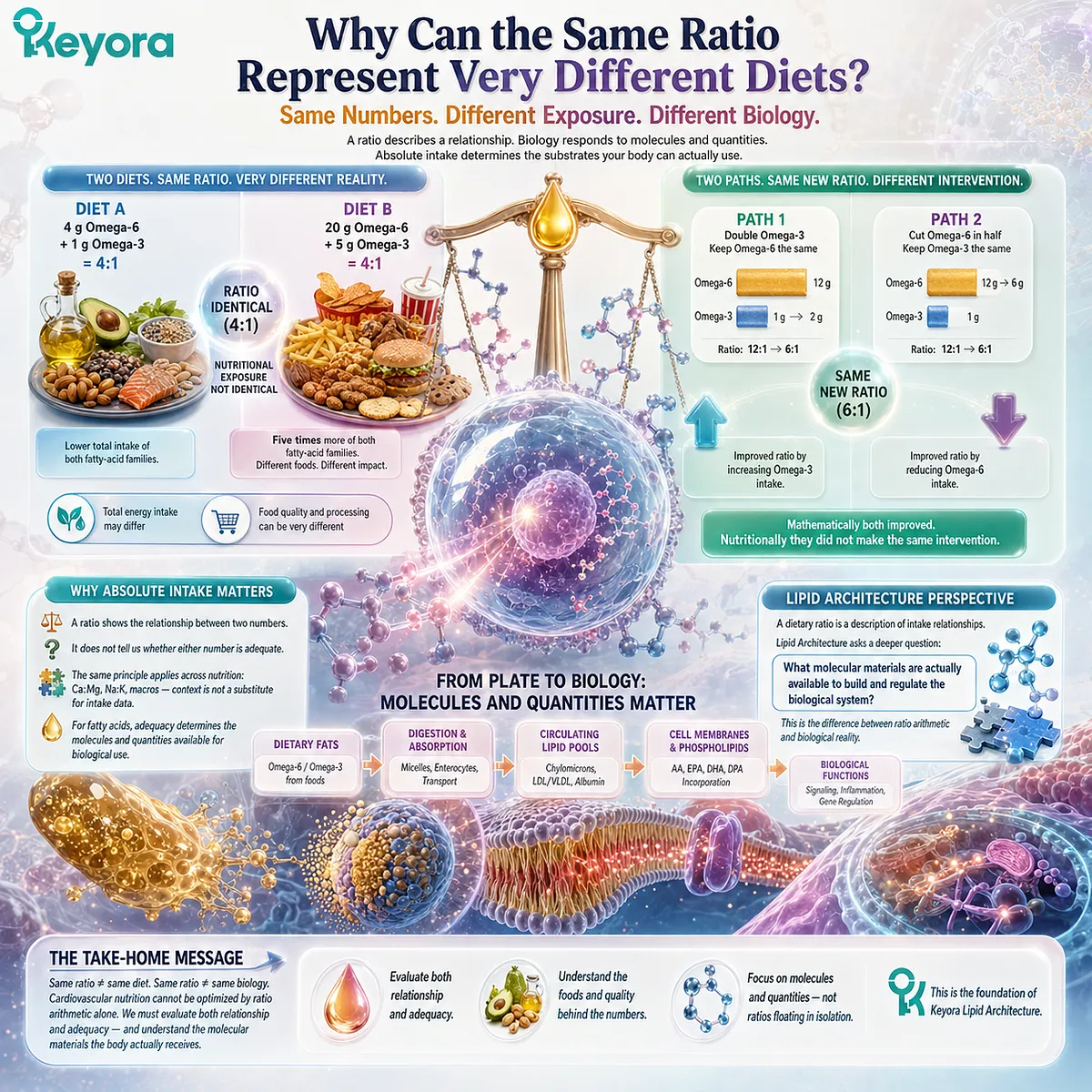
Consider two hypothetical diets.
Diet A provides:
4 g Omega-6 + 1 g Omega-3 = 4:1
Diet B provides:
20 g Omega-6 + 5 g Omega-3 = 4:1
The ratio is identical.
The nutritional exposure is not.
The second diet supplies five times as much of both fatty-acid families.
Total energy intake may also be different, and the foods supplying those fats could range from minimally processed nuts, seeds, fish, and plant oils to a very different processed-food pattern.
Now consider another example.
A person with a 12:1 ratio could reduce it to 6:1 by doubling Omega-3 intake while keeping Omega-6 stable.
Another person could reach exactly the same 6:1 ratio by cutting Omega-6 intake in half while leaving an already inadequate Omega-3 intake unchanged.
Mathematically, both improved their ratio.
Nutritionally, they did not make the same intervention.
This is why absolute intake matters.
A ratio tells us the relationship between two numbers, but it does not tell us whether either number is adequate.
The same principle applies across nutrition: calcium-to-magnesium relationships, sodium-to-potassium patterns, or macronutrient percentages may offer useful context, but none automatically replaces the underlying intake data.
For cardiovascular lipid biology, the distinction becomes even more important because fatty acids become biological substrates.
They may enter circulating lipid pools, become incorporated into phospholipids, or participate in metabolic pathways. The body therefore encounters molecules and quantities – not ratios floating independently in the bloodstream.
This is one of the central ideas behind Keyora Lipid Architecture.
A dietary ratio is a description of intake relationships.
Lipid Architecture asks a deeper question:
What molecular materials are actually available to build and regulate the biological system?
Once that distinction is understood, it becomes much easier to see why cardiovascular nutrition cannot be optimized by ratio arithmetic alone.
Why Does Absolute Omega-3 Intake Matter More Than a Good-Looking Ratio?
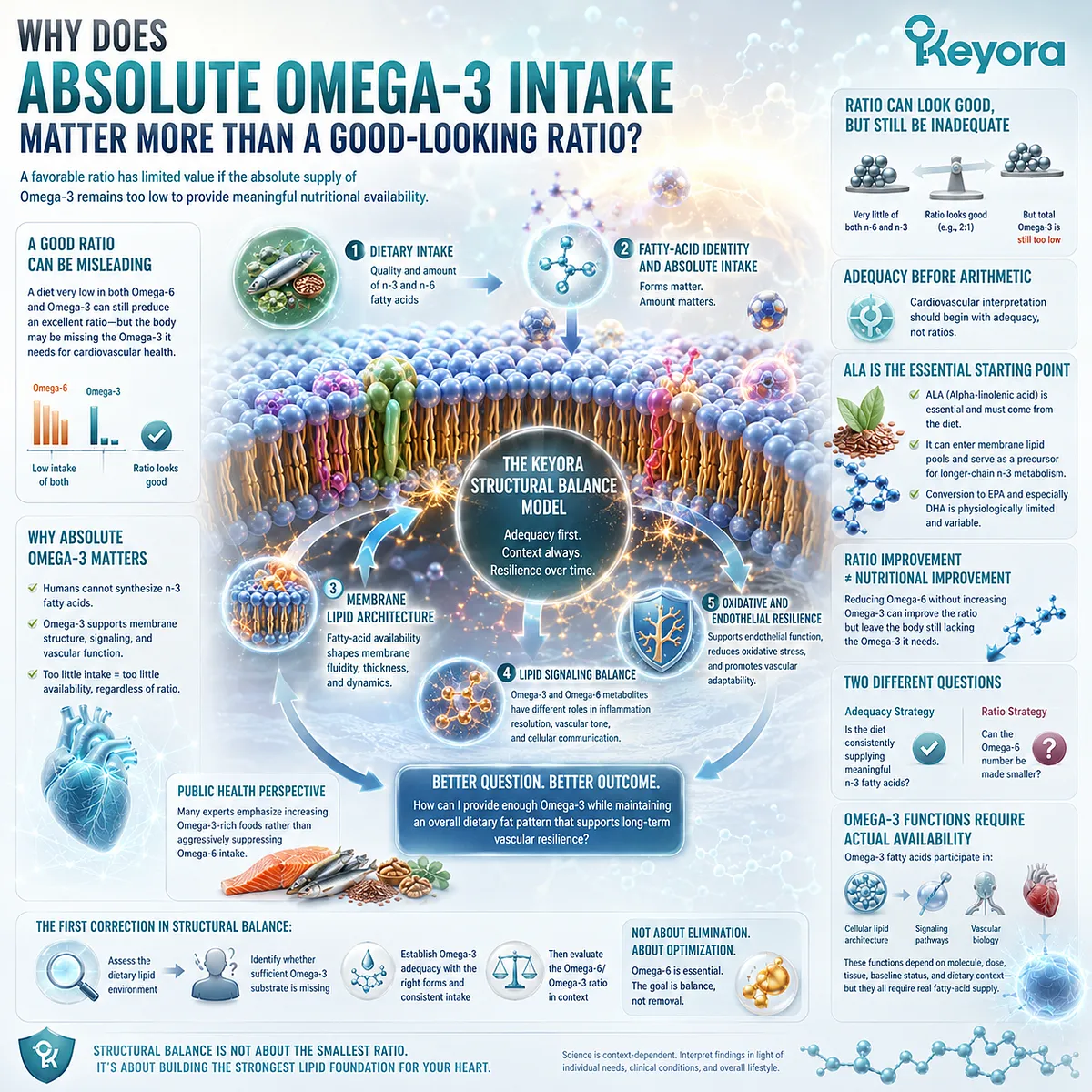
A favorable ratio has limited value if the absolute supply of Omega-3 remains too low to provide meaningful nutritional availability
Imagine a diet containing very little of both essential fatty-acid families. Its Omega-6/Omega-3 ratio could appear excellent, yet the person could still have inadequate Omega-3 intake.
This is why cardiovascular interpretation should begin with adequacy before arithmetic.
ALA is especially relevant because humans cannot synthesize it and must obtain it from the diet. It is the essential dietary starting point of the n-3 family and can enter membrane lipid pools while also serving as a precursor for longer-chain n-3 metabolism.
Conversion toward EPA and especially DHA is physiologically limited and variable, so the presence of ALA does not make all Omega-3 forms interchangeable.
If someone reduces Omega-6 aggressively but does nothing to improve an insufficient Omega-3 supply, the ratio may improve without adequately correcting the missing substrate.
That is a crucial difference.
A cardiovascular strategy based on Omega-3 adequacy asks:
Is the diet consistently supplying meaningful n-3 fatty acids?
A strategy based only on ratio reduction asks:
Can the Omega-6 number be made smaller?
These are not the same nutritional objective.
The broader cardiovascular relevance comes from the fact that Omega-3 fatty acids participate in cellular lipid architecture, signaling pathways, and vascular biology.
The exact effects depend on the molecule, dose, tissue, baseline status, and dietary context, but these functions require actual fatty-acid availability.
A small denominator cannot be rescued simply because the numerator has also been made small.
This is why some public-health approaches have emphasized increasing Omega-3-rich foods rather than aggressively suppressing Omega-6 intake.
Within Keyora Structural Balance, the first correction is therefore not automatically “remove Omega-6.”
It is:
Identify whether the lipid environment is missing sufficient Omega-3 substrate.
Only after adequacy is established does the ratio become more informative.
The cardiovascular question then changes from “How low can I push the ratio?” to the more useful question:
How can I provide enough Omega-3 while maintaining an overall dietary fat pattern that supports long-term vascular resilience?
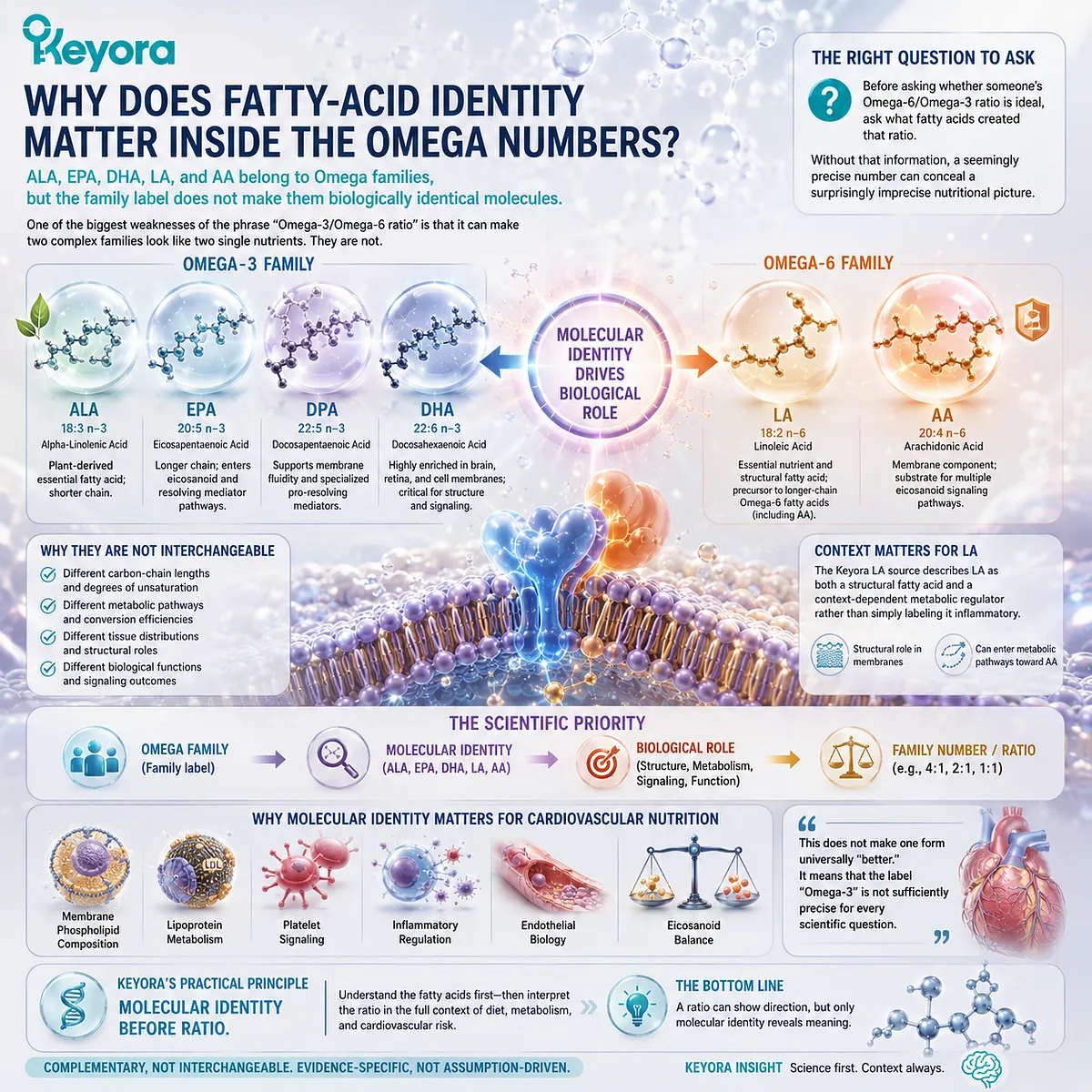
Why Does Fatty-Acid Identity Matter Inside the Omega Numbers?
ALA, EPA, DHA, LA, and AA belong to Omega families, but the family label does not make them biologically identical molecules
One of the biggest weaknesses of the phrase “Omega-3/Omega-6 ratio” is that it can make two complex families look like two single nutrients.
They are not.
Within the Omega-3 family, ALA, EPA, DPA, and DHA have different carbon-chain lengths, degrees of unsaturation, metabolic fates, tissue distributions, and biological roles.
Within the Omega-6 family, LA and arachidonic acid (AA) are likewise not interchangeable.
LA is an essential nutrient and an important structural lipid.
It can be incorporated into phospholipids and also enter metabolic pathways leading toward AA.
AA itself participates in membrane structure and serves as a substrate for multiple eicosanoid signaling pathways.
The Keyora LA source therefore describes LA as both a structural fatty acid and a context-dependent metabolic regulator rather than simply labeling it inflammatory.
This molecular distinction also changes how we interpret “2 grams of Omega-3.”
Two grams of ALA is not biologically equivalent to two grams of EPA plus DHA.
ALA contributes directly to the n-3 dietary environment and can undergo elongation and desaturation, but only a portion is converted to longer-chain n-3 fatty acids. EPA and DHA enter different metabolic and structural pools more directly.
Therefore:
Omega family → molecular identity → biological role
must come before:
family number → ratio
For cardiovascular nutrition, molecular identity matters because different fatty acids can contribute differently to membrane phospholipid composition, lipoprotein metabolism, platelet signaling, inflammatory regulation, and endothelial biology.
This does not make one form universally “better.” It means that the label “Omega-3” is not sufficiently precise for every scientific question.
Keyora’s practical principle here is:
Molecular Identity Before Ratio.
Before asking whether someone’s Omega-6/Omega-3 ratio is ideal, ask what fatty acids created that ratio.
Without that information, a seemingly precise number can conceal a surprisingly imprecise nutritional picture.
Should Cardiovascular Health Require a Specific 2:1 or 4:1 Ratio?
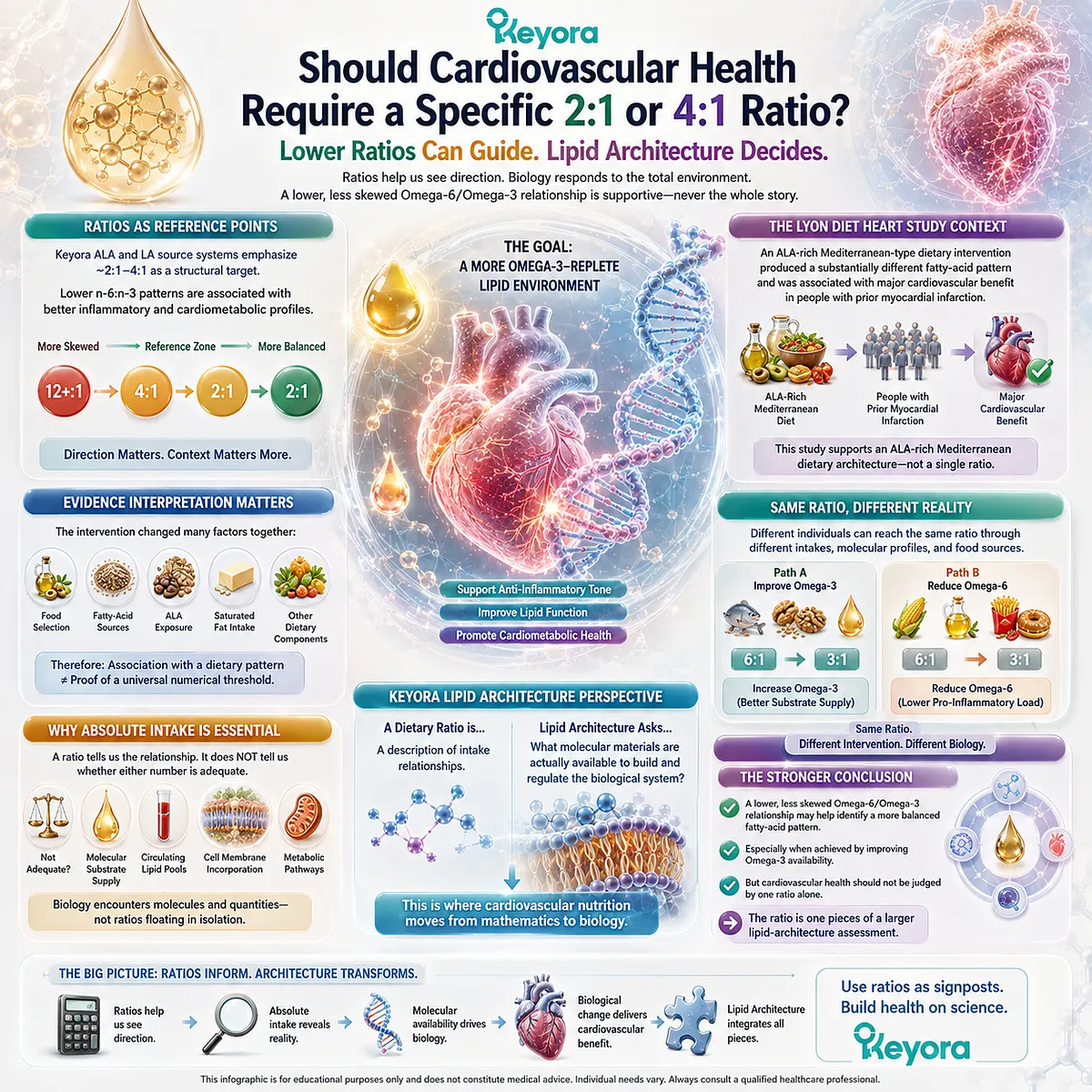
Lower ratios can be useful reference points, but current cardiovascular interpretation should not treat one number as a universal biological threshold
Ratios such as 2:1 or 4:1 appear frequently in discussions of essential fatty-acid balance.
The Keyora ALA and LA source systems both emphasize approximately 2:1–4:1 as a structural target and connect lower n-6:n-3 patterns with improved inflammatory and cardiometabolic conditions.
These numbers have value as nutritional reference points.
They illustrate how different a more Omega-3-replete lipid environment can look compared with highly skewed patterns in which Omega-3 is poorly represented.
The Lyon Diet Heart Study is also commonly discussed in this context because an ALA-rich Mediterranean-type dietary intervention produced a substantially different fatty-acid pattern and was associated with major cardiovascular benefit in people with prior myocardial infarction.
But evidence interpretation matters.
The intervention did not manipulate one isolated ratio while keeping everything else identical. It changed the overall dietary pattern: food selection, fatty-acid sources, ALA exposure, saturated-fat intake, and other components changed together.
Therefore, the study supports the cardiovascular relevance of an ALA-rich Mediterranean dietary architecture.
It does not prove that achieving exactly 4:1 independently produced the entire clinical effect.
This distinction protects the science from an easy mistake:
Association with a dietary pattern ≠ proof of a universal numerical threshold.
Different individuals may also reach the same ratio through different absolute intakes, molecular profiles, and food sources.
For this reason, Keyora can retain 2:1–4:1 as a useful structural reference without presenting it as a rigid cardiovascular commandment.
The stronger conclusion is:
A lower, less skewed Omega-6/Omega-3 relationship may help identify a more balanced fatty-acid pattern, especially when achieved by improving Omega-3 availability.
But cardiovascular health should not be judged by one ratio alone.
That turns the ratio from a marketing number into what it should be:
one piece of a larger lipid-architecture assessment.
Does Improving Omega Balance Mean Cutting Omega-6?
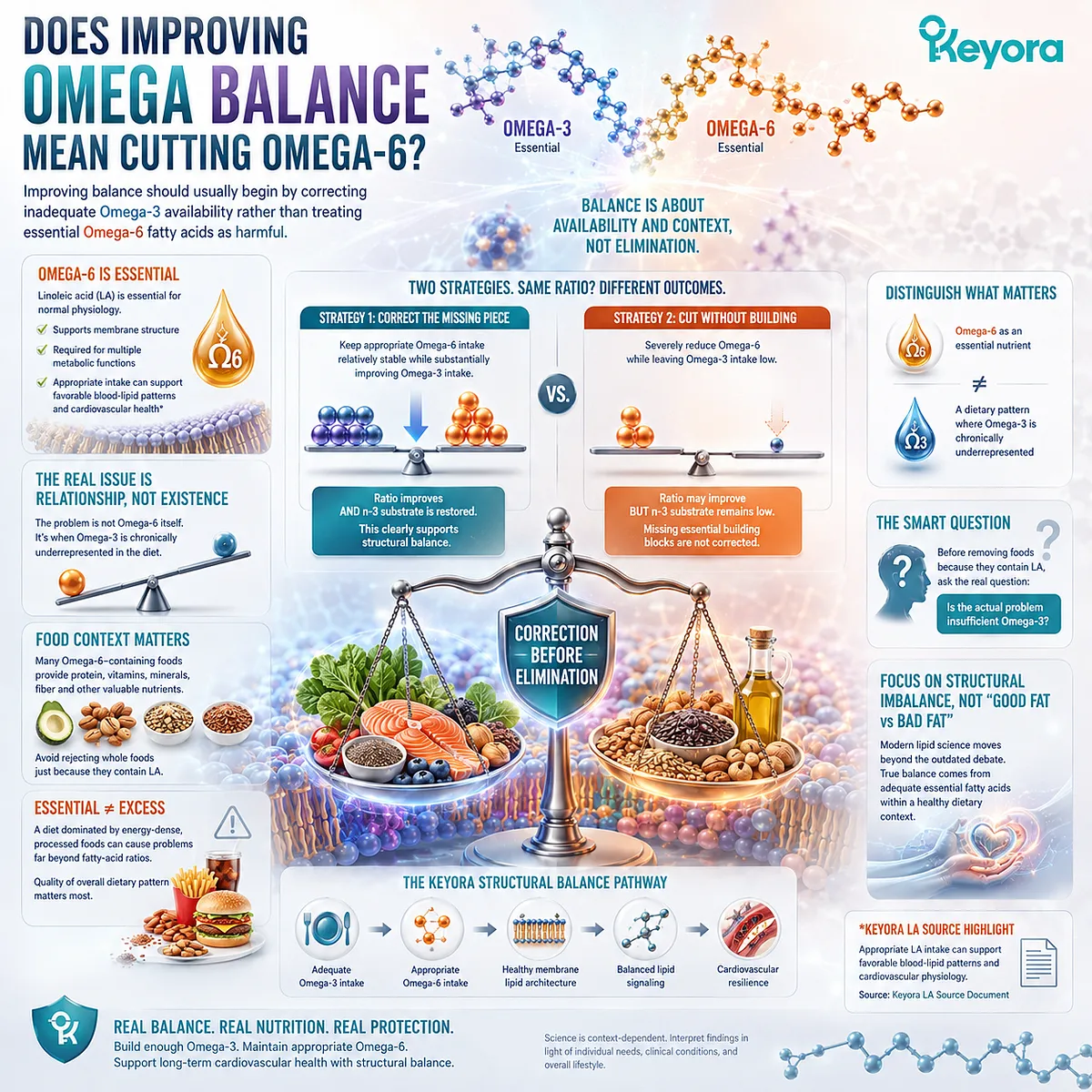
Improving balance should usually begin by correcting inadequate Omega-3 availability rather than treating essential Omega-6 fatty acids as harmful
If someone hears that modern diets can have a high Omega-6/Omega-3 ratio, the intuitive response is often:
“Then I should eat as little Omega-6 as possible.”
That conclusion is too simplistic.
LA is an essential fatty acid. The body requires it for normal physiology, including membrane structure and multiple metabolic functions.
The Keyora LA source also notes that appropriate LA intake can support favorable blood-lipid patterns and cardiovascular physiology.
The problem is therefore not the existence of Omega-6.
It is the relationship between fatty-acid availability and dietary context.
Imagine two strategies.
The first keeps appropriate Omega-6 intake relatively stable but substantially improves Omega-3 intake.
The second severely reduces Omega-6 while leaving Omega-3 intake low.
Both may lower the mathematical ratio.
Only the first clearly corrects the missing n-3 substrate.
This is why the Keyora approach is better described as:
Correction Before Elimination.
Before removing foods simply because they contain LA, ask whether the actual nutritional problem is insufficient Omega-3.
This also prevents another form of dietary confusion.
Many foods containing Omega-6 provide protein, vitamins, minerals, fiber, or other valuable nutrients. Treating the presence of LA as a reason to reject the entire food can produce a less balanced diet rather than a better one.
At the same time, this does not mean Omega-6 quantity and food source are irrelevant. A dietary pattern dominated by energy-dense processed foods can create problems that extend far beyond fatty-acid ratios.
The important point is that cardiovascular nutrition should distinguish:
Omega-6 as an essential nutrient
from
an overall dietary pattern in which Omega-3 is chronically underrepresented.
That distinction keeps the discussion focused on genuine structural imbalance instead of recreating the same “good fat versus bad fat” mistake that modern lipid science should be moving beyond.
Why Does Replacement Context Change the Cardiovascular Meaning of Dietary Fat?
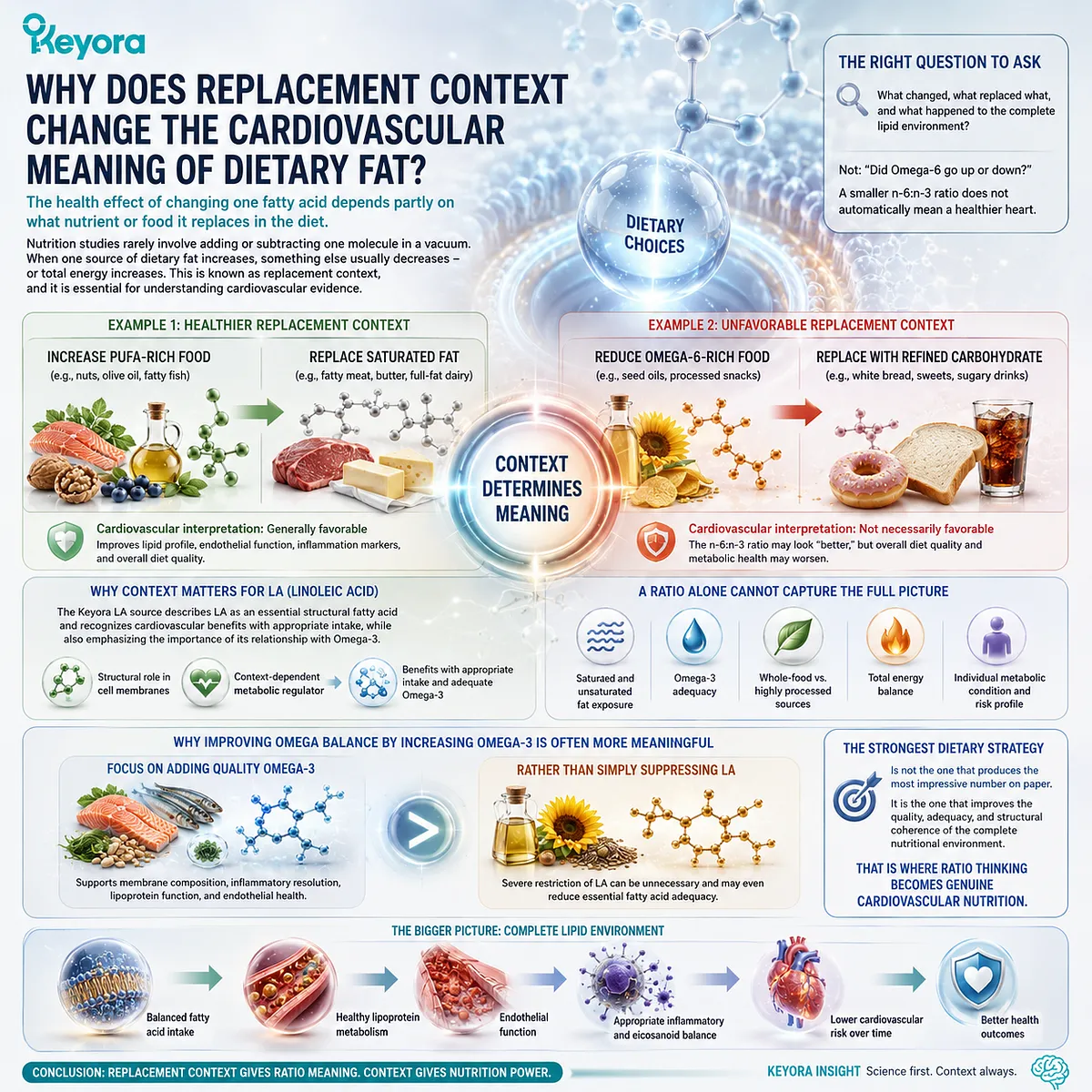
The health effect of changing one fatty acid depends partly on what nutrient or food it replaces in the diet
Nutrition studies rarely involve adding or subtracting one molecule in a vacuum. When one source of dietary fat increases, something else usually decreases – or total energy increases.
This is known as replacement context, and it is essential for understanding cardiovascular evidence.
Suppose a person increases a PUFA-rich food while reducing saturated fat. The cardiovascular interpretation is different from adding the same amount of PUFA to an already energy-excessive diet without replacing anything.
Likewise, reducing an Omega-6-rich food and replacing it with refined carbohydrate does not automatically improve cardiovascular nutrition simply because the n-6:n-3 ratio becomes smaller.
The ratio may look “better” while the overall diet becomes worse.
This is one reason the Keyora LA source can simultaneously describe LA as an essential structural fatty acid and note cardiovascular benefits with appropriate intake, while also emphasizing the importance of its relationship with Omega-3.
These statements are not contradictory when context is included.
The meaningful question is not:
“Did Omega-6 go up or down?”
It is:
What changed, what replaced what, and what happened to the complete lipid environment?
For cardiovascular health, this means evaluating dietary fat within the larger architecture of:
-
saturated and unsaturated fat exposure,
-
Omega-3 adequacy,
-
whole-food versus highly processed sources,
-
total energy balance,
-
and the metabolic condition of the individual.
A ratio alone cannot capture those relationships.
This is also why improving Omega balance through increased Omega-3 availability may be more biologically meaningful than simply trying to suppress LA intake.
The strongest dietary strategy is usually not one that produces the most impressive number on paper.
It is one that improves the quality, adequacy, and structural coherence of the complete nutritional environment.
That is the point where ratio thinking becomes genuine cardiovascular nutrition.
How Should You Judge Omega Balance for Cardiovascular Health in Practice?
The most useful approach evaluates adequacy, molecular identity, replacement context, and lipid architecture before deciding whether a ratio is truly meaningful
A practical cardiovascular assessment of Omega balance can begin with five questions.
First: Is Omega-3 intake actually adequate?
Do not assume that a low ratio automatically answers this question. A favorable number can still coexist with a low absolute Omega-3 intake.
Second: Which Omega-3 fatty acids are present?
ALA is an essential Omega-3 and an important part of dietary n-3 architecture, but ALA, EPA, DPA, and DHA should not be treated as identical molecules.
Third: What is the Omega-6 context?
LA is essential. The goal is not to drive it toward zero. Instead, determine whether the overall diet has become heavily skewed toward Omega-6 while Omega-3 remains underrepresented.
Fourth: What is being replaced?
Increasing unsaturated fats at the expense of saturated or trans fats is nutritionally different from simply adding more dietary fat. Likewise, lowering LA while replacing it with refined carbohydrate is not automatically an improvement.
Fifth: What does the complete lipid architecture look like?
This is where Keyora Structural Balance becomes more useful than ratio chasing.
The cardiovascular pathway should be understood as:
Adequate fatty-acid intake
↓
Appropriate molecular diversity
↓
Lipid Architecture
↓
Lipid Signaling Balance
↓
Oxidative Resilience
↓
Endothelial Resilience
A ratio can contribute information at the beginning of that pathway. It cannot represent the entire pathway.
The most useful conclusion is therefore simple:
Do not chase the smallest Omega-6/Omega-3 number. Build a fatty-acid environment in which Omega-3 is adequately represented and the overall dietary pattern supports cardiovascular resilience.
This reframes Omega balance from a numerical competition into a nutritional architecture problem.
And it prepares the next question in the EP-3 knowledge chain:
If dietary fatty acids matter because they eventually become part of biological structure, why are fatty acids so important for cell membranes in the first place?

This article is for educational and informational purposes only. It does not provide medical advice, diagnosis, treatment, cure, prevention, disease outcome claims, hormone restoration claims, fertility outcome claims, or formula-specific clinical efficacy claims.