
Do “Premium,” “Clinical,” and “Pharmaceutical Grade” Prove Quality?
Keyora Research Q&A Library
This is part of the Keyora Research Q&A Series, derived from Keyora Astaxanthin Research Journal Series.
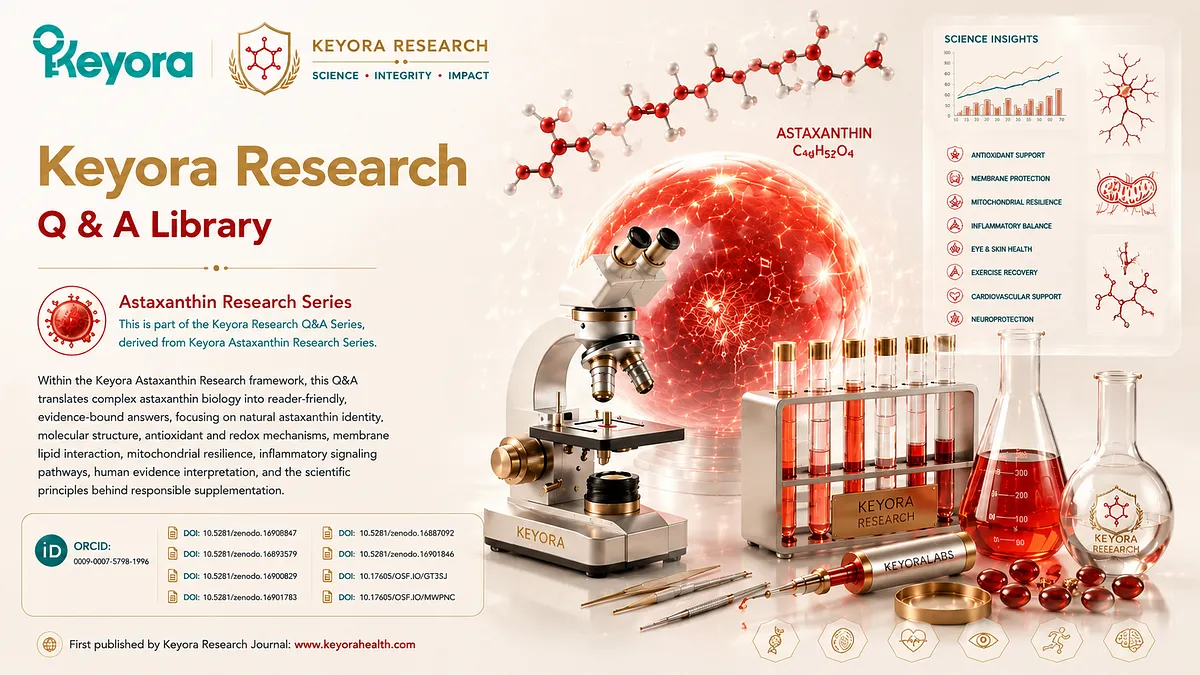
Within the Keyora Astaxanthin Researcn framework, this Q&A translates complex astaxanthin biology into reader-friendly, evidence-bound answers, focusing on natural astaxanthin identity, molecular structure, antioxidant and redox mechanisms, membrane lipid interaction, mitochondrial resilience, inflammatory signaling pathways, human evidence interpretation, and the scientific principles behind responsible supplementation.
First published by Keyora Research Journal: www.keyorahealth.com
Direct Answer
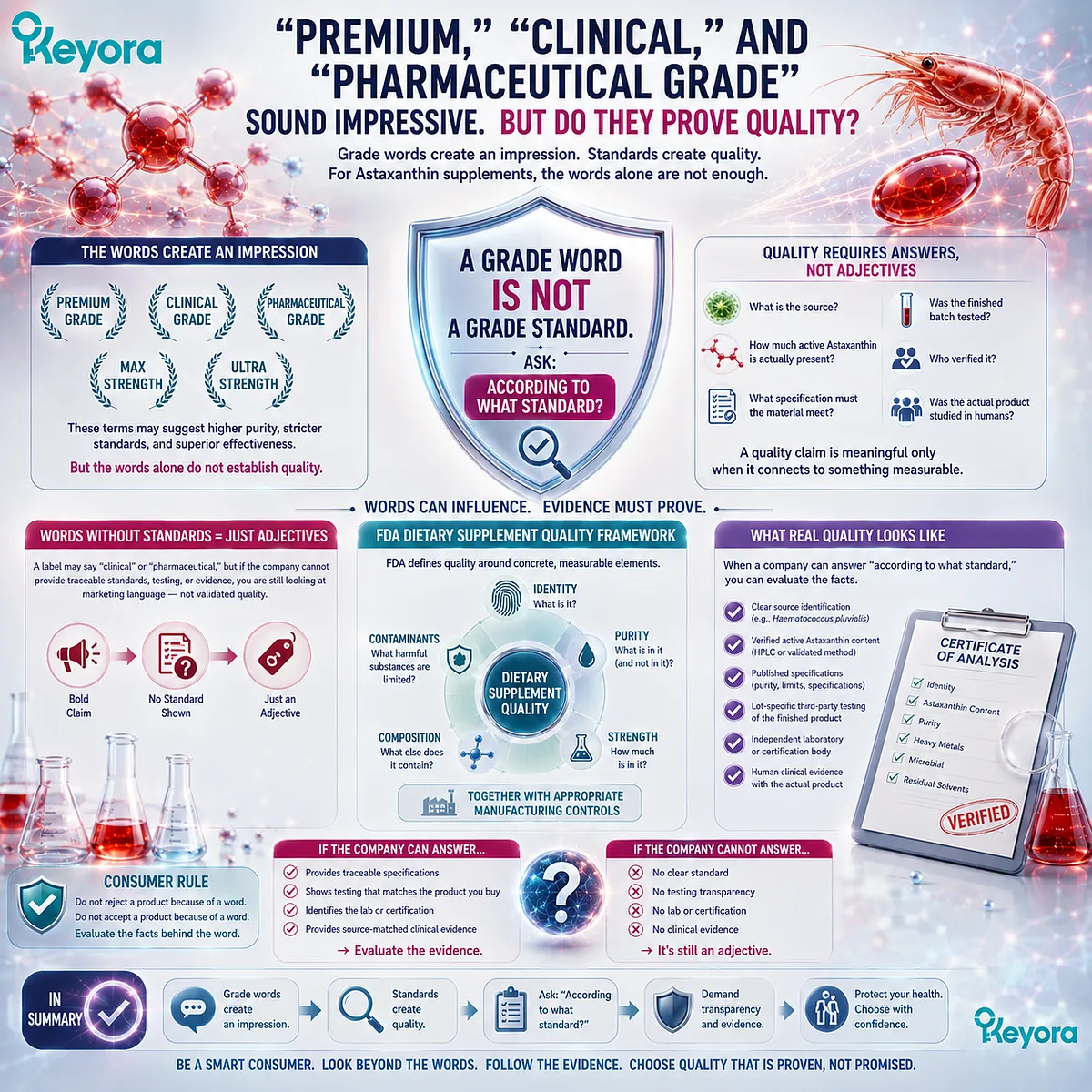
“Premium,” “Clinical,” and “Pharmaceutical Grade” may sound authoritative, but the words alone do not establish the quality of an Astaxanthin supplement.
No.
Not by themselves.
Terms such as “Premium Grade,” “Clinical Grade,” “Pharmaceutical Grade,” “Max Strength,” and “Ultra Strength” can create a powerful impression of scientific authority.
Consumers may reasonably assume that these phrases represent a recognized purity level, regulatory category, manufacturing standard, clinical evidence threshold, or independent certification.
But the words alone do not tell you any of those things.
For an Astaxanthin supplement, a quality claim becomes useful only when it connects to something measurable:
What is the source?
How much active Astaxanthin is actually present?
What specification must the material meet?
Was the finished batch tested?
Who verified it?
Was the actual product studied in humans?
FDA’s own dietary-supplement quality framework is much more concrete. It defines quality around established specifications for identity, purity, strength, composition, and limits on contaminants, together with appropriate manufacturing controls.
That is very different from simply writing “Premium Grade” on a product page.
Keyora’s consumer rule is therefore:
A grade word is not a grade standard.
If a seller says its Astaxanthin is “clinical,” “pharmaceutical,” or “premium,” do not immediately reject the product.
Ask the more useful question:
According to what standard?
If the company can answer that question with traceable specifications, testing, certification, or source-matched clinical evidence, evaluate those facts.
If it cannot, you are still looking at an adjective.
These Grade Words Are Already Used in the Astaxanthin Market
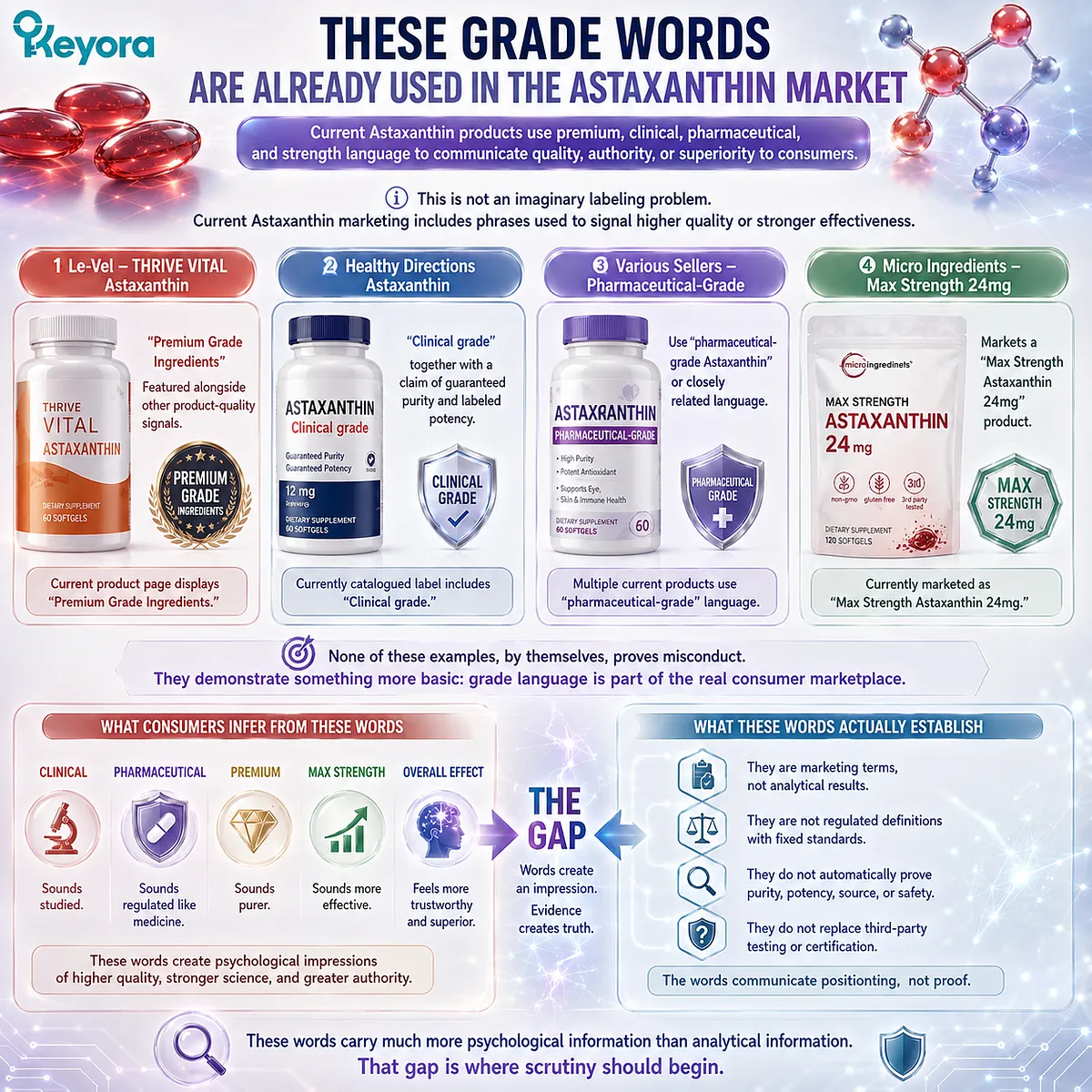
Current Astaxanthin products use premium, clinical, pharmaceutical, and strength language to communicate quality, authority, or superiority to consumers.
This is not an imaginary labeling problem.
Current Astaxanthin marketing includes phrases such as “Premium Grade Ingredients.” Le-Vel’s current THRIVE VITAL Astaxanthin page displays that phrase alongside other product-quality signals.
A currently catalogued Healthy Directions Astaxanthin label includes the phrase “Clinical grade,” together with a claim of guaranteed purity and labeled potency.
Other current Astaxanthin sellers use “pharmaceutical-grade Astaxanthin” or closely related language, while Micro Ingredients markets a “Max Strength Astaxanthin 24mg” product.
None of these examples, by themselves, proves misconduct.
They demonstrate something more basic:
grade language is part of the real consumer marketplace.
And these words carry much more psychological information than analytical information.
“Clinical” sounds studied.
“Pharmaceutical” sounds regulated like medicine.
“Premium” sounds purer.
“Max Strength” sounds more effective.
But what consumers infer from those words may go far beyond what the words themselves establish.
That gap is where scrutiny should begin.
“Premium Grade” Does Not Tell You the Quality Specification
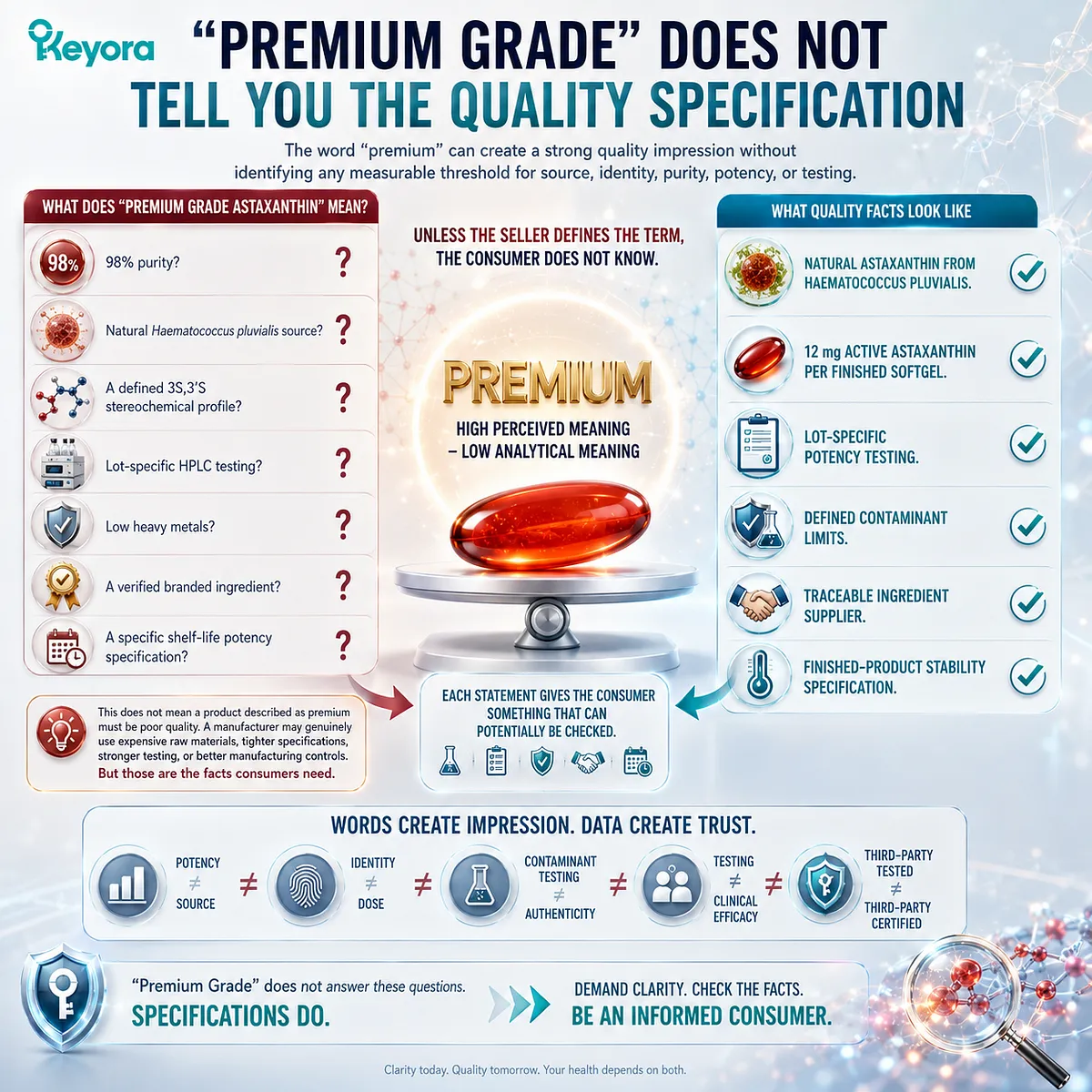
The word “premium” can create a strong quality impression without identifying any measurable threshold for source, identity, purity, potency, or testing.
What does “Premium Grade Astaxanthin” mean?
Does it mean:
98% purity?
Natural Haematococcus pluvialis source?
A defined 3S,3′S stereochemical profile?
Lot-specific HPLC testing?
Low heavy metals?
A verified branded ingredient?
A specific shelf-life potency specification?
Unless the seller defines the term, the consumer does not know.
That is the unusual commercial strength of words such as “premium.”
They can suggest many desirable characteristics without committing to one measurable characteristic.
The result is:
**High perceived meaning
-
low analytical meaning**
This does not mean a product described as premium must be poor quality. A manufacturer may genuinely use expensive raw materials, tighter specifications, stronger testing, or better manufacturing controls.
But those are the facts consumers need.
If a company has them, it should be able to say:
Natural Astaxanthin from Haematococcus pluvialis.
12 mg active Astaxanthin per finished softgel.
Lot-specific potency testing.
Defined contaminant limits.
Traceable ingredient supplier.
Finished-product stability specification.
Each statement gives the consumer something that can potentially be checked.
“Premium Grade” does not.
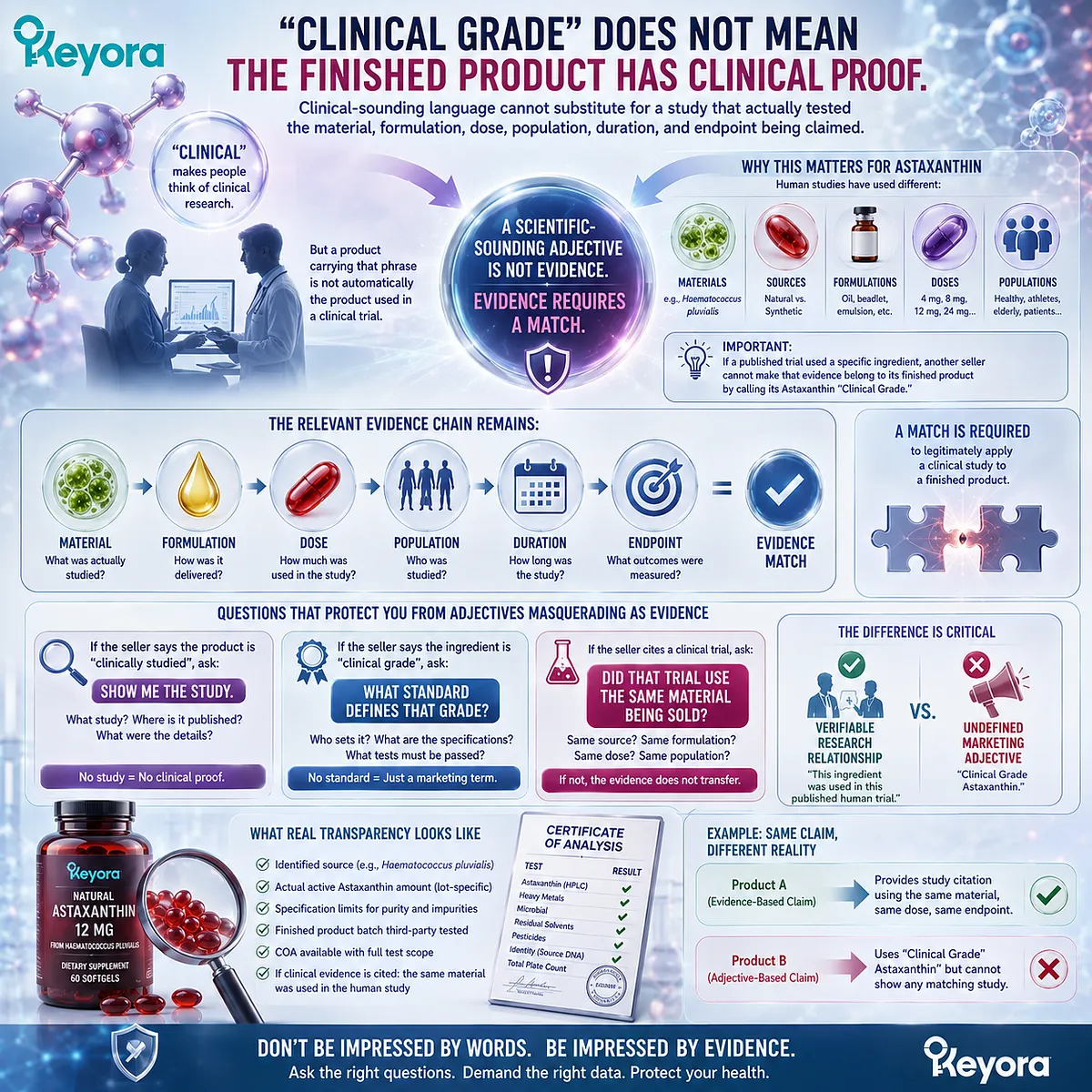
“Clinical Grade” Does Not Mean the Finished Product Has Clinical Proof
Clinical-sounding language cannot substitute for a study that actually tested the material, formulation, dose, population, duration, and endpoint being claimed.
“Clinical Grade” creates a different kind of authority.
The word clinical naturally makes consumers think of clinical research.
But a product carrying that phrase is not automatically the product used in a clinical trial.
This distinction is especially important with Astaxanthin because human studies have used different materials, sources, formulations, doses, and branded ingredients.
Suppose a published trial used a specific Haematococcus pluvialis Astaxanthin preparation.
Another seller cannot make that evidence belong to its finished product simply by calling its Astaxanthin:
“Clinical Grade.”
The relevant evidence chain remains:
Material → Formulation → Dose → Population → Duration → Endpoint
If the seller says the product is “clinically studied,” ask for the study.
If it says the ingredient is “clinical grade,” ask what standard defines that grade.
If it cites a clinical trial, ask whether that trial actually used the same material being sold.
These questions prevent a scientific-sounding adjective from becoming a substitute for evidence matching.
There is a major difference between:
“This ingredient was used in this published human trial.”
and:
“Clinical Grade Astaxanthin.”
The first is a verifiable research relationship.
The second needs a definition.
“Pharmaceutical Grade” Is Not the Same as Drug Approval
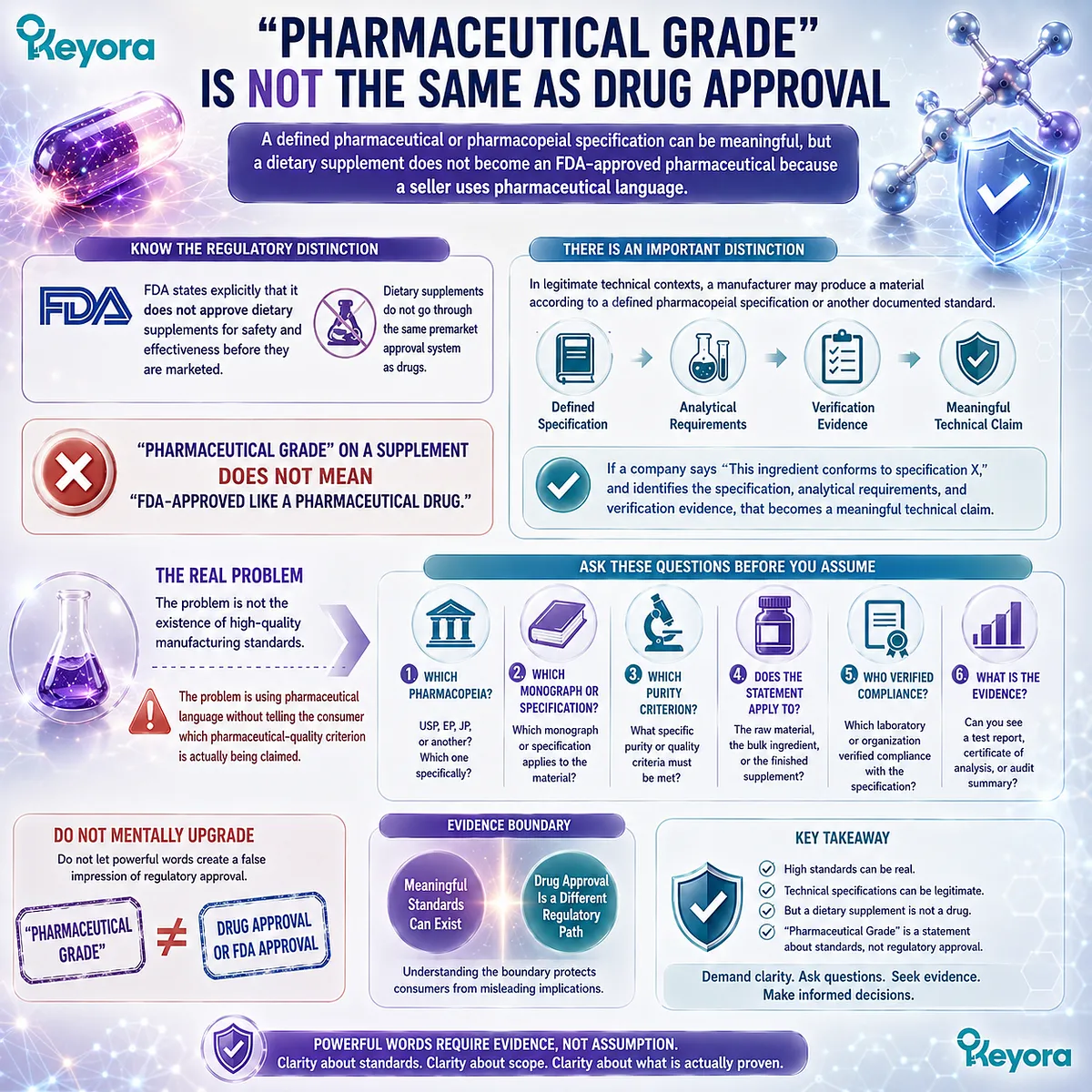
A defined pharmaceutical or pharmacopeial specification can be meaningful, but a dietary supplement does not become an FDA-approved pharmaceutical because a seller uses pharmaceutical language.
“Pharmaceutical Grade” is potentially the most powerful phrase of the group because it can evoke the regulatory standards associated with medicines.
That makes the evidence boundary particularly important.
FDA states explicitly that it does not approve dietary supplements for safety and effectiveness before they are marketed. Dietary supplements do not go through the same premarket approval system as drugs.
Therefore:
“Pharmaceutical Grade” on a supplement does not mean “FDA-approved like a pharmaceutical drug.”
There is, however, an important distinction.
In legitimate technical contexts, a manufacturer may produce a material according to a defined pharmacopeial specification or another documented standard. If a company says:
“This ingredient conforms to specification X,”
and identifies the specification, analytical requirements, and verification evidence, that becomes a meaningful technical claim.
The problem is not the existence of high-quality manufacturing standards.
The problem is using pharmaceutical language without telling the consumer which pharmaceutical-quality criterion is actually being claimed.
So ask:
Which pharmacopeia?
Which monograph or specification?
Which purity criterion?
Does the statement apply to the raw material or the finished supplement?
Who verified compliance?
If none of those questions has an answer, “Pharmaceutical Grade” should not be mentally upgraded into drug-level regulatory approval.
Real Quality Standards Look Different From Grade Words
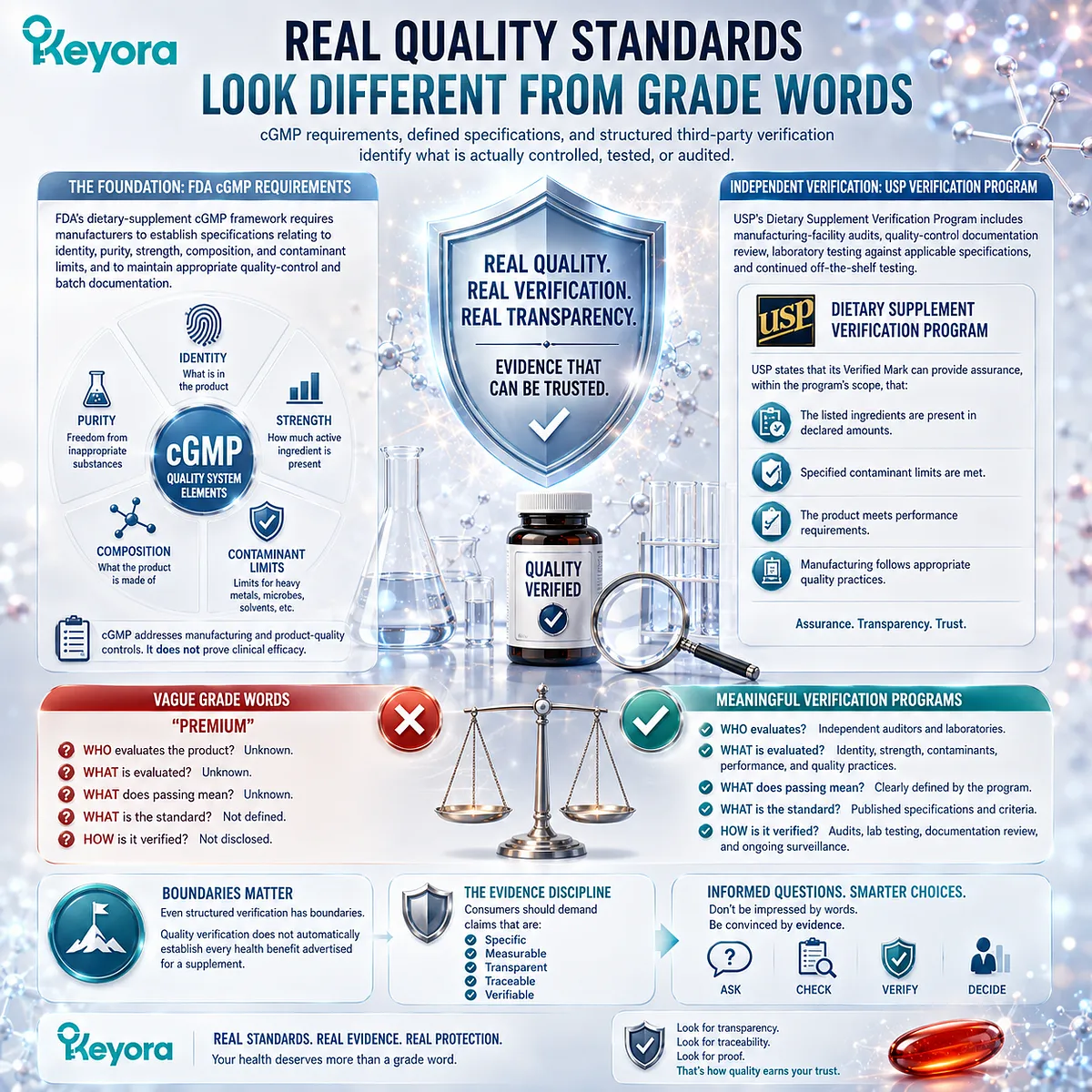
cGMP requirements, defined specifications, and structured third-party verification identify what is actually controlled, tested, or audited.
A genuine quality system contains details.
FDA’s dietary-supplement cGMP framework requires manufacturers to establish specifications relating to identity, purity, strength, composition, and contaminant limits, and to maintain appropriate quality-control and batch documentation.
That does not mean cGMP proves a supplement is clinically effective.
It means cGMP addresses manufacturing and product-quality controls.
Independent verification programs provide another useful comparison.
USP’s Dietary Supplement Verification Program includes manufacturing-facility audits, quality-control documentation review, laboratory testing against applicable specifications, and continued off-the-shelf testing.
USP states that its Verified Mark can provide assurance, within the program’s scope, that:
-
the listed ingredients are present in declared amounts,
-
specified contaminant limits are met,
-
the product meets performance requirements,
-
and manufacturing follows appropriate quality practices.
Notice how different that is from:
“Premium.”
A meaningful verification program tells you:
who evaluates the product, what is evaluated, and what passing the program means.
A vague grade word does not.
And even structured verification has boundaries. Quality verification does not automatically establish every health benefit advertised for a supplement.
This is the evidence discipline consumers should demand from all quality claims.
How Grade Language Can Borrow Scientific Authority
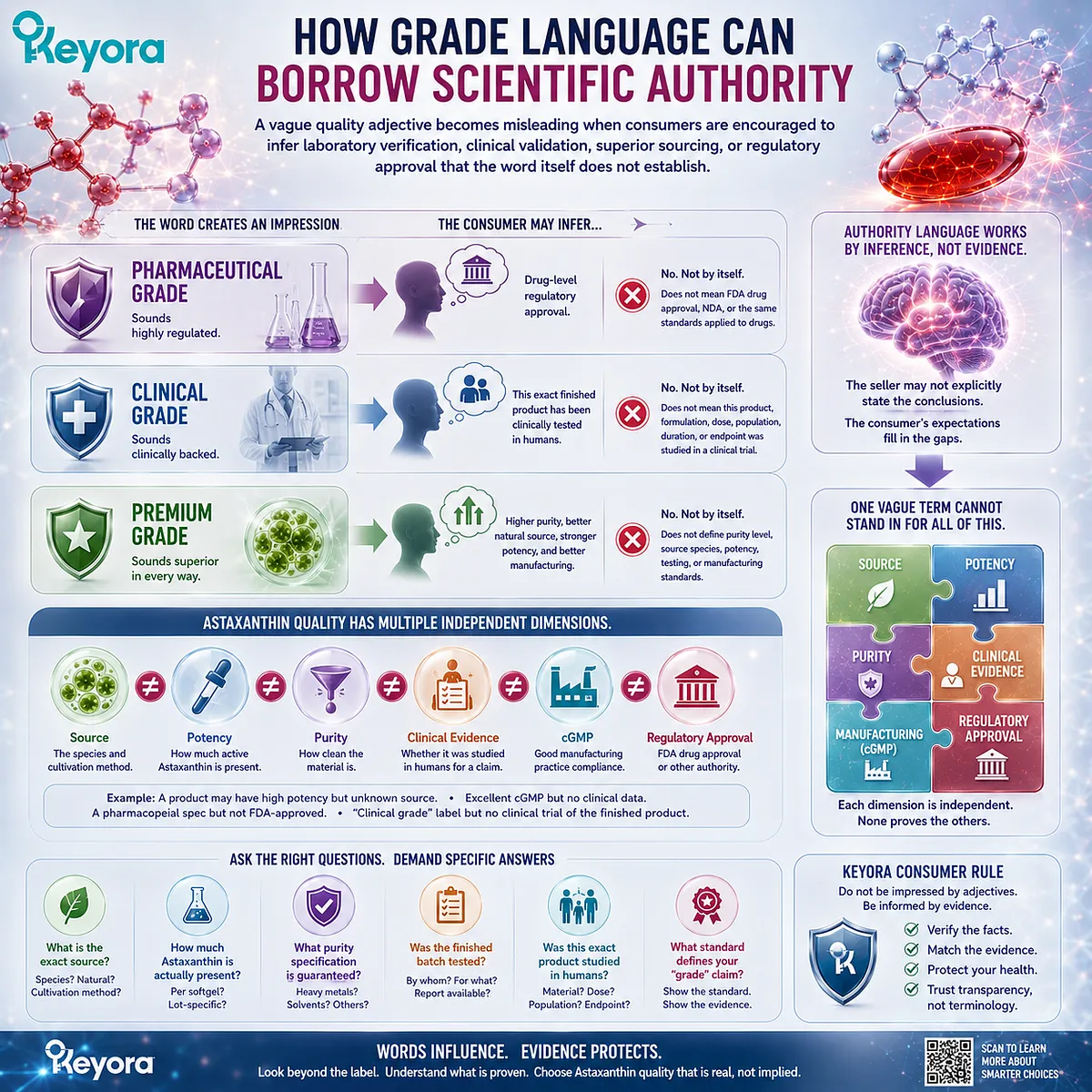
A vague quality adjective becomes misleading when consumers are encouraged to infer laboratory verification, clinical validation, superior sourcing, or regulatory approval that the word itself does not establish.
The most sophisticated supplement marketing does not always need to make a directly false laboratory claim.
Sometimes it only needs to select a word that causes the consumer to make the inference.
Consider:
PHARMACEUTICAL GRADE
A shopper may infer:
drug-level regulatory approval
although no such conclusion follows from the phrase alone.
Or:
CLINICAL GRADE
The shopper may infer:
this exact finished product has been clinically tested
when no study is identified.
Or:
PREMIUM GRADE
The shopper may infer:
higher purity, superior natural source, stronger potency, and better manufacturing
without seeing a specification for any of those properties.
This is what makes authority language so effective.
The seller may not have explicitly written every conclusion the consumer reaches.
The consumer’s own expectations fill in the gaps.
For Astaxanthin, those gaps matter because quality has multiple independent dimensions:
Source ≠ potency.
Potency ≠ purity.
Purity ≠ clinical evidence.
cGMP ≠ clinical efficacy.
A pharmacopeial specification ≠ FDA drug approval.
A clinical-sounding label ≠ a clinical trial.
The consumer-protection problem begins when one vague term is allowed to stand in for all of them.
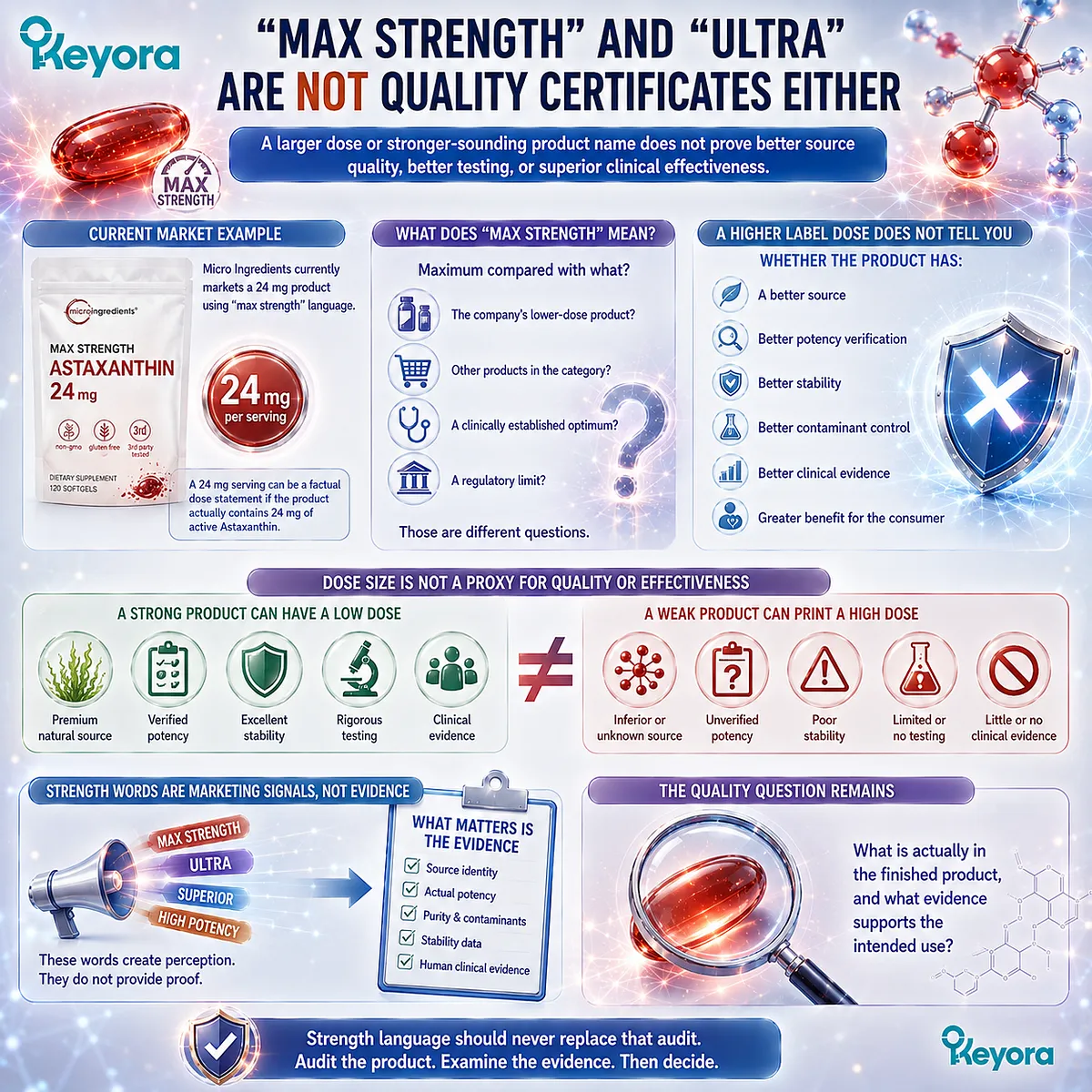
“Max Strength” and “Ultra” Are Not Quality Certificates Either
A larger dose or stronger-sounding product name does not prove better source quality, better testing, or superior clinical effectiveness.
Strength language creates another shortcut.
Current Astaxanthin products may be promoted as “Max Strength” alongside high milligram values. For example, Micro Ingredients currently markets a 24 mg product using “max strength” language.
A 24 mg serving can be a factual dose statement if the product actually contains 24 mg of active Astaxanthin.
But “Max Strength” adds a conclusion that is much less precise.
Maximum compared with what?
The company’s lower-dose product?
Other products in the category?
A clinically established optimum?
A regulatory limit?
Those are different questions.
And a higher labeled dose does not independently tell you whether the product has:
-
a better source,
-
better potency verification,
-
better stability,
-
better contaminant control,
-
better clinical evidence,
-
or greater benefit for the consumer.
A strong product can have a low dose.
A weak product can print a high dose.
The quality question remains:
What is actually in the finished product, and what evidence supports the intended use?
Strength language should never replace that audit.
How to Audit a Grade Claim Before Paying More
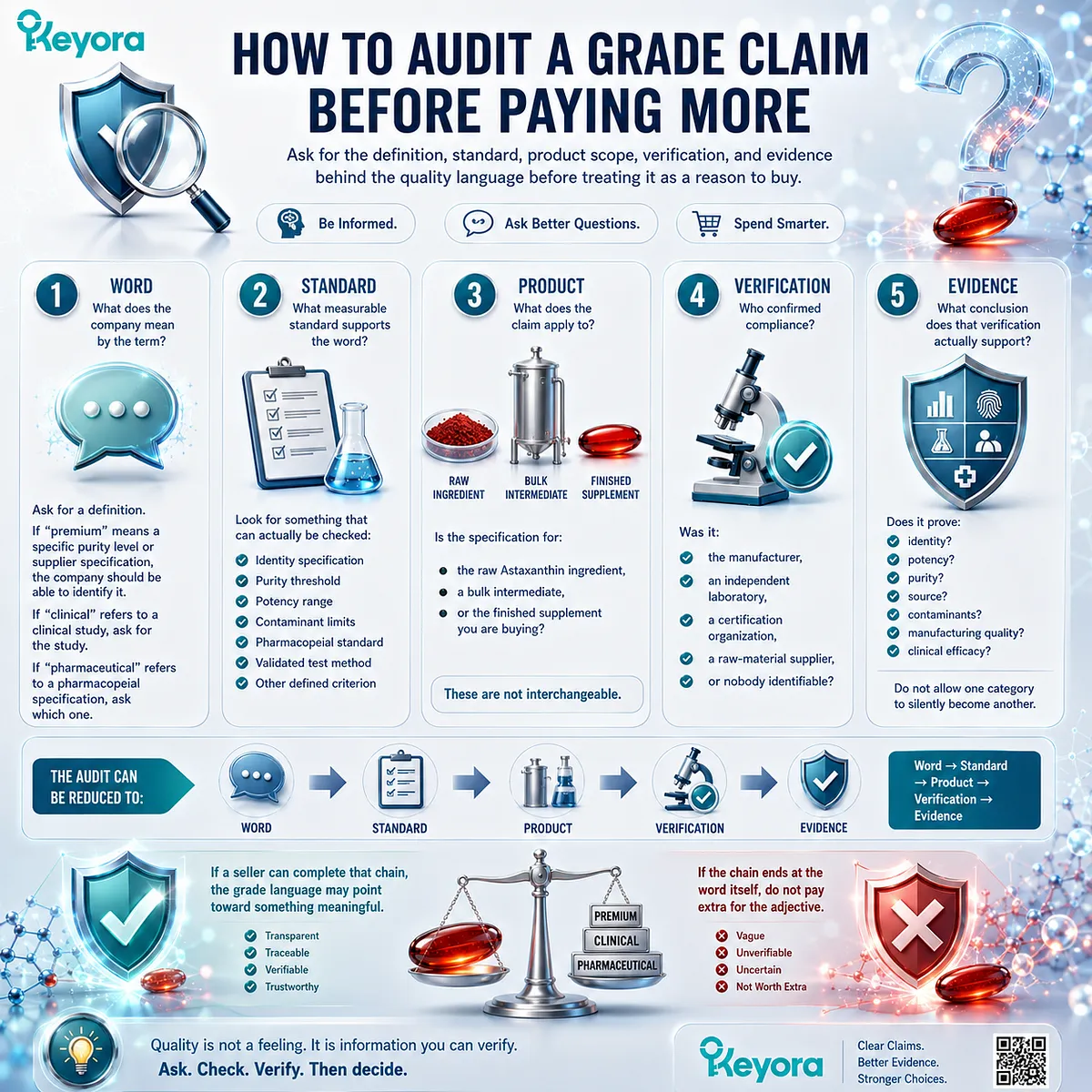
Ask for the definition, standard, product scope, verification, and evidence behind the quality language before treating it as a reason to buy.
When a supplement says Premium Grade, Clinical Grade, or Pharmaceutical Grade, use five questions.
1. Word – What does the company mean by the term?
Ask for a definition.
If “premium” means a specific purity level or supplier specification, the company should be able to identify it.
If “clinical” refers to a clinical study, ask for the study.
If “pharmaceutical” refers to a pharmacopeial specification, ask which one.
2. Standard – What measurable standard supports the word?
Look for something that can actually be checked:
-
identity specification,
-
purity threshold,
-
potency range,
-
contaminant limits,
-
pharmacopeial standard,
-
validated test method,
-
or other defined criterion.
3. Product – What does the claim apply to?
Is the specification for:
the raw Astaxanthin ingredient,
a bulk intermediate,
or the finished supplement you are buying?
These are not interchangeable.
4. Verification – Who confirmed compliance?
Was it:
the manufacturer,
an independent laboratory,
a certification organization,
a raw-material supplier,
or nobody identifiable?
5. Evidence – What conclusion does that verification actually support?
Does it prove:
identity?
potency?
purity?
source?
contaminants?
manufacturing quality?
clinical efficacy?
Do not allow one category to silently become another.
The audit can be reduced to:
Word → Standard → Product → Verification → Evidence
If a seller can complete that chain, the grade language may point toward something meaningful.
If the chain ends at the word itself, do not pay extra for the adjective.
Closing Summary
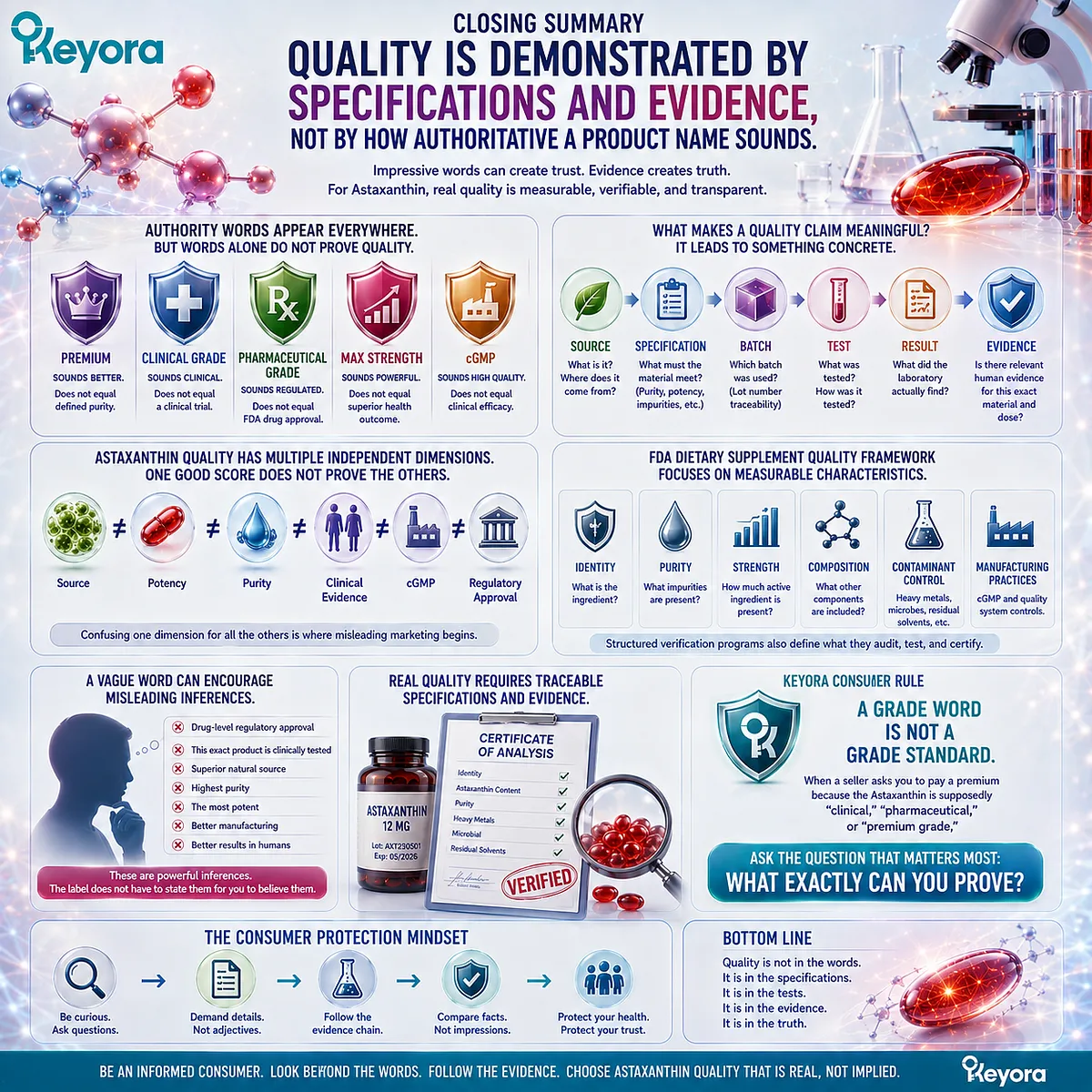
Quality is demonstrated by specifications and evidence, not by how authoritative a product name sounds.
“Premium,” “Clinical,” “Pharmaceutical Grade,” “Max Strength,” and similar expressions can all appear in real Astaxanthin marketing.
Some products using these terms may be genuinely high quality.
The words themselves do not prove it.
For Astaxanthin:
Premium ≠ defined purity.
Clinical Grade ≠ clinical trial.
Pharmaceutical Grade ≠ FDA drug approval.
Max Strength ≠ superior health outcome.
cGMP ≠ clinical efficacy.
A meaningful quality claim should eventually lead you to something concrete:
Source → Specification → Batch → Test → Result → Relevant Evidence
FDA’s own quality framework focuses on measurable characteristics such as identity, purity, strength, composition, contaminant control, and manufacturing practices. Structured verification programs likewise explain what they actually audit and test.
That is the standard consumers should apply to impressive quality language.
Keyora’s rule is simple:
A grade word is not a grade standard.
And when a seller asks you to pay a premium because the Astaxanthin is supposedly “clinical,” “pharmaceutical,” or “premium grade,” ask the question that strips the marketing language back to evidence:
What exactly can you prove?
This article is for educational and informational purposes only. It does not provide medical advice, diagnosis, treatment, cure, prevention, disease outcome claims, hormone restoration claims, fertility outcome claims, or formula-specific clinical efficacy claims.