
What Does “Third-Party Tested” Actually Prove?
Keyora Research Q&A Library
This is part of the Keyora Research Q&A Series, derived from Keyora Astaxanthin Research Journal Series.
Within the Keyora Astaxanthin Researcn framework, this Q&A translates complex astaxanthin biology into reader-friendly, evidence-bound answers, focusing on natural astaxanthin identity, molecular structure, antioxidant and redox mechanisms, membrane lipid interaction, mitochondrial resilience, inflammatory signaling pathways, human evidence interpretation, and the scientific principles behind responsible supplementation.
First published by Keyora Research Journal: www.keyorahealth.com
Direct Answer
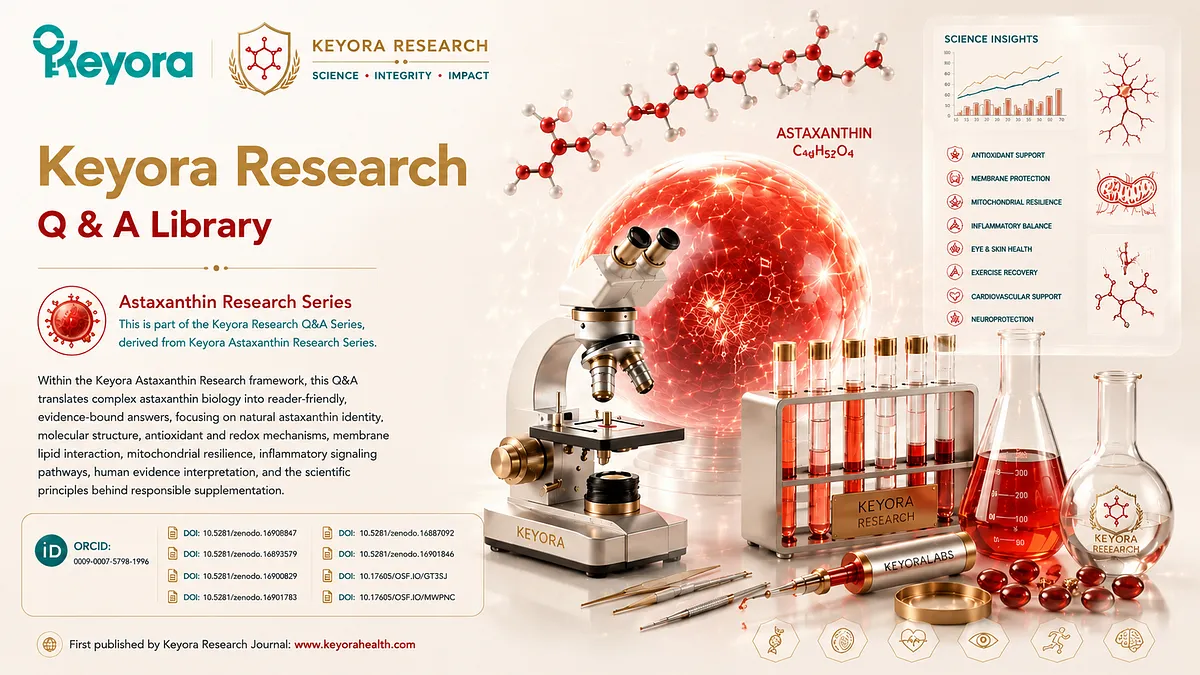
“Third-party tested” can be valuable, but the phrase proves only what the independent laboratory actually tested.
“Third-party tested” sounds reassuring.
It suggests that someone outside the supplement company has checked the product rather than asking consumers to trust the manufacturer alone.
Independent laboratory testing can indeed be valuable, and transparent brands should be encouraged to use it.
But there is a problem.
“Third-party tested” is not a test result.
The phrase does not tell you what was tested, which laboratory performed the analysis, which sample was submitted, whether the sample was a raw ingredient or finished capsule, which batch was examined, which analytical method was used, or what the laboratory actually found.
For an Astaxanthin supplement, those missing details can completely change what the claim means.
A third-party heavy-metal test does not prove that 12 mg of Astaxanthin is present.
A potency test does not automatically prove that the Astaxanthin came from Haematococcus pluvialis.
An identity test does not prove that the labeled dose is correct.
A microbial test does not prove that the product contains Natural rather than Synthetic Astaxanthin.
And none of these laboratory tests proves that a supplement produces the clinical health outcome advertised beside them.
This is where a legitimate quality-control practice can become a misleading trust signal.
Keyora’s consumer rule is simple:
Do not ask only: “Was it tested?”
Ask:
“Tested for what?”
“Third-Party Tested” Does Not Tell You What Was Tested
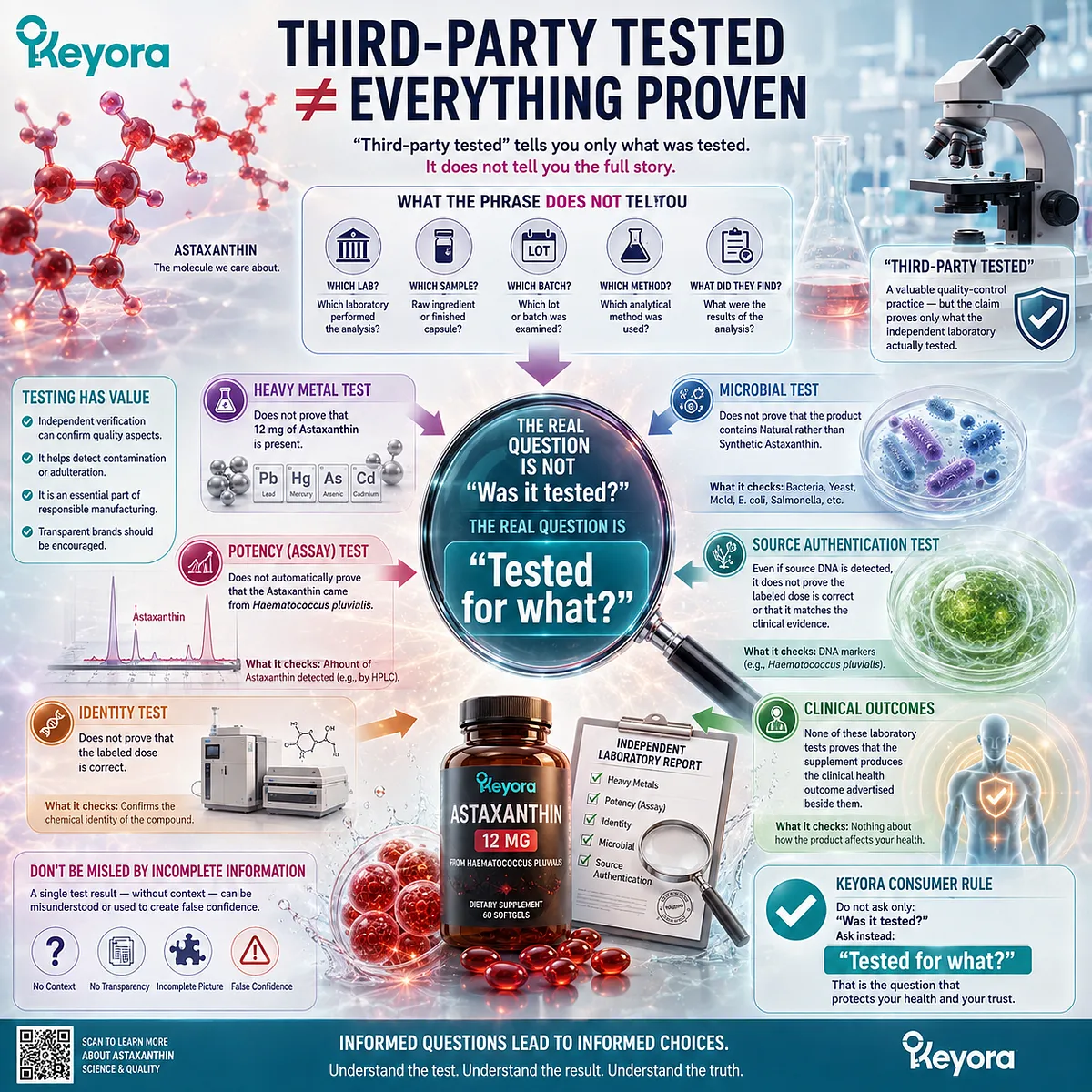
A supplement can truthfully use testing language while the actual analysis covers only one narrow quality question.
Imagine an Astaxanthin supplement displaying:
THIRD-PARTY TESTED
on its product page.
That statement could mean several very different things.
Perhaps an independent laboratory measured lead, arsenic, cadmium, and mercury.
Perhaps it measured microbial contamination.
Perhaps it quantified Astaxanthin.
Perhaps it tested ingredient identity.
Perhaps it did several of these things.
Or perhaps a single raw-material sample was tested months before the finished bottle you are considering was manufactured.
All of these situations can involve genuine third-party laboratory work.
They do not provide the same evidence.
The problem begins when the consumer sees one broad phrase and mentally converts it into:
ingredient verified + dose verified + source verified + purity verified + contaminants verified + finished product verified
The laboratory may never have tested all of those questions.
This is a form of trust-scope expansion.
The test itself may be real.
The misleading part is allowing a narrow test to create the impression that the entire product has been independently proven.
That is why responsible testing claims should provide enough information for consumers to determine the scope of the evidence.
At minimum, the useful questions are:
What was tested?
What sample was tested?
Which batch did it belong to?
Which method was used?
What was the result?
Without those answers, “third-party tested” remains largely a statement about the existence of testing rather than evidence about the quality question you actually care about.
Potency, Identity, Source, and Contaminants Are Different Tests
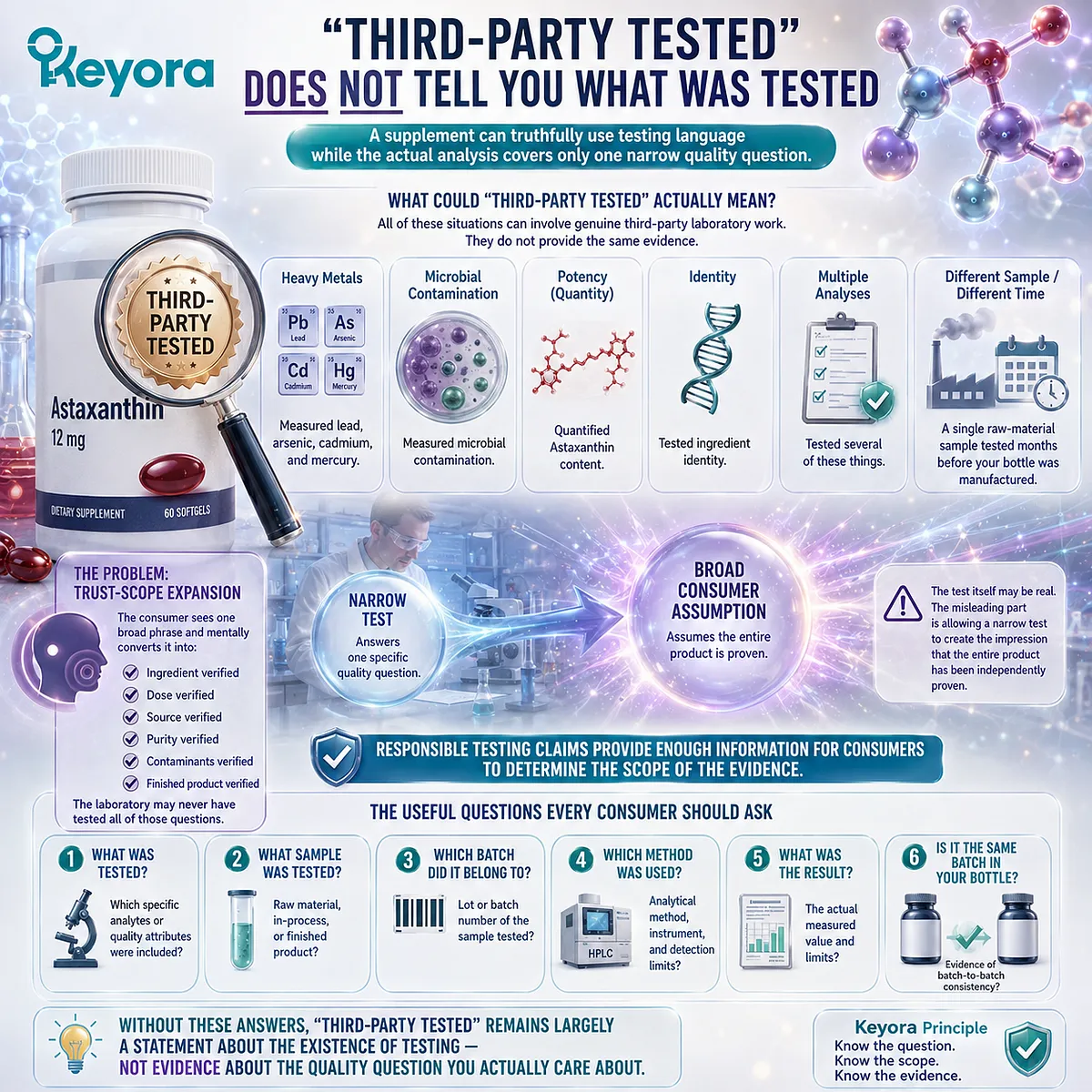
Measuring how much Astaxanthin is present does not automatically prove where it came from, and confirming identity does not prove the labeled dose.
Astaxanthin quality cannot be reduced to a single laboratory number.
Suppose an HPLC assay measures approximately 12 mg of total Astaxanthin in a finished product.
That can be strong evidence about quantity, assuming the method, sampling, and report are appropriate.
But the result does not automatically tell you:
Was the Astaxanthin produced by Haematococcus pluvialis?
Was it Synthetic Astaxanthin?
What stereoisomer profile was present?
Those are additional analytical questions.
The reverse is also true.
Suppose an identity method supports the presence of the expected biological ingredient.
That does not establish that the bottle contains the 12 mg, 16 mg, or 24 mg stated on its label.
You still need quantitative evidence.
Contaminant testing is another separate category.
A laboratory can show that a sample meets specified limits for lead or arsenic while saying nothing about whether the Astaxanthin dose is correct.
A microbial panel may tell you whether the tested organisms met specified limits while telling you nothing about Natural versus Synthetic source.
This separation is fundamental:
Identity asks: What is it?
Potency asks: How much is there?
Source authentication asks: Where did it come from?
Contaminant testing asks: What unwanted substances were found or excluded within the tested panel?
Clinical research asks: What does the intervention actually do in humans?
These questions can support one another.
They cannot replace one another.
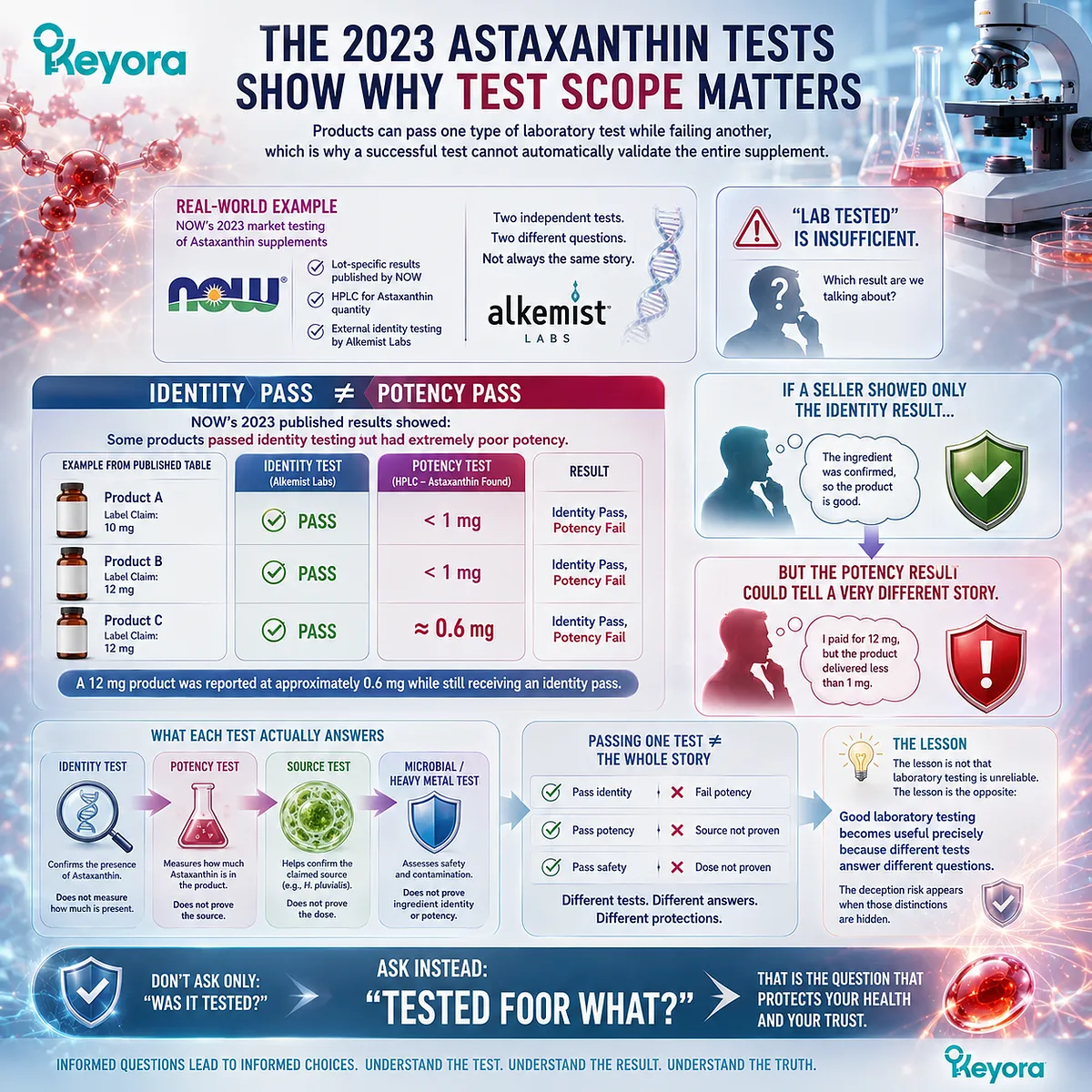
The 2023 Astaxanthin Tests Show Why Test Scope Matters
Products can pass one type of laboratory test while failing another, which is why a successful test cannot automatically validate the entire supplement.
A useful real-world example came from NOW’s 2023 market testing of Astaxanthin supplements.
NOW published lot-specific results using HPLC for Astaxanthin quantity and separate external identity testing by Alkemist Labs. The results are especially useful because the two tests did not always tell the same story.
Some products passed the external identity test while performing extremely poorly on potency.
For example, the published table included products labeled as containing 10 or 12 mg of Astaxanthin that passed the identity test but produced HPLC results below 1 mg. One 12 mg product was reported at approximately 0.6 mg while still receiving an identity pass.
That is exactly why the phrase:
“Lab tested”
is insufficient.
Which result are we talking about?
If a seller showed only the identity result, the consumer might reasonably think:
“The ingredient was confirmed, so the product is good.”
But the potency result could tell a very different story.
Likewise, if a supplement passes potency testing, that does not automatically prove every source claim made on the label.
The lesson is not that laboratory testing is unreliable.
The lesson is the opposite:
Good laboratory testing becomes useful precisely because different tests answer different questions.
The deception risk appears when those distinctions are hidden.
A Third-Party Test Is Not the Same as Third-Party Certification
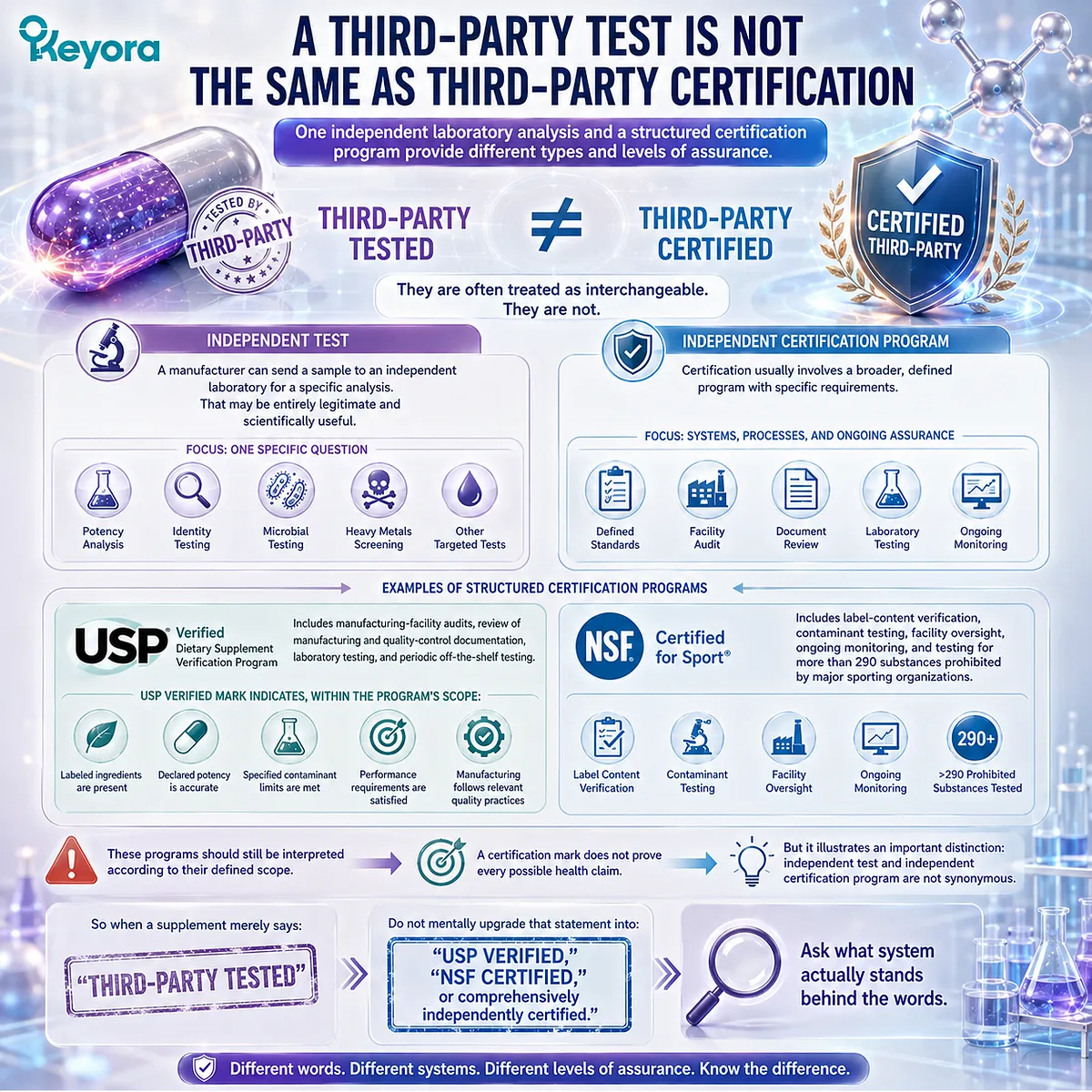
One independent laboratory analysis and a structured certification program provide different types and levels of assurance.
“Third-party tested” and “third-party certified” are often treated as interchangeable.
They are not.
A manufacturer can send a sample to an independent laboratory for a specific analysis. That may be entirely legitimate and scientifically useful.
Certification usually involves a broader, defined program with specific requirements.
USP’s Dietary Supplement Verification Program, for example, includes manufacturing-facility audits, review of manufacturing and quality-control documentation, laboratory testing, and periodic off-the-shelf testing. USP states that its Verified Mark indicates, within the program’s scope, that the labeled ingredients and declared potency are present, specified contaminant limits are met, performance requirements are satisfied, and manufacturing follows relevant quality practices.
NSF Certified for Sport uses another defined framework. Its program includes label-content verification, contaminant testing, facility oversight, ongoing monitoring, and testing for more than 290 substances prohibited by major sporting organizations.
These programs should still be interpreted according to their defined scope.
A certification mark does not prove every possible health claim.
But it illustrates an important distinction:
Independent test
and
independent certification program
are not synonymous.
So when a supplement merely says:
“Third-Party Tested”
do not mentally upgrade that statement into:
“USP Verified,” “NSF Certified,” or comprehensively independently certified.”
Ask what system actually stands behind the words.
A Real Test Report Can Still Be the Wrong Evidence for Your Bottle
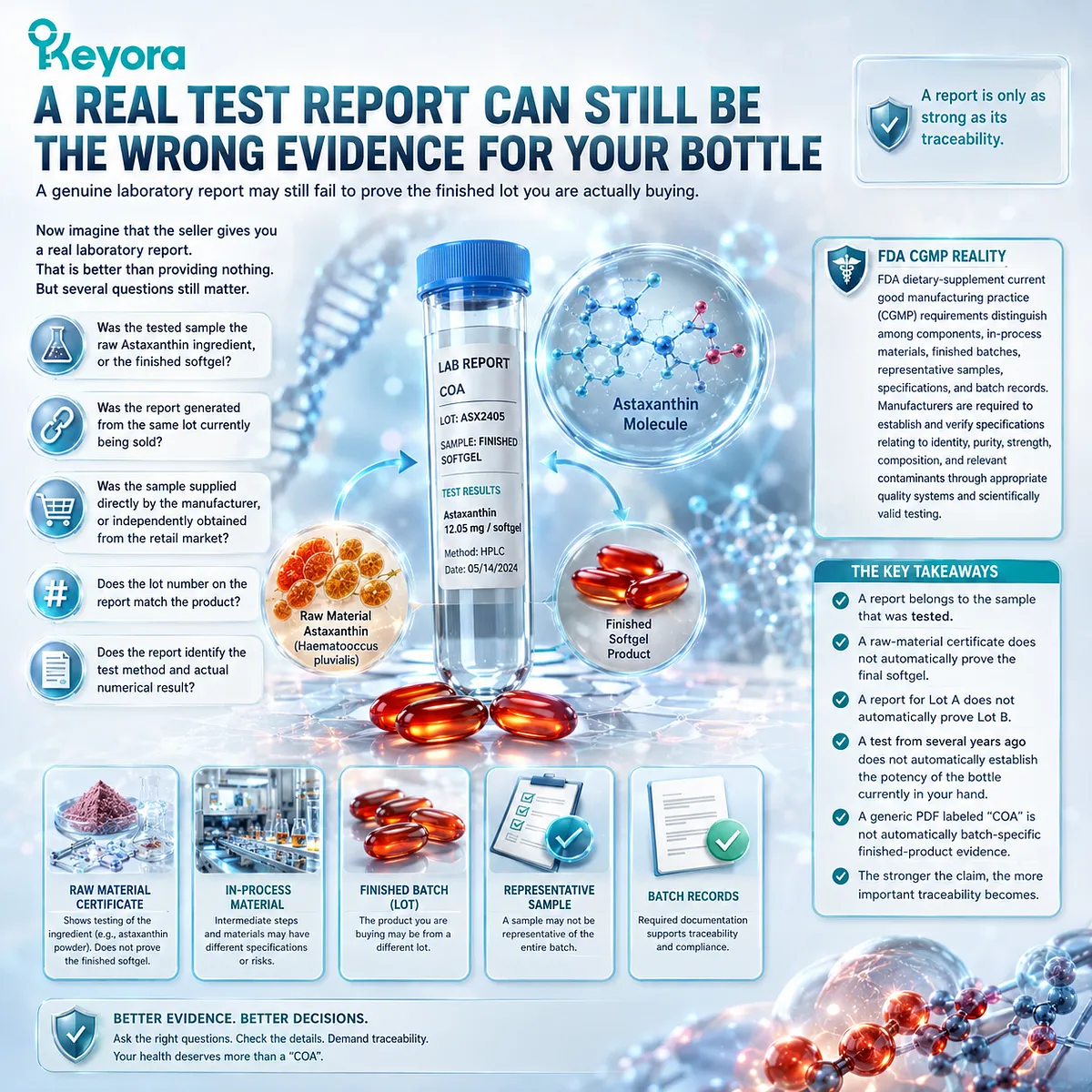
A genuine laboratory report may still fail to prove the finished lot you are actually buying.
Now imagine that the seller gives you a real laboratory report.
That is better than providing nothing.
But several questions still matter.
Was the tested sample the raw Astaxanthin ingredient, or the finished softgel?
Was the report generated from the same lot currently being sold?
Was the sample supplied directly by the manufacturer, or independently obtained from the retail market?
Does the lot number on the report match the product?
Does the report identify the test method and actual numerical result?
These are not trivial details.
FDA dietary-supplement current good manufacturing practice requirements distinguish among components, in-process materials, finished batches, representative samples, specifications, and batch records. Manufacturers are required to establish and verify specifications relating to identity, purity, strength, composition, and relevant contaminants through appropriate quality systems and scientifically valid testing.
That regulatory structure reflects a simple reality:
A report belongs to the sample that was tested.
A raw-material certificate does not automatically prove the final softgel.
A report for Lot A does not automatically prove Lot B.
A test from several years ago does not automatically establish the potency of the bottle currently in your hand.
And a generic PDF labeled “COA” is not automatically batch-specific finished-product evidence.
The stronger the claim, the more important traceability becomes.
How “Third-Party Tested” Becomes a Trust Shortcut
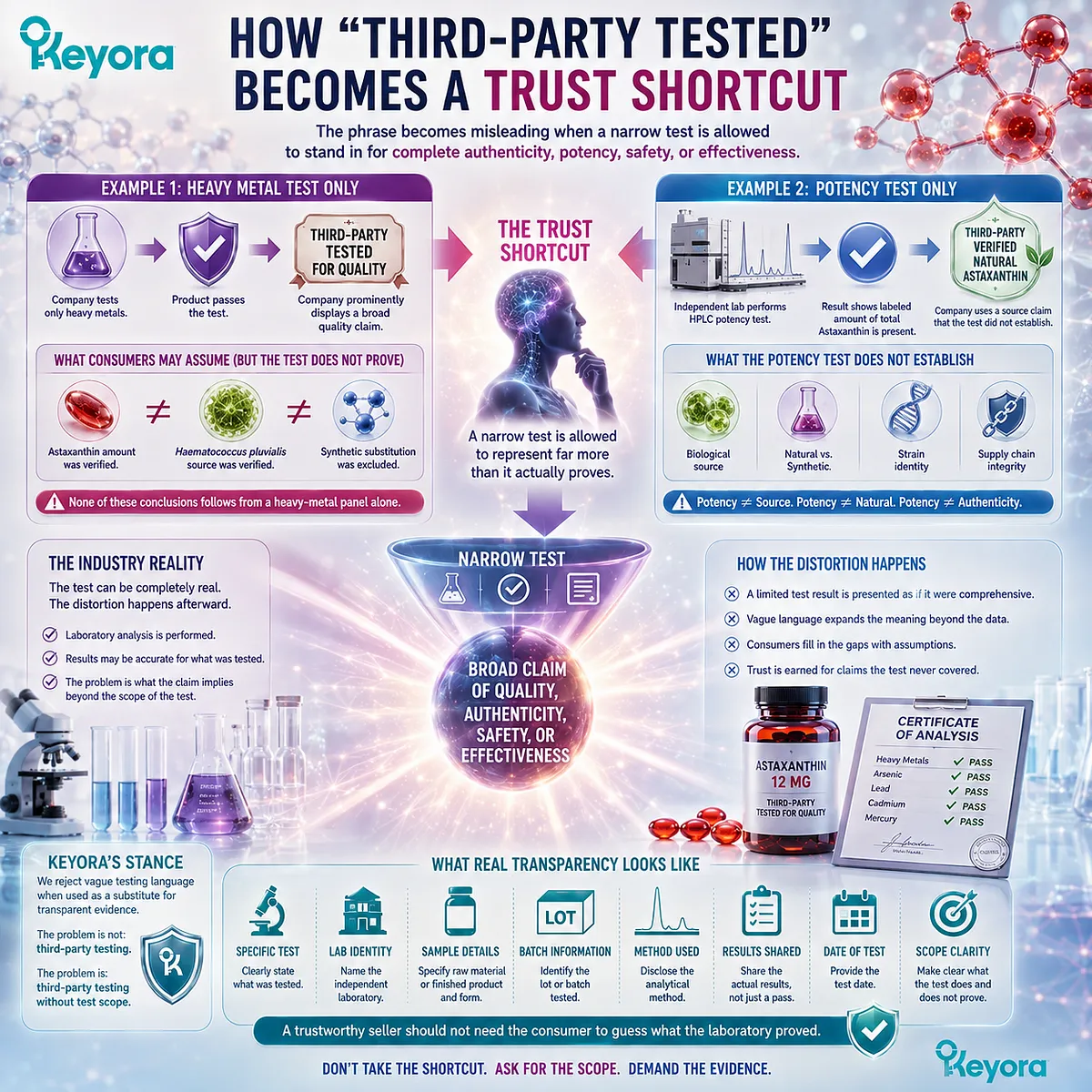
The phrase becomes misleading when a narrow test is allowed to stand in for complete authenticity, potency, safety, or effectiveness.
The supplement industry does not always need to fabricate laboratory science to create a misleading impression.
Sometimes the test can be completely real.
The distortion happens afterward.
Imagine a company tests only heavy metals.
The product passes.
The company then prominently displays:
THIRD-PARTY TESTED FOR QUALITY
A consumer may reasonably interpret “quality” far more broadly than the actual test panel.
He may assume the Astaxanthin amount was verified.
He may assume Haematococcus pluvialis source was verified.
He may assume Synthetic substitution was excluded.
None of those conclusions follows from a heavy-metal panel alone.
Or imagine the company has an HPLC potency result showing that the product contains the labeled amount of total Astaxanthin.
That is useful evidence.
But placing “third-party verified Natural Astaxanthin” beside that result would require something more if the analytical method did not establish biological source.
This is why Keyora rejects vague testing language when it is used as a substitute for transparent evidence.
The problem is not:
third-party testing.
The problem is:
third-party testing without test scope.
A trustworthy seller should not need the consumer to guess what the laboratory proved.
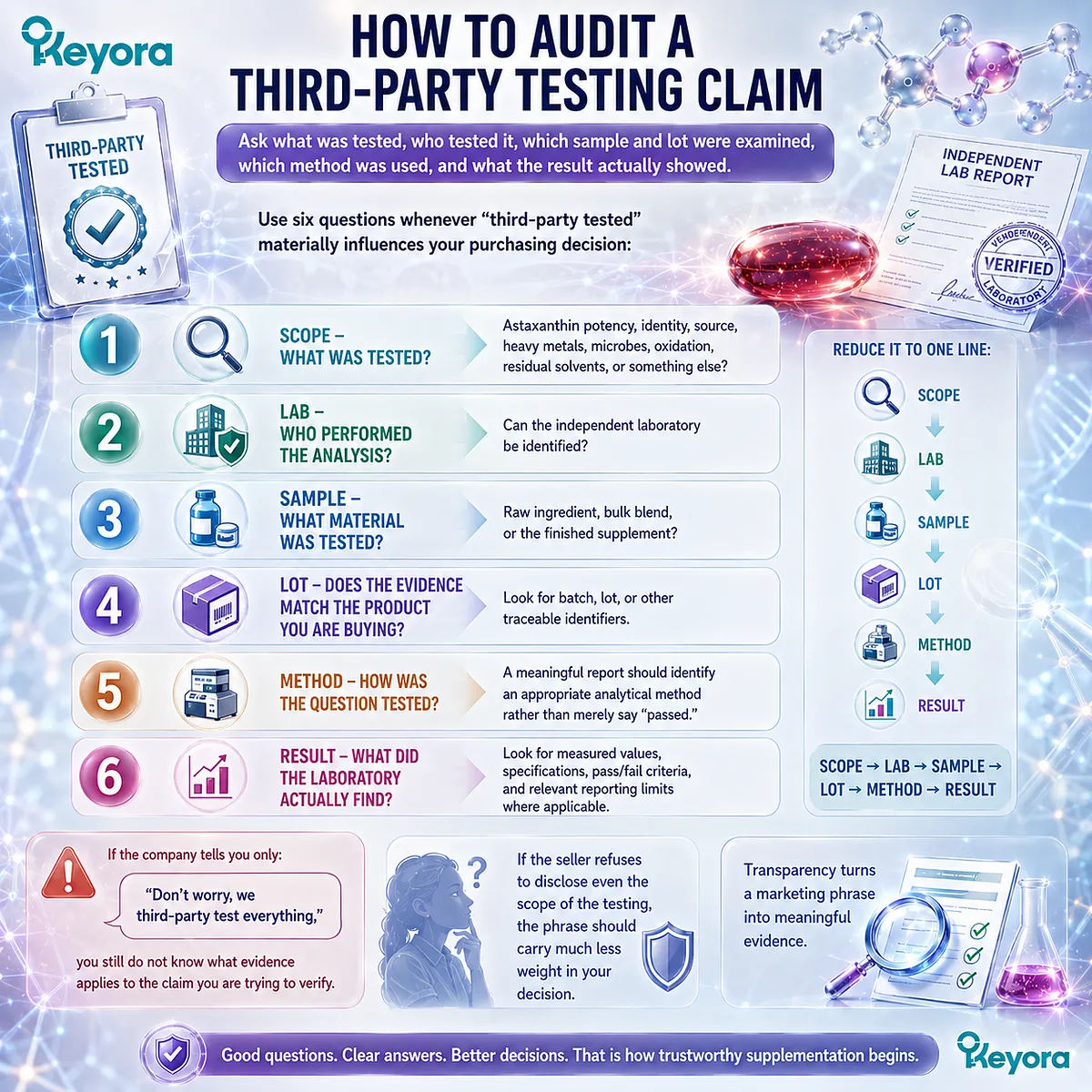
How to Audit a Third-Party Testing Claim
Ask what was tested, who tested it, which sample and lot were examined, which method was used, and what the result actually showed.
Use six questions whenever “third-party tested” materially influences your purchasing decision:
-
Scope – What was tested?
Astaxanthin potency, identity, source, heavy metals, microbes, oxidation, residual solvents, or something else? -
Lab – Who performed the analysis?
Can the independent laboratory be identified? -
Sample – What material was tested?
Raw ingredient, bulk blend, or the finished supplement? -
Lot – Does the evidence match the product you are buying?
Look for batch, lot, or other traceable identifiers. -
Method – How was the question tested?
A meaningful report should identify an appropriate analytical method rather than merely say “passed.” -
Result – What did the laboratory actually find?
Look for measured values, specifications, pass/fail criteria, and relevant reporting limits where applicable.
This can be reduced to one line:
Scope → Lab → Sample → Lot → Method → Result
If the company tells you only:
“Don’t worry, we third-party test everything,”
you still do not know what evidence applies to the claim you are trying to verify.
And if the seller refuses to disclose even the scope of the testing, the phrase should carry much less weight in your decision.
Closing Summary
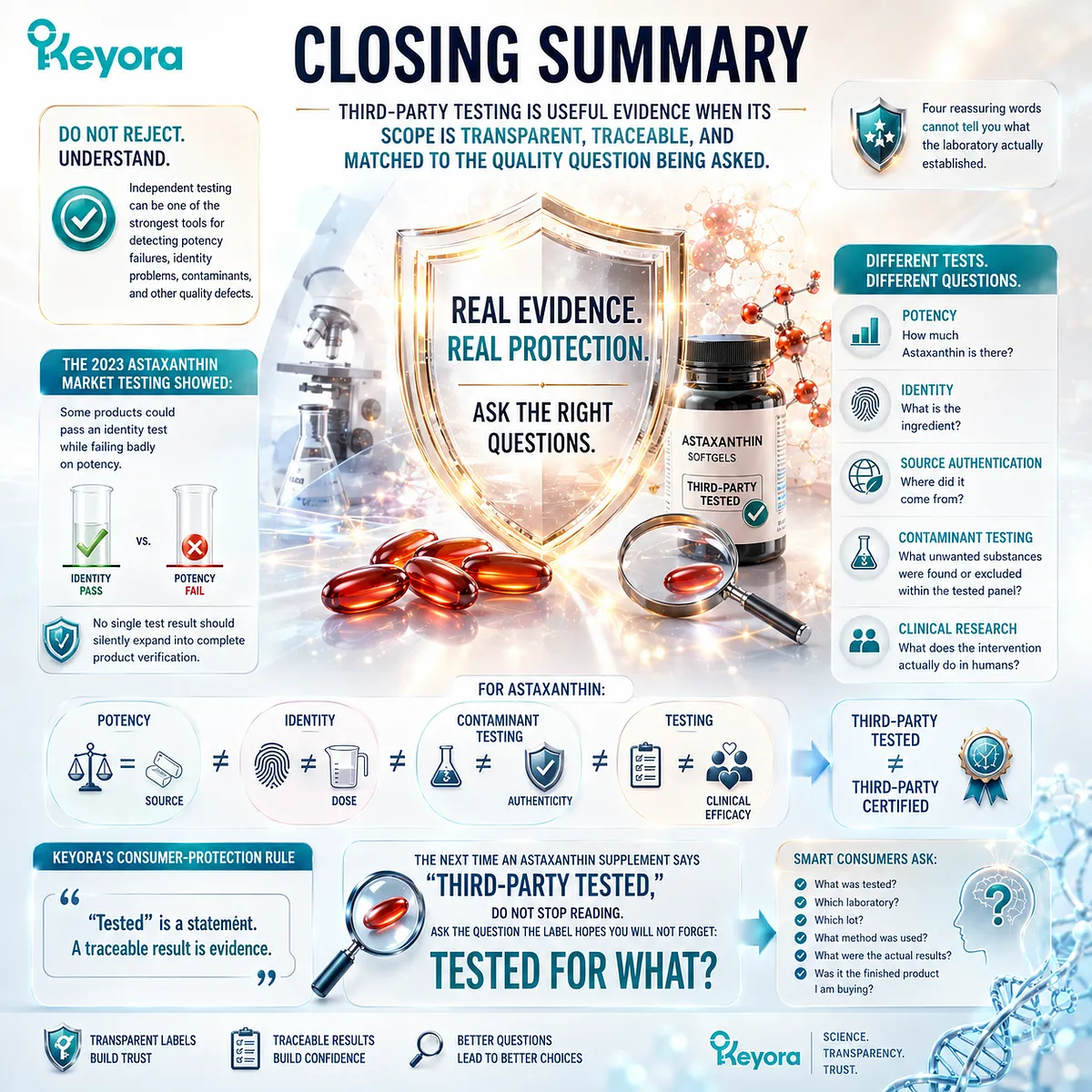
Third-party testing is useful evidence when its scope is transparent, traceable, and matched to the quality question being asked.
Consumers should not reject a supplement because it advertises third-party testing.
Independent testing can be one of the strongest tools available for detecting potency failures, identity problems, contaminants, and other quality defects.
But four reassuring words cannot tell you what the laboratory actually established.
The 2023 Astaxanthin market testing provides a clear example: some products could pass an identity test while failing badly on potency.
That is why no single test result should silently expand into complete product verification.
For Astaxanthin:
Potency ≠ source.
Identity ≠ dose.
Contaminant testing ≠ authenticity.
Testing ≠ clinical efficacy.
And:
Third-party tested ≠ third-party certified.
Keyora’s consumer-protection rule is therefore straightforward:
“Tested” is a statement. A traceable result is evidence.
The next time an Astaxanthin supplement says “Third-Party Tested,” do not stop reading.
Ask the question the label hopes you will not forget:
Tested for what?
This article is for educational and informational purposes only. It does not provide medical advice, diagnosis, treatment, cure, prevention, disease outcome claims, hormone restoration claims, fertility outcome claims, or formula-specific clinical efficacy claims.