
Has Synthetic Astaxanthin Actually Been Studied in Humans?
Keyora Research Q&A Library
This is part of the Keyora Research Q&A Series, derived from Keyora Astaxanthin Research Journal Series.
Within the Keyora Astaxanthin Researcn framework, this Q&A translates complex astaxanthin biology into reader-friendly, evidence-bound answers, focusing on natural astaxanthin identity, molecular structure, antioxidant and redox mechanisms, membrane lipid interaction, mitochondrial resilience, inflammatory signaling pathways, human evidence interpretation, and the scientific principles behind responsible supplementation.
First published by Keyora Research Journal: www.keyorahealth.com
Direct Answer
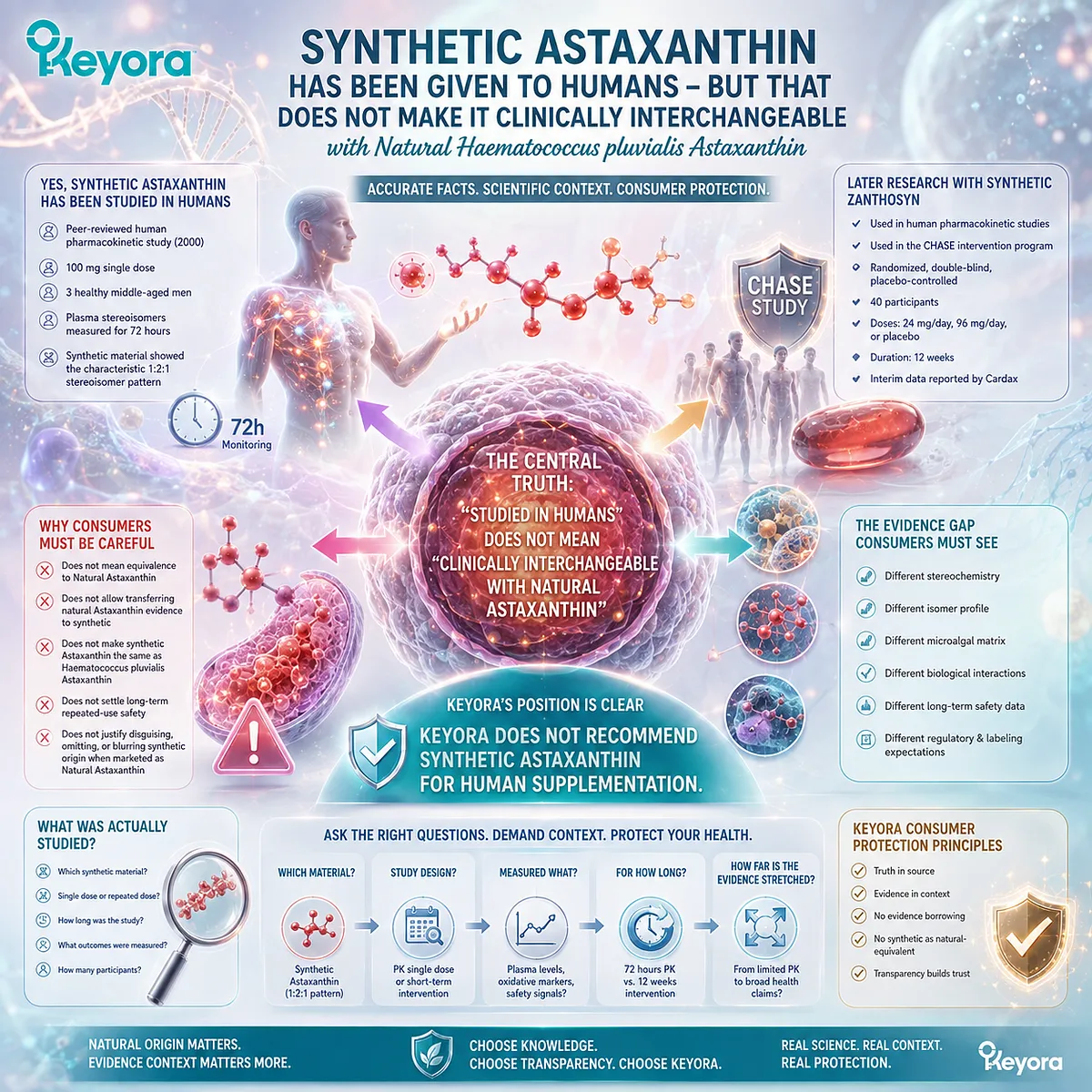
Yes, synthetic Astaxanthin has been given directly to humans, but that fact does not make it clinically interchangeable with natural Haematococcus pluvialis Astaxanthin.
Yes.
Synthetic Astaxanthin has been studied in humans.
That fact needs to be stated accurately because saying that synthetic Astaxanthin has “never” been studied in people is too absolute.
A peer-reviewed human pharmacokinetic study published in 2000 administered a 100 mg Astaxanthin dose to three healthy middle-aged men and followed Astaxanthin stereoisomers in plasma for 72 hours.
The administered material had the characteristic 1:2:1 stereoisomer pattern associated with conventional synthetic Astaxanthin.
Later, synthetic ZanthoSyn was also used in human pharmacokinetic research and in the randomized, double-blind, placebo-controlled CHASE intervention program.
Cardax reported interim CHASE data from 40 participants receiving 24 mg/day, 96 mg/day, or placebo for 12 weeks.
But this is exactly where consumers need to be careful.
“Studied in humans” does not mean “proven equivalent to Natural Astaxanthin.”
It does not mean that the much broader human literature involving natural, algae-derived, or other biologically sourced Astaxanthin can simply be transferred to a synthetic product.
It does not turn synthetic Astaxanthin into Haematococcus pluvialis Astaxanthin. It does not settle long-term repeated-use safety.
And it certainly does not justify disguising, omitting, or blurring synthetic origin when consumers believe they are buying Natural Astaxanthin.
Keyora’s position is clear:
Keyora does not recommend synthetic Astaxanthin for human supplementation.
The important consumer question is therefore not merely whether a human study exists.
It is:
Which synthetic material was actually studied, for how long, what did the study measure, and how far is someone trying to stretch that evidence?
Some Synthetic Astaxanthin Has Been Given Directly to Humans
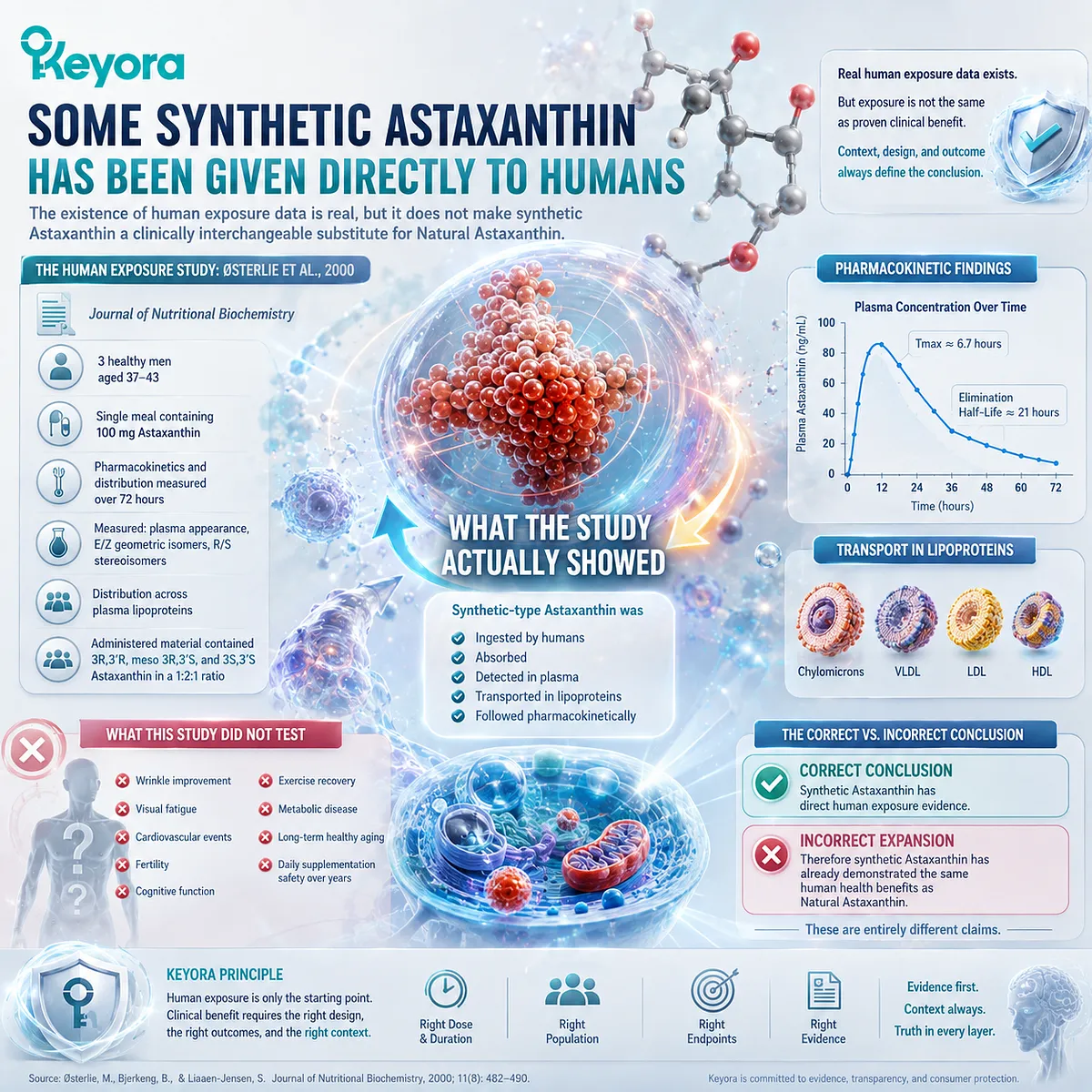
The existence of human exposure data is real, but it does not make synthetic Astaxanthin a clinically interchangeable substitute for Natural Astaxanthin.
One of the clearest examples comes from a 2000 study by Østerlie, Bjerkeng, and Liaaen-Jensen in the Journal of Nutritional Biochemistry.
Three men aged 37 to 43 consumed a single meal containing 100 mg of Astaxanthin. The researchers then measured plasma appearance, pharmacokinetics, E/Z geometric isomers, R/S stereoisomers, and distribution across plasma lipoproteins over 72 hours.
The administered material contained 3R,3′R, meso 3R,3′S, and 3S,3′S Astaxanthin in a 1:2:1 ratio. Maximum plasma concentrations were reached after approximately 6.7 hours, and the reported elimination half-life was about 21 hours.
This is genuine human evidence.
It demonstrates that conventional synthetic-type Astaxanthin material can be ingested by people, absorbed, detected in plasma, transported in lipoproteins, and followed pharmacokinetically.
But look carefully at what the experiment was designed to answer.
It did not test whether synthetic Astaxanthin improves wrinkles.
It did not test visual fatigue.
It did not test cardiovascular events.
It did not test fertility, cognitive function, exercise recovery, metabolic disease, or long-term healthy aging.
And three men receiving one 100 mg dose cannot establish the safety profile of years of daily supplementation.
So the correct conclusion is:
Synthetic Astaxanthin has direct human exposure evidence.
The incorrect expansion is:
Therefore synthetic Astaxanthin has already demonstrated the same human health benefits as Natural Astaxanthin.
Those are entirely different claims.
Human Pharmacokinetic Evidence Is Not Human Clinical Benefit Evidence
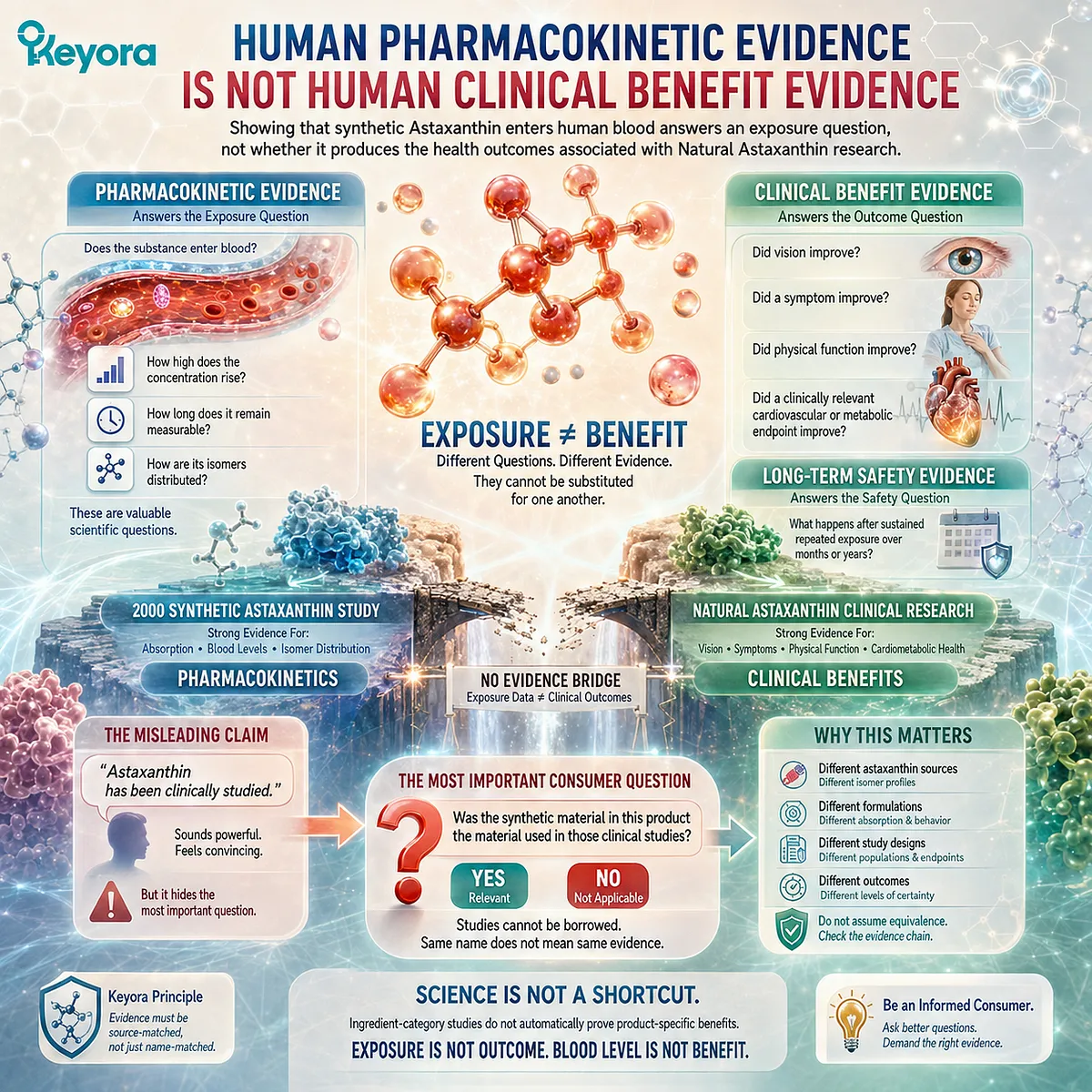
Showing that synthetic Astaxanthin enters human blood answers an exposure question, not whether it produces the health outcomes associated with Natural Astaxanthin research.
The phrase “human study” sounds powerful because it collapses many different types of research into a single category.
But human evidence has layers.
A pharmacokinetic study may ask:
Does the substance enter blood?
How high does the concentration rise?
How long does it remain measurable?
How are its isomers distributed?
Those are valuable scientific questions.
But a clinical benefit study asks something different:
Did vision improve?
Did a symptom improve?
Did physical function improve?
Did a clinically relevant cardiovascular or metabolic endpoint improve?
And a long-term safety study asks another question again:
What happens after sustained repeated exposure over months or years?
These evidence layers cannot be substituted for one another.
The 2000 synthetic Astaxanthin study provides good evidence for human absorption and pharmacokinetics. It does not create an evidence bridge to every Natural Astaxanthin endpoint studied elsewhere.
This distinction becomes especially important when a seller uses the broad phrase:
“Astaxanthin has been clinically studied.”
That sentence may be technically true at the ingredient-category level.
But it still leaves the most important consumer question unanswered:
Was the synthetic material in this product the material used in those clinical studies?
If the answer is no, the studies cannot simply be borrowed because the word “Astaxanthin” appears in both places.
This is one of the central ways scientific literature can be made to look more product-specific than it really is.
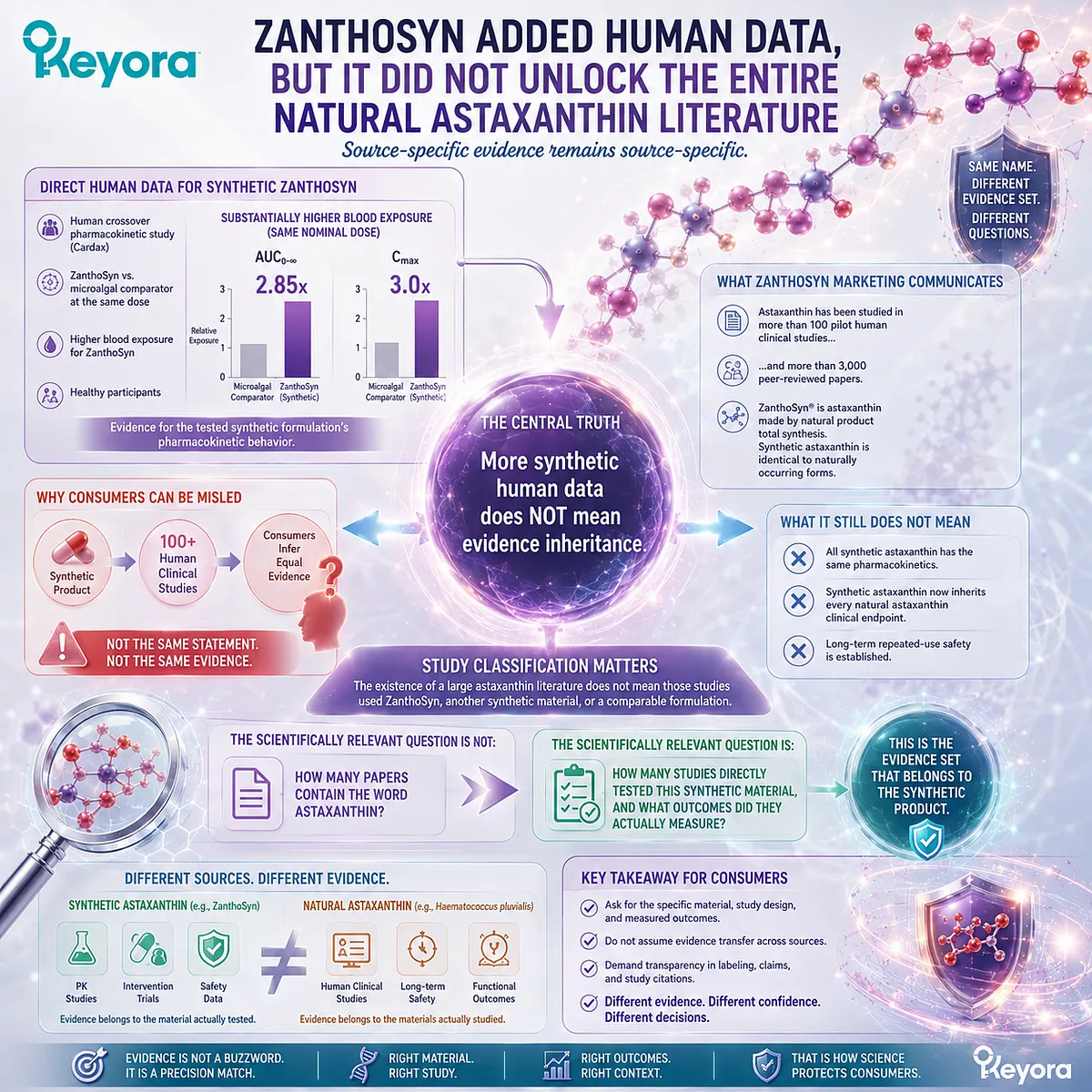
ZanthoSyn Added Human Data, but It Did Not Unlock the Entire Natural Astaxanthin Literature
Later studies gave a synthetic formulation its own human evidence, but source-specific evidence remains source-specific.
Synthetic ZanthoSyn has direct human data beyond the older single-dose study.
Cardax reported a human crossover pharmacokinetic comparison in which ZanthoSyn produced substantially higher Astaxanthin blood exposure than a microalgal comparator at the same nominal dose. The company reported 2.85-fold greater AUC and 3.0-fold greater Cmax.
That provides human evidence for the tested synthetic formulation’s pharmacokinetic behavior.
It still does not mean:
all synthetic Astaxanthin has the same pharmacokinetics,
or:
synthetic Astaxanthin now inherits every Natural Astaxanthin clinical endpoint.
Current ZanthoSyn marketing also tells consumers that Astaxanthin has been studied in more than 100 pilot human clinical studies and more than 3,000 peer-reviewed papers.
The same page identifies ZanthoSyn as Astaxanthin made by natural product total synthesis and describes synthetic Astaxanthin as identical to naturally occurring forms.
This is exactly why study classification matters.
A consumer can easily read:
synthetic product
next to:
100+ human clinical studies
and reasonably infer:
100+ human studies on this synthetic Astaxanthin.
But those are not the same statement.
The existence of a large Astaxanthin literature does not establish that all of those studies used ZanthoSyn, another synthetic material, or even a comparable formulation.
The scientifically relevant question is not:
How many papers contain the word Astaxanthin?
It is:
How many studies directly tested this synthetic material, and what outcomes did they actually measure?
That is the evidence set that belongs to the synthetic product.
The rest must remain attached to the materials actually studied.
CHASE Went Beyond Blood Levels, but Its Interim Results Do Not Establish Broad Clinical Equivalence
Synthetic ZanthoSyn entered a randomized human intervention trial, but interim biomarker findings are not a completed proof of Natural-equivalent clinical efficacy.
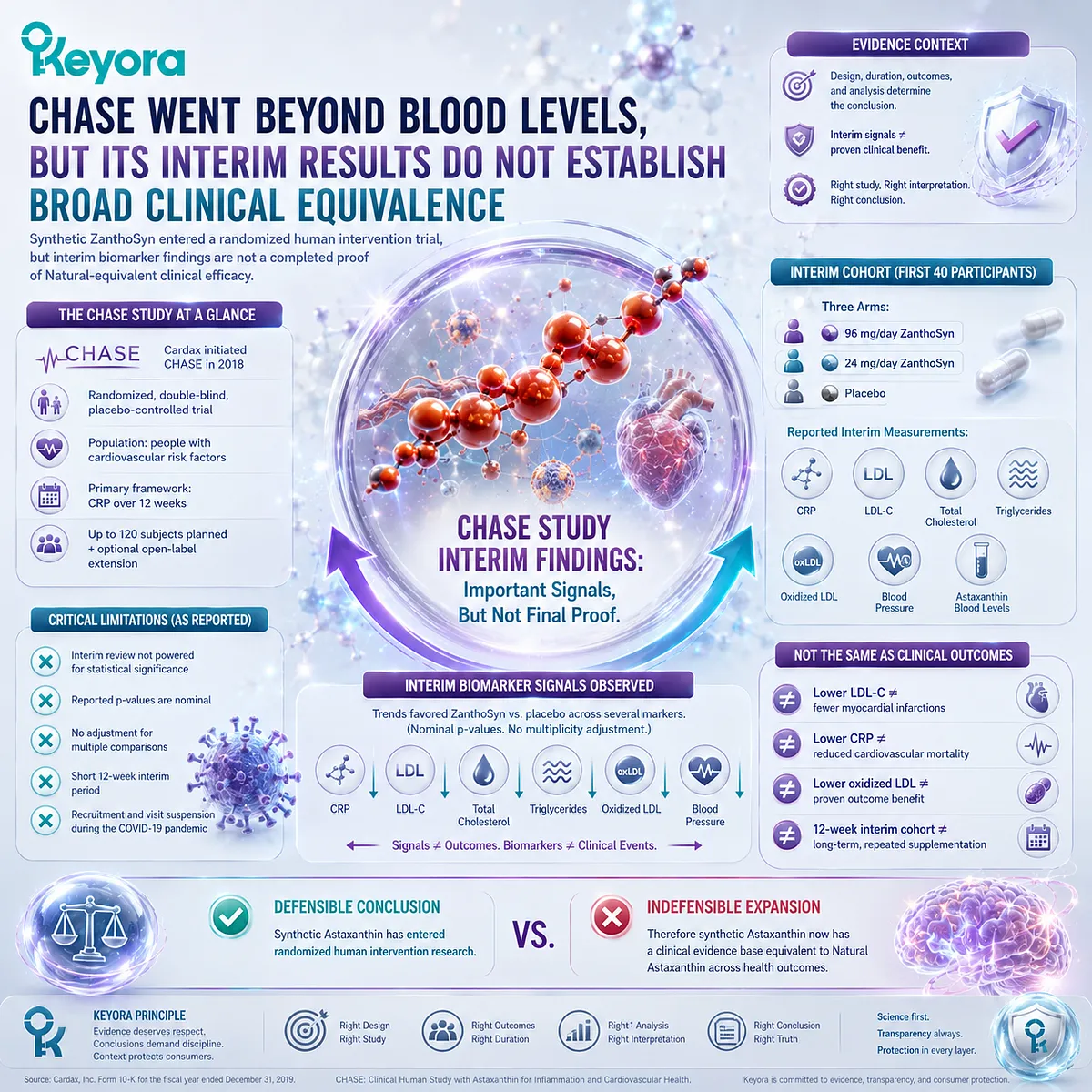
The CHASE study is important because it moved beyond a simple pharmacokinetic question.
Cardax initiated CHASE in 2018 as a randomized, double-blind, placebo-controlled trial evaluating ZanthoSyn in people with cardiovascular risk factors.
The primary framework focused on CRP over 12 weeks, with additional cardiovascular and inflammatory markers. The planned trial included up to 120 subjects and an optional open-label extension.
Cardax reported interim data from the first 40 participants.
The groups received:
-
96 mg/day ZanthoSyn,
-
24 mg/day ZanthoSyn,
-
or placebo.
Reported interim measurements included CRP, LDL-C, total cholesterol, triglycerides, oxidized LDL, blood pressure, and Astaxanthin blood concentrations.
This is direct human intervention evidence involving synthetic Astaxanthin.
But the same corporate filing states something critical: the interim review was not powered for statistical significance, the reported p-values were nominal, and no adjustment for multiple comparisons was performed.
Those limitations matter.
An interim biomarker signal is not equivalent to a fully completed, adequately powered clinical-outcome trial.
A reduction in LDL-C or CRP is not the same as demonstrating fewer myocardial infarctions.
A change in oxidized LDL is not the same as proving reduced cardiovascular mortality.
And a 12-week interim cohort cannot establish the same evidence question as long-term repeated supplementation.
CHASE also experienced recruitment and visit suspension during the COVID-19 pandemic, according to Cardax’s SEC filing.
So CHASE should neither be erased nor exaggerated.
The defensible conclusion is:
Synthetic Astaxanthin has entered randomized human intervention research.
The indefensible conclusion is:
Therefore synthetic Astaxanthin now has a clinical evidence base equivalent to Natural Astaxanthin across health outcomes.
It does not.
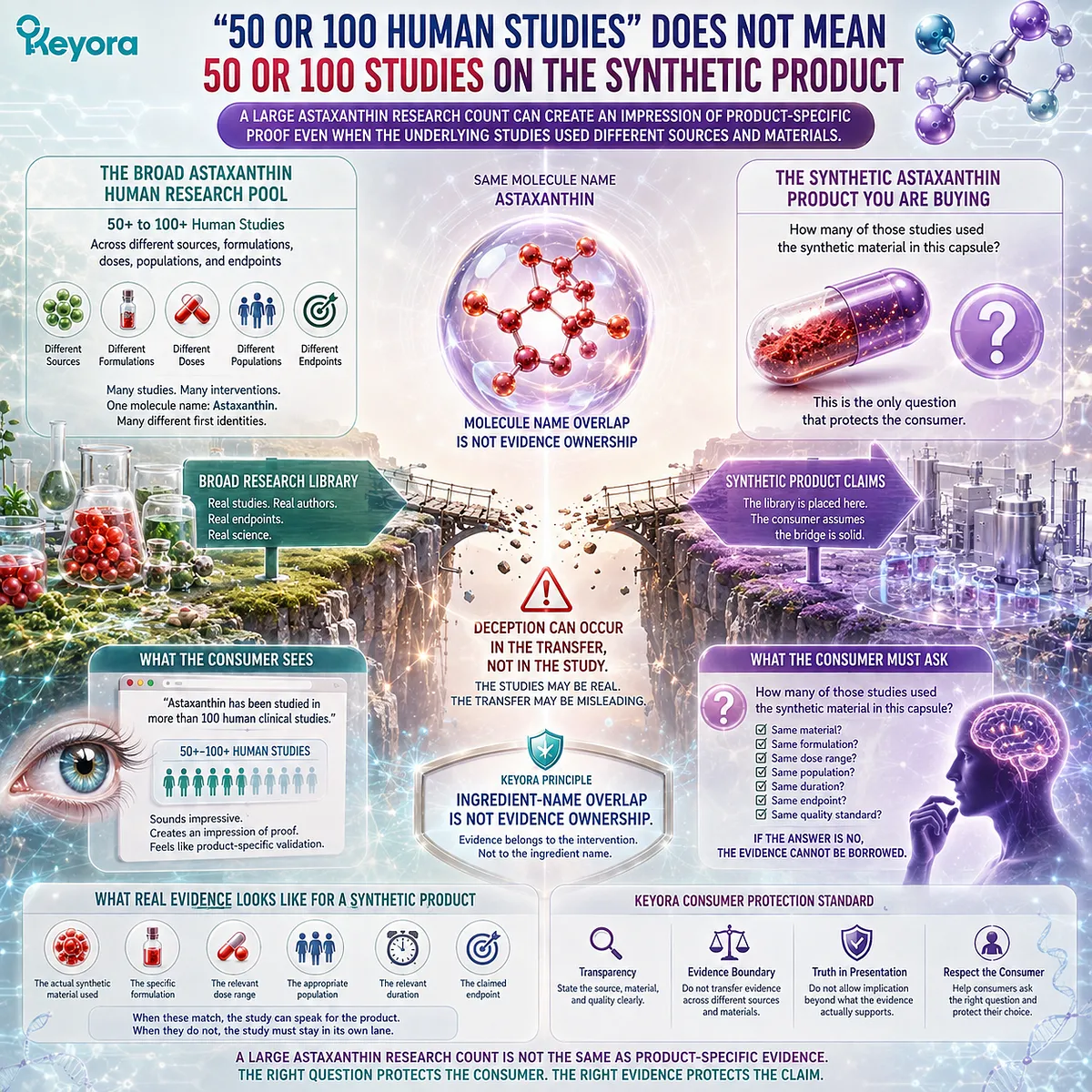
“50 or 100 Human Studies” Does Not Mean 50 or 100 Studies on the Synthetic Product
A large Astaxanthin research count can create an impression of product-specific proof even when the underlying studies used different sources and materials.
This is one of the most important consumer-protection issues in the Synthetic Astaxanthin market.
Imagine a product page that tells you:
Astaxanthin has been studied in more than 100 human clinical studies.
That sounds impressive.
And as a statement about the broad Astaxanthin literature, it may refer to a genuine body of research. ZanthoSyn currently uses exactly this type of language on its product page.
But a consumer buying a synthetic Astaxanthin product needs to ask one more question:
How many of those studies used the synthetic material in this capsule?
That question changes everything.
Human Astaxanthin research has involved different biological sources, extraction materials, formulations, doses, populations, and endpoints. A study on one Haematococcus pluvialis preparation belongs first to that intervention.
It does not automatically become evidence for a chemically synthesized preparation because both contain a molecule called Astaxanthin.
This is where evidence presentation can become misleading even without fabricating a study.
The studies may be real.
The authors may be real.
The endpoints may be real.
The deception can occur in the transfer.
A company can place a broad Astaxanthin evidence library beside a synthetic product and allow the consumer to assume that the library validates the synthetic material.
Keyora rejects that logic.
Ingredient-name overlap is not evidence ownership.
If a seller wants to claim a benefit for a synthetic Astaxanthin product, the strongest evidence should come from studies that actually used that synthetic material, in a relevant formulation, at a relevant dose, in an appropriate population, for an appropriate duration, with the claimed endpoint measured.
Anything less requires a clearly stated evidence boundary.
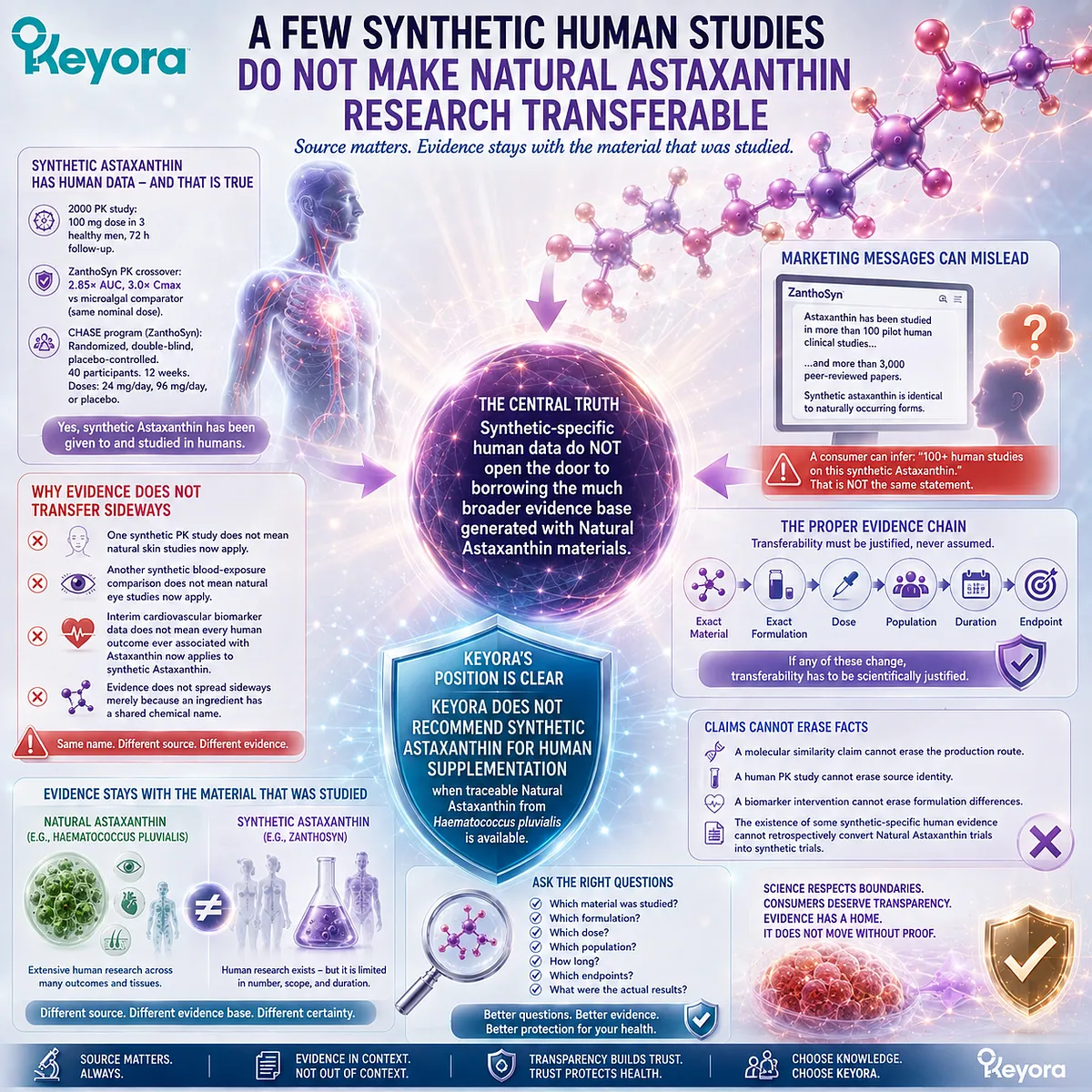
A Few Synthetic Human Studies Do Not Make Natural Astaxanthin Research Transferable
Synthetic-specific human data do not open the door to borrowing the much broader evidence base generated with Natural Astaxanthin materials.
This point is essential.
Finding one synthetic pharmacokinetic study does not mean:
Natural skin studies now apply.
Finding another synthetic blood-exposure comparison does not mean:
Natural eye studies now apply.
Finding interim cardiovascular biomarker data does not mean:
every human outcome ever associated with Astaxanthin now applies to synthetic Astaxanthin.
Evidence does not spread sideways merely because an ingredient has a shared chemical name.
The proper evidence chain is:
Exact Material
→ Exact Formulation
→ Dose
→ Population
→ Duration
→ Endpoint
If any of those change, transferability has to be justified rather than assumed.
This is especially important when synthetic Astaxanthin is positioned as “identical” or Natural-equivalent.
A molecular similarity claim cannot erase the production route.
A human PK study cannot erase source identity.
A biomarker intervention cannot erase formulation differences.
And the existence of some synthetic-specific human evidence cannot retrospectively convert Natural Astaxanthin trials into synthetic trials.
Keyora therefore continues to oppose the use of synthetic Astaxanthin as a human supplement choice when traceable Natural Astaxanthin from Haematococcus pluvialis is available.
That position does not require pretending that synthetic human studies do not exist.
It requires refusing to let narrow synthetic evidence be stretched into a much larger claim than it can scientifically support.
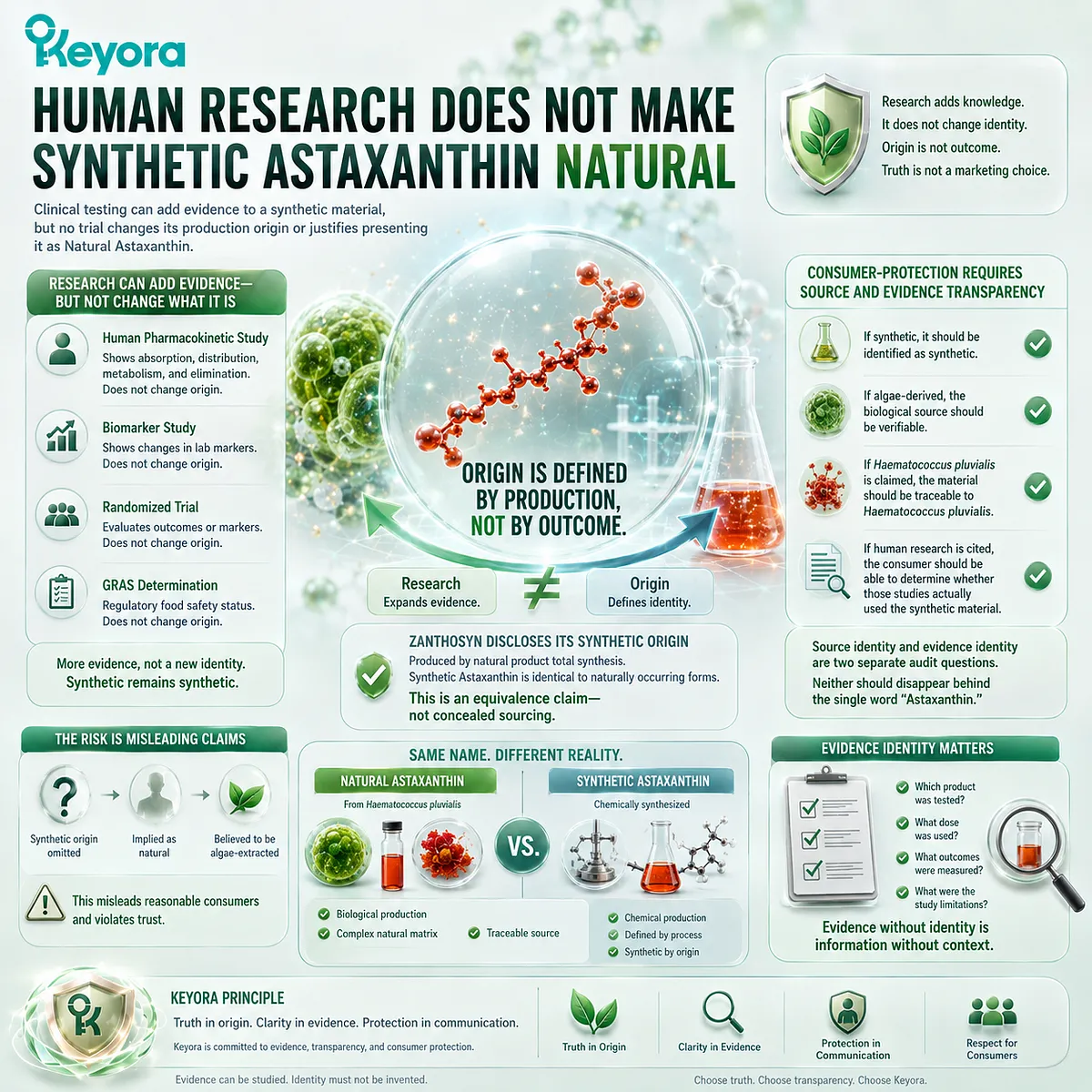
Human Research Does Not Make Synthetic Astaxanthin Natural
Clinical testing can add evidence to a synthetic material, but no trial changes its production origin or justifies presenting it as Natural Astaxanthin.
This distinction should be obvious, yet marketing language can blur it.
A chemically synthesized Astaxanthin material remains synthetic after:
-
a human pharmacokinetic study,
-
a biomarker study,
-
a randomized trial,
-
or a GRAS determination.
Research can tell us more about the material.
Research does not change what the material is.
Current ZanthoSyn information openly states that its Astaxanthin is produced by natural product total synthesis while also stating that synthetic Astaxanthin is identical to naturally occurring forms.
Because the synthetic origin is disclosed there, that specific statement should be evaluated as an equivalence claim, not falsely described as concealed sourcing.
The more serious consumer-protection issue arises when synthetic origin is omitted, obscured, or replaced with language that leads a reasonable consumer to believe the material is naturally extracted from Haematococcus pluvialis.
If a product is synthetic, it should be identified as synthetic.
If it is algae-derived, the biological source should be verifiable.
If a seller claims Haematococcus pluvialis, the material should actually be traceable to Haematococcus pluvialis.
And if a synthetic product cites human research, the consumer should be able to determine whether those studies actually used the synthetic material.
Source identity and evidence identity are two separate audit questions.
Neither should be allowed to disappear behind the single word “Astaxanthin.”
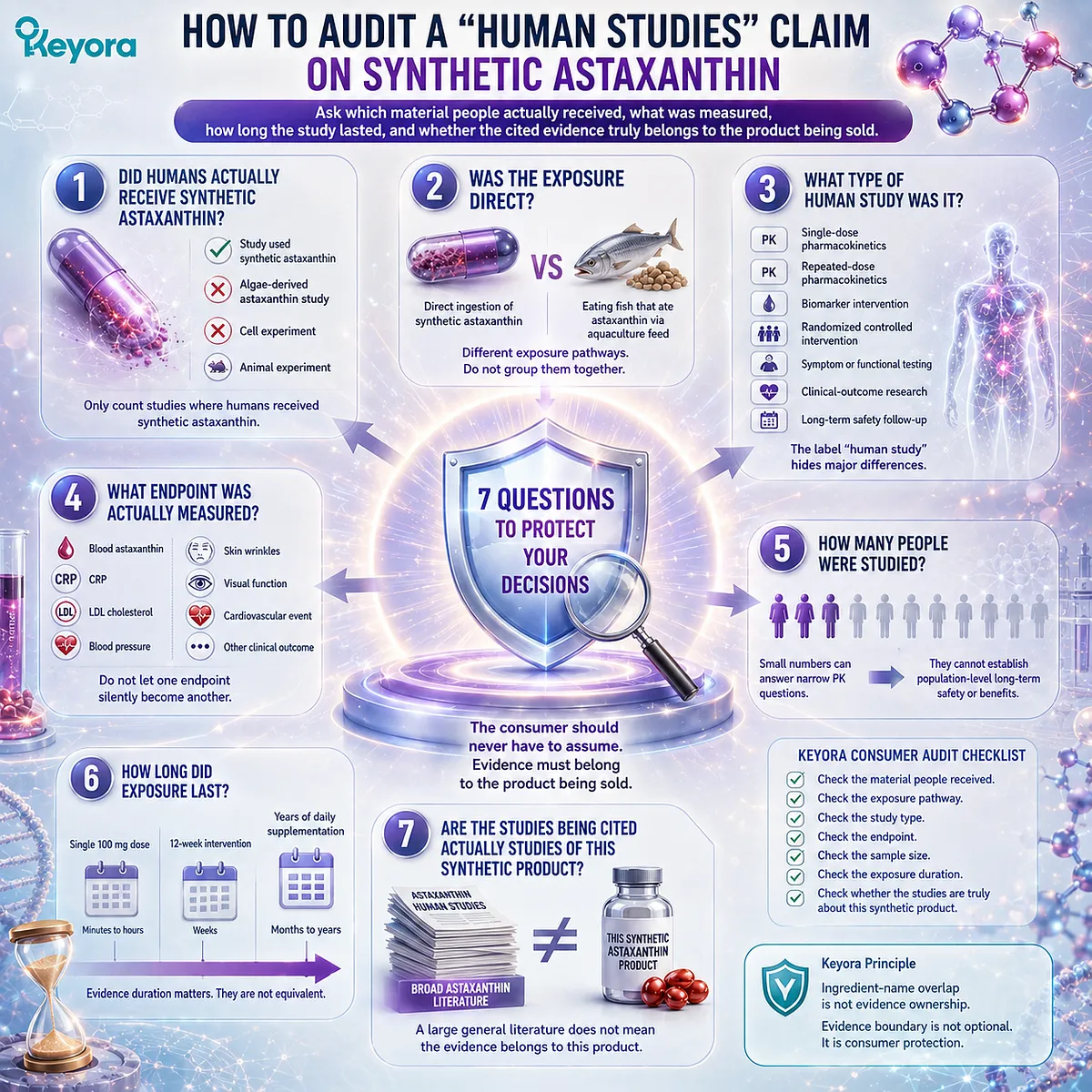
How to Audit a “Human Studies” Claim on Synthetic Astaxanthin
Ask which material people actually received, what was measured, how long the study lasted, and whether the cited evidence truly belongs to the product being sold.
When a synthetic Astaxanthin seller says “human studied,” do not stop at that phrase.
Ask seven questions.
1. Did humans actually receive synthetic Astaxanthin?
A study on algae-derived Astaxanthin is not a synthetic Astaxanthin study.
A cell experiment is not a human study.
An animal experiment is not a human study.
2. Was the exposure direct?
A person swallowing a synthetic Astaxanthin preparation is different from a person eating fish that had previously consumed Astaxanthin in aquaculture feed.
Those are different exposure pathways and should not be grouped together.
3. What type of human study was it?
Was it:
-
single-dose pharmacokinetics,
-
repeated-dose pharmacokinetics,
-
biomarker intervention,
-
randomized controlled intervention,
-
symptom or functional testing,
-
clinical-outcome research,
-
or long-term safety follow-up?
The label “human study” alone hides these differences.
4. What endpoint was actually measured?
Blood Astaxanthin?
CRP?
LDL?
Blood pressure?
Skin wrinkles?
Visual function?
A cardiovascular event?
Do not let one endpoint silently become another.
5. How many people were studied?
Three people in a pharmacokinetic experiment can answer a narrow PK question.
They cannot establish population-level long-term supplementation safety.
6. How long did exposure last?
A single 100 mg dose, a 12-week intervention, and years of repeated daily supplementation are not equivalent evidence durations.
7. Are the studies being cited actually studies of this synthetic product?
This is the decisive question.
A website can truthfully say that Astaxanthin has a large human literature while still leaving unanswered whether that evidence belongs to the synthetic material being sold.
The consumer should never have to assume.
Closing Summary
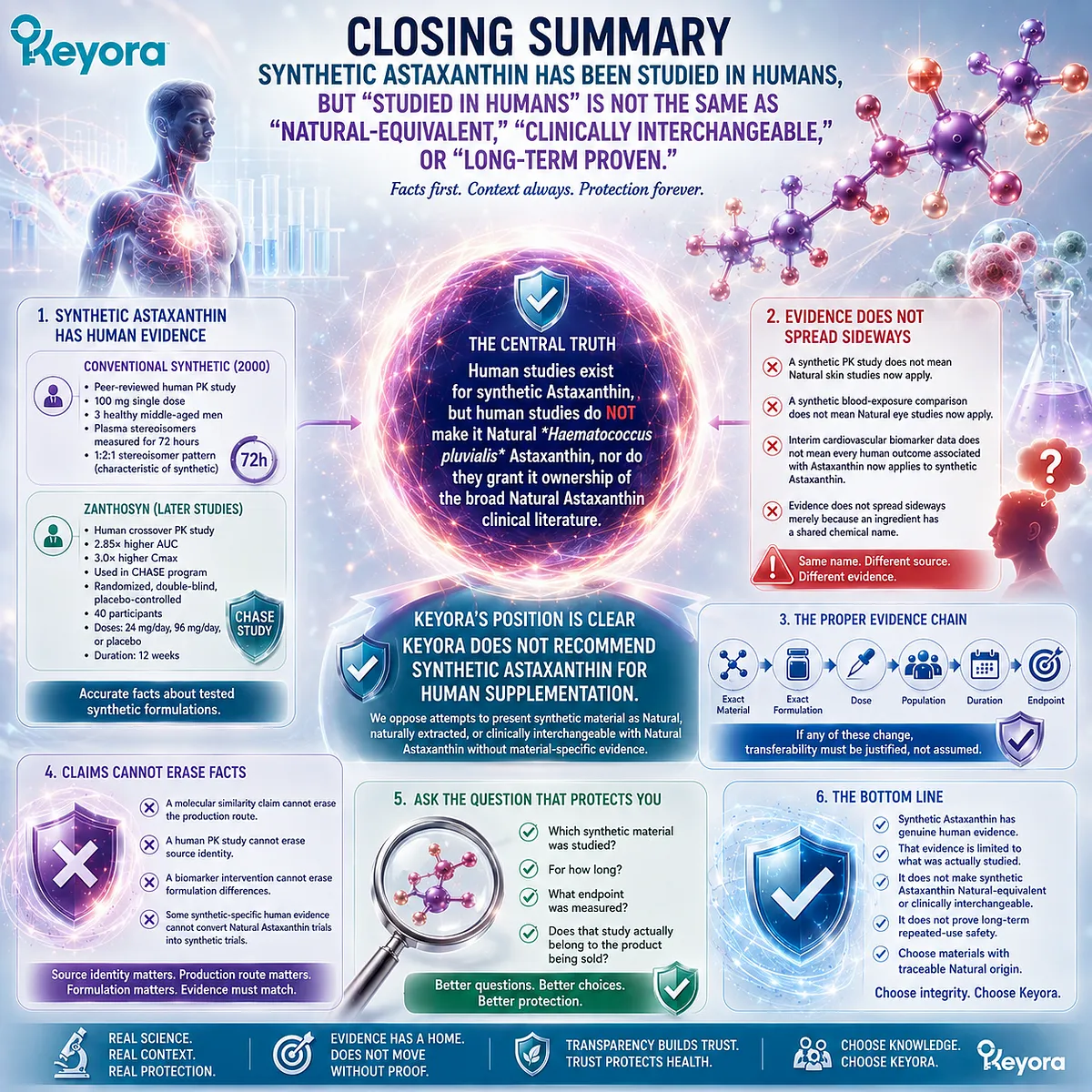
Synthetic Astaxanthin has been studied in humans, but “studied in humans” is not the same conclusion as “Natural-equivalent,” “clinically interchangeable,” or “long-term proven.”
Synthetic Astaxanthin has genuine human evidence.
A peer-reviewed study from 2000 directly administered a conventional mixed-isomer Astaxanthin preparation to three men and measured its plasma pharmacokinetics.
ZanthoSyn later generated additional human pharmacokinetic data and entered the randomized CHASE biomarker-intervention program.
That evidence should be described accurately.
But it should not be allowed to do more work than it can support.
A PK study proves human exposure.
A biomarker study may support a specific biomarker finding.
Neither gives a synthetic product ownership of the broader Natural Astaxanthin clinical literature.
And no human study converts synthetic Astaxanthin into Natural Haematococcus pluvialis Astaxanthin.
Keyora does not recommend synthetic Astaxanthin for human supplementation and rejects attempts to present synthetic material as Natural, naturally extracted, or clinically interchangeable with Natural Astaxanthin without material-specific evidence.
When a synthetic product says “human studied,” ask the question that protects you:
Which synthetic material was studied, for how long, what endpoint was measured, and does that study actually belong to the product being sold?
This article is for educational and informational purposes only. It does not provide medical advice, diagnosis, treatment, cure, prevention, disease outcome claims, hormone restoration claims, fertility outcome claims, or formula-specific clinical efficacy claims.