
Is “Nature Identical” Astaxanthin Actually Natural?
Keyora Research Q&A Library
This is part of the Keyora Research Q&A Series, derived from Keyora Astaxanthin Research Journal Series.
Within the Keyora Astaxanthin Researcn framework, this Q&A translates complex astaxanthin biology into reader-friendly, evidence-bound answers, focusing on natural astaxanthin identity, molecular structure, antioxidant and redox mechanisms, membrane lipid interaction, mitochondrial resilience, inflammatory signaling pathways, human evidence interpretation, and the scientific principles behind responsible supplementation.
First published by Keyora Research Journal: www.keyorahealth.com
Direct Answer
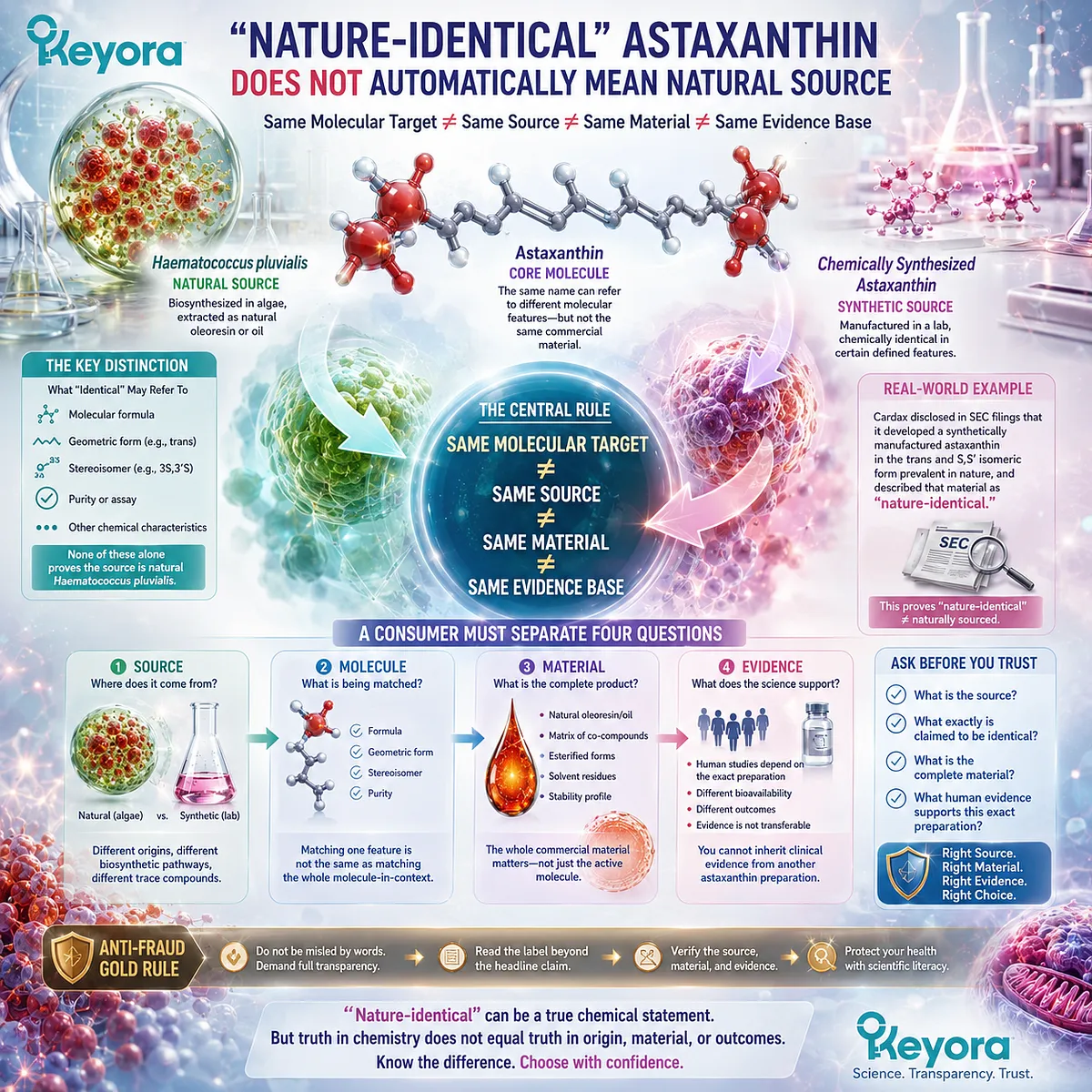
“Nature-identical” Astaxanthin can be chemically synthesized, so the phrase does not by itself mean that the ingredient came from a natural source such as Haematococcus pluvialis.
No. If an Astaxanthin ingredient is described as “nature-identical,” that does not automatically make it natural Astaxanthin.
The most important question is not whether the word “identical” appears on a product page.
It is what, exactly, is being claimed to be identical.
A manufacturer may be referring to a molecular formula, a specific geometric form, a specific stereoisomer such as 3S,3′S, or another defined chemical characteristic.
None of those statements, by themselves, establish that the ingredient was biosynthesized by Haematococcus pluvialis and extracted from algae.
This distinction is not theoretical.
Cardax disclosed in SEC filings that it developed a synthetically manufactured Astaxanthin in the trans and S,S′ isomeric form prevalent in nature, and described that material as “nature-identical.”
The same filing therefore provides a useful real-world example of why “nature-identical” and “naturally sourced” are not synonyms.
A consumer should separate four questions:
Source → Molecule → Material → Evidence
A synthetic material may match an important molecular feature of Astaxanthin found in nature. That can be scientifically meaningful.
But molecular correspondence does not automatically establish the same biological source, the same complete commercial material, the same formulation, or the right to inherit clinical evidence generated with another Astaxanthin preparation.
That is the central anti-fraud rule:
Same molecular target ≠ Same source ≠ Same material ≠ Same evidence base.
Why “Nature Identical” Can Sound More Natural Than It Is
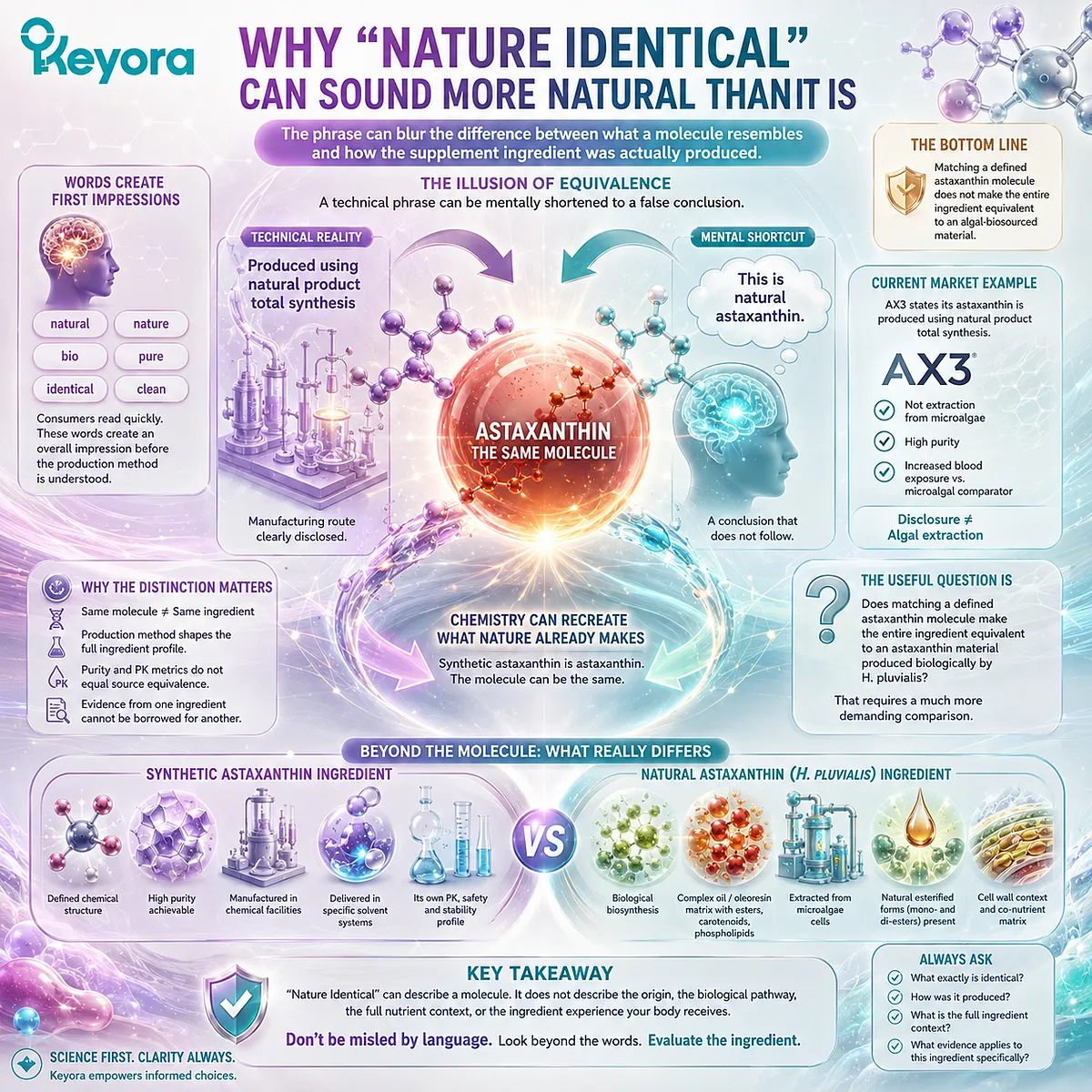
The phrase can blur the difference between what a molecule resembles and how the supplement ingredient was actually produced.
Consumers usually read ingredient language quickly. Words such as “natural,” “nature,” “bio,” “pure,” and “identical” can therefore create an overall impression before the production method is understood.
Current Astaxanthin marketing illustrates why the distinction matters. AX3 states that its Astaxanthin is produced using natural product total synthesis, while contrasting that manufacturing route with extraction from microalgae. The same consumer-facing materials emphasize purity and increased blood exposure compared with a microalgal comparator.
None of that means the manufacturer is secretly claiming that chemical synthesis is algal extraction. In fact, the production route is disclosed. The consumer problem arises when a technical phrase such as “natural product total synthesis” or “nature-identical” is mentally shortened to:
“This is natural Astaxanthin.”
That conclusion does not follow.
Chemical synthesis can intentionally produce a compound that also occurs in nature. Chemistry does this in many fields. The scientific question is therefore not whether a synthesized molecule is “real.” Synthetic Astaxanthin is Astaxanthin.
The more useful question is:
Does matching a defined Astaxanthin molecule make the entire ingredient equivalent to an Astaxanthin material produced biologically by H. pluvialis?
That requires a much more demanding comparison.
Identical to What? A Molecule Is Not the Whole Material
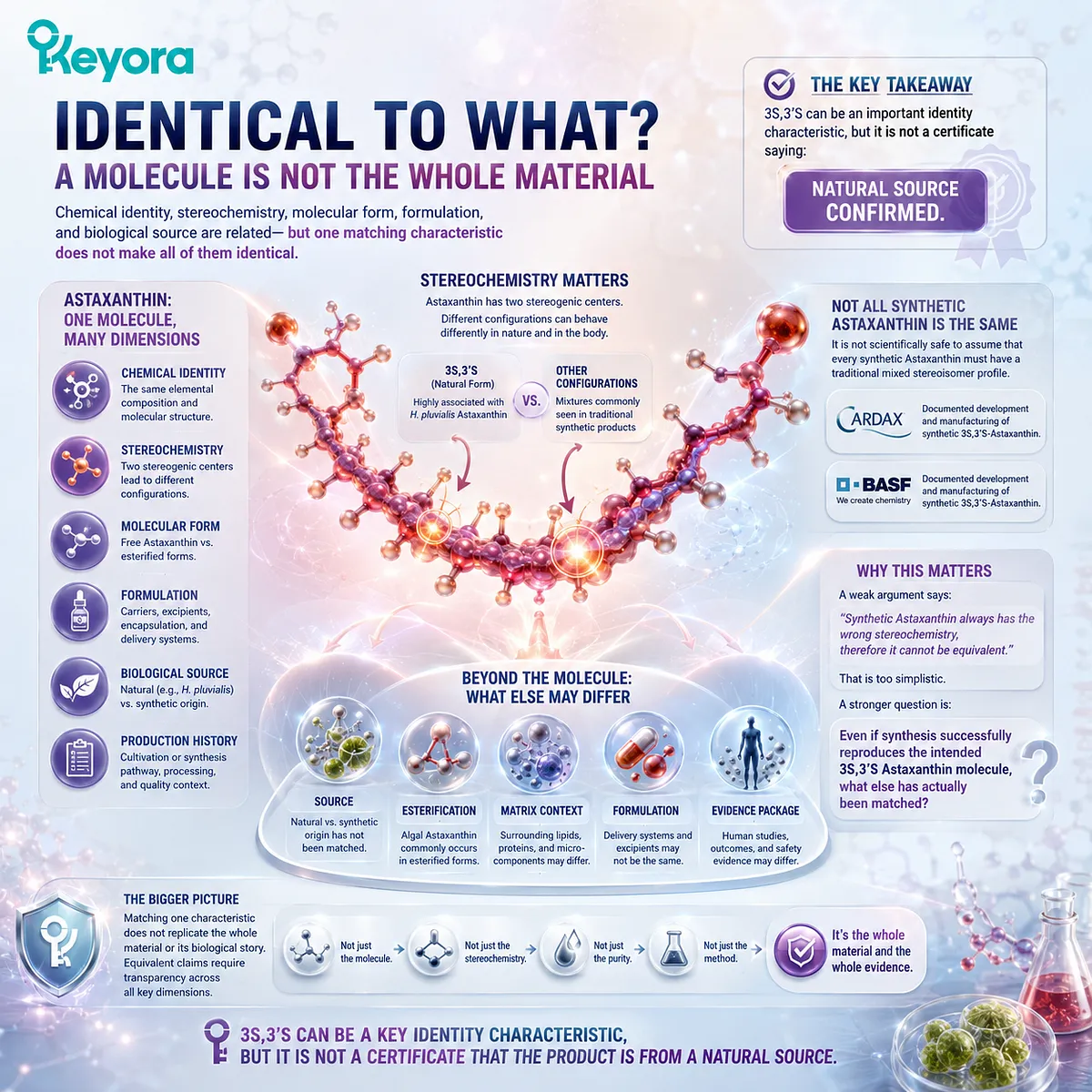
Chemical identity, stereochemistry, molecular form, formulation, and biological source are related characteristics, but one matching characteristic does not make all of them identical.
Astaxanthin has two stereogenic centers and can occur in different stereochemical configurations. Traditional synthetic Astaxanthin is often discussed as a mixture of stereoisomers, while H. pluvialis Astaxanthin is strongly associated with the 3S,3′S configuration. Astaxanthin from algae also commonly occurs in esterified forms rather than existing only as free Astaxanthin.
But there is an important correction consumers should know.
It is not scientifically safe to assume that every synthetic Astaxanthin product must have the traditional mixed stereoisomer profile.
Cardax and BASF documented development and manufacturing work involving synthetically produced 3S,3′S-Astaxanthin. Cardax also described ASTX-1 as synthetically manufactured in the trans and S,S′ form that is prevalent in nature.
This matters because a weak natural-versus-synthetic argument would say:
“Synthetic Astaxanthin always has the wrong stereochemistry, therefore it cannot be equivalent.”
That is too simplistic.
A stronger question is:
Even if synthesis successfully reproduces the intended 3S,3′S Astaxanthin molecule, what else has actually been matched?
Source has not been matched. Production history has not been matched merely by stereochemical correspondence. Esterification and formulation may differ. The surrounding material may differ. The human evidence package may differ.
So 3S,3′S can be an important identity characteristic, but it is not a certificate saying:
Natural source confirmed.
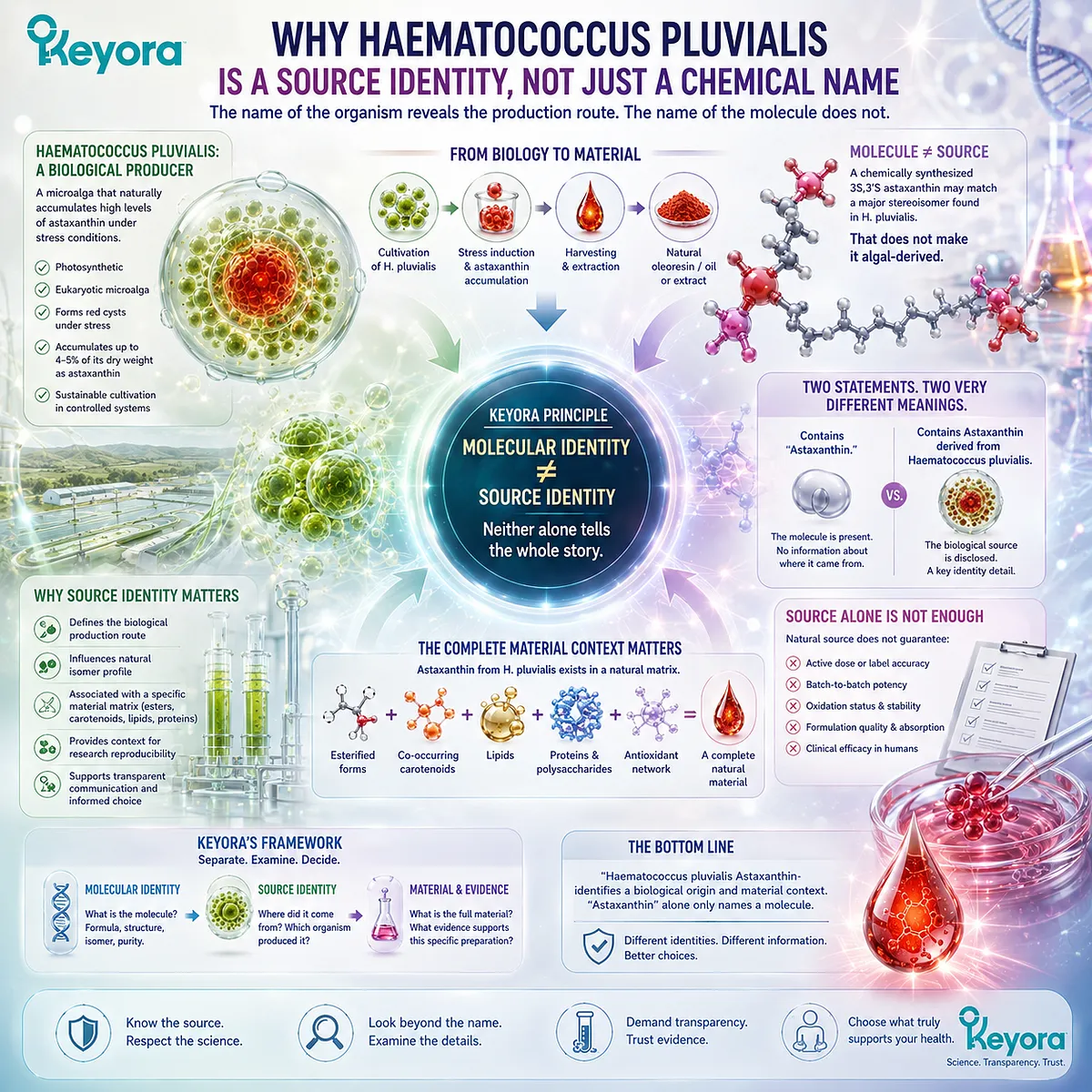
Why Haematococcus pluvialis Is a Source Identity, Not Just a Chemical Name
“Haematococcus pluvialis Astaxanthin” identifies a biological production route and material context that the word “Astaxanthin” alone does not disclose.
Haematococcus pluvialis is a microalga capable of accumulating large quantities of Astaxanthin under appropriate growth conditions. Commercial extracts from this organism form an important source of Astaxanthin used in human supplements and research.
When a study identifies the intervention as an H. pluvialis extract, that information is part of the identity of the intervention.
It does not mean that every H. pluvialis product is automatically high quality. Natural source alone cannot prove the active dose, batch potency, oxidation status, formulation quality, absorption, or clinical efficacy of a finished supplement.
But source still matters.
Consider two statements:
“Contains Astaxanthin.”
and
“Contains Astaxanthin derived from Haematococcus pluvialis.”
The second statement tells the reader something the first does not: where the material came from.
A chemically synthesized 3S,3′S Astaxanthin may correspond to a major stereochemical form associated with H. pluvialis. That correspondence does not retroactively give the synthetic ingredient an algal origin.
This is why Keyora separates molecular identity from source identity rather than treating either one as the whole story.
Purity and Bioavailability Do Not Prove Clinical Equivalence
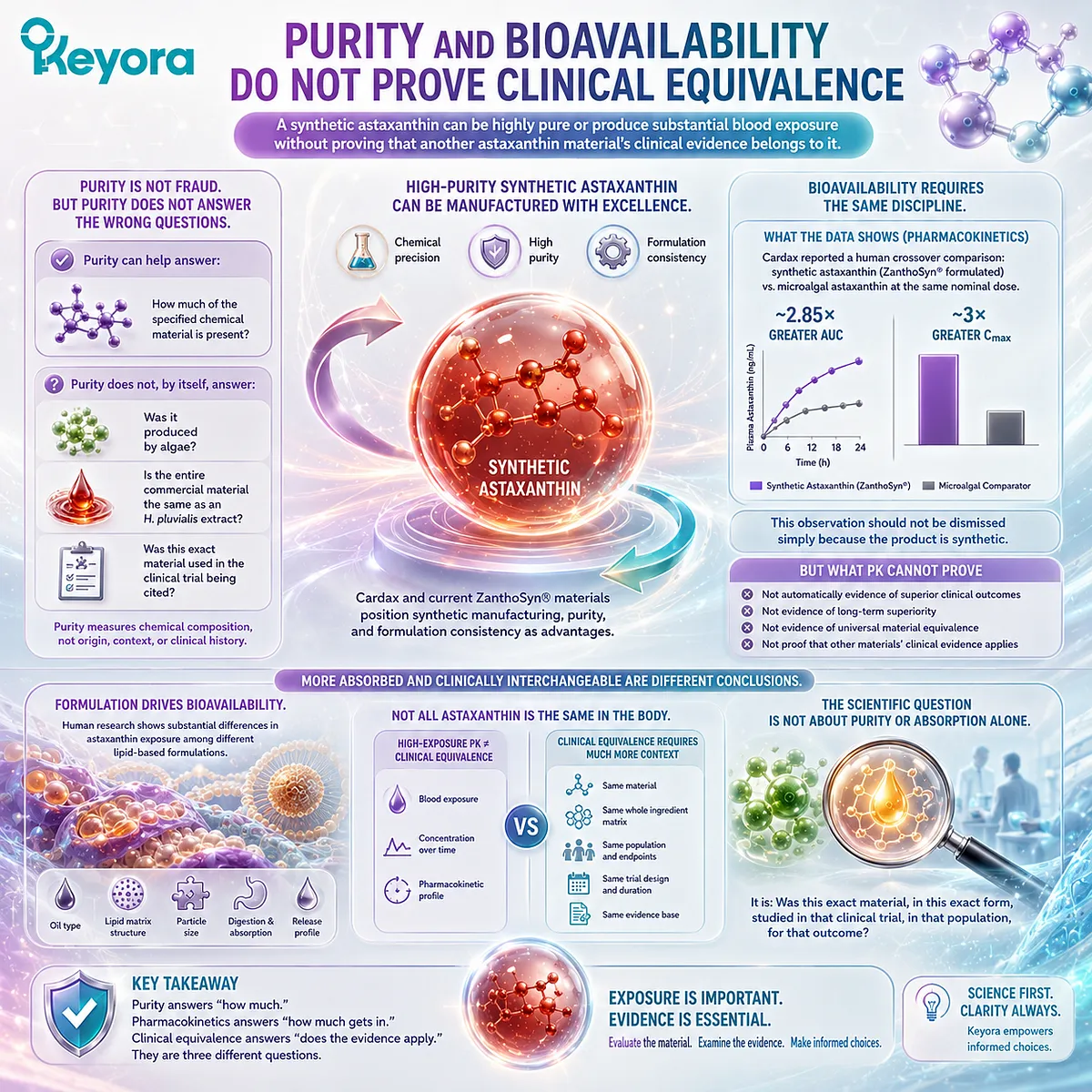
A synthetic Astaxanthin can be highly pure or produce substantial blood exposure without proving that another Astaxanthin material’s clinical evidence belongs to it.
High purity is not evidence of fraud. It is also not a reason to reject a material simply because it was synthesized.
A high-purity synthetic Astaxanthin may be manufactured with excellent chemical precision. Cardax and current ZanthoSyn materials explicitly position synthetic manufacturing, purity, and formulation consistency as advantages.
The mistake occurs when purity is asked to prove something it does not measure.
Purity can help answer:
How much of the specified chemical material is present?
It does not, by itself, answer:
Was it produced by algae?
Is the entire commercial material the same as an H. pluvialis extract?
Was this exact material used in the clinical trial being cited?
Bioavailability requires the same discipline.
Cardax has reported a human crossover comparison in which its formulated synthetic Astaxanthin produced substantially higher Astaxanthin blood exposure than a microalgal comparator at the same nominal dose. Its SEC reporting described approximately 2.85-fold greater AUC and 3-fold greater Cmax in that comparison.
That observation should not be dismissed simply because the product is synthetic.
But it also should not be expanded beyond what pharmacokinetics can establish.
Higher plasma exposure is evidence about exposure. It is not automatically evidence of superior clinical outcomes, long-term superiority, or universal material equivalence.
Human Astaxanthin pharmacokinetics are strongly affected by formulation. Independent human research has likewise shown substantial differences in Astaxanthin exposure among different lipid-based formulations.
So “more absorbed” and “clinically interchangeable” remain different conclusions.
Human Evidence Must Follow the Astaxanthin Material Actually Studied
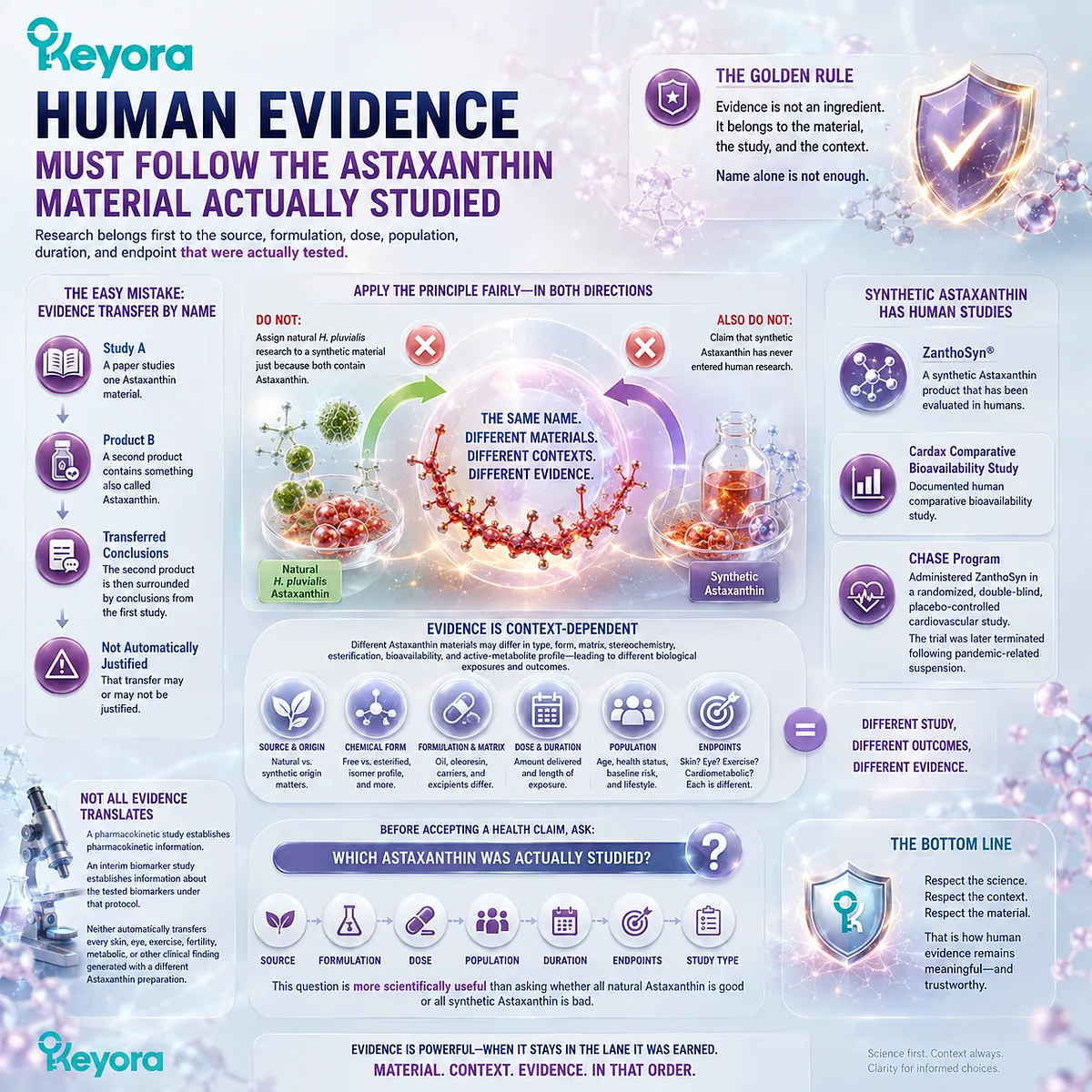
Research belongs first to the source, formulation, dose, population, duration, and endpoint that were actually tested.
One of the easiest mistakes in supplement marketing is evidence transfer by ingredient name.
A paper studies one Astaxanthin material.
A second product contains something also called Astaxanthin.
The second product is then surrounded by conclusions from the first study.
That transfer may or may not be justified. The ingredient name alone is not enough to decide.
This principle must be applied fairly in both directions.
Natural H. pluvialis research should not automatically be assigned to a synthetic material merely because both contain Astaxanthin. But it would also be inaccurate to claim that synthetic Astaxanthin has never entered human research.
ZanthoSyn, a synthetic Astaxanthin product, has been evaluated in humans. Cardax describes a human comparative bioavailability study, and its CHASE program administered ZanthoSyn in a randomized, double-blind, placebo-controlled cardiovascular study before the trial was later terminated following pandemic-related suspension.
That evidence matters.
But its existence does not collapse all Astaxanthin research into one interchangeable evidence pool.
A pharmacokinetic study establishes pharmacokinetic information. An interim biomarker study establishes information about the tested biomarkers under that protocol. Neither automatically transfers every skin, eye, exercise, fertility, metabolic, or other clinical finding generated with a different Astaxanthin preparation.
Before accepting a health claim, ask:
Which Astaxanthin was actually studied?
That question is more scientifically useful than asking whether all natural Astaxanthin is good or all synthetic Astaxanthin is bad.
How to Audit a “Nature Identical” Astaxanthin Claim
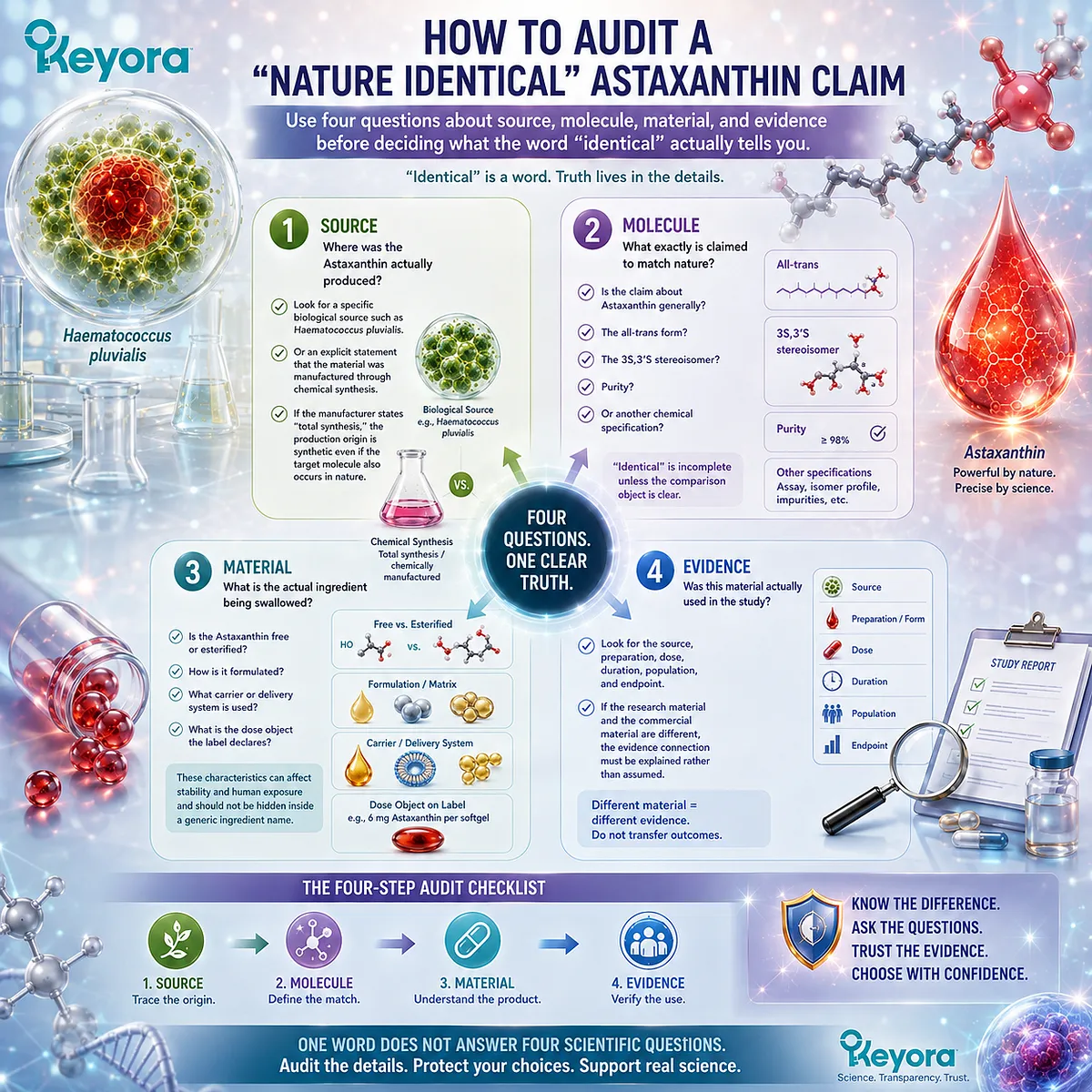
Use four questions about source, molecule, material, and evidence before deciding what the word “identical” actually tells you.
When you encounter “nature-identical,” do not treat the phrase as proof or as automatic evidence of deception. Audit it.
1. Source: Where was the Astaxanthin actually produced?
Look for a specific biological source such as Haematococcus pluvialis, or an explicit statement that the material was manufactured through chemical synthesis.
If the manufacturer states “total synthesis,” the production origin is synthetic even if the target molecule also occurs in nature.
2. Molecule: What exactly is claimed to match nature?
Is the claim about Astaxanthin generally, the all-trans form, the 3S,3′S stereoisomer, purity, or another chemical specification?
“Identical” is incomplete unless the comparison object is clear.
3. Material: What is the actual ingredient being swallowed?
Check whether the Astaxanthin is free or esterified, how it is formulated, what carrier system is used, and what dose object the label declares. These characteristics can affect stability and human exposure and should not be hidden inside a generic ingredient name.
4. Evidence: Was this material actually used in the study?
Look for the source, preparation, dose, duration, population, and endpoint.
If the research material and the commercial material are different, the evidence connection must be explained rather than assumed.
This four-step check does not require consumers to become chemists.
It simply prevents one word, “identical,” from answering four different scientific questions.
Closing Summary
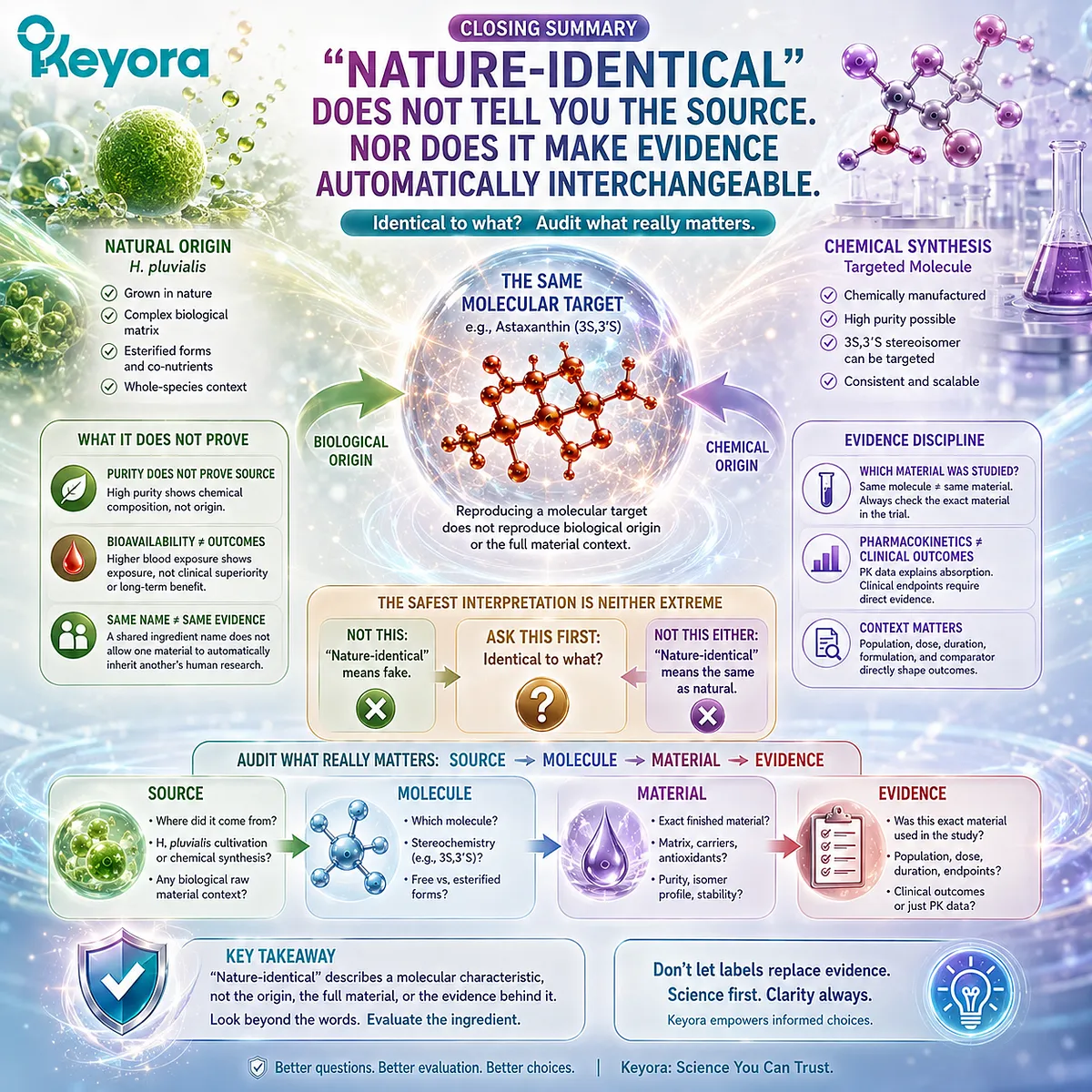
“Nature-identical” does not tell you that an Astaxanthin ingredient came from nature, nor does it automatically make different Astaxanthin evidence bases interchangeable.
A chemically synthesized Astaxanthin can deliberately reproduce an important molecular characteristic found in nature.
Modern synthesis can even target the 3S,3′S stereochemical form associated with Haematococcus pluvialis. That is precisely why the old shortcut, “synthetic always means the wrong stereoisomer,” is not a reliable consumer rule.
But reproducing a molecular target does not reproduce biological origin by definition.
Nor does purity prove source, blood exposure prove clinical superiority, or a shared ingredient name allow one material to automatically inherit another material’s human research.
The safest interpretation is therefore not:
“Nature-identical means fake.”
Nor is it:
“Nature-identical means the same as natural.”
Instead, ask one question first:
Identical to what?
Then audit:
Source → Molecule → Material → Evidence
That is the distinction that helps a consumer understand what they are actually buying without turning either “natural” or “synthetic” into a substitute for evidence.
This article is for educational and informational purposes only. It does not provide medical advice, diagnosis, treatment, cure, prevention, disease outcome claims, hormone restoration claims, fertility outcome claims, or formula-specific clinical efficacy claims.