
Can a 24 mg Astaxanthin Product Contain Less Than 1 mg?
Keyora Research Q&A Library
This is part of the Keyora Research Q&A Series, derived from Keyora Astaxanthin Research Journal Series.
Within the Keyora Astaxanthin Researcn framework, this Q&A translates complex astaxanthin biology into reader-friendly, evidence-bound answers, focusing on natural astaxanthin identity, molecular structure, antioxidant and redox mechanisms, membrane lipid interaction, mitochondrial resilience, inflammatory signaling pathways, human evidence interpretation, and the scientific principles behind responsible supplementation.
First published by Keyora Research Journal: www.keyorahealth.com
Direct Answer
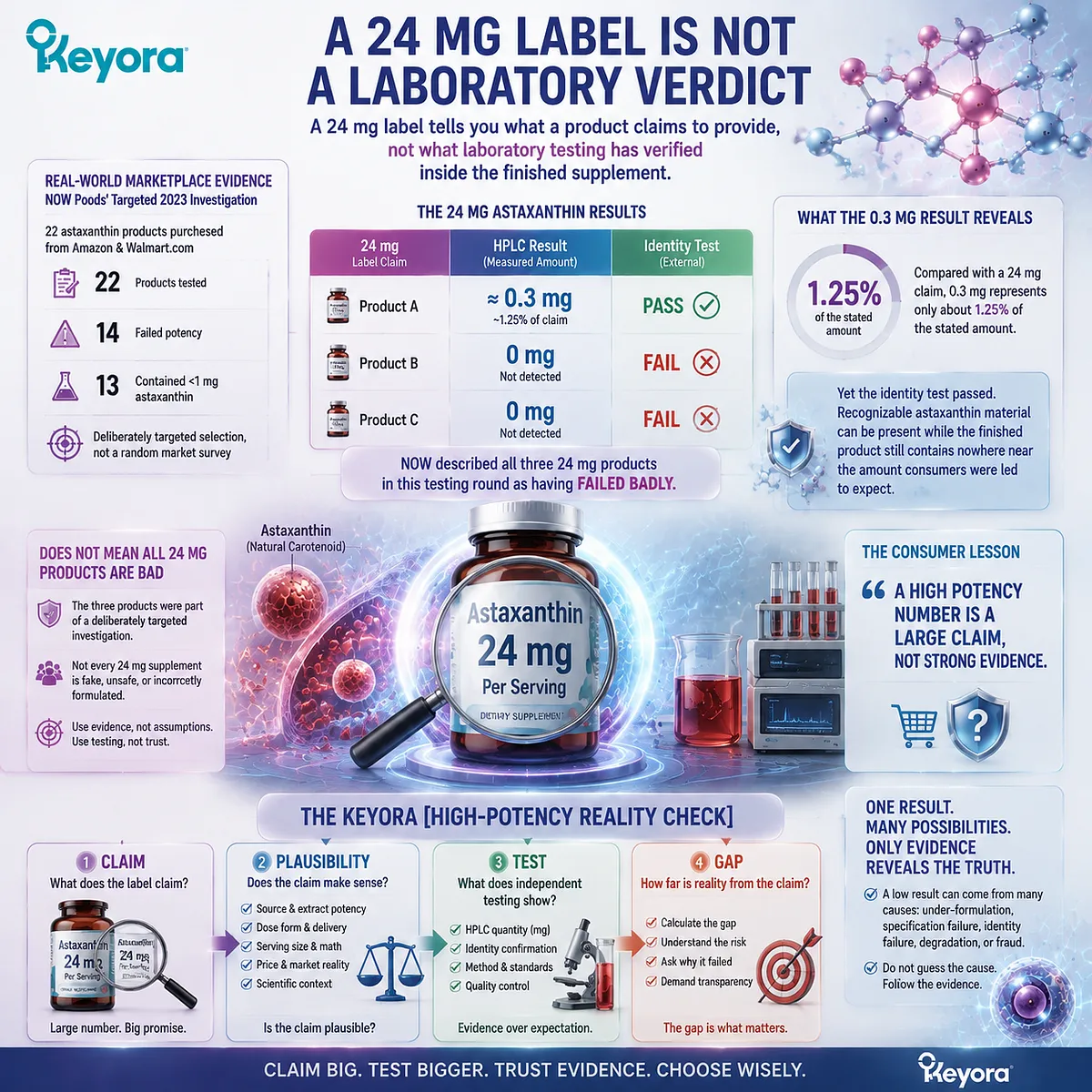
A 24 mg label tells you what a product claims to provide, not what laboratory testing has verified inside the finished supplement.
Yes.
A product labeled as providing 24 mg of Astaxanthin can contain less than 1 mg in the tested sample.
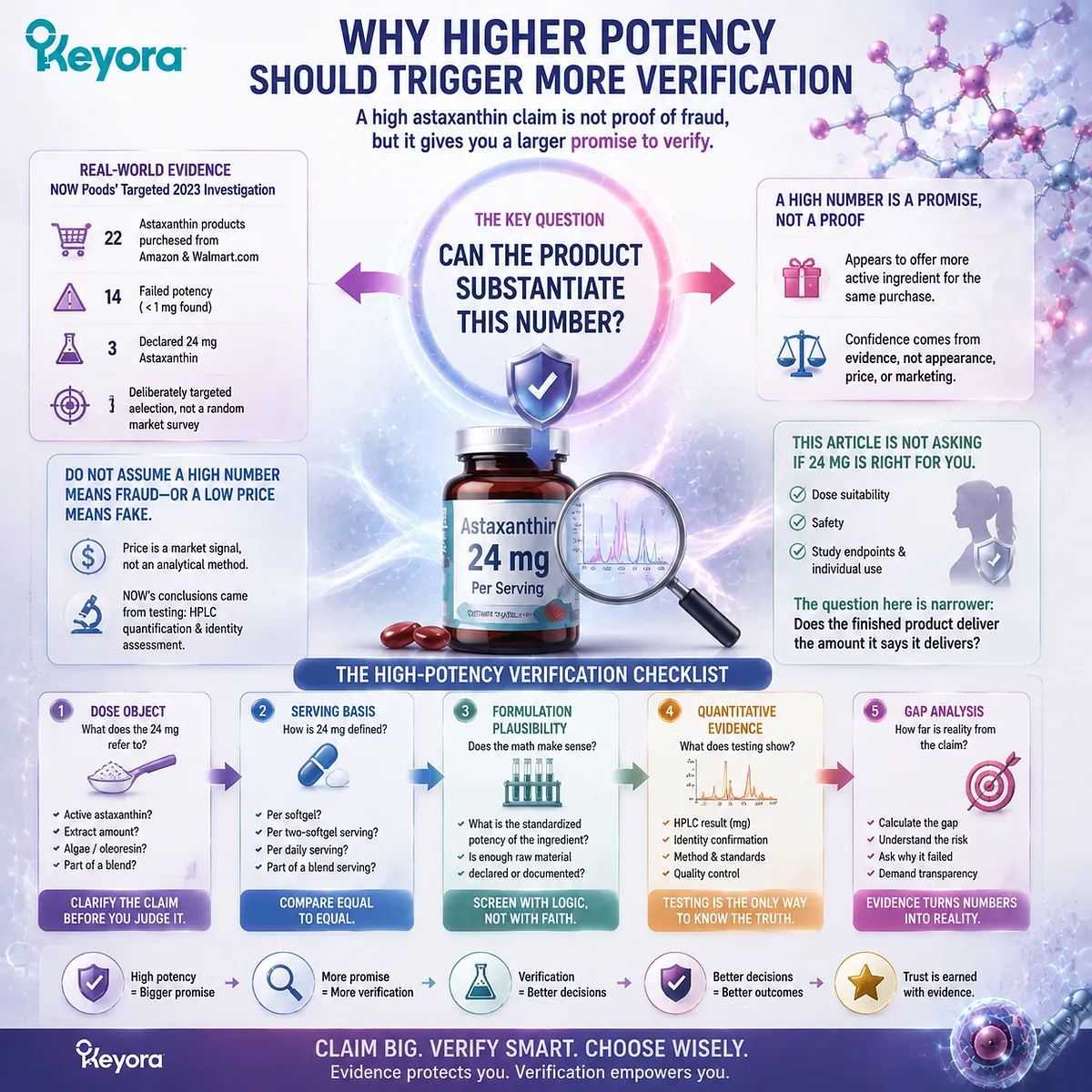
In NOW Foods’ targeted 2023 marketplace investigation, three products carrying 24 mg Astaxanthin claims were tested.
One produced an HPLC result of approximately 0.3 mg and passed the external identity assessment.
The other two produced reported HPLC results of 0 mg and failed the external identity assessment. NOW described all three 24 mg products in that testing round as having failed badly.
The 0.3 mg result is particularly revealing.
Compared with a 24 mg claim, 0.3 mg represents only about 1.25% of the stated amount.
Yet the identity test passed. In other words, recognizable Astaxanthin material could be present while the finished product still contained nowhere near the amount consumers were led to expect.
That does not mean every 24 mg Astaxanthin supplement is fake, unsafe, or incorrectly formulated. The three products were part of a deliberately targeted marketplace investigation, not a random survey of every 24 mg supplement.
The consumer lesson is therefore more precise:
A high potency number is a large claim, not strong evidence.
Use the Keyora [High-Potency Reality Check]:
Claim → Plausibility → Test → Gap
A 24 mg Label Is a Claim, Not a Measurement
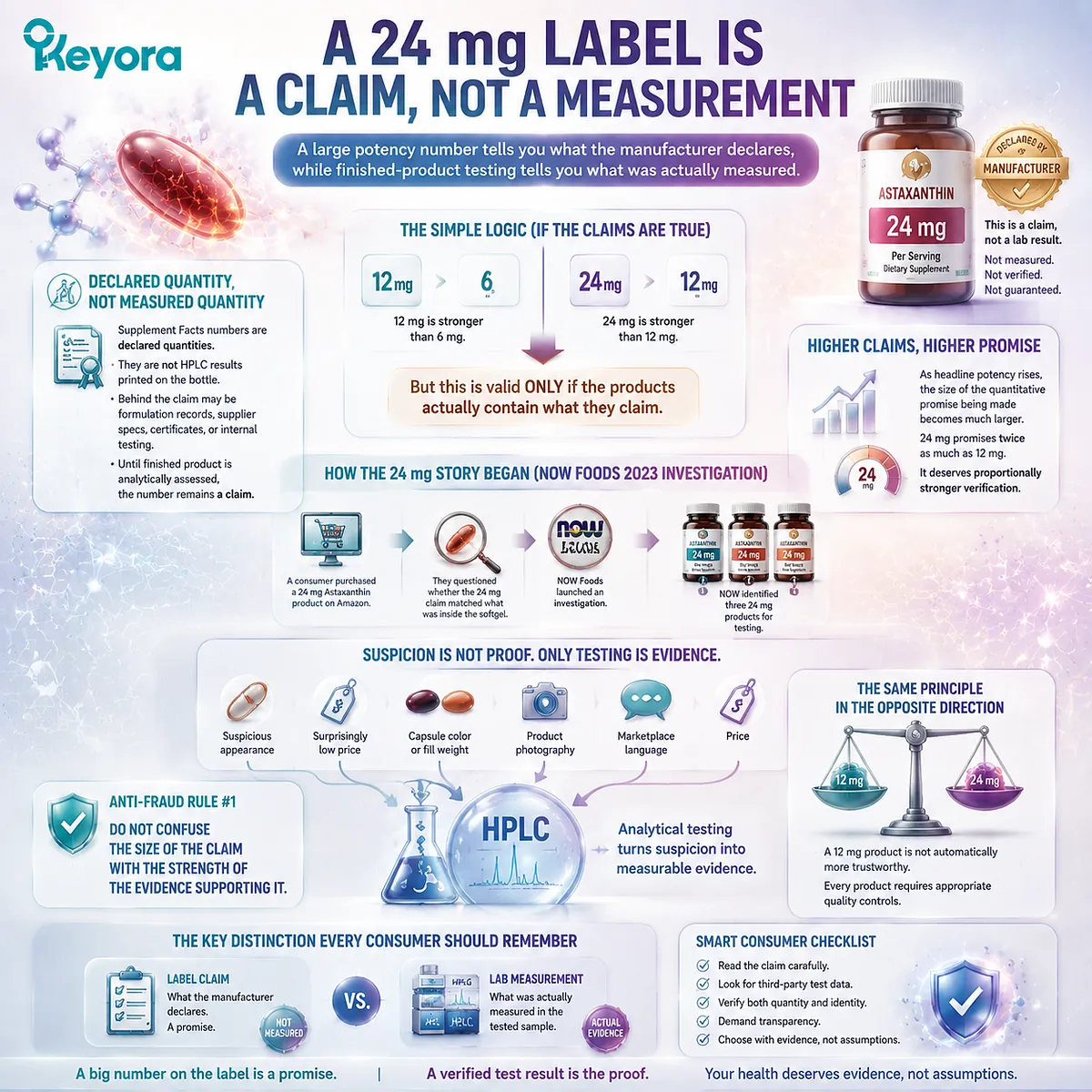
A large potency number tells you what the manufacturer declares, while finished-product testing tells you what was actually measured in the tested sample.
When shoppers compare Astaxanthin supplements, the logic can appear simple:
12 mg is stronger than 6 mg.
24 mg is stronger than 12 mg.
Therefore, the 24 mg product must deliver more Astaxanthin.
That conclusion is valid only if the products actually contain the quantities they claim.
A Supplement Facts number is fundamentally a declared quantity. It is not an HPLC result printed on the bottle.
A manufacturer may have formulation records, supplier specifications, certificates, or internal testing behind that declaration, but the number visible to the shopper remains a claim until the relevant finished product has been analytically assessed.
This distinction becomes especially important as headline potency rises.
NOW reported that its 2023 investigation began after a consumer raised concerns about an Astaxanthin product purchased through Amazon.
The consumer had bought a 24 mg product and questioned whether the label claim matched what appeared to be inside the softgel.
NOW subsequently identified three 24 mg products for testing.
A suspicious appearance is not proof. Neither is a surprisingly low price.
Capsule color, fill weight, product photography, marketplace language, and price can raise questions, but analytical testing is what turns suspicion into measurable evidence.
That is the first anti-fraud rule for high-potency Astaxanthin:
Do not confuse the size of the claim with the strength of the evidence supporting it.
The same principle works in the opposite direction.
A 12 mg product is not automatically more trustworthy merely because its number is smaller.
Every product still requires appropriate quality controls.
What changes with a 24 mg claim is simply the size of the quantitative promise being made.
What Happened to the Three 24 mg Products Tested
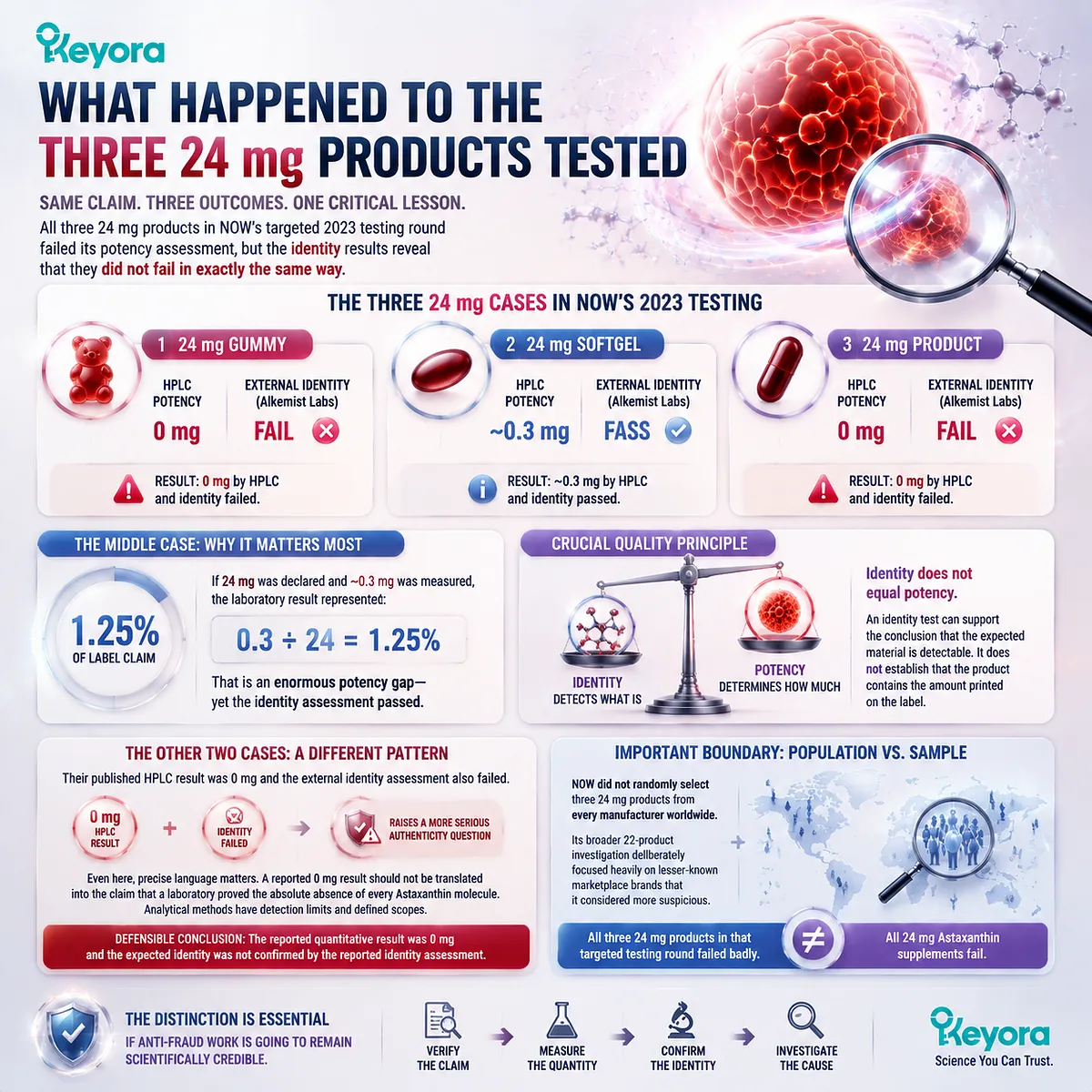
All three 24 mg products in NOW’s targeted 2023 testing round failed its potency assessment, but the identity results reveal that they did not fail in exactly the same way.
The three 24 mg cases are useful because they show why consumers need more than a simple “real” or “fake” classification.
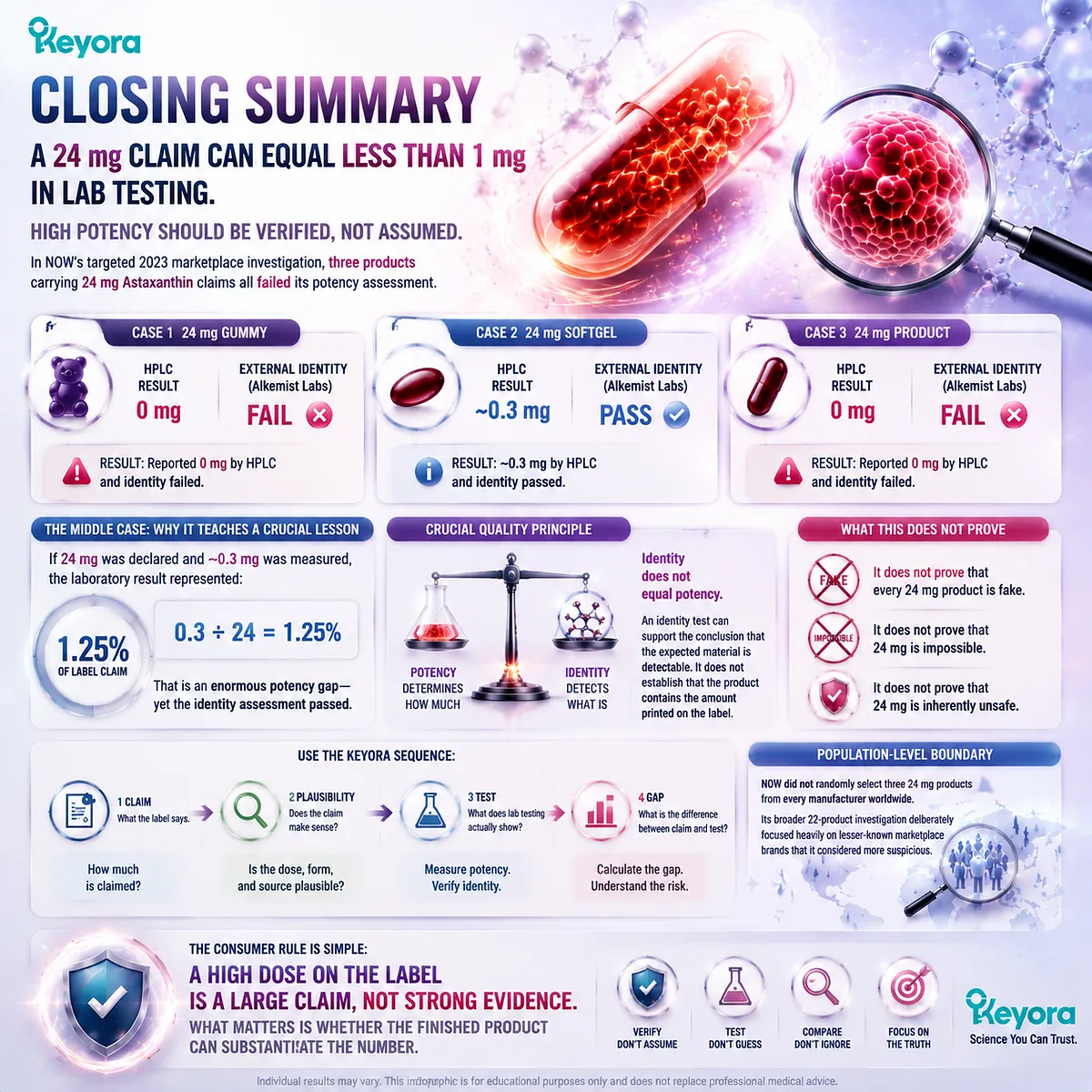
In the first case, a 24 mg gummy product produced a reported 0 mg HPLC result and failed the external identity assessment.
In the second, a 24 mg softgel product produced approximately 0.3 mg by HPLC, while the external identity test passed.
In the third, another 24 mg product produced a reported 0 mg HPLC result and failed the external identity assessment.
The middle case is especially educational.
If 24 mg was declared and approximately 0.3 mg was measured, the laboratory result represented about:
0.3 ÷ 24 = 1.25% of the label claim
That is an enormous potency gap.
Yet the identity assessment passed.
This demonstrates a crucial quality principle:
Identity does not equal potency.
An identity test can support the conclusion that the expected material is detectable. It does not establish that the product contains the amount printed on the label.
The other two 24 mg cases present a different pattern. Their published HPLC result was 0 mg and the external identity assessment also failed. That combination raises a more serious authenticity question because both the reported quantity and expected identity failed in the stated testing program.
Even here, precise language matters.
A reported 0 mg result should not be translated into the claim that a laboratory proved the absolute absence of every Astaxanthin molecule. Analytical methods have detection limits and defined scopes.
The defensible conclusion is that the reported quantitative result was 0 mg and the expected identity was not confirmed by the reported identity assessment.
There is also a population-level boundary.
NOW did not randomly select three 24 mg products from every manufacturer worldwide. Its broader 22-product investigation deliberately focused heavily on lesser-known marketplace brands that it considered more suspicious.
Therefore:
All three 24 mg products in that targeted testing round failed badly.
does not mean:
All 24 mg Astaxanthin supplements fail.
That distinction is essential if anti-fraud work is going to remain scientifically credible.
Why Higher Potency Should Trigger More Verification
An unusually high Astaxanthin claim is not proof of fraud, but it gives the consumer a larger quantitative promise to verify.
A high milligram number can be appealing because it appears to offer more active ingredient for the same purchase.
But a high potency claim should create a question before it creates confidence:
Can the product substantiate this number?
Start with the dose object.
Does “24 mg” actually refer to active Astaxanthin, or is a large extract, algae, oleoresin, or raw-material amount being presented in a way that could be mistaken for active Astaxanthin?
Then examine the serving basis.
Is the 24 mg amount:
-
per softgel?
-
per two-softgel serving?
-
per daily serving?
-
associated with an entire blend?
Next comes formulation plausibility.
If the product uses a standardized Astaxanthin material, is enough raw material declared or documented to support the active claim? A high-dose declaration should make quantitative sense when the source material and concentration are known.
But plausibility is only a screening tool.
A capsule can look large enough. Its raw-material arithmetic can appear reasonable. The source can sound credible. The price can appear normal.
None of those proves that the tested finished product contains 24 mg.
That requires quantitative evidence.
The reverse is equally important. A surprisingly cheap 24 mg product should not automatically be labeled counterfeit. Price is a market signal, not an analytical method.
NOW’s investigation began with several warning signs, but its conclusions about potency came from testing, including HPLC quantification and identity assessment.
The appropriate consumer response to a high-potency claim is therefore not:
“High dose means fake.”
It is:
“High dose means I want the evidence behind the number.”
This article is also not asking whether 24 mg is the right dose for a particular person. Dose suitability, safety, study endpoints, and individual use are separate questions.
Here the question is narrower:
Does the finished product deliver the amount it says it delivers?
Use the High-Potency Reality Check
Compare the size of the claim with formulation plausibility, finished-product testing, and the measured gap before deciding what a high-dose number is worth.
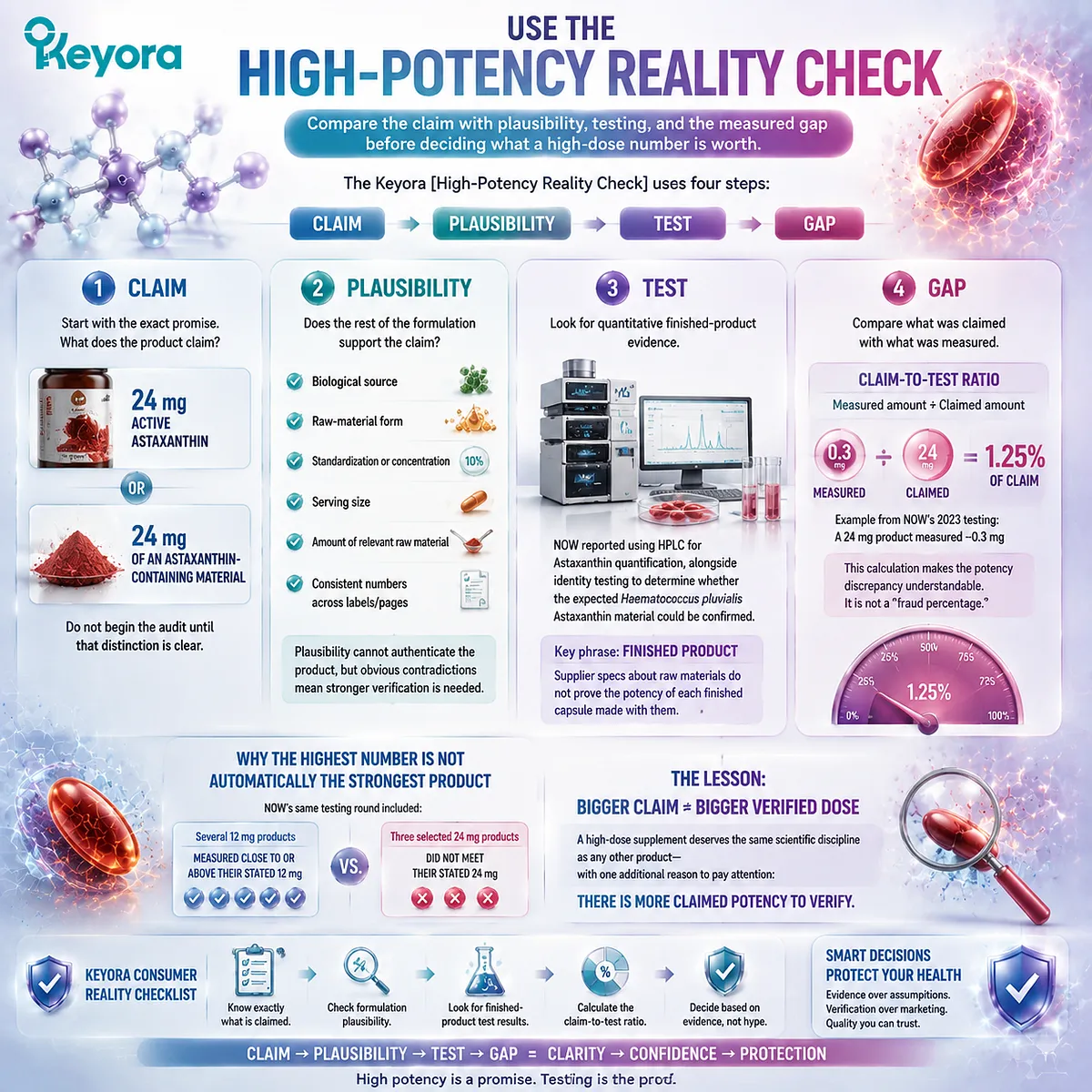
The Keyora [High-Potency Reality Check] uses four steps:
Claim → Plausibility → Test → Gap
Claim
Start with the exact promise.
Does the product claim:
24 mg active Astaxanthin
or:
24 mg of an Astaxanthin-containing material?
Do not begin the audit until that distinction is clear.
Plausibility
Ask whether the rest of the formulation supports the claim.
Check:
-
the biological source
-
raw-material form
-
standardization or concentration
-
serving size
-
amount of relevant raw material
-
whether different pages or labels give consistent numbers
Plausibility cannot authenticate the product, but obvious contradictions can tell you that stronger verification is needed.
Test
Look for quantitative finished-product evidence.
NOW reported using HPLC for Astaxanthin quantification in its marketplace investigation, alongside identity testing to investigate whether the expected Haematococcus pluvialis Astaxanthin material could be confirmed.
The key phrase is finished product.
A supplier specification saying that a raw material contains a particular percentage of Astaxanthin does not automatically establish the potency of every capsule manufactured with it.
Gap
Finally, compare what was claimed with what was measured.
A useful Keyora metric is the Claim-to-Test Ratio:
Measured amount ÷ Claimed amount
For the 24 mg product that measured approximately 0.3 mg:
0.3 ÷ 24 = 1.25%
The purpose of this calculation is not to manufacture a fraud percentage. It is simply to make the potency discrepancy understandable.
The same testing round also shows why the highest number is not automatically the strongest product.
Several 12 mg products in NOW’s table measured close to or above their stated 12 mg potency, while the three selected 24 mg products did not.
The lesson is not that 12 mg is inherently better than 24 mg.
It is:
Bigger Claim ≠ Bigger Verified Dose
A high-dose supplement deserves the same scientific discipline as any other product, with one additional reason to pay attention: there is more claimed potency to verify.
Closing Summary
A 24 mg Astaxanthin claim can correspond to less than 1 mg in laboratory testing, so high potency should be verified rather than assumed.
In NOW’s targeted 2023 marketplace investigation, three products carrying 24 mg Astaxanthin claims all failed its potency assessment.
One measured approximately 0.3 mg while passing the external identity assessment. Two produced reported 0 mg HPLC results and failed the external identity assessment.
Those findings prove that a large label number is not the same thing as a verified finished-product dose.
They do not prove that every 24 mg product is fake, that 24 mg is impossible, or that 24 mg is inherently unsafe.
Use the Keyora sequence:
Claim → Plausibility → Test → Gap
A high-dose claim should make you ask for stronger evidence, not automatically trust the product and not automatically condemn it.
The consumer rule is simple:
A high dose on the label is a large claim, not strong evidence.
What matters is whether the finished product can substantiate the number.
This article is for educational and informational purposes only. It does not provide medical advice, diagnosis, treatment, cure, prevention, disease outcome claims, hormone restoration claims, fertility outcome claims, or formula-specific clinical efficacy claims.