
Can an Astaxanthin Label Make Extract Weight Look Like Active Astaxanthin?
Keyora Research Q&A Library
This is part of the Keyora Research Q&A Series, derived from Keyora Astaxanthin Research Journal Series.
Within the Keyora Astaxanthin Researcn framework, this Q&A translates complex astaxanthin biology into reader-friendly, evidence-bound answers, focusing on natural astaxanthin identity, molecular structure, antioxidant and redox mechanisms, membrane lipid interaction, mitochondrial resilience, inflammatory signaling pathways, human evidence interpretation, and the scientific principles behind responsible supplementation.
First published by Keyora Research Journal: www.keyorahealth.com
Direct Answer
Yes.
An Astaxanthin label or marketplace listing can make an extract, algae material, or standardized raw-material weight look like an active Astaxanthin dose when the largest number receives most of the visual attention and the information that defines the real active amount is much less obvious.
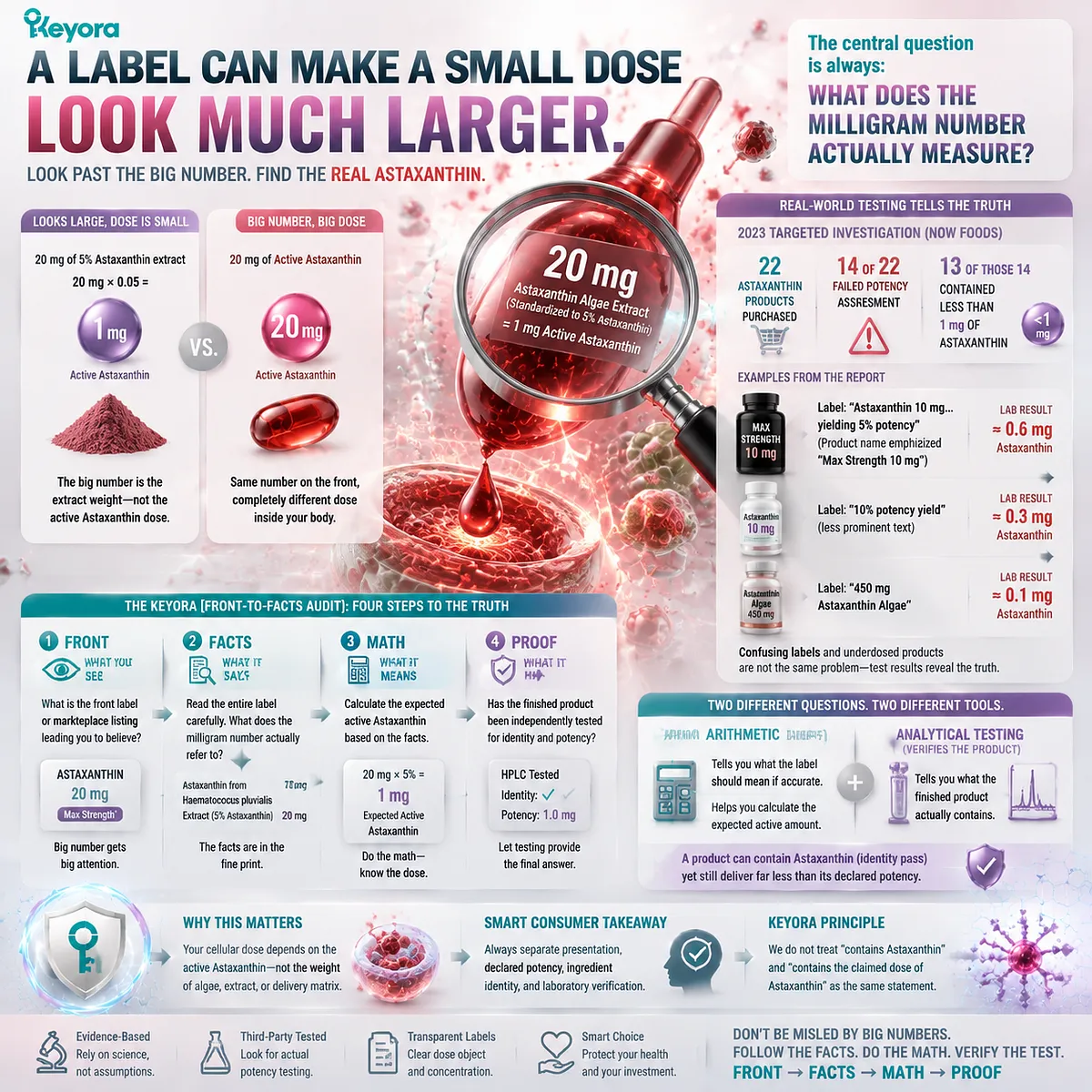
The central question is always: What does the milligram number actually measure?
Twenty milligrams of active Astaxanthin is very different from 20 mg of an algae extract containing 5% Astaxanthin.
In the second case, the expected active amount is only 1 mg.
A front label that emphasizes “20 mg” while making the 5% concentration difficult to notice can therefore create a dramatically different dose impression from what the formulation actually provides.
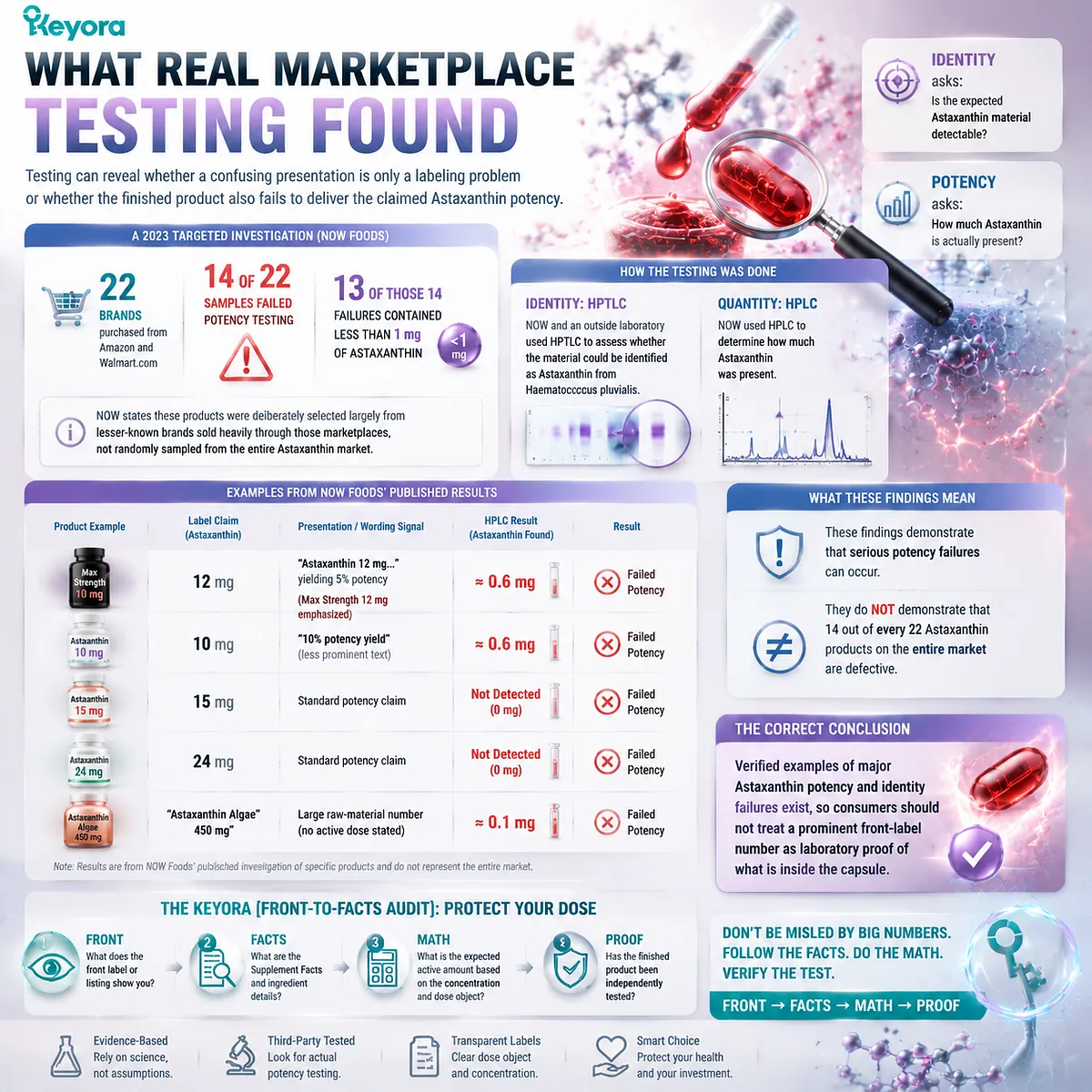
Real marketplace testing shows why this distinction matters. In a targeted 2023 investigation, NOW Foods reported products with prominent Astaxanthin claims that tested far below their stated potency, including products using confusing percentage-yield wording and one product claiming 450 mg of “Astaxanthin Algae” that tested at approximately 0.1 mg Astaxanthin.
But a confusing label and an underdosed product are not automatically the same problem.
Consumers should separate presentation, declared potency, ingredient identity, and laboratory verification.
The Keyora [Front-to-Facts Audit] therefore uses four steps:
Front → Facts → Math → Proof
The Biggest Number Is Not Always the Active Dose
A prominent milligram claim has little meaning until you know whether it describes Astaxanthin itself, an extract, an oil, algae material, or another raw ingredient.
Supplement labels contain several different types of numbers. Consumers often focus on the largest one because product names and front panels are designed to be read quickly. But the largest number does not necessarily represent the biologically relevant active Astaxanthin amount.
Consider two hypothetical statements:
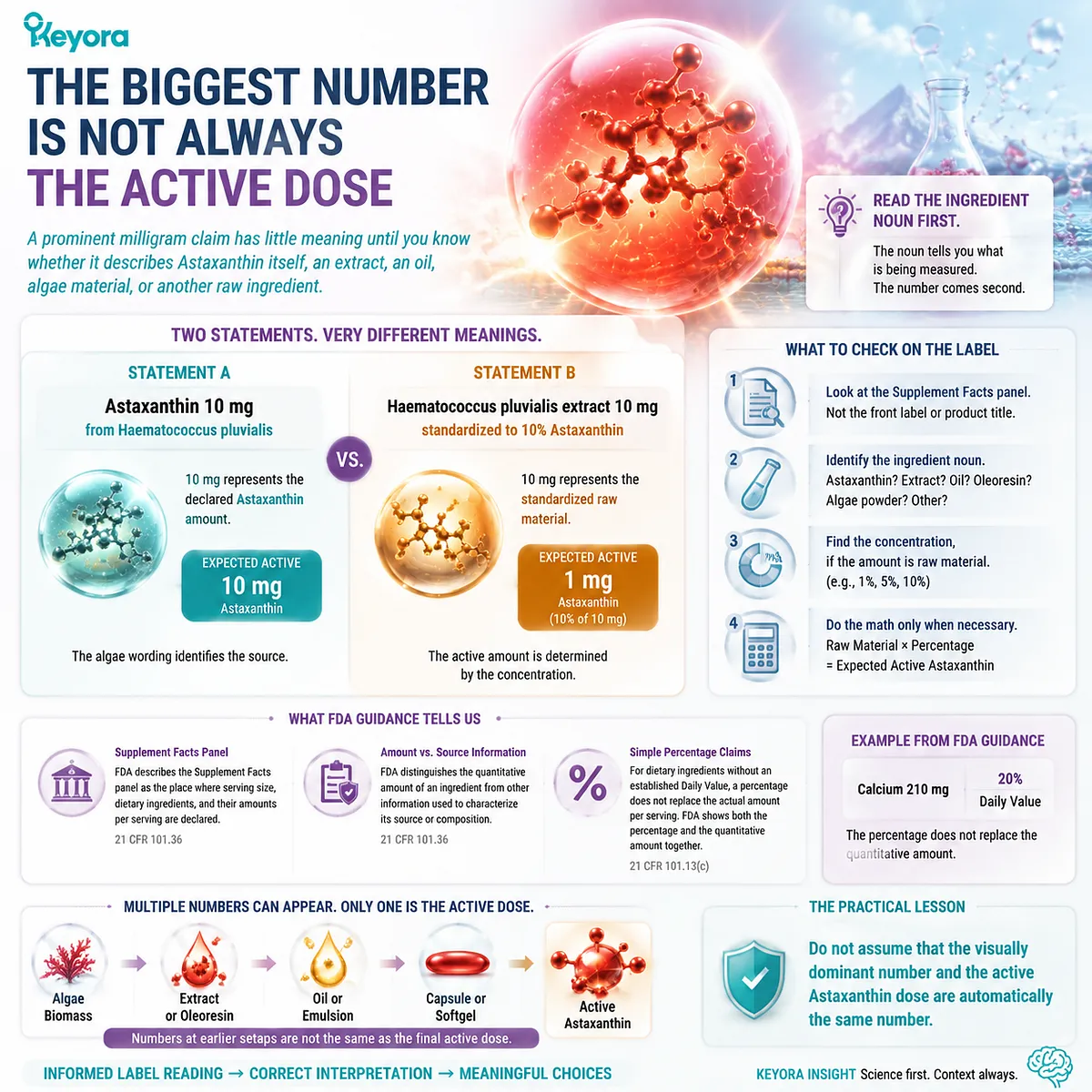
Astaxanthin 10 mg
from Haematococcus pluvialis
and:
Haematococcus pluvialis extract 10 mg
standardized to 10% Astaxanthin
Those statements do not describe the same dose.
In the first construction, 10 mg can represent the declared Astaxanthin amount, while the algae wording identifies its source. In the second, 10 mg represents the standardized raw material. If that material contains 10% Astaxanthin, its expected active amount is only 1 mg.
This is why consumers should read the ingredient noun before reading the number.
In the United States, FDA describes the Supplement Facts panel as the place where serving size, dietary ingredients, and their amounts per serving are declared. FDA guidance also distinguishes an ingredient’s quantitative amount from other information used to characterize its source or composition.
FDA’s guidance on simple percentage claims provides another useful principle. For dietary ingredients without an established Daily Value, a percentage statement does not replace the actual amount per serving. FDA gives an example in which a percentage and the quantitative amount are presented together.
For Astaxanthin buyers, the practical lesson is not to become a labeling lawyer. It is much simpler:
Do not assume that the visually dominant number and the active Astaxanthin dose are automatically the same number.
How Dose-Display Inflation Works
Dose-display inflation occurs when presentation makes a raw-material or extract number feel like the active dose even though another piece of information substantially changes its meaning.
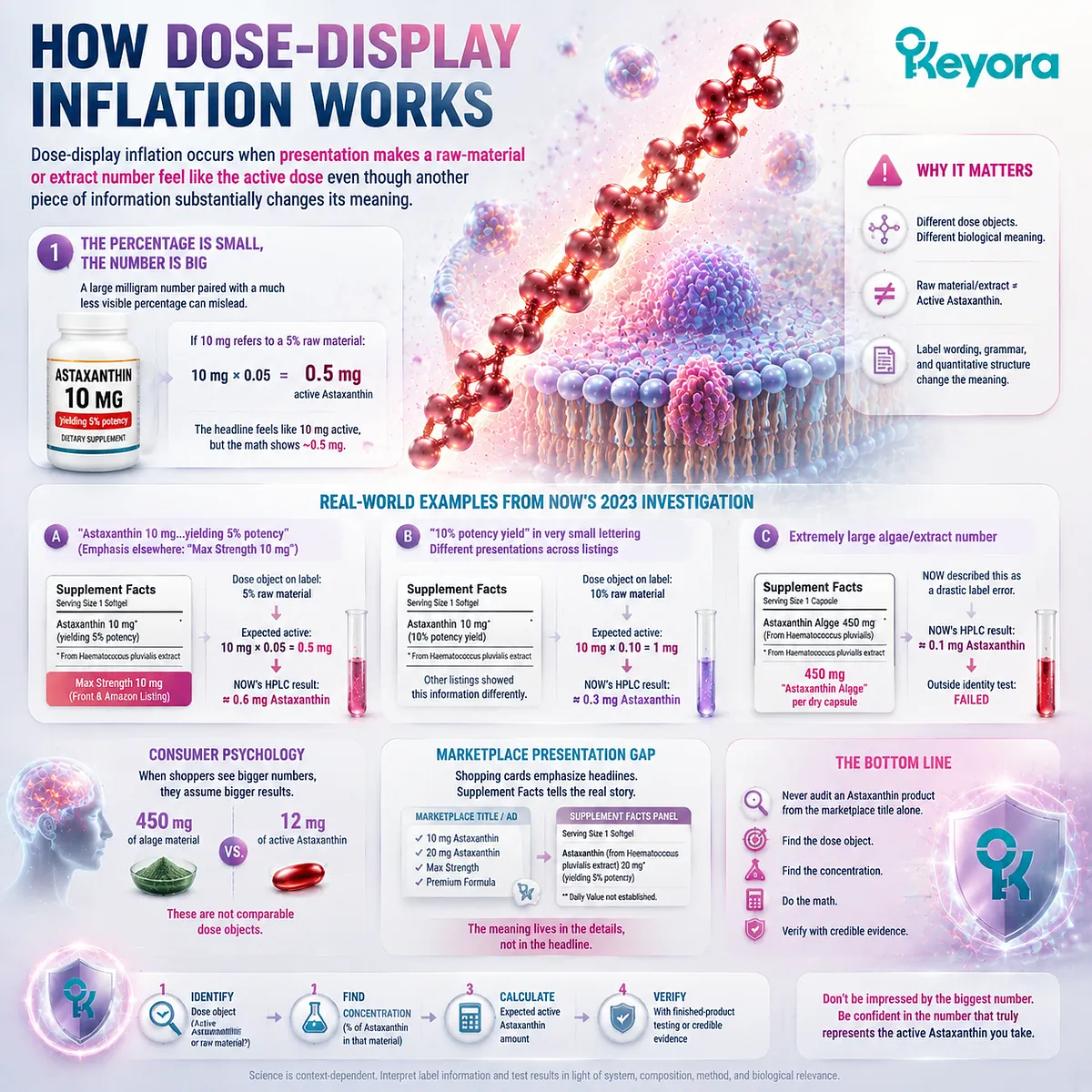
One common pattern is a large milligram number paired with a much less visible percentage.
Imagine a product advertised as:
ASTAXANTHIN 10 MG
while another part of the label says:
yielding 5% potency
If the 10 mg actually describes a 5% raw material, simple arithmetic would imply only 0.5 mg of active Astaxanthin. The wording, grammar, and quantitative structure of the actual label therefore matter enormously.
This is not merely hypothetical. NOW’s 2023 investigation described one tested product as listing “Astaxanthin 10 mg…yielding 5% potency,” while the product name and Amazon description emphasized “Max Strength 10 mg.” NOW characterized the presentation as deceptive and reported approximately 0.6 mg Astaxanthin by HPLC in the tested sample.
NOW described another product as using “10% potency yield” in very small lettering. It also reported finding different presentations of that information on the same product across listings. The tested sample had a 10 mg label potency entry in NOW’s published table but measured approximately 0.3 mg by HPLC.
A second form of dose-display inflation uses an extremely large algae or extract number.
NOW reported a product claiming 450 mg “Astaxanthin Algae” per dry capsule. The company described this as a drastic label error. Its published testing table reported approximately 0.1 mg Astaxanthin by HPLC, while the outside identity test failed for that sample.
The consumer psychology is easy to understand. A shopper comparing “450 mg” with another product labeled “12 mg Astaxanthin” may naturally assume that 450 mg is dramatically stronger.
But 450 mg of algae material and 12 mg of active Astaxanthin are not comparable dose objects.
The same problem can occur when the marketplace title and the Supplement Facts panel communicate different levels of detail. A shopping card may emphasize “10 mg,” “20 mg,” “Max Strength,” or another headline claim while the ingredient panel contains the information needed to understand what that number actually represents.
That is why an Astaxanthin product should never be audited from the marketplace title alone.
What Real Marketplace Testing Found
Testing can reveal whether a confusing presentation is only a labeling problem or whether the finished product also fails to deliver the claimed Astaxanthin potency.
NOW’s 2023 investigation provides an unusually useful case study because it assessed both identity and quantity.
The company purchased products from 22 brands from Amazon and Walmart.com. NOW states that these were deliberately selected largely from lesser-known brands sold heavily through those marketplaces, rather than randomly sampled from the entire Astaxanthin market. That limitation is critical when interpreting the results.
For identity, NOW and an outside laboratory used HPTLC to assess whether the material could be identified as Astaxanthin from Haematococcus pluvialis. For quantity, NOW used HPLC to determine how much Astaxanthin was present.
The distinction matters.
Identity asks: Is the expected Astaxanthin material detectable?
Potency asks: How much Astaxanthin is actually present?
A product can pass one question and fail the other.
NOW reported that 14 of the 22 samples failed its potency testing, and 13 of those 14 failures contained less than 1 mg of Astaxanthin. Its published table included examples such as a 12 mg label claim measuring about 0.6 mg, a 10 mg claim measuring about 0.6 mg, and multiple 15 mg or 24 mg products in which its HPLC analysis reported no detectable Astaxanthin.
These findings demonstrate that serious potency failures can occur.
They do not demonstrate that 14 out of every 22 Astaxanthin products on the entire market are defective. NOW specifically states that the tested brands were selected because they were less known, heavily marketplace-dependent, and considered more suspicious.
This distinction is essential to responsible anti-fraud writing.
The correct conclusion is:
Verified examples of major Astaxanthin potency and identity failures exist, so consumers should not treat a prominent front-label number as laboratory proof of what is inside the capsule.
Use the Front-to-Facts Audit Before You Buy
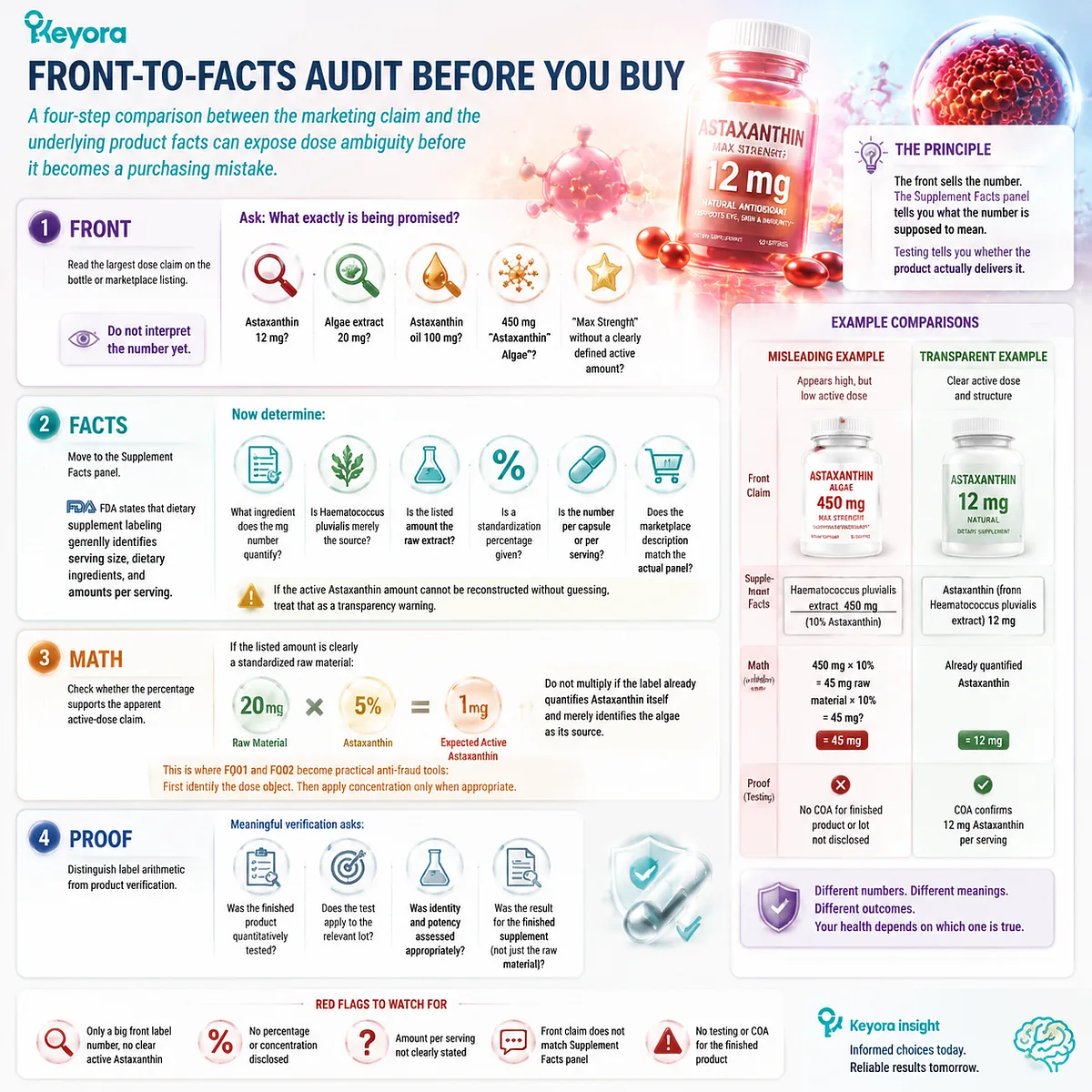
A four-step comparison between the marketing claim and the underlying product facts can expose dose ambiguity before it becomes a purchasing mistake.
The Keyora [Front-to-Facts Audit] begins with the part of the package designed to attract attention, then moves progressively closer to verifiable evidence.
1. Front
Read the largest dose claim on the bottle or marketplace listing.
Ask:
What exactly is being promised?
Is it:
-
Astaxanthin 12 mg?
-
algae extract 20 mg?
-
Astaxanthin oil 100 mg?
-
450 mg “Astaxanthin Algae”?
-
“Max Strength” without a clearly defined active amount?
Do not interpret the number yet.
2. Facts
Move to the Supplement Facts panel.
FDA states that dietary supplement labeling generally identifies serving size, dietary ingredients, and amounts per serving.
Now determine:
-
What ingredient does the mg number quantify?
-
Is Haematococcus pluvialis merely the source?
-
Is the listed amount the raw extract?
-
Is a standardization percentage given?
-
Is the number per capsule or per serving?
-
Does the marketplace description match the actual panel?
If the active Astaxanthin amount cannot be reconstructed without guessing, treat that as a transparency warning.
3. Math
If the listed amount is clearly a standardized raw material, check whether the percentage supports the apparent active-dose claim.
For example:
20 mg raw material × 5% = 1 mg expected active Astaxanthin
But do not multiply if the label already quantifies Astaxanthin itself and merely identifies the algae as its source.
This is the point where FQ01 and FQ02 become practical anti-fraud tools. First identify the dose object. Then apply concentration only when appropriate.
4. Proof
Finally, distinguish label arithmetic from product verification.
A mathematically coherent label tells you what the product is claiming.
It does not prove that the finished capsule actually contains that amount.
Meaningful verification asks whether the finished product was quantitatively tested, whether the test applies to the relevant lot, and whether identity and potency were assessed appropriately.
The principle is:
The front sells the number.
The Supplement Facts panel tells you what the number is supposed to mean.
Testing tells you whether the product actually delivers it.
Closing Summary
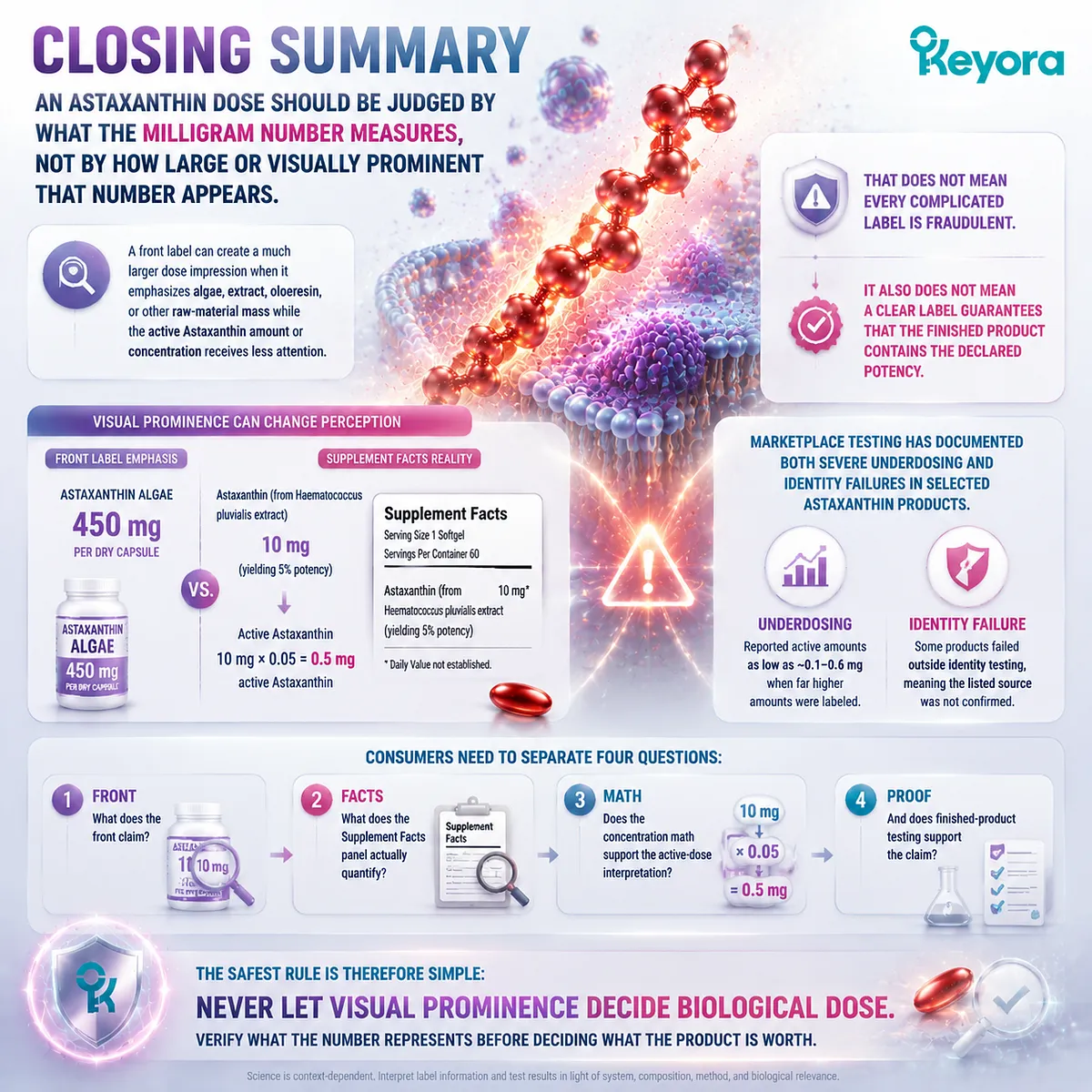
An Astaxanthin dose should be judged by what the milligram number measures, not by how large or visually prominent that number appears.
A front label can create a much larger dose impression when it emphasizes algae, extract, oleoresin, or other raw-material mass while the active Astaxanthin amount or concentration receives less attention.
That does not mean every complicated label is fraudulent. It also does not mean a clear label guarantees that the finished product contains the declared potency.
Consumers need to separate four questions:
Front → Facts → Math → Proof
-
What does the front claim?
-
What does the Supplement Facts panel actually quantify?
-
Does the concentration math support the active-dose interpretation?
-
And does finished-product testing support the claim?
Marketplace testing has documented both severe underdosing and identity failures in selected Astaxanthin products.
The safest rule is therefore simple:
Never let visual prominence decide biological dose.
Verify what the number represents before deciding what the product is worth.
This article is for educational and informational purposes only. It does not provide medical advice, diagnosis, treatment, cure, prevention, disease outcome claims, hormone restoration claims, fertility outcome claims, or formula-specific clinical efficacy claims.