
Does 18 mg of Algae Extract Mean 18 mg of Astaxanthin?
Keyora Research Q&A Library
This is part of the Keyora Research Q&A Series, derived from Keyora Astaxanthin Research Journal Series.
Within the Keyora Astaxanthin Researcn framework, this Q&A translates complex astaxanthin biology into reader-friendly, evidence-bound answers, focusing on natural astaxanthin identity, molecular structure, antioxidant and redox mechanisms, membrane lipid interaction, mitochondrial resilience, inflammatory signaling pathways, human evidence interpretation, and the scientific principles behind responsible supplementation.
First published by Keyora Research Journal: www.keyorahealth.com
Direct Answer
No.
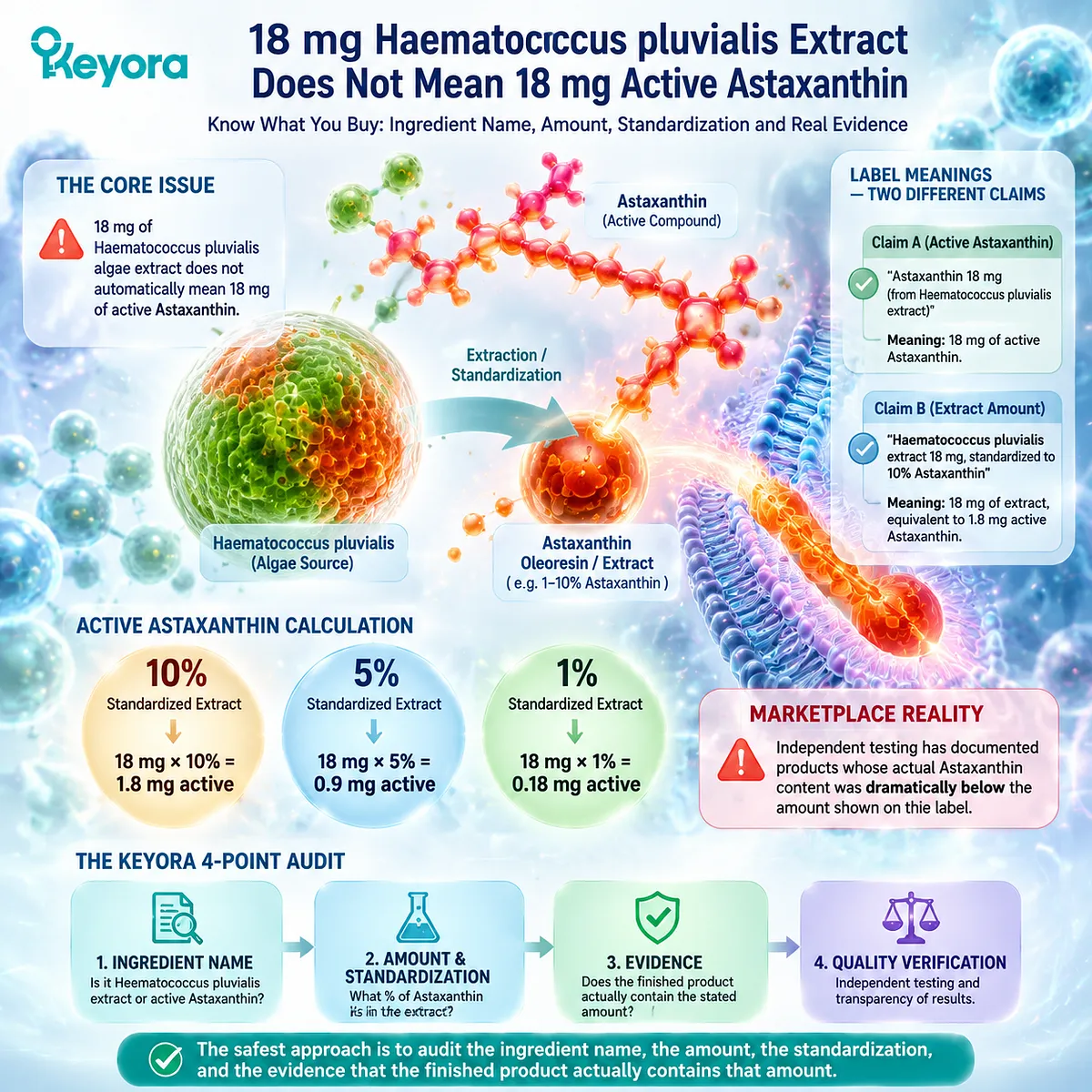
18 mg of Haematococcus pluvialis algae extract does not automatically mean 18 mg of active Astaxanthin.
The first question is not how large the milligram number looks. It is what that number is actually measuring.
A natural Astaxanthin supplement can contain an algae-derived oil, oleoresin, or extract in which Astaxanthin represents only a percentage of the raw material.
If 18 mg refers to a material standardized to 10% Astaxanthin, the calculated active amount is 1.8 mg.
At 5%, it is 0.9 mg. At 1%, it is only 0.18 mg. The percentage must come from the actual product specification or label.
It should never be guessed from what is common in the industry.
There is another important distinction.
A label that says “Astaxanthin 18 mg (from Haematococcus pluvialis extract)” may be declaring 18 mg of Astaxanthin, with the wording in parentheses identifying its source.
That is very different from a label declaring “Haematococcus pluvialis extract 18 mg, standardized to 10% Astaxanthin.”
This matters because marketplace testing has documented products whose actual Astaxanthin content was dramatically below the number consumers saw on the label.
The safest approach is therefore to audit four things separately: the ingredient name, the amount, the standardization, and the evidence that the finished product actually contains that amount.
Read the Dose Object Before the Number
The largest milligram number on a bottle is useful only after you know exactly which ingredient that number describes.
When shoppers compare Astaxanthin products, a large number such as 12 mg, 18 mg, or 24 mg naturally attracts attention.
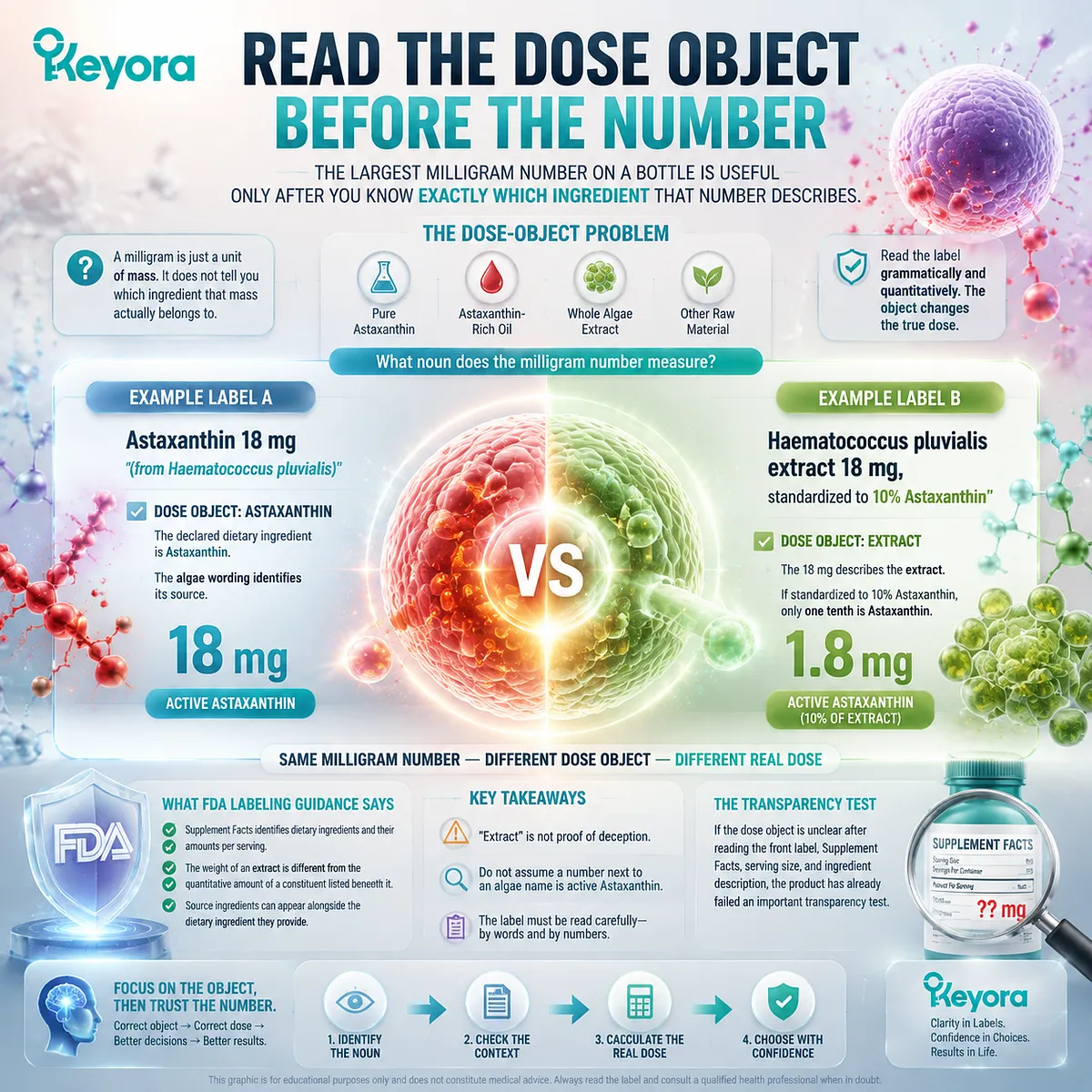
But a milligram is simply a unit of mass. It does not tell you whether the mass belongs to pure or active Astaxanthin, an Astaxanthin-rich oil, a whole algae extract, or another raw material.
This is the dose-object problem.
Suppose one Supplement Facts panel lists Astaxanthin 18 mg, followed by “from Haematococcus pluvialis” in parentheses. In that structure, the declared dietary ingredient may be Astaxanthin, while the algae wording identifies its source.
Now compare that with “Haematococcus pluvialis extract 18 mg, standardized to 10% Astaxanthin.” Here, the 18 mg describes the extract. If the 10% specification applies to that material, only one tenth of the extract mass is Astaxanthin.
The difference is not cosmetic. It changes the actual dose from 18 mg to 1.8 mg.
U.S. FDA dietary supplement labeling guidance illustrates why these objects must be separated. Supplement Facts generally identifies dietary ingredients and their amounts per serving. FDA guidance also distinguishes the weight of an extract from the quantitative amount of a constituent that may be listed beneath that ingredient. Source ingredients can likewise appear alongside the dietary ingredient they provide.
That means the word “extract” is not, by itself, evidence of deception. Nor should consumers assume that any number printed next to an algae name represents active Astaxanthin. The label has to be read grammatically and quantitatively.
Ask a simple question:
What noun does the milligram number measure?
If the answer is unclear after reading the front label, Supplement Facts, serving size, and ingredient description, the product has already failed an important transparency test.
How 1%, 5%, and 10% Change the Real Astaxanthin Dose
When a label declares raw-material weight and a verified standardization percentage, simple arithmetic can reveal the active Astaxanthin amount.
The basic calculation is:
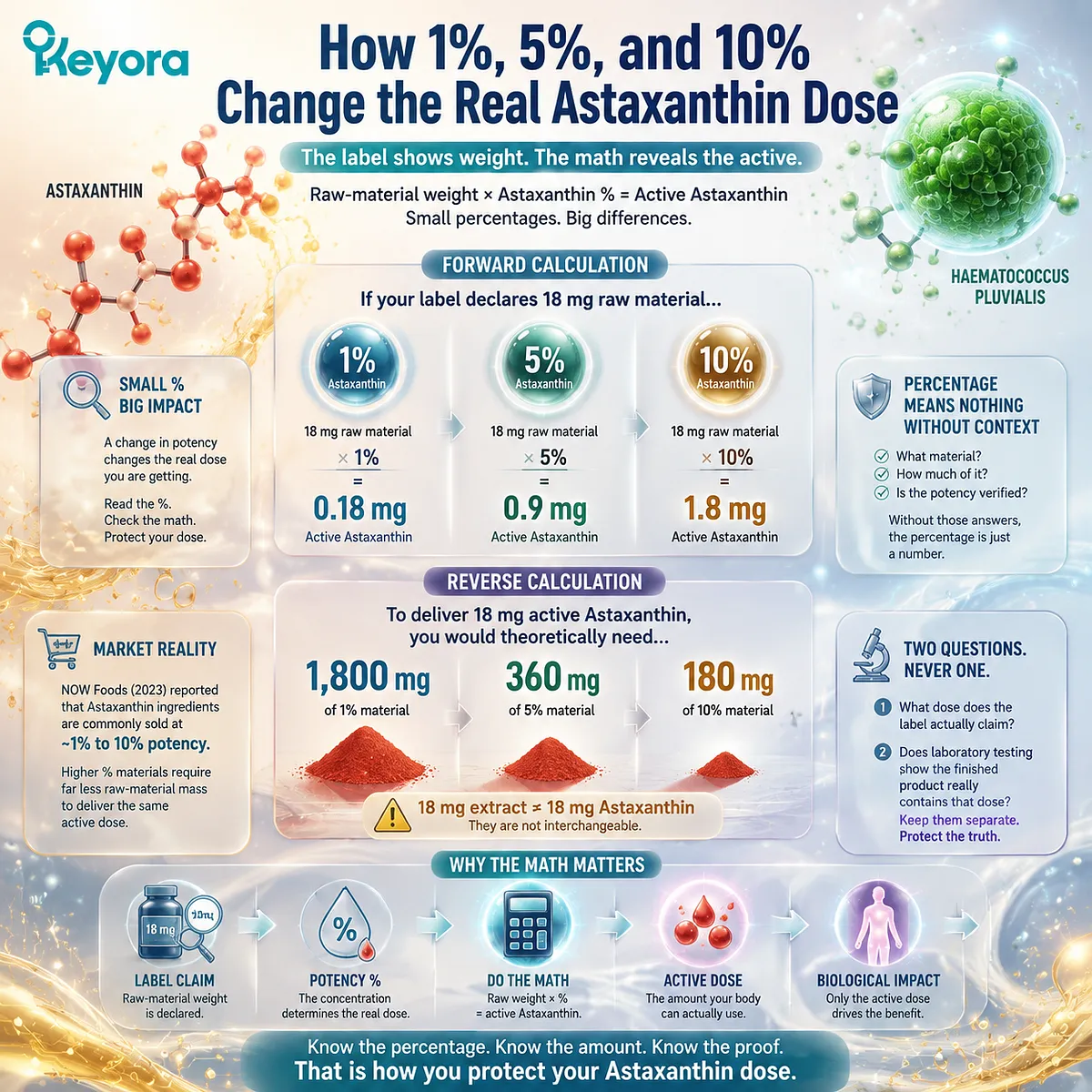
raw-material weight × Astaxanthin percentage = active Astaxanthin
If the declared raw material is 18 mg and it is genuinely standardized to 1% Astaxanthin, the calculated active amount is 0.18 mg.
At 5%, 18 mg of material supplies 0.9 mg.
At 10%, 18 mg of material supplies 1.8 mg.
The reverse calculation makes the distinction even clearer. To deliver 18 mg of active Astaxanthin, a formulation would theoretically require about 1,800 mg of a 1% material, 360 mg of a 5% material, or 180 mg of a 10% material.
This is why 18 mg extract and 18 mg Astaxanthin cannot be treated as interchangeable phrases.
Commercial Astaxanthin materials are available at different concentrations. In its 2023 marketplace investigation, NOW Foods noted that Astaxanthin ingredients are commonly sold at approximately 1% to 10% potency and used the same principle to explain why a 10% material requires substantially more raw-material mass than the final active Astaxanthin claim.
But this calculation has an important boundary.
You cannot look at an unknown product and simply assume that its extract is 1%, 5%, or 10%. The exact concentration must be declared, documented, or analytically established.
The same caution applies to phrases such as “yielding 5%,” “10% potency,” “Astaxanthin-rich oleoresin,” or “standardized extract.” The percentage has meaning only when you know what material it applies to, what amount of that material is present, and whether the claimed potency has been verified.
This is where seemingly small label wording can produce a very large difference in what the consumer believes they are buying.
A product can therefore create two distinct questions:
What dose does the label actually claim?
And separately:
Does laboratory testing show that the finished product really contains that dose?
Those questions should never be collapsed into one.
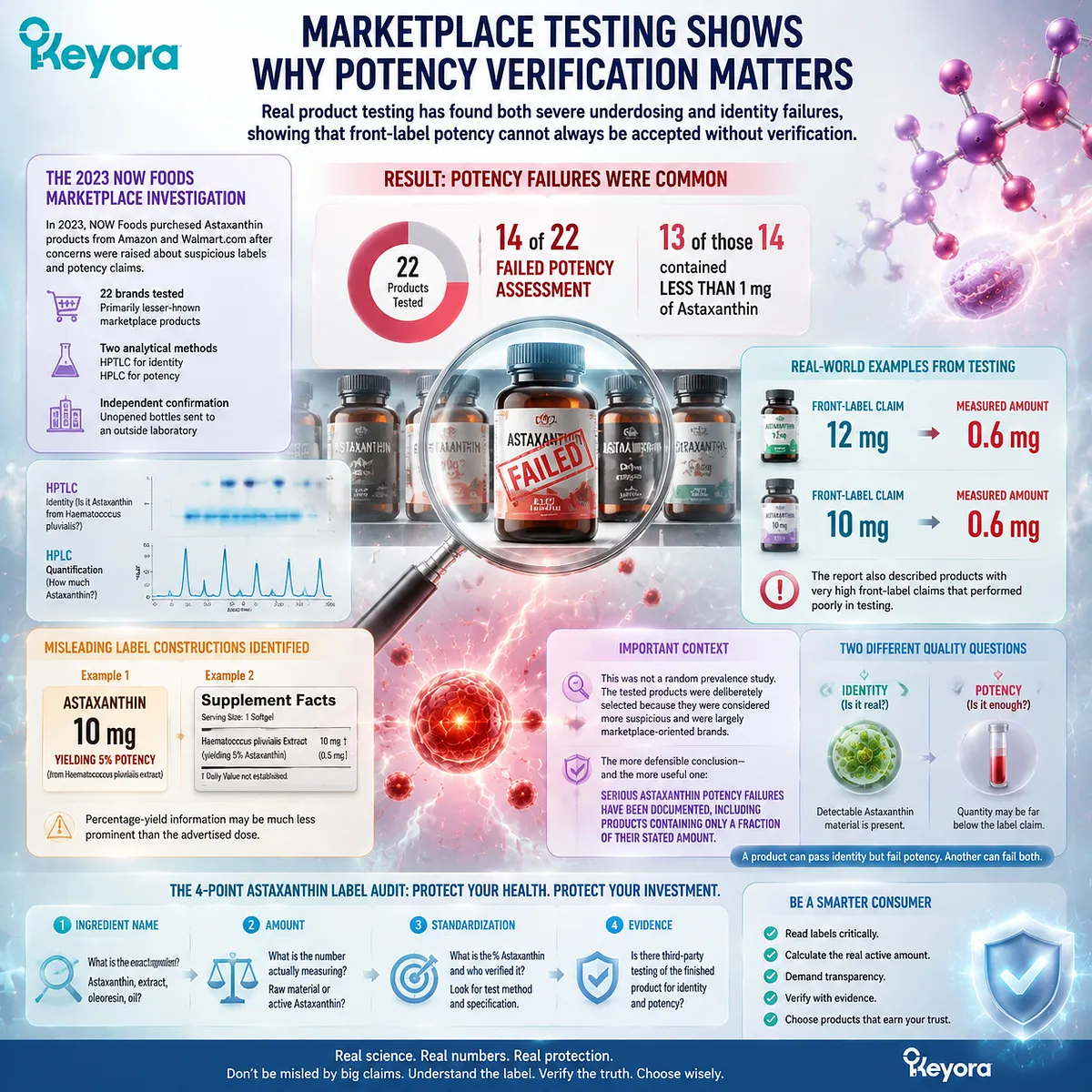
Marketplace Testing Shows Why Potency Verification Matters
Real product testing has found both severe underdosing and identity failures, showing that front-label potency cannot always be accepted without verification.
This concern is not purely theoretical.
In 2023, NOW Foods purchased Astaxanthin products from Amazon and Walmart.com after concerns were raised about suspicious labels and potency claims.
The company selected 22 brands, primarily lesser-known products sold heavily through online marketplaces, and tested them using two different analytical approaches.
HPTLC was used for identification of Haematococcus pluvialis Astaxanthin, while HPLC was used to quantify Astaxanthin content. Unopened bottles were also sent to an outside laboratory for independent identity testing.
Fourteen of the 22 tested samples failed NOW’s potency assessment, and 13 of those 14 failures contained less than 1 mg of Astaxanthin.
One product labeled at 12 mg measured 0.6 mg. Another labeled at 10 mg also measured 0.6 mg. The report also described products with very high front-label claims that performed poorly in testing.
NOW additionally identified label constructions in which a prominent 10 mg claim appeared alongside wording such as “yielding 5% potency,” or where percentage-yield information was much less visually prominent than the advertised dose.
Those examples illustrate why consumers must determine whether a number represents raw material, active Astaxanthin, or another dose object before comparing products.
These findings should not be misrepresented as proof that 14 out of every 22 Astaxanthin supplements on the entire market are defective. The tested products were deliberately selected because they were considered more suspicious and were largely marketplace-oriented brands. It was not a random prevalence study.
The more defensible conclusion is also more useful:
Serious Astaxanthin potency failures have been documented, including products containing only a fraction of their stated amount.
Testing also reveals why “real ingredient” and “correct dose” are different quality questions.
A product may pass an identity test, meaning detectable Astaxanthin material is present, yet still fail potency testing because the quantity is far below the label claim. Another product can fail both identity and potency.
For consumers, that distinction is central to Astaxanthin anti-fraud screening.
Use the Keyora Active-Dose Audit Before You Buy
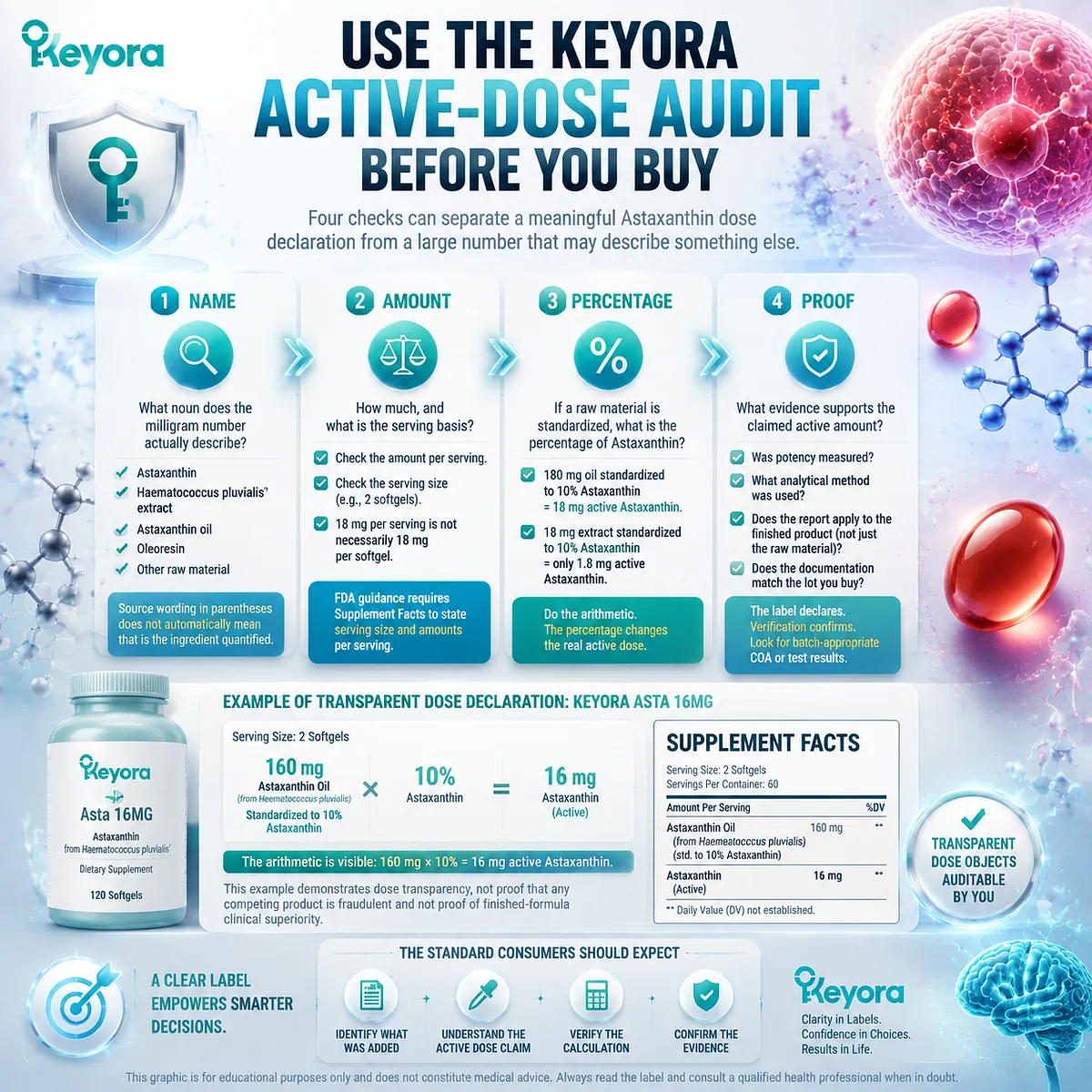
Four checks can separate a meaningful Astaxanthin dose declaration from a large number that may describe something else.
The Keyora [Active-Dose Audit] uses four questions: Name, Amount, Percentage, Proof.
-
First, identify the Name. Does the Supplement Facts panel quantify “Astaxanthin,” “Haematococcus pluvialis extract,” “Astaxanthin oil,” “oleoresin,” or another material? Parenthetical source wording should not automatically be mistaken for the quantified ingredient.
-
Second, identify the Amount and its serving basis. FDA guidance requires Supplement Facts to state a serving size and amounts per serving. A product advertised as 18 mg per serving is not necessarily 18 mg per softgel if the serving contains two or more units.
-
Third, identify the Percentage when the number describes a standardized raw material. If 180 mg of an oil is standardized to 10% Astaxanthin, the arithmetic yields 18 mg active Astaxanthin. If 18 mg of an extract is standardized to 10%, the arithmetic yields only 1.8 mg.
-
Fourth, look for Proof. The label tells you what the manufacturer declares. It does not, by itself, prove what every finished batch contains. Meaningful verification asks whether potency was measured, what analytical method was used, whether the result applies to the finished product rather than only the supplier’s raw material, and whether the documentation corresponds to the actual lot being sold.
A transparent formulation makes these dose objects auditable.
In the current Keyora Asta 16MG project record, for example, the two-softgel serving separates 160 mg of 10% Astaxanthin oil from 16 mg active Astaxanthin, with Haematococcus pluvialis identified as the source.
The arithmetic is visible rather than hidden: 160 mg × 10% = 16 mg. This example demonstrates dose transparency, not proof that any competing product is fraudulent and not proof of finished-formula clinical superiority.
This is the standard consumers should expect: the label should make it possible to identify what was added, how much active Astaxanthin is being claimed, and how that claim could be verified.
Closing Summary
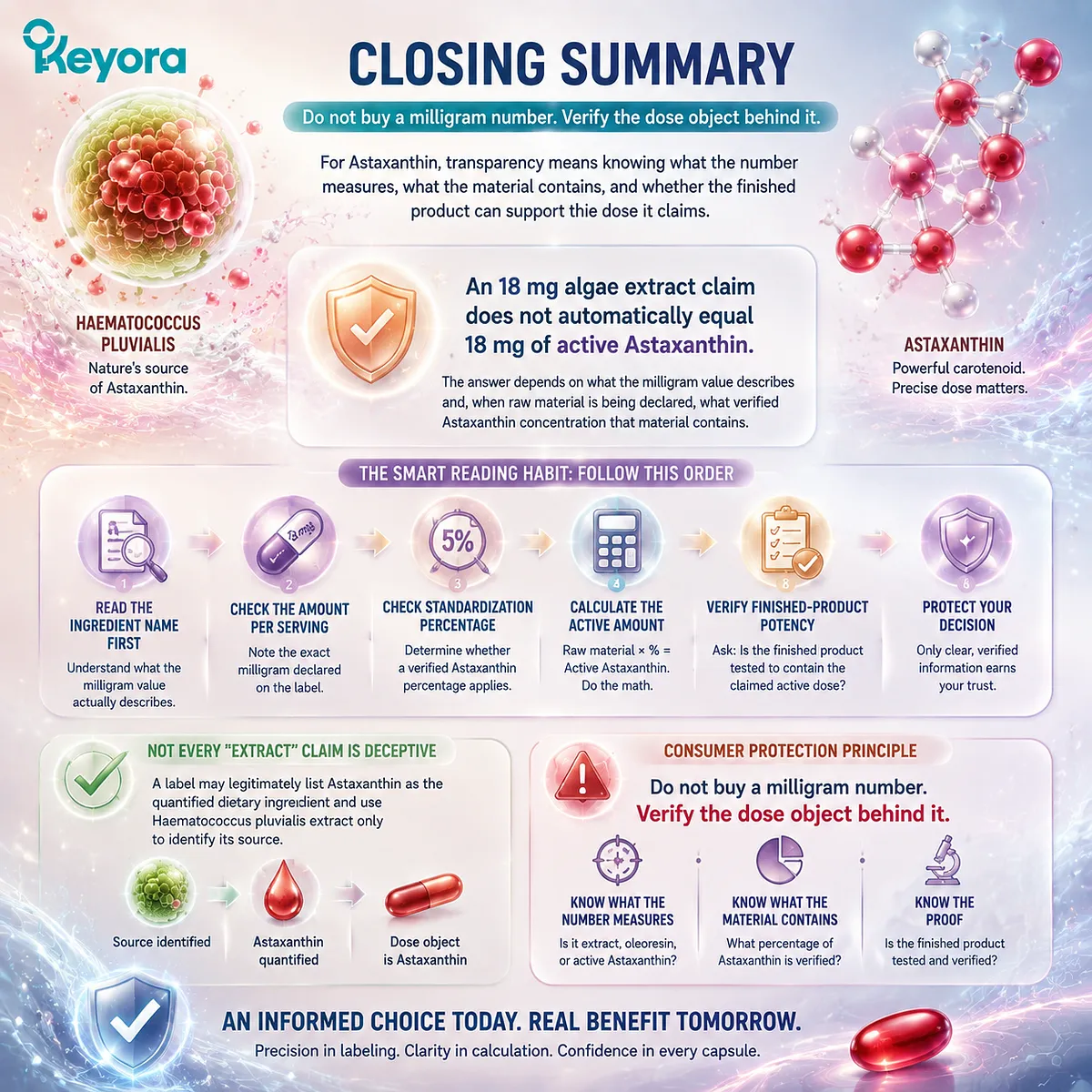
An 18 mg algae extract claim does not automatically equal 18 mg of active Astaxanthin.
The answer depends on what the milligram value describes and, when raw material is being declared, what verified Astaxanthin concentration that material contains.
The most useful habit is to stop reading the biggest number first. Read the ingredient name first. Then check the amount per serving, determine whether a standardization percentage applies, calculate the active amount when appropriate, and ask whether finished-product potency has actually been verified.
At the same time, do not assume that every phrase containing “Haematococcus pluvialis extract” is deceptive. A label may legitimately list Astaxanthin as the quantified dietary ingredient and use the algae wording only to identify its source.
The consumer protection principle is therefore simple:
Do not buy a milligram number.
Verify the dose object behind it.
For Astaxanthin, transparency means knowing what the number measures, what the material contains, and whether the finished product can support the dose it claims.
This article is for educational and informational purposes only. It does not provide medical advice, diagnosis, treatment, cure, prevention, disease outcome claims, hormone restoration claims, fertility outcome claims, or formula-specific clinical efficacy claims.