
Does Astaxanthin Make Skin Glow?
Keyora Research Q&A Library
This is part of the Keyora Research Q&A Series, derived from Keyora Astaxanthin Research Journal Series.
Within the Keyora Astaxanthin Researcn framework, this Q&A translates complex astaxanthin biology into reader-friendly, evidence-bound answers, focusing on natural astaxanthin identity, molecular structure, antioxidant and redox mechanisms, membrane lipid interaction, mitochondrial resilience, inflammatory signaling pathways, human evidence interpretation, and the scientific principles behind responsible supplementation.
First published by Keyora Research Journal: www.keyorahealth.com
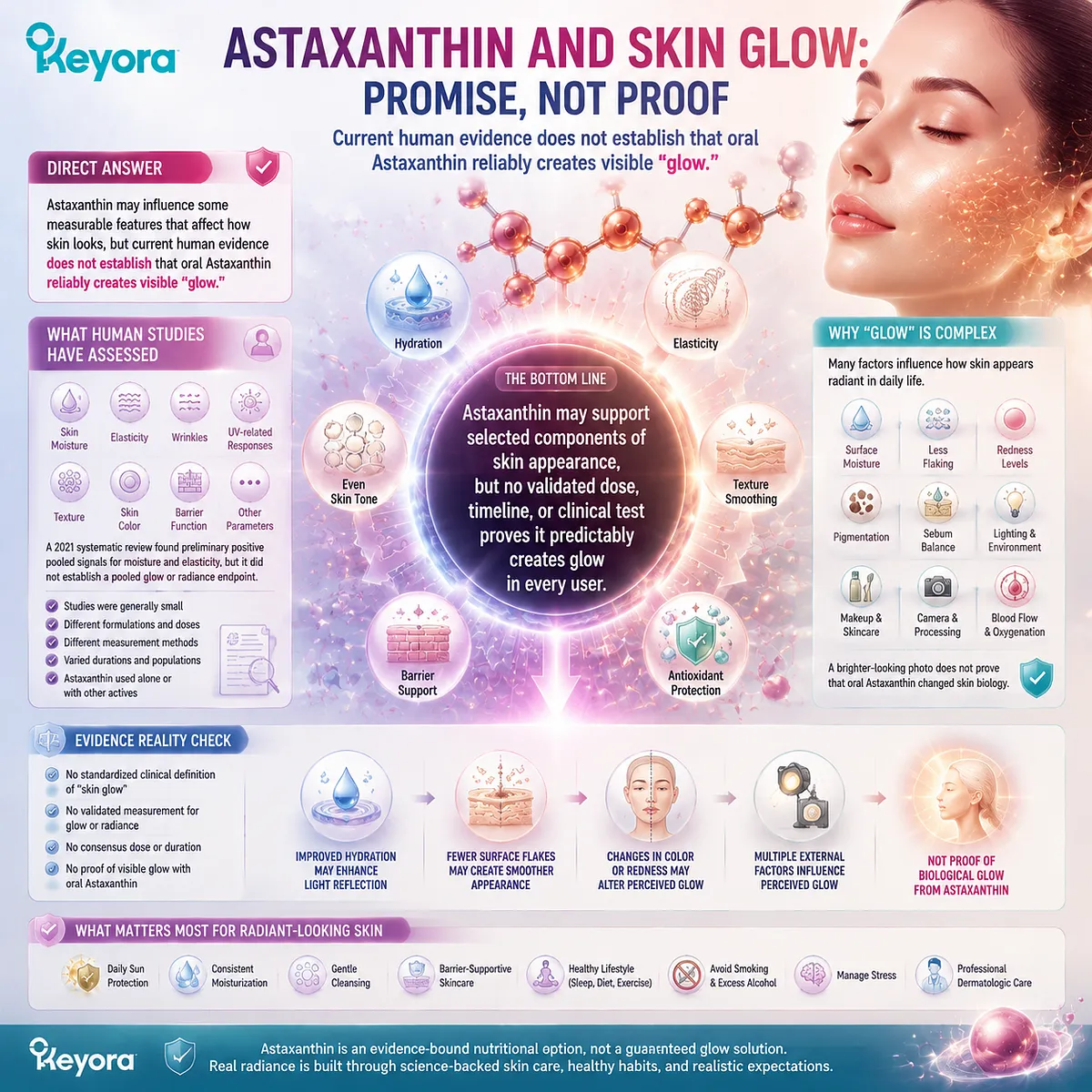
Direct Answer
Astaxanthin may influence some measurable features that affect how skin looks, but current human evidence does not establish that oral Astaxanthin reliably creates visible “glow.”
Astaxanthin may affect hydration, elasticity, color, or other measurements that influence skin appearance, but skin glow is not a single standardized clinical endpoint and should not be treated as a proven Astaxanthin outcome.
Human Astaxanthin studies have assessed skin moisture, elasticity, wrinkles, ultraviolet-related responses, texture, and selected color measurements.
A 2021 systematic review found preliminary positive pooled signals for moisture and elasticity, but it did not establish a pooled glow or radiance endpoint. The included studies were small and differed in formulation, measurement method, duration, population, and whether Astaxanthin was used alone or with other active ingredients.
Skin can look more radiant for many reasons.
Greater surface moisture may improve light reflection. Less flaking may create a smoother appearance.
Changes in redness, pigmentation, sebum, lighting, makeup, camera processing, or facial blood flow may also influence what someone calls glow.
This means that a brighter-looking photograph does not prove that oral Astaxanthin changed skin biology.
Astaxanthin may have indirect relevance to selected components of skin appearance, but there is no validated dose, timeline, or clinical test showing that it predictably produces glow in every user.
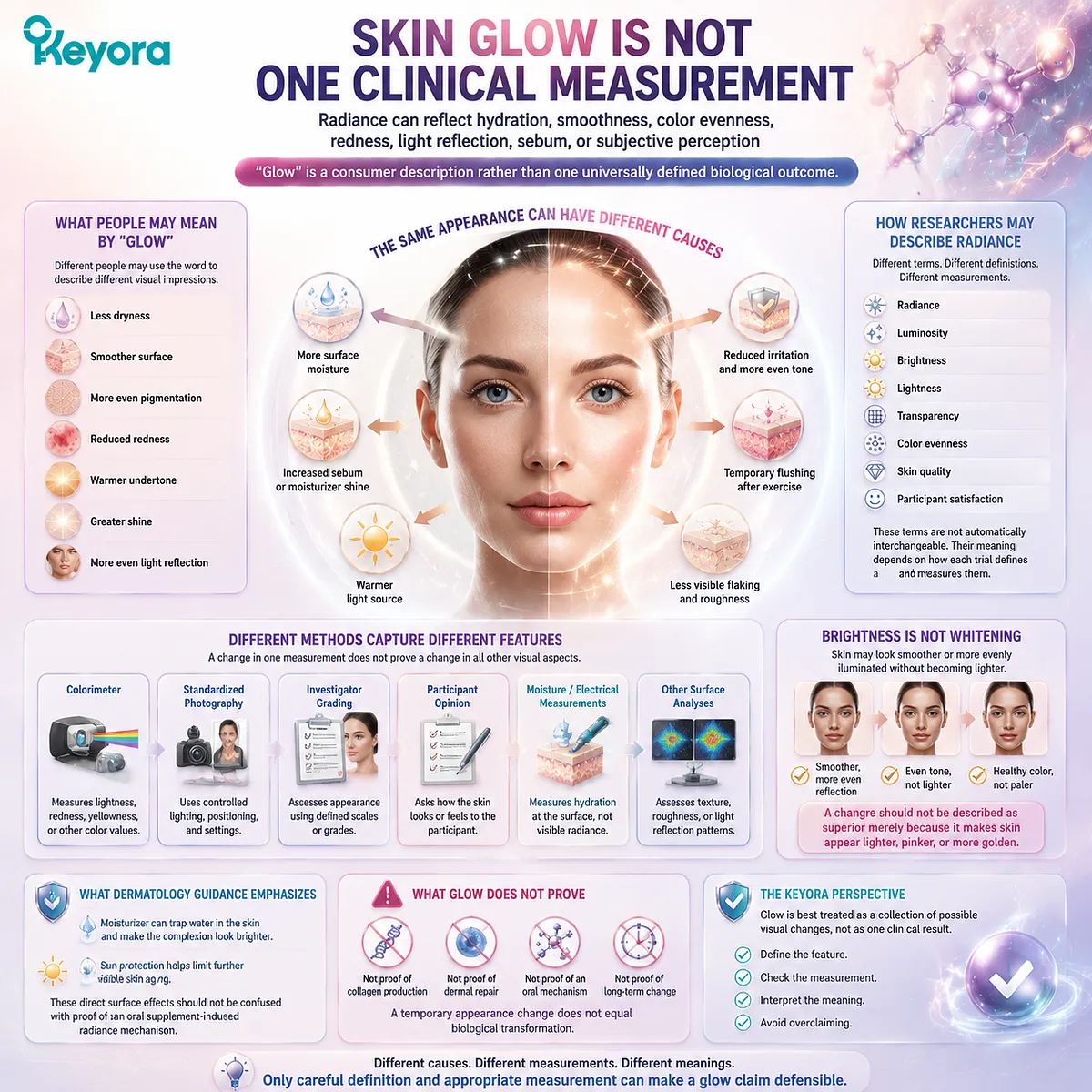
Skin Glow Is Not One Clinical Measurement
Radiance can reflect hydration, smoothness, color evenness, redness, light reflection, sebum, or subjective perception
“Glow” is a consumer description rather than one universally defined biological outcome.
One person may use the word to describe skin that looks less dry. Another may mean a smoother surface, more even pigmentation, reduced redness, a warmer undertone, greater shine, or a complexion that reflects light more evenly.
Researchers may use terms such as:
-
radiance
-
luminosity
-
brightness
-
lightness
-
transparency
-
color evenness
-
skin quality
-
participant satisfaction
These terms are not automatically interchangeable. Their meaning depends on how each trial defines and measures them.
A study may use a colorimeter to measure lightness, redness, or yellowness. Another may use standardized photographs and investigator grading. Another may ask participants whether their skin looks brighter. A moisture study may measure electrical properties at the skin surface without assessing visible radiance at all.
This distinction is important because the same appearance can have different causes.
More surface moisture can reduce visible flaking and improve reflection. Increased sebum or a recently applied moisturizer can create shine. A warmer light source can make skin appear more golden. Reduced irritation may make tone look more even. Flushing after exercise can look “rosy” without representing a lasting skin improvement.
Brightness also does not mean whitening. Skin may look smoother or more evenly illuminated without becoming lighter. A change should not be described as superior merely because it makes skin appear lighter, pinker, or more golden.
Dermatology guidance emphasizes that moisturizer can trap water in the skin and make the complexion look brighter, while sun protection helps limit further visible skin aging. These direct surface effects should not be confused with proof of an oral supplement-induced radiance mechanism.
Glow is therefore best treated as a collection of possible visual changes, not as one clinical result.
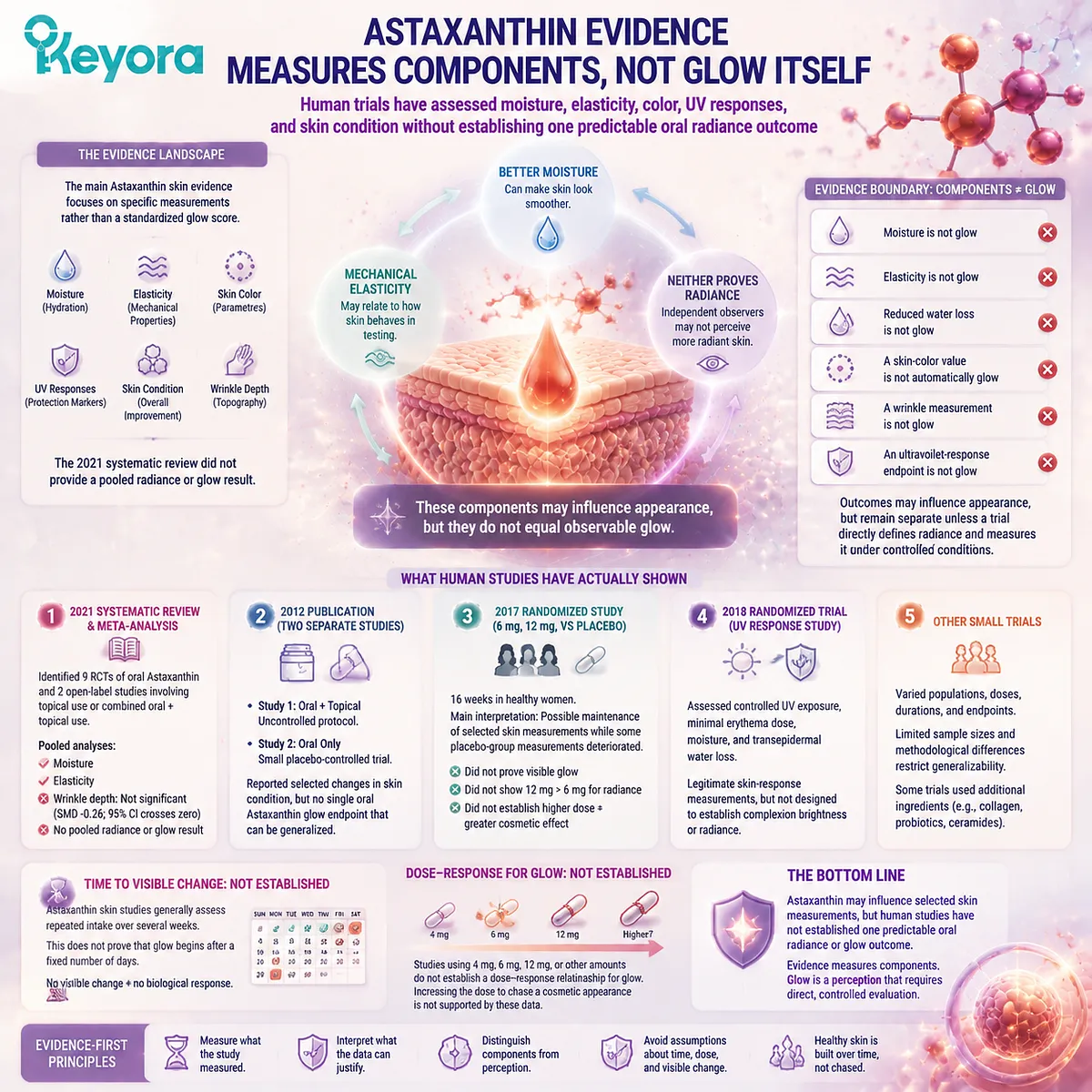
Astaxanthin Evidence Measures Components, Not Glow Itself
Human trials have assessed moisture, elasticity, color, UV responses, and skin condition without establishing one predictable oral radiance outcome
The main Astaxanthin skin evidence focuses on specific measurements rather than a standardized glow score.
The 2021 systematic review identified nine randomized controlled studies of oral Astaxanthin and two open-label studies involving topical use or combined oral and topical use. Its pooled analyses addressed moisture, elasticity, and wrinkle depth. It did not provide a pooled radiance or glow result.
The moisture and elasticity findings may be relevant to appearance. Better surface moisture can make skin look smoother, while mechanical elasticity measurements may relate to how skin behaves under controlled testing. However, neither endpoint proves that independent observers would describe the face as more radiant.
The frequently cited 2012 publication also contained two different studies. One involved both oral and topical Astaxanthin in an uncontrolled protocol. The other was a small placebo-controlled oral trial. These studies reported selected changes in skin condition, but they did not establish a single oral Astaxanthin glow endpoint that can be generalized to all products and users.
A 2017 randomized study compared 6 mg, 12 mg, and placebo over 16 weeks. Its main interpretation concerned possible maintenance of selected skin measurements while some placebo-group measurements deteriorated. It did not prove that participants developed visible glow, that 12 mg created more radiance than 6 mg, or that higher doses produce greater cosmetic effects.
A 2018 randomized trial examined controlled ultraviolet exposure, minimal erythema dose, moisture, and transepidermal water loss. Those are legitimate skin-response measurements, but the study was not designed to establish complexion brightness or radiance.
This creates an evidence boundary:
-
moisture is not glow
-
elasticity is not glow
-
reduced water loss is not glow
-
a skin-color value is not automatically glow
-
a wrinkle measurement is not glow
-
an ultraviolet-response endpoint is not glow
These outcomes may influence appearance, but they should remain separate unless a trial directly defines radiance and measures it under controlled conditions.
The evidence also does not establish a universal time to visible change. Astaxanthin skin studies generally assess repeated intake over several weeks, but this does not prove that glow begins after a fixed number of days or that the absence of visible change means no biological response occurred.
Similarly, studies using 4 mg, 6 mg, 12 mg, or other amounts do not establish a dose-response relationship for glow. Increasing the dose to chase a cosmetic appearance is not supported by these data.
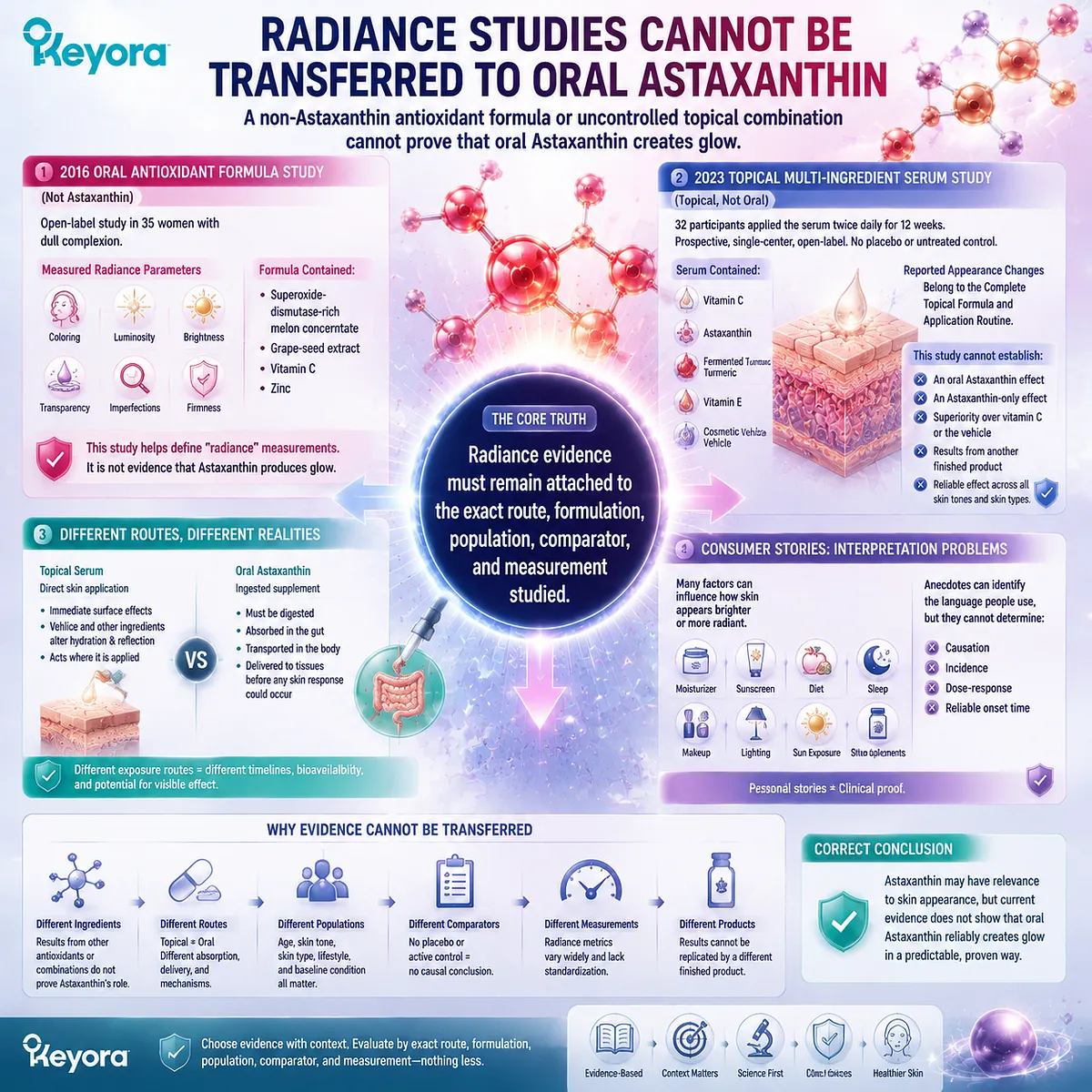
Radiance Studies Cannot Be Transferred to Oral Astaxanthin
A non-Astaxanthin antioxidant formula or uncontrolled topical combination cannot prove that oral Astaxanthin creates glow
Some skin-radiance studies appear relevant at first glance but do not provide oral Astaxanthin evidence.
A 2016 open-label study evaluated an oral antioxidant formula in 35 women with dull complexion. The researchers measured coloring, luminosity, brightness, transparency, imperfections, and firmness.
However, the formula contained a superoxide-dismutase-rich melon concentrate, grape-seed extract, vitamin C, and zinc. It did not contain Astaxanthin.
That study can help show how researchers operationalize the word radiance. It cannot be cited as evidence that Astaxanthin produces glow.
A 2023 study did contain Astaxanthin, but it tested a topical multi-ingredient serum rather than an oral Astaxanthin supplement.
Thirty-two participants applied a formulation containing vitamin C, Astaxanthin, fermented turmeric, vitamin E, and a cosmetic vehicle twice daily for 12 weeks. The study was prospective, single-center, and open-label, without a placebo or untreated comparison group.
The reported appearance changes belong to the complete topical formula and application routine. They cannot establish:
-
an oral Astaxanthin effect
-
an Astaxanthin-only effect
-
superiority over vitamin C or the cosmetic vehicle
-
a predictable result from another finished product
-
a reliable effect across all skin tones and skin types
Topical and oral interventions also operate through different exposure routes.
A topical serum is placed directly on the skin and may immediately alter hydration, surface reflection, and appearance through its vehicle and other ingredients.
Oral Astaxanthin must be digested, absorbed, transported, and delivered to tissue before any possible skin response could occur.
Consumer stories create similar interpretation problems.
Someone reporting a brighter or warmer complexion may also have changed moisturizer, sunscreen, diet, sleep, makeup, lighting, sun exposure, or other supplements.
Anecdotes can identify the language people use, but they cannot determine causation, incidence, dose-response, or a reliable onset time.
The correct conclusion is not that Astaxanthin has no relevance to skin appearance. It is that radiance evidence must remain attached to the exact route, formulation, population, comparator, and measurement studied.
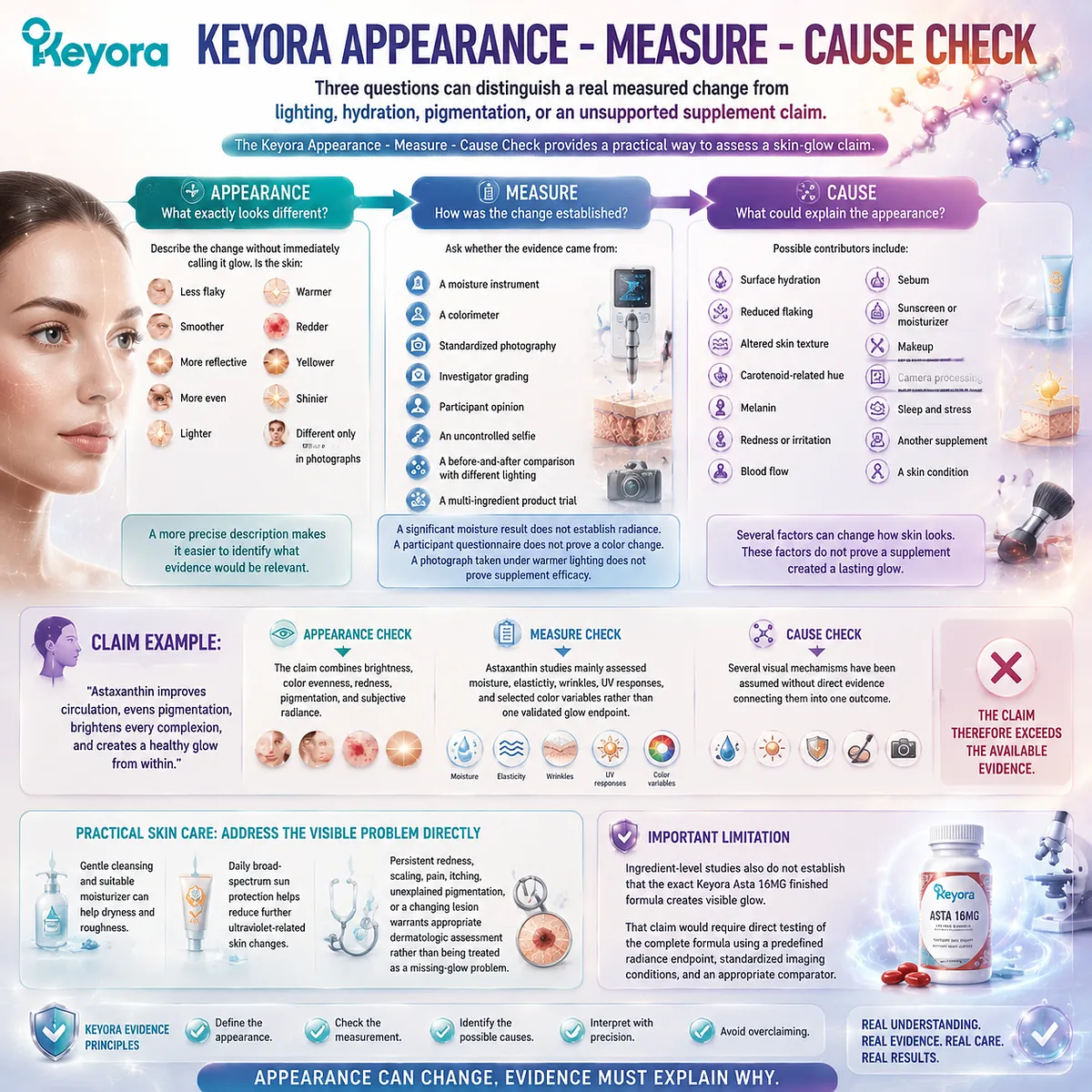
Use the Keyora Appearance – Measure – Cause Check
Three questions can distinguish a real measured change from lighting, hydration, pigmentation, or an unsupported supplement claim
The Keyora Appearance – Measure – Cause Check provides a practical way to assess a skin-glow claim.
Appearance: What exactly looks different?
Describe the change without immediately calling it glow.
Is the skin:
-
less flaky
-
smoother
-
more reflective
-
more even
-
lighter
-
warmer
-
redder
-
yellower
-
shinier
-
different only in photographs
A more precise description makes it easier to identify what evidence would be relevant.
Measure: How was the change established?
Ask whether the evidence came from:
-
a moisture instrument
-
a colorimeter
-
standardized photography
-
investigator grading
-
participant opinion
-
an uncontrolled selfie
-
a before-and-after comparison with different lighting
-
a multi-ingredient product trial
A significant moisture result does not establish radiance. A participant questionnaire does not prove a color change. A photograph taken under warmer lighting does not prove supplement efficacy.
Cause: What could explain the appearance?
Possible contributors include:
-
surface hydration
-
reduced flaking
-
altered skin texture
-
carotenoid-related hue
-
melanin
-
redness or irritation
-
blood flow
-
sebum
-
sunscreen or moisturizer
-
makeup
-
camera processing
-
sleep and stress
-
another supplement
-
a skin condition
Consider the claim:
“Astaxanthin improves circulation, evens pigmentation, brightens every complexion, and creates a healthy glow from within.”
The Appearance check shows that the claim combines brightness, color evenness, redness, pigmentation, and subjective radiance.
The Measure check shows that Astaxanthin studies mainly assessed moisture, elasticity, wrinkles, UV responses, and selected color variables rather than one validated glow endpoint.
The Cause check shows that several visual mechanisms have been assumed without direct evidence connecting them into one outcome.
The claim therefore exceeds the available evidence.
Practical skin care should address the visible problem directly. Gentle cleansing and suitable moisturizer can help dryness and roughness. Daily broad-spectrum sun protection helps reduce further ultraviolet-related skin changes. Persistent redness, scaling, pain, itching, unexplained pigmentation, or a changing lesion warrants appropriate dermatologic assessment rather than being treated as a missing-glow problem.
Ingredient-level studies also do not establish that the exact Keyora Asta 16MG finished formula creates visible glow. That claim would require direct testing of the complete formula using a predefined radiance endpoint, standardized imaging conditions, and an appropriate comparator.
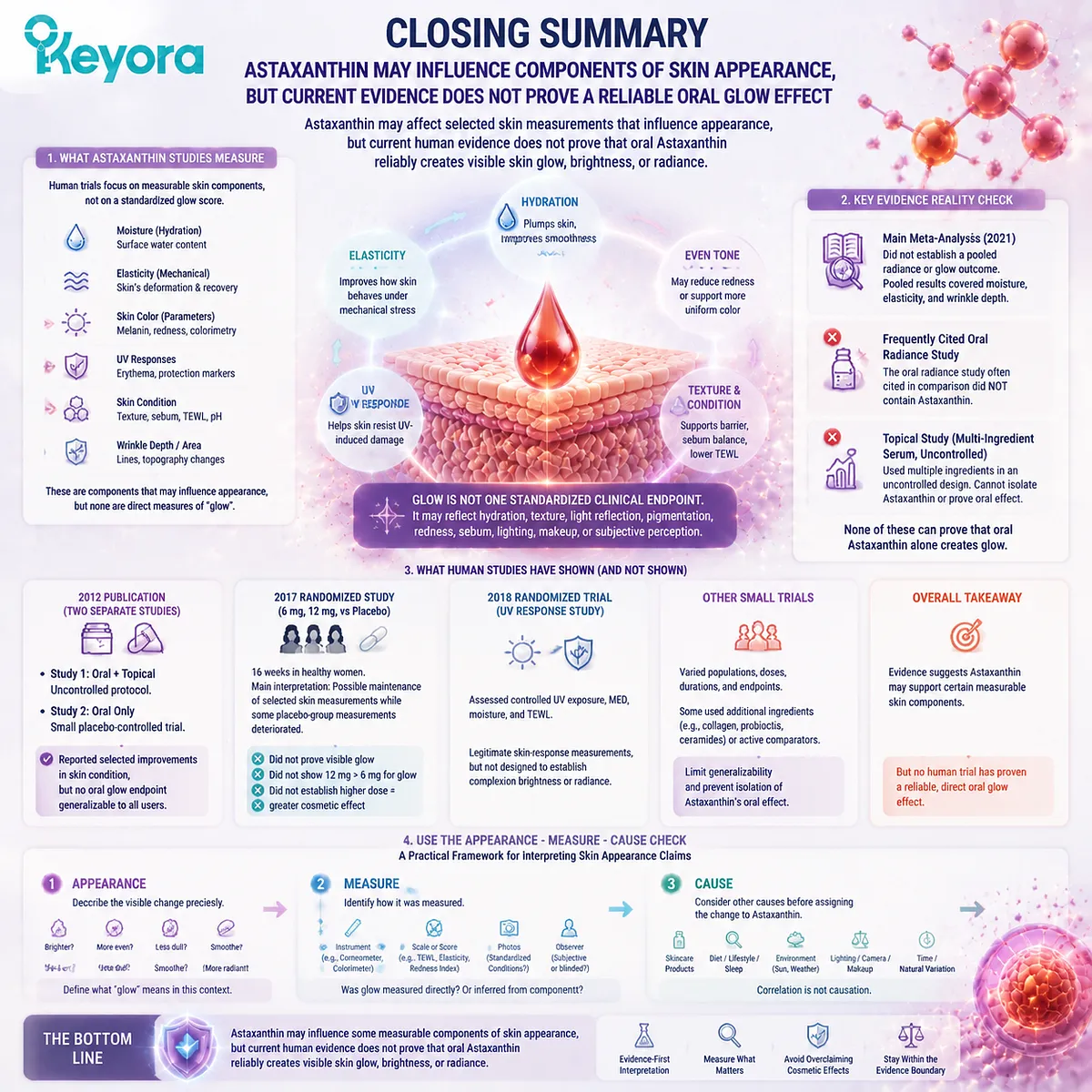
Closing Summary
Astaxanthin may influence components of skin appearance, but current evidence does not prove a reliable oral glow effect
Astaxanthin may affect selected skin measurements that influence appearance, including moisture, elasticity, color, and ultraviolet-related responses.
However, glow is not one standardized clinical endpoint. It may reflect hydration, texture, light reflection, pigmentation, redness, sebum, lighting, makeup, or subjective perception.
The main Astaxanthin skin meta-analysis did not establish a pooled radiance outcome. A frequently cited oral radiance study did not contain Astaxanthin, while a topical study used a multi-ingredient serum in an uncontrolled design. Neither can prove that oral Astaxanthin alone creates glow.
Use the Appearance – Measure – Cause Check. Describe the visible change precisely, identify how it was measured, and consider other causes before assigning it to a supplement.
Astaxanthin may influence some measurable components of skin appearance, but current human evidence does not prove that oral Astaxanthin reliably creates visible skin glow, brightness, or radiance.
This article is for educational and informational purposes only. It does not provide medical advice, diagnosis, treatment, cure, prevention, disease outcome claims, hormone restoration claims, fertility outcome claims, or formula-specific clinical efficacy claims.