
Can Astaxanthin Reduce Wrinkles?
Keyora Research Q&A Library
This is part of the Keyora Research Q&A Series, derived from Keyora Astaxanthin Research Journal Series.
Within the Keyora Astaxanthin Researcn framework, this Q&A translates complex astaxanthin biology into reader-friendly, evidence-bound answers, focusing on natural astaxanthin identity, molecular structure, antioxidant and redox mechanisms, membrane lipid interaction, mitochondrial resilience, inflammatory signaling pathways, human evidence interpretation, and the scientific principles behind responsible supplementation.
First published by Keyora Research Journal: www.keyorahealth.com
Direct Answer
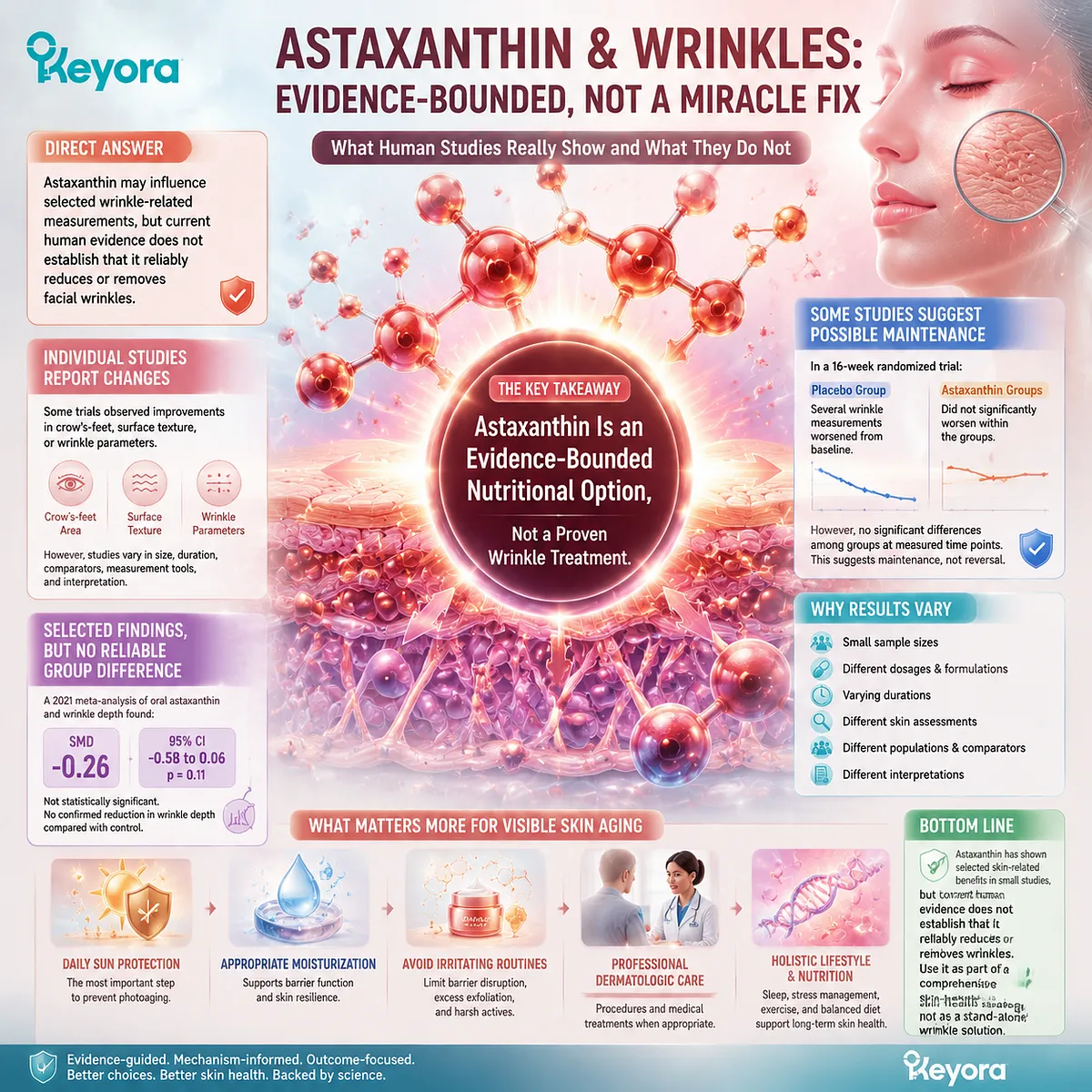
Astaxanthin may influence selected wrinkle-related measurements, but current human evidence does not establish that it reliably reduces or removes facial wrinkles.
Individual studies have reported changes in crow’s-feet, surface texture, or wrinkle parameters, yet these findings come from small trials with different interventions, comparators, measurement methods, and interpretations.
Astaxanthin has produced selected wrinkle-related findings in small studies, but the pooled oral evidence did not show a statistically significant reduction in wrinkle depth compared with control.
In a 2021 meta-analysis, the pooled wrinkle-depth result was SMD -0.26, with a 95 percent confidence interval from -0.58 to 0.06 and p = 0.11. The analysis therefore did not confirm a reliable group difference.
Some studies suggest possible maintenance rather than reversal.
In a 16-week trial, several wrinkle measurements worsened from baseline in the placebo group but did not significantly worsen within the Astaxanthin groups.
However, the study reported no significant differences among the three groups at the measured time points, so it should not be summarized as proven wrinkle reduction.
Astaxanthin should therefore be considered an evidence-bounded nutritional option rather than a wrinkle treatment. Daily sun protection, appropriate moisturization, avoidance of irritating routines, and professional dermatologic care remain more direct responses to visible skin-aging concerns.
Wrinkle Reduction Is Not One Measurement
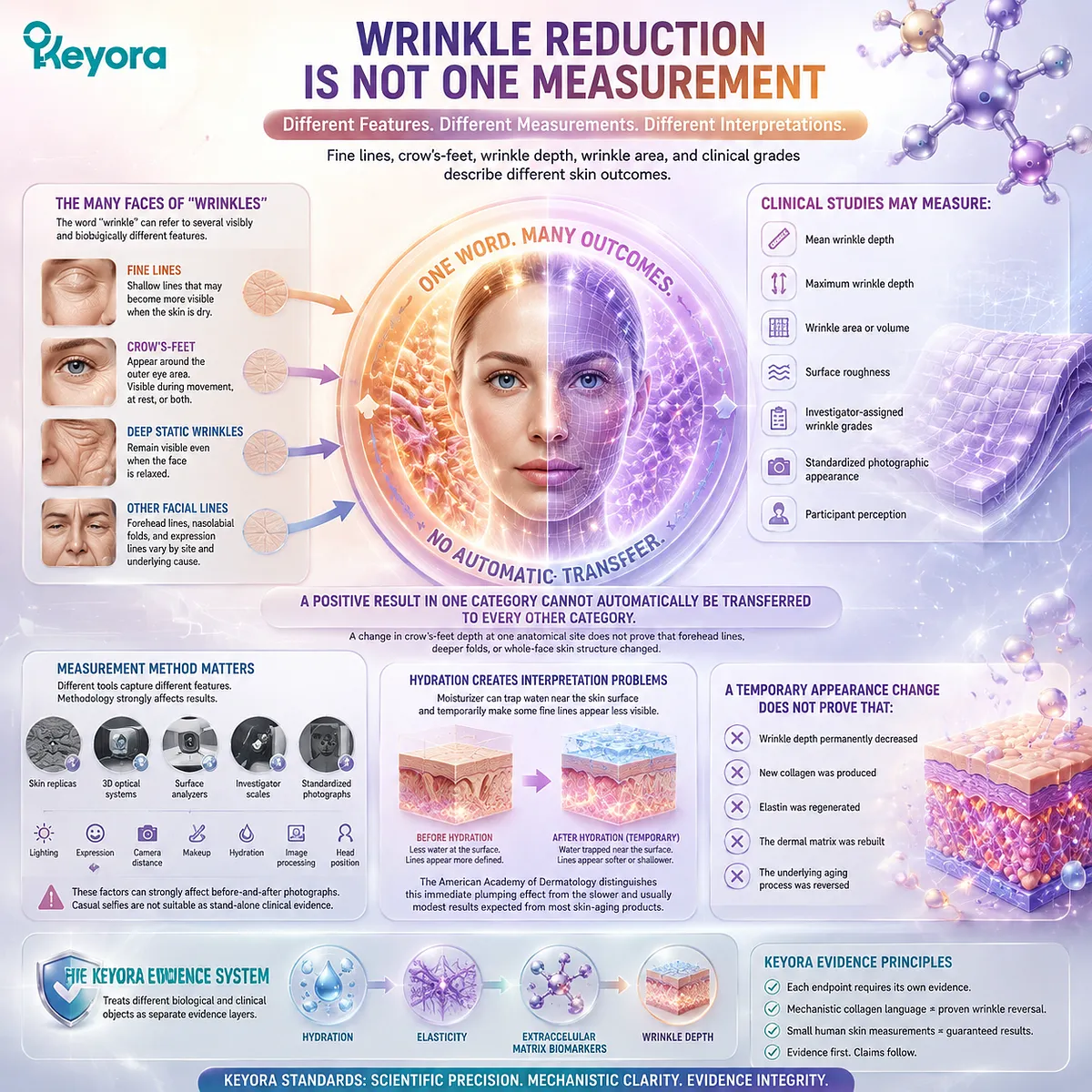
Fine lines, crow’s-feet, wrinkle depth, wrinkle area, and clinical grades describe different skin outcomes
The word “wrinkle” can refer to several visibly and biologically different features. Fine lines may be shallow and become more noticeable when the skin is dry. Crow’s-feet appear around the outer eye area and may be visible during facial movement, at rest, or both. Deeper static wrinkles remain visible when the face is relaxed.
Clinical studies may measure:
-
mean wrinkle depth
-
maximum wrinkle depth
-
wrinkle area or volume
-
surface roughness
-
investigator-assigned wrinkle grades
-
standardized photographic appearance
-
participant perception
A positive result in one category cannot automatically be transferred to every other category. A change in crow’s-feet depth at one anatomical site, for example, does not prove that forehead lines, deeper folds, or whole-face skin structure changed.
The measurement method also matters. Skin replicas, three-dimensional optical systems, surface analyzers, investigator scales, and photographs each capture different features. Lighting, facial expression, camera distance, makeup, hydration, image processing, and head position can strongly affect before-and-after photographs, making casual selfies unsuitable as stand-alone clinical evidence.
Hydration creates another interpretation problem. Moisturizer can trap water near the skin surface and temporarily make some fine lines appear less visible. The American Academy of Dermatology distinguishes this immediate plumping effect from the slower and usually modest results expected from most skin-aging products.
A temporary appearance change does not prove that:
-
wrinkle depth permanently decreased
-
new collagen was produced
-
elastin was regenerated
-
the dermal matrix was rebuilt
-
the underlying aging process was reversed
The Keyora evidence system therefore treats hydration, elasticity, extracellular-matrix biomarkers, and wrinkle depth as separate evidence objects. It specifically prohibits turning mechanistic collagen language or small human skin measurements into guaranteed wrinkle reversal.
Human Studies Show Mixed Wrinkle Findings
Some small trials reported selected changes or maintenance, while pooled oral evidence did not significantly reduce wrinkle depth
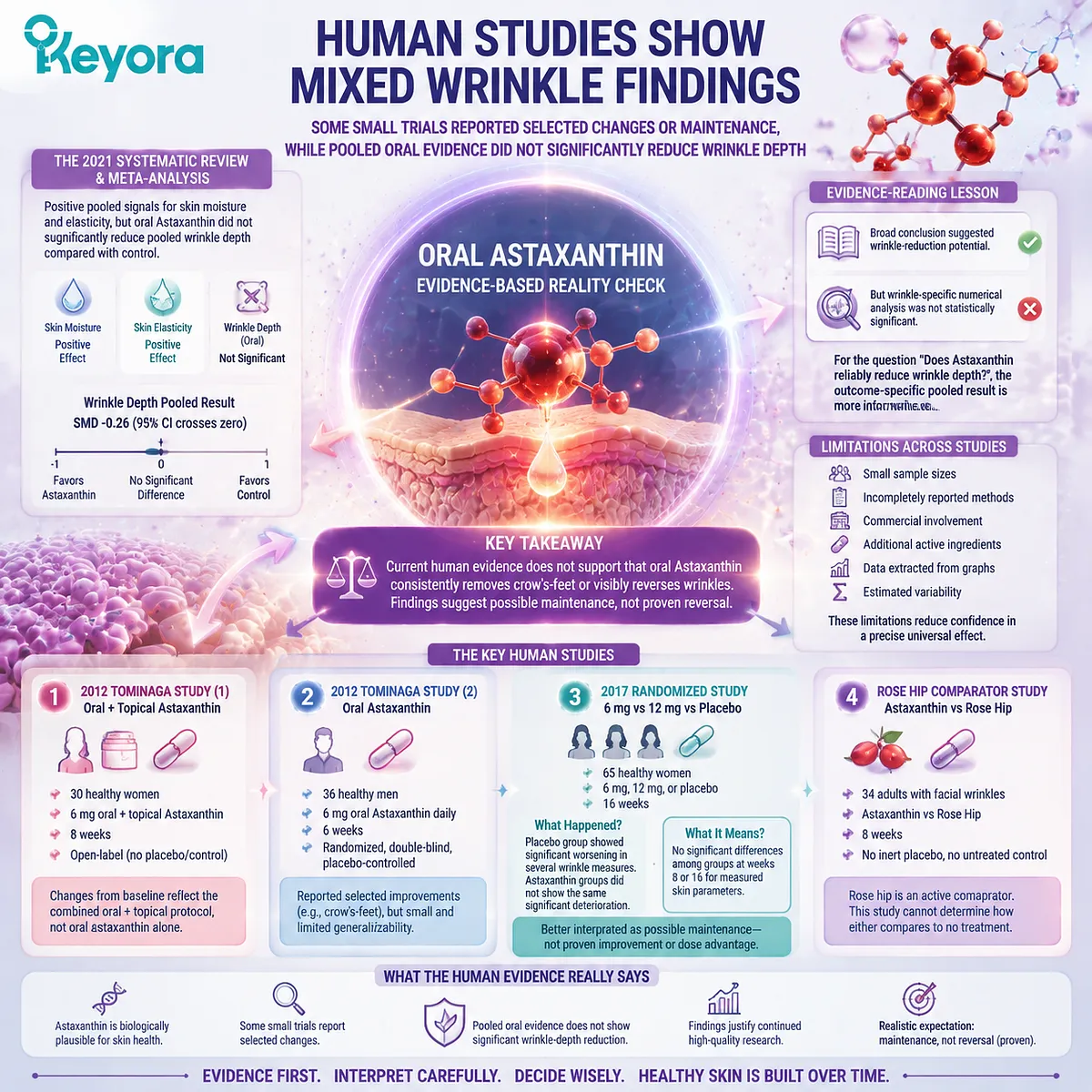
The most useful high-level evidence is the 2021 systematic review and meta-analysis. It found positive pooled signals for skin moisture and elasticity, but oral Astaxanthin did not significantly reduce pooled wrinkle depth compared with control. The wrinkle estimate was SMD -0.26, with a confidence interval crossing zero.
This creates an important evidence-reading lesson. The review’s broad concluding language suggested wrinkle-reduction potential, but its wrinkle-specific numerical analysis was not statistically significant. For the question “Does Astaxanthin reliably reduce wrinkle depth?”, the outcome-specific pooled result is more informative than a broad positive conclusion.
The evidence base was also small. Several studies involved limited participant numbers, incompletely reported trial methods, commercial involvement, or interventions containing additional active ingredients. Some values used in the meta-analysis were extracted from graphs, and variability estimates sometimes required estimation. These limitations reduce confidence in a precise universal effect.
The frequently cited 2012 Tominaga publication contained two separate studies.
The first involved 30 healthy women who used both 6 mg of oral Astaxanthin and topical Astaxanthin for eight weeks. It was open-label and had no untreated or placebo group. Changes from baseline therefore belonged to the combined oral and topical protocol, not to oral Astaxanthin alone.
The second study enrolled 36 healthy men in a six-week randomized, double-blind, placebo-controlled design using 6 mg of oral Astaxanthin daily. The publication reported selected changes in crow’s-feet and other skin measurements. Although this design gives more direct oral evidence, the study was small and does not establish a reliable effect across sexes, age groups, skin types, formulations, or wrinkle locations.
The 2017 study tested 6 mg, 12 mg, and placebo for 16 weeks in 65 healthy women. Several wrinkle measurements significantly worsened from baseline in the placebo group, while the same significant deterioration was not observed in the Astaxanthin groups. However, the researchers also reported no significant differences among groups for the measured skin parameters at weeks 8 or 16.
This distinction is essential:
No significant worsening within a treatment group is not automatically the same as a significant improvement over placebo.
The study is better interpreted as possible maintenance during the trial period than as demonstrated wrinkle reversal. It also did not establish that 12 mg was superior to 6 mg or that increasing the dose would create a larger visible effect.
Another study compared Astaxanthin with rose hip powder in 34 adults with facial wrinkles. Participants received either rose hip or Astaxanthin for eight weeks. Rose hip was an active comparator, not an inert placebo, and the trial did not include an untreated control group. It therefore cannot answer how either intervention compared with no active supplementation.
These studies justify continued investigation, but they do not support the statement that oral Astaxanthin consistently removes crow’s-feet or visibly reverses wrinkles.
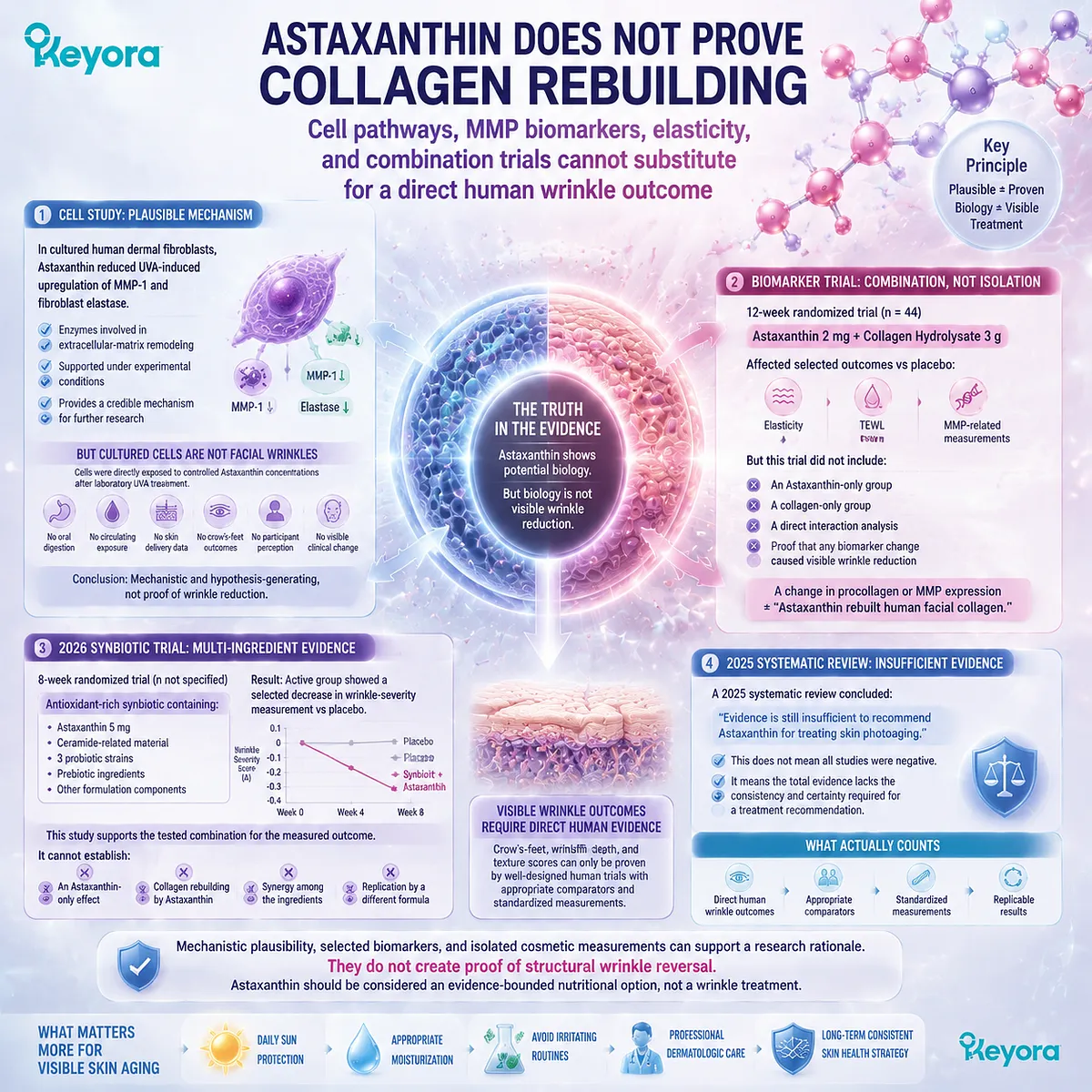
Astaxanthin Does Not Prove Collagen Rebuilding
Cell pathways, MMP biomarkers, elasticity, and combination trials cannot substitute for a direct human wrinkle outcome
Astaxanthin has a plausible relationship to photooxidative skin biology. In cultured human dermal fibroblasts, Astaxanthin reduced UVA-related upregulation of MMP-1 and fibroblast elastase under the experimental conditions. These enzymes participate in extracellular-matrix remodeling, so the study provides a credible mechanism for further research.
However, cultured cells are not facial wrinkles.
The cells were directly exposed to controlled Astaxanthin concentrations after laboratory UVA treatment. That experiment did not test oral digestion, circulating exposure, skin delivery, crow’s-feet, participant perception, or visible clinical change. Its conclusion was mechanistic and hypothesis-generating rather than proof of wrinkle reduction.
Biomarker studies require the same caution. A 12-week randomized trial gave 44 participants a combination containing 2 mg of Astaxanthin and 3 g of collagen hydrolysate. The intervention affected selected elasticity, TEWL, and MMP-related measurements compared with placebo. Because both active ingredients were administered together, the study did not identify Astaxanthin’s independent contribution.
The trial also did not include:
-
an Astaxanthin-only group
-
a collagen-only group
-
a direct interaction analysis
-
proof that any biomarker change caused visible wrinkle reduction
A change in procollagen or MMP expression therefore cannot be rewritten as “Astaxanthin rebuilt human facial collagen.”
The same rule applies to newer combination evidence. A 2026 randomized trial tested an antioxidant-rich synbiotic containing 5 mg of Astaxanthin, ceramide-related material, three probiotic strains, prebiotic ingredients, and other formulation components. The active group showed a selected decrease in wrinkle-severity measurement after eight weeks, but the intervention was a multi-ingredient synbiotic rather than Astaxanthin alone.
That study supports the tested combination for the measured outcome. It cannot establish:
-
an Astaxanthin-only effect
-
collagen rebuilding by Astaxanthin
-
synergy among the ingredients
-
replication by a different finished formula
A broader 2025 systematic review concluded that evidence was still insufficient to recommend Astaxanthin for treating skin photoaging. This does not mean that every small trial was negative. It means the total evidence had not reached the consistency and certainty required for a treatment recommendation.
Mechanistic plausibility, selected biomarkers, and isolated cosmetic measurements can support a research rationale. They do not create proof of structural wrinkle reversal.
Use the Keyora Line – Measure – Meaning Check
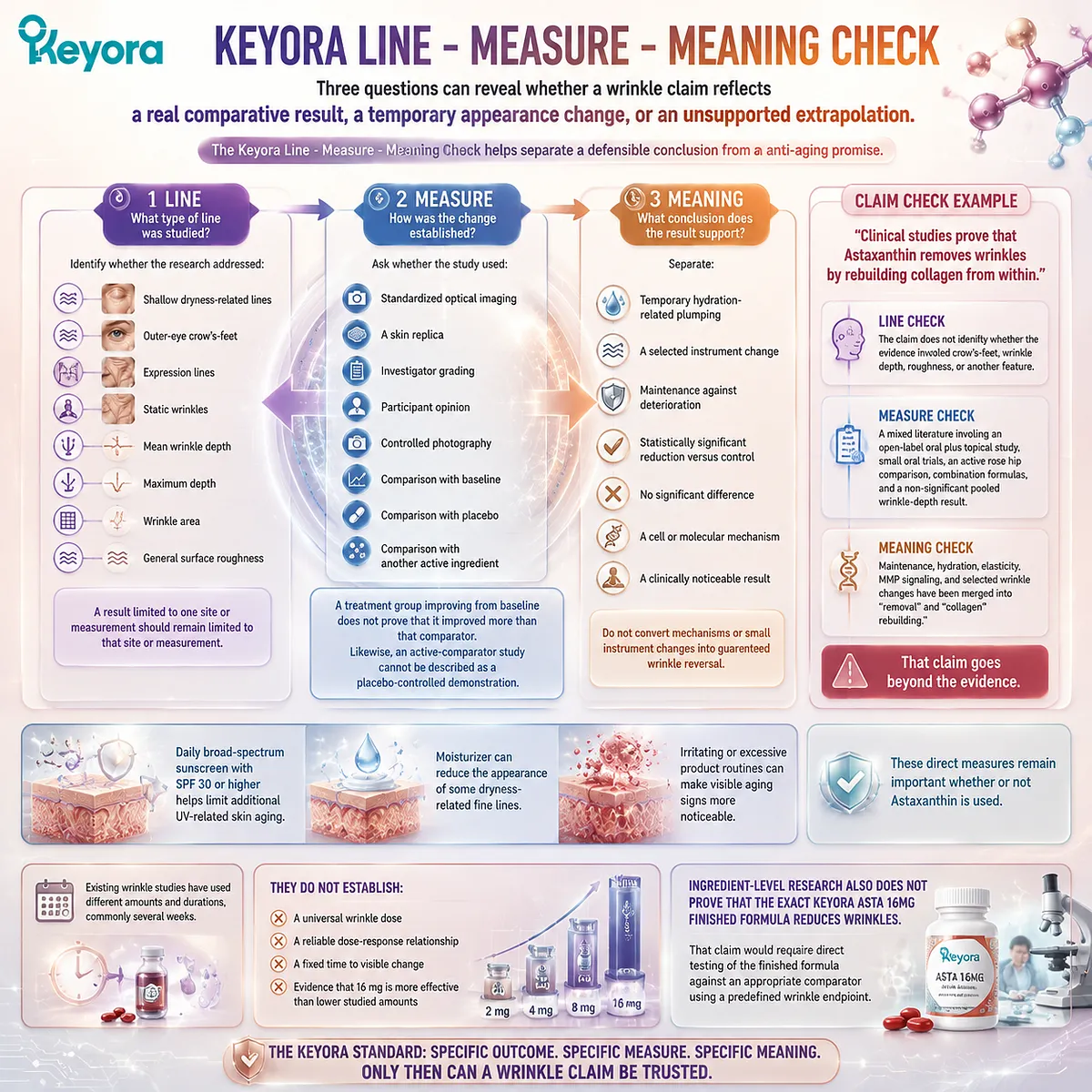
Three questions can reveal whether a wrinkle claim reflects a real comparative result, a temporary appearance change, or an unsupported extrapolation
The Keyora Line – Measure – Meaning Check helps separate a defensible conclusion from an anti-aging promise.
Line: What type of line was studied?
Identify whether the research addressed:
-
shallow dryness-related lines
-
outer-eye crow’s-feet
-
expression lines
-
static wrinkles
-
mean wrinkle depth
-
maximum depth
-
wrinkle area
-
general surface roughness
A result limited to one site or measurement should remain limited to that site or measurement.
Measure: How was the change established?
Ask whether the study used:
-
standardized optical imaging
-
a skin replica
-
investigator grading
-
participant opinion
-
controlled photography
-
comparison with baseline
-
comparison with placebo
-
comparison with another active ingredient
A treatment group improving from baseline does not prove that it improved more than the comparator. Likewise, an active-comparator study cannot be described as a placebo-controlled demonstration.
Meaning: What conclusion does the result support?
Separate:
-
temporary hydration-related plumping
-
a selected instrument change
-
maintenance against deterioration
-
statistically significant reduction versus control
-
no significant difference
-
a cell or molecular mechanism
-
a clinically noticeable result
Consider the claim:
“Clinical studies prove that Astaxanthin removes wrinkles by rebuilding collagen from within.”
The Line check shows that the claim does not identify whether the evidence involved crow’s-feet, wrinkle depth, roughness, or another feature.
The Measure check reveals a mixed literature involving an open-label oral plus topical study, small oral trials, an active rose hip comparison, combination formulas, and a non-significant pooled wrinkle-depth result.
The Meaning check shows that maintenance, hydration, elasticity, MMP signaling, and selected wrinkle changes have been merged into “removal” and “collagen rebuilding.”
That claim goes beyond the evidence.
Daily broad-spectrum sunscreen with SPF 30 or higher helps limit additional UV-related skin aging. Moisturizer can reduce the appearance of some dryness-related fine lines. Irritating or excessive product routines can make visible aging signs more noticeable. These direct measures remain important whether or not Astaxanthin is used.
Existing wrinkle studies have used different amounts and durations, commonly several weeks. They do not establish a universal wrinkle dose, a reliable dose-response relationship, a fixed time to visible change, or evidence that 16 mg is more effective than lower studied amounts.
Ingredient-level research also does not prove that the exact Keyora Asta 16MG finished formula reduces wrinkles. That claim would require direct testing of the finished formula against an appropriate comparator using a predefined wrinkle endpoint.
Closing Summary
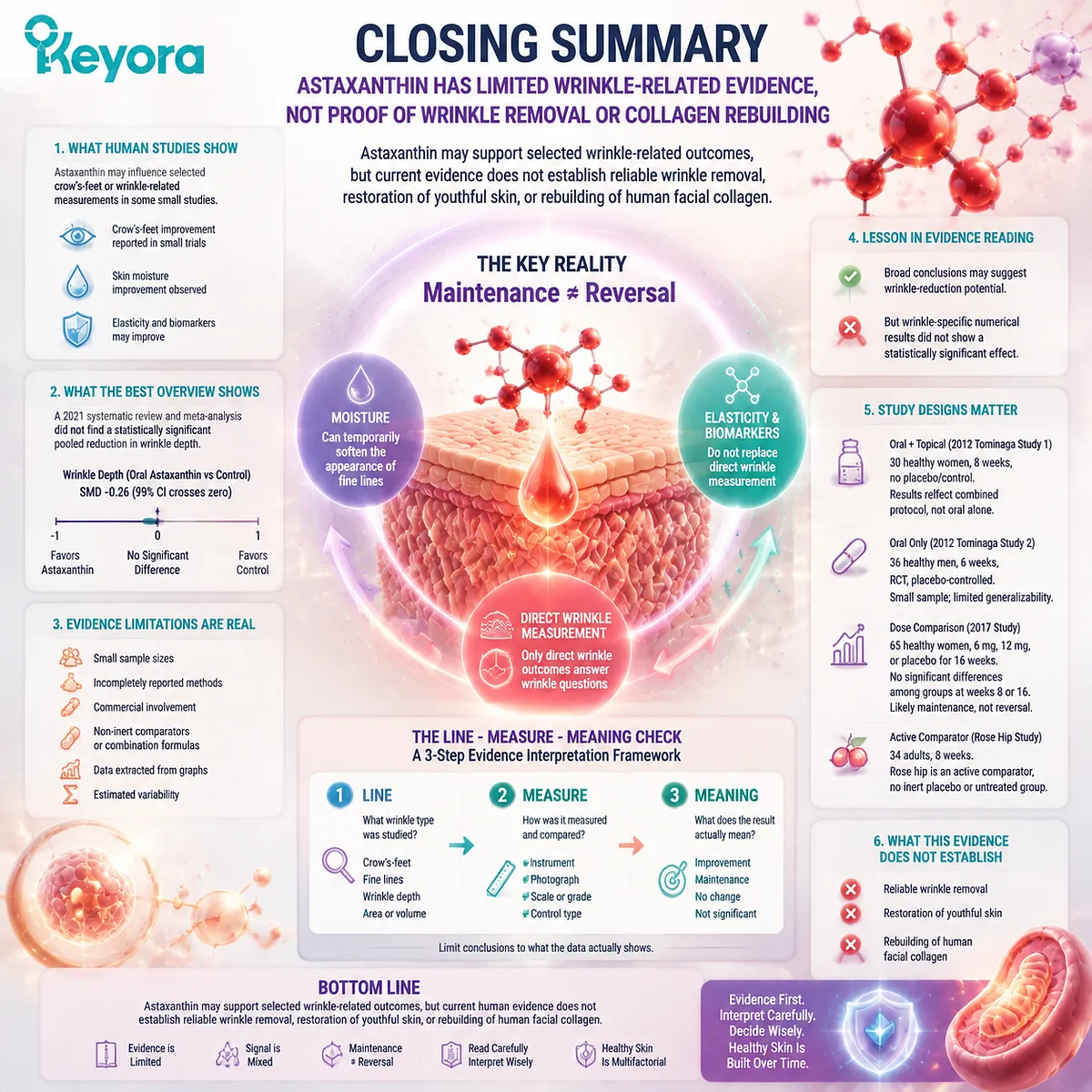
Astaxanthin has limited wrinkle-related evidence, not proof of wrinkle removal or collagen rebuilding
Astaxanthin may influence selected crow’s-feet or wrinkle-related measurements in some small studies.
However, a 2021 meta-analysis did not find a statistically significant pooled reduction in wrinkle depth compared with control. Some studies combined oral and topical Astaxanthin, used another active ingredient as the comparator, or tested Astaxanthin with collagen, probiotics, ceramides, or other ingredients.
Maintenance against deterioration is not wrinkle reversal. Improved moisture can temporarily soften the appearance of fine lines, while elasticity and molecular biomarkers cannot replace a direct wrinkle measurement.
Use the Line – Measure – Meaning Check. Identify the kind of wrinkle studied, examine how the change was measured and compared, and limit the conclusion to what that result actually means.
Astaxanthin may support selected wrinkle-related outcomes, but current evidence does not establish reliable wrinkle removal, restoration of youthful skin, or rebuilding of human facial collagen.
This article is for educational and informational purposes only. It does not provide medical advice, diagnosis, treatment, cure, prevention, disease outcome claims, hormone restoration claims, fertility outcome claims, or formula-specific clinical efficacy claims.