
Is Astaxanthin Better Than Lutein or Zeaxanthin for Eyes?
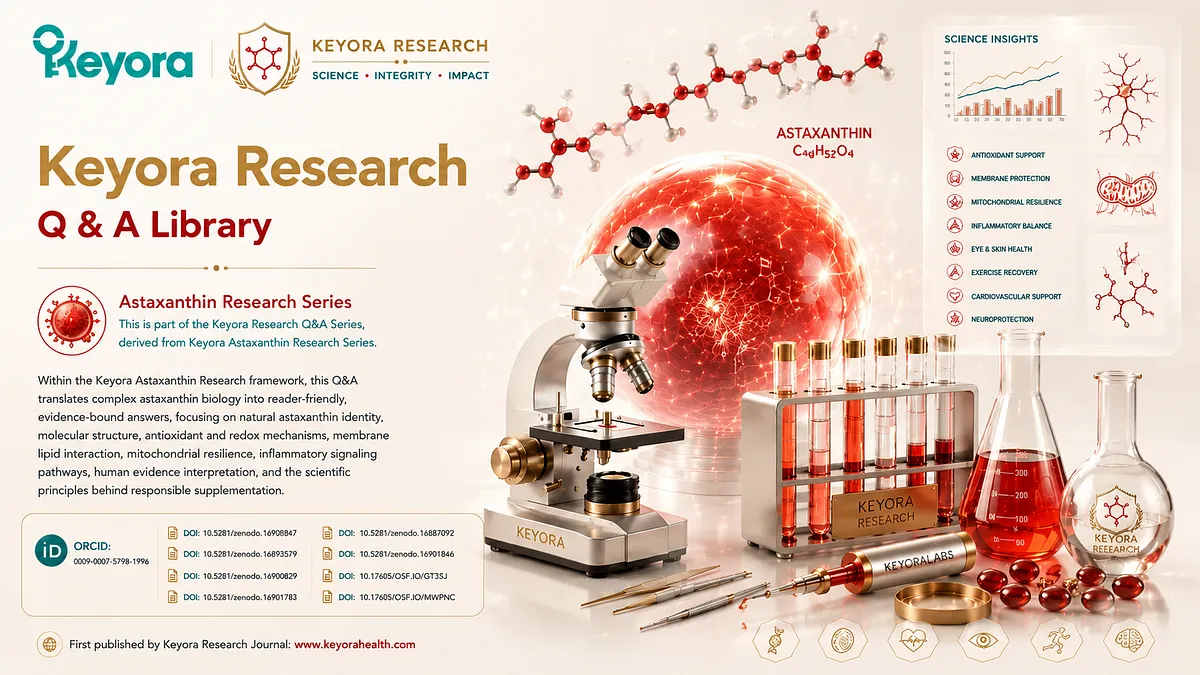
Keyora Research Q&A Library
This is part of the Keyora Research Q&A Series, derived from Keyora Astaxanthin Research Journal Series.
Within the Keyora Astaxanthin Researcn framework, this Q&A translates complex astaxanthin biology into reader-friendly, evidence-bound answers, focusing on natural astaxanthin identity, molecular structure, antioxidant and redox mechanisms, membrane lipid interaction, mitochondrial resilience, inflammatory signaling pathways, human evidence interpretation, and the scientific principles behind responsible supplementation.
First published by Keyora Research Journal: www.keyorahealth.com
Direct Answer
No single carotenoid is universally better for every eye concern.
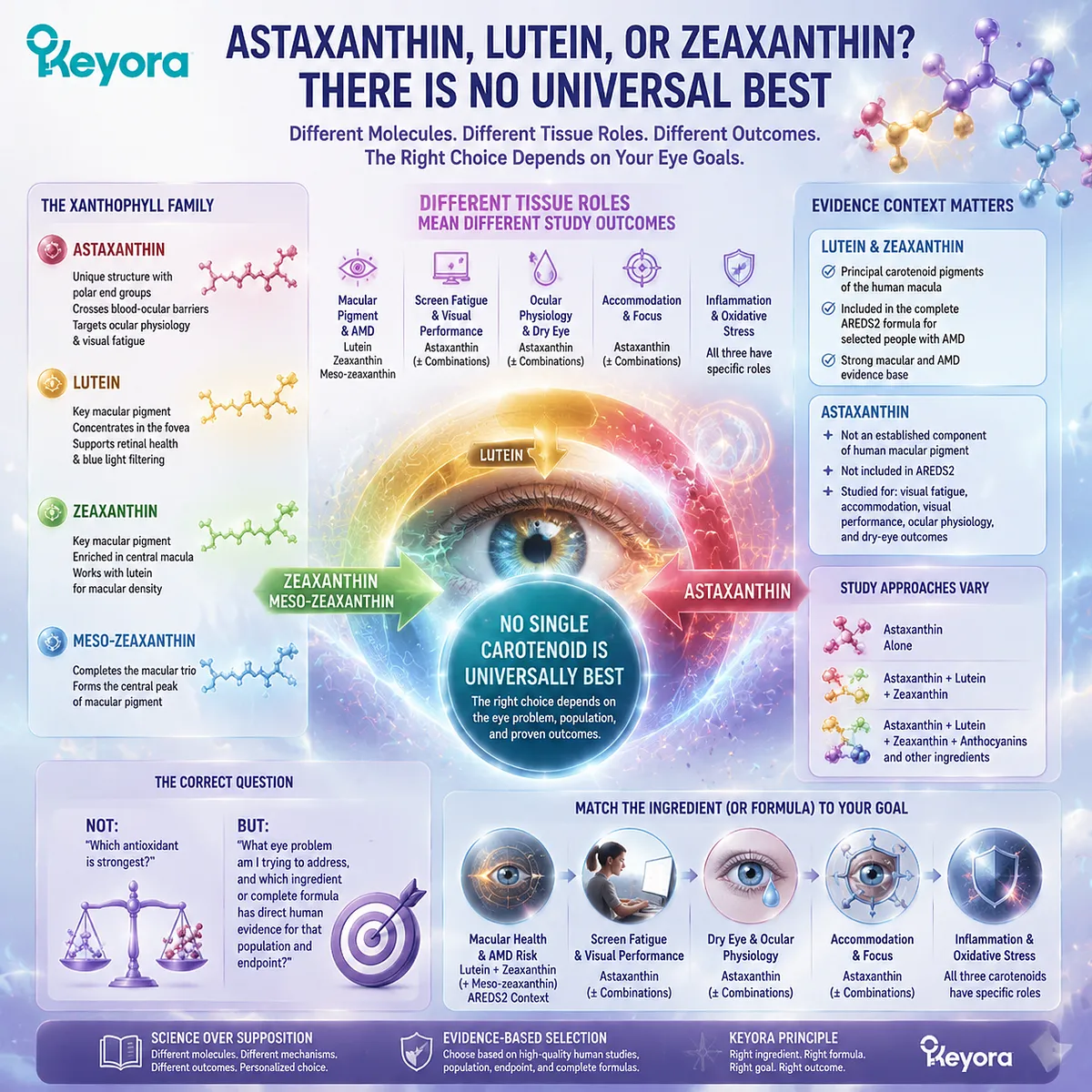
Astaxanthin, lutein, and zeaxanthin belong to the xanthophyll carotenoid family, but they are different molecules with different tissue roles, study populations, formulations, and measured outcomes.
Astaxanthin is not universally better than lutein or zeaxanthin because the three carotenoids have different tissue roles, study populations, and eye endpoints, with lutein and zeaxanthin having a specific macular and AREDS2 evidence context.
Lutein, zeaxanthin, and meso-zeaxanthin form the principal carotenoid pigments of the human macula.
Lutein and zeaxanthin are also components of the complete AREDS2 formula used for certain people with age-related macular degeneration. Astaxanthin is not an established component of human macular pigment and is not included in AREDS2.
Astaxanthin has instead been studied for selected outcomes involving screen-related visual fatigue, accommodation, visual performance, ocular physiology, and dry-eye measurements.
Some studies tested Astaxanthin alone, while others used combinations containing lutein, zeaxanthin, anthocyanins, or additional ingredients.
The correct question is therefore not, “Which antioxidant is strongest?”
It is, “What eye problem am I trying to address, and which ingredient or complete formula has direct human evidence for that population and endpoint?”
These Carotenoids Do Not Perform the Same Eye Role
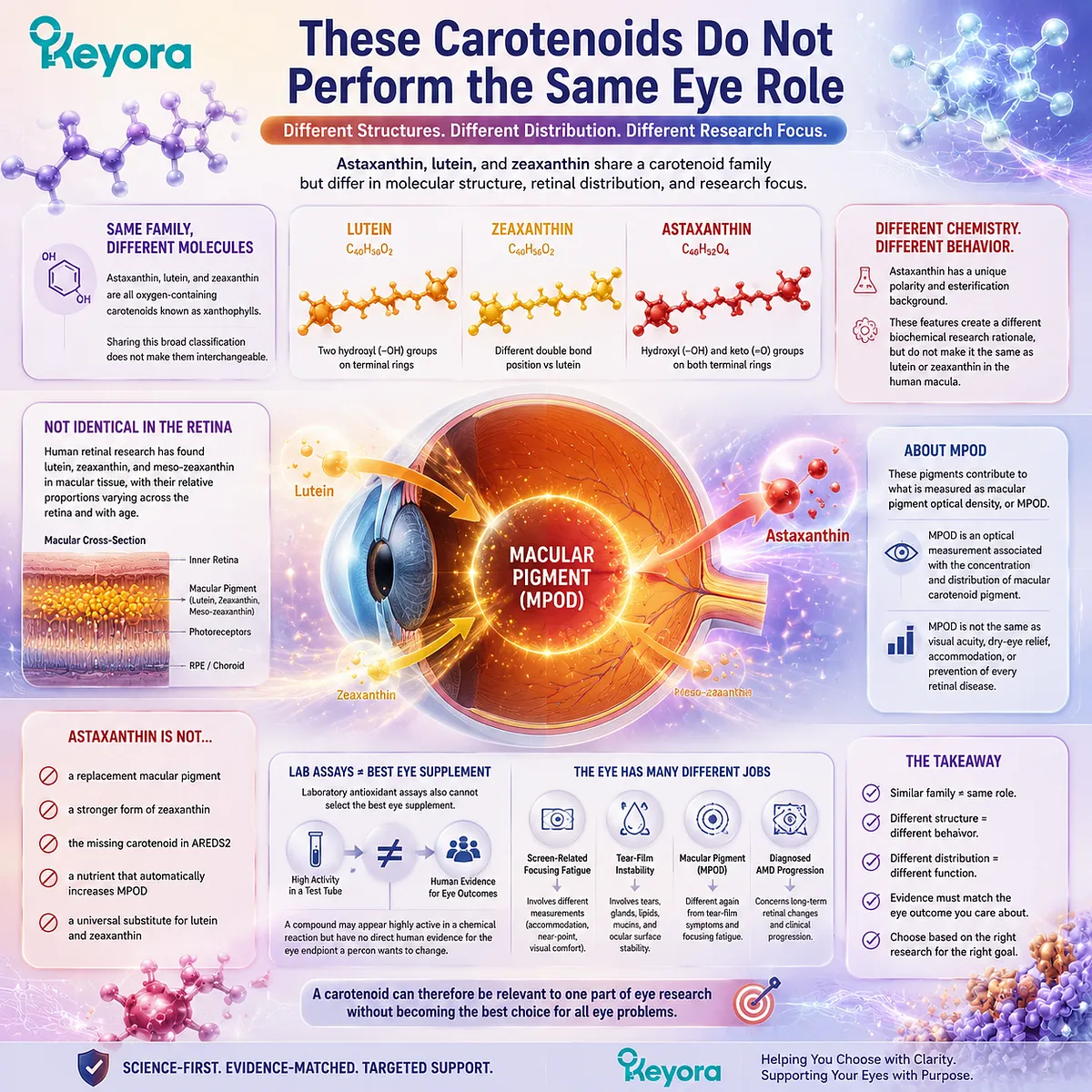
Astaxanthin, lutein, and zeaxanthin share a carotenoid family but differ in molecular structure, retinal distribution, and research focus
Astaxanthin, lutein, and zeaxanthin are all oxygen-containing carotenoids known as xanthophylls. Sharing this broad classification does not make them interchangeable.
Lutein and zeaxanthin are closely related yellow-orange pigments.
Their molecular structures differ in the positioning of double bonds, and their distributions within the retina are not identical.
Human retinal research has found lutein, zeaxanthin, and meso-zeaxanthin in macular tissue, with their relative proportions varying across the retina and with age.
These pigments contribute to what is measured as macular pigment optical density, or MPOD.
MPOD is an optical measurement associated with the concentration and distribution of macular carotenoid pigment. It is not the same as visual acuity, dry-eye relief, accommodation, or prevention of every retinal disease.
Astaxanthin has a different molecular structure, including both hydroxyl and keto groups on its terminal rings. It is a red-orange pigment with a distinct polarity and esterification background.
Those features create a different biochemical research rationale, but they do not establish that Astaxanthin performs the same role as lutein or zeaxanthin in the human macula.
In particular, Astaxanthin should not be described as:
-
a replacement macular pigment
-
a stronger form of zeaxanthin
-
the missing carotenoid in AREDS2
-
a nutrient that automatically increases MPOD
-
a universal substitute for lutein and zeaxanthin
Laboratory antioxidant assays also cannot select the best eye supplement. A compound may appear highly active in a chemical reaction but have no direct human evidence for the eye endpoint a person wants to change.
The eye contains several distinct functional areas.
Screen-related focusing fatigue involves different measurements from tear-film instability. Tear-film symptoms involve different structures from the macula.
Macular pigment is different again from the clinical progression of diagnosed AMD.
A carotenoid can therefore be relevant to one part of eye research without becoming the best choice for all eye problems.
Lutein and Zeaxanthin Have a Specific Macular Evidence Context
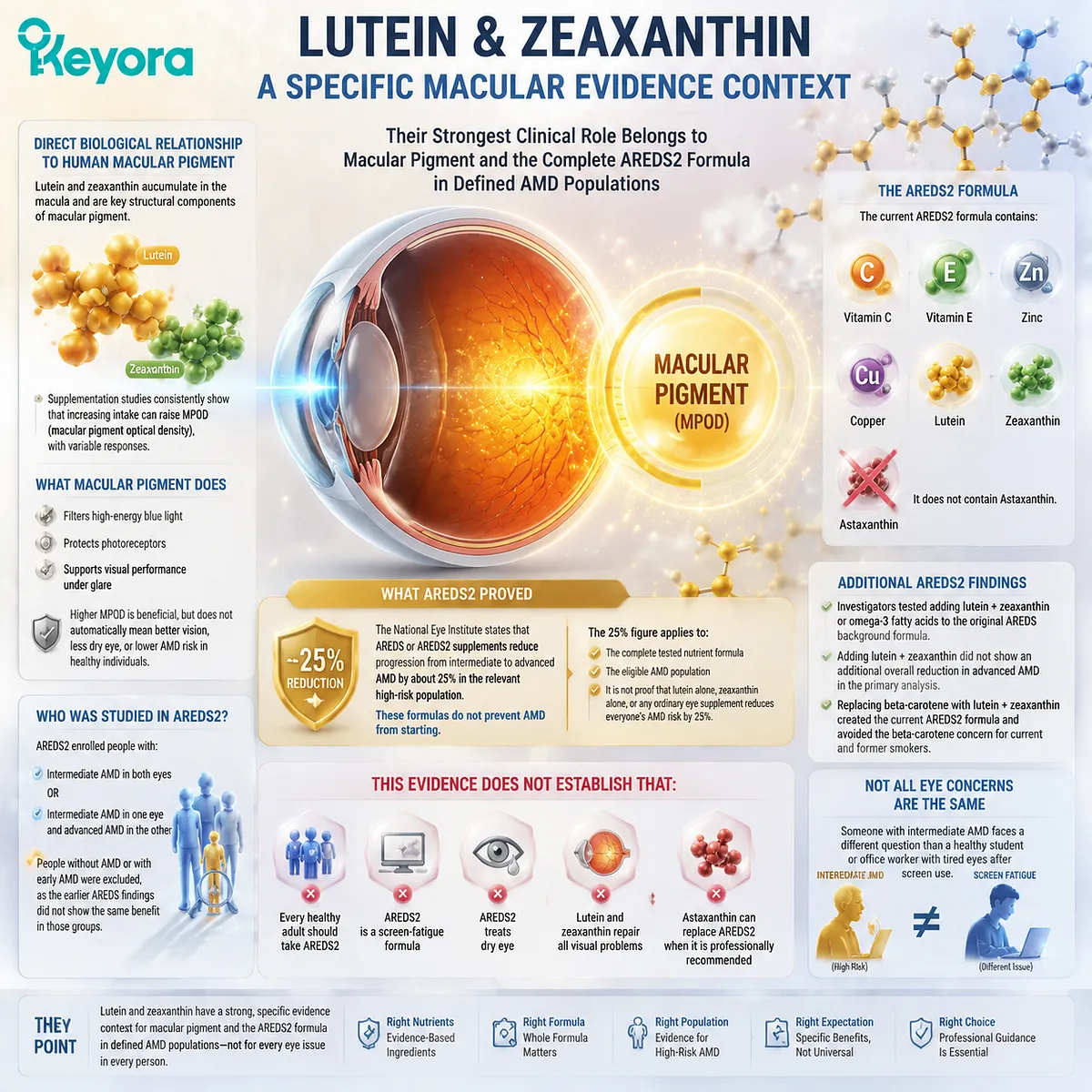
Their strongest clinical role belongs to macular pigment and the complete AREDS2 formula in defined AMD populations
Lutein and zeaxanthin have a direct biological relationship to human macular pigment.
Supplementation studies have repeatedly examined whether increasing their intake changes MPOD and selected visual measurements.
Reviews of this literature generally find that lutein and zeaxanthin intake can increase macular pigment, although the response varies among individuals, formulations, doses, and study durations.
This makes lutein and zeaxanthin more directly relevant than Astaxanthin when the specific question is:
Which carotenoids form and influence human macular pigment?
That conclusion should not be expanded into every eye outcome. Higher MPOD does not automatically prove corrected vision, reduced dry-eye symptoms, slower accommodation fatigue, or prevention of AMD in a healthy person.
The AREDS2 context is even more specific.
The current AREDS2 formula contains:
-
vitamin C
-
vitamin E
-
zinc
-
copper
-
lutein
-
zeaxanthin
It does not contain Astaxanthin.
The National Eye Institute states that AREDS or AREDS2 supplements reduce progression from intermediate to advanced AMD by about 25 percent in the relevant high-risk population. The formulas do not prevent AMD from starting.
The 25 percent figure belongs to the complete tested nutrient formula and the eligible AMD population. It is not proof that lutein alone, zeaxanthin alone, or any ordinary eye supplement reduces everyone’s AMD risk by 25 percent.
AREDS2 enrolled people with intermediate AMD in both eyes, or intermediate AMD in one eye and advanced AMD in the other.
People without AMD and those with early AMD were excluded because the earlier AREDS findings did not show the same benefit for those groups.
The AREDS2 investigators also studied whether adding lutein and zeaxanthin or omega-3 fatty acids to the original AREDS background formula produced additional benefit.
Adding lutein and zeaxanthin did not produce an additional overall reduction in advanced AMD in the primary analysis.
However, replacing beta-carotene with lutein and zeaxanthin created the current AREDS2 formulation and avoided the beta-carotene concern for current and former smokers.
This evidence does not establish that:
-
every healthy adult should take AREDS2
-
AREDS2 is a screen-fatigue formula
-
AREDS2 treats dry eye
-
lutein and zeaxanthin repair all visual problems
-
Astaxanthin can replace AREDS2 when it is professionally recommended
Someone with diagnosed intermediate AMD is asking a different question from a healthy student or office worker with tired eyes after screen use.
Astaxanthin Studies Ask Different Eye Questions
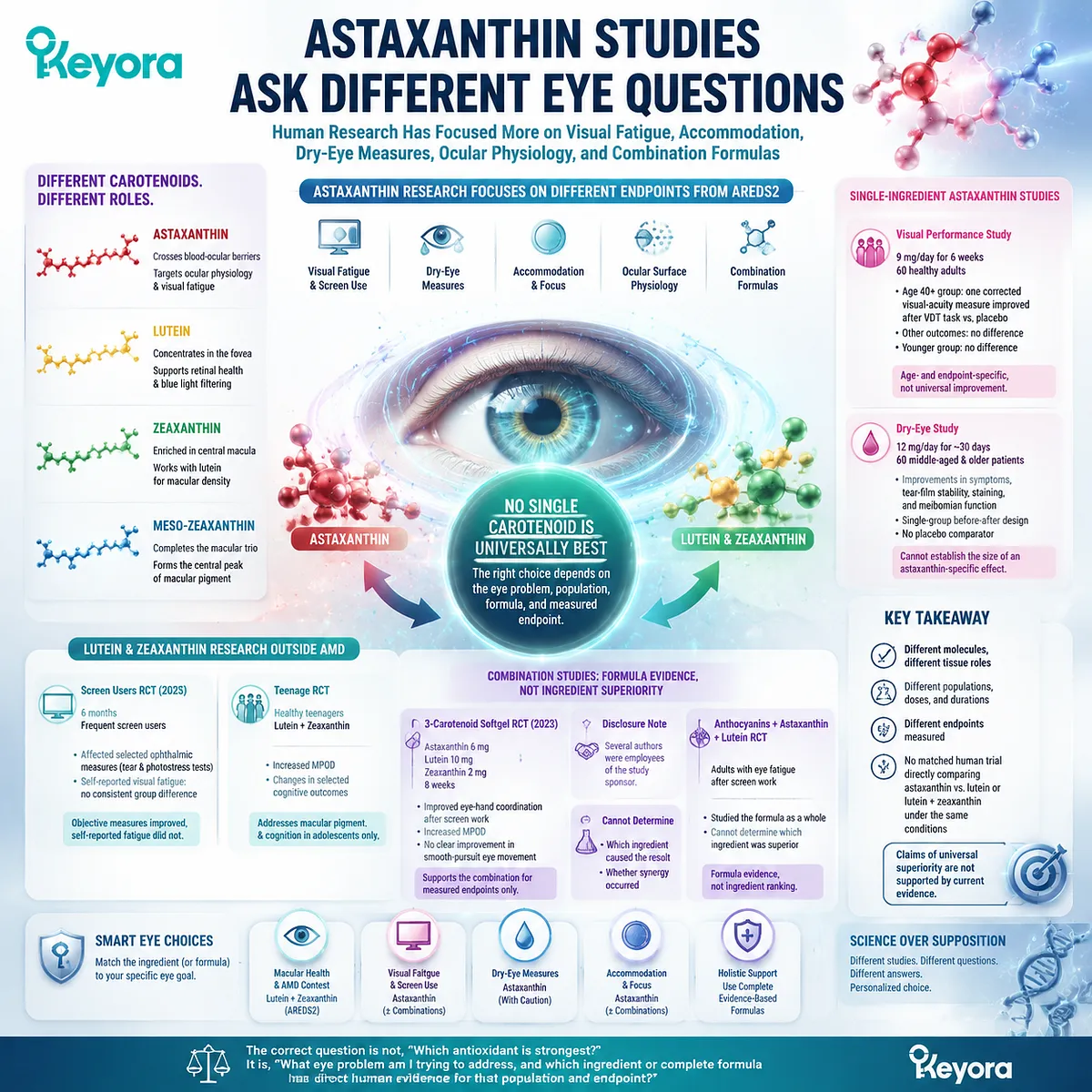
Human research has focused more on visual fatigue, accommodation, dry-eye measures, ocular physiology, and combination formulas
Astaxanthin’s human eye research has generally focused on different endpoints from AREDS2.
A randomized, double-blind, placebo-controlled study tested 9 mg of Astaxanthin daily for six weeks in 60 healthy adults. In participants aged 40 or older, one corrected visual-acuity measurement after a visual display task differed from placebo.
Other outcomes and younger participants did not show the same pattern, making the finding age- and endpoint-specific rather than proof of universal eyesight improvement.
Astaxanthin has also been studied in dry-eye research.
The main direct study involved 60 middle-aged and older patients taking 12 mg daily for approximately 30 days.
It reported changes in selected symptoms, tear-film stability, staining, and meibomian-function measures, but it used a single-group before-after design without a placebo comparator.
It therefore cannot establish the size of an Astaxanthin-specific treatment effect.
These findings create a research role for Astaxanthin in selected visual-fatigue and ocular-surface questions. They do not establish that Astaxanthin is better than lutein or zeaxanthin for the macula, diagnosed AMD, or general eye protection.
Lutein and zeaxanthin also have research outside AMD.
A 2025 randomized, double-blind, placebo-controlled trial studied lutein and zeaxanthin for six months in frequent screen users.
The intervention affected selected ophthalmic measurements, including tear and photostress-related tests, but group differences were not supported consistently by the self-reported visual-fatigue measures.
A newer trial in healthy teenagers reported increased MPOD after lutein and zeaxanthin supplementation, together with changes in selected cognitive outcomes.
That study addressed macular pigment and cognition in a particular adolescent population. It did not compare lutein and zeaxanthin with Astaxanthin, prove dry-eye treatment, or establish AMD prevention in teenagers.
Combination studies require another layer of caution.
A 2023 randomized trial tested one softgel containing:
-
Astaxanthin 6 mg
-
lutein 10 mg
-
zeaxanthin 2 mg
After eight weeks, the combination group showed a selected eye-hand coordination finding after screen work and increased MPOD.
Smooth-pursuit eye movement did not show clear improvement. The investigators also reported that several authors were employees of the study sponsor.
This trial supports the tested three-carotenoid combination for its measured endpoints. It does not establish which ingredient caused the result or whether combining them was synergistic.
Another controlled trial tested anthocyanins, Astaxanthin, and lutein together in adults with eye fatigue after screen work. It likewise studied the formula as a whole and cannot determine whether Astaxanthin or lutein was the superior component.
The available studies discussed here do not provide a matched human trial directly comparing Astaxanthin alone with lutein alone or lutein plus zeaxanthin under the same population, duration, dose conditions, and primary eye endpoint. Claims of universal superiority are therefore unsupported by these evidence sets.
Use the Keyora Goal – Tissue – Evidence Check
Three questions can identify which carotenoid evidence matches the actual eye problem rather than a general eye-health claim
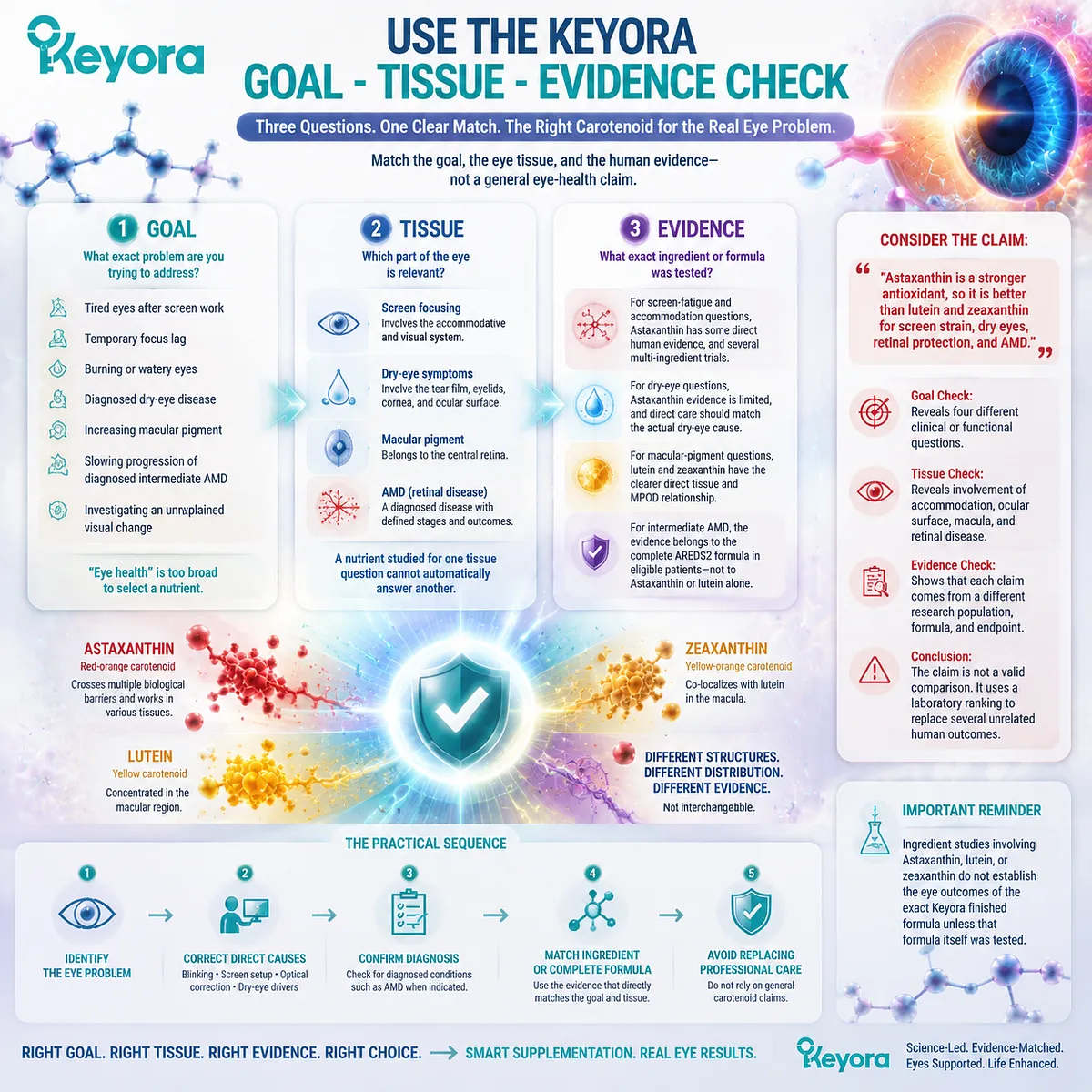
The Keyora Goal – Tissue – Evidence Check provides a practical way to compare Astaxanthin, lutein, and zeaxanthin.
Goal: What exact problem are you trying to address?
Possible goals include:
-
tired eyes after screen work
-
temporary focus lag
-
burning or watery eyes
-
diagnosed dry-eye disease
-
increasing macular pigment
-
slowing progression of diagnosed intermediate AMD
-
investigating an unexplained visual change
“Eye health” is too broad to select a nutrient.
Tissue: Which part of the eye is relevant?
Screen focusing involves the accommodative and visual system.
Dry-eye symptoms involve the tear film, eyelids, cornea, and wider ocular surface.
Macular pigment belongs to the central retina.
AMD is a diagnosed retinal disease with defined stages and progression outcomes.
A nutrient studied for one tissue question cannot automatically answer another.
Evidence: What exact ingredient or formula was tested?
For selected screen-fatigue and accommodation questions, Astaxanthin has some direct human evidence, alongside several multi-ingredient trials.
For dry-eye questions, Astaxanthin evidence is limited, and direct care should match the actual dry-eye cause.
For macular-pigment questions, lutein and zeaxanthin have the clearer direct tissue and MPOD relationship.
For intermediate AMD, the evidence belongs to the complete AREDS2 formula in professionally identified eligible patients, not to Astaxanthin or lutein alone.
Consider the claim:
“Astaxanthin is a stronger antioxidant, so it is better than lutein and zeaxanthin for screen strain, dry eyes, retinal protection, and AMD.”
The Goal check reveals four different clinical or functional questions.
The Tissue check reveals involvement of accommodation, ocular surface, macula, and retinal disease.
The Evidence check shows that each claim comes from a different research population, formula, and endpoint.
The claim is therefore not a valid comparison. It uses a laboratory ranking to replace several unrelated human outcomes.
The practical sequence is:
Identify the eye problem
→ correct direct causes such as blinking, screen setup, optical correction, or dry-eye drivers
→ confirm whether a diagnosed condition such as AMD is present
→ match the ingredient or complete formula to direct human evidence
→ avoid replacing professional care with a general carotenoid claim
Ingredient studies involving Astaxanthin, lutein, or zeaxanthin do not establish the eye outcomes of the exact Keyora finished formula unless that formula itself was tested.
Closing Summary
Astaxanthin, lutein, and zeaxanthin should be chosen by the eye question, not by a universal antioxidant ranking
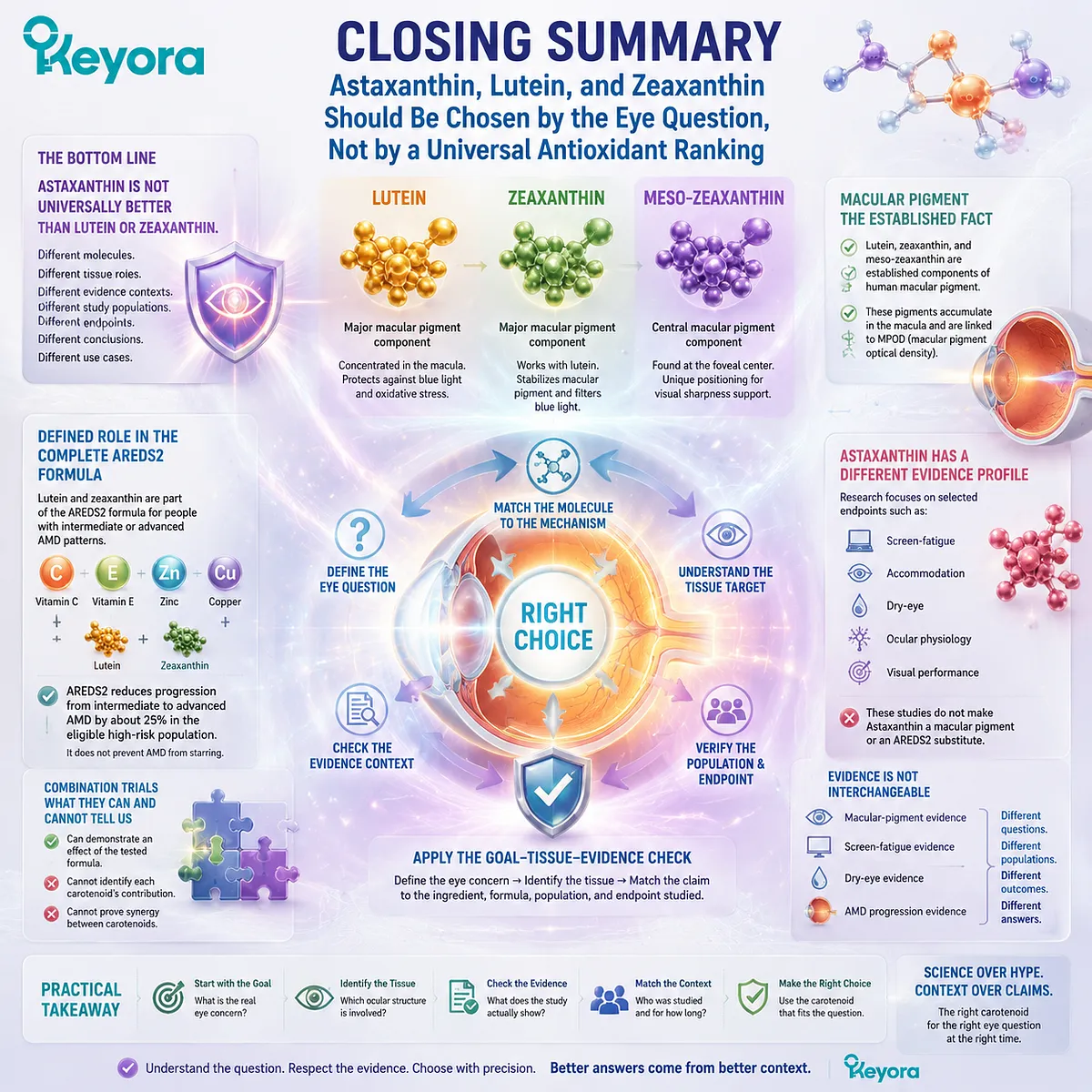
Astaxanthin is not universally better than lutein or zeaxanthin.
Lutein, zeaxanthin, and meso-zeaxanthin are established components of human macular pigment. Lutein and zeaxanthin also have a defined role within the complete AREDS2 formula for certain people with intermediate or advanced AMD patterns.
Astaxanthin has a different research profile involving selected screen-fatigue, accommodation, dry-eye, ocular-physiology, and visual-performance endpoints. These studies do not make Astaxanthin a macular pigment or an AREDS2 substitute.
Combination trials can demonstrate an effect of the tested formula without identifying each carotenoid’s contribution or proving synergy.
Use the Goal – Tissue – Evidence Check. Define the actual eye concern, identify the relevant ocular structure, and match the claim to the ingredient, complete formula, population, and endpoint studied.
Macular-pigment evidence, screen-fatigue evidence, dry-eye evidence, and AMD progression evidence are not interchangeable.
This article is for educational and informational purposes only. It does not provide medical advice, diagnosis, treatment, cure, prevention, disease outcome claims, hormone restoration claims, fertility outcome claims, or formula-specific clinical efficacy claims.