
Can Biomarker Changes Prove Astaxanthin Prevents Disease?
Keyora Research Q&A Library
This is part of the Keyora Research Q&A Series, derived from Keyora Astaxanthin Research Journal Series.
Within the Keyora Astaxanthin Researcn framework, this Q&A translates complex astaxanthin biology into reader-friendly, evidence-bound answers, focusing on natural astaxanthin identity, molecular structure, antioxidant and redox mechanisms, membrane lipid interaction, mitochondrial resilience, inflammatory signaling pathways, human evidence interpretation, and the scientific principles behind responsible supplementation.
First published by Keyora Research Journal: www.keyorahealth.com

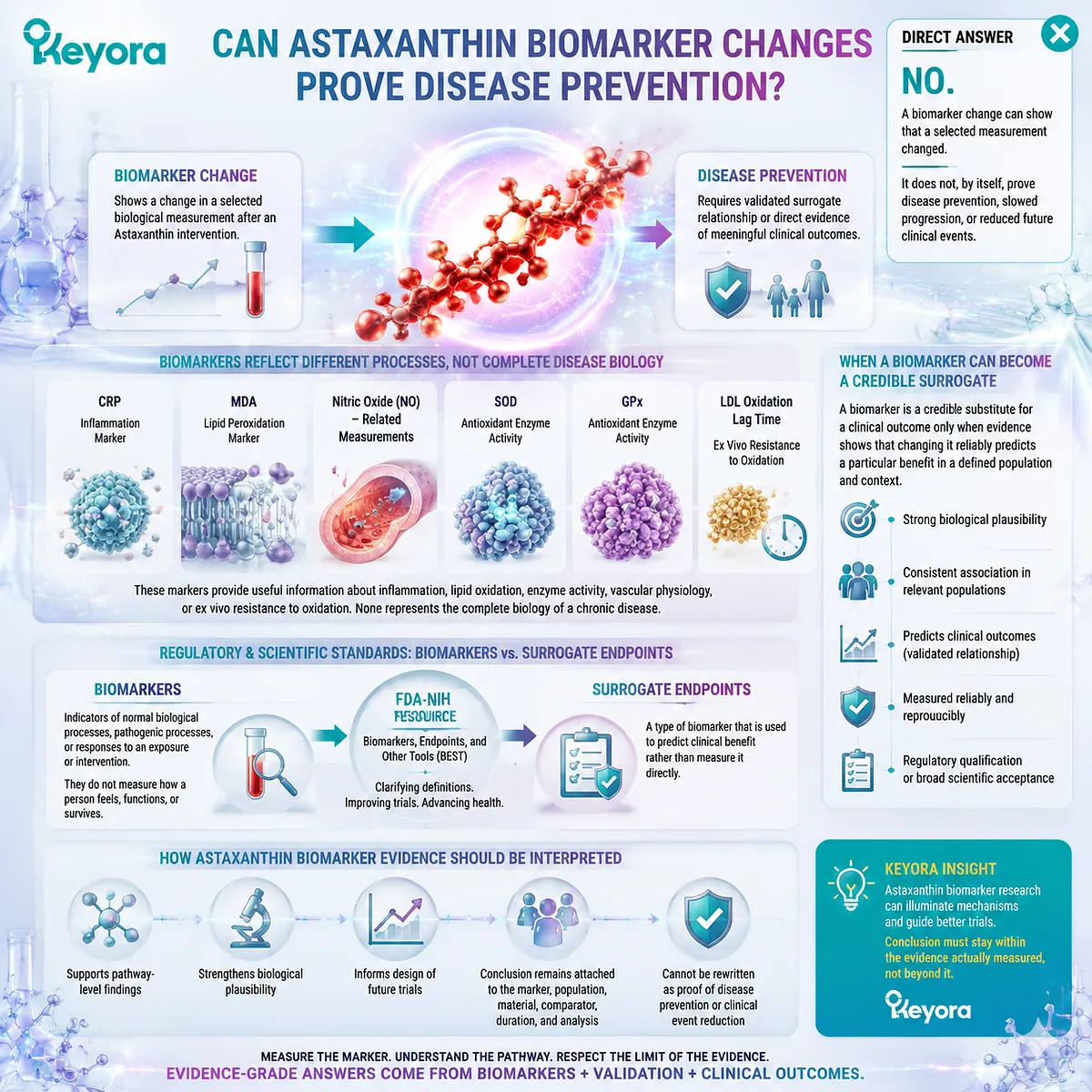
Direct Answer
No.
A biomarker change can show that a selected biological measurement changed after an Astaxanthin intervention. It does not, by itself, prove that Astaxanthin prevented a disease, slowed its progression, or reduced future clinical events.
An Astaxanthin biomarker change can support a pathway-level finding, but disease prevention requires a validated surrogate relationship or direct evidence of meaningful clinical outcomes.
The distinction matters because CRP, MDA, nitric oxide-related measurements, SOD, GPx, and LDL oxidation lag time describe different processes. They may provide useful information about inflammation, lipid oxidation, enzyme activity, vascular physiology, or ex vivo resistance to oxidation. None represents the complete biology of a chronic disease.
A biomarker becomes a credible substitute for a clinical outcome only when evidence shows that changing it reliably predicts a particular benefit in a defined population and context.
The FDA-NIH BEST resource distinguishes biomarkers from measures of how people feel, function, or survive, and defines a surrogate endpoint as a biomarker used to predict clinical benefit rather than measure it directly.
Astaxanthin biomarker research can strengthen biological plausibility and help design later trials. The conclusion must remain attached to the marker, study population, material, comparator, duration, and analysis that produced it.
Biomarkers Describe Signals, Not Whole Diseases
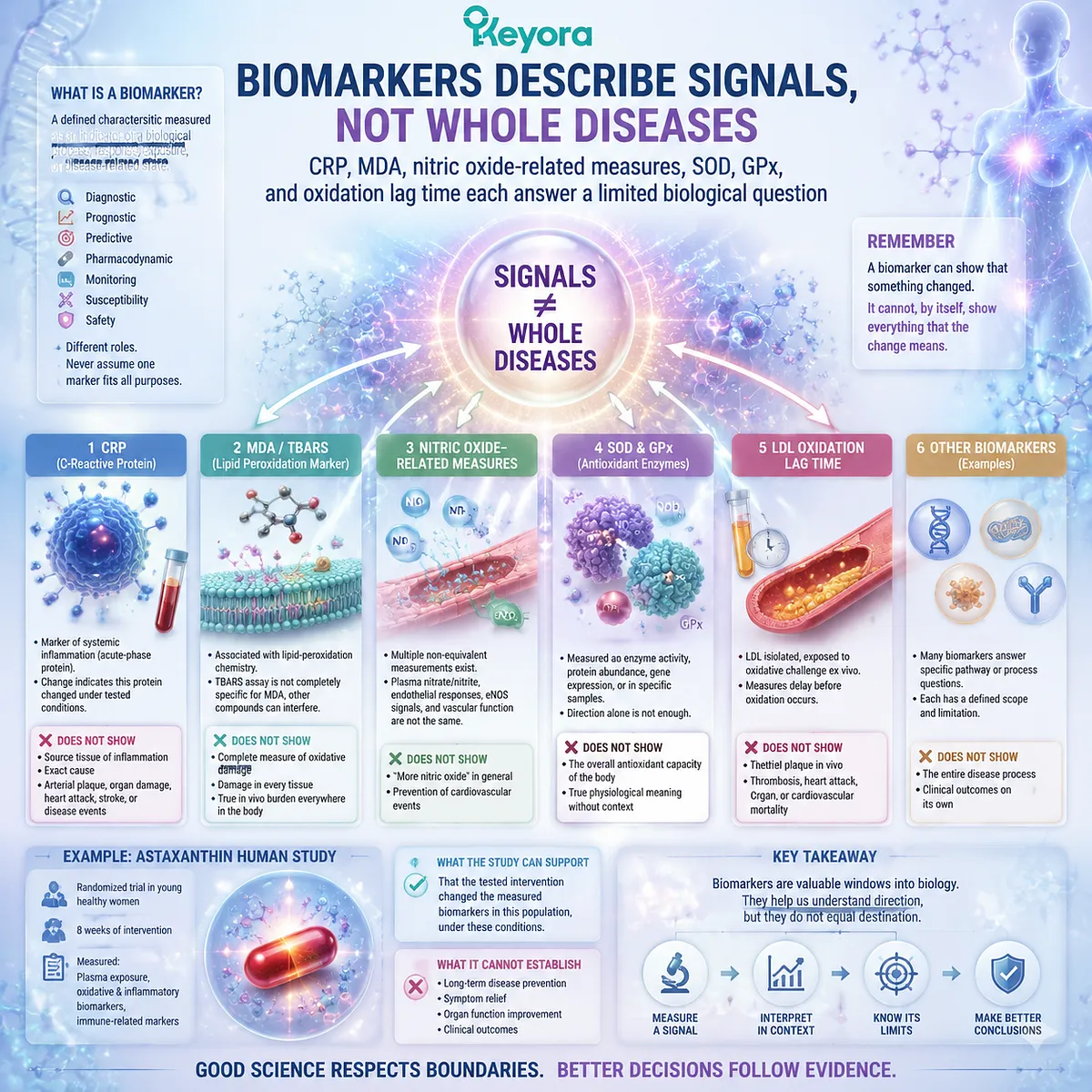
CRP, MDA, nitric oxide-related measures, SOD, GPx, and oxidation lag time each answer a limited biological question
A biomarker is a defined characteristic measured as an indicator of a biological process, response, exposure, or disease-related state. Biomarkers may be diagnostic, prognostic, predictive, pharmacodynamic, monitoring, susceptibility, or safety markers. These roles are different, and a marker that is useful for one purpose should not automatically be treated as valid for another.
CRP is commonly used as a systemic inflammatory marker. A change in CRP can support the conclusion that this measured acute-phase protein changed under the tested conditions. It does not identify the exact tissue producing the inflammatory signal, define the complete cause of inflammation, or directly measure arterial plaque, organ damage, heart attack, stroke, or another disease event.
MDA is associated with lipid-peroxidation chemistry, but its interpretation depends strongly on the assay and sample handling. The widely used thiobarbituric acid test is not completely specific for MDA because other compounds can contribute to the measured signal. MDA or TBARS results therefore provide a limited experimental window into lipid oxidation rather than a complete measure of oxidative damage throughout the body.
Nitric oxide-related research also includes several non-equivalent measurements. Plasma nitrate or nitrite, endothelial responses, eNOS-related signals, and functional vascular testing do not measure the same object. A change in one NO-related variable should not be summarized simply as “more nitric oxide” or converted automatically into prevention of cardiovascular events.
SOD and GPx may be measured as enzyme activity, protein abundance, gene expression, or activity in a particular blood-cell or tissue sample. Direction alone is not enough for interpretation. Higher activity may reflect an adaptive response or altered defense capacity, while lower activity may have different meanings depending on oxidant pressure, substrate availability, sample type, and the wider redox context.
LDL oxidation lag time is more specific still. In the original Astaxanthin study, LDL isolated from participants was exposed to an oxidative challenge outside the body, and the delay before oxidation was measured. The study showed that the tested intervention changed resistance to oxidation in that ex vivo system. It did not measure arterial plaque, thrombosis, myocardial infarction, stroke, or cardiovascular mortality.
Astaxanthin human research illustrates why these distinctions matter. A randomized trial in young healthy women assessed plasma exposure, selected oxidative and inflammatory biomarkers, and immune-related measurements over eight weeks. The results belong to those measured endpoints and that population. They do not establish long-term disease prevention.
A biomarker can show that something changed. It cannot, by itself, show everything that the change means.
A Surrogate Must Predict Clinical Benefit
A biomarker becomes clinically predictive only when changing it reliably forecasts a meaningful outcome within a defined context
A biomarker and a surrogate endpoint are not synonyms.
A biomarker records a biological characteristic. A surrogate endpoint is used in place of a direct clinical outcome because it is expected to predict how a person feels, functions, or survives. That predictive role requires evidence beyond a plausible mechanism or a statistical association with risk.
A validated surrogate must be supported by clinical data showing that an intervention’s effect on the surrogate predicts a specific clinical benefit in a defined context. Validation is not universal. A marker may be informative in one disease, population, intervention class, or treatment setting without becoming a valid surrogate for every other use.
This requirement matters because association does not establish causation.
A marker may lie directly in a disease pathway. It may also be a correlated indicator, a downstream consequence, an adaptive response, or a signal influenced by several unrelated processes. A person with a higher marker may have higher disease risk, yet lowering that marker with a particular intervention may not necessarily reduce that risk.
The intervention itself also matters. Two treatments can change the same biomarker through different mechanisms and produce different effects on clinical outcomes. Surrogate validity therefore cannot be created by saying that the marker is “linked to inflammation,” “linked to oxidative stress,” or “associated with cardiovascular risk.”
Chronic diseases also involve more than one pathway. Cardiovascular outcomes, for example, can be influenced by blood pressure, lipoproteins, glucose regulation, smoking, thrombosis, vascular structure, inflammation, kidney function, medication, genetics, and behavior. A change in CRP, MDA, an NO-related measure, or oxidation lag time captures only part of that biology.
The same boundary applies to broad oxidative-stress claims. Reduced MDA does not prove that every membrane was protected. Higher SOD or GPx activity does not prove that all antioxidant defenses improved. A changed DNA-oxidation marker does not independently establish cancer prevention, and a vascular biomarker does not establish prevention of heart attack or stroke.
A prevention conclusion therefore requires one of two stronger bridges.
The first is a validated surrogate relationship for the exact claimed outcome and context.
The second is direct measurement of clinically meaningful outcomes, such as disease incidence, progression, hospitalization, validated functional decline, major clinical events, or mortality where appropriate.
Without one of those bridges, the defensible conclusion remains at the biomarker level.

Short Studies and Multiple Markers Can Overstate Meaning
Brief follow-up, exploratory endpoints, assay variation, and selective emphasis can make one positive result appear broader than it is
A study can be long enough to measure a biomarker and still be far too short to establish disease prevention.
Blood markers or enzyme activity may change within days, weeks, or months. Chronic-disease incidence and major clinical events may require years of follow-up, much larger populations, sustained adherence, and enough events to make a reliable comparison.
Duration must therefore match the claim. An eight-week Astaxanthin biomarker study can answer an eight-week biomarker question. It cannot directly answer whether taking Astaxanthin prevents disease over several years.
Multiplicity creates another problem. A trial may assess several oxidative markers, inflammatory markers, enzymes, immune measurements, subgroups, and time points. As the number of analyses increases, so does the possibility of finding at least one apparently positive result by chance.
ICH guidance states that trials with multiple objectives and statistical tests need to address multiplicity. It also emphasizes that primary objectives and analyses should be prespecified and that supplementary or exploratory analyses generally deserve less interpretive weight than the main analysis.
Readers should therefore ask whether the biomarker was:
the prespecified primary endpoint,
a prespecified secondary endpoint,
an exploratory measurement,
a subgroup finding,
or a post hoc analysis.
A positive exploratory marker should not silently become the main conclusion of a study designed around another endpoint.
Between-group comparison is also critical. If a biomarker improved from baseline in the Astaxanthin group, that shows change over time. It does not establish that Astaxanthin caused the change unless the result is meaningfully different from the comparator under the appropriate analysis.
Selective interpretation can further exaggerate meaning. A headline may emphasize one favorable marker while omitting unchanged markers, conflicting results, wide confidence intervals, or an inconclusive primary endpoint.
Statistical significance does not solve these problems. A small p-value does not show that a biomarker is a validated surrogate, that the effect is clinically important, that it will persist, or that disease events will decline.
A complete interpretation asks about effect size, confidence interval, assay reliability, baseline balance, comparator, replication, duration, and the marker’s established relationship to the claimed outcome.
One positive marker does not define the entire trial.

Use the Keyora Marker – Link – Outcome Check
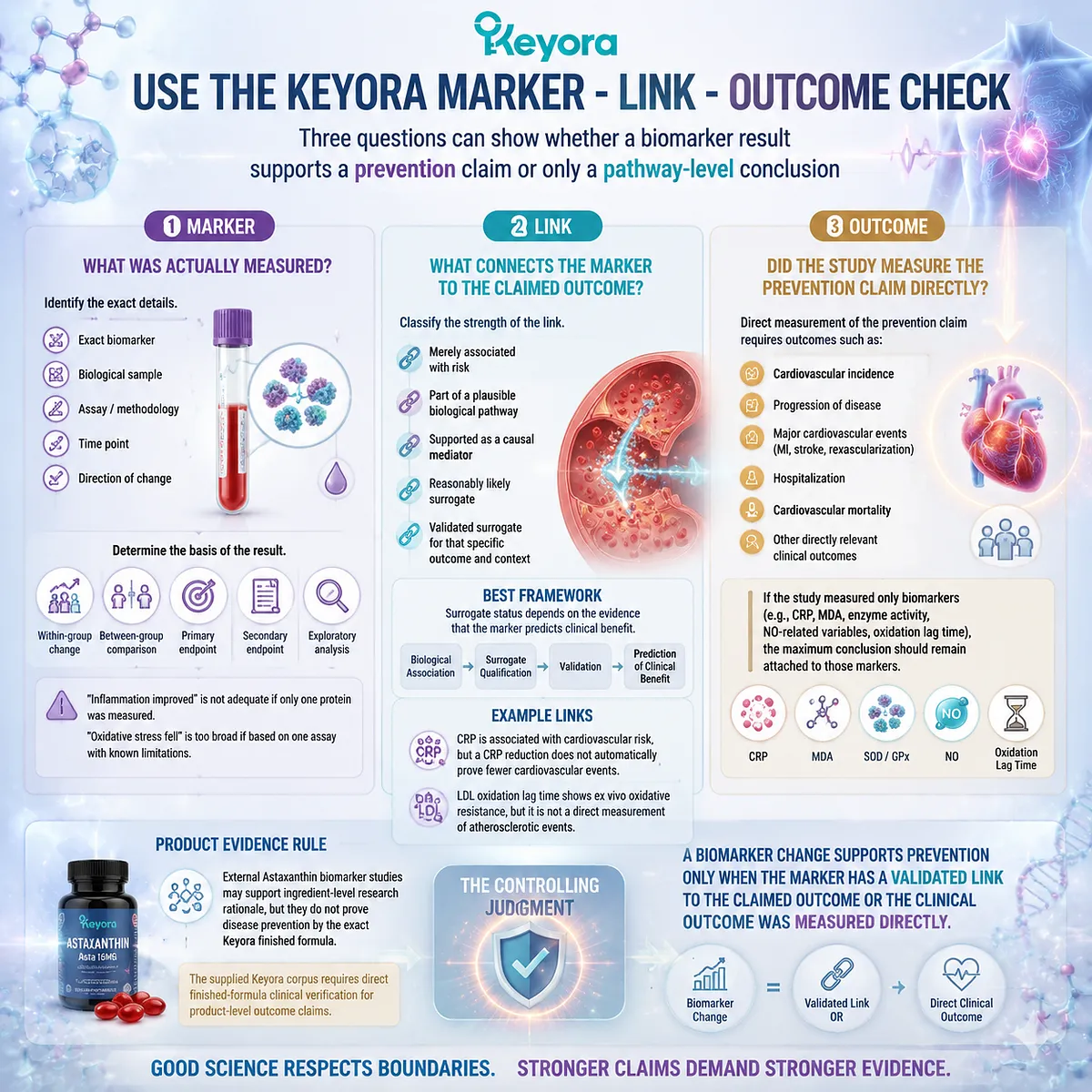
Three questions can show whether a biomarker result supports a prevention claim or only a pathway-level conclusion
The Keyora Marker – Link – Outcome Check helps readers evaluate statements such as, “Astaxanthin lowered inflammation and oxidative stress, so it prevents cardiovascular disease.”
Marker: What was actually measured?
Identify the exact biomarker, biological sample, assay, time point, and direction of change.
Then determine whether the result was based on:
a within-group change,
a between-group comparison,
a primary endpoint,
a secondary endpoint,
or an exploratory analysis.
“Inflammation improved” is not an adequate description if the study measured only one protein. “Oxidative stress fell” is too broad if the result came from one assay with known limitations.
Link: What connects the marker to the claimed disease outcome?
Ask whether the biomarker is:
merely associated with risk,
considered part of a plausible pathway,
supported as a causal mediator,
a reasonably likely surrogate,
or a validated surrogate for that specific outcome and context.
The BEST framework makes clear that surrogate status depends on the evidence supporting prediction of clinical benefit. A general biological relationship is not enough.
For example, CRP may be associated with cardiovascular risk, but an Astaxanthin-induced CRP change does not automatically prove that cardiovascular events will decline. LDL oxidation lag time may support an ex vivo oxidative-resistance finding, but it is not a direct measurement of atherosclerotic events.
Outcome: Did the study measure the prevention claim directly?
A cardiovascular-prevention claim would require appropriately designed evidence involving cardiovascular incidence, progression, major events, hospitalization, mortality, or another directly relevant endpoint.
If the study measured only CRP, MDA, enzyme activity, NO-related variables, or oxidation lag time, the maximum conclusion should remain attached to those markers.
The same rule applies to product evidence. External Astaxanthin biomarker studies may support ingredient-level research rationale, but they do not prove disease prevention by the exact Keyora finished formula. The supplied Keyora corpus requires direct finished-formula clinical verification for product-level outcome claims.
The controlling judgment is:
A biomarker change supports prevention only when the marker has a validated link to the claimed outcome or the clinical outcome was measured directly.
Closing Summary
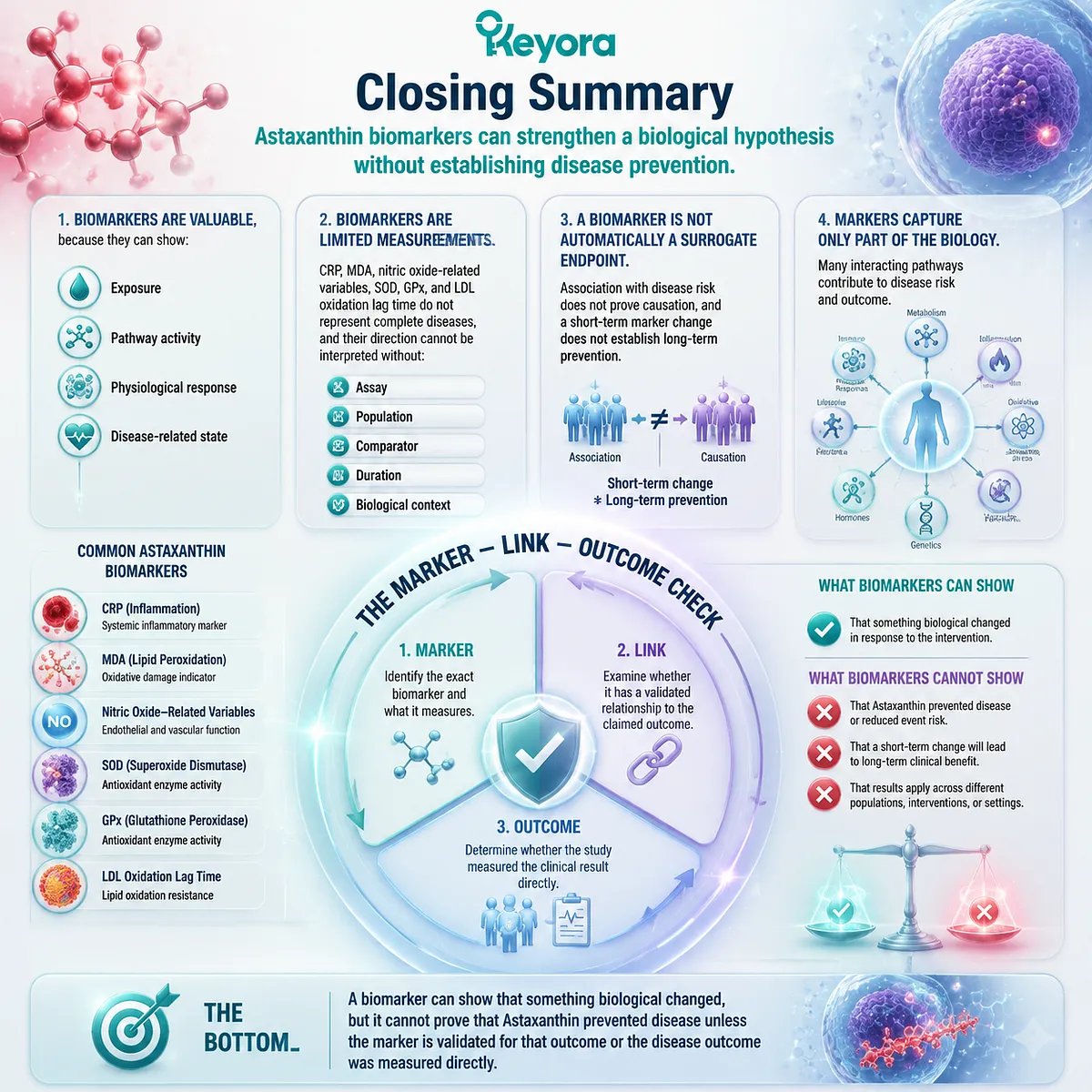
Astaxanthin biomarkers can strengthen a biological hypothesis without establishing disease prevention
Biomarkers are valuable because they can show exposure, pathway activity, physiological response, or disease-related state.
They remain limited measurements. CRP, MDA, nitric oxide-related variables, SOD, GPx, and LDL oxidation lag time do not represent complete diseases, and their direction cannot be interpreted without the assay, population, comparator, duration, and biological context.
A biomarker is not automatically a surrogate endpoint. Association with disease risk does not prove causation, and a short-term marker change does not establish long-term prevention.
The Marker – Link – Outcome Check provides the practical verdict. Identify the exact marker, examine whether it has a validated relationship to the claimed outcome, and determine whether the study measured the clinical result directly.
A biomarker can show that something biological changed, but it cannot prove that Astaxanthin prevented disease unless the marker is validated for that outcome or the disease outcome was measured directly.
This article is for educational and informational purposes only. It does not provide medical advice, diagnosis, treatment, cure, prevention, disease outcome claims, hormone restoration claims, fertility outcome claims, or formula-specific clinical efficacy claims.