
Do Antioxidant Tests Prove Human Health Benefits?
Keyora Research Q&A Library
This is part of the Keyora Research Q&A Series, derived from Keyora Astaxanthin Research Journal Series.
Within the Keyora Astaxanthin Researcn framework, this Q&A translates complex astaxanthin biology into reader-friendly, evidence-bound answers, focusing on natural astaxanthin identity, molecular structure, antioxidant and redox mechanisms, membrane lipid interaction, mitochondrial resilience, inflammatory signaling pathways, human evidence interpretation, and the scientific principles behind responsible supplementation.
First published by Keyora Research Journal: www.keyorahealth.com

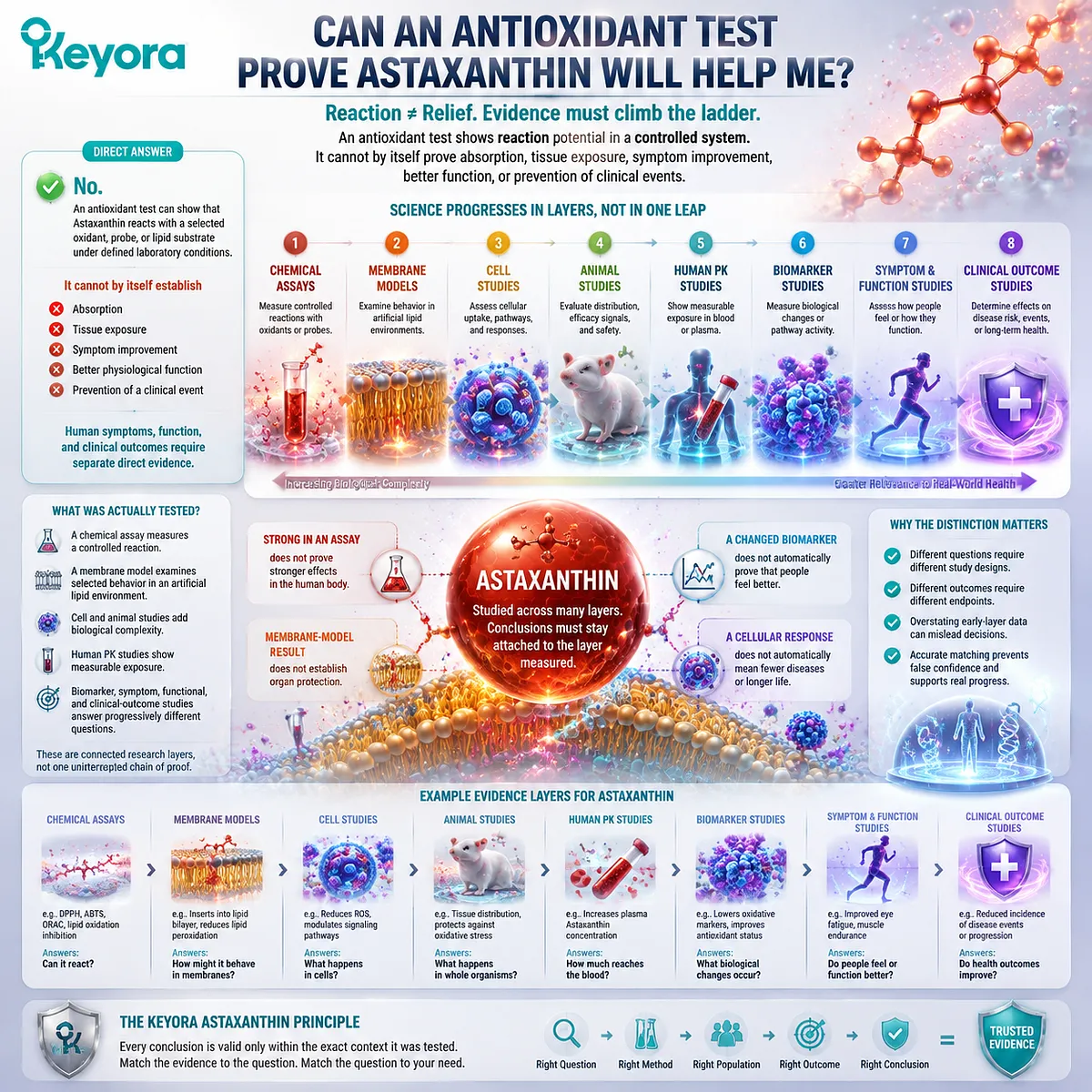
Direct Answer
No.
An antioxidant test can show that Astaxanthin reacts with a selected oxidant, probe, or lipid substrate under defined laboratory conditions.
It cannot by itself establish absorption, tissue exposure, symptom improvement, better physiological function, or prevention of a clinical event.
Chemical antioxidant assays and membrane models can establish reaction-level or biophysical plausibility, but human symptoms, function, and clinical outcomes require separate direct evidence.
The distinction begins with what was actually tested.
A chemical assay measures a controlled reaction.
A membrane model examines selected behavior in an artificial lipid environment.
Cell and animal studies add biological complexity.
Human pharmacokinetic studies can show measurable exposure, while biomarker, symptom, functional, and clinical-outcome studies answer progressively different questions. These are connected research layers, not one uninterrupted chain of proof.
Astaxanthin has been studied across several of these layers. That breadth is scientifically useful, but the conclusion must remain attached to the layer measured.
Strong activity in an assay does not prove stronger effects in the human body.
A membrane-model result does not establish organ protection, and a changed biomarker does not automatically prove that people feel better, function better, or experience fewer diseases.
The Keyora Astaxanthin project therefore treats chemical assays, membrane effects, cell pathways, animal findings, human exposure, biomarkers, symptoms, functions, and clinical outcomes as separate evidence objects.
Chemical Assays Measure Controlled Reactions
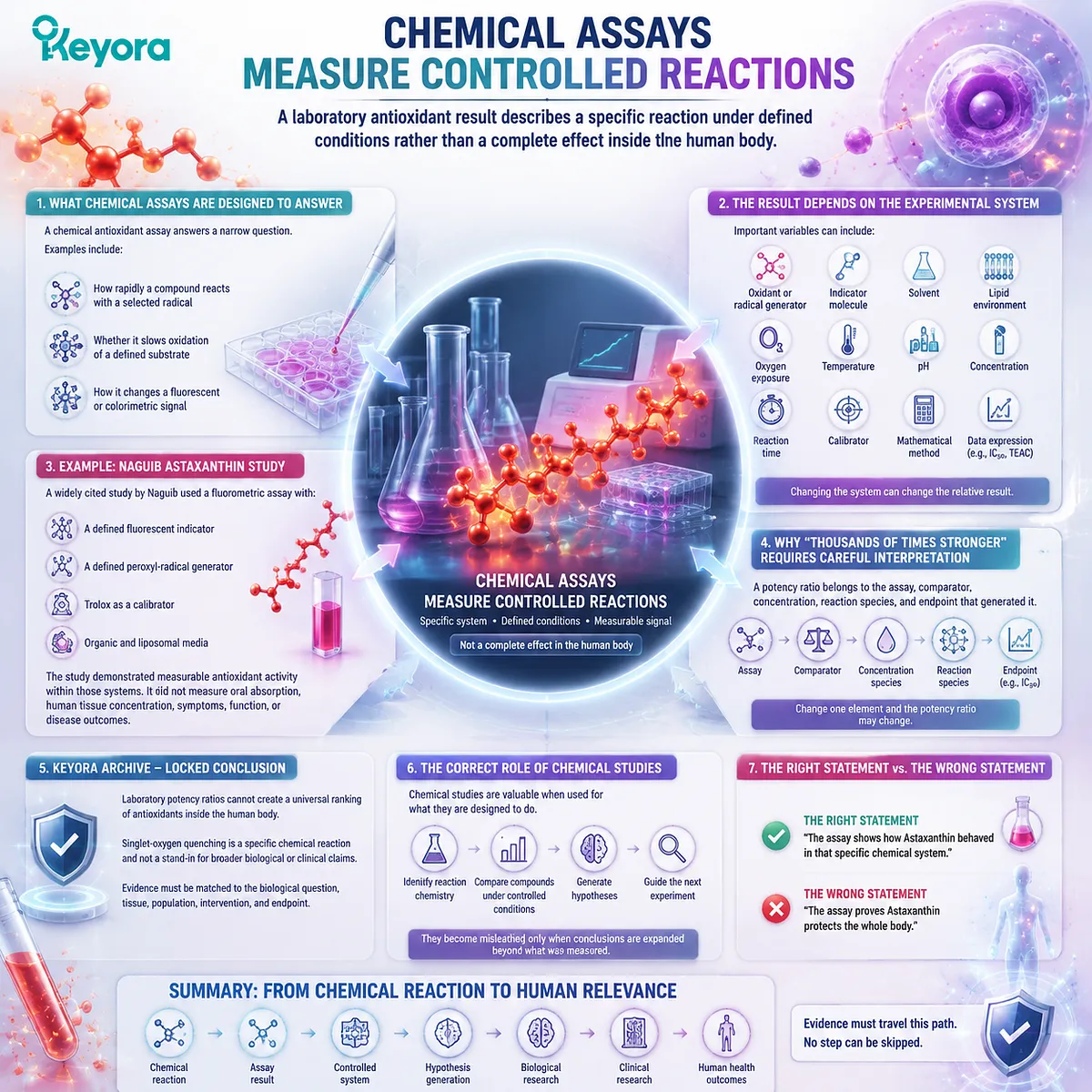
A laboratory antioxidant result describes a specific reaction under defined conditions rather than a complete effect inside the human body
A chemical antioxidant assay is designed to answer a narrow question. It may ask how rapidly a compound reacts with a selected radical, whether it slows oxidation of a defined substrate, or how it changes a fluorescent or colorimetric signal.
The answer depends on the experimental system. Important variables can include the oxidant or radical generator, indicator molecule, solvent, lipid environment, oxygen exposure, temperature, pH, concentration, reaction time, calibrator, and mathematical method used to express the result.
A widely cited Astaxanthin study by Naguib used a fluorometric assay with a defined indicator, a defined peroxyl-radical generator, and Trolox as a calibrator in organic and liposomal media. The study demonstrated measurable antioxidant activity within those systems. It did not measure oral absorption, human tissue concentration, symptoms, function, or disease outcomes.
This is why phrases such as “thousands of times stronger” require careful interpretation. A potency ratio belongs to the assay, comparator, concentration, reaction species, and endpoint that generated it. Changing the assay can change the relative result.
The Keyora archive has already locked the conclusion that laboratory potency ratios cannot create a universal ranking of antioxidants inside the human body. It also separates singlet-oxygen quenching from broader biological and clinical claims.
Chemical studies are not meaningless. They can identify reaction chemistry, compare compounds under controlled conditions, generate hypotheses, and help researchers choose the next experiment.
Their value is lost only when the conclusion is expanded beyond the measurement. The correct statement is not “the assay proves Astaxanthin protects the whole body.” It is “the assay shows how Astaxanthin behaved in that specific chemical system.”
Membrane Models Add Context Without Proving Human Protection
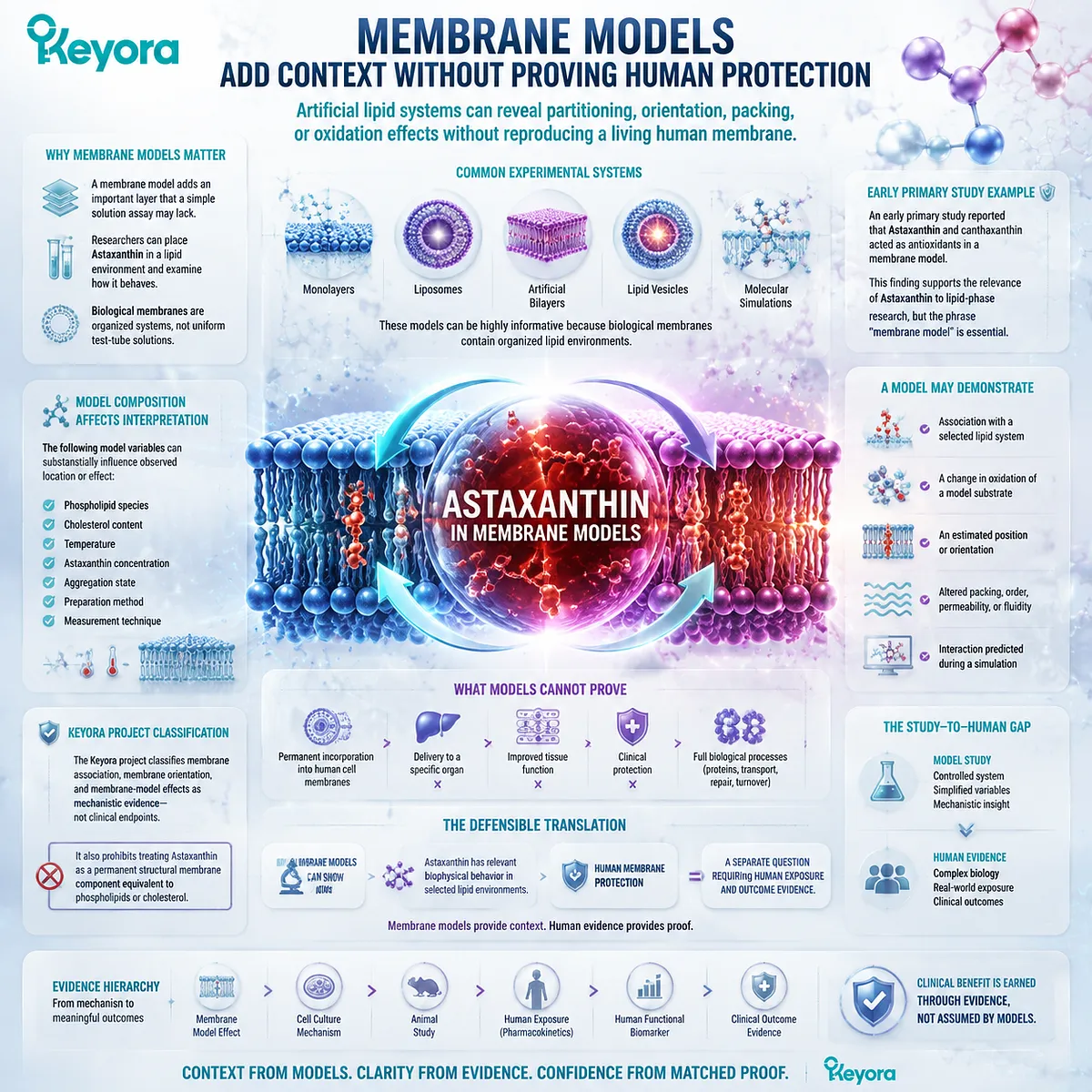
Artificial lipid systems can reveal partitioning, orientation, packing, or oxidation effects without reproducing a living human membrane
A membrane model adds an important layer that a simple solution assay may lack. Researchers can place Astaxanthin in a lipid environment and examine whether it associates with the system, affects oxidation, changes lipid organization, or behaves differently from another carotenoid.
Common experimental systems include monolayers, liposomes, artificial bilayers, lipid vesicles, and molecular simulations. These models can be highly informative because biological membranes contain organized lipid environments rather than uniform test-tube solutions.
An early primary study reported that Astaxanthin and canthaxanthin acted as antioxidants in a membrane model. This finding supports the relevance of Astaxanthin to lipid-phase research, but the phrase “membrane model” is essential. The experiment did not reproduce the full composition, metabolism, proteins, transport systems, repair processes, or turnover of a living human membrane.
Model composition can substantially affect interpretation. The phospholipid species, cholesterol content, temperature, Astaxanthin concentration, aggregation state, preparation method, and measurement technique may all influence the observed location or effect.
A model may therefore demonstrate:
-
association with a selected lipid system
-
a change in oxidation of a model substrate
-
an estimated position or orientation
-
altered packing, order, permeability, or fluidity
-
interaction predicted during a simulation
None of these outcomes automatically proves permanent incorporation into human cell membranes, delivery to a particular organ, improved tissue function, or clinical protection.
The Keyora project specifically classifies membrane association, membrane orientation, and membrane-model effects as mechanistic evidence rather than clinical endpoints. It also prohibits treating Astaxanthin as a permanent structural membrane component equivalent to phospholipids or cholesterol.
The defensible translation is limited but useful: membrane models can show that Astaxanthin has relevant biophysical behavior in selected lipid environments. Human membrane protection remains a separate question requiring human exposure and outcome evidence.
Every Step Toward a Human Outcome Needs New Evidence
Cells, animals, human exposure, biomarkers, symptoms, functions, and clinical outcomes answer progressively different questions
Evidence can be arranged as a sequence, but the sequence should not be mistaken for an automatic proof chain.
Chemical assay: This level asks whether Astaxanthin performs a selected reaction under controlled conditions. It establishes reaction-level evidence.
Membrane model: This level asks how Astaxanthin behaves in a defined lipid environment. It establishes selected physicochemical or biophysical effects.
Cell study: Cultured cells add membranes, organelles, enzymes, transporters, and signaling pathways. A cell study may measure viability, reactive species, gene expression, mitochondrial measurements, cytokines, or lipid oxidation. It still does not reproduce oral digestion, whole-body distribution, organ interaction, or a person’s symptoms.
Animal study: An intact organism permits investigation of absorption, metabolism, tissue distribution, toxicology, and integrated physiological responses. Animal findings can guide human research, but species differences prevent them from directly establishing a human dose, tissue concentration, symptom response, or clinical benefit.
Human exposure: A pharmacokinetic study can determine whether orally consumed Astaxanthin becomes measurable in plasma and how concentrations change over time. In one primary study, healthy male volunteers received oral Astaxanthin formulations and researchers measured plasma concentrations and pharmacokinetic parameters. That study demonstrated exposure, not organ protection or clinical efficacy.
Biomarker: A biomarker is an objectively measured characteristic indicating a normal process, disease-related process, or response to an exposure or intervention. FDA guidance emphasizes that a biomarker is not itself an assessment of how a person feels, functions, or survives.
Symptom: A symptom endpoint records what a participant experiences, such as discomfort or perceived fatigue. It is closer to the person’s experience than a laboratory marker, but it does not necessarily establish objective physiological change.
Function: A functional endpoint measures an ability or physiological operation, such as performance on a cognitive task, visual accommodation, physical performance, or another directly tested function. It remains limited to the function and conditions studied.
Clinical outcome: A clinical outcome directly concerns how people feel, function, or survive, or another meaningful health event appropriate to the research question. FDA distinguishes these outcomes from biomarkers and from surrogate endpoints used as substitutes for direct clinical outcomes.
A surrogate endpoint requires its own evidence. A biomarker does not become a reliable substitute for clinical benefit simply because it belongs to a plausible pathway. FDA notes that validation requires evidence showing that changes in the surrogate predict a specific clinical benefit within a defined context.
This ladder is not a claim that every higher level is automatically higher quality. A poorly designed human study can be less informative than a rigorous laboratory experiment for a narrowly defined mechanism. ICH guidance treats human pharmacology, exploratory studies, confirmatory studies, and later studies as different designs with different objectives.
The correct principle is question matching. Each study should be judged by whether its model, design, material, population, and endpoint adequately answer the question it was built to test.

Use the Keyora Test – Translation – Outcome Check
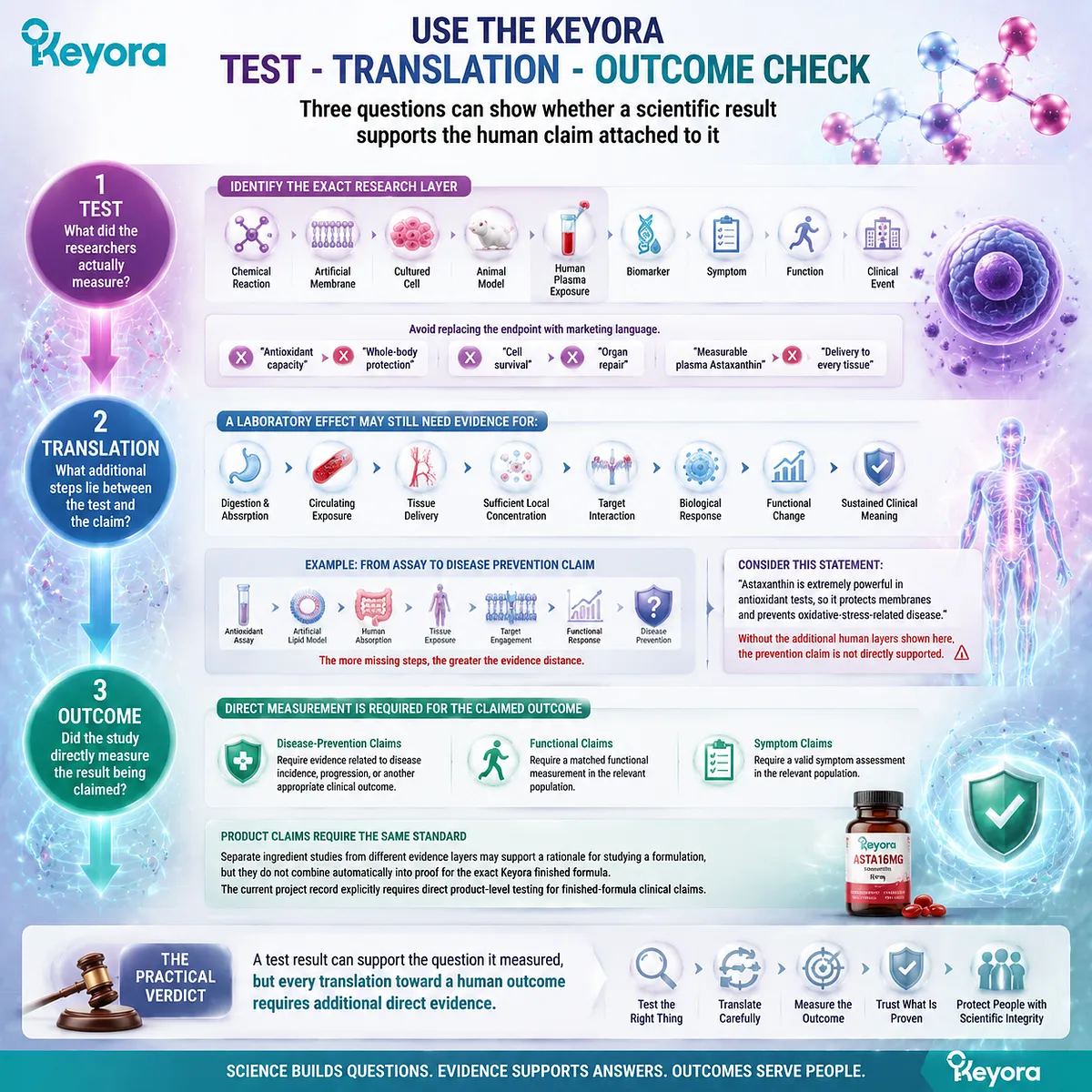
Three questions can show whether a scientific result supports the human claim attached to it
The Keyora Test – Translation – Outcome Check helps readers examine statements that begin with a laboratory result and end with a broad human claim.
Test: What did the researchers actually measure?
Identify the exact research layer:
-
chemical reaction
-
artificial membrane
-
cultured cell
-
animal model
-
human plasma exposure
-
biomarker
-
symptom
-
function
-
clinical event
Avoid replacing the endpoint with marketing language. “Antioxidant capacity” should not be rewritten as “whole-body protection.” “Cell survival” should not become “organ repair.” “Measurable plasma Astaxanthin” should not become “delivery to every tissue.”
Translation: What additional steps lie between the test and the claim?
A laboratory effect may still need evidence for:
-
digestion and absorption
-
circulating exposure
-
tissue delivery
-
sufficient local concentration
-
target interaction
-
biological response
-
functional change
-
sustained clinical meaning
The number of missing steps determines the evidence distance between the measurement and the public claim.
Consider the statement:
“Astaxanthin is extremely powerful in antioxidant tests, so it protects membranes and prevents oxidative-stress-related disease.”
The test may consist of a chemical assay or artificial lipid model. The translation still requires human absorption, relevant tissue exposure, target engagement, functional response, and a study measuring an appropriate clinical outcome. Without those additional layers, the prevention claim is not directly supported.
Outcome: Did the study directly measure the result being claimed?
A disease-prevention claim requires evidence related to disease incidence, progression, or another appropriate clinical outcome. A functional claim requires a matched functional measurement. A symptom claim requires a valid symptom assessment in the relevant population.
The same boundary applies to product claims. Separate ingredient studies from different evidence layers may support a rationale for studying a formulation, but they do not combine automatically into proof for the exact Keyora finished formula. The current project record explicitly requires direct product-level testing for finished-formula clinical claims.
The practical verdict is:
A test result can support the question it measured, but every translation toward a human outcome requires additional direct evidence.
Closing Summary
Laboratory science can establish valuable mechanisms, but it cannot substitute for matched human outcomes
Antioxidant tests do not by themselves prove human health benefits.
A chemical assay can show how Astaxanthin reacts in a defined system.
A membrane model can reveal selected behavior in an artificial lipid environment.
Cell and animal studies can test biological responses, while human pharmacokinetic studies can establish measurable exposure.
Biomarkers, symptoms, functions, and clinical outcomes remain different evidence levels.
A biomarker change does not automatically mean that people feel or function better, and neither a mechanism nor a biomarker automatically proves disease prevention.
The Test – Translation – Outcome Check provides the practical judgment. Identify what was tested, map the missing translation steps, and determine whether the claimed human outcome was measured directly.
Chemical assays, membrane models, cells, animals, human exposure, biomarkers, symptoms, functions, and clinical outcomes are distinct evidence layers.
No Astaxanthin claim should extend beyond the layer directly measured.

This article is for educational and informational purposes only. It does not provide medical advice, diagnosis, treatment, cure, prevention, disease outcome claims, hormone restoration claims, fertility outcome claims, or formula-specific clinical efficacy claims.