
Why Can’t One Astaxanthin Mechanism Prove Every Organ Benefit?
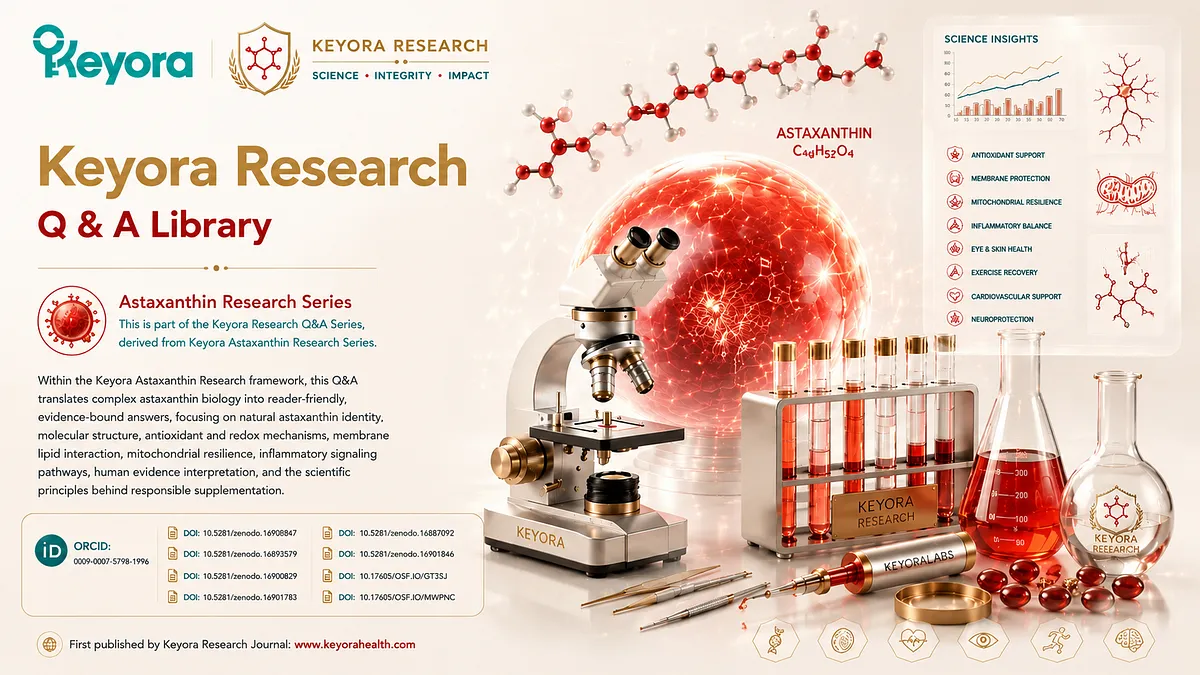
Keyora Research Q&A Library
This is part of the Keyora Research Q&A Series, derived from Keyora Astaxanthin Research Journal Series.
Within the Keyora Astaxanthin Researcn framework, this Q&A translates complex astaxanthin biology into reader-friendly, evidence-bound answers, focusing on natural astaxanthin identity, molecular structure, antioxidant and redox mechanisms, membrane lipid interaction, mitochondrial resilience, inflammatory signaling pathways, human evidence interpretation, and the scientific principles behind responsible supplementation.
First published by Keyora Research Journal: www.keyorahealth.com
Direct Answer
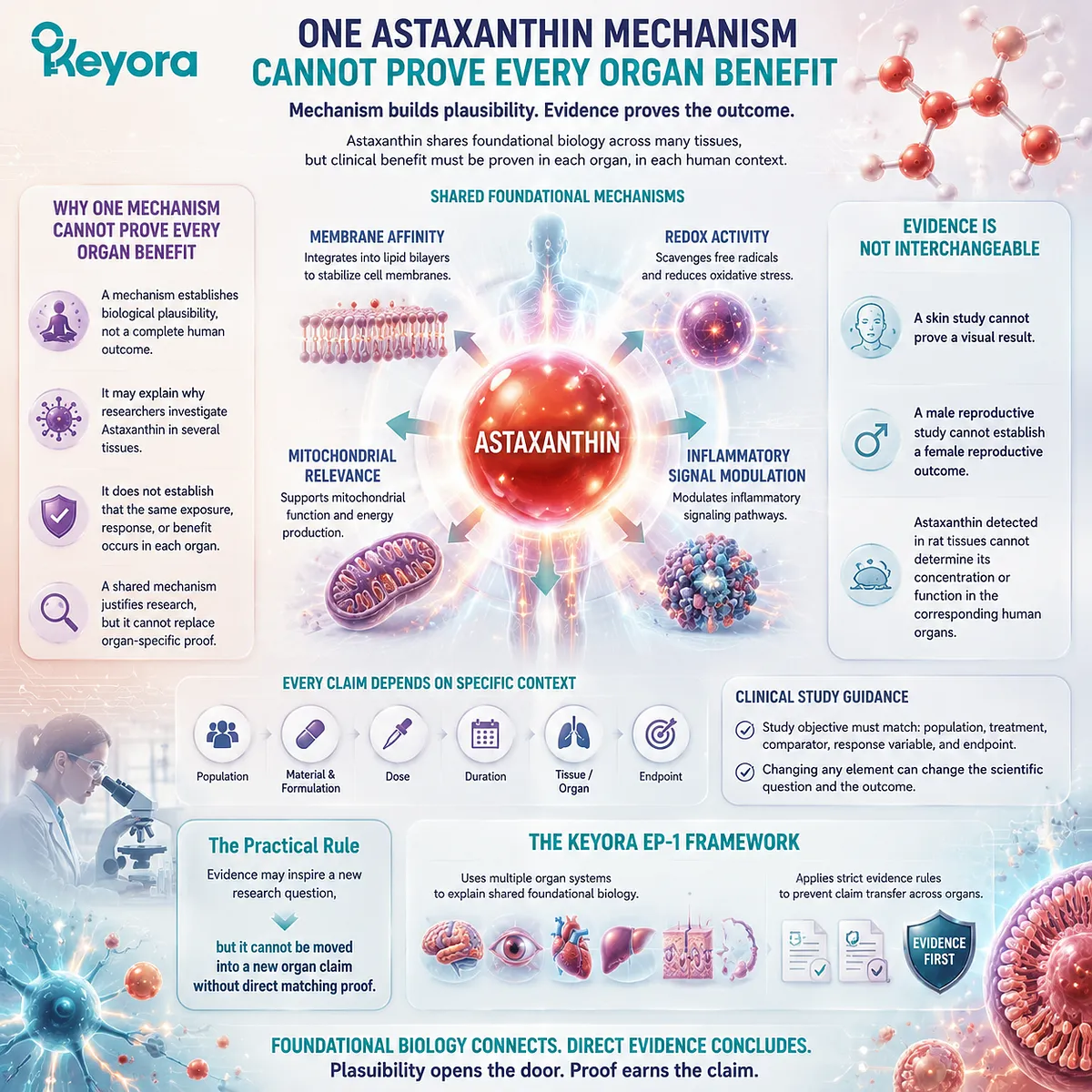
One Astaxanthin mechanism cannot prove every organ benefit because a mechanism establishes biological plausibility, not a complete human outcome.
Membrane affinity, redox activity, mitochondrial relevance, or inflammatory-signaling effects may explain why researchers investigate Astaxanthin in several tissues. They do not establish that the same exposure, response, or benefit occurs in each one.
A shared Astaxanthin mechanism can justify research across several organs, but it cannot replace organ-specific exposure data, matched human endpoints, and direct clinical evidence.
Every claim depends on a particular material, formulation, population, dose, duration, tissue, and endpoint.
A skin study cannot prove a visual result.
A male reproductive study cannot establish a female reproductive outcome.
Astaxanthin detected in rat tissues cannot determine its concentration or function in the corresponding human organs.
Clinical-study guidance reflects the same principle.
A study objective must be connected to a defined population, treatment, comparator, response variable, and endpoint.
Changing any of these elements can change the scientific question being answered.
The practical rule is simple: evidence may inspire a new research question, but it cannot be moved into a new organ claim without direct matching proof.
The Keyora EP-1 framework uses several organ systems to explain shared foundational biology, while its controlling evidence rules prohibit transferring one organ’s clinical conclusion to another.
A Shared Pathway Creates a Hypothesis, Not a Benefit
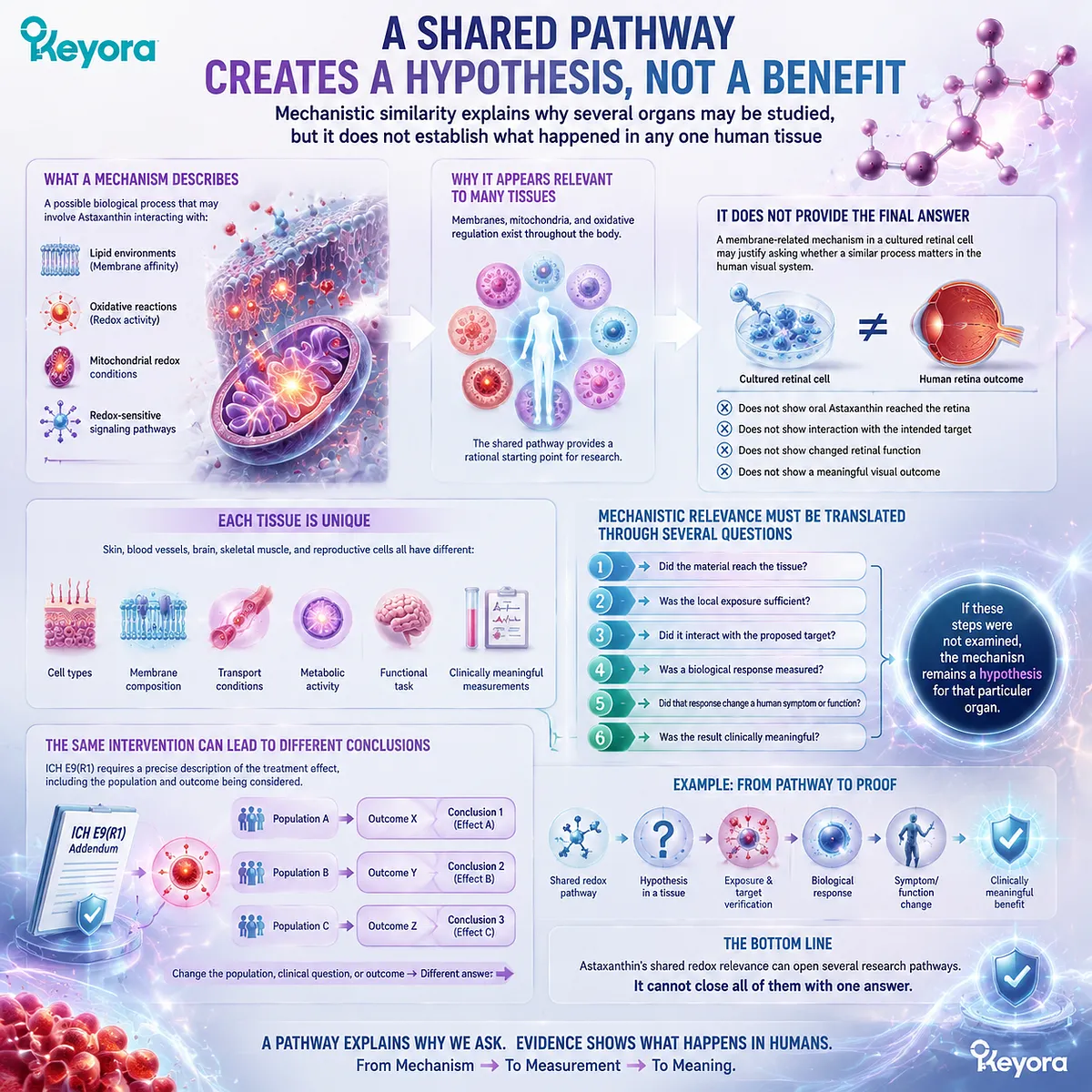
Mechanistic similarity explains why several organs may be studied, but it does not establish what happened in any one human tissue
A mechanism describes a possible biological process. In Astaxanthin research, that process may involve interaction with lipid environments, selected oxidative reactions, mitochondrial redox conditions, or redox-sensitive signaling.
These mechanisms can appear relevant to multiple tissues because membranes, mitochondria, and oxidative regulation exist throughout the body. The shared pathway therefore provides a rational starting point for research.
It does not provide the final answer.
A membrane-related mechanism in a cultured retinal cell may justify asking whether a similar process matters in the human visual system. It does not show that orally consumed Astaxanthin reached the human retina, interacted with the intended target, changed retinal function, or produced a meaningful visual outcome.
The same problem appears when a general mechanism is applied to skin, blood vessels, the brain, skeletal muscle, or reproductive cells. Each tissue has its own cell types, membrane composition, transport conditions, metabolic activity, functional task, and clinically meaningful measurements.
Mechanistic relevance must therefore be translated through several questions:
Did the material reach the tissue?
Was the local exposure sufficient?
Did it interact with the proposed target?
Was a biological response measured?
Did that response change a human symptom or function?
Was the result clinically meaningful?
If those steps were not examined, the mechanism remains a hypothesis for that particular organ.
Clinical-trial methodology also distinguishes the scientific question from the treatment effect actually estimated. ICH E9(R1) requires a precise description of the treatment effect, including the population and outcome being considered. The same intervention can therefore produce different conclusions when the population, clinical question, or outcome changes.
Astaxanthin’s shared redox relevance can open several research pathways. It cannot close all of them with one answer.
Evidence Can Fail When It Moves Between Organs
A result from one tissue cannot fill an evidence gap in another tissue with different cells, exposure, functions, and endpoints
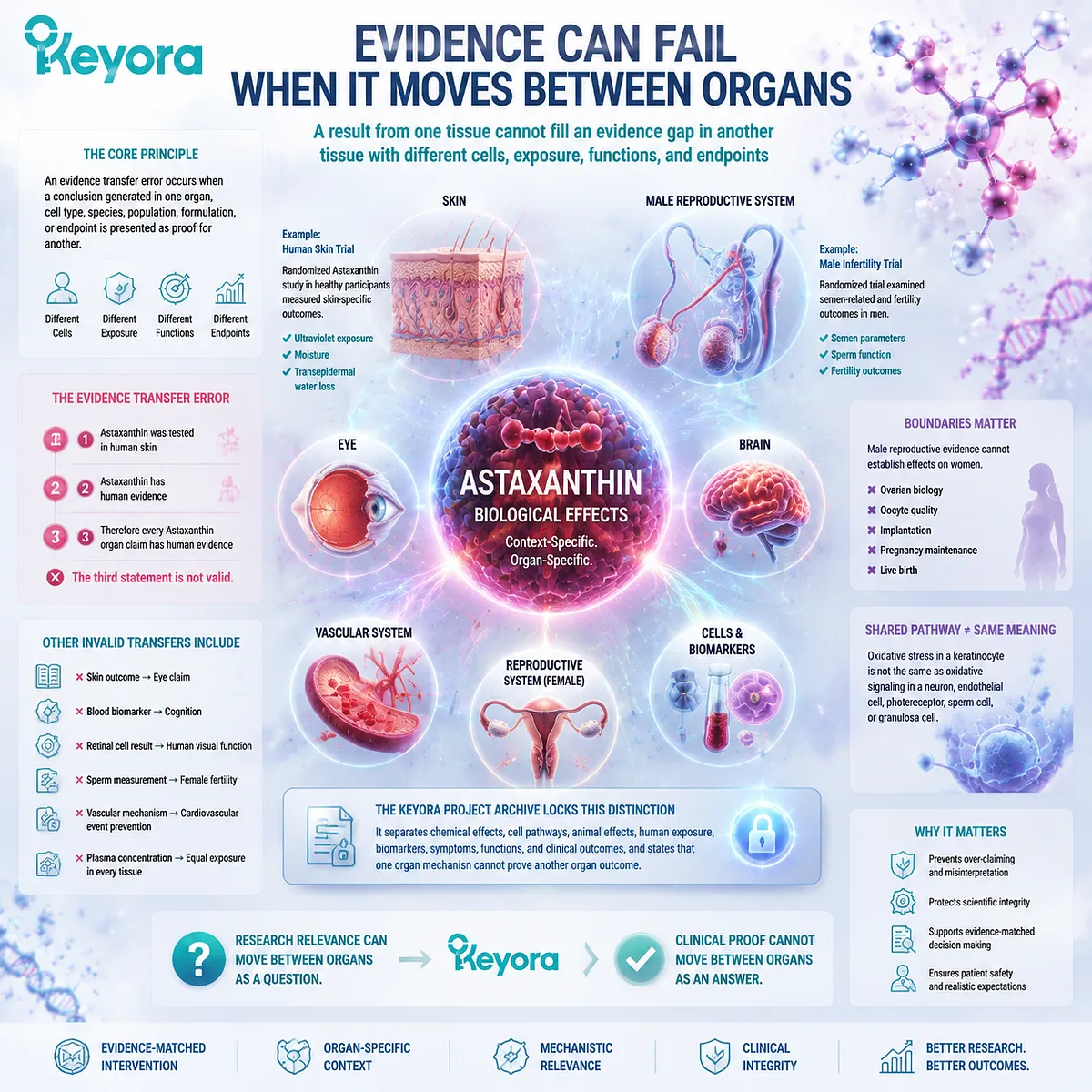
An evidence transfer error occurs when a conclusion generated in one organ, cell type, species, population, formulation, or endpoint is presented as proof for another.
Consider a human skin trial. One randomized Astaxanthin study in healthy participants assessed skin-specific outcomes related to ultraviolet exposure, moisture, and transepidermal water loss. Those measurements can inform a skin question within that study context. They do not measure accommodation, cognitive function, endothelial performance, or reproductive success.
The error would be:
Astaxanthin was tested in human skin
→ Astaxanthin has human evidence
→ therefore every Astaxanthin organ claim has human evidence
The first two statements may be accurate within their limited context. The third is not.
A similar boundary applies to reproductive evidence. A randomized trial involving men with infertility examined a male reproductive context, including semen-related and fertility outcomes. It cannot establish effects on female ovarian biology, oocyte quality, implantation, pregnancy maintenance, or live birth in women.
Sex-specific transfer is only one example. Other invalid transfers include:
-
a skin outcome used to support an eye claim
-
a blood biomarker used to support cognition
-
a retinal cell result used to support human visual function
-
a sperm measurement used to support female fertility
-
a vascular mechanism used to support cardiovascular-event prevention
-
a plasma concentration used to support equal exposure in every tissue
A shared pathway name does not solve these mismatches. Oxidative stress in a keratinocyte does not have the same functional meaning as oxidative signaling in a neuron, endothelial cell, photoreceptor, sperm cell, or granulosa cell.
The Keyora project archive locks this distinction explicitly. It separates chemical effects, cell pathways, animal effects, human exposure, biomarkers, symptoms, functions, and clinical outcomes, and it states that one organ mechanism cannot prove another organ outcome.
Research relevance can move between organs as a question.
Clinical proof cannot move between organs as an answer.
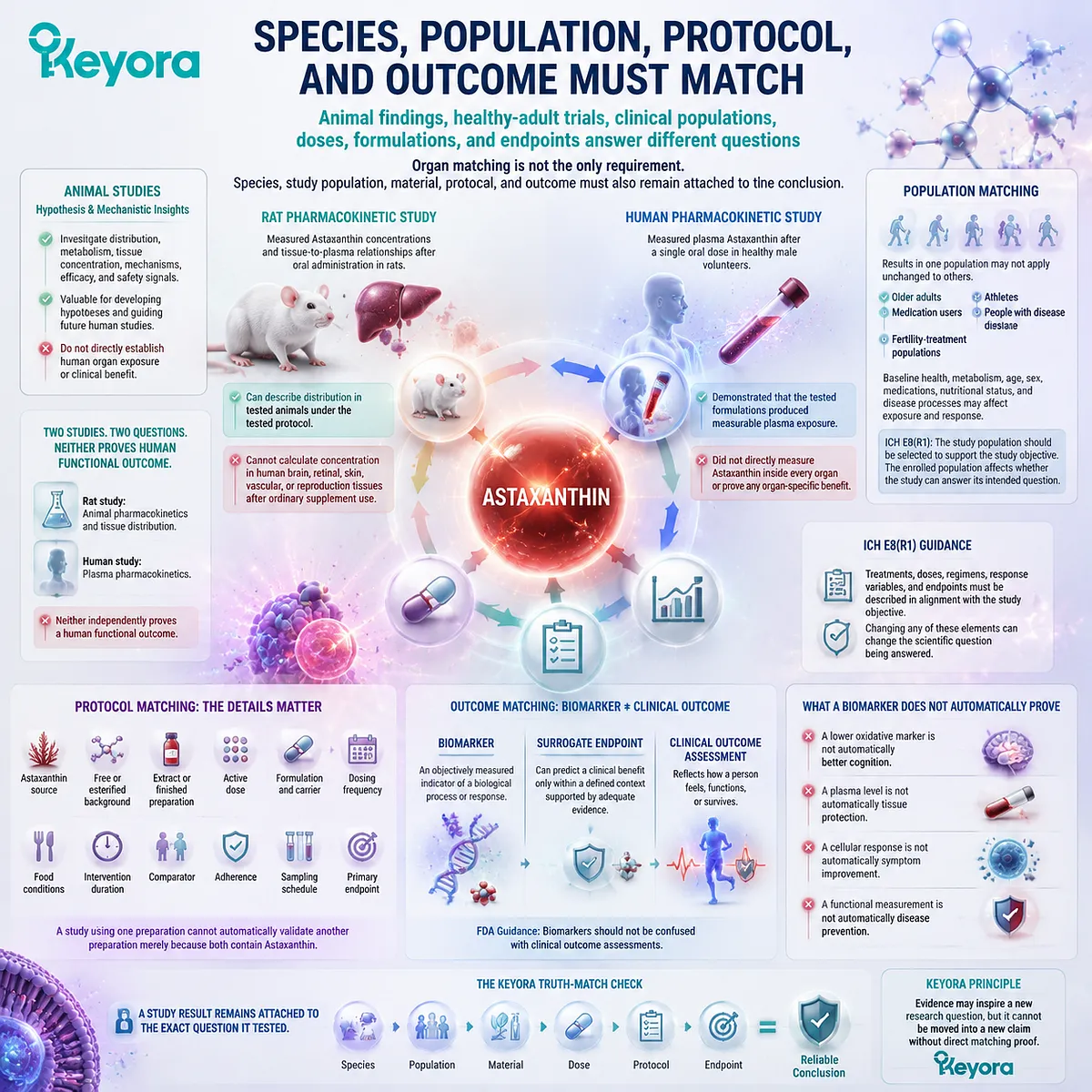
Species, Population, Protocol, and Outcome Must Match
Animal findings, healthy-adult trials, clinical populations, doses, formulations, and endpoints answer different questions
Organ matching is not the only requirement. Species, study population, material, protocol, and outcome must also remain attached to the conclusion.
Animal studies can investigate distribution, metabolism, tissue concentration, mechanisms, experimental efficacy, and safety signals. They are valuable for developing hypotheses and deciding what should be tested next.
They do not directly establish human organ exposure or clinical benefit.
A rat pharmacokinetic study measured Astaxanthin concentrations and tissue-to-plasma relationships after oral administration in rats. That study can describe distribution in the tested animals under the tested protocol. It cannot calculate the concentration in human brain, retinal, skin, vascular, or reproductive tissues after ordinary supplement use.
A human pharmacokinetic study, by contrast, measured plasma Astaxanthin after a single oral dose in healthy male volunteers. It demonstrated that the tested formulations produced measurable plasma exposure. It did not directly measure Astaxanthin inside every organ or prove any organ-specific benefit.
The two studies answer different questions:
The rat study examined animal pharmacokinetics and tissue distribution.
The human study examined plasma pharmacokinetics.
Neither independently proves a human functional outcome.
Population matching is equally important. Results in healthy adults may not apply unchanged to older adults, athletes, medication users, people with diagnosed disease, or fertility-treatment populations. Baseline health, metabolism, age, sex, medications, nutritional status, and disease processes may affect exposure and response.
ICH E8(R1) states that the study population should be selected to support the study objective and that the enrolled population affects whether the study can answer its intended question. The same guidance requires treatments, doses, regimens, response variables, and endpoints to be described in alignment with that objective.
Protocol matching therefore requires attention to:
-
Astaxanthin source and material
-
free or esterified background
-
extract or finished preparation
-
active dose
-
formulation and carrier
-
dosing frequency
-
food conditions
-
intervention duration
-
comparator
-
adherence
-
sampling schedule
-
primary endpoint
A study using one preparation cannot automatically validate another preparation merely because both contain Astaxanthin.
Outcome matching is the final gate. A biomarker is an objectively measured indicator of a biological process or response. A clinical outcome assessment reflects how a person feels, functions, or survives. FDA guidance specifically warns that biomarkers should not be confused with clinical outcome assessments.
A biomarker can sometimes serve as a surrogate endpoint, but only within a defined context supported by adequate evidence that it predicts a particular clinical benefit. It does not become a universal substitute for organ function simply because it is connected to a plausible pathway.
Therefore:
A lower oxidative marker is not automatically better cognition.
A plasma level is not automatically tissue protection.
A cellular response is not automatically symptom improvement.
A functional measurement is not automatically disease prevention.
A study result remains attached to the exact question it tested.
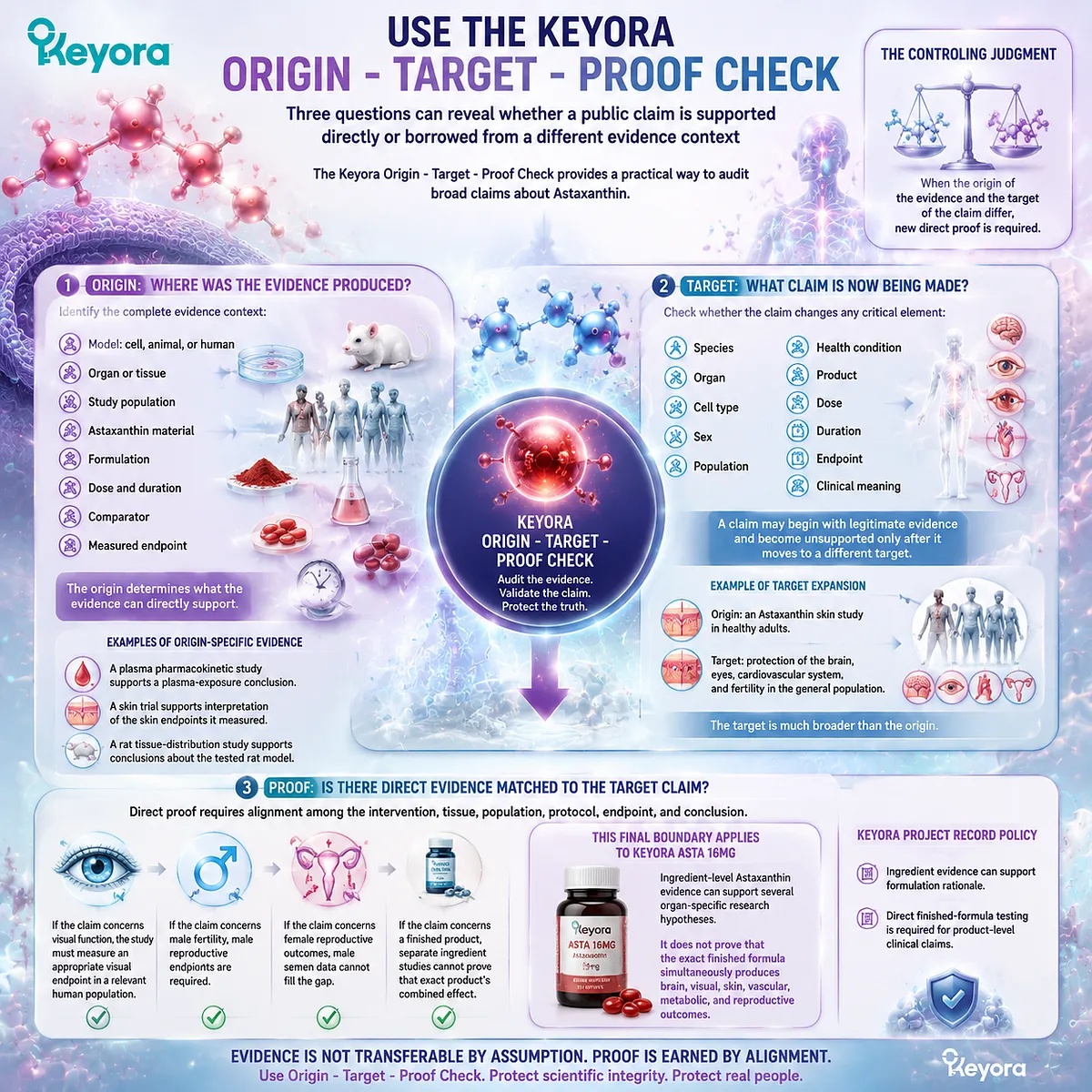
Use the Keyora Origin – Target – Proof Check
Three questions can reveal whether a public claim is supported directly or borrowed from a different evidence context
The Keyora Origin – Target – Proof Check provides a practical way to audit broad claims about Astaxanthin.
Origin: Where was the evidence produced?
Identify the complete evidence context:
-
model, cell, animal, or human
-
organ or tissue
-
study population
-
Astaxanthin material
-
formulation
-
dose and duration
-
comparator
-
measured endpoint
The origin determines what the evidence can directly support.
A plasma pharmacokinetic study supports a plasma-exposure conclusion. A skin trial supports interpretation of the skin endpoints it measured. A rat tissue-distribution study supports conclusions about the tested rat model.
Target: What claim is now being made?
Check whether the claim changes any critical element:
-
species
-
organ
-
cell type
-
sex
-
population
-
health condition
-
product
-
dose
-
duration
-
endpoint
-
clinical meaning
A claim may begin with legitimate evidence and become unsupported only after it moves to a different target.
For example:
Origin: an Astaxanthin skin study in healthy adults.
Target: protection of the brain, eyes, cardiovascular system, and fertility in the general population.
The target is much broader than the origin.
Proof: Is there direct evidence matched to the target claim?
Direct proof requires alignment among the intervention, tissue, population, protocol, endpoint, and conclusion.
If the claim concerns visual function, the study must measure an appropriate visual endpoint in a relevant human population.
If the claim concerns male fertility, male reproductive endpoints are required.
If the claim concerns female reproductive outcomes, male semen data cannot fill the gap.
If the claim concerns a finished product, separate ingredient studies cannot prove that exact product’s combined effect.
This final boundary applies to Keyora Asta 16MG. Ingredient-level Astaxanthin evidence can support several organ-specific research hypotheses. It does not prove that the exact finished formula simultaneously produces brain, visual, skin, vascular, metabolic, and reproductive outcomes.
The Keyora project record permits ingredient evidence to support formulation rationale while requiring direct finished-formula testing for product-level clinical claims.
The controlling judgment is:
When the origin of the evidence and the target of the claim differ, new direct proof is required.
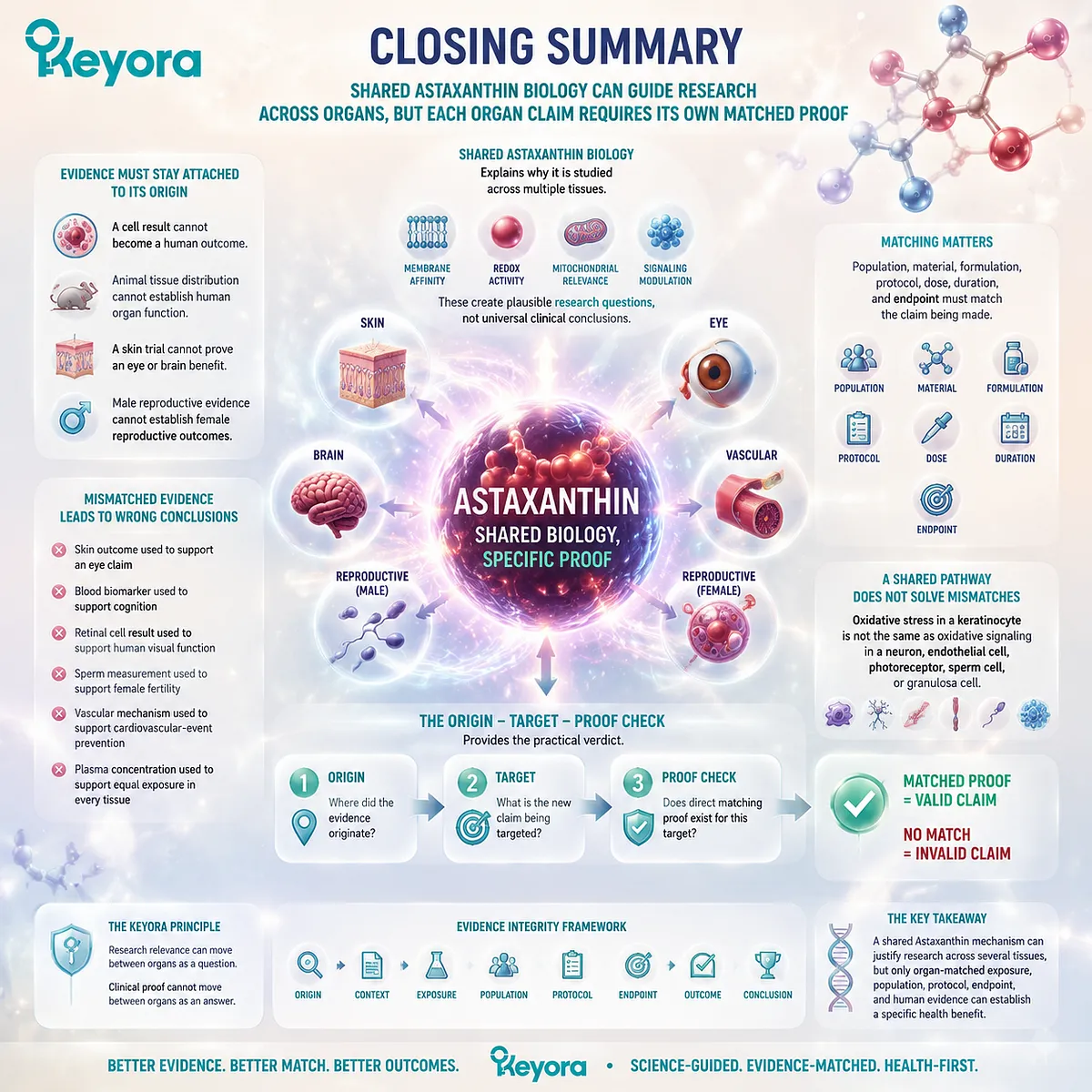
Closing Summary
Shared Astaxanthin biology can guide research across organs, but each organ claim requires its own matched proof
Astaxanthin’s membrane, redox, mitochondrial, and signaling relevance can explain why it is studied across multiple tissues. That shared biology creates plausible research questions, not universal clinical conclusions.
Evidence must remain attached to its origin. A cell result cannot become a human outcome. Animal tissue distribution cannot establish human organ function. A skin trial cannot prove an eye or brain benefit. Male reproductive evidence cannot establish female reproductive outcomes.
Population, material, formulation, protocol, dose, duration, and endpoint must also match the claim being made.
The Origin – Target – Proof Check provides the practical verdict. Identify where the evidence originated, define the new claim being targeted, and determine whether direct matching proof exists.
A shared Astaxanthin mechanism can justify research across several tissues, but only organ-matched exposure, population, protocol, endpoint, and human evidence can establish a specific health benefit.
This article is for educational and informational purposes only. It does not provide medical advice, diagnosis, treatment, cure, prevention, disease outcome claims, hormone restoration claims, fertility outcome claims, or formula-specific clinical efficacy claims.